Write your answer on paper. Then open the answer to check it.
Section A
Diagram 1.1 shows a rod that appears bent in water.
Medium4 marks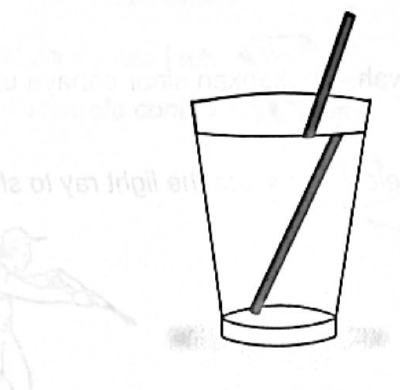
- (a)
Name the light phenomenon involved.
[1] - (b)(i)
Diagram 1.2 shows a man shooting a fish seen in water. However, his shooting does not hit the fish. Give the reason why his shooting does not hit the fish.
[1]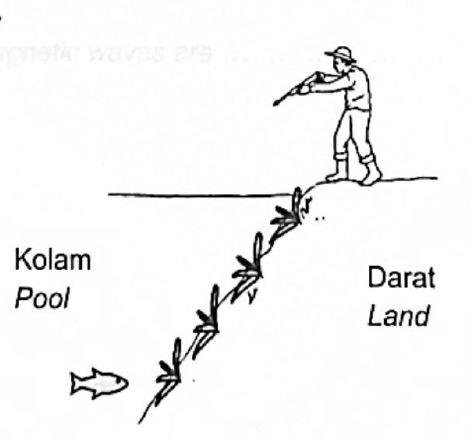
- (b)(ii)
On the diagram, complete the light ray to show the image of the fish.
[2]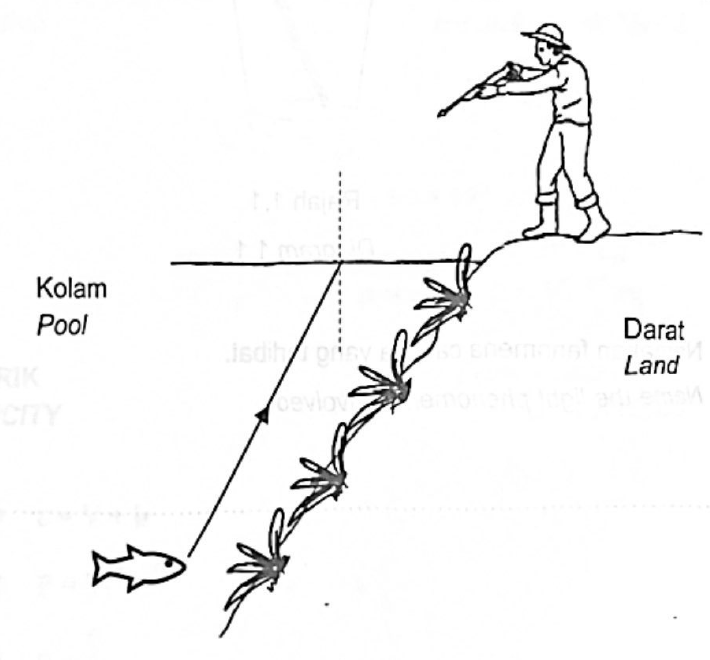
Diagram 2 shows a remote control of a television.
Medium5 marks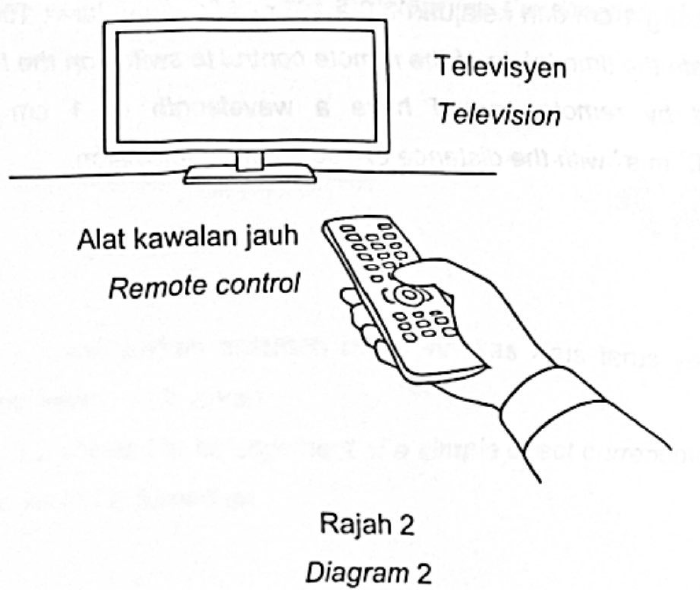
- (a)
State the type of wave used by the remote control.
[1] - (b)
Complete the sentence: The electromagnetic waves are ______ waves.
[1] - (c)
Calculate the time taken for the remote control to switch on the television. The waves emitted have a wavelength of 1 cm and a speed of 3.0 × 10² m s⁻¹ over a distance of 150 cm from the television.
[3]
Diagram 3.1 shows a toy helicopter. The helicopter rotor is connected to a direct current motor.
Medium6 marks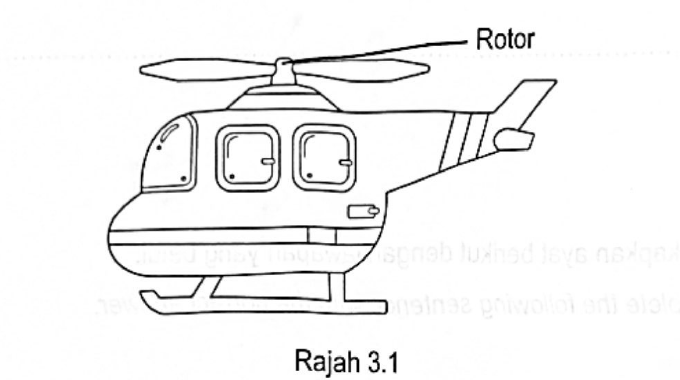
- (a)(i)
Tick (✓) the correct answer. The fan on Diagram 3.1 will rotate in the direction of: anticlockwise only or clockwise only / anticlockwise and clockwise.
[1] - (a)(ii)
Name the physics rule used to determine the direction of fan rotation on the toy car.
[1] - (b)(i)
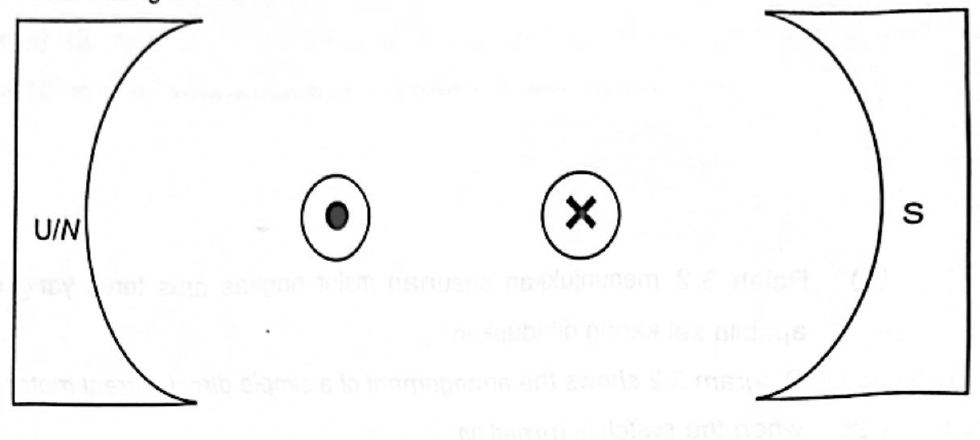
Diagram 3.2 shows the arrangement of a simple direct current motor that rotates the fan when the switch is turned on. Complete Diagram 3.3 to show the resultant magnetic field and the direction of the force acting on the coil.
[2]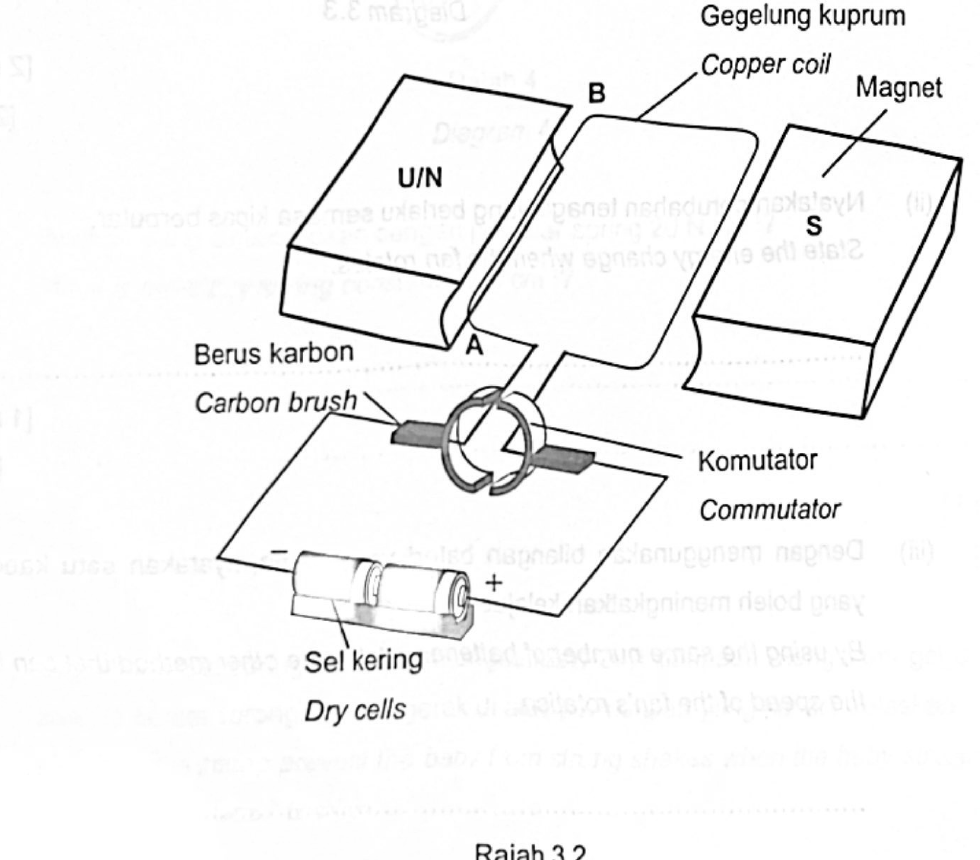
- (b)(ii)
State the energy change when the fan rotates.
[1] - (b)(iii)
By using the same number of batteries, state one other method that can increase the speed of the fan’s rotation.
[1]
Diagram 4 shows 4 identical springs located at the wheels of a baby stroller. The spring constant of the spring is 20 N cm⁻¹.
Medium9 marks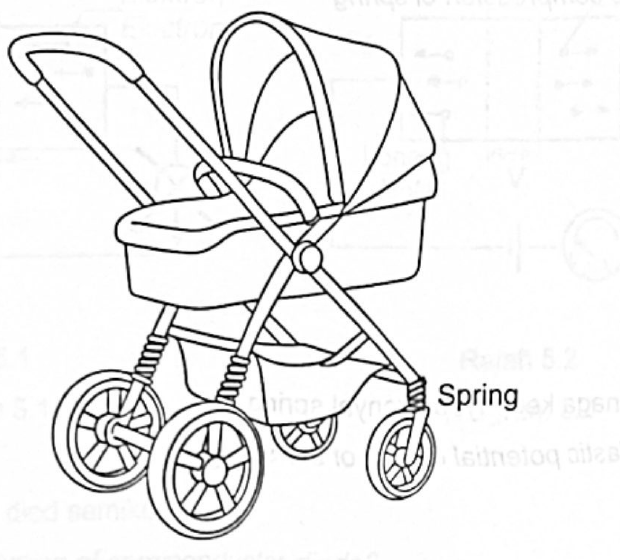
- (a)
What is meant by spring constant 20 N cm⁻¹?
[1] - (b)
How can the spring prevent the baby from strong shakes when the baby stroller moves on a rough surface? Explain.
[2] - (c)(i)
If the weight of the baby is 80 N, calculate the compression of the spring.
[3] - (c)(ii)
If the weight of the baby is 80 N, calculate the elastic potential energy of the spring.
[3]
Diagram 5.1 and Diagram 5.2 show the diode connection in a simple circuit.
Medium9 marks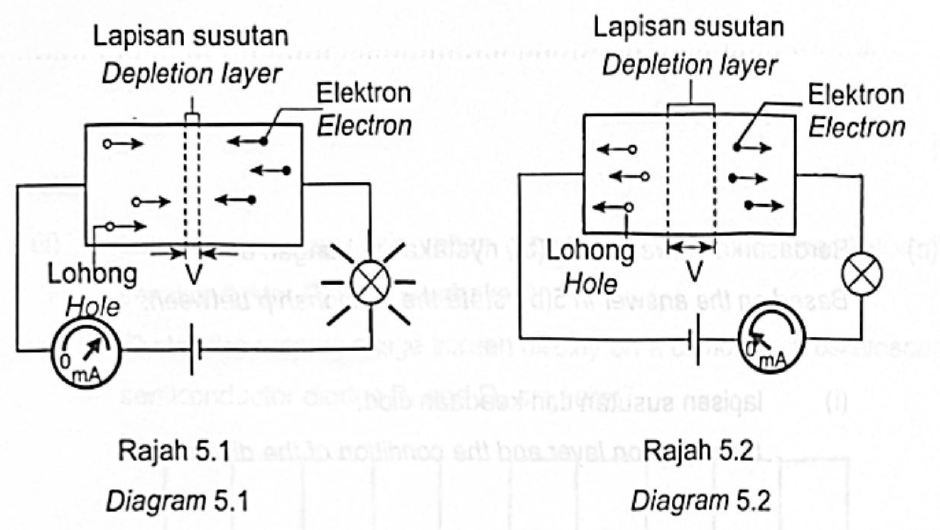
- (a)
What is the function of a semiconductor diode?
[1] - (b)(i)
Based on Diagram 5.1 and Diagram 5.2, compare the depletion layer.
[1] - (b)(ii)
Based on Diagram 5.1 and Diagram 5.2, compare the condition of the diode.
[1] - (b)(iii)
Based on Diagram 5.1 and Diagram 5.2, compare the condition of the bulb.
[1] - (c)(i)
Based on the answer in 5(b), state the relationship between the depletion layer and the condition of the diode.
[1] - (c)(ii)
Based on the answer in 5(b), state the relationship between the depletion layer, the junction voltage and the current.
[1] - (d)(i)
Diagram 5.3 shows a circuit using four semiconductor diodes. What is the type of rectification used?
[1]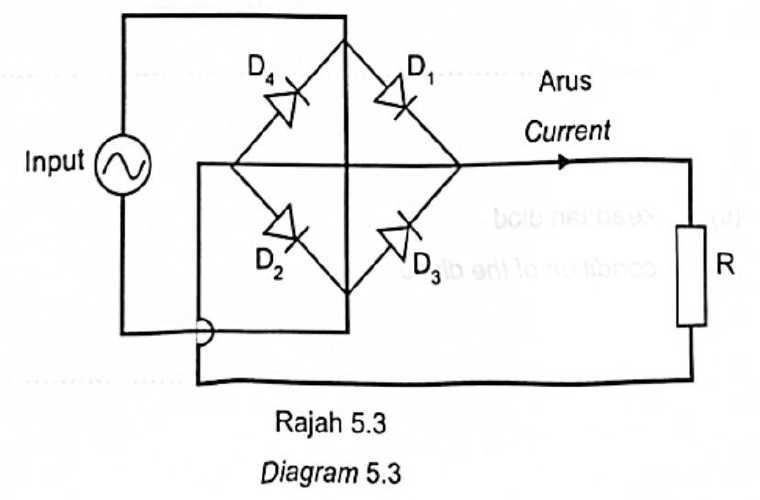
- (d)(ii)
Sketch the output voltage display on a cathode ray oscilloscope if the semiconductor diodes D₁ and D₂ are burnt.
[2]
Diagram 6.1 shows a steel ball with a mass of 0.1 kg and a feather with a mass of 0.01 kg dropped in air.
Medium9 marks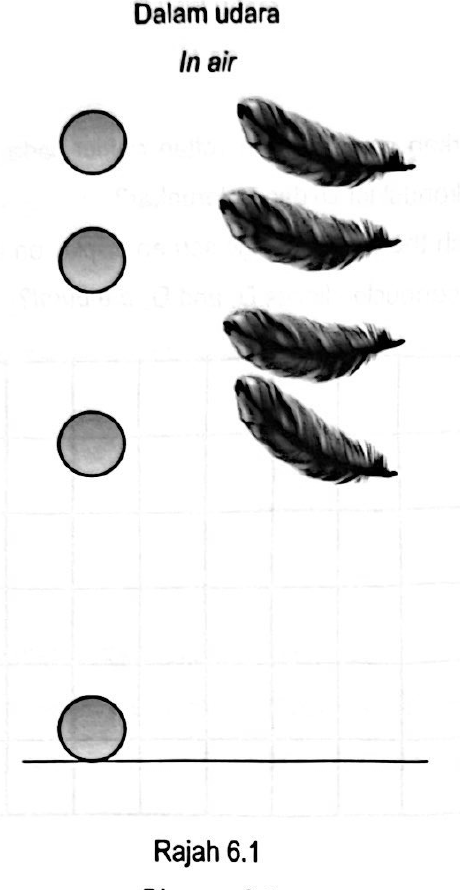
- (a)
Name one physical quantity which causes the feather and ball to fall.
[1] - (b)(i)
Diagram 6.2 shows the same steel ball and feather dropped from the same height in vacuum. Based on Diagram 6.1 and Diagram 6.2, state the forces acting on objects in air.
[2]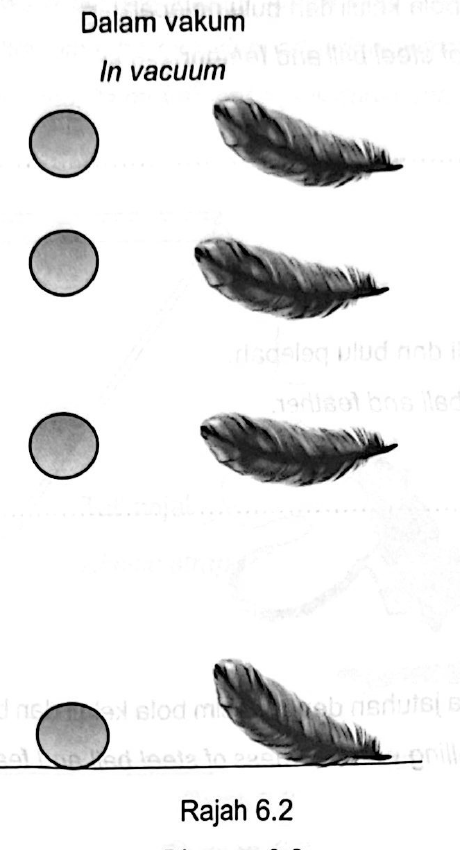
- (b)(ii)
State the force acting on objects in vacuum.
[1] - (c)(i)
Based on Diagram 6.2, compare the time of falling of the steel ball and the feather.
[1] - (c)(ii)
Based on Diagram 6.2, compare the mass of the steel ball and the feather.
[1] - (d)
Relate the time of falling with the mass of the steel ball and feather in vacuum.
[1] - (e)
Diagram 6.3 shows a bungee jumper jumping from a platform with a height of 50 m. At the beginning of the jump, the jumper accelerates downward. When the elastic strap becomes strained, the movement slows down and eventually bounces upwards. What causes the jumper to stop accelerating downward? Explain.
[2]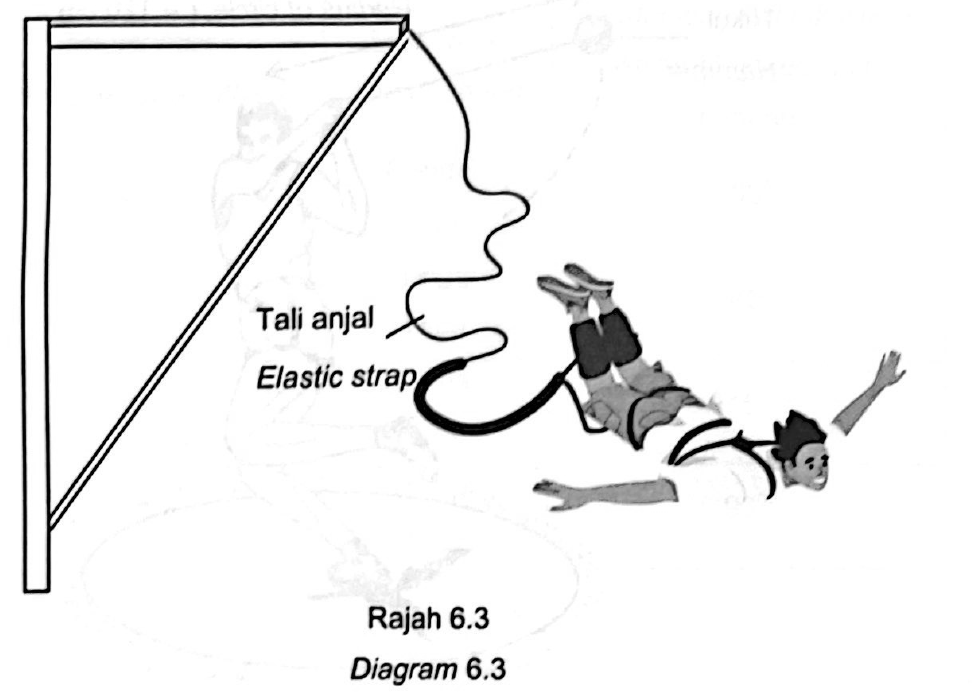
Diagram 7 shows an athlete in a hammer throw rotating a hammer of mass 6.0 kg in a circle before releasing it. The linear speed of the hammer is 20 m s⁻¹ and the radius of the circle is r = 120 cm.
Medium9 marks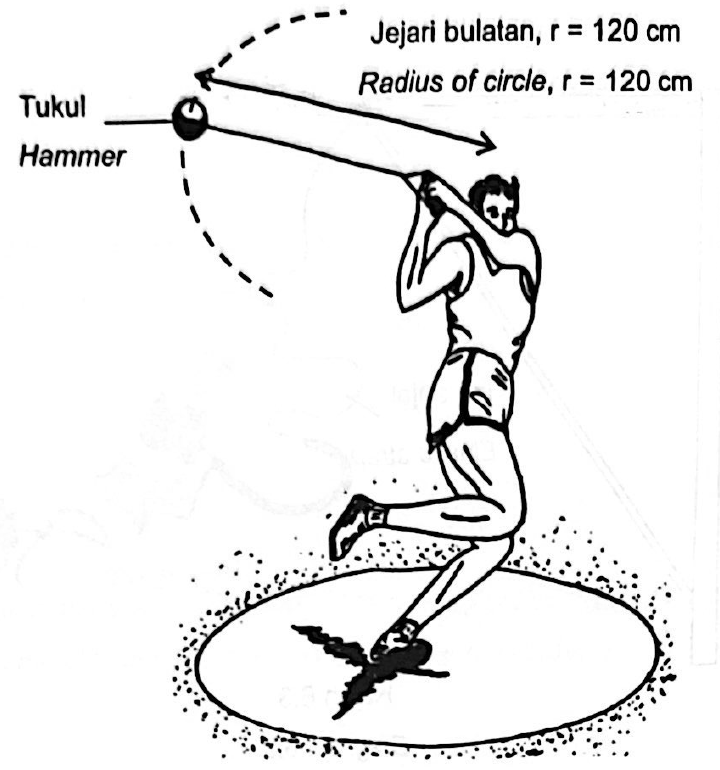
- (a)
Draw and label the direction of the linear speed, v of the hammer after releasing it in Diagram 7.
[1] - (b)
Calculate the centripetal force of the hammer.
[3] - (c)(i)
Table 1 shows techniques of athletes P, Q, R and S (P: low speed, 90°; Q: high speed, 45°; R: low speed, 45°; S: high speed, 90°). Based on Table 1, state the suitable linear speed of the hammer and give one reason.
[2]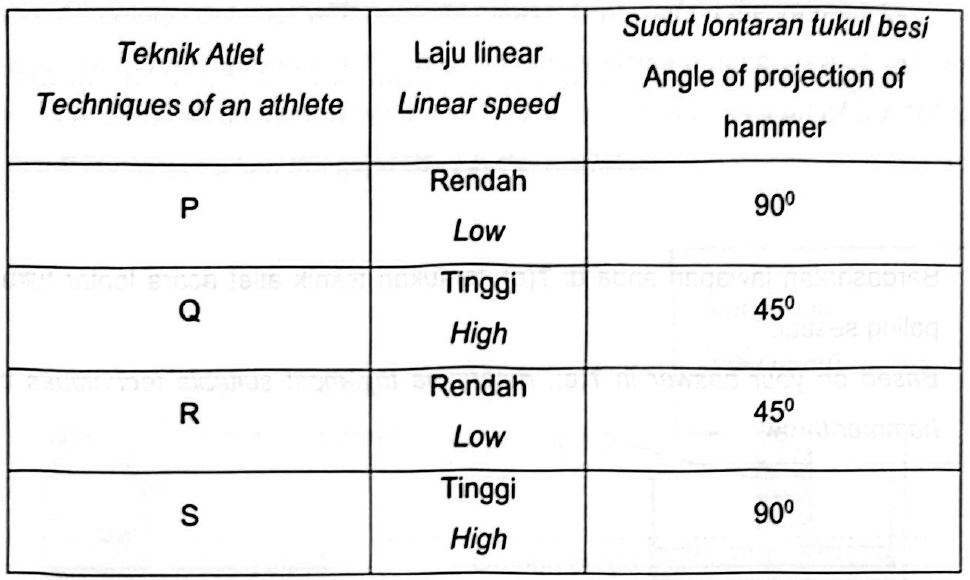
- (c)(ii)
Based on Table 1, state the suitable angle of projection of the hammer and give one reason.
[2] - (d)
Based on your answer in 7(c), determine the most suitable technique of the athlete in hammer throw.
[1]
Diagram 8 shows a spring placed between a rigid beam and the output piston of a hydraulic system. An empty container with negligible mass is placed on the input piston. The input piston has an area of A and the output piston has an area of 18A. Initially, the spring is at its original length with a spring constant of 3 × 10⁴ N m⁻¹. The spring compresses when sand is poured into the container.
Hard9 marks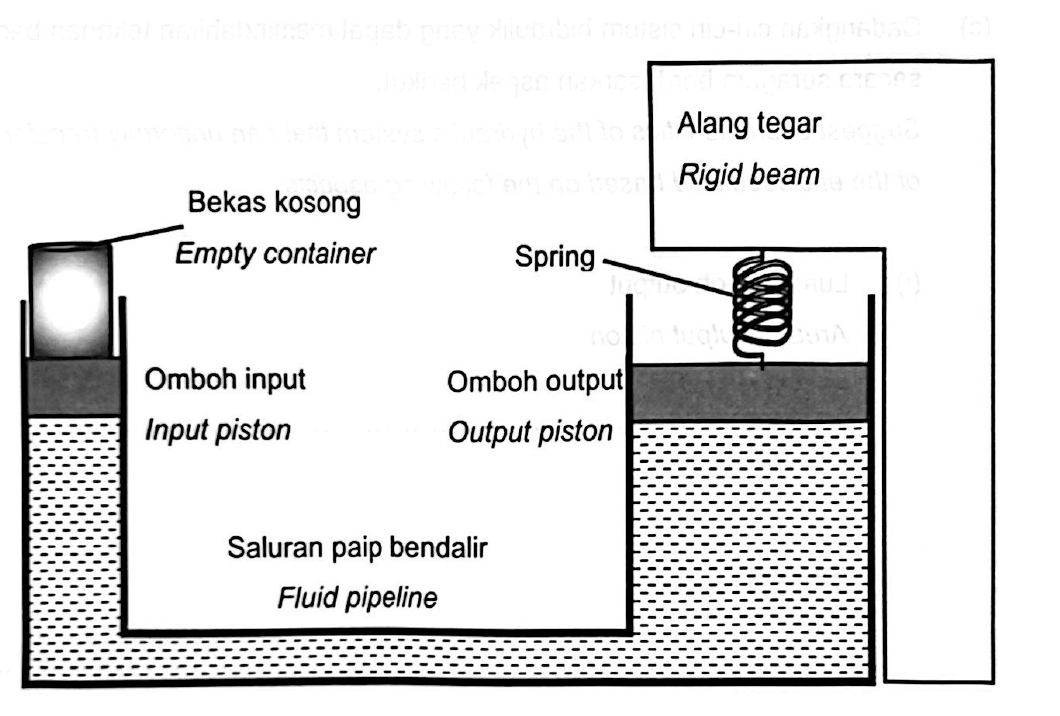
- (a)
State the principle that allows pressure to be transmitted from the input piston to the output piston.
[1] - (b)
Calculate the weight of sand that must be poured into the container to compress the spring by 0.05 m.
[2] - (c)(i)
Suggest the area of the output piston so the hydraulic system can uniformly transfer the pressure of the enclosed fluid. Give a reason.
[2] - (c)(ii)
Suggest the strength of the fluid pipeline. Give a reason.
[2] - (c)(iii)
Suggest the type of fluid. Give a reason.
[2]
Section B
Diagram 9.1 shows the cross-section of a pressure cooker which can cook food in a shorter time.
Medium20 marks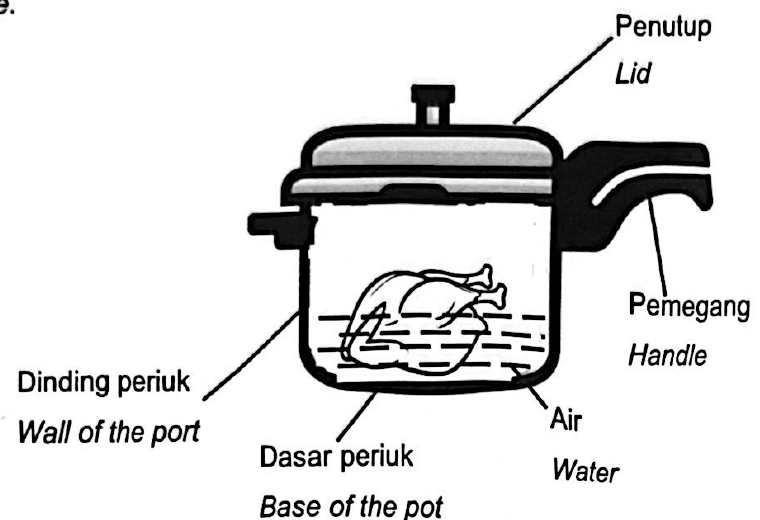
- (a)
Name the gas law involved in this pressure cooker.
[1] - (b)
Using the kinetic theory of gas, explain how the pressure of the air in the pressure cooker increases when the temperature increases.
[4] - (c)
Table 2 shows the characteristics of pressure cookers P, Q, R and S (P: copper base, steel handle, high wall thickness, no valve; Q: iron base, plastic handle, low thickness, has valve; R: copper base, plastic handle, high thickness, has valve; S: iron base, steel handle, low thickness, no valve). Explain the suitability of each characteristic. Determine the suitable pressure cooker which can cook food in a shorter time.
[10]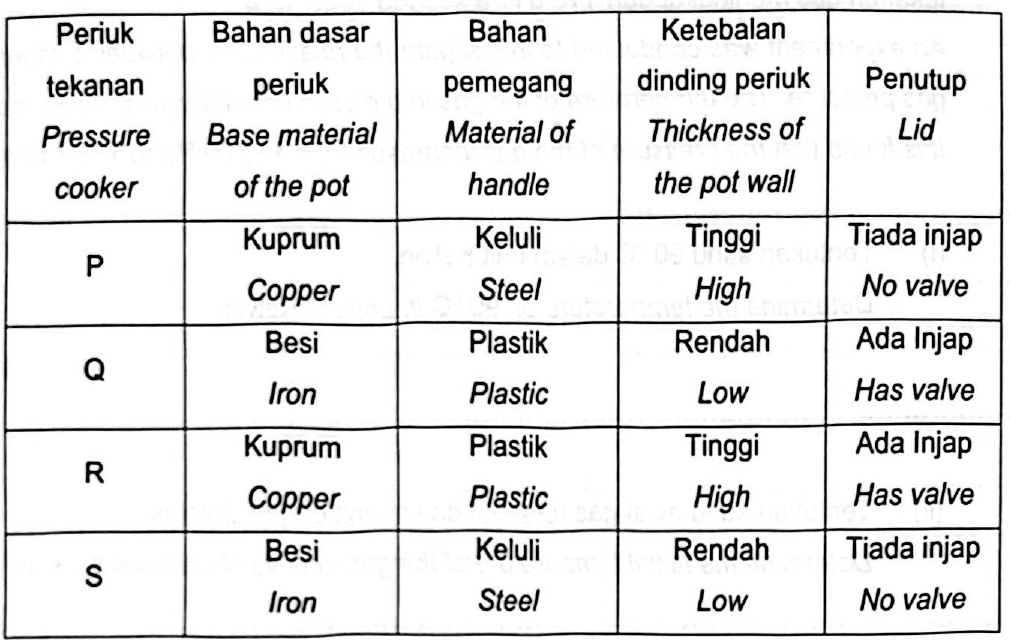
- (d)(i)
An experiment investigates the relationship between temperature and gas pressure. The temperature of the gas in a closed container is increased to 90 °C. The pressure of the gas increases from 110.0 kPa to 132.7 kPa. Determine the temperature of 90 °C in units of Kelvin.
[2] - (d)(ii)
Determine the initial temperature of the gas in units of degrees Celsius.
[3]
Diagram 10.1 shows a light beam being directed to a photocell.
Hard20 marks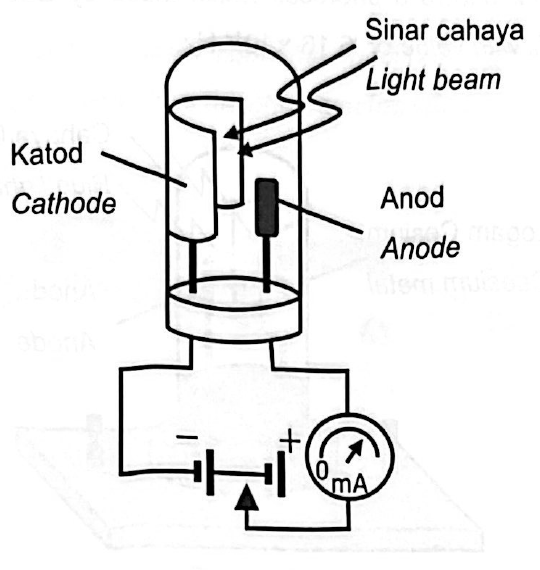
- (a)
What is meant by threshold frequency?
[1] - (b)
Based on Diagram 10.1, explain how light shone onto a photocell is able to deflect the milliammeter pointer.
[4] - (c)(i)
Diagram 10.2 shows a photocell made of caesium metal with threshold frequency f₀ = 5.16 × 10¹⁴ Hz. The metal is illuminated with blue light of wavelength λ = 4.6 × 10⁻⁷ m. Calculate the photon energy of the blue light.
[2]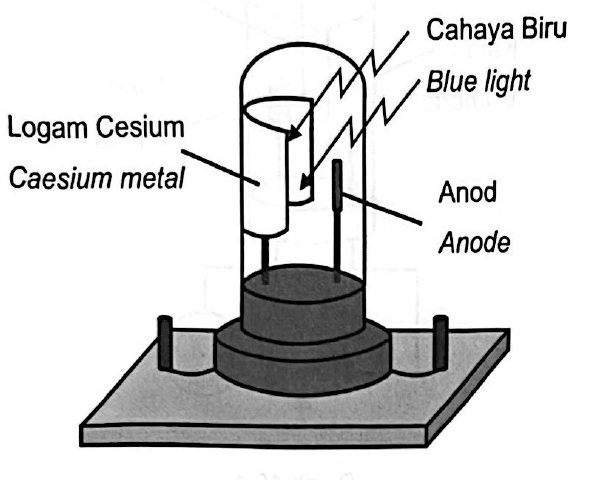
- (c)(ii)
Calculate the work function of caesium metal.
[2] - (c)(iii)
Calculate the maximum kinetic energy of the emitted photoelectron.
[1] - (d)
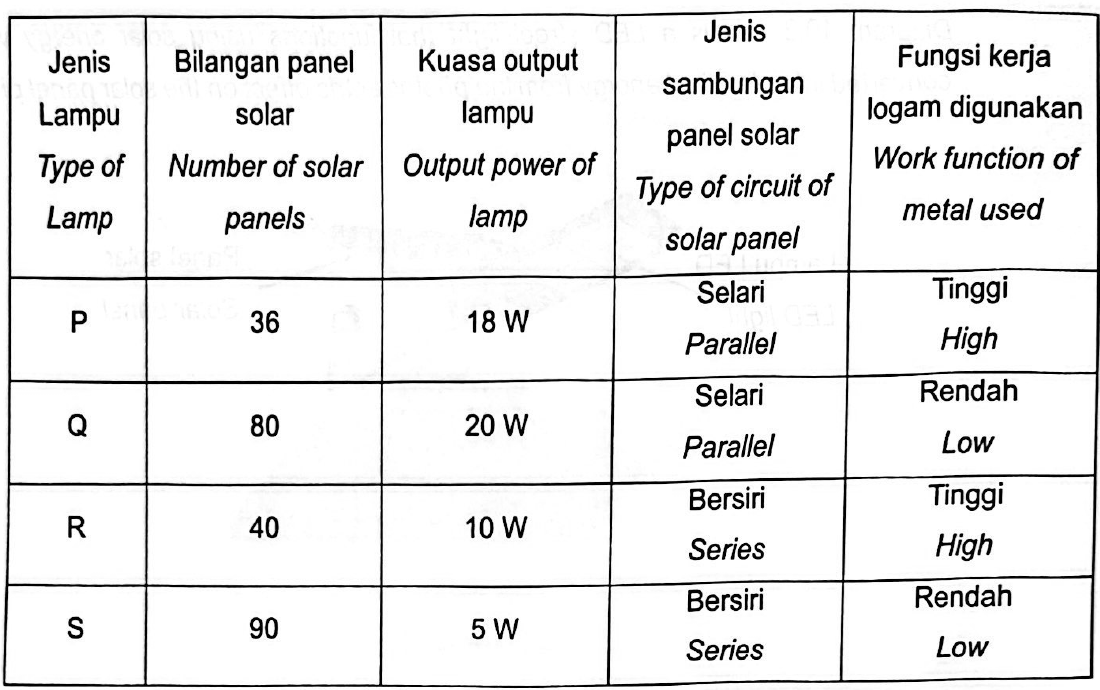
Diagram 10.3 shows an LED street light powered by solar energy converted to electrical energy by the photoelectric effect on the solar panel photocell. Table 3 shows four specifications of solar panels for lamps P, Q, R and S (P: 36 panels, 18 W, parallel, high work function; Q: 80 panels, 20 W, parallel, low work function; R: 40 panels, 10 W, series, high work function; S: 90 panels, 5 W, series, low work function). Study all the specifications and determine the most suitable lamp as a more effective street lamp. Give reasons for your choice.
[10]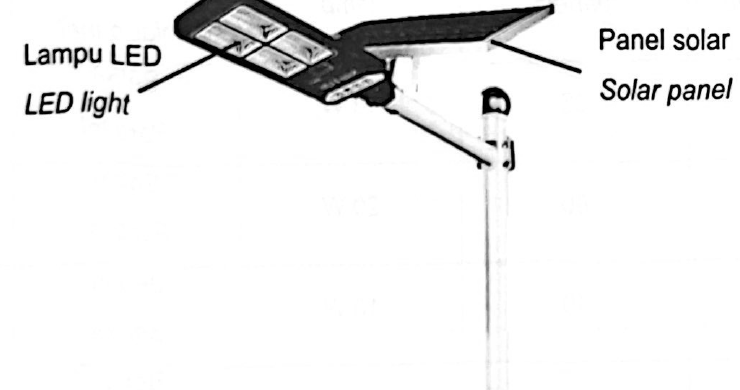
Section C
Diagram 11.1 shows a circuit containing six similar dry cells with an electromotive force of 1.5 V each. Diagram 11.2 shows a circuit containing one dry cell with an electromotive force of 9 V. Both circuits are connected to a similar bulb.
Medium20 marks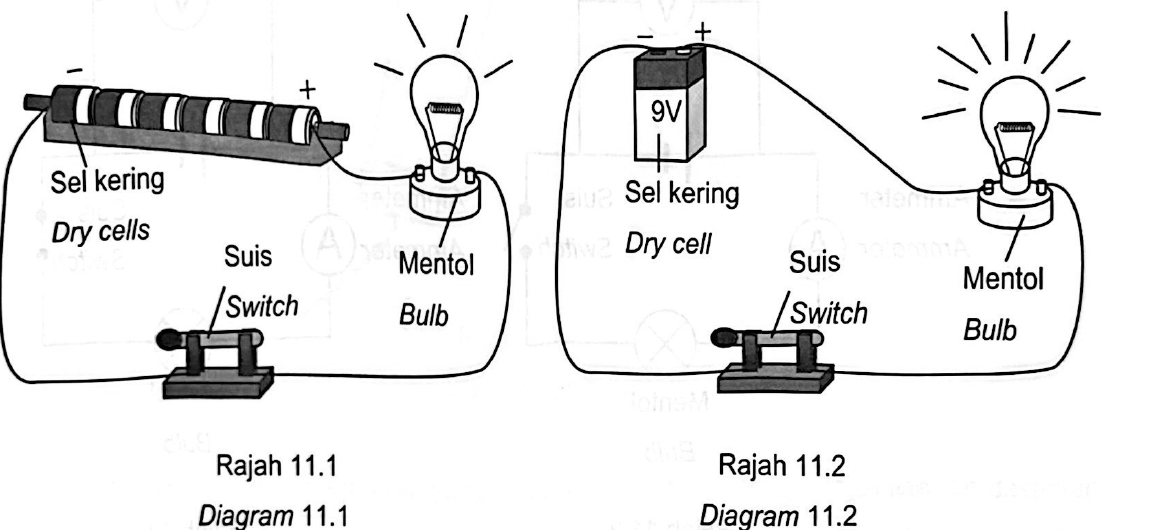
- (a)
What is the meaning of 9 V electromotive force?
[1] - (b)
Based on Diagram 11.1 and Diagram 11.2, compare the electromotive force, the bulb brightness and the total internal resistance of the dry cells. Relate the amount of current flow to the bulb brightness to make a deduction about the relationship between the current and the total internal resistance of the dry cells.
[5] - (c)
Diagram 11.3 shows the circuit with no current flowing (open circuit). Diagram 11.4 shows the circuit with current flowing (closed circuit). The voltmeter readings are 1.5 V and 1.3 V respectively. Explain the difference in the voltmeter readings by relating it to the internal resistance of the dry cell.
[4]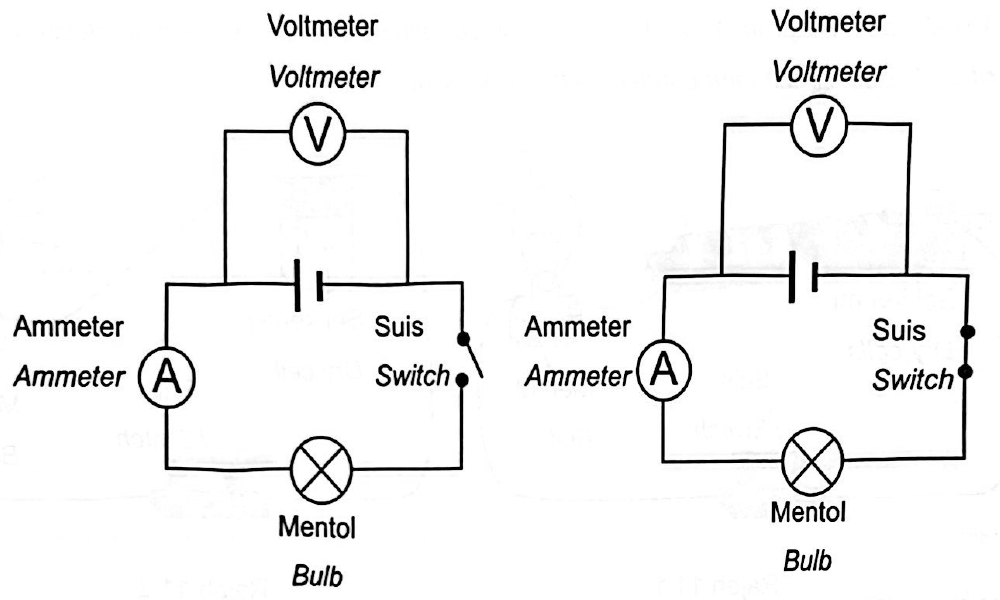
- (d)
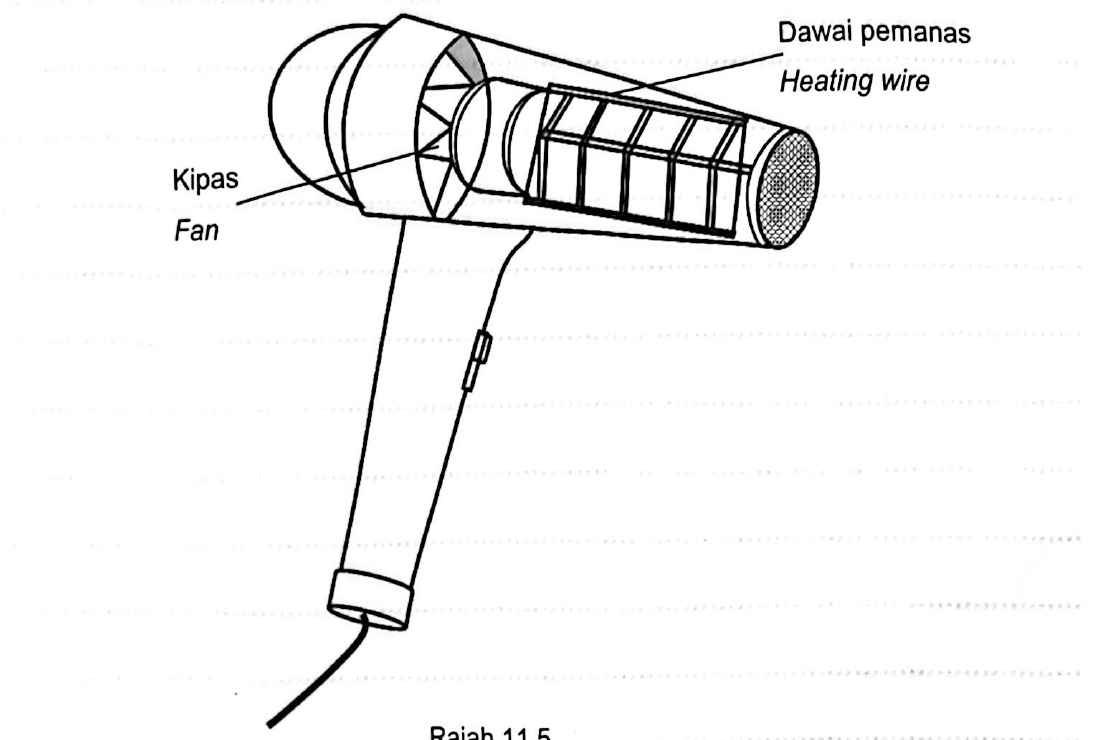
Diagram 11.5 shows the structure of a hair dryer. Using appropriate physics concepts, describe the modifications based on the structure of the fan and the characteristics of the heating wire on the hair dryer to dry hair quickly and safely.
[10]