Write your answer on paper. Then open the answer to check it.
Section A
Diagram 1.1 shows an electronic circuit used to convert alternating current to direct current.
Medium4 marks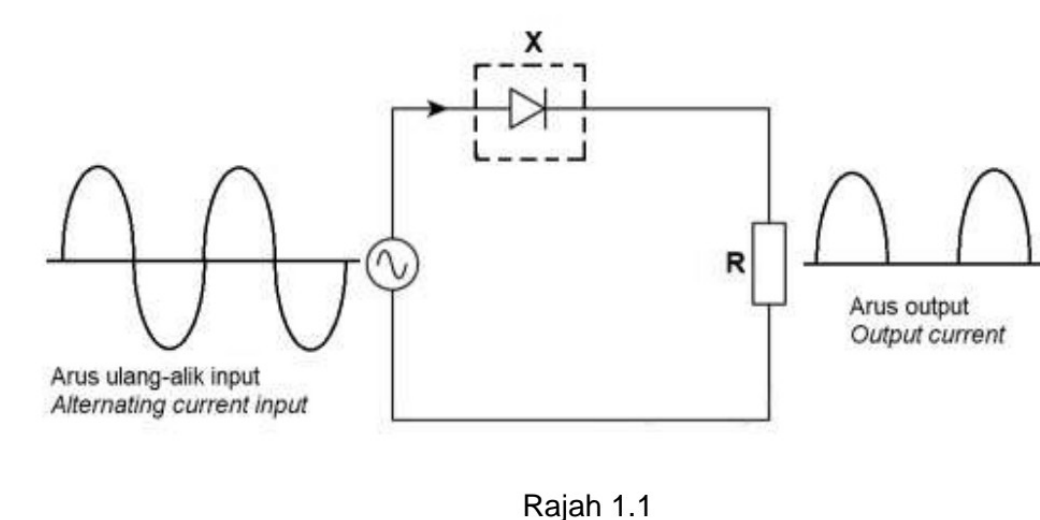
- (a)
What is the name of the electronic component in box X?
[1] - (b)
The process of converting alternating current to direct current is known as
[1] - (c)(i)
A capacitor, C is placed in parallel with a resistor, R as in Diagram 1.2. What changes occur to the shape of the output wave produced?
[1]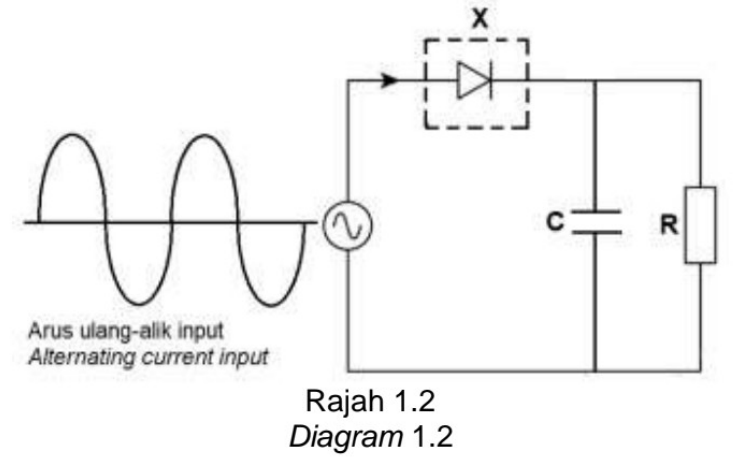
- (c)(ii)
Give one reason for the answer in 1(c)(i).
[1]
Diagram 2 shows a durian hanging from a pair of ropes (T1 and T2, each at 30° to the vertical) that are in a state of force equilibrium. The weight of the durian is W.
Medium5 marks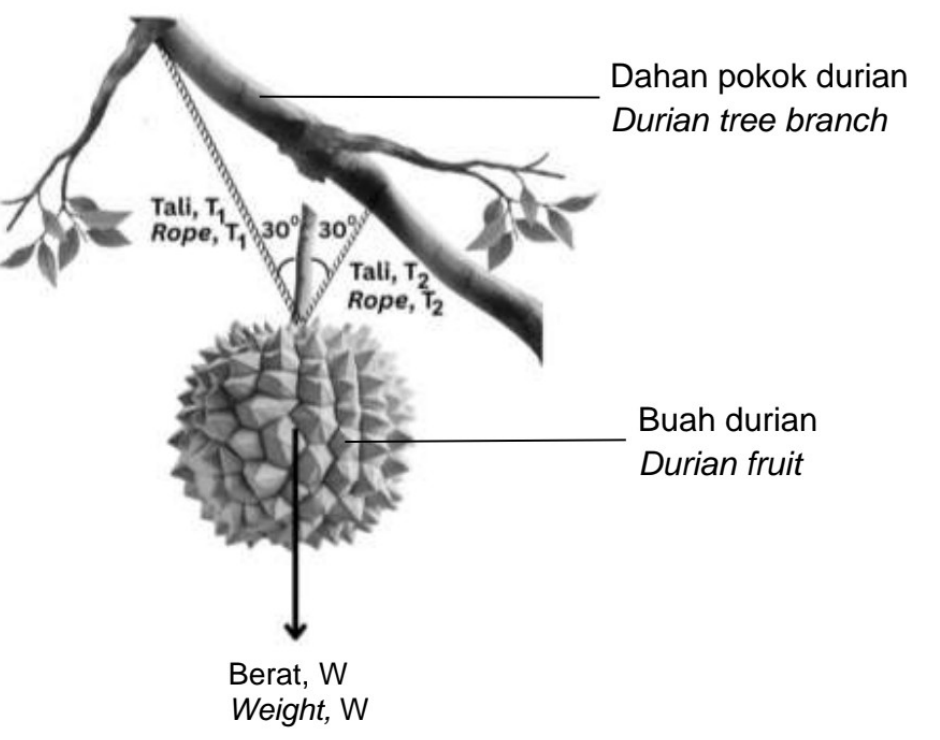
- (a)
State the meaning of force equilibrium.
[1] - (b)
Based on your knowledge of the concept of force, draw a force triangle to show why the durian is still hanging and not falling.
[2] - (c)(i)
If the rope labelled T1 snapped, what happens to the tension of the rope labelled T2 that is still holding the durian?
[1] - (c)(ii)
State one equation that relates the tension of the rope, T2 to weight, W.
[1]
Diagram 3 shows part of the ray diagram of a concave lens with a focal length of 10 cm. The object is placed between F and 2F on the object side.
Medium6 marks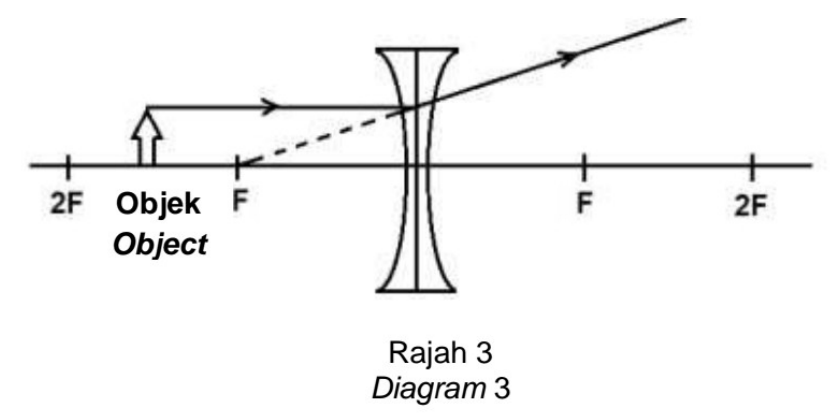
- (a)
State the light phenomenon involved in Diagram 3.
[1] - (b)
Complete Diagram 3 by drawing another one ray of light to show the intersection of the rays for image formation.
[1] - (c)
If the object is at a distance of 15 cm in front of the concave lens, calculate the distance of the image formed.
[2] - (d)(i)
The concave lens in Diagram 3 is replaced by a thicker concave lens. State the change in the focal length of the lens.
[1] - (d)(ii)
State the change in the distance of the image formed if the object remains in the same position.
[1]
Diagram 4.1 shows an instrument which is used to measure the atmospheric pressure (mercury column h = 76 cm above the mercury surface in the dish, vacuum above the column).
Medium9 marks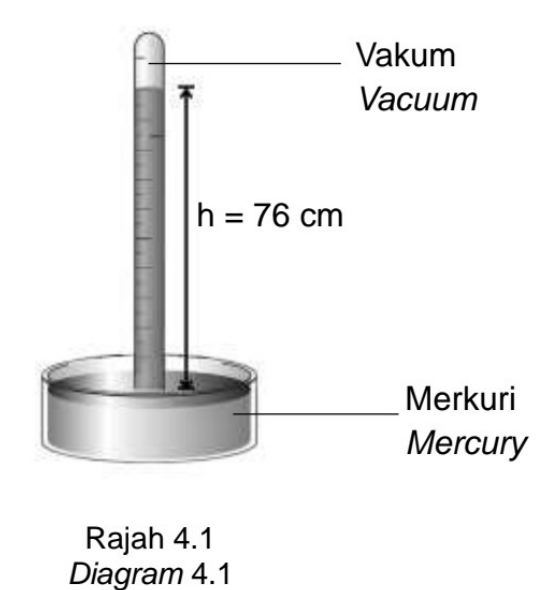
- (a)
Name the instrument shown in Diagram 4.1.
[1] - (b)
State one reason why mercury is used in the instrument.
[1] - (c)(i)
If the instrument is at the top of a mountain, state the changes to the height of the mercury column, h.
[1] - (c)(ii)
Give the reason for the answer in 4(c)(i).
[1] - (d)(i)
Diagram 4.2 shows an instrument used to measure atmospheric pressure in an inclined position. Given the atmospheric pressure is 76 cm Hg (density of mercury = 1.36 × 10⁴ kg m⁻³). In Diagram 4.2, label with the symbol R the area that has zero pressure.
[1]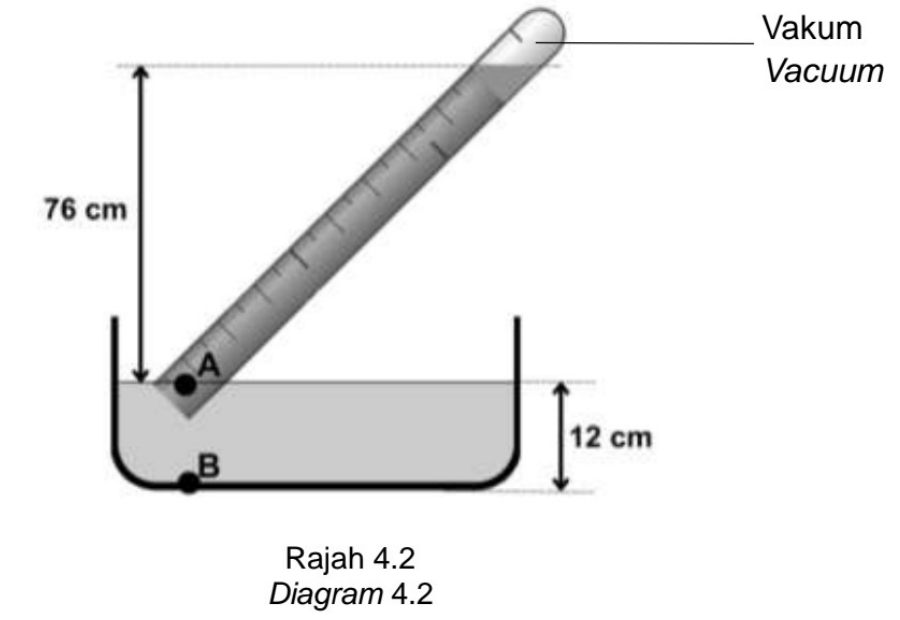
- (d)(ii)
Calculate the pressure at A in units of Pa.
[2] - (d)(iii)
Calculate the pressure at B in units of Pa.
[2]
Diagram 5.1 shows a side view of a ripple tank used in the laboratory to study the relationship between depth and speed of water wave. A perspex with different thicknesses is placed in the ripple tank (Region P is deeper, Region Q is shallower).
Medium9 marks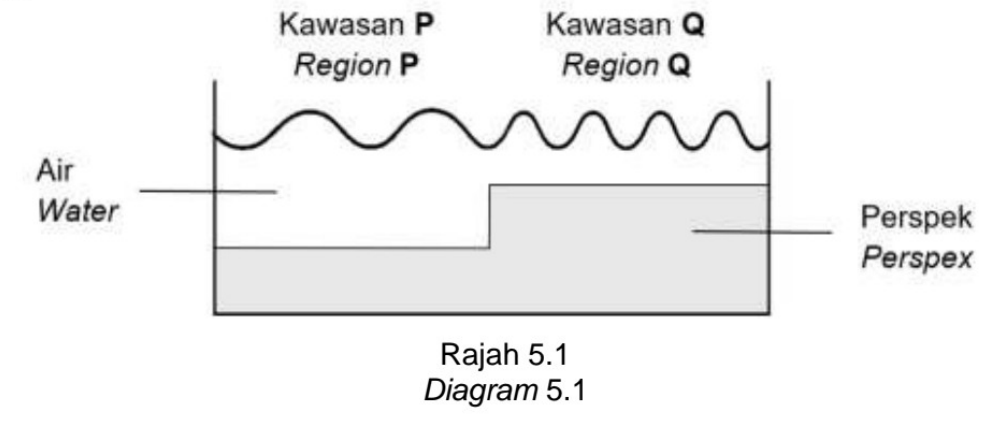
- (a)
State the wave phenomenon involved.
[1] - (b)(i)
Compare region P and region Q in terms of depth of water.
[1] - (b)(ii)
Compare region P and region Q in terms of wavelength.
[1] - (b)(iii)
Compare region P and region Q in terms of speed of water wave.
[1] - (c)(i)
Based on the answer in 5(b), deduce the relationship between the depth of water and the wavelength.
[1] - (c)(ii)
Deduce the relationship between the wavelength and the speed of water wave.
[1] - (d)
State the physical quantity that is kept constant when the water waves propagate in region P or region Q.
[1] - (e)
In shallow water region, the wavelength and wave speed are 1.5 cm and 6 cm s⁻¹ respectively. When the wave enters the deep water region, its speed increases to 9 cm s⁻¹. Calculate the wavelength in the deep water region.
[2]
Diagram 6.1 and Diagram 6.2 show the curve graphs of the half-lives of radioactive Xenon-133 and radioactive Iodine-131 respectively (activity in counts per minute against time in minutes; both start at 2000 counts per minute).
Medium9 marks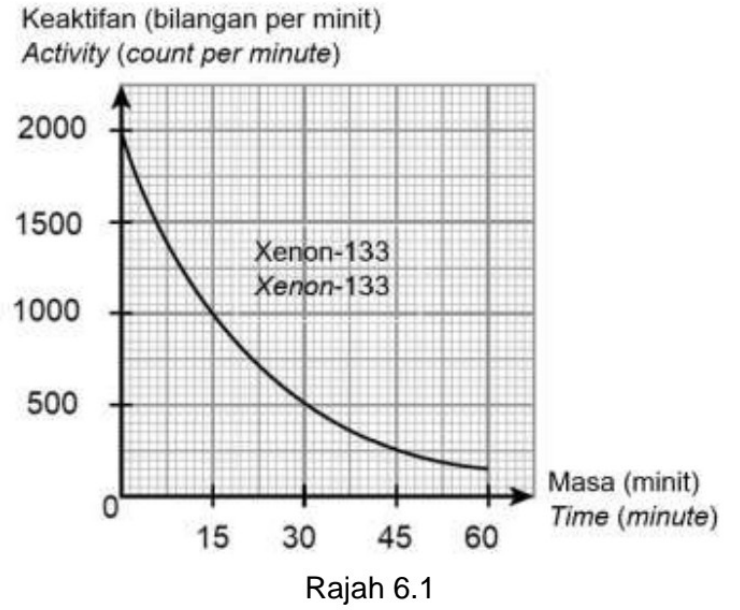
- (a)
State the meaning of half-life.
[1] - (b)(i)
Compare the activity of original nuclei (Diagram 6.1 and 6.2).
[1] - (b)(ii)
Compare the half-life.
[1] - (b)(iii)
Compare the decay rate.
[1] - (c)
Based on your answer in 6(b), deduce the relationship between half-life and decay rate.
[1] - (d)(i)
Based on Diagram 6.2, determine the half-life of radioactive Iodine-131. Show on the graph how you determine the half-life.
[2]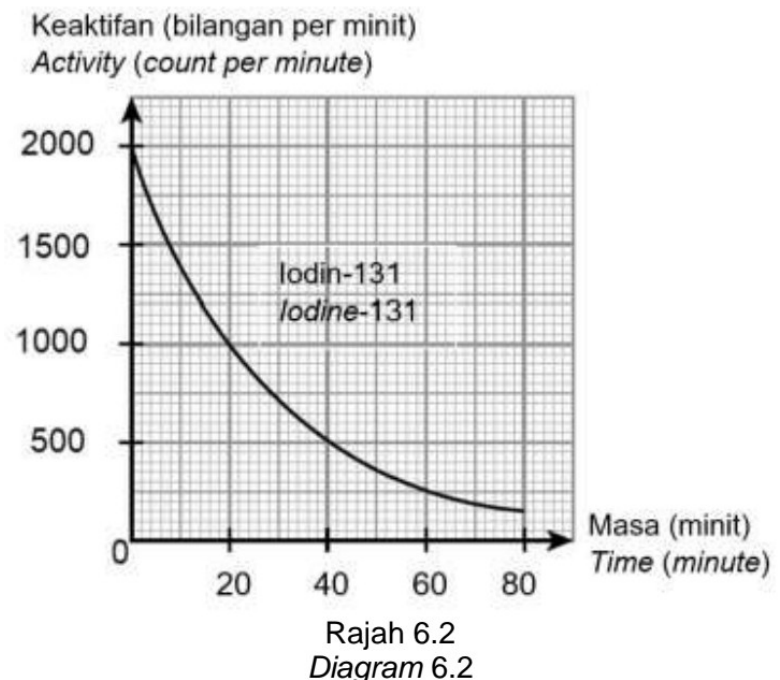
- (d)(ii)
Determine the activity of radioactive Iodine-131 after three half-lives.
[2]
Diagram 7.1 shows an arrangement of the apparatus to determine the specific heat capacity of aluminium block (immersion heater, thermometer, power supply, felt cloth, polystyrene plate, oil in hole).
Medium9 marks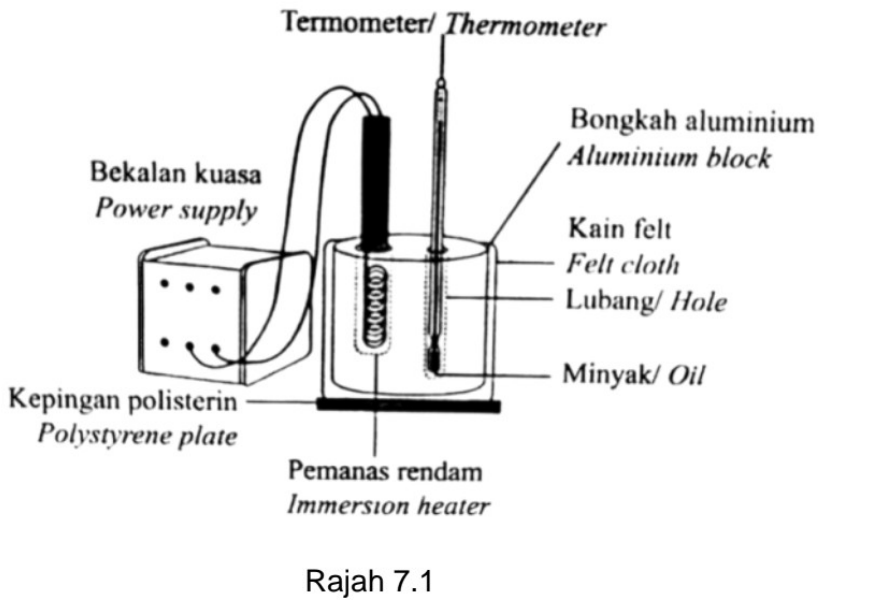
- (a)
State the meaning of specific heat capacity.
[1] - (b)(i)
The aluminium block of mass 1 kg is being heated by using electric heater of power 50 W for 5 minutes. The rise of temperature for aluminium block in Diagram 7.1 is 16 °C. Calculate the specific heat capacity for the aluminium block in Diagram 7.1.
[2] - (b)(ii)
State one assumption for the calculation in 7(b)(i).
[1] - (c)(i)
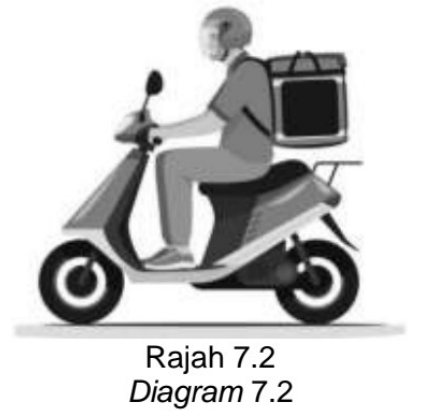
Diagram 7.2 shows a food delivery service. The hot food ordered by the customer will be kept inside a food bag and be delivered in the shortest time. Based on Table 7, state the characteristics of food bag so that it can be used to keep the food warm in a long time. Give reasons for the suitability of each characteristic. Specific heat capacity of food bag (Table 7: bag T 1770 J kg⁻¹ °C⁻¹, shiny surface; bag U 925, shiny surface; bag V 1140, dark surface). Give reason.
[2]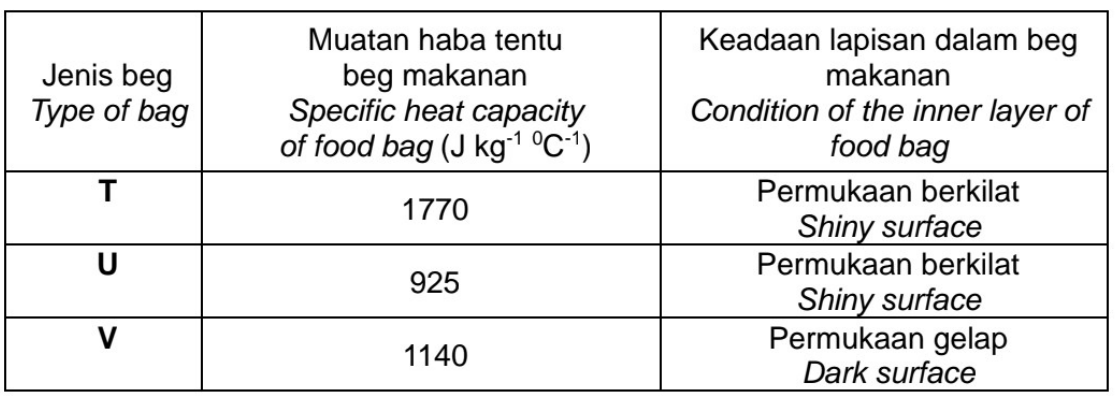
- (c)(ii)
Condition of the inner layer of food bag. Give reason.
[2] - (c)(iii)
Based on the answers in 7(c), choose the most suitable type of food bag.
[1]
Diagram 8 shows an electric grill and its specifications used in a food stall: Fuse 13 A; Power rating 240 V, 3000 W.
Medium9 marks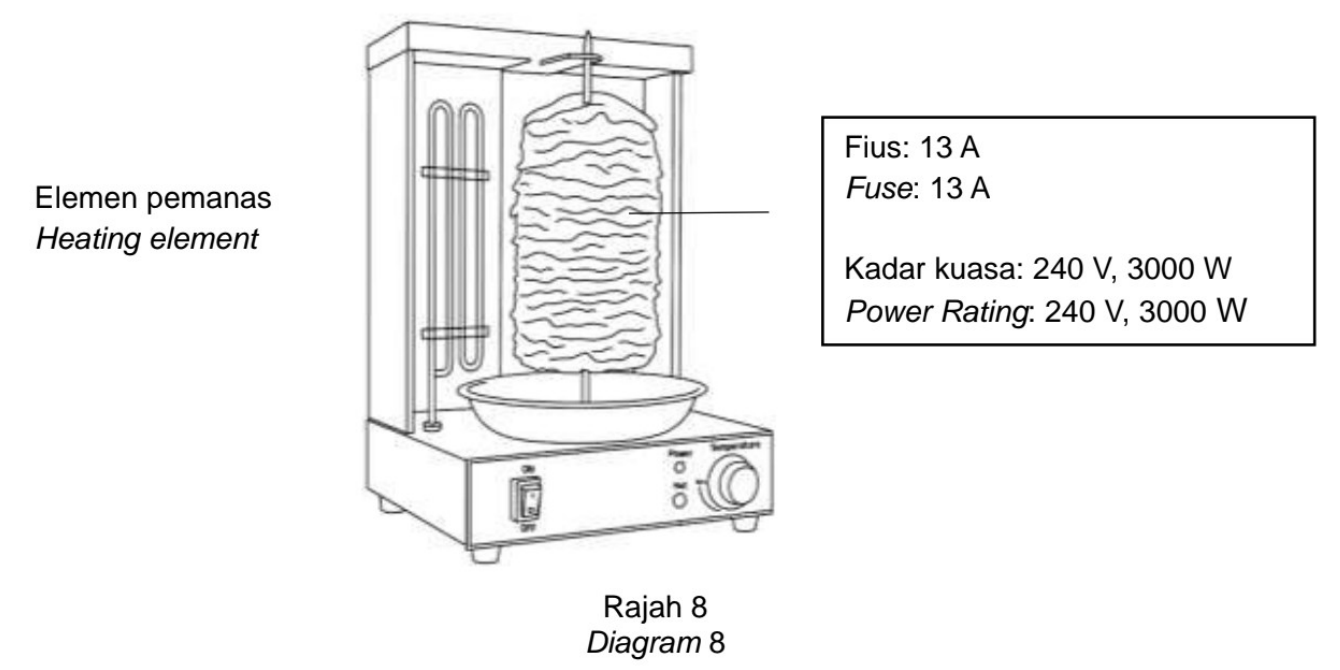
- (a)
State the meaning of power, P = 3000 W.
[1] - (b)
Calculate current flows in the electric grill.
[2] - (c)(i)
Suggest the characteristics of a heating element that can be used to grill meat quickly and safely: type of heating element. Give reason.
[2] - (c)(ii)
Resistivity of the heating element. Give reason.
[2] - (c)(iii)
Melting point of heating element. Give reason.
[2]
Section B
Diagram 9.1 shows the Moon and a satellite orbiting the Earth (orbital radius of satellite rs, of Moon rm). Section B: answer one question (Q9 or Q10).
Medium20 marks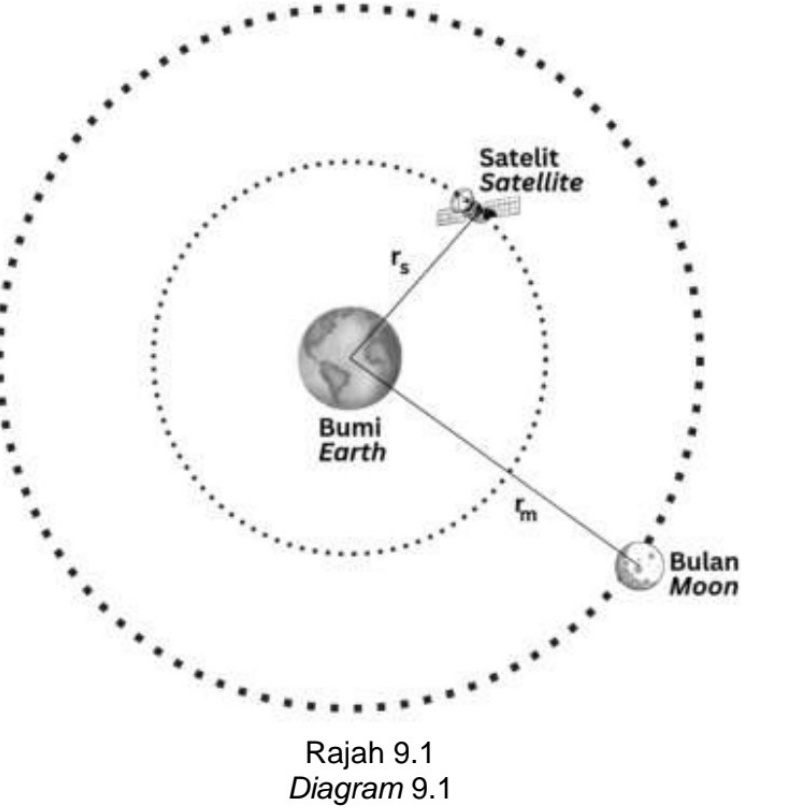
- (a)
Name the physics law that relates the orbital period, T and orbital radius, r.
[1] - (b)
Derive an expression that describes the physics law in 9(a) using the equations F = GMm/r², F = mv²/r and v = 2πr/T.
[4] - (c)(i)
The orbital radius of the Moon is 57 times greater than the orbital radius of the satellite. [Radius of the Earth, R = 6.37 × 10⁶ m, Mass of the Earth, M = 5.97 × 10²⁴ kg, Mass of the Moon, m = 7.35 × 10²² kg, Orbital radius of the Moon, rm = 3.83 × 10⁸ m, Period of the Moon orbiting the Earth, T = 655.2 hours] Calculate the height of the satellite from the surface of the Earth.
[3] - (c)(ii)
Calculate the period taken by the satellite to orbit the Earth.
[2] - (d)
Diagram 9.2 shows a rocket being launched to carry a communications satellite into its orbit. Table 9 shows the characteristics of rockets K, L, M and N that can be used in satellite delivery missions. Table 9 (Type of rocket; Mass; Maximum height (km); Quantity of fuel; Type of engine): K Low, 500, More, Single-stage; L High, 800, Less, Staged; M High, 300, Less, Single-stage; N Low, 1500, More, Staged. You are required to investigate the characteristics of the rocket suitable for the mission of sending the communication satellite into its orbit. Explain the suitability of each characteristic and determine the most suitable rocket. Give reasons for your choice.
[10]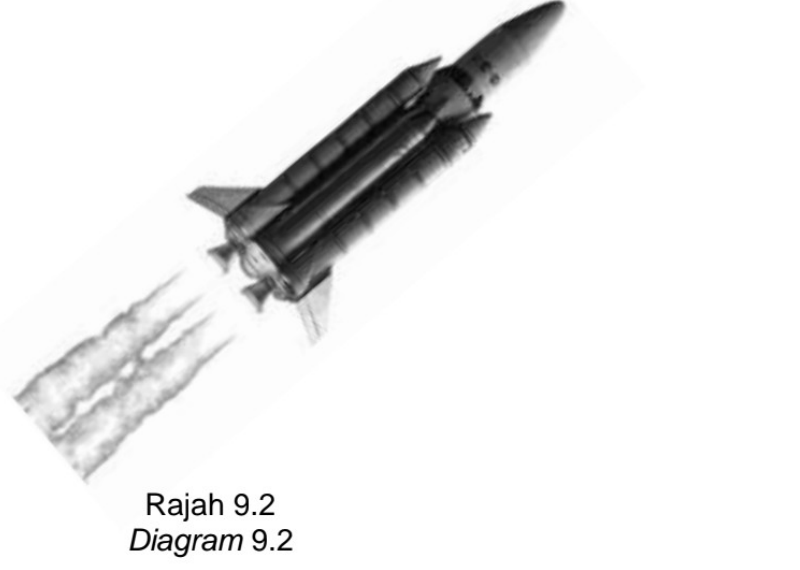
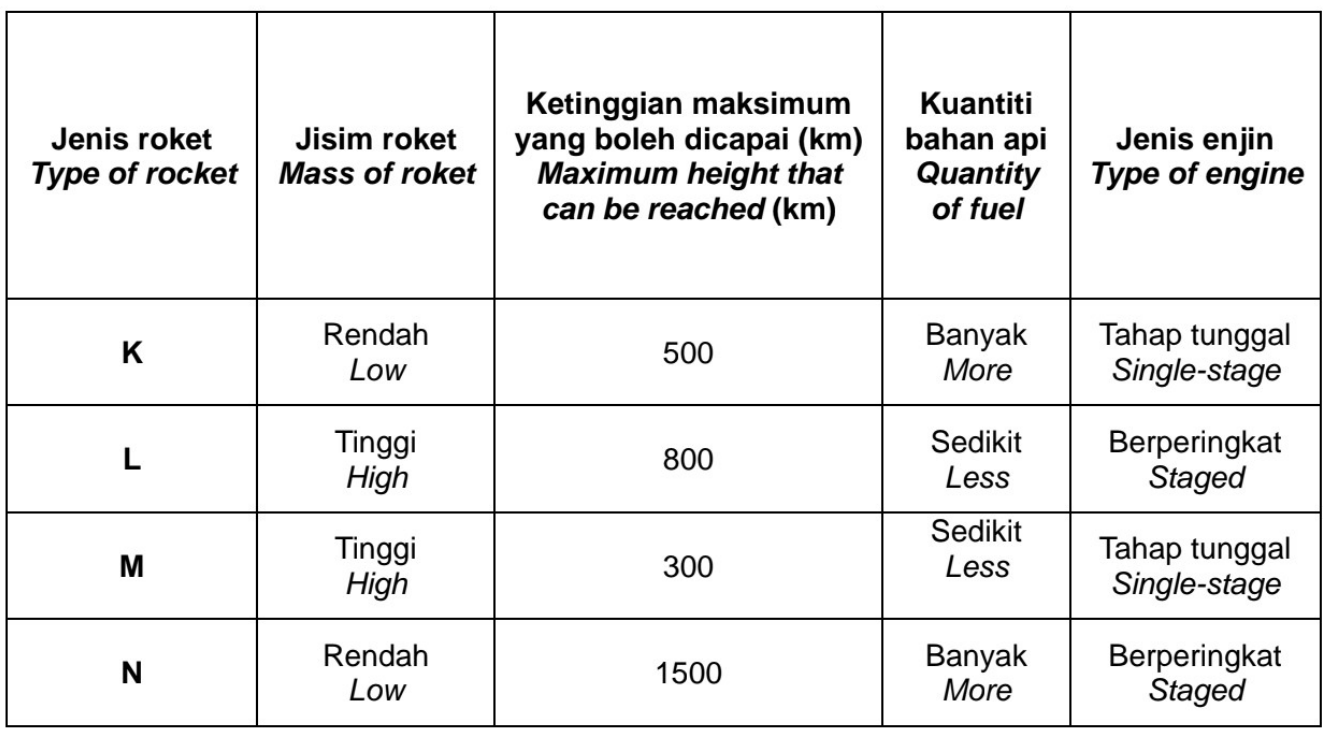
Diagram 10 shows a bulb labelled 24 V, 48 W is connected to the output of a transformer (primary coil connected to 240 V a.c.). The efficiency of the transformer is 80%. Section B: answer one question (Q9 or Q10).
Hard20 marks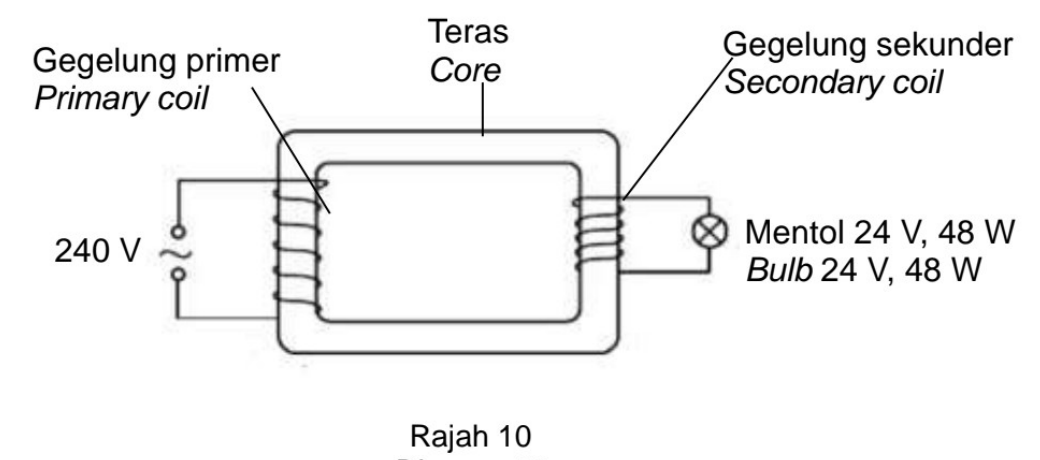
- (a)(i)
Based on Diagram 10, state the type of transformer used.
[1] - (a)(ii)
Explain how a transformer can function and cause a light bulb to light up with normal brightness.
[4] - (b)(i)
If the number of turns of the secondary coil, Ns is 50 turns and the number of turns of the primary coil, Np is 500 turns used in the transformer in Diagram 10, calculate the ratio of the number of turns of the primary coil to the number of turns of the secondary coil.
[1] - (b)(ii)
Calculate the input power in the primary coil.
[2] - (b)(iii)
Calculate the current flowing in the primary coil.
[2] - (c)
Table 10 shows the characteristics of four transformers, P, Q, R and S (thickness of the coil, material of the core, design of the core, method of winding the coil). P: high, soft iron, solid, primary and secondary coils on separate limbs. Q: low, iron, solid, coils wound on the same limb separately. R: high, soft iron, laminated, secondary coil wound over the primary coil. S: low, iron, laminated, coils on separate limbs. You are required to study the characteristics of the transformers in Table 10 that are most suitable for use to produce a transformer efficiency of 100%. Explain the suitability of each characteristic and determine the most suitable transformer. Give reasons for your choice.
[10]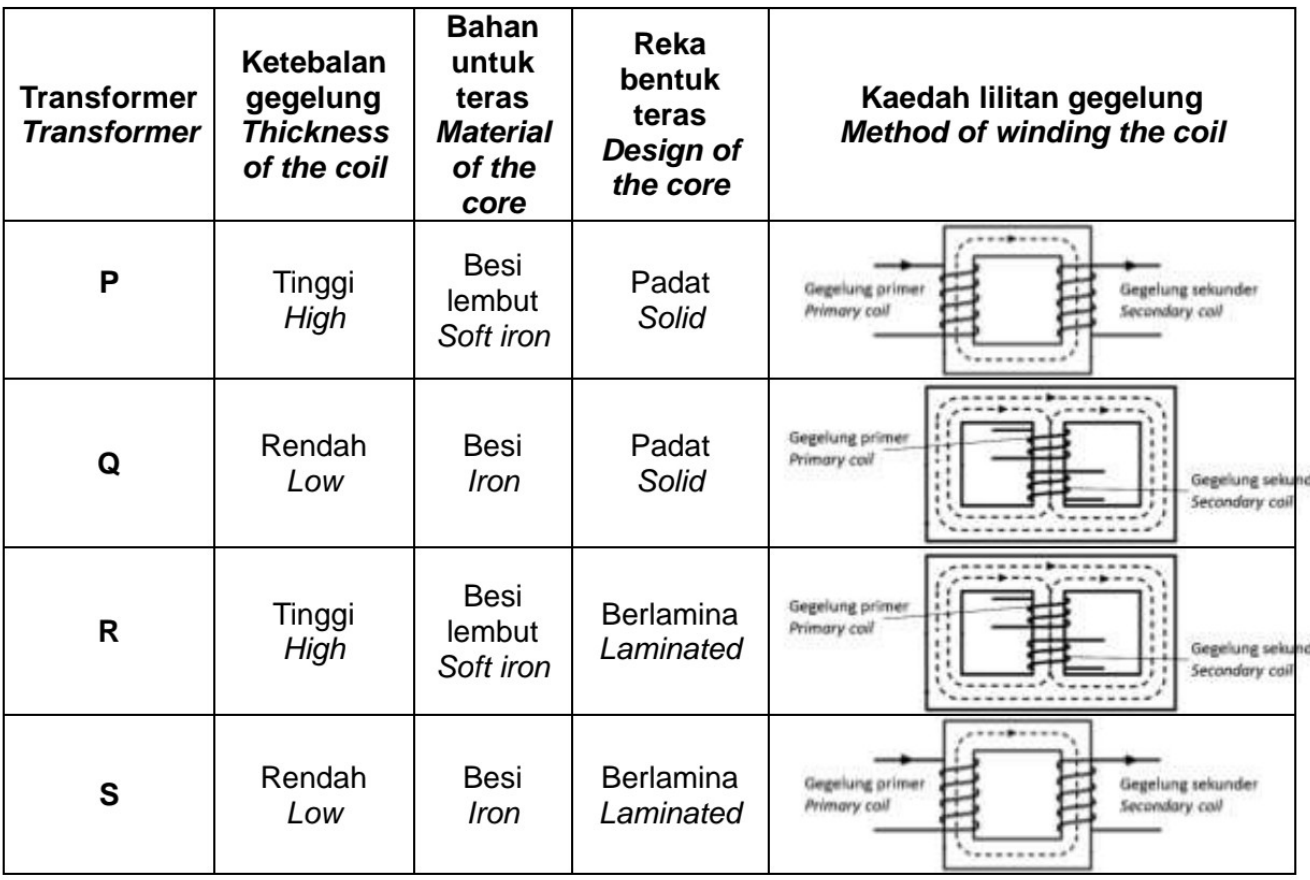
Section C
Diagram 11.1 and Diagram 11.2 show the velocity-time graphs for the motion of car A (reaching 15 m s⁻¹ at 5 s) and car B (reaching 20 m s⁻¹ at 5 s) in 5 seconds. Both are straight lines from the origin. Section C: compulsory.
Medium20 marks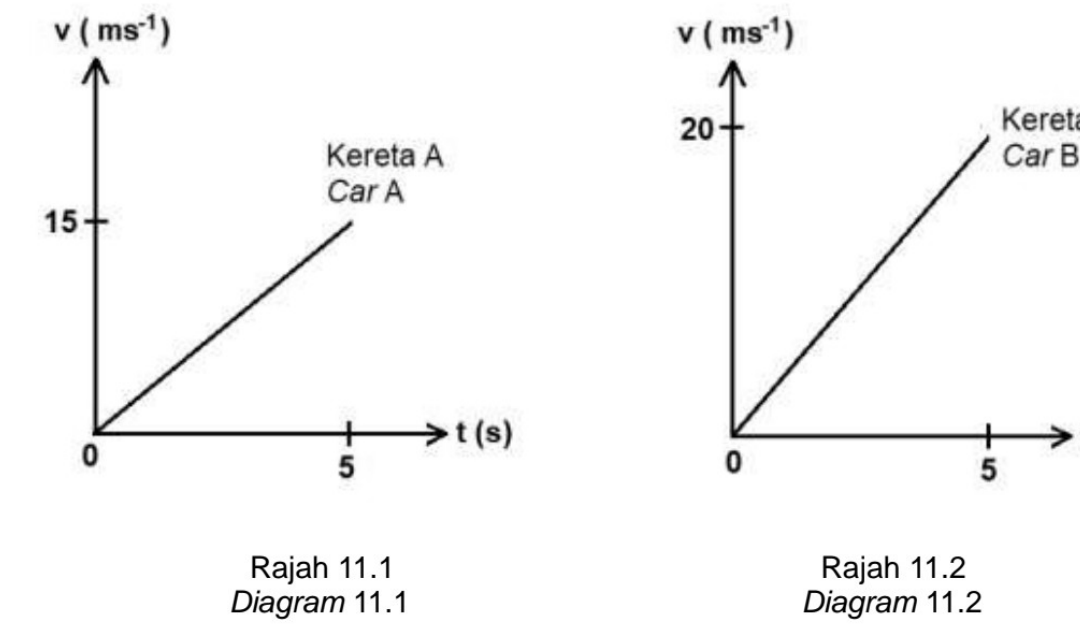
- (a)
State the meaning of velocity.
[1] - (b)
Based on Diagram 11.1 and Diagram 11.2, compare the gradient of the graph, acceleration and final velocity of the car.
[3] - (c)
Based on the answer in 11(b) relate the gradient of the graph to the final velocity and then deduce the relationship between the gradient of the graph and the acceleration of the car.
[2] - (d)
Diagram 11.3 shows a racing car with a mass of 800 kg (with a spoiler). Based on Diagram 11.3, explain how a racing car can move at high speeds and safely.
[4]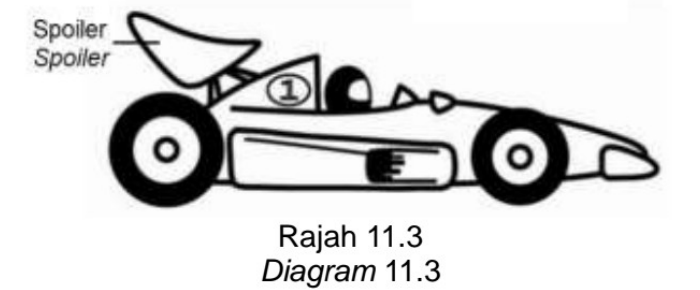
- (e)
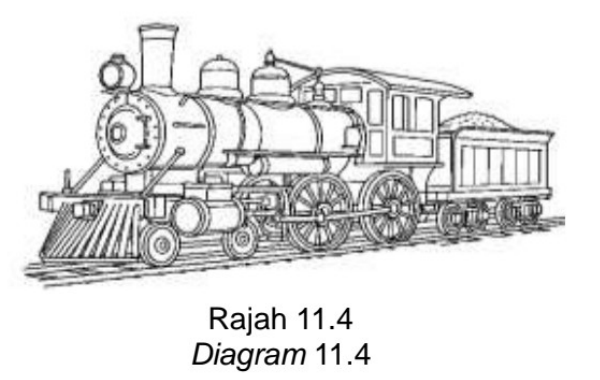
Diagram 11.4 shows an old train that moves slowly and carries a small load at a time. You are required to provide suggestions to enable the train to move quickly and be able to carry a lot of cargo or passengers at a time safely. Your suggestions should include aspects of train design, type or characteristics of materials for the train body, type of energy, number of carriages and engine power used.
[10]