Diagram 1 shows three physical quantities: Displacement, Force, Momentum. These physical quantities can be categorized as
Easy
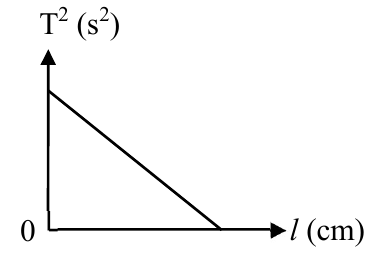
Diagram 2 shows the graph plotted by Siew Ling to study the relationship between length, l and period, T (graph of T² (s²) against l (cm): a straight line with a negative gradient starting from a positive T² intercept and not passing through the origin). What type of graph did Siew Ling draw?
Medium
The Principle of the Conservation of Momentum states that
Easy
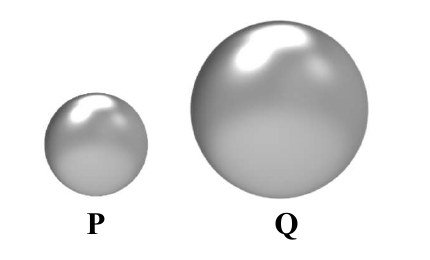
Diagram 3 shows two steel balls, P (smaller) and Q (larger), dropped simultaneously from the top of a building to the ground. Assume air resistance is negligible. Which of the following velocity-time graphs shows the correct motion of P and Q?
Medium
Which of the following shows the effect of inertia? I: A girl dries her wet hair by moving her head quickly. II: A strong steel structure is installed on a lorry between the driver's seat and the area used to carry logs. III: The hammer head is tightened by tapping the handle against the floor.
Easy
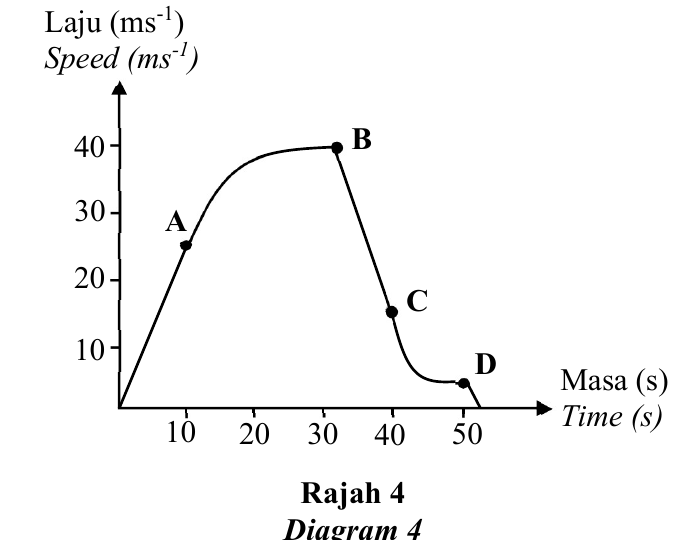
Diagram 4 shows the speed-time graph for a skydiver. He falls freely from an aircraft, then opens his parachute and lands safely on the ground. At which point does the parachute fully open? (Points A, B, C, D are marked on the graph: A on the initial rising curve at about 25 m s⁻¹, B at the top at 40 m s⁻¹ and about 32 s, C on the falling line at about 15 m s⁻¹, D near the bottom at about 5 m s⁻¹ and 50 s.)
Medium
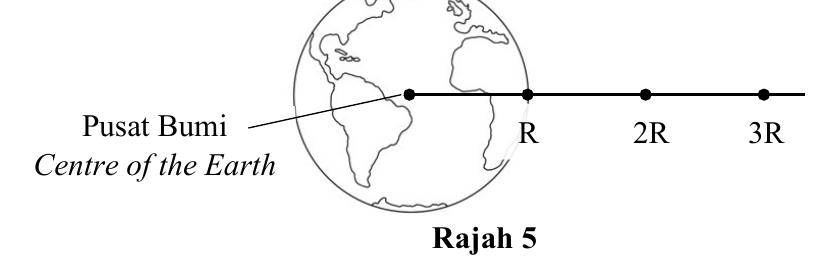
Diagram 5 shows distances measured from the centre of the Earth, where R is the radius of the Earth (marks at R, 2R, 3R). If r is any distance measured from the centre of the Earth and g is the Earth's gravitational acceleration, what is the relationship between g and r in the form of a graph?
Medium
Diagram 6 states a physics law: "All the planets move in elliptical orbits with the Sun positioned at one of the focal points." What law is explained by the above statement?
Easy
The orbital period of Earth is 1.0 year, while Jupiter's orbital period is 11.9 years. If the orbital radius of Earth is 1.5 × 10¹¹ m, calculate the orbital radius of Jupiter.
Medium
Diagram 7 shows a clinical thermometer used to measure a patient's body temperature (photograph of a thermometer under a child's tongue). What is the physics concept applied in the thermometer?
Medium
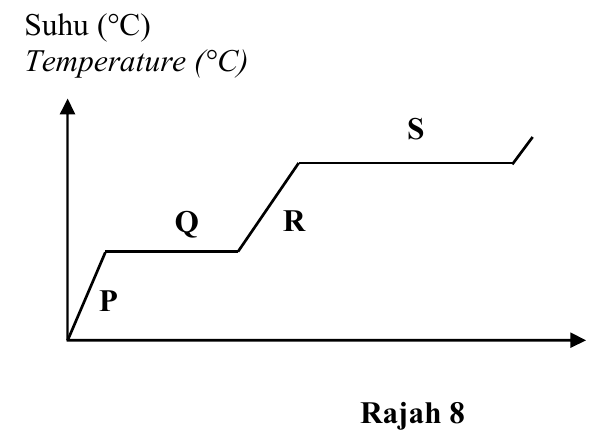
A substance is heated at a uniform rate. It changes from a solid to a liquid, and then to a gas. Diagram 8 is a graph that shows how the temperature changes with time (sections P, Q, R, S from left to right; Q and S are flat). Which part of the graph shows latent heat of vaporisation?
Medium
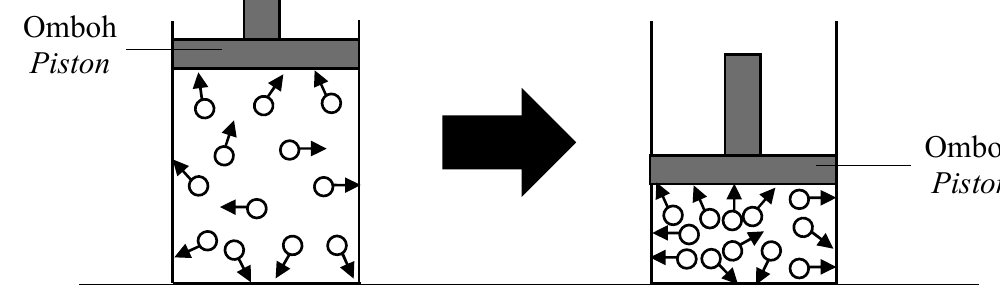
Diagram 9 shows a container with a volume of 7.5 cm³ and a pressure of 105 kPa. When the piston is pushed, the volume of the container becomes 4.3 cm³. What is the air pressure in the container after being compressed?
Medium
Which situations involved Gay-Lussac's Law? (Options are pictures: A hot air balloon, B bulb light up, C pressure cooker, D dented ping pong ball in hot water.)
Medium
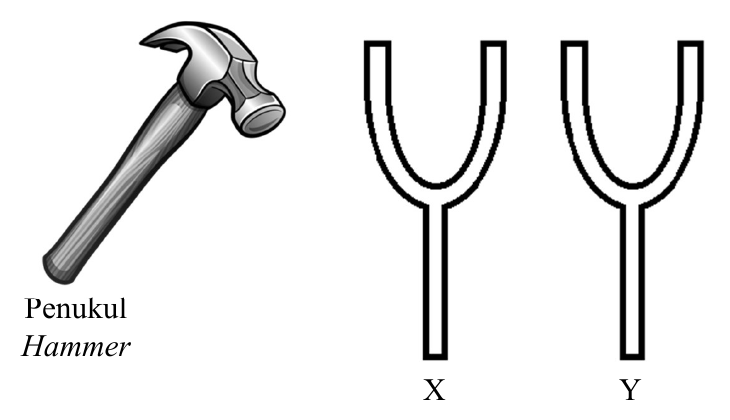
Diagram 10 shows two identical tuning forks, X and Y, placed side by side. Tuning fork X is struck to make it vibrate. Tuning fork Y then vibrates too. This effect is known as
Medium
In a lecture hall, the sound from the loudspeaker is often heard as an echo. What is the best solution to the cause of this problem?
Medium
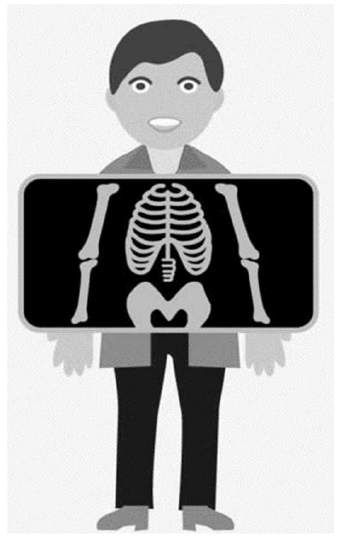
Diagram 11 shows an application of electromagnetic waves in the medical field (an X-ray image of a person). Which statement is correct about the wave used? Options give: type of wave, frequency, total energy. A: Transverse, High, Low. B: Transverse, High, High. C: Longitudinal, High, High. D: Longitudinal, Low, Low.
Medium
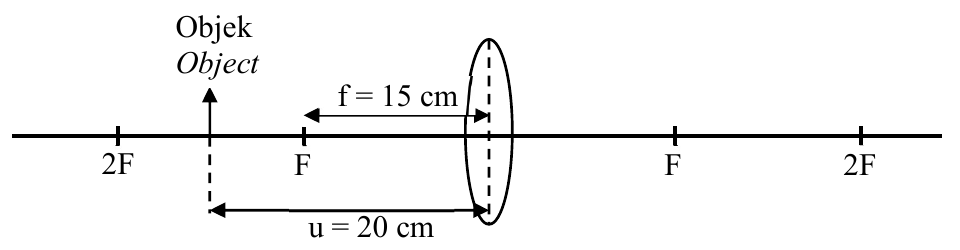
Diagram 12 shows an object in front of a convex lens. The focal length is f = 15 cm and the object distance is u = 20 cm. What is the image distance?
Medium
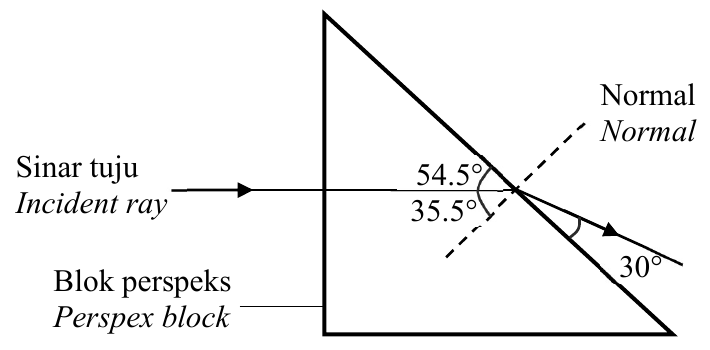
Diagram 13 shows a light ray emerging from a perspex block (angles 54.5°, 35.5° and 30° are marked at the emergent point). What is the critical angle of the perspex?
Medium
Which of the following optical instruments apply the concept of total internal reflection? (Options are pictures: A camera, B binoculars, C projector, D microscope.)
Easy
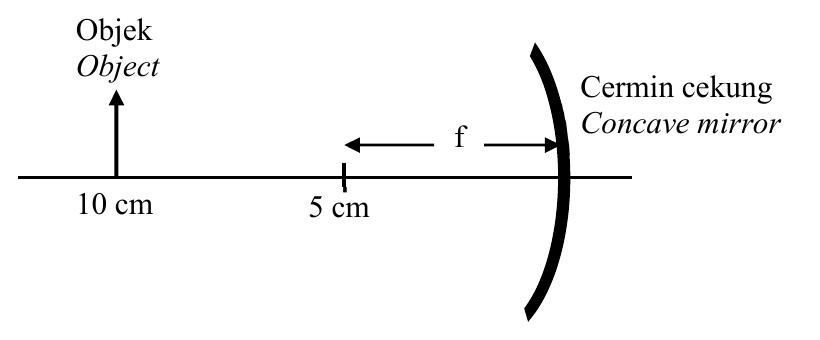
Diagram 14 shows an object placed 10 cm in front of a concave mirror. The focal length, f, of the concave mirror is 5 cm. What are the characteristics of the image formed?
Medium
All the following phenomena involve force equilibrium, except
Medium
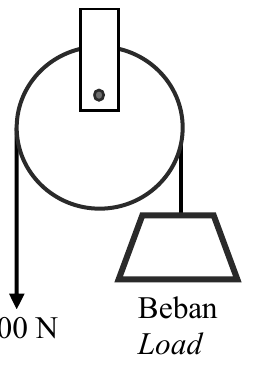
Diagram 15 shows a 6 kg load suspended from a smooth pulley. A force of 100 N is applied to lift the load. What is the acceleration of the load?
Medium
Which situation will produce zero resultant force? (Two people push a refrigerator from opposite sides. A: 100 N and 200 N. B: 150 N and 100 N. C: 100 N and 150 N. D: 100 N and 100 N.)
Easy
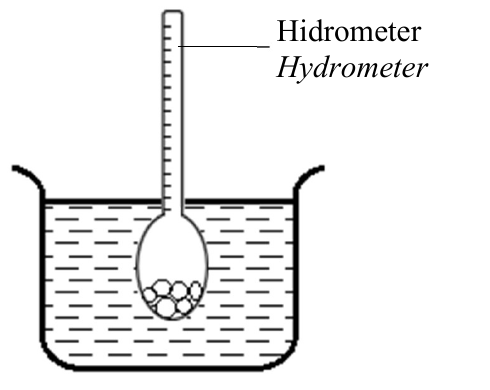
Diagram 16 shows a hydrometer being used to determine the density of a liquid. Which physics principle is the hydrometer based on?
Easy
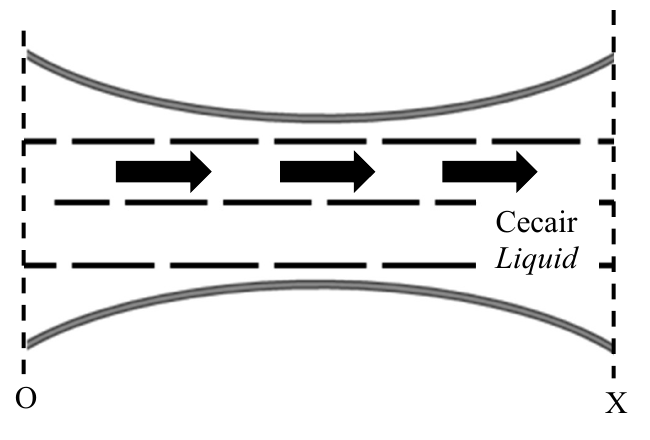
Diagram 17 shows a liquid flowing steadily through a tube that narrows in the middle and widens again from O to X. Which of the following graphs shows the change in liquid pressure, P as it flows along the tube from O to X?
Medium
Diagram 18 shows a boat with a weight of 1200 N floating on water. All of the following are true except
Medium
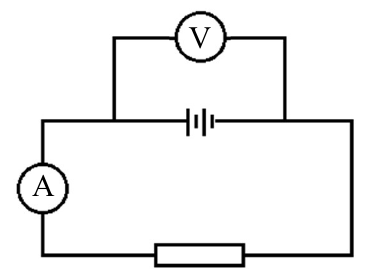
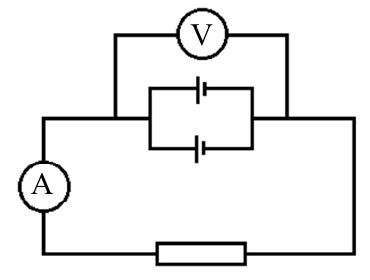
Diagrams 19(a) and 19(b) show two dry cells arranged in different ways (19(a): a single cell in a circuit with ammeter, voltmeter and resistor; 19(b): two cells connected in parallel in the same circuit). Which of the following is correct if the dry cell in Diagram 19(a) is arranged as in Diagram 19(b)? Compare the electromotive force (e.m.f.) and the internal resistance, r.
Medium
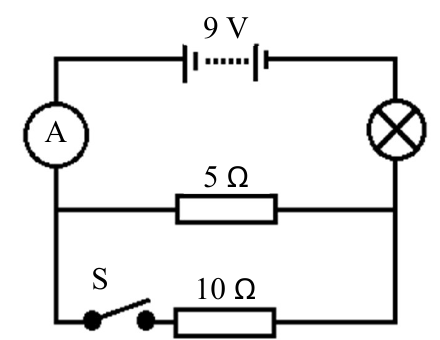
Diagram 20 shows a circuit containing two resistors and a bulb. The 9 V cell, ammeter and bulb are in series with a 5 Ω resistor; a 10 Ω resistor with switch S is in parallel with the 5 Ω resistor. The ammeter reading is 1.5 A when switch S is turned off. Calculate the reading of the ammeter when the switch S is on.
Medium
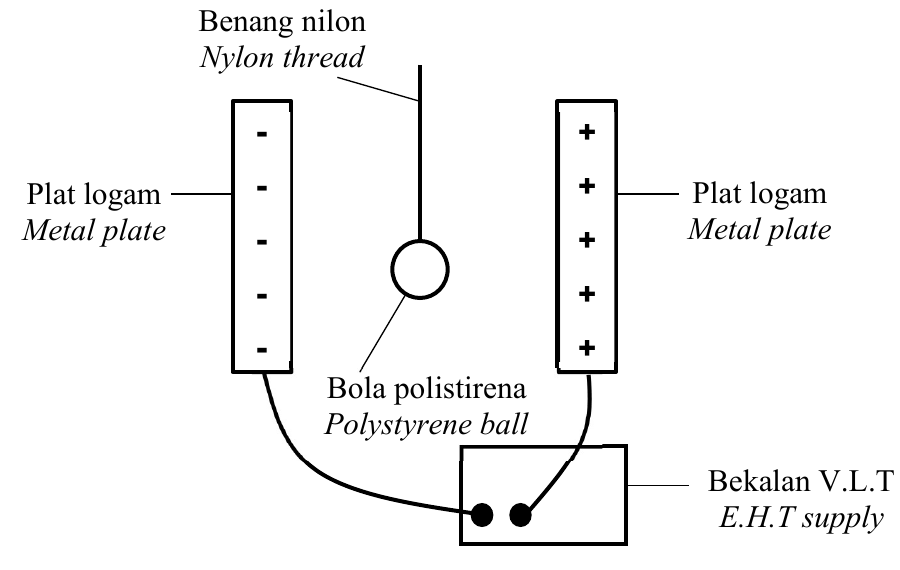
Diagram 21 shows apparatus to describe the behaviour of a charged object in an electric field. A metal-coated polystyrene ball on a nylon thread hangs between a negative and a positive metal plate connected to an E.H.T. supply, and is touched to the positive plate. The frequency of oscillation of the polystyrene ball increases when
Medium
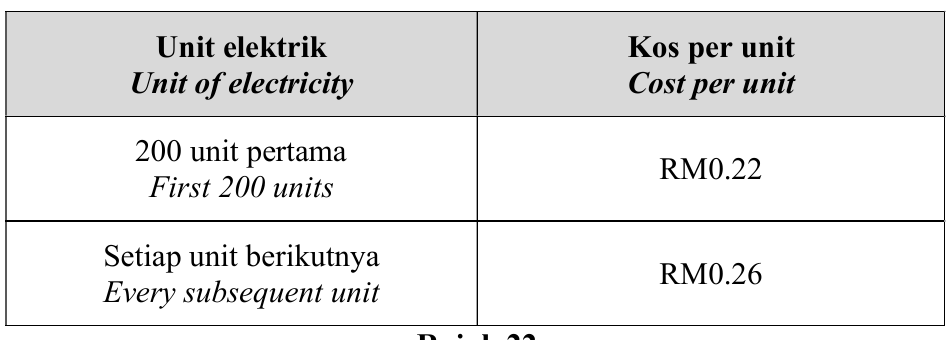
Diagram 22 shows the electricity tariff: first 200 units RM0.22 per unit; every subsequent unit RM0.26 per unit. An air conditioner with a power rating of 2.0 kW is operated for 8 hours a day. Calculate the cost of using the air conditioner for the entire month of May in RM.
Medium
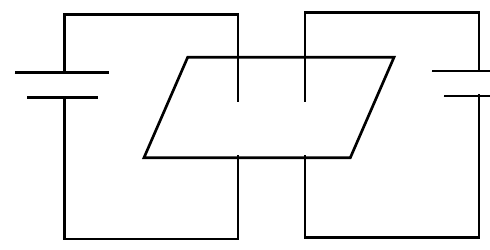
Diagram 23 shows two wires penetrating the same cardboard. Which of the following is the pattern for the magnetic field produced?
Medium
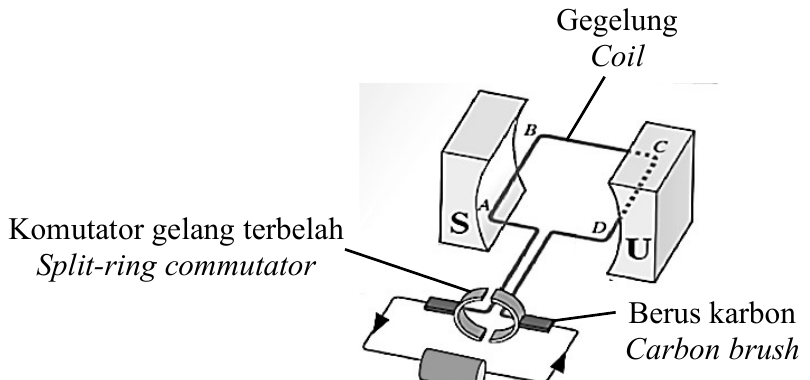
Diagram 24 shows a current-carrying coil in a magnetic field (split-ring commutator and carbon brushes). State the direction of rotation of the coil when the switch is turned on.
Medium
When a bar magnet is pushed faster into a solenoid, the magnitude of the induced current produced increases. This is stated by the
Medium
What is meant by thermionic emission?
Easy
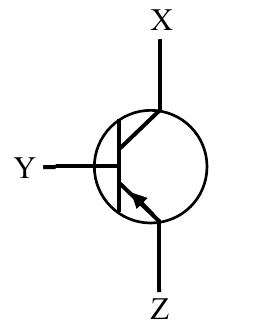
Diagram 25 shows a symbol for a type of transistor with terminals X (top), Y (left) and Z (bottom, with the arrow). Which of the following are true about the terminals X, Y and Z?
Easy
Diagram 26 shows an equation that represents alpha decay: ⁿ²¹⁴Po → ⁸²ᵐPb + α, that is, polonium with nucleon number 214 and proton number n decays to lead with nucleon number m and proton number 82, plus an alpha particle. What are the values of m and n?
Medium
A radioactive element has an initial mass of 40 g and a half-life of 5 days. Which of the following statements is correct about the mass of the radioactive element?
Medium
A chain reaction can occur in a reactor because during nuclear fission
Easy
Einstein's photoelectric equation for a metal is hf = ½mv² + W. ½mv² represents
Easy
When a photoelectric material is illuminated with blue light of wavelength λ = 452 nm, a photoelectron with 0.75 eV is emitted. What is the threshold wavelength of the photoelectric material? [Given hc = 1.243 × 10³ eV nm]