When an object is moving at a constant velocity, its acceleration will be
Easy
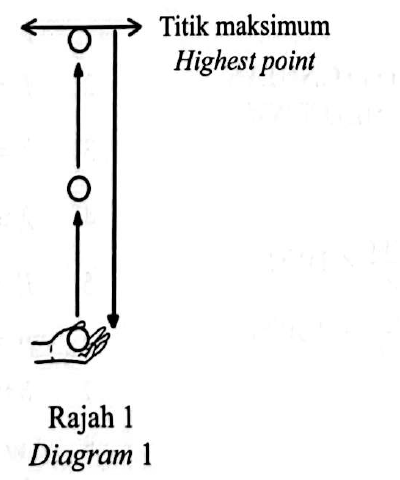
A student threw a ball upward with a velocity of 35 m s⁻¹ as shown in Diagram 1. How long does it take for the ball to return to his hand?
Medium
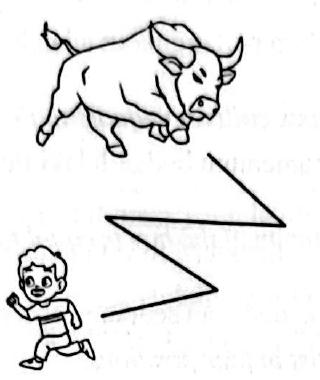
Diagram 2 shows a boy being chased by a cow. The boy ran in a zigzag pattern because he knew that it was difficult for the cow to change the direction of its movement due to its large inertia compared to him. What causes the inertia of the cow to be bigger?
Easy
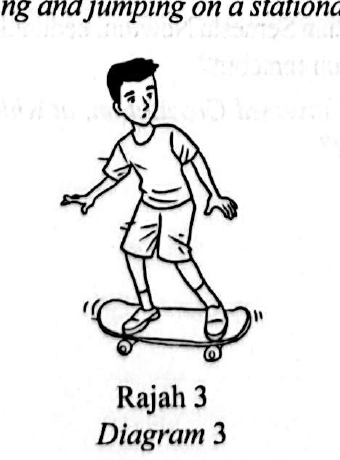
Diagram 3 shows a boy running and jumping on a stationary skateboard. Which of the following statement is correct about the above situation?
Medium
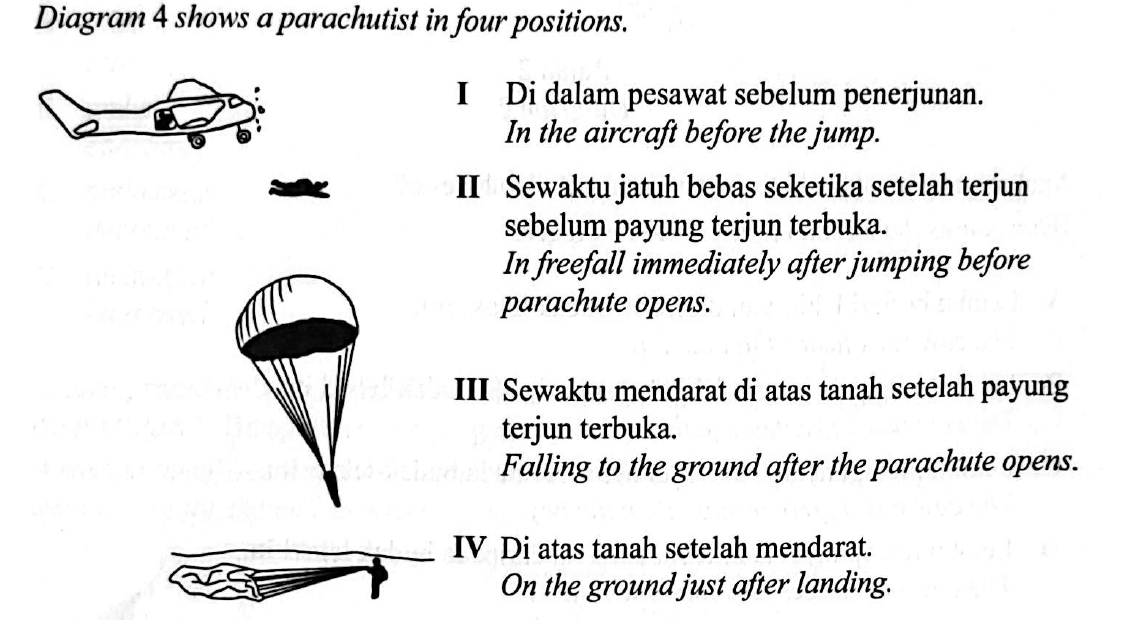
Diagram 4 shows a parachutist in four positions. I: In the aircraft before the jump. II: In freefall immediately after jumping before parachute opens. III: Falling to the ground after the parachute opens. IV: On the ground just after landing. Based on Newton’s Law of Universal Gravitation, at which position does the gravitational force act on the parachutist?
Medium
The following is a conversation between a teacher and a student during a Physics class. Student: Why does the Moon take shorter time to orbit the Earth than the Earth orbits the Sun? Teacher: This is because the radius of orbit of the Moon is smaller than the radius of orbit of the Earth. The larger the radius of an orbit, the longer the orbital period. Which law supports the teacher’s answer?
Medium
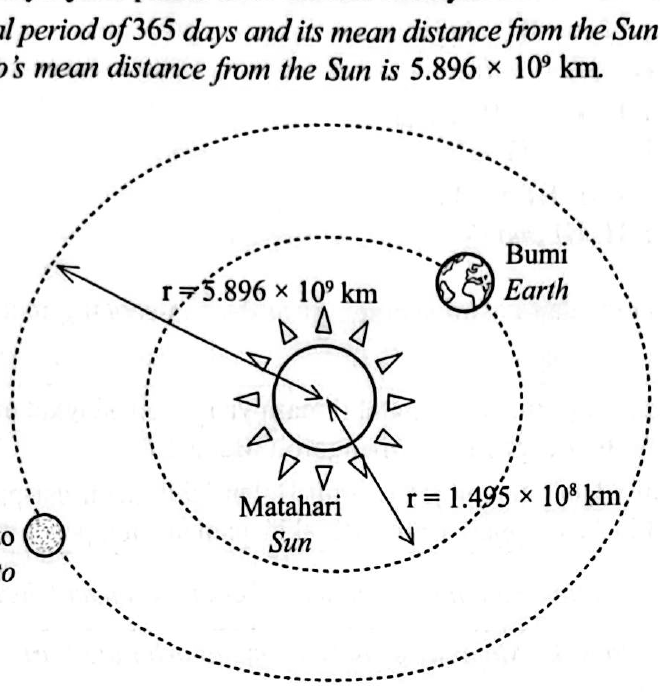
Earth has an orbital period of 365 days and its mean distance from the Sun is 1.495 × 10⁸ km. The planet Pluto’s mean distance from the Sun is 5.896 × 10⁹ km (Diagram 5). What is the Pluto’s orbital period?
Medium
Which of the following statement is correct about geostationary satellites?
Medium
What is the concept used in measuring the temperature of water using a thermometer?
Easy
The specific latent heat of vaporisation of water is the heat absorbed by
Easy
A gas of volume 20 m³ at 37 °C is heated until its temperature becomes 87 °C at constant pressure. What is the increase in volume?
Medium
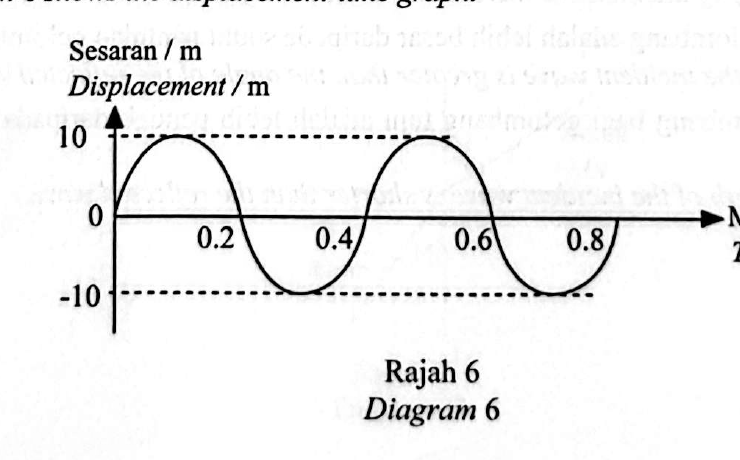
Diagram 6 shows the displacement-time graph. Based on the graph above, what is the frequency of the wave?
Medium
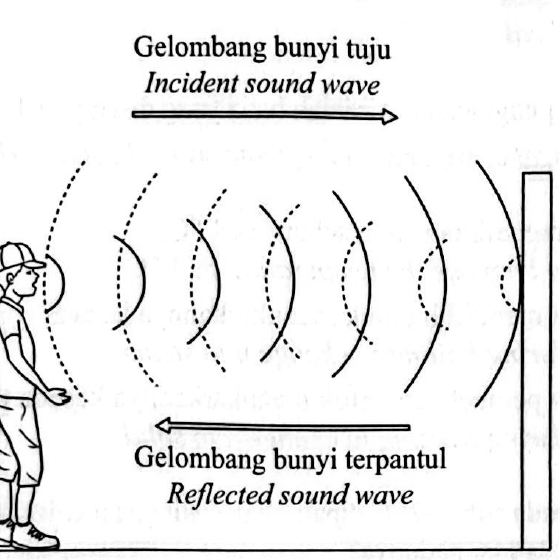
Diagram 7 shows an incident sound wave reflected from a concrete wall. Which of the following statement is correct about the above situation?
Medium
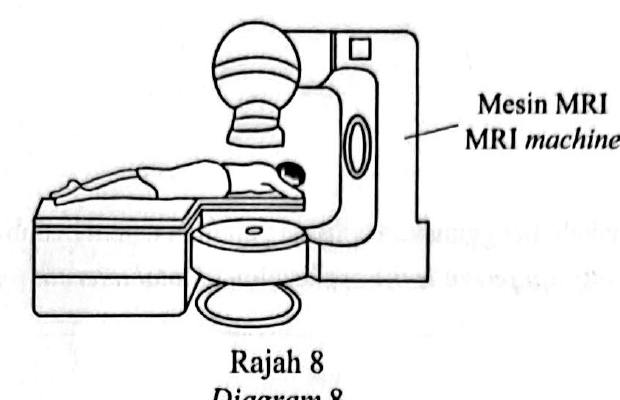
Diagram 8 shows the application of electromagnetic wave (MRI machine). Which pair shows the characteristics of the wave used?
Medium
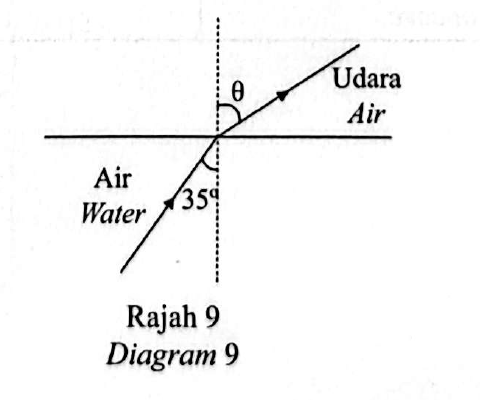
Diagram 9 shows a light ray propagating from water to air. The refractive index of water is 1.33. What is the value of angle θ?
Medium
Which of the following equipment is the application of total internal reflection?
Easy
Which of the following is the characteristics of the objective lens for a telescope? (type of objective lens, fo; focal length of the objective lens, fo compared to the eyepiece, fe)
Medium
Which of the following are the characteristics of the image produced by a concave mirror? I: Real, inverted, diminished. II: Real, inverted, same size as object. III: Virtual, inverted, magnified. IV: Virtual, upright, diminished.
Medium
Which diagram shows the correct resultant force? (Three forces 10 N, 6 N and 8 N drawn as triangles in options A to D.)
Medium
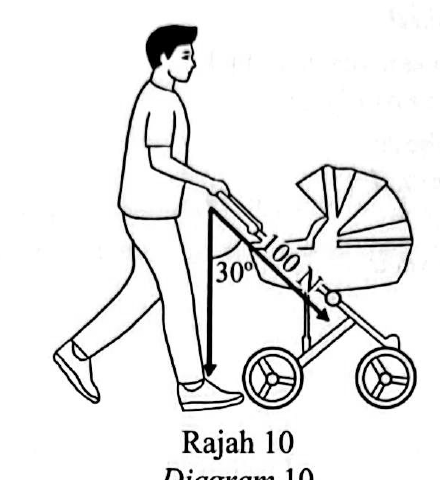
Diagram 10 shows a father pushing a baby stroller with a force, F of 100 N (the force makes an angle of 30° with the vertical). What is the horizontal force, Fx and vertical force, Fy applied?
Medium
A lorry moves with a uniform velocity. Which of the following statement describes the situation?
Easy
Which of the following device is the application of atmospheric pressure?
Easy
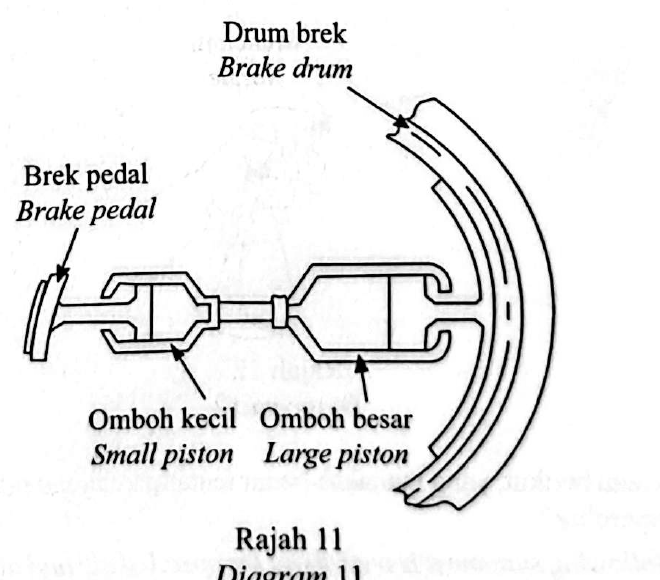
Diagram 11 shows a hydraulic brake system of a vehicle. The cross-sectional area of small piston is 2.5 × 10⁻⁴ m². If the driver presses the brake pedal with force 100 N, calculate the pressure produced in the system.
Medium
An athlete with a mass of 60 kg is paddling a kayak. The mass of the kayak is 30 kg. The kayak is floating on the river water. The kayak has displaced a certain volume of river water while floating. Calculate the volume of river water displaced, V. [Density of river water, ρ = 1000 kg m⁻³]
Medium
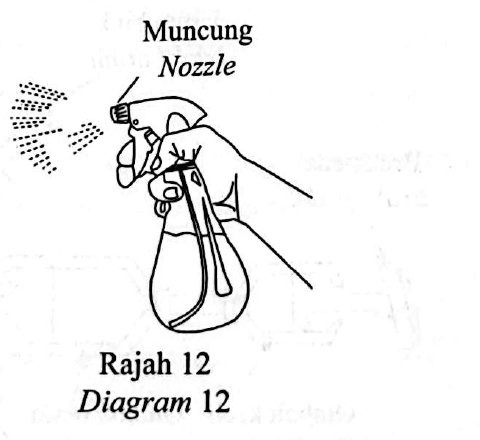
Diagram 12 shows a fine spray of water coming out when the sprayer is squeezed. Which of the following statement is true about the speed of air and air pressure at the nozzle?
Medium
Which diagram shows the correct electric field pattern?
Medium
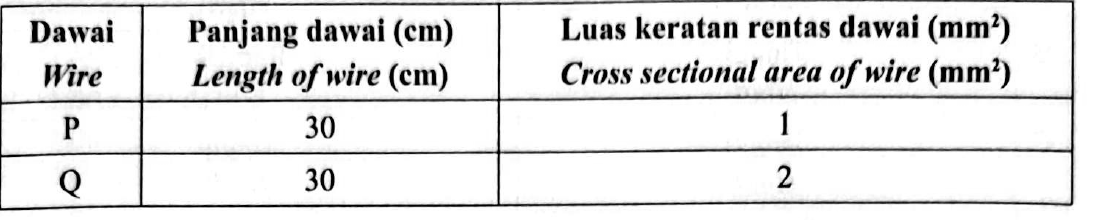
Wire P and Q are made from the same material. A student connects wire P in a circuit. Wire P: length 30 cm, cross-sectional area 1 mm². Wire Q: length 30 cm, cross-sectional area 2 mm². What happens to the current when wire P is replaced with wire Q in the circuit?
Medium
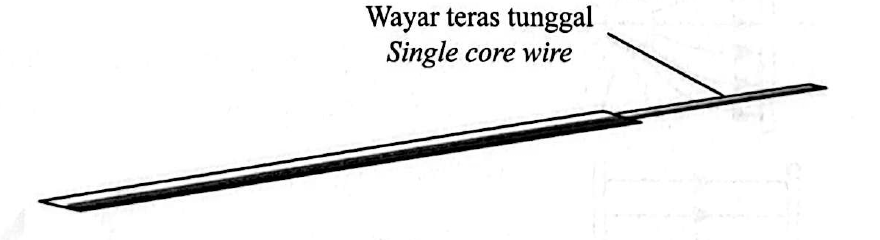
Diagram 13 shows a single core wire with a length of 0.8 m. The wire has a resistivity of 1.7 × 10⁻⁸ Ω m and a diameter of 1.5 × 10⁻³ m. What is the resistance of the wire? [π = 3.142]
Medium
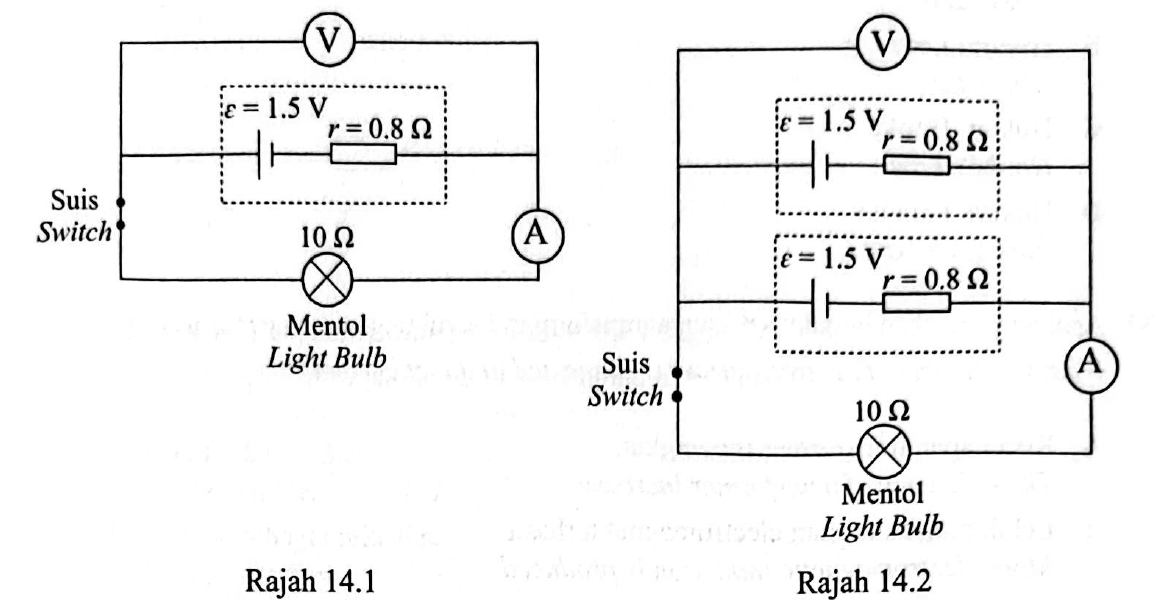
Diagram 14.1 shows a circuit with one dry cell (e.m.f. 1.5 V, internal resistance 0.8 Ω, bulb 10 Ω). Diagram 14.2 shows two dry cells arranged in parallel. State the change in the current flowing in the circuit in Diagram 14.2 compared to the circuit in Diagram 14.1.
Medium
What is the main function of Fleming’s left-hand rule?
Easy
What is the law that explains the direction of induced current in solenoid?
Easy
What will happen if the transformer is connected to direct current?
Medium
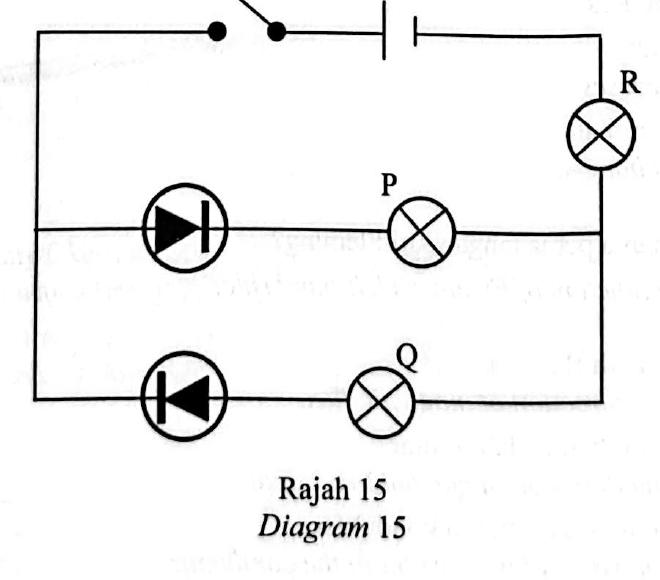
Diagram 15 shows two diodes which are connected in parallel in a circuit. When the switch is closed, which bulb will light up?
Medium
Which of the following statement is correct about transistor?
Easy
Which of the following radioactive decay equation shows beta decay? A: ²¹⁴₈₃Bi → ²¹⁴₈₃Bi + X; B: ⁹⁰₃₈Sr → ⁹⁰₃₉Y + X; C: ²³⁸₉₂U → ²³⁴₉₀Th + X; D: ²¹⁴₈₄Po → ²¹⁰₈₂Pb + X
Medium
The tremendous energy released in a nuclear fission reaction is due to
Easy
Quantum physicist had confirmed the properties of light and electron through experiment. Choose the correct statements. I: Light exhibits wave characteristics. II: Light exhibits particle characteristics. III: Electron exhibits wave characteristics. IV: Electron exhibits particle characteristics.
Medium
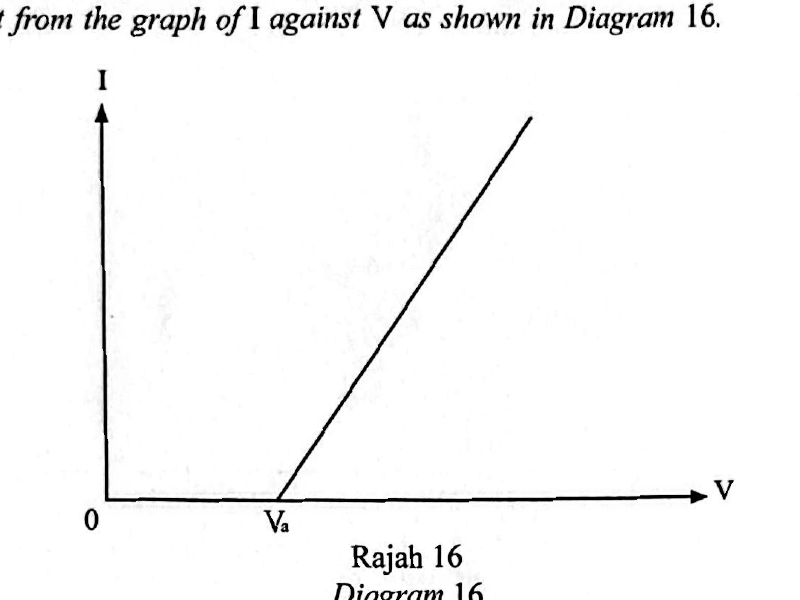
In the experiment of photoelectric effect, one physical quantity, Va can be obtained through V-intercept from the graph of I against V as shown in Diagram 16. What is represented by the physical quantity of Va?
Medium
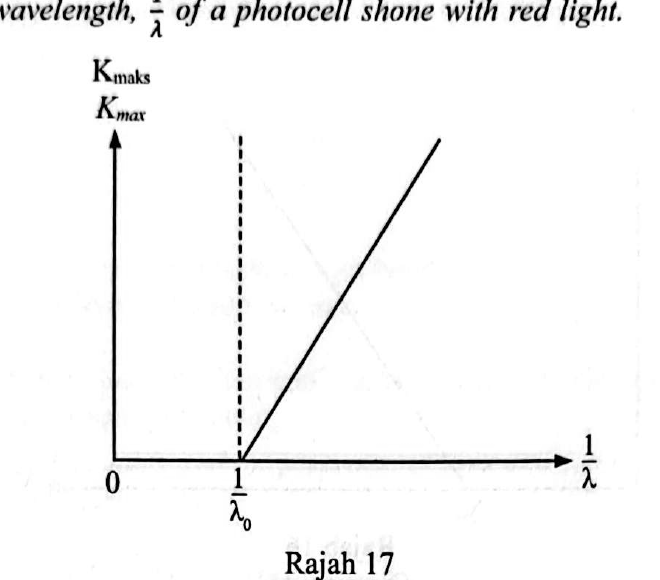
Diagram 17 shows a graph of maximum kinetic energy of photoelectron, Kmax against the reciprocal of wavelength, 1/λ of a photocell shone with red light. What happen to value of Kmax when the value of λ decreases?