SBP 2024 P2 Q9
MediumWrite your answer on paper. Then open the answer to check it.
Diagram 9.1 shows a cotton ball soaked with isopropyl alcohol liquid applied to the shoulder of a patient. The patient feels cold in the skin area covered by the isopropyl alcohol liquid. A few seconds later, the isopropyl alcohol liquid evaporates where the heat involved is the specific latent heat of vaporisation.
Medium20 marks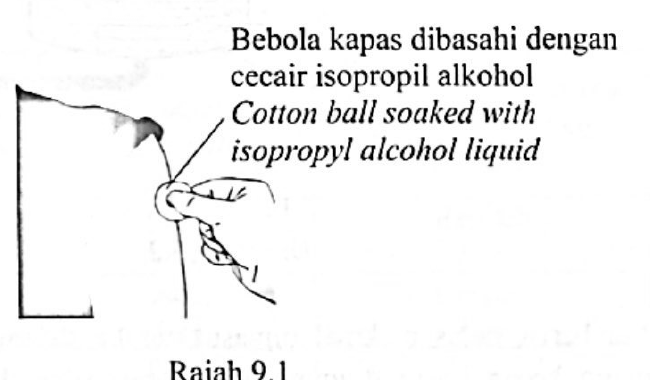
- (a)
What is the meaning of specific latent heat of vaporisation?
[1] - (b)
When a cotton ball soaked with cold water is applied to the same skin area, it is found that after a few seconds the water does not evaporate like the alcohol isopropyl liquid. The cooling effect of cold water is smaller than the isopropyl alcohol liquid. Explain.
[4] - (c)(i)
Diagram 9.2 shows the basic structure of an autoclave in a laboratory used to kill germs and viruses on laboratory apparatus. The power of the heating element is 500 W. Calculate the heat supplied by the heating element for 15 minutes.
[3]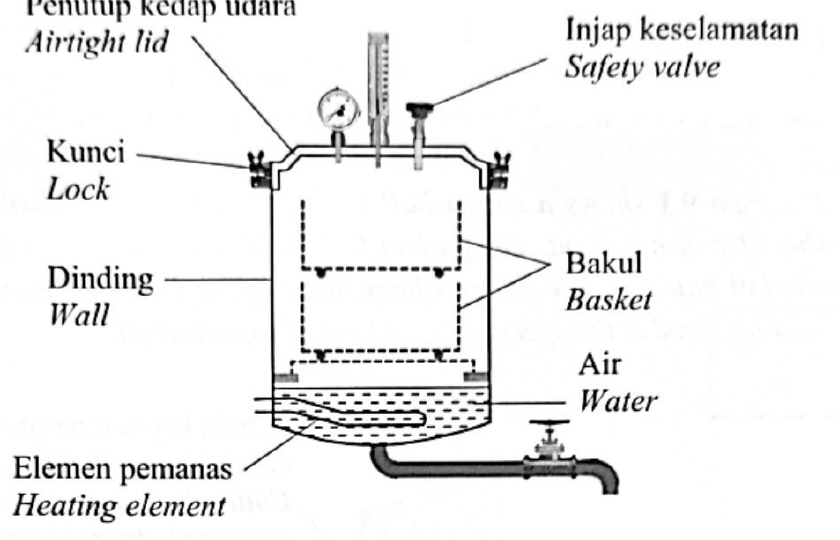
- (c)(ii)
The heat in 9(c)(i) is used to change water at 25 °C into steam at 100 °C. Given specific heat capacity of water = 4200 J kg⁻¹ °C⁻¹ and specific latent heat of vaporisation of water = 2.26 × 10⁶ J kg⁻¹. Calculate the mass of water involved in the process.
[2] - (c)(iii)
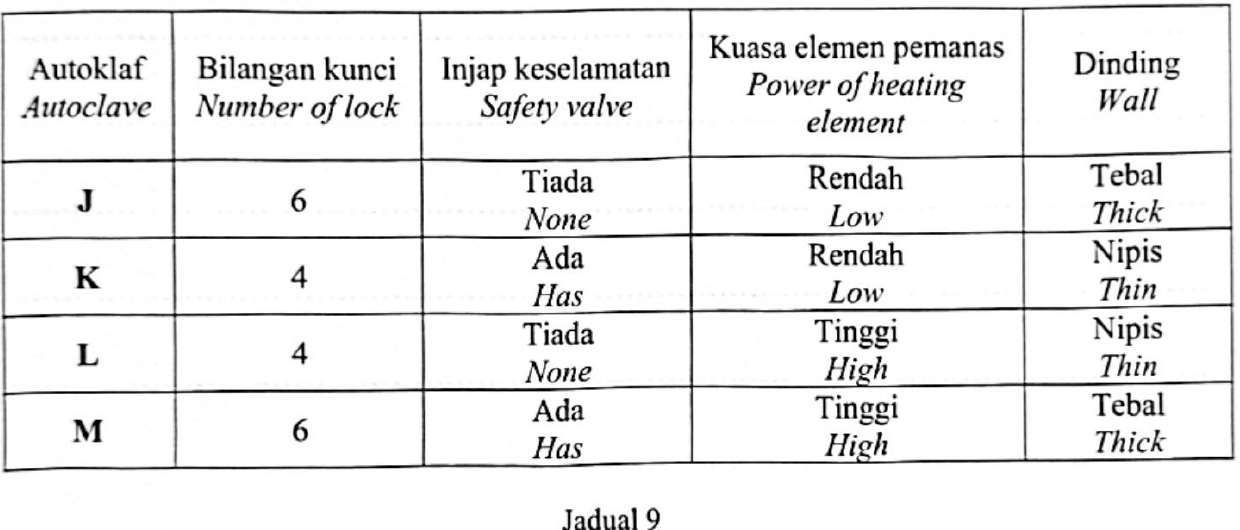
Table 9 shows four types of autoclave J, K, L and M with different specifications (number of locks; safety valve; power of heating element; wall): J (6, none, low, thick); K (4, has, low, thin); L (4, none, high, thin); M (6, has, high, thick). Explain the suitability of the aspects so that the sterilisation of laboratory apparatus can be carried out quickly and safely. Determine the most suitable autoclave. Give a reason for your choice.
[10]