SBP 2025 P2 Q9
HardWrite your answer on paper. Then open the answer to check it.
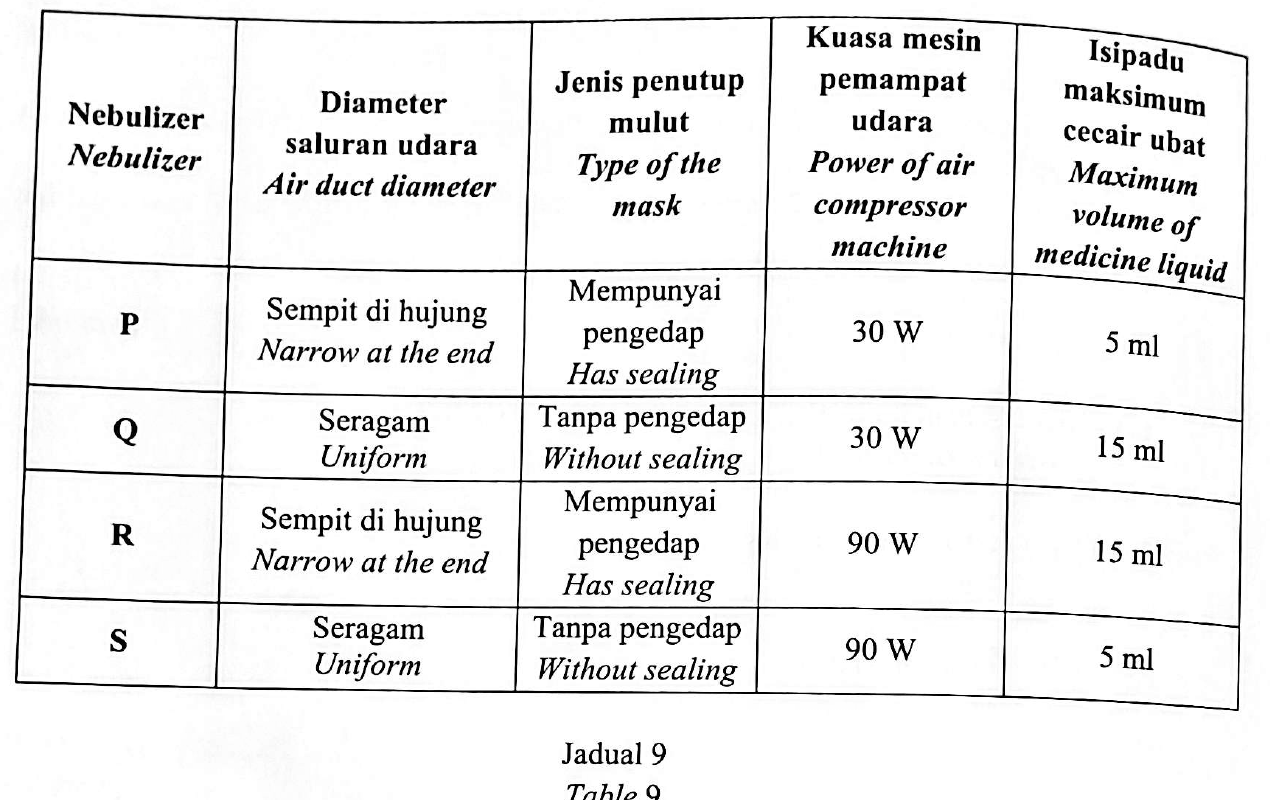
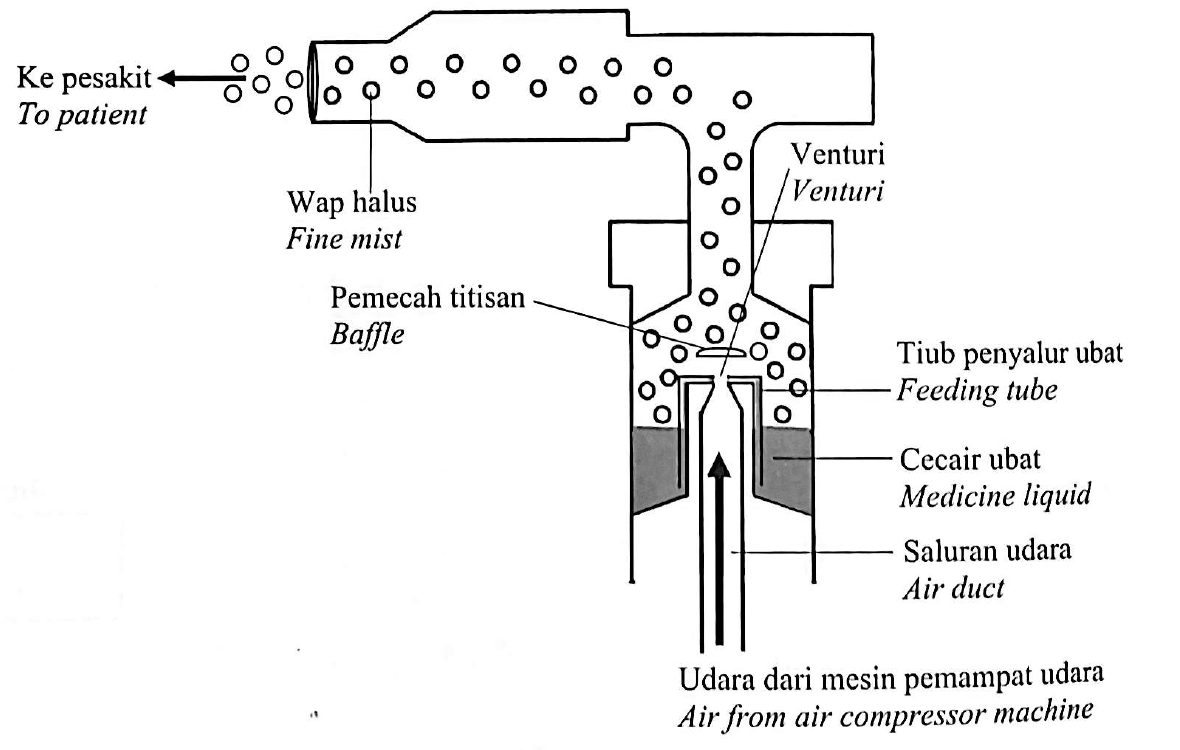
Diagram 9.1 shows an asthmatic patient using a nebulizer. Diagram 9.2 shows the basic structure of the nebulizer (air from air compressor machine passes through the air duct and venturi; feeding tube; medicine liquid; baffle; fine mist to patient). Nebulizers work based on Bernoulli's principle, where liquid medicine is converted into fine mist so that it can be easily absorbed into the lungs.
Hard20 marks- (a)
State the Bernoulli's principle.
[1] - (b)
Based on Diagram 9.2, describe how medicine liquid can be converted into fine mist.
[4]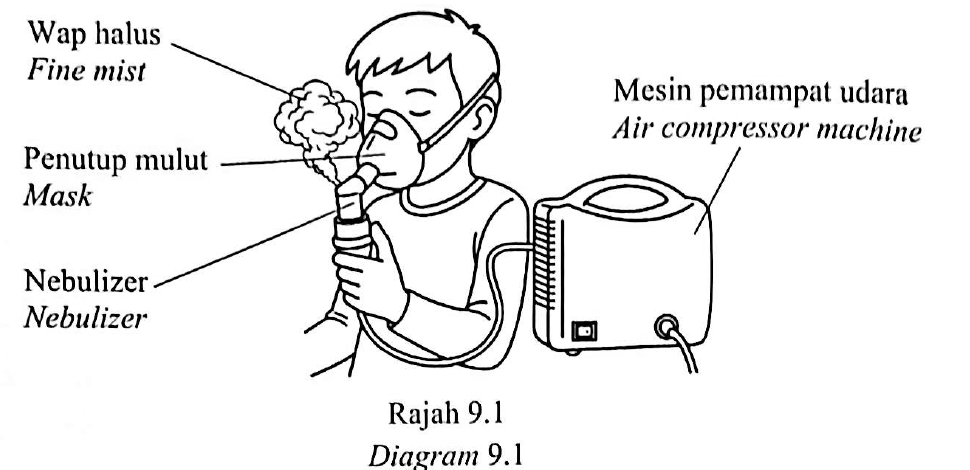
- (c)(i)
Based on Diagram 9.2, state the area with high velocity of air.
[1] - (c)(ii)
State the area with high pressure (BM paper: low pressure).
[1] - (d)(i)
The air pressure at the surface of the medicine liquid is 101 325 Pa while the air pressure when air is flowed in the venturi area is 100 000 Pa. Calculate the difference in air pressure.
[1] - (d)(ii)
Given the surface area of the medicine liquid is 2.5 × 10⁻⁶ m². Calculate the force that pushes the medicine liquid out through the medicine feeding tube.
[2] - (e)
The nebulizer in Diagram 9.1 was found to be unable to effectively supply a fine mist of medicine liquid over a longer treatment period. Table 9 shows four types of nebulizers P, Q, R and S (air duct diameter, type of mask, power of air compressor machine, maximum volume of medicine liquid). Based on the specifications in Table 9, you are required to determine the most suitable nebulizer to effectively supply a fine mist of liquid medicine over a longer treatment period. Explain the suitability of each specification and determine the most suitable nebulizer. Give reasons for your choice. Table 9: P - narrow at the end, has sealing, 30 W, 5 ml; Q - uniform, without sealing, 30 W, 15 ml; R - narrow at the end, has sealing, 90 W, 15 ml; S - uniform, without sealing, 90 W, 5 ml.
[10]