SELANGOR SET 1 2021 P2 Q10
HardWrite your answer on paper. Then open the answer to check it.
Diagrams 10.1(a) and 10.1(b) show the apparatus used by a student to study a physics principle. In 10.1(a) the weight of an object measured by a spring balance in air is 6.0 N. In 10.1(b) the object is lowered until fully submerged in water; its weight in water is 4.8 N and the weight of the water displaced is 1.2 N. The density of water is 1 × 10³ kg m⁻³.
Hard20 marks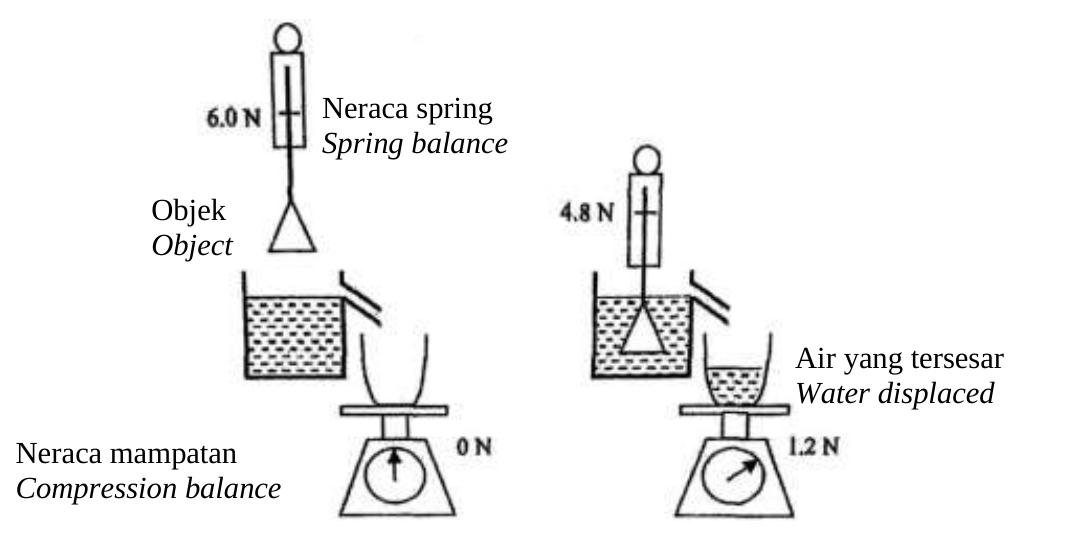
- (a)
Name the physics principle involved.
[1] - (b)(i)
Based on Diagrams 10.1(a) and (b), what is the buoyant force acting on the object?
[1] - (b)(ii)
Compare the buoyant force and the weight of water displaced by the object.
[1] - (b)(iii)
Calculate the volume of the object.
[3] - (c)
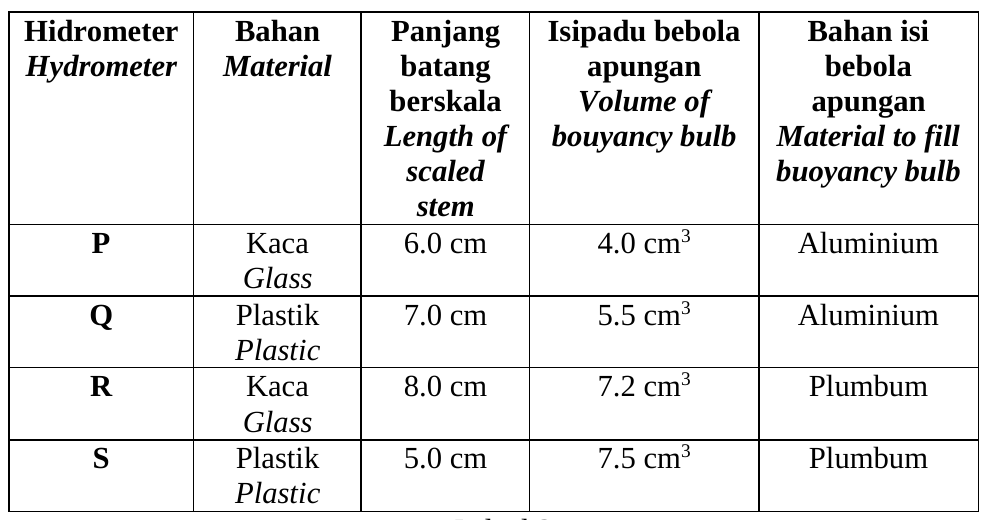
A hydrometer measures the relative density of liquids based on buoyancy (Diagram 10.2: sealed hollow glass tube with a wider buoyancy bulb, a ballast bulb and a narrow stem with a scale). Table 3 shows the characteristics of hydrometers P (glass, 6.0 cm stem, 4.0 cm³ bulb, aluminium), Q (plastic, 7.0 cm, 5.5 cm³, aluminium), R (glass, 8.0 cm, 7.2 cm³, lead) and S (plastic, 5.0 cm, 7.5 cm³, lead). Explain the suitability of each characteristic listed and determine which hydrometer should be chosen. Give reasons for your choice.
[10]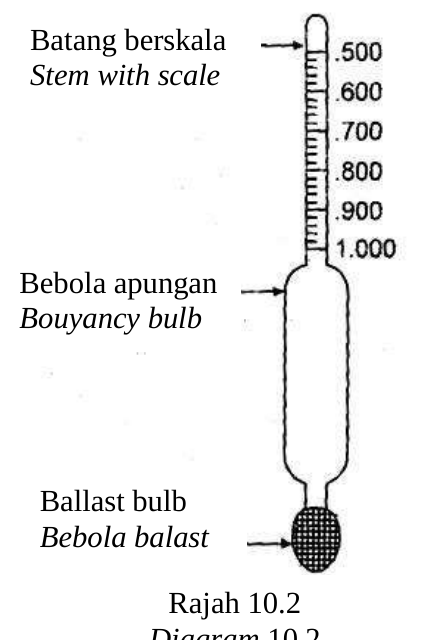
- (d)
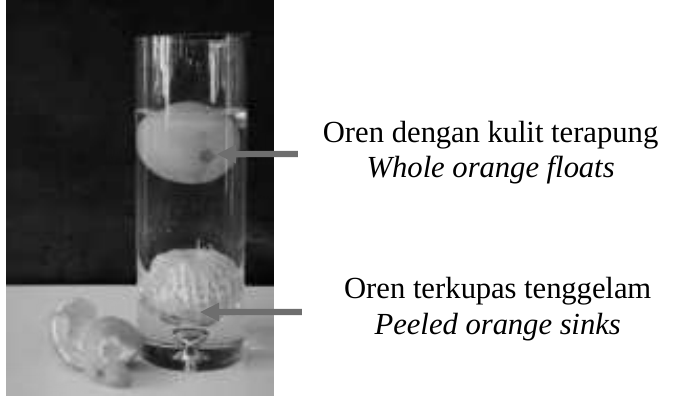
Diagram 10.2 shows an orange floating on the surface while a peeled orange sinks to the bottom of a glass of water. Using Archimedes' Principle, explain how this situation happened.
[4]