TERENGGANU 2025 P2 Q10
HardWrite your answer on paper. Then open the answer to check it.
Diagram 10.1 shows an electrical circuit (cell, ammeter A, voltmeter V, switch S, bulb).
Hard20 marks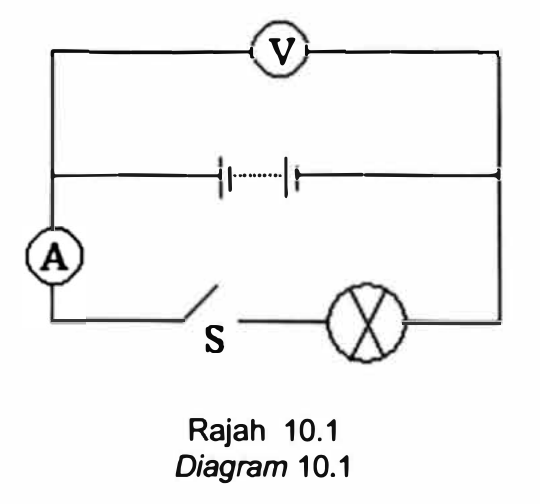
- (a)(i)
What is the function of the ammeter?
[1] - (a)(ii)
Explain what happens to the ammeter reading and voltmeter reading before and after switch S is turned on.
[4] - (b)
You are given 4 dry cells each with e.m.f. 1.5 V and internal resistance 0.5 Ω, 3 bulbs labelled 2.4 V, 0.8 W and connecting wires. Table 10 shows four different circuits W, X, Y and Z (W: filament bulbs type III connection, dry cells type I, high-resistance wires; X: dry cells type II, filament bulbs type IV, low-resistance wires; Y: dry cells type II, LED bulbs type III, low-resistance wires; Z: dry cells type I, LED bulbs type IV, high-resistance wires). Based on Table 10, state the characteristics of the circuit that are suitable for lighting a bulb more brightly and not easily burnt. Give reasons for the suitability of each characteristic. Determine the most suitable circuit to use.
[10]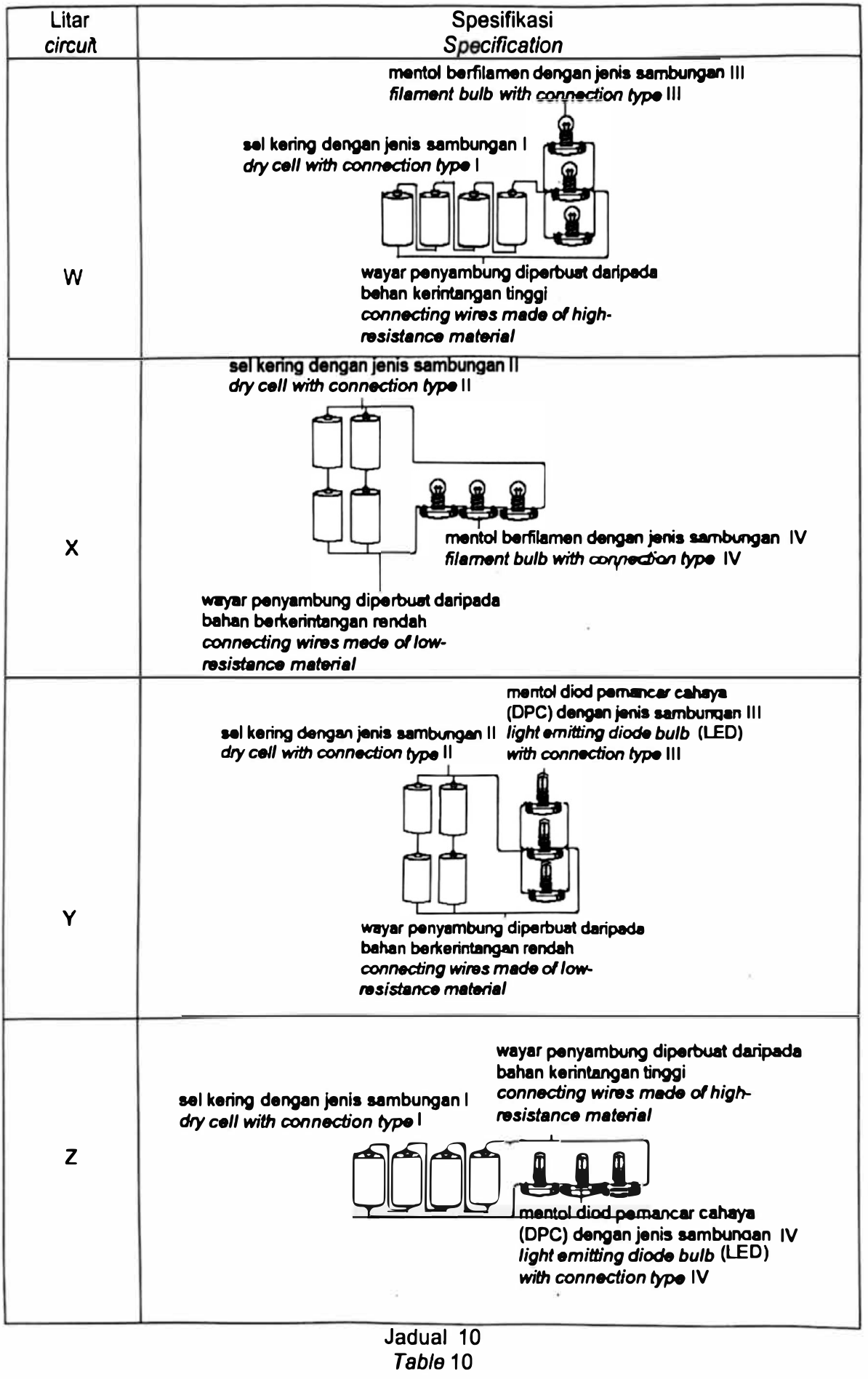
- (c)(i)
Diagram 10.2 shows an electric circuit (12 V cell; branch with S and 6 Ω in parallel with 4 Ω + 10 Ω in series). The ammeter reading is 0.857 A when switch S is opened. Calculate the effective resistance of the circuit.
[1]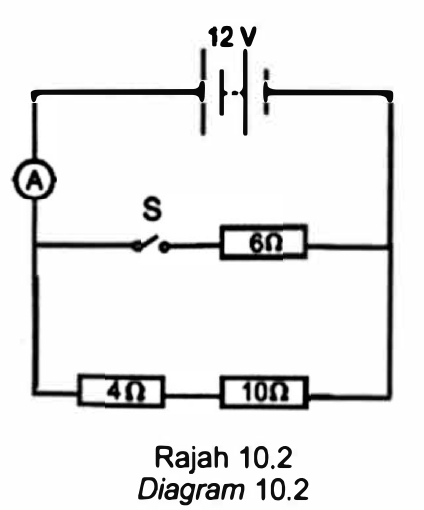
- (c)(ii)
Calculate the effective resistance when switch S is closed.
[2] - (c)(iii)
Calculate the ammeter reading when switch S is closed.
[2]