JOHOR 2021 P1 Q7
EasyWrite your answer on paper. Then open the answer to check it.
(a) Express the function f(x) = −2(x + 1/4) − 49/8 in the form of intercept. (b) Given the quadratic function f(x) = −x² + 4x + 12 where a = −1, b = 4 and c = 12: (i) make a generalisation on the shape of the graph when the value of a changes to −8; (ii) if the graph moves 5 units upwards, determine the maximum point.
Easy5 marks- (a)
Express f(x) in the form of intercept.
[2] - (b)(i)
Generalise the shape of the graph when a changes to −8.
[1] - (b)(ii)
Maximum point after the graph moves 5 units upwards.
[2]
(a) The straight line y = 30 touches the curve f(x) = −x² + kx + h at one point. If k = 10, state the equation of the axis of symmetry of the curve. Hence, sketch the graph of the function. (b) The quadratic function f(x) = −3(x − 1/3)² + 4/3 can be expressed in the form f(x) = a(x − p)(x − q), where a, p and q are constants and p > q. Find the values of a, p and q.
Medium8 marks- (a)
State the axis of symmetry and sketch the graph.
[5] - (b)
Find a, p and q.
[3]
Given the quadratic function f(x) = 4x² + 18x − 5.
Medium7 marks- (a)
Using completing the square, express f(x) in the form a(x + p)² + q, where p and q are rational numbers.
[3] - (b)
Find the minimum/maximum point of the function f(x).
[2] - (c)
State the equation of the curve in completing the square form when the graph is reflected in the x-axis.
[2]
The quadratic equation x² + 3(4x + k) = 0, where k is a constant, has roots p and 2p, p ≠ 0. (a) Find the value of p and of k. (b) Hence, form the quadratic equation that has the roots p + 1 and p − 5.
Medium6 marks- (a)
Find the value of p and of k.
[4] - (b)
Form the quadratic equation with roots p + 1 and p − 5.
[2]
Iman is a shot put athlete who will throw a ball from her ear. The ball will fall to the ground after passing its maximum height. The height of the ball, h, in metres, at t seconds above the ground is given by the function h(t) = −t² + 5/2 t + 3/2. (a) State the height of the ball before it was thrown. (b) Using the completing the square method, determine the maximum height, in metres, that can be achieved by the ball after it was thrown by Iman. (c) What is the range of time, in seconds, when the height of the ball exceeded 3 m?
Medium7 marks- (a)
State the height of the ball before it was thrown.
[1] - (b)
Using completing the square, determine the maximum height.
[3] - (c)
Find the range of time when the height exceeds 3 m.
[3]
(a) Complete the table of values in the answer space for the equation y = 3x − x² for 0 ≤ x ≤ 8. Table: x = 0, 1, 2, 3, 4, 5, 6, 7, 8; y = blank. (b) By using a scale of 1 cm to 1 unit on the x-axis and 1 cm to 5 units on the y-axis, draw the graph of y = 3x − x² for 0 ≤ x ≤ 8. [Use the provided graph paper] (c) Hence, on the same graph, draw the line y = −2x + 4 and state the points of intersection.
Easy8 marks
- (a)
Complete the table of values.
[2] - (b)
Draw the graph of y = 3x − x² for 0 ≤ x ≤ 8 on the graph paper.
[3] - (c)
Draw the line y = −2x + 4 on the same graph and state the points of intersection.
[3]
The graph of the quadratic function g(x) = −3(x − 2)² + k passes through the point (0, −13). (a) Find the value of k. (b) Sketch the graph of the function g(x) for 0 ≤ x ≤ 4. (c) If the value of k changes to −6, generalize the effect of the change on (i) the shape and position of the graph, (ii) the equation of the axis of symmetry, (iii) its maximum value.
Medium7 marks- (a)
Find the value of k.
[1] - (b)
Sketch the graph of g(x) for 0 ≤ x ≤ 4.
[3] - (c)(i)
If k changes to −6, the effect on the shape and position of the graph.
[1] - (c)(ii)
The effect on the equation of the axis of symmetry.
[1] - (c)(iii)
The effect on its maximum value.
[1]
Diagram 5 shows part of the graph of the quadratic function f(x) = ax² − 8x + c, where a and c are constants. The graph is a U-shaped curve cutting the x-axis at m (negative) and n (positive) and the y-axis below the origin.
Medium7 marks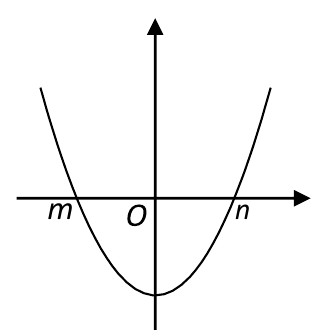
- (a)
State the range of values of x if f(x) > 0.
[2] - (b)
Express the range of values of a in terms of c.
[2] - (c)
Prove that (m + n)/(mn) = 8/c.
[3]
It is given that the quadratic equation 3x² − 5x − 2 = 0 has roots α and β where α > 0 and β < 0. (a) Find the sum of roots and the product of roots. (b) Form the quadratic equation with roots α − 1 and β + 3/4.
Medium6 marks- (a)
Find the sum and the product of the roots.
[2] - (b)
Form the quadratic equation with roots α − 1 and β + 3/4.
[4]
(a) The graph is of the function y = 3x² + 2x. If the linear relationship y = −x + 4 is drawn on the same graph, at what value of x will the graphs meet? (b) A soccer player kicks a ball and the height h of the ball after t seconds is h = 16 − 4t². Sketch the graph of h = 16 − 4t² in the answer space and determine when h = 0.
Easy4 marks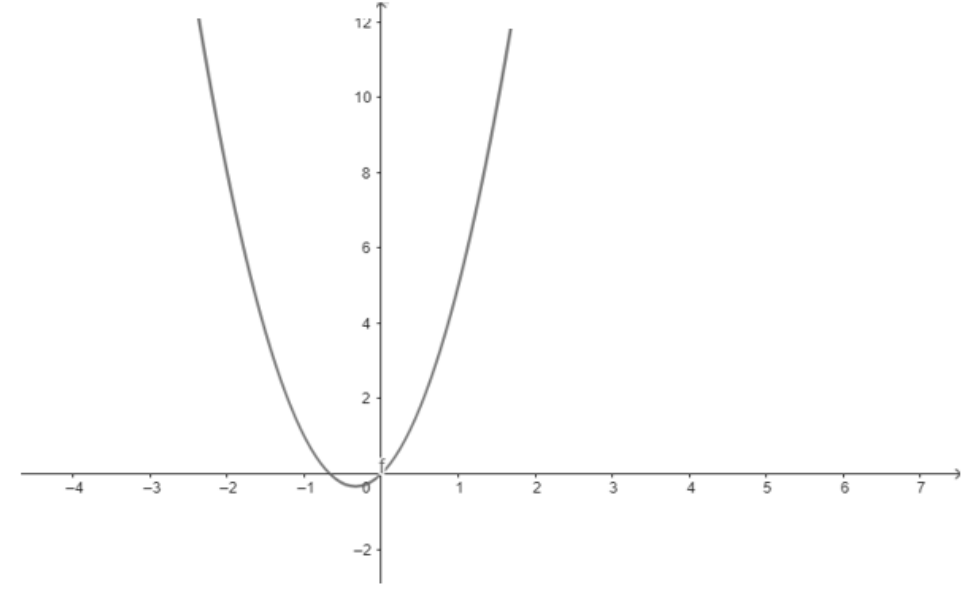
- (a)
At what value of x will the graph of y = 3x² + 2x meet the line y = −x + 4?
[2] - (b)
Sketch the graph of h = 16 − 4t² (axes provided) and determine when h = 0.
[2]
The curve of the quadratic function g(x) = (x − 3h)² − 2k intersects the x-axis at (−1, 0) and (9, 0), and the straight line x = 4 passes through the minimum point of the curve.
Medium7 marks- (a)
Find the values of h and k.
[3] - (b)
Hence, sketch the graph of g(x) for −2 ≤ x ≤ 10.
[3]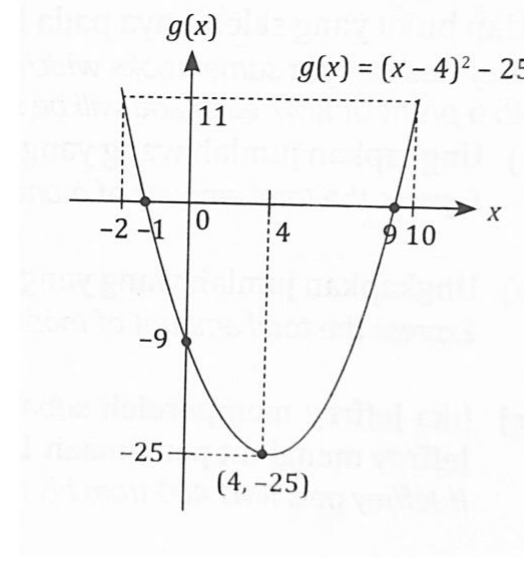
- (c)
Write an equation for the curve if the graph is reflected in the y-axis.
[1]
Given that the quadratic function f(x) = a(x − 2)² + k passes through the point (0, −8) and has the tangent y = 4 at the maximum point.
Medium7 marks- (a)
Find the values of a and k.
[2] - (b)
Sketch the graph of f(x) = a(x − 2)² + k for 0 ≤ x ≤ 4. Hence state the change in the position of the graph when k changes to −4.
[5]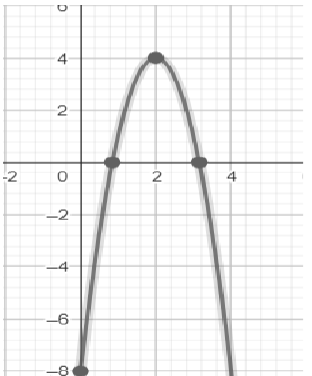
(a) The quadratic equation 3x² − x + k = kx − 1, where k is a constant, has two distinct roots. Find the range of values of k. (b) Diagram 5 shows the graph of quadratic function y = f(x) with a minimum point (3, −7); the graph passes through (0, 5). Express f(x) in the form a(x + p)² + q where a, p and q are constants. (c) If the graph in Diagram 5 is reflected in the x-axis, write the new f(x) and state whether the axis of symmetry changes.
Medium7 marks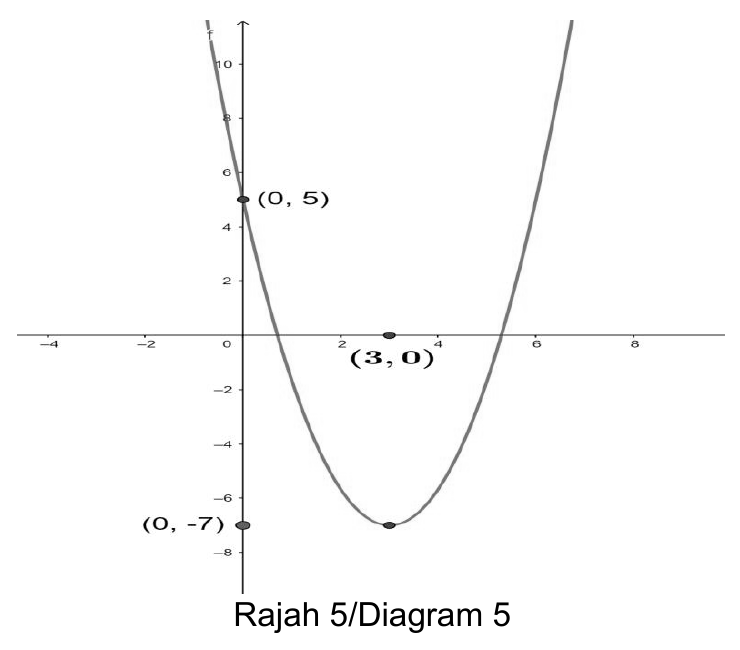
- (a)
Find the range of values of k.
[3] - (b)
Express f(x) in the form a(x + p)² + q.
[2] - (c)
Write the new f(x) after reflection in the x-axis; does the axis of symmetry change?
[2]
Given α and β are the roots of the quadratic equation 3x² − 7x = 2x − 6. Form a quadratic equation with the following roots: (a) α/β and β/α, (b) α²β and β²α.
Medium6 marks- (a)
Form a quadratic equation with roots α/β and β/α.
[3] - (b)
Form a quadratic equation with roots α²β and β²α.
[3]
A quadratic function is given as f(x) = a(x − 2)² + k. The graph of f(x) passes through the point (0, 5) and has a tangent y = −3 at the minimum point. (a) Find the values of a and k. (b) Sketch the graph of f(x) = a(x − 2)² + k for the domain 0 ≤ x ≤ 4. Hence, state the change in the position of the graph when the value of h changes to 4.
Medium7 marks- (a)
Find the values of a and k.
[3] - (b)
Sketch the graph of f(x) for the domain 0 ≤ x ≤ 4 (blank axes provided). Hence, state the change in the position of the graph when the value of h changes to 4.
[4]
A quadratic function f(x) = a(x − 2)² + k passes through the point (0, 5) and has a tangent y = −3 at the minimum point. (a) Find the values of a and k. (b) Sketch the graph of f(x) = a(x − 2)² + k for the domain 0 ≤ x ≤ 4. Hence, state the change in the position of the graph when the value of k changes to 4.
Medium7 marks- (a)
Find the values of a and k.
[2] - (b)
Sketch the graph for 0 ≤ x ≤ 4. State the change in position when k changes to 4.
[5]
Diagram 2 shows the locus of a dolphin jumping out of the water surface. The locus meets the x-axis at x = k and at (4, 0), which are 5 metres apart. The maximum height is 3.125 m. Point A(−2, −3) is on the locus.
Medium4 marks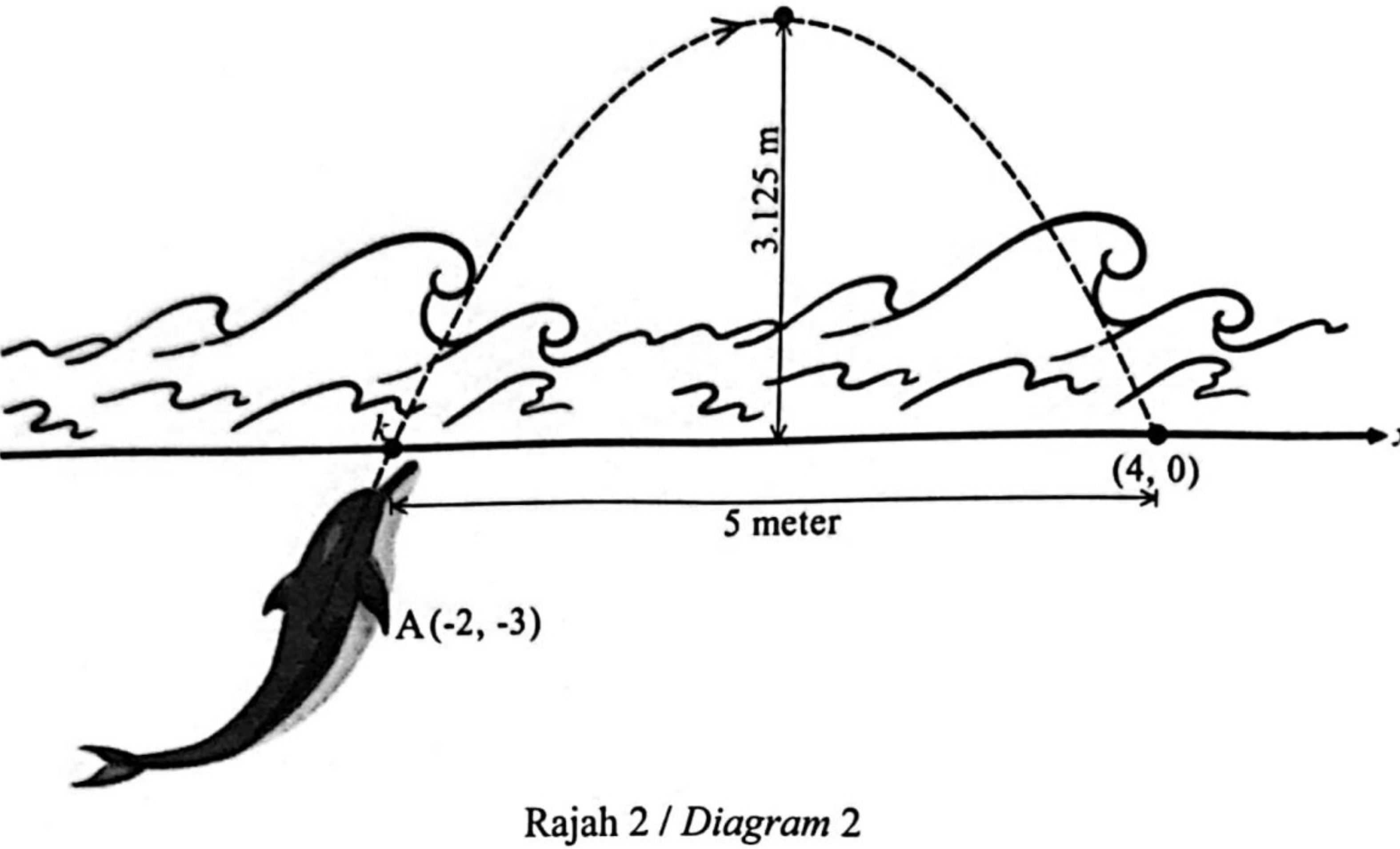
- (a)
Find the value of k.
[1] - (b)
Form the function for the locus of the dolphin's jump in intercept form.
[3]
Diagram 15(a) shows a hammock tied to two supporting sticks such that the lowest point of the hammock is at a height of h m above the water surface. The function of the height of the hammock from the water surface is f(x) = (2/3)x² − (4/3)x + 1, where x, in metres, is a horizontal distance measured from the left stick.
Medium8 marks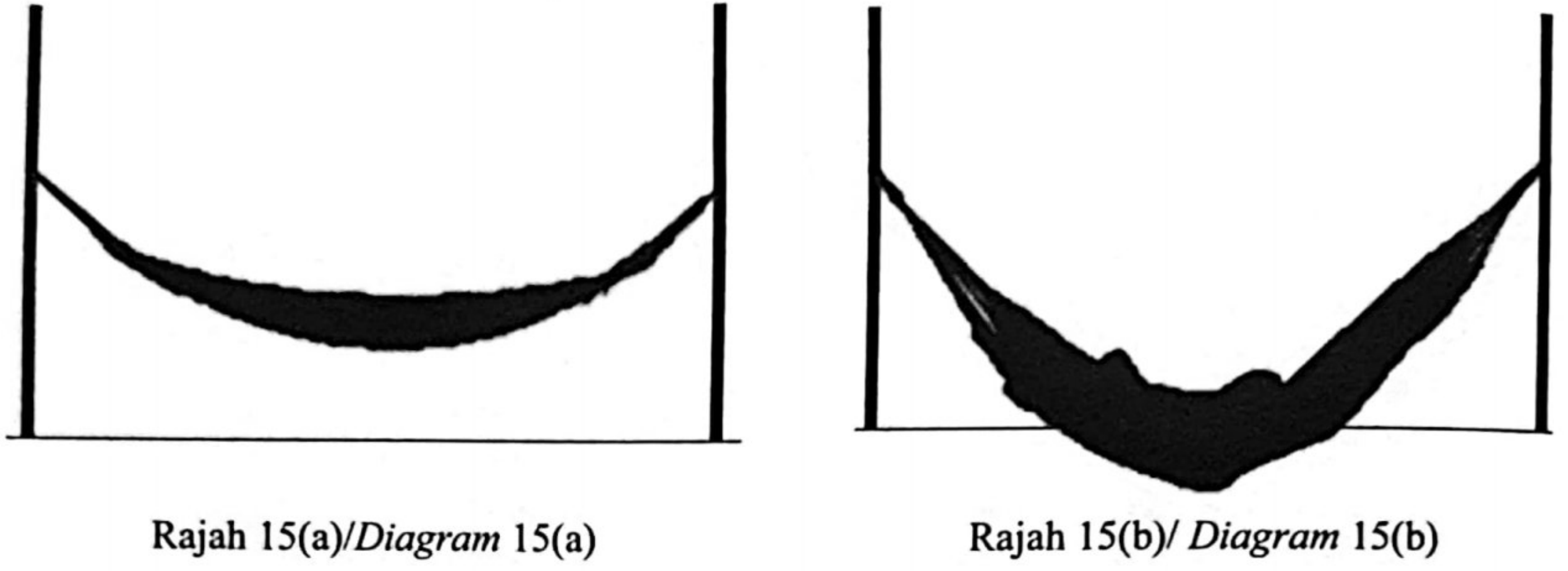
- (a)
Calculate the value of h.
[3] - (b)(i)
A tourist lays down on the hammock causing it to drop by 0.5 metre as shown in Diagram 15(b). Show that, by using discriminant, the hammock will be under the water surface when the tourist lies down on the hammock.
[3] - (b)(ii)
Find the domain where parts of the tourist's body is below the surface of the water.
[2]
(a) Using the number line method, find the range of x if 2x² ≥ −5x + 3. (b) Using completing the square, find the maximum or minimum point of f(x) = 2x² − 12x + 10. Hence state the equation of the axis of symmetry.
Medium6 marks- (a)
By the number line method, find the range of x if 2x² ≥ −5x + 3.
[3] - (b)
By completing the square, find the maximum or minimum point of f(x) = 2x² − 12x + 10. Hence state the equation of the axis of symmetry.
[3]
Diagram 13 shows Adam training for the state volleyball tournament. Adam's serve function is f(x) = −(3/100)x² + (1/5)x + 13/4, where x is the distance from the end line of the court. He does a jump serve when the ball is at (0, 3.25). The net is 2.43 m high and 9.00 m from the start of the court as shown (5.00 m + 9.00 m).
Medium8 marks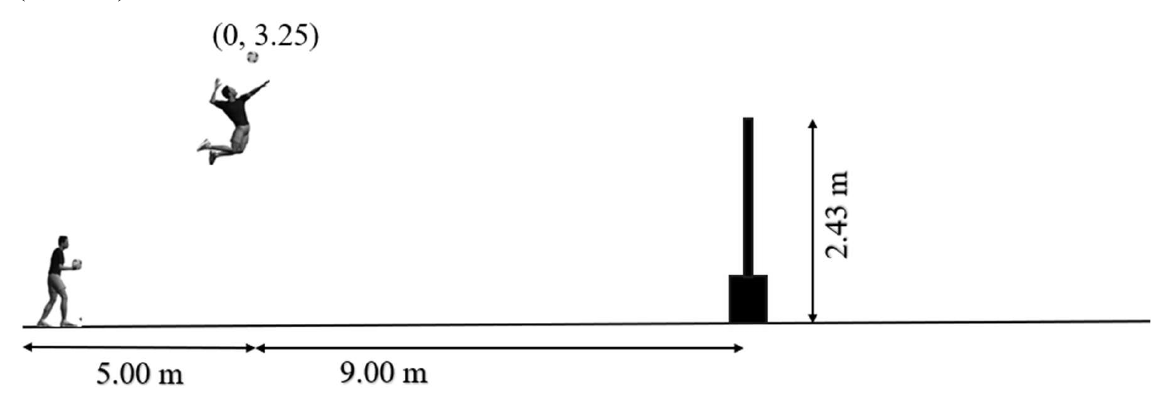
- (a)
Express the service function f(x) in vertex form. Determine the maximum height of the ball.
[3] - (b)
Determine the height of the ball, in metres, above the net when the ball passes over the net.
[2] - (c)
Is Adam's service expected to score points for his team? Support your explanation with calculations.
[2] - (d)
Hence sketch the graph of the locus of the moving ball.
[1]
Diagram 6 shows the parabolic locus of two frogs of different species, starting at (0, 0). The maximum height of the leap of both frogs is 25 cm and the horizontal leap distance of frog P is 50 cm. (a) Write a quadratic function f(x), representing the locus of frog P, in general form. (b) The locus of frog Q is g(x) = −x²/64 + 5x/4. Express g(x) in vertex form, hence state the horizontal leaping distance of frog Q, in cm. (c) If a₁ and a₂ are the coefficients of x² for f(x) and g(x) respectively, state the relation between the coefficients of x² of both functions and the horizontal distance of the frogs. Give your justification.
Medium8 marks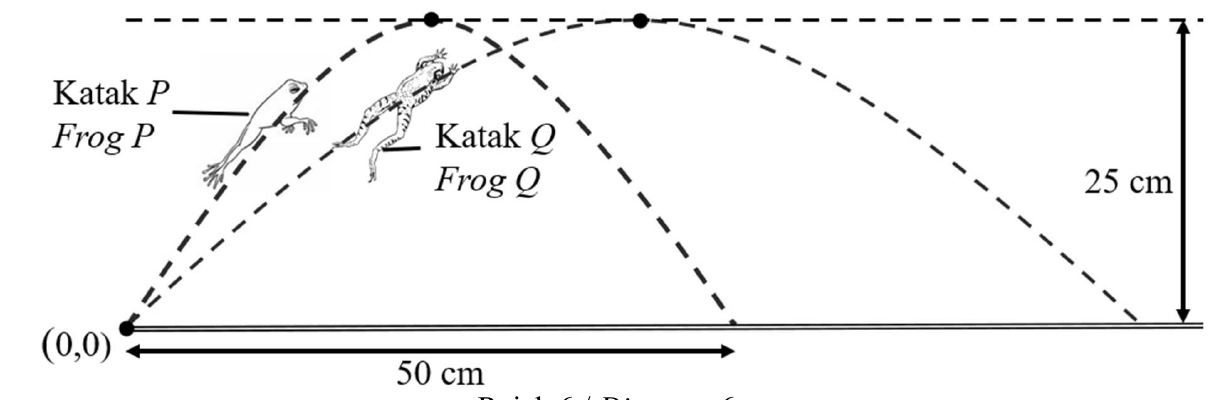
- (a)
Write a quadratic function f(x) for frog P in general form.
[3] - (b)(i)
Express g(x) in vertex form.
[2] - (b)(ii)
State the horizontal leaping distance of frog Q, in cm.
[1] - (c)
State the relation between the coefficients of x² and the horizontal distance of the frogs. Give your justification.
[2]
The quadratic equation 3x² − 4x + c = 0 has no real roots and c is a positive integer. (a) C₁ and C₂ are the two smallest values of c. State the possible values of C₁ and C₂. (b) Hence, if c is the difference between C₁ and C₂ in (a), determine the type of roots of 3x² − 4x + c = 0.
Easy4 marks- (a)
State the possible values of C₁ and C₂, the two smallest values of c.
[2] - (b)
Determine the type of roots of 3x² − 4x + c = 0 when c = C₂ − C₁.
[2]
The differentiation method is not accepted for this question. Diagram 14 gives the annual profit function U(x) = −2x² + 16x − 24 (in millions of Malaysian Ringgit) of a company that sells an AI technology product, where x is the selling price (in thousands of Malaysian Ringgit). (a) Determine the range of selling prices for the company to avoid incurring losses. (b) Find the optimal selling price and the expected maximum annual profit.
Medium8 marks- (a)
Determine the range of selling prices for the company to avoid incurring losses.
[4] - (b)
Find the optimal selling price and the expected maximum annual profit.
[4]
Diagram 2 shows the graph of the quadratic function f(x) = a(x + 1)² + 8 + 2k, where a and k are constants. The curve has a minimum point on the line y = 12.
Easy4 marks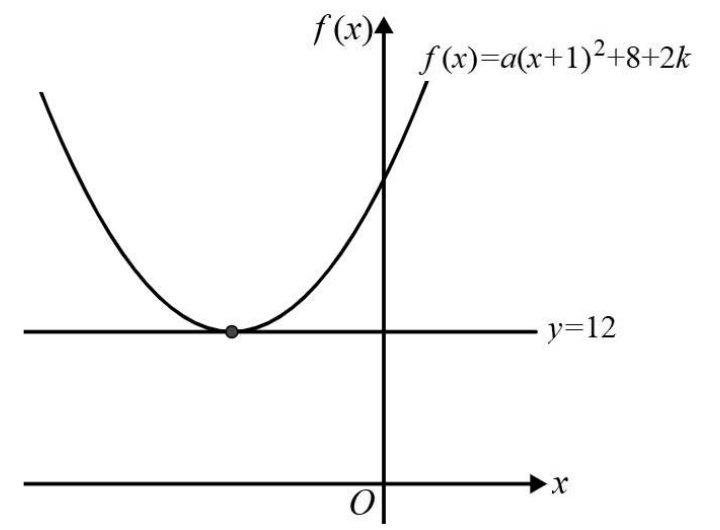
- (a)(i)
State the range of values of a.
[1] - (a)(ii)
State the equation of the axis of symmetry of the curve.
[1] - (b)
Find the value of k.
[2]
Diagram 14 shows part of the curve of the quadratic function g(x) = −x² + px − 6. The maximum point is A(3, k) and the curve cuts the g(x)-axis at B.
Medium8 marks- (a)
By using the method of completing the square, find the values of p and of k.
[4]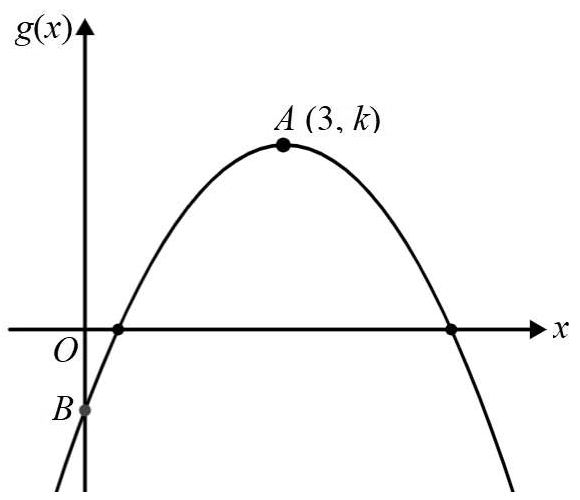
- (b)
State the coordinates of B.
[1] - (c)
Determine the range of values of x if g(x) ≤ 2.
[3]
The curve of a quadratic function f(x) = −(x − k)² − 2h + 1 intercepts the x-axis at points (−2, 0) and (4, 0). The straight line y = 9 touches the maximum point of the curve.
Easy4 marks- (a)
Find the value of h and of k.
[2] - (b)
Hence, sketch the graph of f(x) for −2 ≤ x ≤ 5.
[2]
Diagram 13 shows a three-panel window to be installed in a house. The smaller panels have the same width of 0.5 m. The total width of the window is twice its height. The area of the middle panel is 3 m². [Ignore the frame width]
Medium8 marks
- (a)
Find the height of the window.
[5] - (b)
Find the perimeter of the whole window.
[3]
(a) Diagram 14(a) shows a rectangular piece of land ABCD with AB = x m and BD = (x + 3) m (the vegetable area is the triangle ABD). Mr Azizan plants vegetables on part of the land with AB at least 0.5 m. (b) Diagram 14(b) shows a golf ball hit so that it moves in a parabolic path. Its height from the ground, h m, after t seconds is given by h(t) = 15t − (15/8)t².
Medium8 marks- (a)
Determine the range of BD so that the area of land for vegetables is not more than 27 m².
[4]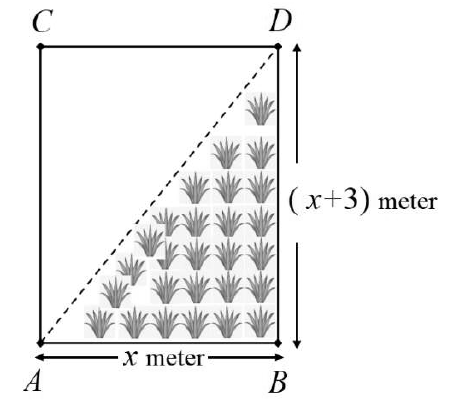
- (b)(i)
Find the maximum height of the ball.
[2]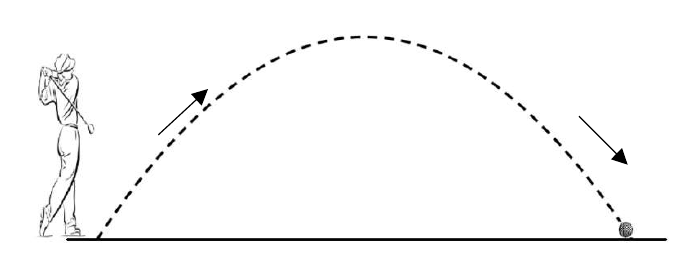
- (b)(ii)
Determine the range of time, in the nearest integer, if the position of the ball is more than 20 metres above the ground.
[2]
(a) Determine the range of x for x(8 − x) ≤ 15. (b) The roots of the quadratic equation 2x² − 7x + 1 = 0 are α and β, while the roots of the quadratic equation 8x² + px + q = 0 are α + β and α² + β². Calculate the value and the values of p and q.
Medium6 marks- (a)
Determine the range of x for x(8 − x) ≤ 15.
[2] - (b)
Roots of 2x² − 7x + 1 = 0 are α and β; roots of 8x² + px + q = 0 are α + β and α² + β². Calculate p and q.
[4]
(a) Given 4x² − 3y − 1 = 0, find the range of values of x if y < 5. (b) If one root of the quadratic equation x² − (10 − (5/2)m)x + 2/m = 0 is the reciprocal of the other root, find the value of its discriminant.
Medium5 marks- (a)
Given 4x² − 3y − 1 = 0, find the range of values of x if y < 5.
[2] - (b)
If one root of x² − (10 − (5/2)m)x + 2/m = 0 is the reciprocal of the other root, find the value of its discriminant.
[3]
(a) Given that the quadratic equation ax² + bx + c = 0 (a, b, c constants, a ≠ 0) has roots α and β, show that α + β = −b/a and αβ = c/a. (b) Sketch the graph of the quadratic function f(x) = 2(x + 2)² + 3. Hence form the quadratic equation if the graph is shifted 3 units to the right.
Medium8 marks- (a)
Show that α + β = −b/a and αβ = c/a.
[5] - (b)
Sketch f(x) = 2(x + 2)² + 3; form the equation after a shift of 3 units to the right.
[3]
Diagram 1 shows the graph y = 2x² + kx (a curve cutting the x-axis at x = −5 and at the origin). Based on the graph, a table of y/x against x is obtained: y/x = −6 when x = p, and y/x = q when x = −2. Calculate the values of k, p and q.
Easy5 marks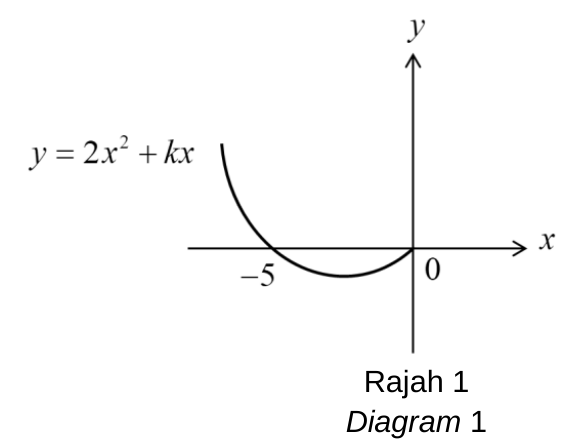
Calculate the values of k, p and q.
[5]
(a) Find the range of values of x if y < 10 and 2x² − 3y + 4x = 0. (b) Given 2x² − 8x − 10 = a(x + b)² + c where a, b and c are constants. Find the values of a, b and c, hence find the minimum value of the expression 2x² − 8x − 10.
Medium8 marks- (a)
Find the range of values of x if y < 10 and 2x² − 3y + 4x = 0.
[4] - (b)
Find the values of a, b and c, hence find the minimum value of 2x² − 8x − 10.
[4]
Diagram 4 shows part of the graph of the function f(x) = 2x² − (n − 1)x + 7, where m and n are constants. The graph cuts the x-axis at x = m and x = n − 9. (a) Find the values of m and of n if m < 1. (b) Express f(x) in vertex form. Hence, state the equation of the axis of symmetry.
Medium8 marks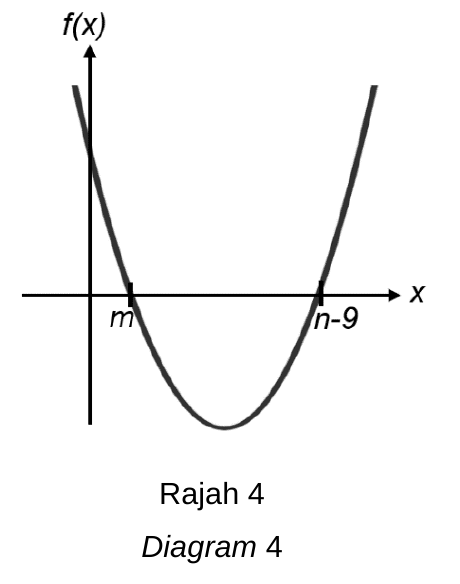
- (a)
Find the values of m and of n if m < 1.
[5] - (b)
Express f(x) in vertex form. Hence, state the equation of the axis of symmetry.
[3]
(a) Solve the quadratic equation 3x² − 5x + 3 = 0. Give the answer in the form a + bi. (b) The quadratic equation (x² + 1)h + k = (2h − k)x has two equal real roots, determine the ratio h : k.
Easy6 marks- (a)
Solve 3x² − 5x + 3 = 0. Give the answer in the form a + bi.
[3] - (b)
The equation (x² + 1)h + k = (2h − k)x has two equal real roots. Determine the ratio h : k.
[3]
Diagram 3 shows the quadratic functions y = f(x) and y = g(x). Given f(x) = x² + px + 9 and g(x) = −x² + 4x + 2q. These two quadratic functions have the same axis of symmetry. (a) Find the range of values of p. (b) By using completing the square, express q in terms of p.
Medium7 marks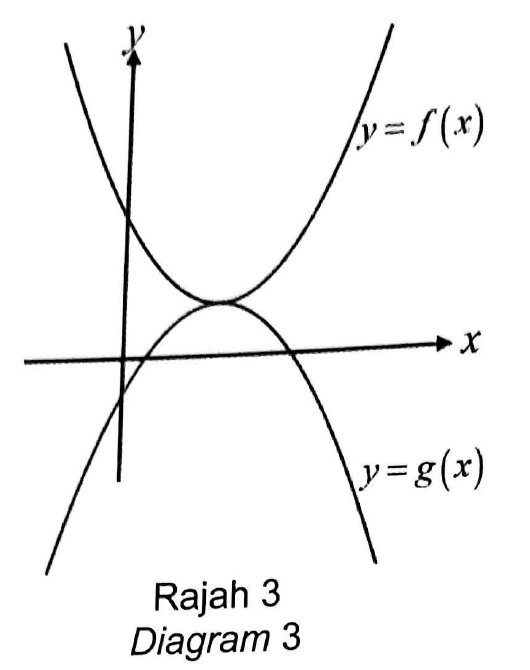
- (a)
Find the range of values of p.
[3] - (b)
By completing the square, express q in terms of p.
[4]
Diagram 4 shows the quadratic function f(x) = x² − (p − 2)x + 4, which has a minimum point (h, −k). The graph y = f(x) cuts the x-axis at two points and the y-axis above the origin.
Medium8 marks- (a)(i)
Express p in terms of h.
[2]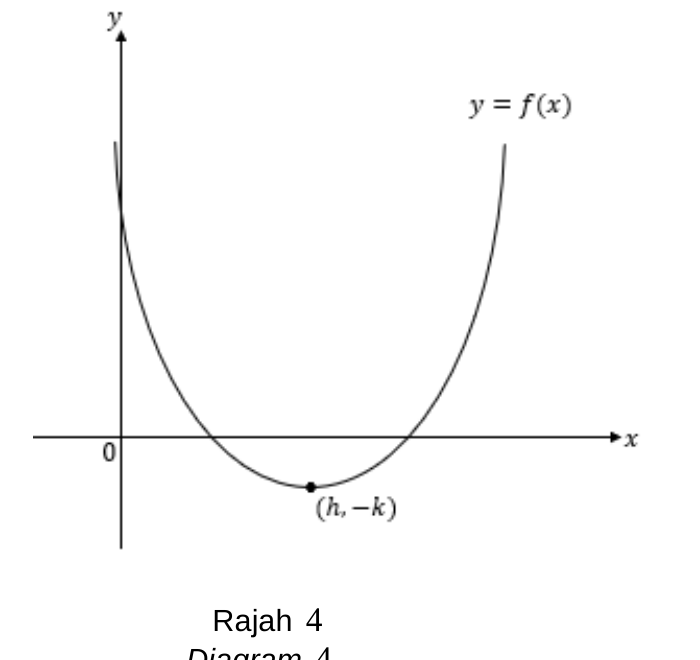
- (a)(ii)
By using the number line method, find the range of values of p, if the minimum point is (h, k), the y-intercept does not change.
[3] - (b)(i)
Given that 2 + 2i and 2 − 2i are the roots of a quadratic equation. Find the value of the discriminant of the quadratic equation.
[1] - (b)(ii)
Form the quadratic equation.
[2]
Quadratic equations and functions.
Medium8 marks- (a)
Given a quadratic equation ax² + bx + c = 0, by using completing the square, derive the formula x = (−b ± √(b² − 4ac))/(2a).
[3] - (b)
Express f(x) = 3x² + 15x − 18 in the form f(x) = a(x + p)(x + q). Hence, find the turning point and sketch the graph of the quadratic function.
[5]
Quadratic functions.
Medium5 marks- (a)
Diagram 1 shows the graph of a quadratic function y = f(x). The straight line y = −9 is a tangent to the curve y = f(x). The curve crosses the x-axis at x = 1 and x = 7. Express f(x) in the form (x + p)² + q, where p and q are constants, if the graph is reflected about the x-axis.
[2]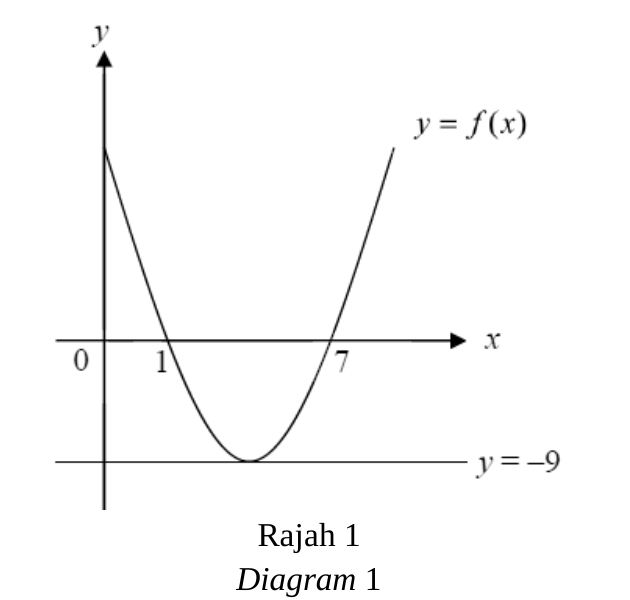
- (b)
Given (−2, 5) is the maximum point of the graph of the quadratic function f(x) = 3m − (2n + x)², where m and n are constants. Determine the value of m and of n.
[3]
Given that the function f(x) = 2x² − nx + p has a minimum point at (1, −7).
Medium8 marks- (a)
Find the value of n and of p.
[4] - (b)
Sketch the graph of the function f(x).
[2] - (c)
Hence, find the range of values of h if the function f(x) = h has two distinct roots.
[2]
(a) Form a quadratic equation if the roots are h and 1/h². (b) Given the quadratic equation (k − 2)p² − p + 3 = 0 has no roots, find the range of k.
Medium5 marks- (a)
Form a quadratic equation if the roots are h and 1/h².
[3] - (b)
Given the quadratic equation (k − 2)p² − p + 3 = 0 has no roots, find the range of k.
[2]
(a) Given m and n are the roots of the quadratic equation ax² + bx + c = 0, express c/b in terms of m and n. (b) Express 7 − 6x − 3x² in the form k + a(x − h)². Hence, solve the equation 6 − 6x − 3x² = 0.
Medium7 marks- (a)
Express c/b in terms of m and n.
[3] - (b)
Express 7 − 6x − 3x² in the form k + a(x − h)². Hence, solve 6 − 6x − 3x² = 0.
[4]
Diagram 2 shows the trajectory of a kicked football which follows a parabolic curve. The ball is kicked from the ground; the maximum height is 2 m and the horizontal distance from the kick to where the ball lands is 8 m. Given that the horizontal distance from where the ball is kicked is x m and the height of the ball from the ground is y m, express the trajectory in the form y = a(x − h)² + k.
Easy4 marks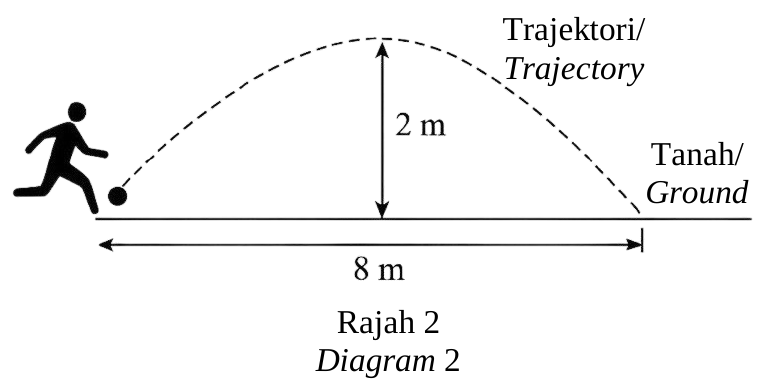
Express the trajectory in the form y = a(x − h)² + k.
[4]
The quadratic function f(x) = 2x² − 6x + 7 has roots α and β. (a) Form a quadratic equation g(x) with roots 3α + 1 and 3β + 1. Hence, by using the method of completing the square, express the equation in vertex form. (b) If |x| > h is the solution of the inequality f(x) + 6x > x² + 16, where h is a constant, find the value of h.
Hard8 marks- (a)
Form the quadratic equation with roots 3α + 1 and 3β + 1, then write it in vertex form by completing the square.
[5] - (b)
If |x| > h is the solution of f(x) + 6x > x² + 16, find h.
[3]
(a) It is given that one of the roots of the quadratic equation x² + (p + 3)x − p² = 0, where p is a constant, is negative of the other. Find the value of the product of the roots. (b) Find the range of values of x such that the quadratic function f(x) = 6 + 5x − x² is negative.
Easy5 marks- (a)
One root is the negative of the other. Find the product of the roots.
[2] - (b)
Find the range of values of x such that f(x) = 6 + 5x − x² is negative.
[3]
A quadratic function f(x) = 2[(x − h)² + k], where h and k are constants, has a minimum point (2t, 3t²). (a) State the value of h and k in terms of t. (b) If t = 2, sketch the graph of f(x) for domain −4 ≤ x ≤ 6. (c) Using the same value of t in question 2(b), find the range of n such that the equation f(x) = n has real roots.
Medium8 marks- (a)
State h and k in terms of t.
[2] - (b)
If t = 2, sketch the graph of f(x) for −4 ≤ x ≤ 6.
[3]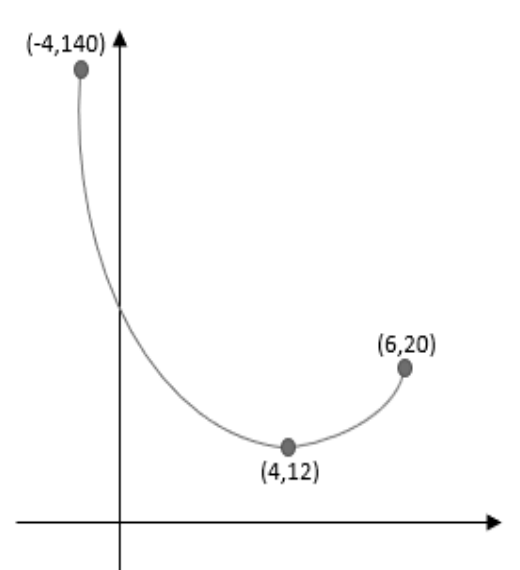
- (c)
Find the range of n such that f(x) = n has real roots.
[3]
Hanif hits a golf ball from A and it drops into the first hole B, 10 m away (Diagram 9; C and D are 1 m and 2 m further). The function h(x) = −x² + 10x represents the height of the ball, in metres. The height of the hall roof is 50 m. (a) Express h(x) in the form h(x) = a(x + p)² + q, where a, p and q are constants. (b) State the maximum height reached by the ball. (c) If Hanif wants the ball to drop into the third hole D, the path passes through point E, 4 m to the right of A and 32 m vertically above the ground. Determine whether the ball can reach the roof of the hall and give your reason.
Medium8 marks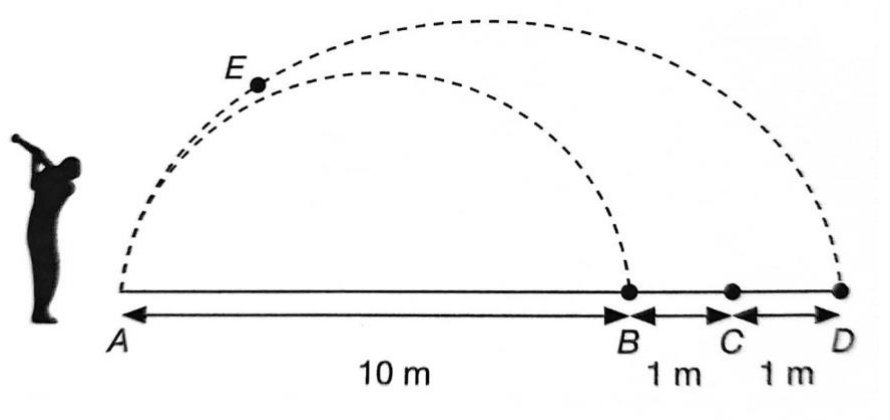
- (a)
Express h(x) in the form h(x) = a(x + p)² + q.
[3] - (b)
State the maximum height reached by the ball, in metres.
[1] - (c)
Path to third hole D (12 m from A) through E (4 m right of A, 32 m high). Can the ball reach the roof (50 m)? Give a reason.
[4]
The curve of a quadratic function f(x) = −(x − p)² + 3q intersects the x-axis at (−1, 0) and (5, 0). The straight line y = 9 is tangent to the maximum point of the curve. (a) Find the value of p and of q. (b) Hence, sketch the graph of f(x) for 0 ≤ x ≤ 6. (c) Write the equation of the curve if the graph is reflected about (i) the x-axis, (ii) the y-axis.
Medium8 marks- (a)
Find the value of p and of q.
[3] - (b)
Hence, sketch the graph of f(x) for 0 ≤ x ≤ 6.
[3]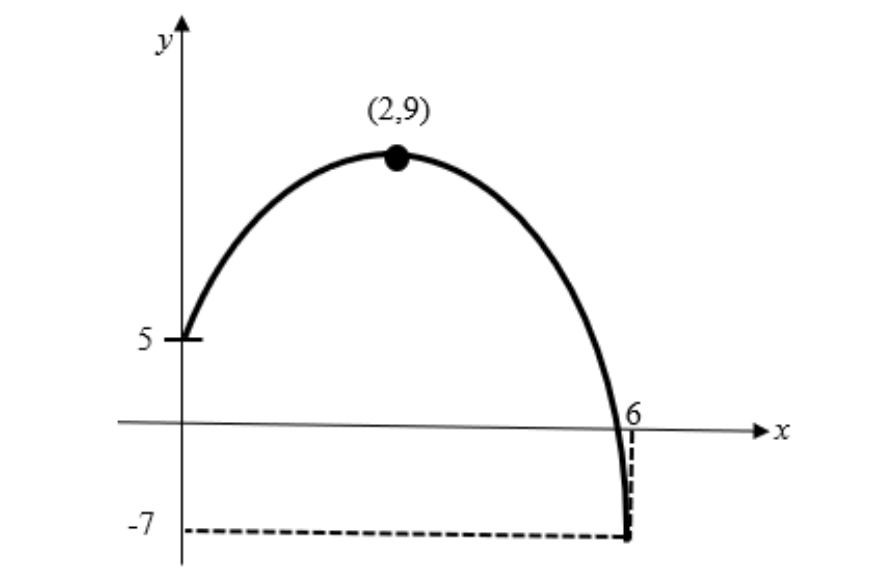
- (c)(i)
Reflected about the x-axis, write the equation of the curve.
[1] - (c)(ii)
Reflected about the y-axis, write the equation of the curve.
[1]
(a) Diagram 3 shows the graph of y = 2x² + 2x + 2 and the straight line OB. Find the range of values of the gradient, m, of the straight line OB. (b) The function T(x) = −5x² + 30x (Diagram 4) represents the height, in metres, of a firework x seconds after it was launched. The firework exploded at its highest point. By using the completing the square method, determine (i) when the firework exploded, (ii) the height at which the firework exploded.
Medium6 marks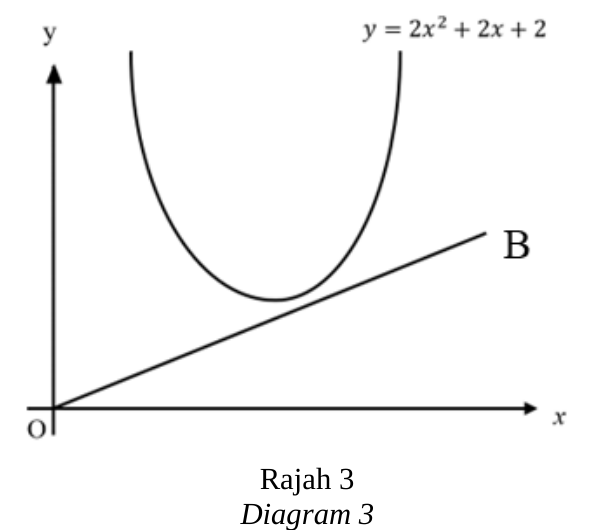
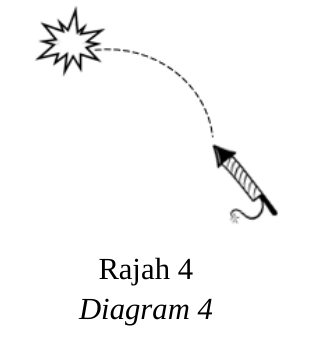
- (a)
Find the range of values of m for line OB (y = mx) that does not meet the curve.
[3] - (b)(i)
When did the firework explode? (completing the square)
[2] - (b)(ii)
What was the height at which the firework exploded?
[1]
Diagram 1 shows a graph of y = 2x² + px + q (x-intercepts 2 and 5). (a) If α and β are the roots of the quadratic equation 2x² + px + q = 0, state (i) α + β, (ii) αβ. (b) Given the roots of 3x² + 2x = 6 are h and k, form a quadratic equation that has roots h/k and k/h. (c) Given the quadratic equation x² + (3h − 1)x = −2h − 10, where h is a constant, has two real and different roots, find the range of values of h.
Medium8 marks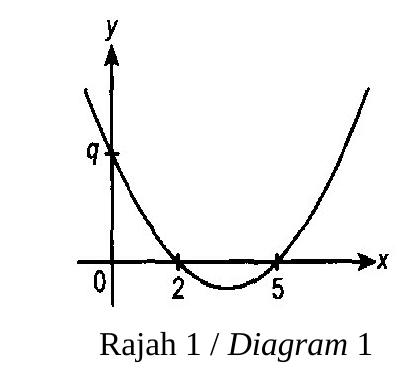
- (a)(i)
State α + β.
[1] - (a)(ii)
State αβ.
[1] - (b)
Form the quadratic equation with roots h/k and k/h.
[3] - (c)
Find the range of h for two real and different roots.
[3]
The quadratic equation x² − 8x + 7 = 0 has roots h and k, where h > k. (a) Find the value of h and of k. (b) Hence, form the quadratic equation which has roots h + 3 and 2k − 1.
Easy5 marks- (a)
Find the value of h and of k.
[2] - (b)
Form the quadratic equation which has roots h + 3 and 2k − 1.
[3]
The function f(x) = x² − 6kx + 10k² + 1 has a minimum value r² + 2k, where r and k are constants. (a) By completing the square, show that r = k − 1. (b) Hence, find the values of k and of r if the graph of the function is symmetrical about x = r² − 1.
Medium8 marks- (a)
By completing the square, show that r = k − 1.
[4] - (b)
Find k and r if the graph is symmetrical about x = r² − 1.
[4]
(a) Express the quadratic equation 3(3x + 4) = (x − 3)(x − 5) − x in the general form ax² + bx + c = 0. Hence, if α and β are the roots of the equation, state the value of α + β and αβ. (b) Given that (x + h)² − j = 0 is a quadratic equation where h = 4 and j = 64, determine the type of roots of the equation.
Easy5 marks- (a)
Express 3(3x + 4) = (x − 3)(x − 5) − x in the form ax² + bx + c = 0. Hence state α + β and αβ.
[3] - (b)
Given (x + h)² − j = 0 with h = 4 and j = 64, determine the type of roots.
[2]
(a) Solve the quadratic inequality x² − 2x > 35 by using the number line method. (b) A quadratic function, g(x) = (x + p)(x + q) intersects the x-axis at points M and N. The distance of point M is 5 units to the left of the y-axis while the distance of point N is 3 units to the right of the y-axis. State the minimum point.
Medium7 marks- (a)
Solve x² − 2x > 35 by the number line method.
[3] - (b)
g(x) = (x + p)(x + q) cuts the x-axis at M (5 units left of the y-axis) and N (3 units right of the y-axis). State the minimum point.
[4]
Diagram 1 shows the cross-section of a semi-circular concrete seat. Given that h(x) = −2x² + 19x − 42 represents the curve of the outer part of the concrete seat, with A and B the end points on the base line. (a) Find the distance AB of the seat. (b) By using the method of completing the square, find the maximum distance of the outside of the curve from AB.
Medium7 marks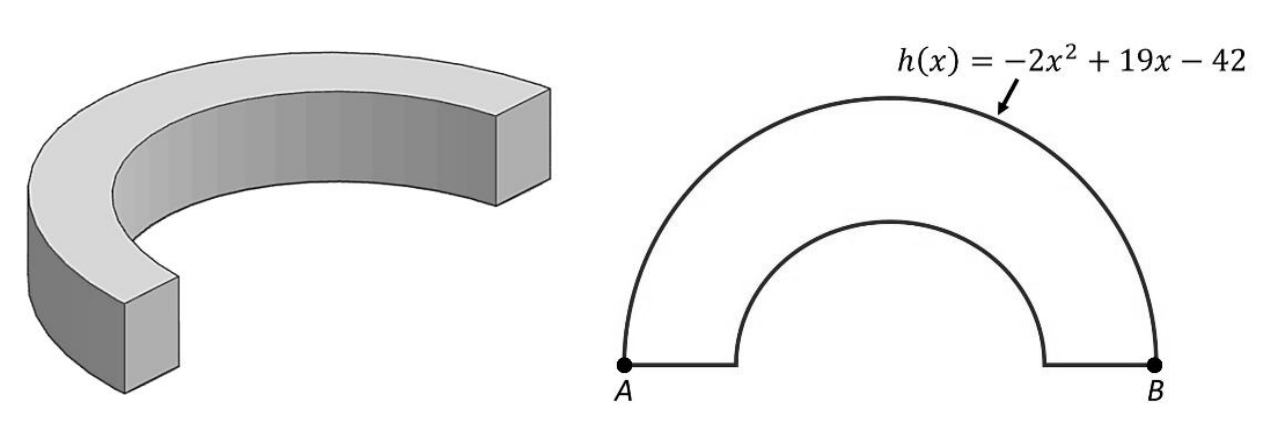
- (a)
Find the distance AB of the seat.
[4] - (b)
By completing the square, find the maximum distance of the outside of the curve from AB.
[3]
(a) Diagram 2 shows a parallelogram ABCD in such a way that the length of AB is 10 units more than the length of AQ (AQ is perpendicular to DC). (b) Diagram 3 shows the graph of y = (x − m)². When the graph is reflected in the line y = 9, the function y = −(x − m)² + q is obtained, where m and q are constants.
Easy5 marks- (a)
If the area of parallelogram ABCD does not exceed p unit², find the range of length AQ in terms of p.
[4]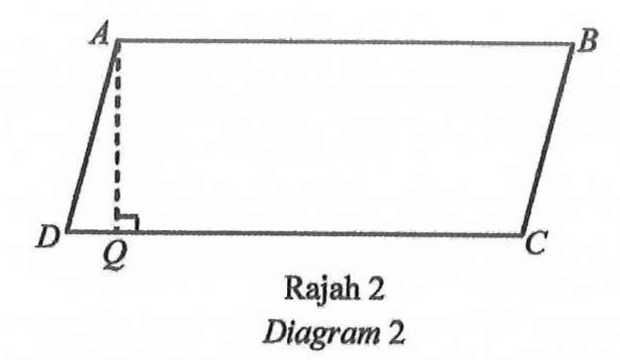
- (b)
Determine the type of roots for −(x − m)² + q = 0.
[1]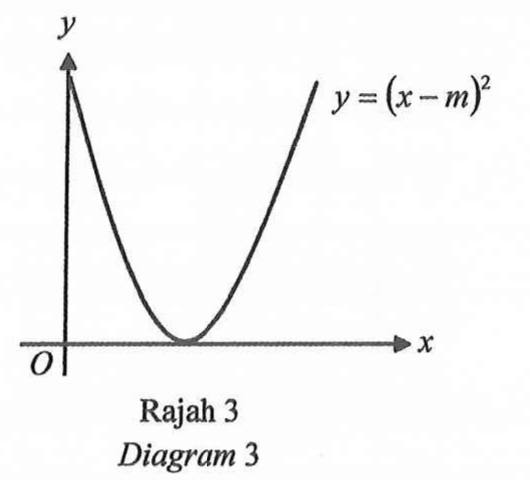
Given the function f(x) = −4x² − 4x + 2.
Medium6 marks- (a)
By using the method of completing the square, express f(x) in the form of f(x) = −4(x + h)² + k.
[2] - (b)
Sketch the graph of f(x) = −4x² − 4x + 2.
[2] - (c)
Given point P(r, s) lies on the graph f(x) = −4x² − 4x + 2 such that s > 0. If the vertical distance of point P from x-axis is 0.44 units, find the horizontal distance of point P from the axis of symmetry of the graph.
[2]
It is given that 2α and 2β are the roots of the quadratic equation x² + mx − 3 = 0. (a) Find the value of m if α + β = −2. (b) Hence, form a quadratic equation with roots α and β.
Easy4 marks- (a)
Find the value of m if α + β = −2.
[2] - (b)
Hence, form a quadratic equation with roots α and β.
[2]
(a) Find the range of values of x for the quadratic inequality −x² < ½(x − 1). (b) Given ax² + bx + c = 0, derive the quadratic formula by using completing the square method.
Medium5 marks- (a)
Find the range of values of x for the quadratic inequality −x² < ½(x − 1).
[3] - (b)
Given ax² + bx + c = 0, derive the quadratic formula by using completing the square method.
[2]
A rock is thrown upward from the top of a cliff facing the ocean. The path of the rock is represented by the function h(t) = −2t² + 8t + 25, where t is the time in seconds and h is the rock's height, in m, from the sea level. (a) (i) Express h(t) = −2t² + 8t + 25 as h(t) = a(t − p)² + q, where a, p and q are constants. (ii) Hence, determine the time, in seconds and the height, in m, when the rock reaches the maximum height. (b) Find time, in seconds, when the rock touches the sea level.
Medium6 marks- (a)(i)
Express h(t) = −2t² + 8t + 25 as h(t) = a(t − p)² + q, where a, p and q are constants.
[2] - (a)(ii)
Hence, determine the time, in seconds and the height, in m, when the rock reaches the maximum height.
[2] - (b)
Find time, in seconds, when the rock touches the sea level.
[2]
(a) Quadratic equation x² − kx + 4 = 0. (b) Diagram 4 shows the graph of two quadratic functions f(x) = ax² + bx + c and g(x) = p(x − 3)² + 1, both with minimum point (3, 1). (c) A straight line y = mx − 3 intersects the curve y = x² − 3x + m at two different points.
Medium7 marks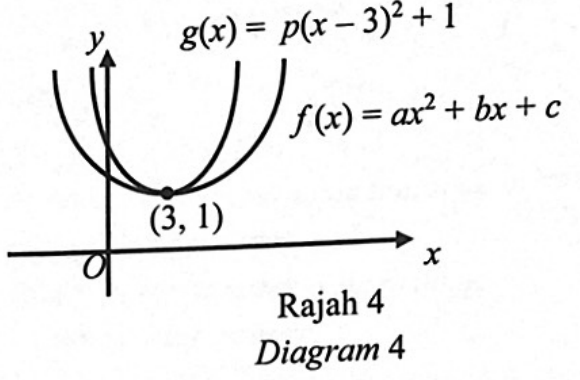
- (a)
Find the roots of the quadratic equation x² − kx + 4 = 0 in terms of k.
[2] - (b)(i)
State the range of a in terms of p.
[1] - (b)(ii)
Write the new quadratic function of g(x), if the graph of g(x) moves 5 units to the left.
[1] - (c)
Given that a straight line y = mx − 3 intersects the curve y = x² − 3x + m at two different points. Find the range of values of m.
[3]
Diagram 3 shows the location of three football players in a football league on a Cartesian plane. Player A (at the origin) from the opponent team tries to attack the goal of team player B and player C. Player B is at (46, 3) and player C is at the goal.
Medium8 marks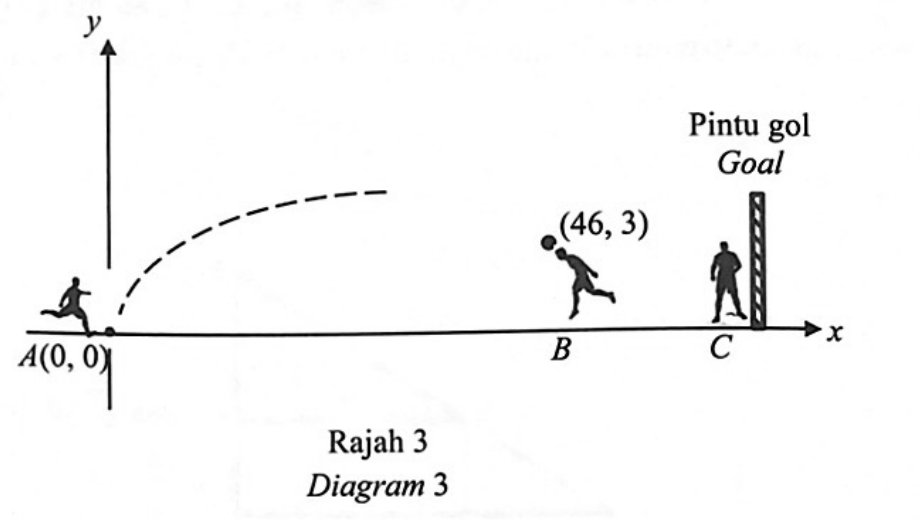
- (a)
Given movement of the ball kicked by player A follows the quadratic function f(x) = −(1/150)x² + (2/5)x. Determine the location of the ball when it lands on the ground.
[3] - (b)
In another trial, the ball from player A has been defended by player B at a location of (46, 3). Given the movement of the ball follows the quadratic function f(x) = −(1/92)(x + p)² + q, find the maximum height of the ball.
[5]
Given m and n are the roots of the quadratic equation x² = 2x + 3. Form a quadratic equation with roots −m and −n.
Easy3 marksForm a quadratic equation with roots −m and −n.
[3]
Given that the function g(x) = 2x² − mx + n has a minimum point at (3/4, −49/8). (a) By using the completing the square method, find the value of m and of n. (b) Sketch graph of g(x) for −2 ≤ x ≤ 4.
Medium7 marks- (a)
Using completing the square, find m and n.
[5] - (b)
Sketch the graph of g(x) for −2 ≤ x ≤ 4.
[2]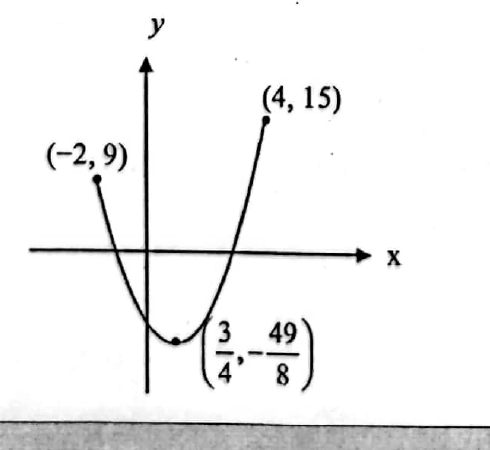
(a) Given the quadratic equation ax² + bx + c = 0, such that a, b and c are constants and a ≠ 0. By using the method of completing the square, form the formula x = [−b ± √(b² − 4ac)]/(2a). (b) Hence, given the quadratic equation x² − 2kx + 2 − k = 0, express the roots of the quadratic equation in terms of k. (c) If this quadratic equation in (b) has real roots, determine the range of values of k by using the number line method.
Medium8 marks- (a)
By completing the square, derive x = [−b ± √(b² − 4ac)]/(2a).
[3] - (b)
Express the roots of x² − 2kx + 2 − k = 0 in terms of k.
[2] - (c)
If the equation has real roots, determine the range of values of k by the number line method.
[3]
Diagram 1 shows the curve of a quadratic function f(x) = −x² + 2qx − 5p + 1. The curve opens downward, lies entirely below the x-axis, and has axis of symmetry x = q. (a)(i) Express the range of values of p in terms of q. (ii) Referring to the function graph in Diagram 1, if the value of b changes to −2q, sketch the new graph of the quadratic function in the answer space in Diagram 2. (b) Diagram 3 shows the function graphs g(x) = 2x² + 3 and h(x). Write the possible quadratic function of h(x).
Medium6 marks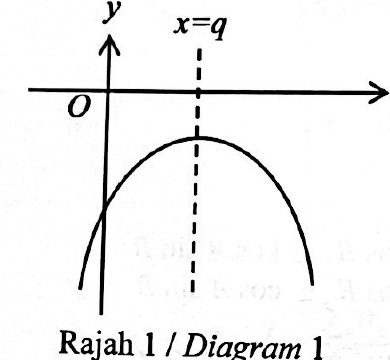
- (a)(i)
Express the range of values of p in terms of q.
[2] - (a)(ii)
If b changes to −2q, sketch the new graph in Diagram 2 (the answer space shows the original curve with axis x = q).
[2]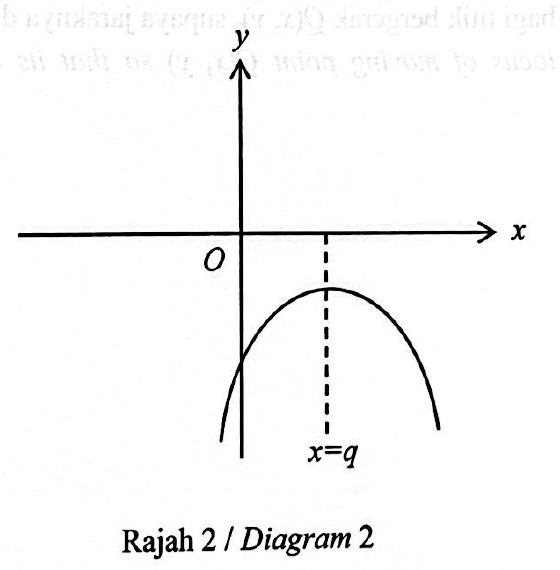
- (b)
Write the possible quadratic function h(x) (g(x) = 2x² + 3 and h(x) both touch at y = 3 on the y-axis, h(x) opens downward).
[2]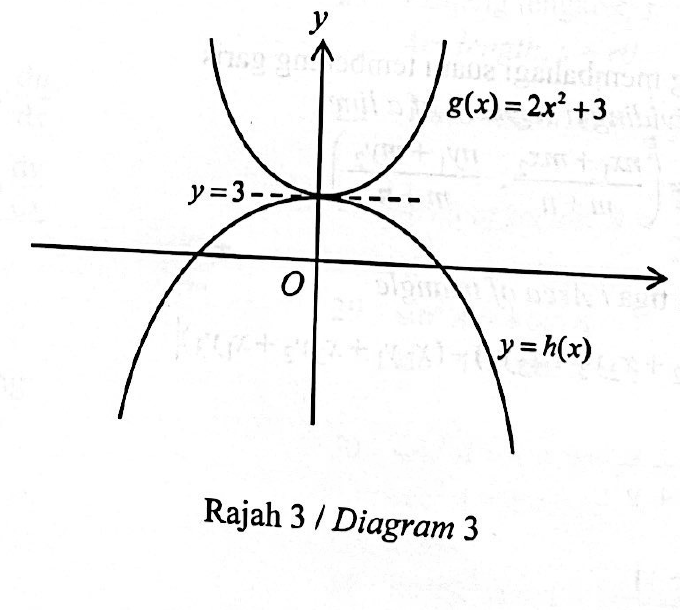
Two parts on quadratic functions.
Medium8 marks- (a)(i)
Given a quadratic function y = ax² − bx + c does not touch the x-axis and c < 0. State the range of a.
[1] - (a)(ii)
State the range of the function discriminant.
[1] - (b)(i)
Diagram 11 shows a parabolic gate. The gate needs to be wide enough for two vehicles to pass through. Diagram 12 shows the largest vehicle that will use the route (height 4.3 m, length 12.2 m, width 2.1 m). Syabas Company has proposed to build the gate 6 metres high and the width of the base is 10 metres. Represent the gate shape design proposed by Syabas Company in the form f(x) = a(x + p)² + q.
[3] - (b)(ii)
Can the gate design allow two vehicles shown in Diagram 12 to pass through simultaneously? Justify your answer.
[3]
Two parts on quadratic equations and functions.
Medium8 marks- (a)
Given the straight line y = x + p intersects the curve x² + y² − 2 = 0 at points M and N. Find the range of values of p.
[4] - (b)(i)
Given the quadratic function f(x) = 3 + 5x − 2x². By using the method of completing the square, express f(x) in the form f(x) = a(x + p)² + q, such that a, p and q are constants.
[2] - (b)(ii)
Hence, sketch the graph of f(x) for 0 ≤ x ≤ 5.
[2]
Given a quadratic function m(x) = 8x² − kx − (5 − k) where k < 5, has a minimum value of −25/8. (a) Express m(x) in terms of x and k in the vertex form. (b) Hence, find the value of k. (c) If the graph of the function m(x) intersects the graph of the function n(x) = 7x² + p − 1 at two different points, find the range of values of p.
Medium8 marks- (a)
Express m(x) in vertex form.
[3] - (b)
Hence, find the value of k.
[2] - (c)
Find the range of values of p so that m(x) and n(x) intersect at two different points.
[3]
Given that f(x) = 2x² + 6x − 8. (a) Write the function in vertex form f(x) = a(x + b)² + c. (b) Based on part (a), (i) state the equation of the axis of symmetry, (ii) determine the characteristic of the turning point of the function. Justify your answer. (c) Hence, sketch the graph of |f(x)| for −6 ≤ x ≤ 2.
Medium7 marks- (a)
Write f(x) in the form a(x + b)² + c.
[2] - (b)(i)
State the equation of the axis of symmetry.
[1] - (b)(ii)
Determine the characteristic of the turning point. Justify your answer.
[1] - (c)
Sketch the graph of |f(x)| for −6 ≤ x ≤ 2.
[3]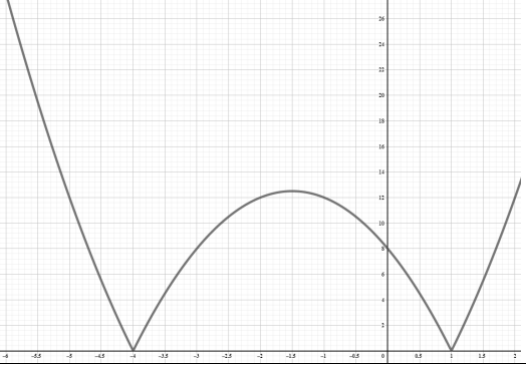
α and β are the roots of the equation 2x² − px + q = 0, where p and q are constants.
Medium6 marks- (a)
State α + β and αβ in terms of p and/or q.
[2] - (b)
Hence, find the value of p and of q, if 2/α and 2/β are the roots of the quadratic equation 3x² − 12x + 8 = 0.
[4]
Luqman made a birthday card in the shape of a right-angled triangle. The longest side of the card is y cm. The other two sides are x cm and (2x − 1) cm. He decorated all sides of the card using decorative lights of length 40 cm. Find the longest side of the card.
Medium7 marksFind the longest side of the card.
[7]
Given the function f(x) = −2x² − 4x + 5.
Easy6 marks- (a)
By using the method of completing the square, express f(x) in the vertex form.
[2] - (b)
Sketch the graph f(x) = −2x² − 4x + 5 for −3 ≤ x ≤ 2.
[3]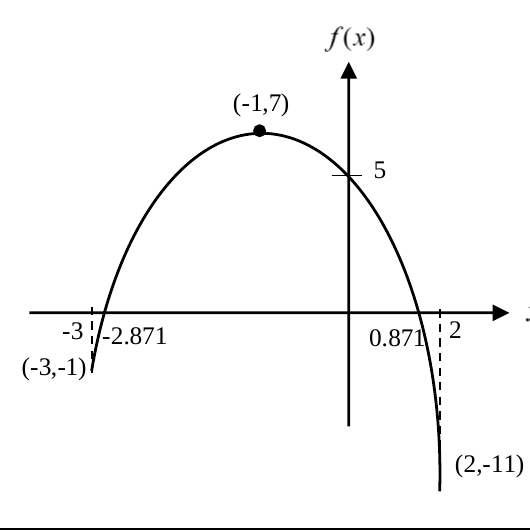
- (c)
State the equation of the axis of symmetry when the graph is reflected on the y-axis.
[1]
The graph of the quadratic function f(x) = px² − 8x + q, where p and q are constants, has a maximum point. (a) Given p is an integer such that −2 < p < 2, state the value of p. (b) Using the answer from 11(a), find the value of q when the graph touches the x-axis at one point.
Easy3 marks- (a)
Given p is an integer such that −2 < p < 2, state the value of p.
[1] - (b)
Using the answer from 11(a), find the value of q when the graph touches the x-axis at one point.
[2]
(a) Given that the graph of the quadratic function f(x) = rx² + 2x + r does not intersect the x-axis, find the range of values of r by using the number line method. (b) (i) Diagram 6 shows the graph of f(x) = 2x² − 4mx + 2m² + 2n with a = 2, b = −4m and c = 2m² + 2n. The graph meets the x-axis at x = 1 and x = 5 and has minimum value −8 (line y = −8). On Diagram 6, sketch the graph of y = g(x) when the variable a becomes 1. (ii) Express f(x) = 2x² − 4mx + 2m² + 2n in the form a(x − h)² + k, where h and k are constants. Hence, find the value of m and of n.
Medium8 marks- (a)
Given that the graph of f(x) = rx² + 2x + r does not intersect the x-axis, find the range of values of r by using the number line method.
[3] - (b)(i)
On Diagram 6, sketch the graph of y = g(x) when the variable a becomes 1.
[1]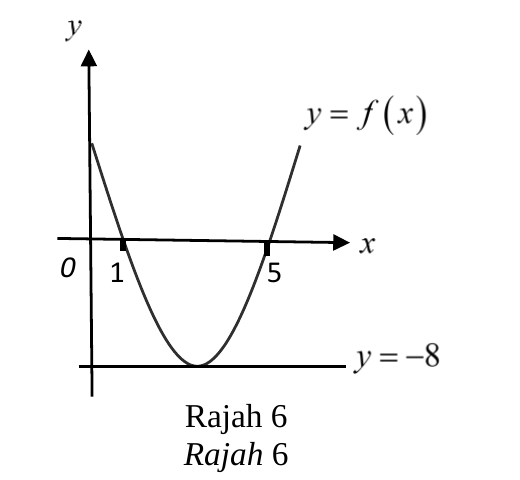
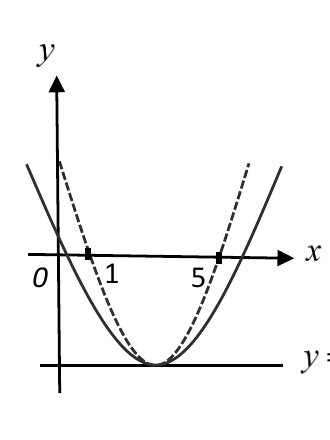
- (b)(ii)
Express f(x) = 2x² − 4mx + 2m² + 2n in the form a(x − h)² + k. Hence, find the value of m and of n.
[4]
(a) Given the quadratic equation x(x − 5) = 4. (i) Express the equation in the form ax² + bx + c = 0. (ii) State the sum of roots and the product of roots of the equation. (b) Express h(x) = −x² − 8x + 9 in the form h(x) = −(x + p)² + q. Hence state the maximum value of h(x) and the corresponding value of x.
Medium6 marks- (a)(i)
Express x(x − 5) = 4 in the form ax² + bx + c = 0.
[1] - (a)(ii)
State the sum of roots and the product of roots of the equation.
[2] - (b)
Express h(x) = −x² − 8x + 9 in the form h(x) = −(x + p)² + q. Hence state the maximum value of h(x) and the corresponding value of x.
[3]
A ball is punted into the air by a child. The height of the ball from the ground h, in metres, after t seconds is given by h = 5 + 8t − 2t².
Easy6 marks- (a)
How high is the ball after 1 second?
[1] - (b)
Find the maximum height of the ball.
[2] - (c)
When does the ball reach its maximum height?
[1] - (d)
How long does the ball stay above 11 m?
[2]
Quadratic inequality and forming a quadratic equation from given roots.
Easy5 marks- (a)
Find the range of values of x for x² + x ≥ 3/4.
[2] - (b)
Form a quadratic equation if the roots are a and 1/a², where a is a constant.
[3]
(a) Given the quadratic function f(x) = x² + px + 3p − 5 is always positive, where p is a constant, when u < p < v. Find the value of u and of v. (b) Diagram 3 shows the graph of a quadratic curve with x-intercepts −3/2 and 2 and y-intercept −3. Based on Diagram 3, form the quadratic function in intercept form.
Easy5 marks- (a)
Find the value of u and of v. [3 marks]
[3] - (b)
Form the quadratic function in intercept form. [2 marks]
[2]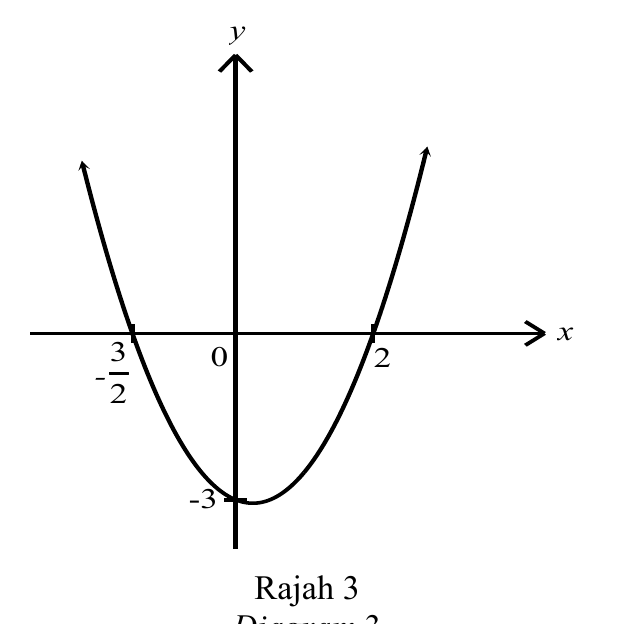
Diagram 2 shows the parabolic path of a basketball when Daniel made his trial shot. x is the horizontal distance of the basketball, in m, from point O (the origin of the Cartesian plane). The height of the basketball, in m, from the court's ground is f(x). The height of the basketball at B is 1.60 m from O. The horizontal distance of the basketball from O at maximum height is 4 m. At A, a perfect shot is made only when the basketball is at a horizontal distance of 7 m from O and at a height of 143/64 m from the court's ground. (a) Form an equation of motion of the ball in vertex form. Hence, determine whether the ball enters the net or not. (b) Hence, find the horizontal distance of the basketball, in m, from O when the basketball is at a height of 2 m from the court's ground after the maximum point.
Medium9 marks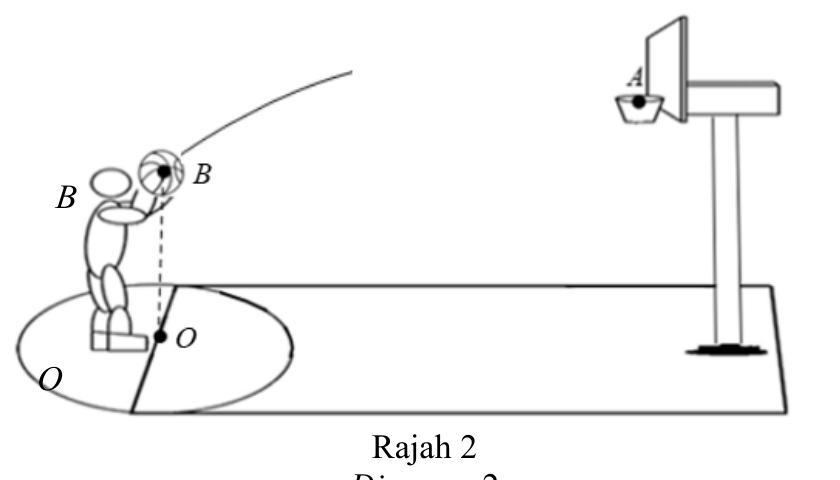
- (a)
Form an equation of motion in vertex form. Hence determine whether the ball enters the net. [6 marks]
[6] - (b)
the horizontal distance from O when the ball is at height 2 m after the maximum point. [3 marks]
[3]
Sketch the graph of y = (x − 2)² − 8 such that y = a(x + b)² + c. Hence, make generalisation on the shape and position of the graph when (a) the value of a changes to −1, (b) the value of b changes to 3, (c) the value of c changes to 4.
Medium6 marksSketch the graph of y = (x − 2)² − 8.
[3]- (a)
The value of a changes to −1: the shape and position of the graph.
[1] - (b)
The value of b changes to 3: the shape and position of the graph.
[1] - (c)
The value of c changes to 4: the shape and position of the graph.
[1]
It takes Mazni 3.5 hours to hike up a hill and back down. Her average speed hiking down is 2 km h⁻¹ faster than her average speed hiking up. The distance from the bottom to the top is 12 km. (a) Find Mazni's average uphill and downhill speeds. (b) Hence, sketch the graph representing Mazni's average speed.
Medium8 marks- (a)
Find Mazni's average uphill and downhill speeds.
[5] - (b)
Sketch the graph representing Mazni's average speed.
[3]
(a) The sum of the squares of two consecutive integers is 841. Find the two integers. (b) Given that α and β are the roots of the quadratic equation px² − 4px + 5 − p = 0. If α ≠ β, find the range of values of p.
Medium7 marks- (a)
Find the two consecutive integers.
[4] - (b)
If α ≠ β, find the range of values of p.
[3]
(a) Diagram 2 shows the curve of the quadratic function y = −x² + 10x − 13. The shaded region is bounded by the quadratic curve and the straight line y = 8. (b) The quadratic equation x² − 15x + 2h − k = 0 has real and equal roots.
Medium5 marks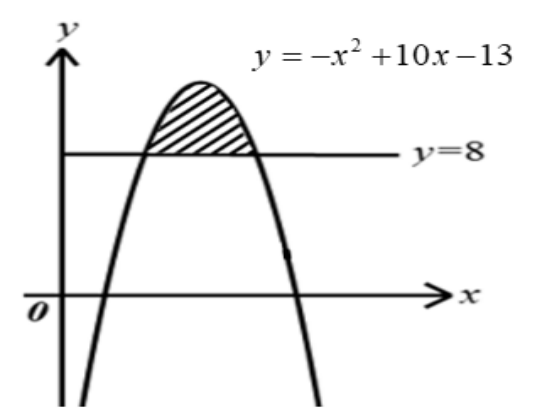
- (a)
Find the range of values of x which satisfies the shaded region.
[3] - (b)
Express h in terms of k.
[2]
Diagram 7 shows the graph of a quadratic function f(x) = x² + (n − 1)x + 6, where n is a constant. The graph cuts the x-axis at x = a and x = b.
Medium8 marks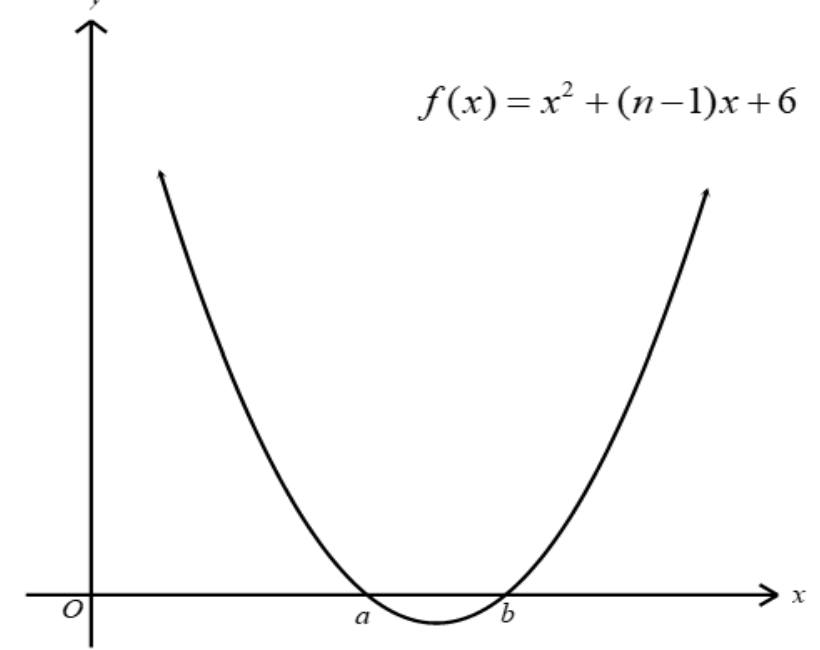
- (a)(i)
Form a new quadratic equation in terms of n which has the roots 3/a and 3/b.
[3] - (a)(ii)
The graph of the function is symmetrical about x = p − 1. Express p in terms of a and b.
[2] - (b)
Given that the quadratic function f(x) = −x² + 4kx − p has maximum point (2, k + 4k²), where p and k are constants. By using the method of completing the square, find the value of p and of k.
[3]
(a) Find the range of x of −5x − 2 ≤ 5x² + 6x. (b) The quadratic equation 3x² + 4 = 2kx − k, where k is a constant, has roots m and n. Given m² + n² = (4/3)², (i) state the type of root of the quadratic equation, (ii) find the values of the constant k.
Medium6 marks- (a)
Find the range of x of −5x − 2 ≤ 5x² + 6x.
[2] - (b)(i)
State the type of root of the quadratic equation.
[1] - (b)(ii)
Find the values of the constant k.
[3]
The curve of the quadratic function f(x) = (x − 1)h + 11 − 3x² has a maximum point A(r, 8). (a) Express f(x) in vertex form in terms of x and h. Hence, find the value of h and of r. (b) Sketch the graph of f(x). (c) State the changes to the graph of f(x) when the value of r becomes smaller.
Medium7 marks- (a)
Express f(x) in vertex form in terms of x and h. Find h and r.
[4] - (b)
Sketch the graph of f(x).
[2] - (c)
State the changes to the graph when r becomes smaller.
[1]
The roots of the quadratic equation x(x − 6) = 4 + p are 3α and 3β respectively, where p is a constant. (a) Find the range of p if α ≠ β. (b) Given that α/2 and β/2 are the roots of another quadratic equation 2x² + qx + 1/3 = 0, with q a constant, find the values of p and q.
Easy5 marks- (a)
Find the range of p if α ≠ β.
[2] - (b)
Given that α/2 and β/2 are the roots of 2x² + qx + 1/3 = 0, find the values of p and q.
[3]
(a) Given px² + qx − 3 = 0, with x = α and x = β as the solutions of the quadratic equation, (i) express α²β + β²α in terms of p and q, (ii) form a quadratic equation with the roots 6α and 6β in terms of p and q; give the answer in general form. (b) The curve of the graph of f(x) = 3x² − 12x − 36 intersects the x-axis at two different points. (i) State the coordinates of the intersection points. (ii) Express f(x) in vertex form by completing the square. Hence, state the function g(x) if g(x) is the function f(x) reflected on the y-axis.
Medium8 marks- (a)(i)
Express α²β + β²α in terms of p and q.
[2] - (a)(ii)
Form a quadratic equation with the roots 6α and 6β in terms of p and q. Give the answer in general form.
[2] - (b)(i)
State the coordinates of the intersection points.
[1] - (b)(ii)
Express f(x) in vertex form by using of completing the square. Hence, state the function g(x) if g(x) is the function f(x) reflected on the y-axis.
[3]
Diagram 8 shows the graph of f(x) = 4(x − 1)² + 4, where a = 4, h = 1 and k = 4.
Medium6 marks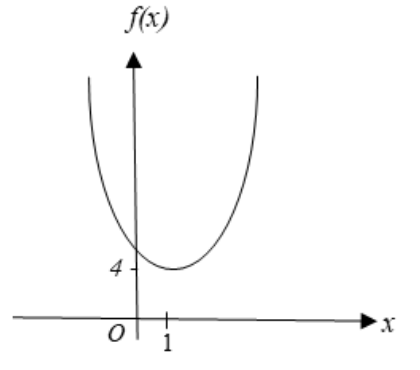
- (a)
Determine the minimum point and the equation of the axis of symmetry.
[2] - (b)
Make a generalisation about the shape and position of the graph f(x) = 2(x − 1)² + 6 when the values of a, h or k change. Hence sketch the graph.
[4]
Diagram 1 shows the graph f(x) = −2(x − 4)² + 6 where a = −2, h = 4 and k = 6 (maximum point (4, 6)). Sketch a graph of f(x) that is formed when the values of a, h and k change simultaneously: (i) value of a changes to −1; (ii) value of h changes to −2; (iii) value of k changes to −10. Hence, make a generalization from the change in shape and position of the obtained graph.
Easy4 marks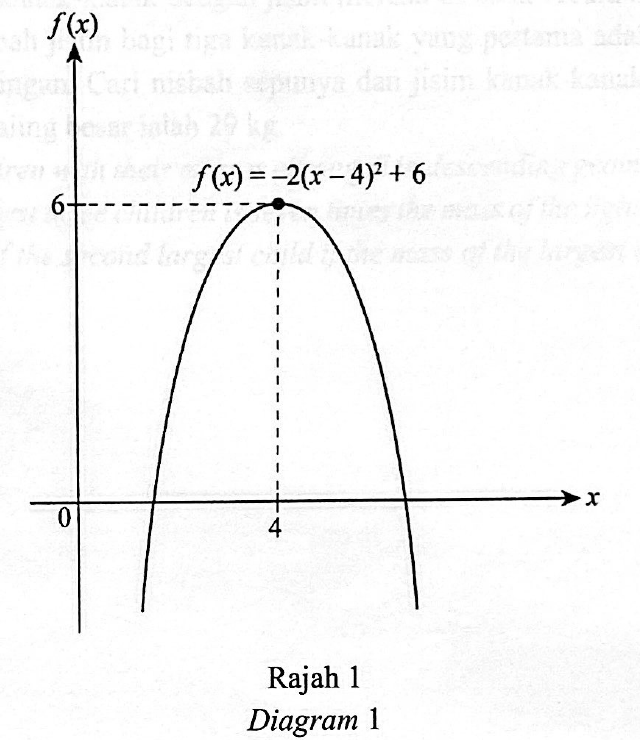
Sketch the new graph and make a generalization.
[4]
A company is introducing a new flavour of ice cream. During the trial period, the company produces a limited quantity of ice creams for sale. The company held a discussion to determine the selling price per unit for the ice cream. Table 1 shows the details of the expected sale: number of ice creams produced 100 units; cost per unit for making the ice cream RM 1.00; selling price per unit of the ice cream RM x; number of ice creams expected to be sold (−20x + 100) units. (a) If the expected total profit of selling the ice creams is RM P, show that P = −20x² + 100x − 100. (b) Hence, by using completing square method, determine, (i) the maximum total profit that can be achieved, (ii) the suitable selling price per unit of the ice cream to achieve the maximum total profit, (iii) the number of ice creams expected to be sold when the selling price per unit is fixed as in (b)(ii).
Medium7 marks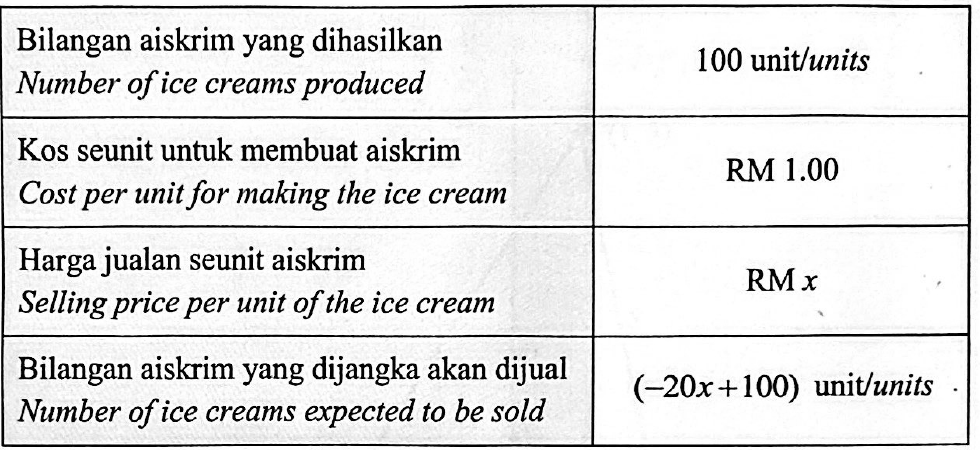
- (a)
Show that P = −20x² + 100x − 100.
[2] - (b)(i)
Using completing the square, find the maximum total profit.
[3] - (b)(ii)
Find the suitable selling price per unit to achieve the maximum total profit.
[1] - (b)(iii)
Find the number of ice creams expected to be sold at that price.
[1]
The straight line y = 16 − px intersects the curve y = x² + 8x + 32 as shown in Diagram 1. Find the range of values of p so that both the straight line and the curve must meet.
Easy4 marks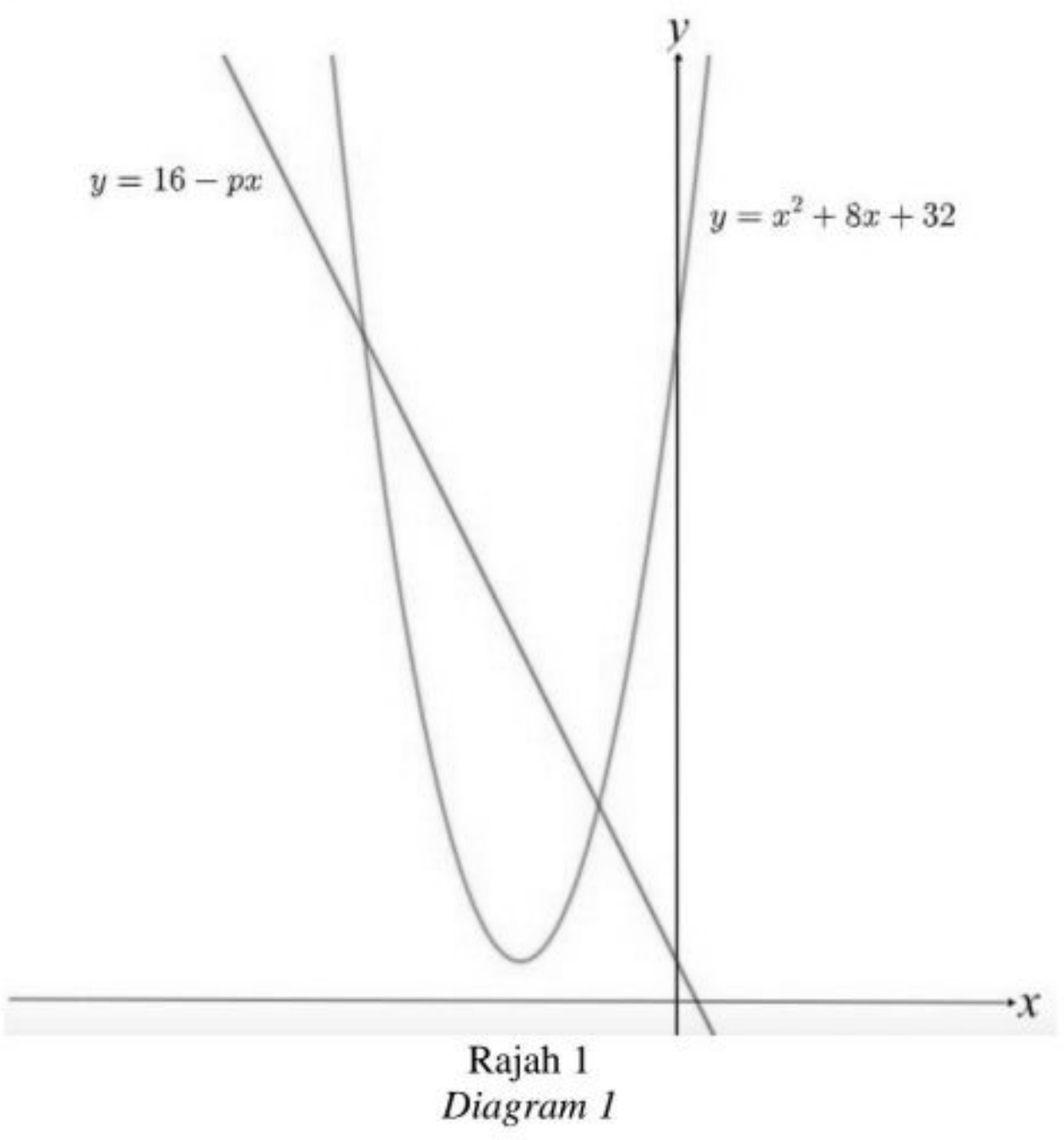
Find the range of values of p so that the line and the curve must meet.
[4]
(a) Given ax² + bx + c = 0, derive the quadratic formula by completing the square. (b) Diagram 1 shows a trapezoid ABCD with AB = (x − 1) cm, BC = 4 cm, CD = (2x − 1) cm. Derive the formula for the area of the trapezium in terms of x, hence find the possible values of x if the area of the trapezium is 17 cm².
Medium7 marks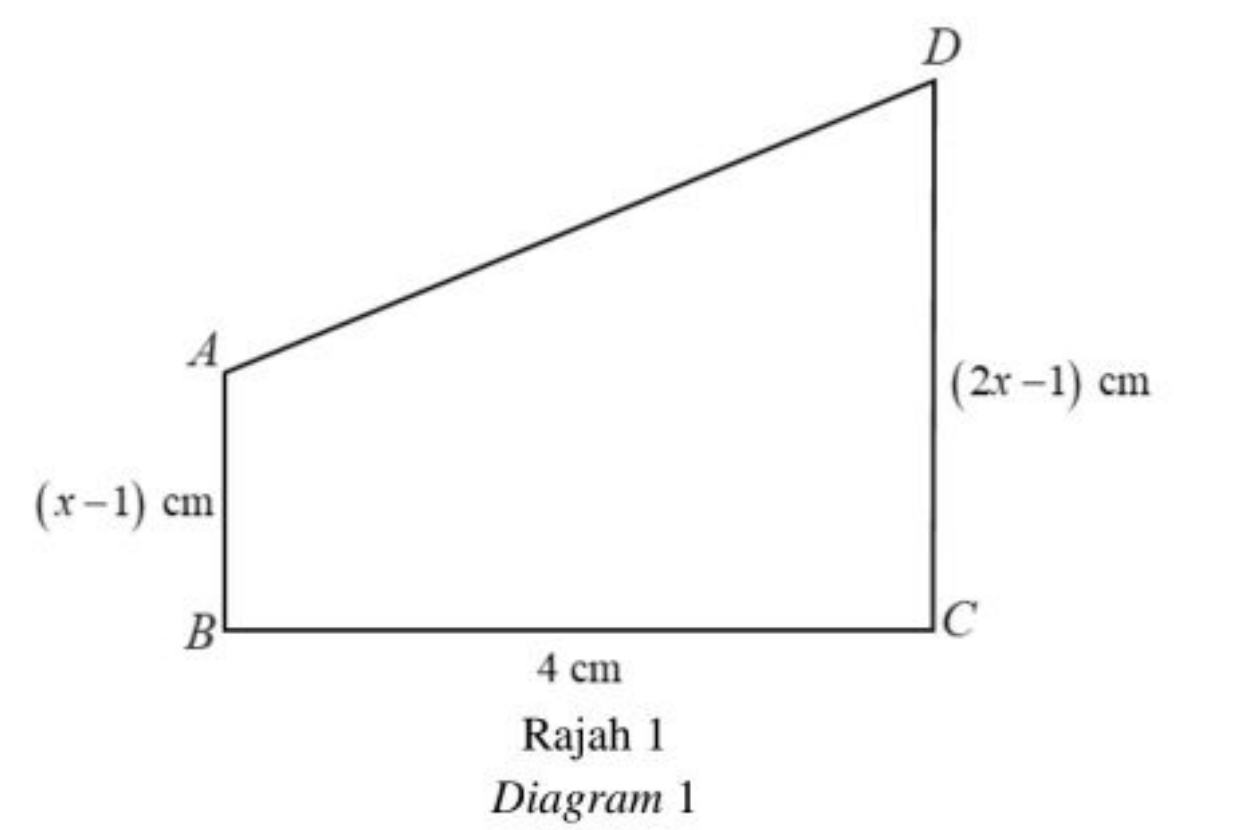
- (a)
Derive the quadratic formula by completing the square.
[3] - (b)
Derive the area of the trapezium in terms of x and find the possible values of x when the area is 17 cm².
[4]
α and β are the roots of x² + (c + 7)x + 5c = −10.
Medium6 marks- (a)
Form the quadratic equation whose roots are 2α and 2β.
[4] - (b)
Find the range of values of c if the equation x² + (c + 7)x + 5c = −10 has two real and different roots.
[2]
In a 2020 EURO football tournament a player takes a free kick. The ball follows a parabola, reaching a maximum height of 12 m and touching the field again after 8 seconds.
Medium6 marks- (a)
Express the equation of the ball's movement in the form a(x + p)² + q.
[3] - (b)
Find the height of the ball 2 seconds after it passed the maximum height.
[3]
Given α and β are the roots of the quadratic equation 3x² + 2x = 7, find the new quadratic equations which have the following roots: (a) α + 1, β + 1; (b) α/β, β/α.
Medium6 marks- (a)
Roots α + 1 and β + 1.
[3] - (b)
Roots α/β and β/α.
[3]
Diagram 6 shows the curve of a quadratic function f(x) = −x² + px − 15. The curve has a maximum point at G(3, h) and intersects the f(x)-axis at point F. (a) State the coordinates of F. (b) By using the completing the square method, find the value of h. (c) Determine the range of values of x if f(x) > −7.
Medium8 marks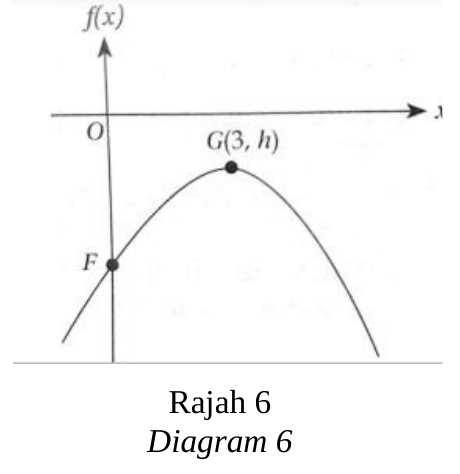
- (a)
State the coordinates of F.
[2] - (b)
Find h by completing the square.
[4] - (c)
Range of x if f(x) > −7.
[2]
Given a quadratic function f(x) = 9 − (x − 2)². (a) Sketch the graph of f(x) for −1 ≤ x ≤ 5. (b) If the graph is reflected about the x-axis, write the quadratic function of the curve.
Easy4 marks- (a)
Sketch the graph of f(x) for −1 ≤ x ≤ 5.
[3]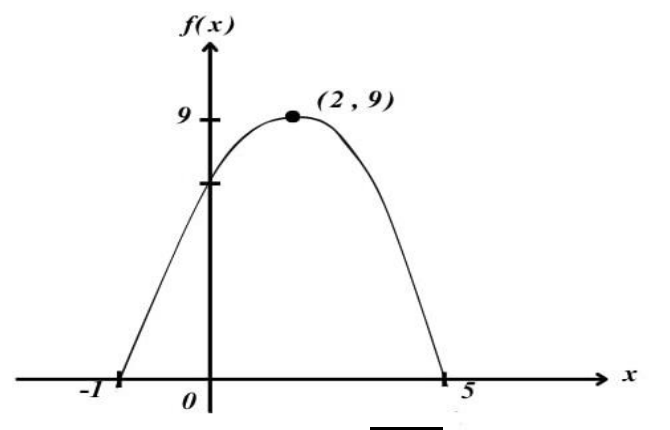
- (b)
Quadratic function of the reflected curve.
[1]
Diagram 1 shows a triangle ABC with a right angle at B. D is on AC and E is on BC with DE ⊥ BC, DE = 5 cm, CE = m cm, EB = 9 cm and AB = n cm. It is given that AB + BC = 32 cm. Find the values of m and n.
Medium7 marks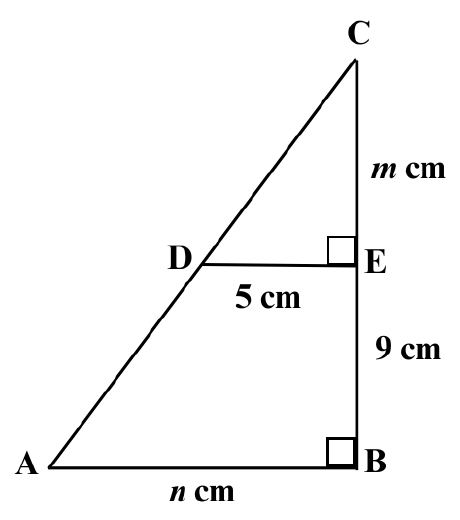
Find the values of m and n.
[7]
Given the quadratic function f(x) = (2x − 3)(x + 4) + p, where p is a constant. When f(x) = 0, its roots are α and β such that α = 4β. (a) Find the value of p. (b) Hence, find the range of values of x when f(x) < 0.
Medium6 marks- (a)
Find p.
[4] - (b)
Hence, find the range of x when f(x) < 0.
[2]
Given the quadratic function f(x) = −½(x − 1)² + 2. (a) Sketch the graph of the quadratic function. (b) Write the quadratic function when the graph is reflected on the f(x)-axis.
Easy4 marks- (a)
Sketch the graph of the quadratic function.
[3] - (b)
Write the quadratic function when the graph is reflected on the f(x)-axis.
[1]
(a) If α and β are the roots of x² + 4x + 6 = 0, find the new quadratic equation whose roots are 1/α and 1/β. (b) Two quadratic curves with the equations y = x² − 4x + 5 and y = m + 2x − x², where m is a constant, touch at the point P. Determine the coordinates of point P.
Medium6 marks- (a)
If α and β are the roots of x² + 4x + 6 = 0, find the new quadratic equation whose roots are 1/α and 1/β.
[3] - (b)
The curves y = x² − 4x + 5 and y = m + 2x − x² touch at point P. Determine the coordinates of P.
[3]
Diagram 3 shows the graph of the quadratic function f(x) = x² + 6x + 2k − 3, where k is a constant. The minimum value of the function is 4 (marked on the f(x)-axis).
Easy5 marks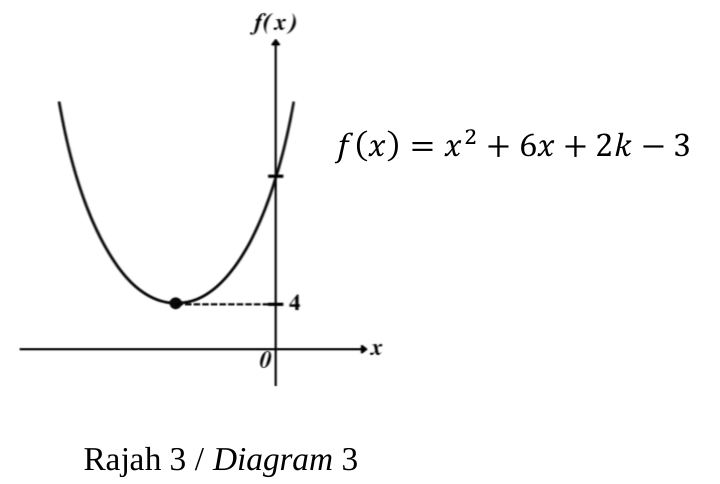
- (a)
By using the method of completing the square, convert the function f(x) to vertex form. Hence, state the equation of the axis of symmetry of the curve.
[3] - (b)
Given that the minimum value of the function is 4, find the value of k.
[2]
(a) The quadratic equation mx² + (1 + 2m)x + m − 1 = 0 has two equal roots. Find the value of m. (b) By using number line method, find the range of values of x for 3x² − 5x − 16 ≤ x(2x + 1).
Medium6 marks- (a)
The quadratic equation mx² + (1 + 2m)x + m − 1 = 0 has two equal roots. Find the value of m.
[3] - (b)
By using number line method, find the range of values of x for 3x² − 5x − 16 ≤ x(2x + 1).
[3]
(a) Given −4 is one of the roots of the quadratic equation 3(x + h)² = 75, where h is a constant. Find the values of h. (b) If α and β are the roots of the quadratic equation x² − 3x − 5 = 0, form a quadratic equation with the roots 1/α and 1/β.
Easy5 marks- (a)
Find the values of h.
[2] - (b)
Form a quadratic equation with the roots 1/α and 1/β.
[3]
Diagram 15 shows a football player making a throw-in from off the football field. The function h(x) = −x² + 4x + 1.5 represents the height of the ball, h, in metres. Find (a) the initial height when the ball is thrown, (b) the maximum height of the ball, (c) the distance of the ball from the edge of the field when it falls to the surface of the field.
Medium8 marks- (a)
Find the initial height when the ball is thrown.
[2] - (b)
Find the maximum height of the ball.
[3] - (c)
Find the distance of the ball from the edge of the field when it falls to the surface of the field.
[3]
Diagram 3 shows the graph of the quadratic function f(x) = (x − 3)² + m, where m is a constant. The graph cuts the x-axis at x = k (negative) and x = 8. (a) Find the equation of the axis of symmetry of the graph. (b) Find the value of k. (c) State the change of the value of k if the value of m decreased. Justify your answer.
Medium5 marks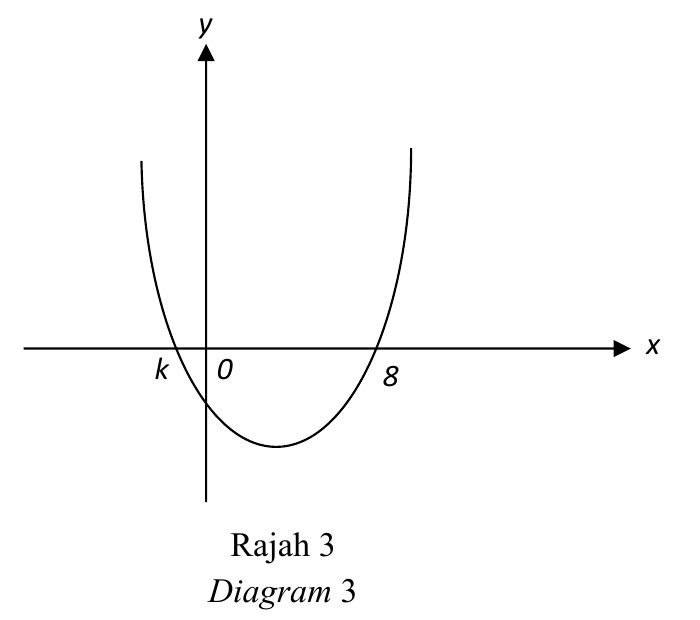
- (a)
Find the equation of the axis of symmetry of the graph.
[1] - (b)
Find the value of k.
[2] - (c)
State the change of the value of k if the value of m decreased. Justify your answer.
[2]
The quadratic equation 9tx − x² = 80 has roots α and β which follow the ratio 4 : 5. (a) Find the values of t. (b) Hence, form a new quadratic equation if the new roots are α² and β², where t > 0.
Medium8 marks- (a)
Find the values of t.
[4] - (b)
Form a new quadratic equation with roots α² and β², where t > 0.
[4]
(a) Find the range of values of x for x + 12 < 5x(x − 2). (b) Given the quadratic function f(x) = −2x² + 8x − 7. Without drawing the graph, find the maximum point of f(x).
Easy5 marks- (a)
Find the range of values of x for x + 12 < 5x(x − 2).
[3] - (b)
Given f(x) = −2x² + 8x − 7. Without drawing the graph, find the maximum point of f(x).
[2]
(a) The sum of the squares of two consecutive integers is 841. Find the two integers. (b) Given that α and β are the roots of the quadratic equation px² − 4px + 5 − p = 0. If α ≠ β, find the range of values of p.
Medium7 marks- (a)
Find the two consecutive integers whose squares sum to 841.
[4] - (b)
Given α ≠ β are the roots of px² − 4px + 5 − p = 0, find the range of values of p.
[3]
Diagram 2 shows a graph of a quadratic function f(x) = −x² + mx − 11. The graph has a maximum point P(3, k) and intersects the y-axis at point Q. (a) State the coordinates of the point Q. (b) By using the method of completing the square, find the value of k and the value of m. (c) Determine the range of values of x if f(x) ≥ −18.
Easy5 marks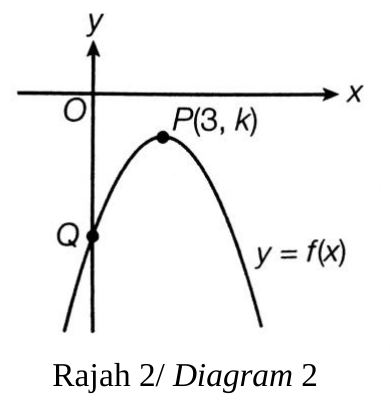
- (a)
State the coordinates of Q.
[1] - (b)
By completing the square, find k and m.
[4] - (c)
Determine the range of x for f(x) ≥ −18.
[0]
Express x² − 3x + 5 in the form a(x − b)² + c, where a, b and c are constants. Hence, state (a) the minimum value of x² − 3x + 5, (b) the value of x at which the minimum value occurs, (c) sketch the curve of x² − 3x + 5.
Easy8 marks- Express
Express x² − 3x + 5 in the form a(x − b)² + c.
[2] - (a)
State the minimum value.
[1] - (b)
State the value of x at the minimum.
[1] - (c)
Sketch the curve of x² − 3x + 5.
[4]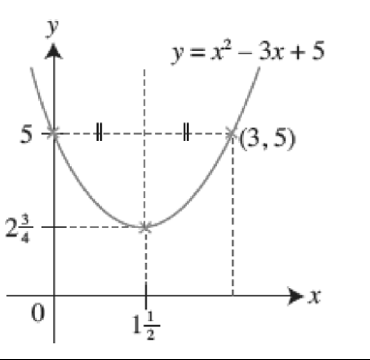
(a) Given the quadratic equation 3x² − 6px + p = 0, where p is a constant, has only one solution. Find the values of p. (b) The quadratic equation x² + x = 3kx − k² has two different real roots. Find the range of values of k.
Medium5 marks- (a)
3x² − 6px + p = 0 has only one solution. Find the values of p.
[2] - (b)
x² + x = 3kx − k² has two different real roots. Find the range of values of k.
[3]
Hashim throws a ball upward. The function of the height of the ball is h(x) = −x² + 6x + 1, where h is the height of the ball from the ground, in m, and x is the horizontal distance of the ball from Hashim, in m. (a)(i) By using the method of completing the square, find the maximum height, in m, of the ball. (ii) Hence, state the horizontal distance of the ball from Hashim when the ball reaches the maximum height. (b) Find the horizontal distance between Hashim and the ball, in m, when the ball touches the ground.
Medium6 marks- (a)(i)
Using completing the square, find the maximum height, in m.
[2] - (a)(ii)
Hence, state the horizontal distance when the ball reaches maximum height.
[1] - (b)
Find the horizontal distance, in m, when the ball touches the ground.
[3]
(a) Given that the straight line y = 0 is the tangent line to the curve f(x) = 2x² + (h − 1)x + 2k², where h and k are constants, express h in terms of k. (b) Given the quadratic function f(x) = −2x² + 4x + 30 defined in the domain −3 ≤ x ≤ 7, (i) by using completing the square, express f(x) in vertex form and state the turning point of f(x), (ii) express f(x) in intercept form and hence sketch the graph of f(x).
Medium8 marks- (a)
Express h in terms of k.
[2] - (b)(i)
Express f(x) in vertex form by completing the square and state the turning point.
[3] - (b)(ii)
Express f(x) in intercept form and sketch the graph of f(x).
[3]
Given a function f(x) = 2x² − 6x + 7 has roots m and n, where m and n are constants. (a) Form a quadratic equation which has roots 3m + 1 and 3n + 1. (b) If |x| > p is the solution of the inequality f(x) + 6x > x² + 16, where p is a constant, find the value of p.
Medium6 marks- (a)
Form a quadratic equation with roots 3m + 1 and 3n + 1.
[3] - (b)
If |x| > p is the solution of f(x) + 6x > x² + 16, find p.
[3]
Diagram 14 shows part of the graph of the quadratic function f(x) = px² + x − q, where p and q are constants. The graph is a downward parabola crossing the x-axis at x = m and x = n, with maximum point T and axis of symmetry x = 1/4.
Medium8 marks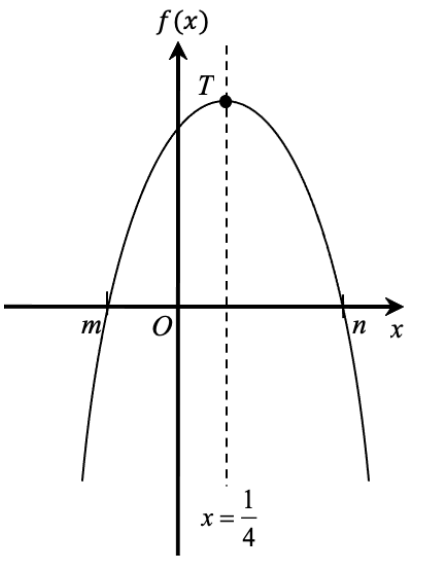
- (a)
Express the range of values of q in terms of p.
[2] - (b)
Prove that m/n + n/m = 1/(2q) − 2.
[3] - (c)
Using the method of completing the square, express the maximum value of function f(x) in terms of q.
[3]
Diagram 3 shows the cross section of a drain of a school; the drain has a width of 25 cm at floor level. The shape of the drain is represented by the equation y = (2/5)x² − 12x + 50. If the width of the drain is 25 cm, find the depth of the drain, in cm.
Medium6 marks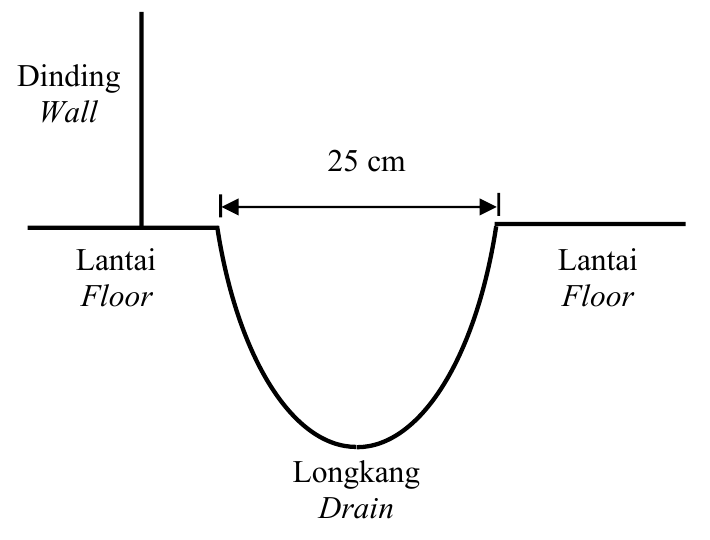
Find the depth of the drain, in cm.
[6]
Diagram 5.1 and Diagram 5.2 show two balances containing blocks with different masses. In Diagram 5.1 pan S holds a 15 kg block, and pan T holds block P, block Q and a 5 kg block, and the balance is level. In Diagram 5.2 pan S holds the 15 kg block and a 28 kg block, and pan T holds blocks P, Q and the 5 kg block, and pan S is lower. The masses of block P and Q are x kg and y kg respectively, and x² + 23y − 110 = 0.
Medium7 marks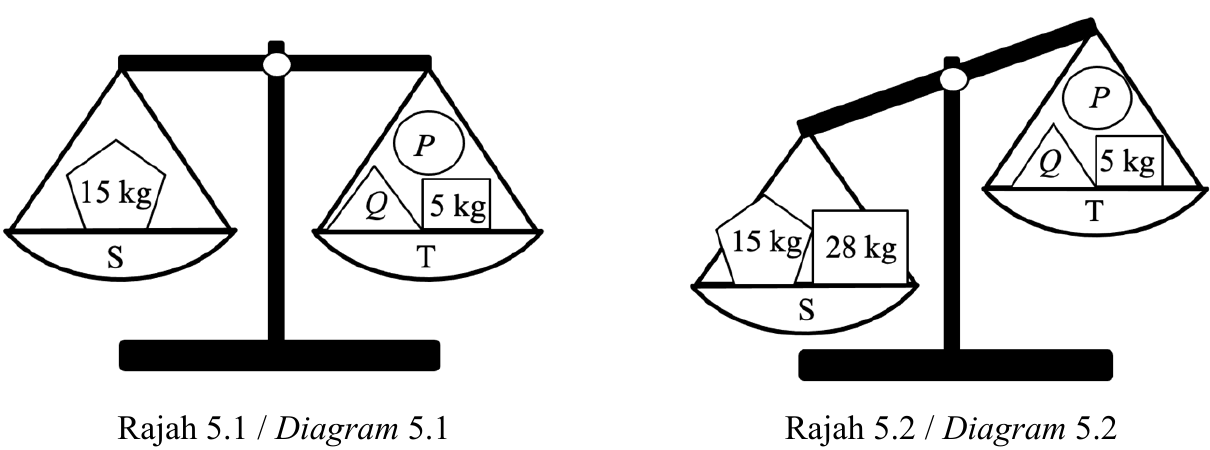
- (a)
Based on Diagram 5.1, find the value of x and of y.
[6] - (b)
A block with mass 28 kg is added to the balance in S as shown in Diagram 5.2. Find the number of blocks of P and of Q that need to be added in T to rebalance the scale.
[1]
(a) Express the graph of the function f(x) = 2 + 4x − 3x² as f(x) = a(x − b)² + c, where a, b and c are constants. Determine the maximum or minimum value and find the equation of the axis of symmetry. (b) Hence, make a generalisation on the shape and position of the graph when (i) the value of a changes to −9, (ii) the value of b changes to 5/3.
Medium8 marks- (a)
Express f(x) = 2 + 4x − 3x² as a(x − b)² + c; state the maximum or minimum value and the axis of symmetry.
[4] - (b)(i)
Generalise the change in shape and position when a changes to −9.
[2] - (b)(ii)
Generalise the change in shape and position when b changes to 5/3.
[2]
A quadratic function is given by f(x) = 4x² − 16x + k, such that k is a constant. (a) Find the smallest value of k such that f(x) > 0 and k is an integer. (b) The roots of the quadratic equation when f(x) = 0 are α and β. (i) If β exceeds α by 1, determine the value of k that satisfies the equation. (ii) If the product of roots is 2α + 5, express the value of α in terms of k.
Medium7 marks- (a)
Find the smallest value of k such that f(x) > 0 and k is an integer.
[2] - (b)(i)
If β exceeds α by 1, determine the value of k.
[3] - (b)(ii)
If the product of roots is 2α + 5, express α in terms of k.
[2]
(a) By using completing the square method, express f(x) = 8 − 6x − x² in the form f(x) = a − (x + b)². Hence, find the range of f(x). (b) It is given that a quadratic function f(x) = a(x − m)² + n, where a > 0 has a negative discriminant value. Sketch the possible quadratic graph. (c) Find the range of values of x for (1 − x)² + 2x ≥ 17 by using number line method.
Medium8 marks- (a)
Express f(x) = 8 − 6x − x² in the form a − (x + b)² and find the range of f(x).
[3] - (b)
Sketch the possible quadratic graph (a > 0, negative discriminant).
[2]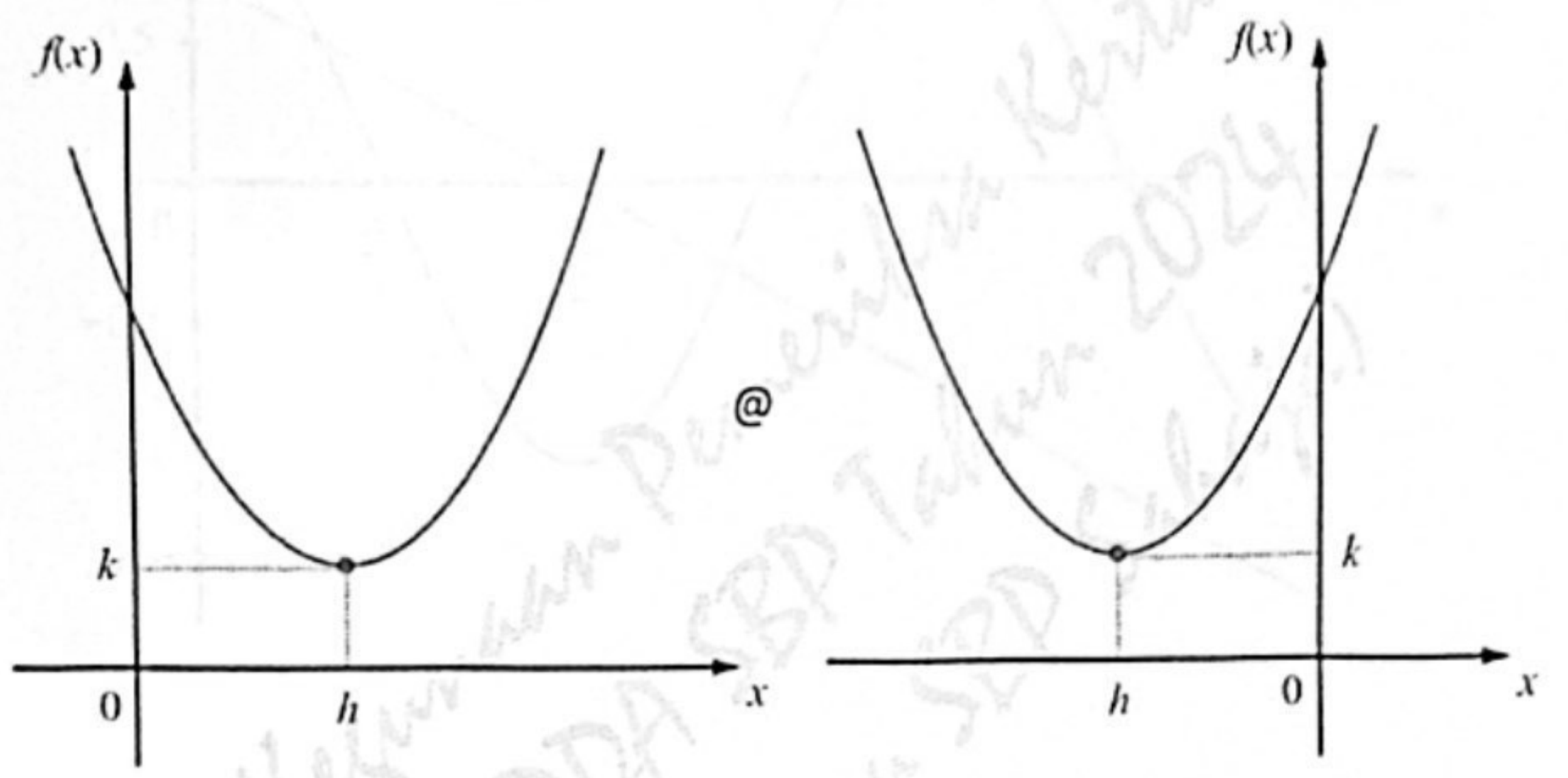
- (c)
Find the range of values of x for (1 − x)² + 2x ≥ 17 by number line method.
[3]
It is given that f(x) = −x² + 6x − 5. (a) Find the range of values of x such that f(x) < 0. (b) The equation mx − f(x) + n = 0, such that m and n are constants, has roots α and β. (i) State α + β and αβ in terms of m and / or n. (ii) The roots of the quadratic equation x² + px + p = 8 are 2α and 2β, such that p is a constant. Express m in terms of n.
Medium7 marks- (a)
Find the range of values of x such that f(x) < 0.
[2] - (b)(i)
State α + β and αβ in terms of m and / or n.
[1] - (b)(ii)
Express m in terms of n.
[4]
It is given that f(x) = 4px − 5p² − 1 − x² has a maximum value −q² − 2p, such that p and q are constants. (a) By using completing the square, show that q = p − 1. (b) Hence, find the value of p and q if the graph of the function is symmetrical about the axis x = q² − 1, such that p > 0. (c) By using the value of p in (b), calculate the value of discriminant of the function.
Medium8 marks- (a)
By using completing the square, show that q = p − 1.
[4] - (b)
Hence, find the value of p and q.
[2] - (c)
Calculate the value of the discriminant.
[2]
Find the range of values of x for 5 < 2x² + x + 4 and 2x² + x + 4 < 10. Hence, solve the inequality 5 < 2x² + x + 4 < 10.
Easy4 marksFind the range of values of x for 5 < 2x² + x + 4 and 2x² + x + 4 < 10. Hence, solve 5 < 2x² + x + 4 < 10.
[4]
(a) Find the range of values of x for 2x² + 5x ≤ 3. (b) The quadratic equation px² + 3qx + 4 = 0, where p and q are constants, has two equal roots. Express q in terms of p.
Easy4 marks- (a)
Find the range of values of x for 2x² + 5x ≤ 3.
[2] - (b)
The quadratic equation px² + 3qx + 4 = 0, where p and q are constants, has two equal roots. Express q in terms of p.
[2]
(a) Given ax² + bx + c = 0. Derive the quadratic formula by using completing the square method. (b) By using the quadratic formula derived from 15(a), determine the roots of the quadratic equation 9x² − 6x + 5 = 0. Give your answer in terms of imaginary number, i with i = √−1.
Medium8 marks- (a)
Given ax² + bx + c = 0. Derive the quadratic formula by using completing the square method.
[5] - (b)
By using the quadratic formula derived from 15(a), determine the roots of 9x² − 6x + 5 = 0. Give your answer in terms of imaginary number, i with i = √−1.
[3]
Diagram 5 shows the graph of the curve y = |(x − m)² + 1 − n| with the turning point (3, 4). Points P and Q are on the x-axis. State (a) the turning point for the graph of the curve y = (x − m)² + 1 − n, (b) the equation of the axis of symmetry for the curve if the graph moves 2 units to the right, (c) the value of m and of n.
Medium5 marks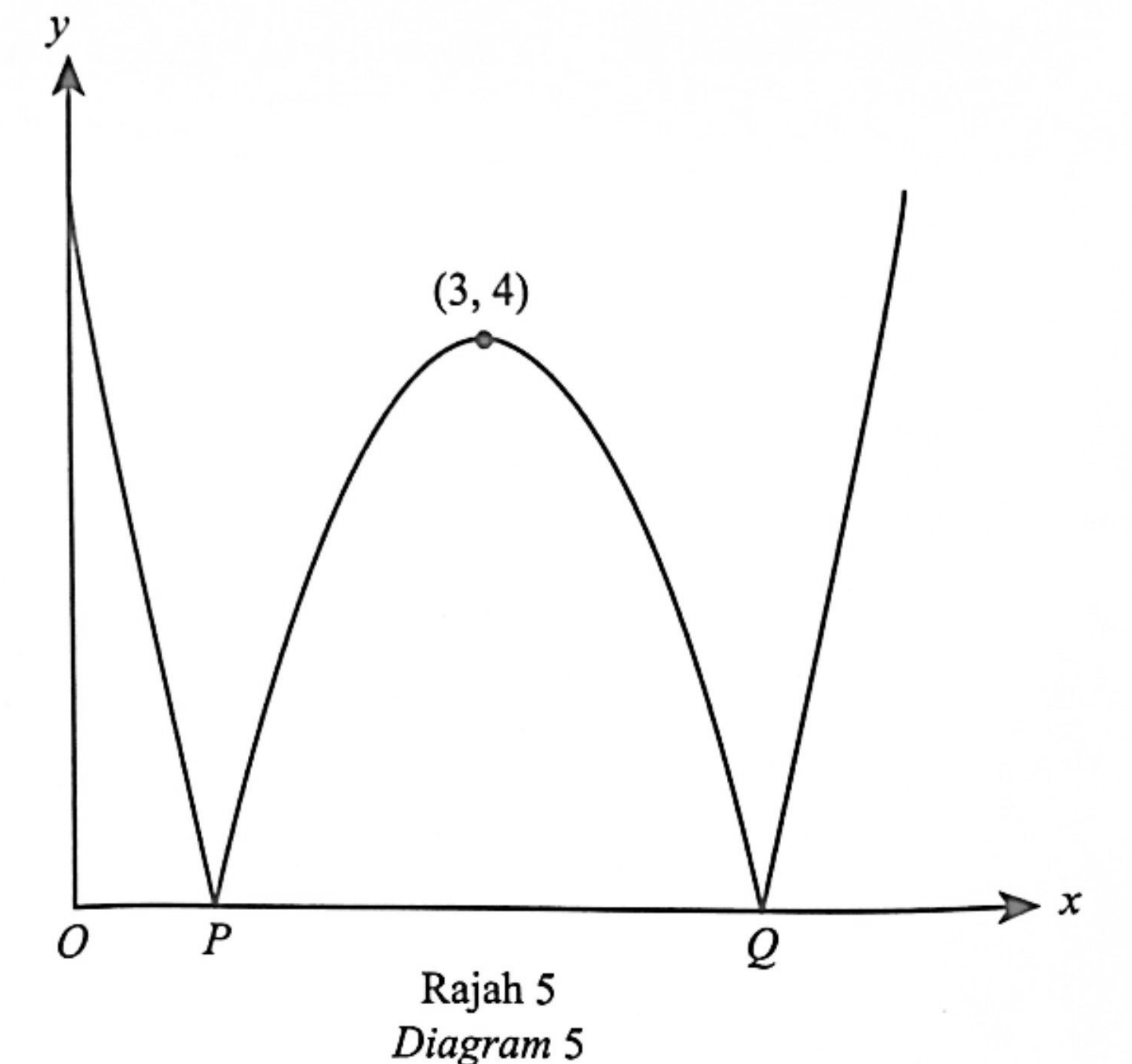
- (a)
State the turning point for the graph of the curve y = (x − m)² + 1 − n.
[1] - (b)
State the equation of the axis of symmetry for the curve if the graph moves 2 units to the right.
[1] - (c)
State the value of m and of n.
[3]
(a) Diagram 7 shows a rectangle measuring 3y m in length and 2y m in width. Part of the rectangle is cut into a square shape with sides y metres. Find the range of values of y if the shaded area is at least (y² + 4) m². (b) It is given α and β are the roots of the quadratic equation 2x² + 6x − 3 = 0. Find the value of α² + β².
Medium7 marks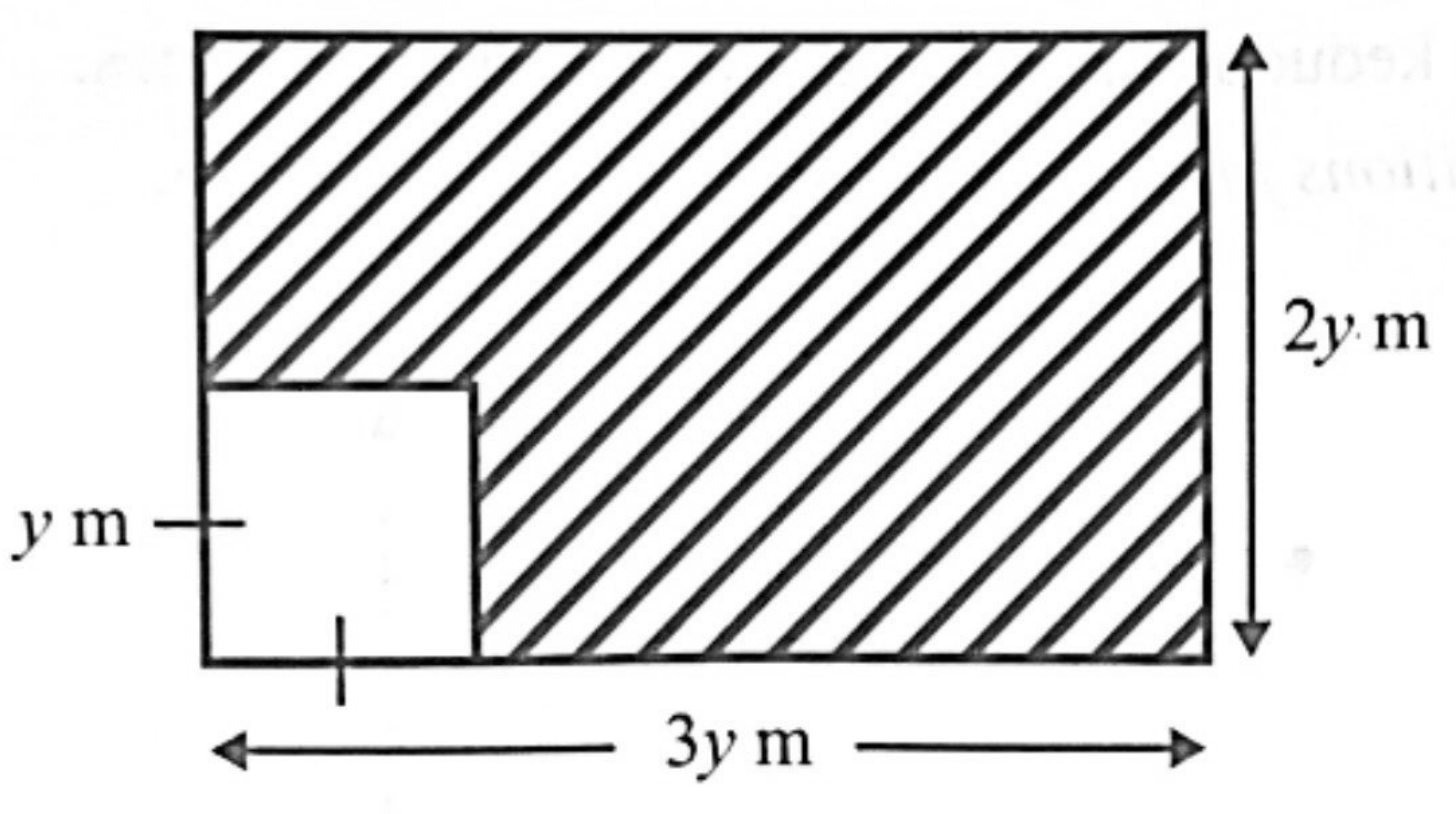
- (a)
Find the range of values of y if the shaded area is at least (y² + 4) m².
[4] - (b)
Given α and β are the roots of 2x² + 6x − 3 = 0, find α² + β².
[3]
(a) Ken undergoes two cycling training sessions. In each session, Ken cycles a distance of 150 km. In the first session, Ken cycles at an average speed of x km h⁻¹. In the second session, Ken increases his average speed by 10 km h⁻¹, and he finishes the training 20 minutes earlier compared to the first session. Calculate Ken's average speed in the first session. (b) Given α and β are the roots of the quadratic equation 2x² − 6x + 9 = 0. Form a quadratic equation which has the roots α + 2 and β + 2. Give your answer in the form ax² + bx + c = 0 where a, b and c are integers.
Medium7 marks- (a)
Calculate Ken's average speed in the first session.
[4] - (b)
Form a quadratic equation which has the roots α + 2 and β + 2. Give your answer in the form ax² + bx + c = 0 where a, b and c are integers.
[3]
(a) Diagram 2 shows a curve y = −x² + 2x − 1 and a straight line y = mx + 3. Find the range of the values of m by using the number line method such that the straight line does not touch the curve. (b)(i) Sketch the graph of g(x) = 2(x + 3)² − 8. (ii) It is given that h(x) = 2(x + p)² + q, state the range of values of p and of q if the graph of h(x) is on the right of g(x) and the position of the minimum point of h(x) is higher than g(x).
Medium7 marks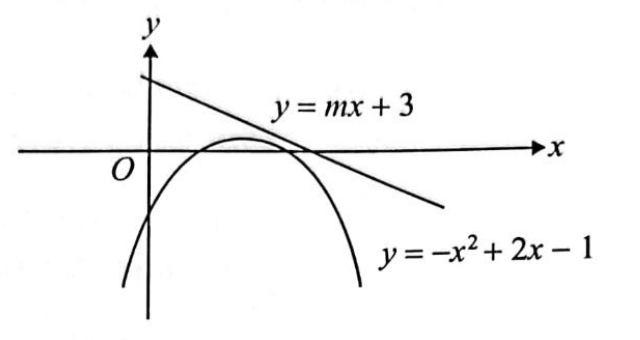
- (a)
Find the range of the values of m by using the number line method such that the straight line does not touch the curve.
[3] - (b)(i)
Sketch the graph of g(x) = 2(x + 3)² − 8.
[2]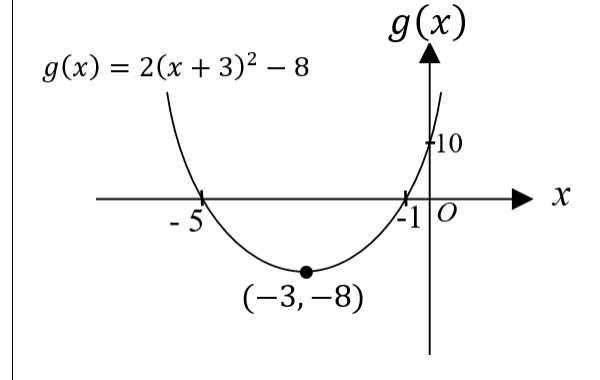
- (b)(ii)
State the range of values of p and of q.
[2]
Find the range of values of x for 5 < 2x² + x + 4 and 2x² + x + 4 ≤ 10. Hence, solve the inequality 5 < 2x² + x + 4 ≤ 10.
Easy4 marksFind the range of values of x for 5 < 2x² + x + 4 and 2x² + x + 4 ≤ 10. Hence, solve the inequality 5 < 2x² + x + 4 ≤ 10.
[4]
(a) Given that y = 2x² − 6, find the range of values of x when x + y < 0. (b) The quadratic equation mx² − 2nx + 5 = 0, where m and n are constants, has two equal roots. Express n in terms of m.
Easy4 marks- (a)
Given that y = 2x² − 6, find the range of values of x when x + y < 0.
[2] - (b)
The quadratic equation mx² − 2nx + 5 = 0 has two equal roots. Express n in terms of m.
[2]
(a) Given ax² + bx + c = 0. Derive the quadratic formula by using completing the square method. (b) By using the quadratic formula derived from 15(a), determine the roots of the quadratic equation x² − 4x + 5 = 0. Give your answer in terms of imaginary number, i with i = √−1.
Medium8 marks- (a)
Given ax² + bx + c = 0, derive the quadratic formula by using the completing the square method.
[5] - (b)
Determine the roots of x² − 4x + 5 = 0. Give your answer in terms of i, with i = √−1.
[3]
It is given that a straight line y = mx − m intersects the curve y = 2x² + 3x − 3 at two different points, find the range of values of m.
Easy4 marksFind the range of values of m.
[4]
A golf player hits a golf ball 3 m on the left side of hole A. The locus of the golf ball is given by f(x) = −(1/2)x² + px + 2q such that p, q are constants and x is the horizontal displacement of the golf ball from hole A. The golf ball falls to the ground again 10 m towards the right from where the ball was hit.
Medium4 marks- (a)
Find the value of p and of q.
[2] - (b)
Hence, find the maximum height that the golf ball reached.
[2]
(a) Alvin undergoes two running training sessions. In each session, Alvin runs for a distance of 5 km. In the first session, Alvin runs at an average speed of x km h⁻¹. In the second session, Alvin decreases his average speed by 2 km h⁻¹, and finishes the training 3 minutes later compared to the first session. Calculate Alvin's average speed in the first session. (Give your answer correct to four significant figures.) (b) Given α and β are the roots of the quadratic equation 3x² − 4x + 9 = 0. Find the new quadratic equation which has the roots 1/α and 1/β. Give your answer in the form ax² + bx + c = 0 where a, b and c are integers.
Medium7 marks- (a)
Calculate Alvin's average speed in the first session, given the conditions above. (Give your answer correct to four significant figures.)
[4] - (b)
Given α and β are the roots of 3x² − 4x + 9 = 0, find the new quadratic equation which has the roots 1/α and 1/β, in the form ax² + bx + c = 0 where a, b and c are integers.
[3]
(a) Diagram 2 shows a curve y = −x² + 4x − 3 intersecting a straight line y = mx + 6 at two different points. Find the range of the values of m by using the number line method. (b) (i) Sketch the graph of g(x) = 3(x + 5)² − 48. (ii) It is given that h(x) = 3(x + p)² + q, state the range of values of p and of q if the graph of h(x) is on the left of g(x) and the position of the minimum point of h(x) is lower than g(x).
Medium7 marks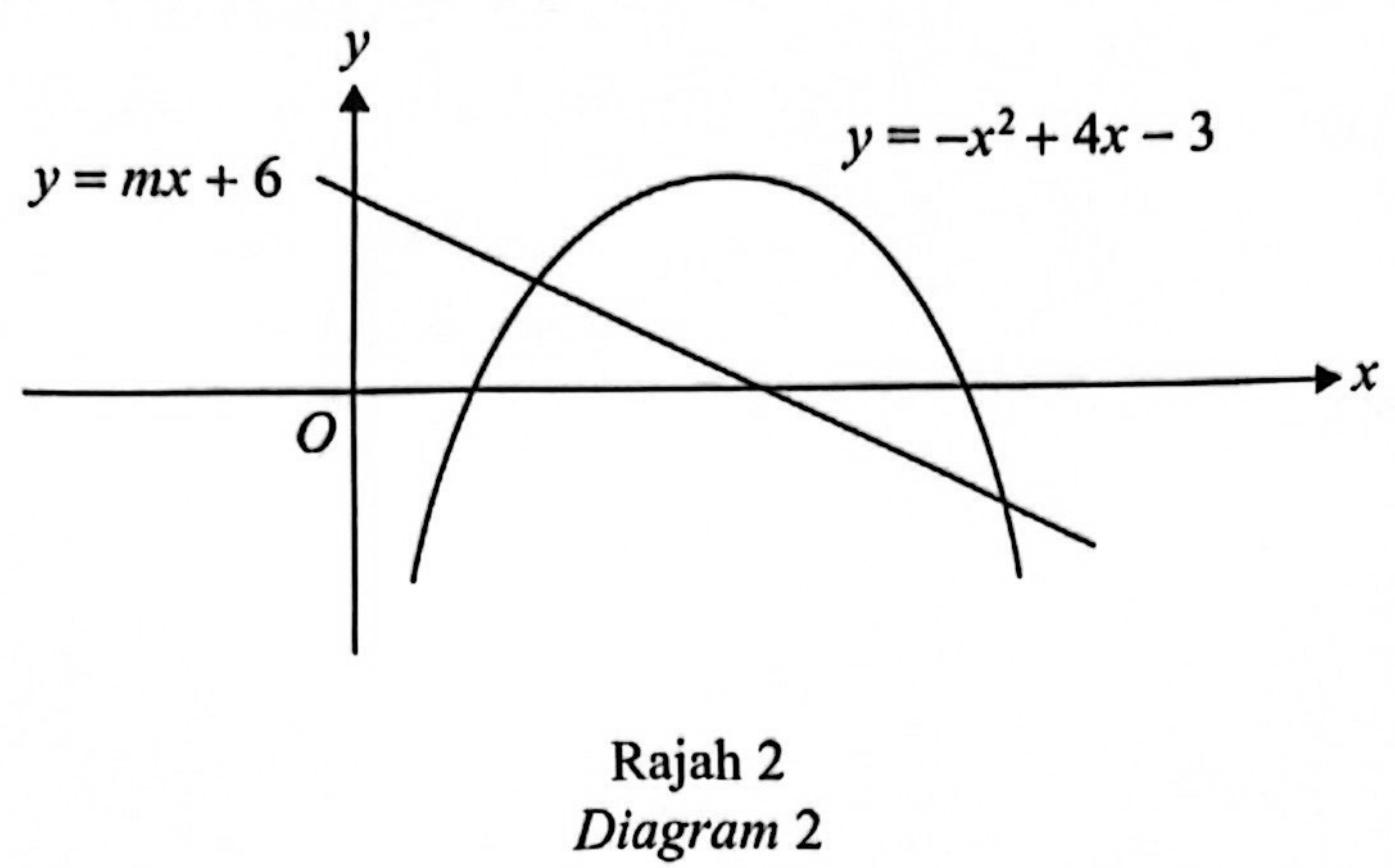
- (a)
Find the range of the values of m by using the number line method.
[3] - (b)(i)
Sketch the graph of g(x) = 3(x + 5)² − 48.
[2]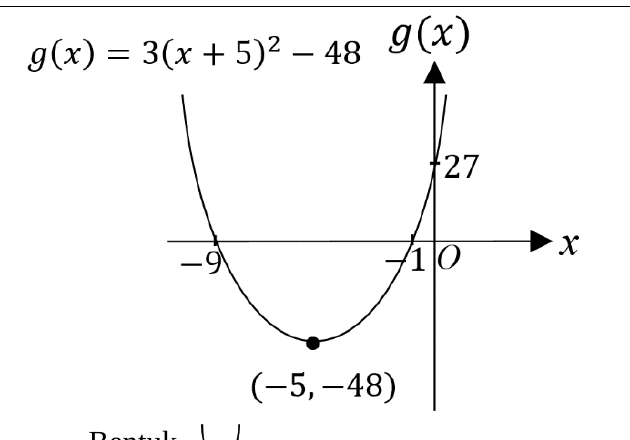
- (b)(ii)
State the range of values of p and of q if the graph of h(x) is on the left of g(x) and the position of the minimum point of h(x) is lower than g(x).
[2]
(a) Given that y = 4x² − 15x + 3, find the range of values of x when 2x + y > 0. (b) The quadratic equation 2px² − 2qx + 6 = 0, where p and q are constants, has two equal roots. Express q in terms of p.
Easy4 marks- (a)
Given y = 4x² − 15x + 3, find the range of values of x when 2x + y > 0.
[2] - (b)
The quadratic equation 2px² − 2qx + 6 = 0 has two equal roots. Express q in terms of p.
[2]
(a) Given ax² + bx + c = 0. Derive the quadratic formula by using completing the square method. (b) By using the quadratic formula derived from 15(a), determine the roots of the quadratic equation 5x² − 6x + 9 = 0. Give your answer in terms of imaginary number, i with i = √−1.
Medium8 marks- (a)
Given ax² + bx + c = 0. Derive the quadratic formula by using the completing the square method.
[5] - (b)
Using the formula from 15(a), determine the roots of 5x² − 6x + 9 = 0. Give the answer in terms of i, with i = √−1.
[3]
Given a quadratic function f(x) = (x + 1)(1 − 3x).
Medium5 marks- (a)
By using the method of completing the square, find the maximum value of f(x).
[3] - (b)
Hence, sketch the graph of f(x) for the domain −2 ≤ x ≤ 1.
[2]
Diagram 6 shows a rectangle ABCD and a square KLMC. AD = (15 + x) cm, DC = 10x cm and LM = (x + 5) cm. The total area of the entire diagram is 1100 cm².
Medium8 marks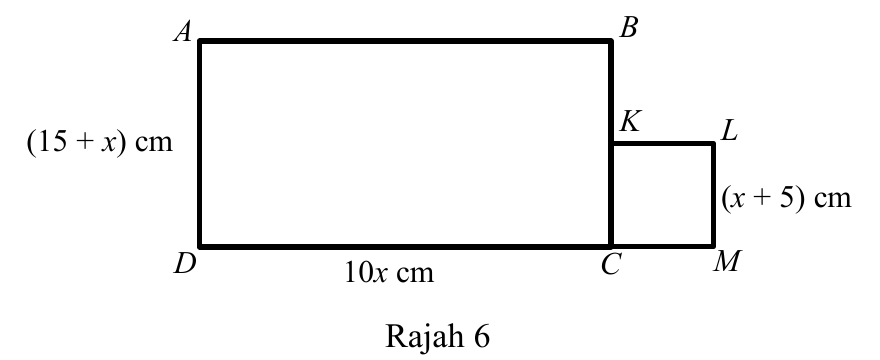
- (a)
Find the value of x.
[4] - (b)
Hence, find the length of the square KLMC that needs to be added so that its area is equal to the area of the rectangle ABCD. Round off your answer to the nearest integer.
[4]
Diagram 1 shows a curve y = x² + 3x and a straight line y = px − 1. Find the range of values of p so that both the line and the curve meet.
Medium4 marks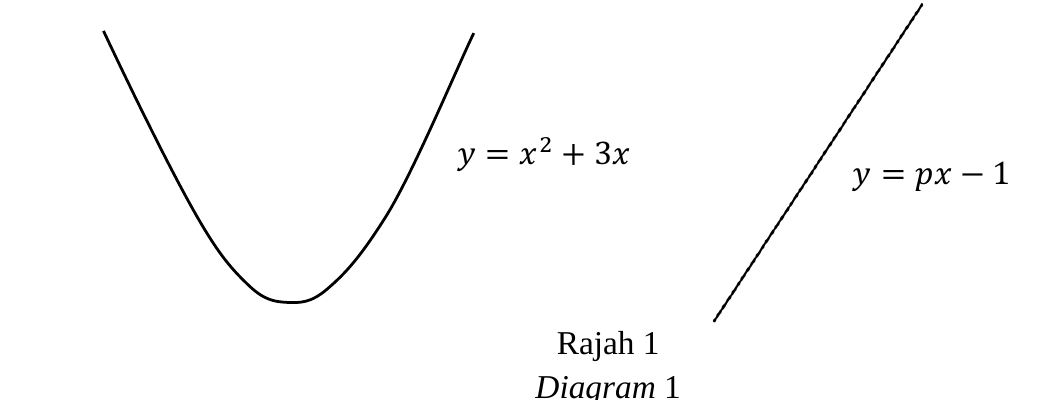
Find the range of values of p so that the line and the curve meet.
[4]
Express the quadratic function y = ½[(x + 5)² + (x − 7)²] in the form y = a(x + b)² + c.
Medium5 marks- (a)
Express y in the form y = a(x + b)² + c. Hence, state the minimum point of the quadratic function y.
[4] - (b)
If the curve is reflected about the x-axis, find the range of values of a.
[1]
(a) Given ax² + bx + c = 0. By using the completing the square method, show that x = (−b ± √(b² − 4ac))/(2a). (b) Solve the simultaneous equations 2x² + 3y² − 8xy = 24 and 4x − y − 6 = 0. Give the answers correct to 3 significant figures.
Medium8 marks- (a)
Show that x = (−b ± √(b² − 4ac))/(2a) by completing the square.
[3] - (b)
Solve 2x² + 3y² − 8xy = 24 and 4x − y − 6 = 0 (3 s.f.).
[5]
Find the range of values of x if the expression 6 − 7x − 3x² is always negative.
Easy3 marksFind the range of values of x if the expression 6 − 7x − 3x² is always negative.
[3]
(a) Find the range of values of x for (x − 4)² ≥ 4. (b) (i) Express f(x) = (4 − x)(2 + x) in vertex form f(x) = −(x − a)² + b such that a and b are constants. Hence, state the value of a and of b. (ii) If the graph of f(x) is reflected about the y-axis, write the equation of the curve.
Medium6 marks- (a)
Find the range of values of x for (x − 4)² ≥ 4.
[2] - (b)(i)
Express f(x) = (4 − x)(2 + x) in vertex form f(x) = −(x − a)² + b such that a and b are constants. Hence, state the value of a and of b.
[3] - (b)(ii)
If the graph of f(x) is reflected about the y-axis, write the equation of the curve.
[1]
(a) Complete the steps to derive the quadratic formula: ax² + bx + c = 0, a(x² + (b/a)x + c/a) = 0, x² + (b/a)x + c/a = 0, x² + (b/a)x + (b/2a)² − (b/2a)² + c/a = 0, ... x = (−b ± √(b² − 4ac))/2a. (b) Solve the simultaneous equations 4x + y = 7 and 4x² − 4xy + y² = 1.
Medium8 marks- (a)
Complete the steps to derive the quadratic formula from ax² + bx + c = 0 (the first lines are given up to x² + (b/a)x + (b/2a)² − (b/2a)² + c/a = 0).
[3] - (b)
Solve the simultaneous equations 4x + y = 7 and 4x² − 4xy + y² = 1.
[5]
Find the values of m and n that satisfy the equation m² + n(m − 6) − 6 = 0 and m/n + 2 = 0, giving the answers correct to three decimal places.
Easy5 marksFind m and n (3 d.p.).
[5]
The graph of the quadratic function f(x) = −2(x − p)² + 20, where p is a constant, has (1, q) as the maximum point. (a) State the values of p and q. (b) State the equation of the axis of symmetry. (c) Sketch the graph of f(x).
Easy7 marks- (a)
State the values of p and q.
[2] - (b)
State the equation of the axis of symmetry.
[1] - (c)
Sketch the graph of f(x).
[4]
(a) Find the range of values of x for (x − 4)² ≥ 4. (b) (i) Express the quadratic function f(x) = (4 − x)(2 + x) in the vertex form f(x) = −(x − a)² + b, where a and b are constants. Hence, state the values of a and b. (ii) If the graph of f(x) is reflected about the y-axis, write the equation of the curve.
Medium6 marks- (a)
Find the range of values of x for (x − 4)² ≥ 4.
[2] - (b)(i)
Express f(x) = (4 − x)(2 + x) in the form −(x − a)² + b; state a and b.
[3] - (b)(ii)
Write the equation of the curve when the graph of f(x) is reflected about the y-axis.
[1]
Diagram 2 shows part of the graph of the quadratic function f(x) = ax² − 8x + c, where a and c are constants. The graph cuts the x-axis at p and q (p < 0 < q) and the f(x)-axis below the origin.
Medium6 marks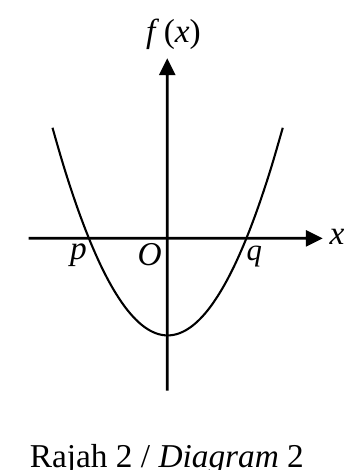
- (a)
State the range of values of x if f(x) ≤ 0.
[1] - (b)
Express the range of values of a in terms of c.
[2] - (c)
Prove that (p + q)/(pq) = 8/c.
[3]
The quadratic function f(x) = x² + 5k² − 4kx + 1 has a minimum value of h² + 2k, where h and k are constants.
Medium6 marks- (a)
By using the completing the square method, express h in terms of k.
[3] - (b)
Hence, find the value of k and of h if the axis of symmetry is at x = h − 1.
[3]
Given f(x) = (x + 3)(6 − x) for all values of x.
Medium6 marks- (a)(i)
State the equation of the axis of symmetry.
[1] - (a)(ii)
Find the range of f(x) for all real values of x.
[2] - (b)
Hence, sketch the graph of g(x) = |f(x)| for the domain −4 ≤ x ≤ 8.
[3]
Given the curve of the quadratic function f(x) = (x − 4)² + p with y-intercept 7, and it intersects the curve of g(x) = −3x² + (q + 10)x − 21 on the x-axis at two same points.
Medium8 marks- (a)
Find the values of p and of q.
[5] - (b)
Hence, by using the method of completing the square, find the coordinates of the maximum point of g(x).
[3]
It is given that g(x) = −3x² − x + 2.
Medium9 marks- (a)
Find the range of values of x such that g(x) > 0.
[2] - (b)
Using the method of completing the square, find the maximum value of function g(x).
[3] - (c)(i)
The equation mx + n − g(x) = 0, such that m and n are constants, has roots α and β. State α + β in terms of m and/or n.
[1] - (c)(ii)
The roots of the quadratic equation x² + kx + k = 14 are 1/α and 1/β, such that k is a constant. Express m in terms of n.
[3]
(a) The quadratic equation px² − 9qx + 9p = 0, where p and q are constants, has two equal roots. (b) One root of x² − 12x + k = 0 is three times the other root.
Medium4 marks- (a)
Find p : q.
[2] - (b)
Find the value of constant k.
[2]
Given the quadratic function f(x) = −3x² + 8x + 3.
Medium6 marks- (a)
By using the completing the square method, find the minimum or maximum value of the quadratic function f(x).
[3] - (b)
Sketch the graph of f(x) = −3x² + 8x + 3 for −1 ≤ x ≤ 4. Hence, state the range of values of f(x) when the graph is reflected about the x-axis.
[3]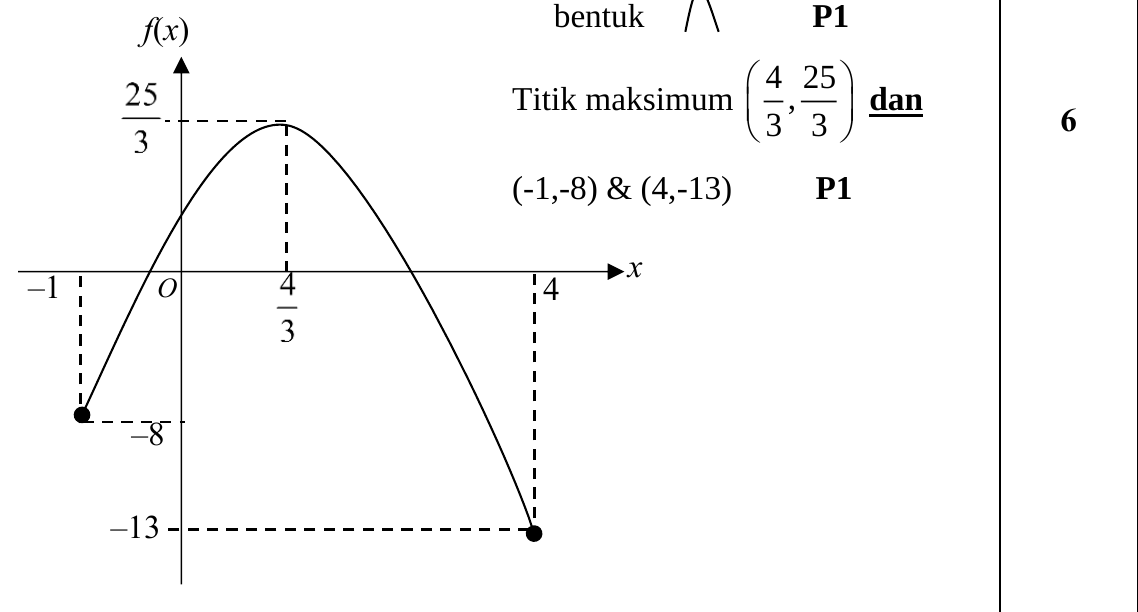
(a) Given the quadratic equation px² − 7qx + 16p = 0, where p and q are constants and equal roots, find p : q. Hence, find the value of p + q. (b) Find the range of values of x for the quadratic inequality 2x² ≤ 1 + x by using the number line method. (c) Given a quadratic function g(x) = a(x − b)² + c, where a, b and c are constants, has a maximum value of 10. The equation of the axis of symmetry of the graph g(x) is x = 4. Find (i) the range of values of a, (ii) the values of b, (iii) the values of c.
Medium8 marks- (a)
Equal roots of px² − 7qx + 16p = 0: find p : q, then p + q.
[3] - (b)
Find the range of x for 2x² ≤ 1 + x by the number line method.
[2] - (c)(i)
Find the range of values of a.
[1] - (c)(ii)
Find the value of b.
[1] - (c)(iii)
Find the value of c.
[1]
A landscape architect, Mr. Haiqal, has been tasked with designing a park that consists of two main sections, a rectangular area and a semicircular area. Given the area of the rectangular section is A₁ = x² − 6x + 8 and the area of the semicircular section, A₂, with radius r, where x = r + 2. Determine the values of x and r when the total area of both sections is 50 m². Hence, find the area of each section. Give answer to two decimal places.
Medium10 marksDetermine x and r when the total area is 50 m². Hence, find the area of each section (2 d.p.).
[10]