JOHOR 2021 P1 Q10
MediumWrite your answer on paper. Then open the answer to check it.
(a) Solve the equation log_√2 (x² − 4) + 1 = log₂ (2 − x). (b) The area of a rectangle is (3 + √3) cm². Given that its length is (2 + √3) cm, find its width in surd form.
Medium6 marks- (a)
Solve log_√2 (x² − 4) + 1 = log₂ (2 − x).
[4] - (b)
Find the width in surd form.
[2]
(a) Given 2^y = p and 3^y = q, express 81^(2y) − 4^(2y) in terms of p and q. (b) Show that 6^(m+2) + 6^(m+1) − 18(6^m) is divisible by 24 for all positive integer values of m.
Medium5 marks- (a)
Given 2^y = p and 3^y = q, express 81^(2y) − 4^(2y) in terms of p and q.
[2] - (b)
Show that 6^(m+2) + 6^(m+1) − 18(6^m) is divisible by 24 for all positive integer values of m.
[3]
(a) The area of a rectangle is (3 + √2) unit². If the length is (2 − √2) units, find its width in the form (a + b√2) units. (b) Solve the logarithmic equation log₇(x − 1) − log₇(x − 7) = 1.
Medium6 marks- (a)
Find the width in the form (a + b√2) units.
[4] - (b)
Solve log₇(x − 1) − log₇(x − 7) = 1.
[2]
(a) Given that 2^(x + 2) = 2^x + 10. Find the value of 2^x. (b) Given that log_{2x}(9 − x²) is defined for 0 < x < a, find the value of a. (c) Without using a calculator, evaluate log_a(4 log_b √b − ln e).
Medium8 marks- (a)
Find the value of 2^x.
[3] - (b)
Find the value of a.
[3] - (c)
Evaluate log_a(4 log_b √b − ln e).
[2]
(a) Solve the following equation: 2e^(3x) + 3e^(2x) = 5e^x. (b) Diagram 7 shows the side view of a bus waiting hut near a Mini Market (roof width 2√2 m, sloping roof edge √3 m, total height (1 + √3) m, vertical drop at roof 1/3 √3 m). One day, a rice truck had accidentally hit one of the pillars of the hut until it was bent. If the Town Council wants to change the bent pillar according to its original size before it was hit, calculate the length of the pillar in the form (a/b)√3, such that a and b are positive integers.
Medium8 marks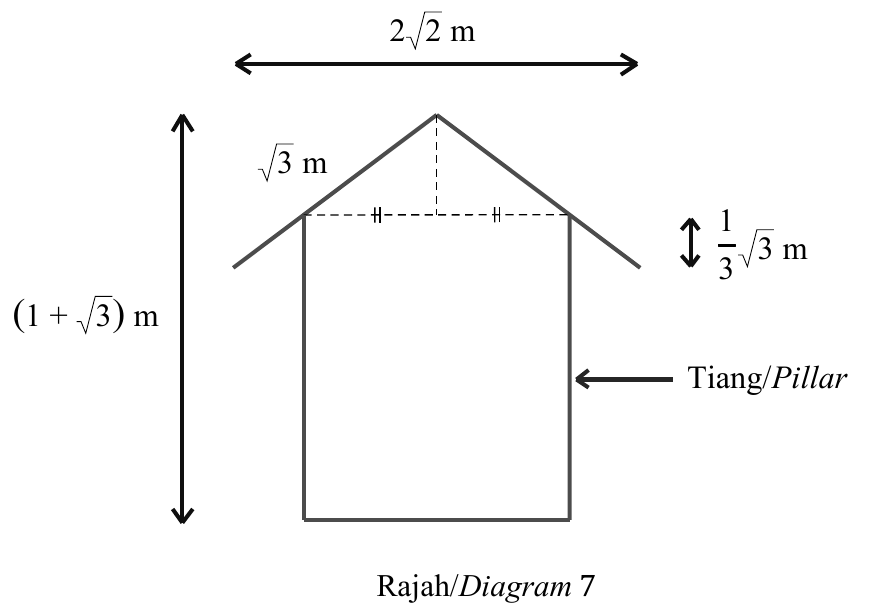
- (a)
Solve 2e^(3x) + 3e^(2x) = 5e^x.
[4] - (b)
Calculate the length of the pillar in the form (a/b)√3.
[4]
(a) Solve the equation 3ˣ = 162 − 3ˣ. (b) Show that 3ⁿ⁺⁴ + 3ⁿ⁺⁵ + 3ⁿ = 325(3ⁿ).
Medium5 marks- (a)
Solve the equation 3ˣ = 162 − 3ˣ.
[3] - (b)
Show that 3ⁿ⁺⁴ + 3ⁿ⁺⁵ + 3ⁿ = 325(3ⁿ).
[2]
(a) Simplify (5 + √7)/(5 − √7). (b) Solve 3^(x−4) = 50^(x−3). Give your answer correct to 3 decimal places.
Easy6 marks- (a)
Simplify (5 + √7)/(5 − √7).
[3] - (b)
Solve 3^(x−4) = 50^(x−3), correct to 3 decimal places.
[3]
(a) Given 3(4ᵖ) = 5(2ᵖ) and 9(8ᵖ) = 10(4ᵖ). Show that 2ᵖ⁺¹ = 5. (b) It is given that logₘ p = 2(logₘ q − logₘ 2) where p > 0, m > 0 and m ≠ p. Express p in terms of q. (c) Given n = ln m + 1, where m is a rational number and is the solution to the equation 5eⁿ⁻³ = e⁻², find the value of m.
Medium8 marks- (a)
Show that 2ᵖ⁺¹ = 5.
[3] - (b)
Express p in terms of q.
[2] - (c)
Find the value of m.
[3]
(a) Solve the equation 2e³ˣ⁺¹ = 9e²⁻ˣ. (b) The diagram shows a right-angled triangle with the two perpendicular sides (4 − 2√2) cm and (4 + 2√2) cm. Find the area and the perimeter of the triangle.
Medium8 marks- (a)
Solve 2e³ˣ⁺¹ = 9e²⁻ˣ.
[3] - (b)
Find the area and the perimeter of the right-angled triangle.
[5]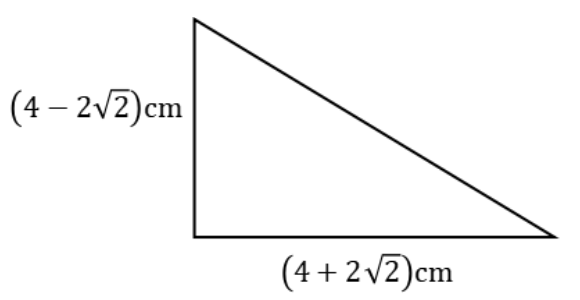
The temperature of a type of metal increases from 36°C to h°C according to h = 36(1.08)ᵗ when it is heated for t seconds. Calculate (a) the temperature of the metal when it is heated for 15 seconds, (b) the time, in seconds, taken to increase the temperature of the metal from 36°C to 1000°C.
Easy5 marks- (a)
Calculate the temperature after 15 seconds.
[2] - (b)
Calculate the time taken to increase the temperature from 36°C to 1000°C.
[3]
(a) Show that (3⁵ + 13)(5^(3n) + 2^(8(n+1))) is divisible by 8 for all positive integers n. (b) Given 3(4^p) = 5(2^q) and 9(8^p) = 10(4^q), show that 2^(p+1) = 5.
Medium5 marks- (a)
Show that (3⁵ + 13)(5^(3n) + 2^(8(n+1))) is divisible by 8 for all positive integers n.
[2] - (b)
Given 3(4^p) = 5(2^q) and 9(8^p) = 10(4^q), show that 2^(p+1) = 5.
[3]
(a) Rationalise the denominator and simplify (1 + √2)/(1 − √2). (b) Solve the equation log₂ 8 − log₄ (x − 4) = 1/2.
Easy6 marks- (a)
Rationalise the denominator and simplify (1 + √2)/(1 − √2).
[3] - (b)
Solve the equation log₂ 8 − log₄ (x − 4) = 1/2.
[3]
(a) Solve the equation 3^(x−1) = 1/9^x. (b) Given log₄[logₓ(2y − 5)] = 1/2, express y in terms of x. (c) Express x³ = e^(6x−9) in the form ln x = ax + b. Find the value of a and of b.
Medium8 marks- (a)
Solve 3^(x−1) = 1/9^x.
[3] - (b)
Given log₄[logₓ(2y − 5)] = 1/2, express y in terms of x.
[2] - (c)
Express x³ = e^(6x−9) in the form ln x = ax + b. Find a and b.
[3]
(a) The air pressure, in mm Hg, at an altitude of h km above sea level is given by P = 759e^(−0.325h). Find the height above sea level if the pressure at that altitude is 360 mm Hg. (b) A right-angled triangle ABC with width AB = (4 + 3√2) cm has an area of (10 + 8√2) cm². Find (i) the height BC, in cm, in the form a + b√2, (ii) the length, in cm, of AC. Give your answer correct to 3 significant figures.
Medium8 marks- (a)
Find h when P = 360.
[4] - (b)(i)
Find BC in the form a + b√2.
[2] - (b)(ii)
Find AC, correct to 3 significant figures.
[2]
Indices, surds and logarithms.
Medium7 marks- (a)
Simplify (3ⁿ⁺² + 15(3ⁿ⁻¹))/42.
[2] - (b)
Given that 1/(7√3) = a√b/21. State the value of a and of b.
[2] - (c)
Show that log₉ xy = log₃ √x + log₃ √y.
[3]
Solve the equation log₃(x − 2) − log₃ 2 = log₃ x² − log₃(3x + 4).
Easy4 marksSolve the equation log₃(x − 2) − log₃ 2 = log₃ x² − log₃(3x + 4).
[4]
Given that log_a b = √5, find the value of 1/log_ab b − 1/log_ab a.
Medium4 marksFind the value of 1/log_ab b − 1/log_ab a.
[4]
Three short questions on indices and logarithms.
Medium6 marks- (a)
Given (2^(3x) × 2)/32^(x−1) = 16^y, express x in terms of y.
[2] - (b)
Find the possible value of x for x + 2 = −3(√x − 4).
[2] - (c)
Find the value of k if k log₈ 5 = log₂ 5.
[2]
(a) Given (11 + √3) − (13/(√3 + 4))² = a + b√3, where a and b are integers. (b) Given 32^(h+3) ÷ 64^(2k−1) = 8.
Easy5 marks- (a)
Find the values of a and b.
[3] - (b)
Express h in terms of k.
[2]
(a)(i) Solve x + √(16 − 8x) = 2. (ii) Given 3^(x+1) + 15(3^x) + 3^(x+3) = m(3^(x+k)) such that k and m are positive integers while k > 0, find the value of k + m. (b) Given 2^s = 3^t = 6^u, express u in terms of s and t.
Medium8 marks- (a)(i)
Solve x + √(16 − 8x) = 2.
[3] - (a)(ii)
Find the value of k + m.
[2] - (b)
Given 2^s = 3^t = 6^u, express u in terms of s and t.
[3]
(a) Solve ln(3x − 1) = 2, giving the answer in terms of e. (b) Given 27^(log₃ p) = (q + 1)³ where p > 0, express q in terms of p.
Easy5 marks- (a)
Solve the equation ln(3x − 1) = 2 and give your answer in terms of e.
[2] - (b)
Given 27^(log₃ p) = (q + 1)³ where p > 0, express q in terms of p.
[3]
(a) Find the value of (i) log_m 1, (ii) log_m ∛m + log_n √n + log_81 3, where m > 0, m ≠ 1. (b) Petrol flows out of a container according to H = 96(0.45)^t, where H is the height of the petrol in cm and t is the time in seconds since the petrol began to flow out.
Medium8 marks- (a)(i)
Find the value of log_m 1.
[1] - (a)(ii)
Find the value of log_m ∛m + log_n √n + log_81 3.
[3] - (b)(i)
Determine the original height of the petrol in the container.
[2] - (b)(ii)
Determine the time when the height of the petrol is 10 cm.
[2]
Given that √(m + n√5) = 11/(4 − √5), where m and n are constants. Without using a calculator, find the value of m − n.
Medium5 marksFind the value of m − n.
[5]
(a) Solve the equation 2/(log_y 2) = 4 + log₂(y + 5). (b) Given log_a N = ½[1/(log₂₄ a) − log_a (3/8) − 6 log_a 3]. (i) Without using a calculator, determine the value of N in simplest form p/q. (ii) Hence, if a = 2/3, find the value of log_a N.
Medium8 marks- (a)
Solve 2/(log_y 2) = 4 + log₂(y + 5).
[3] - (b)(i)
Without a calculator, find N in simplest form p/q.
[3] - (b)(ii)
Hence, if a = 2/3, find log_a N.
[2]
(a) Express √45 in the form a√b, where a and b are positive integers. (b) Solve the equation (2x+1)-th root of 256 = (2x+2)-th root of 512.
Easy4 marks- (a)
Express √45 in the form a√b, where a and b are positive integers.
[1] - (b)
Solve 256^(1/(2x+1)) = 512^(1/(2x+2)) (written as the (2x+1)-th root of 256 = the (2x+2)-th root of 512).
[3]
Given log_a(p²q) = h and log_a(q/p³) = k, express log_a(p/q) in terms of h and k.
Easy5 marksExpress log_a(p/q) in terms of h and k.
[5]
(a) Show that 27^(y+1) + 3^(3y) can be written in the form a(bʸ), where a and b are constants. Hence, find the values of a and of b. (b) Solve the equation log_p (5 + x²) = log_√p (3 − x).
Medium5 marks- (a)
Show that 27^(y+1) + 3^(3y) can be written in the form a(bʸ), where a and b are constants. Hence, find the values of a and of b.
[2] - (b)
Solve the equation log_p (5 + x²) = log_√p (3 − x).
[3]
(a) Convert 0.168168168... to a fraction without using the progression method. (b) The solution of the equation √12 x − √5 x = √6 is (p√2 + √q)/7, where p and q are constants. Without using a calculator, find the values of integers p and q.
Medium5 marks- (a)
Convert 0.168168168... to a fraction without using the progression method.
[2] - (b)
The solution of √12 x − √5 x = √6 is (p√2 + √q)/7. Without using a calculator, find the values of integers p and q.
[3]
(a) Solve 28√(3ˣ) − 3^(x+1) = 9 with the condition x > 0. (b) Given log₃ P = a and log₉ Q = b, express 25^(log₅(Q/P)) in terms of a and b.
Medium6 marks- (a)
Solve 28√(3ˣ) − 3^(x+1) = 9, x > 0.
[3] - (b)
Given log₃ P = a and log₉ Q = b, express 25^(log₅(Q/P)) in terms of a and b.
[3]
(a) Given that m/n = 0.0454545… is a ratio number where m and n are positive integers. Without using the progression method, find the value of m − n. (b) Diagram 2 shows the position of three circular swimming pools of the same size, centred at A, B and C, touching each other. Given the area of the shaded region is (3/4)(16√3 − 8π) m², find the radius, in m, of the pool in the form a√b, where a and b are constants.
Medium7 marks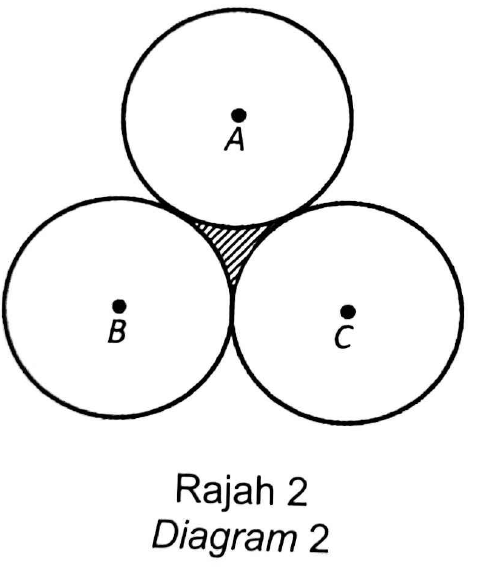
- (a)
Find the value of m − n without using the progression method.
[2] - (b)
Find the radius, in m, of the pool in the form a√b.
[5]
Indices and logarithms. Table 1(a) shows x = 1, 9 and y = 8, 16. Table 1(b) shows log_q x = 0, 2 and log_p y = 3, 4.
Medium6 marks- (a)
Given the equation 4(3^(2x+1)) + 17(3^x) − 7 = 0. By using the indices law method, show that the value of x = −1 satisfies the equation.
[3] - (b)
Table 1(a) shows the variables x and y, while Table 1(b) represents the variables log_q x and log_p y. Find the values of p and of q. [Table 1(a): x = 1, 9; y = 8, 16. Table 1(b): log_q x = 0, 2; log_p y = 3, 4]
[3]
Indices and equations.
Medium6 marks- (a)
Given 2^(3x) = 2p, 2^y = q and 2^(y+3x) = 5 + 8^x. Express p in terms of q.
[3] - (b)
Solve the equation m + 4 = √(m + 10).
[3]
Solve the equation log₂ y = 4 log_y 2.
Medium4 marksSolve the equation log₂ y = 4 log_y 2.
[4]
(a) Simplify 3⁻ⁿ(15ⁿ − 27ⁿ). (b) Express h in terms of a and b if the solution to the equation √(4x) − √x = 3/(√a − √b), such that a and b are constants, is x = h(√a + √b)². (c) Given that q = ln p + 1, such that p is a rational number and is the solution to the equation 5e^(q−3) = e⁻², find the value of p.
Medium7 marks- (a)
Simplify 3⁻ⁿ(15ⁿ − 27ⁿ).
[2] - (b)
Express h in terms of a and b if the solution to √(4x) − √x = 3/(√a − √b) is x = h(√a + √b)².
[2] - (c)
Given q = ln p + 1 and 5e^(q−3) = e⁻², find the value of p.
[3]
(a) Solve the inequality 0.62ˣ > 3. Give your answer accurate to three significant figures. (b) Given that log₉ xy = m and log₉ (x/y) = n, show that x = 3^(m + n). Hence, express y in terms of m and n.
Medium7 marks- (a)
Solve 0.62ˣ > 3 (3 significant figures).
[2] - (b)
Show that x = 3^(m + n). Hence, express y in terms of m and n.
[5]
(a) Rationalise the denominator and simplify 5/(√5 − 5). (b) Given 2^(4x) = r, 2^y = s and 4^(2x+y) = 7 + 16^x, express r in terms of s.
Easy5 marks- (a)
Rationalise the denominator and simplify 5/(√5 − 5).
[2] - (b)
Given 2^(4x) = r, 2^y = s and 4^(2x+y) = 7 + 16^x, express r in terms of s.
[3]
(a) Rationalise the denominator and simplify (6 − √3)/(9 − √12). (b) The total number of people infected by a highly infectious virus follows the equation M(t) = 1500 + e^(0.9t) after time t (in days). Determine the minimum number of days needed for the virus to infect more than 9500 people.
Medium5 marks- (a)
Rationalise the denominator and simplify (6 − √3)/(9 − √12).
[2] - (b)
Find the minimum number of days for M(t) > 9500.
[3]
(a) Show that 1/log_m(mn) + 1/log_n(mn) = 1. Hence, solve log₆(2x − 1) = 1/log_m(mn) + 1/log_n(mn). (b) Solve the equation 5²ˣ − 5ˣ⁺¹ = 50.
Medium7 marks- (a)
Show that 1/log_m(mn) + 1/log_n(mn) = 1; hence solve log₆(2x − 1) = 1/log_m(mn) + 1/log_n(mn).
[4] - (b)
Solve 5²ˣ − 5ˣ⁺¹ = 50.
[3]
(a) Simplify k^(1/2) × 3k^(−1/3). (b) Show that 5^(x+1) − 5^(x−1) + 5^x is divisible by 29 for all positive integers x.
Easy4 marks- (a)
Simplify k^(1/2) × 3k^(−1/3).
[2] - (b)
Show that 5^(x+1) − 5^(x−1) + 5^x is divisible by 29 for all positive integers x.
[2]
(a) Convert the recurring decimal 0.545454… to a fraction without using the progression method. (b) The length and width of the rectangle in Diagram 4 are 2√5 − √2 and √5 + √2 respectively. Determine the area of the coloured region and state the answer in the form a + b√10, where a and b are rational numbers.
Easy5 marks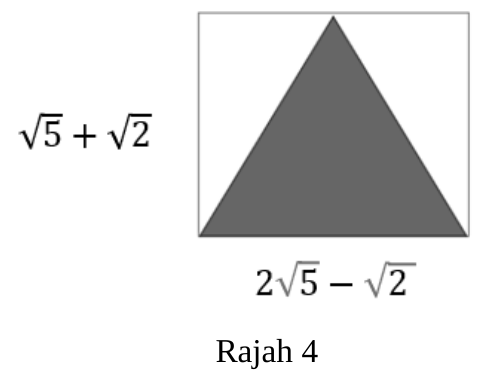
- (a)
Convert the recurring decimal 0.545454… to a fraction without using the progression method.
[2] - (b)
The length and width of the rectangle in Diagram 4 are 2√5 − √2 and √5 + √2. Determine the area of the coloured region (the triangle, whose base is the rectangle's length and height its width), in the form a + b√10, a and b rational.
[3]
(a) Given m = log_b n, state one condition for b. (b) Evaluate log_p (p/√q) + log_p √(pq). (c) Given log₂ 3 = x and log₁₄ 6 = y, find log₂ 7 in terms of x and of y.
Medium6 marks- (a)
Given m = log_b n, state one condition for b.
[1] - (b)
Evaluate log_p (p/√q) + log_p √(pq).
[3] - (c)
Given log₂ 3 = x and log₁₄ 6 = y, find log₂ 7 in terms of x and of y.
[2]
(a) Solve the equation 16^(2x) (64) = 4^x. (b) Given that log₃ p + log₉ k = 3, form an equation in terms of p and k.
Easy5 marks- (a)
Solve 16^(2x)(64) = 4^x.
[2] - (b)
Form an equation in p and k from log₃ p + log₉ k = 3.
[3]
(a) Simplify (3 + 2√h)(14 + 2√h). (b) Diagram 7 shows a trapezium ABCD. The lengths of AD and BC are 6 + 4√h and 8 − 2√h respectively. The height of the trapezium is half of the length of AD and the area of trapezium ABCD is 27 + 17√h. Find the value of h.
Easy5 marks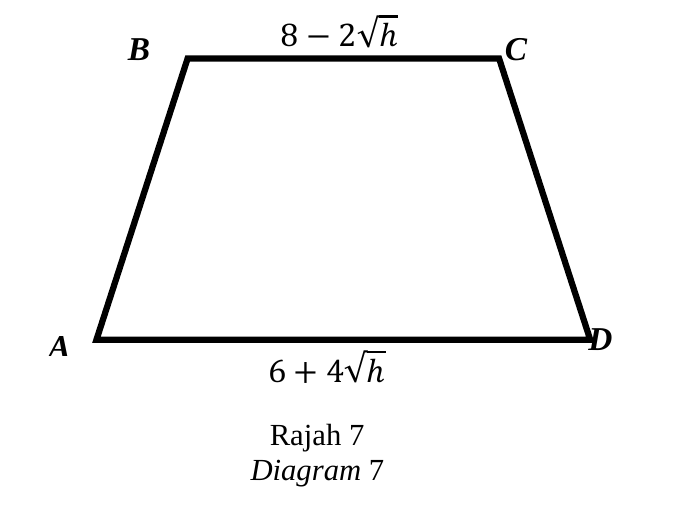
- (a)
Simplify (3 + 2√h)(14 + 2√h).
[2] - (b)
Find h from the area of the trapezium.
[3]
(a) Convert log₆ 254 to natural logarithms and evaluate. (b) Given logₙ 2 = p and logₙ 3 = q, express log₃ 16n² in terms of p and q.
Easy5 marks- (a)
Convert log₆ 254 to natural logarithms and evaluate.
[2] - (b)
Given logₙ 2 = p and logₙ 3 = q, express log₃ 16n² in terms of p and q.
[3]
(a) Determine whether √16 is a surd or not. Give your reason. (b) Solve ln(3x − 5) = 6. (c) Diagram 9 shows three circles. Circle J has radius 6 cm and circle K has radius 3 cm. The small circle has radius r cm. MN is a common tangent and all circles touch one another. Show that r = 6/(3 + 2√2).
Medium8 marks- (a)
Is √16 a surd? Give your reason.
[1] - (b)
Solve ln(3x − 5) = 6.
[2] - (c)
Show that r = 6/(3 + 2√2).
[5]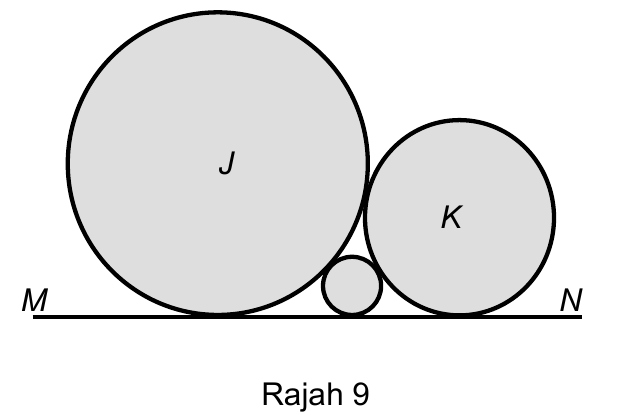
(a) Simplify (7²ⁿ × 7ᵐ)/7ⁿ. (b) Given log₂ b = x and log₂ c = y, express log₄ (8b/c) in terms of x and y.
Easy5 marks- (a)
Simplify (7²ⁿ × 7ᵐ)/7ⁿ.
[2] - (b)
Given log₂ b = x and log₂ c = y, express log₄ (8b/c) in terms of x and y.
[3]
(a) Rationalise the denominator and simplify (5 + √3)/√3. (b) Solve the equation (k/169)^(1/2) × √k = 6. (c) Without using a calculator, solve the equation log₄ [log₃ (5 − 2x)] = log₁₆ 4.
Medium7 marks- (a)
Rationalise the denominator and simplify (5 + √3)/√3.
[2] - (b)
Solve (k/169)^(1/2) × √k = 6.
[2] - (c)
Without a calculator, solve log₄ [log₃ (5 − 2x)] = log₁₆ 4.
[3]
Simplify 4√(4a) − 3/√a + √(9a) and state the final answer in the form ((pa − 3)√a)/a, where p is a constant.
Easy4 marksSimplify 4√(4a) − 3/√a + √(9a) in the form ((pa − 3)√a)/a.
[4]
(a) Solve 5^(x+1) + 5^(x+3) + 5^x = 5^x(42x + 5). (b) Evaluate log_m √(mn) + log_m (m/√n).
Easy6 marks- (a)
Solve 5^(x+1) + 5^(x+3) + 5^x = 5^x(42x + 5).
[3] - (b)
Evaluate log_m √(mn) + log_m (m/√n).
[3]
(a) Given log₁₀ a < 0, state the range of values of a. (b) Given that a = 7ˣ and b = 7ʸ, simplify 49^(x+y) + 7^(x−y) in terms of a and b.
Easy4 marks- (a)
Given log₁₀ a < 0, state the range of values of a.
[1] - (b)
Given that a = 7ˣ and b = 7ʸ, simplify 49^(x+y) + 7^(x−y) in terms of a and b.
[3]
The population of bacteria A grows according to the function Aₙ = 200eⁿ and the population of bacteria B grows according to the function Bₙ = 20e^(n+1), such that n is a number of days. (a) Find the total population of bacteria A on the 2nd day. (b) After how many days will the total population of both bacteria exceed 800 000?
Easy4 marks- (a)
Find the total population of bacteria A on the 2nd day.
[1] - (b)
After how many days will the total population of both bacteria exceed 800 000?
[3]
(a) A cylinder has a radius of 1/(√3 + 1) cm and a height of (√3 − 1) cm. Find the volume of the cylinder in the form of (a + b√3)π cm³, such that a and b are constants. (b) Table 1 shows the number of population in a country: 2020 is 33 200 000 and 2022 is 33 900 000. Population growth rate, r in the country can be represented by r = (1/n) ln(Pₙ/P₀) such that Pₙ is the number of population in the current year, P₀ is the number of population in the base year and n is the number of years. Find the growth rate, in percentage, for the year 2022. (c) Diagram 11 shows Vanessa holding a placard with 5³⁰⁰ > 3⁵⁰⁰ and Hazwan holding a placard with 5³⁰⁰ < 3⁵⁰⁰. Whose statement is true? Give your justification by using the law of indices.
Medium8 marks- (a)
Find the volume of the cylinder in the form of (a + b√3)π cm³, such that a and b are constants.
[4] - (b)
Find the growth rate, in percentage, for the year 2022.
[2]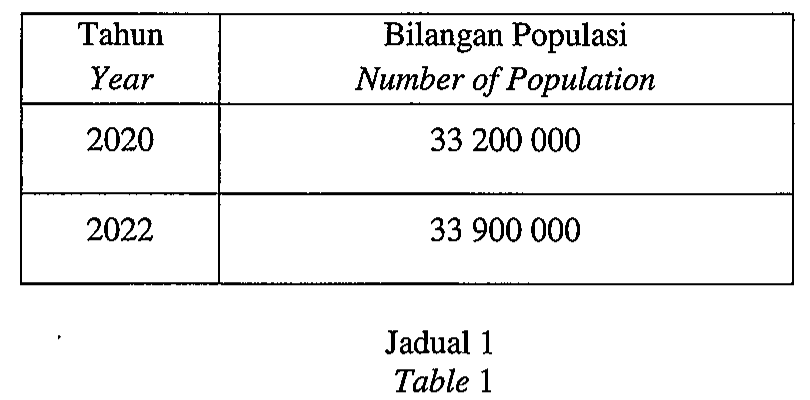
- (c)
Whose statement is true? Give your justification by using the law of indices.
[2]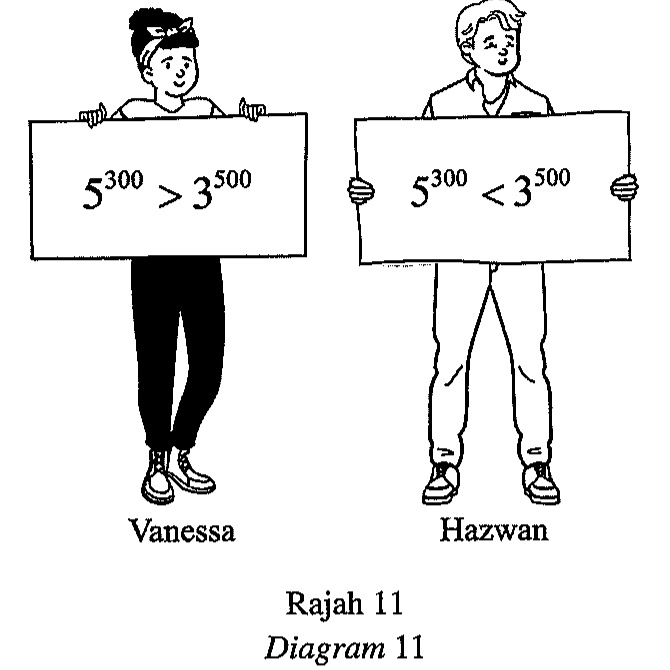
(a) Given that 81ˣ = 243, find the value of 9²ˣ⁻¹. (b) (i) Prove that logₐ b = 1/(log_b a). (ii) Hence, simplify 3 log_b √a − 1/(logₐ b²).
Medium7 marks- (a)
Given that 81ˣ = 243, find the value of 9²ˣ⁻¹.
[2] - (b)(i)
Prove that logₐ b = 1/(log_b a).
[2] - (b)(ii)
Hence, simplify 3 log_b √a − 1/(logₐ b²).
[3]
(a) Given log₁₂ 3 = k, express log_√3 8 in terms of k. (b) A group of scientists in Hawkin City discovered an odd organism that reproduces following the equation ln(x/e²) = t − 3 ln x such that x is the number of resulting cells and t is the reproductive time in hours. After 10 hours, express the number of resulting cells in terms of e.
Medium8 marks- (a)
Given log₁₂ 3 = k, express log_√3 8 in terms of k.
[4] - (b)
After 10 hours, express the number of resulting cells in terms of e.
[4]
(a) Diagram 2 shows a right-angled triangle ABC where AB = 5√(5y) cm and BC = 4√(5x) cm. PBSR is a rectangle inscribed in the triangle ABC where BS = 2√x cm and PB = 3√y cm. The area of the shaded region is k√(xy) cm². (b) An experiment was conducted to test the property of a substance when heated for t seconds. Temperature, T in °C of the substance follows the equation 2²ᵗ⁺¹ = T + 2ᵗ.
Medium7 marks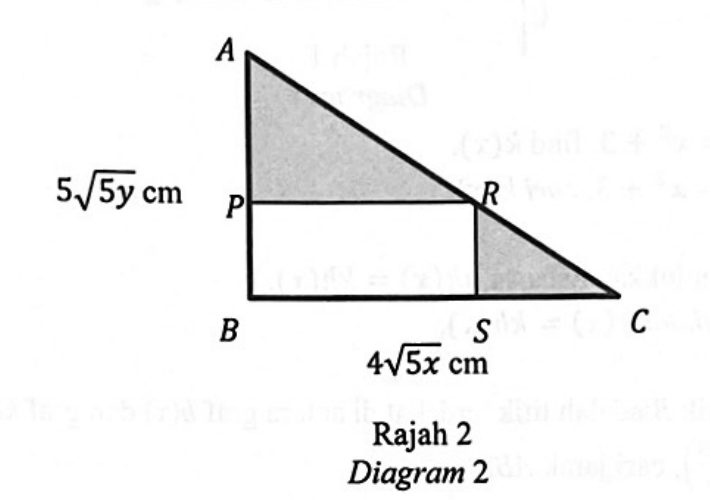
- (a)
Find the value of k.
[3] - (b)
Find the time, in seconds, for the substance to reach temperature of 120°C.
[4]
(a) Given 2 log₂ y = log₂ x + 4. Express y in terms of x. (b) Solve the equation 4ˣ = 80 − 4ˣ⁻¹.
Medium6 marks- (a)
Express y in terms of x.
[3] - (b)
Solve 4ˣ = 80 − 4ˣ⁻¹.
[3]
(a) Solve 2√x − 1 = √(4x − 9). (b) Given that logₓ 4 = k, express log₄ ∛x in terms of k.
Easy5 marks- (a)
Solve 2√x − 1 = √(4x − 9).
[2] - (b)
Given that logₓ 4 = k, express log₄ ∛x in terms of k.
[3]
(a) Given 7^(y−4) = 3^(2x). Express y in terms of x. (b) Show that 2^(x+5) + 2^(x+3) − 2^(x+2) can be divided by 4 for all positive integer x. Justify your answer.
Medium5 marks- (a)
Given 7^(y−4) = 3^(2x). Express y in terms of x.
[2] - (b)
Show that 2^(x+5) + 2^(x+3) − 2^(x+2) can be divided by 4 for all positive integer x. Justify your answer.
[3]
Two parts on indices and logarithms.
Medium6 marks- (a)
Given 2^m × 5^m = a^(2m) × b^m, express a in terms of b.
[3] - (b)
Solve log₁₆ 2x + log₂ x = −1.
[3]
Three parts on surds, logarithms and indices.
Medium8 marks- (a)
Given √m x + √7 = √3, express x in terms of m.
[2] - (b)
Given m = aˣ, show that logₐ mⁿ = n logₐ m, such that n is any real number.
[2] - (c)
Diagram 10 shows a right angled triangle with sides 1, 2^(k/2 − 1) and hypotenuse 3 × 2^(k/2 − 1). Find the value of k.
[4]
(a) Given that 5ⁿ⁺² − 5ⁿ − 125(5ⁿ⁻²) = k(5ⁿ), find the value of k. (b) Express (4√5 − 2)²/(√5 − 1) in the form p√5 + q, where p and q are integers. (c) Given log₃ p = m, express log₃ √p in terms of m.
Medium8 marks- (a)
Given 5ⁿ⁺² − 5ⁿ − 125(5ⁿ⁻²) = k(5ⁿ), find k.
[3] - (b)
Express (4√5 − 2)²/(√5 − 1) in the form p√5 + q.
[4] - (c)
Given log₃ p = m, express log₃ √p in terms of m.
[1]
(a) Are all numbers with roots surds? Support your statement. (b) Solve the equation 8(4^(x−1)) = 8^(2x−1). (c) Given that x = 3^p and y = 3^q, express log₂₇ x − log₉ y in terms of p and q.
Medium7 marks- (a)
Are all numbers with roots surds? Support your statement.
[2] - (b)
Solve 8(4^(x−1)) = 8^(2x−1).
[2] - (c)
Given x = 3^p and y = 3^q, express log₂₇ x − log₉ y in terms of p and q.
[3]
(b) At the beginning of 2022 the population of a species in a forest reserve was 20 000. After t years the number N is N = 20 000e^(−0.03t).
Medium8 marks- (a)(i)
Derive that log_a(x/y) = log_a x − log_a y.
[3] - (a)(ii)
Hence, without using a calculator, find the value of log₃54 − log₃6 − log₃3.
[2] - (b)
Calculate the minimum number of years in which the population is less than half the population at the beginning of 2022.
[3]
(a) Given log₂3 = h and log₂5 = k, express in terms of h and k. (b) Solve the equation √2 p − 8 = √24 − √8 p.
Medium7 marks- (a)(i)
log₂3.6
[2] - (a)(ii)
log₂270
[2] - (b)
Solve the equation √2 p − 8 = √24 − √8 p.
[3]
(a) The amount of caffeine in a person's body after drinking coffee is C = C₀e^(−0.15t), where C₀ is the initial caffeine content, in mg, and C is the caffeine content, in mg, after t hours. Find the time needed for the caffeine level to reduce to half of its original value. Round off your answer to the nearest whole number. (b) Diagram 5 shows a triangular metal ABC designed by an engineer to support a building structure. AC = √6 m, BC = √2/(√3 + √2) m, AB = √(16 − 4√6) m. Determine whether triangle ABC is a right-angled triangle at C or not. Show your calculations.
Medium6 marks- (a)
Find the time needed for the caffeine level to reduce to half of its original value. Round off to the nearest whole number.
[3] - (b)
Determine whether triangle ABC is a right-angled triangle at C or not. Show your calculations.
[3]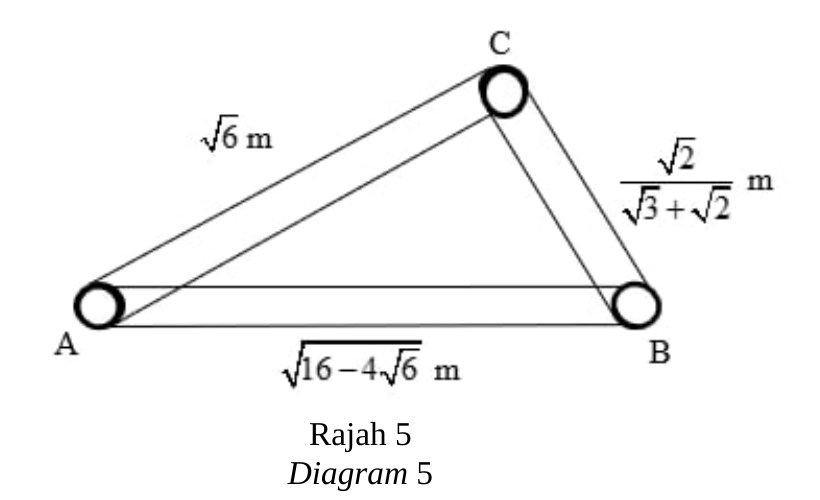
Solve the following equations. (a) (i) 49^(3x) · √(3^(12x)) = 21. (ii) y√12 = 6 − √3. (b) Given log₃ r = m and log₉ s = n, express log₃ (r² s³) in terms of m and/or n.
Medium7 marks- (a)(i)
Solve 49^(3x) · √(3^(12x)) = 21.
[2] - (a)(ii)
Solve y√12 = 6 − √3.
[2] - (b)
Given log₃ r = m and log₉ s = n, express log₃ (r² s³) in terms of m and/or n.
[3]
Logarithm questions.
Easy5 marks- (a)
Solve the equation 1 + log₂ x = log₂ (x + 5).
[2] - (b)
Given log₅ 2 = m and log₅ 8 = n, express log₅ 6.4 in terms of m and n.
[3]
Indices and surds questions.
Easy6 marks- (a)
Solve the equation 4ˣ × 16ˣ⁻² = 1/64.
[3] - (b)
The area of a right-angled triangle is (−2 + 20√3) cm². One of its sides has length (8 − 2√3) cm. Find the length of the side perpendicular to it in the form a + b√3.
[3]
(a) Simplify log₃(x + 1) − 5 log₉ x² + 4 log₃ x. (b) Hence, find the value of x if log₃(x + 1) − 5 log₉ x² + 4 log₃ x = ½. Give the answer in the form of a + b√c.
Medium6 marks- (a)
Simplify log₃(x + 1) − 5 log₉ x² + 4 log₃ x. [3 marks]
[3] - (b)
Hence find x if the expression equals ½, in the form a + b√c. [3 marks]
[3]
(a) The curved surface area of a cylinder is π(20√2 + 10) cm². Determine the height of the cylinder in the form (a√3 + b√6) cm if the radius of the cylinder is (3/√6 + √3) cm. (b) Based on Diagram 7 (a right-angled triangle with sides 2^(x+1), 2^(x/2) and hypotenuse 3 × 2^(1/2)), find the value of x.
Medium8 marks- (a)
Find the height of the cylinder in the form (a√3 + b√6) cm. [4 marks]
[4] - (b)
Find the value of x. [4 marks]
[4]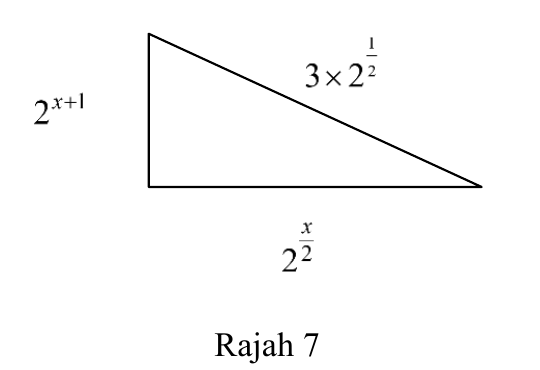
A ladder of length 4.672 m is placed (1 + √2) m from a vertical wall at the side of a building. How far up the wall does the ladder reach?
Easy2 marks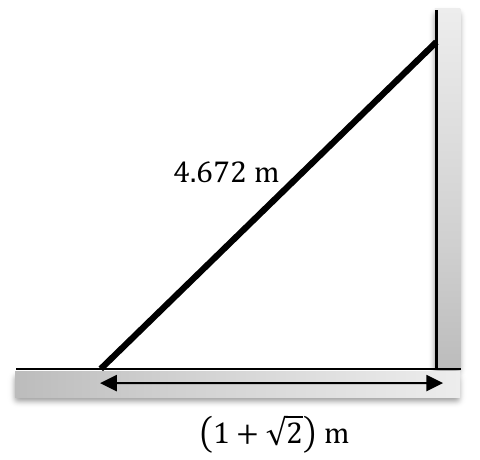
How far up the wall does the ladder reach?
[2]
(a) Use log₃ p = 0.1, log₃ q = 0.5 and N = −3(pq)⁵ to find the value of N without using a calculator. (b) The diagram shows a rectangle ABCD and a right-angled triangle BQP such that Q is on AD and P is on CD. Given AB = √5 cm, AQ = 2 cm and angle PBQ = 30°, find the length, in cm, of PQ. Give your answer in surd form.
Medium7 marks- (a)
Find the value of N without using a calculator.
[3] - (b)
Find the length, in cm, of PQ. Give the answer in surd form.
[4]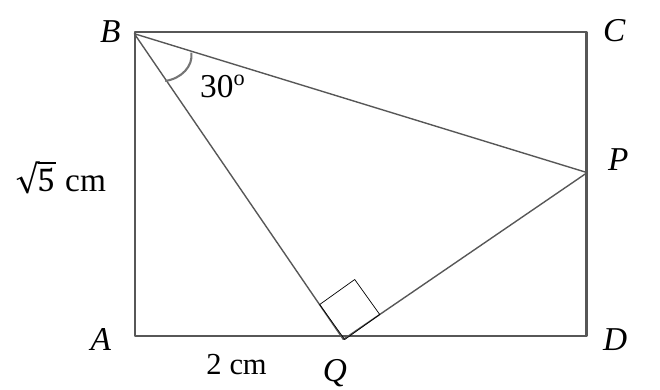
(a) Find the value of log_q (q²/√p) + log_q √(pq). (b) Solve ln (8 − x) = 2.
Easy5 marks- (a)
Find the value of log_q (q²/√p) + log_q √(pq).
[3] - (b)
Solve ln (8 − x) = 2.
[2]
(a) Show that log_a pq = log_a p + log_a q. (b)(i) Given log_a p = m and log_b p = n, find the value of log_ab √p. (ii) If log_a c = √5 and log_a b = √2, find the value of log_(b/a) c.
Medium9 marks- (a)
Show that log_a pq = log_a p + log_a q.
[3] - (b)(i)
Given log_a p = m and log_b p = n. Find the value of log_ab √p.
[4] - (b)(ii)
If log_a c = √5 and log_a b = √2, find the value of log_(b/a) c.
[2]
Solve the equation: 2^(3x) = 8 + 2^(3x−1).
Easy4 marksSolve the equation 2^(3x) = 8 + 2^(3x−1).
[4]
(a) Given log₃ p − log₃ q = ½, express p in terms of q. (b) Express 4√2/(3 + √2) + 6/√2 in the form (a√2 − b)/c.
Easy5 marks- (a)
Given log₃ p − log₃ q = ½, express p in terms of q.
[2] - (b)
Express 4√2/(3 + √2) + 6/√2 in the form (a√2 − b)/c.
[3]
Given that log_c (pq) = 2 and log_c (p²q³) = 3. (a) Find the values of log_c p and log_c q. (b) Hence, state the values of p and q when c = 2.
Easy5 marks- (a)
Find the values of log_c p and log_c q.
[4] - (b)
Hence, state the values of p and q when c = 2.
[1]
(a) Given the equation 2^(2x+1) × 3^(x−1) = 8ˣ × 3^(2x). Show that 6ˣ = 2/3. (b) Express 3/(3 − √6) + (3/2)√(8/27) in the form a + b√6.
Medium8 marks- (a)
Given the equation 2^(2x+1) × 3^(x−1) = 8ˣ × 3^(2x). Show that 6ˣ = 2/3.
[4] - (b)
Express 3/(3 − √6) + (3/2)√(8/27) in the form a + b√6.
[4]
Diagram 7 shows a triangular prism with length CE = 3 cm; its cross-section is an equilateral triangle of area √8 cm². A cylindrical tank of height h and radius r holds 3√2 πr² cm³ of water. (a) The prism is placed in the tank and the tank becomes full. Find the height of water displaced by the prism in terms of r. (b) Later a cube of side √2 x is placed in the cylinder; the height of water it displaces is 1.08 times that displaced by the prism. Find x and h when r = 3 cm, to 1 decimal place.
Medium7 marks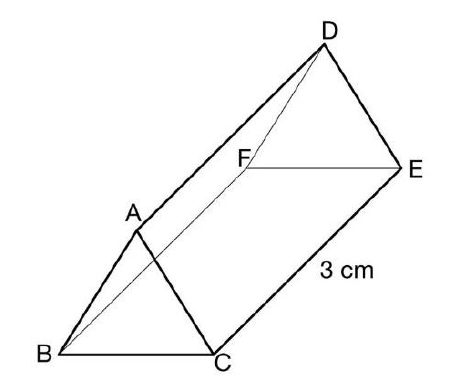
- (a)
Find the height of the water displaced by the prism in terms of r.
[4] - (b)
Find the values of x and h when the radius is 3 cm, to 1 decimal place.
[3]
(a) Given 3ˣ = √p, 3 = q^(1/y) and 9ˣ × 3ʸ = 9ˣ + 16. Express p in terms of q. (b) Given 1/log_a m − 1/log₃ m = 5 − log_m (5 − m). Express a in terms of m.
Medium7 marks- (a)
Express p in terms of q.
[4] - (b)
Express a in terms of m.
[3]
The growth rate of the teak tree population in a forest is proportional to the total mass of wood on the tree in a certain time. The initial wood mass of the teak tree is 500 kg. K(t) is the total mass of wood on the teak tree at time t and r is the relative growth rate of the teak tree per year. The exponential equation is K(t) = K₀ e^(rt) (K₀ = the initial wood mass of the teak tree). If the teak tree takes 10 years to reach 1000 kg of wood, determine: (a) the relative growth rate, r in percentage per year. (b) Given that the relative growth rate of the teak wood is 5% per year: (i) how many years are needed to obtain 1400 kg of teak wood? (ii) Hence, calculate the amount of wood mass on the teak tree after 15 years.
Medium6 marks- (a)
Find the relative growth rate, r, in percentage per year.
[2] - (b)(i)
With r = 5% per year, find the number of years needed to obtain 1400 kg of teak wood.
[2] - (b)(ii)
Calculate the amount of wood mass on the teak tree after 15 years.
[2]
(a) Express 25^(m+1) − 5^(2m) in the form a(b^m), where a and b are constants. Hence, determine whether 25^(m+1) − 5^(2m) is divisible by 4 for all positive integer values of m. (b) Diagram 7 shows a trapezium PQRS. Given the lengths of PS and SR are 8 − 2√h and 4 + 6√h respectively. The length of PQ is half of the length of SR. If the length of QR = 68, find the values of h.
Medium8 marks- (a)
Express 25^(m+1) − 5^(2m) in the form a(b^m), then determine whether it is divisible by 4 for all positive integer m.
[3] - (b)
Find the values of h.
[5]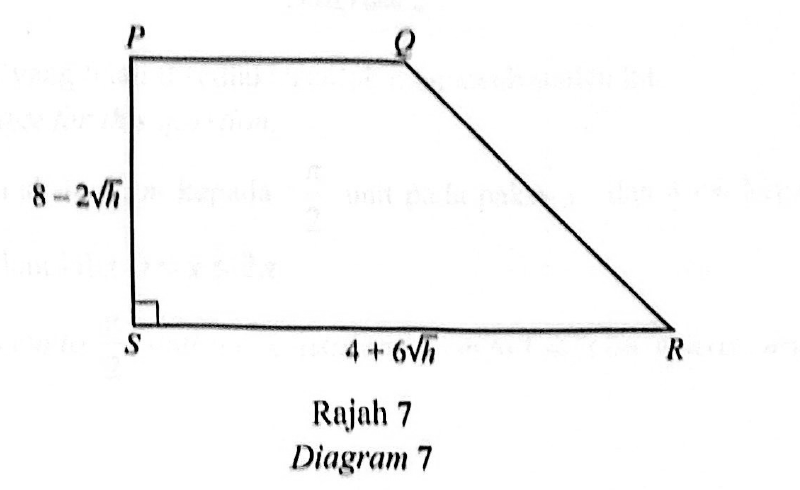
Two experiments were conducted to determine the relationship between the variables x and y. The results of both experiments show that the relationship between x and y is based on 25(5^(x+4)) = 125^y and log_x y − 1 = log_x (x − 2) respectively. Find the value of x and of y that satisfy both experiments.
Medium6 marksFind the value of x and of y that satisfy both equations.
[6]
(a) Given 25(5^(2x−3)) = 1, find the value of x. (b) Given x = 1/(4 + 3√2) and y = 1/(4 − 3√2), find the value of xy² + x²y.
Medium6 marks- (a)
Find the value of x.
[2] - (b)
Find the value of xy² + x²y.
[4]
(a) Given 2^x = 4^y = 8^z, express y in terms of x and z. (b) The temperature of an aluminium cube decreases from 120°C to T°C following T = 100(0.95)^x after x seconds. Calculate (i) the temperature after 4 seconds, (ii) the time t in seconds for the temperature to decrease from 120°C to 90°C.
Medium8 marks- (a)
Express y in terms of x and z.
[4] - (b)(i)
Calculate the temperature after 4 seconds.
[1] - (b)(ii)
Calculate the time t for the temperature to decrease from 120°C to 90°C.
[3]
A cylinder (drinks can, Diagram 4) has a circumference of 2π/(√2 − 1) cm and height (√2 + 1) cm and is filled with drinking water.
Medium4 marks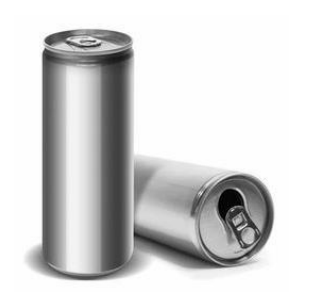
Show that the volume of the drinking water in the cylinder is (7 + 5√2)π cm³.
[4]
(a) logₘ 3 = x and logₘ 5 = y. (b) x = log₃ 7.
Medium8 marks- (a)
Given logₘ 3 = x and logₘ 5 = y, express log₅ 27m² in terms of x and y.
[4] - (b)
Given x = log₃ 7, find the value of 9ˣ. Hence, find the value of 9ʸ if y = ½ + x.
[4]
Simplify (2 − √3)/(2 + √3) + 8/√12.
Easy4 marksSimplify (2 − √3)/(2 + √3) + 8/√12.
[4]
It is given that x = 3^m and y = 3^n. Express (a) 27^(m + 2n) ÷ 9^m in terms of x and y; (b) log₈₁ (243x/y²) in terms of m and n.
Medium8 marks- (a)
Express 27^(m + 2n) ÷ 9^m in terms of x and y.
[3] - (b)
Express log₈₁ (243x/y²) in terms of m and n.
[5]
Given x = aᵖ and y = a^q. (a) Prove the division law of logarithm: log_a (x/y) = log_a x − log_a y. (b) Hence, show that log₂ P − log₂ Q = 2 log₄ (P/Q).
Medium6 marks- (a)
Prove log_a (x/y) = log_a x − log_a y.
[3] - (b)
Hence, show log₂ P − log₂ Q = 2 log₄ (P/Q).
[3]
(a) Given 3 − 2 log₃ x = log₃ y, express y in terms of x. (b) If 3²ˣ / 9ʸ = 243 and 2ˣ⁻¹ × 4ʸ = 64, find the values of x and y.
Medium8 marks- (a)
Express y in terms of x.
[3] - (b)
Find x and y.
[5]
(a) Rationalise the denominator and simplify 2/(√2 − 2). (b)(i) Show that log_(a³) hk = (1/3) log_a h + (1/3) log_a k. (ii) Hence, if (1/3)(log_a 3 + log_a q) = 1, express q in terms of a.
Medium7 marks- (a)
Rationalise the denominator and simplify 2/(√2 − 2).
[3] - (b)(i)
Show that log_(a³) hk = (1/3) log_a h + (1/3) log_a k.
[2] - (b)(ii)
Hence, if (1/3)(log_a 3 + log_a q) = 1, express q in terms of a.
[2]
(a) Given log₅ 3 = h and 5^(5k+6) = 1215. Express k in terms of h. (b) Given ln 8 = m and 4eˣ − 6 = 250. Express x in terms of m. (c) Solve √(2x − 3) + √(2x − 1) = 4.
Medium8 marks- (a)
Given log₅ 3 = h and 5^(5k+6) = 1215, express k in terms of h.
[3] - (b)
Given ln 8 = m and 4eˣ − 6 = 250, express x in terms of m.
[2] - (c)
Solve √(2x − 3) + √(2x − 1) = 4.
[3]
(a) Solve the equation 2^(3x) = 8 + 2^(3x−1). (b) Given that log₂ x = h and log₂ y = k, express log₂ (x³/y) in terms of h and k.
Medium6 marks- (a)
Solve the equation 2^(3x) = 8 + 2^(3x−1).
[3] - (b)
Given that log₂ x = h and log₂ y = k, express log₂ (x³/y) in terms of h and k.
[3]
(a) Simplify log₂(2x + 1) − 5 log₄ x² + 4 log₂ x. (b) Hence, solve the equation log₂(2x + 1) − 5 log₄ x² + 4 log₂ x = 3.
Medium7 marks- (a)
Simplify log₂(2x + 1) − 5 log₄ x² + 4 log₂ x.
[4] - (b)
Hence, solve the equation log₂(2x + 1) − 5 log₄ x² + 4 log₂ x = 3.
[3]
Answer any two questions from Section B. (a) Solve log₃(3x + 4) − 7 log₉ x² + 6 log₃ x = 2. (b) The lengths of green tea leaves are given by √50 mm, √18 mm and √8 mm. Calculate the mean length of the leaves, giving your answer in the form a√2.
Medium8 marks- (a)
Solve log₃(3x + 4) − 7 log₉ x² + 6 log₃ x = 2.
[5] - (b)
Calculate the mean length of the leaves in the form a√2.
[3]
(a) A study is carried out on insect attack on two fields. Field A has a breadth of (2 + √3) acres whereas field B has a breadth of (3 + √3) acres. Both fields have the same length. What is the ratio of field A to field B? (b) An entomologist discovers that the insect attack on plant area is given by A = 1000 × 2^(0.4n) acres, where n is the number of weeks after the first inspection. (i) Find the area of insect attack after 5 weeks. (ii) How long would it take for the attack to spread to an area of 16000 acres?
Medium8 marks- (a)
Ratio of field A to field B.
[4] - (b)(i)
Find the area of insect attack after 5 weeks.
[2] - (b)(ii)
How long for the attack to spread to 16000 acres?
[2]
Solve the following equations. (a) 1 + log₃ (x − 3) = log₃ x. (b) √(2s + 5) − √(s − 1) = 2.
Medium6 marks- (a)
Solve 1 + log₃ (x − 3) = log₃ x.
[2] - (b)
Solve √(2s + 5) − √(s − 1) = 2.
[4]
(a) Solve 3(7ˣ) = 65. Round off x correct to three significant figures. (b) Solve x + 4 = √(x + 10). (c) Solve log₃(3x) = logₓ 81 + 1.
Easy6 marks- (a)
Solve 3(7ˣ) = 65. Round off x to three significant figures.
[2] - (b)
Solve x + 4 = √(x + 10).
[2] - (c)
Solve log₃(3x) = logₓ 81 + 1.
[2]
(a) Use the following information to find the value of N without using a calculator: log₃ p = 0.1, log₃ q = 0.5, N = −3(pq)⁵. (b) Diagram 2 shows a rectangle ABCD and a right-angled triangle BQP such that point Q is on the side AD and point P is on the side CD. Given AB = √5 cm, AQ = 2 cm and ∠PBQ = 30°. Find the length, in cm, of PQ. Give your answer in surd form.
Medium7 marks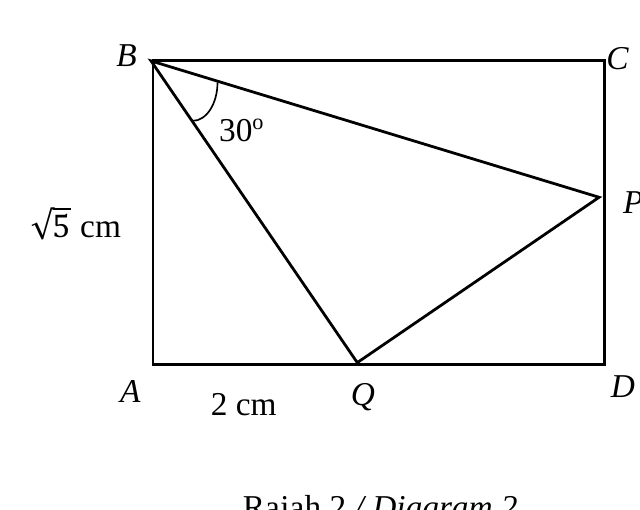
- (a)
Find the value of N without a calculator (log₃ p = 0.1, log₃ q = 0.5, N = −3(pq)⁵).
[3] - (b)
Find the length, in cm, of PQ in surd form.
[4]
(a) Simplify 3/(√7 − 4). (b) Solve the equation log₂ x² + log₂ x = 3/4. Give your answer correct to four decimal places. (c) Given 2^(n−1) × 8ⁿ = 2048, find the value of n.
Medium7 marks- (a)
Simplify 3/(√7 − 4).
[2] - (b)
Solve log₂ x² + log₂ x = 3/4 (4 decimal places).
[3] - (c)
Given 2^(n−1) × 8ⁿ = 2048, find n.
[2]
(a) Solve the equation 8^(log₂ u) = 125. (b) A right-angled triangle has a base of (2√3 + 1) m and height h m. If the area of the triangle is ½(9√3 − 1) m², find the value of h. Give your answer in the form a + b√3, where a and b are constants.
Medium7 marks- (a)
Solve 8^(log₂ u) = 125.
[3] - (b)
Find h in the form a + b√3.
[4]
(a) Solve the equation log₂ x − log₂ (x − 3) − 2 = 0. (b) Rationalise the denominator and simplify √8 + 2/(1 − √2).
Medium6 marks- (a)
Solve log₂ x − log₂ (x − 3) − 2 = 0.
[3] - (b)
Rationalise the denominator and simplify √8 + 2/(1 − √2).
[3]
(a) Simplify − log_m a − log_m b − log_m c as a single term. (b) Given 49m⁵nᶜ = (2401 m¹⁰ n⁴ × mᵇ n²)/(a m⁷ n), find the values of a, b and c.
Medium4 marks- (a)
Simplify − log_m a − log_m b − log_m c as a single term.
[1] - (b)
Given 49m⁵nᶜ = (2401 m¹⁰ n⁴ × mᵇ n²)/(a m⁷ n), find the values of a, b and c.
[3]
(a) Solve the equation e^(3x+2) = 10. (b) Solve the equation log₃(6 + 5x) / log₉(2 + x) = 4.
Medium6 marks- (a)
Solve the equation e^(3x+2) = 10.
[2] - (b)
Solve the equation log₃(6 + 5x) / log₉(2 + x) = 4.
[4]
Diagram 11 shows a cylinder with a volume of (23 − 3√5)π cm³. The radius of the cylinder is (√20 + 3) cm. Find the height of the cylinder, h, and give your answer in the form a + b√c, where a, b and c are integers.
Easy5 marks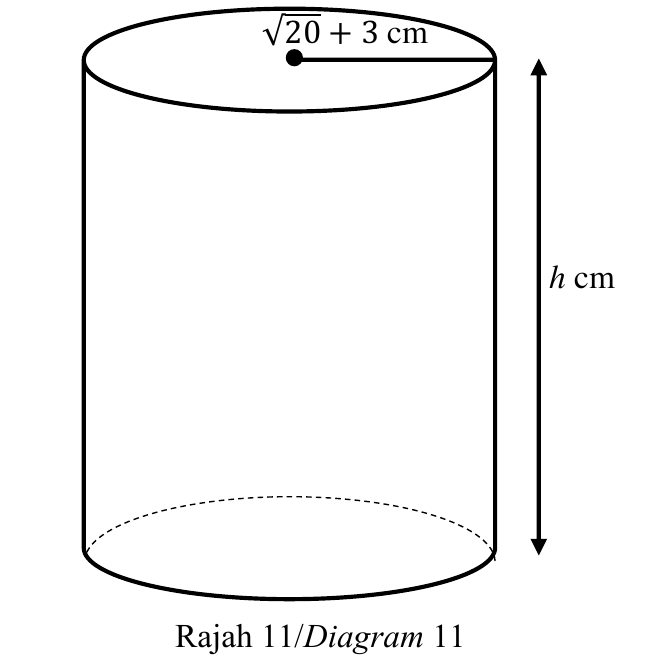
Find the height of the cylinder, h, in the form a + b√c.
[5]
Express n in terms of p.
Easy5 marks- (a)
2^(2n) = 2 ÷ 2^(n − p)
[2] - (b)
5^(2np + 1) = 750 − 25^(np)
[3]
(a) Simplify log₂(2x − 1) − 4 log₄ x² + 3 log₂ x. (b) Express y in terms of x and of e: ln 5x = 3 + ln y².
Medium6 marks- (a)
Simplify log₂(2x − 1) − 4 log₄ x² + 3 log₂ x.
[3] - (b)
Express y in terms of x and of e: ln 5x = 3 + ln y².
[3]
Diagram 11 shows a triangular prism with length CE = 3 cm. The cross-sectional area of the prism, an equilateral triangle, is (1 + √8)π cm². A cylindrical water tank has radius r cm and height 6 cm and contains 3√2 π r² cm³ of water. The tank is fully filled when the prism is placed in it. Find the value of r in the form √(a + b√2), where a and b are rational numbers.
Medium4 marks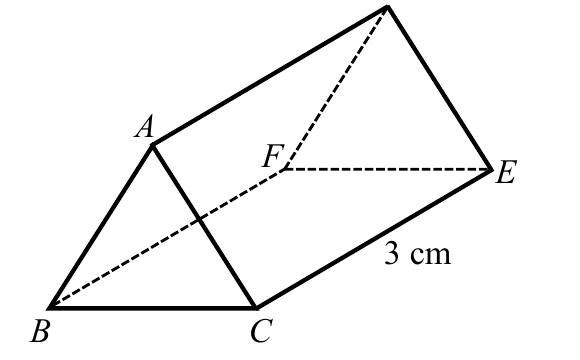
Find the value of r in the form √(a + b√2), where a and b are rational numbers.
[4]
(a) Solve the equation 2ˣ(8) = (1/16)^(2x+3). (b) The air pressure, in mm Hg, at an altitude of h km above sea level is given by P = 759e^(−0.325h). Find the height above sea level if the pressure at that altitude is 360 mm Hg.
Medium7 marks- (a)
Solve the equation 2ˣ(8) = (1/16)^(2x+3).
[3] - (b)
Find the height above sea level if the pressure is 360 mm Hg.
[4]
(a) Rationalise the denominator and simplify 7√5/(14 − √5). (b) Diagram 5 shows a cylinder with radius 4√3 cm and height h cm. The total surface area of the cylinder is 56√6 π cm². Find the value of h and give your answer in the form a√2 + b√3, where a and b are integers.
Medium8 marks- (a)
Rationalise the denominator and simplify 7√5/(14 − √5).
[3] - (b)
Find h in the form a√2 + b√3.
[5]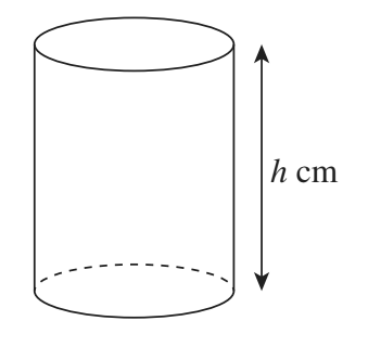
(a) Diagram 5 shows a cylinder. It is given that the radius of the cylinder is 4√3 cm, the height h cm and the total surface area is 56π√6 cm². Express h in the form m√2 + n√3, such that m and n are constants. (b) Given that log_p k = a and log_q k = b, show that log_k pq = (a + b)/(ab). (c) Solve ln(1/x) = 3. Give the answer correct to four significant figures.
Medium7 marks- (a)
Express h in the form m√2 + n√3.
[3]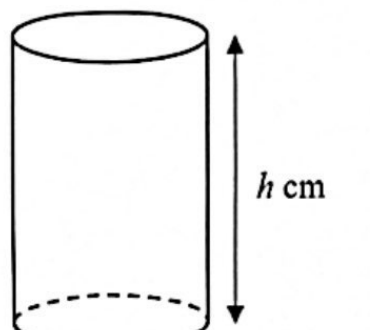
- (b)
Show that log_k pq = (a + b)/(ab).
[2] - (c)
Solve ln(1/x) = 3, correct to four significant figures.
[2]
(a) Given that 81√(3√27) = 9ᵏ. Find the value of k. (b) Solution by listing is not accepted. After t years, the price of the car that was bought by Nik is RM78 000(0.8)ᵗ. (i) Determine the price of the car after 6 years. (ii) Find the minimum number of years that it will take for the price of the car to be less than RM30 000. (iii) Starting from the seventh year and onwards, the car's value depreciates by 65%. If Nik bought the car in 2018, calculate the value of Nik's car in 2027.
Medium8 marks- (a)
Find the value of k.
[2] - (b)(i)
Determine the price of the car after 6 years.
[1] - (b)(ii)
Find the minimum number of years for the price to be less than RM30 000.
[2] - (b)(iii)
Find the value of Nik's car in 2027 (depreciating 65% from the seventh year).
[3]
(a) A technology company produces small processing chips that are placed in special cube-shaped boxes. The volume per chip (in mm³) is given by v(x) = √(2ˣ · 5), where x is the number of hours the chip is operating in test mode. (i) Use the law of logarithms to express log₁₀ v(x) in terms of ax + b, such that a and b are constants. (ii) Hence, when the chip volume is 50 mm³, find the number of chips produced in the operation. (b) Prove that a^(ln b) = b^(ln a), a > 0 and b > 0.
Medium6 marks- (a)(i)
Express log₁₀ v(x) in the form ax + b.
[2] - (a)(ii)
When the chip volume is 50 mm³, find the number of chips produced.
[2] - (b)
Prove that a^(ln b) = b^(ln a), a > 0 and b > 0.
[2]
(a) Simplify 49ⁿ × 1/(16807)^(n/3) × ∛(7^(5n)). Hence, show that the answer is always positive for all values of n. (b) (i) Given 9^(x+1) / 729^(√y−2) = 1, express y in terms of x. (ii) Rationalise the denominator and simplify 7/(7 + √7).
Medium8 marks- (a)
Simplify 49ⁿ × 1/(16807)^(n/3) × ∛(7^(5n)). Hence, show that the answer is always positive for all values of n.
[3] - (b)(i)
Given 9^(x+1) / 729^(√y−2) = 1, express y in terms of x.
[3] - (b)(ii)
Rationalise the denominator and simplify 7/(7 + √7).
[2]
(a) If √7 x = √2 x + √3, find the value of x in the form (√p + √6)/q. (b) Find the value of p which satisfies 4/log_p(pq) + 4/log_q(pq) + 2 = 6p.
Hard6 marks- (a)
If √7 x = √2 x + √3, find the value of x in the form (√p + √6)/q.
[3] - (b)
Find the value of p which satisfies 4/log_p(pq) + 4/log_q(pq) + 2 = 6p.
[3]
(a) Given (p²/3)(3/y³)^p (y/2)^(p+2) = q/y², find the values of p and q. (b) Evaluate (log_√y 9)(log_x y)(log_3 x).
Medium7 marks- (a)
Given (p²/3)(3/y³)^p (y/2)^(p+2) = q/y², find the values of p and q.
[4] - (b)
Evaluate (log_√y 9)(log_x y)(log_3 x).
[3]
(a) Given that the length of the two diagonals of a rhombus PQRS is (2 + √3) cm and (3 + √48) cm respectively. Calculate the area, in cm², of the rhombus PQRS. Give your answer in the form of a + b√3 where a and b are rational numbers. (b) Given that log_a P = ½(log_a 48 + log_a 0.25 − 5 log_a 3), find the value of P. Hence, find the value of log_a P when a = √2/3.
Medium7 marks- (a)
Calculate the area, in cm², of the rhombus PQRS. Give your answer in the form of a + b√3 where a and b are rational numbers.
[3] - (b)
Given that log_a P = ½(log_a 48 + log_a 0.25 − 5 log_a 3), find the value of P. Hence, find the value of log_a P when a = √2/3.
[4]
(a) Show that 6^(k+2) + 6^(k+1) − 18(6^k) is divisible by 24 for all positive integer values of k. (b) It is given that 5^a = s and 5^b = t. Express log₂₅ (s²/(5t)) in terms of a and b.
Medium6 marks- (a)
Show that 6^(k+2) + 6^(k+1) − 18(6^k) is divisible by 24 for all positive integer values of k.
[3] - (b)
It is given that 5^a = s and 5^b = t. Express log₂₅ (s²/(5t)) in terms of a and b.
[3]
(a) Simplify (1 + √3)(4 − 2√3). (b) The temperature of a solution, in °C, after t minutes being cooled is 30(4/5)^t. (i) Find the initial temperature of the solution. (ii) Find the value of t when the temperature of the solution is 15.36 °C. (iii) Calculate after how many minutes the temperature of the solution be less than 5 °C for the first time.
Medium8 marks- (a)
Simplify (1 + √3)(4 − 2√3).
[2] - (b)(i)
Find the initial temperature of the solution.
[1] - (b)(ii)
Find the value of t when the temperature of the solution is 15.36 °C.
[2] - (b)(iii)
Calculate after how many minutes the temperature of the solution be less than 5 °C for the first time.
[3]
(a) Simplify (−8x⁴y³)²/(16x⁵y). (b) Solve the equation 2^(4x) = 16 + 2^(4x − 1).
Easy5 marks- (a)
Simplify (−8x⁴y³)²/(16x⁵y).
[2] - (b)
Solve the equation 2^(4x) = 16 + 2^(4x − 1).
[3]
(a) Solve (i) 2^(2x−1) − 9(2^(x−2)) + 1 = 0, (ii) log_x 4 = 2 + 4 log_4 2. (b) Solve the equation 5 + 4√k = 9 + 8√2. Write the answer in the form a + b√2 with a and b are integers.
Medium8 marks- (a)(i)
Solve 2^(2x−1) − 9(2^(x−2)) + 1 = 0.
[3] - (a)(ii)
Solve log_x 4 = 2 + 4 log_4 2.
[3] - (b)
Solve the equation 5 + 4√k = 9 + 8√2. Write the answer in the form a + b√2 with a and b integers.
[2]
It is given that log10 xy² = 2 and log10 (x³/y) = 4. Find the value of log10 √(xy).
Easy6 marksFind the value of log10 √(xy).
[6]
(a) Find the value of p and q for the equation (√2 − 1)(p + q√2) = 5 − √8. (b) Find the value of p which satisfies 3/log_p(pq) + 3/log_q(pq) + 2 = 5p.
Medium6 marks- (a)
Find the value of p and q for the equation (√2 − 1)(p + q√2) = 5 − √8.
[3] - (b)
Find the value of p which satisfies the following equation: 3/log_p(pq) + 3/log_q(pq) + 2 = 5p
[3]
(a) Given (p²/3)(3/y⁴)^p (y/2)^(p+6) = q/y³, find the values of p and q. (b) Evaluate (log_√y 8)(log_x y)(log_2 x).
Medium7 marks- (a)
Given (p²/3)(3/y⁴)^p (y/2)^(p+6) = q/y³, find the values of p and q.
[4] - (b)
Evaluate (log_√y 8)(log_x y)(log_2 x).
[3]
(a) Given that the length of the two diagonals of a kite PQRS is (2 + √3) cm and (4 + √27) cm respectively. Calculate the area, in cm², of the kite PQRS. Give your answer in the form of a + b√3 where a and b are rational numbers. (b) Given that logₐP = 1/3 (logₐ24 − logₐ(3/8) − 6 logₐ3), find the value of P. Hence, find the value of log_a P when a = 2/3.
Medium7 marks- (a)
Calculate the area, in cm², of the kite PQRS. Give your answer in the form a + b√3.
[3] - (b)
Given logₐP = 1/3(logₐ24 − logₐ(3/8) − 6 logₐ3), find the value of P. Hence, find the value of logₐP when a = 2/3.
[4]
(a) Simplify 8^(x−1) ÷ 32^x into the form 1/(p(2^(nx))) such that p and n are integers. (b) A cylinder has a radius of 1/(√2 − 1) cm and height h cm. The volume of the cylinder is π(7 + 5√2) cm³. Calculate the value of h in terms of a + √b.
Medium6 marks- (a)
Simplify 8^(x−1) ÷ 32^x into the form 1/(p(2^(nx))) such that p and n are integers.
[3] - (b)
A cylinder has a radius of 1/(√2 − 1) cm and height h cm. The volume of the cylinder is π(7 + 5√2) cm³. Calculate the value of h in terms of a + √b.
[3]
(a) It is given that log_m k + log_m (1/k) = t. Find the value of t. (b) Simplify log₂ (2x + 1) − 5 log₄ x² + 4 log₂ x.
Medium7 marks- (a)
It is given that log_m k + log_m (1/k) = t. Find the value of t.
[3] - (b)
Simplify log₂ (2x + 1) − 5 log₄ x² + 4 log₂ x.
[4]
(a) Solve the equation 2^(x+6) − 2^(x+5) = 4. (b) It is given that log₂ m − log₁₆ n = 4, express m in terms of n. (c) Rationalise the denominator (2 + √5)/(2 − √5).
Medium8 marks- (a)
Solve the equation 2^(x+6) − 2^(x+5) = 4.
[3] - (b)
It is given that log₂ m − log₁₆ n = 4, express m in terms of n.
[3] - (c)
Rationalise the denominator (2 + √5)/(2 − √5).
[2]
(a) It is given that log_(√x) 9 = s and log_y 3 = t, express log₉ x⁸y⁷ in terms of s and/or t. (b) A bank pays 4.3% of interest per annum for its saving accounts. Saving account M has a balance of RM10 000. Calculate the years required for the account to exceed RM70 000. Given the formula to calculate the total saving, p, after q years is p = 10 000(1.043)^q.
Medium6 marks- (a)
Express log₉ x⁸y⁷ in terms of s and/or t, given log_(√x) 9 = s and log_y 3 = t.
[3] - (b)
Calculate the years required for account M to exceed RM70 000, given p = 10 000(1.043)^q.
[3]
(a) Given (p²/3)(3/y²)^p (y/2)^(p+2) = q/y², find the values of p and q. (b) It is given that log_x 3 = p, log_y 2 = q and log_z 5 = r, find the value of the expression (x^p)(y^2q) − z^r.
Medium7 marks- (a)
Given (p²/3)(3/y²)^p (y/2)^(p+2) = q/y², find the values of p and q.
[4] - (b)
Given log_x 3 = p, log_y 2 = q and log_z 5 = r, find the value of (x^p)(y^2q) − z^r.
[3]
(a) Given the sum of two parallel sides and the height of a trapezium PQRS are (5 + √3) cm and (2 + √27) cm respectively. Calculate the area, in cm², of the trapezium PQRS. Give your answer in the form of a + b√3 where a and b are rational numbers. (b) Given that x² + y² = 11xy, show that log_a (x − y) = ½ log_a x + ½ log_a y + log_a 3.
Medium7 marks- (a)
Calculate the area, in cm², of the trapezium. Give the answer in the form a + b√3.
[3] - (b)
Given x² + y² = 11xy, show that log_a (x − y) = ½ log_a x + ½ log_a y + log_a 3.
[4]
Simplify the following algebraic expression: (6^(a−2) + 6^(a+3))/216.
Easy3 marksSimplify (6^(a−2) + 6^(a+3))/216.
[3]
Diagram 2 shows a trapezium PQRST. RT is parallel to PQ. Given the area of the trapezium is 15√5 + 20√2 cm², RT = √5 cm and PQ = √2 cm. Find the height of the trapezium in the form a + b√10.
Medium5 marks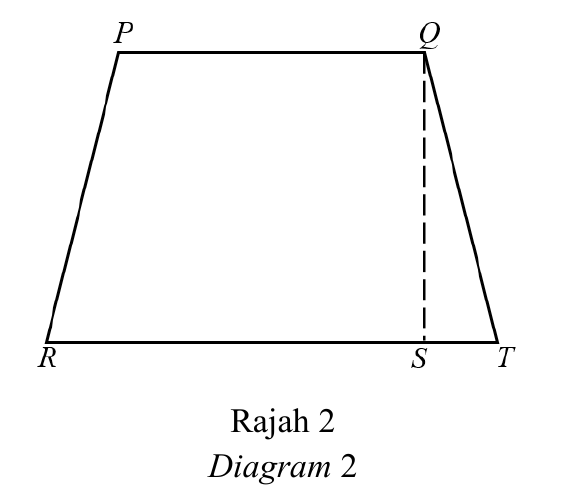
Find the height of the trapezium in the form a + b√10.
[5]
(a) Given log₂ x = m, express log_x 32x⁴ in terms of m. (b) The price of gold increases from RM330 per gram to RM x per gram by P = 330(1.05)ᵗ after t years. Find the number of years when the gold price exceeds RM530 per gram.
Easy6 marks- (a)
Given log₂ x = m, express log_x 32x⁴ in terms of m.
[3] - (b)
Find the number of years when the gold price exceeds RM530 per gram.
[3]
(a) Express y in terms of x of (i) 5^(x−1) = √(25^(7−y)); (ii) (k/h)^(−7) = (h/k)^(x+2y). (b) Given (3 + x√2)/(4 − √2) = m + n√2, express m and n in terms of x.
Medium7 marks- (a)
Express y in terms of x of (i) 5^(x−1) = √(25^(7−y)); (ii) (k/h)^(−7) = (h/k)^(x+2y).
[4] - (b)
Given (3 + x√2)/(4 − √2) = m + n√2, express m and n in terms of x.
[3]
(a) State the conditions for a and N such that logₐ N is defined. (b) Given logₘ n = p and logₘ 2 = q, express log_(mn) (1/(2√n)) in terms of p and q. (c) The number of people N living in a town increases to 1226 after 3⅓ years and then starts to decrease. The population after t years is modelled by N = 1000t e^(−at), where a is a constant. Find the population after 2 years.
Medium8 marks- (a)
State the conditions for a and N such that logₐ N is defined.
[2] - (b)
Given logₘ n = p and logₘ 2 = q, express log_(mn) (1/(2√n)) in terms of p and q.
[3] - (c)
Find the population of the town after 2 years.
[3]
(a) Solve 3^(3x) = 54 + 3^(3x−1). (b) Diagram 4 shows a right-angled triangle with sides 2 + √3 and 5 − 2√3. Given its area is q + √3/2, find the value of q.
Easy5 marks- (a)
Solve the equation 3^(3x) = 54 + 3^(3x−1).
[3] - (b)
Diagram 4 shows a right-angled triangle with perpendicular sides 2 + √3 and 5 − 2√3. Given that the area of the triangle is q + √3/2, find the value of q.
[2]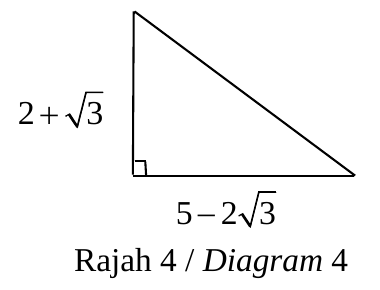
(a) Solve (i) x − 7√x = −12, (ii) log₄ x + log₁₆ 3x = −1. (b) Shahida's savings after n years in a bank is RM1500(1 + 0.08)ⁿ. Calculate the minimum number of years so that her savings exceed RM20 000.
Medium8 marks- (a)(i)
Solve x − 7√x = −12.
[2] - (a)(ii)
Solve log₄ x + log₁₆ 3x = −1.
[3] - (b)
Shahida's savings after n years in a bank is RM1500(1 + 0.08)ⁿ. Calculate the minimum number of years so that her savings exceed RM20 000.
[3]
(a) Solve the equations: (i) 3^(2x − 3) = 1; (ii) 3^(3x) = 54 + 3^(3x − 1). (b) Diagram 3(b) shows a right-angled triangle with the two perpendicular sides 2 + √3 and 5 − 2√3. Given that the area of the triangle is q + √3/2, find the value of q.
Easy5 marks- (a)(i)
Solve 3^(2x − 3) = 1.
[1] - (a)(ii)
Solve 3^(3x) = 54 + 3^(3x − 1).
[2] - (b)
Given the area is q + √3/2, find q.
[2]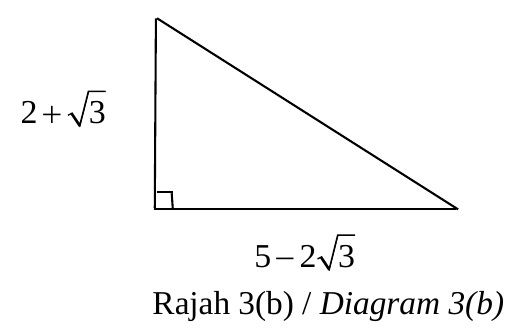
Solve the equation log₃(2x + 3) − 4 log₉ x² + 3 log₃ x = 2.
Easy4 marksSolve log₃(2x + 3) − 4 log₉ x² + 3 log₃ x = 2.
[4]
(a) Rationalise the denominator and simplify 3√5/(√5 + √3). (b) Solve 4^(log₂ x) = 64. (c) Shahida's savings after n years in a bank is RM1500(1 + 0.08)ⁿ. Calculate the minimum number of years so that her savings exceed RM20 000.
Medium7 marks- (a)
Rationalise the denominator and simplify 3√5/(√5 + √3).
[2] - (b)
Solve 4^(log₂ x) = 64.
[2] - (c)
Calculate the minimum number of years so that her savings exceed RM20 000.
[3]
(a) Given 2⁴ˣ = r, 2ʸ = s and 4²ˣ⁺ʸ = 7 + 16ˣ. Express r in terms of s. (b) Simplify (2 + √3)/(2 − √3) − 2/√3.
Medium6 marks- (a)
Given 2⁴ˣ = r, 2ʸ = s and 4²ˣ⁺ʸ = 7 + 16ˣ. Express r in terms of s.
[3] - (b)
Simplify (2 + √3)/(2 − √3) − 2/√3.
[3]
(a) The value of a house increases by 6% of its original value after each year. If the original value is RM120 000, the value after n years, RM p, is given by p = 120000(1.06)ⁿ. (b) (i) Simplify 1/log_h(hk) + 1/log_k(hk). (ii) Hence, solve ln(3x − 2) = 1/log_h(hk) + 1/log_k(hk).
Medium8 marks- (a)(i)
Find the value of the house after 5 years.
[1] - (a)(ii)
Find the minimum number of years for the value of the house to be more than RM530 000.
[3] - (b)(i)
Simplify 1/log_h(hk) + 1/log_k(hk).
[2] - (b)(ii)
Hence, solve ln(3x − 2) = 1/log_h(hk) + 1/log_k(hk).
[2]
It is given that a satisfies the equation logₘ a = 2(logₘ b − logₘ 2) where b > 0, m > 0 and m ≠ b.
Medium4 marks- (a)
State the value of b.
[1] - (b)
Express b in terms of a.
[3]
(a) Rationalise the denominator and simplify 3/(√3 − 3). (b)(i) Show that log_{a²} hk = ½ log_a h + ½ log_a k. (ii) Hence, if ½ log_a 5 + ½ log_a q = 1, express a in terms of q.
Medium8 marks- (a)
Rationalise the denominator and simplify 3/(√3 − 3).
[2] - (b)(i)
Show that log_{a²} hk = ½ log_a h + ½ log_a k.
[3] - (b)(ii)
Hence, if ½ log_a 5 + ½ log_a q = 1, express a in terms of q.
[3]
Question on logarithms and indices.
Easy4 marks- (a)
Given that log₃ a − log₉ b = 2, express b in terms of a.
[2] - (b)
Simplify 3^(m−1) × 9^m ÷ 27^((2/3)m).
[2]
It is given that √(a + b√2) = 7/(3 − √2), where a and b are constants.
Medium6 marks- (a)
Find the value of a and of b.
[4] - (b)
Hence, solve e^(2 ln a) + e^(2 ln b).
[2]
(a) Given log₅ 3 = j and log₅ 4 = k, express log₅ 36 in terms of j and k. (b) Given that 9^a = √(3^b) = 3^c, find a : b : c. (c) Solve the simultaneous equations log₃ x − 2 log₉ y = 1 and log₂(4y + 2) + log₂(1/(2x)) = 2.
Medium8 marks- (a)
Express log₅ 36 in terms of j and k.
[2] - (b)
Given 9^a = √(3^b) = 3^c, find a : b : c.
[2] - (c)
Solve the simultaneous equations log₃ x − 2 log₉ y = 1 and log₂(4y + 2) + log₂(1/(2x)) = 2.
[4]
Solve the exponential equation (1/3)^p = 1/6, by giving the answer in the form of a + log₃ b, a and b are constants.
Medium3 marksSolve (1/3)^p = 1/6 in the form a + log₃ b.
[3]
(a) Solve the equation 9 − 4√3 = 3 + 2√m and write the answer in the form m = a + b√3, with a and b integers. (b) Given that logₐ 3 = x and logₐ 2 = y, express logₐ (18/a³) in terms of x and y.
Easy5 marks- (a)
Solve 9 − 4√3 = 3 + 2√m and write m = a + b√3.
[2] - (b)
Given logₐ 3 = x and logₐ 2 = y, express logₐ (18/a³) in terms of x and y.
[3]