JOHOR 2021 P1 Q12
MediumWrite your answer on paper. Then open the answer to check it.
(a) Determine the number of terms, n, for 2p², 5p², 8p², ..., 92p². (b) The 9th term of an arithmetic progression is 36 and the sum of the first 19 terms of the progression is 760. Determine the sum of the 5 terms after the 19th term.
Medium6 marks- (a)
Determine the number of terms n.
[2] - (b)
Determine the sum of the 5 terms after the 19th term.
[4]
Given that …, 256, x, 4096, … is part of a geometric progression and the sum of the first four terms of the progression is 85. Find (a) the common ratio and the first term, (b) the smallest value of n such that the nth term exceeds 12000.
Medium8 marks- (a)
Find the common ratio and the first term.
[4] - (b)
Find the smallest n such that Tₙ > 12000.
[4]
A contractor digs an oil well. The cost to dig the first 2 m is RM600, the second 2 m is RM680 and the third 2 m is RM760. The cost increases by a constant amount for every subsequent 2 m. Find (a) the cost to dig the 12th 2 m, (b) the cost to dig a 120 m deep oil well, (c) the depth of the oil well if the company's budget is half a million (RM500 000).
Medium8 marks- (a)
Find the cost to dig the 12th 2 m.
[2] - (b)
Find the cost to dig a 120 m deep oil well.
[2] - (c)
Find the depth of the oil well if the budget is RM500 000.
[4]
Radesh is offered a job in two companies, X and Y. Company X offers RM 45 500 per annum with a RM 500 yearly increment, while company Y offers RM 40 300 per annum with a 7% yearly increment. (a) Based on the salaries and increments offered, determine which company's salary scheme follows (i) a geometric progression. (b) Find his salary if he works for 5 years in company X or Y. (c) Radesh chooses the company that offers the higher salary amount. During his tenure at the company, he saves 13% of his annual salary in the bank. Calculate the amount deposited in the bank after 10 years, regardless of bank interest.
Medium7 marks- (a)(i)
Determine which company's salary scheme follows a geometric progression.
[3] - (b)
Find his salary after working for 5 years in company X or Y.
[2] - (c)
Calculate the amount deposited in the bank after 10 years.
[2]
In a geometric progression, the first term is 64 and the common ratio is r.
Easy3 marks- (a)
State the condition for r such that the sum to infinity of the progression exists.
[1] - (b)
Given that the sum to infinity of the progression is 256, find the value of r.
[2]
Given a sequence with the sum of the first n terms Sₙ = 3n² + 7n. (a) Express Sₙ₋₁. (b) Find the nth term. (c) Show that this sequence is an arithmetic progression.
Medium8 marks- (a)
Express Sₙ₋₁.
[2] - (b)
Find the nth term.
[2] - (c)
Show that the sequence is an arithmetic progression.
[4]
Diagram 10 shows part of the arrangement of bricks of equal size on a wall built by Zainal. The number of bricks in the bottom row is 80. For the next rows, the number of bricks is 2 less than the row below. The height of each brick is 7 cm. The number of bricks in the top row is 6. Calculate (a) the height, in cm, of the wall, (b) the total cost of the bricks used if the price of a brick is 50 sen.
Medium6 marks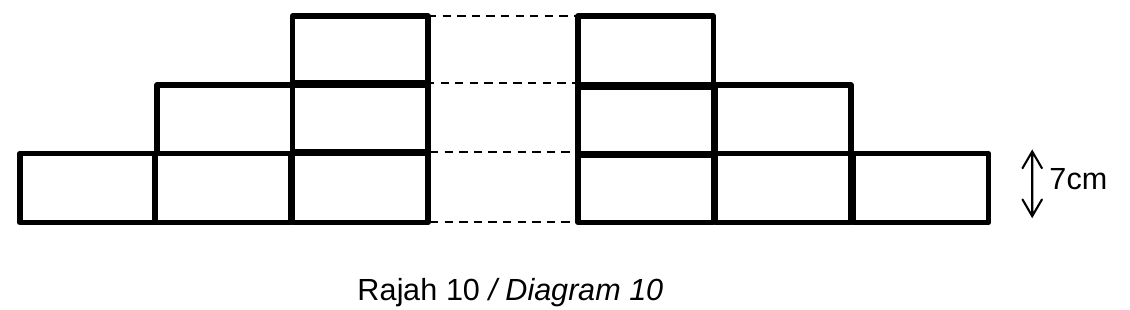
- (a)
Calculate the height, in cm, of the wall.
[3] - (b)
Calculate the total cost of the bricks used if the price of a brick is 50 sen.
[3]
Muiz started working for a company on 1 January 2022 with an initial annual salary of RM22 800. Every January, the company increased his salary by 3.5% of the previous year's salary. Give your answers correct to two decimal places. Calculate (a) his annual salary, in RM, for the year 2027, (b) the total salary, in RM, paid to him by the company for the years 2022 to 2027, (c) the minimum value of n such that his annual salary in the nth year will exceed RM40 000.
Medium7 marks- (a)
His annual salary for 2027 (RM).
[2] - (b)
Total salary paid for 2022 to 2027 (RM).
[2] - (c)
Minimum n such that the salary in the nth year exceeds RM40 000.
[3]
The first term of a geometric progression exceeds the second term by 8 and the sum to infinity is 18. Find the common ratio of the progression.
Easy3 marksFind the common ratio.
[3]
(a) The sum of the first n terms of an arithmetic progression is Sₙ = n(4n − 7). Find (i) the sum of the 8th term to the 16th term, (ii) the first term and the common difference. (b) A runner starts training by running 2 kilometres on the first day. Each day, he adds 0.5 kilometres to the previous day's distance. How far will he run on the 15th day?
Medium8 marks- (a)(i)
Find the sum of the 8th term to the 16th term.
[2] - (a)(ii)
Find the first term and the common difference.
[3] - (b)
How far will the runner run on the 15th day?
[3]
(a) The diagram shows a circle with centre O divided into 10 sectors. The angles of the sectors (18°, 22°, 26°, 30°, …) form an arithmetic progression with first term 18°. Show that the formula for the nth term of an arithmetic progression is Tₙ = a + (n − 1)d. (b) The sum of the first n terms of an arithmetic progression is given by Sₙ = 2n² − 4n. Find (i) the sum of the first 8 terms, (ii) the 8th term.
Medium8 marks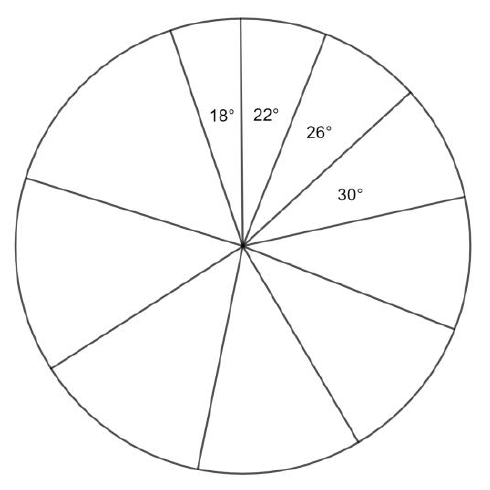
- (a)
Show that Tₙ = a + (n − 1)d.
[4] - (b)(i)
Find the sum of the first 8 terms.
[2] - (b)(ii)
Find the 8th term.
[2]
Steven wants to buy a Brand X computer with selling price RM6555. He pays by monthly instalment. Table 3: Option 1 – monthly instalment for one year, starting payment RM255, increasing by 14% every month from the previous month. Option 2 – monthly instalment for two years, starting payment RM290, increasing by RM1 every month from the previous month.
Medium8 marks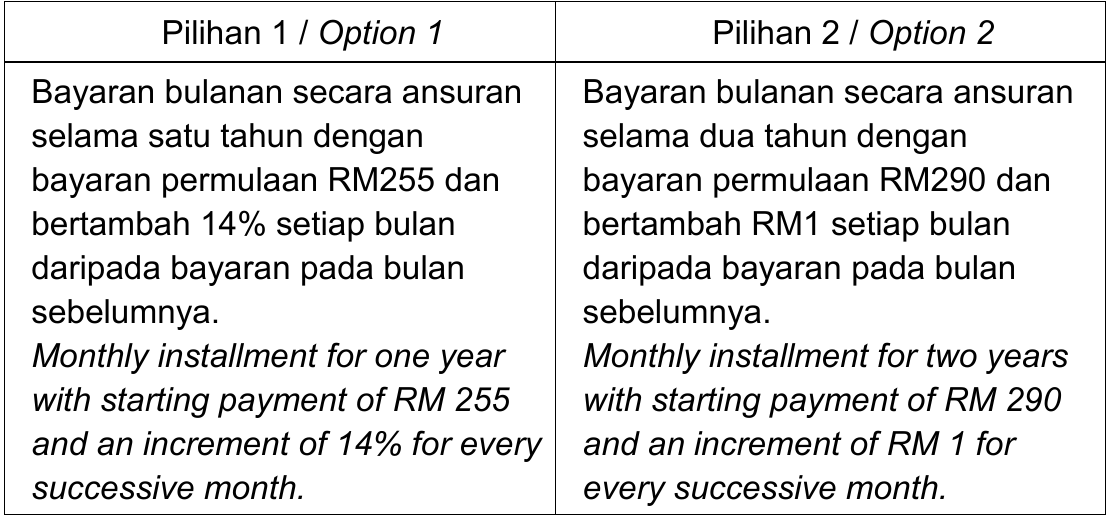
- (a)
If Steven selects Option 1, calculate the amount paid for the last payment.
[2] - (b)
Find the total amount paid for Option 1 and Option 2.
[4] - (c)
If Steven's monthly salary and expenses are RM2500 and RM2000 respectively, which option is more suitable to Steven? Justify your answer.
[2]
Given that 1, x², x⁴, x⁶, … is a geometric progression and the sum to infinity is 9/8. Find (a) the common ratio in terms of x, (b) the positive value of x.
Medium3 marks- (a)
The common ratio in terms of x.
[1] - (b)
The positive value of x.
[2]
(a) If the sum of the first n terms of an arithmetic progression is S_n = (n/2)(5n + 3), find (i) the sum of the 5th term to the 10th term, (ii) the first term and the common difference. (b) A string of length 2030 cm is cut into 28 parts, starting with the longest part of 140 cm. The lengths of the parts follow an arithmetic progression. Find the common difference of the lengths.
Medium8 marks- (a)(i)
Sum of the 5th term to the 10th term.
[2] - (a)(ii)
First term and common difference.
[3] - (b)
Common difference of the lengths of string.
[3]
(a) A recurring decimal. (b) Diagram 5 shows Kumar climbing a slippery pole in a competition.
Medium6 marks- (a)
If x and y are positive one-digit integers and 2.ẋẏ (the recurring decimal 2.xyxy…) = p + xy/q, where p and q are constants, find the value of p and of q.
[2] - (b)
The height Kumar climbed was recorded every 3 seconds: 1 m, 95 cm, 90 cm, ... To win, Kumar needs the Malaysian flag at the top of the pole at a height of 1060 cm. Did Kumar succeed? Give your justification.
[4]
Arithmetic progression with first term a, common difference d, sum of the first n terms Sₙ = (n/2)[2a + (n − 1)d] and nth term Tₙ = a + (n − 1)d.
Medium10 marks- (a)
Show that Sₙ − Sₙ₋₁ = Tₙ.
[2] - (b)
Find the sum of all two-digit positive integer that are exactly divisible by 3.
[4] - (c)(i)
Diagram 10 shows a graph of the number of cancer cells (against day) resulted after patient was injected with a type of drug (points close to a straight line). Based on the graph, determine whether the number of cancer cells has an arithmetic progression pattern or a geometric progression pattern and give your reason.
[1]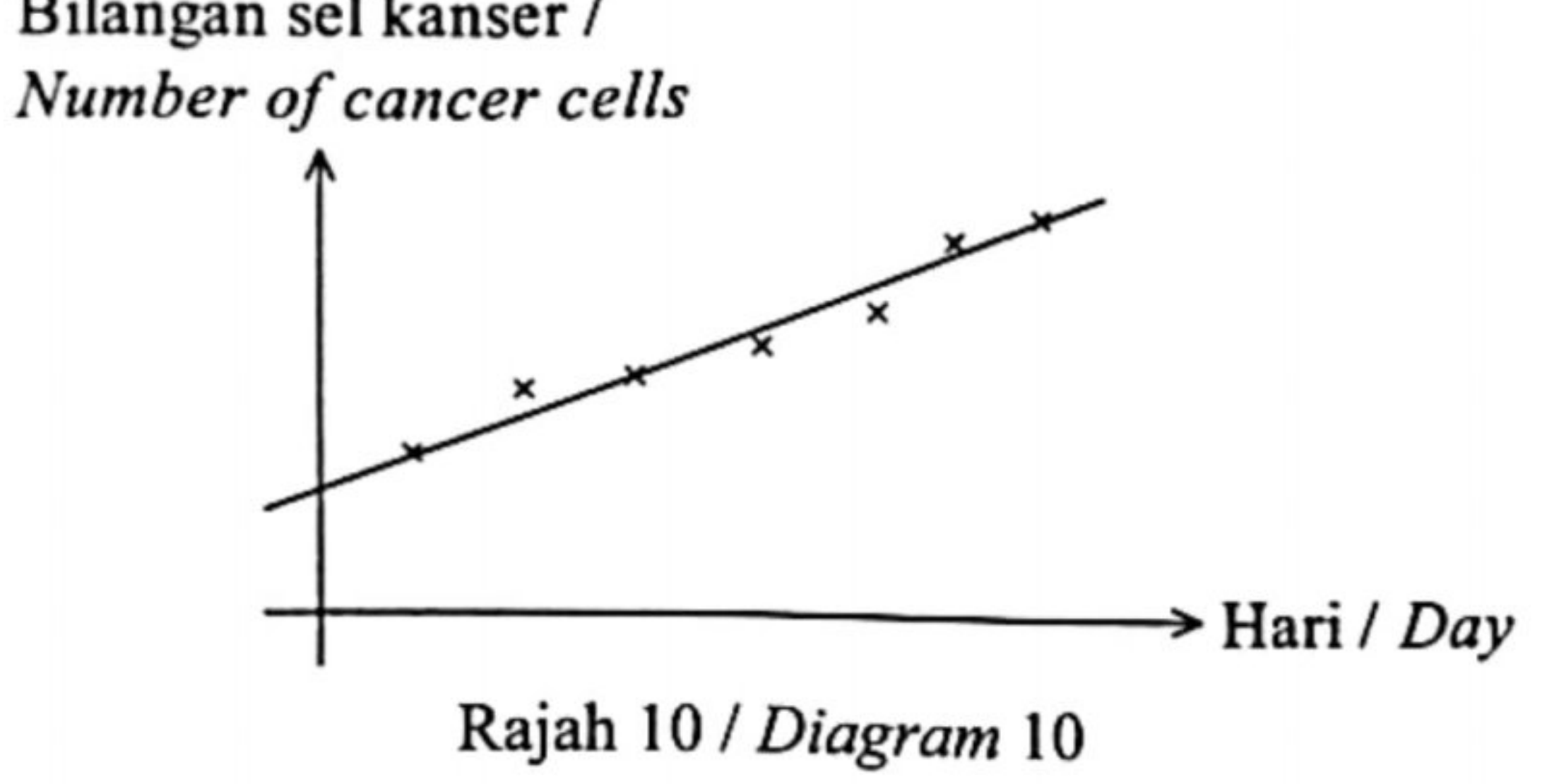
- (c)(ii)
The number of cancer cells on the first day of injection was 1537 and this number increased constantly at a rate of 3 cells/day after the patient was given the first injection. The patient will be given a second injection if the number of cancer cells exceeds 1700. Determine on which day the second injection will be given to this patient.
[3]
Diagram 14 shows Adib (height 136 cm) and Azim (height 191 cm) skipping. The length of the skipping rope is decided by height as in Table 14 (121.92–144.78 cm: ≥ 213.36 cm; 147.32–160.02: ≥ 243.84; 162.56–180.34: ≥ 274.32; 182.88–193.04: ≥ 304.80; > 193.04: 335.28). Adib's rope is divided into 9 parts and Azim's rope into 16 parts so that the longest part of each rope is k cm and each part is shorter than the previous by h cm. [Listing method is not allowed]
Medium8 marks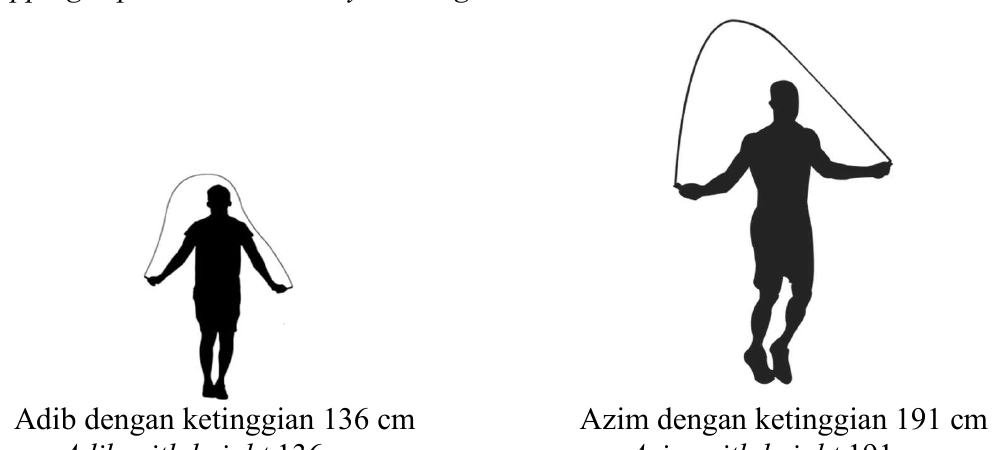
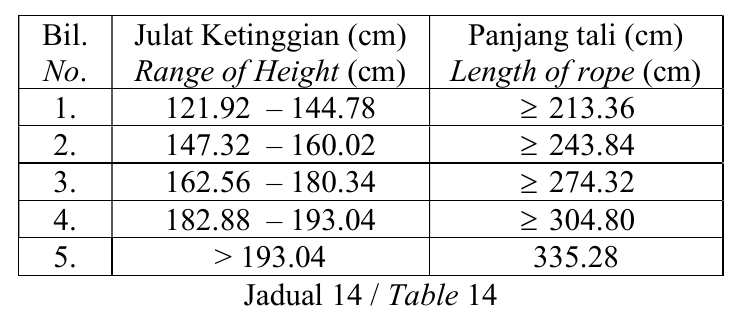
- (a)
Find the value of k and of h. Give your answer correct to 2 decimal places.
[4] - (b)
Hence, if the length of the last part of Aiman's rope is 15.73 cm, determine the range of Aiman's height, in cm.
[4]
Diagram 10 shows four cylinders of different sizes. Each cylinder has radius x m and the height of each successive cylinder is half the height of the previous one. The height of the first cylinder is h m. (a) Express x in terms of h if the sum of the volumes of the first four cylinders is 480π m³. (b) Hence, find the value of h if the ratio of the radius to the height of the first cylinder is 1 : 4. (c) (i) Find the number of cylinders that can be completely filled with water to hold 1600 m³ of water. (ii) Hence, find the volume of the remaining water, in m³. [Use π = 3.142]
Medium10 marks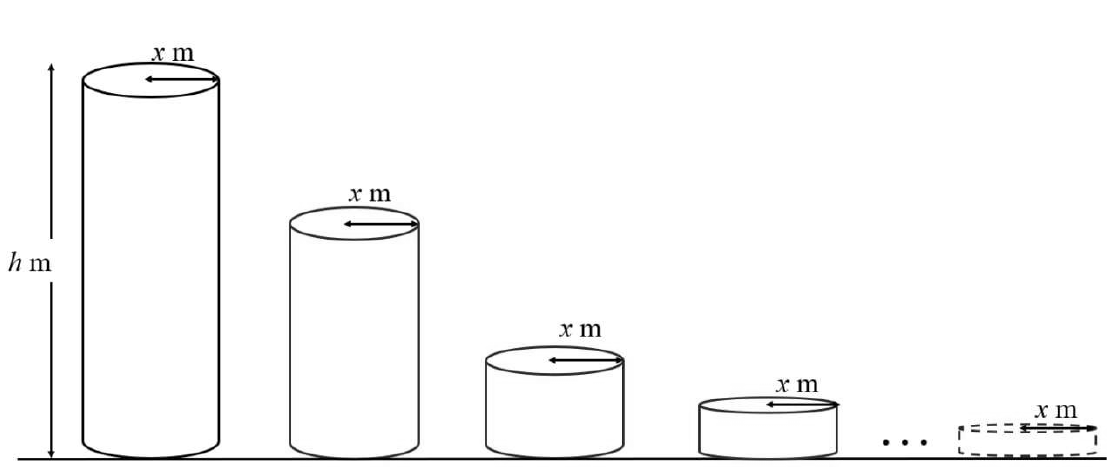
- (a)
Express x in terms of h if the sum of the first four volumes is 480π m³.
[3] - (b)
Find the value of h if the ratio of the radius to the height of the first cylinder is 1 : 4.
[3] - (c)(i)
Find the number of cylinders completely filled by 1600 m³ of water.
[2] - (c)(ii)
Find the volume of the remaining water, in m³.
[2]
Diagram 13 shows four consecutive terms of a progression: …, m², m⁴, m⁶, m⁸, …. (a) State whether the sequence is a geometric progression or an arithmetic progression. Give your justification. (b) In 2025, two palm oil factories, Factory A and Factory B, process 5200 and 4500 metric tons of palm oil respectively. The amount decreases following a geometric progression: Factory A decreases by 12% and Factory B by 9% each year. In which year will the amount in Factory A be less than that in Factory B for the first time?
Medium8 marks- (a)
State whether the sequence is a geometric progression or an arithmetic progression. Give your justification.
[2] - (b)
In which year will the metric tons in Factory A be less than in Factory B for the first time?
[6]
(a) Diagram 4(a) shows a ball dropped from a height of 120 cm that bounces until it stops. The maximum height of the fourth bounce is 320/9 cm. The maximum heights of the bounces form a geometric progression. Find the total of the maximum heights until the ball stops. (b) Listing method is not accepted. In an arithmetic progression, the sum of the first four terms is 46 and the seventh term exceeds twice the second term by 5. Find the sum of ten even terms of the progression.
Medium8 marks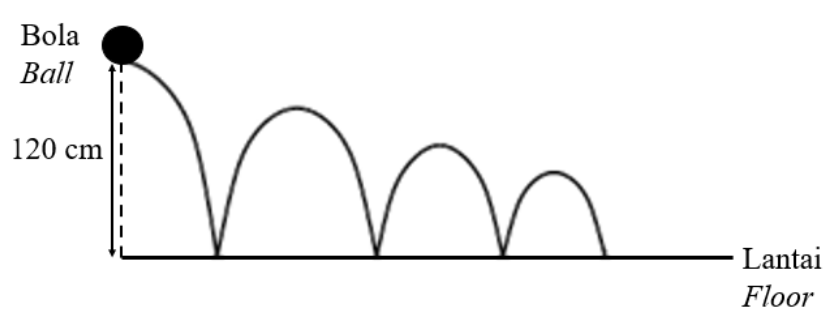
- (a)
Find the total of the maximum heights until the ball stops.
[4] - (b)
Find the sum of ten even terms of the arithmetic progression (listing method not accepted).
[4]
Diagram 5 shows 7 circles formed from a piece of wire with a length of 140π cm. The radii of the circles differ from each other successively by 2 cm.
Medium5 marks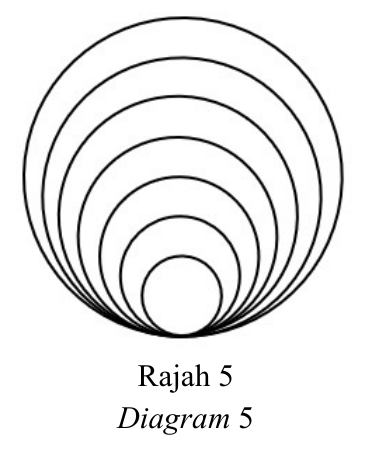
- (a)
Find the radius, in cm, of the smallest circle.
[3] - (b)
Find the number of complete circles that can be formed if the original length of the wire is 200π cm.
[2]
Diagram 1 shows the length of the arc swing of a simple pendulum released to swing freely. The arc lengths of the successive swings are 18 cm, 14.4 cm and 11.52 cm. (a) Find the length of the arc, in cm, of the 10th swing. (b) On which swing is the length of the arc first less than 2 cm? (c) Calculate the total swing distance by the pendulum, in cm, before it stops.
Medium7 marks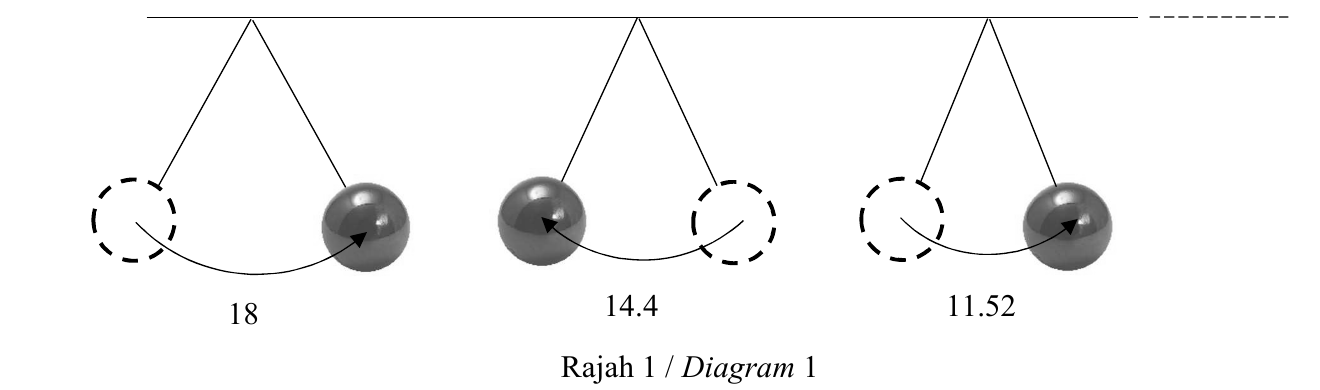
- (a)
Find the length of the arc, in cm, of the 10th swing.
[3] - (b)
On which swing is the length of the arc first less than 2 cm?
[2] - (c)
Calculate the total swing distance by the pendulum, in cm, before it stops.
[2]
Diagram 5 shows 8 circles formed from a piece of wire with a length of 255π cm. The diameter of each circle is twice that of the previous circle. The diameter of the smallest circle is d cm.
Medium5 marks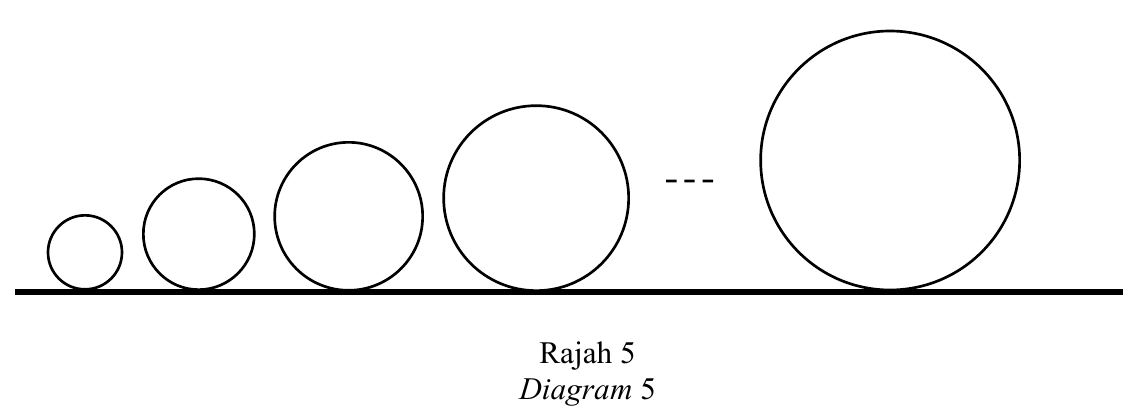
- (a)
Find the value of d.
[3] - (b)
Find the value of p, if the total area of the last three circles is pπ cm².
[2]
Diagram 1 shows the arrangement of cylinders having the same diameter, 6 cm. The height of the first cylinder is h cm and the height of each subsequent cylinder increases by 2 cm.
Medium7 marks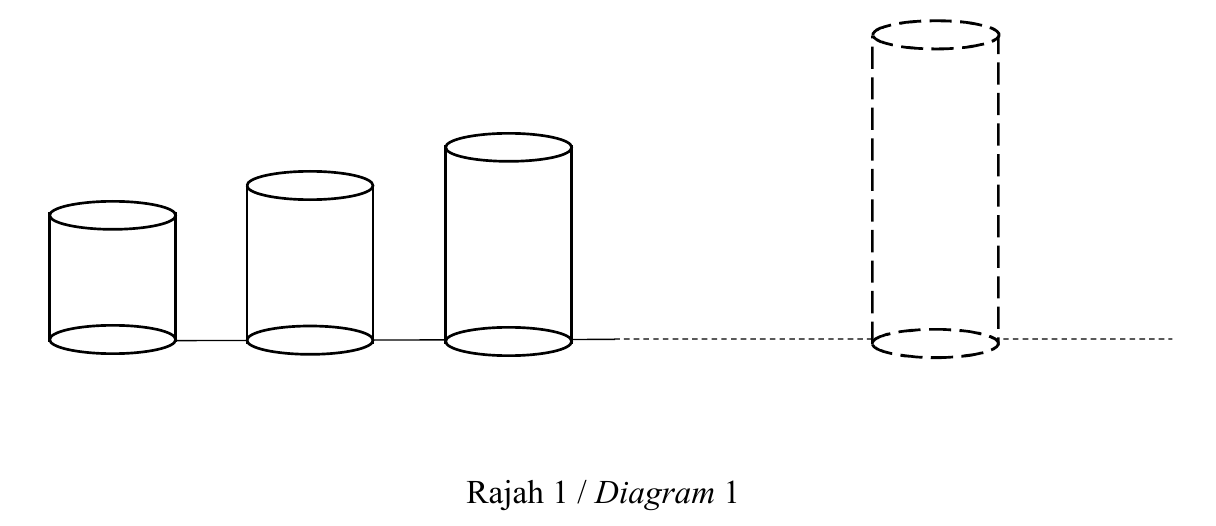
- (a)
Show that the volumes of the cylinders form an arithmetic progression.
[2] - (b)
Calculate the value of h if the volume of the 13th cylinder is 252π cm³.
[2] - (c)
Given the total volume of three consecutive cylinders is 1,620π cm³, determine the height of each cylinder.
[3]
Given (h + 2), (2h − 11) and (h + 2)/9 are the first three odd terms of an arithmetic progression. Find (a) the value of h, (b) the common difference, give your answer in the form a/b.
Medium5 marks- (a)
The value of h.
[3] - (b)
The common difference, in the form a/b.
[2]
Diagram 4 shows how the two wires A and B have been bent into several parts. The first part must be a cm in size and each subsequent part is shortened by d cm in a row. Wire A, of length 820 cm, is bent into exactly 10 parts while wire B, of length 1240 cm, is bent into exactly 20 parts. Find (a) the values of a and d, (b) which part measures 52 cm, (c) the difference between the lengths of the last part of the two wires.
Medium7 marks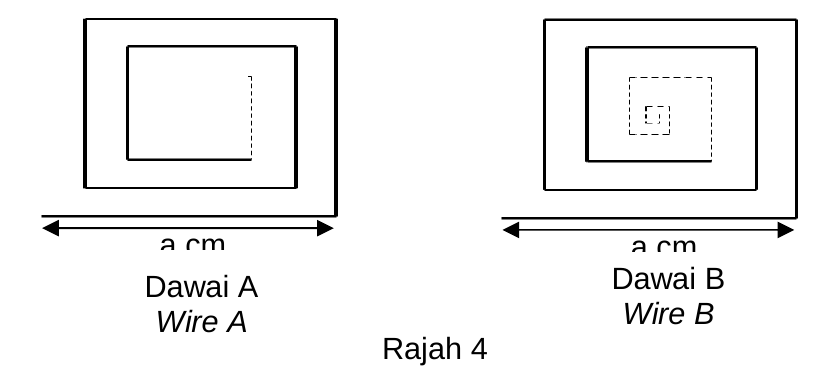
- (a)
Find the values of a and d.
[4] - (b)
Which part measures 52 cm?
[1] - (c)
The difference between the lengths of the last part of the two wires.
[2]
There are three rectangles. The first rectangle is x cm long and y cm wide. The length and width of each subsequent rectangle are half those of the previous one. (a) Show that the areas of the rectangles form a geometric progression and state the common ratio. (b) Given x = 160 cm and y = 80 cm, determine which rectangle (the nth) has area 25/512 cm².
Medium5 marks- (a)
Show that the areas form a geometric progression and state the common ratio.
[2] - (b)
Given x = 160 and y = 80, find n for area 25/512 cm².
[3]
The sum of the first n terms of an arithmetic progression is Sₙ = an² + bn. (a) Express Tₙ in simplest form in terms of a, b and n. (b) Given S₄ = 44 and S₈ = 152, find the values of a and b. (c) Find the common difference.
Medium8 marks- (a)
Express Tₙ in simplest form, in terms of a, b and n.
[2] - (b)
Given S₄ = 44 and S₈ = 152, find a and b.
[3] - (c)
Find the common difference.
[3]
An arithmetic progression and a geometric progression have the same first term. Both have the same common difference and common ratio which is 1/2. The seventh term of the arithmetic progression is 13, while the eleventh term of the arithmetic progression is equal to the sum of the first n terms of the geometric progression.
Medium5 marks- (a)
Find the first term for both progressions.
[2] - (b)
Find the value of n.
[3]
Diagram 2 shows cans filled with sand in order of mass in an arithmetic progression and hung on a bar. The mass of the lightest sand is 0.8 kg and the mass of the heaviest sand is 1.18 kg. The difference in mass of adjacent cans of sand is 0.02 kg. (a) Find (i) the number of cans used, (ii) the total mass of sand used. (b) The same force is used to swing all the cans. The time taken for each can to stop also changes in an arithmetic progression: the lightest can stops fastest, in 3.5 minutes, and the heaviest can takes the longest, X minutes. If the ratio of the common difference of the mass of the cans to the common difference of the time taken to stop is 1 : 25, find the value of X.
Medium7 marks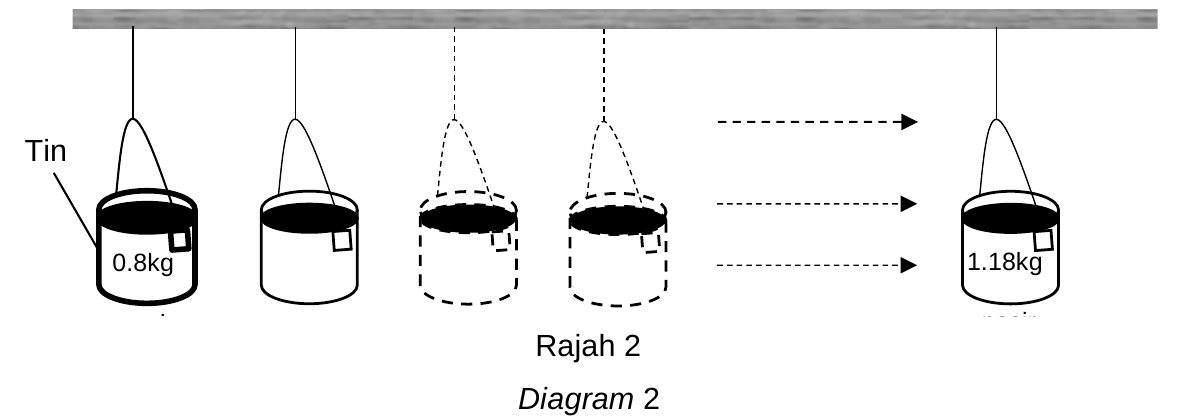
- (a)(i)
Find the number of cans used in this experiment.
[2] - (a)(ii)
Find the total mass of sand used.
[2] - (b)
Find the value of X.
[3]
(a) In an arithmetic progression, the sum of the first four terms is 34 and the sum of the next four terms is 82. Find the first term and the common difference. (b) Two tanks, Tank 1 and Tank 2, contain 3500 litres and 2700 litres of oil respectively. Because of leakage, the oil is measured again every 20 minutes. The amount of oil follows a geometric pattern: Tank 1 decreases by 12% and Tank 2 by 9% every 20 minutes. If the observation starts at 1 o'clock in the afternoon, at what time will the amount of oil in Tank 1 be less than in Tank 2 for the first time? [Tank 1 and Tank 2 are the same specification.]
Medium8 marks- (a)
Find the first term and the common difference.
[3] - (b)
At what time will the amount of oil in Tank 1 first be less than in Tank 2?
[5]
Find unknown values.
Medium6 marks- (a)
Given that h/k = 1/3 + 0.0454545…, find the values of h and of k without using the progression method.
[3] - (b)
Given that q√2 = 7/(3 − √2) − p, find the values of p and of q.
[3]
Arithmetic progressions.
Easy6 marks- (a)
The first three terms of an arithmetic progression are 2x, 2x + 5 and 4x. Find (i) the value of x. Hence, determine the arithmetic mean value. (ii) the sum of the first 8 terms of the progression.
[3] - (b)
Given that the nth term of an arithmetic progression is given by Tₙ = 5n − 8. Find (i) the common difference of the progression. (ii) the value of n if Tₙ = 47.
[3]
Geometric progressions.
Medium10 marks- (a)(i)
A piece of wire is cut into several pieces. The length of the first piece is (x + 3) cm, the second piece is (5x + 3) cm, the third piece is (11x + 3) cm and so on. The length of each piece forms a geometric progression. Find the value of x for which x > 0 and hence, calculate the length of the shortest section of wire.
[2] - (a)(ii)
If the wire is cut into 10 pieces, find the length of the wire, in metres. Give the answer to one decimal place.
[3] - (b)(i)
Given that the nth term of a geometric progression is Tₙ = (5/2)rⁿ⁻¹, r ≠ k. State the value of k.
[1] - (b)(ii)
State the first term of the progression.
[1] - (b)(iii)
State the sum to infinity if the third term is 1/10 and r is greater than 0.
[3]
Geometric progressions.
Medium5 marks- (a)(i)
Given the geometric progression 2, −4/3, 8/9, ..., find the common ratio.
[1] - (a)(ii)
Find the sum of the progression when rⁿ ≈ 0.
[2] - (b)
The first and second terms of a geometric progression are h³/9 and h respectively. Find the values, other than zero, that are not possible for h.
[2]
Diagram 1 shows some sectors of concentric circles at O. The radius of each sector is 3 cm more than the one before. Given the area of the n-th sector is 512π cm², the radius of the first sector OA = 10 cm and ∠AOA′ = π/4 rad.
Medium7 marks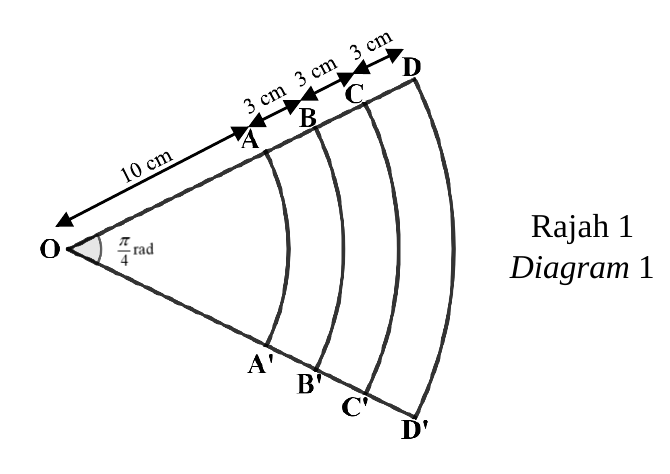
- (a)
Find the radius, in cm, of the n-th sector, in terms of n.
[2] - (b)
Find the value of n.
[2] - (c)
Find the sum of the arc lengths, in terms of π, of the first 20 sectors.
[3]
(a) T₁, T₂ and T₃ are three consecutive terms of an arithmetic progression. It is given that T₁ = 7 and Tₙ₊₁ = Tₙ + 4 for n ≥ 1. Find the 17th term. (b) Amira took out a bank loan to buy a car. She paid RM1405.00 in the third instalment and RM1700.00 in the seventh instalment to the bank. These instalment payments form a geometric progression. Find the first payment and hence the 15th payment made by Amira.
Medium8 marks- (a)
Find the 17th term.
[3] - (b)
Find the first payment and hence the 15th payment.
[5]
At the start of 2020, Farah invested RM1 500 in a savings scheme that gives annual dividends of 8%. Each year, Farah reinvested the original investment together with all the dividends she received. Calculate (a) the ratio of Farah's investment at the start of 2021 to her investment at the start of 2020, (b) the year when Farah's investment exceeds RM2 500 for the first time.
Easy5 marks- (a)
Find the ratio of the investment at the start of 2021 to that at the start of 2020.
[2] - (b)
Find the year when the investment exceeds RM2 500 for the first time.
[3]
Farhana joins a fitness program and records the number of exercise steps she takes each month. The number of steps she takes increases every month following a geometric progression. The total number of steps in the first four months is ten times the total number of steps in the first two months. (a) If r represents the common ratio, show that r⁴ − 10r² + 9 = 0. Hence, find the positive value of r. (b) Calculate the total calories burned by Farhana over the six months if she starts with 2000 steps in the first month and burns an average of 0.05 calories per step.
Medium8 marks- (a)
Show that r⁴ − 10r² + 9 = 0 and find the positive value of r.
[5] - (b)
Calculate the total calories burned over six months.
[3]
(a) Given the first three terms of an arithmetic progression are 12 − x, 18 and 4x, find the value of x. (b) Three consecutive positive terms of a geometric progression are 36, h and k. It is given that the sum of the terms is 52. Find the value of h and k.
Easy5 marks- (a)
Find x for the arithmetic progression 12 − x, 18, 4x.
[2] - (b)
Find h and k for the geometric progression 36, h, k with sum 52.
[3]
Aleena has just completed her diploma in banking. She was offered a job from two banks. Bank A offered an initial salary of RM 45 000 per annum with 5% yearly increment from the basic salary. Bank B offered an initial salary of RM 47 000 per annum with RM 2 000 increment yearly. Aleena decided to choose the bank which offered higher income and save 15% of her salary for further study after working for 8 years. (a) Determine which bank Aleena should choose. Show calculation to support your answer. [Round off your answer to the nearest RM] (b) Does Aleena's total saving enough to pay her studies fee of RM 60 000? Justify your answer.
Medium8 marks- (a)
Determine which bank Aleena should choose (total salary for 8 years), to the nearest RM.
[5] - (b)
Is her saving enough for RM 60 000? Justify.
[3]
(a)(i) If a is the first term and d is the common difference of an arithmetic progression, show that the sum of the first n terms is Sₙ = (n/2)[2a + (n − 1)d]. (ii) Given the arithmetic progression 3, 7, 11, 15, …, find the sum of the first n terms. (b) Solve the equation 3 + 7 + 11 + 15 + … + x = 1275.
Medium8 marks- (a)(i)
Show that Sₙ = (n/2)[2a + (n − 1)d].
[3] - (a)(ii)
Given 3, 7, 11, 15, …, find the sum of the first n terms.
[2] - (b)
Solve 3 + 7 + 11 + 15 + … + x = 1275.
[3]
(a) It is given that x⁵, x¹⁰, x¹⁵, x²⁰, … is a geometric progression with 0 < x < 1. The sum to infinity of this progression is 1/31. Find (i) the common ratio in terms of x, (ii) the value of x. (b) A geometric progression is formed by three positive numbers with r > 1. If the second term is doubled, the new numbers form an arithmetic progression. Find the common ratio of the geometric progression.
Medium7 marks- (a)(i)
Find the common ratio in terms of x.
[2] - (a)(ii)
The sum to infinity is 1/31. Find the value of x.
[2] - (b)
A GP of three positive numbers with r > 1: doubling the second term gives an AP. Find the common ratio.
[3]
(a) If a is the first term and r is the common ratio of a geometric progression, show that the sum to infinity of the progression is S∞ = a/(1 − r), |r| < 1. (b) Diagram 9 shows a pattern that repeats itself to infinity, consisting of squares and shaded triangles. The length of a side of the big square is 6 cm. Find (i) the base length of the 5th triangle, (ii) the area of the shaded region, in cm².
Medium8 marks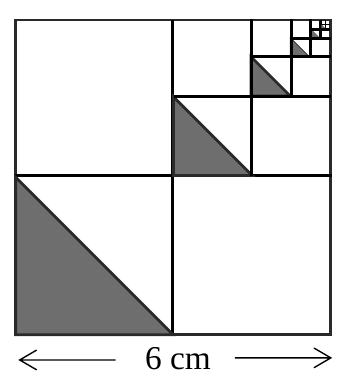
- (a)
Show that S∞ = a/(1 − r), |r| < 1.
[2] - (b)(i)
Base length of the 5th triangle.
[2] - (b)(ii)
Area of the shaded region in cm².
[4]
In an arithmetic progression, the sum of the first seven terms is 511 and the sum of the next 12 terms is −150. Find (a) the first term and the common difference of the arithmetic progression, (b) the value of n if Tₙ = −8.
Medium7 marks- (a)
Find the first term and the common difference.
[5] - (b)
Find n if Tₙ = −8.
[2]
An engineer celebrates his 34th birthday on 31 December 2024. He is offered a senior engineer position by company A and company B and will start work on 1 January 2025. Company A offers RM7 500 a month with an annual increase of RM340. Company B offers RM7 800 a month with an annual increase of 4% of the salary of the previous year. (a) Based on the total salary offered by the two companies, which company would the engineer choose if he plans to retire at the age of 58 in that company? (b) Hence, find the engineer's last monthly salary if the company offers a monthly increase of 1% per month for him to continue working until the age of 60.
Medium8 marks- (a)
Which company should he choose (retire at 58)?
[4] - (b)
Find his last monthly salary if the monthly increase is 1% per month until age 60.
[4]
(a) Diagram 3 shows three right-angled triangles with base and height: (k cm, k cm), (k cm, (k + 1) cm), (k cm, (k + 2) cm). Show that the areas of the triangles follow an arithmetic progression. Hence, find the sum of the first n terms of this progression in terms of n, if k = 4. (b) A piece of string of length 45 m is cut into several pieces such that the lengths of the pieces form an arithmetic progression. The shortest piece is 50 cm and the longest is 4 m. Find the number of pieces.
Medium7 marks- (a)
Show the areas follow an AP; find Sₙ in terms of n if k = 4.
[5]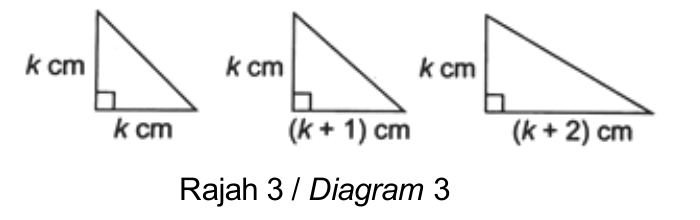
- (b)
Find the number of pieces of string.
[2]
A rope is cut into a few parts. 10p cm, (4p + 20) cm and (3p − 10) cm are the three consecutive parts of a geometric progression. Find the longest part if 10p is the third longest term.
Easy5 marksFind the longest part if 10p is the third longest term.
[5]
It is given that …, 145, x, y, 138, … is part of an arithmetic progression and the 16th term of the progression is 138. Find (a) the first term and the common difference, (b) the smallest value of n such that the nth term is negative, (c) the sum of the 41st term to the 70th term.
Medium7 marks- (a)
Find the first term and the common difference.
[2] - (b)
Find the smallest value of n such that the nth term is negative.
[2] - (c)
Find the sum of the 41st term to the 70th term.
[3]
Diagram 1 shows the first three art statues in cuboid shape with the square base arranged by Ali in his new closet. The cuboids have a square base of side x cm and heights y cm, (y + 5) cm and (y + 10) cm. The closet height is 60 cm. Given that the height of the closet is 60 cm and the height of each cuboid is 5 cm more than the previous cuboid. The volumes of the cuboids form an arithmetic progression.
Medium5 marks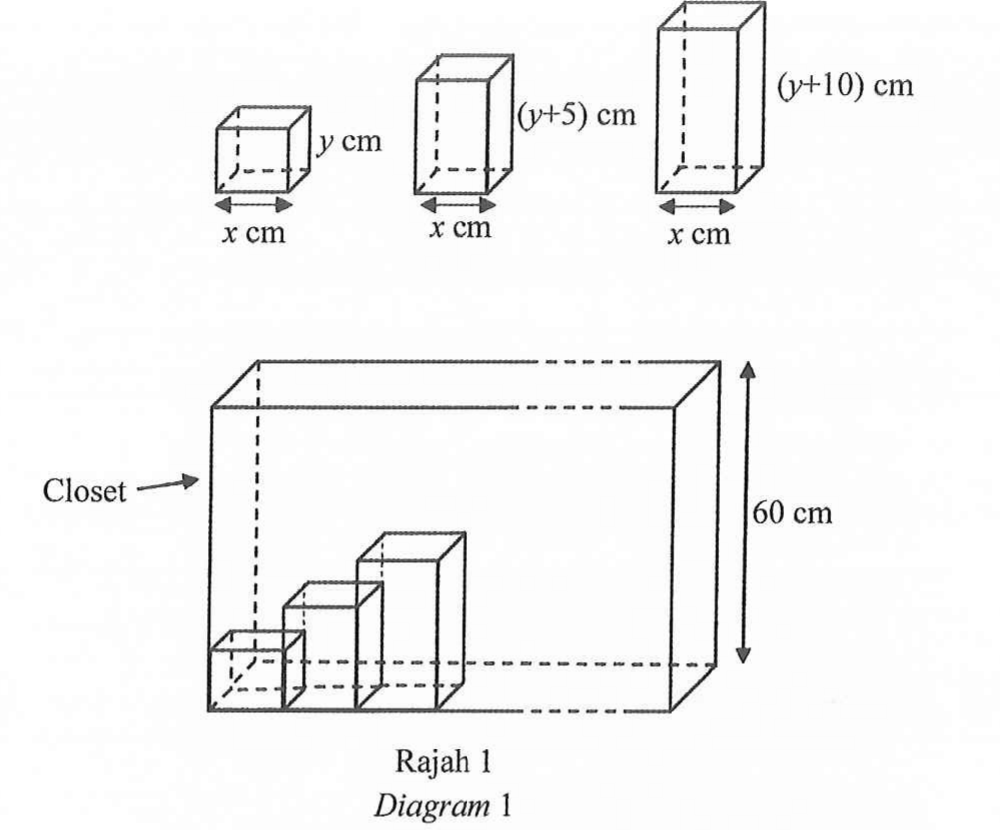
- (a)
If the volume of the sixth cuboid is 4 500 cm³ and the sum of volumes of the first four cuboids are 11 000 cm³, find the value of x and of y.
[3] - (b)
Ali wants to arrange 10 cuboids horizontally in a row in the closet. Can he do that? Verify your answer by calculation.
[2]
(a) The members of Art Club MRSM X want to draw a mural on the wall of their college's computer lab. The design of the mural is congruent blue squares as shown in Diagram 11 (row 1 has 1 blue square, row 2 has 3, row 3 has 5, and so on). The blue squares shape at 20th row until 25th row will be painted with red colour. (b) Diagram 12 shows information about the rainforest based on a report of an NGO: January 2021, 785 million (hectares of) rainforest remaining from all over the world. The report also stated that the average annual rate of deforestation in the world is 0.8 %.
Medium8 marks- (a)(i)
Derive the formula of sum of the first nth terms, Sₙ, of the number of blue squares shape that are drawn.
[2]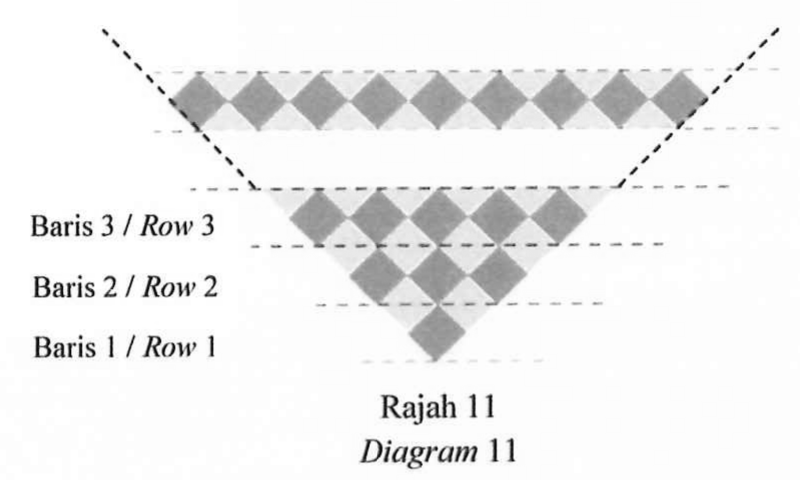
- (a)(ii)
Hence, calculate the number of blue squares shape that will be painted with red colour.
[2] - (b)(i)
Find the remaining area of rainforest, in million hectares, for the nth year, from the year 2021.
[1]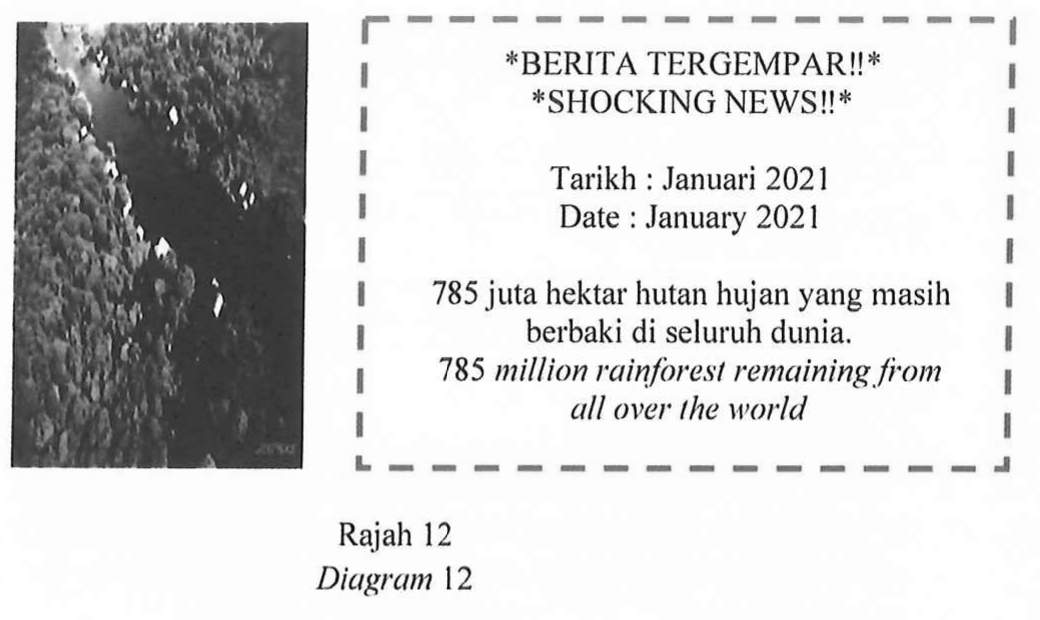
- (b)(ii)
Hence, find the minimum number of years where at most half of the area in million hectares, of the rainforest still remains, from the year 2021.
[3]
(a) The sum to infinity of a geometric progression is 6 and the sum of its first two terms is 5⅓. (b) During the outbreak of the flu virus in town A, approximately the rate of infection increases daily by 15% from the previous day. Given that on the 1st July, the number of cases is 30.
Medium8 marks- (a)
Find the possible common ratios.
[3] - (b)(i)
Find the estimated total cases for month of July.
[2] - (b)(ii)
Starting from 1st of August preventive measures has been taken by the local authority to deal with the outbreaks. Given the number of new cases on 1st August and 31st of August is 2 284 and 45 464 cases respectively. Determine the estimated infection rate for the duration from 1st August until 31st August. Do the preventive measures taken give positive effect? Give your justification.
[3]
Table 1 shows the monthly rental schedule of a house: Jan 2021 – Dec 2022: RM660; Jan 2023 – Dec 2024: RM710; Jan 2025 – Dec 2026: RM760; Jan 2027 – Dec 2028: RM810. Rizqi rents the house with monthly rental of RM660 on 1 January 2021. The house owner will increase his monthly rental on a regular basis every 2 years. (a) Determine whether the monthly rental form an arithmetic progression or a geometric progression. Verify your answer with calculation. (b) When will the monthly rental exceed RM1 350 for the first time? (c) Calculate the total rental paid to the house owner for the years 2028 to 2056.
Medium8 marks- (a)
Determine whether the monthly rental form an arithmetic progression or a geometric progression. Verify your answer with calculation.
[2]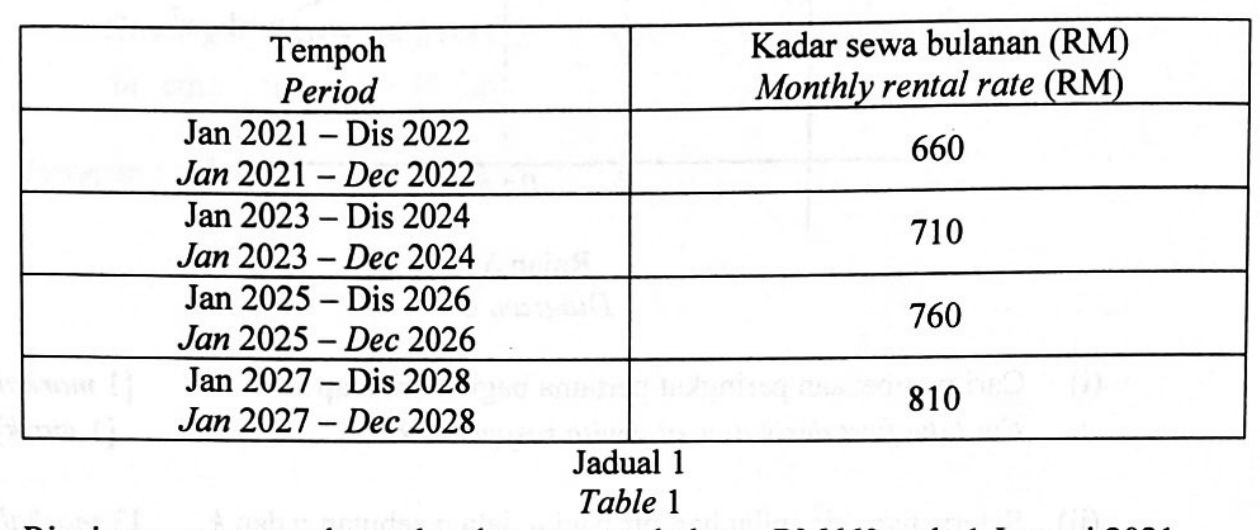
- (b)
When will the monthly rental exceed RM1 350 for the first time?
[3] - (c)
Calculate the total rental paid to the house owner for the years 2028 to 2056.
[3]
Diagram 1(a) shows a wave front formed after bait is dropped into a river. Diagram 1(b) shows the plan of the wave front formed on the surface of the river. Both types of wavelengths formed a geometric progression. (a) Given that the sum of the wavelength from the source towards the deep water is Sₙ = 5/2 + 3(2ⁿ⁻¹ − 1). Find (i) the first wavelength, (ii) the common ratio of this progression. (b) Given that 9T₄ = 10T₅ and the first wavelength from the source towards the riverbank is 1 cm, find the total distance of the wavelength when the wave front stops forming.
Medium7 marks- (a)
Given Sₙ = 5/2 + 3(2ⁿ⁻¹ − 1), find (i) the first wavelength, (ii) the common ratio.
[4]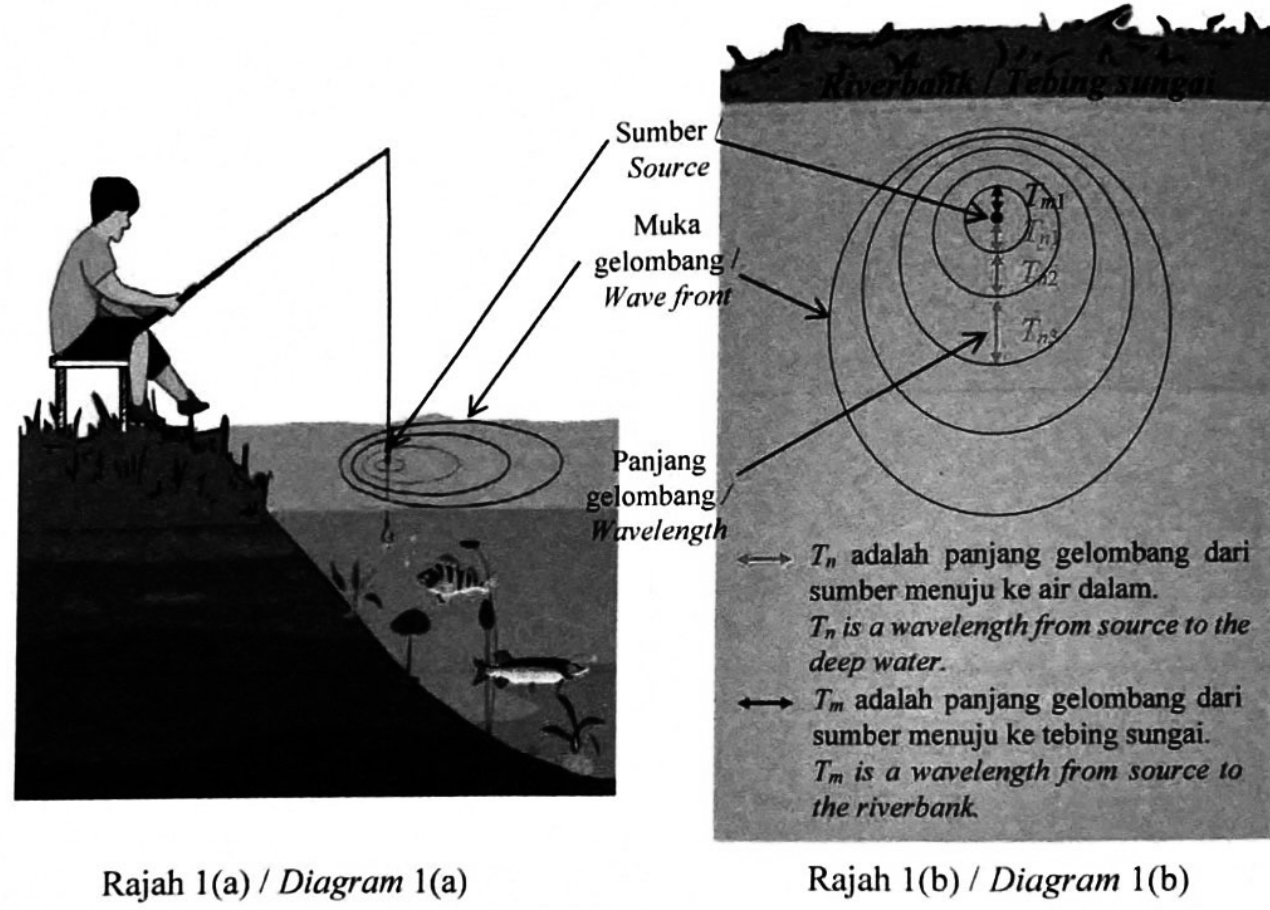
- (b)
Given 9T₄ = 10T₅ and the first wavelength from the source towards the riverbank is 1 cm, find the total distance of the wavelength when the wave front stops forming.
[3]
Encik Adi, Puan Balqis and Encik Chandran are 3 members of the first generation in an organization. The constitution of the organization stipulates that each member needs to recruit 2 new members. [Assume that each member has successfully fulfilled the constitution of the organization] (a) If the total members of the organization exceed 12 000 for the first time in the nth generation, find the value of n. (b) Hence, find the difference between the total members of the organization until the nth generation and the number of members in the nth generation.
Easy5 marks- (a)
If the total members of the organization exceed 12 000 for the first time in the nth generation, find the value of n.
[2] - (b)
Hence, find the difference between the total members of the organization until the nth generation and the number of members in the nth generation.
[3]
(a) The following is a false statement regarding arithmetic progression: "Arithmetic progression is a sequence of numbers such that each term is obtained by multiplying a constant to the term before it." Write a true statement for an arithmetic progression by changing only one word from the statement. (b) Diagram 9 shows a circle that will be divided into 15 sectors to form an arithmetic progression such that θ₁ < θ₂. (i) Given that the angle of the largest sector is 38°, find the sum of the last five terms of the progression. (ii) There are other ways to divide the circle into 15 sectors. Find all the combination of the first term, a and the common difference, d such that a and d are positive integers.
Medium8 marks- (a)
Write a true statement for an arithmetic progression by changing only one word from the statement.
[1] - (b)(i)
Given that the angle of the largest sector is 38°, find the sum of the last five terms of the progression.
[4]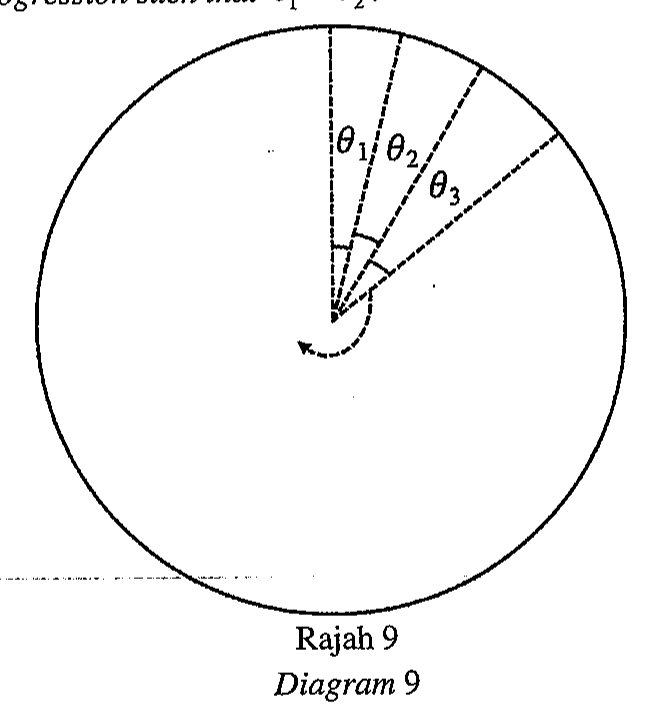
- (b)(ii)
Find all the combination of the first term, a and the common difference, d such that a and d are positive integers.
[3]
Aini has a wire of length W metres. Aini divides the wire into several pieces. Each piece is to form a square. Diagram 3 shows the first three squares formed by Aini, with sides p cm, (p + q) cm and (p + 2q) cm.
Medium5 marks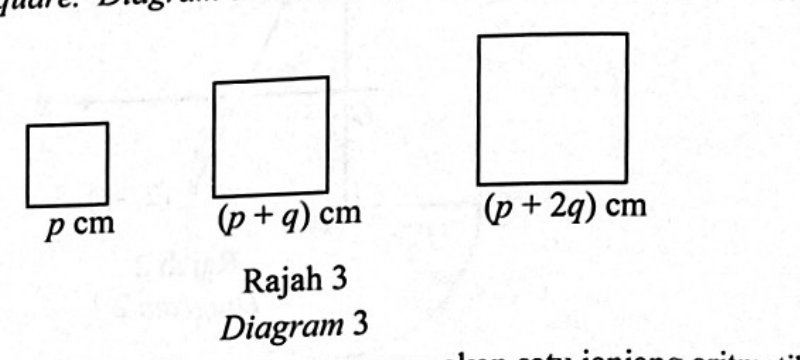
- (a)
State whether the perimeter of the squares is an arithmetic progression or a geometric progression. Justify your answer.
[3] - (b)
If Aini managed to form exactly 10 squares, express W in terms of p and q.
[2]
Ryan uses coloured triangular cards of different sizes to investigate the pattern of the Sierpinski's Triangle. Diagram 8 shows the pattern of the Sierpinski's Triangle, the height of the second stage triangle is half of the height of the triangle in the first stage. Ryan starts the first stage triangle with 40 cm.
Medium8 marks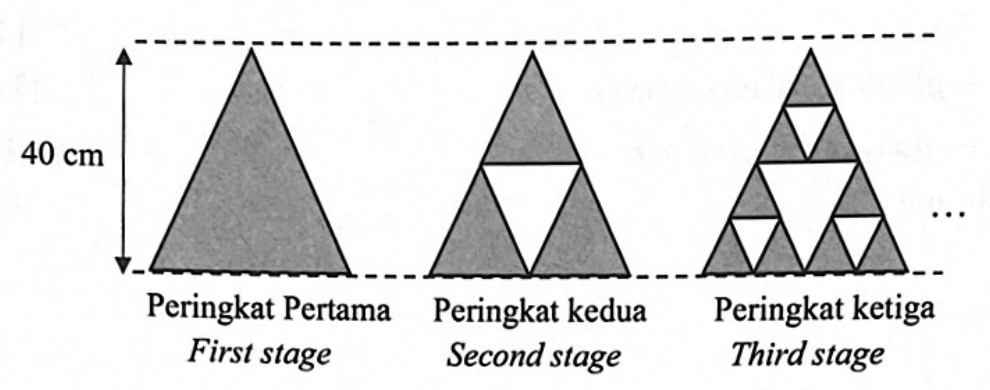
- (a)(i)
Find the height of the triangle used in the seventh stage.
[2] - (a)(ii)
Find the number of triangles used at the last stage, if the height of the triangle at this stage is 5/64 cm.
[3] - (b)
Given a is the first term and r is the common ratio of a geometric progression. If |r| > 1, show that the sum of the first n terms of the progression is Sₙ = a(rⁿ − 1)/(r − 1).
[3]
The nth term of a geometric progression is given by Tₙ = pq^(2n−1). If the 5th term is 16 times the 3rd term, find the common ratio where r > 1.
Easy4 marksFind the common ratio r where r > 1.
[4]
Given a sequence with the sum of the first n terms is given by Sₙ = 2n² + 3n. (a) Express Sₙ₋₁, hence find the nth term. (b) Show that this sequence is an arithmetic progression.
Medium6 marks- (a)
Express Sₙ₋₁, hence find the nth term.
[3] - (b)
Show that this sequence is an arithmetic progression.
[3]
An arithmetic progression has the first term −64 and common difference 7. If the number of positive terms of this progression is 3/2 times the number of negative terms, find (a) the number of negative terms of this progression, (b) the sum of all positive terms of this progression.
Medium5 marks- (a)
Find the number of negative terms of this progression.
[2] - (b)
Find the sum of all positive terms of this progression.
[3]
(a) The first three terms of a geometric progression are β − 2, β + 1 and 2β + 2 such that β ≠ −1. Determine (i) the value of β, (ii) whether the sum to infinity exists. Give justification of your answer. (b) Diagram 5 shows a new plant species discovered by botanists. The stems of the plant form several branches that produce 4 twigs on each one. Height of every part of branch will be reduced by 5% from the previous height (the 1st branch has height x, the 2nd branch height is below it). (i) Find the height of the first branch, x if the plant being studied has 8 branches and the height of the whole plant is 201.95 cm. (ii) The plant continues to grow and form new branches and twigs. Find the maximum number of twigs of the plant if the height of the smallest branch is more than 18 cm.
Medium9 marks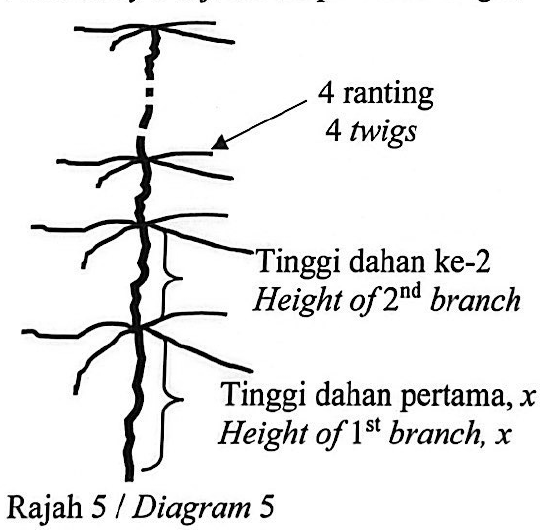
- (a)(i)
Determine the value of β.
[2] - (a)(ii)
Determine whether the sum to infinity exists. Justify.
[2] - (b)(i)
Find the height of the first branch, x.
[2] - (b)(ii)
Find the maximum number of twigs if the smallest branch height is more than 18 cm.
[3]
Two parts on progressions.
Medium5 marks- (a)
It is given that the first three terms of a sequence are x, x², x³. State the type of the sequence. Give a reason for your answer.
[1] - (b)
Starting from 2020, electric car sales in Malaysia have consistently increased by 8.5%. A total of 32 550 units of electric cars were sold in 2021. Company T is one of the companies supplying electric cars in the Malaysian market and managed to dominate 30% of the market share from 2023 to 2025. Estimate the number of electric cars successfully sold by the company from 2023 to 2025.
[4]
A city planner arranges rows of flower pots as shown in Diagram 2. The first row has 5 pots, the second row 8 pots, the third row 11 pots, and the number of pots in the subsequent rows increases uniformly.
Easy4 marks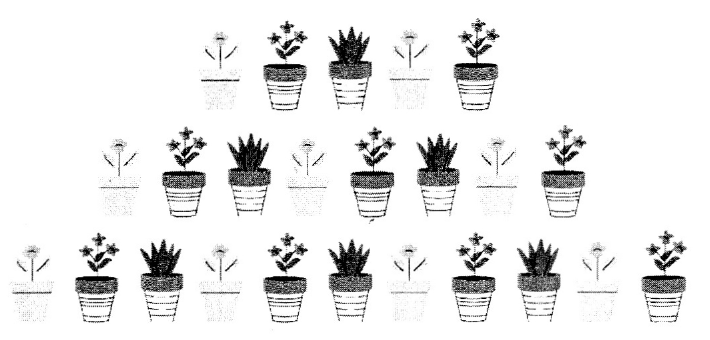
- (a)
Find the number of pots in the nth row.
[2] - (b)
If the total number of pots does not exceed 1500, what is the maximum number of rows that can be arranged?
[2]
Given that the ratio of the 18th term to the 6th term in an arithmetic progression is 3 : 1, calculate the ratio of the sum of the first 12 terms to the sum of the first 4 terms.
Easy4 marksFind the ratio of S₁₂ to S₄.
[4]
3q − 2, q + 3 and q are the first three terms of an arithmetic progression.
Easy5 marks- (a)
Find the value of q.
[2] - (b)
Find the sum of the 7th term to the 14th term.
[3]
Diagram 6 shows part of an arrangement of rectangles. The first rectangle has length 120 cm and width 189 cm. The length and the width of each subsequent rectangle is 3/4 of the previous measurement.
Medium6 marks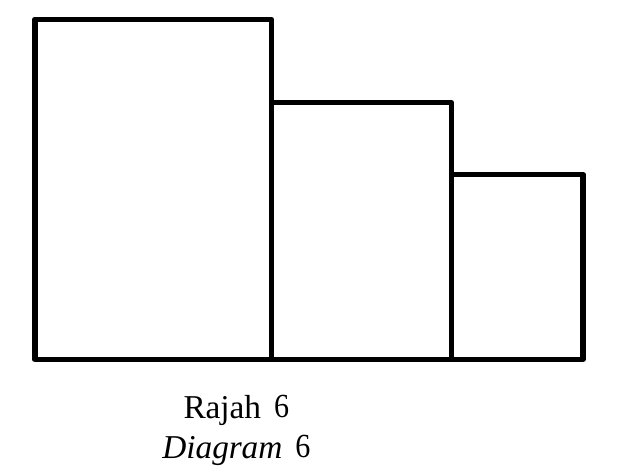
- (a)
Find the smallest value of n such that the area of the nth rectangle is less than 100 cm².
[4] - (b)
Find the sum to infinity of the area of the rectangles, in cm².
[2]
A teacher plans to save money over a period of 2 years. Plan A: He saves RM x in the first month and increases the amount by RM20 every month thereafter. Plan B: He saves RM2100 in the first year and increases the savings in the following year by RM400. (a) For Plan A, if he saves RM240 in the 3rd month, calculate his savings in the 6th month. (b) Determine which plan allows the teacher to reach the savings target of RM10320 earlier. Justify your answer.
Medium7 marks- (a)
For Plan A, if he saves RM240 in the 3rd month, calculate his savings in the 6th month.
[3] - (b)
Determine which plan allows the teacher to reach the savings target of RM10320 earlier. Justify your answer.
[4]
A soy sauce factory produces 5000 litres of soy sauce on the first day of operations. On each subsequent day, the volume of production decreases by 2% from the previous day. (a) (i) Calculate the volume of production of soy sauce on the fourth day. (ii) Hence, find the total volume of production in the first week of operation. (b) It is given that x, 6, 10, 14, ..., 54 is an arithmetic progression. (i) State the value of x. (ii) Find the number of terms of the sequence.
Medium8 marks- (a)(i)
Calculate the volume of production of soy sauce on the fourth day.
[3] - (a)(ii)
Hence, find the total volume of production of soy sauce in the first week of operation.
[2] - (b)(i)
State the value of x.
[1] - (b)(ii)
Find the number of terms of the sequence.
[2]
Progressions questions.
Medium8 marks- (a)
Chong applied for a job. The company offered him an initial salary of RM 18 000 per annum with 5% yearly increment from the basic salary. Chong planned to save 25% of his salary for further study after working for 5 years. Calculate his total savings for his studies after working for 5 years. Give your answer correct to the nearest RM.
[3] - (b)
Given that three consecutive terms of an arithmetic progression are 3x + 1, 25 and x² − 5. Find the value of x if the common difference is more than 10. Hence, determine the first term if x² − 5 is the tenth term.
[5]
Progressions questions.
Medium10 marks- (a)(i)
Mr Kamal has a pond. He has 1996 fish in the pond and adds 140 fish into the pond on the first day of each month starting in March 2019. What is the number of fish in the pond on 15 May 2020?
[3] - (a)(ii)
On 31 May 2020, the fish in the pond were infected by a disease. Half of the fish in the pond will die every day starting from the next day and the following days. State the date when all the fish in the pond die.
[3] - (b)
An arithmetic progression has 11 terms such that the sum of all odd terms is 222 and the last term is 50.75. Find the first term and the common difference of the progression.
[4]
Given 36, 11k − 5, 144 are three consecutive terms in a geometric progression where k is a positive integer. Find (a) the value of k, (b) the common ratio of the progression.
Easy4 marks- (a)
the value of k. [3 marks]
[3] - (b)
the common ratio of the progression. [1 mark]
[1]
A rice factory sells imported white rice from January to December in 2020 at RM 25 for a 5 kg pack. The number of packs sold increases constantly by 250 packs each subsequent month. The number of packs sold in July is four times the number sold in January. Find (a) the number of packs sold in January, (b) the value of n if the total number of packs sold is more than 13 500, where n is the number of months after January, (c) the factory's profit in 2020 from the sale of imported white rice if the cost price for one pack is RM 17.
Medium8 marks- (a)
the number of packs sold in January. [2 marks]
[2] - (b)
the value of n if the total number of packs sold is more than 13 500. [3 marks]
[3] - (c)
the factory's profit in 2020 if the cost price for one pack is RM 17. [3 marks]
[3]
Fahmi saves RM30 in the first month, RM45 in the second month, RM60 in the third month, and so on. Table: Month 1: savings RM30, total RM30; Month 2: RM45, RM75; Month 3: RM60, RM135; Months 4, 5, 6 blank. (a) Copy and complete the table for the first 6 months. (b) Determine whether the sequence is an arithmetic progression or a geometric progression and give your justification. (c) How long will it take for Fahmi to save a total of at least RM1000?
Medium5 marks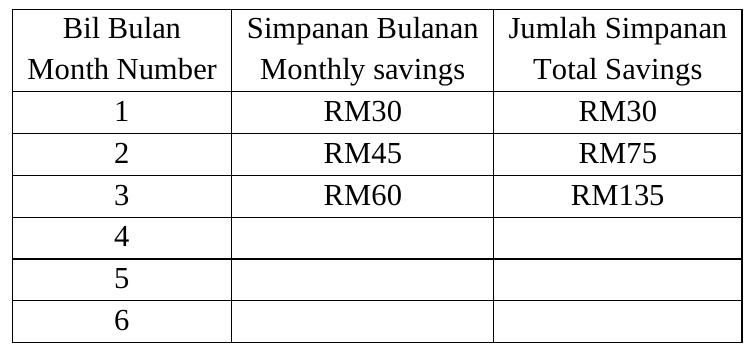
- (a)
Copy and complete the table for the first 6 months.
[2] - (b)
Determine whether the sequence is an arithmetic progression or a geometric progression and justify.
[1] - (c)
How long will it take to save a total of at least RM1000?
[2]
When 3 plastic glasses are stacked together as in the diagram, the height of the stack is 13.5 cm, whereas when 6 plastic glasses are stacked, the height is 15.75 cm. (a) How high would a stack of 20 glasses stand? (b) Find how many glasses it would take to make a stack at least 0.5 m high.
Easy7 marks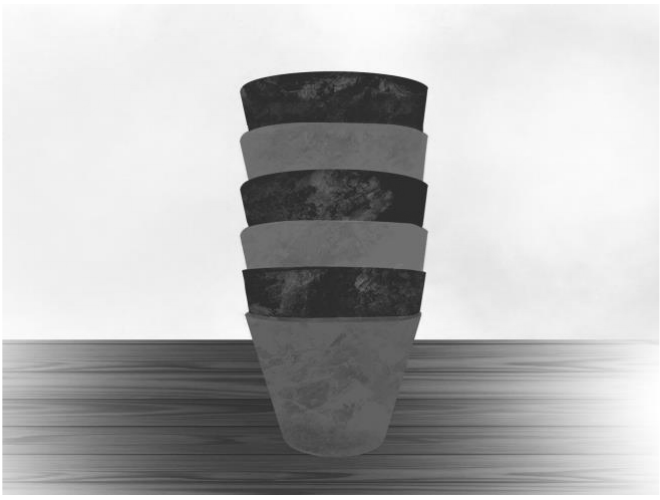
- (a)
How high would a stack of 20 glasses stand?
[5] - (b)
Find how many glasses make a stack of at least 0.5 m high.
[2]
Diagram 9 shows the first three plots of vegetables planted with Chilli (C), Lemongrass (S) and Onion (B) alternately. The total number of plots is 45 with a total horizontal length of 306 m. The plots have lengths x cm, (x + 30) cm and (x + 60) cm, and a width of 120 cm.
Medium8 marks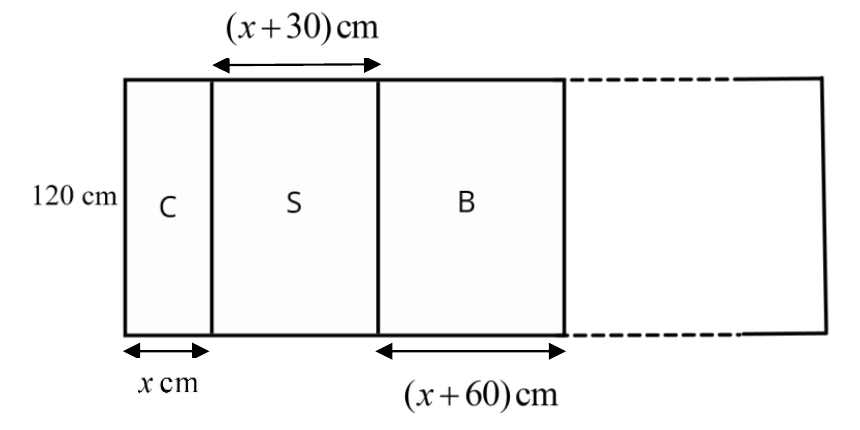
- (a)
Show that the length of the plots is arranged according to an arithmetic progression.
[1] - (b)
Wahab has watered the first 3/5 of the vegetable plots. Calculate the total length, in cm, of the last 12 plots that have been watered.
[4] - (c)
Which vegetable plot has an area of 139 200 cm²? Hence, state the vegetable of that plot.
[3]
Syuhada has an 8188 cm ribbon roll that will be cut into a few pieces to decorate her class. The length of each piece of ribbon increases and follows a geometric progression with common ratio r > 1. The length of the second ribbon is 8 cm while the length of the third ribbon exceeds the length of the first ribbon by 12 cm.
Medium6 marks- (a)(i)
Find the common ratio.
[2] - (a)(ii)
Find the maximum number of ribbons that can be cut.
[2] - (b)
State the length of the largest ribbon.
[2]
Diagram 6 shows four circles of different sizes. The largest circle has a radius of k cm. The radius of each circle is half of the radius of the previous one. The areas of the circles in descending order form a geometric progression. (a) Given that the sum of the areas of the four circles is 132 13/16 π cm², find the area of the first circle in terms of π. (b) The area of the nth circle is 25/4 π cm². Determine the value of n. (c) Find the sum to infinity of the areas, in cm², of the circles.
Medium8 marks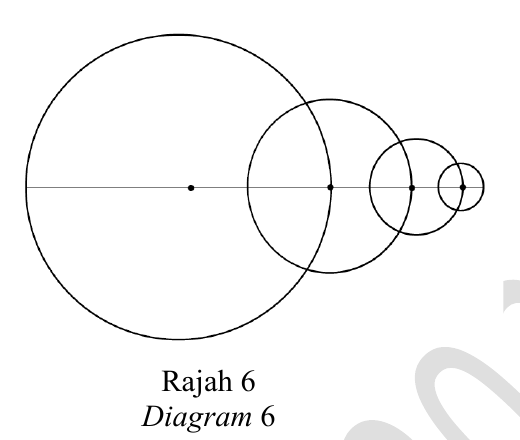
- (a)
Find the area of the first circle in terms of π.
[4] - (b)
Determine the value of n.
[2] - (c)
Find the sum to infinity of the areas.
[2]
Diagram 2 shows part of an arrangement of triangular blocks built by Johan. The lowest row has 198 triangular blocks. For each of the subsequent rows, the number of triangular blocks is 4 less than the previous row. The number of triangular blocks in the top row is 2. (a) Calculate the number of rows in this arrangement. (b) Given the height and base of each triangular block are 6 cm and 8 cm respectively and the price of a triangular block is RM0.80, calculate the area, in cm², of the whole arrangement of triangular blocks and the entire cost required, in RM.
Medium8 marks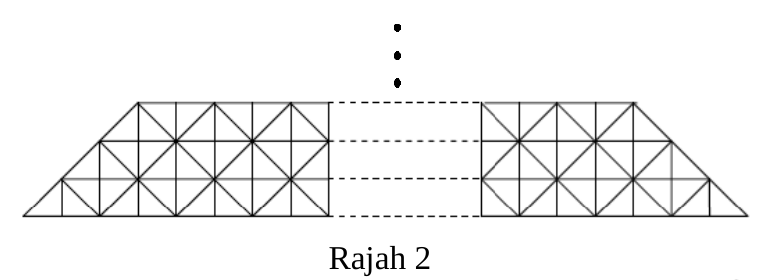
- (a)
Calculate the number of rows.
[3] - (b)
Calculate the total area, in cm², and the total cost, in RM.
[5]
The first three terms of a sequence are log₁₀ p, log₁₀ pq and log₁₀ pq². (a) Show that the sequence is an arithmetic progression. (b) Find the sum of the first six terms.
Easy4 marks- (a)
Show that the sequence is an arithmetic progression.
[2] - (b)
Find the sum of the first six terms.
[2]
Shahrul has a toy car collection which he collects every month. The number of toy cars increases every month according to geometric progression. The total number of toy cars in the first four months is ten times the total number of toy cars in the first two months. (a) If r represents the common ratio, show that r⁴ − 10r² + 9 = 0. Hence, find the positive values of r. (b) Calculate the expenses paid by Shahrul in the 6 months if he started to buy 3 toy cars and the average price of a toy car is RM7.25.
Medium8 marks- (a)
If r represents the common ratio, show that r⁴ − 10r² + 9 = 0. Hence, find the positive values of r.
[5] - (b)
Calculate the expenses paid by Shahrul in the 6 months if he started to buy 3 toy cars and the average price of a toy car is RM7.25.
[3]
A college lecture hall has 10 rows of seats (Diagram 4). The first row has 7 seats and each later row has 4 more seats than the row before.
Easy5 marks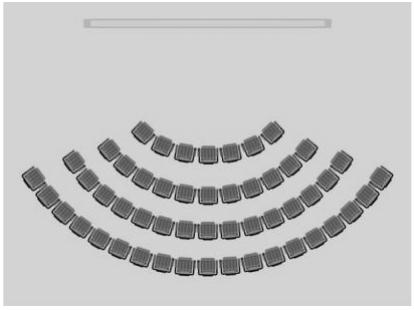
- (a)
How many seats are there in the last row?
[2] - (b)
A seminar will be held in this hall. Determine whether the hall can accommodate 260 participants. Give your justification.
[3]
(a) Complete Table 2 to derive the formula for the sum of the first n terms, Sₙ, of a geometric progression. (b) Damia is offered an initial salary of RM 18 000 per year with a 5% yearly increment from the basic salary. She plans to save 25% of her salary after working for 5 years. Calculate her total savings, correct to the nearest RM.
Hard8 marks- (a)
Complete Table 2 to derive the formula for Sₙ.
[4]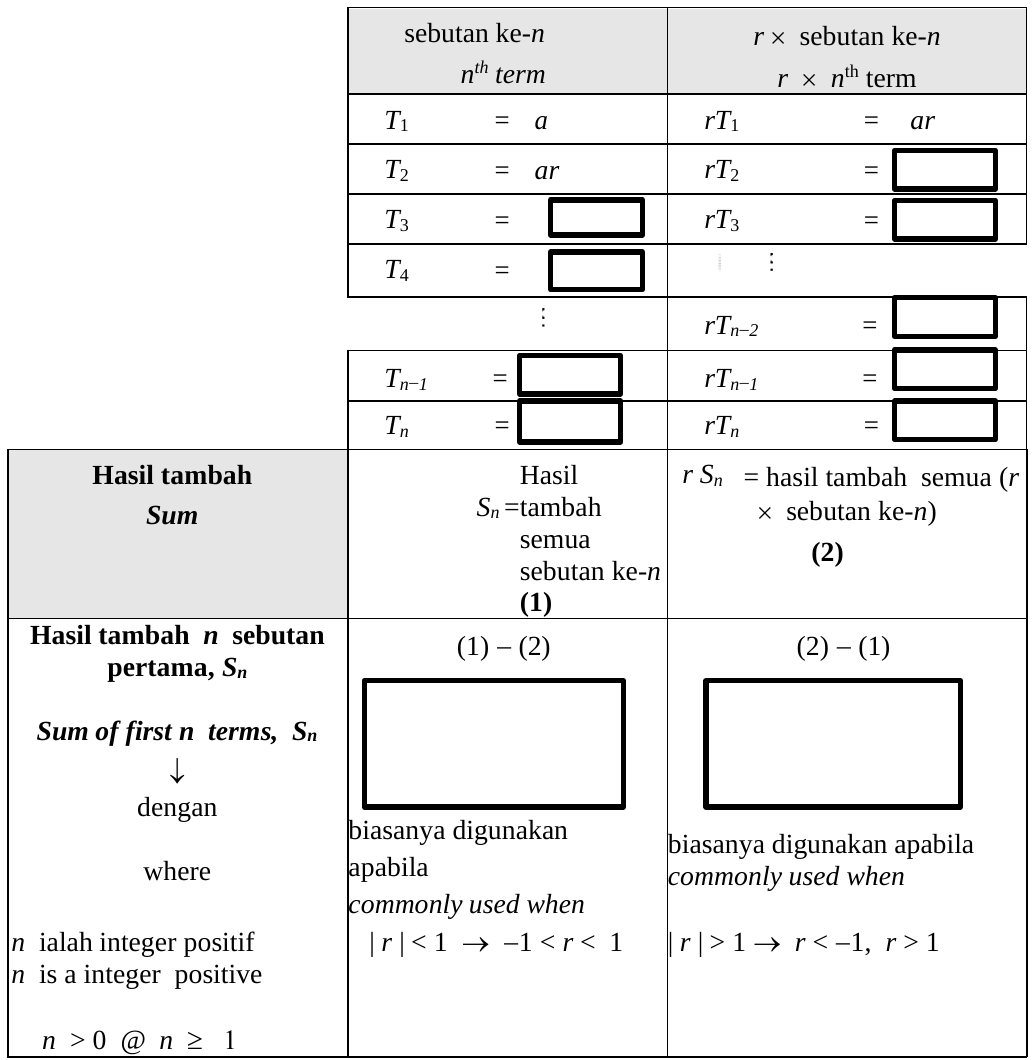
- (b)
Calculate Damia's total savings after 5 years, to the nearest RM.
[4]
(a) If a is the first term and r is the common ratio of a geometric progression, show that the sum of the first n terms is Sₙ = a(1 − rⁿ)/(1 − r), r ≠ 1. (b) There are three children with their masses arranged in descending geometric progression. The sum of the masses of the first three children is seven times the mass of the lightest child. Find the common ratio and the mass of the second largest child if the mass of the largest child is 29 kg.
Medium6 marks- (a)
Show that Sₙ = a(1 − rⁿ)/(1 − r), r ≠ 1.
[3] - (b)
Find the common ratio and the mass of the second largest child.
[3]
A university plans to construct a new lecture hall. The lecture hall will have 12 rows of seats, arranged such that the number of seats in each row forms an arithmetic progression. The number of seats in the second row is 21 and the number of seats in the last row is 81. (a) Calculate the total number of seats in the lecture hall. (b) The university later changed the plan such that the hall could accommodate at least 850 seats. Using the same arithmetic progression, is it sufficient to add 3 more rows to the lecture hall? Give your justification.
Medium8 marks- (a)
Calculate the total number of seats in the lecture hall.
[4] - (b)
Is it sufficient to add 3 more rows? Give your justification.
[4]
(a) Determine whether 768p, 192p², 48p³, 12p⁴, … is a geometric progression. (b) Ben starts on an annual salary of RM18000 with a pay rise of RM1800 each year until his salary reaches RM36000, then no more rises. Kent starts on RM a with a pay rise of RM1000 each year until RM36000, first reached in year 15, then no more rises. Who receives more total earnings after year 15?
Medium7 marks- (a)
Determine whether the progression is geometric. Give your justification.
[2] - (b)
Who will receive more total earnings after year 15? Give your justification.
[5]
A string is cut into n parts. The lengths of the parts increase and form a geometric progression. The length of the fifth part is four times the length of the third part. (a) Calculate the common ratio of the string. (b) If the total length of the string is 1020 cm and the length of the first part is 4 cm, calculate (i) the value of n, (ii) the length in cm of the last part.
Medium9 marks- (a)
Calculate the common ratio.
[3] - (b)(i)
Find the value of n.
[4] - (b)(ii)
Find the length of the last part.
[2]
5p − 2q, 3p and 2p + q, where p ≠ q, are the first three terms of a geometric progression.
Medium6 marks- (a)
Express q in terms of p.
[3] - (b)
Hence, find the common ratio of the progression.
[3]
(a) A water tank contains 2000 cm³ of water and leaks at 30 cm³ s⁻¹. (b) A farm produces m eggs in the first month and increases production by k eggs each month.
Easy7 marks- (a)
Find the time taken for the water to leak until 680 cm³ is left.
[2] - (b)
7000 eggs were produced in the 6th month and the total for the first 5 months was 29000 eggs. Find the values of m and k.
[5]
Asman has just completed her diploma in banking. She was offered a job by two different banks. Bank P offered an initial salary of RM 45 000 per annum with a 5% yearly increment from the basic salary. Bank Q offered an initial salary of RM 47 000 per annum with an RM 2 000 increment yearly. Asman decided to choose the bank which offers higher income in 5 years. Determine which bank she should choose. Show calculation to support your answer. [Round off your answer to the nearest RM]
Medium6 marksDetermine which bank Asman should choose, with calculation.
[6]
Rizuan is given a piece of wire of length 4 meters. He cuts the wire into several pieces. Each piece is bent to form a square. Diagram 2 shows the first three squares made by Rizuan (sides 2 cm, 5 cm and 8 cm). Find (a) how many squares can be made by Rizuan, (b) the length of the wire of the longest part.
Medium6 marks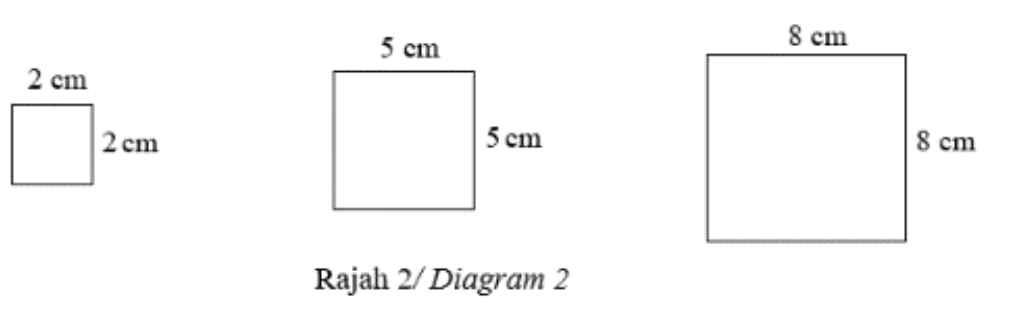
- (a)
Number of squares that can be made.
[4] - (b)
Length of wire of the longest part.
[2]
Given a geometric progression a, ar, ar², ar³, ar⁴, ..., arⁿ⁻², arⁿ⁻¹. (a) Derive the formula for the sum of the first n terms, Sₙ = a(1 − rⁿ)/(1 − r). (b) Hence, state the range of values of r.
Medium4 marks- (a)
Derive Sₙ = a(1 − rⁿ)/(1 − r).
[3] - (b)
State the range of values of r.
[1]
Two shops, Abdullah and Basir, started selling Malay clothes (baju melayu) at the same time. (a) Abdullah's shop sells x pairs in the first month and the sales increase uniformly by y pairs in each subsequent month. The shop sold 210 pairs in the 7th month and the total sales in the first 9 months was 1,440 pairs. Find x and y. (b) Basir's shop sold 95 pairs in the first month and the sales increased uniformly by 20 pairs each subsequent month. If both shops sell the same number of pairs in the n-th month, find n.
Medium7 marks- (a)
Find x and y.
[4] - (b)
Find n.
[3]
(a) By considering a geometric progression 2, −6, 18, −54, …, where a is the first term and r is the common ratio, show that the nth term is given by T_n = ar^(n−1). (b) The first three consecutive terms of a geometric progression are 6 + 2m, 2 − m, 4 − 2m. Determine the negative value of m.
Medium6 marks- (a)
Show that the nth term of the geometric progression 2, −6, 18, −54, … is T_n = ar^(n−1).
[3] - (b)
The first three terms of a geometric progression are 6 + 2m, 2 − m, 4 − 2m. Determine the negative value of m.
[3]
Diagram 7 shows a sequence of semicircles drawn on a straight line OVWXY. The diameter of the smallest semicircle is 2a cm and increases by a cm for the next semicircle. (a) Find the perimeter of the first three semicircles. (b) Hence, show that the perimeters form an arithmetic progression. (c) If a = 2, find the semicircle that has the perimeter of 12(π + 2) cm.
Medium7 marks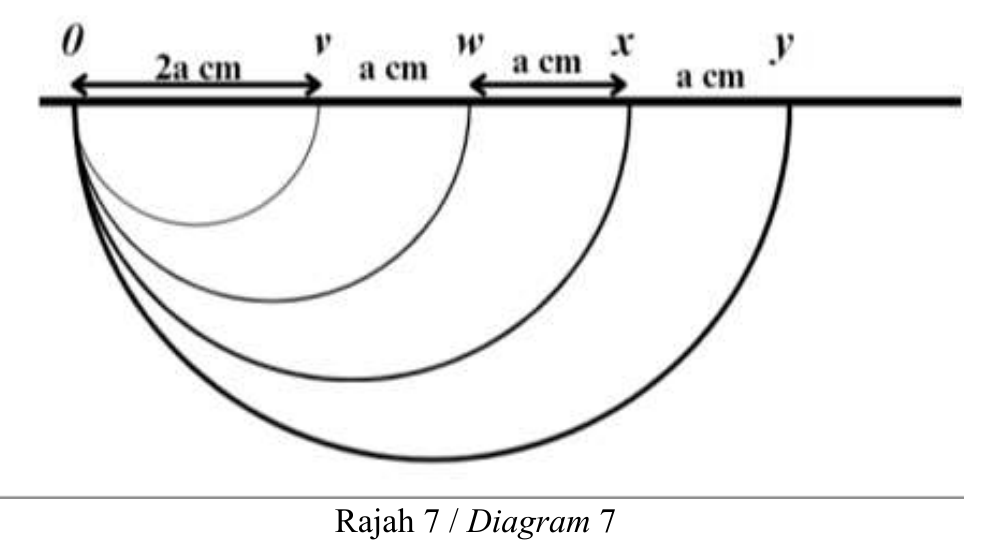
- (a)
Find the perimeter of the first three semicircles.
[3] - (b)
Hence, show that the perimeters form an arithmetic progression.
[2] - (c)
If a = 2, find the semicircle that has the perimeter of 12(π + 2) cm.
[2]
(a) It is given that x, 5, 8, …, 41, … is an arithmetic progression. (i) State the value of x. (ii) Write the three consecutive terms after 41. (b) The second term of an arithmetic progression is −3 and the sixth term is 13. Find the first term and the common difference of the progression.
Medium6 marks- (a)(i)
State the value of x.
[2] - (a)(ii)
Write the three consecutive terms after 41.
[1] - (b)
The second term of an arithmetic progression is −3 and the sixth term is 13. Find the first term and the common difference.
[3]
(a) It is given that x², x⁴, x⁶, x⁸, … is a geometric progression such that 0 < x < 1. The sum to infinity of this progression is 1/3. Find (i) the common ratio of this progression in terms of x, (ii) the value of x. (b) In a geometric progression, the first term is a and the common ratio is r. Given that the third term exceeds the second term by 12a, find the values of r.
Medium6 marks- (a)(i)
Find the common ratio in terms of x.
[1] - (a)(ii)
Find the value of x, given that the sum to infinity is 1/3.
[2] - (b)
The first term is a and the common ratio is r. The third term exceeds the second term by 12a. Find the values of r.
[3]
It is given that …, 1701, y, 15309, … is a part of a geometric progression and the sum of the first five terms of the progression is 847. Find (a) the common ratio, (b) the first term, (c) the smallest value of n such that the nth term exceeds 75000.
Medium7 marks- (a)
Find the common ratio.
[2] - (b)
Find the first term.
[2] - (c)
Find the smallest value of n such that the nth term exceeds 75000.
[3]
Melvin is given a piece of wire of length 14.04 m. He cuts the wire into several pieces. Each piece is bent to form a square. The diagram shows the first three squares made by Melvin (sides 3 cm, 7 cm, 11 cm). How many squares can be made by Melvin?
Medium5 marks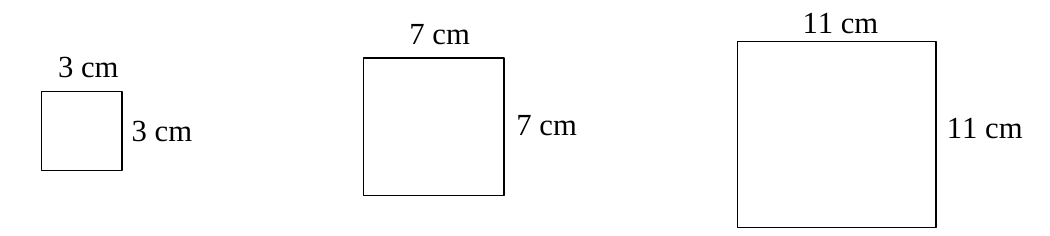
How many squares can be made by Melvin?
[5]
Diagram 7 shows part of a rectangular wall painted in blue, B, red, M, and green, H, in turn (B, M, H, B, M, H, …). The height of the wall is 1.5 m. The side length of the first coloured rectangle is 18 cm and the side length of each subsequent coloured rectangle increases by 5 cm. Given the total number of coloured rectangles is 60. (a) Find (i) the side length, in cm, of the last coloured rectangle, (ii) the total length, in cm, of the painted wall. (b) Which coloured rectangle has an area of 40200 cm²? Hence, state the colour of that rectangle.
Medium7 marks- (a)(i)
Find the side length, in cm, of the last coloured rectangle.
[2]
- (a)(ii)
Find the total length, in cm, of the painted wall.
[2] - (b)
Which coloured rectangle has an area of 40200 cm²? State its colour.
[3]
Diagram 14 shows part of several squares drawn in a row. The lengths of the sides of the squares form a geometric progression. The length of the side of the first square is x cm and the ratio of the length of the side of the fourth square to the length of the side of the first square is 8 : 27. (a) Find the perimeter of the sixth square in terms of x. (b) From the diagram, derive a formula to find the sum of the lengths of the sides of the squares involved.
Medium8 marks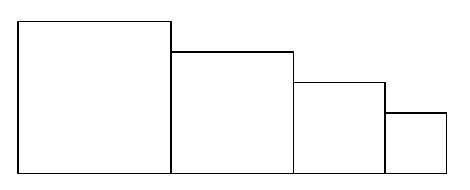
- (a)
Find the perimeter of the sixth square in terms of x.
[4] - (b)
Derive a formula for the sum of the lengths of the sides of the squares.
[4]
Diagram 6 shows an example of a birthday cake that has been ordered. The bottom layer has a radius of 80 cm and the radius of each subsequent layer is reduced by 4 cm. (a) Find the number of layers that make up the cake. (b) Given also that the height of the bottom cylinder is 30 cm and the height of each subsequent cylinder is reduced by 1 cm, find (i) the volume of the bottom cylinder, (ii) the height of the cake.
Medium7 marks
- (a)
Find the number of layers that make up the cake.
[3] - (b)(i)
The volume of the bottom cylinder.
[2] - (b)(ii)
The height of the cake.
[2]
Miss Lim deposited some money into her account at the beginning of year 2015, which is compounded annually. Table 4 shows the amount in her account at the end of each year: 2015: RM2000; 2016: RM2100; 2017: RM2205. (a) How many percent of interest does the bank give? (b) If the pattern continues, how much does she have in the account at the beginning of year 2019?
Easy5 marks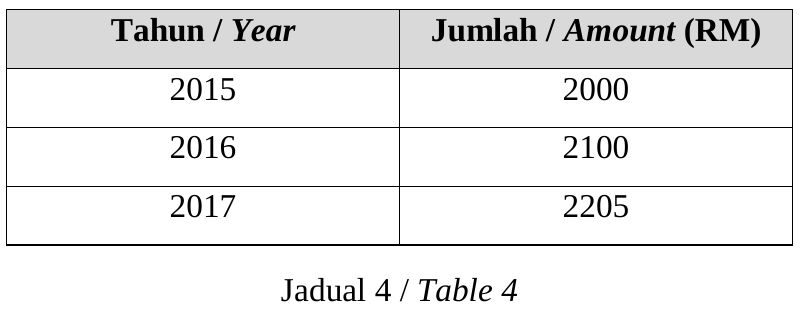
- (a)
How many percent of interest does the bank give?
[2] - (b)
If the pattern continues, how much does she have in the account at the beginning of year 2019?
[3]
When 3 plastic glasses are stacked together as in Diagram 1, the height of the arrangement is 13.5 cm, whereas when 6 plastic glasses are stacked together, the height is 15.75 cm. (a) How high would a stack of 20 glasses stand? (b) Find how many glasses would it take to make a stack of at least 0.5 m high.
Medium7 marks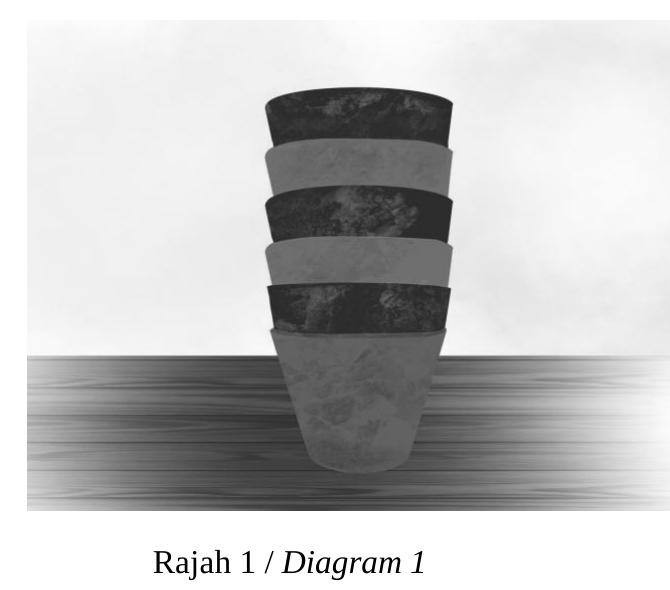
- (a)
How high would a stack of 20 glasses stand?
[5] - (b)
Find how many glasses make a stack of at least 0.5 m high.
[2]
The following sequence of numbers shows the number of people who received an injection of Covid-19 vaccine in a vaccination centre every day for a specified period: 1024, 1536, 2304, ..., 26244. Find the number of vaccine recipients during that period.
Medium5 marksFind the total number of recipients during the period.
[5]
A chicken farmer has 3000 chickens. Starting the next day, he sells 25 chickens a day. Calculate (a) on what day there are 2000 chickens (the wording: 'On what day are 2000 chickens sold' / 'Pada hari keberapakah terdapat 2000 ekor ayam yang dijual'), (b) the total income of the breeder up to the day there are 2000 unsold chickens if he spends 15 sen on food for each chicken per day.
Medium7 marks- (a)
On what day are there 2000 chickens?
[3] - (b)
Find the total up to that day, with 15 sen food cost per chicken per day.
[4]
Given 15m + n, 3m + n and n − m are the first three terms of a geometric progression with m > 0. (a) Express n in terms of m. (b) Find the common ratio for the above progression. (c) Find the sum to infinity for the progression, if m = 6.
Medium7 marks- (a)
Express n in terms of m.
[3] - (b)
Find the common ratio.
[2] - (c)
Find the sum to infinity if m = 6.
[2]
A ribbon with length of 176 cm has been cut into 20 parts with the length of each part forming an ascending arithmetic progression. Given the total length of the shortest five parts is 14 cm. Find (a) the common difference, (b) the shortest part of the ribbon, (c) the longest part of the ribbon.
Medium7 marks- (a)
Find the common difference.
[3] - (b)
Find the shortest part of the ribbon.
[2] - (c)
Find the longest part of the ribbon.
[2]
(a) If a is the first term and d is the common difference of an arithmetic progression, show that the sum of the first n terms is Sₙ = (n/2)[2a + (n − 1)d]. (b) Given an arithmetic progression 5, 9, 13, 17, …, find the sum of the first n terms. (c) Hence, solve the equation 5 + 9 + 13 + 17 + … + x = 2277.
Medium9 marks- (a)
Show that Sₙ = (n/2)[2a + (n − 1)d].
[3] - (b)
Find the sum of the first n terms of 5, 9, 13, 17, …
[2] - (c)
Hence, solve 5 + 9 + 13 + 17 + … + x = 2277.
[4]
(a) Prove the formula for the sum to infinity S∞ = a/(1 − r). (b) Hence, using the formula in (a): Diagram 4 shows a pendulum of length 20 cm swinging and forming an arc with angle θ. The first swing forms an angle of 70°, the second swing forms an angle of 67.2° and each subsequent swing follows a geometric progression. Determine whether the total distance travelled by the pendulum exceeds 700 cm when the pendulum stops.
Medium7 marks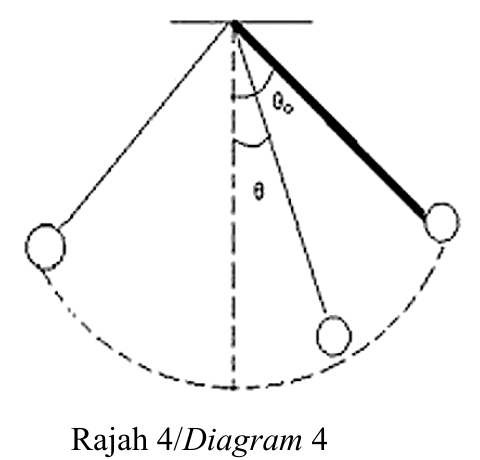
- (a)
Prove the formula S∞ = a/(1 − r).
[2] - (b)
Determine whether the total distance exceeds 700 cm when the pendulum stops.
[5]
Listing out all terms of the sequence is not accepted. Diagram 12 shows Nazwin on a swing. When the swing is released from position X, the distance travelled for its first swing is q metres. The distance travelled by each swing is 10% less than the previous swing. The distance travelled during the nth swing is 324 cm, and the total distance travelled for the first n swings is 1084 cm.
Medium9 marks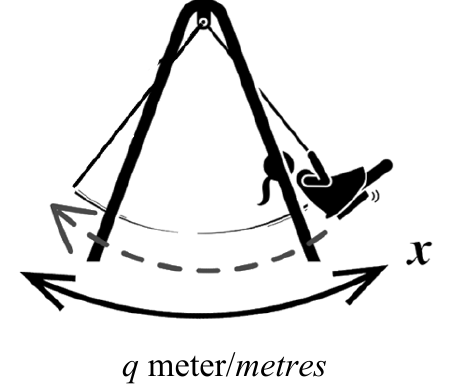
- (a)
Find the value of q and of n.
[5] - (b)
Find the number of swings when the distance travelled by the swing is less than 2 metres for the first time.
[2] - (c)
Find the total distance travelled, in metres, before the swing stops.
[2]
(a) Given a is the first term and d is the common difference of an arithmetic progression. (b) Kak Kiah's bakery sold 500 cakes in the first week.
Medium7 marks- (a)
Show that the sum of the first n terms of the progression is Sₙ = (n/2)[2a + (n − 1)d].
[3] - (b)
Listing out all terms of the sequence is not accepted. On a specific day, Kak Kiah's bakery sold 500 cakes in the first week. In the second week, sales declined by 10 cakes compared with the previous week. This decline continued until the 9th week. Due to a promotion, cake sales increased by 50% in the 10th week compared with the sales of the previous week. If each cake generates a profit of RM8, calculate the total profit earned from sales from the first week to the promotion week.
[4]
A wall clock gives an hourly chime and currently shows 12 pm. The clock is almost out of battery, so the time taken for the hour hand to move to 1 pm and give the next chime is 10% longer than the time taken previously. (a) If the clock hand moves from 4 pm to 5 pm, how much time, in minutes, does it take? (b) If the battery lasts for exactly 12 hours, how many more times will the clock chime?
Medium6 marks- (a)
How much time, in minutes, does the hand take to move from 4 pm to 5 pm?
[3] - (b)
If the battery lasts exactly 12 hours (720 minutes), how many more times will the clock chime?
[3]
An arithmetic progression has 12 terms. The sum of the odd terms is 114 and the sum of the even terms is 132. Find (a) the common difference, (b) the first term.
Medium5 marks- (a)
Find the common difference.
[3] - (b)
Find the first term.
[2]
(a) Three consecutive terms of an arithmetic progression are p, q and r. State the relation between p, q and r. (b) The first three positive terms of a geometric progression are x − 4, x, 5x − 12. Find the value of x.
Easy5 marks- (a)
State the relation between p, q and r.
[2] - (b)
Find the value of x.
[3]
Diagram 6 shows a few grey coloured isosceles triangles drawn on a net of a rectangular roll of paper of height 20 cm. It is given that the length of AB = p cm, BC = (p + k) cm, CD = (p + 2k) cm and subsequently. (a) Express the area of the second isosceles triangle in terms of p and k. (b) Given the area of the 15th and 30th isosceles triangles are 700 cm² and 1300 cm² respectively. Find the value of p and of k. (c) A bottle of poster paint can colour an area of 600 cm². If the cost of a bottle of poster paint is RM2.50, calculate the cost needed to buy the poster paint to colour the whole 30 isosceles triangles.
Medium8 marks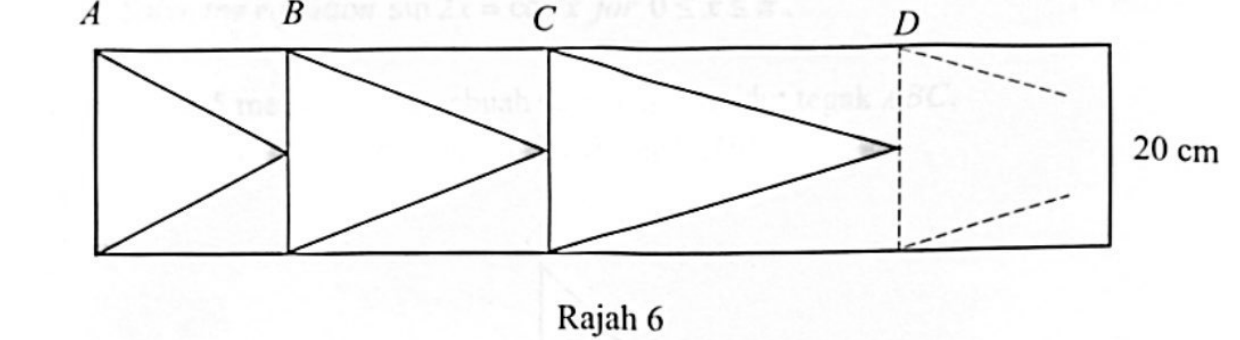
- (a)
Express the area of the second isosceles triangle in terms of p and k.
[1] - (b)
Find the value of p and of k.
[3] - (c)
Calculate the cost of the poster paint to colour the 30 triangles.
[4]
The first three terms of an arithmetic progression are 5, −3 and −11 with the first term, a and the common difference, d. (a) Show that Sn = 9n − 4n². (b) Hence, calculate the value of n if S3n + 765 = 0.
Easy5 marks- (a)
Show that Sn = 9n − 4n².
[2] - (b)
Hence, calculate the value of n if S3n + 765 = 0.
[3]
Solving by listing method is not accepted. Isyraf and Haqim are two contestants in a Bijak Matematik Competition. Both go through two rounds. Points: a correctly answered question gets 3 points; a question correctly answered, consecutively from the previous correctly answered question gets twice the points of the previous correctly answered question; a wrongly answered question gets 0; a question correctly answered if the previous question is wrongly answered gets 3 points. (a) In the first round, the contestants will answer 7 questions. Calculate (i) the points obtained by Isyraf for the last question, if he answered all the questions correctly, (ii) the total points obtained by Haqim, if only his answer to the sixth question is wrong. (b) In the second round, the first contestant to reach at least total point of 10 000 will be declared winner. If both contestants answered the second question wrongly, determine the minimum number of questions need to be answered by the contestant before being declared as the winner of the second round.
Medium8 marks- (a)(i)
Find the points for the last (7th) question if all answered correctly.
[2] - (a)(ii)
Find the total points of Haqim if only the sixth answer is wrong.
[3] - (b)
Find the minimum number of questions needed in the second round.
[3]
(a) Given a geometric progression with terms a, ar, ar², ar³, ..., arⁿ⁻², arⁿ⁻¹ and the sum of first n terms is Sₙ. Derive the formula for the sum of the first n terms, Sₙ for the geometric progression when |r| > 1. (b) Hence, find the value of n for which the sum of the first 2n terms is 28 times the sum of first n terms of a geometric progression which has a common ratio of 3.
Medium7 marks- (a)
Derive the formula for the sum of the first n terms, Sₙ, for the geometric progression when |r| > 1.
[3] - (b)
Hence, find n for which S₂ₙ = 28Sₙ for a geometric progression with common ratio 3.
[4]
An insurance company offers a saving plan where the customer only has to deposit saving for 10 years. The deposit saving for the 10 years formed an arithmetic progression. Given that the monthly deposit for the first three years are RM200, RM250 and RM300. Other information (Diagram 2): Enjoy the compound interest 10% per annum from 11th year onward. Quit within 10 years? Get back 5% interest on your total saving. (a) Kah Meng wishes to stop saving and withdraw all his saving after 6 years. How much money will Kah Meng get back from this insurance company? (b) Jessica has saved under this plan since 15 years ago, now she wishes to withdraw all her money. How much money in total that Jessica will get? What is the average annual interest rate that Jessica gets from this saving?
Medium7 marks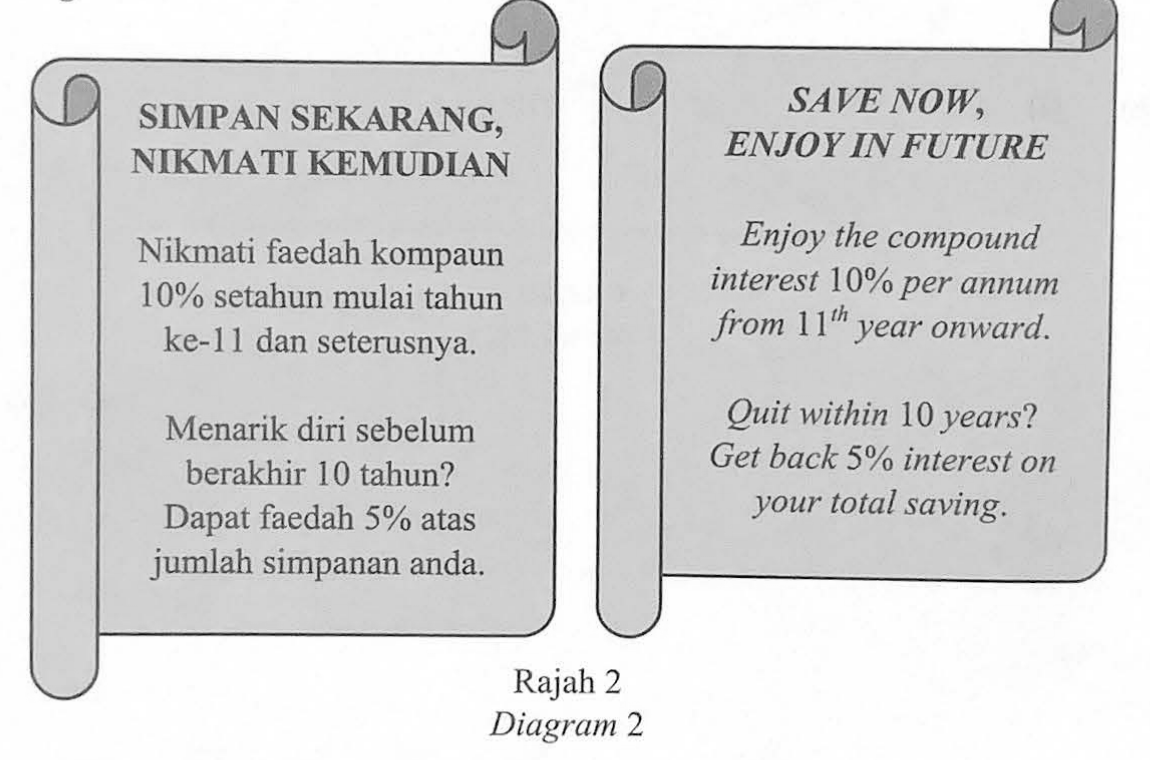
- (a)
How much money will Kah Meng get back after 6 years?
[3] - (b)
How much money in total will Jessica get? What is the average annual interest rate that Jessica gets from this saving?
[4]
(a) Diagram 6 shows a child playing on a swing. The swing is released from a position and it swings through a distance of 4 m in the first swing. On each successive swing, the distance is 4% less than the previous swing. The process continues until the swing stops. Find (i) the value of n where the nth swing that covers a distance of less than 300 cm for the first time, (ii) the total distance travelled, in cm, by the swing before it stops. (b) Khairunisa bought a set of conical shaped birthday party hat. A set of birthday party hat contains of 5 hats of different sizes. Khairunisa wants to decorate the hats by patching ribbons around the base of the hats. She has used 30π cm ribbons to decorate all the hats. The diameter of each of the hats increased by 2 cm consecutively. Calculate (i) the length, in term of π, of the ribbon to patch on the smallest hat, (ii) Khairunisa buys a few more hats to complete her set. If she used 18π cm ribbon to patch on the largest hat, how many additional hat bought by Khairunisa?
Medium10 marks- (a)(i)
Find the value of n where the nth swing covers a distance of less than 300 cm for the first time.
[3] - (a)(ii)
Find the total distance travelled, in cm, by the swing before it stops.
[2] - (b)(i)
Calculate the length, in term of π, of the ribbon to patch on the smallest hat.
[3] - (b)(ii)
If she used 18π cm ribbon to patch on the largest hat, how many additional hats did Khairunisa buy?
[2]
Since 5 years ago, Suhaila has saved RM15 000 in her savings account with an interest rate of 4.5% per annum. The savings receive compound interest every 6 months for each year. Calculate (a) the amount of savings of Suhaila until now if she has never made any additional savings or withdrawals, (b) the amount of compound interest earned by her.
Easy5 marks- (a)
Calculate the amount of savings of Suhaila until now if she has never made any additional savings or withdrawals.
[3] - (b)
Calculate the amount of compound interest earned by her.
[2]
(a) The second, third and sixth terms of an arithmetic progression are three consecutive terms of a geometric progression. Find the common ratio of the geometric progression. (b) Rylar wanted to save money to buy his best friend a gift worth RM925. Diagram 2 shows his savings for the first 3 days (notes of money: day 1, day 2, day 3). He continued his savings in the form of an arithmetic progression. Find the amount he saved on the last day when his total savings was enough to buy the gift.
Medium7 marks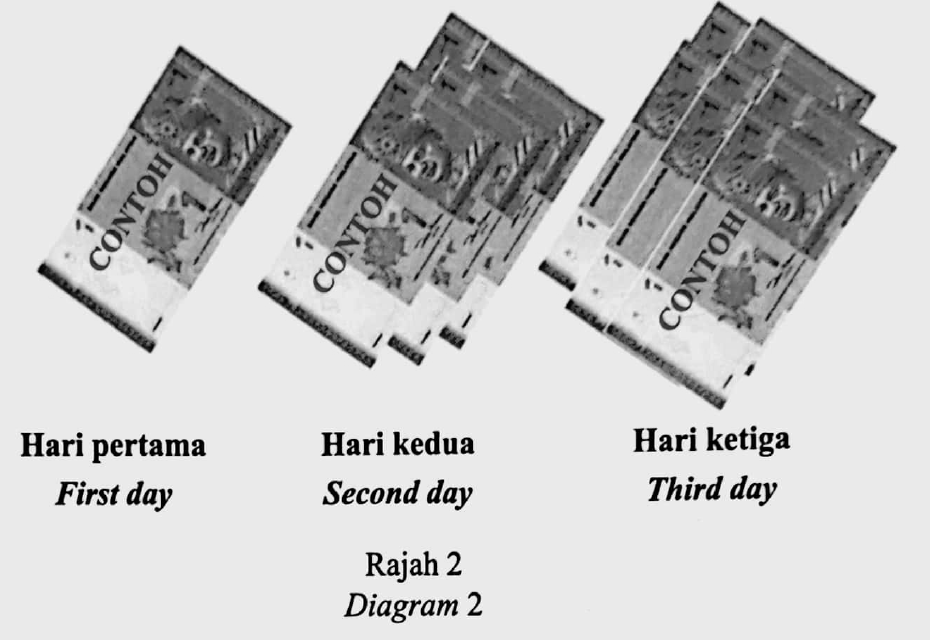
- (a)
Find the common ratio of the geometric progression.
[4] - (b)
Find the amount he saved on the last day when his total savings was enough to buy the gift.
[3]
Diagram 10 shows some round wooden blocks that can be purchased online, with estimated cost excluding postage RM4.00 to RM13.00 according to diameter. The diameters form a progression 6 cm, 12 cm, 18 cm, ... . (a) Determine whether the progression is arithmetic or geometric. (b) Derive the formula Tₙ by referring to the progression in (a). (c) Pak Abu wishes to purchase three consecutive sizes with a total diameter of 108 cm, starting price RM4.00 for diameter 6 cm and an increase of RM1.00 for each subsequent size. State the sizes he purchased and the price to be paid including postage RM4.90.
Medium8 marks- (a)
Determine whether the progression 6, 12, 18, ... is an arithmetic or geometric progression.
[1] - (b)
Derive the formula Tₙ by referring to the progression in 10(a).
[3] - (c)
State the sizes of the three consecutive wooden blocks (total diameter 108 cm) and the price to be paid including postage RM4.90.
[4]
Lee has saved some money in n months. His savings increased and formed a geometric progression. It is given that the savings in the fifth month are 4 times the savings in the third month. (a) Calculate the common ratio. (b) If the total of his savings is RM1 533 and the beginning of his savings is RM3, calculate (i) the value of n, (ii) his last savings.
Medium7 marks- (a)
Calculate the common ratio.
[2] - (b)(i)
If the total savings is RM1 533 and the first saving is RM3, calculate the value of n.
[3] - (b)(ii)
Calculate his last savings.
[2]
(a) Determine whether the sequence p⁸, p¹², p¹⁶, p²⁰ is a geometric progression or not. Give your justification. (b) If a is the first term and r is the common ratio of a geometric progression, show that the sum of the first n terms is Sn = a(rⁿ − 1)/(r − 1).
Medium5 marks- (a)
Determine whether p⁸, p¹², p¹⁶, p²⁰ is a geometric progression or not. Give your justification.
[2] - (b)
If a is the first term and r is the common ratio of a geometric progression, show that the sum of the first n terms is Sn = a(rⁿ − 1)/(r − 1).
[3]
(a) A geometric progression has terms a, ar, ar², ar³, ..., ar^(n−2), ar^(n−1) and the sum of the first n terms is Sₙ. Derive the formula for the sum of the first n terms, Sₙ, for the geometric progression when |r| < 1. (b) Hence, find the value of n for which the sum of the first 2n terms is 127/128 times of the sum of first n terms of a geometric progression which has a common ratio of −1/2.
Medium7 marks- (a)
Derive the formula for the sum of the first n terms, Sₙ, for the geometric progression when |r| < 1.
[3] - (b)
Hence, find the value of n for which the sum of the first 2n terms is 127/128 times of the sum of first n terms of a geometric progression which has a common ratio of −1/2.
[4]
An insurance company offers a savings plan with customers only making savings for the first 10 years. The savings for the 10 years formed an arithmetic progression. Given that the monthly savings for the first three years are RM500, RM550 and RM600. Other information about the savings plan are given in Diagram 3: 'Save now, enjoy in the future. Enjoy a compound interest of 15% per annum from the 11th year onwards. Withdraw before the end of 10 years? Get back 5% interest on your total savings.' (a) Before enough of 10 years, Diana wants to withdraw all her savings and interest amounting to RM79 380. In which year does Diana withdraw her money? (b) Jeremy has saved under this savings plan for 18 years, now he wants to withdraw all his money. How much money in total will Jeremy get? What is the average annual interest rate that Jeremy gets from this savings?
Medium7 marks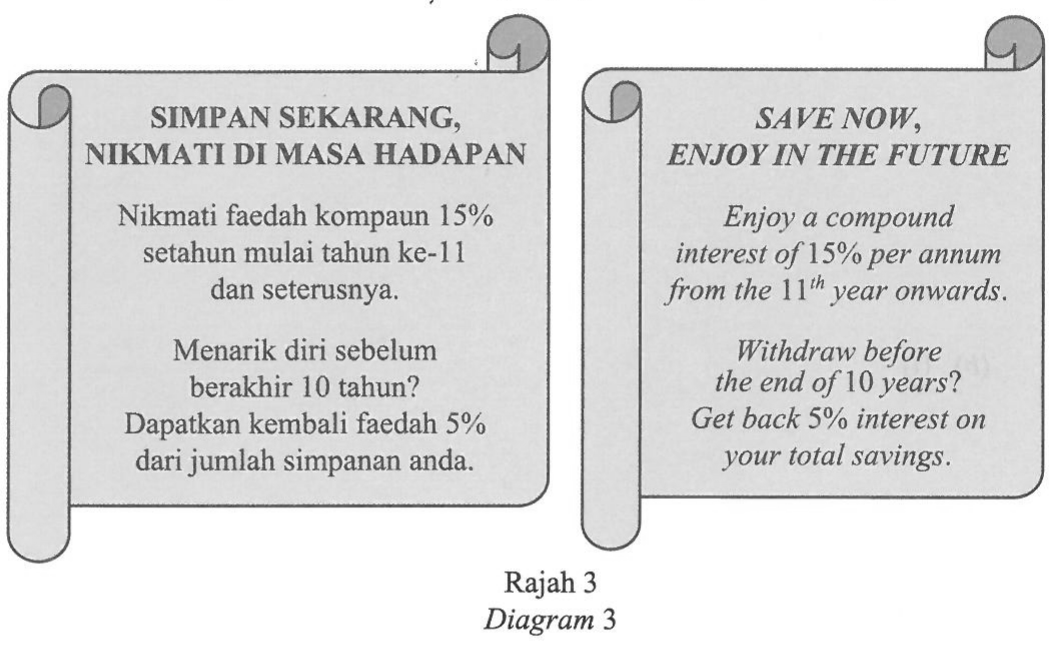
- (a)
In which year does Diana withdraw her money?
[3] - (b)
How much money in total will Jeremy get? What is the average annual interest rate that Jeremy gets from this savings?
[4]
(a) Amir drops a ping-pong ball at the height of 148 cm from the floor surface. After each bounce, the ping-pong ball reaches a height of 3/4 from its previous height as shown in Diagram 7. The ping-pong ball continues bouncing until it stops. Find (i) the number of bounces when the height of the ping-pong ball is less than 20 cm for the first time. (ii) the total distance, in cm, travelled by the ping-pong ball until it stops. (b) A private company managed to make a profit of 1.5 million in the year 2015. In each subsequent year, the company's profit increased by 4%. (i) Find the total profits of the company from the year 2016 to 2020. (ii) If 19% of the company's profit from the year 2018 to 2020 was gained from the investment sources, calculate the total profit of the company gained from the investment.
Medium10 marks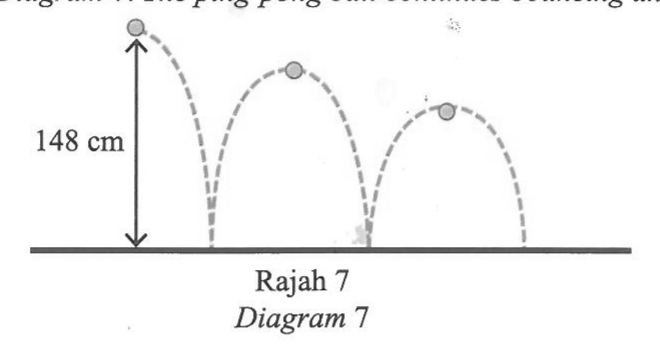
- (a)
(i) the number of bounces when the height of the ping-pong ball is less than 20 cm for the first time. (ii) the total distance, in cm, travelled by the ping-pong ball until it stops.
[5] - (b)
(i) Find the total profits of the company from the year 2016 to 2020. (ii) If 19% of the company's profit from the year 2018 to 2020 was gained from the investment sources, calculate the total profit of the company gained from the investment.
[5]
Aiman collects Lego every month. The number of Lego collections he collects increases every month according to a geometric progression. His total Lego collection in the first four months was ten times his total Lego collection in the first two months. If r represents the common ratio, show that r⁴ − 10r² + 9 = 0. Next, find the positive value of r.
Easy5 marksShow that r⁴ − 10r² + 9 = 0. Next, find the positive value of r.
[5]
(a) The third, sixth and twelfth terms of an arithmetic progression are consecutive terms of a geometric progression. Find the common ratio of the geometric progression. (b) Diagram 2 shows the stock of acorns of a squirrel for the first 3 days (day 1: 5 pictures, day 2: 10 pictures, day 3: 15 pictures; each picture = 5 acorns). A squirrel wanted to store more than 1 000 acorns as its food for the winter. It continued its stock in the form of an arithmetic progression. Find the total number of acorns it had in its stock on the last day when the number was sufficient.
Medium7 marks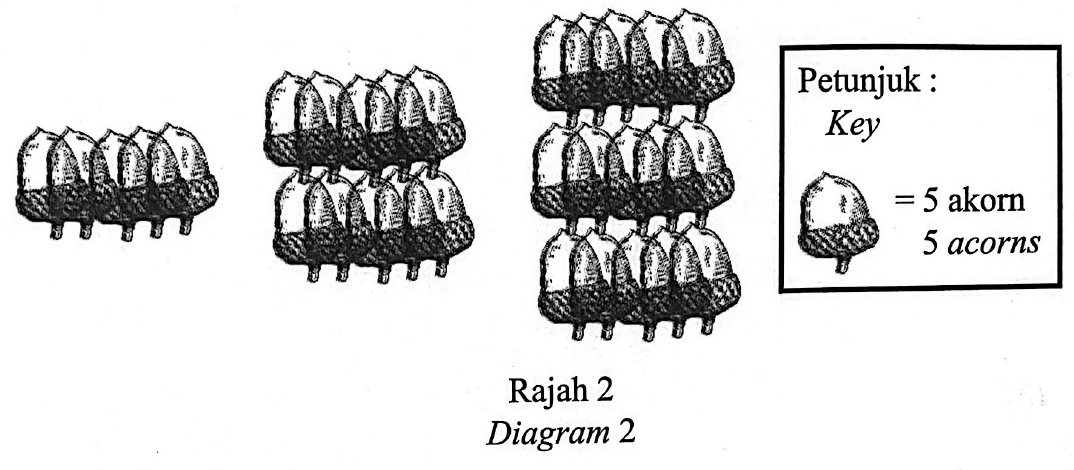
- (a)
The third, sixth and twelfth terms of an arithmetic progression are consecutive terms of a geometric progression. Find the common ratio of the geometric progression.
[4] - (b)
Find the total number of acorns in its stock on the last day when the number was sufficient (more than 1 000).
[3]
A coil of wire with the length of p cm is cut into 32 parts such that their lengths form an arithmetic progression. It is given that the length of the longest part is 105 cm and the sum of the lengths of the three shortest parts is 45 cm.
Medium6 marks- (a)
Find the length, in cm, of the shortest part.
[4] - (b)
Hence, calculate the value of p.
[2]
The first four terms of a geometric progression are 27, 18, 12 and 8 with the first term, a, and the common ratio, r. By using the given geometric progression, (a) derive a formula of the nth term, (b) find the sum to infinity of the progression.
Medium6 marks- (a)
Derive a formula of the nth term.
[4] - (b)
Find the sum to infinity of the progression.
[2]
(a) Determine whether the sequence 6π, 9π, 12π, 15π, .... is a geometric progression or not. Give your justification. (b) If a is the first term and r is the common ratio of a geometric progression, show that the sum of the first n terms is Sₙ = a(rⁿ − 1)/(r − 1).
Easy5 marks- (a)
Determine whether the sequence 6π, 9π, 12π, 15π, .... is a geometric progression or not. Give your justification.
[2] - (b)
If a is the first term and r is the common ratio of a geometric progression, show that the sum of the first n terms is Sₙ = a(rⁿ − 1)/(r − 1).
[3]
Jaslene deposited RM5 000 into a bank on 1 January 2014. The bank will pay 3.5% of annual interest to the deposit. Jaslene did not make any deposit and withdrawal after the initial deposit. Calculate (a) the total deposit in her account on 1 January 2023, (b) the minimum value of n such that the total deposit in her account in the nth year will exceed RM7 000.
Easy5 marks- (a)
The total deposit in her account on 1 January 2023.
[2] - (b)
The minimum value of n such that the total deposit in her account in the nth year will exceed RM7 000.
[3]
(a) The second, fourth and eleventh terms of an arithmetic progression are three consecutive terms of a geometric progression. Find the common ratio of the geometric progression. (b) Josey invites 55 friends to her house on her birthday. She wants to give each of her friends a present. Diagram 2 shows her purchase for the first 3 days (3, 7 and 11 presents on the first, second and third day). She continued buying in the form of an arithmetic progression. Find the number of presents that were bought on the last day when she had bought enough presents for all her friends.
Medium7 marks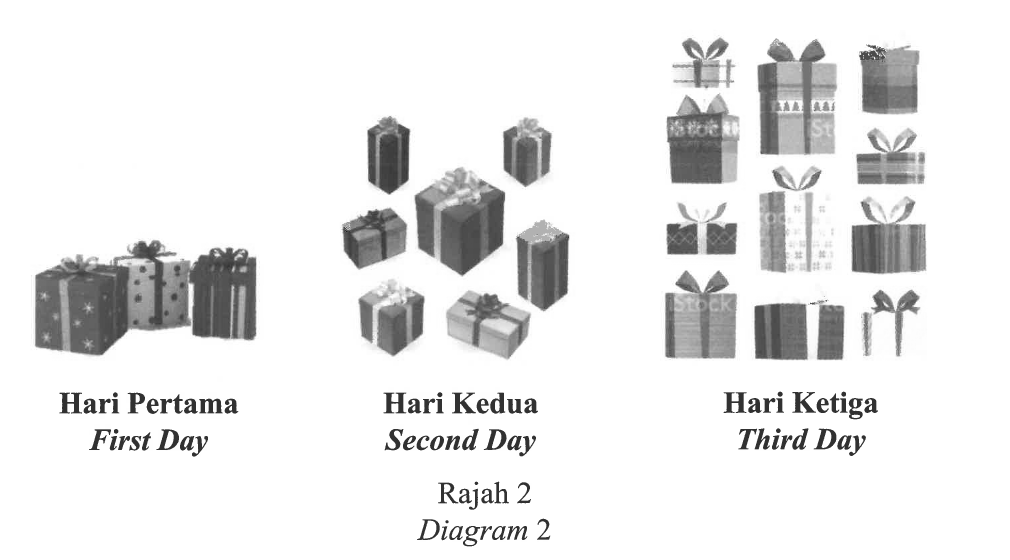
- (a)
The second, fourth and eleventh terms of an arithmetic progression are three consecutive terms of a geometric progression. Find the common ratio of the geometric progression.
[4] - (b)
Josey bought presents in an arithmetic progression (3, 7, 11, … on the first three days, Diagram 2). Find the number of presents bought on the last day when she had bought enough presents for all 55 friends.
[3]
Given a is the first term and d is the common difference of an arithmetic progression.
Medium5 marks- (a)
Show that the n-th term of the progression is Tₙ = a + (n − 1)d.
[3] - (b)
Hence, find the sum of the first 5 terms in terms of a and d.
[2]
A geometric progression has first term log₂ 36 and common ratio log₂ y.
Medium7 marks- (a)(i)
Find the range of y for which the geometric progression has a sum to infinity.
[2] - (a)(ii)
Find the value of y such that the sum to infinity of the geometric progression is 2.
[3] - (b)(i)
It is given that the nth term of a geometric progression is Tₙ = 8rⁿ⁻¹/5, r ≠ m. State the values of m.
[1] - (b)(ii)
State the first term of the progression.
[1]
(a) Given the sequence 27p^(1/2)q, 9p^(3/2)q, 3p^(5/2)q, … Is this sequence a progression? Explain. (b) Ahmad works with Company A for 320 days in a year, starting with a salary of RM2 on the first day, RM4 on the second day, RM6 on the third day, and so on. Company B offers a salary of RM2000 in the first month and a monthly salary increase of RM900.
Medium7 marks- (a)
Is this sequence a progression? Explain your answer.
[2]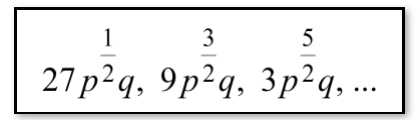
- (b)(i)
What is the total salary Ahmad receives after completing his service with Company A?
[2] - (b)(ii)
Company B offers RM2000 in the first month and a monthly increase of RM900. Calculate the total salary for one year.
[2] - (b)(iii)
Which company should Ahmad choose? Provide your justification.
[1]
Encik Amin starts saving RM 6 000 in his child's bank account as a gift for his child's first birthday. The bank offers an interest rate of 5% per year. Encik Amin hopes that the savings will reach RM 15 000 when the child turns 18.
Medium9 marks- (a)
Assuming Encik Amin adds nothing to the account, show that the situation is a geometric progression.
[3] - (b)
Can savings of RM 15 000 be achieved when the child is 18? Show your calculation.
[2] - (c)
If after 10 years the interest rate increases to 7% per year, calculate the savings when the child is 18. Will the savings reach RM 15 000?
[4]
(a) The second term of an arithmetic progression is 12 and the tenth term is 52. Find (i) the common difference, (ii) the first term. (b) m + 2, 2m + 4 and 5m + 4 are three consecutive terms of a geometric progression. Find the possible values of m.
Medium6 marks- (a)
The second term of an arithmetic progression is 12 and the tenth term is 52. Find (i) the common difference of the progression, (ii) the first term of the progression.
[3] - (b)
It is given that m + 2, 2m + 4 and 5m + 4 are three consecutive terms of a geometric progression. Find the possible values of m.
[3]
Diagram 1 shows two salary schemes by Rahmat Company. Salim chose scheme A, Sally chose scheme B. Both started with a salary of RM2000. Scheme A: salary increment of RM200 per year. Scheme B: 5% annual salary increase. (a) Which scheme is a geometric progression? Justify your answer. (b) Both save 15% of their salary when it reaches RM3000. Who will have the most total savings for the first 20 years of work?
Medium9 marks- (a)
Which scheme is a geometric progression? Justify your answer.
[2] - (b)
Both save 15% of their salary when it reaches RM3000. Who will have the most total amount of savings for the first 20 years of work?
[7]
Diagram 5 shows two salary schemes offered by Rahmat Company. Scheme A: salary increment of RM 200 per year. Scheme B: 5% annual salary increase. Salim chose scheme A while Sally chose scheme B. Both started working in January 2021 with the same starting salary of RM 2000 per month. Both save 15% of their salary when it reaches RM 3000. Who has more savings during the first 20 years of work?
Medium7 marksWho has more savings during the first 20 years of work?
[7]
(a) Given that the second term of an arithmetic progression is 12 and the tenth term is 52, find (i) the common difference; (ii) the first term. (b) It is given that m + 2, 2m + 4 and 5m + 4 are three consecutive terms of a geometric progression. Find the possible values of m.
Easy7 marks- (a)(i)
Find the common difference.
[2] - (a)(ii)
Find the first term.
[1] - (b)
Find the possible values of m.
[4]
Given ……. x, x – 3, x – 6, ….. are three consecutive terms of an arithmetic progression.
Easy5 marks- (a)
Find the common difference.
[1] - (b)
Hence, if x is the 15th term and the sum of the first 20 terms is y, express x in terms of y.
[4]
After Ahmad registered on Instagram, he had 7 followers. The next day, another 15 people followed him. Table 11 shows the number of Ahmad's followers, m, on day t: t = 1, 2, 3, 4 gives m = 7, 15, 23, 31.
Easy5 marks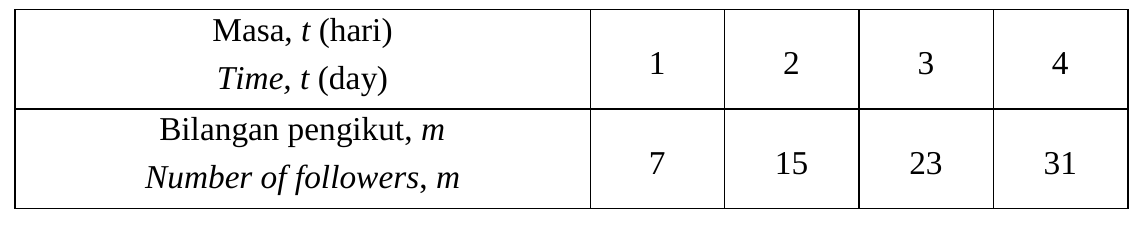
- (a)
Using function notation, express m in terms of t.
[1] - (b)
Calculate the number of Ahmad's followers on the 9th day.
[2] - (c)
Which day will Ahmad's followers be expected to be at least 239?
[2]
Given two geometric progressions, X and Y, with common ratio 1/2 and 1/3 respectively. The sums to infinity of both progressions are the same. If the fourth term of progression X exceeds the fourth term of progression Y by 49/36, find the difference of the first terms of the two progressions.
Medium7 marksFind the difference of the first terms of the two progressions.
[7]
Diagram 8 shows three of the circles formed by using a wire of length mπ cm. The radius of the first circle is r cm and the radius of each subsequent circle increases by 1 cm.
Medium8 marks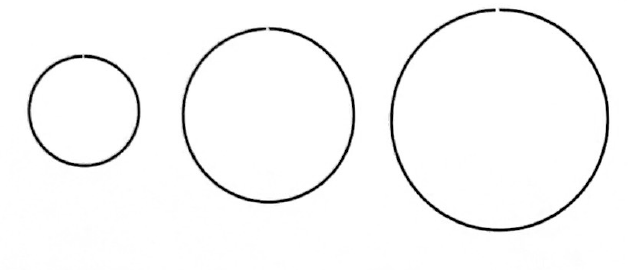
- (a)(i)
Show that the circumferences of the circles form an arithmetic progression.
[3] - (a)(ii)
If only 10 circles can be formed using the wire, state the value of m in terms of r.
[2] - (b)
Find the number of terms in the geometric progression 32, 16, 8, …, 1/2⁸.
[3]
The sum of the first three terms of a geometric progression is 8 times the sum of the next three terms.
Medium7 marks- (a)
Find the common ratio of the progression.
[3] - (b)(i)
Given the sum of the first three terms exceeds the sum of the next three terms by 98. Based on the answer in 5(a), find the first term of the progression.
[2] - (b)(ii)
Find the sum to infinity of the progression.
[2]
A geometric progression is such that the 5th term is 9 times the 3rd term. Show that the sum of the first 6 terms is 28 times the sum of the first 3 terms such that r > 0.
Easy4 marksShow that S₆ = 28 S₃ given T₅ = 9 T₃ and r > 0.
[4]
Diagram 2(a) shows a roll of wire and diagram 2(b) shows a cube. A roll of wire is cut into 30 sections with lengths forming an arithmetic progression. It is given that the sum of the lengths of the three shortest sections is 180 cm and the length of the longest section is 396 cm. Lutfi is assigned to cut the wire started with the shortest section.
Medium10 marks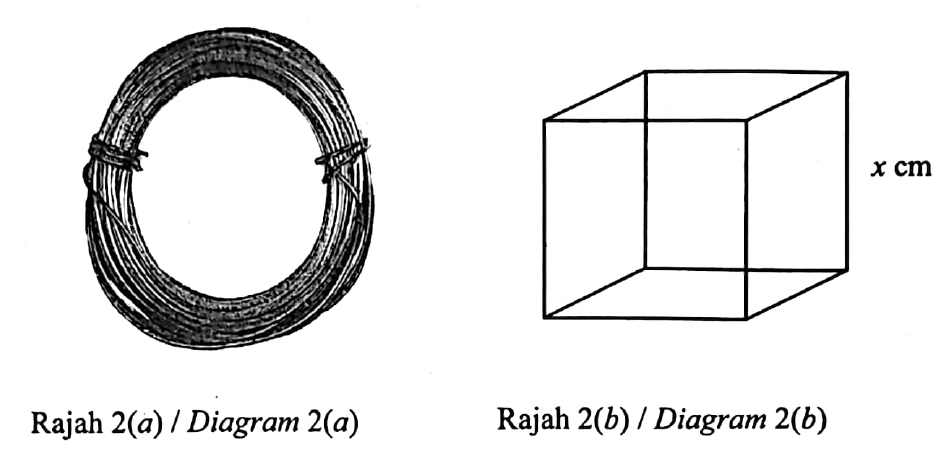
- (a)
Find the length of the wire.
[5] - (b)
Lutfi has completed 2/3 of his task. Calculate the total length, in cm, of the remaining uncut wire.
[2] - (c)
If the second longest section of the wire is bent to form the cube, find the value of x.
[3]
Azman has a collection of books that he accumulates every month. The number of books increases every month following an arithmetic progression. The total number of books in the first six months is four times the number of books in the fifth month. (a) If d is the common difference, show that d = 2a, where a is the number of books in the first month. Then find d if the number of books in the first month is 3. (b) He decides to sell part of his book collection in the 10th month to buy a bicycle that costs RM1200. If he sells 30% of the total number of books accumulated in 10 months, with an average price of RM12.50 per book, can he buy the bicycle? Provide your justification.
Medium6 marks- (a)
Show that d = 2a. Then find d if a = 3.
[3] - (b)
Can he buy the bicycle costing RM1200? Provide your justification.
[3]
(a) 0.123123123… can be written in the form h/333. Using the sum to infinity, calculate the value of h. (b) Diagram 2 shows the spiral pattern of a snail's shell. The arc length of each semicircle follows a geometric progression, with the diameter of the smallest semicircle being 6 mm and each subsequent diameter increasing by 50%.
Medium8 marks
- (a)
0.123123123… can be written in the form h/333. Using the sum to infinity, calculate the value of h.
[3] - (b)(i)
Form the first three terms of the arc length of the semicircle in terms of π.
[1] - (b)(ii)
Calculate the diameter of the 5th semicircle.
[2] - (b)(iii)
Given that the sum of the arc lengths of the first n semicircles is 62.34375π mm, find the value of n.
[2]
Damia Furniture Company sold 30 000 dining table sets in 2019. Each year, sales increase by 2.5%. (a) Find the total number of dining table sets sold from 2019 to 2025. (b) If 24% of the sets sold from 2021 to 2025 are round and 15% are square, calculate the sum of round and square dining table sets.
Medium7 marks- (a)
Find the total number of dining table sets sold from 2019 to 2025.
[3] - (b)
If 24% of the sets sold from 2021 to 2025 are round and 15% are square, calculate the sum of round and square sets.
[4]
Listing out all terms of the sequence is not accepted. Diagram 1 shows a roll of wallpaper and Diagram 2 shows a cube. The wallpaper is divided into 20 pieces with their lengths forming an arithmetic progression. Given that the sum of length of the three shortest pieces is 96 cm and the length of the longest piece is 284 cm (the roll is 50 cm wide; the cube has edge x cm). (a) Find the length of a roll of wallpaper. (b) If the fourth piece of wallpaper is used to wrap the cube in Diagram 2, find the range of values of x.
Medium9 marks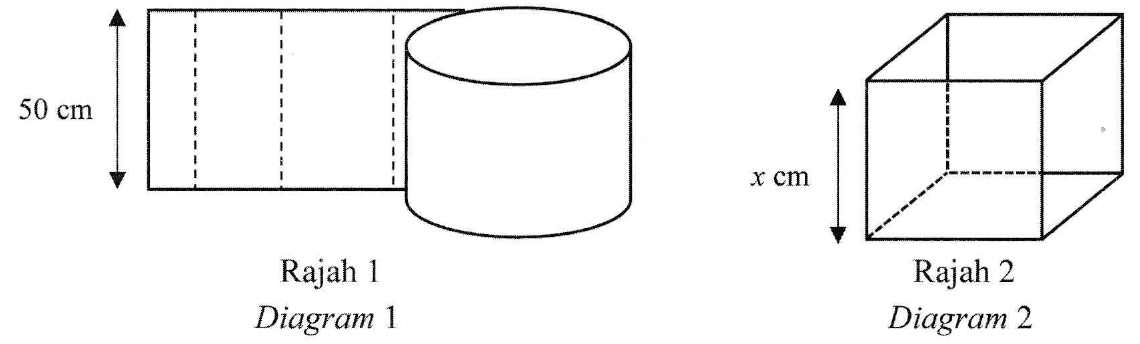
- (a)
Find the length of a roll of wallpaper.
[6] - (b)
If the fourth piece is used to wrap the cube in Diagram 2, find the range of values of x.
[3]