JOHOR 2021 P1 Q9
EasyWrite your answer on paper. Then open the answer to check it.
(a) The length of vector k is 5 units and its direction is opposite to the vector (1, −2) [column vector]. Find vector k. (b) Ship X left port O with velocity vₓ = 6i + 8j km h⁻¹. At the same time ship Y left port P with velocity v_y = −4i + 4j km h⁻¹. The position vector of port P is OP→ = 25i + 10j. (i) After t hours the position vector of ship X is t(6i + 8j). Find the position vector of ship Y at that time. (ii) Hence find the time when ship X collides with ship Y.
Easy6 marks- (a)
Find vector k.
[2] - (b)(i)
Position vector of ship Y after t hours.
[2] - (b)(ii)
Find the time when X collides with Y.
[2]
The diagram shows the plan view of Mr John's house O and five buildings A, B, C, D and E on the same plane. Building D is 600 m from O and building E is 900 m from O in the direction OD. Building A is 450 m from O and building B is 900 m from A in the direction OA. Buildings D, C and B are in a straight line such that the distance from B to C is five times the distance from C to D. (a) Using u to represent 100 m in the direction OE and v to represent 150 m in the direction OB, express in terms of u and v: (i) DB→, (ii) OC→, (iii) EC→. (b) The government plans to build a straight LRT passing through building E to building A. Determine whether this LRT will pass through building C. Prove your answer mathematically.
Medium10 marks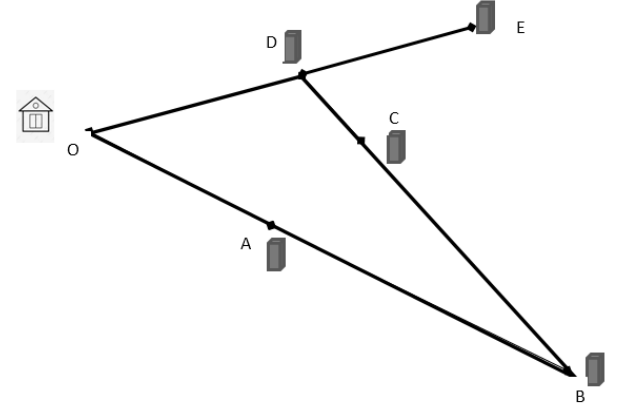
- (a)(i)
Express DB→ in terms of u and v.
[2] - (a)(ii)
Express OC→ in terms of u and v.
[2] - (a)(iii)
Express EC→ in terms of u and v.
[2] - (b)
Determine whether the LRT from E to A passes through C.
[4]
(a) A fish swims at a velocity v = 20i + 14j. A stream flows at a velocity a = 7i − 21j. Find the magnitude and direction of the resultant velocity of the fish. (b) Given u = ai + bj and v = i − 4j. If |u − 2v| = √(a² + b²), express a in terms of b.
Medium8 marks- (a)
Find the magnitude and direction of the resultant velocity of the fish.
[5] - (b)
Express a in terms of b.
[3]
Diagram 9 shows a quadrilateral ABCD. The diagonals BD and AC intersect at F. Point E lies on AD. It is given that AE→ = (1/5)AD→, BF→ = (1/5)BD→, AB→ = **x** and AE→ = **y**. (a) Express in terms of **x** and **y**: (i) DB→, (ii) AF→. (b) Given DC→ = m**x** − **y** and AF→ = nAC→, where m and n are constants, find the value of m and of n.
Medium10 marks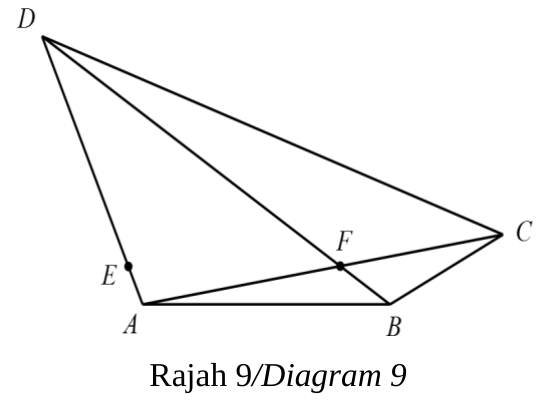
- (a)(i)
Express DB→ in terms of x and y.
[2] - (a)(ii)
Express AF→ in terms of x and y.
[3] - (b)
Find the value of m and of n.
[5]
In the Cartesian plane, an object is moving with a constant velocity v = 3i + 4j units per second. (a) Find the object's speed and the unit vector in the direction of the object's velocity. (b) If the object starts at the position A(2, −1), find the position vector of the object after 5 seconds. When will the object be to the right of the origin O?
Medium7 marks- (a)
Find the object's speed and the unit vector in the direction of the velocity.
[3] - (b)
Find the position vector of the object after 5 seconds. When will the object be to the right of the origin O?
[4]
Diagram 1 shows a triangle ABC. Point E is the midpoint of BC and point D lies on AB such that AD : DB = 1 : 2 and N is the intersection point of AE and CD. It is given that AB→ = 14x and AC→ = 8y. (a) Express in terms of x and y, (i) AE→, (ii) CD→. (b) Given that AN→ = hAE→ and CN→ = kCD→, express AN→ in terms of (i) h, x and/or y, (ii) k, x and/or y. (c) Hence, find the value of h and of k.
Hard9 marks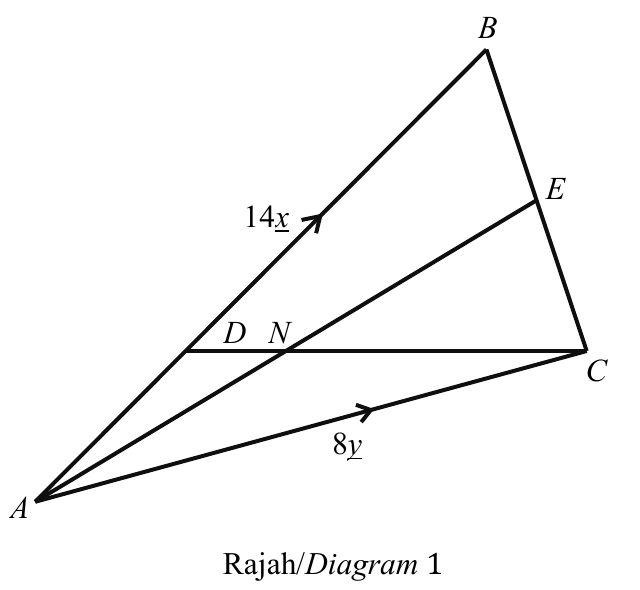
- (a)(i)
Express AE→ in terms of x and y.
[1] - (a)(ii)
Express CD→ in terms of x and y.
[2] - (b)(i)
Express AN→ in terms of h, x and y.
[1] - (b)(ii)
Express AN→ in terms of k, x and y.
[1] - (c)
Hence, find the value of h and of k.
[4]
In Diagram 9, ABCD is a quadrilateral and M is the midpoint of the diagonal BD. It is given AB→ = u + 6v, AD→ = 7u − 2v and DC→ = 3kv − u, where k is a constant. (a) Express in terms of u and v: (i) BM→, (ii) AM→. (b) Find AC→ in terms of k, u and v. Hence, find the value of k if A, M and C are collinear.
Medium6 marks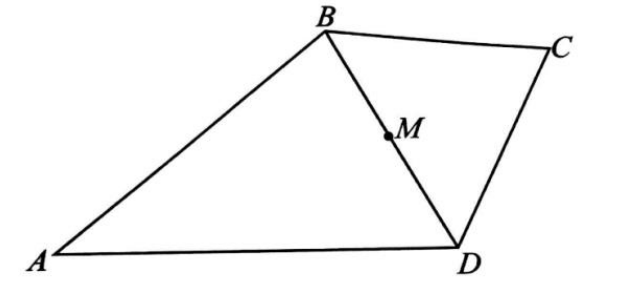
- (a)(i)
Express BM→ in terms of u and v.
[2] - (a)(ii)
Express AM→ in terms of u and v.
[1] - (b)
Find AC→ in terms of k, u and v. Hence, find the value of k if A, M and C are collinear.
[3]
Diagram 11 shows triangles OAQ and OPB where point P lies on OA and point Q lies on OB. The straight lines AQ and PB intersect at point R. It is given that OA→ = 18x, OB→ = 16y, OP : PA = 1 : 2, OQ : QB = 3 : 1, PR→ = m PB→ and QR→ = n QA→, where m and n are constants. (a) Express OR→ in terms of (i) m, x, y (ii) n, x, y. (b) Hence, find the value of m and the value of n. (c) Given |x| = 2 units and |y| = 1 unit and OA is perpendicular to OB, calculate |PR→|.
Medium10 marks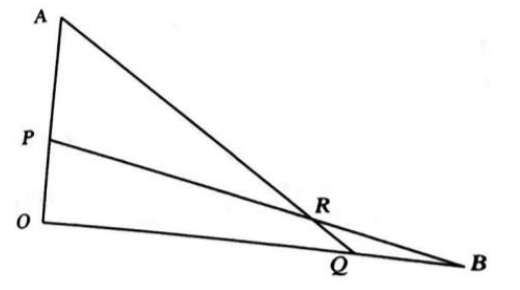
- (a)
Express OR→ in terms of (i) m, x, y and (ii) n, x, y.
[4] - (b)
Find the values of m and n.
[4] - (c)
Calculate |PR→|.
[2]
A car moves from point P(7, 24) with velocity vector v = 8i − 4j km s⁻¹. After t seconds, the car is at point Q where OQ→ = OP→ + tv.
Medium7 marks- (a)
Find the unit vector in the direction of PO→.
[2] - (b)
Find the speed and the position of the car after 10 seconds.
[3] - (c)
When will the car be at the east side of the origin? [Assume north is the y-axis.]
[2]
Diagram 1 shows two triangles, ABC and ABD. It is given that 3AC→ = 2BD→, AB→ = 16x and AC→ = 12y. (a) Express in terms of x and y (i) AD→, (ii) BC→. (b) Given that AE→ = h AD→ and BE→ = k BC→, where h and k are constants, find the values of h and k.
Medium9 marks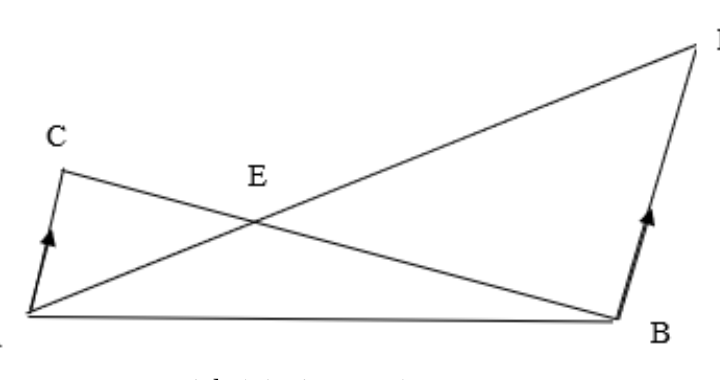
- (a)
Express AD→ and BC→ in terms of x and y.
[3] - (b)
Find the values of h and k.
[6]
Ship A leaves harbour P with a velocity of v_A = (3**i** + **j**) km h⁻¹ at the same time as ship B leaves harbour Q with a velocity of v_B = (−2**i** + 3**j**) km h⁻¹. The position vector of harbour Q from O is OQ→ = (10**i** + 4**j**) km. (a) Determine the speed of ship A. (b) Find the velocity of ships A and B after t hours, in terms of t. (c) Did the two ships meet? State your reasons.
Medium8 marks- (a)
Determine the speed of ship A.
[1] - (b)
Find the velocity of ships A and B after t hours, in terms of t.
[2] - (c)
Did the two ships meet? State your reasons.
[5]
Diagram 9 shows a triangle OPQ. E is a point on PQ where PE : EQ = 1 : 2 and F is the midpoint of OQ. The line OE intersects PF at G. Given OP→ = 3x and OQ→ = 6y.
Medium10 marks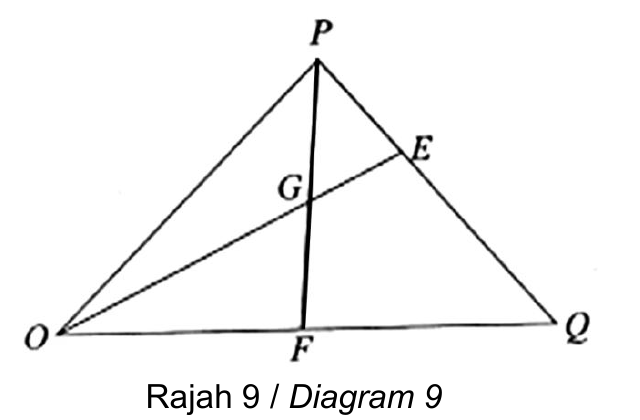
- (a)
Express in terms of x and/or y: (i) OF→, (ii) OE→.
[3] - (b)
It is given PG→ = hPF→ and OG→ = kOE→, where h and k are constants. (i) Express OG→ in terms of h, x and/or y. (ii) Express OG→ in terms of k, x and/or y. Hence, find the values of k and h.
[4] - (c)
Find the area of triangle POF.
[3]
Particle A moves from point P(−4, 5) with a constant velocity of (2**i** − **j**) m s⁻¹, while particle B moves from point Q(−8, 9) with a constant velocity of (3**i** − 2**j**) m s⁻¹. (a) Find the unit vector in the direction of PQ→. (b) Find the time t, in seconds, when particles A and B meet. (c) Find the meeting point of particles A and B.
Medium7 marks- (a)
Find the unit vector in the direction of PQ→.
[2] - (b)
Find the time t, in seconds, when particles A and B meet.
[3] - (c)
Find the meeting point of particles A and B.
[2]
Diagram 3 shows triangles AOX and AOY. It is given that OA→ = **a** and OY→ = **b**. Point M lies on AY such that AM = (2/5)AY. (a) Express in terms of **a** and/or **b**: (i) AY→, (ii) OM→. (b) AY and OX intersect at M. It is given that OX→ = k OM→ and AX→ = h OY→. Express (i) OX→ in terms of k, **a** and/or **b**, (ii) AX→ in terms of h, **a** and/or **b**. Hence, find the values of h and k.
Medium9 marks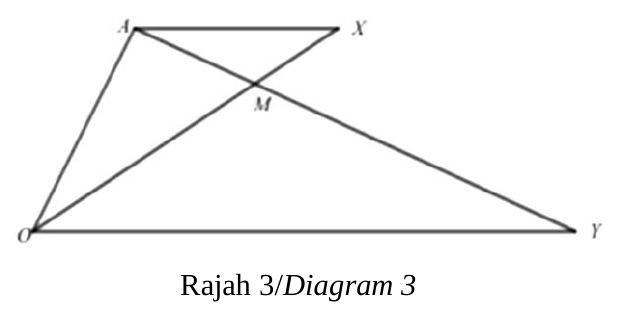
- (a)
Express (i) AY→ and (ii) OM→ in terms of **a** and/or **b**.
[3] - (b)
Express (i) OX→ in terms of k, **a**, **b** and (ii) AX→ in terms of h, **a**, **b**. Hence find h and k.
[6]
Diagram 8 shows the movement of Afiqah and Imran drawn on the Cartesian plane. A(2, 6), B(10, 8), C(8, 2); P is the intersection of AC and OQ; Q is on BC.
Medium6 marks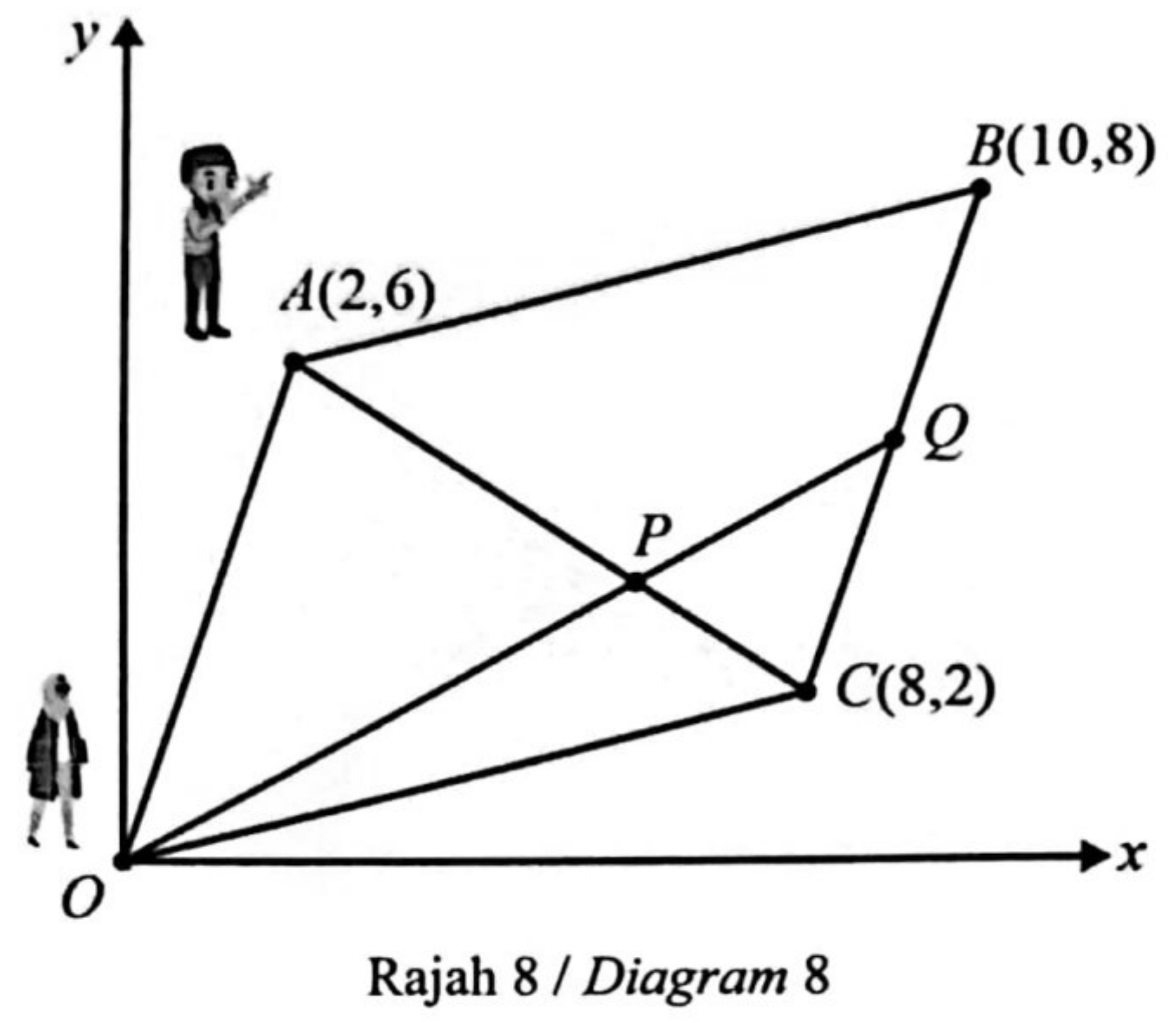
- (a)(i)
Afiqah moves from O to Q passing through A and B where point Q is the midpoint of BC. State the magnitude of displacement of Afiqah.
[2] - (a)(ii)
Imran moves from point A to point C. Using the law of triangles, express Imran's movement in column vector form.
[2] - (b)
If AP→ = (2/3) AC→. Find the unit vector in the direction of AP→.
[2]
Diagram 5 shows the position of teacher's desk, G and the student's desks A, B, C, D, E in the 5 STEM class. The desks of students A and B are at a distance of 4 m and 8 m respectively from the teacher's desk, G in the direction of GB→. The desks of students C and D are at a distance of 4 m and 6 m respectively from the teacher's desk, G in the direction of GD→. Given GE : GF = 2 : 3 and BF = FD.
Medium7 marks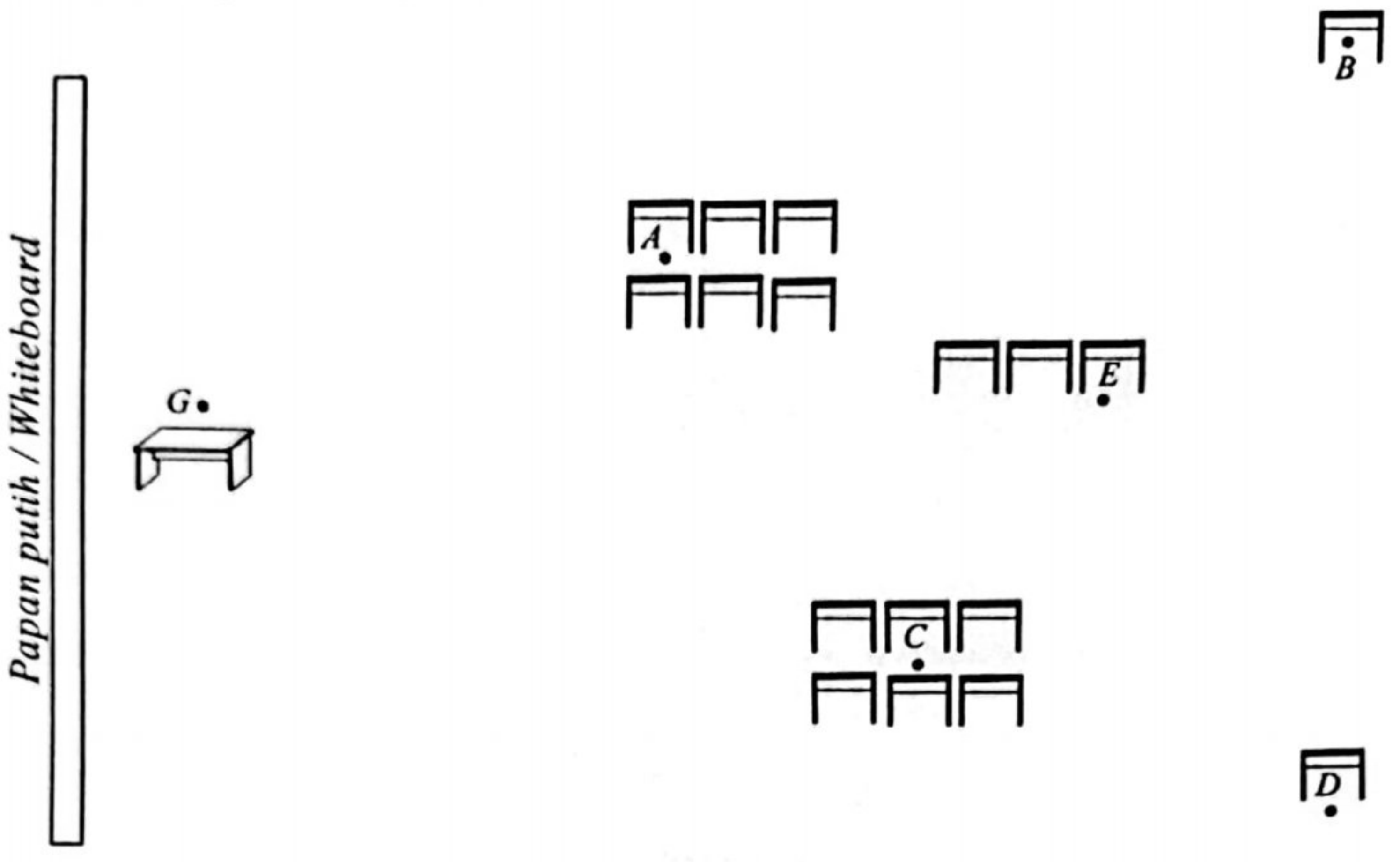
- (a)(i)
Using a to represent 1 m in the GB→ direction and b to represent 2 m in the GD→ direction, express in terms of a and b: BD→.
[2] - (a)(ii)
Express in terms of a and b: EF→.
[2] - (b)
Given the straight line AE is parallel to the straight line GC. The distance between desk A and E is 2 m. Find the area of triangle ABE if the area of triangle GBC is 25 m².
[3]
Diagram 6 shows the positions of Ali's house A(−6, 2), the bank B(6, 2), the school C(2, −6), the post office D(−2, −6) and a petrol station E on a Cartesian plane. (a) Ali moves from home to school but all roads towards the post office are closed. (i) Using the triangle law, express Ali's movement as a column vector. (ii) Hence find the unit vector of Ali's movement from home to school. (b) A petrol station is to be built at (k, 6), k a constant. Given C, B and E are collinear, use vector operations to find k.
Medium7 marks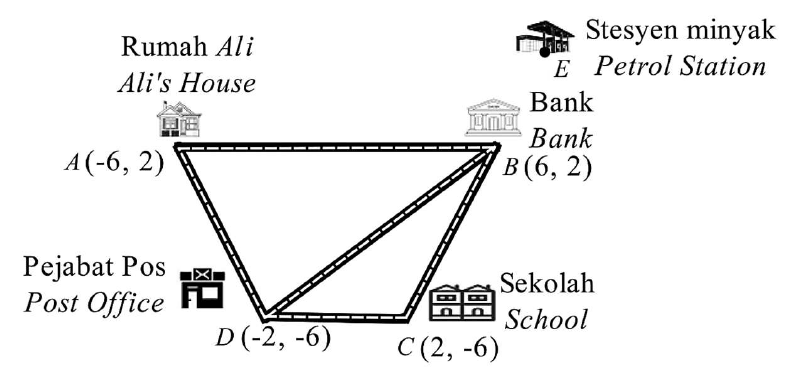
- (a)(i)
Using the triangle law, express Ali's movement from home to school as a column vector.
[2] - (a)(ii)
Hence find the unit vector of Ali's movement from home to school.
[2] - (b)
The petrol station is at (k, 6). Given C, B and E are collinear, use vector operations to find k.
[3]
Diagram 5 shows a quadrilateral OABC such that the straight line OB intersects the straight line AD at E. Given OA : CB = 1 : 2, OC : OD = 3 : 1, OD→ = d, OA→ = a, AE→ = m AD→ and OE→ = n OB→. (a) Show that OE→ = (1 − m)a + m d. (b) Find (i) the value of m and of n, (ii) DE : EA.
Medium7 marks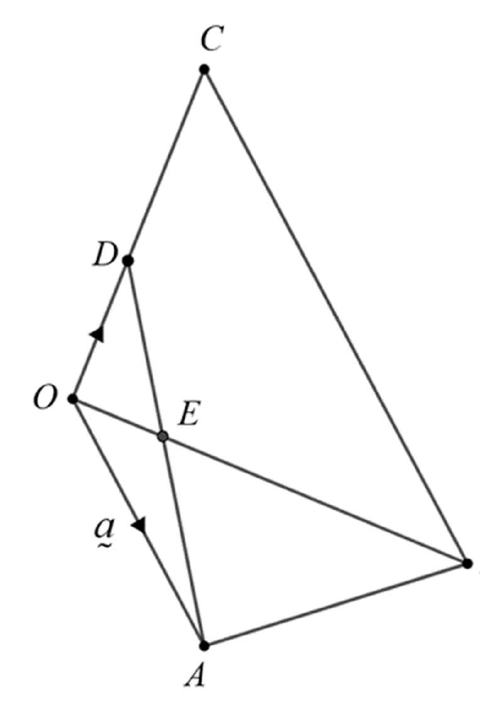
- (a)
Show that OE→ = (1 − m)a + m d.
[2] - (b)(i)
Find the value of m and of n.
[4] - (b)(ii)
Find DE : EA.
[1]
Diagram 15 shows roads of a residential area forming rectangle OABC. The surau S is on road OB, the public hall R is on road OA, and the police outpost P is on AB extended with AB = 2BP. Given OA→ = 4x, OC→ = 4y, OS→ = 3x + 3y, OR = RA and OS : OB = m : n. (a) Express in terms of x and y (i) RS→, (ii) OP→. (b) Find the ratio m : n. (c) Prove that R, S and P lie on the same straight line.
Medium8 marks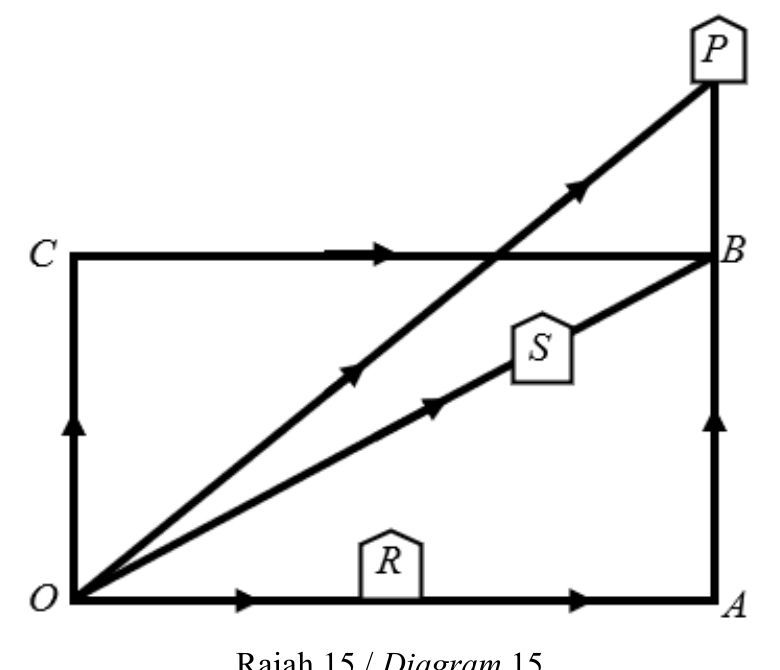
- (a)(i)
Express RS→ in terms of x and y.
[2] - (a)(ii)
Express OP→ in terms of x and y.
[1] - (b)
Find the ratio m : n.
[3] - (c)
Prove that R, S and P lie on the same straight line.
[2]
Diagram 7 shows the map of the 2025 TVET Carnival treasure hunt programme in the shape of a parallelogram ABCD. There are 4 stations; participants start at station A and end at station D. AC→ = 15i + 9j and AD→ = 12i + 5j. (a) Find the route for Station A to Station B. (b) R is the prize-giving location with DR→ = 3DB→. (i) Find the distance from station D to R. (ii) Hence, find the unit vector parallel to DR→.
Medium7 marks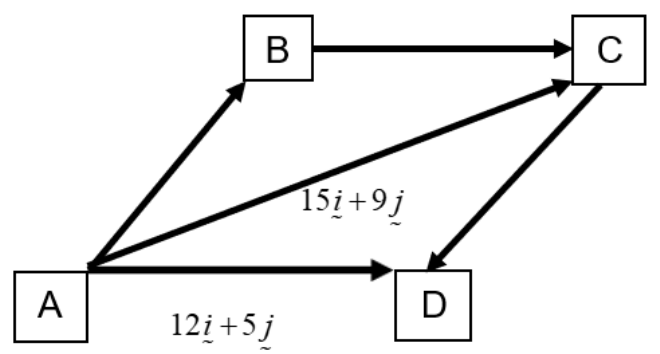
- (a)
Find the route (vector) for Station A to Station B.
[2] - (b)(i)
Find the distance from station D to the prize-giving location R, where DR→ = 3DB→.
[4] - (b)(ii)
Hence, find the unit vector parallel to DR→.
[1]
Diagram 6 shows a triangle ABC with A(−3p, −2h), B(−1, 2) and C(h, m). Given that AB→ + BC→ = 5i + 3j. Express m in terms of p.
Easy4 marks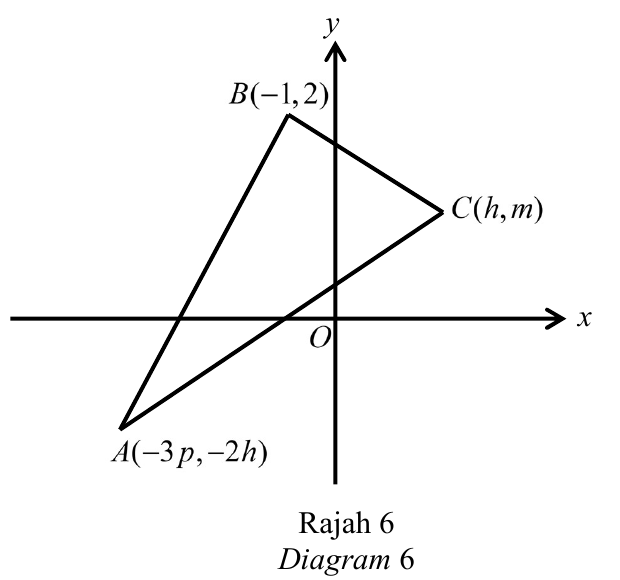
Express m in terms of p.
[4]
Diagram 8 shows a triangle POQ. The point A lies on OQ and the point B lies on PQ. The straight line PA intersects the straight line OB at point C. Given that OQ→ = 5**x**, OP→ = 4**y**, OQ : OA = 5 : 3 and PQ→ = 3PB→. (a) Express in terms of **x** and **y** (i) PA→, (ii) OB→. (b) If OC→ = hOB→ and PC→ = kPA→, where h and k are constants, find the value of h and of k. (c) Given that |**x**| = 5 unit and the area of triangle OPA is 90 unit², find the perpendicular distance from P to OQ.
Medium10 marks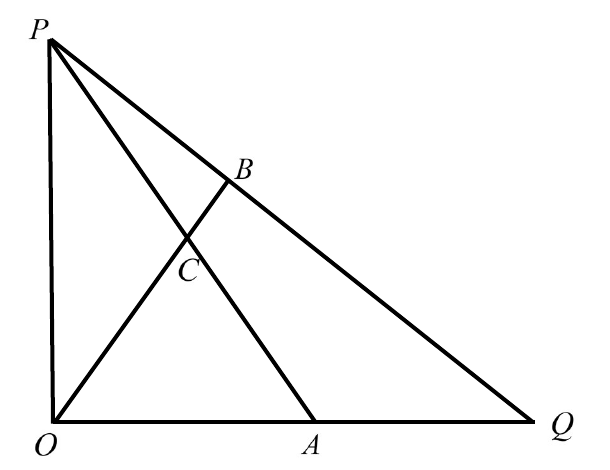
- (a)
Express in terms of x and y: (i) PA→, (ii) OB→.
[3] - (b)
If OC→ = hOB→ and PC→ = kPA→, find the value of h and of k.
[5] - (c)
Given |x| = 5 unit and the area of triangle OPA is 90 unit², find the perpendicular distance from P to OQ.
[2]
Diagram 6 shows the location of Azizi's house, (−3, 4), and his school on the Cartesian plane. The shortest distance of Azizi's house from the x-axis is 4 km and the vector from Azizi's house to his school is 8**i** + 15**j** (i and j are unit vectors in the x- and y-directions).
Easy4 marks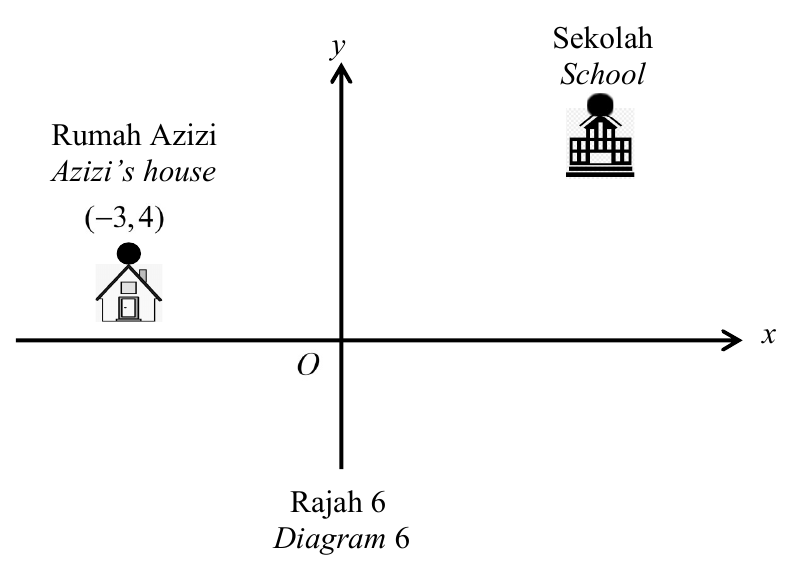
- (a)
Find the location of the school.
[2] - (b)
Find the distance of the school from Azizi's house.
[2]
Diagram 8 shows triangle POQ and point R on PQ. Given OP→ = **a**, OQ→ = **b** and PR : RQ = 3 : m.
Medium10 marks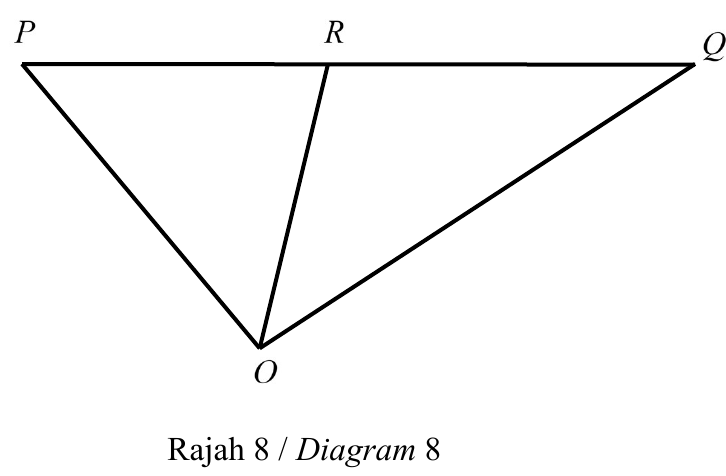
- (a)(i)
Express PQ→ in terms of **a** and **b**.
[2] - (a)(ii)
Express OR→ in terms of m, **a** and **b**.
[4] - (b)
If S lies on OR extended such that RS→ = 8**a** + 6**b**, find the value of m.
[4]
Diagram 2 shows triangle PQR. Given that QT→ = (3/4) QR→, PQ→ = 8**p** and PR→ = 12**q**. (a) Express in terms of **p** and/or **q** (i) QR→, (ii) PT→. (b) Given PS→ = h PT→ and RS→ = k(2**p** − 7**q**) where h and k are constants, find the ratio between value h and value k.
Medium6 marks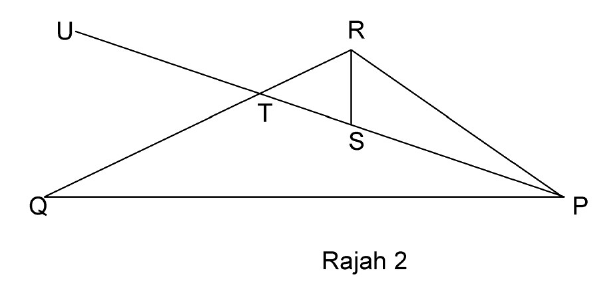
- (a)(i)
QR→ in terms of **p** and/or **q**.
[1] - (a)(ii)
PT→ in terms of **p** and/or **q**.
[1] - (b)
Given PS→ = h PT→ and RS→ = k(2**p** − 7**q**) where h and k are constants. Find the ratio between value h and value k.
[4]
Diagram 3 shows a triangle OAB. The point C lies on AB and the point D is the midpoint of OB. It is given that OA→ = **a**, OB→ = **b** and AC→ = 2CB→. (a) Express in terms of **a** and **b** (i) DA→, (ii) OC→. (b) The straight line OC is extended to the point E so that DA is parallel to BE. It is given that OE→ = hOC→ and BE→ = kDA→, where h and k are constants. Express OE→ (i) in terms of h, **a** and **b**, (ii) in terms of k, **a** and **b**. (c) Hence, find the value of h and of k.
Medium8 marks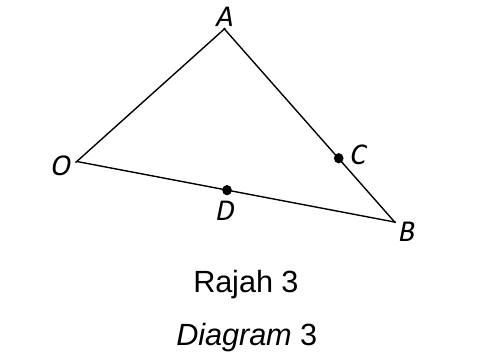
- (a)
Express in terms of **a** and **b**: (i) DA→, (ii) OC→.
[2] - (b)
Express OE→ (i) in terms of h, **a** and **b**, (ii) in terms of k, **a** and **b**.
[3] - (c)
Hence, find the value of h and of k.
[3]
(a) Diagram 4 shows vectors on a grid of 1 unit squares. Given LM→ = **a** and NM→ = **b**, express in terms of **a** and **b**: (i) LN→, (ii) MP→. (b) P(−3, −2) and Q(−1, 1) lie on a Cartesian plane. It is given that 3OP→ − OR→ = 4OQ→. Find (i) the coordinates of R, (ii) |QR→|.
Easy7 marks- (a)(i)
Express LN→ in terms of **a** and **b**.
[2]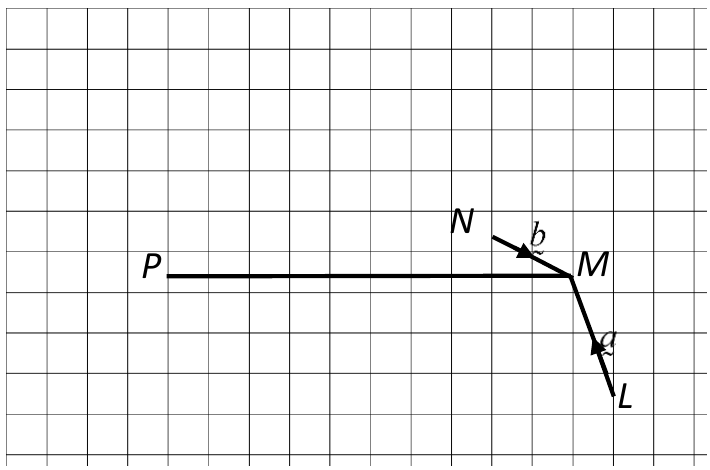
- (a)(ii)
Express MP→ in terms of **a** and **b**.
[1] - (b)(i)
Find the coordinates of R.
[2] - (b)(ii)
Find |QR→|.
[2]
Points A and B have position vectors **a** and **b** relative to O. L is the midpoint of OA and M is the point on OB produced such that OM→ = 3OB→. P is the point on LM such that LP→ = k LM→. (a) Express LM→ in terms of **a** and **b**. (b) Express AP→ in terms of **a**, **b** and k. (c) If A, P and B are collinear, find (i) k, (ii) AP/PB.
Hard10 marks- (a)
Express LM→ in terms of **a** and **b**.
[2] - (b)
Express AP→ in terms of **a**, **b** and k.
[2] - (c)(i)
If A, P, B are collinear, find k.
[4] - (c)(ii)
Find AP/PB.
[2]
Diagram 4 shows vectors OQ→, OR→ and SO→ on a square grid with sides of 1 unit. Vector OQ→ goes 3 units left and 4 units up from O. (a) Find |−OQ→|. (b) Given that OQ→ = q and OR→ = r, express RQ→ in terms of q and r.
Easy4 marks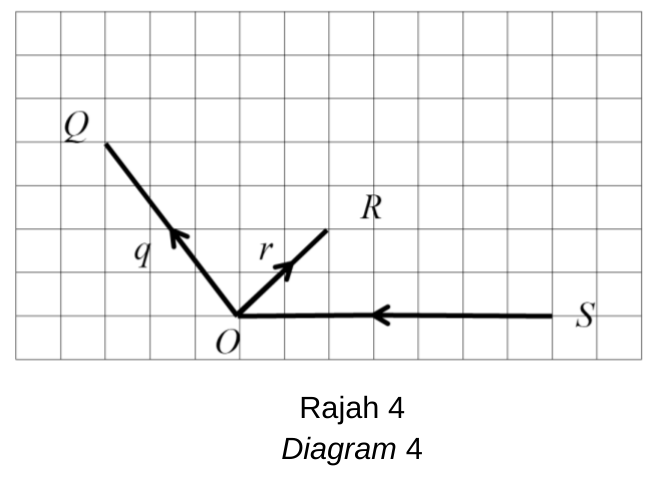
- (a)
Find |−OQ→|.
[2] - (b)
Given that OQ→ = q and OR→ = r, express RQ→ in terms of q and r.
[2]
In Diagram 5, OAB is a triangle. Given that OP→ = (2/3)OA→, AB→ = 2AQ→, OR→ = (4/5)OQ→, OA→ = 9h and OB→ = 4k (Q lies on AB and R lies on OQ). (a) Express, in terms of h and/or k, (i) PB→, (ii) OQ→. (b) Hence, prove that points P, R and B are collinear. (c) Given the area of triangle PAB is 12 cm², find the area of OAB.
Hard10 marks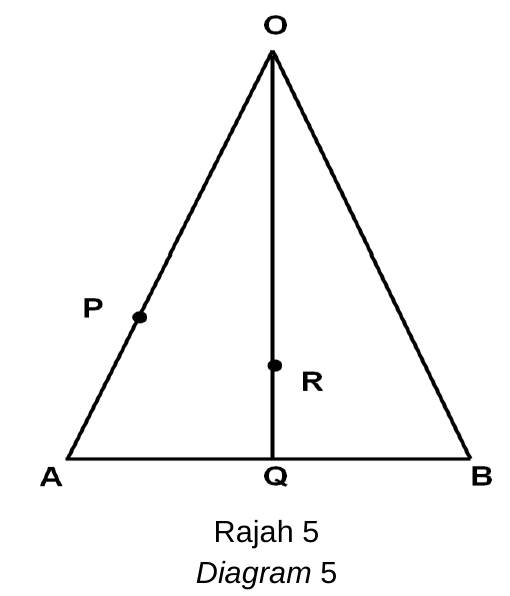
- (a)
Express, in terms of h and/or k, (i) PB→, (ii) OQ→.
[3] - (b)
Hence, prove that points P, R and B are collinear.
[4] - (c)
Given the area of triangle PAB is 12 cm², find the area of OAB.
[3]
Given that A(−6, 12) and B(2, 3) are two points on the Cartesian plane and OC→ + 4OB→ = OA→, find (a) the coordinates of point C, (b) |AC→|, (c) the unit vector of AC→.
Easy5 marks- (a)
Coordinates of point C.
[2] - (b)
|AC→|.
[2] - (c)
The unit vector of AC→.
[1]
Diagram 7 shows a triangle OMN. It is given that OP : PN = 4 : 1, MS : SO = 1 : 2, ON→ = 15x and MN→ = 6y. (a) Express in terms of x and y (i) PM→, (ii) OS→. (b) It is given that x = 3i and y = −i + 2j, find |OS→|. (c) It is given that PT→ = hPM→ and TS→ = kNS→, where h and k are constants. Find the values of h and of k.
Hard10 marks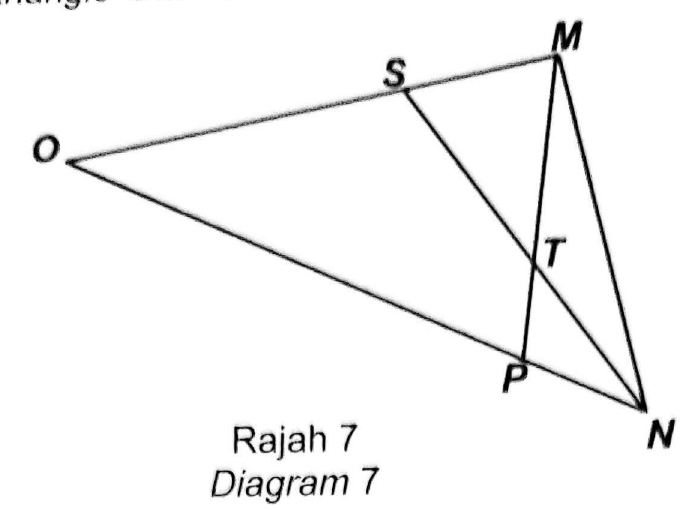
- (a)(i)
Express PM→ in terms of x and y.
[2] - (a)(ii)
Express OS→ in terms of x and y.
[1] - (b)
Given x = 3i and y = −i + 2j, find |OS→|.
[2] - (c)
Given PT→ = hPM→ and TS→ = kNS→, find the values of h and of k.
[5]
Vectors written as column vectors or in terms of i and j. k is a constant.
Easy6 marks- (a)
Given that a unit vector in the direction of the vector MN = ki − 4j is (1/(3k)) [[k], [−4]], find the value of k.
[3] - (b)
It is given that the point P(2, 5) and vector PQ = 7i + 9j. Find the terminal point of the vector PQ.
[3]
Diagram 4 shows the origin O, while points ADB, OXB, OYC and DXY are straight lines. Given OA = h**x** + k**y**, OB = 3h**x** + 4k**y**, OC = h**x** − 5k**y** and OD = (3/2)h**x** + (7/2)k**y**. Given OY : OC = 2 : 5, XB : OX = 3 : 2 and AD : AB = p : q.
Medium8 marks- (a)(i)
Express AB in terms of h, k, x and y.
[2]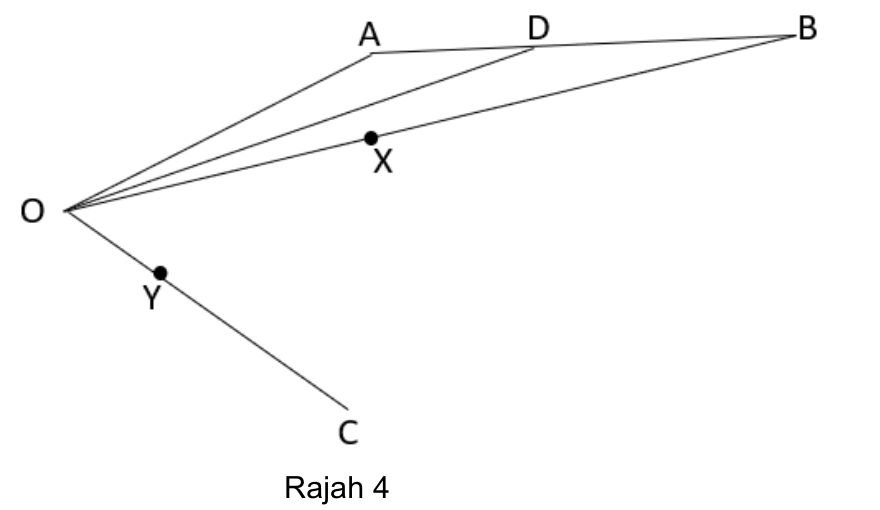
- (a)(ii)
Express XY in terms of h, k, x and y.
[2] - (b)
Find the values of p and of q.
[4]
Diagram 3 shows a quadrilateral OABC such that OB intersects AD at E. Given OA : CB = 1 : 2, OC : OD = 3 : 1, AE→ = m AD→ and OE→ = n OB→. (OA→ = **a**, OD→ = **d**.)
Medium7 marks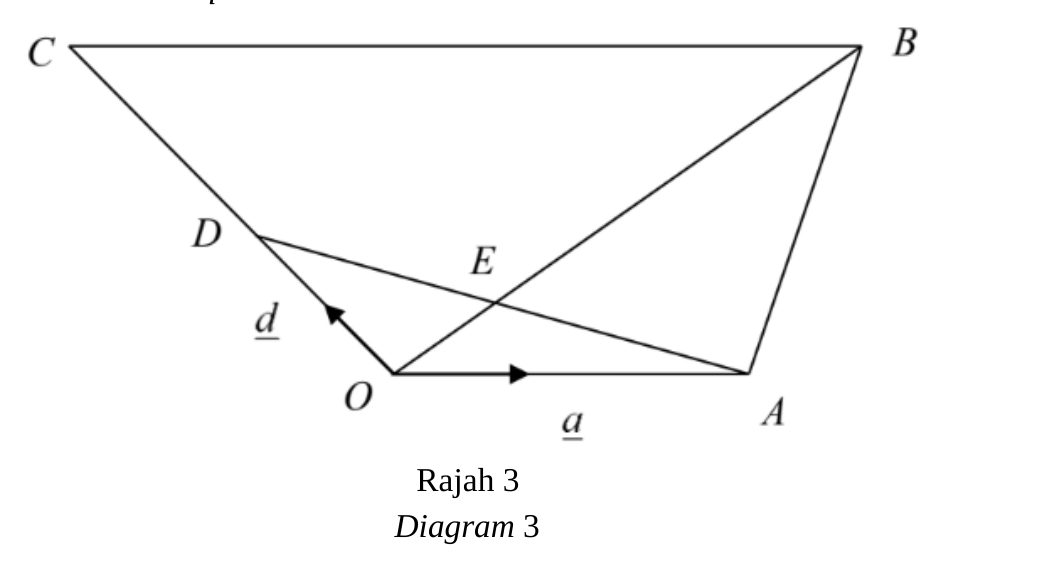
- (a)
Show that OE→ = m**d** + (1 − m)**a**.
[2] - (b)(i)
Find the value of m and of n.
[3] - (b)(ii)
Find the ratio DE : EA.
[2]
Diagram 5 shows triangle ABC. Point R lies on BP and point T lies on BC. Given AB→ = 6**x**, AC→ = 4**y**, 3AP = PC and T is the midpoint of BC. (P lies on AC.)
Medium10 marks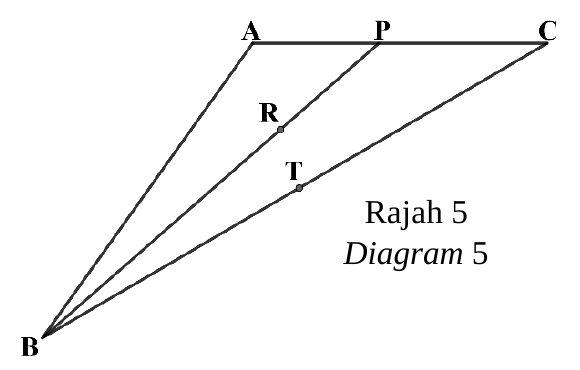
- (a)(i)
Express BC→ in terms of **x** and **y**.
[2] - (a)(ii)
Express AT→ in terms of **x** and **y**.
[2] - (b)
Given AR→ = m AT→ and AR→ = AP→ − n BP→, where m and n are constants, find the values of m and of n.
[6]
It is given that OA→ = i + 3j, OB→ = 2i + 5j and OC→ = mi + 11j, where m is a constant. (a) Find the value of m if A, B and C are collinear. (b) Hence, find the unit vector in the direction of BC→.
Easy5 marks- (a)
Find the value of m if A, B and C are collinear.
[3] - (b)
Hence, find the unit vector in the direction of BC→.
[2]
Diagram 4 shows a triangle RST. Given RT→ = 6x and RS→ = 4y. U is a point on ST where TU = 2US. (a) Express TU→ and RU→ in terms of x and y. (b) Given V is a point where SV→ = 3x. Determine whether the points R, U and V are collinear or not. (c) If |x| = 2 unit and the area of △RST is 24 unit², calculate (i) the area, in unit², of △RSV, (ii) the distance, in unit, between SV and RT.
Medium10 marks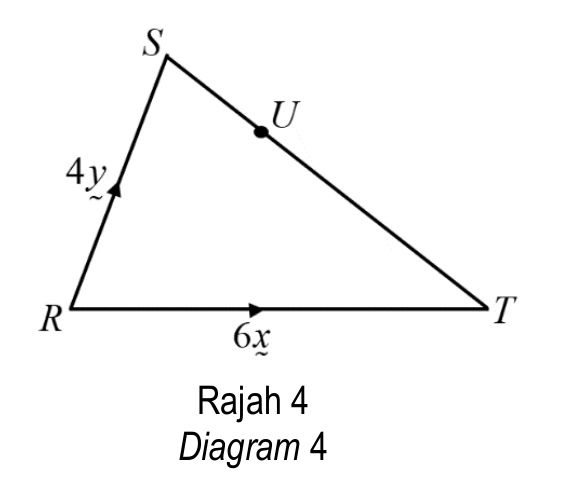
- (a)
Express TU→ and RU→ in terms of x and y.
[3] - (b)
Given SV→ = 3x, determine whether R, U and V are collinear.
[4] - (c)(i)
Find the area, in unit², of △RSV.
[1] - (c)(ii)
Find the distance, in unit, between SV and RT.
[2]
The position vectors of S, T and U are i + j, 3i − 2j and 6i + kj respectively. Find (a) the vector ST→ in the form xi + yj, (b) the value of k if TU→ is parallel to the x-axis.
Easy5 marks- (a)
Find ST→ in the form xi + yj.
[2] - (b)
Find k if TU→ is parallel to the x-axis.
[3]
Diagram 4 shows quadrilateral OPQR. Diagonal OQ and diagonal PR intersect at point S. It is given that OR→ = −3x, RQ→ = 6y and PQ→ = y − 2x. (a) Express the following vectors in terms of x and y: (i) OQ→, (ii) RP→. (b) If the points O, S and Q are collinear, RS = 2SP and OS : SQ = k : h, find the value of h and of k. (c) Given that x = 3i + 2j and y = i + 2j, find the unit vector in the direction of OQ→.
Hard10 marks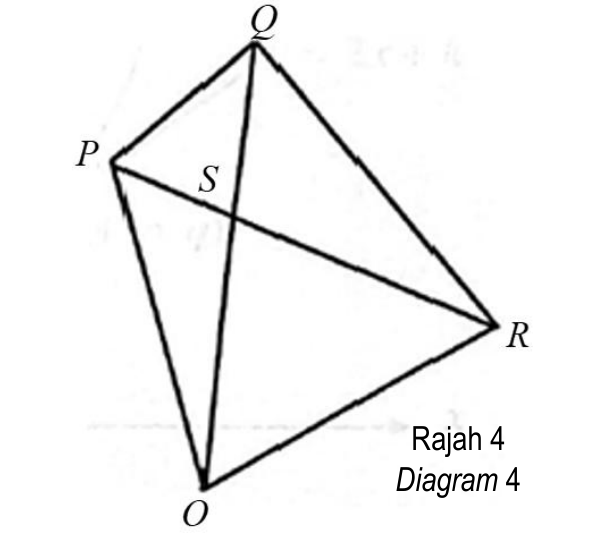
- (a)(i)
Express OQ→ in terms of x and y.
[2] - (a)(ii)
Express RP→ in terms of x and y.
[1] - (b)
Find h and k when O, S, Q are collinear, RS = 2SP and OS : SQ = k : h.
[5] - (c)
Find the unit vector in the direction of OQ→.
[2]
Diagram 4 shows a pentagonal swimming pool ABCDE with poles at A, B, C, D and E. Point F is the midpoint of DC. Given DE→ = (2/3)AB→, BC→ = ½AD→, AB→ = 6**q** and AD→ = 6**p** (vectors in bold). (a) If Ali swims from pole A to pole C, calculate the magnitude covered by Ali. (b) Another swimmer, Badrul, swims from pole A to pole E passing through point F. Determine whether the points A, F and E are collinear.
Medium5 marks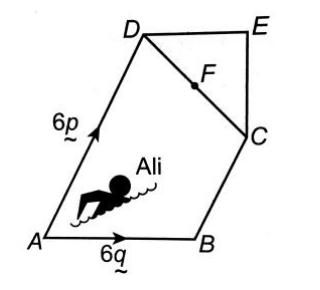
- (a)
Calculate the magnitude covered by Ali swimming from A to C.
[1] - (b)
Determine whether A, F and E are collinear.
[4]
Diagram 4 shows a triangle OAB. The straight line OM intersects the straight line AP at Q. Given OA→ = **a**, OB→ = **b**, OP→ = ⅓OB→, AM→ = MB→. (a) Express in terms of **a** or/and **b**: (i) AM→, (ii) AP→, (iii) OM→. (b) Given OQ→ = h OM→ and AQ→ = k AP→, where h and k are constants, find the value of h and of k.
Medium10 marks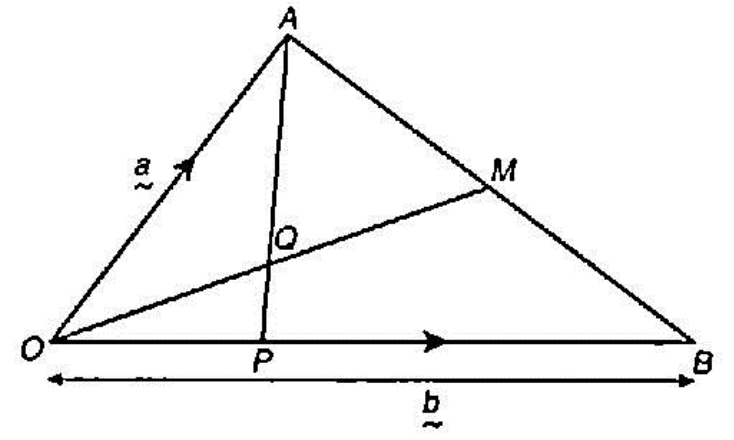
- (a)(i)
Express AM→ in terms of a and/or b.
[2] - (a)(ii)
Express AP→ in terms of a and/or b.
[2] - (a)(iii)
Express OM→ in terms of a and/or b.
[1] - (b)
Find the value of h and of k.
[5]
Diagram 5 shows a trapezium ABCD. Given AB→ = (h + 2)**i** − 3**j**, CD→ = 2**i** + 3k**j** and 2AB→ = DC→, find (a) the values of h and of k, (b) the unit vector in the direction AB→.
Easy5 marks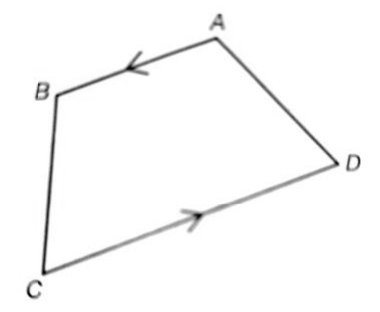
- (a)
Find the values of h and of k.
[3] - (b)
Find the unit vector in the direction AB→.
[2]
Diagram 2 shows a triangle RST. Point L lies on the straight line TS such that TS = 3TL. It is given that RT→ = 8**x**, RK→ = 6**y**, KS→ = 4**y** and RQ→ = n RL→. (a) Express in terms of **x** and **y**: (i) TS→, (ii) TK→. (b)(i) Express TQ→ in terms of n, **x** and **y**. (ii) Hence, find the value of n if points T, Q and K are collinear.
Medium8 marks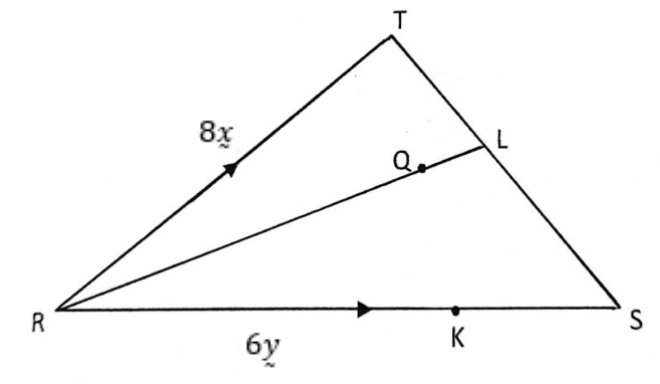
- (a)(i)
Express TS→ in terms of x and y.
[2] - (a)(ii)
Express TK→ in terms of x and y.
[1] - (b)(i)
Express TQ→ in terms of n, x and y.
[2] - (b)(ii)
Hence, find the value of n if T, Q and K are collinear.
[3]
Given PQ→ = 4i − 6j, PR→ = 2i + 4j and QR→ = −2i + 10j. T is on the line QR such that QT = 3TR. Find (a) the vector PT→ in terms of i and j, (b) the unit vector of PT→.
Medium5 marks- (a)
Find PT→ in terms of i and j.
[3] - (b)
Find the unit vector of PT→.
[2]
Diagram 4 shows triangle AOX and triangle AOY. Given OA→ = **a**, OY→ = **b**, and M is a point on AY such that AM = (2/5)AY. (a) Express in terms of **a** and/or **b**: (i) AY→, (ii) OM→. (b) AY and OX intersect at M. Given OX→ = k OM→ and AX→ = h OY→, express (i) OX→ in terms of k, **a** and/or **b**, (ii) AX→ in terms of h, **a** and/or **b**. Hence, find the value of h and of k. (c) State OM:MX.
Medium10 marks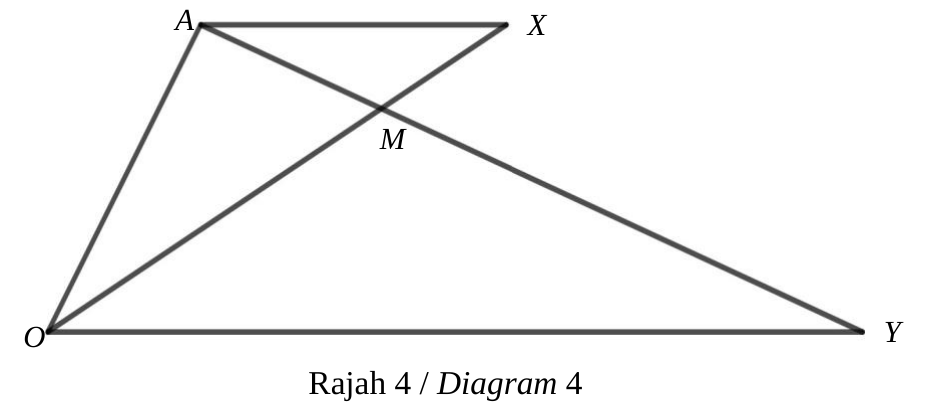
- (a)(i)
Express AY→ in terms of a and b.
[2] - (a)(ii)
Express OM→ in terms of a and b.
[1] - (b)(i)
Express OX→ in terms of k, a and b.
[1] - (b)(ii)
Express AX→ in terms of h, a and b.
[1] - (b) Hence
Find the value of h and of k.
[4] - (c)
State OM:MX.
[1]
Vectors a and b are non-zero and not parallel. (a) Given (h − 3)a = (k + 2)b, where h and k are constants, find h and k. (b) Given a = 2i + kj and b = 17i + 5j, find the values of k if |b − a| = 17 units.
Medium5 marks- (a)
Given (h − 3)a = (k + 2)b, where h and k are constants, find h and k.
[2] - (b)
Given a = 2i + kj, b = 17i + 5j, find the values of k if |b − a| = 17 units.
[3]
(a) Diagram 5 shows a triangle PQR, where point S is the midpoint of line PR. Given QP→ = 4p and QR→ = 5r. Find QS→. (b) Given that point D(−2, 1) and point E(−7, 13) are two points on the Cartesian plane. Find (i) DE→, (ii) the unit vector of DE→, in terms of i and j.
Medium8 marks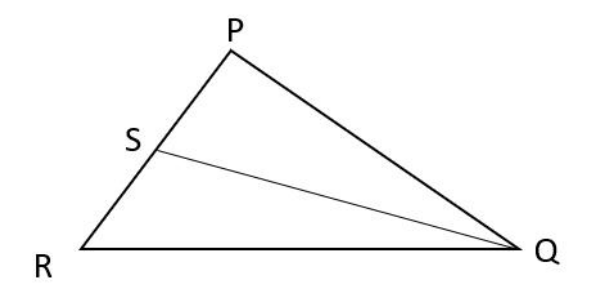
- (a)
Given QP→ = 4p and QR→ = 5r, S the midpoint of PR. Find QS→.
[3] - (b)(i)
Find DE→ for D(−2, 1) and E(−7, 13).
[3] - (b)(ii)
Find the unit vector of DE→ in terms of i and j.
[2]
In Diagram 3, ABCD is a quadrilateral. AED, CFE and BFD are straight lines. Given AB→ = 20x, AE→ = 4y, BC→ = 5x + 4y, BD→ = −20x + 16y and BD→ = 4BF→. (a) Express in terms of x and/or y (i) CD→, (ii) CF→. (b) Given CF→ = kCE→, where k is a constant, find the value of k. (c) If |x| = 1, |y| = 3 and ∠DAB = 90°, find |BC→|.
Medium7 marks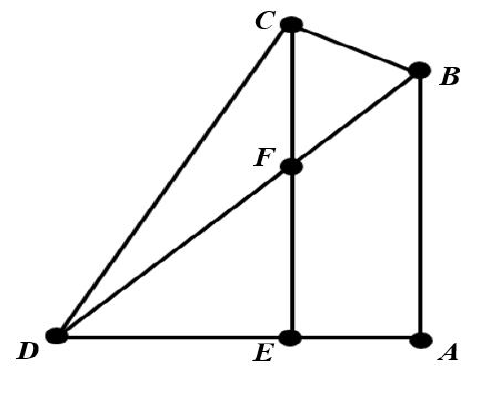
- (a)
Express in terms of x and/or y: (i) CD→, (ii) CF→.
[3] - (b)
Given CF→ = kCE→, find the value of k.
[2] - (c)
If |x| = 1, |y| = 3 and ∠DAB = 90°, find |BC→|.
[2]
(a) Given a = (5, −3) and b = (2, −12) as column vectors. (b) Solution by scale drawing is not accepted. Diagram 7 shows the straight line AB that intersects the straight line CD at point C. A(2, 0), B(6, 6), E(−2, 0), D(r, −4).
Medium7 marks- (a)(i)
Given a = [[5], [−3]] and b = [[2], [−12]] (column vectors), find 2a − b.
[1] - (a)(ii)
Find the unit vector in the direction of 2a − b.
[2] - (b)
Given that C is the midpoint of AB and point E divides the line segment CD such that hED = kCD. Find the value of r.
[4]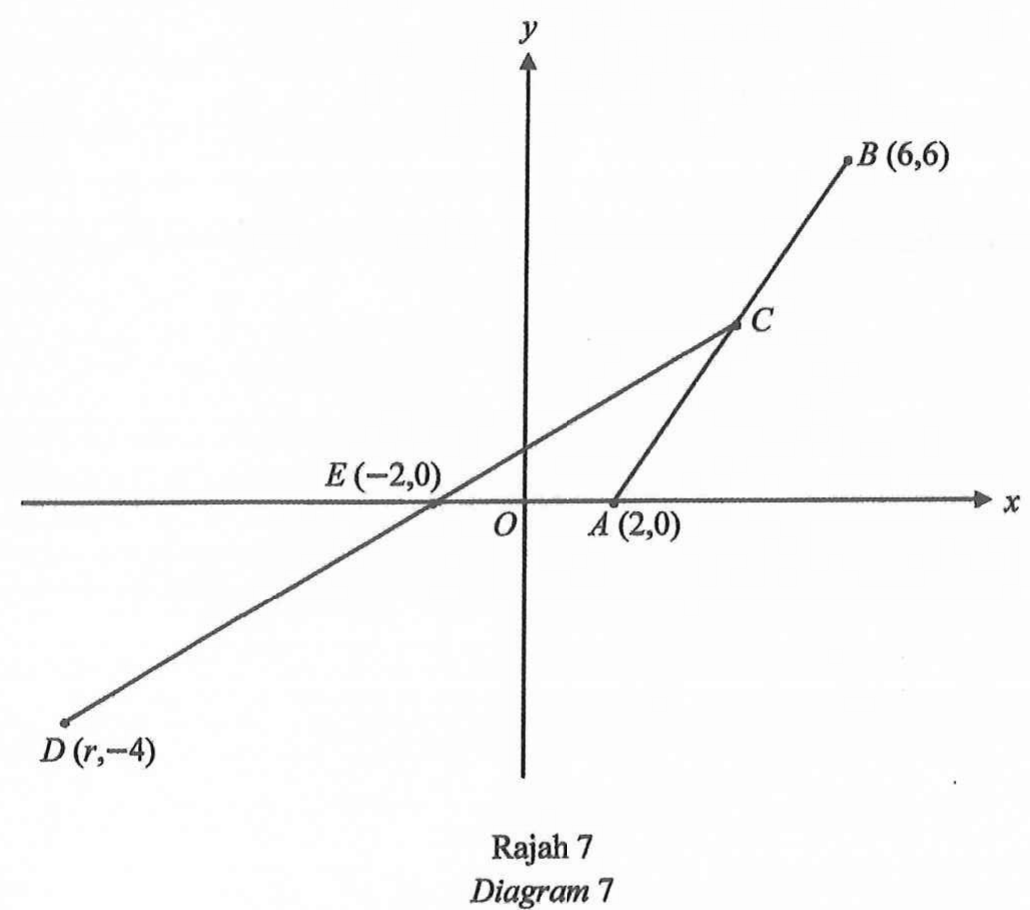
Diagram 3 shows quadrilateral AEFG and triangle ABD such that BD and AG intersect at point C (D lies on AE). Given that AB→ = 4x, CB→ = −(1/2)y, GF→ = (3/2)y, EF→ = 3x and ratio BC : CD = 2 : 3.
Medium8 marks- (a)
Express in terms of x and y: (i) AC→, (ii) AD→.
[3]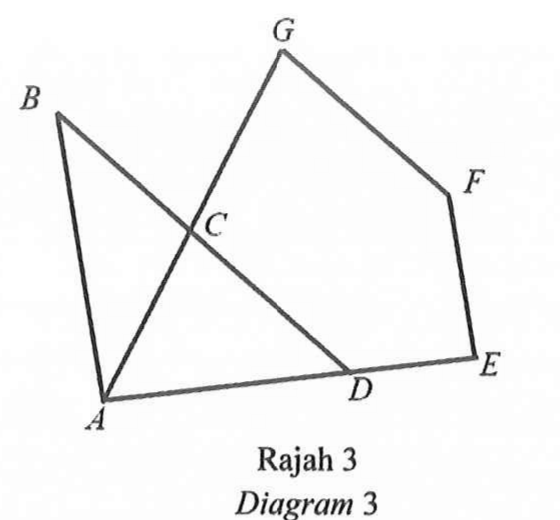
- (b)
Given AG→ is λ times of AC→ and AE→ is μ times of AD→. Express vector AF→ in terms of (i) λ, x and y, (ii) μ, x and y. Hence, find the value of λ and of μ.
[5]
(a) Diagram 4 shows a straight line PQ with P(−3, 8) and Q(n, 10). It is given that the unit vector in the direction of PQ→ is (ki + 2j)/√29. (i) Find the value of n. (ii) Hence, express OQ→ in the form of column vector. (b) Diagram 5 shows a quadrilateral KLMN with KL→ = 3a, LM→ = a + b and NM→ = λ(5a + b). Prove the vector LM→ is parallel to vector KN→.
Medium8 marks- (a)(i)
Find the value of n.
[3]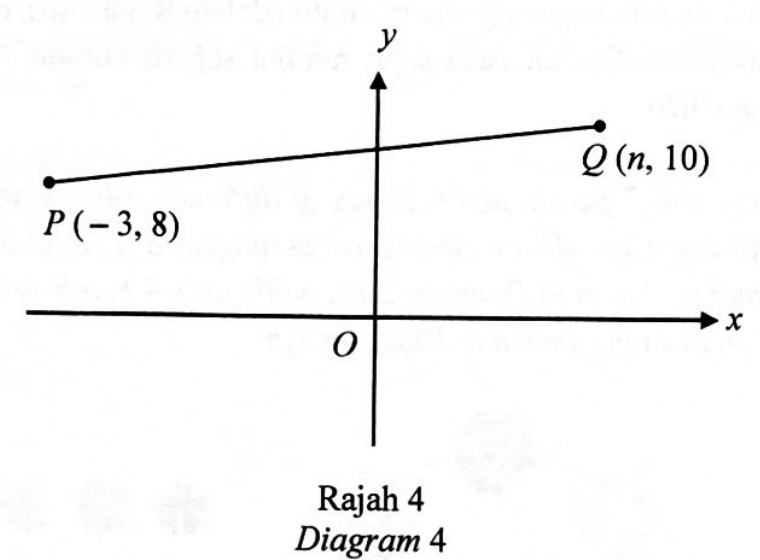
- (a)(ii)
Hence, express OQ→ in the form of column vector.
[1] - (b)
Prove the vector LM→ is parallel to vector KN→.
[4]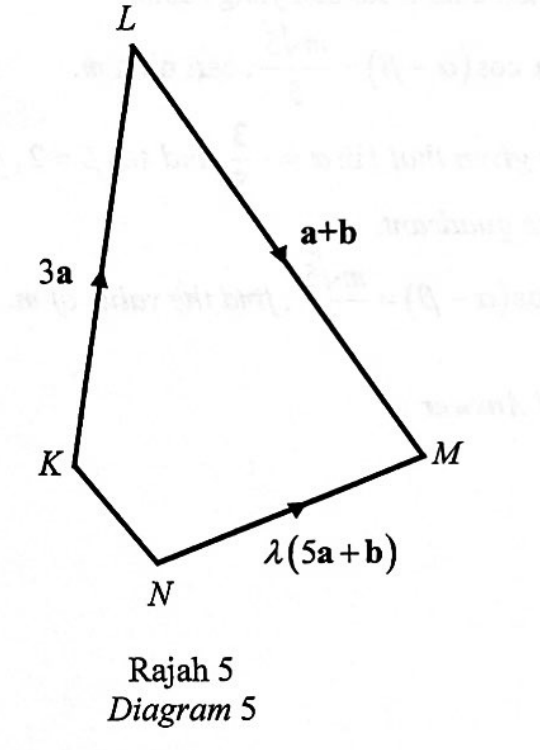
(a) Diagram 5 shows trapezium ADEF and triangle ABC. It is given that AD→ = 8x, BE→ = 3y, BE→ = (3/5)BC→ and ratio AD : FE = 2 : 1. (i) Express AC→ in terms of x and/or y. (ii) Line FE is extended to a point M such that FM→ = (8/5)FE→ and BM→ = kAC→. Find the value of k. (b) Airport Q is located at the north of airport P and on the west of airport R. The bearing of airport R from airport P is 036.87°. An airplane travelled from airport P to airport R with position vector of 900i + 1200j. After that, the airplane continues its journey to airport S which is located 3000 km on the north of airport P in 2 hours. Find the speed, in km/h, of the airplane after leaving airport R.
Medium10 marks- (a)(i)
Express AC→ in terms of x and/or y.
[3]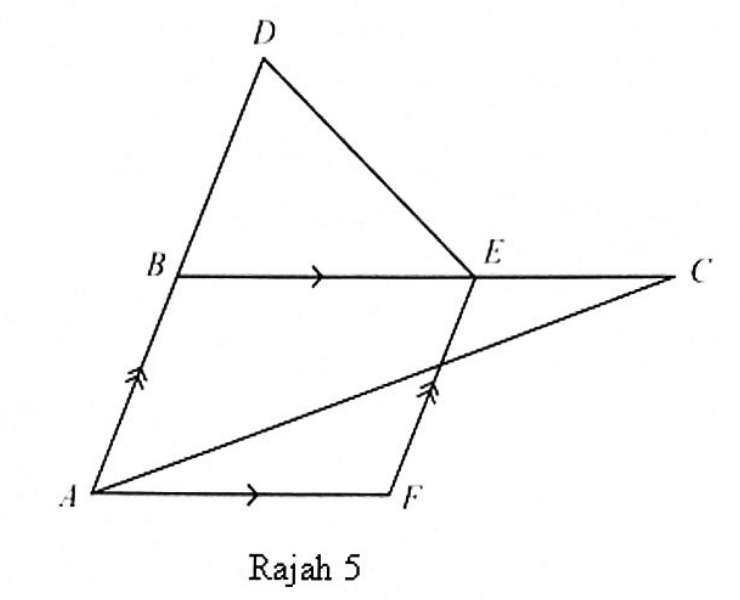
- (a)(ii)
Find the value of k (FM→ = (8/5)FE→, BM→ = kAC→).
[4] - (b)
Find the speed, in km/h, of the airplane after leaving airport R.
[3]
Diagram 4 shows rhombus OPQR with ∠ORQ = 60°. The diagonals OQ and PR intersect at point N. It is given that OP→ = **p**, OR→ = **r** and |**p**| = 2. (a) State the magnitude of 3QR→. (b) Express in terms of **p** and **r**, (i) OQ→, (ii) RN→. (c) Find the value of |**p** − **r**|.
Medium6 marks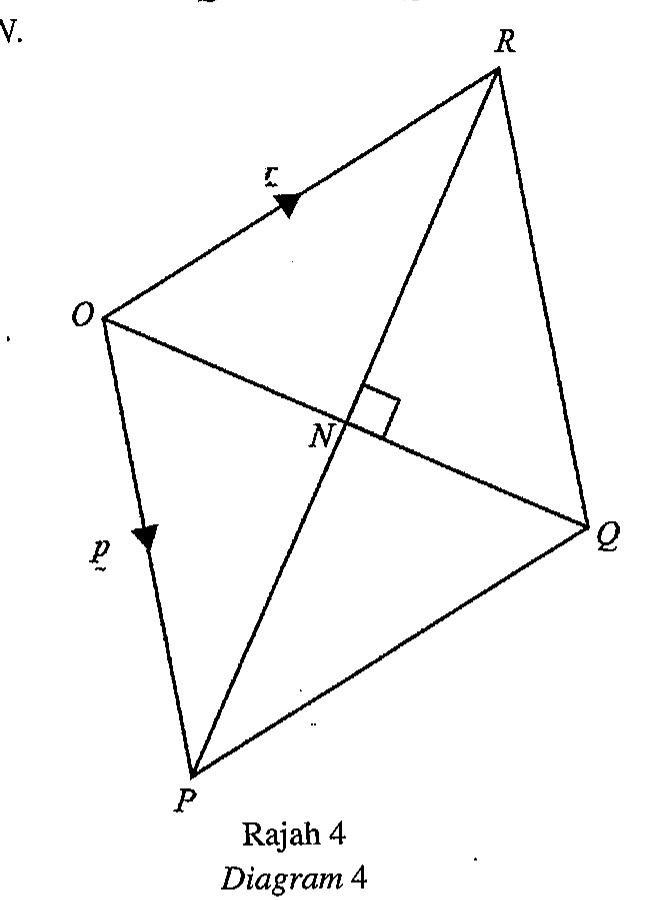
- (a)
State the magnitude of 3QR→.
[1] - (b)(i)
Express OQ→ in terms of p and r.
[2] - (b)(ii)
Express RN→ in terms of p and r.
[1] - (c)
Find the value of |p − r|.
[2]
Diagram 1 shows a quadrilateral ABCD. The straight lines AC and BD intersect at point E. It is given that AB→ = **x**, BC→ = 4**y** and AB = (1/5)DC. (a) Express in terms of **x** and/or **y** (i) AC→, (ii) DB→. (b) It is given that CE→ = hCA→ and DE→ = kDB→, where h and k are constants. Express CE→ (i) in terms of h, **x** and **y**, (ii) in terms of k, **x** and **y**. Hence, find the value of h and of k.
Medium8 marks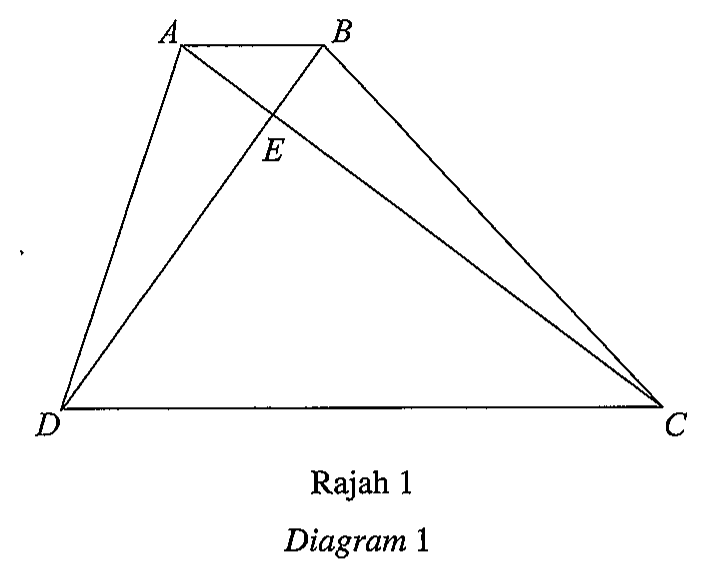
- (a)(i)
Express AC→ in terms of x and/or y.
[2] - (a)(ii)
Express DB→ in terms of x and/or y.
[1] - (b)(i)
Express CE→ in terms of h, x and y.
[1] - (b)(ii)
Express CE→ in terms of k, x and y. Hence, find the value of h and of k.
[4]
(a) Diagram 6 shows the unit vector u in the direction PQ on a grid with unit vectors i and j. (b) Given a = 3i − 4j and b = −2i + j. If JH = 2a + b, |JH| = 2|KL| and KL is in the opposite direction of JH, find vector KL in terms of i and j.
Medium6 marks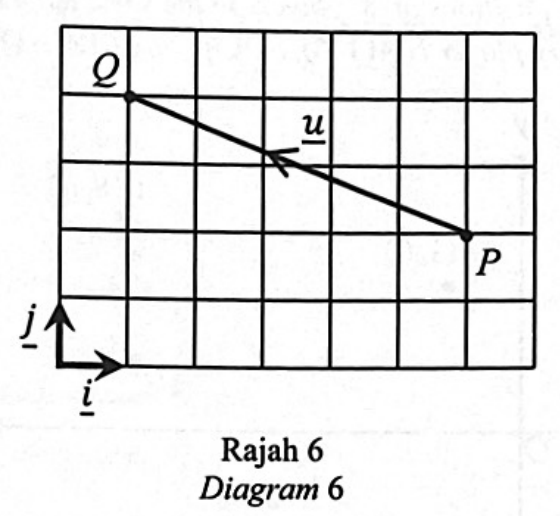
- (a)(i)
Find unit vector, û.
[2] - (a)(ii)
State the maximum number of unit vector, û that would fit inside the line PQ.
[1] - (b)
Find vector KL, in terms of i and j.
[3]
In Diagram 5, OAB is a triangle, OP = (2/3)OA, AB = 2AQ, and OR = (4/5)OQ. Given that OA→ = 9x and OB→ = 4y.
Medium9 marks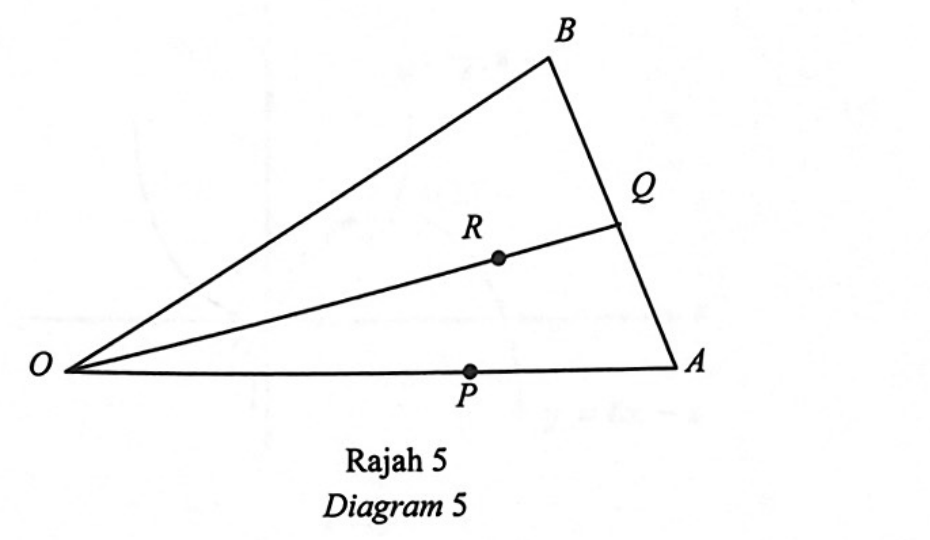
- (a)
Express, in terms of x and/or y, (i) PB→, (ii) OQ→.
[3] - (b)
Hence, prove that points P, R and B are collinear.
[4] - (c)
Given the area of △PAB is 12 cm². Find the area of △OAB.
[2]
Diagram 8 shows an object A experiences three forces, F₁ = −4**i** + h**j**, F₂ = k**i** − 2**j** and F₃ = −**i** − 7**j**, measured in Newton. (a) Find the value of h and of k if the object is not moving. (b) Find magnitude of the resultant force acting on the object if force F₃ is removed from the system. Give your answer in the surd form. (c) Assume that the three forces lie on a Cartesian plane. If the force F₁ is increased by 2 units in the direction of x-axis and decreased by 5 units in the direction of y-axis, find the unit vector of object A in the direction of F₁.
Medium8 marks- (a)
Find h and k if the object is not moving.
[2]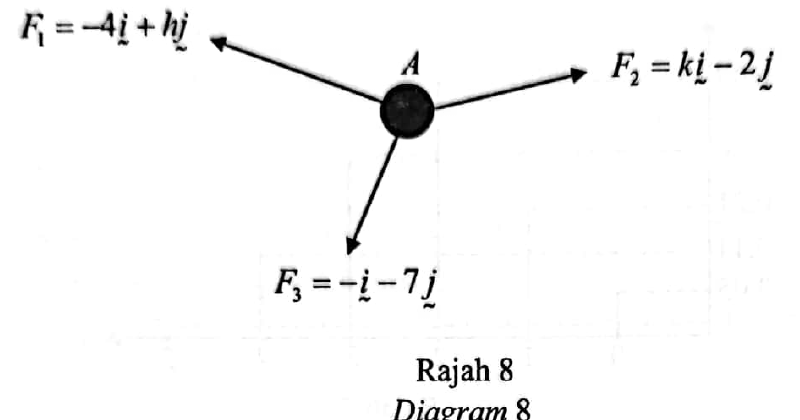
- (b)
Find the magnitude of the resultant force if F₃ is removed. Give the answer in surd form.
[3] - (c)
Find the unit vector in the direction of the new F₁.
[3]
(a) Diagram 3 shows a quadrilateral JKLM. Given that JK→ = (p + 1)**a**, KL→ = −2**a** + (q + 1)**b** and ML→ = q**a**, such that p and q are constants. If JM→ = ((p + 1)/2)**a** + 2q**b**, find the value of p and of q. (b) The straight line JM is extended to the point R. Given JR→ = (9/2)**a** + k**b** such that k is a constant. Find (i) the value of k, (ii) JM : MR.
Medium8 marks- (a)
Find p and q (Diagram 3).
[4]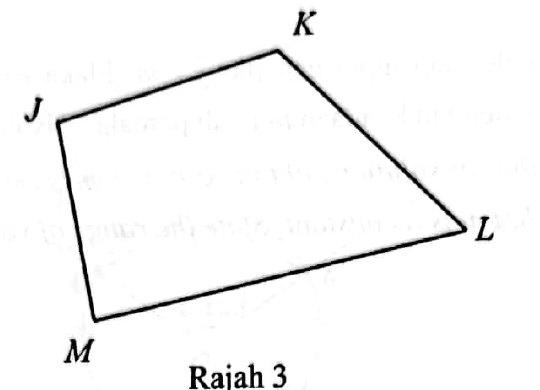
- (b)(i)
Find the value of k.
[3] - (b)(ii)
Find JM : MR.
[1]
(a) Determine whether the vector (√3/2)i − (1/2)j is a unit vector or not. Justify your answer. (b) Solution by scale drawing is not accepted. Diagram 1 shows the playing court of a traditional game on the Cartesian plane. Point P is the location of the "goal". The player has to push their marble into the "goal" starting from the origin. The game gives two trials. In the first trial, Aiman's marble shows a vector of [[3], [8]] (column vector) and in the second trial the marble shows a vector of [[p], [q]]. Finally, Aiman has successfully pushed the marble into the "goal", P. Assume motion of the marble is in a straight line. Find the value of p and of q.
Easy5 marks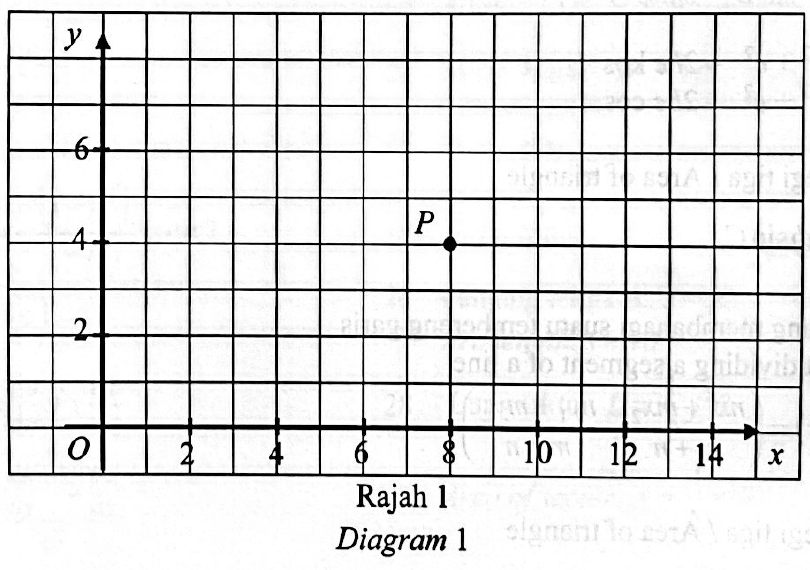
- (a)
Determine whether the vector (√3/2)i − (1/2)j is a unit vector or not. Justify your answer.
[2] - (b)
Find the value of p and of q (P is the point (8, 4) in Diagram 1; scale drawing not accepted).
[3]
Diagram 9 shows quadrilateral ABCD. Diagonal AC and diagonal BD intersect at point E. It is given that AD→ = 3x, AB→ = 6y and BC→ = 2x − y. (a) Express the following vector in terms of x and y: (i) AC→, (ii) BD→. (b) If points B, E and D are collinear, AE = 2EC and BE : ED = h : k, find the value of h and of k. (c) Given that |x| = 3 units and |y| = 2 units, determine whether the straight line AB is perpendicular to the straight line AD. Give your justification.
Hard10 marks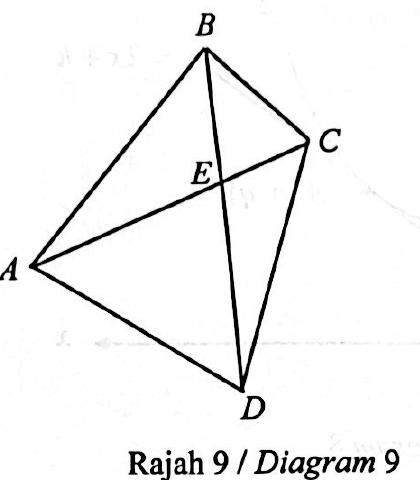
- (a)(i)
Express AC→ in terms of x and y.
[2] - (a)(ii)
Express BD→ in terms of x and y.
[1] - (b)
If B, E and D are collinear, AE = 2EC and BE : ED = h : k, find h and k.
[5] - (c)
Given |x| = 3 and |y| = 2, determine whether AB is perpendicular to AD. Justify.
[2]
Given the points P(−3, 2), Q(12, 7) and R lies on a straight line such that PR→ = (3/5) PQ→. By using vector arithmetic operations, find
Medium5 marks- (a)
PQ→,
[2] - (b)
|OR→|.
[3]
An airplane flies from point P to point Q, where Q is 900 km due east of P. The velocity of the airplane in still air is v = 700i − 100j km h⁻¹. There is a wind blowing with a constant velocity of u = ai + bj km h⁻¹ (Diagram 13).
Medium8 marks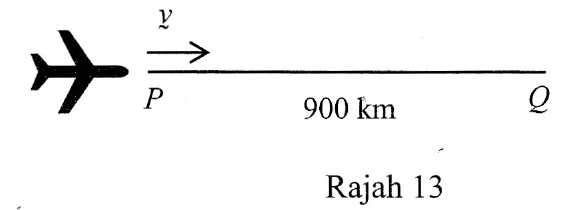
- (a)
Given that the airplane flies directly from P to Q, find the value of b.
[3] - (b)
If the journey takes 1.25 hours, show that a = 20.
[2] - (c)
The airplane returns from Q to P, with its velocity in still air v = −700i − 100j km h⁻¹. Calculate the time taken for the return journey, assuming the wind velocity remains unchanged.
[2] - (d)
What is the actual speed of the airplane when there is no wind?
[1]
Diagram 1 shows a parallelogram OABC. Given OA→ = **x** and OC→ = **y**. OB is extended to D such that OB = BD and OA is extended to E such that AE = ½ OA. The line CE and AD intersect at point X.
Medium8 marks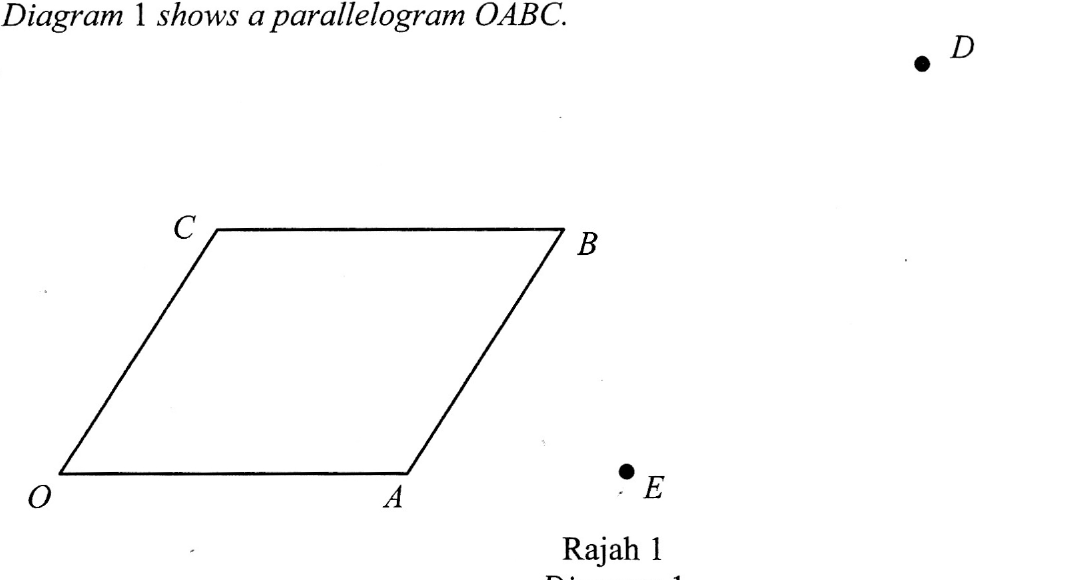
- (a)(i)
Given AX→ = p AD→ and CX→ = q CE→, find AX→ in terms of p, **x** and **y**.
[2] - (a)(ii)
Find AX→ in terms of q, **x** and **y**.
[2] - (b)
Hence, find the values of p and of q.
[4]
(a) Given a = (3, −2) and b = (1, 8) (column vectors), find the unit vector in the direction of 2a − b. (b) Vectors u and v are non-zero and not parallel. Given (h + k)u = (h − k + 2)v where h and k are constants, find the value of h and of k.
Medium6 marks- (a)
Find the unit vector in the direction of 2a − b, where a = (3, −2) and b = (1, 8).
[3] - (b)
Given (h + k)u = (h − k + 2)v with u and v non-zero and not parallel, find h and k.
[3]
Given the unit vector in the direction of vector u is û = ((1 − p)i + qj)/5, express q in terms of p.
Easy4 marksExpress q in terms of p.
[4]
Diagram 1 shows roads of schools in a town area that form a quadrilateral OABC (printed as 'rectangle'). School M is at the middle of schools A and C, and OM : OB = 2 : 3. Given OA→ = 3x + 2y, OC→ = 9x + 2y and CB→ = 3ry, where r is a constant, (a) express in terms of x and/or y, (i) AC→, (ii) OM→; (b) express OB→ in terms of (i) x and y, (ii) x, y and r. Hence, find the value of r. (x and y are vectors.)
Medium8 marks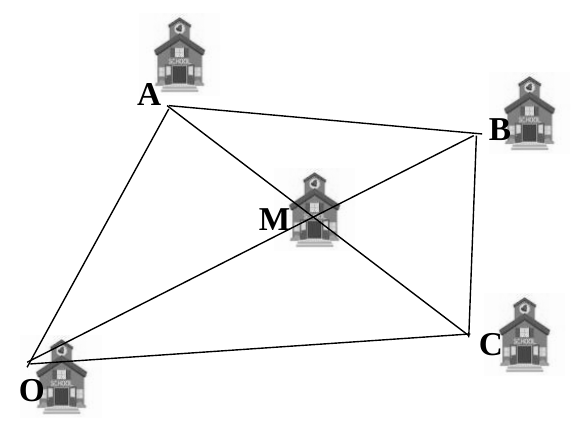
- (a)(i)
Express AC→ in terms of x and/or y.
[1] - (a)(ii)
Express OM→ in terms of x and/or y.
[2] - (b)(i)
Express OB→ in terms of x and y.
[2] - (b)(ii)
Express OB→ in terms of x, y and r. Hence, find r.
[3]
Triangle ABC has AB→ = 4i − 6j and AC→ = 2i + 4j. T lies on line BC such that 3BT→ = TC→. (Vectors are written with arrows; i and j are unit vectors.)
Medium8 marks- (a)(i)
Find the vector BC→.
[2] - (a)(ii)
Find AT→. Hence, find the unit vector in the direction of AT→.
[3] - (b)
If D is a point such that AD→ = hBC→ and AD→ = −3i + kj, where h and k are constants, find the value of h and of k.
[3]
Diagram 2 shows four sports house stations on a Cartesian plane. PQRS is a parallelogram, PQ is parallel to SR, P(5, 11) and S(1, 1). Distances are in metres.
Easy6 marks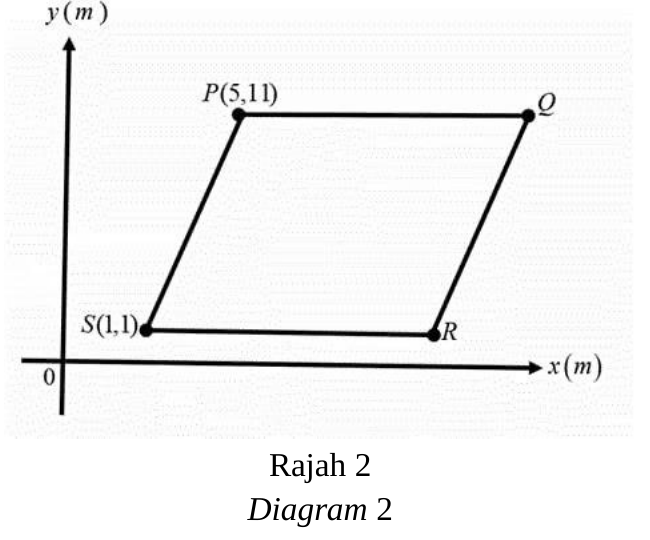
- (a)
State the value of |SR→ + RP→ + PS→|.
[1] - (b)
A path from station S to station R is parallel to the x-axis and the displacement is 11 m. Find the resultant vector from S station to Q station.
[2] - (c)
A student moves from S station to a tent at A(5, k) with constant velocity (3i + 4j) m s⁻¹. He takes t seconds to reach the tent. Write a vector equation in terms of t and k. Hence, find the value of t and of k.
[3]
(a) Diagram 7 shows a parallelogram DEFG. Point P lies on the straight line DE and point Y lies on the straight line GF. PT is a straight line that passes through the point F. Given DY→ = **a** + 6**b** and DT→ = (3/2)**a** + 9**b**. A straight line is drawn by connecting point D to point T. Using the vector method, determine whether the line passes through point Y or not. (b) Diagram 8 shows a regular hexagon PQRSTU drawn on a Cartesian plane with centre at the origin O. (i) Express PQ→ + TS→ as a single vector. (ii) Given OR→ = 5**i**, OT→ = −(5/2)**i** − (5√3/2)**j**, find the unit vector in the direction of RT→, in terms of **i** and **j**.
Medium8 marks- (a)
Using the vector method, determine whether the straight line from D to T passes through point Y or not.
[4]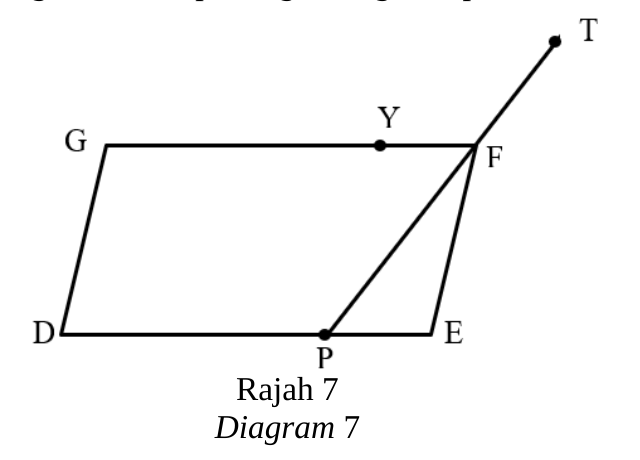
- (b)(i)
Express PQ→ + TS→ as a single vector.
[1]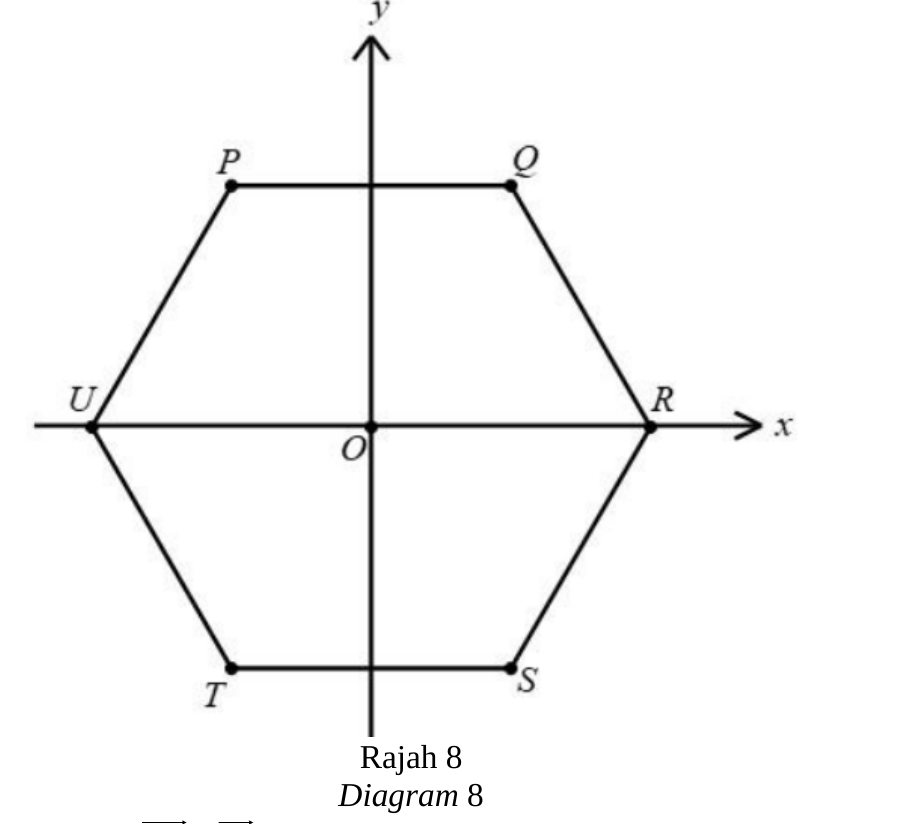
- (b)(ii)
Given OR→ = 5**i**, OT→ = −(5/2)**i** − (5√3/2)**j**, find the unit vector in the direction of RT→, in terms of **i** and **j**.
[3]
Diagram 1 shows a triangle OPQ. It is given that OP→ = **a**, OQ→ = **b** and OR : RM = 3 : 2. M is the midpoint of PQ. N is a point on OQ and P, R, N are collinear. (a) Find (i) OM→, (ii) PR→. (b) If PN→ = −**a** + λ**b** and PR→ = kPN→, find ON : NQ.
Medium8 marks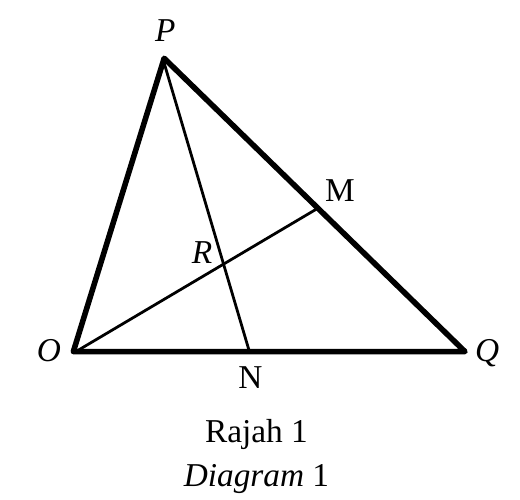
- (a)(i)
Find OM→.
[3] - (a)(ii)
Find PR→.
[2] - (b)
If PN→ = −**a** + λ**b** and PR→ = kPN→, find ON : NQ.
[3]
Diagram 3 shows a quadrilateral ABCD. Given AR→ = 2x, AB→ = 3y, 2BT = TD and AR : AD = 1 : 3.
Medium10 marks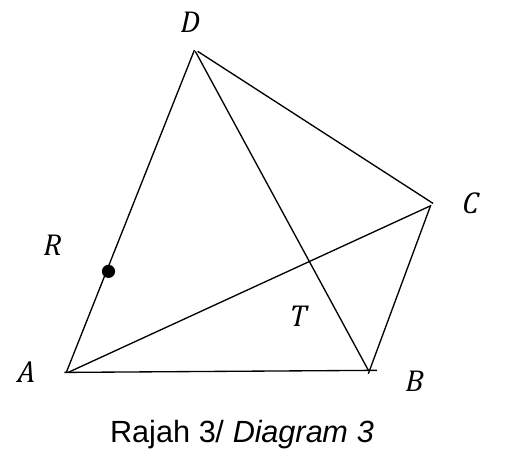
- (a)(i)
Express DB→ in terms of x and y.
[1] - (a)(ii)
Express AT→ in terms of x and y.
[2] - (b)(i)
Given DC→ = 2hy − 2x and AC→ = (1/k)AT→, where h and k are constants, find DC→ in terms of k, x and y.
[2] - (b)(ii)
Find the values of h and k.
[3] - (c)
Given the area of △ABD is 120 unit² and the perpendicular distance from B to AD is 5 unit, find |x|.
[2]
Given that RS→ = ½**x** + **y**, where **x** = 4**i** − 6**j** and **y** = 5**i** + 17**j**. Find (a) RS→ in terms of **i** and **j**, (b) the unit vector in the direction of RS→.
Easy3 marks- (a)
RS→ in terms of **i** and **j**. [1 mark]
[1] - (b)
the unit vector in the direction of RS→. [2 marks]
[2]
Diagram 4 shows points X and Y which are the midpoints of lines EF and DE, respectively. Given DF→ = 2**u**, FE→ = 2**v** and FY→ = ¾ FG→. (a) Express in terms of **u** and **v**: (i) DX→, (ii) XY→. (b) Show that DX→ is parallel to GE→ and state the ratio DX : GE.
Hard10 marks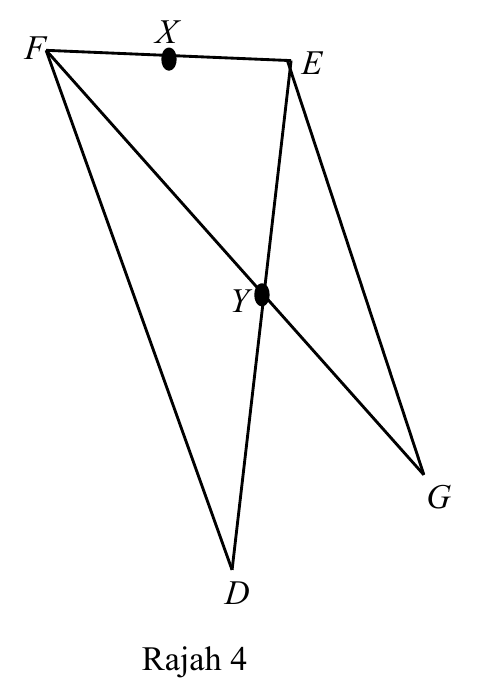
- (a)(i)
DX→ in terms of **u** and **v**. [(a): 3 marks]
[2] - (a)(ii)
XY→ in terms of **u** and **v**.
[1] - (b)
Show that DX→ is parallel to GE→ and state the ratio DX : GE. [7 marks]
[7]
The diagram shows triangle OAB; P, Q and R are the midpoints of OA, OB and AB respectively (the paper says OC). Given BA→ = x and OB→ = y. (a) Find (i) PO→, (ii) PB→. (b) Express PQ→ in terms of x and y. Hence, state the relationship between the line BA and the line PQ.
Medium6 marks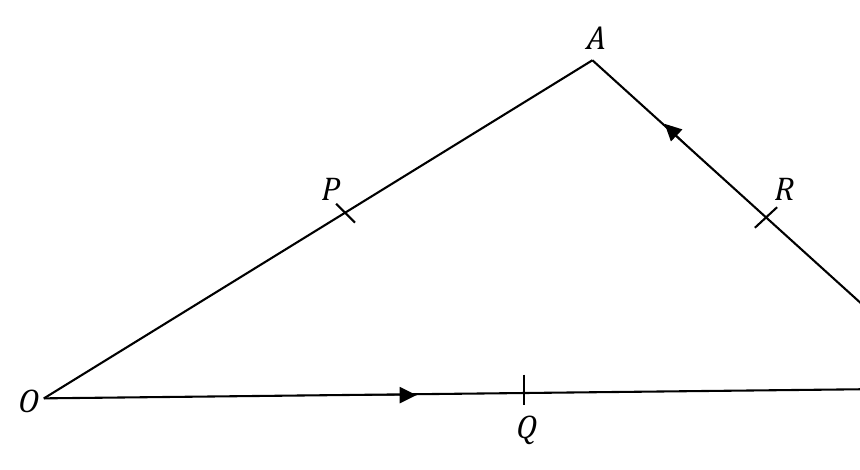
- (a)
Find (i) PO→ (ii) PB→.
[3] - (b)
Express PQ→ in terms of x and y. Hence state the relationship between BA and PQ.
[3]
Given OA→ = 4a, OB→ = 8b, AP→ = αAN→, OA = 2MA and ON : OB = 5 : 8 (M on OA, N on OB, P is the intersection of MB and AN). (a) Express (i) MB→ in terms of a and b, (ii) AP→ in terms of α, a and b, (iii) MP→ in terms of α, a and b. (b) Given M, P and B are collinear, find the value of α.
Medium8 marks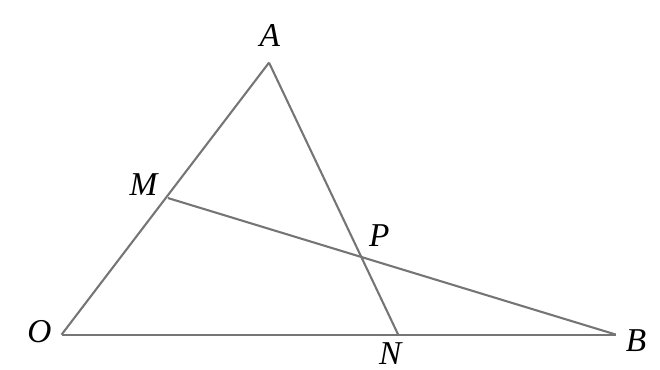
- (a)
Express (i) MB→, (ii) AP→, (iii) MP→.
[5] - (b)
Given M, P and B are collinear, find the value of α.
[3]
Diagram 6 shows a triangle MNU and a quadrilateral KLMT. Given KL→ = 30p, KT→ = 2p + 10q, NM→ = 36p − (45/2)q, KT→ = (2/3)UN→ and TU→ = (2/3)TM→.
Medium8 marks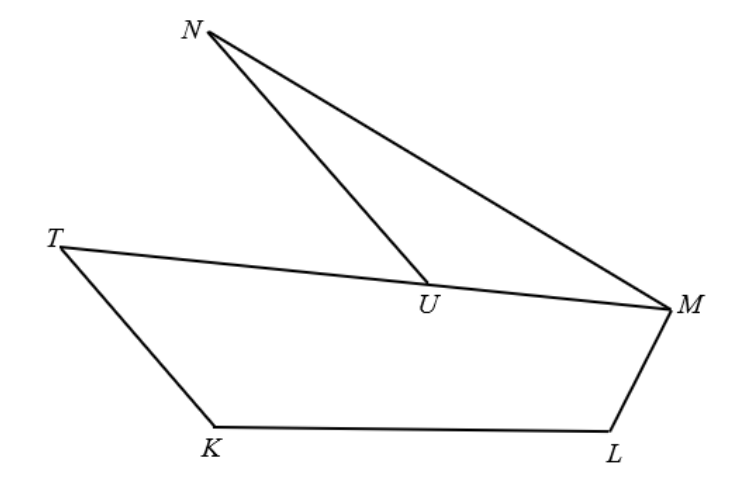
- (a)(i)
Express TM→ in terms of p and/or q.
[3] - (a)(ii)
Express LN→ in terms of p and/or q.
[1] - (b)
Determine whether L, U and N are collinear or not. Give your reason.
[2] - (c)
If |p| = 1 unit and |q| = 2 units, find |TM→|.
[2]
Given a = (3, 4) and b = (6, p − 2) as column vectors. Find the value of p if |3a − b| = 9, and the unit vector of 3a − b.
Easy5 marks- (a)
Find the value of p if |3a − b| = 9.
[2] - (b)
Find the unit vector of 3a − b.
[3]
(a) Given QR→ = 2i − 4j and PS→ = hi − 12j, where h is a constant and PS→ is parallel to QR→, find the value of h. (b) Given u and v are non-zero and non-parallel vectors, find the value of m and of n if (2m + 1)u − (n − 3)v = 0.
Medium6 marks- (a)
Find the value of h.
[3] - (b)
Find the value of m and of n.
[3]
Points A(4, 7) and B(p, 2p) lie on the Cartesian plane, where O is the origin. (a) State the position vector of the point A. (b) Given AB→ is a unit vector. By using the vector triangle law, find the possible values of p.
Easy5 marks- (a)
State the position vector of the point A.
[1] - (b)
Find the possible values of p.
[4]
Diagram 4 shows three vectors OA, OB and OC drawn on a Cartesian plane with A(1, 3), B(6, 4) and C(11, −3). It is given that OB : OE = 2 : 3 and O, B, E are collinear. (a)(i) On Diagram 4, mark and label the coordinates of E. (ii) State CE. (b) Given AN = m**i** − 3**j**, such that m is a constant and AN is parallel to CE, by using vectors find the value of m.
Medium5 marks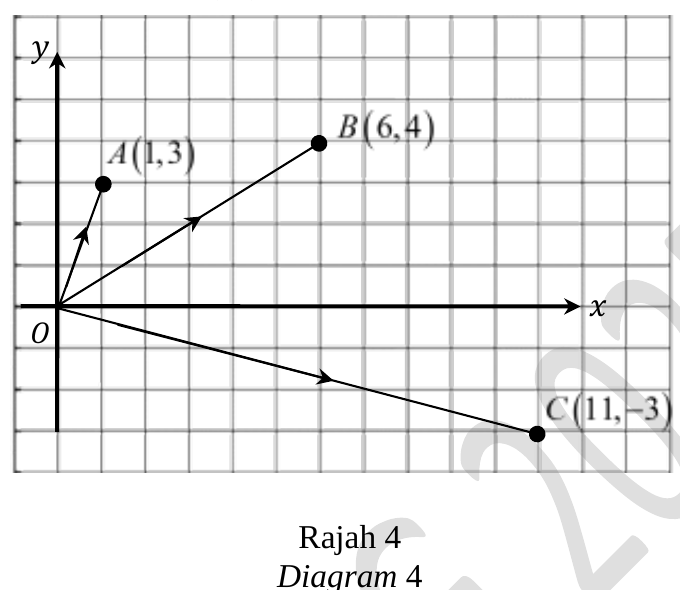
- (a)(i)
On Diagram 4, mark and label the coordinates of E.
[1] - (a)(ii)
State CE.
[1] - (b)
Given AN = m**i** − 3**j**, such that m is a constant and AN is parallel to CE, by using vectors find the value of m.
[3]
Diagram 6 shows a quadrilateral PQRS. The straight line PR intersects the straight line QS at point T. It is given that QT : TS = 2 : 3, PQ = 10**u**, PS = 25**v** and QR = −**u** + 15**v** (vectors PQ, PS, QR). (a) Express in terms of **u** and **v** (i) QS, (ii) PT. (b)(i) Find the ratio PT : TR. (ii) Hence, find the area of triangle STR, given that the area of triangle PSR is 6.05 units².
Medium10 marks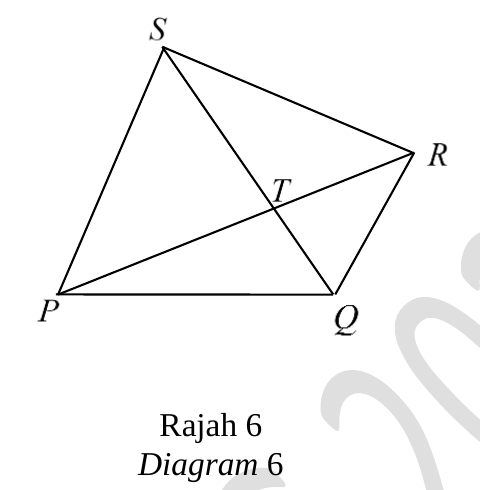
- (a)(i)
Express QS in terms of **u** and **v**.
[1] - (a)(ii)
Express PT in terms of **u** and **v**.
[2] - (b)(i)
Find the ratio PT : TR.
[4] - (b)(ii)
Hence, find the area of triangle STR, given that the area of triangle PSR is 6.05 units².
[3]
Diagram 9 shows the positions and directions of Ahmad's and Ben's sailing boats in a competition. The water velocity is v = (2i + ½j) m s⁻¹. Ahmad and Ben sail with velocities a = (5i + 3j) m s⁻¹ and b = (3i + 2j) m s⁻¹ respectively. Both boats move in the direction of the water current.
Medium6 marks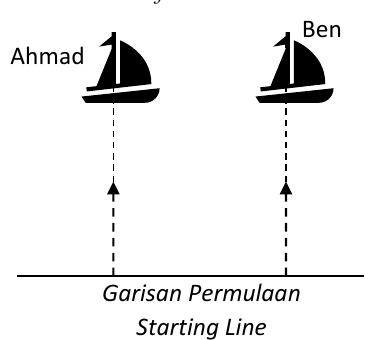
- (a)
How many times is the resultant velocity of Ahmad's boat compared to the resultant velocity of Ben's boat?
[4] - (b)
Chong's boat moves off track with velocity c = (3i − 3/2 j) m s⁻¹. Find the resultant velocity and the magnitude of the velocity of Chong's boat.
[2]
Diagram 1 shows triangle ABC. Points P and Q lie on BC and AC respectively. Given BP→ = 4x, BA→ = 20y, BP : PC = 1 : 2 and AQ : AC = 3 : n, where n is a constant.
Medium6 marks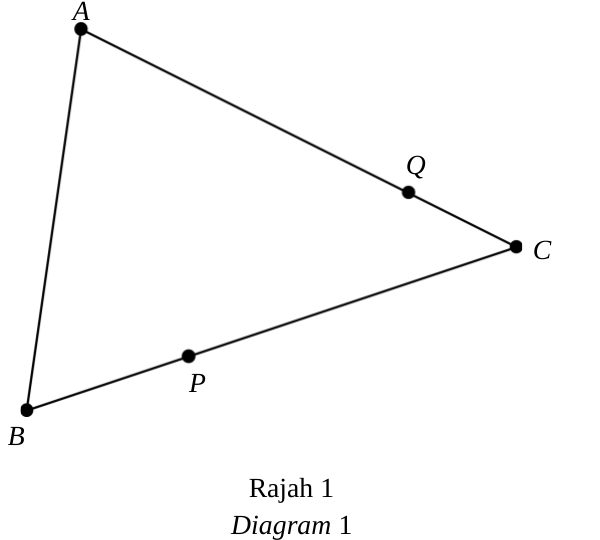
- (a)
Find the value of n if CQ→ = −3x + 5y.
[3] - (b)
Given x = 3i and y = i − 3/5 j, find the unit vector in the direction of CA→.
[3]
A swimmer swims with velocity v = (2.3, 1.4) (column vector). There is a current that flows with velocity a = (0.6, −2.0). Find the magnitude and direction of the swimmer's resultant velocity.
Easy4 marksFind the magnitude and direction of the swimmer's resultant velocity.
[4]
Diagram 3 shows ABCD is a quadrilateral. The diagonals BD and AC intersect at point R. Point P lies on AD. Given AB→ = **x** and DP→ = 2**y**. Given AP→ = ⅓AD→ and BR→ = ⅓BD→. (a) Express AR→ and PR→ in terms of **x** and **y**. (b) Given DC→ = k**x** − **y** and AR→ = hAC→ where h and k are constants, find the value of h and of k.
Medium8 marks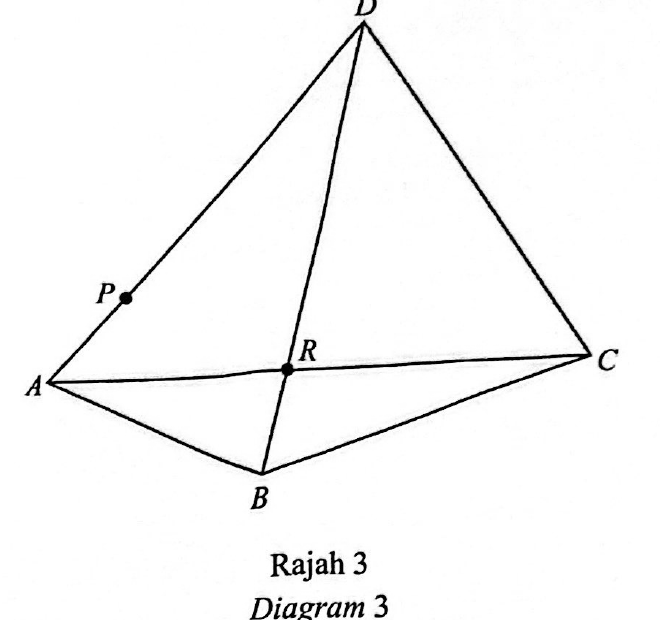
- (a)
Express AR→ and PR→ in terms of **x** and **y**.
[3] - (b)
Find h and k.
[5]
Diagram 6 shows roads of a village forming quadrilateral PQRS. A mosque M is at the junction of SQ and PR. Kamal's house K is on road SP. Given SP = 4SK and PM : MR = 3 : 1, road SR is represented by vector x and road SP by vector 4y. (a) Express in terms of x and y: (i) KR→, (ii) SM→. (b) Given PQ→ = px − 2y and SM→ = qSQ→ where p and q are constants, find p and q.
Medium7 marks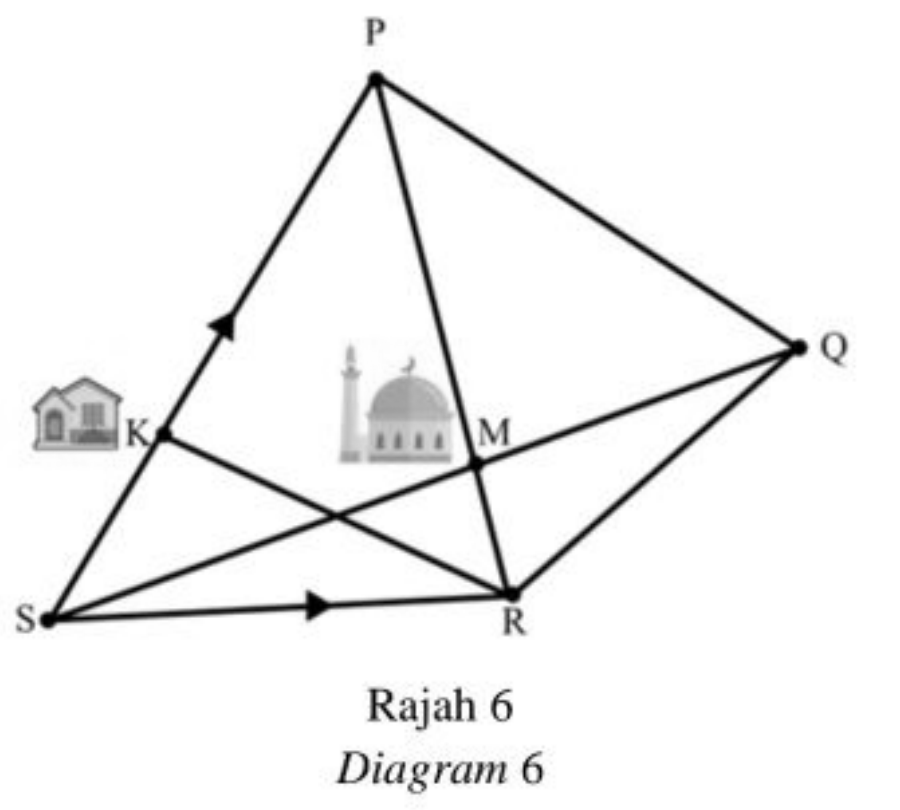
- (a)(i)
Express KR→ in terms of x and y.
[1] - (a)(ii)
Express SM→ in terms of x and y.
[2] - (b)
Find the values of p and q.
[4]
Solution by scale drawing is not accepted. Diagram 2 shows the map of a tropical forest. O is the ranger hut; A, B, C, D, E are wildlife observatories. A is 300 m from O and B is 540 m from O in the direction of OA. D is 320 m from O and E is 480 m from D in the direction of OD. A, C and E lie on a straight line with 3AC = 2CE. (a) Using x to represent 60 m in the direction of OA and y to represent 80 m in the direction of OD, express in terms of x and y: (i) AE→, (ii) BC→. (b) If a ranger uses a binocular to observe B from D, determine whether B can be seen without being blocked by C. Prove your answer mathematically.
Medium7 marks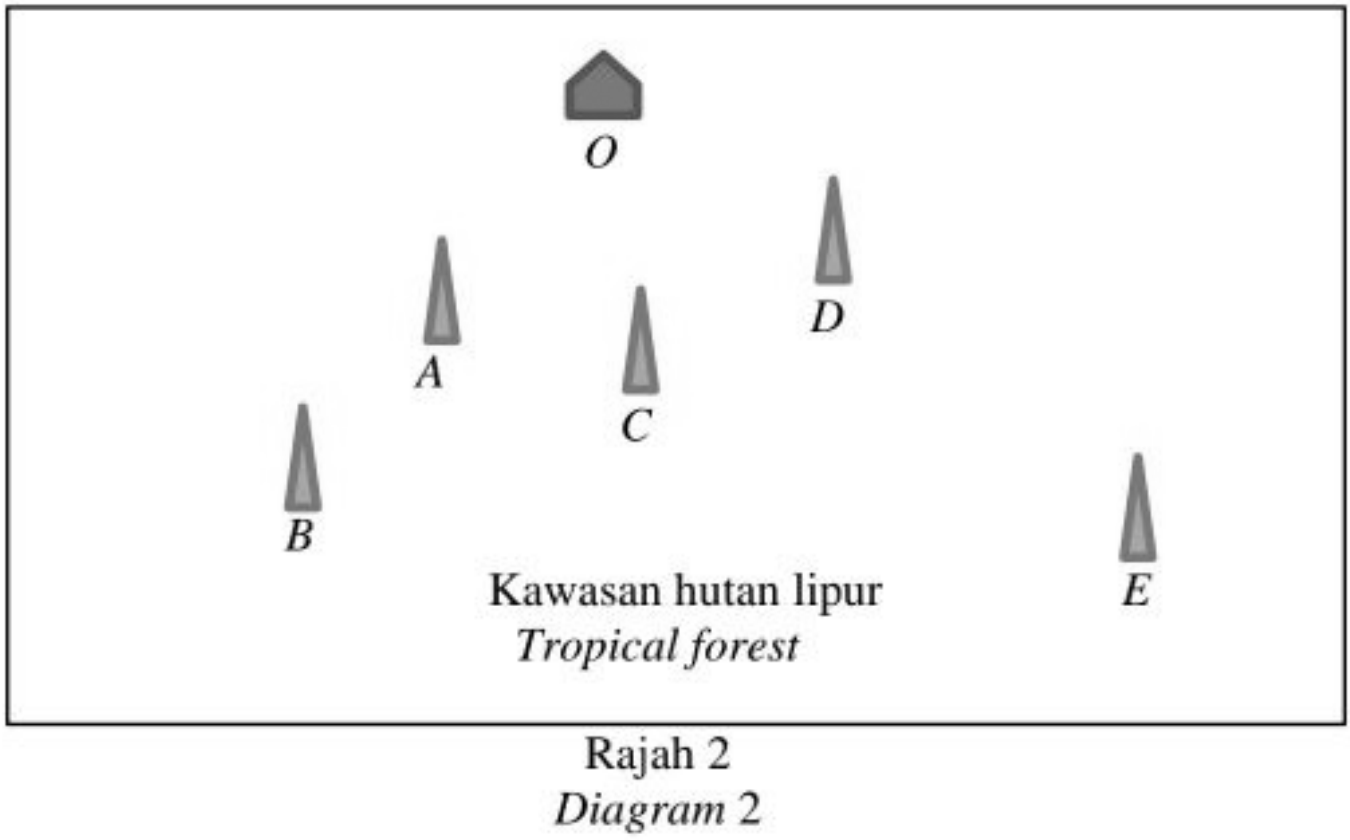
- (a)(i)
Express AE→ in terms of x and y.
[1] - (a)(ii)
Express BC→ in terms of x and y.
[2] - (b)
Determine whether B can be seen from D without being blocked by C; prove mathematically.
[4]
(a) Points O(0, 0), A(3, −1), B(−2, p) and C(5, 3). (b) Diagram 13 shows vectors OP and OQ on a Cartesian plane, P(3, 4) and Q(−7, 6).
Medium8 marks- (a)
Find the value of p if OA→ is parallel to AB→.
[4] - (b)(i)
State OP→ in the form xi + yj.
[1]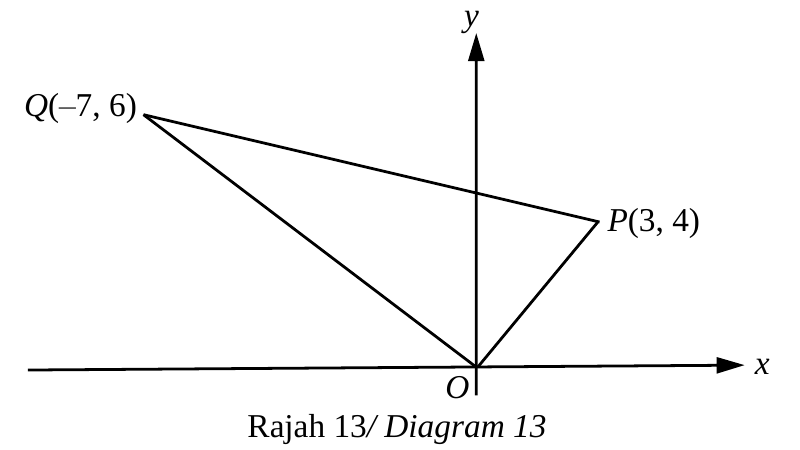
- (b)(ii)
Express PQ→ in the form (x, y) as a column vector.
[1] - (b)(iii)
Hence, find the unit vector of PQ→.
[2]
Diagram 3 shows quadrilateral ABCD. AB→ = 4y, BC→ = 3x, and M lies on AC such that AM = 2MC.
Medium7 marks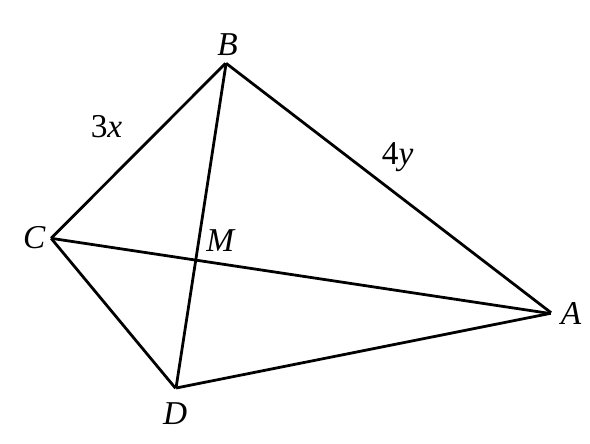
- (a)
Express in terms of x and/or y: (i) AM→ (ii) BM→.
[3] - (b)
Using BD→ = hBM→ and DC→ = kAB→, where h and k are constants, find the values of h and k.
[4]
(a) Given p = (3, 4) and q = (6, 2k − 1) (column vectors), find the value of k such that p and q are parallel. (b) ABCD is a parallelogram. T is the midpoint of BC. Given AB→ = 2i + 3j and AT→ = i + j, where i and j are unit vectors parallel to the x-axis and y-axis. Find (i) AD→ in terms of i and/or j, (ii) the length of DT.
Medium8 marks- (a)
Find k such that p and q are parallel.
[3] - (b)(i)
Find AD→ in terms of i and/or j.
[2] - (b)(ii)
Find the length of DT.
[3]
Diagram 3 shows a rectangle PQRS. T is a point which lies on QS such that QS = 4QT. (a) Given QP→ = 15x and QS→ = 15x + 7y, express the following vectors in terms of x and y: (i) QT→, (ii) PT→. (b) Given that the straight line PT is extended to the point U such that PU→ = −9x + ky, find the value of k.
Medium7 marks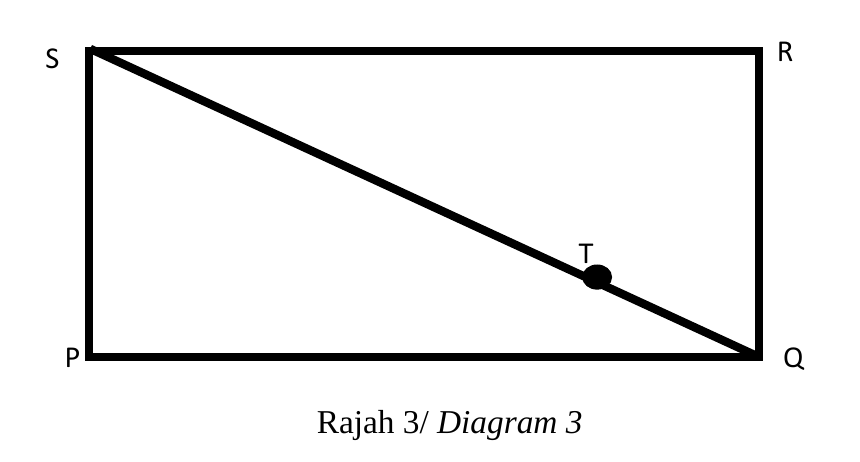
- (a)(i)
Express QT→ in terms of x and y.
[1] - (a)(ii)
Express PT→ in terms of x and y.
[2] - (b)
Find k.
[4]
Diagram 11 shows Ainul and Juliana wanting to swim from point A to point B across a river 15 m wide. (a) Ainul swims with constant velocity V = 13i − 8j m s⁻¹. There is a constant current U = 2i m s⁻¹ to the right. Find (i) the magnitude of Ainul's velocity, (ii) the unit vector in the direction of Ainul's velocity. (b) Juliana swims with constant speed V = 3.0 m s⁻¹. There is a constant current U = 2.0 m s⁻¹ to the right. (i) Find the resultant vector of Juliana's velocity. (ii) How far is Juliana from B when she reaches the other side of the river?
Medium7 marks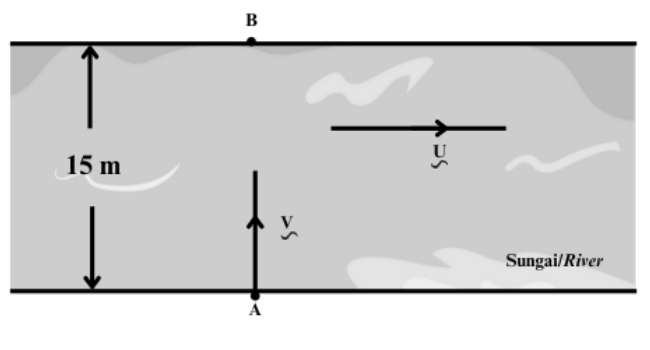
- (a)
(i) Magnitude of Ainul's velocity. (ii) Unit vector in the direction of Ainul's velocity.
[4] - (b)
(i) Resultant vector of Juliana's velocity. (ii) Distance of Juliana from B on reaching the other side.
[3]
Diagram 3 shows roads of a housing area forming a rectangle OABC. House D is on road OB and house E is on road OA with OD = (3/4)OB and OE : OA = 1 : 2. House Y is on road AB extended with BY = (1/2)AB. Road OA is represented by vector 8a and road OC by vector 8b. (a) Express in terms of a and b the vectors (i) OY, (ii) ED. (b) Prove that houses E, D and Y lie on the same straight line.
Medium7 marks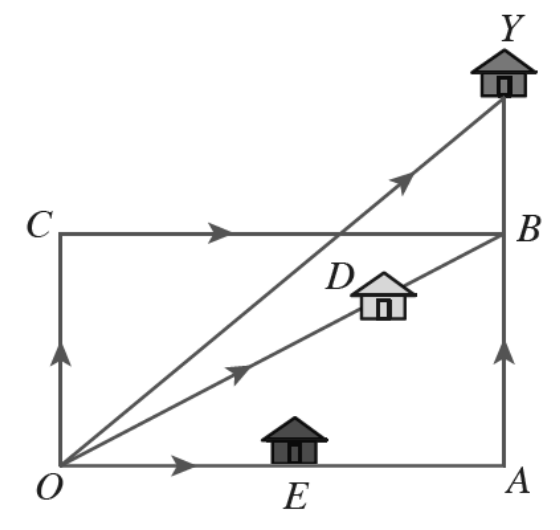
- (a)
Express (i) OY and (ii) ED in terms of a and b.
[3] - (b)
Prove that E, D and Y are collinear.
[4]
ABC is a triangle. The coordinates of A are (−4, 1), AC→ = 6i + 3j and BC→ = −2i + 6j. (a) Using the triangle law of vectors, find the coordinates of the midpoint of line BC. (b) Determine the unit vector in the direction of AC→.
Easy6 marks- (a)
Using the triangle law of vectors, find the coordinates of the midpoint of line BC.
[4] - (b)
Determine the unit vector in the direction of AC→.
[2]
Diagram 6 shows that PQR is a straight line such that PR = 4PQ. Point T on line SQ is such that SQ = 3TQ. Point U on line SR is such that SR = 3SU. Given PQ→ = x and PS→ = y. (a) Express PU→ and PT→ in terms of x and y. (b) Determine whether points P, T and U are collinear or not.
Medium7 marks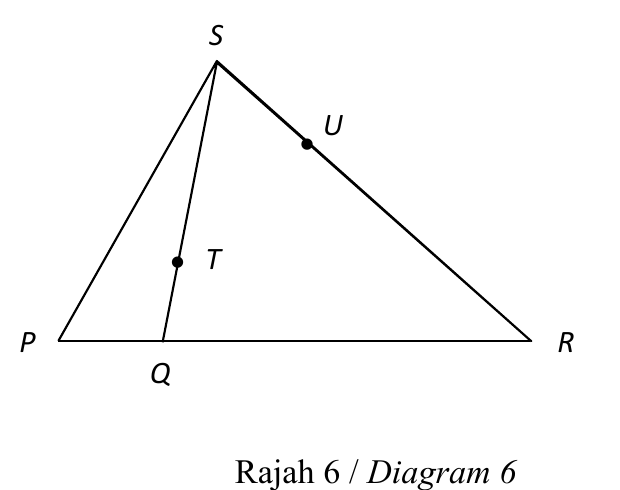
- (a)
Express PU→ and PT→ in terms of x and y.
[4] - (b)
Determine whether points P, T and U are collinear or not.
[3]
(a) Diagram 14(a) shows vector OA drawn on a Cartesian plane (O at the origin, A at (10, 5)). (b) Diagram 14(b) shows a parallelogram ODEF drawn on a Cartesian plane. (c) It is given that vector r = (8, −2) and vector s = (h, 7), where h is a constant.
Medium8 marks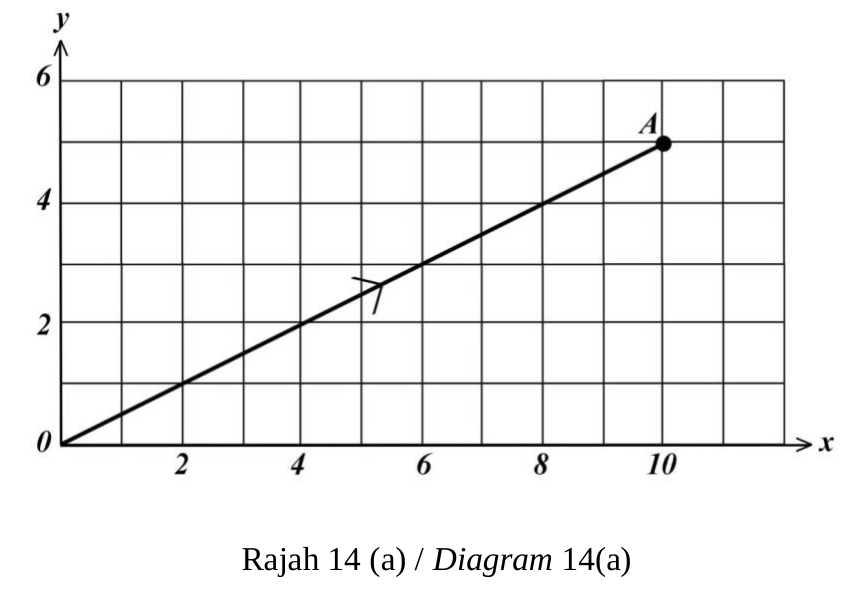
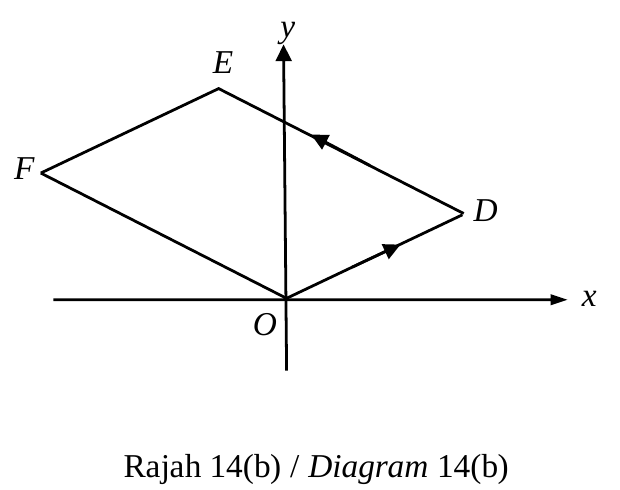
- (a)(i)
Express OA→ in the form (x, y) (column vector).
[1] - (a)(ii)
Find the unit vector in the direction of OA→.
[1] - (b)
It is given that OD→ = 3i + 2j and DE→ = −5i + 3j. Find DF→.
[3] - (c)(i)
Express vector r + s in terms of h.
[1] - (c)(ii)
Given |r + s| = 13 units, find the positive value of h.
[2]
Diagram 10 shows a parallelogram ABCD. Point P lies on the straight line BC and point Q lies on the straight line AD. The straight line CQ is extended to the point R such that CQ = 2QR. It is given that BP : PC = 1 : 3, AQ : QD = 1 : 3, CP→ = 6u and CD→ = v. (a) Express, in terms of u and v, (i) CQ→, (ii) PA→. Hence, show that the points P, A and R are collinear. (b) It is given that u = −3i and v = −2i + 5j. (i) Express PA→ in terms of i and j. (ii) Find the unit vector in the direction of PA→. (u, v, i, j are vectors, written with a tilde under the letter in the paper.)
Medium10 marks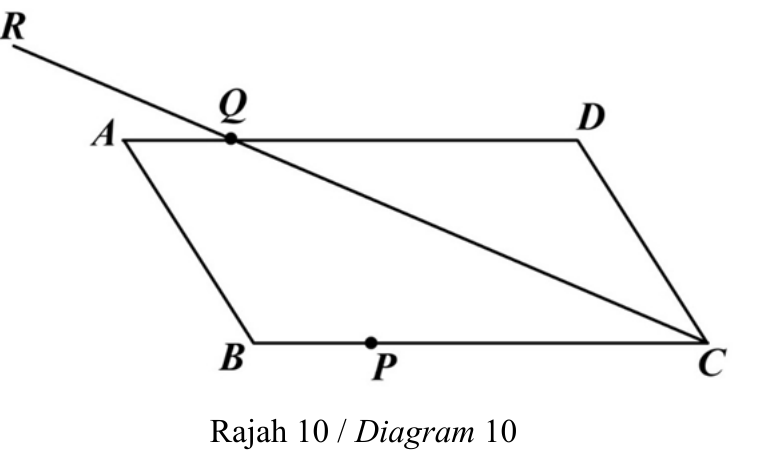
- (a)(i)
Express CQ→ in terms of u and v.
[2] - (a)(ii)
Express PA→ in terms of u and v. Hence, show that the points P, A and R are collinear.
[4] - (b)(i)
Express PA→ in terms of i and j.
[2] - (b)(ii)
Find the unit vector in the direction of PA→.
[2]
Diagram 12 shows a triangle ABC with AC→ = 2a and AB→ = 8b (D on AB, E on BC). (a) Find BC→ in terms of a and b. (b) Given AB = 4DB and BE = EC, find DE→ in terms of a and b.
Easy5 marks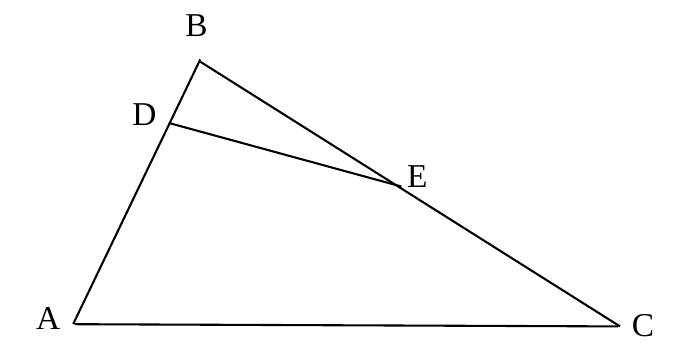
- (a)
Find BC→ in terms of a and b.
[2] - (b)
Find DE→ in terms of a and b.
[3]
Section B: answer any three questions. Diagram 8 shows the locations of the bookshop (B), computer shop (C), park (P), shopping mall (S) and public library (L) in a town. The vector from the bookshop to the public library is 12x and the vector from the bookshop to the shopping mall is 16x + 10y. T is the intersection junction between the straight roads BC and LS. Given the distance of the public library from the bookshop is 3 times that from the park (BL : LP = 3 : 1). The computer shop is in the middle between the shopping mall and the park on the straight road PS. (a) Find the vector, in terms of x and y, from (i) the public library to the shopping mall, (ii) the bookshop to the computer shop. (b) Find BT : TC. Given BT→ = λ BC→ and LT→ = k LS→.
Medium10 marks- (a)(i)
Find the vector from the public library to the shopping mall.
[2]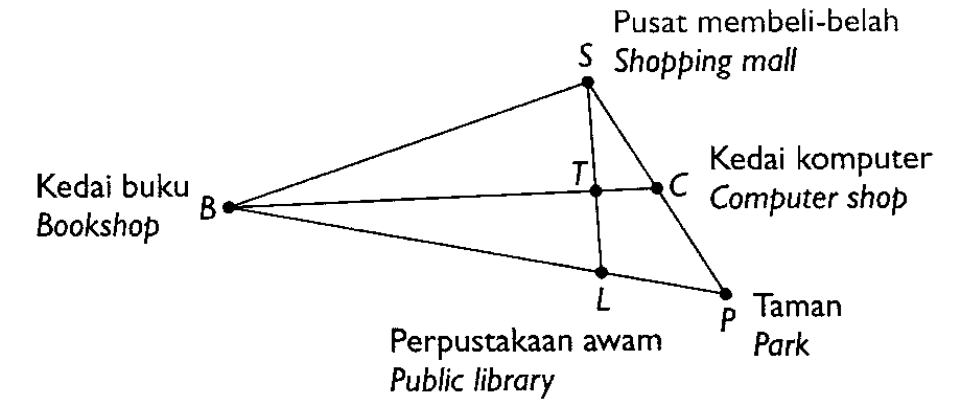
- (a)(ii)
Find the vector from the bookshop to the computer shop.
[3] - (b)
Find BT : TC.
[5]
It is given that u = (m + 1, −9) and w = (m, 1) as column vectors, where m is a constant. (a) Express the vector u + w in terms of m. (b) Given |u + w| = 10 units, find the values of m.
Easy6 marks- (a)
Express the vector u + w in terms of m.
[2] - (b)
Given |u + w| = 10 units, find the values of m.
[4]
In the diagram, ABCD is a quadrilateral. AFE and BFD are straight lines. It is given that AB→ = 2x, AD→ = y, CD→ = −3x − ½y, 2BC→ = AE→. (a) Express in terms of x and/or y (i) BD→, (ii) AE→. (b) Using AF→ = hAE→ and BF→ = kBD→, where h and k are constants, find the values of h and k.
Medium8 marks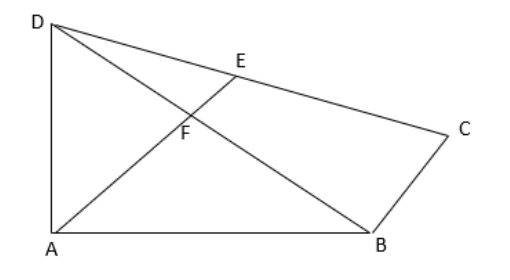
- (a)
Express in terms of x and/or y: (i) BD→, (ii) AE→.
[3] - (b)
Using AF→ = hAE→ and BF→ = kBD→, find h and k.
[5]
(a) a = (6, m − 1) and b = (3, 7) are column vectors. Given a = kb such that a is parallel to b and k is a constant, find the value of k and of m. (b) Given vector p = (7, −1) and vector q = (h, 3), where h is a constant, (i) express the vector p + q in terms of h, (ii) given |p + q| = √148 units, find the possible values of h.
Easy5 marks- (a)
Given a = kb with a = (6, m − 1), b = (3, 7), find the value of k and of m.
[2] - (b)(i)
Express the vector p + q in terms of h.
[1] - (b)(ii)
Given |p + q| = √148 units, find the possible values of h.
[2]
Diagram 3 shows a rectangle ABCD. The straight lines AE and BF intersect at point T (E is on DC, F is on AD). It is given that AB→ = 25x, AD→ = 18y, AD = 3FD and DE : EC = 3 : 2. (a) Express AE→ in terms of x and y. (b) Given AT→ = hAE→ and BT→ = kBF→, where h and k are constants, (i) express AT→ in terms of h, x and y, (ii) express BT→ in terms of k, x and y, (iii) hence, find the values of h and of k.
Medium8 marks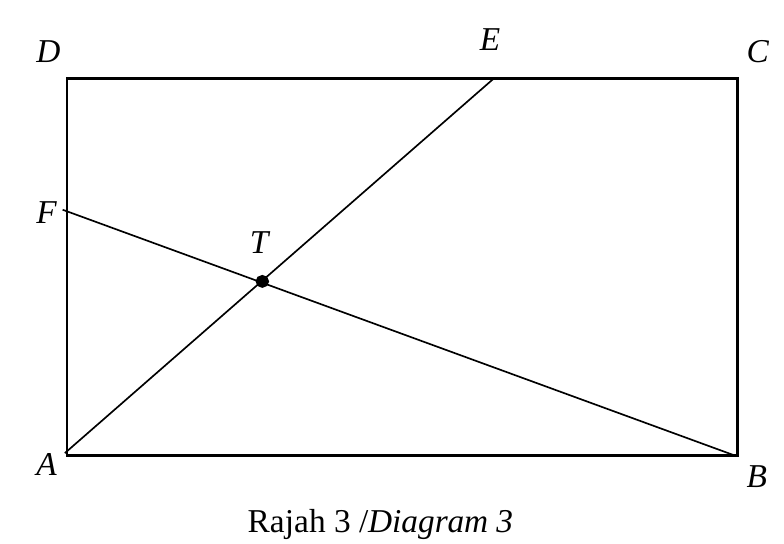
- (a)
Express AE→ in terms of x and y.
[2] - (b)(i)
Express AT→ in terms of h, x and y.
[1] - (b)(ii)
Express BT→ in terms of k, x and y.
[2] - (b)(iii)
Hence, find the values of h and of k.
[3]
It is given that m = (−12, 9) and n = (10, p + 2) (column vectors). (a) Find |m|. (b) Find the value of p such that m + n is parallel to the x-axis. (c) x and y are non-zero vectors and not parallel. Given (p + q − 3)x = (4 + q)y, where p and q are constants, find the values of p and q.
Easy6 marks- (a)
Find |m|.
[2] - (b)
Find p so that m + n is parallel to the x-axis.
[2] - (c)
Find p and q.
[2]
The information refers to Diagram 1: OA = 4a, OB = 8b (vectors), AP = α AN, OA = 2MA, ON : OB = 5 : 8 (M is on OA, N is on OB, P is the intersection of AN and MB). (a) Express (i) MB in terms of a and b, (ii) AP in terms of α, a and b, (iii) MP in terms of α, a and b. (b) Given M, P and B are collinear, find the value of α.
Medium8 marks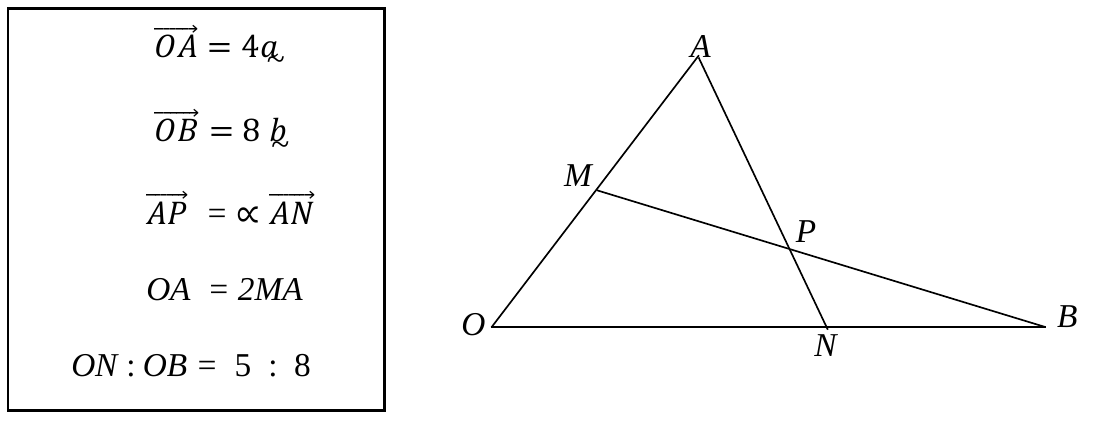
- (a)(i)
Express MB in terms of a and b.
[2] - (a)(ii)
Express AP in terms of α, a and b.
[2] - (a)(iii)
Express MP in terms of α, a and b.
[1] - (b)
Find α given M, P, B are collinear.
[3]
The points F, G and H are collinear. It is given that FG→ = 6p − 4q and GH→ = 4p − (2u − 1)q, where u is a constant. (a) Find the value of u. (b) Given the magnitude of FG→ is 6 units, find the magnitude of FH→.
Easy5 marks- (a)
Find the value of u.
[3] - (b)
Given |FG→| = 6 units, find |FH→|.
[2]
Solution by scale drawing is not accepted. Diagram 10 shows the position vectors of two boats, A and B, relative to the fixed point O, which are −2i + 8j and −qi − 2j respectively. Boat A moves with a velocity of (4i + pj) m min⁻¹ and boat B moves with a velocity of (3i − j) m min⁻¹ at the same time. (a) Given boat A moves with a speed of 5 m min⁻¹, find the value of p where p < 0. (b) Find the direction of boat A that moves with a velocity of (4i + pj) m min⁻¹, correct to the nearest degree. (c) Find the time taken in minutes, when boat A meets boat B. Hence, find the position vector where the two boats meet.
Hard10 marks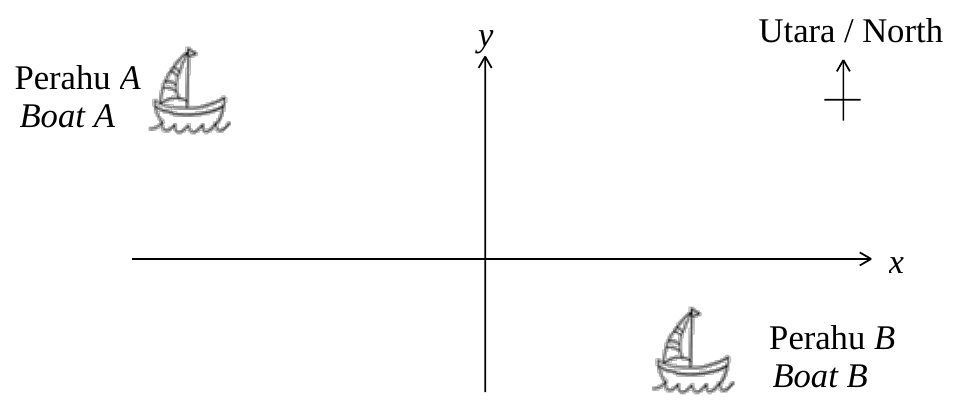
- (a)
Boat A has speed 5 m min⁻¹; find p (p < 0).
[2] - (b)
Find the direction of boat A, to the nearest degree.
[3] - (c)
Find the time when A meets B and the position vector of the meeting point.
[5]
Given the points P(1, p − 1) and R(9, 8), find the possible value/values of p for each case: (a) OP→ and OR→ are parallel. (b) |OP→| = |OR→|.
Easy4 marks- (a)
OP→ and OR→ are parallel.
[2] - (b)
|OP→| = |OR→|.
[2]
Diagram 8 shows a parallelogram OABC with B(5, 9). Given O is the origin and AB→ = 15**i** + 3**j**. (a) Find (i) the unit vector parallel to AB→, (ii) the coordinates of C. (b) D is a point such that BD→ = h**i** + (k − 2)**j**. If A, B and D are collinear, express k in terms of h.
Medium10 marks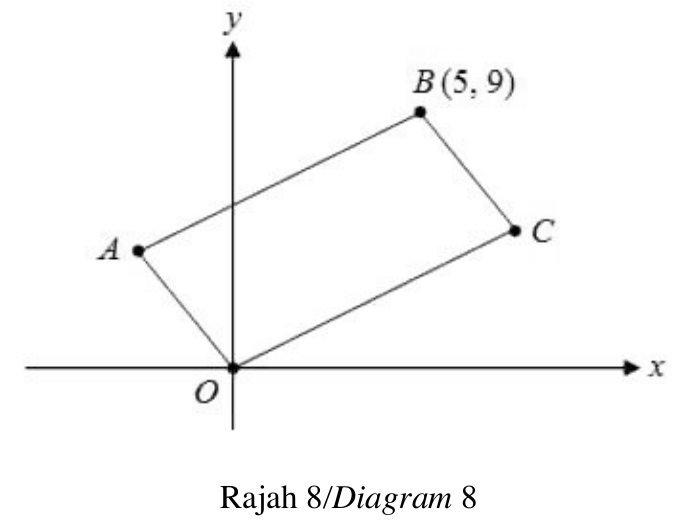
- (a)(i)
Find the unit vector parallel to AB→.
[2] - (a)(ii)
Find the coordinates of C.
[4] - (b)
If A, B, D are collinear, express k in terms of h.
[4]
Diagram 5 shows an isosceles triangle ABC such that BC = BA, AB→ = [[6], [8]] (column vector), point B = (3, 2) and C = (k, −4). Find AC→ in terms of i and of j.
Easy4 marks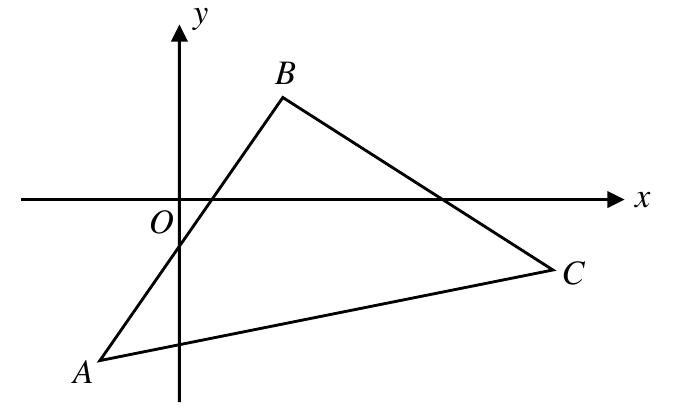
Find AC→ in terms of i and of j.
[4]
Section B: answer three questions. Diagram 8 shows parallelogram PQRS and point S is the midpoint of straight line PST. Given that ST→ = a, PQ→ = 2b and TU→ = (3/2)PQ→. (Points: T and U lie on the line below SR, so that P, S, T are collinear and R lies on QU.)
Medium10 marks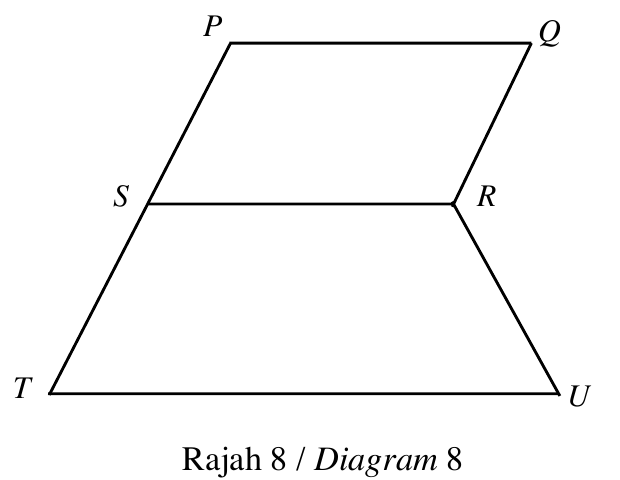
- (a)(i)
Express PU→ in terms of a and b.
[2] - (a)(ii)
Express QU→ in terms of a and b.
[1] - (b)
Determine whether the points P, R and U are collinear.
[3] - (c)
Given a = −2i − nj and b = nj and the unit vector for QU→ = (2/√m)(−2i + 2j), find the values of m and n.
[4]
Diagram 3 shows a triangle OAC with B on CA. Given that BC→ = (2/3) AB→, BO→ = x and AB→ = y (vectors x and y). (a) Express CO→ in terms of x and/or y. (b) Hence, find the unit vector in the direction of OC→ if x = (2, −3) and y = (−3, 0) (column vectors).
Easy5 marks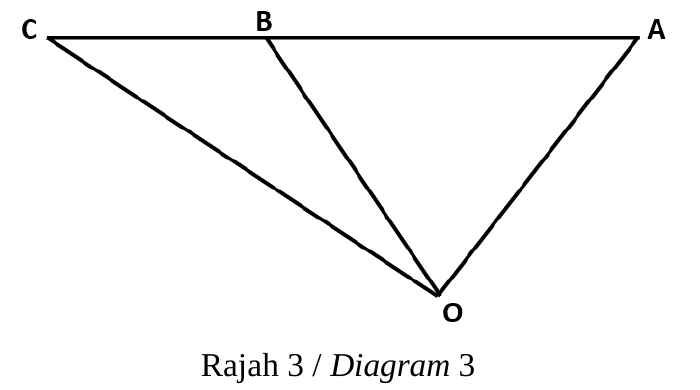
- (a)
Express CO→ in terms of x and/or y.
[2] - (b)
Hence, find the unit vector in the direction of OC→ if x = (2, −3) and y = (−3, 0).
[3]
Diagram 10 shows a quadrilateral PQRS with K on PS and L the intersection of PR and SQ. It is given that PK→ = 2x, PQ→ = 3y, PK : PS = 1 : 3 and 2QL = LS. (a) Express in terms of x and/or y: (i) SQ→, (ii) PL→. (b) Given that SR→ = 2ay − 2x and PR→ = (1/b) PL→, such that a and b are constants, find (i) SR→ in terms of b, x and y, (ii) the value of a and of b. (c) Given the area of triangle PQS is 120 unit², and the perpendicular distance from Q to PS is 5 unit, find |x|.
Medium10 marks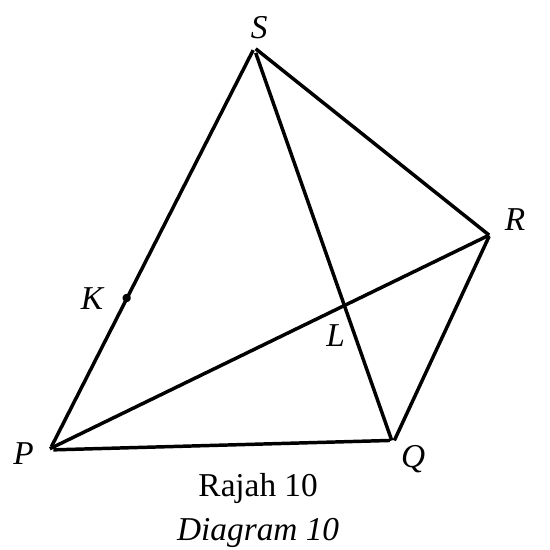
- (a)(i)
Express SQ→ in terms of x and/or y.
[1] - (a)(ii)
Express PL→ in terms of x and/or y.
[2] - (b)(i)
Find SR→ in terms of b, x and y.
[2] - (b)(ii)
Find the value of a and of b.
[3] - (c)
Find |x|.
[2]
Diagram 1 shows OQ→ = a and OP→ = b on a square grid of sides 1 unit. Express in terms of a and/or b: (a) OR→ (b) RS→
Easy2 marks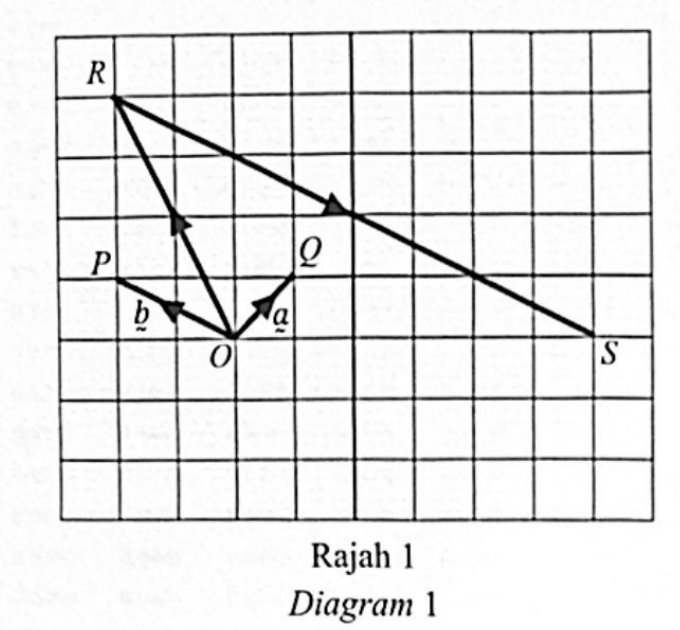
- (a)
OR→
[1] - (b)
RS→
[1]
The following information refers to the vectors m and n: m = [[2], [k]] (column vector), n = [[3], [11]] (column vector). Find the value of k if vector 2m + n is parallel to [[1], [−1]]. [3 marks]
Easy3 marksFind the value of k if 2m + n is parallel to [[1], [−1]].
[3]
Diagram 7 shows two triangles POQ and SOQ. Straight line OS intersects the straight line PQ at point R. Given OP→ = x, OQ→ = 2y and OP→ = 2QS→. (a) Express in terms of x and/or y (i) OS→, (ii) PQ→. (b) Given OR→ = mOS→ and PR→ = nPQ→, express OR→ in terms of (i) m, x and/or y, (ii) n, x and/or y. Hence, find the values of m and n. (c) Given |x| = 3 units and |y| = 5 units, find |PQ→|.
Medium10 marks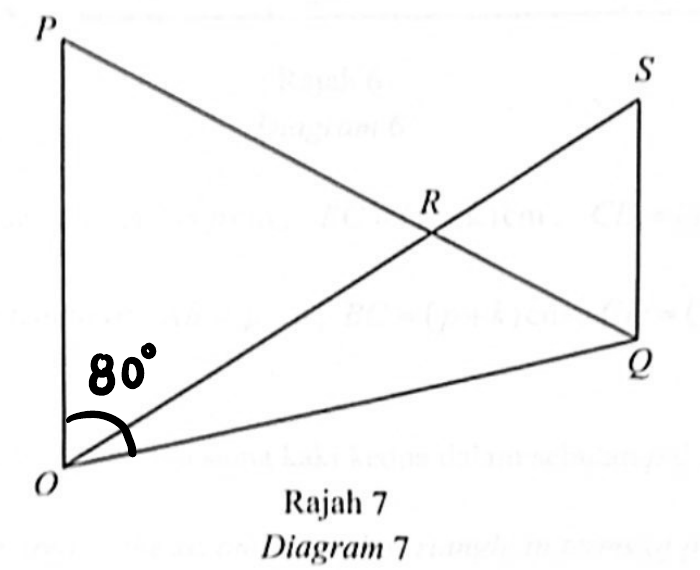
- (a)(i)
Express OS→ in terms of x and/or y.
[2] - (a)(ii)
Express PQ→ in terms of x and/or y.
[1] - (b)(i)
Express OR→ in terms of m, x and/or y.
[1] - (b)(ii)
Express OR→ in terms of n, x and/or y.
[2] - (b)
Hence, find the values of m and n.
[2] - (c)
Given |x| = 3 units and |y| = 5 units, find |PQ→|.
[2]
The coordinates of points A and B are (−4, 2) and (m, 3m − 1) respectively. (a) State the value of |AO→ − BO→ + BA→|. (b) Using vector's triangle law, find AB→ in terms of m. (c) It is given that the unit vector in the direction of AB→ is 1/15 times of AB→. Determine the unit vector in the direction of AB→. Hence, find the value of m such that m > 0.
Medium6 marks- (a)
State the value of |AO→ − BO→ + BA→|.
[1] - (b)
Using vector's triangle law, find AB→ in terms of m.
[2] - (c)
Determine the unit vector in the direction of AB→. Hence, find the value of m such that m > 0.
[3]
Diagram 1 shows trapezium SPQR and point T lies on PR. It is given that SR→ = 10b, SP→ = 8a, SR : PQ = 2 : 1 and PT : PR = 1 : 3.
Medium6 marks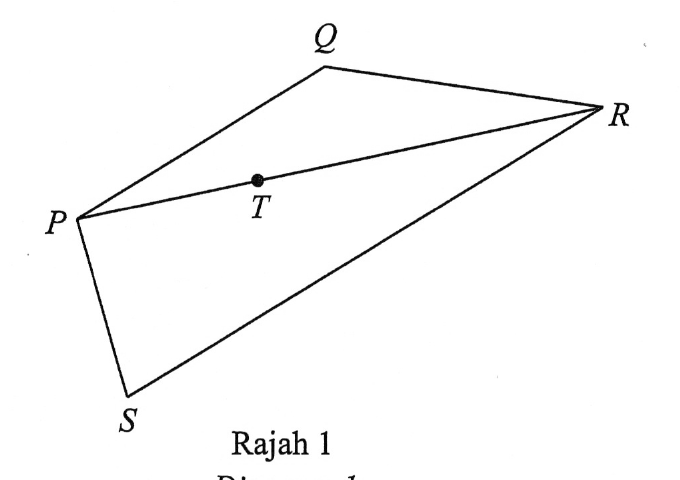
- (a)
Express SQ→ in terms of a and b.
[2] - (b)(i)
If ST→ = hSQ→, express ST→ in terms of h, a and b.
[1] - (b)(ii)
Find the value of h if the points S, T and Q are collinear.
[3]
In Diagram 3, OPQ is a triangle with OP→ = 5x and OQ→ = y. R and S are two points that lie on the line OP and PQ respectively with condition OR→ = (3/5) OP→ and PS→ = (2/3) PQ→. Express (a) OS→ in terms of x and y, (b) the unit vector in the direction of RS→ in terms of x and y.
Easy5 marks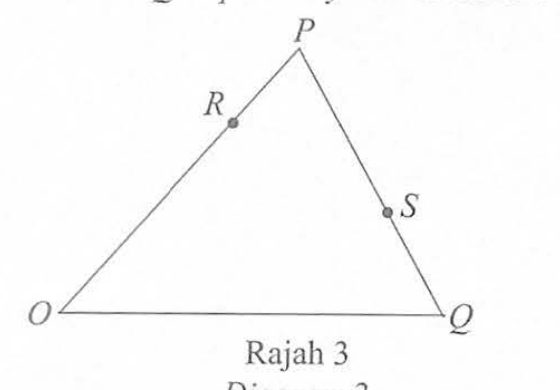
- (a)
Express OS→ in terms of x and y.
[2] - (b)
Express the unit vector in the direction of RS→ in terms of x and y.
[3]
Diagram 1 shows two triangles, PQR and PRS. The straight line PS intersects the straight line QR at T. It is given that PR→ = 8x, PQ→ = 6y and RS→ = 2y. (a) Find (i) PS→, (ii) QR→. (b) Given PT→ = h PS→ and QT→ = k QR→, express PT→ in terms of (i) h, x and y, (ii) k, x and y. (c) By using PT→ from 3(b), find the value of h and k.
Medium8 marks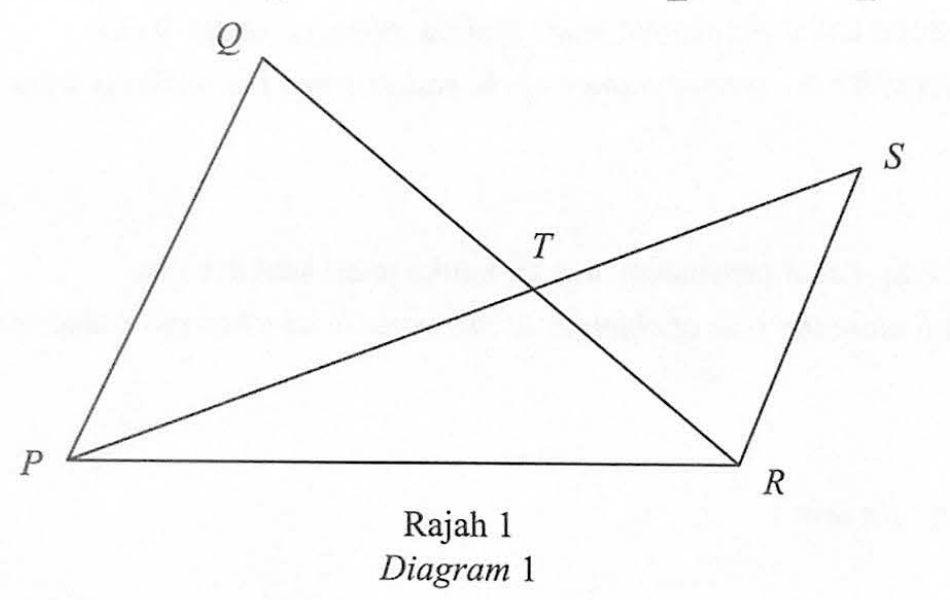
- (a)(i)
Find PS→.
[1] - (a)(ii)
Find QR→.
[1] - (b)(i)
Given PT→ = h PS→, express PT→ in terms of h, x and y.
[1] - (b)(ii)
Given QT→ = k QR→, express PT→ in terms of k, x and y.
[2] - (c)
By using PT→ from 3(b), find the value of h and k.
[3]
Diagram 2 shows triangle ABC. K is a point on line BC such that BK : KC = n : 2. Given that AB→ = 3x and AC→ = 6y. Express vector (a) BC→ in terms of x and y, (b) AK→ in terms of n, x and y.
Easy4 marks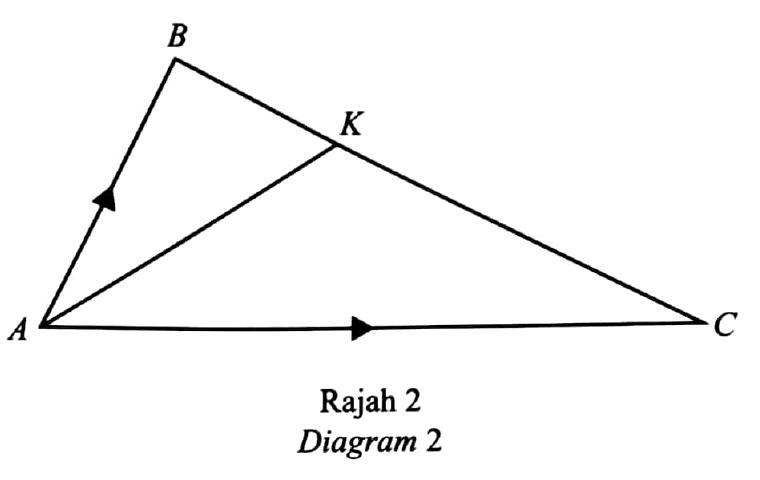
- (a)
Express vector BC→ in terms of x and y.
[1] - (b)
Express vector AK→ in terms of n, x and y.
[3]
Diagram 1 shows a triangle OPQ on a Cartesian plane and O is the origin. Given that R and S lie on the straight line OQ and PQ respectively where OR : RQ = 2 : 1 and QS = 5SP. It is given that OP→ = 6i and OR→ = 2i + 4j.
Medium8 marks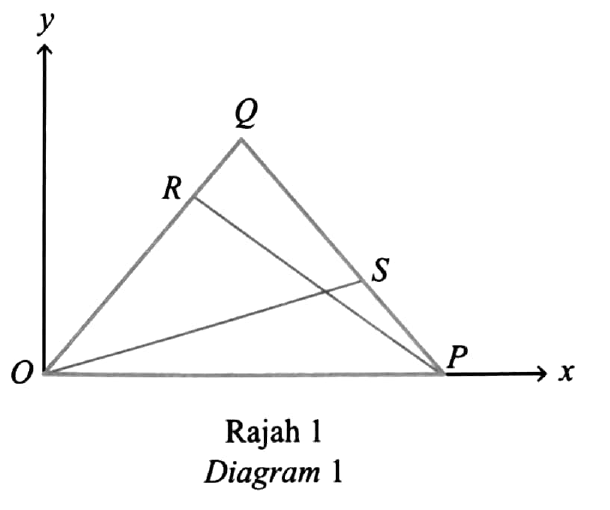
- (a)
Find the coordinates of the point: (i) Q, (ii) S.
[4] - (b)
Determine the unit vector in the direction of vector RS→. Give your answer in the simplest surd form.
[4]
Diagram 11 shows triangle ABC. Point P lies on AC and point Q lies on BC. R lies on AB extended. It is given that AC→ = 2a, AB→ = 2b, AP→ = (2/3)AC→ and PQ→ = −(8/15)a + (6/5)b. (a) AB is extended to R such that AR→ = λAB→, λ constant. Express PR→ in terms of λ, a and b. (b) Given P, Q and R are collinear, find (i) the value of λ, (ii) the ratio PQ : QR.
Medium5 marks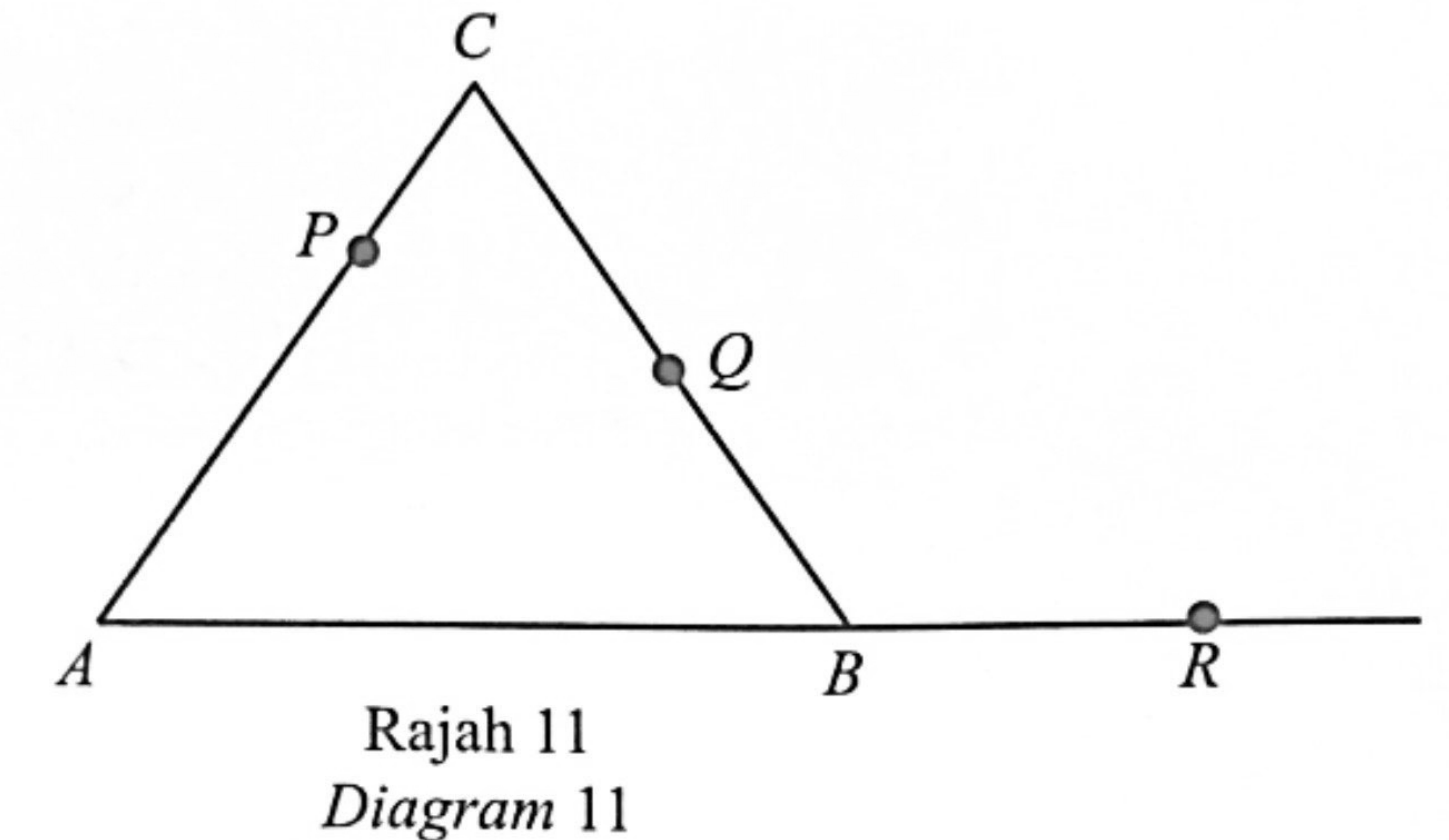
- (a)
Express PR→ in terms of λ, a and b.
[2] - (b)(i)
Given P, Q and R are collinear, find the value of λ.
[2] - (b)(ii)
Find the ratio PQ : QR.
[1]
Solutions by scale drawing is not accepted. Diagram 8 shows positions for three points in a Cartesian plane: A(1, 1), B(−2, 3), C(−6, 6). (a) Find (i) AB→ and AC→, (ii) the unit vector in the direction BC→. (b) Given AD→ = ki − 15j, where k is a constant and AD→ is parallel to BC→, find the value of k.
Medium10 marks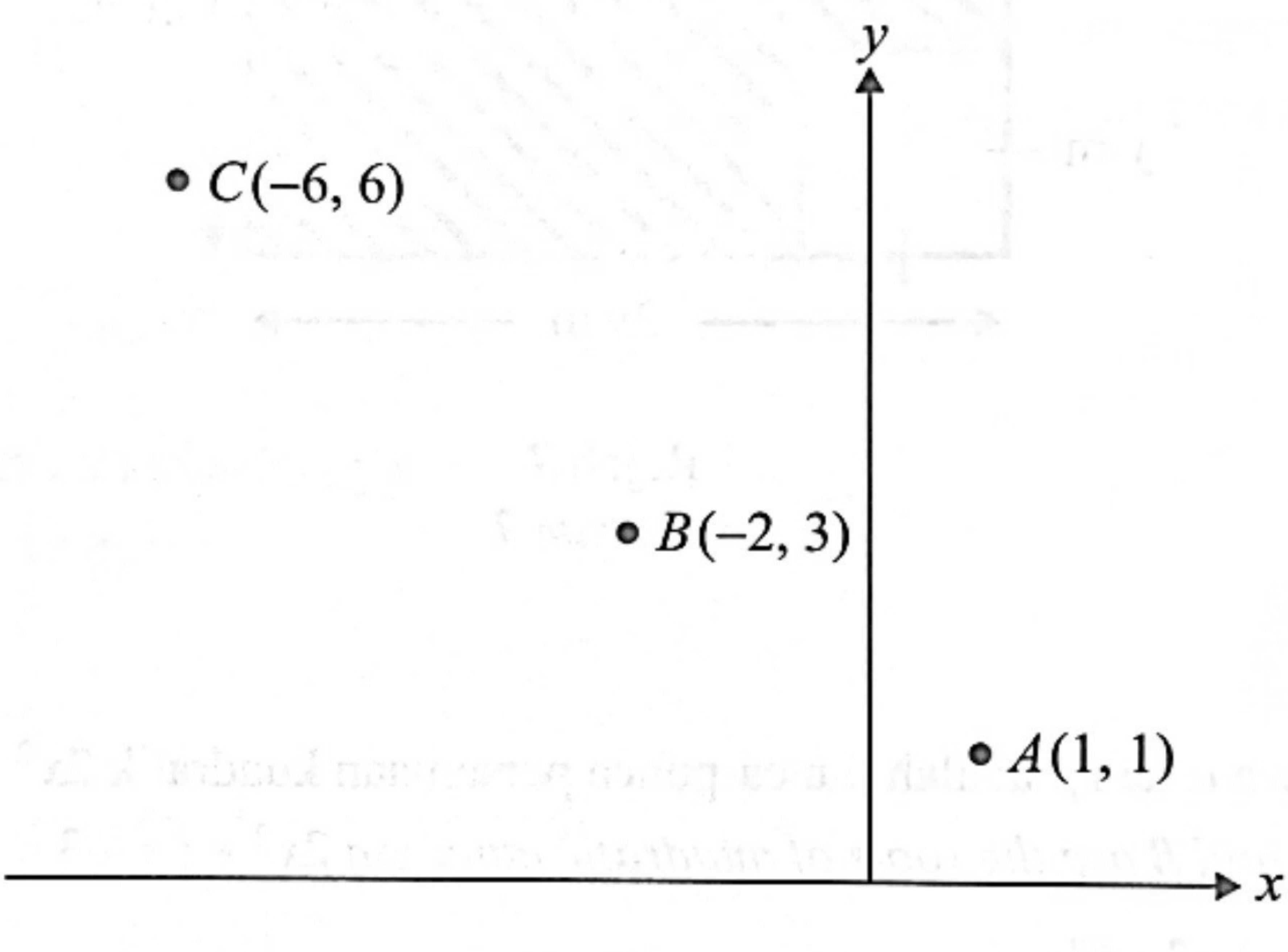
- (a)(i)
Find AB→ and AC→.
[3] - (a)(ii)
Find the unit vector in the direction BC→.
[4] - (b)
Given AD→ = ki − 15j is parallel to BC→, find the value of k.
[3]
(a) Determine whether the quantity below is a scalar quantity or a vector quantity. Give your justification: Water has a density of around 1 000 kg/m³. (b) Diagram 3 shows two straight lines ODC and ADB. Given OA = 5p, OB = 10q, AD : DB = 2 : 3, AC = mOB and OD = nOC. (i) Express OC in terms of m, p and q. (ii) Express OC in terms of n, p and q. (iii) Hence, find the value of m and of n.
Medium7 marks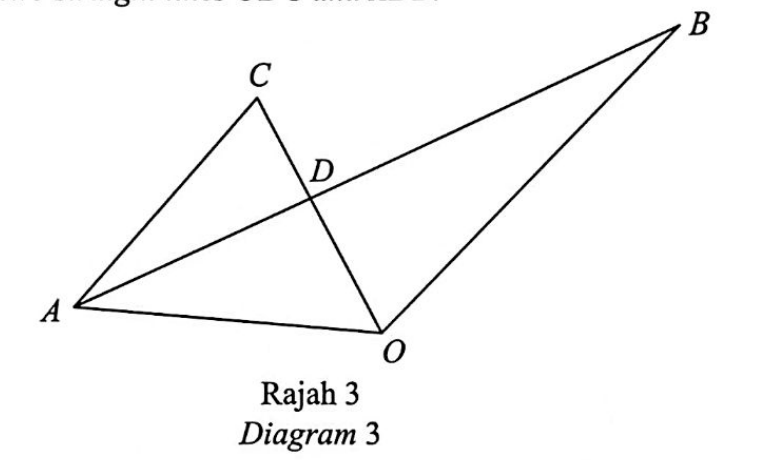
- (a)
Determine whether the quantity is a scalar quantity or a vector quantity. Give your justification. Water has a density of around 1 000 kg/m³.
[1] - (b)(i)
Express OC in terms of m, p and q.
[2] - (b)(ii)
Express OC in terms of n, p and q.
[1] - (b)(iii)
Hence, find the value of m and of n.
[3]
(a) Diagram 4 shows the vector PQ drawn on a Cartesian plane (P(2, 2), Q(6, 6)). Find the unit vector in the direction of PQ. (b) Diagram 5 shows a quadrilateral PQRS. PJS and JKR are straight lines. It is given that PQ = 20x, PJ = 8y, SR = 25x − 24y, PJ = ¼PS and JK = (3/5)JR. Express in terms of x and y: (i) QS, (ii) JR. (iii) Hence, show that the points S, K and Q are collinear.
Medium8 marks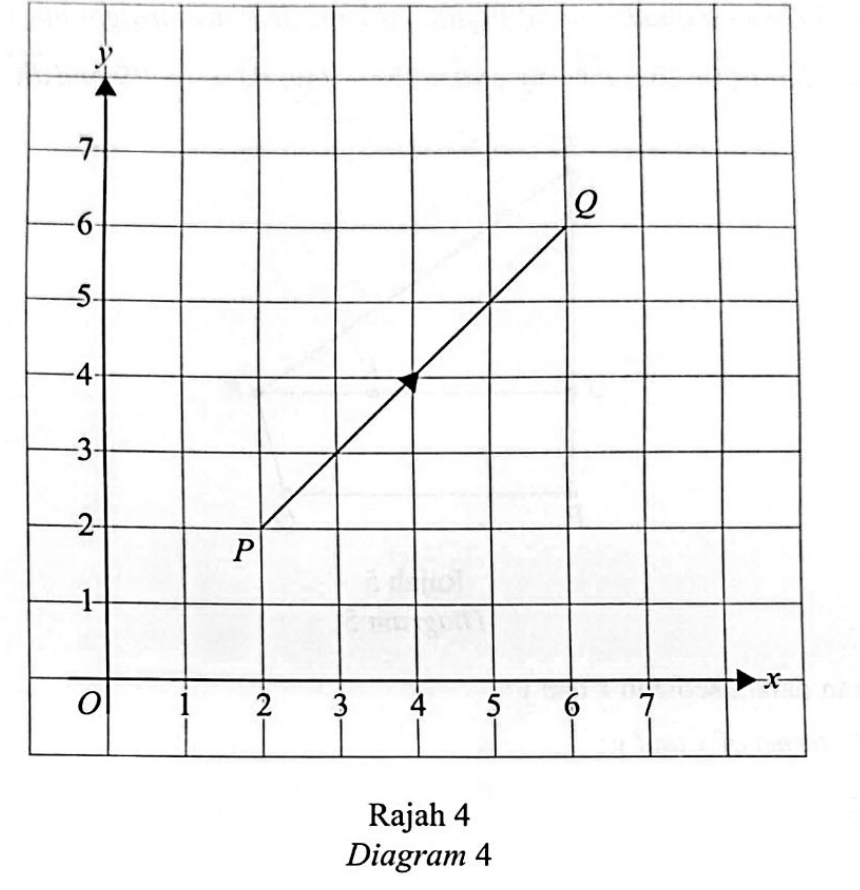
- (a)
Find the unit vector in the direction of PQ.
[2] - (b)(i)
Express QS in terms of x and y.
[2]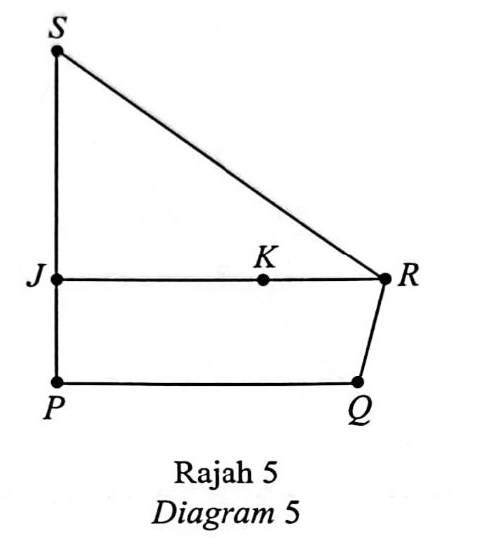
- (b)(ii)
Express JR in terms of x and y.
[1] - (b)(iii)
Hence, show that the points S, K and Q are collinear.
[3]
Diagram 3 shows a parallelogram OABC. Point P is the midpoint of AB and the ratio of QP : OP = 2 : 5 (as printed). Given that OA→ = 3i + 4j and OC→ = 6i + j. Express in terms of i and j, (a) OP→, (b) AQ→.
Easy4 marks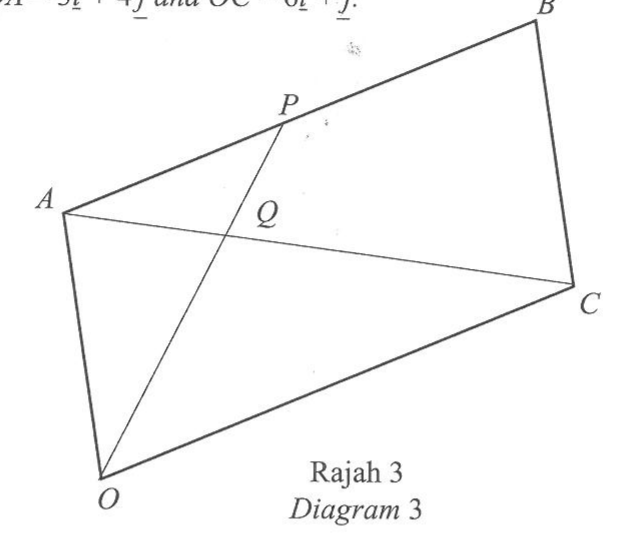
- (a)
OP→
[1] - (b)
AQ→
[3]
Diagram 2 shows a trapezium PQRS. T is a point lies on the straight line PS. Given that PQ→ = 8x, PS→ = 24y, PT→ = (2/3)PS→ and QR→ = (3/4)PS→. (a) Express PR→ in terms of x and y. (b) Point U lies inside the trapezium PQRS such that TU→ = (k − 1)PQ→, and k is a constant. (i) Express PU→ in terms of k, x and y. (ii) If points P, U and R are collinear, find the value of k.
Medium8 marks- (a)
Express PR→ in terms of x and y.
[2] - (b)(i)
Express PU→ in terms of k, x and y.
[2] - (b)(ii)
If points P, U and R are collinear, find the value of k.
[4]
Diagram 2 shows two triangles OPS and ORQ where point R lies on OP and point S lies on OQ. The straight lines PS and RQ intersect at point T. It is given that OP→ = 10b, OQ→ = 8a, OR : RP = 1 : 1, OS : SQ = 1 : 3, RT→ = m RQ→ and ST→ = n SP→, where m and n are constants. Express OT→ in terms of (a) m, a and b, (b) n, a and b.
Easy4 marks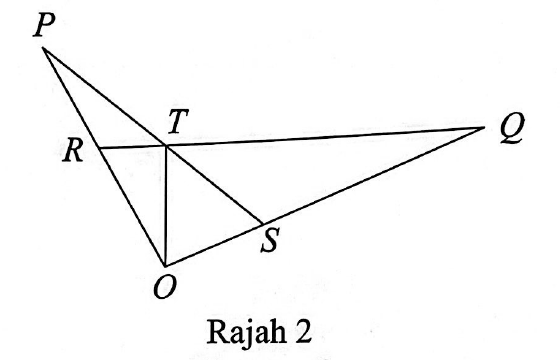
- (a)
Express OT→ in terms of m, a and b.
[2] - (b)
Express OT→ in terms of n, a and b.
[2]
Diagram 1 shows a triangle PQR. T is the midpoint of the straight line PR. It is given that coordinates P is (2, −1), PQ→ = (4, 3) and TR→ = (5, 2). (a) Show that the coordinates of the point: (i) Q is (6, 2). (ii) R is (12, 3). (b) Determine the unit vector in the direction of vector QT→. Give your answer in the simplest surd form.
Medium8 marks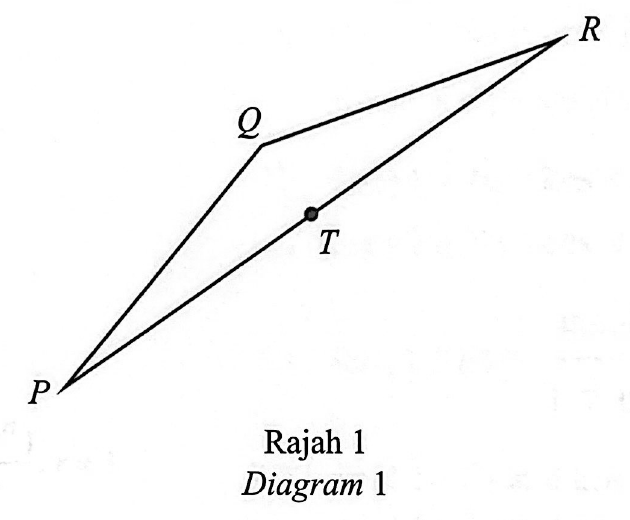
- (a)
Show that the coordinates of the point: (i) Q is (6, 2). (ii) R is (12, 3).
[4] - (b)
Determine the unit vector in the direction of vector QT→. Give your answer in the simplest surd form.
[4]
It is given ABCD is a parallelogram, where BC→ = k**i** − **j** and CD→ = −4**i** + k**j**. Find the length of the diagonal AC in terms of k.
Easy3 marksFind the length of the diagonal AC in terms of k.
[3]
Diagram 14 shows the positions of four pesticide spraying robots on the Cartesian plane at points O, P, Q and R. It is given that OPQR forms a parallelogram and PR→ = −**i** − 15**j**; P is (5, 12). (a) Find (i) the value of |OP→ − QP→ + QR→ − OR→|, (ii) the coordinates of point Q. (b) Robot at point P moves to point T (2, 6) with a constant velocity (−5**i** + w**j**) m s⁻¹. It takes t seconds to reach point T. (i) Based on the given information, write a vector equation in terms of t and w. (ii) Hence, find the value of t and of w.
Medium8 marks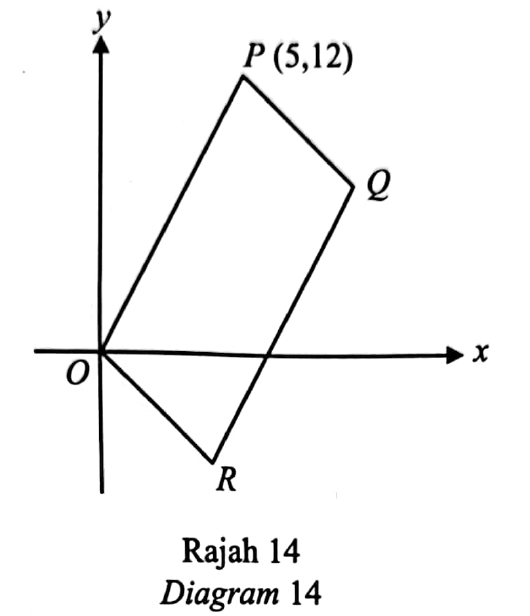
- (a)(i)
Find the value of |OP→ − QP→ + QR→ − OR→|.
[1] - (a)(ii)
Find the coordinates of point Q.
[4] - (b)(i)
Based on the given information, write a vector equation in terms of t and w.
[1] - (b)(ii)
Hence, find the value of t and of w.
[2]
Diagram 6 shows a triangle ABC. Point N lies on the straight line CB such that CB = 3CN. It is given that AC→ = 8**x**, AM→ = 6**y**, MB→ = 4**y** and AQ→ = nAN→. (a) Express in terms of **x** and **y** of (i) CM→, (ii) CN→. (b) (i) Express CQ→ in terms of n, **x** and **y**. (ii) Hence, find the value of n if points C, Q and M are collinear.
Medium9 marks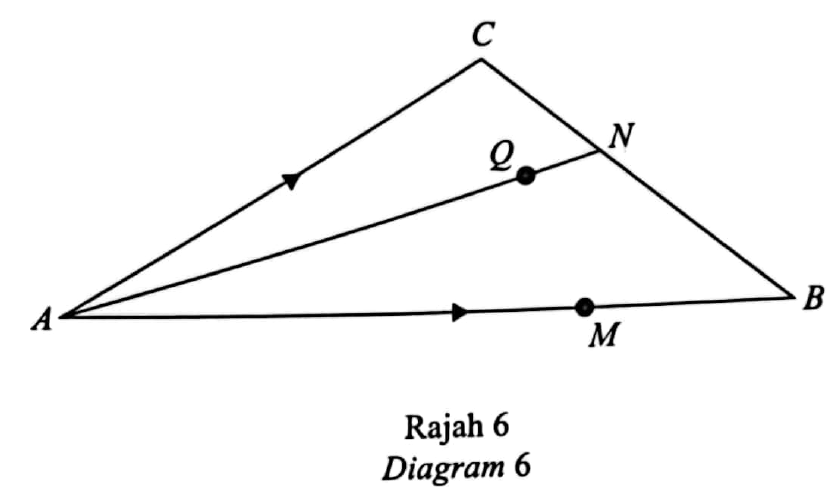
- (a)(i)
Express CM→ in terms of **x** and **y**.
[2] - (a)(ii)
Express CN→ in terms of **x** and **y**.
[2] - (b)(i)
Express CQ→ in terms of n, **x** and **y**.
[2] - (b)(ii)
Hence, find the value of n if points C, Q and M are collinear.
[3]
(a) Determine whether the quantity in the following statement is a scalar quantity or a vector quantity. Give your justification. "During landing on the ground, paratroopers bend their legs. In this way, it is possible to reduce the impulse force by extending the impact time of the foot with the ground." (b) Diagram 3 shows a triangle OPR. The straight lines OQ and PS intersect at point T. It is given that 5OT→ = 2OQ→, 8PQ→ = 3PR→, PR→ = 8**x**, OP→ = **y**, PS→ = kPT→, OS→ = hOR→. (i) Express PS→ in terms of k, **x** and **y**. (ii) Express PS→ in terms of h, **x** and **y**. (iii) Hence, find the value of h and of k.
Medium7 marks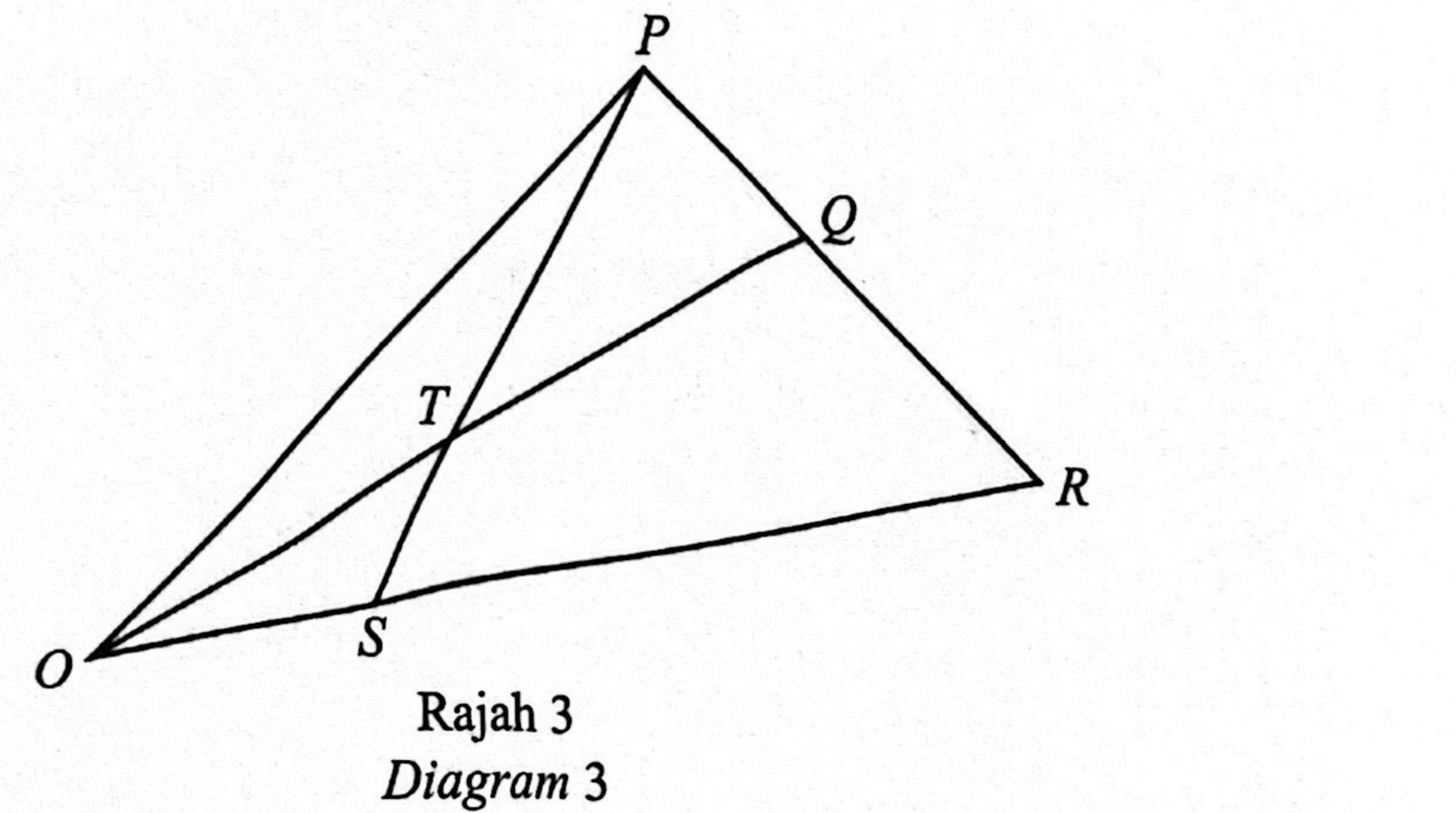
- (a)
Determine whether the quantity (impulse force when paratroopers bend their legs on landing) is a scalar quantity or a vector quantity. Give your justification.
[1] - (b)(i)
Express PS→ in terms of k, **x** and **y**.
[2] - (b)(ii)
Express PS→ in terms of h, **x** and **y**.
[1] - (b)(iii)
Hence, find the value of h and of k.
[3]
(a) Diagram 4 shows the vector PQ→ drawn on a Cartesian plane (P(6, 2), Q(1, 7)). Find the unit vector in the direction of PQ→. (b) Diagram 5 shows a quadrilateral ABCD. AED and EFC are straight lines. It is given that AB→ = 20**x**, AE→ = 8**y**, DC→ = 25**x** − 24**y**, AE→ = (1/4)AD→ and EF→ = (3/5)EC→. Express in terms of **x** and **y**: (i) BD→, (ii) EC→, (iii) Hence, show that the points B, F and D are collinear.
Medium8 marks- (a)
Find the unit vector in the direction of PQ→.
[2]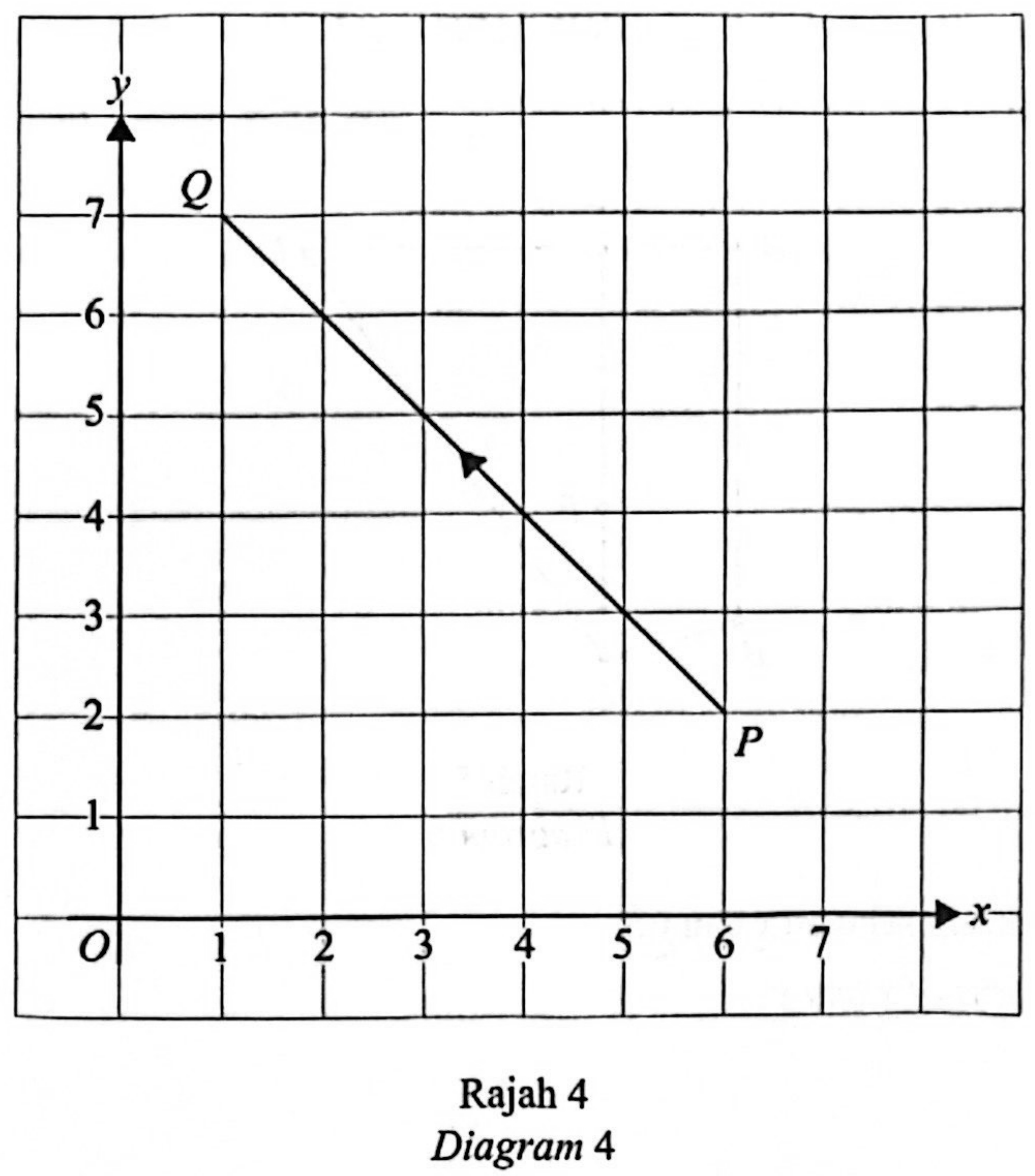
- (b)(i)
Express BD→ in terms of **x** and **y**.
[2] - (b)(ii)
Express EC→ in terms of **x** and **y**.
[1] - (b)(iii)
Hence, show that the points B, F and D are collinear.
[3]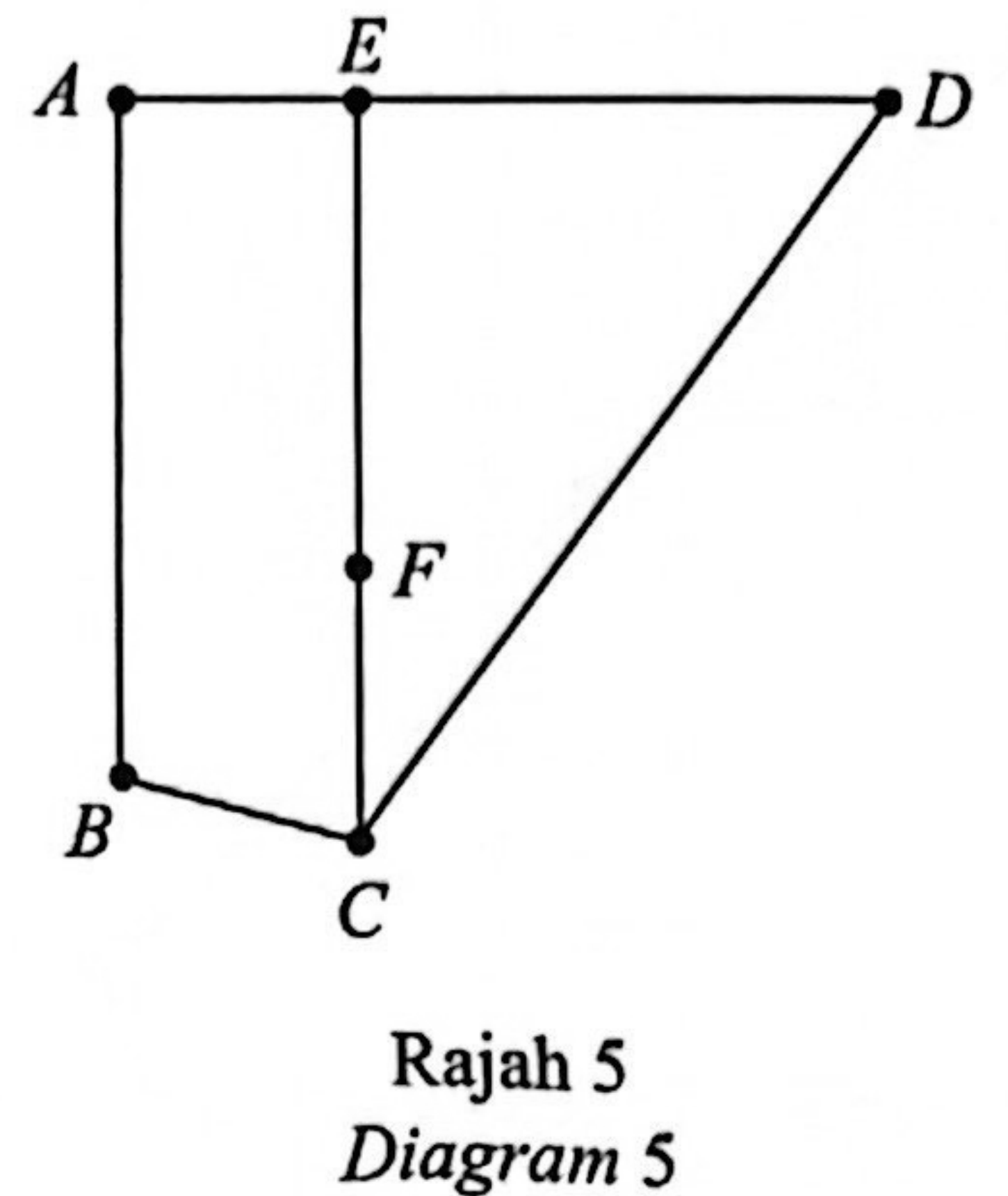
Diagram 2 shows two parallel lines AB and DC. It is given that AD→ = 4x, CD→ = 9y, AB = (1/3)DC and BQD is a straight line such that BQ : BD = 1 : 4. Show that the points A, Q and C are collinear.
Medium4 marks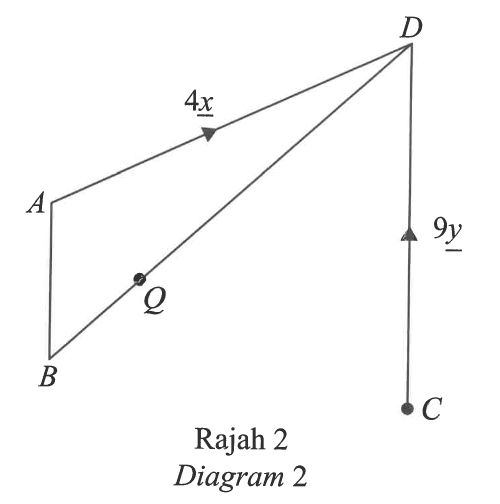
Show that the points A, Q and C are collinear.
[4]
Diagram 1 shows a triangle OPQ on a Cartesian plane and O is the origin. Given that R and S lie on the straight line OQ and PQ respectively where OR : OQ = 1 : 3 and PS = 3SQ. It is given that OP→ = 6i and OR→ = i + 4j. (a) Find the coordinates of the point: (i) Q, (ii) S. (b) Determine the unit vector in the direction of vector RS→. Give your answer in the simplest surd form.
Medium8 marks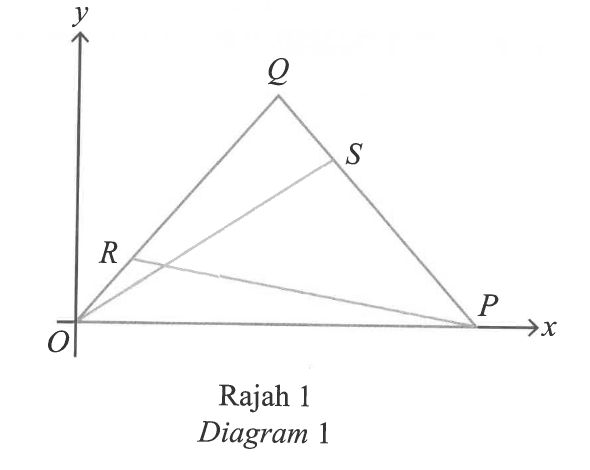
- (a)(i)
Find the coordinates of the point Q.
[2] - (a)(ii)
Find the coordinates of the point S.
[2] - (b)
Determine the unit vector in the direction of vector RS→. Give your answer in the simplest surd form.
[4]
Diagram 3 shows point A(7, 12) on the Cartesian plane.
Easy5 marks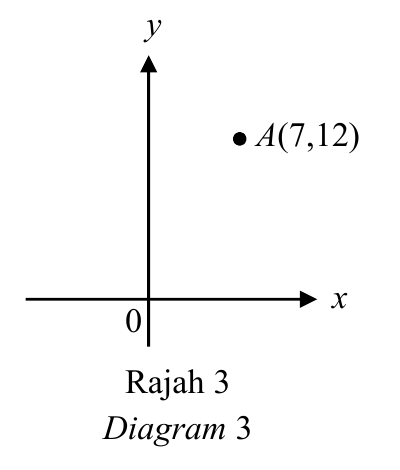
- (a)
State OA→ in the form of a column vector.
[1] - (b)
Point A is reflected about the x-axis to point A′. Given OB→ = h i + 5 j and the unit vector of A′B→ is k [[10], [17]], where h and k are constants. Find the value of h and k.
[4]
Diagram 5 shows a triangle ABC. The straight line PR intersects the straight line AB at R. Point Q lies on PR (C lies on PR between Q and P). Given BR→ = (1/3)BA→, AC→ = 4x and BC→ = 10x − 9y.
Medium10 marks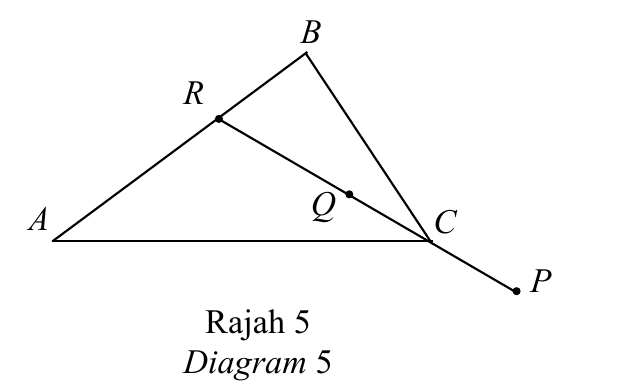
- (a)
Express in terms of x and/or y: (i) BA→, (ii) RC→.
[3] - (b)
Given RQ→ = mRC→ and BQ→ = n(x − y), where m and n are constants, find the value of m and n.
[5] - (c)
Given RP→ = 12x + hy, where h is a constant, find the value of h.
[2]
Diagram 7 shows the position of four houses ABCD drawn on a Cartesian plane, forming a parallelogram. A(−5, 3), C(−3, −2).
Medium7 marks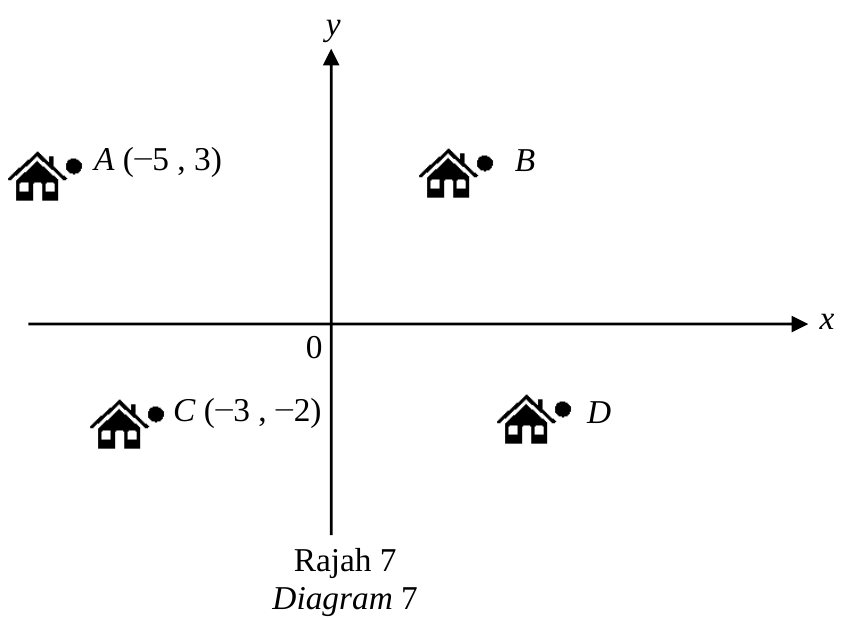
- (a)
The displacement of house A and B is 9 km and the path from A to B is parallel to the x-axis. Find the vector of house B.
[1] - (b)
Hence, find the resultant vector from house B to house C.
[2] - (c)
Amir walks from house C to a grocery store at S(2, k) with a constant velocity (6i + 9j) km h⁻¹. He takes h minutes to reach the store. Find the value of k and of h.
[4]
Diagram 1 shows the position of a field PQRS. Points U, V and T are the midpoints of RS, RT and QS respectively. Given PQ→ = 2x + 6y, QR→ = 5x + y and SR→ = x + 5y.
Medium7 marks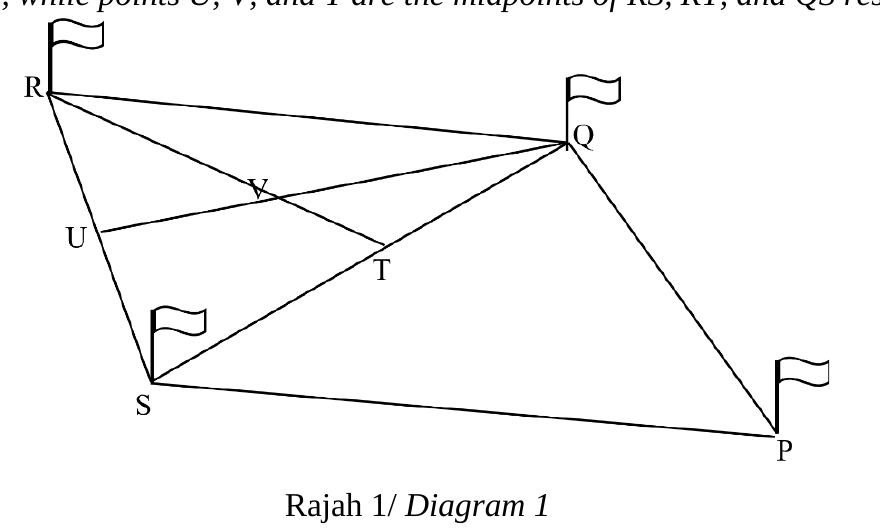
- (a)
Express in terms of x and y (i) TR→, (ii) QU→.
[4] - (b)
Ahmad is at P and wants to go directly to R. Determine whether the shortcut from P to R can be taken. Justify mathematically.
[3]
Diagram 7 shows OLMN is a parallelogram such that OL→ = 4i + j and OM→ = 6i + 5j. Find (a) ON→. (b) A point P is given such that OP→ = −8i + 19j. (i) Find LN→ and NP→. (ii) Show that the points L, N and P are collinear.
Medium8 marks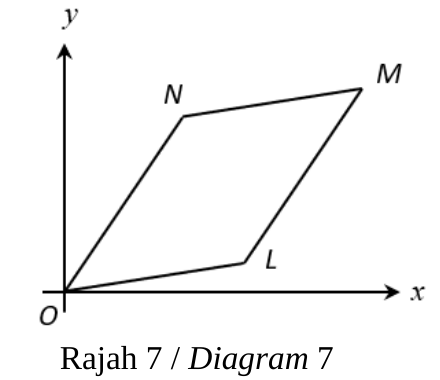
- (a)
Find ON→.
[2] - (b)(i)
Given OP→ = −8i + 19j. Find LN→ and NP→.
[3] - (b)(ii)
Show that the points L, N and P are collinear.
[3]
P, Q and R are three collinear points. Given PR→ = 14u where u = (1/7)i + yj and Q divides the line segment PR with ratio 3 : 4. (a) Express in terms of u: (i) PQ→, (ii) RQ→. (b) Given |PR→| = √40, find the value of y and hence the unit vector of PR→.
Medium7 marks- (a)
Express in terms of u: (i) PQ→, (ii) RQ→.
[3] - (b)
Given |PR→| = √40, find the value of y and hence the unit vector of PR→.
[4]
Diagram 15 shows OLMN is a parallelogram with OL→ = 4i + j and OM→ = 6i + 5j. (a) Find (i) ON→; (ii) the unit vector in the direction ON→. (b) Next, point P is given such that OP→ = −8i + 19j. (i) Find LN→ and NP→. (ii) Show that the points L, N and P are collinear.
Medium8 marks- (a)(i)
Find ON→.
[1]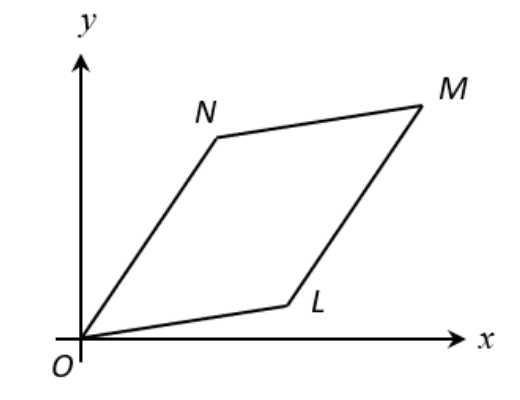
- (a)(ii)
Find the unit vector in the direction ON→.
[2] - (b)(i)
Find LN→ and NP→.
[2] - (b)(ii)
Show that the points L, N and P are collinear.
[3]
It is given that OA→ = k(2, −10), OB→ = (−4, −6) and OC→ = (4, 8) (column vectors). (a) Express in terms of k (i) AB→; (ii) |AB→|. (b) It is also given that |AB→| = |BC→|. (i) Show that k² − k − 2 = 0. (ii) Hence, find two possible vectors for AB→.
Medium8 marks- (a)(i)
Express AB→ in terms of k.
[2] - (a)(ii)
Express |AB→| in terms of k.
[2] - (b)(i)
Show that k² − k − 2 = 0.
[2] - (b)(ii)
Find two possible vectors for AB→.
[2]
Given u = 5i + 2j and v = 3i + kj, find the value of k if (a) |u + v| = 10, (b) 2u − v is parallel to the x-axis.
Medium5 marks- (a)
|u + v| = 10.
[3] - (b)
2u − v is parallel to the x-axis.
[2]
Diagram 5 shows a plan of footpaths in a school forming a quadrilateral PQRS. A lamp post is placed at T, such that PT : TR = 1 : 3. The footpaths QP and RS are parallel with RS→ = (3/4) QP→. In the diagram PS→ = 20**x** and QP→ = 24**y** (arrows as drawn).
Medium8 marks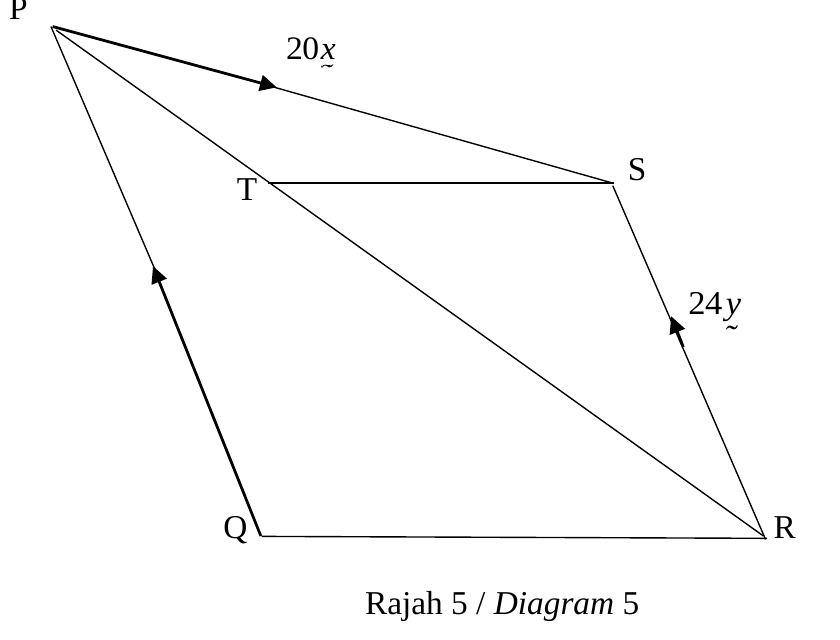
- (a)
Express PR→ and TS→ in terms of **x** and **y**.
[3] - (b)
Show that the footpath TS is parallel to the footpath QR.
[5]
Diagram 4 shows a pentagonal go-kart track PQRST. Pit stop U is the midpoint of QS. TQ is an emergency lane. Given PQ→ = (1/2)TS→, SR→ = (2/3)TP→, TS→ = 6a and TP→ = 6b. Vectors are written in bold/underlined letters a and b.
Medium5 marks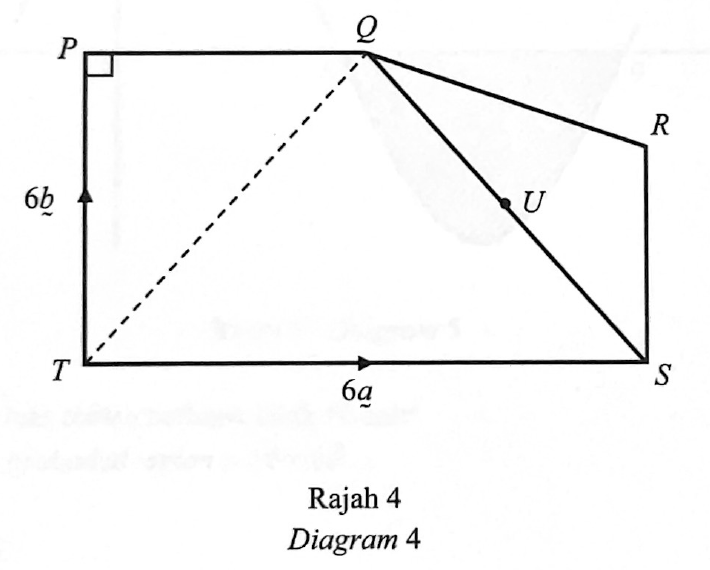
- (a)
For the first round, Farhan drives from T to Q. Calculate the distance of the emergency lane if |a| = 1 unit and |b| = 2 units.
[2] - (b)
Farhan drives for the second round from T to R passing through U. Determine whether pit stops T, U and R are collinear.
[3]
OAB is a triangle. Point C lies on OA and point D lies on AB. The straight line BC intersects the straight line OD at point E. Given OA : OC = 4 : 3, AB : AD = 2 : 1, OA→ = 20x and OB→ = 9y. (x and y are vectors.)
Hard10 marks- (a)
Express in terms of x and/or y: (i) BC→, (ii) OD→.
[3] - (b)
If BE→ = mBC→ and OE→ = nOD→, where m and n are constants, find the values of m and of n.
[5] - (c)
Given that |x| = 2 unit and the area of triangle OAB is 140 unit², calculate the perpendicular distance from B to OA.
[2]
Diagram 5 shows a trapezium ABCD. Given AB→ = 6x, BC→ = 8y, BC = 4BQ, AB = (3/4)DC and DP→ = λDC→. (Vectors written as underlined x, y.)
Medium8 marks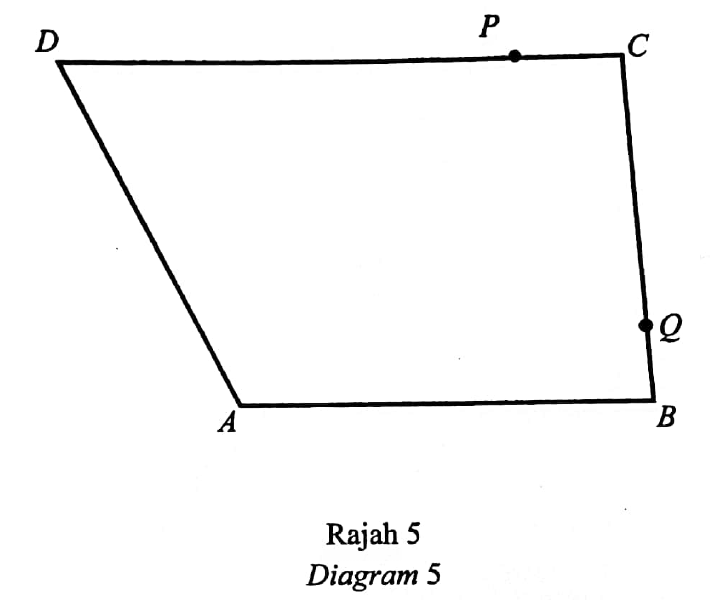
- (a)(i)
Express AD→ in terms of x and y.
[2] - (a)(ii)
Express QP→ in terms of λ, x and y.
[2] - (b)
Hence, find the value of λ if AD→ and QP→ are parallel.
[4]
It is given that PQR is a triangle. Point T(3, 1) lies on the line QR, the coordinates of P is (−4, 1), PR→ = 6i + 3j and QR→ = −2i + 6j. (i and j are unit vectors written underlined in the paper.)
Medium8 marks- (a)
Using the vector's triangle law, show that point T is the midpoint for the line QR.
[6] - (b)
Determine the unit vector in the direction of PR→.
[2]
Diagram 2 shows two vectors OA→ = m and OB→ = n (not parallel). Find the value of a and of b such that (a − 2)m = (3a + b)n.
Easy3 marks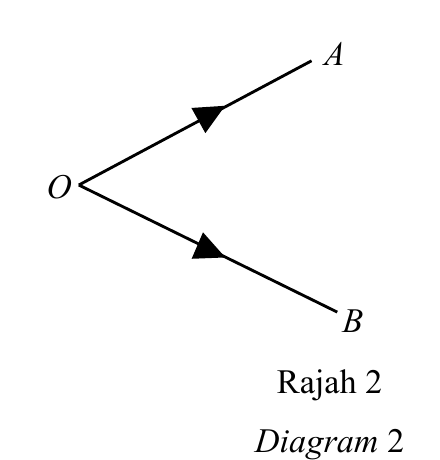
Find the value of a and of b such that (a − 2)m = (3a + b)n.
[3]
Diagram 10 shows objects R, S, T, U, V and W placed in a certain arrangement. The distances between R, S and T form a triangle. Given SV→ = (3/4)ST→, RS→ = 6m and RT→ = 18n.
Medium10 marks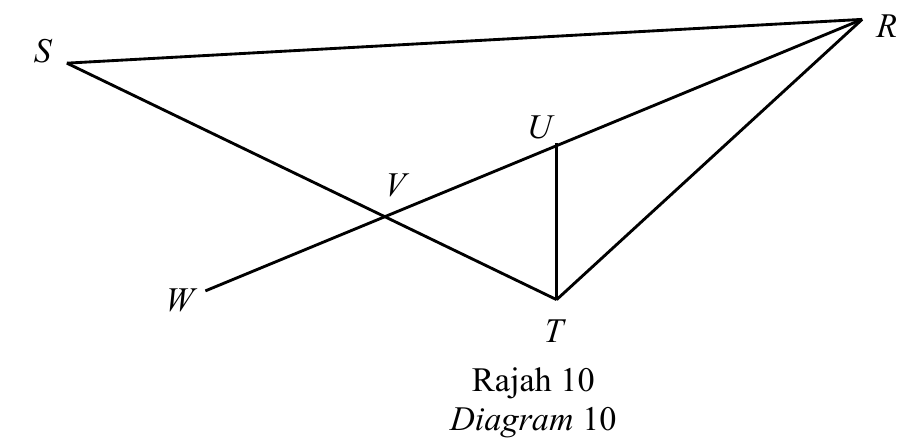
- (a)(i)
Express ST→ in terms of m and/or n.
[2] - (a)(ii)
Express RV→ in terms of m and/or n.
[1] - (b)
Given RU→ = d RV→ and TU→ = e(2m − 7n), where d and e are constants, find the value of d and of e.
[4] - (c)
Given RW→ = gm + 2n, where g is a constant, find the value of g.
[3]
(a) Given u = (7, 9) and v = (n − 1, 3) (column vectors). Find the possible value of n if (i) u and v are parallel, (ii) |u| = |v|. (b) Given p = (m − 1, 1) and q = (9, 8), where m is a constant. Find the value of m if p is perpendicular to q.
Easy7 marks- (a)(i)
u and v are parallel.
[2] - (a)(ii)
|u| = |v|.
[2] - (b)
Find the value of m if p is perpendicular to q.
[3]
OABC is a parallelogram such that OA→ = 3i + 4j and OC→ = 12i + 5j. (a) Find (i) OB→, (ii) the unit vector in the direction of OB→, (iii) ∠AOB. (b) R is a point such that CR→ = 3i + 7j. (i) Find AR→. (ii) Hence, determine whether O, A and R are collinear.
Medium10 marks- (a)(i)
Find OB→.
[2] - (a)(ii)
Find the unit vector in the direction of OB→.
[2] - (a)(iii)
Find ∠AOB.
[3] - (b)(i)
Find AR→.
[1] - (b)(ii)
Hence, determine whether O, A and R are collinear.
[2]