JOHOR 2021 P2 Q14
MediumWrite your answer on paper. Then open the answer to check it.
Diagram 14 shows a cyclic quadrilateral ABCD with AB = 8 cm, BC = 14 cm, ∠ABC = 73° and AD = 4 cm. (a) Calculate (i) the length, in cm, of AC, (ii) ∠CAD. (b) Find (i) the area, in cm², of △ABC, (ii) the shortest distance, in cm, from point B to AC.
Medium10 marks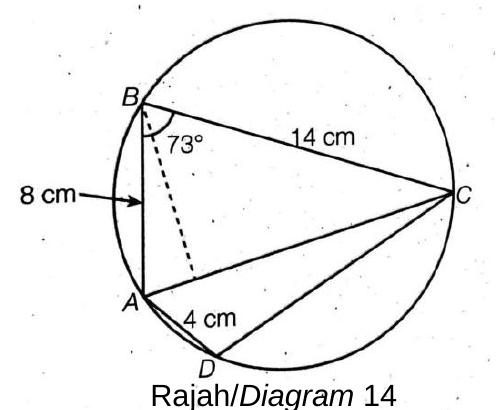
- (a)(i)
Length of AC.
[2] - (a)(ii)
Find ∠CAD.
[4] - (b)(i)
Area of △ABC.
[2] - (b)(ii)
Shortest distance from B to AC.
[2]
Diagram 14 shows a cyclic quadrilateral PQRS. Given PQ = 5.3 cm, QR = 4.6 cm, PR = 7.4 cm and ∠PRS = 60°, find (a) the area of △PQR, (b) ∠PSR, (c) the area of the quadrilateral PQRS.
Medium10 marks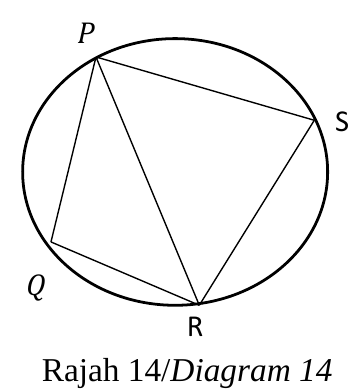
- (a)
Find the area of △PQR.
[3] - (b)
Find ∠PSR.
[3] - (c)
Find the area of the quadrilateral PQRS.
[4]
Diagram 5 shows a triangular-shaped seedbed plan ABC belonging to Mrs. Suraya. The plot AFG is planted with lemongrass, while the plot DCE is planted with pandan plants. AGDC, AFB and BEC are straight lines. The straight line FG is perpendicular to the straight line AB. Given that AD = 4.6 m, DC = 2.6 m, CE = 2.4 m, ∠BAC = 34.1° and sin ∠ACB = 49/50. (a) Calculate the length, in m, of (i) DE, (ii) EB. (b) The area of triangle AFG is equal to the area of triangle DEC. Calculate the area, in m², of the nursery site that is not planted with lemongrass and pandan plants. (c) Sketch the triangle A′B′C′ which has a different shape from triangle ABC, such that A′C′ = AC, B′C′ = BC and ∠B′A′C′ = ∠BAC.
Medium10 marks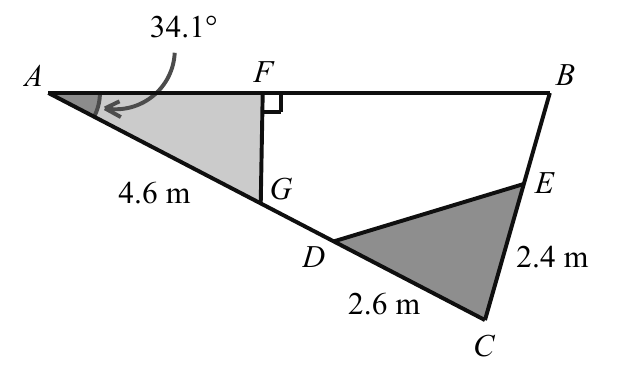
- (a)(i)
Calculate the length of DE.
[3] - (a)(ii)
Calculate the length of EB.
[2] - (b)
Calculate the area of the nursery site not planted with lemongrass and pandan.
[4] - (c)
Sketch triangle A′B′C′ with a different shape from ABC.
[1]
Solutions by scale drawing are not accepted. The diagram shows a cyclic quadrilateral ABCD with AB = 8 cm, BC = 7 cm, ∠ABC = 80°, CD = 3 cm. (a) Calculate (i) the length, in cm, of AC, (ii) ∠ACD. (b) Find (i) the area, in cm², of △ABC using Heron's formula, (ii) the shortest distance, in cm, from point B to AC.
Medium10 marks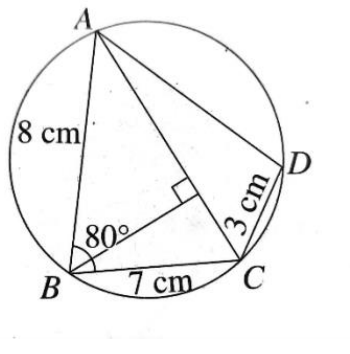
- (a)(i)
Calculate the length of AC.
[2] - (a)(ii)
Calculate ∠ACD.
[3] - (b)(i)
Area of △ABC using Heron's formula.
[3] - (b)(ii)
Shortest distance from B to AC.
[2]
In Diagram 4, AB = 8.4 cm, BC = 10.2 cm, DA = 10 cm, ∠BCD = 76°25′ and ∠DBC = 47°. (a) Calculate the length, in cm, of DB. (b) Calculate ∠ADB. (c) Sketch a triangle B′D′C′ which has a different shape from triangle BDC such that C′D′ = CD, B′D′ = BD and ∠C′B′D′ = ∠CBD. Hence state the angle B′C′D′. (d) Calculate the area of quadrilateral ABCD.
Medium10 marks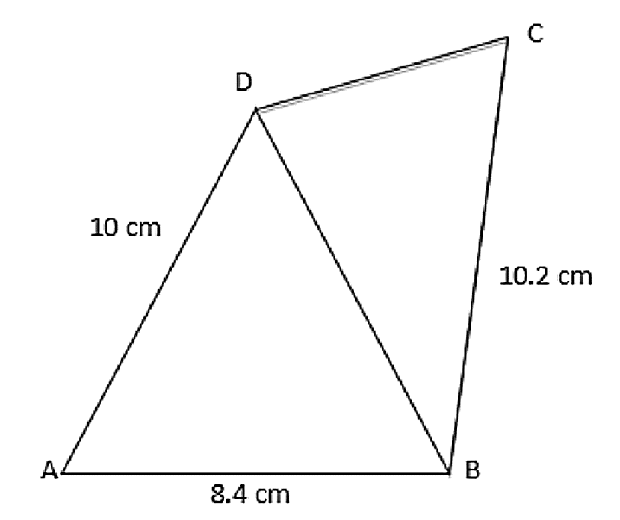
- (a)
Calculate the length of DB.
[3] - (b)
Calculate ∠ADB.
[2] - (c)
Sketch triangle B′D′C′ with a different shape such that C′D′ = CD, B′D′ = BD and ∠C′B′D′ = ∠CBD. Hence state ∠B′C′D′.
[2]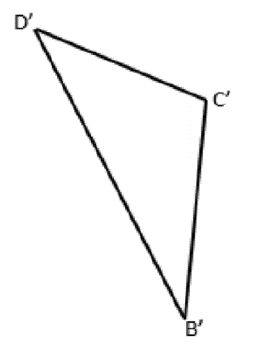
- (d)
Calculate the area of quadrilateral ABCD.
[3]
Diagram 14 shows a trapezium PQRS with PS parallel to QR, ∠SPQ = 65°, QS = 11.9 cm, SR = 8.3 cm and QR = 5.1 cm.
Medium10 marks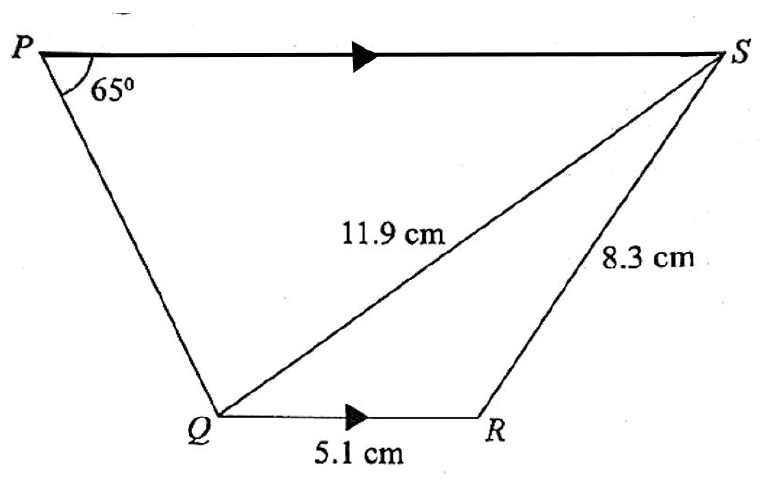
- (a)(i)
Calculate ∠SQR.
[2] - (a)(ii)
Calculate the length, in cm, of PS.
[2] - (b)
Find the area, in cm², of triangle QRS using Heron's formula. Hence, calculate the area, in cm², of triangle PQS.
[4] - (c)
Sketch a triangle Q′R′S′ which has a different shape from triangle QRS such that Q′R′ = QR, S′R′ = SR and ∠Q′R′S′ = ∠QSR. Hence, state ∠S′Q′R′.
[2]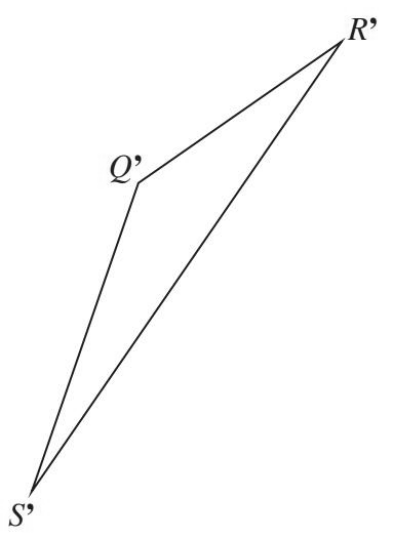
Diagram 9 shows a quadrilateral PQRS where PR is the diagonal (∠QPR = 22°, ∠PRQ = 78°, QR = 9 cm, PS = 8 cm, SR = 17 cm). (a) Calculate (i) the length, in cm, of PR, (ii) ∠PSR. (b) Sketch a triangle P′R′S′ which has a different shape from triangle PRS such that ∠P′R′S′ = ∠PRS, P′S′ = PS and R′S′ = RS. Hence, find the area, in cm², of triangle P′R′S′.
Medium10 marks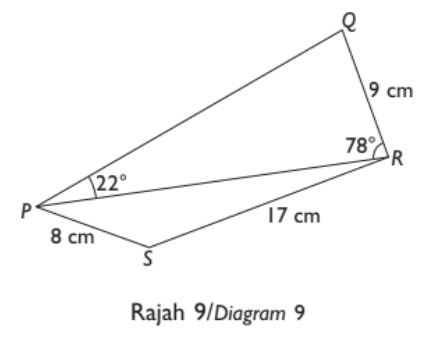
- (a)(i)
Length of PR.
[2] - (a)(ii)
Find ∠PSR.
[2] - (b)
Sketch triangle P′R′S′ and find its area.
[6]
Diagram 7 shows guard houses in three housing areas connected by straight roads: Taman Aman to Taman Sentosa 6.08 km, Taman Aman to Taman Damai 3.16 km, Taman Damai to Taman Sentosa 8.06 km. Scale: 1 unit = 1 km.
Medium8 marks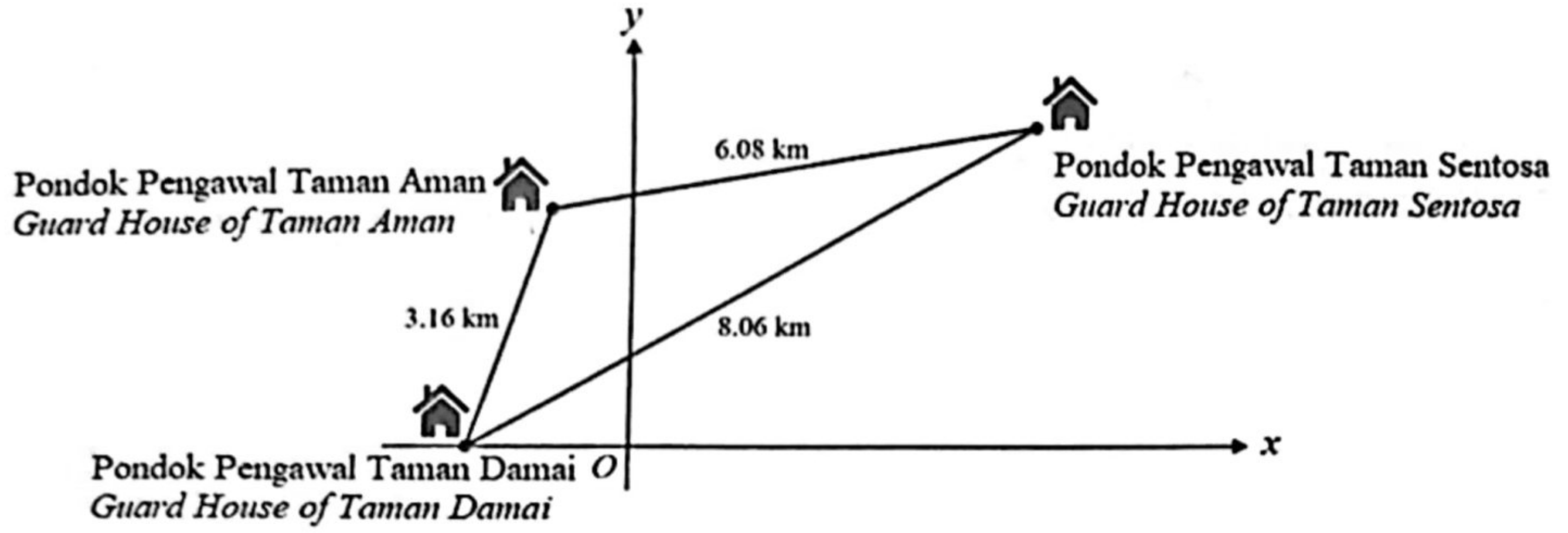
- (a)
Determine the area bounded by the three roads.
[3] - (b)
The developer wants to build a new road at a minimal cost connecting guard house of Taman Aman and Balai Raya. Balai Raya is located at the road that connects guard house of Taman Damai and guard house of Taman Sentosa. Find the length, in km, of that road.
[2] - (c)
Given the position of guard house of Taman Sentosa is (5, 4) and guard house of Taman Damai is located 2 km from the origin. Write the equation in intercept form, the road that connects guard house of Taman Sentosa and guard house of Taman Damai.
[3]
(a) Diagram 12(a) shows two triangles JKL and LMN. JK and MN are parallel. JK = 40 cm, ∠KJL = 23°, ∠LMN = 33°, MN = p. (b) Diagram 12(b) shows a prism of length 10 cm.
Medium10 marks- (a)(i)
Find the length of JL, in cm, correct to two decimal places.
[3]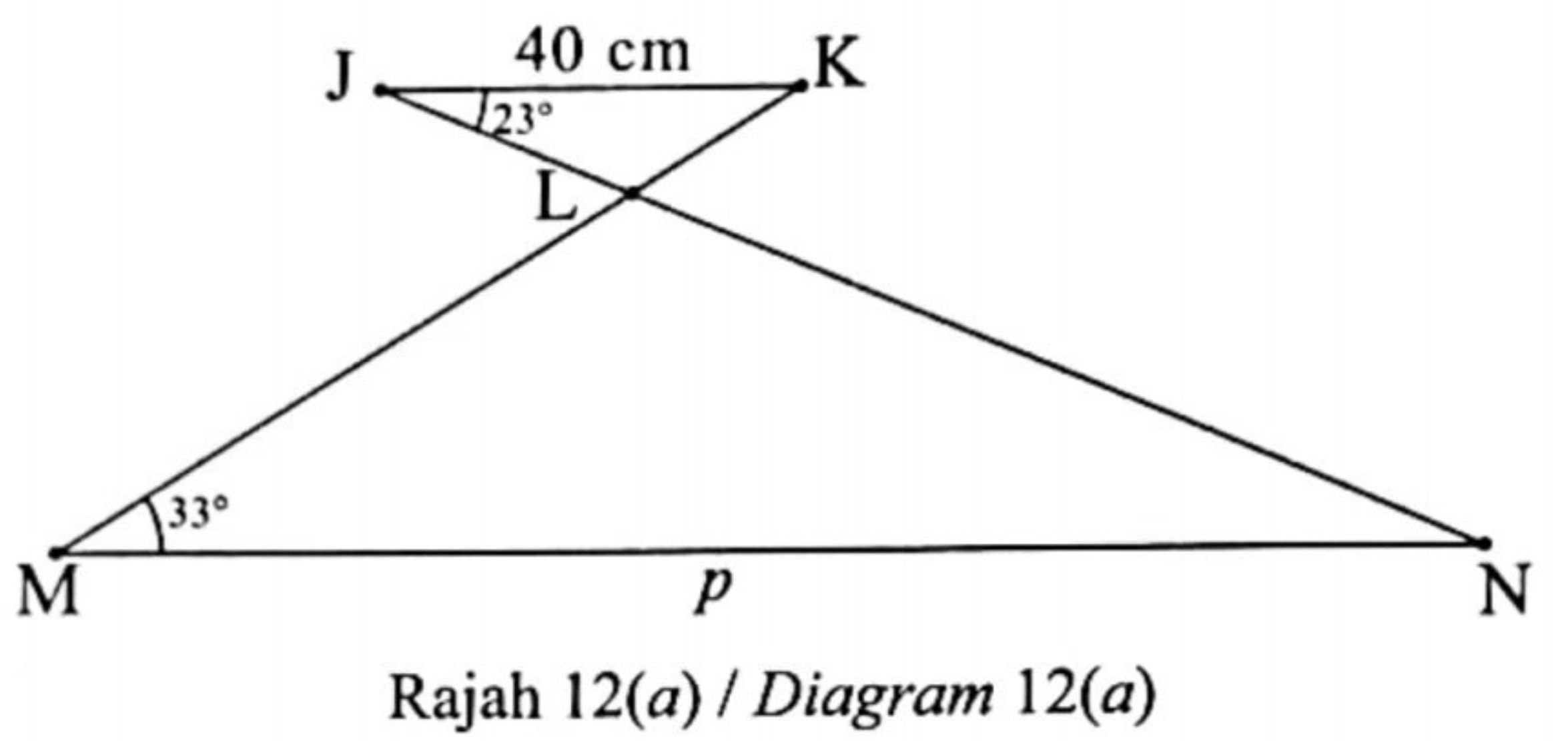
- (a)(ii)
Given JN = 114.24 cm, by using cosine rule, express LM² in terms of p.
[1] - (a)(iii)
State the smallest integer of LM if the case of ambiguity of triangle LMN exists.
[2] - (b)
Given AB = 40 cm, BC = 17 cm and AC = 33 cm. Find the volume, in cm³, of this prism.
[4]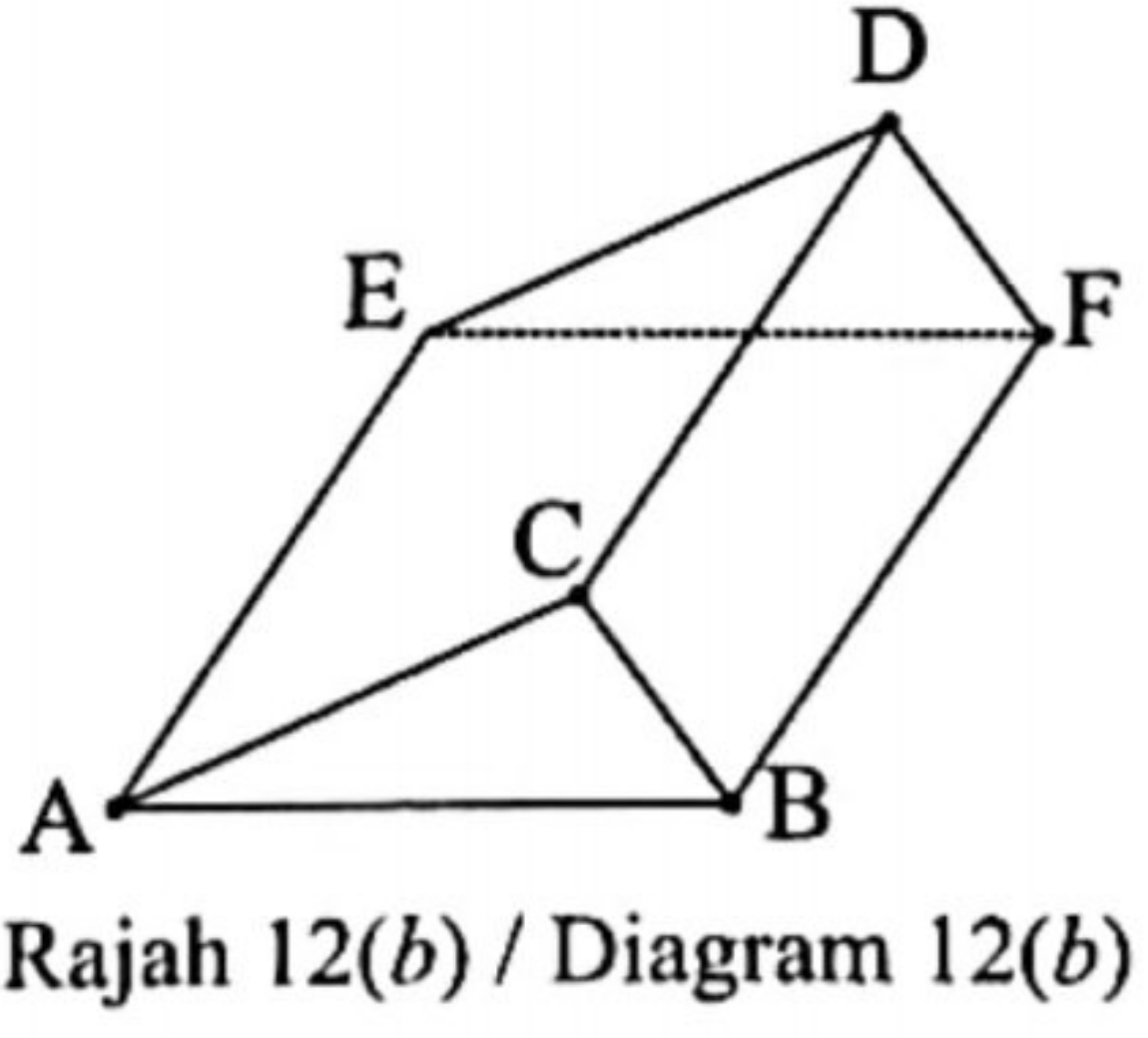
Diagram 12 shows a circle of radius 7 cm centred at O. Angle ABC is obtuse. ∠BAC = 25° is marked and chord AB = 8.14 cm. (a) (i) Find the length, in cm, of chord BC. (ii) Hence, find the area of triangle OBC using Heron's formula. (b) Given the area of triangle ABC is 20.98 cm², calculate ∠ABC. (c) Sketch a triangle A′B′C′ which has a different shape from triangle ABC such that C′B′ = CB, A′B′ = AB and ∠C′A′B′ = ∠CAB. Hence, find the value of ∠B′C′A′.
Hard10 marks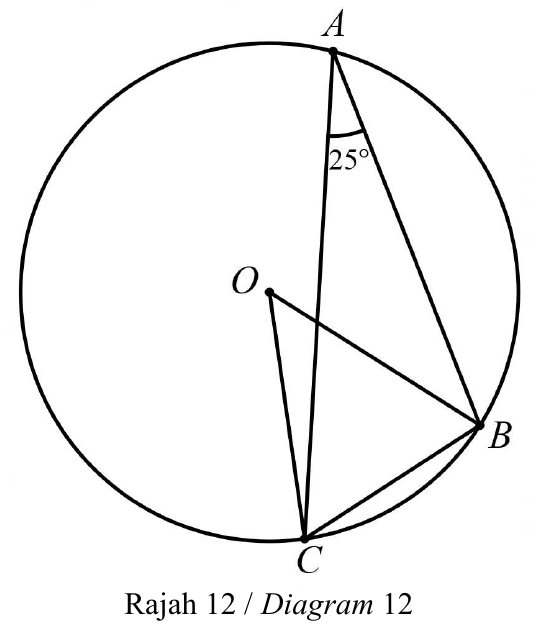
- (a)(i)
Find the length, in cm, of chord BC.
[2] - (a)(ii)
Hence, find the area of triangle OBC using Heron's formula.
[3] - (b)
Given that the area of triangle ABC is 20.98 cm², calculate ∠ABC.
[2] - (c)
Sketch triangle A′B′C′ with C′B′ = CB, A′B′ = AB and ∠C′A′B′ = ∠CAB but a different shape. Hence find ∠B′C′A′.
[3]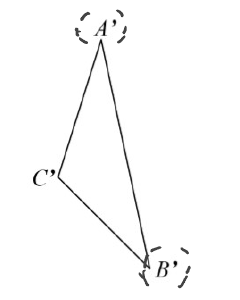
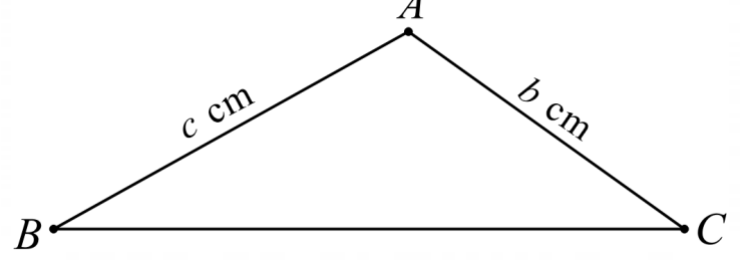
(a) Diagram 14(a) shows a piece of land: ABC is the area for mustard greens and ACD is the area for cabbage. A pond DEF is built so that AD and DF are perpendicular (E lies on CD). Given AB = 80 m, BC = 90 m, CE = 100 m, sin∠CAD = 4/7 and EF = 6 m. (i) Calculate the area, in m², of the mustard greens. (ii) Sketch triangle ACD′ which has a different shape from triangle ACD with CD = CD′ and ∠CAD = ∠CAD′. (iii) Mr Musa plans to build a cemented path starting at C for the cabbage growing area. Find the distance, in m, at the minimum cost for the cemented path. (b) Diagram 14(b) shows triangle ABC with AB = c cm and AC = b cm. Derive that b/sin B = c/sin C.
Hard10 marks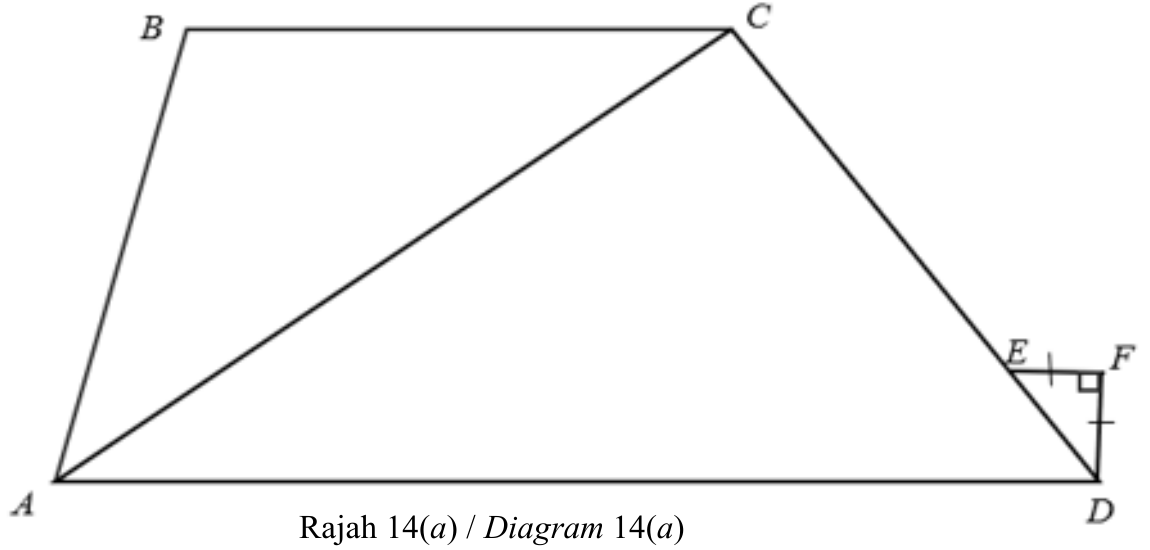
- (a)(i)
Calculate the area, in m², of the mustard greens (triangle ABC).
[3] - (a)(ii)
Sketch triangle ACD′ which has a different shape from triangle ACD with CD = CD′ and ∠CAD = ∠CAD′.
[1]
- (a)(iii)
Find the distance, in m, at the minimum cost for the cemented path starting at C.
[4] - (b)
Based on Diagram 14(b), derive that b/sin B = c/sin C.
[2]
Diagram 12 shows a regular polygon ABCFG and a triangle ADG. Given AB = 8 cm and AC : CD = 1 : 1. (a) Find the length, in cm, of AC. (b) A triangle AB′C is constructed such that B′C = BC and B′ lies on an elongated straight line AB. Find the length, in cm, of B′D. (c) Find the area, in cm², of the shaded region.
Medium10 marks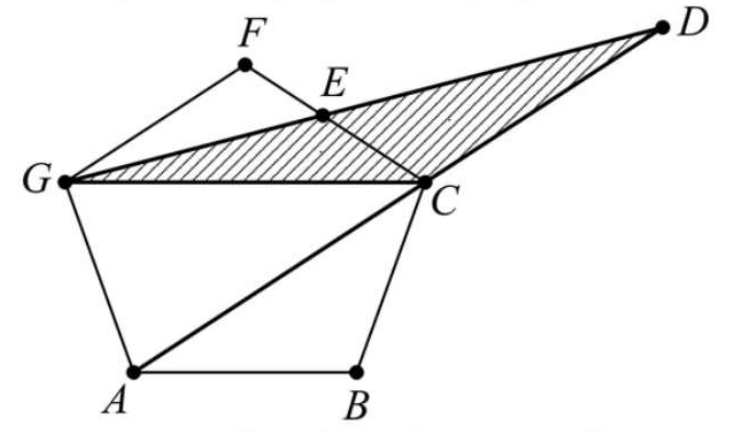
- (a)
Find the length, in cm, of AC.
[3] - (b)
Find the length, in cm, of B′D.
[3] - (c)
Find the area, in cm², of the shaded region.
[4]
Diagram 12 shows triangle ABE combined with quadrilateral BCDE, with AE = 5.32 cm, EB = 4.27 cm, AB = 5.52 cm and ED = 3.35 cm. The straight line ABC is parallel to the straight line DE.
Medium10 marks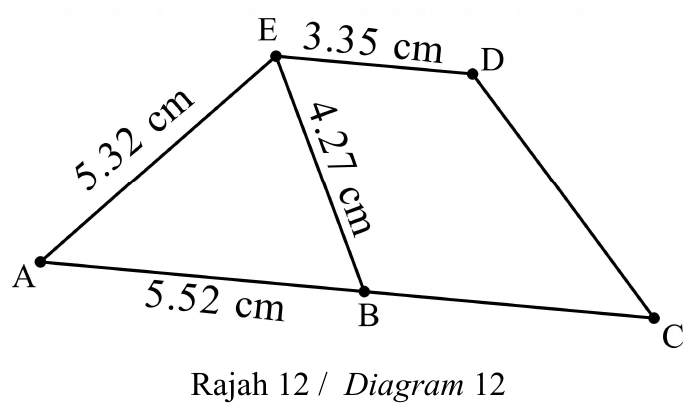
- (a)
Find the area of ABE, in cm², using Heron's formula.
[2] - (b)
Find the length of CD, in cm, given AB : BC = 1 : 1.
[5] - (c)
Find the area of quadrilateral BCDE, in cm².
[3]
Diagram 9 shows a right prism PQRSTU with PQR as the cross-section. Given that PQ = 6.3 cm, QR = 10.5 cm, RS = 12.4 cm and ∠PQR = 40.63°. Find (a) the angle between the lines PT and RT, (b) the area of the plane UQR, (c) the shortest distance from U to QR.
Hard10 marks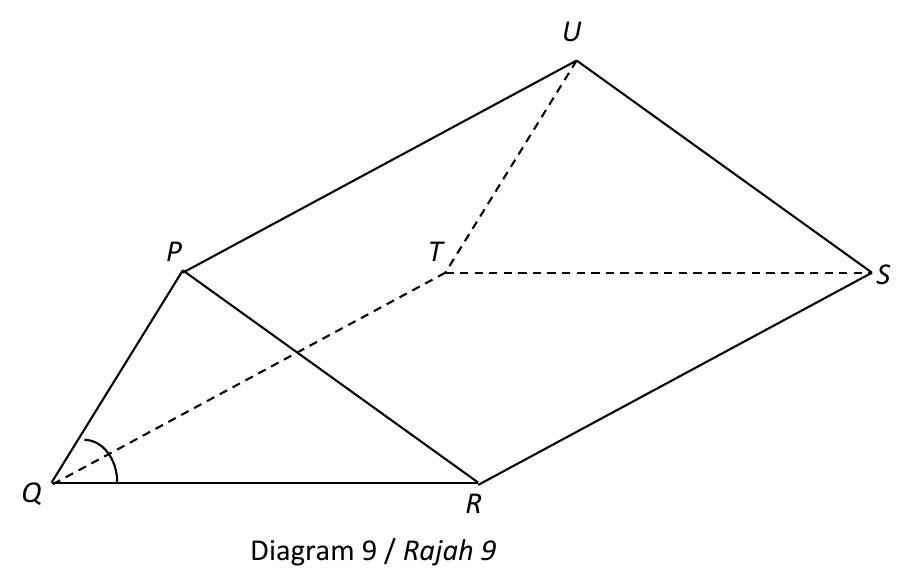
- (a)
The angle between the lines PT and RT.
[4] - (b)
The area of the plane UQR.
[4] - (c)
The shortest distance from U to QR.
[2]
In Diagram 6, AE = 8 cm, CD = 12 cm, BE = 6 cm and BC = 10 cm. ∠EBC is obtuse. ABC and AED are straight lines. Given the area of triangle CDE = 50 cm², find (a) the length of CE, in cm, (b) ∠DCE, (c) triangle A′B′E′ has a different shape from triangle ABE, with A′E′ = AE, B′E′ = BE and ∠B′A′E′ = ∠BAE: (i) sketch triangle A′B′E′, (ii) find the area, in cm², of triangle A′B′E′. (∠BAE = 30°.)
Medium10 marks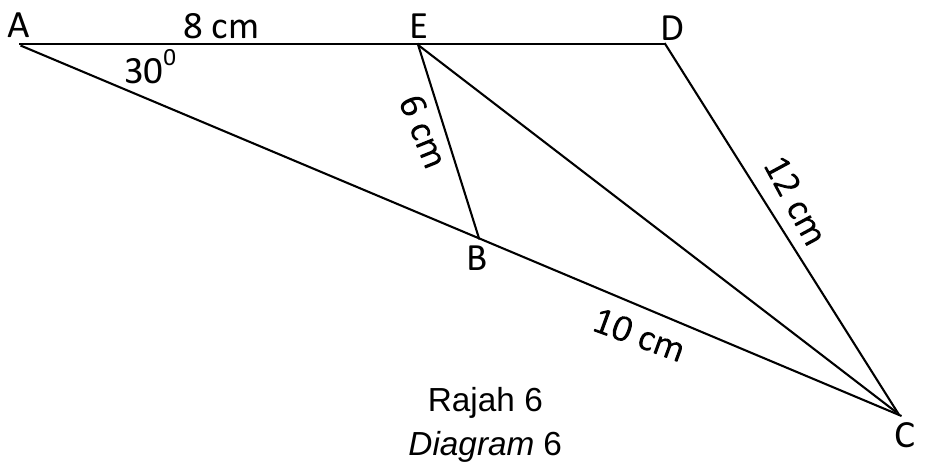
- (a)
Find the length of CE, in cm.
[4] - (b)
Find ∠DCE.
[2] - (c)(i)
Sketch triangle A′B′E′.
[1]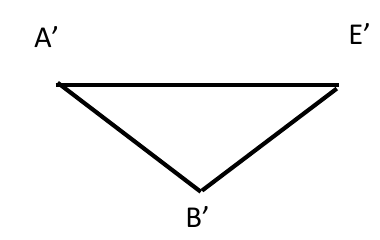
- (c)(ii)
Find the area, in cm², of triangle A′B′E′.
[3]
Mr. Salleh has a triangular piece of land. The two sides of the land have lengths (2x + 10) m and (5x − 20) m respectively. The angle between the two sides is 30°. Find the length of both sides of the land to the nearest integer, if the area of the land is 1700 m².
Easy5 marksFind the length of both sides of the land to the nearest integer.
[5]
Diagram 9 shows a cuboid ABCDEFGH. Given EF = 14 cm, FG = 10 cm and CG = 8 cm. M is the midpoint of AD. Find (a) ∠FCM, (b) ∠CMF, (c) the area of triangle FCM, (d) the shortest distance from M to CF.
Medium10 marks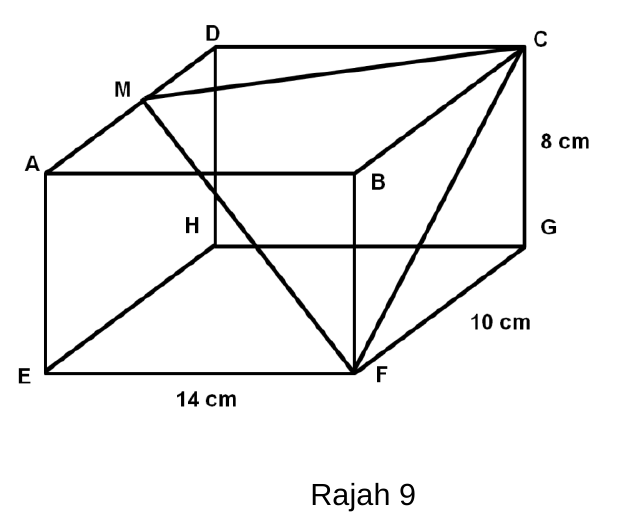
- (a)
Find ∠FCM.
[4] - (b)
Find ∠CMF.
[2] - (c)
Find the area of triangle FCM.
[2] - (d)
Find the shortest distance from M to CF.
[2]
A triangle ABC with an area of 28 cm². Given AB = 9 cm, ∠ABC = 34° and ∠BAC is the largest angle in the triangle. (a) Sketch the triangle ABC. (b) Calculate (i) the length, in cm, of BC, (ii) the length, in cm, of AC, (iii) ∠ACB. (c) The point C′ lies on the line BC where AC′ = AC. Calculate the area of the triangle ABC′.
Medium10 marks- (a)
Sketch the triangle ABC.
[1]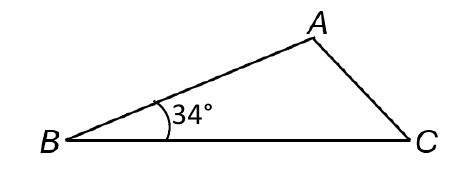
- (b)(i)
The length, in cm, of BC.
[2] - (b)(ii)
The length, in cm, of AC.
[2] - (b)(iii)
∠ACB.
[2] - (c)
The area of triangle ABC′ (C′ on BC with AC′ = AC).
[3]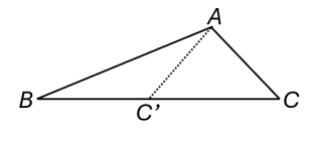
Solution of triangles.
Hard10 marks- (a)
Diagram 6 shows a cyclic quadrilateral PQRS. The lengths of the straight lines RS and SP are 3 cm and 6 cm respectively; PQ = 5 cm and RQ = 8 cm; ∠PSR = m and ∠PQR = n. Express PR in terms of (i) m (ii) n. Hence show that cos m = −11/29.
[6]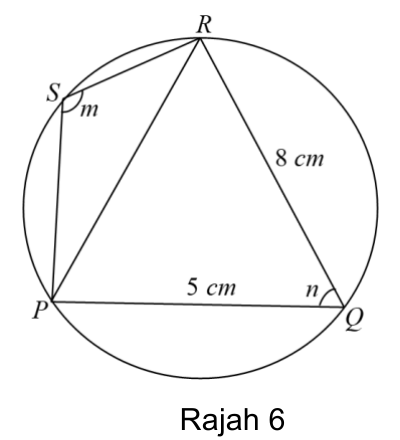
- (b)(i)
Diagram 7 shows AB = 4 cm, AC = 7 cm, ∠AOC = 22° and ∠BAC = 37° (O, A, B lie on a straight line). Calculate the length of OA.
[2]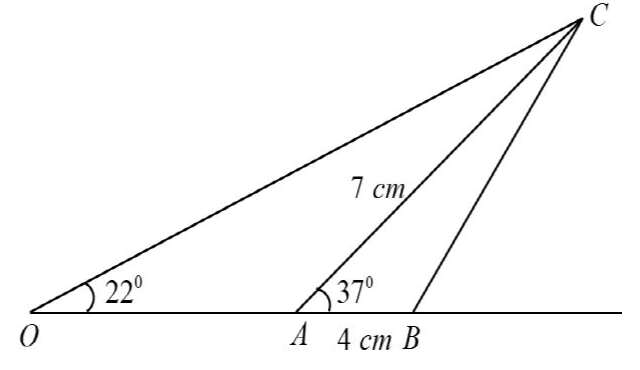
- (b)(ii)
Calculate the area of triangle ABC, using Heron's formula.
[2]
Solutions by scale drawing are not accepted. Diagram 7 shows a cyclic quadrilateral ABCD. Given AB = 5 cm, BC = 7.7 cm, CD = 3.2 cm and ∠ABC = 69°.
Medium10 marks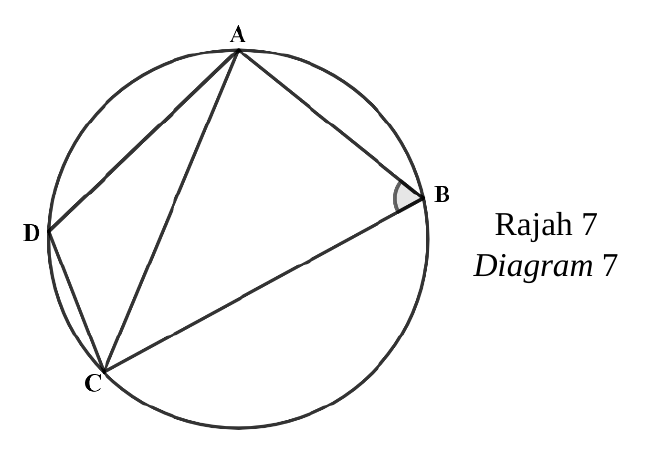
- (a)(i)
Calculate the length, in cm, of AC.
[2] - (a)(ii)
Calculate ∠ACD.
[2] - (b)(i)
Find the area, in cm², of △ABC.
[2] - (b)(ii)
Find the shortest distance, in cm, from point B to AC.
[2] - (c)
A triangle A′C′D′ has a shape different from triangle ACD, with A′D′ = AD, C′D′ = CD and ∠C′A′D′ = ∠CAD. Sketch the triangle A′C′D′ and state the value of ∠A′C′D′.
[2]
Diagram 6 shows a sculpture in the shape of a pyramid ABCD. The horizontal base of the sculpture, △BCD, and the inclined plane △ABC are isosceles triangles. Given that BD = CD, BC = 12 cm, AB = AC = 6.8 cm, ∠BDC = 70° and ∠ACD = 38°. Calculate (a) the length of CD, (b) the length of AD, (c) the area, in cm², of the triangle ACD, (d) the angle between plane ABC and plane BCD.
Medium10 marks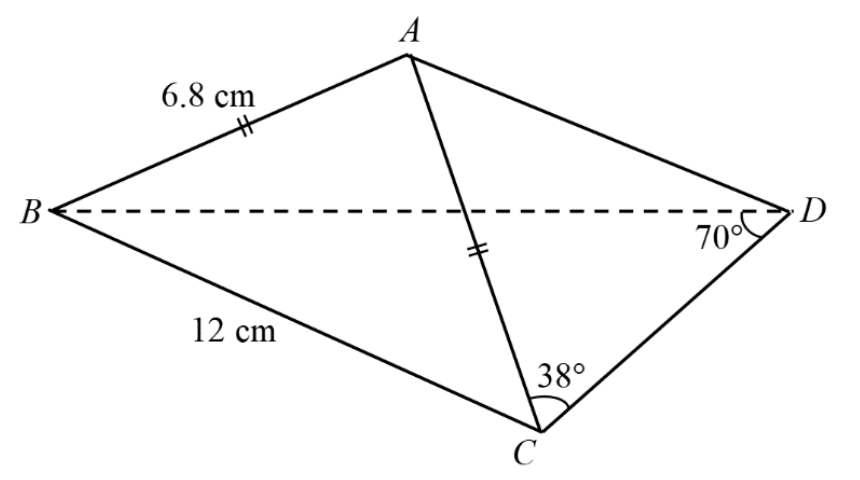
- (a)
Calculate the length of CD.
[2] - (b)
Calculate the length of AD.
[2] - (c)
Calculate the area, in cm², of triangle ACD.
[2] - (d)
Calculate the angle between plane ABC and plane BCD.
[4]
Diagram 6 shows a circle with radius 7 cm centred at O. The angle PQR is an obtuse angle and angle QPR = 25°. Given the length of chord PQ = 8.14 cm, (a) (i) find the length in cm of chord QR, (ii) hence, find the area of triangle OQR by using Heron's formula. (b) Given that the area of triangle PQR is 20.98 cm², calculate ∠PQR. (c) Sketch a triangle P′Q′R′ which has a different shape from triangle PQR such that Q′R′ = QR, P′Q′ = PQ and ∠Q′P′R′ = ∠QPR. Hence, find the value of ∠Q′R′P′.
Medium10 marks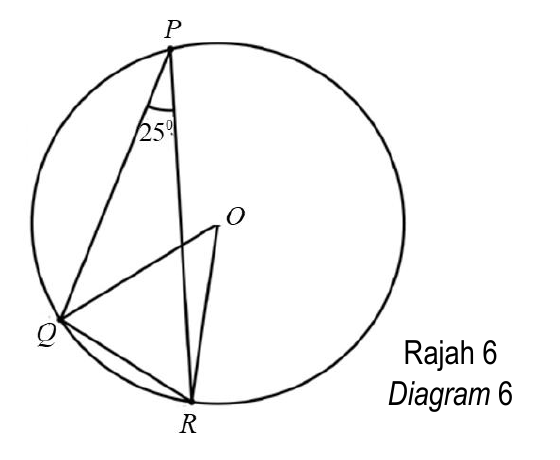
- (a)(i)
Find the length of chord QR in cm.
[2] - (a)(ii)
Find the area of triangle OQR by Heron's formula.
[3] - (b)
Given the area of triangle PQR is 20.98 cm², calculate ∠PQR.
[2] - (c)
Sketch triangle P′Q′R′ (different shape, Q′R′ = QR, P′Q′ = PQ, ∠Q′P′R′ = ∠QPR) and find ∠Q′R′P′.
[3]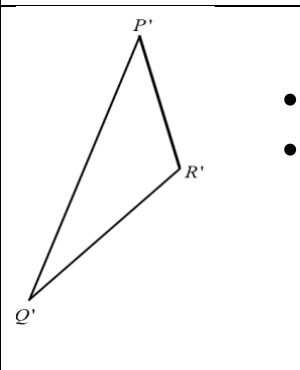
P, Q, R and S are four points on level ground with Q due east of P. Given PR = 55 m, RS = 25 m, PS = 70 m, ∠RPQ = 50° and ∠PQR = 48°. (a) Calculate (i) the length of PQ, (ii) ∠RPS, (iii) the area of triangle PQR. (b) A man walks along PQ from P until he reaches a point X which is equidistant from P and R. Calculate the distance of PX.
Medium10 marks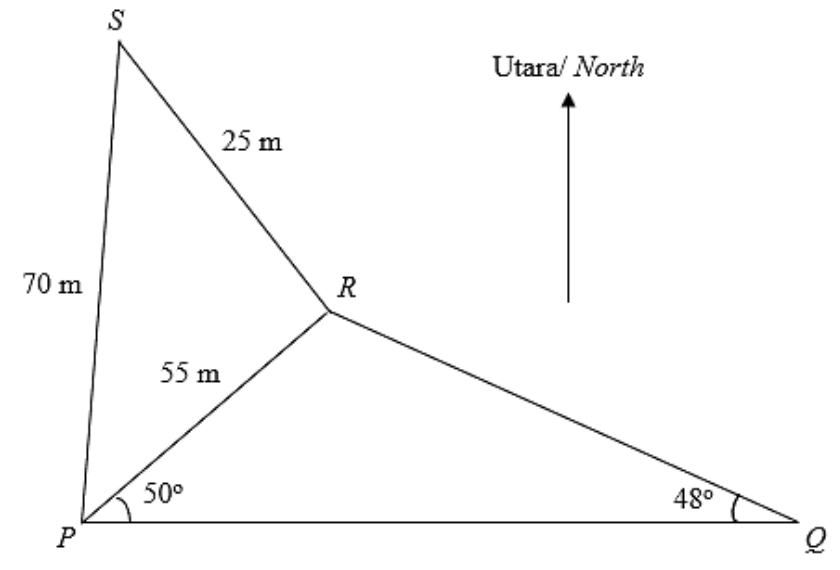
- (a)(i)
Calculate the length of PQ.
[3] - (a)(ii)
Calculate ∠RPS.
[2] - (a)(iii)
Calculate the area of triangle PQR.
[2] - (b)
Calculate the distance PX.
[3]
In Diagram 5, AB = 8.4 cm, BC = 10.2 cm, DA = 10 cm, ∠BCD = 76° 25′ and ∠DBC = 47°. (a) Calculate the length, in cm, of DB. (b) Calculate ∠ADB. (c) Sketch △B′D′C′ which has a different shape from △BDC such that C′D′ = CD, B′D′ = BD and ∠C′B′D′ = ∠CBD. Hence state the angle B′C′D′. (d) Calculate the area of quadrilateral ABCD.
Medium10 marks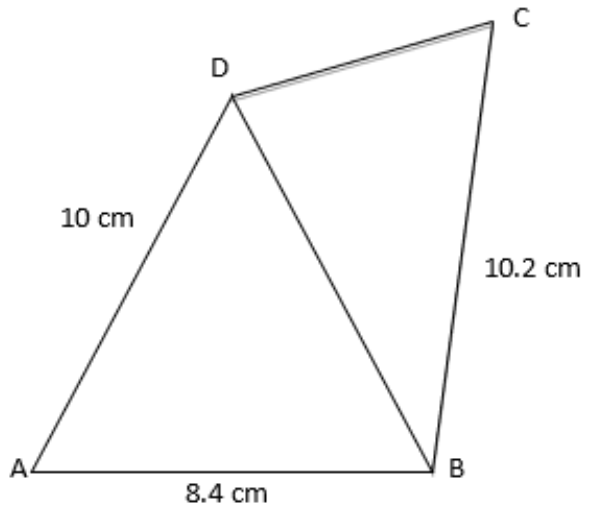
- (a)
Calculate the length, in cm, of DB.
[3] - (b)
Calculate ∠ADB.
[2] - (c)
Sketch △B′D′C′ (different shape from △BDC, with C′D′ = CD, B′D′ = BD, ∠C′B′D′ = ∠CBD) and state ∠B′C′D′.
[2]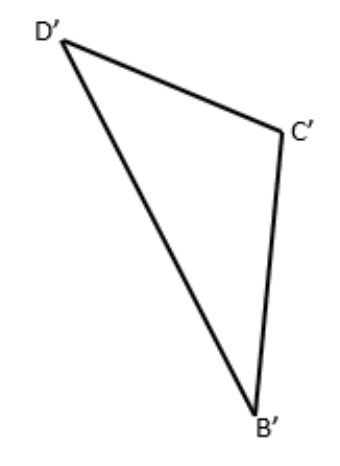
- (d)
Calculate the area of quadrilateral ABCD.
[3]
Diagram 6 shows a building in the shape of a pyramid with base QTS. Given QT = 60 m, TS = 80 m and QS = 100 m. The vertex P is 90 m vertically above T. A group of workers has to paint the inclined wall PQS. (a) Find the side length in m of (i) PS, (ii) PQ. (b) Calculate ∠PSQ. (c) By using Heron's formula, find the area of the painted inclined wall. (d) (i) Sketch a triangle P′Q′S′ which has a different shape from triangle PQS such that P′Q′ = PQ, P′S′ = PS and ∠P′S′Q′ = ∠PSQ. (ii) Find ∠P′Q′S′.
Hard10 marks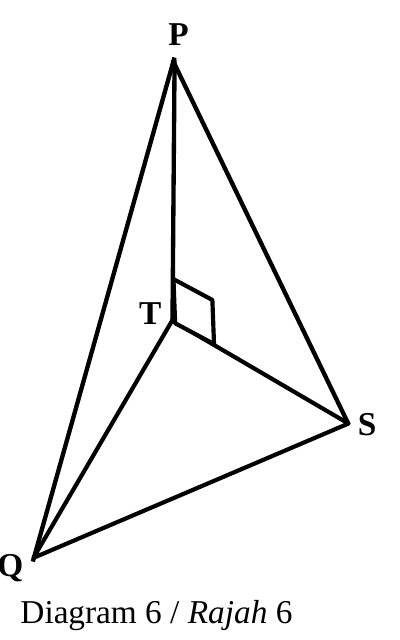
- (a)(i)
Find PS.
[1] - (a)(ii)
Find PQ.
[1] - (b)
Calculate ∠PSQ.
[2] - (c)
Find the area using Heron's formula.
[2] - (d)(i)
Sketch triangle P′Q′S′.
[1]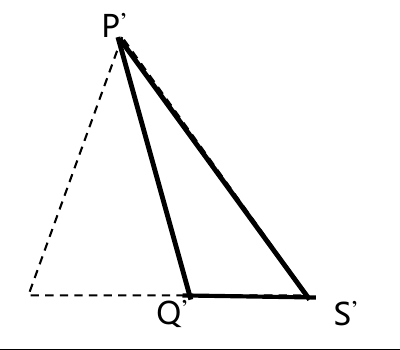
- (d)(ii)
Find ∠P′Q′S′.
[3]
Diagram 6 shows a right prism ABCDEF. The length and breadth of the base BCFE are 12 cm and 5 cm. Calculate (a) CD, (b) the angle between BD and CD, (c) the area of triangle BCD, (d) the angle between the plane BCD and the plane BCFE.
Medium10 marks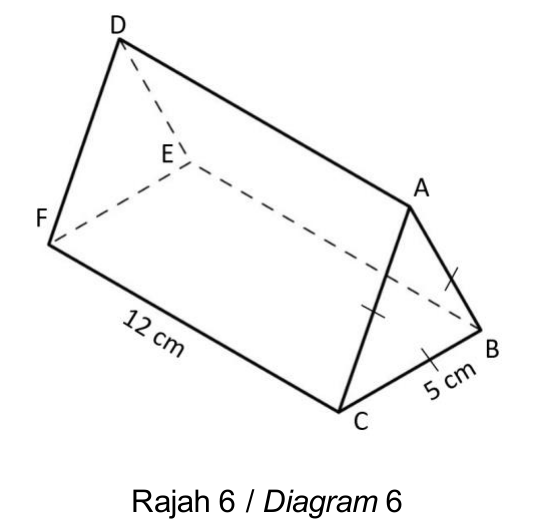
- (a)
Calculate CD.
[2] - (b)
Calculate the angle between BD and CD.
[3] - (c)
Calculate the area of triangle BCD.
[2] - (d)
Calculate the angle between the plane BCD and the plane BCFE.
[3]
Diagram 6 shows a cyclic quadrilateral PQRS. QR = 7.5 cm and ∠PQR = 85°. (a) It is given that the length of PQ = 9 cm and RS = 4 cm. Calculate (i) the length, in cm, of PR, (ii) ∠PRS. (b) Find (i) the area, in cm², of △PQR, (ii) the shortest distance, in cm, from point Q to PR.
Medium10 marks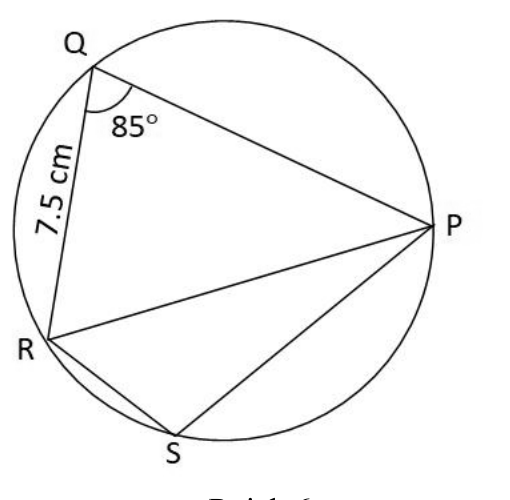
- (a)(i)
Calculate the length of PR in cm.
[2] - (a)(ii)
Calculate ∠PRS.
[4] - (b)(i)
Calculate the area of △PQR in cm².
[2] - (b)(ii)
Find the shortest distance from Q to PR in cm.
[2]
Solution by scale drawing is not accepted. Diagram 8 shows a quadrilateral PQRS with PQ = 12.21 cm, QR = 7.813 cm, RS = 8.599 cm, PS = 13.58 cm and ∠RPS = 26.6°.
Medium10 marks- (a)(i)
Given ∠PRS is an obtuse angle, find ∠PRS.
[2]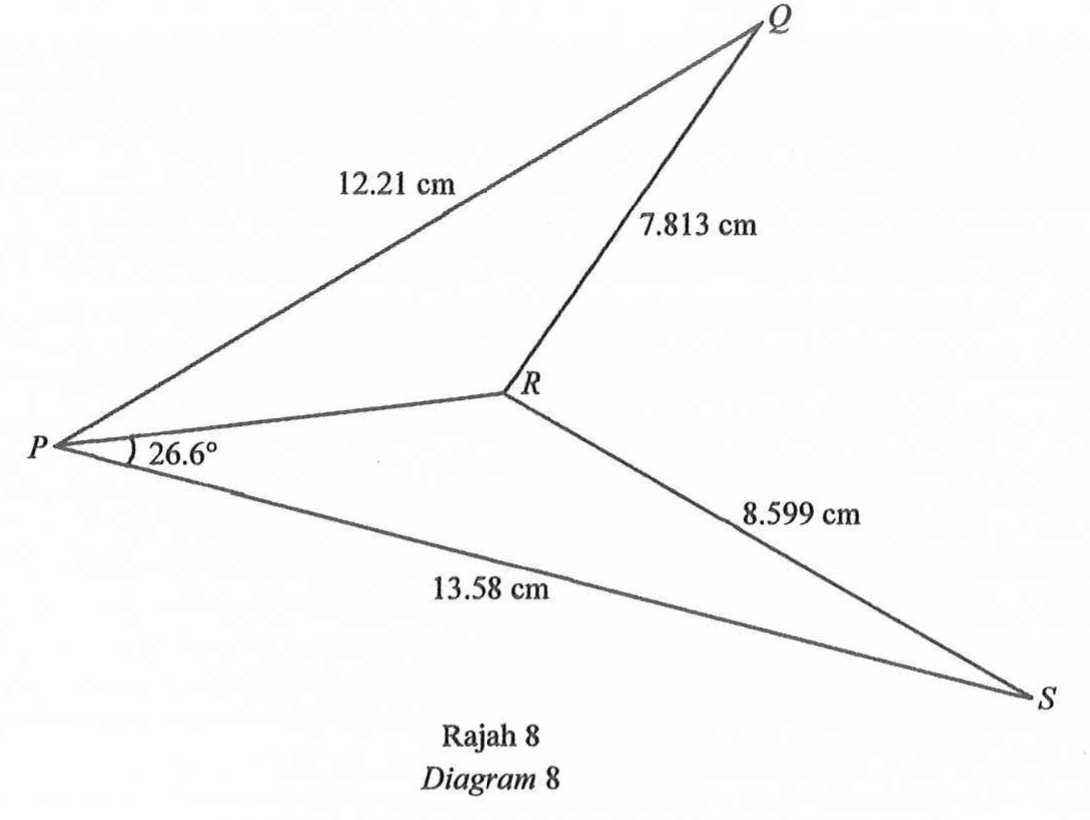
- (a)(ii)
If straight line PR is extended to a point M, such that ∠RPS = ∠MPS and RS = MS, find the length, in cm, of PM.
[2] - (b)
Find ∠PRQ.
[3] - (c)
Calculate the area, in cm², of pentagon PQRMS.
[3]
Solution by scale drawing is not accepted. Diagram 6 shows a triangle PQR such that ∠PQR is an obtuse angle. The straight line PAB intersects with the straight line AR at point A and B is the midpoint of QR. Given that 2PA = 3AB and the shortest distance from Q to the straight line PR is 5.36 cm. (QR = 6.99 cm, PR = 12.01 cm.) (a) Find the length, in cm, of PQ. (b) (i) Sketch a triangle P′Q′R′ which has a different shape from triangle PQR such that P′Q′ = PQ, Q′R′ = QR and ∠Q′P′R′ = ∠QPR. (ii) Hence, state the size ∠P′R′Q′. (iii) Find ∠QPR. (c) Find the area, in cm², of triangle ABR.
Medium10 marks- (a)
Find the length, in cm, of PQ.
[3]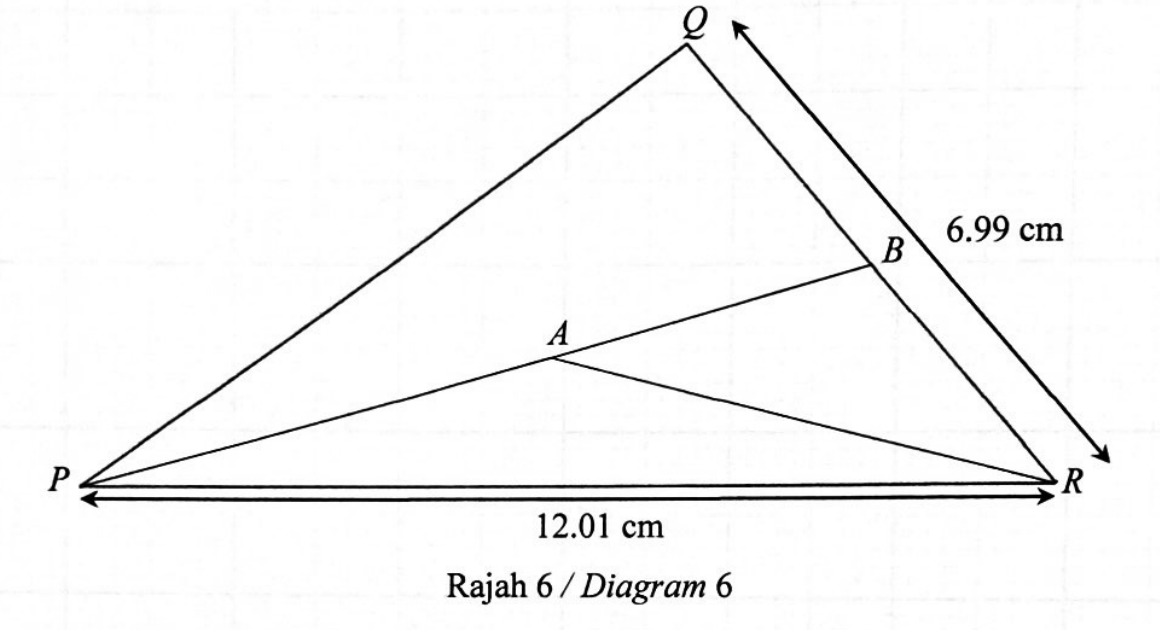
- (b)(i)
Sketch a triangle P′Q′R′ which has a different shape from triangle PQR such that P′Q′ = PQ, Q′R′ = QR and ∠Q′P′R′ = ∠QPR.
[1] - (b)(ii)
Hence, state the size ∠P′R′Q′.
[1] - (b)(iii)
Find ∠QPR.
[2] - (c)
Find the area, in cm², of triangle ABR.
[3]
Solutions by scale drawing is not accepted. Diagram 6 shows a triangle PQR with PR = 16 cm and QR = 7.3 cm. It is given that the area of triangle PQR is 32.5 cm² and ∠PRQ is an obtuse angle. (a) Find (i) ∠PRQ, (ii) the length, in cm, of PQ, (iii) ∠RPQ. (b) Triangle P′Q′R′ has a different shape from triangle PQR such that P′R′ = PR, Q′R′ = QR and ∠Q′P′R′ = ∠QPR. (i) Sketch triangle P′Q′R′. (ii) State the size of ∠P′R′Q′. (iii) Calculate the area, in cm², of triangle P′Q′R′.
Medium10 marks- (a)(i)
Find ∠PRQ.
[2]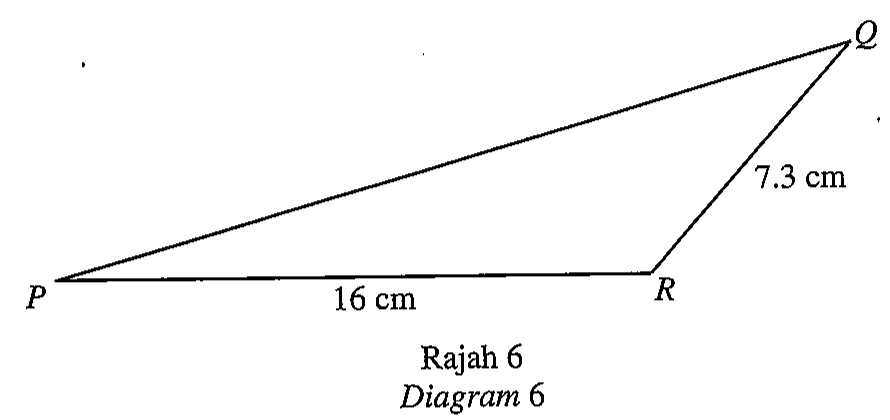
- (a)(ii)
Find the length, in cm, of PQ.
[2] - (a)(iii)
Find ∠RPQ.
[2] - (b)(i)
Sketch triangle P′Q′R′.
[1]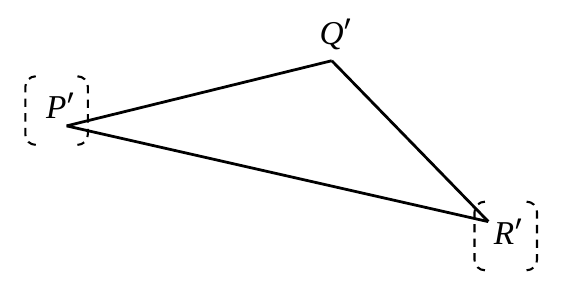
- (b)(ii)
State the size of ∠P′R′Q′.
[1] - (b)(iii)
Calculate the area, in cm², of triangle P′Q′R′.
[2]
Solution by scale drawing is not accepted. Diagram 9 shows a quadrilateral PQRS with PQ = 9.2 cm, ∠PQS = 80°, ∠PSQ = 35°, QR = 6.5 cm and RS = 12.4 cm.
Hard10 marks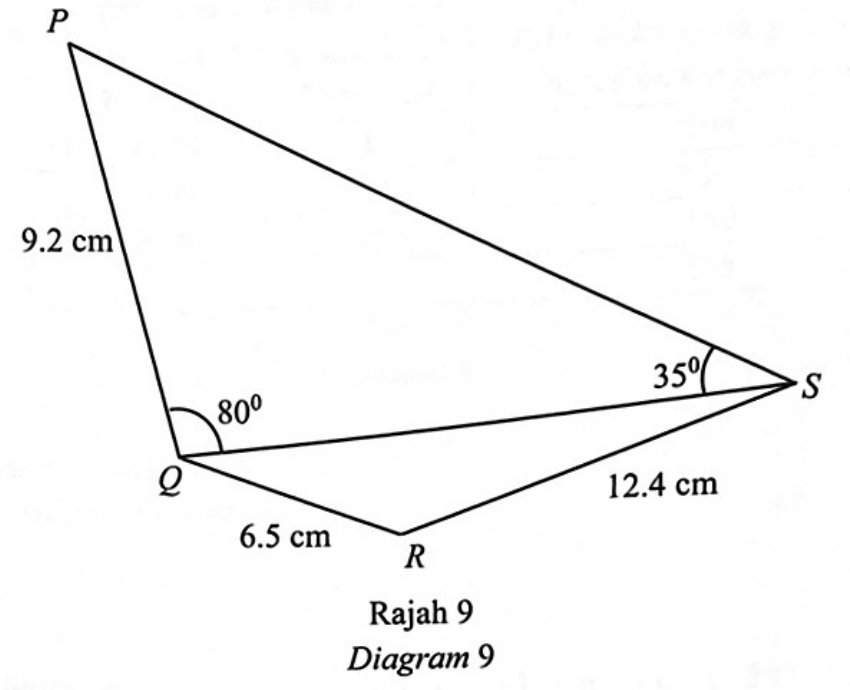
- (a)(i)
Calculate the length, in cm, of QS.
[3] - (a)(ii)
Calculate ∠QRS.
[2] - (a)(iii)
Calculate the area, in cm², of the quadrilateral PQRS.
[3] - (b)(i)
Sketch a triangle Q′R′S′ which has a different shape from triangle QRS such that Q′R′ = QR, Q′S′ = QS and ∠Q′S′R′ = ∠QSR.
[1]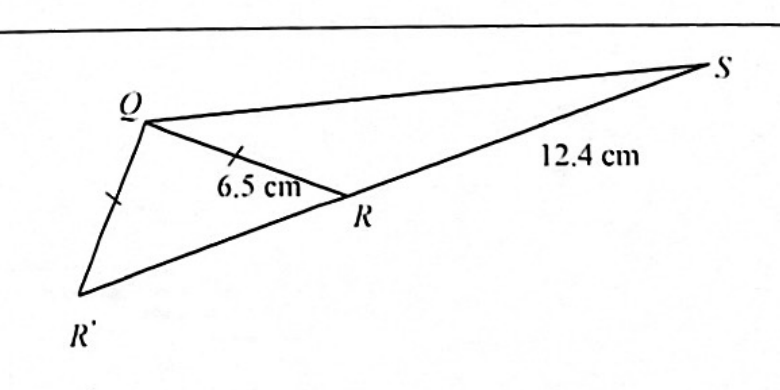
- (b)(ii)
Hence, state the size of ∠Q′R′S′.
[1]
Diagram 7 shows a triangle ABC. APB and AQC are straight lines and line PQ is parallel to the line BC. AP = 5.30 cm, AQ = 7.22 cm, PQ = 7.78 cm. (a) Find (i) ∠PAQ, (ii) ∠APQ, (iii) the area, in cm², of triangle APQ. (b) Given that AP : PB = 3 : 2, find (i) the area of triangle ABC, (ii) the shortest distance from vertex A to the straight line BC.
Medium10 marks- (a)(i)
Find ∠PAQ.
[2]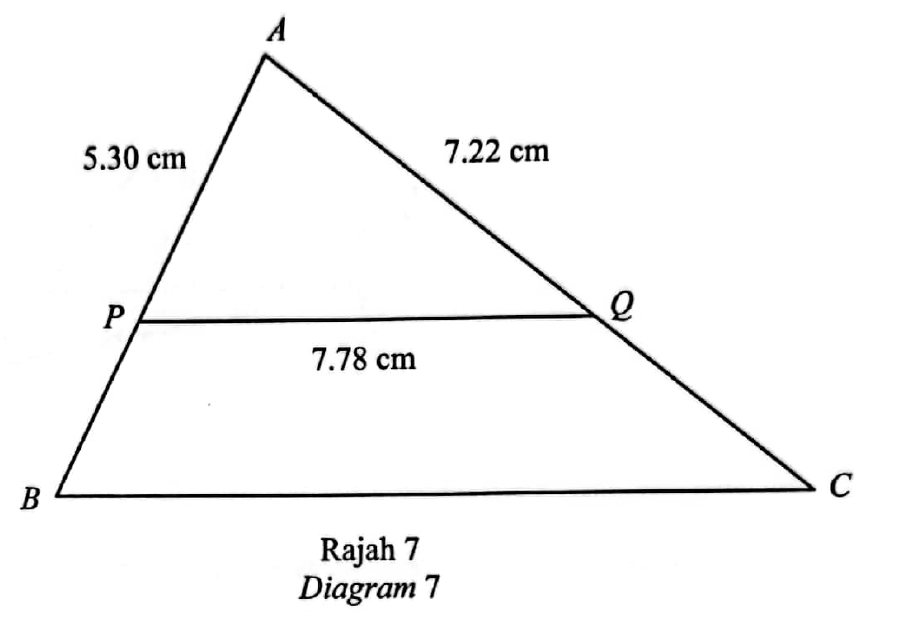
- (a)(ii)
Find ∠APQ.
[2] - (a)(iii)
Find the area, in cm², of triangle APQ.
[2] - (b)(i)
Find the area of triangle ABC.
[2] - (b)(ii)
Find the shortest distance from A to BC.
[2]
Solution by scale drawing is not accepted. Diagram 10 shows a quadrilateral ABCD with AB = 5.6 cm, AD = 12.8 cm, CD = 3.9 cm, ∠BAD = 42° and ∠BCD = 115°. (a) Calculate (i) the length, in cm, of BD, (ii) ∠CBD, (iii) the area, in cm², of △ABD, (iv) the shortest distance, in cm, from point B to the straight line AD. (b) (i) Sketch a triangle B′C′D′ which has a different shape from triangle BCD such that C′D′ = CD, C′B′ = CB and ∠C′B′D′ = ∠CBD. (ii) Hence, find ∠C′D′B′.
Medium10 marks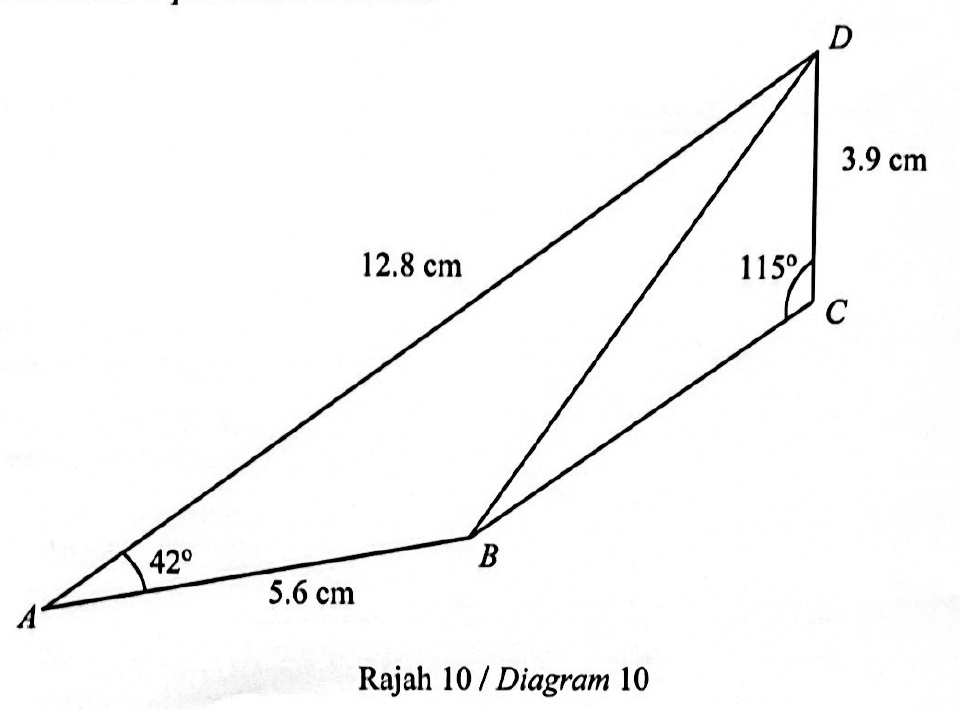
- (a)(i)
Calculate the length of BD.
[2] - (a)(ii)
Calculate ∠CBD.
[2] - (a)(iii)
Calculate the area of △ABD.
[2] - (a)(iv)
Calculate the shortest distance from B to the straight line AD.
[2] - (b)(i)
Sketch triangle B′C′D′ with C′D′ = CD, C′B′ = CB and ∠C′B′D′ = ∠CBD, of different shape from BCD.
[1] - (b)(ii)
Hence, find ∠C′D′B′.
[1]
Diagram 9 shows a triangular stage ABC. AE and CF are two vertical columns on the bases of vertices A and C to build the roof of the triangular stage BEF. Given the length AE = CF = 8 m, AB = 8.02 m, BC = 16.03 m and ∠ABC = 46°.
Hard10 marks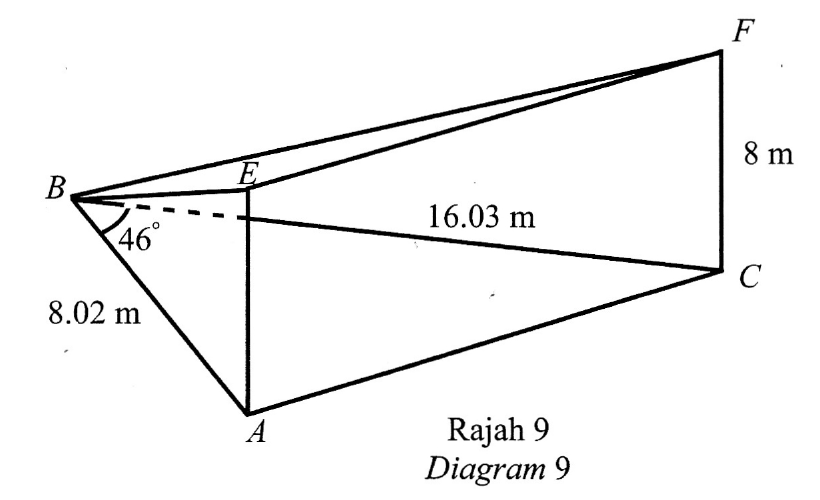
- (a)(i)
Find the length, in m, of AC.
[2] - (a)(ii)
Find the possible angle of ∠BAC.
[3] - (a)(iii)
Find ∠BEF, if the area of the roof BEF is 18.64 m² and ∠BEF is an obtuse angle.
[3] - (b)(i)
The stage has been enlarged to a shape △A′B′C′ which has a different shape from △ABC, such that A′B′ = AB, B′C′ = BC and ∠A′C′B′ = ∠ACB. Sketch △A′B′C′.
[1] - (b)(ii)
Hence, state the value of ∠A′B′C′.
[1]
Diagram 6 shows a combination of triangles ABC, BCD and ACD on the horizontal plane. Given that ∠ACB and ∠BCD are obtuse. DB = 8 cm, BC = 6 cm, AC = 10 cm and ∠BDC = 40°. If the area of triangle ABC is 22 cm², calculate (a) ∠ACB, (b) the length, in cm, of AB, (c) ∠DBA, (d) the area, in cm², of triangle ABD.
Medium10 marks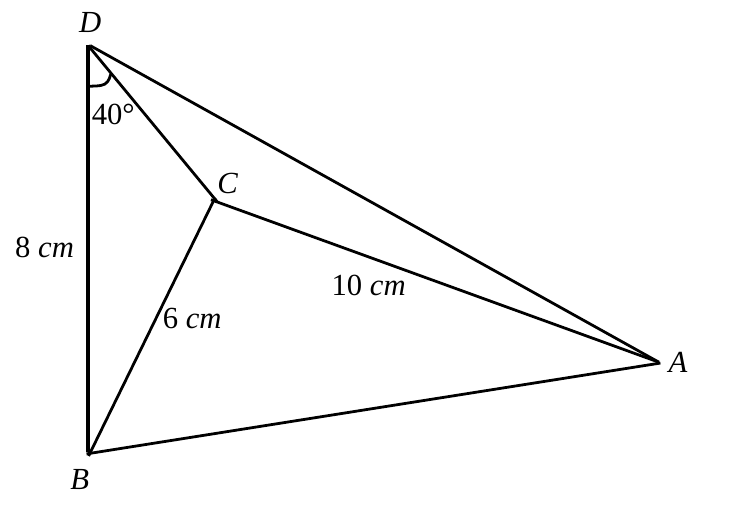
- (a)
Calculate ∠ACB.
[2] - (b)
Calculate the length of AB in cm.
[2] - (c)
Calculate ∠DBA.
[4] - (d)
Calculate the area of triangle ABD in cm².
[2]
Diagram 6 shows a quadrilateral ABCD with AD = 52.4 cm, DC = 109 cm, BC = 64 cm, angle ABC = 93.20° and angle ACB = 58°. Angle ADC is obtuse.
Medium10 marks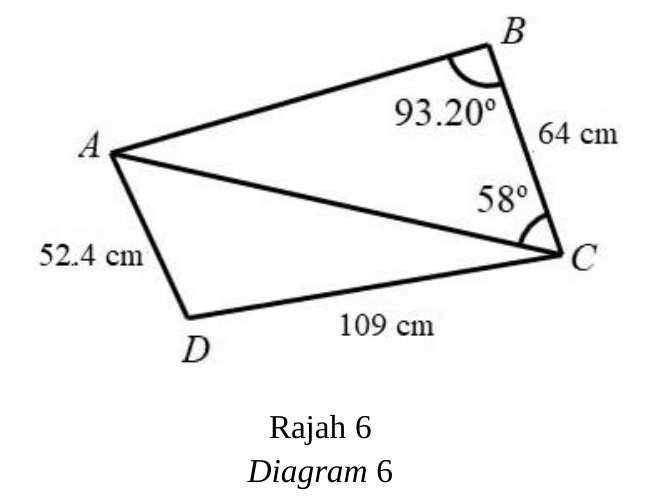
- (a)
Without any calculation, state the point which is the furthest from point A. Give reason for your answer.
[1] - (b)(i)
Calculate ∠ADC.
[3] - (b)(ii)
Calculate the area of region, in cm², of the quadrilateral ABCD.
[3] - (c)(i)
On Diagram 6, mark point E, where line CD is extended to E such that E is the point at the shortest distance from A to CD.
[1] - (c)(ii)
Find the shortest distance of E from A to CD.
[2]
(a) Sketch a triangle ABC with side a = BC, b = AC and angle C = ∠ACB. Hence, by using the concept of trigonometry and area of a triangle, derive the formula Area = ½ab sin C. (b) Diagram 7 shows the positions of a boat, an aircraft, an oil rig station and a shark. The distance between the boat and the aircraft is 24 units and the distance between the oil rig and the shark is 12 units, while the angle between the boat, the aircraft and the oil rig is 32°. The distance between the oil rig and the aircraft is equal to the distance between the boat and the oil rig. The positions of the shark, the oil rig and the aircraft are in a straight line. (i) Find the distance, in units, between the aircraft and the oil rig. (ii) Find the distance, in units, between the boat and the shark. (iii) Calculate the area of the triangle bounded by the positions of the boat, the aircraft and the shark.
Medium10 marks- (a)
Sketch a triangle ABC with side a = BC, b = AC and angle C = ∠ACB. Hence, derive the formula Area = ½ab sin C.
[4]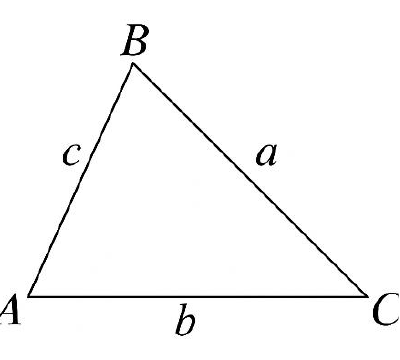
- (b)(i)
Find the distance, in units, between the aircraft and the oil rig.
[2]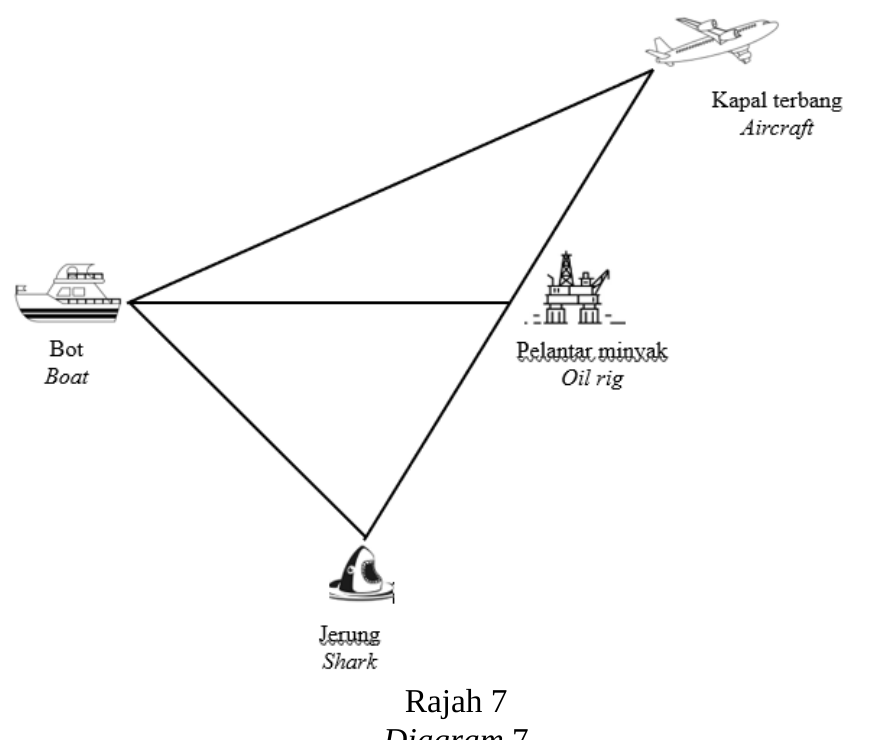
- (b)(ii)
Find the distance, in units, between the boat and the shark.
[2] - (b)(iii)
Calculate the area of the triangle bounded by the positions of the boat, the aircraft and the shark.
[2]
Diagram 4 shows a quadrilateral ABCD with ∠ADC = 31°, DC = 3 cm, AC = 5 cm, AB = 7 cm and BC = 6 cm.
Medium10 marks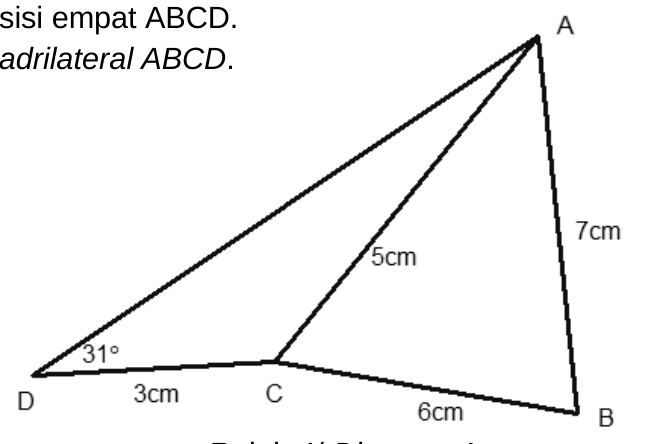
- (a)(i)
Calculate ∠DAC.
[2] - (a)(ii)
Calculate ∠BAC.
[2] - (b)(i)
A triangle ACD′ has a different shape from the triangle ACD such that CD′ = 3 cm, AC = 5 cm and ∠CAD′ = ∠CAD. Sketch the triangle ACD′.
[1]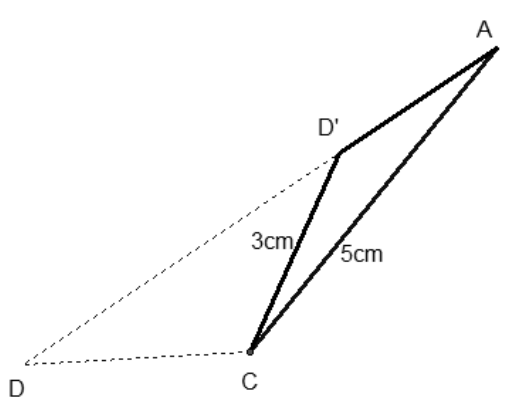
- (b)(ii)
Calculate ∠ACD′.
[2] - (b)(iii)
Hence, find the shortest distance from D′ to the line AC.
[3]
Solutions by scale drawing are not accepted. Diagram 6 shows triangle MNO with MN = 7.2 cm, ON = 5.4 cm and ∠MNO = 95.5°. (a) Find (i) the length, in cm, of MO, (ii) ∠MON. (b) The straight line ON is extended to N′ such that MN = M′N′. (i) Sketch the triangle M′N′O′. (ii) Find ∠O′M′N′. (iii) Calculate the area of triangle M′N′O′, in cm². Hence, find the shortest distance of M′ from N′O′.
Medium10 marks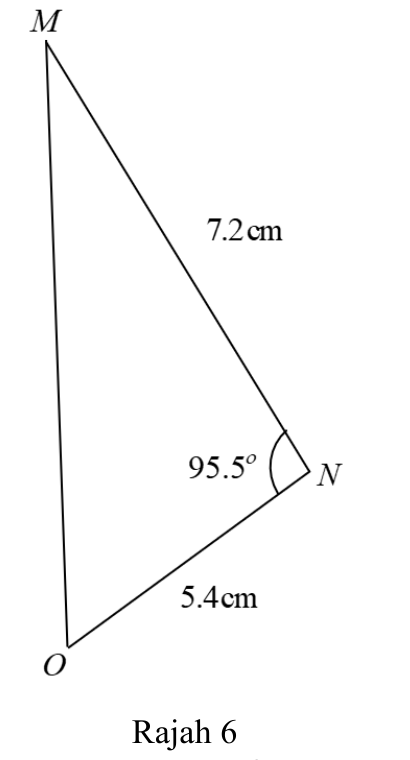
- (a)
Find (i) the length MO, in cm, (ii) ∠MON. [4 marks]
[4] - (b)(i)
Sketch the triangle M′N′O′. [(b): 6 marks]
[1]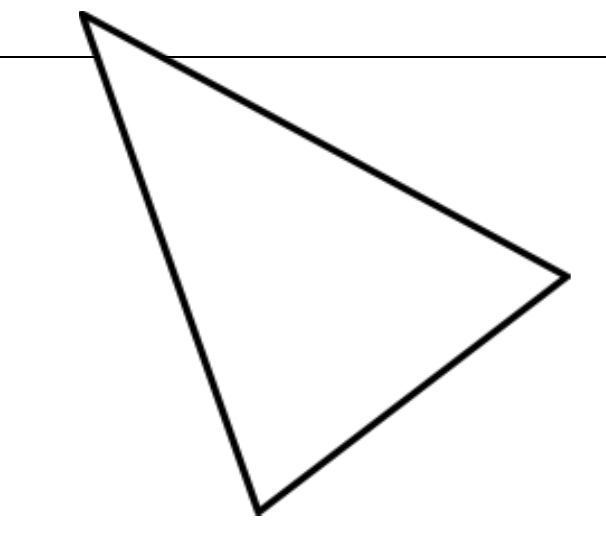
- (b)(ii)
Find ∠O′M′N′.
[1] - (b)(iii)
Calculate the area of triangle M′N′O′, in cm². Hence find the shortest distance of M′ from N′O′.
[4]
The diagram shows a square plot of land UVWX. A triangular area XYW is fenced with barbed wire. Angle YXW = 30° and the length XY = 20.8 m. The area of triangle XYW is 130 m². (a) Calculate (i) the length, in m, of barbed wire used to fence the area, (ii) angle XYW. (b) Another fence YZ is installed connecting Y with point Z on XW such that YZ = YW. (i) Sketch triangle XYZ. (ii) Triangle XYZ will be a fish pond and the rest of the land will be used for gardening. Calculate, in m², the area used for gardening.
Medium10 marks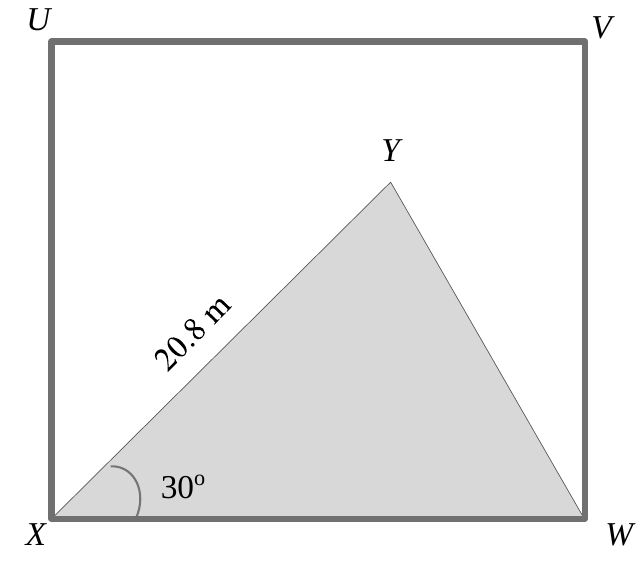
- (a)
Calculate (i) the length of barbed wire used, (ii) angle XYW.
[6] - (b)
(i) Sketch triangle XYZ. (ii) Calculate the area used for gardening.
[4]
Solution by scale drawing is not accepted. Diagram 3 shows a cuboid on the horizontal plane with dimensions 10 cm, 5 cm and 4 cm. Triangle ABC is drawn inside the cuboid.
Medium10 marks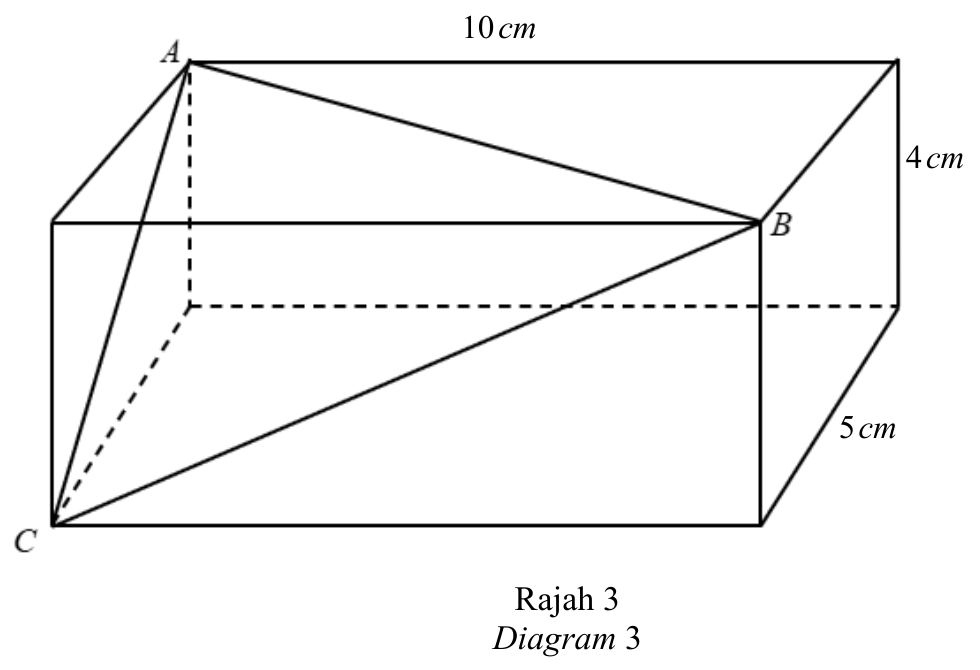
- (a)
By using Heron's formula, find the area of triangle ABC.
[3] - (b)
Find ∠ACB.
[2] - (c)(i)
Sketch a triangle A′B′C′ which has a different shape from triangle ABC, such that A′C′ = AC, A′B′ = AB and ∠A′B′C′ = ∠ABC.
[1]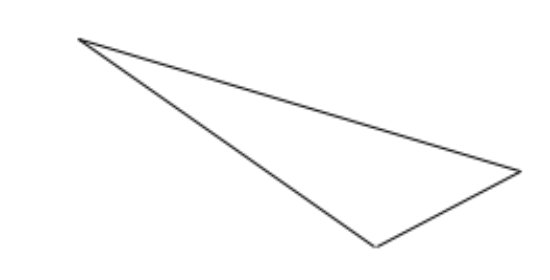
- (c)(ii)
Hence, state the size of ∠A′C′B′.
[1] - (c)(iii)
Find the area of triangle A′B′C′.
[3]
Diagram 7 shows a triangle PQR such that PQ = 11 cm, PR = 13.2 cm and ∠QPR = 63°. (a) Find (i) the length of QR, in cm, (ii) ∠PQR. (b) Point Q′ lies on the line QR such that PQ′ = PQ. (i) Sketch triangle Q′PR and state ∠PQ′R. (ii) Find the area of triangle PQ′R, in cm². Hence, find the percentage of that area compared to the area of triangle PQR.
Medium10 marks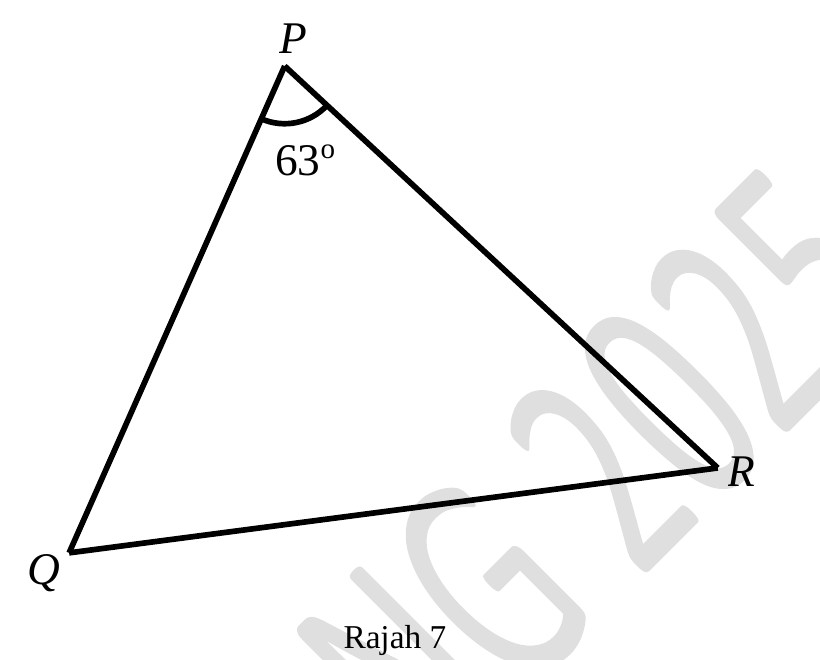
- (a)(i)
Find the length of QR, in cm.
[2] - (a)(ii)
Find ∠PQR.
[2] - (b)(i)
Sketch triangle Q′PR and state ∠PQ′R.
[2] - (b)(ii)
Find the area of triangle PQ′R, in cm², and the percentage compared with triangle PQR.
[4]
Diagram 7 shows a triangle WXY with XY = 19 cm, XW = 26 cm and angle YXW = 72°. (a) Calculate the length, in cm, of WY. (b) A quadrilateral WXYZ is formed such that WY is a diagonal. Given that ∠WYZ = 50° and WZ = 22 cm. (i) Find the possible values of ∠WZY. (ii) Calculate the length of YZ when ∠WZY < 90°. (iii) Calculate the area of the quadrilateral WXYZ.
Medium10 marks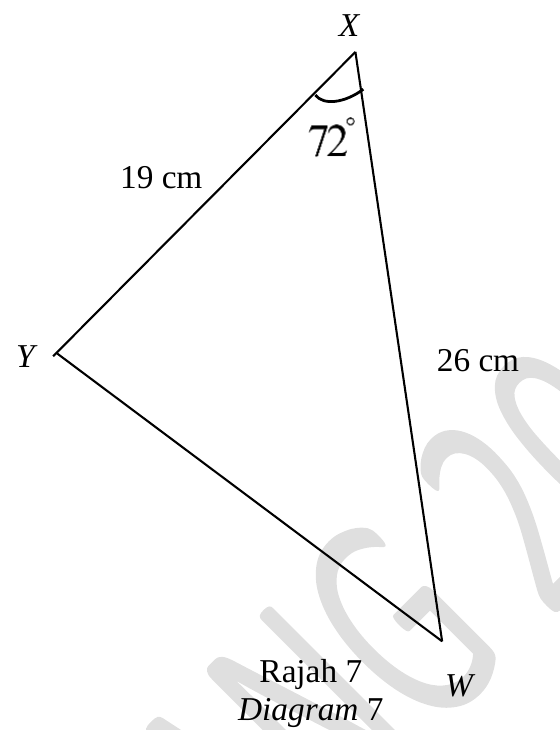
- (a)
Calculate the length, in cm, of WY.
[2] - (b)(i)
Find the possible values of ∠WZY.
[3] - (b)(ii)
Calculate the length of YZ when ∠WZY < 90°.
[2] - (b)(iii)
Calculate the area of the quadrilateral WXYZ.
[3]
Three triangles ABC, ACD and CED are such that ACE and BCD are straight lines. ∠DCE = 50.5°, ∠CED is an acute angle, BC = 5 cm, CD = 7 cm, AC = 9 cm and ED = 6.5 cm (Diagram).
Medium10 marks- (a)(i)
Calculate ∠CED.
[2]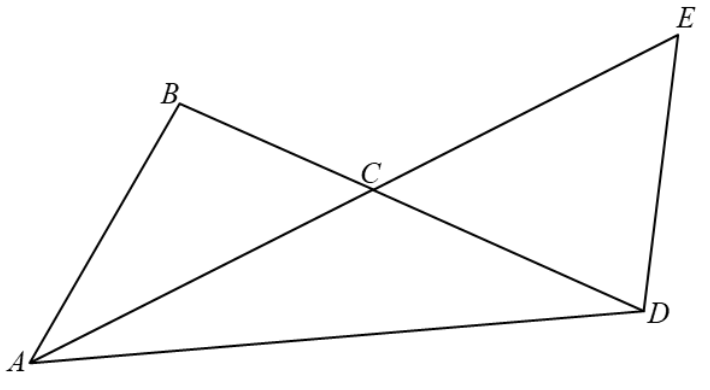
- (a)(ii)
Calculate the length of AB.
[2] - (a)(iii)
Calculate the area of triangle AED.
[4] - (b)
The straight line AB is extended to point B′ such that CB′ = CB. On the same diagram, draw and colour triangle BCB′. Hence, without calculation, determine which point, B′ or C, is further from A. Justify your answer.
[2]
Diagram 6 shows a triangle CDE. CFHD, CGE, and DIE are straight lines. Line HI is perpendicular to DE. Given that CF = 18 cm, DF = 24 cm, CG = 17 cm, ∠FCG = 50°, and ∠HDI = 60°. (a) Calculate the length, in cm, of (i) FG, (ii) EG. (b) The area of △FCG is twice the area of △HDI. Find the length, in cm, of DI. (c) Sketch △C′D′E′ which has a different shape from △CDE such that C′D′ = CD, C′E′ = CE, and ∠C′D′E′ = ∠CDE.
Medium10 marks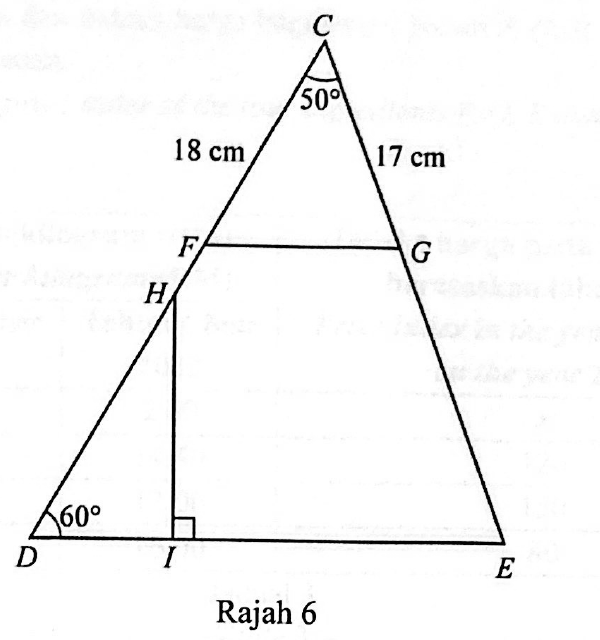
- (a)(i)
Calculate the length of FG.
[2] - (a)(ii)
Calculate the length of EG.
[3] - (b)
Find the length of DI.
[4] - (c)
Sketch △C′D′E′ with a different shape from △CDE such that C′D′ = CD, C′E′ = CE, and ∠C′D′E′ = ∠CDE.
[1]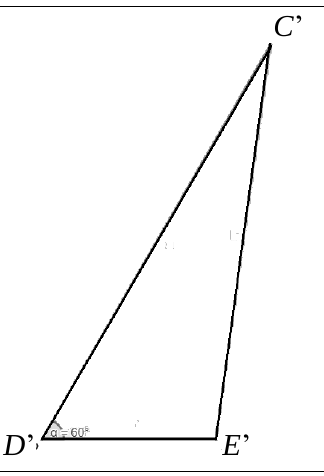
Diagram 7 shows a cuboid ABCDEFGH with AB = 10 cm, BC = 5 cm and CG = 8 cm. Find (a) the length of AG, (b) the angle between the line AG and the plane ABFE, (c) the area of triangle HAG.
Medium10 marks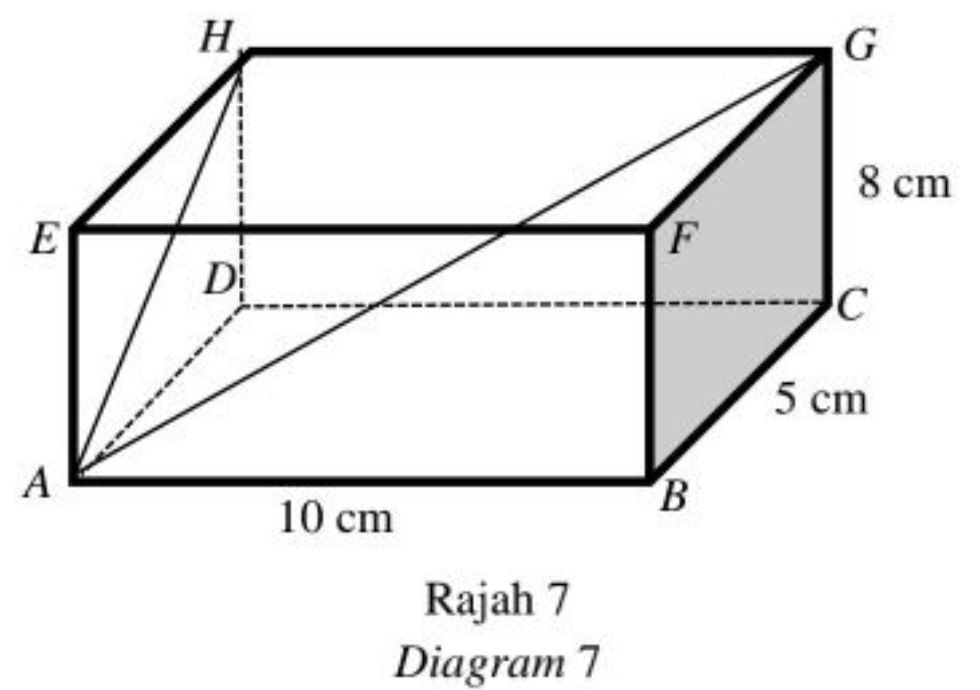
- (a)
Find the length of AG.
[3] - (b)
Find the angle between AG and the plane ABFE.
[3] - (c)
Find the area of triangle HAG.
[4]
Diagram 14 shows ΔPQR and ΔPAB. PQ = 14 cm, QR = 6 cm and RP = 12 cm. M is the midpoint of RP and N is a point on QP with QN = 5 cm. QNPA and RMPB are straight lines. PA = 4.5 cm and AB = 2 cm.
Medium10 marks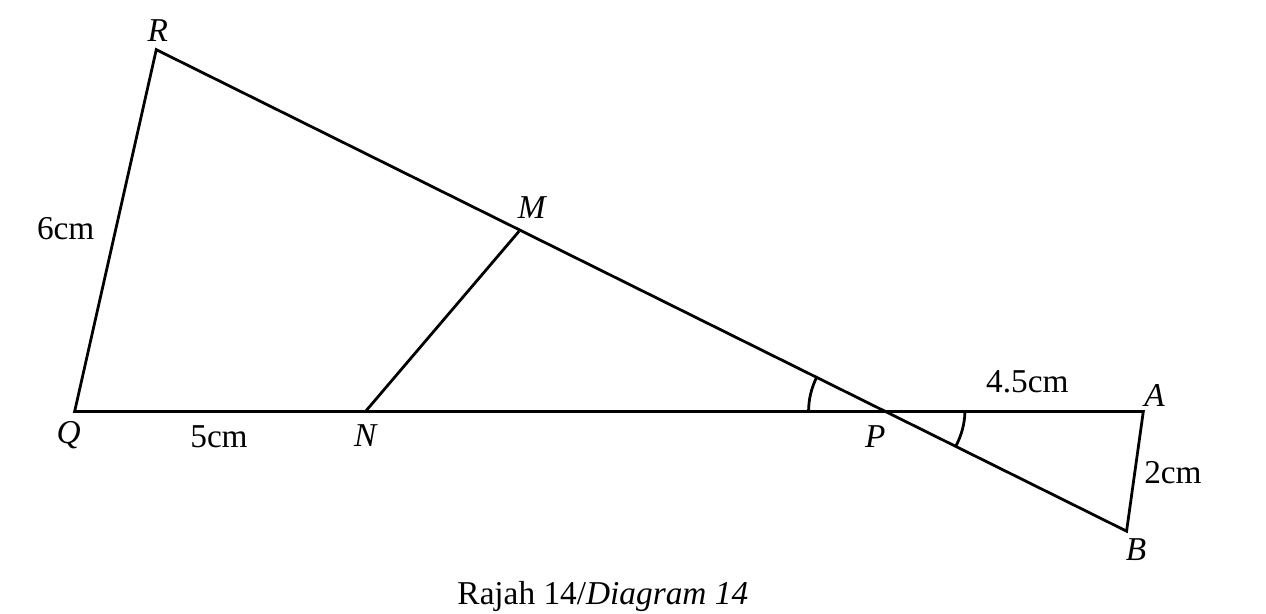
- (a)
Show that cos ∠RPQ = 19/21.
[2] - (a)(i)
Hence, find the length of MN.
[2] - (a)(ii)
Hence, find the area of ΔMPN.
[2] - (b)
In ΔPAB, sketch ΔPAB′ where PA = PA, AB′ = AB and ∠APB′ = ∠APB. Hence, find ∠PB′A.
[4]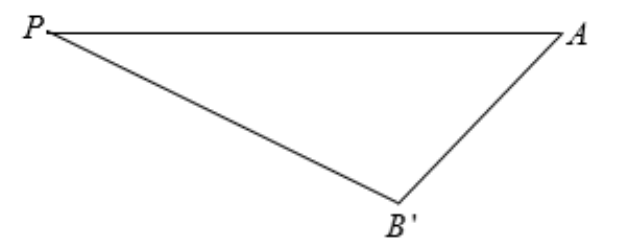
Diagram 14 shows a triangle ABC with AB = 14 cm, BC = 10 cm and angle ABC = 55°. (a) Calculate the length, in cm, of AC. (b) A quadrilateral ABCD is then formed so that AC is a diagonal, angle ACD = 30° and AD = 8.6 cm. Calculate the two possible values for angle ADC. (c) Using the acute angle ADC from (b), calculate (i) the length, in cm, of CD; (ii) hence, find the area, in cm², of quadrilateral ABCD.
Medium10 marks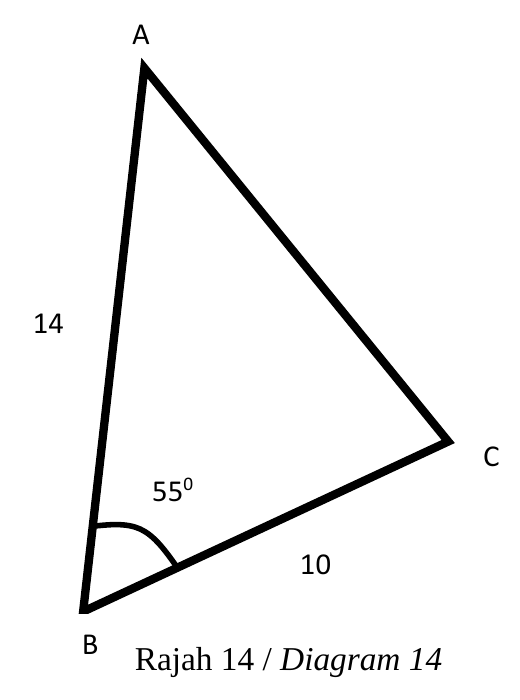
- (a)
Length of AC (cm).
[2] - (b)
Two possible values of angle ADC.
[2] - (c)(i)
Length of CD (cm).
[3] - (c)(ii)
Area of quadrilateral ABCD (cm²).
[3]
Diagram 14 shows a quadrilateral ABCD where ∠ABC is an acute angle (AC = 15 cm, BC = 9 cm, ∠BAC = 30°, AD = 10 cm, CD = 8 cm). (a) Calculate (i) ∠ABC, (ii) ∠ADC, (iii) the area, in cm², of the quadrilateral ABCD. (b) Triangle AB′C has the same measurements as triangle ABC, that is AC = 15 cm, CB′ = 9 cm and ∠B′AC = 30°, but in a different shape. (i) Sketch the triangle AB′C. (ii) Hence, state the size of ∠AB′C.
Medium10 marks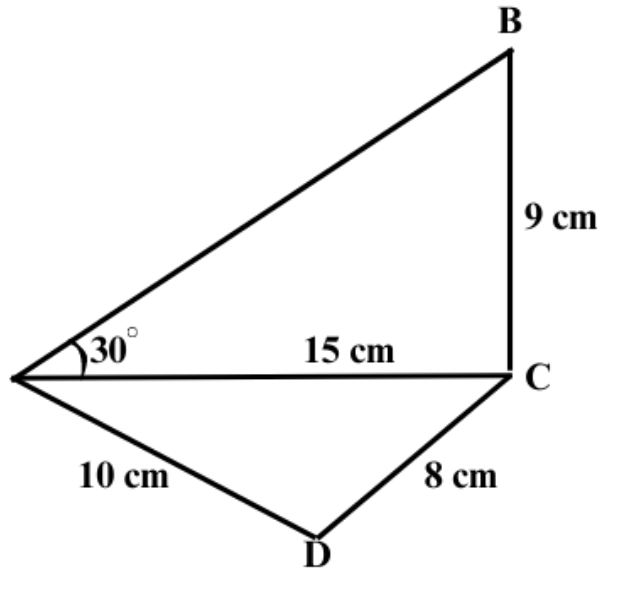
- (a)(i)
Calculate ∠ABC.
[2] - (a)(ii)
Calculate ∠ADC.
[2] - (a)(iii)
Area of quadrilateral ABCD.
[4] - (b)(i)
Sketch the triangle AB′C.
[1] - (b)(ii)
State the size of ∠AB′C.
[1]
Diagram 13 shows a triangular plot of land ABC divided into three parts. ADB, BFC and AEGC are straight lines. AD = 0.13 km, DB = 0.07 km, AE = 0.06 km, EC = 0.24 km, angle FGC is a right angle and sin ∠BAC = 12/13. (a) If a fence is to be raised along BC, calculate the length of the fence. (b) Calculate ∠BCA. (c) Given that the area of ΔFCG equals the area of ΔADE, calculate the length of GC.
Medium10 marks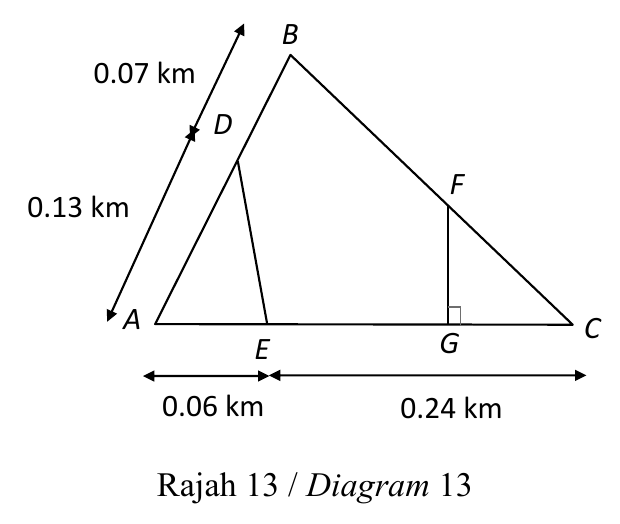
- (a)
Calculate the length of the fence along BC.
[3] - (b)
Calculate ∠BCA.
[2] - (c)
Given that the area of ΔFCG equals the area of ΔADE, calculate the length of GC.
[5]
Diagram 13 shows triangle ABC, which has been divided into two parts. ADC is a straight line. AB = 10 cm, BC = 7 cm, AC = 12 cm. Given that ∠BDC = 40.37°. Find (a) ∠ACB, (b) ∠BAC, (c) the length, in cm, of DC, (d) the area of ΔABD.
Medium10 marks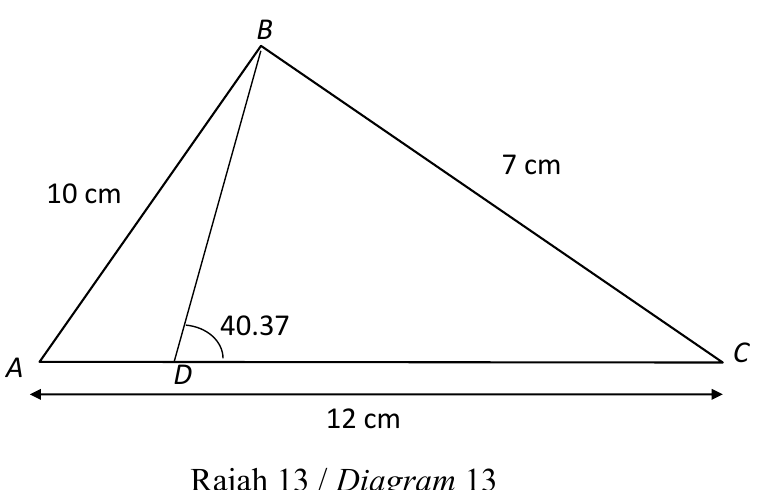
- (a)
Find ∠ACB.
[2] - (b)
Find ∠BAC.
[2] - (c)
Find the length, in cm, of DC.
[4] - (d)
Find the area of ΔABD.
[2]
Section C: answer any two questions. Diagram 14 shows a triangle PQR (PQ = 2 km, QR = 1.5 km, ∠PQR = 65°). It is given that P is due north of R. (a) Calculate the distance, in km, of PR. (b) Given that the bearing of point S from point R is 040° and the distance PS is 1.6 km, calculate the possible values of ∠PSR. (c) If a piece of land PRS is used as a paddy field, calculate the maximum area of the paddy field.
Medium10 marks- (a)
Calculate the distance PR in km.
[2]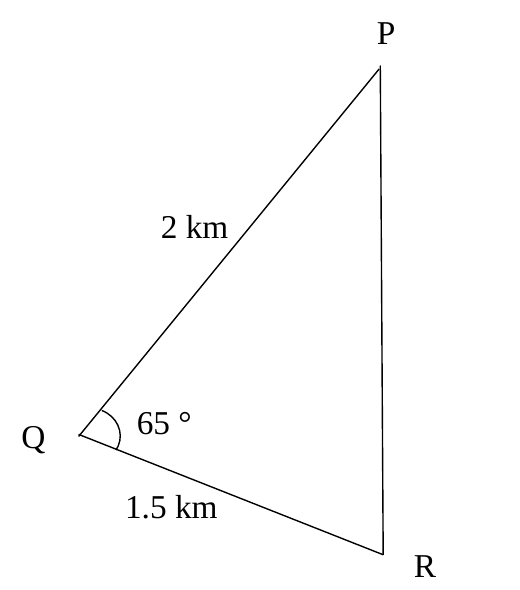
- (b)
Calculate the possible values of ∠PSR.
[5] - (c)
Calculate the maximum area of the paddy field PRS.
[3]
Solution by scale drawing is not accepted. Diagram 11 shows a transparent prism with a rectangular base ABCD. The inclined surface ABFE is a square with sides 12 cm and the inclined surface CDEF is a rectangle. AED is a uniform cross-section of the prism. BDE is a shaded plane in the prism. It is given that ∠ADE = 37° and ∠EAD = 45°. Find (a) the length, in cm, of DE, (b) the area, in cm², of the shaded plane, (c) the shortest length, in cm, from the point E to the straight line BD.
Medium10 marks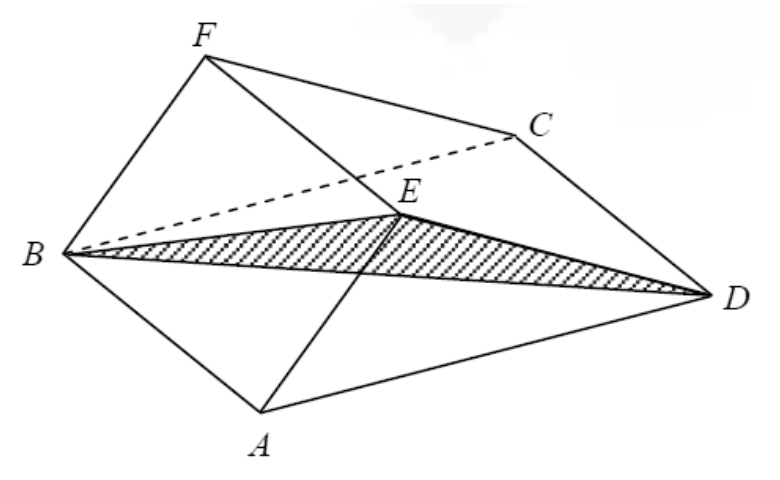
- (a)
Find the length, in cm, of DE.
[2] - (b)
Find the area, in cm², of the shaded plane.
[6] - (c)
Find the shortest length, in cm, from the point E to the straight line BD.
[2]
Diagram 14 shows two triangles RSP and QRP. RP is a straight line and ∠PQR is an acute angle (QR = 9 cm, RP = 15 cm, ∠QPR = 30°, RS = 8 cm, SP = 10 cm). (a) Calculate (i) ∠PQR, (ii) ∠RSP, (iii) the area, in cm², of the quadrilateral PQRS. (b) Sketch and label a new triangle P′Q′R′ of different shape from triangle PQR such that P′R′ = 15 cm, R′Q′ = 9 cm and ∠Q′P′R′ = 30°. Find the value of ∠P′Q′R′.
Medium10 marks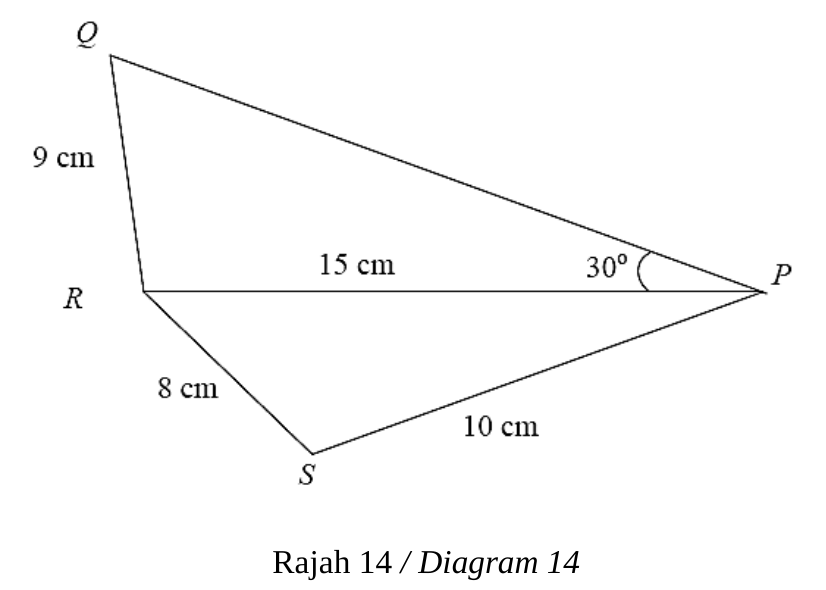
- (a)(i)
Calculate ∠PQR.
[2] - (a)(ii)
Calculate ∠RSP.
[2] - (a)(iii)
Calculate the area, in cm², of the quadrilateral PQRS.
[4] - (b)
Sketch and label triangle P′Q′R′ and find ∠P′Q′R′.
[2]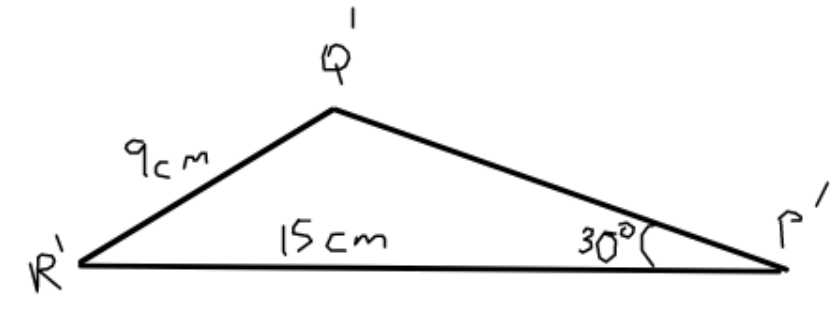
Diagram 5 shows a piece of land in the shape of triangle ABC, divided into three parts. ADB, BFC and AEGH are straight lines. In the diagram AD = 0.13 km, DB = 0.07 km, AE = 0.06 km and the distance from E to C is 0.24 km. Given sin ∠BAC = 12/13. [Use π = 3.142] (a) Calculate ∠DAE in radian. (b) If a fence is to be built along BC, calculate the length of the fence needed. (c) Given the area of ΔFGC is equal to the area of ΔADE, calculate the length of EG if the length of FC is 0.09 km.
Medium10 marks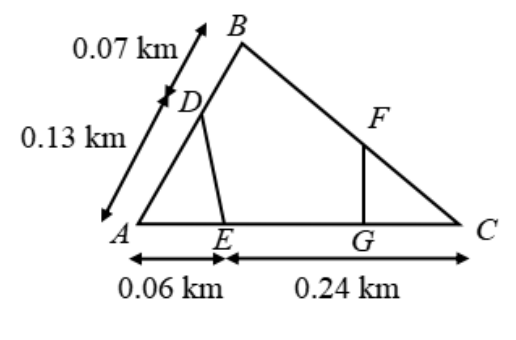
- (a)
Calculate ∠DAE in radians.
[3] - (b)
Length of the fence along BC.
[2] - (c)
Find EG given area FGC = area ADE and FC = 0.09 km.
[5]
Diagram 12 shows three points, A, B and C lie on a plane to form a triangle. Given that the point A is due west of the point B, AB = 14 m, AC = 18 m, and the bearing of the point C from the point A is 126°. Find (a)(i) the length, in m, of BC, (ii) the angle ACB. (b) The bearing of point D from point A is the same as the bearing of point C from point A, and BD = BC. (i) Sketch the triangle ABD, and state the angle ADB. (ii) Hence, find the area of triangle ABD.
Medium10 marks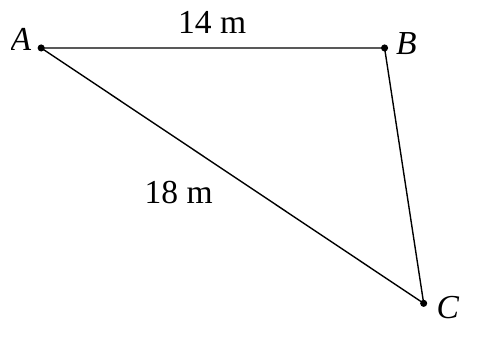
- (a)(i)
Find the length of BC, in m.
[3] - (a)(ii)
Find angle ACB.
[2] - (b)(i)
Sketch triangle ABD and state angle ADB.
[2] - (b)(ii)
Find the area of triangle ABD.
[3]
Diagram 12 shows quadrilateral PQRS with PQ = 8 cm, QR = 17 cm, ∠PQR = 118°, PS = 13 cm and SR = 20 cm. (a) Find (i) the length, in cm, of PR, (ii) ∠PRQ, (iii) the area, in cm², of quadrilateral PQRS. (b) (i) Sketch triangle P′R′S′ which has a different shape from triangle PRS such that P′ lies on PR and sin ∠RPS = sin ∠R′P′S′. (ii) Hence, state the size of ∠R′P′S′.
Medium10 marks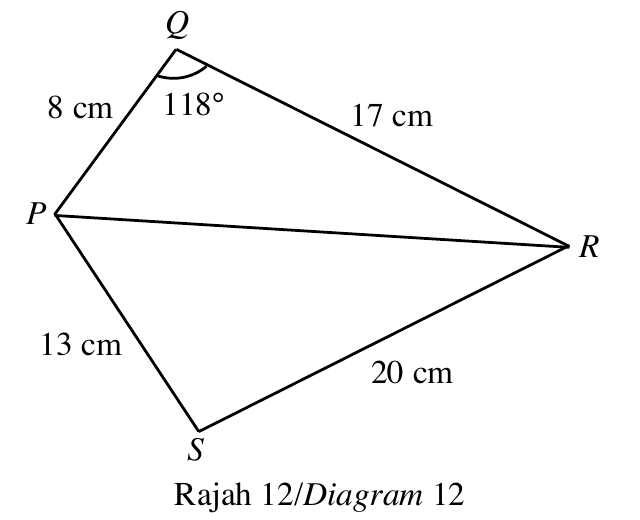
- (a)(i)
Find the length of PR.
[2] - (a)(ii)
Find ∠PRQ.
[2] - (a)(iii)
Find the area of quadrilateral PQRS.
[3] - (b)(i)
Sketch triangle P′R′S′ with a different shape from PRS such that P′ lies on PR and sin ∠RPS = sin ∠R′P′S′.
[2] - (b)(ii)
State the size of ∠R′P′S′.
[1]
Solutions by scale drawing are not accepted. Diagram 13 shows a quadrilateral ABCD. Line AB is parallel to line DC. AC = 8 cm, BC = 7.1 cm, ∠ACB = 50° and ∠ADC = 100°.
Medium10 marks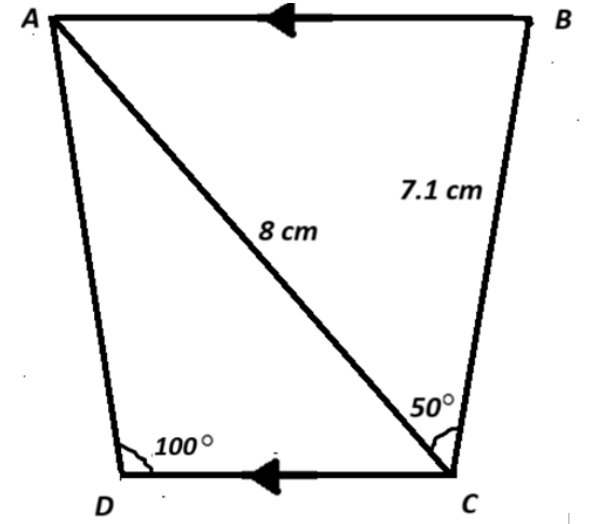
- (a)
Calculate ∠BAC. Give your answer correct to 1 decimal place.
[4] - (b)
Calculate the area of ABCD, in cm².
[5] - (c)
Sketch triangle A′D′C′ which has a different shape from triangle ADC such that C′ lies on AC and sin∠CAD = sin∠C′A′D′.
[1]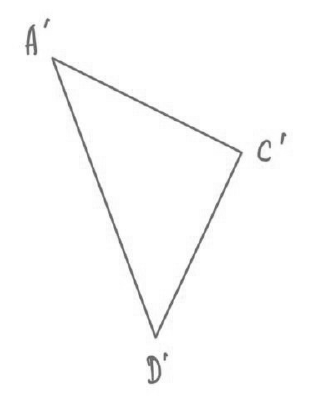
Solution by scale drawing is not accepted. Diagram 13 shows a quadrilateral PQRS. Point T is the intersection of straight lines PR and SQ. Given that PT = TQ, PS = 5.1 cm, SR = 7.7 cm, ST = 5.6 cm and TR = 3.3 cm. (a) Calculate (i) ∠PTQ, (ii) the length, in cm, of PT, (iii) the length, in cm, of PQ. (b) (i) Sketch a triangle P′R′S′ which has a different shape from triangle PRS such that P′R′ = PR, P′S′ = PS and ∠P′R′S′ = ∠PRS. (ii) Hence, state the size of ∠P′S′R′.
Medium10 marks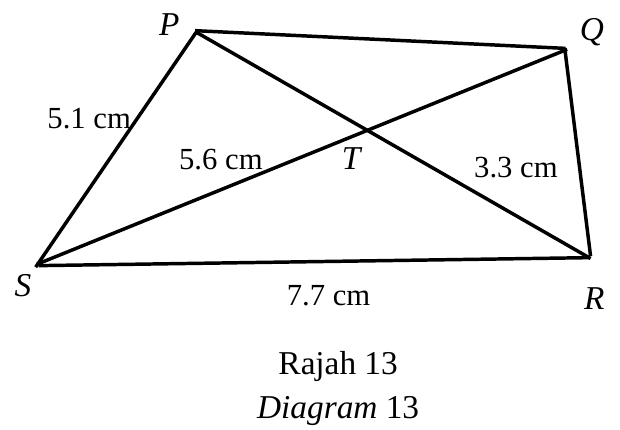
- (a)(i)
Calculate ∠PTQ.
[2] - (a)(ii)
Calculate the length of PT.
[3] - (a)(iii)
Calculate the length of PQ.
[2] - (b)(i)
Sketch triangle P′R′S′ (different shape, P′R′ = PR, P′S′ = PS, ∠P′R′S′ = ∠PRS).
[1]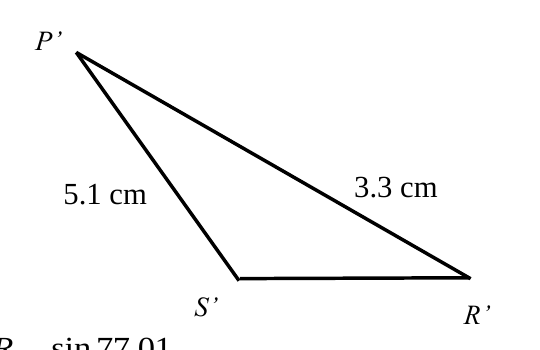
- (b)(ii)
State the size of ∠P′S′R′.
[2]
Solution by scale drawing is not accepted. Diagram 9 shows a quadrilateral PQRS with PQ = 14 cm, QR = 8 cm, RS = 6 cm, PS = 10.2 cm and ∠PQR = 36°. (a) Find (i) the length, in cm, of PR, (ii) ∠PRQ. (b) (i) By using Heron's formula, calculate the area, in cm², of triangle PRS. (ii) Find the shortest distance, in cm, from point R to straight line PS. (c) Sketch Δ P′Q′R′ which has a different shape from ΔPQR, such that Q′R′ = QR, Q′P′ = QP and ∠Q′P′R′ = ∠QPR. Hence, state the value of ∠P′R′Q′.
Hard10 marks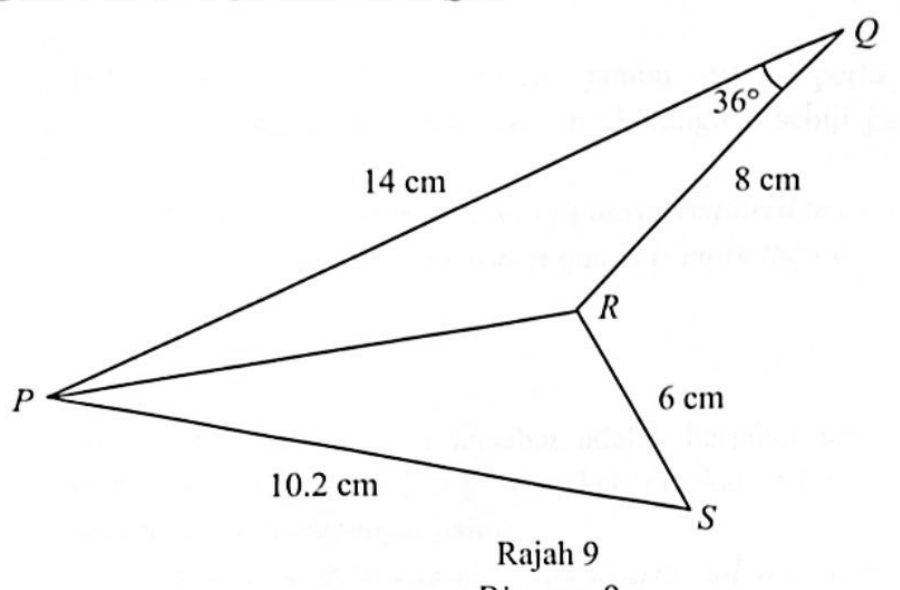
- (a)(i)
Find the length, in cm, of PR.
[2] - (a)(ii)
Find ∠PRQ.
[2] - (b)(i)
Using Heron's formula, calculate the area, in cm², of triangle PRS.
[2] - (b)(ii)
Find the shortest distance, in cm, from R to PS.
[2] - (c)
Sketch Δ P′Q′R′ (different shape) and state ∠P′R′Q′.
[2]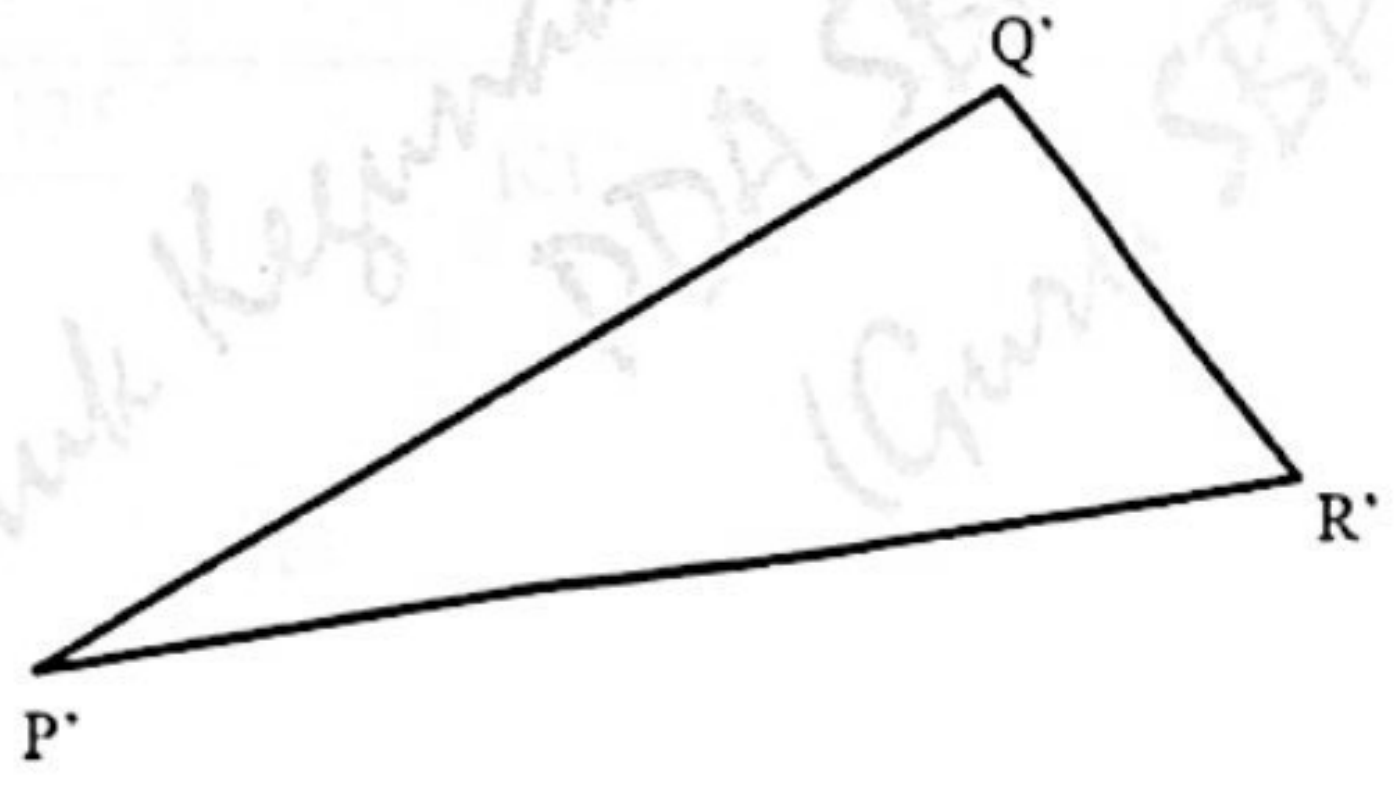
Solution by scale drawing is not accepted. Diagram 6 shows a solid prism with a horizontal rectangular surface ABCD. The trapezium ABFE is the uniform cross section of the prism. The rectangles ADHE and BCGF are a vertical plane while the base surface EFGH is an inclined plane. Dimensions marked on the diagram: 11.04 cm (AE), 12.35 cm (AB), 8.21 cm (BC), 5.72 cm (BF). (a) Given that ∠HEC = 63.66°, find ∠HCE. (b) Find ∠BFE. Hence, calculate the area, in cm², of triangle BFE using Heron's formula. (c) Determine the shortest distance, in cm, from point F to EB.
Medium10 marks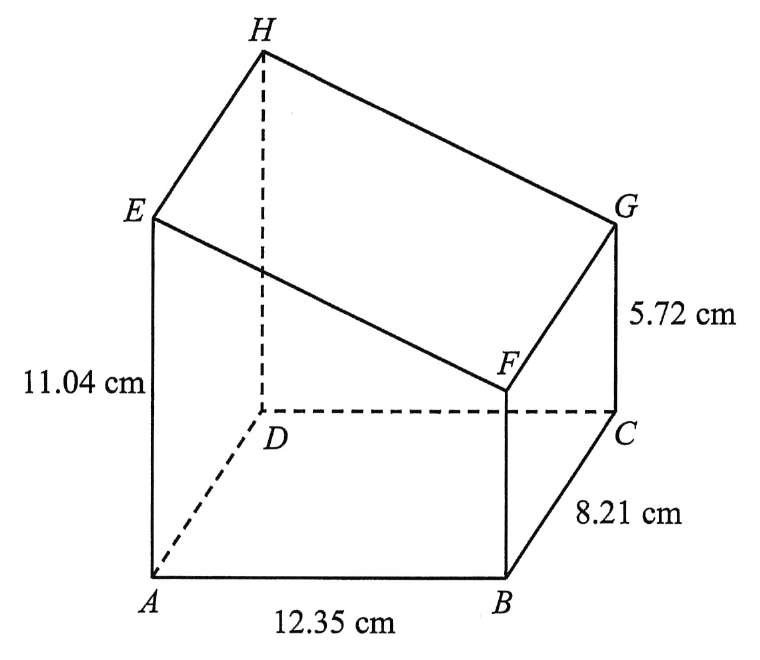
- (a)
Given that ∠HEC = 63.66°, find ∠HCE.
[3] - (b)
Find ∠BFE. Hence, calculate the area, in cm², of triangle BFE using Heron's formula.
[5] - (c)
Determine the shortest distance, in cm, from point F to EB.
[2]
In Diagram 6, ABC is a triangle with AB = 18 cm, AD = 16 cm, DC = 8 cm, BC = 15 cm and ∠ADE = 120°. Calculate (a) ∠ACB, (b) the length of DE, (c) the length of the perpendicular line from B to straight line AC.
Medium8 marks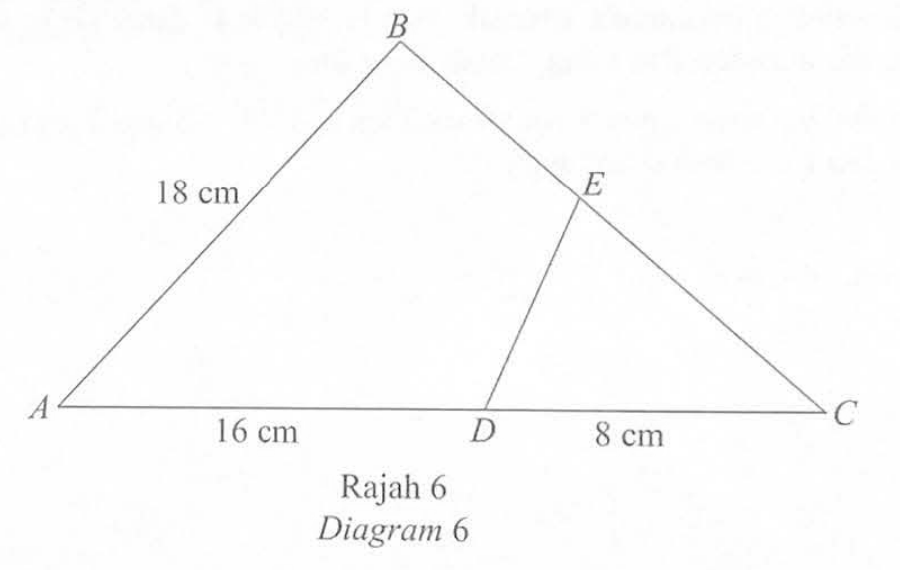
- (a)
Calculate ∠ACB.
[3] - (b)
Calculate the length of DE.
[3] - (c)
Calculate the length of the perpendicular line from B to straight line AC.
[2]
Diagram 7 shows a tent VABC in the shape of a pyramid with triangle ABC as the horizontal base. V is the vertex of the tent and the angle between the inclined plane VBC and the base is 50°. Given that VB = VC = 2.2 m and AB = AC = 2.6 m, calculate (a) the length of BC if the base area is 3 m², (b) the length of AV if the angle between the straight line AV and the base is 25°, (c) the angle between the two incline planes VAB and VAC.
Hard10 marks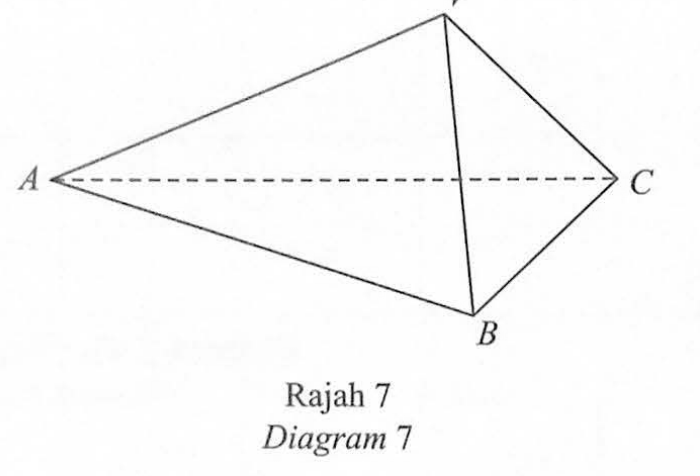
- (a)
Calculate the length of BC if the base area is 3 m².
[2] - (b)
Calculate the length of AV if the angle between the straight line AV and the base is 25°.
[3] - (c)
Calculate the angle between the two inclined planes VAB and VAC.
[5]
Solution by scale drawing is not accepted. Diagram 6 shows a triangle PQR where angle R is an obtuse angle. Given that PQ = 7.2 cm, QR = 3.646 cm and PR = 4.992 cm. (a) Without finding any of the angle P, Q or R, calculate the area, in cm², of the triangle PQR. (b) Find ∠QPR. (c) The straight line PR is extended to point R′ with condition QR = QR′ and ∠QPR = ∠QPR′. (i) Sketch the triangle PQR′. (ii) Calculate ∠PR′Q. (iii) Find the shortest distance, in cm, from Q to the straight line PR′.
Medium10 marks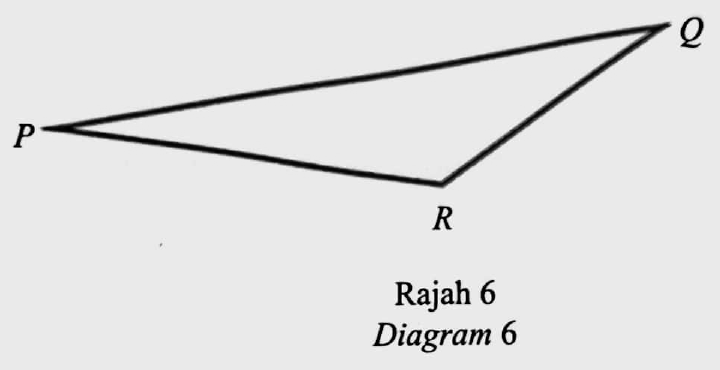
- (a)
Without finding any of the angle P, Q or R, calculate the area, in cm², of the triangle PQR.
[3] - (b)
Find ∠QPR.
[2] - (c)(i)
Sketch the triangle PQR′.
[1] - (c)(ii)
Calculate ∠PR′Q.
[2] - (c)(iii)
Find the shortest distance, in cm, from Q to the straight line PR′.
[2]
Solutions by scale drawing is not accepted. Diagram 13 shows trapezium ABCD with AB = 4 cm, AD = 5 cm, BD = 7 cm, ∠BCD = 110°, AB parallel to DC. (a) Calculate (i) ∠ABD, (ii) the length, in cm, of BC. (b) The straight line BA is extended to A′ such that AD = A′D. (i) Sketch the trapezium A′BCD. (ii) Calculate the area, in cm², of △AA′D.
Medium10 marks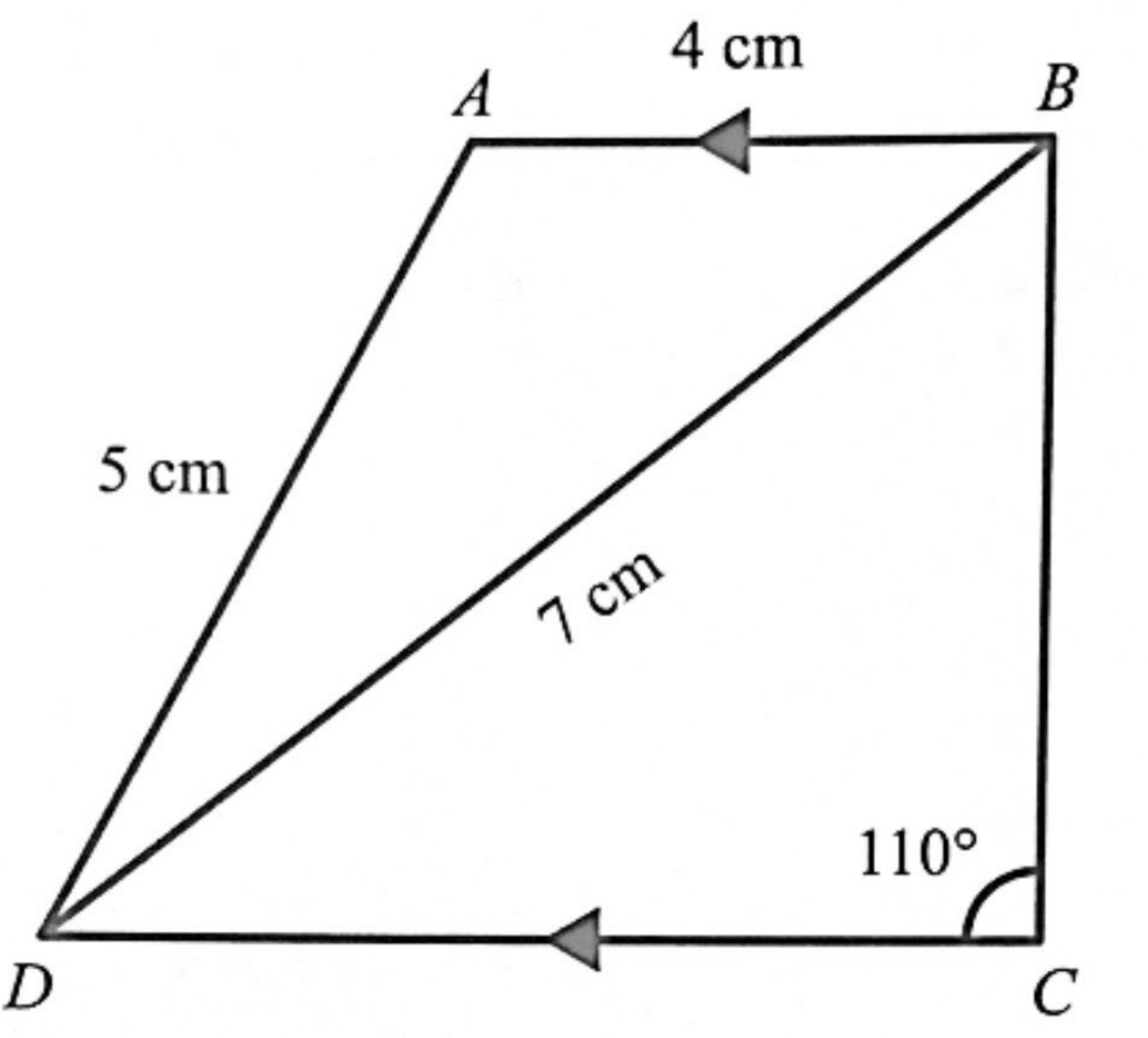
- (a)
Calculate ∠ABD and the length, in cm, of BC.
[4] - (b)(i)
Sketch the trapezium A′BCD.
[1] - (b)(ii)
Calculate the area, in cm², of △AA′D.
[5]
Solutions by scale drawing are not accepted. Diagram 8 shows a triangle PSR. Given QR = 5 cm, RS = 9 cm, PS = 7.8 cm and ∠QRS = 40° (Q lies on PR). (a) Calculate (i) the length, in cm, of QS, (ii) ∠QPS, (iii) area, in cm², of the triangle PRS. (b) Without doing calculations, determine the point which is the furthest from point R. Explain. (c) Calculate the shortest distance, in cm, from point P to straight line RS.
Medium10 marks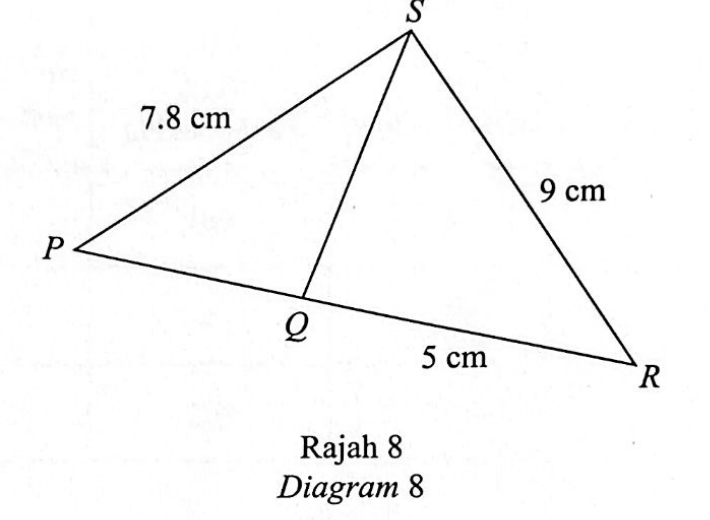
- (a)(i)
Calculate the length, in cm, of QS.
[2] - (a)(ii)
Calculate ∠QPS.
[2] - (a)(iii)
Calculate the area, in cm², of the triangle PRS.
[3] - (b)
Without doing calculations, determine the point which is the furthest from point R. Explain.
[1] - (c)
Calculate the shortest distance, in cm, from point P to straight line RS.
[2]
Diagram 6 shows a triangle ABC. Given that the area of triangle ABC is 21 cm² and ∠BAC is obtuse angle. AB = 14 cm and AC = 5 cm. Find (a) ∠BAC, (b) the length of BC, in cm, (c) the length of the perpendicular line from A to BC.
Medium8 marks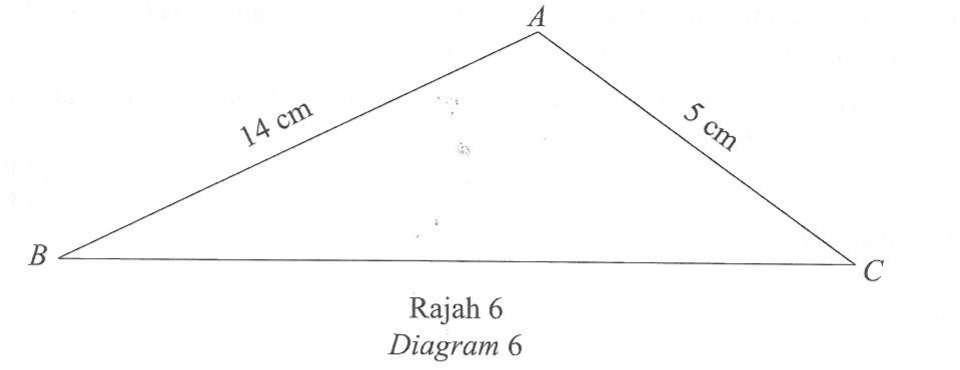
- (a)
∠BAC,
[3] - (b)
the length of BC, in cm,
[2] - (c)
the length of the perpendicular line from A to BC.
[3]
Diagram 8 shows a tent VABC in the shape of a pyramid with triangle ABC as the horizontal base. V is the vertex of the tent and the angle between the inclined plane VBC and the base is 42°. Given that VB = VC = 2.6 m and AB = AC = 3.2 m, calculate (a) the length of BC if the area of the triangle VBC is 2.5893 m², (b) the length of AV if the angle between the straight line AV and the base is 37°, (c) the angle between the two inclined planes VAB and VAC.
Hard10 marks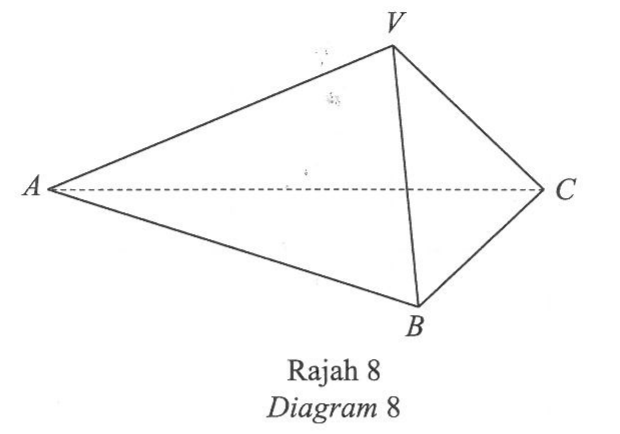
- (a)
the length of BC if the area of the triangle VBC is 2.5893 m²,
[2] - (b)
the length of AV if the angle between the straight line AV and the base is 37°,
[3] - (c)
the angle between the two inclined planes VAB and VAC.
[5]
Solution by scale drawing is not accepted. Diagram 6 shows a triangle PQR where angle R is an obtuse angle. Given that PQ = 6.8 cm, QR = 3.786 cm and PR = 4.916 cm. (a) Without finding any of the angle P, Q or R, calculate the area, in cm², of the triangle PQR. (b) Find ∠QPR. (c) The straight line PR is extended to point R′ with condition QR = QR′ and ∠QPR = ∠QPR′. (i) Sketch the triangle PQR′. (ii) Calculate ∠PR′Q. (iii) Find the shortest distance, in cm, from Q to the straight line PR′.
Medium10 marks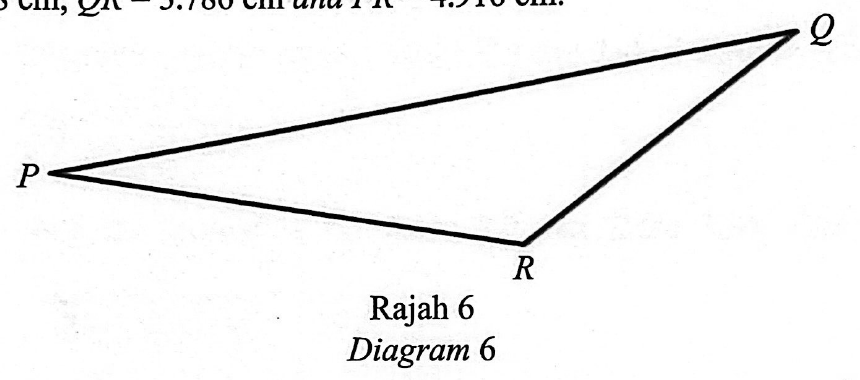
- (a)
Without finding any of the angle P, Q or R, calculate the area, in cm², of the triangle PQR.
[3] - (b)
Find ∠QPR.
[2] - (c)(i)
Sketch the triangle PQR′.
[1] - (c)(ii)
Calculate ∠PR′Q.
[2] - (c)(iii)
Find the shortest distance, in cm, from Q to the straight line PR′.
[2]
Solution by scale drawing will not be accepted. Diagram 12 shows two triangles ABC and CDE such that BCD is a straight line. ∠ACB = 50.52° and ∠CDE = 44.89°. It is given that AC = 4.916 cm, BC = 5.280 cm, DE = 6.025 cm and line AB is parallel to line EC. (a) Calculate (i) the length, in cm, of AB, correct to three decimal places, (ii) ∠DCE, (iii) area, in cm², of the triangle CDE. (b) Point C′ lies on CD such that CE = C′E. (i) Sketch and label the triangle C′DE. (ii) State the value of ∠DC′E.
Medium10 marks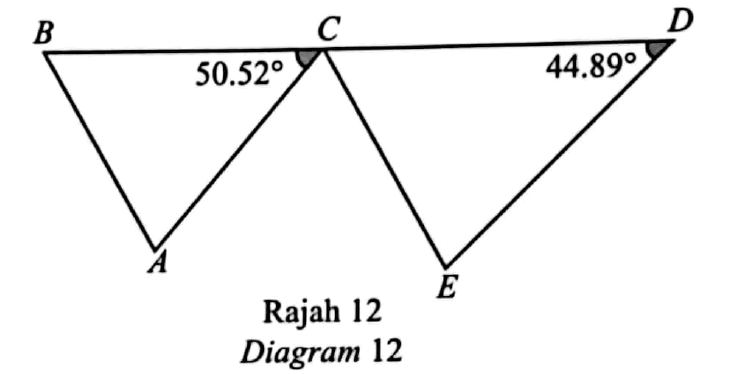
- (a)(i)
Calculate the length, in cm, of AB, correct to three decimal places.
[2] - (a)(ii)
Calculate ∠DCE.
[2] - (a)(iii)
Calculate the area, in cm², of the triangle CDE.
[4] - (b)(i)
Sketch and label the triangle C′DE.
[1] - (b)(ii)
State the value of ∠DC′E.
[1]
Solutions by scale drawing is not accepted. Diagram 9 shows a triangle ABC. ADFB, AEC and BGC are straight lines and FG is perpendicular to BC. BD = 17 cm, DA = 15 cm, AE = 12 cm, BG = FG and ∠BAC = 80°. (a) Calculate the length of (i) DE, (ii) EC. (b) Area of triangle DAE is two times the area of BFG, calculate the length of BG. (c) Sketch the triangle A′B′C′ which has different shape with A′B′ = AB, A′C′ = AC and ∠A′B′C′ = ∠ABC. Hence, calculate ∠B′C′A′.
Hard10 marks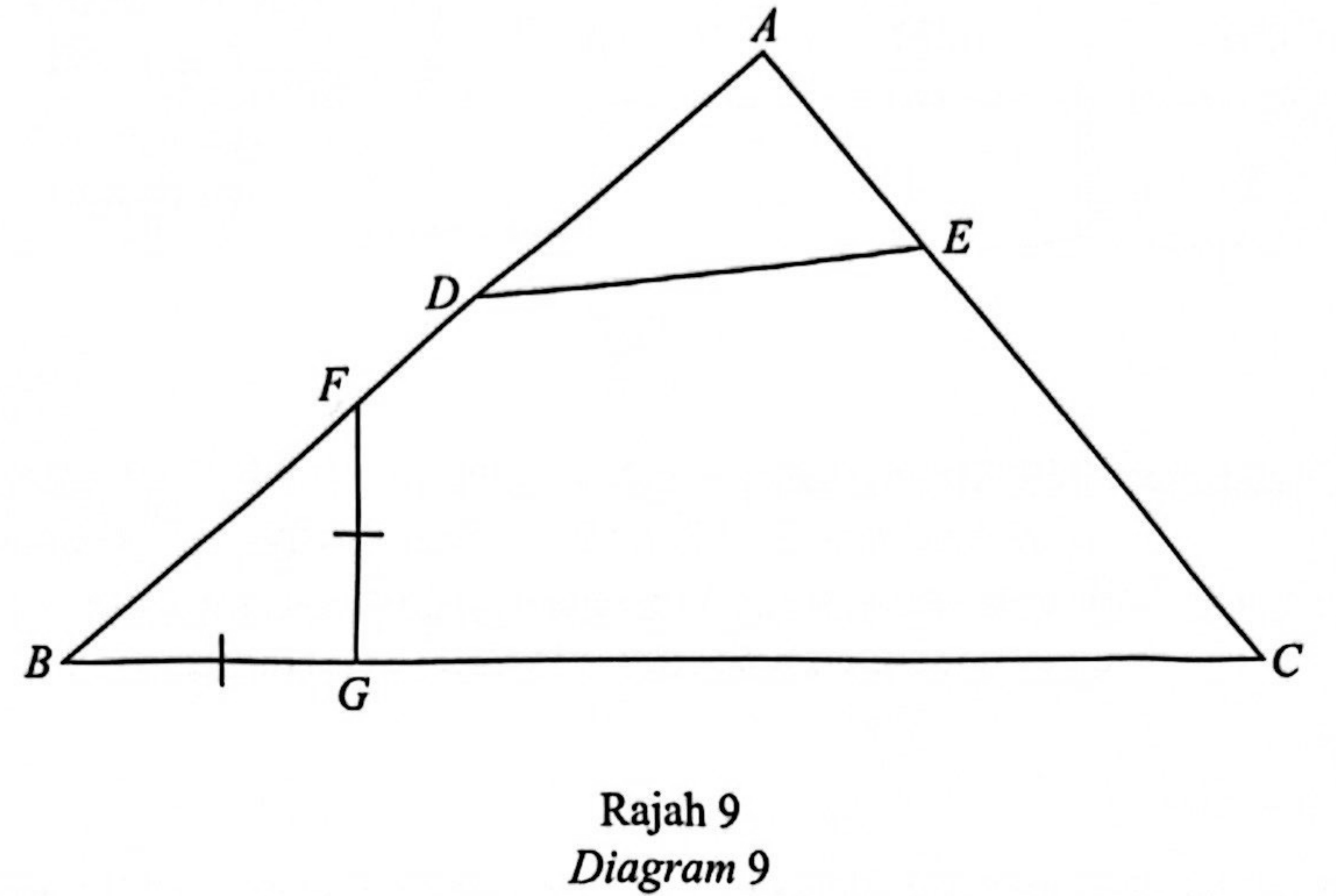
- (a)(i)
Calculate the length of DE.
[2] - (a)(ii)
Calculate the length of EC.
[3] - (b)
Area of triangle DAE is two times the area of BFG, calculate the length of BG.
[3] - (c)
Sketch triangle A′B′C′ with A′B′ = AB, A′C′ = AC and ∠A′B′C′ = ∠ABC. Hence, calculate ∠B′C′A′.
[2]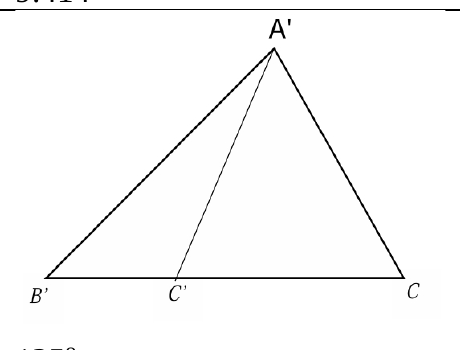
Solution by scale drawing is not accepted. Diagram 6 shows a triangle PQR where angle R is an obtuse angle. Given that PQ = 8.2 cm, QR = 3.6 cm and PR = 5.32 cm. (a) Without finding any of the angle P, Q or R, calculate the area, in cm², of the triangle PQR. (b) Find ∠QPR. (c) A triangle P′Q′R′ that is different shape and size to triangle PQR is formed with condition Q′R′ = QR, P′R′ = PR and ∠Q′P′R′ = ∠QPR. (i) Sketch the triangle P′Q′R′. (ii) Calculate ∠P′Q′R′. (iii) Find the shortest distance, in cm, from Q′ to the straight line P′R′.
Medium10 marks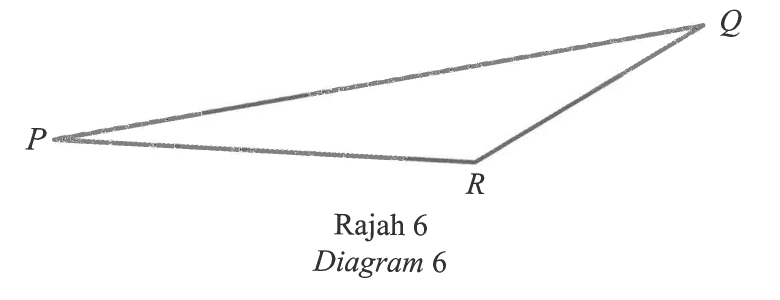
- (a)
Without finding any of the angles P, Q or R, calculate the area, in cm², of the triangle PQR.
[3] - (b)
Find ∠QPR.
[2] - (c)(i)
Sketch the triangle P′Q′R′.
[1] - (c)(ii)
Calculate ∠P′Q′R′.
[2] - (c)(iii)
Find the shortest distance, in cm, from Q′ to the straight line P′R′.
[2]
Diagram 6 shows two triangles RSP and QRP. RP is a straight line and ∠PQR is an acute angle. From the diagram: QR = 9 cm, RP = 15 cm, ∠QPR = 30°, RS = 8 cm, SP = 10 cm.
Medium10 marks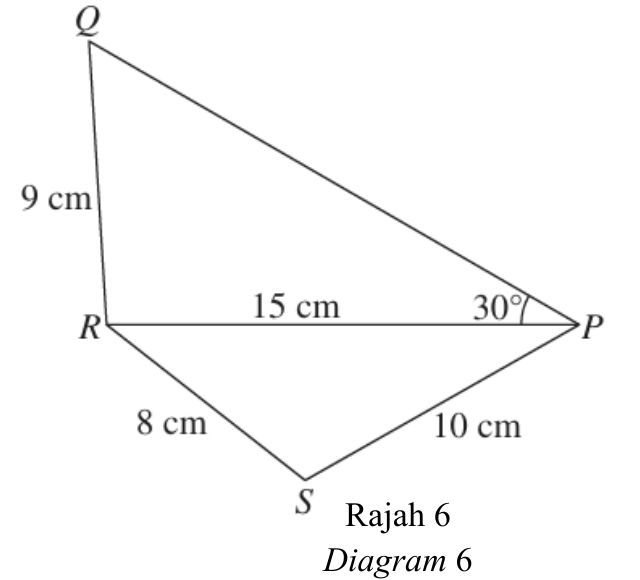
- (a)(i)
Calculate ∠PQR.
[2] - (a)(ii)
Calculate ∠RSP.
[2] - (a)(iii)
Calculate the area, in cm², of quadrilateral PQRS.
[4] - (b)
Sketch triangle P′Q′R′ which has a different shape from triangle PQR such that P′R′ = 15 cm, R′Q′ = 9 cm and ∠Q′P′R′ = 30°. Hence, find ∠P′Q′R′.
[2]
Solution by scale drawing is not accepted. Diagram 4 shows a prism with a rectangular base ABCD. DFB is a shaded plane region in the prism. The inclined surface ABEF, parallel to AB as viewed from X, is a square with sides 14 cm and the inclined surface CDFE is a rectangle. AFD is a uniform cross section of the prism. Given ∠ADF = 47° and ∠FAD = 55°.
Hard10 marks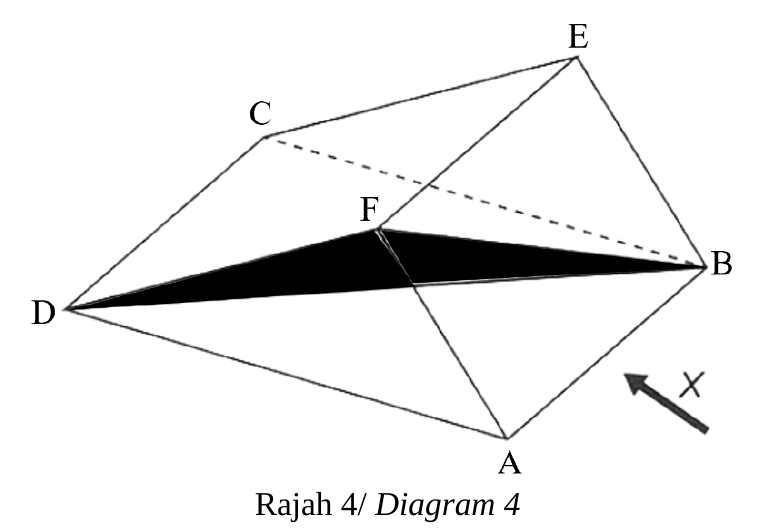
- (a)
Find the length, in cm, of DF.
[2] - (b)
Find the area, in cm², of the shaded region.
[6] - (c)
Find the shortest distance, from point F to the straight line DB.
[2]
Solution by scale drawing is not accepted. Diagram 4 shows a quadrilateral PQRS. Point T is the intersection of straight lines PR and SQ. PT = TQ, PS = 5.1 cm, SR = 7.7 cm, ST = 5.6 cm and TR = 3.3 cm. (a) Calculate (i) ∠PTQ, (ii) the length, in cm, of PT, (iii) the length, in cm, of PQ. (b) (i) Sketch a triangle P′R′S′ which has a different shape from triangle PRS such that P′R′ = PR, P′S′ = PS and ∠P′R′S′ = ∠PRS. (ii) Hence, state the size of ∠P′S′R′.
Medium10 marks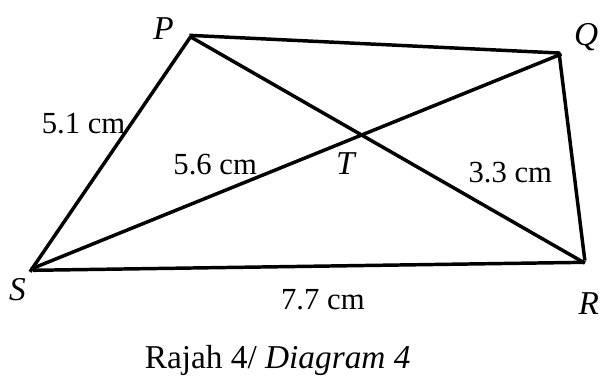
- (a)(i)
Calculate ∠PTQ.
[2] - (a)(ii)
Calculate the length, in cm, of PT.
[3] - (a)(iii)
Calculate the length, in cm, of PQ.
[2] - (b)(i)
Sketch a triangle P′R′S′ which has a different shape from triangle PRS such that P′R′ = PR, P′S′ = PS and ∠P′R′S′ = ∠PRS.
[1] - (b)(ii)
Hence, state the size of ∠P′S′R′.
[2]
Diagram 13 shows AE = 10 cm, BE = 8 cm and BC = 12 cm. Both ABC and AED are straight lines; ∠BAE = 50° and CD = 14 cm. It is given that the area of △CDE = 60 cm² and ∠EBC is an obtuse angle. Find (a) ∠EBC; (b) (i) the length of CE; (ii) ∠DCE. (c) Sketch a triangle C′D′E′ which has a different shape from △CDE such that C′D′ = 14 cm, E′D′ = ED and ∠C′D′E′ = ∠CDE. Hence, state ∠D′C′E′.
Medium10 marks- (a)
Find ∠EBC.
[3]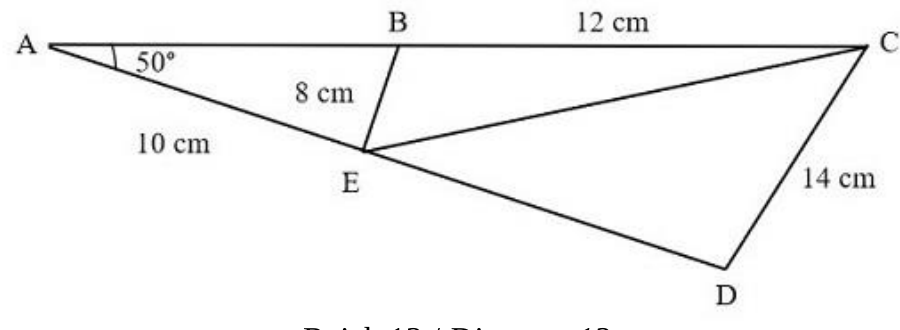
- (b)(i)
Find the length of CE.
[2] - (b)(ii)
Find ∠DCE.
[2] - (c)
Sketch triangle C′D′E′ (different shape) and state ∠D′C′E′.
[3]
In Diagram 13, ABC is an isosceles triangle and BCD is a straight line. AB = AC = 12 cm, AD = 18 cm and BD = 20 cm.
Medium10 marks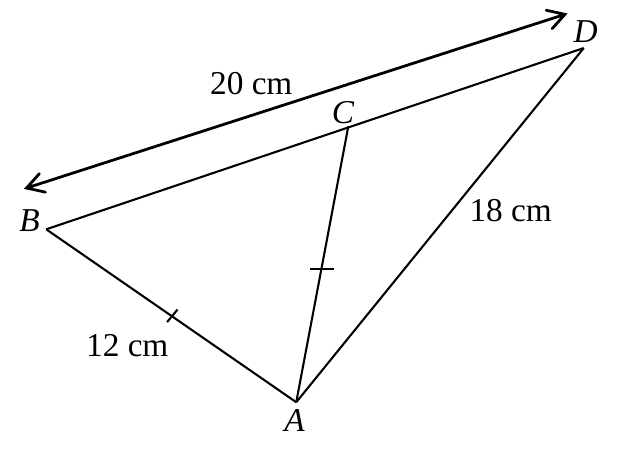
- (a)(i)
Calculate ∠ABD.
[2] - (a)(ii)
Calculate the length of BC, in cm.
[2] - (a)(iii)
Calculate the area, in cm², of triangle ABC.
[2] - (b)(i)
Sketch triangle A′C′D′ with a different shape from triangle ACD such that A′C′ = AC, C′D′ = CD and ∠C′A′D′ = ∠CAD.
[1]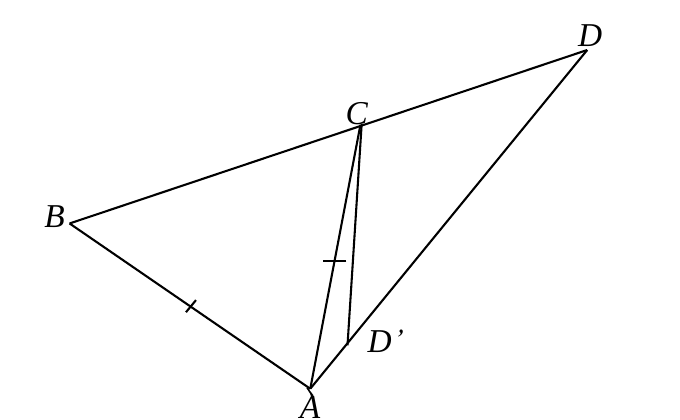
- (b)(ii)
Hence, calculate ∠A′D′C′.
[3]
Diagram 5 shows a plot of agricultural land in the shape of a quadrilateral ABCD divided into 2 parts. Part ABC will be planted with corn and the rest with pineapple. AB = 96 m, BC = 125 m, CD = 99 m, DA = 55 m. Given sin ∠ACB = 7/10 and ∠ADC is an obtuse angle. The fence is built along AC.
Medium10 marks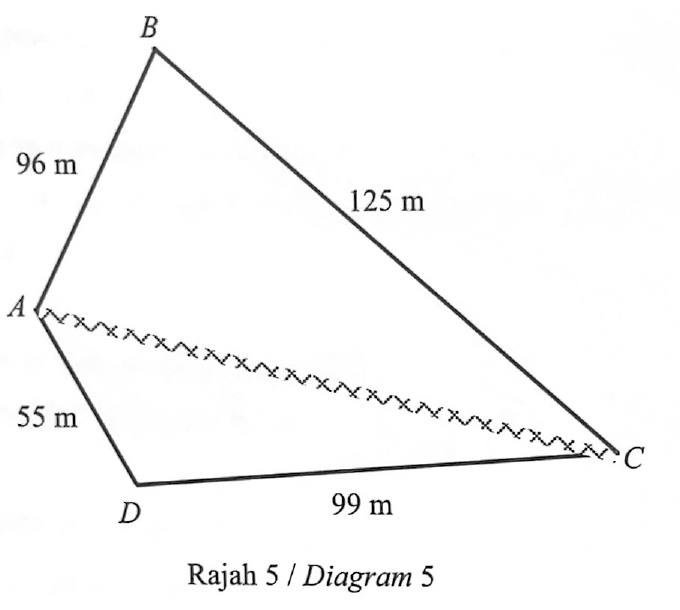
- (a)
Find the required fence length.
[4] - (b)(i)
Calculate ∠ADC.
[2] - (b)(ii)
Hence, find the area in m², the part of land planted with pineapples.
[2] - (c)
Find the shortest distance from D to AC.
[2]
In Diagram 5, BD = 5 cm, BC = 7 cm, CD = 8 cm, AE = 12 cm and ∠AEB = 40°. (D lies on both AC and BE.)
Medium10 marks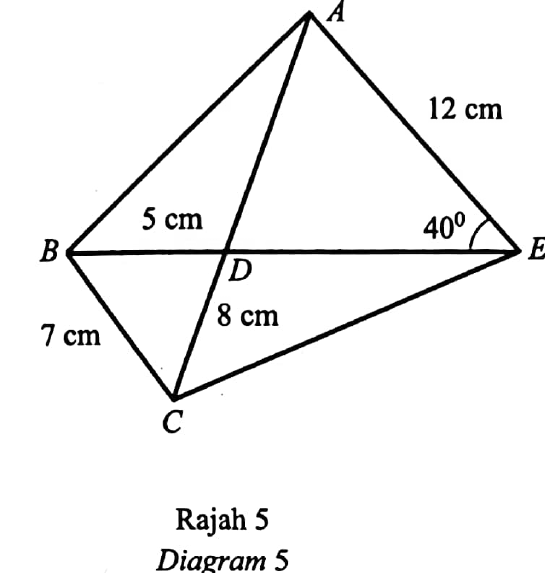
- (a)(i)
Calculate ∠BDC.
[2] - (a)(ii)
Calculate the length, in cm, of AD.
[2] - (a)(iii)
Calculate the area, in cm², of triangle ABC.
[3] - (b)(i)
Point D′ lies on BE such that AD′ = AD. Sketch △AD′E.
[1]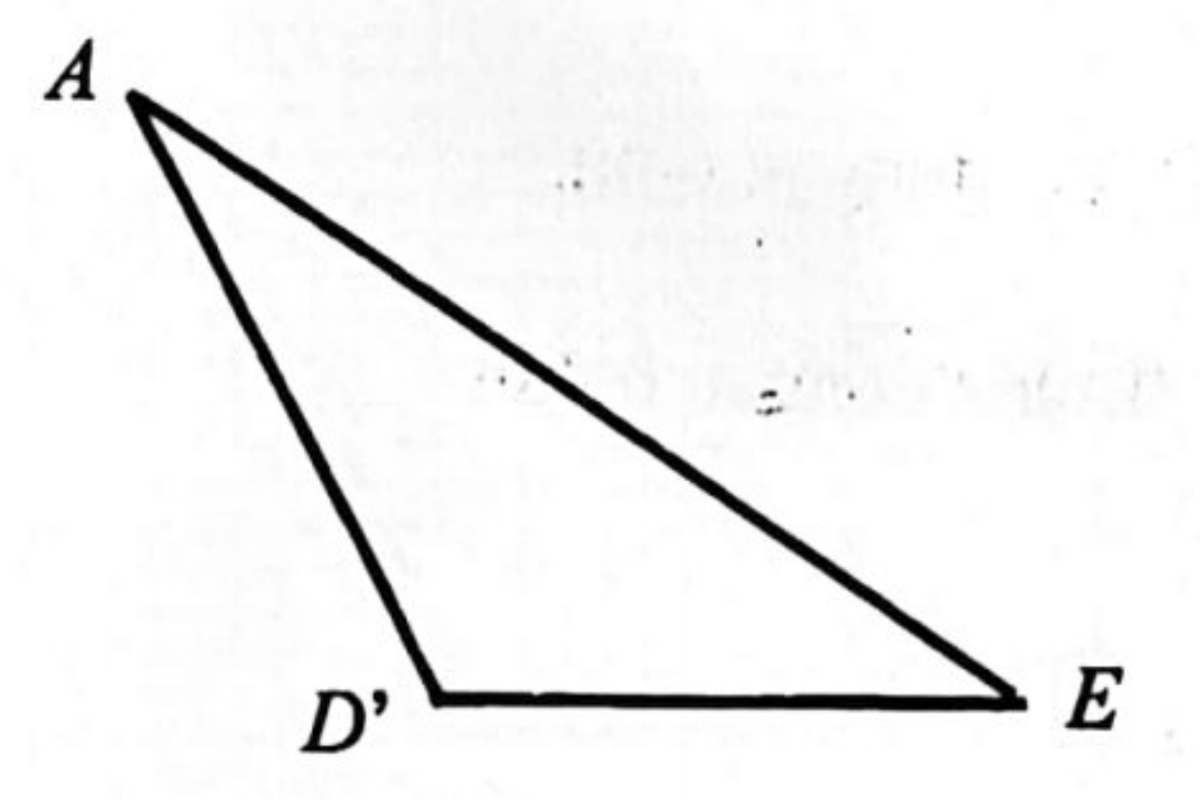
- (b)(ii)
Calculate the area, in cm², △AD′E.
[2]
Diagram 13 shows the positions of Tina's house, a mosque and Nurul's house, forming a triangle. The mosque is 90 m from Tina's house and 70 m from Nurul's house. The angle at Nurul's house (between the mosque and Tina's house) is 50.69°.
Medium10 marks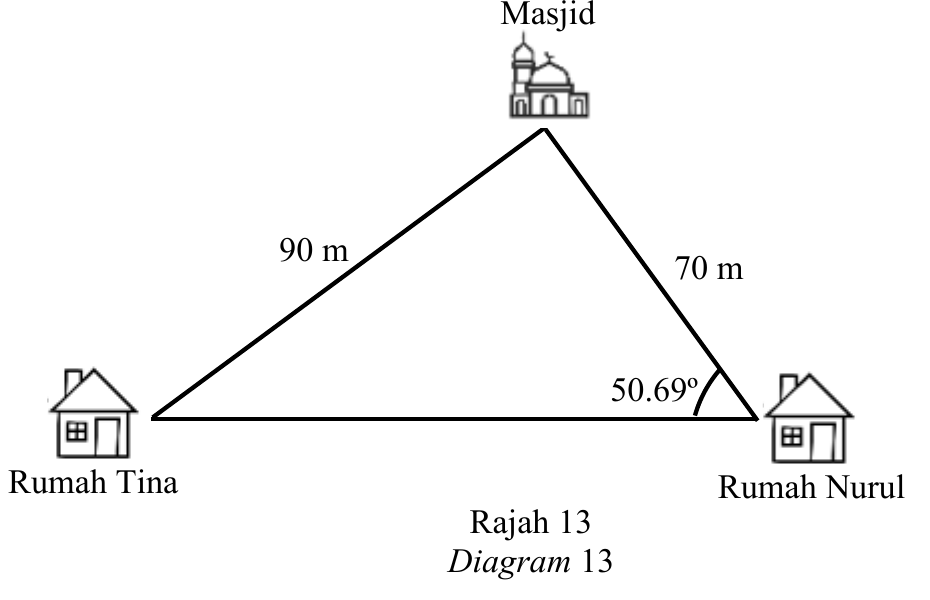
- (a)
Find the distance between Tina's house and Nurul's house.
[4] - (b)
Nurul will move to a new house. The distance between Tina's house and the mosque, and the angle formed between the mosque, Tina's house and Nurul's house, do not change. Calculate the distance between Tina's house and Nurul's new house so that only one triangle is formed.
[3] - (c)
Find the area bounded by Nurul's old house, the mosque and Nurul's new house.
[3]
Diagram 5 shows triangle ABC and triangle CDE where ACE and BCD are straight lines (AC = 12 cm, CE = 7 cm, CD = 5 cm, ∠BAC = 48°, ∠ABC = 63°). (a) Calculate the length, in cm, of (i) BC, (ii) DE. (b) Point C′ lies on AE such that DC = DC′. (i) Sketch triangle AC′D. (ii) State ∠AC′D. (iii) Calculate the area, in cm², of triangle AC′D.
Medium10 marks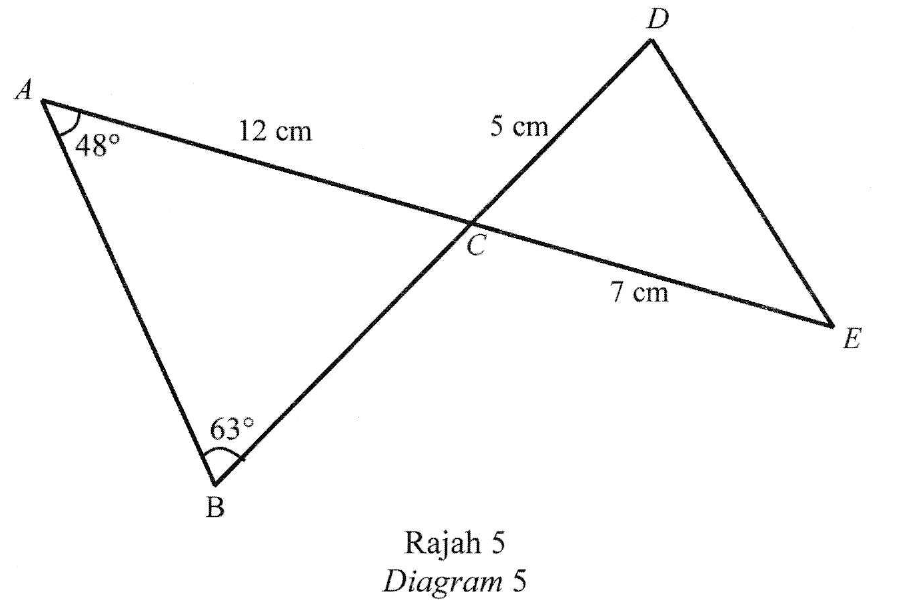
- (a)(i)
Calculate the length, in cm, of BC.
[2] - (a)(ii)
Calculate the length, in cm, of DE.
[2] - (b)(i)
Sketch triangle AC′D.
[1] - (b)(ii)
State ∠AC′D.
[1] - (b)(iii)
Calculate the area, in cm², of triangle AC′D.
[4]