JOHOR 2021 P1 Q13
MediumWrite your answer on paper. Then open the answer to check it.
There are 40 spherical marbles of radius x cm and 60 spherical marbles of radius y cm. If x + y = 15 and x > y, find the values of x and y such that the total volume of the marbles is minimum.
Medium8 marksFind x and y so that the total volume is minimum.
[8]
(a) Given that the gradient function of a curve is 8 − x³ and it has a turning point at (p, 3). Find (i) the value of p, (ii) determine whether the turning point is a maximum or a minimum point. (b) Given that the curve y = 3x² + 4x − 2 passes through the point (−1, 3). Find the equation of the tangent to the curve at the point (−1, 3).
Easy7 marks- (a)(i)
Find the value of p.
[2] - (a)(ii)
Determine whether the turning point is a maximum or a minimum.
[2] - (b)
Find the equation of the tangent at (−1, 3).
[3]
The volume of water, V cm³, in a container is given by V = ⅓h³ + 8h, where h cm is the height of the water. Water is poured into the container at a rate of 10 cm³ s⁻¹. Find the rate of change of the height of the water when its height is 2 cm.
Easy4 marksFind the rate of change of the height of the water when h = 2 cm.
[4]
Diagram 7 shows part of the curve y = x(x + 2)³, with stationary points P and Q. (a) Find an expression for dy/dx. (b) Find the coordinates of the two stationary points, P and Q. (c) Hence, determine the nature of stationary point P using the tangent sketching method.
Medium8 marks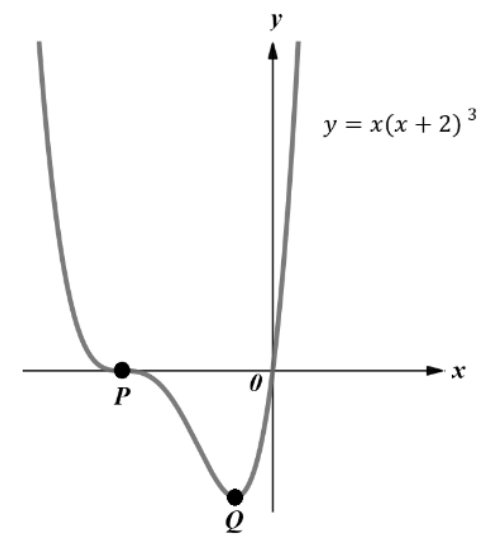
- (a)
Find an expression for dy/dx.
[2] - (b)
Find the coordinates of the stationary points P and Q.
[4] - (c)
Determine the nature of P using the tangent sketching method.
[2]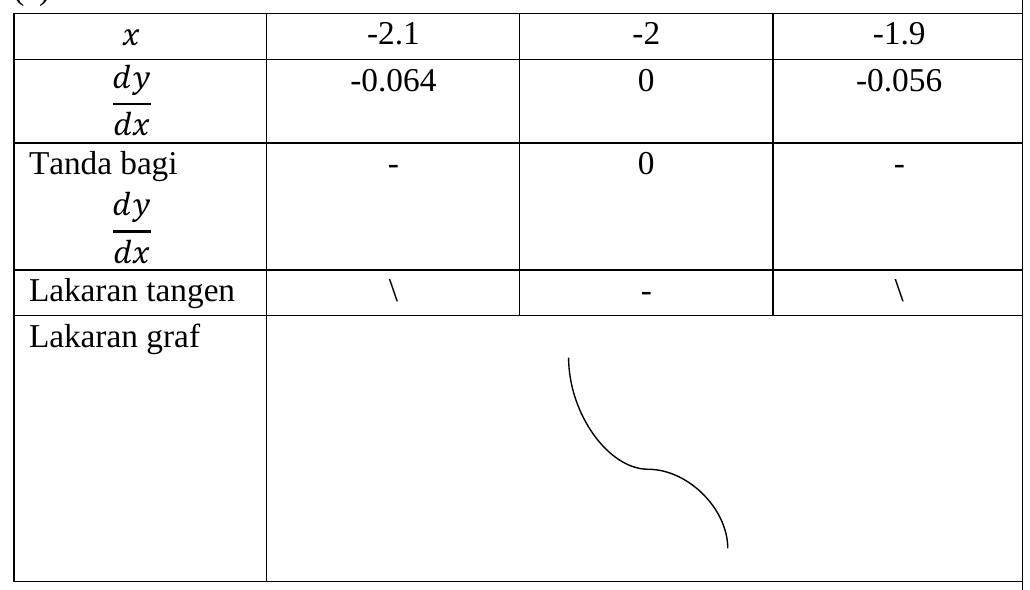
(a) Diagram 4 shows a hemispherical bowl of diameter 10 cm. Water is poured into the bowl so that the depth of the water, h cm, increases at the rate of 0.2 cm s⁻¹. It is found that the area of the water surface in the bowl is A = π(10h − h²), find the rate of change of the area of the water surface, in terms of π, when h = 4 cm. (b)(i) Given d(x²)/dx = 2x, determine ∫2x dx. (ii) Hence, given dy/dx = 2x, state one of the possible expressions for y. What is the expression known as?
Medium6 marks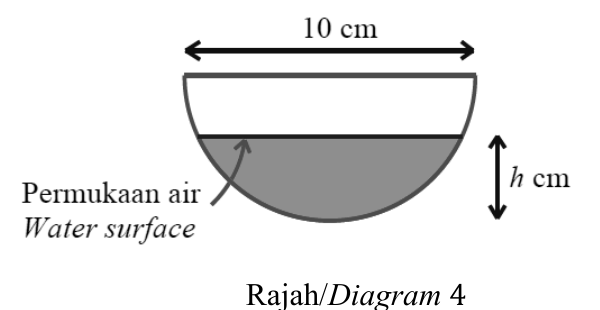
- (a)
Find the rate of change of the area of the water surface, in terms of π, when h = 4 cm.
[3] - (b)(i)
Given d(x²)/dx = 2x, determine ∫2x dx.
[1] - (b)(ii)
Given dy/dx = 2x, state one possible expression for y. What is the expression known as?
[2]
Diagram 2 shows a vessel in the shape of an inverted cone with the base of 10 cm and the height of 20 cm. (a) If the height of the water in the vessel is h cm, show that the volume of water, V cm³, in the vessel is given by V = 1/48 πh³. (b) Hence, if the water flows out through the bottom of the vessel, (i) find the small change in the volume of water when h decreases from 5 cm to 4.99 cm. (ii) show that the approximate percentage decrease of p% in the height of the water will cause the approximate percentage decrease of 3p% in the volume.
Medium9 marks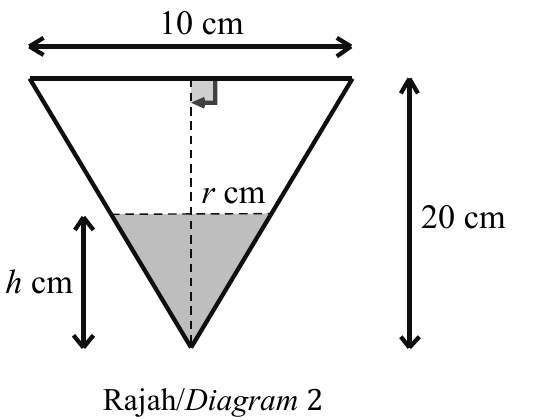
- (a)
Show that V = 1/48 πh³.
[3] - (b)(i)
Find the small change in the volume when h decreases from 5 cm to 4.99 cm.
[3] - (b)(ii)
Show that a decrease of p% in h causes a decrease of 3p% in the volume.
[3]
(a) Find the value of lim(k→4) (k² − 16)/(k − 4). (b) Given that V = y²(3 − 2/y), find the small change in V when y changes from 2 to 1.99.
Easy4 marks- (a)
Find the value of lim(k→4) (k² − 16)/(k − 4).
[2] - (b)
Given V = y²(3 − 2/y), find the small change in V when y changes from 2 to 1.99.
[2]
The diagram shows a part of the curve y = x(x − 2)³. (a) Find an expression for dy/dx. (b) Find the coordinates of the two stationary points, P and Q. (c) Hence, determine which stationary point is a point of inflection.
Medium8 marks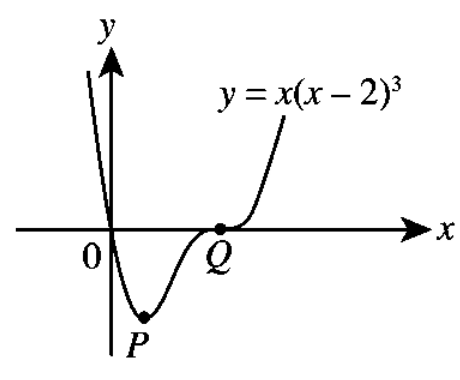
- (a)
Find dy/dx.
[2] - (b)
Find the coordinates of P and Q.
[4] - (c)
Determine which stationary point is a point of inflection.
[2]
(a) A hot air balloon is rising vertically at a constant rate of 10 m s⁻¹. A person on the ground stands 50 m from the point directly below the balloon. Find the rate of change of the distance between the person and the balloon when the balloon is 40 m above the ground. (b) Given y = x/(3x − 5), show that dy/dx = −5/(3x − 5)². Hence, find ∫ 1/(3x − 5)² dx.
Medium7 marks- (a)
Find the rate of change of the distance between the person and the balloon when the balloon is 40 m above the ground.
[4]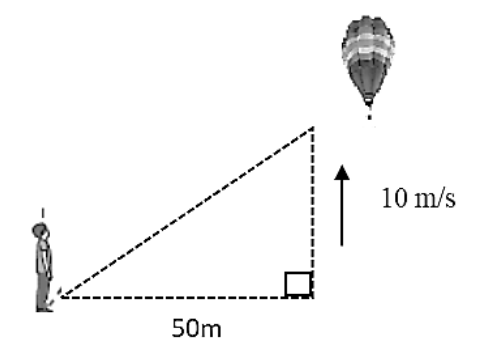
- (b)
Show that dy/dx = −5/(3x − 5)². Hence find ∫ 1/(3x − 5)² dx.
[3]
Diagram 2 shows a closed cylindrical iron container with radius r cm and height of water h cm. The volume of water in the container is 175π cm³ and h = 7 cm. When the container is soaked in cool water, the height of the water shows a small increase of p cm. [Volume of cylinder, V = πr²h]
Medium8 marks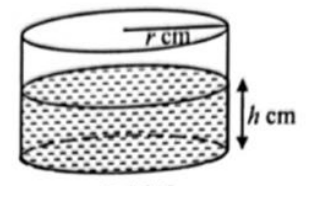
- (a)
Find the small change in the radius, in cm, in terms of p.
[5] - (b)
Find the percentage of the small change in the radius, hence describe the percentage.
[3]
Two variables, x and y, are related by the equation y = 24/x². Express in terms of p, the approximate change in y when x changes from 6 to 6 + p, where p is a small value.
Easy4 marksExpress the approximate change in y in terms of p.
[4]
Given the curve y = 2x³ − 9x² + 12x + 4 passes through the point P(1/2, 8) and has two turning points, A and B. Find (a) the gradient of the curve at P, (b) the equation of the normal to the curve at P, (c) the coordinates of the turning points A and B, and determine the nature of each point.
Medium8 marks- (a)
Find the gradient of the curve at P.
[2] - (b)
Find the equation of the normal to the curve at P.
[2] - (c)
Find the coordinates of the turning points A and B, and determine the nature of each point.
[4]
(a) The diagram shows a cube of volume 729 cm³ (the diagram is labelled 20 cm and the water level h cm). If the water level in the cube, h cm, is increasing at the rate of 0.8 cm s⁻¹, find the rate of increase of the volume of water. (b)(i) Given d/dx(5x²) = 10x, find ∫10x dx. (ii) The usage of water at school A is given by the function F = 100t³ + 20t², where F is the volume of water used, in litres, and t is the time, in days. If the rate of change of the water usage of school A changes according to dF/dt = 300t² + 50t, find the volume, in litres, used on the fourth day.
Medium7 marks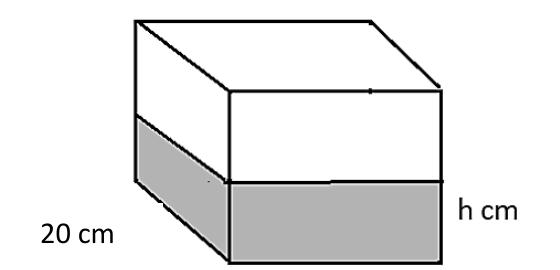
- (a)
Find the rate of increase of the volume of water.
[4] - (b)(i)
Find ∫10x dx.
[1] - (b)(ii)
Find the volume used on the fourth day.
[2]
The diagram shows an inverted pyramid-shaped tank with a square base of side 10 cm and height 30 cm. (a) If the height of the water in the tank is h cm, show that the volume of the water, V cm³, is V = h³/27. (b) Water flows out through a hole at the end of the tank. (i) Find the small change in the volume of water when h decreases from 6 cm to 5.98 cm. (ii) Show that a small decrease of p% in the height of the water causes a decrease of 3p% in the volume.
Medium8 marks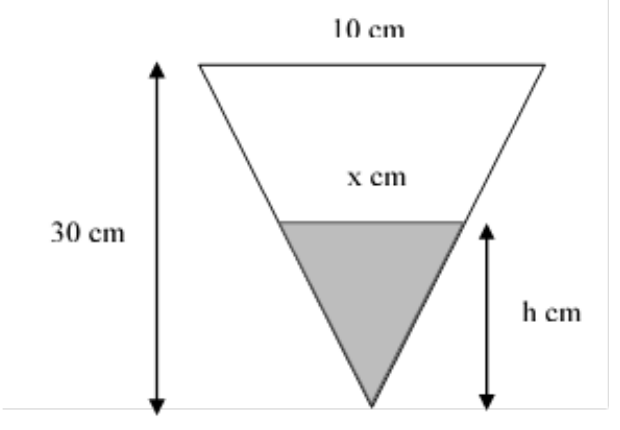
- (a)
Show that V = h³/27.
[3] - (b)(i)
Find the small change in V when h decreases from 6 cm to 5.98 cm.
[2] - (b)(ii)
Show that a decrease of p% in h causes a decrease of 3p% in V.
[3]
(a) Given y = (1/9)t³ and x = 2t − 7. (b) Given f′[x/(3x − 2)⁵] = −2(ax + 1)/(3x − 2)⁶, where a is a constant.
Easy5 marks- (a)
Find dy/dx using the chain rule. Hence, find the value of dy/dx if x = 2.
[3] - (b)
Find the value of a.
[2]
Diagram 10(a) shows a hemispherical bowl and Diagram 10(b) shows a cross-section of the bowl, filled with water. Given the radius of the bowl is 10 cm and the height of the water in the bowl is h cm.
Medium6 marks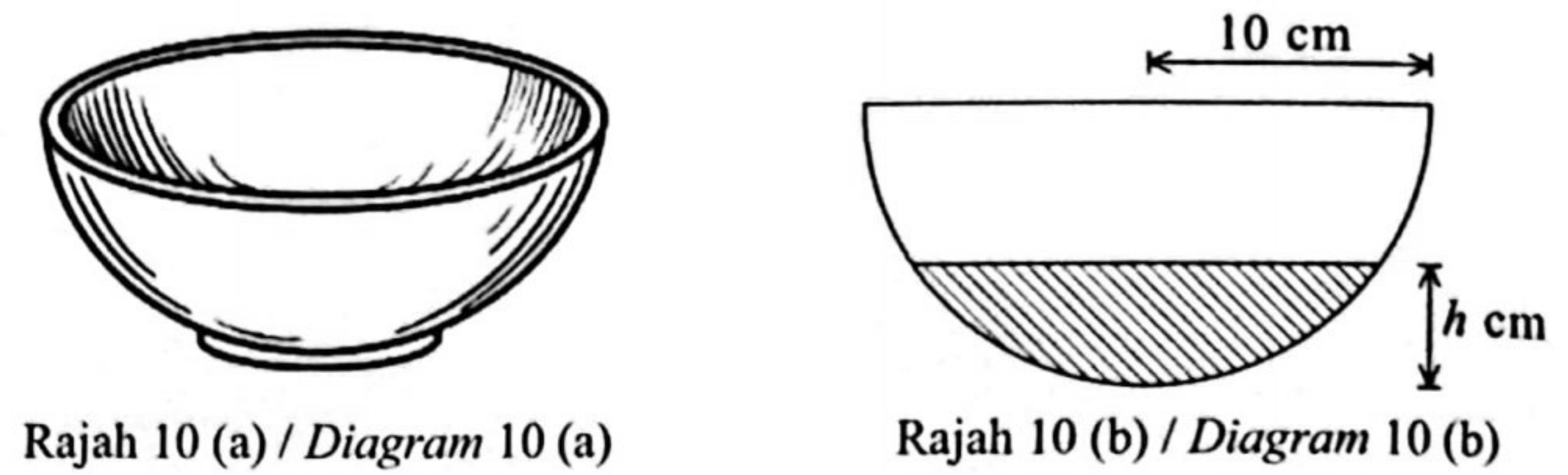
- (a)
Show that the surface area of the water, A cm², in the bowl is A = π(20h − h²).
[3] - (b)
An error of 2% is recorded for small changes in water height. Find the small changes in the surface area of the water in terms of π.
[3]
Given the curve with the equation y = −x((1/2)x − 3)³ passing through a stationary point A(6, 0).
Medium7 marks- (a)
By using tangent sketch method, determine the type of the stationary point A.
[4] - (b)
There is a small change in x by 1% when x = 2. Find the corresponding percentage change in y.
[3]
(a) Diagram 9 shows the graph of y = f(x) on a Cartesian plane. Does lim(x→0) f(x) exist? Give your justification. (b) Find the first derivative of f(x) = 2/(x + 4) by using the first principle.
Medium6 marks- (a)
Does lim(x→0) f(x) exist? Give your justification.
[2]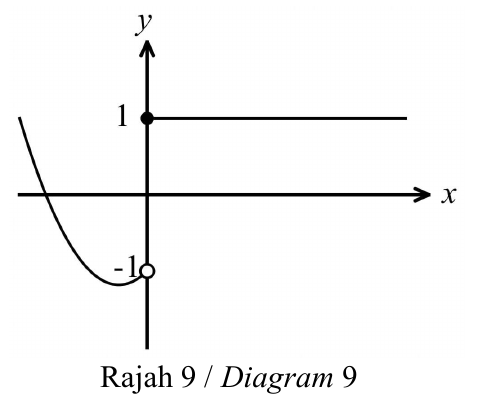
- (b)
Find the first derivative of f(x) = 2/(x + 4) by using the first principle.
[4]
Diagram 4 shows the route of a cycling track represented by the curve y = x²(3x/2 − 2) + 5/2. At point P(1, 2), Hazim uses the path PQ, which is tangent to the cycling track. (a) Using calculus, find the equation of PQ. (b) A canal perpendicular to path PQ, passing through point P, is represented by the equation y + 2x = q² + 3. Find the value of q, if q > 0.
Medium7 marks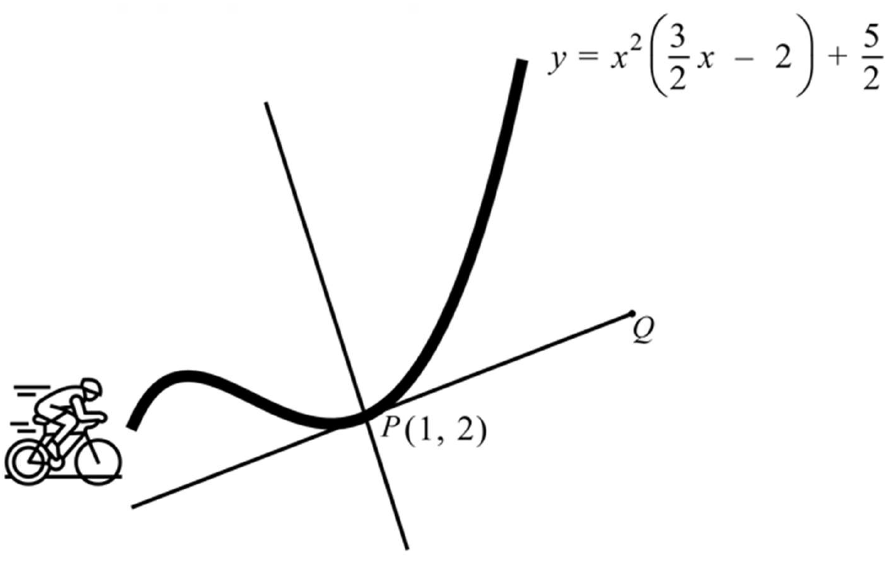
- (a)
Using calculus, find the equation of PQ.
[4] - (b)
Find the value of q, if q > 0.
[3]
Diagram 8 shows Cecilia kayaking in a lake. P is her starting point, A is the jetty and C is the rest house. PA = 5 km and PA is perpendicular to AC; AB = x km and AC = 6 km. She kayaks from P to B at 2 km/h, then walks from B to C at 4 km/h.
Medium6 marks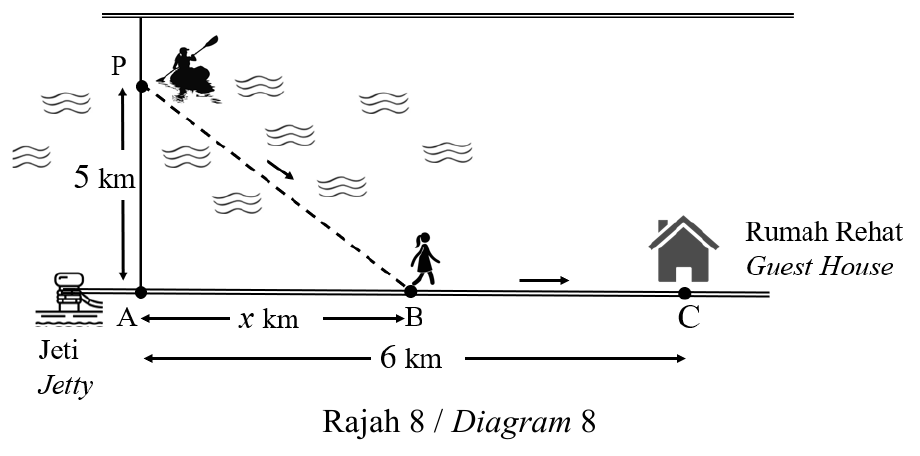
- (a)
Show that the time T, in hours, taken by Cecilia is T = (2√(25 + x²) + 6 − x)/4.
[2] - (b)
Using the tangent sketch method, prove that the time taken by Cecilia is the shortest time. (Answer in the table: x, dT/dx, sign of dT/dx, sketch of the tangent, sketch of the graph.)
[4]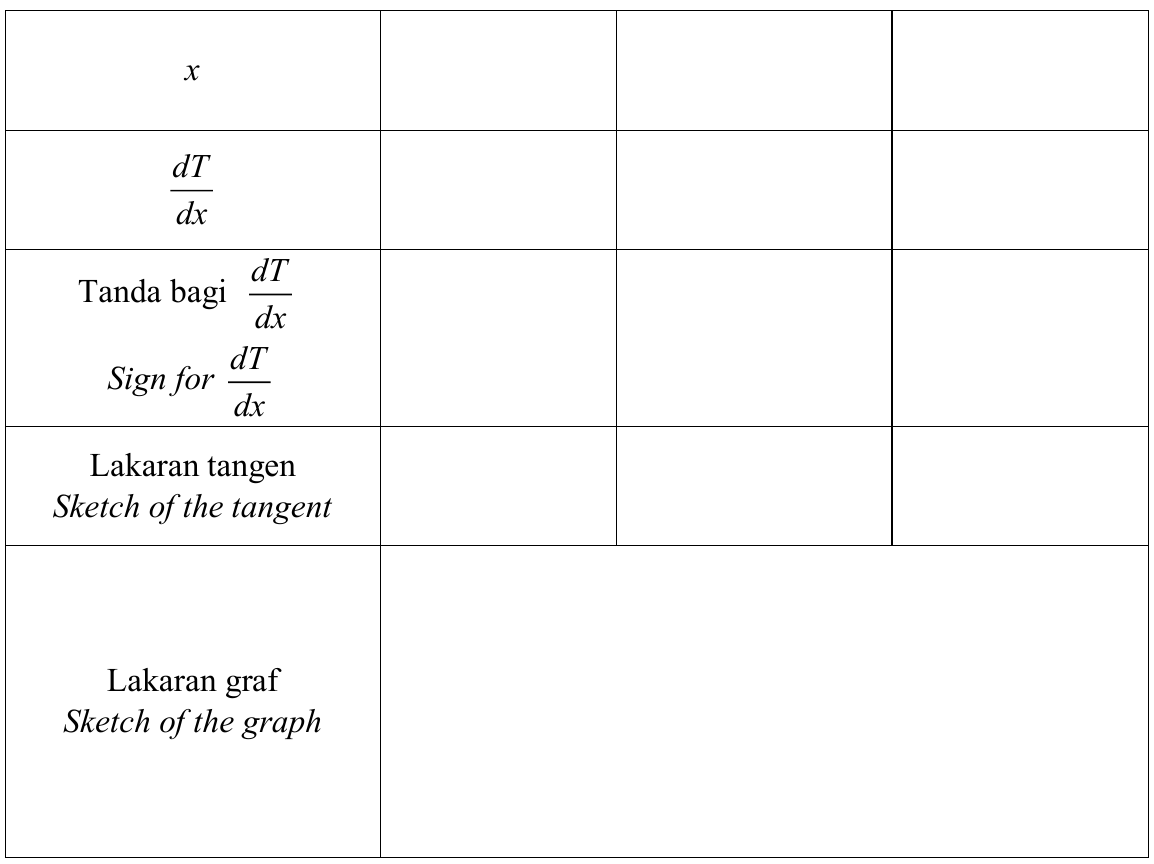
Diagram 9 shows the curve f(x) = (2/3)x³ + (9/2)x² − 18x + 16 which intersects the y-axis at point R. Q is a turning point of the curve (minimum point on the right). (a)(i) State the coordinates of R. (ii) Find the gradient of the normal at point R. (b) By using the second derivative, show that Q is a minimum point. (c) Find the percentage of approximate change in f(x) if there is a small change in x of 0.03 when x = 5.
Medium10 marks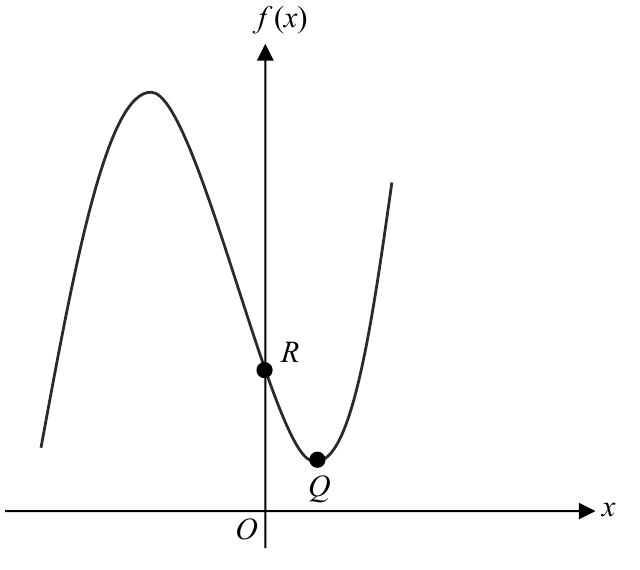
- (a)(i)
State the coordinates of R.
[1] - (a)(ii)
Find the gradient of the normal at point R.
[3] - (b)
By using the second derivative, show that Q is a minimum point.
[3] - (c)
Find the percentage of approximate change in f(x) if there is a small change in x of 0.03 when x = 5.
[3]
Given d/dx [3/(2x⁴) + (5 − x)⁵] = h/x^k + (h + 1)(5 − x)^(k−1). (a) Find the values of h and k. (b) If point A lies on the curve such that the sign of dy/dx remains unchanged but the gradient decreases before A and increases after A, state the value of d²y/dx² at point A.
Medium5 marks- (a)
Find the values of h and k.
[4] - (b)
State the value of d²y/dx² at point A.
[1]
(a) Find the value of a and of b so that the straight line 2x + 3y = a becomes a tangent to the curve y = bx² at x = 3. (b)(i) Given that d/dx[(16/5)x⁵ − x] = 16x⁴ − 1, by using the tangent sketching method, determine the type of stationary point of the curve at x = 1/2. (ii) Hence, determine the coordinates of the other stationary point.
Medium8 marks- (a)
Find the value of a and of b.
[4] - (b)(i)
By using the tangent sketching method, determine the type of stationary point of the curve at x = 1/2.
[2] - (b)(ii)
Hence, determine the coordinates of the other stationary point.
[2]
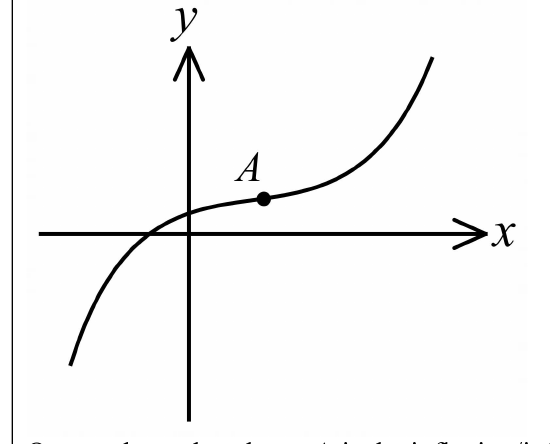
(a) Given y = f(x). A point A(h, k) lies on the curve such that dy/dx = 0 and d²y/dx² = 0. On the axes, sketch a possible graph for y = f(x) and label point A. (b) Determine the value of the limit as x → 3 of (9 − x²)/(4 − √(x² + 7)).
Easy4 marks- (a)
Sketch a possible graph for y = f(x) on the axes and label the position of point A.
[1]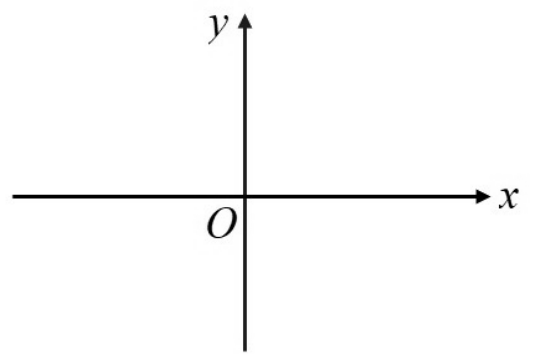
- (b)
Determine the value of lim (x → 3) (9 − x²)/(4 − √(x² + 7)).
[3]
(a)(i) Find the value of d/dx[3/(2√x)] when x = 8. (a)(ii) Find the first derivative of y = 3x(2 − 5x)⁶. (b) State whether the limit as x → 3 of (2x² − 3ax + x − a − 1)/(x² − 2x − 3) exists for each case, and give your explanation: (i) when a = 0, (ii) when a = 2.
Medium8 marks- (a)(i)
Find the value of d/dx[3/(2√x)] when x = 8.
[2] - (a)(ii)
Find the first derivative of y = 3x(2 − 5x)⁶.
[2] - (b)(i)
State whether the limit exists when a = 0, and explain.
[2] - (b)(ii)
State whether the limit exists when a = 2, and explain.
[2]
Diagram 4 shows the curve y = x² + p and the tangent to the curve at the point A(2, q). Find (a) the y-intercept for the curve in terms of q, (b) the equation of the tangent at point A if the y-intercept for the curve is 1.
Medium5 marks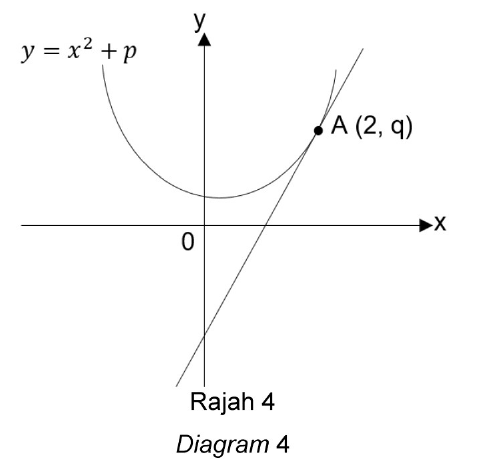
- (a)
y-intercept for the curve in terms of q.
[2] - (b)
Equation of the tangent at point A if the y-intercept for the curve is 1.
[3]
Diagram 1 shows the curve y = x², point R(−1, 0) and point P(p, 0). P is a changeable point on the x-axis and p increases at a rate of 10 units s⁻¹. PQ is parallel to the y-axis. (a) State the length, L units, of QR in terms of p. (b) Calculate the rate of increase of the length QR when p = 1.
Medium6 marks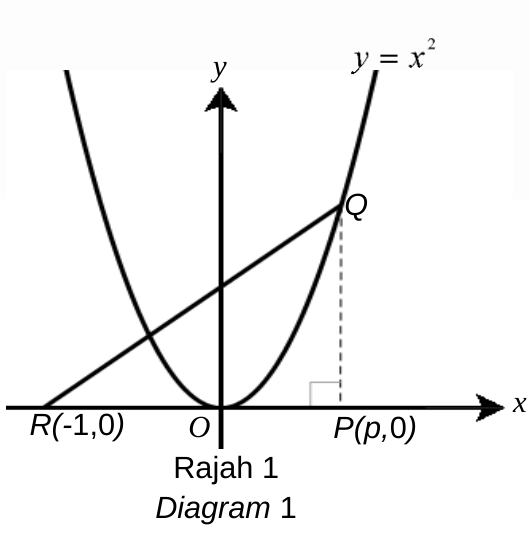
- (a)
State the length, L units, of QR in terms of p.
[2] - (b)
Calculate the rate of increase of the length QR when p = 1.
[4]
The equation of a curve is y = 3x² − 6x + 5. Find (a) the gradient function of the curve by the first principle method, (b) the coordinates of the turning point, (c) the equation of the normal to the curve at the point (2, 5).
Medium8 marks- (a)
Find the gradient function by the first principle method.
[3] - (b)
Find the coordinates of the turning point.
[2] - (c)
Find the equation of the normal at (2, 5).
[3]
(a) Two numbers h and k are connected by h + k = 6. Find the values of h and k which give a turning point of the function Z = 2h² + 3k². Hence, determine whether that stationary point is a maximum or minimum point. (b) Find the coordinates of the point on the curve y = (3x − 1)² such that the normal gradient to the curve at that point is −1/6.
Medium8 marks- (a)
Find h and k for the turning point of Z = 2h² + 3k² and determine its nature.
[5] - (b)
Find the coordinates of the point where the normal gradient is −1/6.
[3]
(a) Given two functions, y = f(u) and u = g(x). Using the idea of limits, prove that dy/dx = dy/du × du/dx. (b) Given y = 5t² + 2t and x = 1 − 2t. Find dy/dx in terms of x.
Medium6 marks- (a)
Using the idea of limits, prove that dy/dx = dy/du × du/dx.
[3] - (b)
Given y = 5t² + 2t and x = 1 − 2t. Find dy/dx in terms of x.
[3]
(a)(i) Find f′(x) for f(x) = 3x² + 1 using differentiation by the first principles. (ii) Find the first derivative of the function f(x) = (1/2)x² − 3x. (b) The volume of a sphere decreases at a rate of 2.5π cm³ s⁻¹. Find the rate of change of the radius of the sphere when the radius is 5 cm. [Volume of a sphere, V = (4/3)πr³]
Medium8 marks- (a)(i)
Find f′(x) for f(x) = 3x² + 1 using the first principles.
[3] - (a)(ii)
Find the first derivative of f(x) = (1/2)x² − 3x.
[1] - (b)
Find the rate of change of the radius when r = 5 cm (volume decreases at 2.5π cm³ s⁻¹).
[4]
A piece of wire, 80 cm long, is bent to form the shape shown in Diagram 5. The shape consists of a semicircular arc, radius r cm and three sides of a rectangle of height x cm. (a) Express the area of the shape, A cm², in terms of r and π. (b) By using π = 3.142, find the value of r when the area of the shape is maximum. Hence find the maximum area.
Medium7 marks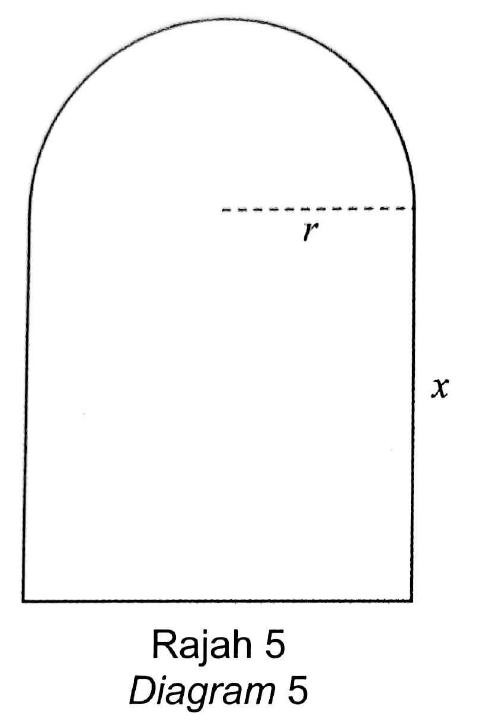
- (a)
Express the area A cm² in terms of r and π.
[3] - (b)
Using π = 3.142, find r when the area is maximum. Hence find the maximum area.
[4]
Differentiation and limits.
Easy6 marks- (a)
The straight line y = 3x − 2 is tangent to the curve y = px² + qx, where p and q are constants, at x = 4. Find the values of p and of q.
[4] - (b)
Determine the limit value of lim(x→−3) (2x² + 3x − 9)/(x + 3).
[2]
Diagram 5 shows a composite solid consisting of a hemisphere and a cylinder. The diameter of both the hemisphere and the cylinder is 2r cm. The total surface area, A cm² is given by A = √3π(√3r² + 18/r).
Medium7 marks- (a)
When heated, the solid expands such that the rate of change of the radius is 0.2 cm s⁻¹. Find the rate of change of the total surface area of the composite solid, in terms of π, given that the curved surface area of the hemisphere is 32π cm².
[4]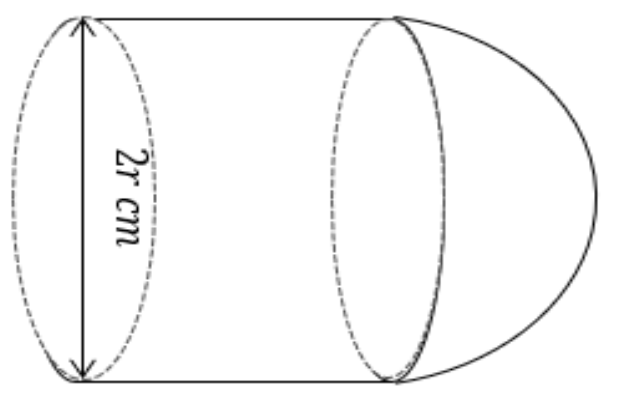
- (b)
Find the radius that makes the total surface area of the solid minimum.
[3]
Differentiation and integration.
Medium6 marks- (a)
Given y = x²/(x − 1), show that dy/dx = x(x − 2)/(x − 1)². Hence, find the value of ∫₀² 4x(x − 2)/(x − 1)² dx.
[3] - (b)
Given d²y/dx² = 12x + 5, when x = −1, y = −2 and dy/dx = 1, find y in terms of x.
[3]
Given the equation of a curve is y = x²(3 − (2/3)x) + 1/2.
Medium8 marks- (a)
Find the coordinates of the stationary points.
[3] - (b)
Hence, determine whether each of the stationary points is a maximum or a minimum.
[2] - (c)
If x increases from 2 to 2.01, find the approximate value of y.
[3]
Diagram 3 shows a solid prism with triangular cross section perpendicular to the parallel edges AD, BE and CF. The length of each of AD, BE and CF is y cm. The triangles have right angles at C and F. AC = DF = 4x cm and BC = EF = 3x cm. The volume of the prism is 1500 cm³.
Hard8 marks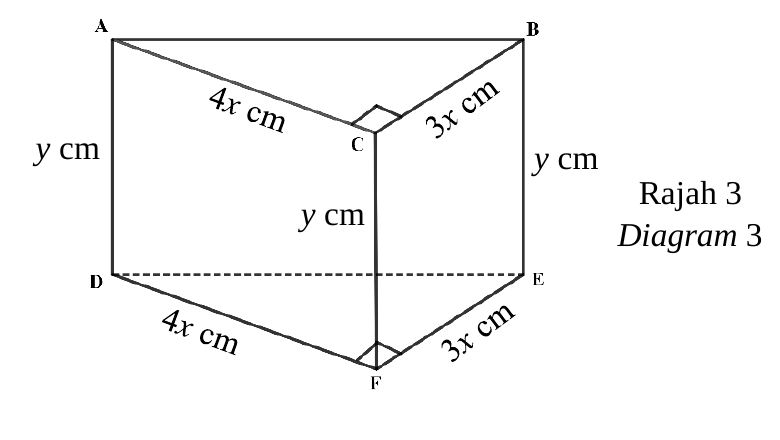
- (a)
Show that the total surface area, S cm², is given by S = 12x² + 3000/x.
[4] - (b)
Find the stationary value of S.
[4]
(a) Find the value of lim (x → 3) (x − 3)/(3 − √(12 − x)). (b) The tangent to the curve y = −x³ − qx² + 4x + 3 at x = −1 is parallel to the straight line y = −3x. Find (i) the value of q, (ii) the equation of the tangent to the curve at x = −1.
Medium8 marks- (a)
Find lim (x → 3) (x − 3)/(3 − √(12 − x)).
[3] - (b)(i)
Find the value of q.
[2] - (b)(ii)
Find the equation of the tangent to the curve at x = −1.
[3]
Diagram 2 shows a rectangle PQRS. Given PQ = 2n cm and QR = n cm, where n is a constant. T and U are points on PS and SR respectively, where ST = x cm and RU = 2x cm. (a) Show that the area of △QUT is (n² − nx + x²) cm². (b) Express x in terms of n such that the area of △QUT is minimum. (c) Find the minimum area of △QUT in terms of n.
Medium7 marks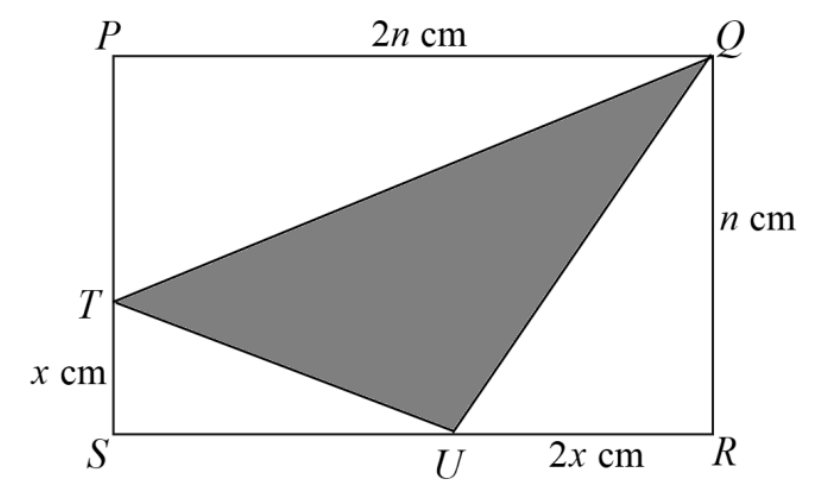
- (a)
Show that the area of △QUT is (n² − nx + x²) cm².
[3] - (b)
Express x in terms of n such that the area of △QUT is minimum.
[2] - (c)
Find the minimum area of △QUT in terms of n.
[2]
It is given that the curve y = 2x(3 − x)⁴ passes through the point Q(2, 4). Find (a) the gradient of the tangent to the curve at point Q, (b) the equation of the normal to the curve at point Q.
Medium7 marks- (a)
Find the gradient of the tangent to the curve at Q(2, 4).
[4] - (b)
Find the equation of the normal to the curve at Q.
[3]
(a) Given h = 3x − 2 and k = x² − 1, find the value of dk/dh when x = 2. (b) Diagram 5 shows a closed box with a square base of side x cm and height h cm, with a total surface area of 216 cm². Find the value of x when its volume is maximum.
Medium6 marks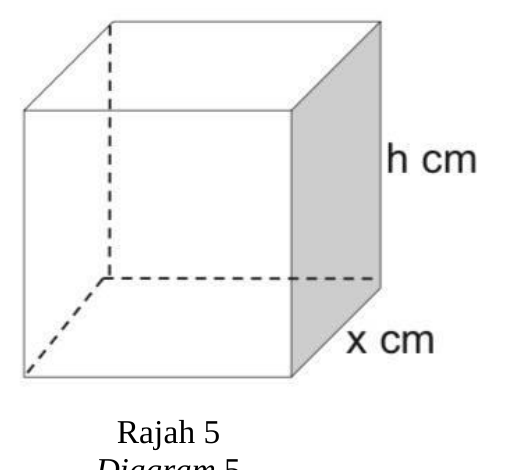
- (a)
Find dk/dh when x = 2.
[3] - (b)
Find x when the volume of the box is maximum.
[3]
(a) Given y = (x − 4)³. (i) Find dy/dx when y = 8. (ii) Hence, calculate the small change in x when y increases from 8 to 8.2. (b) The volume of a hemisphere is decreasing at a constant rate of 1.02π cm³ s⁻¹. Find the radius of the hemisphere at the instant when the radius is decreasing at a rate of 0.1 cm s⁻¹.
Medium7 marks- (a)(i)
Find dy/dx when y = 8.
[2] - (a)(ii)
Hence, find the small change in x when y increases from 8 to 8.2.
[2] - (b)
Find the radius when the radius is decreasing at 0.1 cm s⁻¹ and the volume at 1.02π cm³ s⁻¹.
[3]
It is given that y = 3/(2x − 1)³. (a) Find the value of dy/dx when x = 2. (b) Express in terms of k, the approximate change in y, when x changes from 2 to 2 + k, where k is a small positive value. State whether this change is an increase or decrease.
Easy4 marks- (a)
Find dy/dx when x = 2.
[2] - (b)
Find the approximate change in y in terms of k and state increase or decrease.
[2]
The tangent to the curve y = −x³ − px² + 4x + 3 at x = −1 is parallel to the straight line y = −3x. Find (a) the value of p, (b) the equation of the tangent to the curve at x = −1, (c) the x-coordinates of the turning points.
Medium8 marks- (a)
Find the value of p.
[2] - (b)
Find the equation of the tangent at x = −1.
[3] - (c)
Find the x-coordinates of the turning points.
[3]
Given f(x) = 4/(1 − 2x)³ and f′(x) = m(1 − 2x)ⁿ. (a) Find the value of m + n. (b) Hence, find the value of p given (1/p)∫f′(x) dx = −1/81 and x = 2.
Medium5 marks- (a)
Find the value of m + n.
[2] - (b)
Hence, find the value of p given (1/p)∫f′(x) dx = −1/81 and x = 2.
[3]
Pak Samad owns rectangular land in which a semicircle is a pond (Diagram 10) and the rest is used to rear ducks. The area is fenced with wire of 120 m length. The width of the land is 2x m. (a) Show that the area to keep the ducks, in m², is L = 120x − 2x² − (3/2)πx². (b) Find the value of x, when L is maximum, in terms of π. (c) During drought, the surface of the pond reduces at the rate of 0.02 m² s⁻¹ due to evaporation. Find the rate of change of the radius at the instant when the radius is 8 m, in terms of π.
Medium8 marks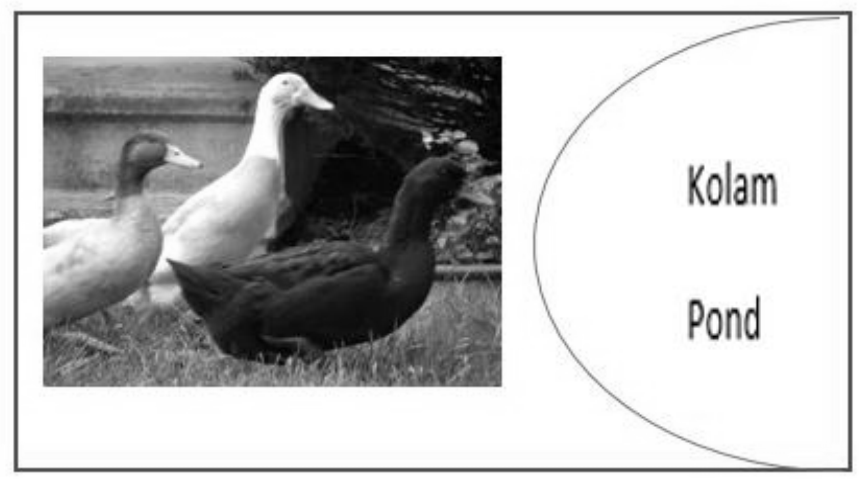
- (a)
Show that the area to keep the ducks is L = 120x − 2x² − (3/2)πx².
[3] - (b)
Find the value of x, when L is maximum, in terms of π.
[2] - (c)
The pond surface reduces at 0.02 m² s⁻¹. Find the rate of change of the radius when the radius is 8 m, in terms of π.
[3]
(a) A curve with gradient function 2x − 2/x² has a stationary point at (k, 8). (i) Find the value of k. (ii) Hence, by using the sketching of tangent method, determine whether the stationary point is a maximum or a minimum point, giving your justification. (b) Diagram 4 shows a straight line with x-intercept 1 touching the curve x = y² + 10 at the point (k, 3). Given the area of the shaded region is 9 unit². By using integration, find the value of k.
Medium10 marks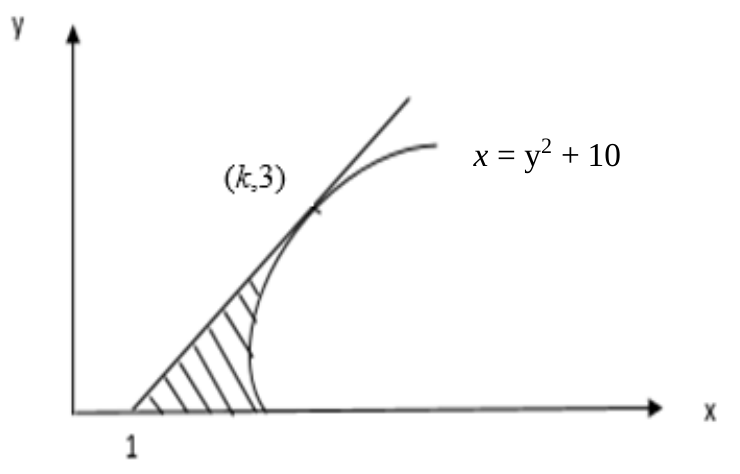
- (a)(i)
Find the value of k.
[2] - (a)(ii)
Hence, by the tangent-sketching method, determine whether the stationary point is a maximum or a minimum, with justification.
[3]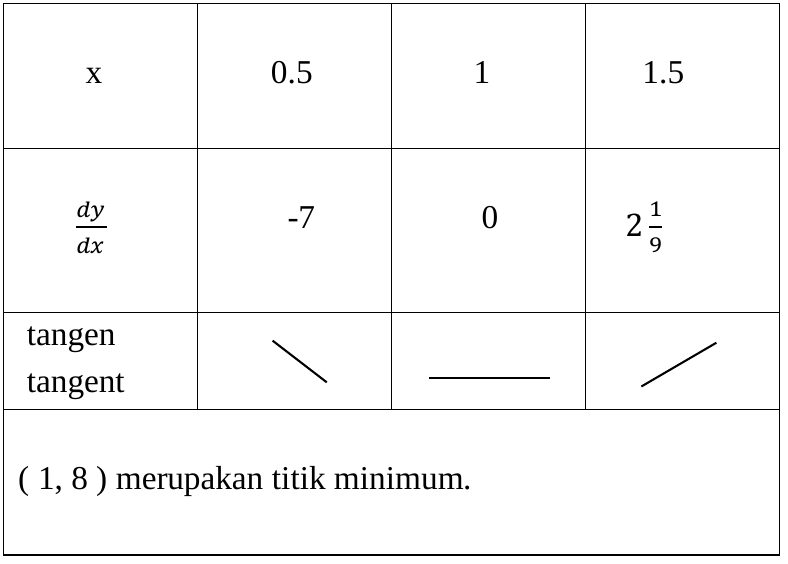
- (b)
Using integration, find the value of k (shaded area = 9 unit²).
[5]
Diagram 5 shows a part of the curve y = −x³(x − 3) + 4. (a) Find the coordinates of the two stationary points, P and Q. (b) Hence, determine the nature of stationary point P by using the tangent sketching method.
Easy4 marks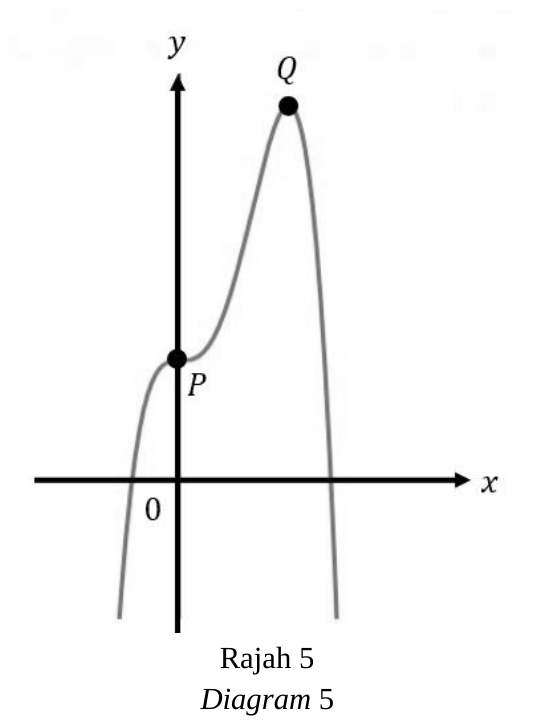
- (a)
Find the coordinates of the stationary points P and Q.
[2] - (b)
Determine the nature of P by the tangent sketching method.
[2]
(a) Given y = 2√x, (i) find dy/dx by using the first principle, (ii) hence, find the small change in y when x increases from 25 to 25.04. (b) The volume of a hemisphere is decreasing at a constant rate of 1.02 cm³ s⁻¹. Find the radius of the hemisphere at the instant when the radius is decreasing at a rate of 0.1 cm s⁻¹.
Medium8 marks- (a)(i)
Find dy/dx by first principles.
[3] - (a)(ii)
Find the small change in y when x increases from 25 to 25.04.
[2] - (b)
Find the radius of the hemisphere.
[3]
Diagram 5 shows part of the curve y = (2/5)x(8 − x)³ with stationary points M and N. (a) Find the coordinates of the two stationary points M and N. (b) Hence, determine the nature of stationary point N by using the tangent sketching method.
Medium7 marks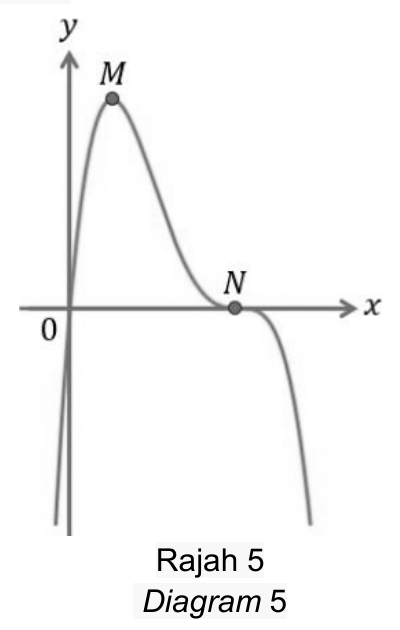
- (a)
Find the coordinates of the stationary points M and N.
[4] - (b)
Determine the nature of N by the tangent sketching method.
[3]
Milk is poured into a hemispherical bowl of radius 4 cm at the rate of 3π cm³ s⁻¹. If the depth of the milk is h cm, its volume is V = π(4h² − h³/3). (a) Find the rate of change of h when the depth of the milk is 3/2 cm. (b) Given that the radius of the milk surface is r = √(8h − h²), determine the small change of the radius of the milk surface if the depth of milk decreases by 5% from h = 1 cm.
Medium7 marks- (a)
Find dh/dt when h = 3/2 cm.
[3] - (b)
Find the small change in r when h decreases 5% from h = 1 cm.
[4]
(a) Determine the limit value of lim (x→2) (2x² + 1). (b) Find dy/dx for y = 2x² + 1 by using first principles.
Easy4 marks- (a)
Determine lim (x→2) (2x² + 1).
[1] - (b)
Find dy/dx for y = 2x² + 1 by using first principles.
[3]
A company wants to build an open-top cylindrical tank with a volume of 1000 m³. The radius is r m and the height is h m. The cost to build the base is RM5 per square metre and the cylindrical wall is RM2 per square metre. (a) Express the cost to build the tank, C, in terms of r and π. (b) Find the radius and height that minimise the construction cost. Hence, find the minimum construction cost. [Use π = 3.142] (c) After the tank is built, the tank starts being filled with water at a rate of 20 m³ per minute. Find the rate of change of the water height in the tank when the water reaches a height of 8 metres.
Hard10 marks- (a)
Express the cost C in terms of r and π.
[3] - (b)
Find the radius and height that minimise the cost, and the minimum cost.
[5] - (c)
Find the rate of change of the water height when the water height is 8 m.
[2]
Diagram 10.1 shows a rectangular cardboard KLMN with a perimeter of 100 cm used to form a closed cylinder with maximum volume (KL = p cm, LM = q cm). Sides KN and LM will form the height of the cylinder. While Diagram 10.2 shows two circles that will be cut from cardboard TUVW (height 11 cm) to make the cover and base of the cylinder.
Medium8 marksDetermine by calculation, whether the given size of TUVW cardboard is suitable to be used to form the cover and the base of the cylinder.
[8]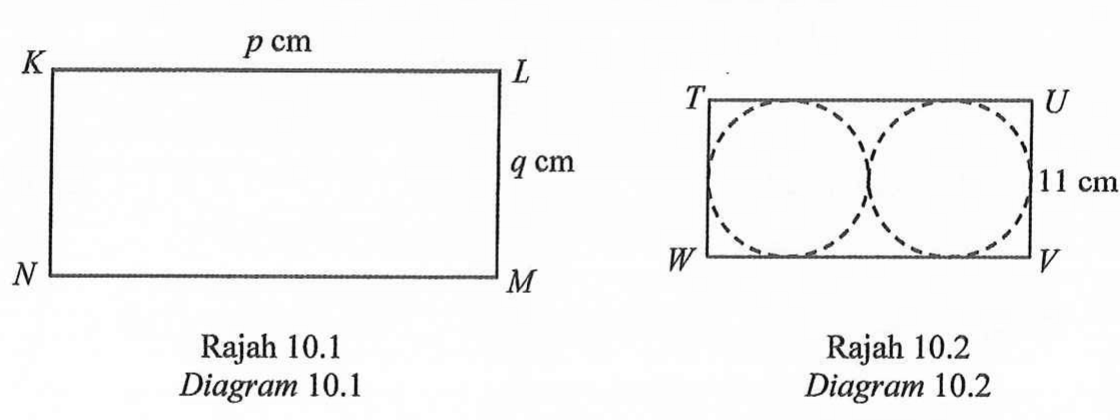
(a) Given the first derivative of 3x(x² + 5)⁴ is 3(x² + 5)³(hx² + 5). (b) Diagram 4 shows an inverted cone with a base diameter of 12 cm and a height of 18 cm. Given the height of water in the cone is h cm and the radius of water surface is r cm. The water leaks out through a small hole at the tip of the cone. [V(cone) = (1/3)πr²h]
Medium8 marks- (a)
Find the value of h.
[3] - (b)
Calculate the small changes in the height of water when the volume decreases from 8π cm³ to 7.5π cm³.
[5]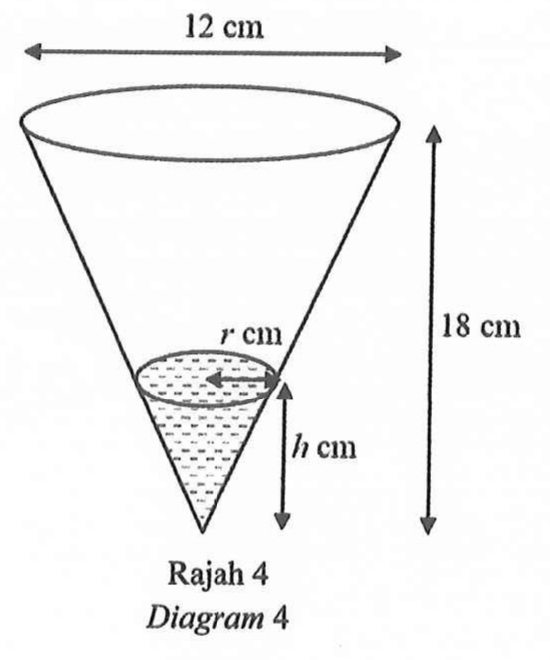
The normal line to the curve y = ax² + b/x at the point (1, 5) is parallel to the straight line x + y − 8 = 0. Find the value of a and of b.
Easy4 marksFind the value of a and of b.
[4]
(a) The variables f and g are related by the equation 1/f + 1/g = 1/15. Given g increases at a rate of 1.2 cm s⁻¹, find the rate of change of f, in cm s⁻¹, when g = 20 cm. (b) Diagram 6 shows part of the curve y = 1 − x². (i) Find the first derivative of y with respect to x. (ii) Hence, calculate the approximate value of q in terms of p and k.
Medium8 marks- (a)
Find the rate of change of f, in cm s⁻¹, when g = 20 cm.
[4] - (b)(i)
Find the first derivative of y with respect to x.
[1] - (b)(ii)
Hence, calculate the approximate value of q in terms of p and k.
[3]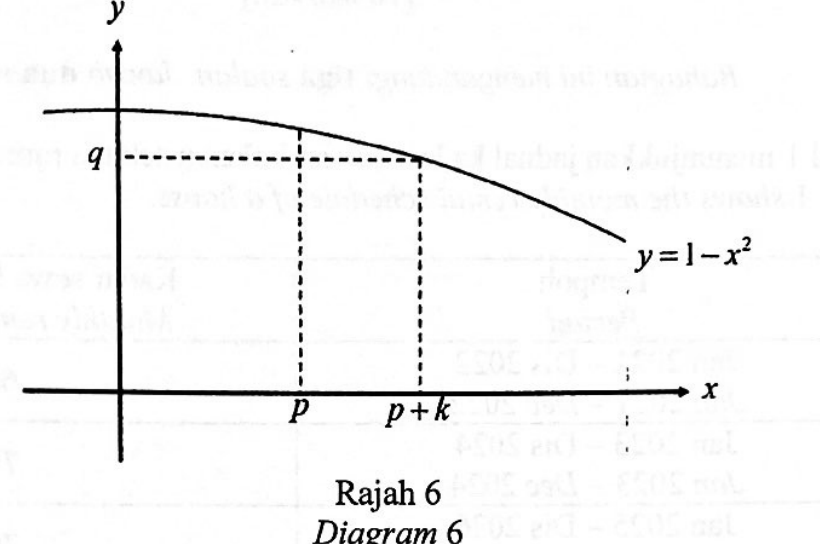
Amrin participates in a workshop to build a geometric model. He has been given a piece of wire to make a cuboid-shaped box frame. The volume of the box is 375 cm³ and the base length of the box must be twice its base width. (a) By taking the base width of the box as x, show that the length of wire used is P = 12x + 750/x². (b) (i) Find the value of x, in cm, that makes the value of P the shortest. (ii) Hence, calculate the value of P. (c) Given that the price for a meter of a wire is RM 1.80, how much should the organizer of the workshop need to spend, in RM, for 30 participants?
Medium10 marks- (a)
By taking the base width as x, show that the length of wire used is P = 12x + 750/x².
[3] - (b)(i)
Find the value of x, in cm, that makes the value of P the shortest.
[3] - (b)(ii)
Hence, calculate the value of P.
[2] - (c)
Given that the price for a meter of wire is RM 1.80, how much should the organizer need to spend, in RM, for 30 participants?
[2]
Given A(4, 20) lies on a curve y = −2x² + 10x + 12, find (a) the gradient of tangent to the curve at point A, (b) the equation of normal to the curve at point A.
Easy5 marks- (a)
The gradient of tangent to the curve at point A.
[2] - (b)
The equation of normal to the curve at point A.
[3]
Diagram 4(a) shows a closed cuboid with a square base, x cm and the height, h cm. Diagram 4(b) shows a right pyramid with a square base, x cm and the height, h cm. [Volume of right pyramid = (1/3) × base area × height] It is given that total surface area of the cuboid is 96 cm². (a) (i) Show that the sum of volume of cuboid and right pyramid is V = 32x − (2/3)x³. (ii) Find the value of x when V is maximum. Hence, find the maximum value of V. (b) If there is a small change in V by 0.84 cm³, find the percentage change in x when x = 3.
Hard10 marks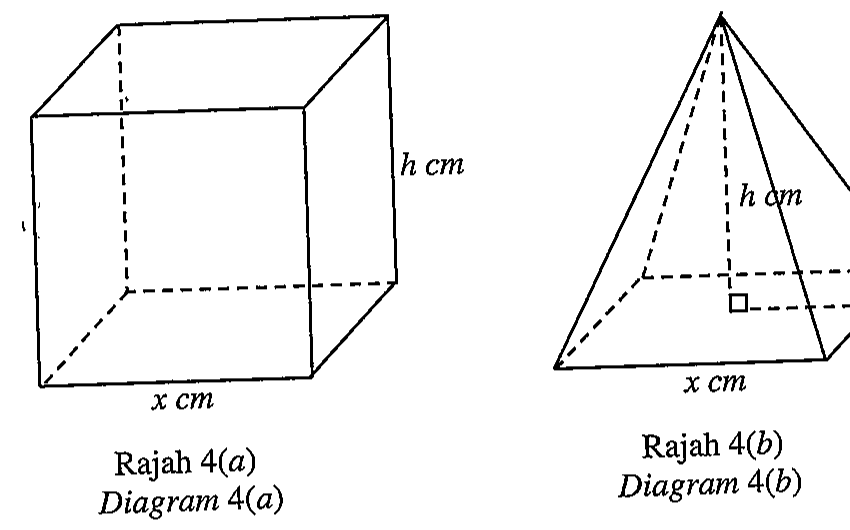
- (a)(i)
Show that the sum of volume of cuboid and right pyramid is V = 32x − (2/3)x³.
[3] - (a)(ii)
Find the value of x when V is maximum. Hence, find the maximum value of V.
[4] - (b)
If there is a small change in V by 0.84 cm³, find the percentage change in x when x = 3.
[3]
It is given that the equation of the curve is f(x) = x²(2x + 1)³ and its gradient function is px(qx + 1)(2x + 1)². Find the value of p and of q.
Easy5 marksFind the value of p and of q.
[5]
Diagram 6 shows a round bottom flask with centre O that has a radius of 10 cm. Water is poured into the flask such that the depth of water from its base, h cm, increases at a rate of 0.5 cm s⁻¹.
Medium10 marks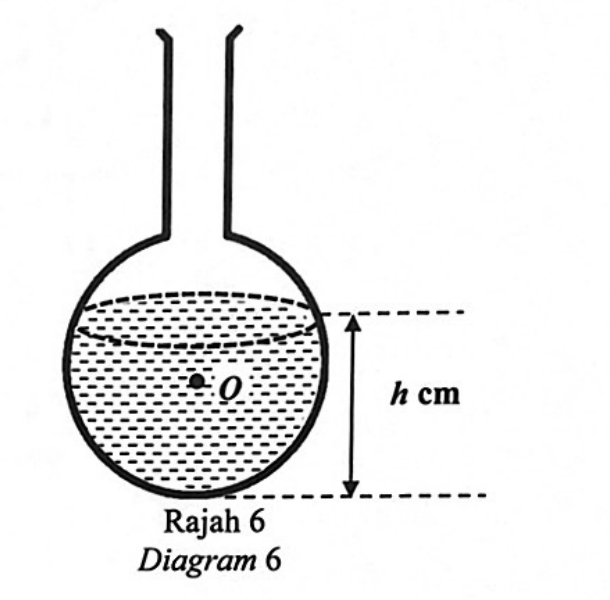
- (a)
Show that the surface area of water, A cm², is given by A = π(20h − h²).
[3] - (b)
Find the rate of change of the water surface area, cm² s⁻¹, when the depth is 12 cm, in terms of π.
[4] - (c)
When h = 12, there is a small change in h by p%. By using the method of differentiation, find the small change of the water surface area, A cm², in terms of p and π.
[3]
Diagram 5 shows an iron container with a close top, cylindrical in shape. The radius is r cm and the height of the water is h cm. The volume of the water is 175π cm³ and h = 7 cm. When the container is soaked in cool water, the height of the water shows a small increase of p cm. [Volume of cylinder, V = πr²h] Find (a) the small change in the radius, in cm, in terms of p, (b) the percentage of the small change in the radius, hence describe the percentage.
Medium6 marks- (a)
Find the small change in the radius, in cm, in terms of p.
[4]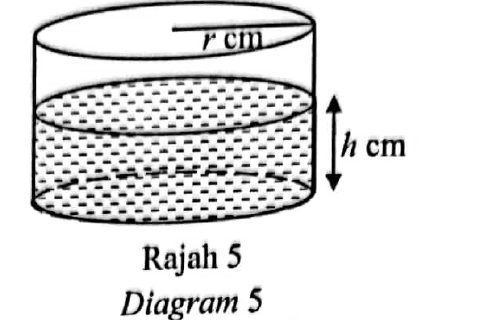
- (b)
Find the percentage of the small change in the radius, hence describe the percentage.
[2]
(a) Given lim(δx→0) δy/δx = 10x. By using first principles, prove that the value of a in function y = ax² is 5. (b) Diagram 1 shows a graph of y = x³ − hx² + k. Point A is the x-intercept (at x = 1) and point B is a turning point of the graph (at x = 2). Find the value of h and of k.
Medium9 marks- (a)
Prove a = 5 using first principles.
[4] - (b)
Find h and k (Diagram 1).
[5]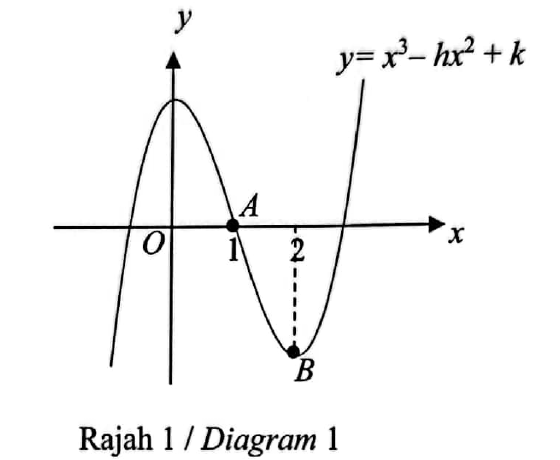
(a) Given that the gradient of tangent to the curve y = x²(px + q) at point (1, −2) is 5. Express q in terms of p. (b) By using the method of Chain Rule, find the first derivative of y = 1/(2u⁵) if u = 6 − 3x.
Easy6 marks- (a)
Express q in terms of p.
[3] - (b)
By using the Chain Rule, find the first derivative of y = 1/(2u⁵) if u = 6 − 3x.
[3]
The total surface area of a box, A cm², is given by A = 2x² + 540/x, such that x is the length of side of the box. (a) When x = 3, there is a small change in x by 2%. Find the percentage change in total surface area of the box. (b) Hence, find the value of x when the total surface area is maximum.
Medium7 marks- (a)
Find the percentage change in total surface area when x = 3 and x changes by 2%.
[5] - (b)
Hence, find the value of x when the total surface area is maximum.
[2]
Two parts on limits and differentiation.
Easy6 marks- (a)(i)
Diagram 4 shows part of the graph of the function y = f(x). Based on the graph, state lim(x→0) f(x).
[1] - (a)(ii)
State the value of m, if lim(x→m) f(x) is undefined.
[1] - (b)(i)
Given the gradient function of y = g(x) is 3x² − px + 3 and the point L(1, y) is a turning point of the graph function, find the value of p.
[2] - (b)(ii)
State the nature of point L. Show the calculations to support your answer.
[2]
Diagram 4 shows a cylindrical cake mould and Diagram 5 shows the cake mould filled with unbaked cake mixture. The height of the cake mould is h cm and the diameter is 24 cm. The cake mixture has a height of 3 cm before baking.
Medium7 marks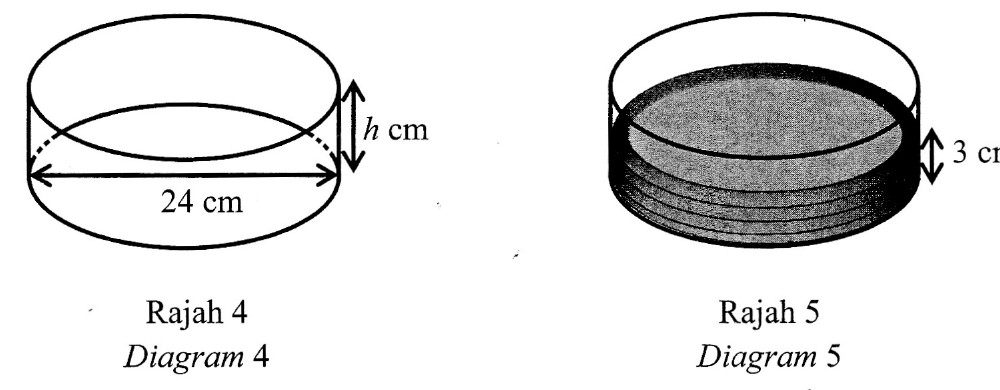
- (a)
Given that the height of the cake mixture increases at a constant rate of 1/720 cm s⁻¹ when baked at 180°C. Find the rate of change of the volume of the cake mixture, in cm³ s⁻¹.
[3] - (b)(i)
Given that the cake has been baked to a height of h cm. The cake is removed from the mould to cool. After a certain time, the height of the cake is found to change to (h − 0.001) cm and the percentage of change in the height of the cake is −0.0125%. Find the value of h.
[2] - (b)(ii)
Find the volume after the cake is cooled for that period of time.
[2]
Given y = 2x³ − 6x² − 18x + 4, find (a) dy/dx when x = 2, (b) hence, determine its maximum point.
Easy6 marks- (a)
Find dy/dx when x = 2.
[2] - (b)
Hence, determine its maximum point.
[4]
Diagram 2 shows a piece of wire bent to form the perimeter OPQR of a sector of a circle, centre O, radius x cm, where angle POR is θ radian. The wire is of length 100 cm while x and θ may vary. (a) Show that the area of the sector, A cm², can be expressed as A = 50x − x². (b) Hence, find (i) the value of x for which the area enclosed by the wire is a maximum, (ii) the corresponding value of θ in radian.
Medium8 marks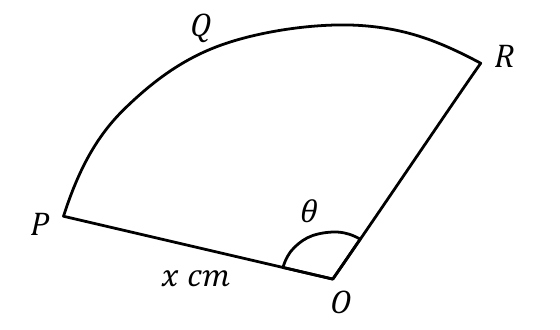
- (a)
Show that A = 50x − x².
[2] - (b)(i)
Find the value of x for which the area is a maximum.
[4] - (b)(ii)
Find the corresponding value of θ in radian.
[2]
Diagram 7 shows an ice cream cone. The volume, V cm³ of the cone decreases from 93.6 cm³ to 93 cm³. If the height of the cone is always three times its radius, find the approximate change in radius when the radius is 3.1 cm.
Medium5 marks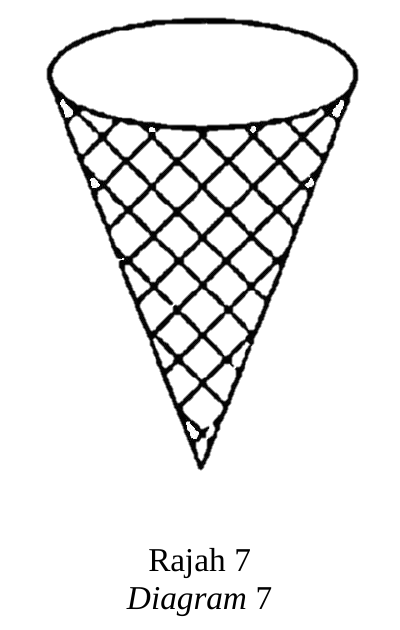
Find the approximate change in radius.
[5]
The curve y = x³ − 6x² + 9x + 4 passes through the point M(2, 6) and has two turning points K(1, 8) and L.
Medium8 marks- (a)
Find the value of the gradient of the curve and the normal equation to the curve at point M.
[4] - (b)
Determine whether L is a maximum or a minimum point.
[4]
(a) Given h(x) = (1 − 2x)³, evaluate h′(1). (b) A curve has the equation y = 3x + 4/x. If x is decreasing at a constant rate of 3 units per second, find the rate of change of y when x = 2.
Medium7 marks- (a)
Given h(x) = (1 − 2x)³, evaluate h′(1).
[3] - (b)
A curve has the equation y = 3x + 4/x. If x is decreasing at a constant rate of 3 units per second, find the rate of change of y when x = 2.
[4]
Alif wants to make a right, covered circular cylinder from a manila card. He still does not know the radius of its base, but its volume must be 54π cm³.
Medium5 marks- (a)
Find the radius of the cylinder base, r, which makes the area of the manila card needed minimum.
[3] - (b)
Calculate the height of the cylinder.
[2]
Differentiation and integration questions.
Medium6 marks- (a)
Given y = x²/(x − 1), show that dy/dx = x(x − 2)/(x − 1)². Hence, find the value of ∫₀² 4x(x − 2)/(x − 1)² dx.
[3] - (b)
Given d²y/dx² = 12x + 5, when x = −1, y = −2 and dy/dx = 1, find y in terms of x.
[3]
The gradient function of a curve is ½k(11 − x), where k is a constant. At the point where x = −1, the gradient of the curve is 3. Find
Medium7 marks- (a)
the value of k
[2] - (b)
the value of x when y is maximum
[2] - (c)
the equation of the normal to the curve at the point (5, −2)
[3]
(a) Given y = ⅓x², find dy/dx by using the first principles method. (b) Diagram 4 shows a curve y = x/(x + 1). A straight line y = −px + 6 passes through the point A(q, r) and is perpendicular to the tangent line at point A. (i) Find the gradient of the tangent that passes through point A in terms of q. (ii) Hence, express q in terms of p.
Medium6 marks- (a)
Find dy/dx by first principles for y = ⅓x². [2 marks]
[2] - (b)(i)
Find the gradient of the tangent at A in terms of q. [(b): 4 marks]
[2]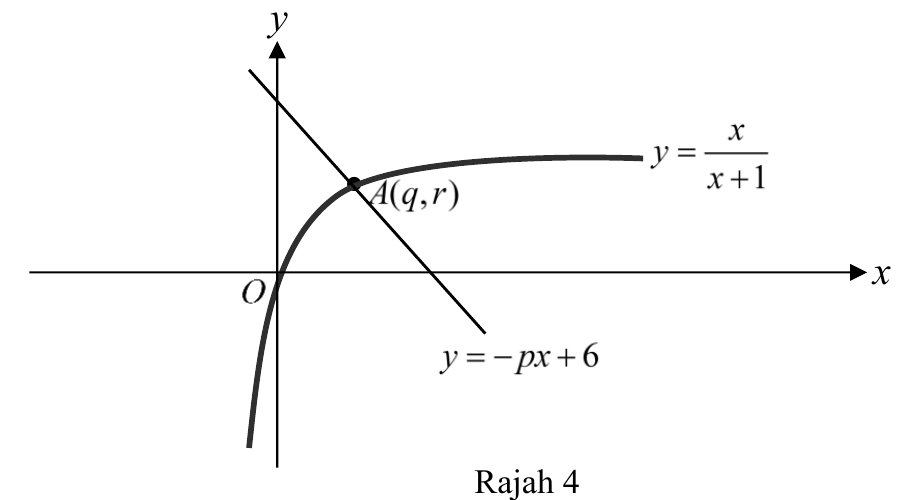
- (b)(ii)
Hence express q in terms of p.
[2]
Diagram 5 shows a sagging electric cable between pole A and pole B. The shape of the cable is y = ⅛x(x − 16), with point P as the origin. P and Q are on a straight line parallel to the ground surface AB, and P is 12 m above the ground. (a) By using differentiation, find the shortest vertical distance, in metres, from the curve of the cable to ground level. (b) Point R is 7 m from pole A. Find the equation of the normal through point R. Hence, state whether the normal line passes through point Q or not.
Medium10 marks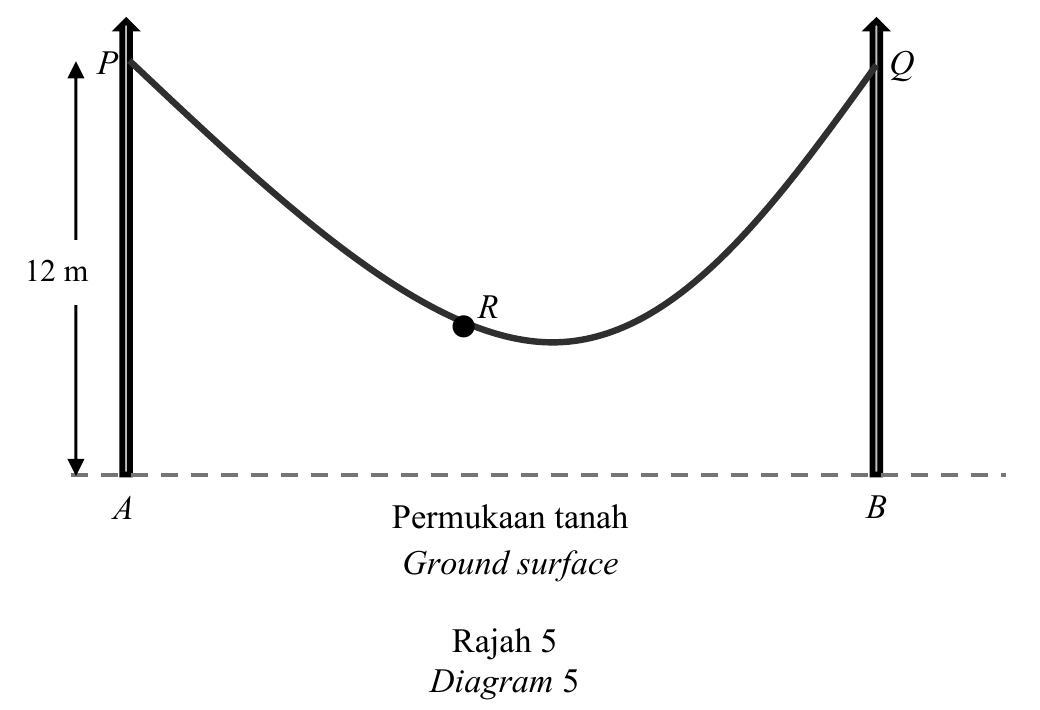
- (a)
the shortest vertical distance from the cable to ground level. [6 marks]
[6] - (b)
the equation of the normal at R; whether it passes through Q. [4 marks]
[4]
(a) Find dy/dx by using first principles for y = 8x − 3x². (b) A hemispherical bowl with radius 5 cm contains water x cm deep. The volume of water is V = (1/3)πx²(20 − x) cm³. Water is poured into the bowl at a rate of 4 cm³. Find the rate of rise of the water level when the depth is 3 cm.
Medium7 marks- (a)
Find dy/dx by using first principles for y = 8x − 3x².
[3] - (b)
Find the rate of rise of the water level when the depth is 3 cm.
[4]
Diagram 8 shows a geometrical model made of a cone on top of a cylinder. The volume of the cylinder is 152π cm³. The cone has radius p cm and slant length 3p cm.
Medium8 marks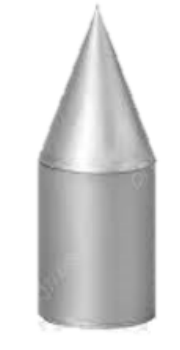
- (a)
Show that the total surface area of the model, L cm², is given by L = 4π(p² + 76/p).
[4] - (b)
Calculate the minimum value of the total surface area of the model.
[4]
(a) Given the function h(x) = px³ − 7x² + 3x. Find the value of p if h″(2) = 10. (b) Determine the limit of (x² + x − 12)/(x + 4) as x → −4.
Easy6 marks- (a)
Given the function h(x) = px³ − 7x² + 3x. Find the value of p if h″(2) = 10.
[4] - (b)
Determine the limit of (x² + x − 12)/(x + 4) as x → −4.
[2]
Diagram 7 shows a piece of thin rectangular metal PQRS with PQ = x cm and height h cm (PS = x cm, SR = h cm). Sides PQ and SR are joined to form an open cylinder of height h cm. The perimeter of PQRS is 60 cm and the volume of the cylinder is V cm³. (a) Show that V = x²/(4π) (30 − x). Hence, find the height and the radius of the cylinder when its volume is maximum. (b) The cylinder is closed at the bottom and filled with oil at a rate of 4 cm³ s⁻¹. Find the rate of change of the height of oil in the cylinder if its radius is 5 cm.
Medium8 marks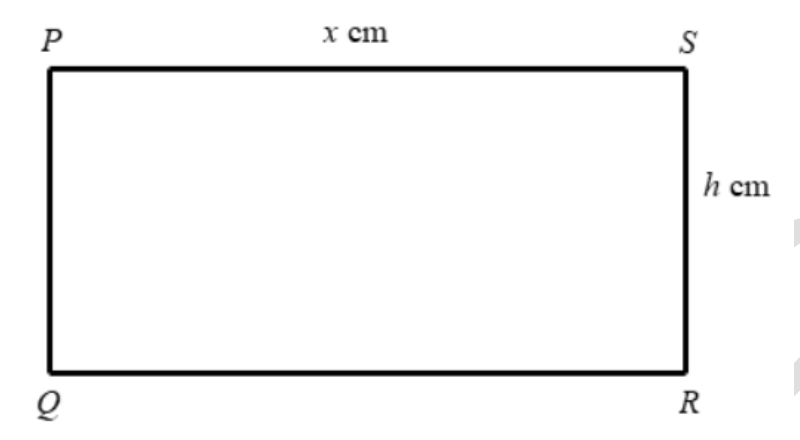
- (a)
Show that V = x²/(4π)(30 − x). Find the height and radius when V is maximum.
[5] - (b)
Find the rate of change of the height of oil if the radius is 5 cm.
[3]
Diagram 3 shows part of the roller coaster's track represented by the function y = x³ − (15/2)x² + 12x, where A is the origin. (a) Find the coordinates of the turning points of the track. (b) By using the method of sketching tangents, determine whether each turning point is a maximum point or a minimum point. (c) When the roller coaster passes through B(0.5, y), there is a small change in the value of x, where it increases by 1%. By using the concept of calculus, find the corresponding percentage change in y.
Medium10 marks
- (a)
Find the coordinates of the turning points.
[3] - (b)
Use sketches of tangents to determine maximum or minimum.
[3] - (c)
Find the percentage change in y.
[4]
(a) Find lim (x → 3) of (x² − 4x + 3)/(2x² − 5x − 3). (b) Given y = (2x + 1)/(x² − 3), find dy/dx.
Easy5 marks- (a)
Find lim (x → 3) of (x² − 4x + 3)/(2x² − 5x − 3).
[3] - (b)
Given y = (2x + 1)/(x² − 3), find dy/dx.
[2]
Diagram 4 shows a rectangular sheet of metal, 8 m by 3 m, and a square of side x m is cut out from each corner. The remaining piece is folded to make an open box. Given the height of the metal box is x. (a) Show that the volume of the box, V m³, is given by V = 4x³ − 22x² + 24x. (b) Find the maximum volume, in m³, of the box. (c) Given the sides of the square cut out increase from 1 m to 1.09 m, find the approximate change in the volume, in m³, of the box. (d) Encik Amin fills the chemical liquid in the metal box with rate 0.1 m³s⁻¹. Calculate the rate of change of height, in ms⁻¹, of the liquid in the metal box when x = 0.5 m.
Medium10 marks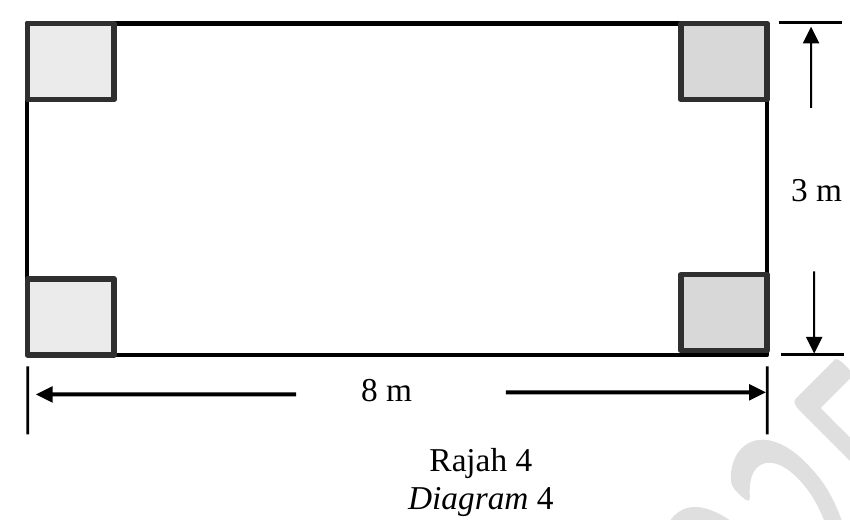
- (a)
Show that the volume of the box, V m³, is given by V = 4x³ − 22x² + 24x.
[2] - (b)
Find the maximum volume, in m³, of the box.
[4] - (c)
Given the sides of the square cut out increase from 1 m to 1.09 m, find the approximate change in the volume, in m³, of the box.
[2] - (d)
Calculate the rate of change of height, in ms⁻¹, of the liquid in the metal box when x = 0.5 m.
[2]
Diagram 5 shows part of the curve y = 3/(2x − 1)², which passes through the y-axis at p. (a) Find the equation of the tangent to the curve at p. (b)(i) Find the area bounded by the curve y = 3/(2x − 1)², the x-axis and the straight lines x = −3 and x = −1. (ii) Find the volume, in terms of π, when the region is revolved through 90° about the x-axis.
Medium10 marks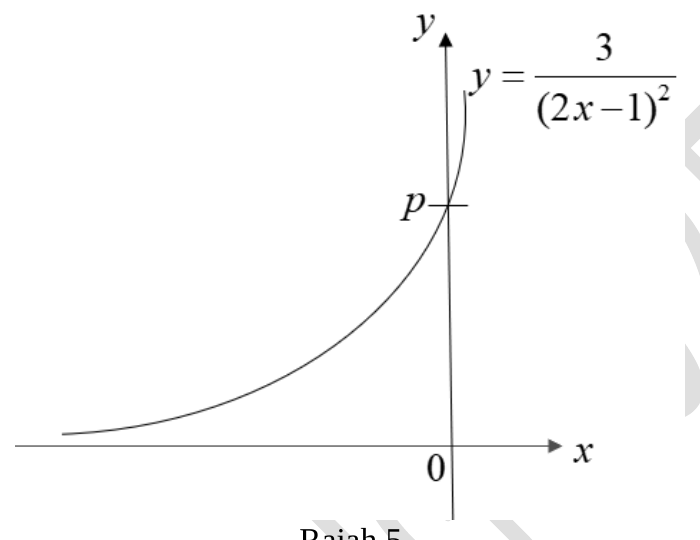
- (a)
Find the equation of the tangent to the curve at p.
[4] - (b)(i)
Find the area bounded by the curve y = 3/(2x − 1)², the x-axis and the straight lines x = −3 and x = −1.
[3] - (b)(ii)
Find the volume, in terms of π, when the region is revolved through 90° about the x-axis.
[3]
A cube-shaped ice sculpture (Diagram 1) has a volume of 125000 cm³. After the party its volume is 64000 cm³. Find the small change in the volume, in cm³, of the ice sculpture.
Easy3 marks
Find the small change in the volume, in cm³, of the ice sculpture.
[3]
Given the curve y = x(2x − 3)² − 4.
Medium8 marks- (a)
Find dy/dx and d²y/dx².
[2] - (b)
Hence, find the coordinates of the turning points and determine the maximum and minimum points of the curve.
[6]
(a) Given y = √x, find dy/dx by using first principles. (b) Given y = 2x/(6 − x), find dy/dx.
Medium6 marks- (a)
Given y = √x, find dy/dx by using first principles.
[3] - (b)
Given y = 2x/(6 − x), find dy/dx.
[3]
Differentiate (3x + 1)²/(1 − 2x) with respect to x.
Easy3 marksDifferentiate (3x + 1)²/(1 − 2x) with respect to x.
[3]
Diagram 8 shows a solid made of a cone on top of a cylinder of radius x cm. The slant height of the cone is 3x cm and the volume of the cylinder is 32π cm³. (a) Prove that the total surface area L cm² is L = 4π(x² + 16/x). (b) Calculate the minimum value of the radius of the cylinder. (c) Given the total surface area changes at the rate 42π cm² s⁻¹, find the rate of change of the radius when the radius is 4 cm.
Medium8 marks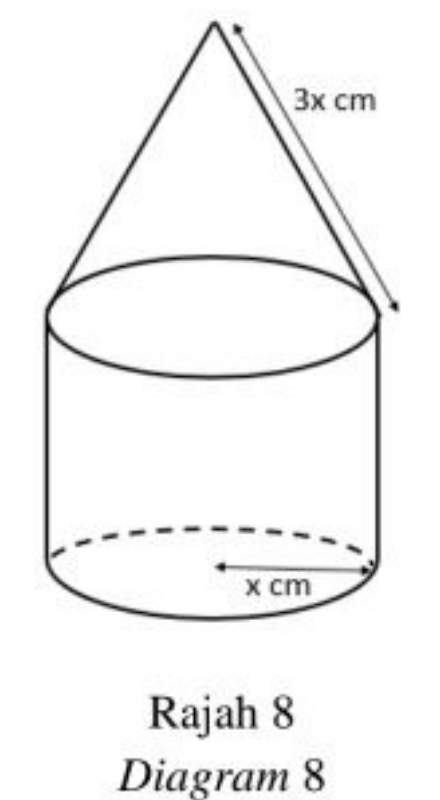
- (a)
Prove that L = 4π(x² + 16/x).
[3] - (b)
Calculate the minimum value of the radius of the cylinder.
[2] - (c)
Find the rate of change of the radius when the radius is 4 cm.
[3]
(a) s(t) = t² + 2t is the displacement in metres of a commuter after t seconds, t ≥ 0. (b) f(x) = (x² − 1)³/(x² + 1).
Medium7 marks- (a)
By using first principles, find the velocity of the commuter when t = 7. (The paper's English says 'first derivative'; the BM says 'prinsip pertama'.)
[4] - (b)
Given f(x) = (x² − 1)³/(x² + 1), find f′(x).
[3]
Given the curve y = x³ − 3x² − 9x + 15.
Medium8 marks- (a)
Find the turning points of the curve. Hence, state whether each turning point is a maximum or minimum point.
[6] - (b)
Find the inflection point of the curve.
[2]
(a) Find the value of lim(x→6) (x − 6)/(x² − 36). (b) Calculate the coordinates of the point on the curve y = 4x² − 12x + 9 when the gradient of the tangent is 4.
Easy5 marks- (a)
Find lim(x→6) (x − 6)/(x² − 36).
[2] - (b)
Find the coordinates of the point on y = 4x² − 12x + 9 where the gradient is 4.
[3]
Given y = √x(x − 1), find the value of dy/dx when x = 4. Hence, calculate (a) the small corresponding change in y when x increases from 4 to 4.01, (b) the corresponding rate of change in y at x = 4, if the rate of change in x is 0.4 units per second.
Medium8 marksFind dy/dx when x = 4.
[4]- (a)
Small change in y when x increases from 4 to 4.01.
[2] - (b)
Rate of change of y at x = 4 when dx/dt = 0.4 units per second.
[2]
Diagram 3 shows a hemispherical container. (a) Find the approximate change in the volume of the hemisphere when its radius changes from 15 cm to 15.02 cm. (b) The volume of a hemisphere decreases at a rate of 5.4π cm³ s⁻¹. Find the rate of change in the radius when the radius is 15 cm.
Medium6 marks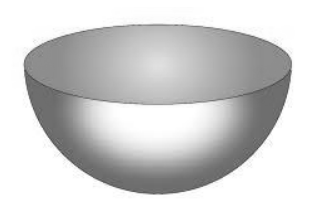
- (a)
Approximate change in volume when r changes from 15 cm to 15.02 cm.
[3] - (b)
Rate of change of the radius when r = 15 cm.
[3]
(a) Given the curve y = 5 + 6x² − x³ passes through point P(1, 10), find the equation of the tangent to the curve at P. (b) Find the coordinates of the turning points of the curve y = 5 + 6x² − x³.
Medium8 marks- (a)
Find the equation of the tangent at P(1, 10).
[4] - (b)
Find the coordinates of the turning points.
[4]
Given p = 2x − 3 and y = −3/p². Find (a) the rate of change of x when p changes at a rate of 3 units per second, (b) dy/dx in terms of x, (c) the approximate change in y when x decreases from 2 to 1.98.
Medium6 marks- (a)
Find the rate of change of the value of x when p changes at a rate of 3 units per second.
[2] - (b)
Find dy/dx in terms of x.
[2] - (c)
Find the approximate change in y when x decreases from 2 to 1.98.
[2]
Given x = h − 1/h and y = 2h + 1/h. (a) Show that dy/dx = (2h² − 1)/(h² + 1). (b) Hence, determine the turning point for h > 0.
Medium8 marks- (a)
Show that dy/dx = (2h² − 1)/(h² + 1).
[4] - (b)
Hence, determine the turning point for h > 0.
[4]
It is given that y = 10 − 12/x. Find the small change in x, in terms of p, when the value of y changes from 4 to 4 + p.
Easy3 marksFind the small change in x, in terms of p, when y changes from 4 to 4 + p.
[3]
Given a curve y = −2x³ + 6x² + 1. Find (a) the gradient function of the curve, (b) the turning points of the curve, (c) Hence, determine whether each of the turning points is a maximum or minimum.
Medium6 marks- (a)
Find the gradient function of the curve.
[2] - (b)
Find the turning points of the curve.
[2] - (c)
Hence, determine whether each of the turning points is a maximum or minimum.
[2]
(a) Given f(x) = 5x²/(x − 3), x ≠ 3, find the value of f′(1). (b) Given y = (5x − 1)³ and the rate of change of x is 4 unit s⁻¹ at all times, find the rate of change of y when x = 1.
Medium5 marks- (a)
Find the value of f′(1).
[2] - (b)
Find the rate of change of y when x = 1.
[3]
Section C: answer any two questions. (a) Given that the gradient of the normal to a curve is 5/(2x − 5). The curve passes through point P(1/2, 4) and has a minimum point (k, 2). Calculate (i) the equation of the tangent to the curve at point P, (ii) the value of k. (b) The curve y = −2x² + 8x + 5 has a stationary point at x = m, where m is a constant. Find the value of m and state the coordinates of the stationary point.
Medium10 marks- (a)(i)
Calculate the equation of the tangent to the curve at P(1/2, 4).
[4] - (a)(ii)
Calculate the value of k.
[2] - (b)
Find the value of m and state the coordinates of the stationary point.
[4]
The curve y = 2x + b/x² has gradient function 2 + 16/x³, where b is a constant. (a) Find the value of b. (b) Find the turning point of the curve. Hence, determine whether the turning point is a minimum or a maximum point.
Medium6 marks- (a)
Find the value of b.
[2] - (b)
Find the turning point. Hence determine whether it is a minimum or a maximum point.
[4]
Given the equation of a curve is y = x²(3 − (2/3)x) + 1/2. (a) Find the coordinates of the stationary points. (b) Hence, determine whether each of the stationary points is a maximum or a minimum. (c) If x increases from 2 to 2.01, find the approximate value in y.
Medium10 marks- (a)
Find the coordinates of the stationary points.
[4] - (b)
Determine whether each stationary point is a maximum or a minimum.
[3] - (c)
If x increases from 2 to 2.01, find the approximate value in y.
[3]
(a) Find the limit of the function g(x) = 3/(x − 1) when x approaches zero. (b) Given f(x) = 3/(5x²), find f′(1/2). (c) It is given that the gradient of the tangent of the curve y = 4x² + 2x + 5 is −6 when x = k, where k is a constant. Find the value of k.
Easy6 marks- (a)
Find the limit of g(x) = 3/(x − 1) as x approaches zero.
[1] - (b)
Given f(x) = 3/(5x²), find f′(1/2).
[2] - (c)
The gradient of the tangent of y = 4x² + 2x + 5 is −6 when x = k. Find k.
[3]
(a) Given the equation of a curve is y = x²(3 − x) + 1/2. (i) Find the gradient function of the curve. (ii) Find the coordinates of the turning points. (b) Given dy/dx = 6 and ∫₀⁴ y dx = 12. Find y in terms of x.
Medium8 marks- (a)(i)
Find the gradient function of the curve.
[2] - (a)(ii)
Find the coordinates of the turning points.
[3] - (b)
Given dy/dx = 6 and ∫₀⁴ y dx = 12, find y in terms of x.
[3]
(a) Given lim(x→a) (√x − 3)/(x − 9) = 1/6, find the value(s) of a. (b) Find the value of dy/dx for y = 2/x − 1/x² when x = 4.
Medium6 marks- (a)
Find a.
[3] - (b)
Find dy/dx when x = 4.
[3]
(a) A curve y = f(x) is such that dy/dx = 3kx + 5, where k is a constant. The gradient of the curve at x = 2 is 9. Find the value of k. (b) The gradient of the tangent to the curve y = x²(2 + px) at x = −2 is 7. Find the value of p. (c) Find ∫₄^a (x + 4) dx, in terms of a.
Easy8 marks- (a)
Find k.
[2] - (b)
Find p.
[3] - (c)
Find ∫₄^a (x + 4) dx in terms of a.
[3]
(a) Given y = x³ − 8. Find d/dx (y/x − dy/dx). (b) Given the curve y = x + m²(x − 3)², where m is a constant, has a turning point at (k, h). Express k in terms of m.
Medium6 marks- (a)
Given y = x³ − 8, find d/dx (y/x − dy/dx).
[3] - (b)
Curve y = x + m²(x − 3)² has a turning point at (k, h). Express k in terms of m.
[3]
(a) Given that y = mx + 5/8 is the tangent to the curve y = (4 + 3x)/(6 + 6x) at point P(1, k), such that m and k are constants. (i) Find the value of m. (ii) Hence find the equation of the normal at point P. (b) There is a small change in the radius of a spherical balloon, which increases by p% from its previous radius of 10 cm. By using the method of differentiation, find the corresponding percentage change in its surface area, in terms of p.
Medium8 marks- (a)(i)
Find the value of m.
[2] - (a)(ii)
Hence find the equation of the normal at P.
[2] - (b)
Radius 10 cm increases by p%. Find the percentage change in surface area, in terms of p.
[4]
Diagram 7 shows a solid block consisting of a right cone located above a cylinder of radius r cm. The slant length of the cone is 2r cm and the volume of the cylinder is 81π cm³. (a) Show that the surface area of the block, L cm², is given by L = 3π(r² + 54/r). (b) Calculate the minimum value for the surface area of the block, in terms of π. (c) Given that L is increasing at a rate of 63π cm² s⁻¹, find the rate of increase of the radius when the radius is 6 cm. (d) Find the small change in L when r increases from 6 cm to 6.002 cm.
Medium10 marks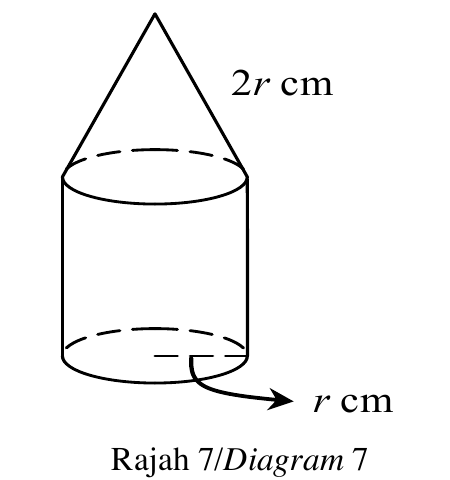
- (a)
Show that L = 3π(r² + 54/r).
[3] - (b)
Calculate the minimum value of L, in terms of π.
[3] - (c)
Find the rate of increase of the radius when r = 6 cm.
[2] - (d)
Find the small change in L when r increases from 6 cm to 6.002 cm.
[2]
(a) By using the first principle, show that the first derivative of y = 2x² − 3x is dy/dx = 4x − 3. (b) Given the gradient function of the curve that passes through point P(2, −1) is (x⁴ − 8x²)/(3x), find the equation for the curve.
Medium6 marks- (a)
By using the first principle, show that the first derivative of y = 2x² − 3x is dy/dx = 4x − 3.
[3] - (b)
Given the gradient function of the curve that passes through point P(2, −1) is (x⁴ − 8x²)/(3x), find the equation for the curve.
[3]
Diagram 7 shows a small cone-shaped water tank with radius x cm and height 1.5x cm, where x is a constant, supported by an iron stand. The tank is filled with water to a depth of h cm (water surface radius r cm) and has a leak: water drips out from the bottom.
Medium10 marks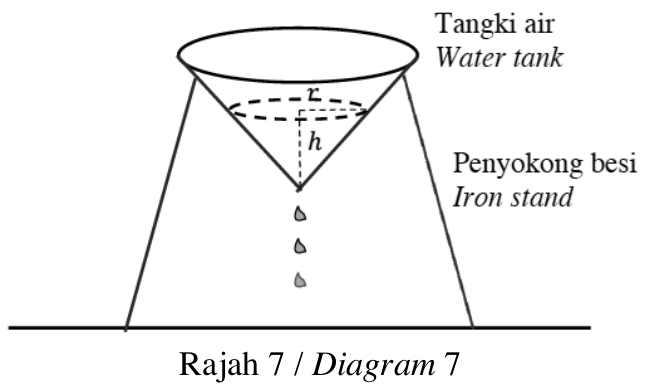
- (a)
Show that the volume of the water, in cm³, in the water tank is V = (4/27)πh³.
[2] - (b)
Calculate the percentage of change of the volume of water in the water tank when the depth of water decreases from 9 cm to 8.97 cm.
[4] - (c)
Given that the surface area of the water decreases at a constant rate of 25π cm² s⁻¹, find the rate of change of the volume, in cm³ s⁻¹, in the water tank at the instant the depth is 9 cm. Give your answer in terms of π.
[4]
Given that a point P(1, 6) lies on a curve f(x) = x² + 5x. Find (a) the gradient function of the curve by using first principles, f′(x) = lim (δx→0) [f(x + δx) − f(x)]/δx, (b) the equation of the tangent to the curve at point P, (c) the equation of the normal to the curve at point P.
Medium8 marks- (a)
Find the gradient function f′(x) by using first principles.
[3] - (b)
Find the equation of the tangent to the curve at P.
[3] - (c)
Find the equation of the normal to the curve at P.
[2]
Given the equation of a curve is y = x⁴ − 4x³ + 1. (a) Find the stationary points of the curve. (b) Hence, determine the nature of each stationary point by using the tangent sketching method.
Medium9 marks- (a)
Find the stationary points of the curve.
[3] - (b)
Determine the nature of each stationary point by the tangent sketching method.
[6]
(a) Solutions using other than calculus are not accepted. Find the small change in the volume of a cube when each of its sides increases from 2 cm to 2.02 cm. (b) Dania tried to find the first derivative of y = x² − 2x − 3 using the first principles but was unable to continue her work. Her working: y = x² − 2x − 3; y + δy = (x + δx)² − 2(x + δx) − 3; y + δy = x² + 2x(δx) + (δx)² − 2x − 2δx − 3; … Help Dania answer the question.
Easy6 marks- (a)
Find the small change in the volume of a cube when each side increases from 2 cm to 2.02 cm (calculus only).
[3] - (b)
Continue Dania's first-principles working to find the first derivative of y = x² − 2x − 3.
[3]
Diagram 8 shows a cylinder with a radius of 4 cm containing water up to a height of 6 cm being poured at a constant rate into a cone. At t seconds, the height of the water level in the cone is x cm, and the volume of water in the cone is given by V = ⅓πx³ cm³. If all the water is poured into the cone in 4 seconds, find (a) the original volume of water in the cylinder, (b) the rate of change of the cone's height when its height is 3 cm, (c) the volume of water in the cylinder at 3 seconds, (d) the time required for the height of the water in the cone to reach 5 cm.
Medium10 marks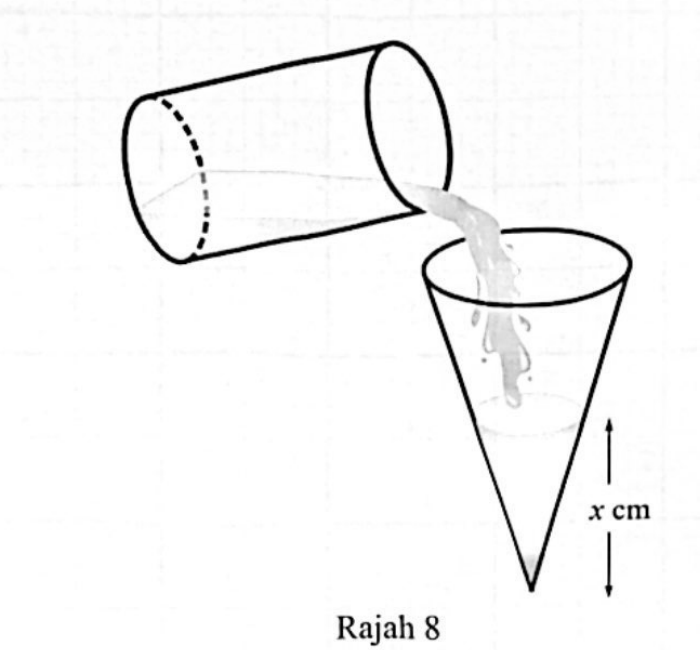
- (a)
Find the original volume of water in the cylinder.
[1] - (b)
Find the rate of change of the cone's height when its height is 3 cm.
[4] - (c)
Find the volume of water in the cylinder at 3 seconds.
[2] - (d)
Find the time required for the water height in the cone to reach 5 cm.
[3]
Diagram 8 shows part of the curve y = 4/x and the straight line y = h(x). It is given that the straight line is a normal to the curve at point P. (a) Show that dy/dx = −4/x² by using first principles. (b) (i) Given that the normal line is parallel to the straight line connecting point A(0, −1) and point B(1, 3), find the coordinates of P. (ii) Hence, find the equation of tangent at point P.
Medium8 marks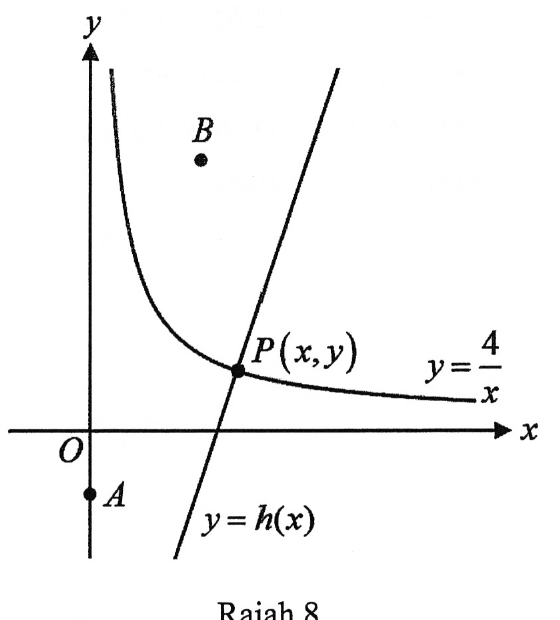
- (a)
Show that dy/dx = −4/x² by using first principles.
[2] - (b)(i)
Find the coordinates of P.
[4] - (b)(ii)
Find the equation of tangent at point P.
[2]
(a) In a factory, there is a cutting machine that cuts a cuboid shaped wooden block into smaller pieces. The volume of the wooden block is represented by the equation V = (39/2)(x² − 12x), such that x is the length of the wooden block and x > 12 cm. When the cutting machine is turned on, given that the length of the wooden block decreases at the rate of 0.5 cm s⁻¹, find the rate of change of its volume, in cm³ s⁻¹, when the length of the wooden block is 15 cm. (b) By using the concept of calculus, find the percentage change in the volume of a sphere when there is a small change in radius by 3.6%. [Volume of sphere = (4/3)πr³]
Medium7 marks- (a)
Find the rate of change of its volume, in cm³ s⁻¹, when the length is 15 cm.
[3] - (b)
Find the percentage change in the volume of a sphere when the radius changes by 3.6%.
[4]
Given that y = 3x² − 2x + 3, find (a) the value of dy/dx when x = 2, (b) the percentage of the approximate change in y, in term of m, when x changes from 2 to 2 + m, where m is a small value.
Medium5 marks- (a)
Find the value of dy/dx when x = 2.
[2] - (b)
Find the percentage of the approximate change in y, in term of m, when x changes from 2 to 2 + m, where m is a small value.
[3]
The volume of a cylinder increases at a rate of 3 cm³ s⁻¹. The height, h cm of the cylinder is twice the radius, r cm. (a) Calculate the rate of change of the radius when the radius is 9 cm. (b) Calculate the rate of changes of the water level when the radius is 6 cm.
Medium7 marks- (a)
Calculate the rate of change of the radius when the radius is 9 cm.
[3] - (b)
Calculate the rate of change of the water level when the radius is 6 cm.
[4]
(a) It is given that x = t³ − 6 and dy/dt = (9/2)t⁵. Find (i) dx/dt, (ii) dy/dx, in terms of x. (b) Find the coordinates of the point on the curve y = (3 − 15x)³ such that the gradient of the normal to the curve at the point is 1/5.
Medium8 marks- (a)
It is given that x = t³ − 6 and dy/dt = (9/2)t⁵. Find (i) dx/dt, (ii) dy/dx, in terms of x.
[3] - (b)
Find the coordinates of the point on the curve y = (3 − 15x)³ such that the gradient of the normal to the curve at the point is 1/5.
[5]
(a) Given that f(x) = 2x/(3 − √(x + 9)), (i) find f(0), (ii) complete the Table 2(i) and Table 2(ii) given in the answer space. Give your answers correct to four decimal places. (iii) from the answer in the Table 2(i) and Table 2(ii), state the value of lim(x→0) 2x/(3 − √(x + 9)). (b) Given that y = x(x² − 4), express x d²y/dx² + dy/dx in terms of x. Hence, find the range of values of x such that x d²y/dx² + dy/dx > 0.
Medium10 marks- (a)(i)
Find f(0).
[1] - (a)(ii)
Complete Table 2(i) (x = −0.1, −0.01, −0.001, −0.0001, 0) and Table 2(ii) (x = 0.1, 0.01, 0.001, 0.0001, 0) for f(x), correct to four decimal places.
[2]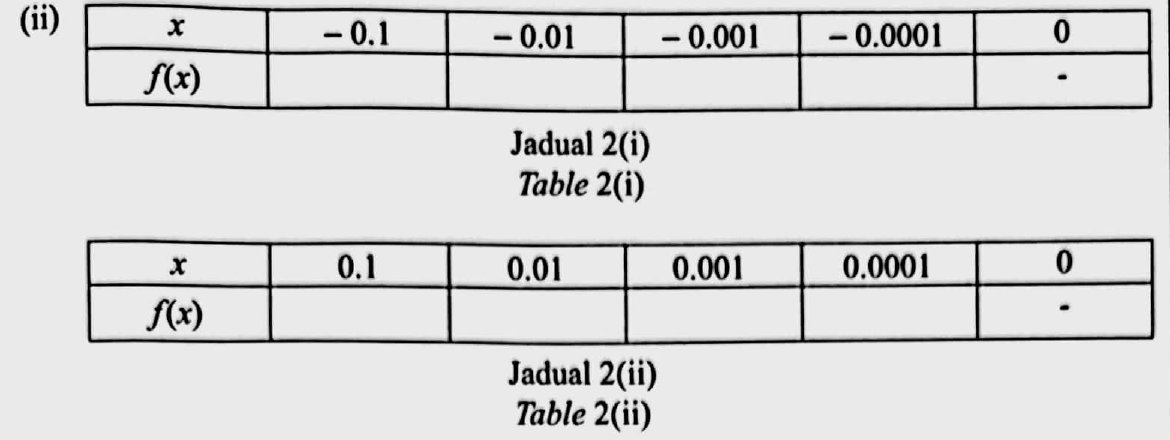
- (a)(iii)
State the value of lim(x→0) 2x/(3 − √(x + 9)).
[1] - (b)
Given that y = x(x² − 4), express x d²y/dx² + dy/dx in terms of x. Hence, find the range of values of x such that x d²y/dx² + dy/dx > 0.
[6]
It is given that L = 4t − t² and x = 3 + 6t. (a)(i) Express dL/dx in terms of t. (ii) Find the value of dL/dx when t = 4. (b) Calculate the corresponding percentage rate of change of L when x = 9, if the small change in x is 10%.
Medium8 marks- (a)(i)
Express dL/dx in terms of t.
[3] - (a)(ii)
Find the value of dL/dx when t = 4.
[1] - (b)
Calculate the corresponding percentage rate of change of L when x = 9, if the small change in x is 10%.
[4]
Solutions by scale drawing is not accepted. Diagram 5 shows the position of Michelle when running in the period of 5 hours is given by the equation of a curve s = (t/3)(t² − 9t + 24) km where t is the time, in hour. (a) Find the slope of the curve at t = 2.4. (b) Find the exact position of Michelle at the turning points. (c) Hence, by using calculus, show that each of the positions in 5(b) is a maximum or a minimum.
Medium9 marks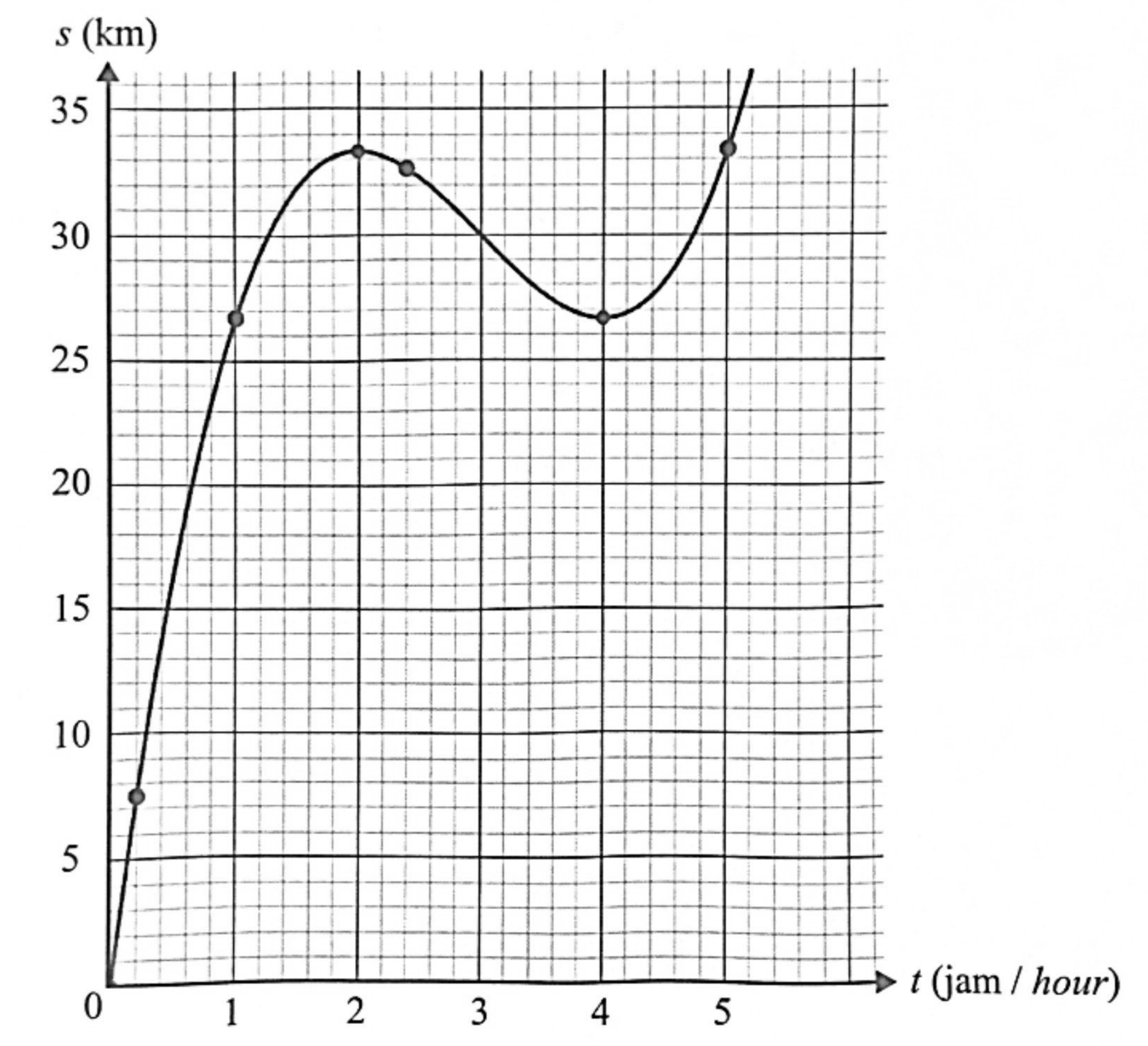
- (a)
Find the slope of the curve at t = 2.4.
[2] - (b)
Find the exact position of Michelle at the turning points.
[3] - (c)
By using calculus, show that each of the positions in 5(b) is a maximum or a minimum.
[4]
(a) The radius of a circle increases at a rate of 3 cm s⁻¹. Find the rate of change of its area, in cm² s⁻¹, when the radius is 2 cm. (b) It is given that the function k(x) = mx³ − 2x² + 6x. Find the value of m if k″(2) = k′(1).
Medium5 marks- (a)
The radius of a circle increases at a rate of 3 cm s⁻¹. Find the rate of change of its area, in cm² s⁻¹, when the radius is 2 cm.
[2] - (b)
It is given that the function k(x) = mx³ − 2x² + 6x. Find the value of m if k″(2) = k′(1).
[3]
It is given that the curve y = (x − 5)²/x. (a) find the coordinates of the stationary points of the curve. (b) Hence, determine the nature of the stationary points.
Easy5 marks- (a)
Find the coordinates of the stationary points of the curve.
[3] - (b)
Hence, determine the nature of the stationary points.
[2]
(a) It is given that f(x) = 11/(2x + x³), find f′(x). (b) Find dy/dx for y = 4x² by using the first principles. (c) Diagram 6 shows a part of the curve of y = x(x − 2)² and OM intersects the curve at point M(1, 1). (i) Find the equation of tangent to the curve at point M. (ii) Show that OM is normal to the curve at point M.
Medium10 marks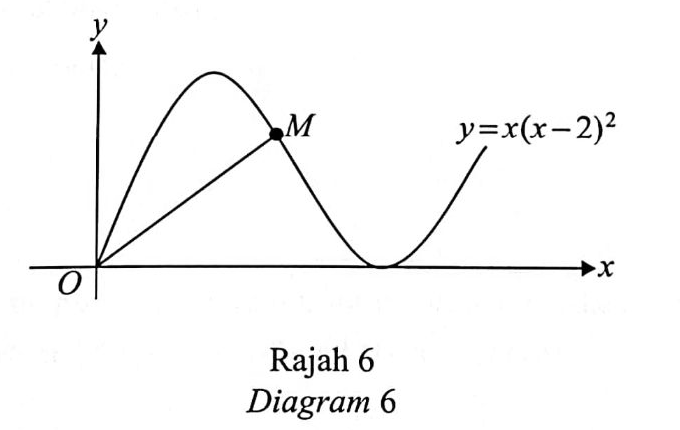
- (a)
Find f′(x).
[2] - (b)
Find dy/dx for y = 4x² by using the first principles.
[3] - (c)(i)
Find the equation of tangent to the curve at point M.
[3] - (c)(ii)
Show that OM is normal to the curve at point M.
[2]
(a) Given the gradient of the tangent to the curve y = x²(3 + px) is −3 when x = −1. Find the value of p. (b) Volume, V cm³, of a solid is given by V = 8πr² + (2/3)πr³, r is the radius. Find the approximate change in V, in terms of π, if r increases from 3 cm to 3.005 cm.
Medium5 marks- (a)
Given the gradient of the tangent to the curve y = x²(3 + px) is −3 when x = −1. Find the value of p.
[2] - (b)
Volume, V cm³, of a solid is given by V = 8πr² + (2/3)πr³, r is the radius. Find the approximate change in V, in terms of π, if r increases from 3 cm to 3.005 cm.
[3]
The volume of a cylinder decreases at a rate of 0.25 cm³ s⁻¹. The height, h cm of the cylinder is twice the radius, r cm. (a) Calculate the rate of change of the radius when the radius is 2 cm. (b) Calculate the rate of change of the water level when the radius is 4 cm.
Medium7 marks- (a)
Calculate the rate of change of the radius when the radius is 2 cm.
[3] - (b)
Calculate the rate of change of the water level when the radius is 4 cm.
[4]
(a) Given x = t² + 3 and dy/dt = 14t³. Find (i) dx/dt, (ii) dy/dx, in terms of x. (b) Farah wants to produce an open cylinder at both ends using a rectangular piece of aluminium with a perimeter of 18 cm. Find the length and the width, in cm, of the piece of aluminium so that the volume of the cylinder is maximum.
Medium8 marks- (a)(i)
Given x = t² + 3, find dx/dt.
[1] - (a)(ii)
Given dy/dt = 14t³, find dy/dx in terms of x.
[2] - (b)
Find the length and the width, in cm, of the piece of aluminium so that the volume of the cylinder is maximum.
[5]
(a) Given that f(x) = 3x / (2 − √(x + 4)), (i) find f(0), (ii) complete the Table 3(i) and Table 3(ii) given in the answer space. Give your answers correct to four decimal places. Table 3(i): x = −0.1, −0.01, −0.001, −0.0001, 0. Table 3(ii): x = 0.1, 0.01, 0.001, 0.0001, 0. (iii) From the answer in Table 3(i) and Table 3(ii), state the value of lim (x→0) 3x / (2 − √(x + 4)). (b) Given that y = (x² − 4)/x, express x³(d²y/dx²) + x²(dy/dx) in terms of x. Hence, find the range of values of x such that x³(d²y/dx²) + x²(dy/dx) < 0.
Medium10 marks- (a)(i)
Find f(0).
[1] - (a)(ii)
Complete Table 3(i) (x = −0.1, −0.01, −0.001, −0.0001, 0) and Table 3(ii) (x = 0.1, 0.01, 0.001, 0.0001, 0) giving f(x) correct to four decimal places.
[2]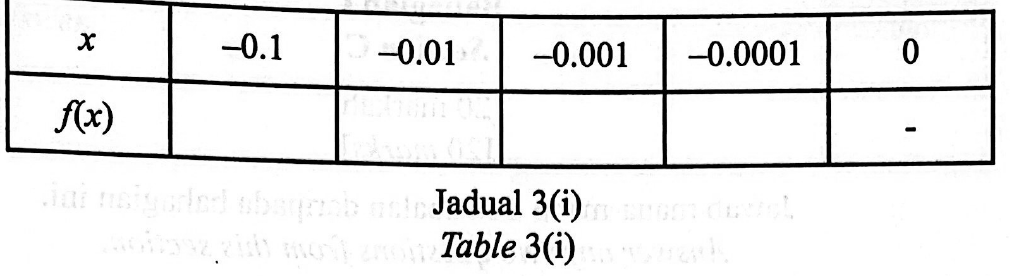
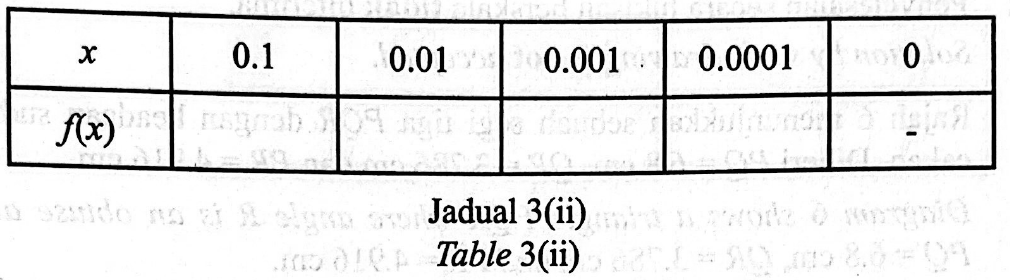
- (a)(iii)
State the value of the limit as x → 0 of 3x / (2 − √(x + 4)).
[1] - (b)
Given y = (x² − 4)/x, express x³(d²y/dx²) + x²(dy/dx) in terms of x. Hence, find the range of values of x such that it is less than 0.
[6]
It is given that function f(x) = (x − 3)(x² − 9). Find (a) the gradient function of f(x), (b) the stationary points for f(x) and determine the nature of each stationary point, (c) the value of f(1.001) by using the concept of calculus.
Medium8 marks- (a)
Find the gradient function of f(x).
[2] - (b)
Find the stationary points for f(x) and determine the nature of each stationary point.
[3] - (c)
Find the value of f(1.001) by using the concept of calculus.
[3]
Diagram 8 shows a solid cylinder with volume 256π cm³. Two identical hemispheres with radius r cm are removed from each end. (a) Show that the total surface area, A cm², of the remaining solid is given by A = 4πr² + 512π/r. [Surface area of sphere = 4πr²] (b) Calculate the minimum total surface area, in term of π, of the remaining solid. (c) The remaining solid is heated and the rate of change of its total surface area of the solid is 84π cm² s⁻¹. Calculate the rate of change of the radius of the solid when its radius is 8 cm.
Medium10 marks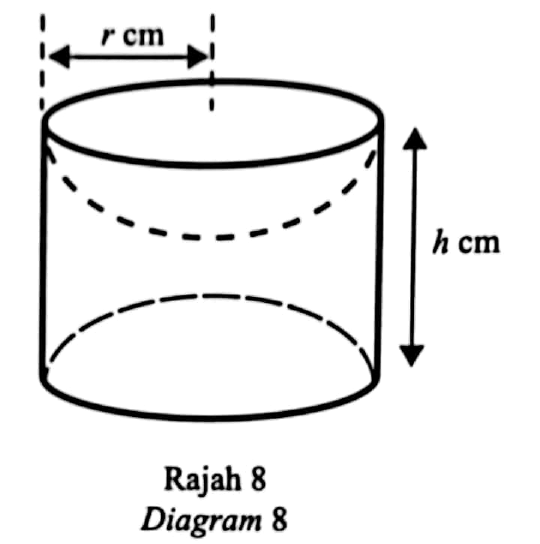
- (a)
Show that the total surface area, A cm², of the remaining solid is given by A = 4πr² + 512π/r. [Surface area of sphere = 4πr²]
[3] - (b)
Calculate the minimum total surface area, in term of π, of the remaining solid.
[4] - (c)
The remaining solid is heated and the rate of change of its total surface area is 84π cm² s⁻¹. Calculate the rate of change of the radius when its radius is 8 cm.
[3]
(a) Given y = x(5 − x), express y d²y/dx² + (dy/dx)² + 15 in its simplest form. (b) The area of a square with side x cm increases at a rate of 3 cm² s⁻¹. Find the rate of change of its side when the area is 9 cm².
Medium5 marks- (a)
Given y = x(5 − x), express y d²y/dx² + (dy/dx)² + 15 in its simplest form.
[3] - (b)
The area of a square with side x cm increases at a rate of 3 cm² s⁻¹. Find the rate of change of its side when the area is 9 cm².
[2]
A curve with gradient function x − 27/x², has a stationary point (m, 3). (a) Find the value of m. (b) Hence, determine the nature of the stationary point.
Easy5 marks- (a)
Find the value of m.
[2] - (b)
Hence, determine the nature of the stationary point.
[3]
(a) It is given that f(x) = 3x(2x + 6)⁶, find f′(x). (b) It is given that y = 5x², find dy/dx by using the first principles. (c) Diagram 6 shows a curve y = (2x − 8)/(x − 2) and straight line y = 3hx. It is given that the straight line y = 3hx is parallel to the tangent to the curve at point R(6, 1). Find the value of h. Hence, state the value of gradient of normal at point R.
Medium10 marks- (a)
Given f(x) = 3x(2x + 6)⁶, find f′(x).
[2] - (b)
Given y = 5x², find dy/dx by using the first principles.
[3] - (c)
Find the value of h. Hence, state the value of gradient of normal at point R.
[5]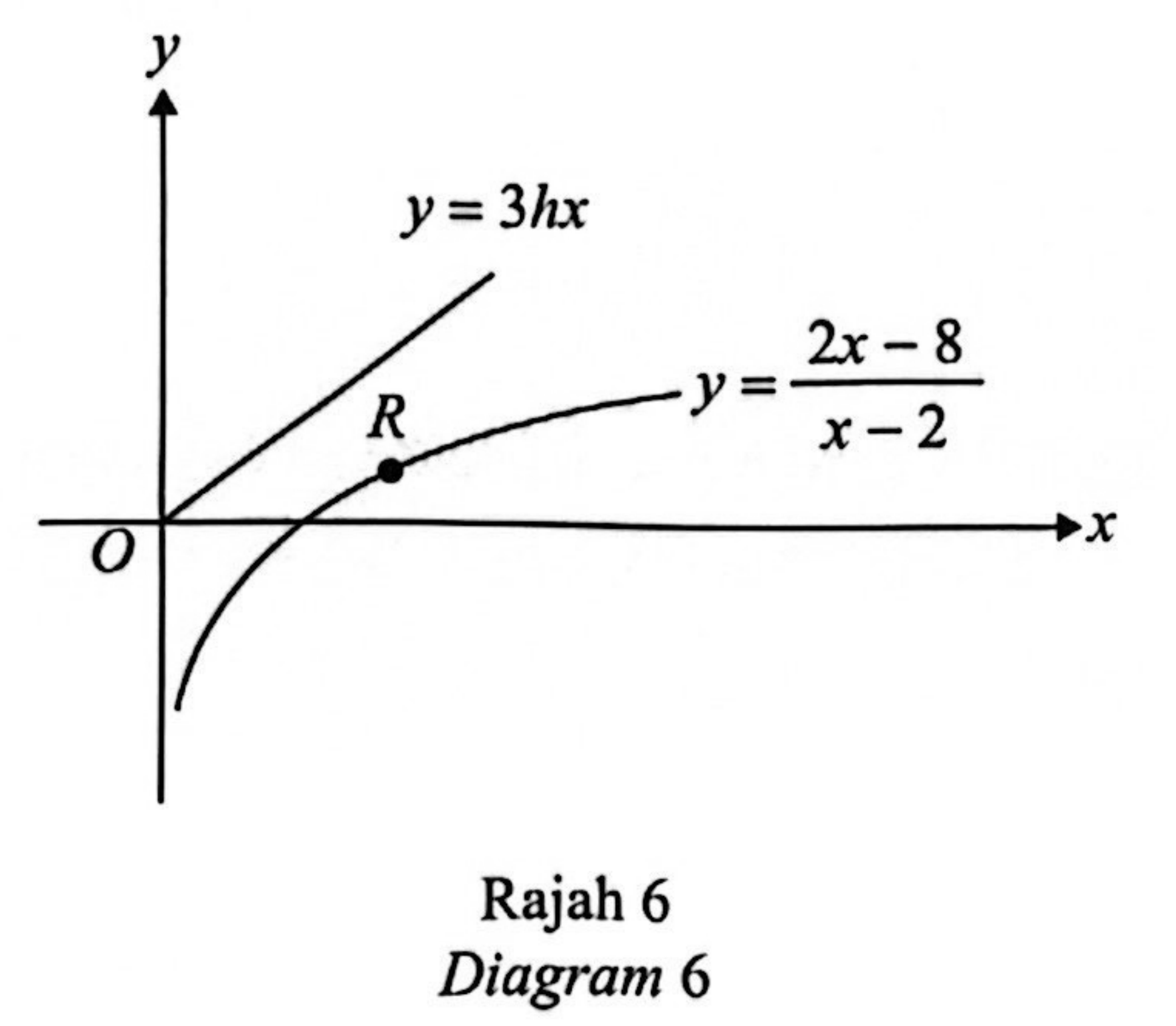
(a) It is given that x = 2t² − 4 and dy/dt = 4t³. Find (i) dx/dt, (ii) dy/dx, in terms of x. (b) Zainal has a rectangular piece of zinc with a perimeter of 25 cm. He wants to use that piece of zinc to build an open cylinder at both ends. Find the length and the width, in cm, of the piece of zinc that makes the volume of the cylinder maximum.
Medium8 marks- (a)(i)
Given x = 2t² − 4, find dx/dt.
[1] - (a)(ii)
Given dy/dt = 4t³, find dy/dx in terms of x.
[2] - (b)
A rectangular piece of zinc has perimeter 25 cm and is rolled into an open cylinder (open at both ends). Find the length and the width, in cm, that make the volume of the cylinder maximum.
[5]
(a) Given that f(x) = 2x/(4 − √(x + 16)), (i) find f(0), (ii) complete the Table 2(i) and Table 2(ii) given in the answer space. Give your answers correct to four decimal places. (iii) from the answer in the Table 2(i) and Table 2(ii), state the value of lim(x→0) 2x/(4 − √(x + 16)). (b) Given that y = 2x(x + 3), express d²y/dx² + x dy/dx + y in terms of x. Hence, find the value of x such that d²y/dx² + x dy/dx + y = −2.
Medium10 marks- (a)(i)
Given f(x) = 2x/(4 − √(x + 16)), find f(0).
[1] - (a)(ii)
Complete Table 2(i) (x = −0.1, −0.01, −0.001, −0.0001, 0) and Table 2(ii) (x = 0.1, 0.01, 0.001, 0.0001, 0) with f(x), correct to four decimal places.
[2]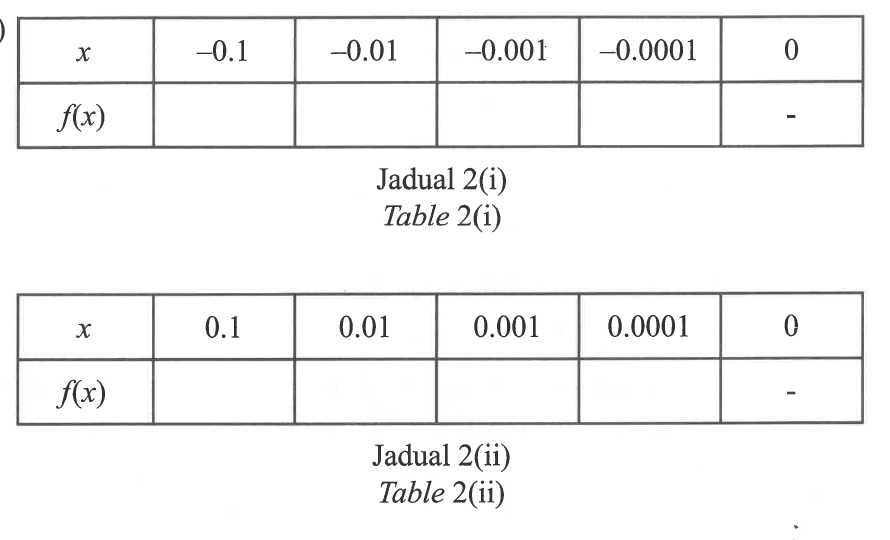
- (a)(iii)
From the tables, state the value of lim(x→0) 2x/(4 − √(x + 16)).
[1] - (b)
Given y = 2x(x + 3), express d²y/dx² + x dy/dx + y in terms of x. Hence, find the value of x such that d²y/dx² + x dy/dx + y = −2.
[6]
The tangent to the curve y = 2x² + px − 4 at x = 1 is parallel to the line y = 2x.
Easy7 marks- (a)
Find the value of p.
[3] - (b)
Find the coordinates of the turning point of the curve. Hence, using the sketching of tangents method, determine the type of the turning point.
[4]
Diagram 4 shows a closed cylinder with height 15 cm and radius r cm. (Paper prints the volume as 375π cm²; it is cm³.)
Medium10 marks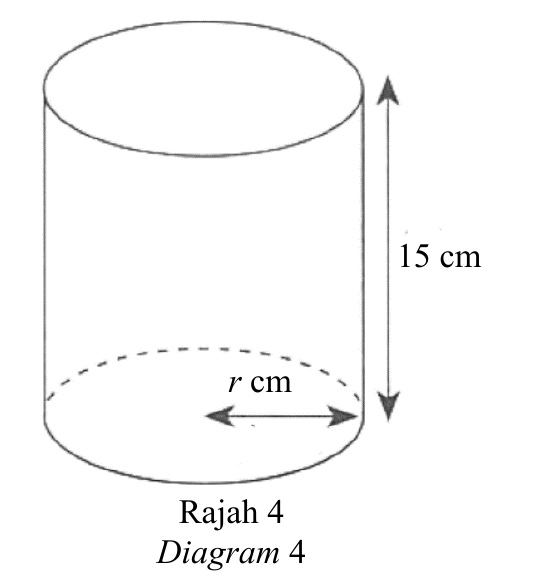
- (a)
Given that the volume of the cylinder is 375π cm³, show that A = 2πr² + 750π/r.
[3] - (b)
Find the approximate change in the total surface area of the cylinder when the radius increases from 5 cm to 5.02 cm such that its height is constant at 15 cm.
[7]
Given h(x) = (2 + 3x)³/(1 + x), find d/dx [h(x)].
Easy3 marksFind d/dx [h(x)].
[3]
Diagram 8 shows an area of open land behind Pak Ali's house which consists of a semicircle and a rectangle with a length of 2y m and a width of b m. The perimeter of the area is 120 m.
Medium8 marks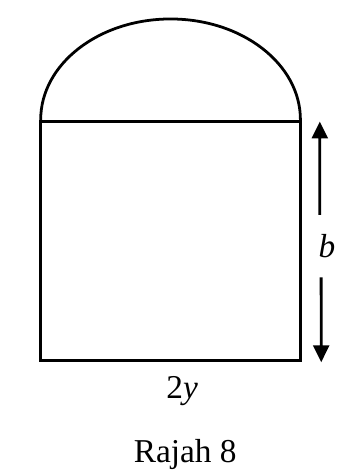
- (a)
Show that the area of the land, L m², is given by L = 120y − (2 + π/2)y².
[2] - (b)
Hence, find the value of the radius of the semicircle in terms of π such that L is maximum.
[3] - (c)
The radius of the semicircle increases at a rate of 1/p m h⁻¹. Find the rate of change of the area, in terms of p, when the radius is 10 m.
[3]
Given y = t − 4t² and x = 5t + 4. By using the chain rule, find dy/dx in terms of x.
Easy4 marksGiven y = t − 4t² and x = 5t + 4. By using the chain rule, find dy/dx in terms of x.
[4]
Diagram 9 shows a solid formed by joining a cylinder with radius x cm and a cone on top of it. The slant length of the cone is 2x cm and the volume of the cylinder is 192π cm³. (a) Show that the total surface area of the solid, A cm², is given by A = 3πx² + 384π/x. (b) Calculate the radius of the cylinder when the surface area of the solid is minimum. (c) The surface area is increasing at a rate of 84π cm² s⁻¹. Find the rate of change of the radius at the instant when the radius is 8 cm.
Medium8 marks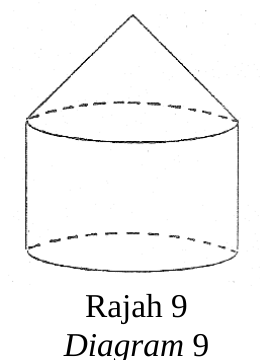
- (a)
Show that the total surface area of the solid, A cm², is given by A = 3πx² + 384π/x.
[2] - (b)
Calculate the radius of the cylinder when the surface area of the solid is minimum.
[3] - (c)
Given that the surface area of the solid is increasing at a rate of 84π cm² s⁻¹. Find the rate of change of the radius at the instant when the radius is 8 cm.
[3]
Given y = 2x² + 4x + 3, find dy/dx by using the first principle.
Easy4 marksFind dy/dx by using the first principle.
[4]
Diagram 9 shows the straight line AC, which is normal to the curve y = x²/2 + 1 at B(2, 3). The straight line BD is parallel to the y-axis; C is (p, 0) on the x-axis and D is on the x-axis below B. Find (a) the value of p; (b) the area of the shaded region; (c) the volume generated, in terms of π, when the region bounded by the curve, the y-axis and the straight line y = 3 is revolved through 360° about the y-axis.
Medium11 marks- (a)
Find the value of p.
[3] - (b)
Find the area of the shaded region.
[4]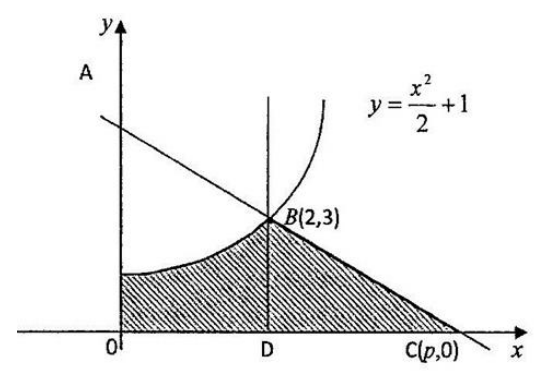
- (c)
Find the volume generated, in terms of π.
[4]
The equation of a curve is y = (2/3)x²(3 − x) + 1/2.
Medium8 marks- (a)
Find the coordinates of the stationary points.
[3] - (b)
Hence, determine whether each of the stationary points is a maximum or a minimum.
[2] - (c)
If x increases from 2 to 2.01, find the approximate change in y.
[3]
The curve y = 3x(5 − 2x)⁴ passes through point Q at x = 2. Find (a) the gradient of the curve at Q, (b) the equation of the normal to the curve at Q.
Medium6 marks- (a)
The gradient of the curve at Q.
[3] - (b)
The equation of the normal to the curve at Q.
[3]
Diagram 2 shows point A (x, y) and point B (x + δx, y + δy) on the curve y = x².
Easy5 marks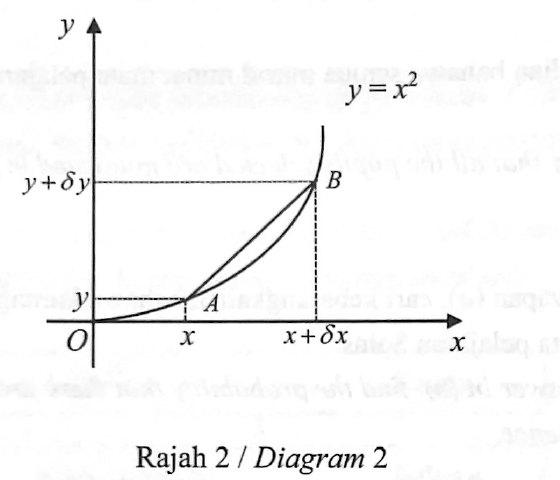
- (a)
When B approaches A, prove that dy/dx = 2x.
[2] - (b)
The gradient function of the curve y = ax² + b/x at point (4, 5) is 7. Find the values of a and of b.
[3]
A string of length 120 cm is bent to form a rectangle with length x cm and width y cm. Given y = x + 3x² and x increases at the rate of 1/5 unit per second.
Medium7 marks- (a)(i)
Show that the area of the rectangle, A = 60x − x².
[2] - (a)(ii)
Hence, find the maximum area of the rectangle.
[3] - (b)
Given y = x + 3x² and x increases at the rate of 1/5 unit per second. Find the rate of change of y when x = 4.
[2]
Diagram 3 shows the graph of a curve y = f(x). The straight line y = (1/3)x − 7 is a normal to the curve at point B. The gradient function of the curve is kx − 12, where k is a constant. The curve has a minimum point at (4, −15/2).
Medium10 marks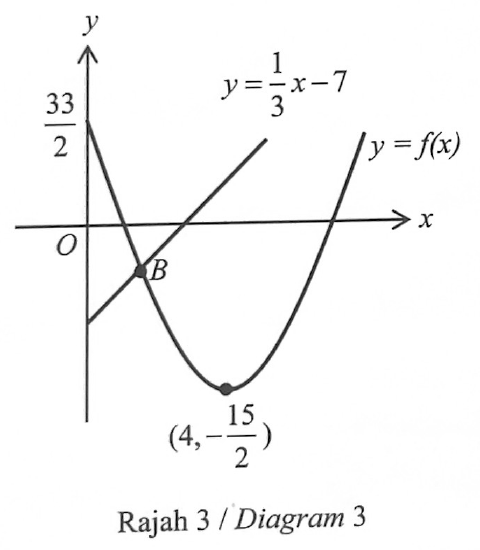
- (a)(i)
Find the value of k.
[2] - (a)(ii)
Find the coordinates of point B.
[2] - (b)
Find the equation of the curve.
[2] - (c)
If the curve is moved 4 units to the left, find the new equation of the curve. Hence, find the volume generated, in terms of π, when the region bounded by the curve and the straight line y = −6 is revolved 180° about the y-axis.
[4]
Diagram 3 shows a curve f(x) = x² − 8x + 7.
Easy6 marks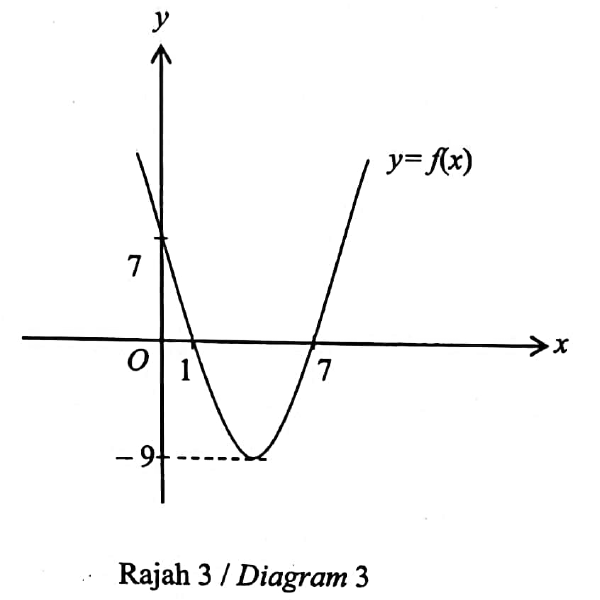
- (a)(i)
Find the value lim(x→0) f(x).
[1] - (a)(ii)
Find the possible values of a if lim(x→a) f(x) = −5.
[2] - (b)
Determine gradient function, dy/dx using the first principle.
[3]
It is given that the equation of a curve is y = x²(x − 2).
Medium10 marks- (a)(i)
Find the gradient function of the curve,
[1] - (a)(ii)
Find the coordinates of the turning points of the curve,
[2] - (a)(ii) Hence
Hence, determine whether each of the turning points is a maximum or minimum point.
[3] - (b)
If the tangents to the curve at point A(2, 0) and a point P are parallel, find the coordinates of point P.
[4]
Given y = (3 − 2x³)². Find (a) dy/dx, giving the answer in the form dy/dx = ax^b(3 − 2x³)^c where a, b and c are constants; (b) the small change in y when x increases from 1 to 1.03.
Easy4 marks- (a)
Find dy/dx in the form ax^b(3 − 2x³)^c.
[2] - (b)
Find the small change in y when x increases from 1 to 1.03.
[2]
The curve y = −x² + kx + 12 passes through the point S(5, 7) and has a turning point at L.
Medium10 marks- (a)
Find the value of k.
[1] - (b)
Find the gradient of the tangent to the curve at point S.
[2] - (c)
Find the equation of the normal to the curve at point S.
[3] - (d)
Find the coordinates of the turning point of the curve. Justify your answer by using the sketching of tangents method.
[4]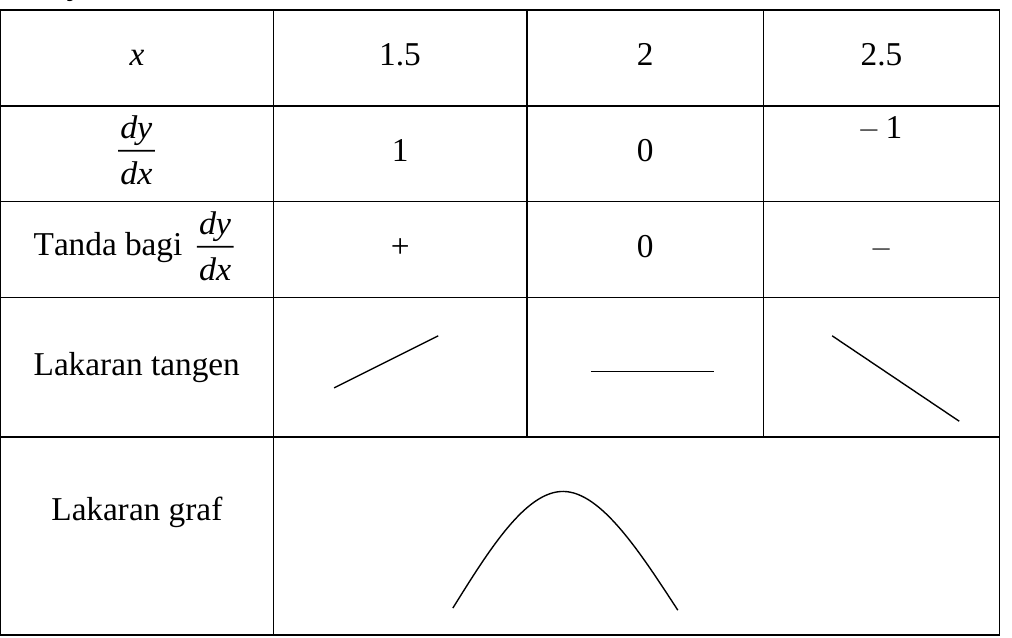
(a)(i) Given two functions u(x) and v(x). Using differentiation from first principles, prove the product rule d/dx[u(x)v(x)] = u(x)v′(x) + v(x)u′(x). (ii) Hence, differentiate (2x − 3)⁴(3x + 2) with respect to x. (b) The annual production cost K(n) for producing n units of houses is K(n) = 2n² − 100n + 1375000. Determine the number n of houses to be produced to minimise the annual production cost by using the calculus method. Hence, calculate the annual production cost.
Hard9 marks- (a)(i)
Prove the product rule using first principles.
[3] - (a)(ii)
Differentiate (2x − 3)⁴(3x + 2) with respect to x.
[2] - (b)
Determine n that minimises K(n) = 2n² − 100n + 1375000, and calculate the minimum annual production cost.
[4]
(a) Find the gradient of tangent of the curve y = −x² + 2x + 4 when x = 1. (b) Differentiate y = √((17 + 3x)⁶) with respect to x.
Medium5 marks- (a)
Find the gradient of tangent of the curve y = −x² + 2x + 4 when x = 1.
[3] - (b)
Differentiate y = √((17 + 3x)⁶) with respect to x.
[2]