JOHOR 2021 P1 Q6
MediumWrite your answer on paper. Then open the answer to check it.
(a) Diagram 6(a) shows the front view of a door. BAC is part of the graph y = 9 − x²/6; A is the highest point from DE. Find the surface area of the door. (b) Diagram 6(b) shows a curve y = g(x) and a straight line y = f(x). Given ∫₀ʰ g(x) dx = 6: (i) on the diagram, shade the region represented by ∫₀ʰ g(x) dx; (ii) find the area, in terms of m, of the region bounded by the y-axis, y = g(x) and y = f(x).
Medium6 marks- (a)
Find the surface area of the door (Diagram 6(a)).
[3]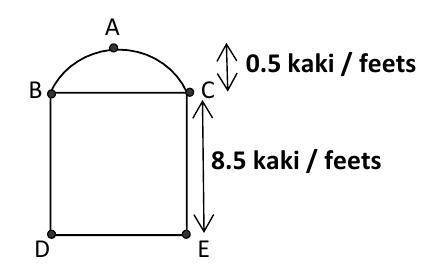
- (b)(i)
Shade the region represented by ∫₀ʰ g(x) dx on Diagram 6(b).
[1]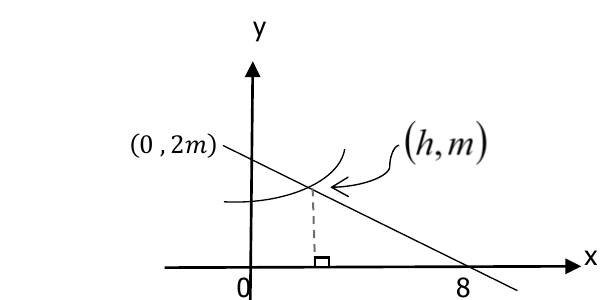
- (b)(ii)
Find the area, in terms of m, bounded by the y-axis, y = g(x) and y = f(x).
[2]
The diagram shows the curve y = 4 − x² intersecting the line y = 2x + 4 at the points (0, 4) and (−2, 0). O is the origin. Calculate (a) the area of the shaded region, (b) the volume generated, in terms of π, when the shaded region is revolved through 360° about the y-axis.
Medium10 marks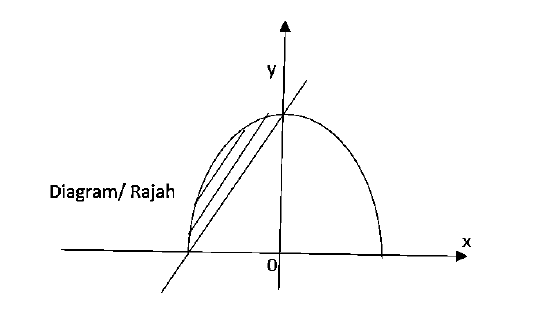
- (a)
Area of the shaded region.
[5] - (b)
Volume generated when the shaded region is revolved 360° about the y-axis.
[5]
(a) Diagram 9 shows the shaded region bounded by the curve y = 4 − x², the straight line y = k, the x-axis and the y-axis. When the shaded region is revolved through 360° about the y-axis, the volume generated is 6π unit³. Calculate the value of k. (b) Given ∫₁³ f(x) dx = 6, find the value of ∫₁³ [2f(x) − 5] dx.
Medium5 marks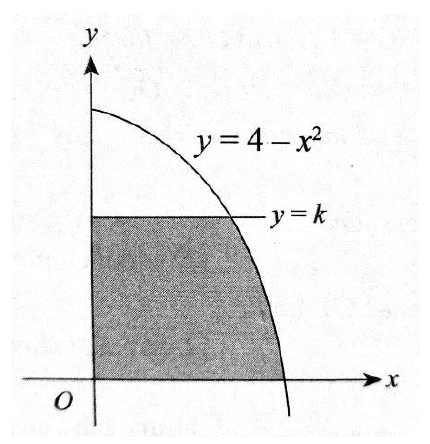
- (a)
Calculate the value of k.
[3] - (b)
Find the value of ∫₁³ [2f(x) − 5] dx.
[2]
Diagram 8 shows the curve x = y² + 3 intersecting the straight line y = 5 − x at A and the x-axis at point B. The point A is given as A(1, 4) in the paper (the diagram marks 1 on the y-axis and 4 on the x-axis, so A is at x = 4, y = 1). Find (a) the coordinates of point B, (b) the area of the shaded region R, (c) the volume generated, in terms of π, when the region bounded by the curve x = y² + 3, the straight line y = 5 − x and the x-axis is revolved through 360° about the x-axis.
Medium10 marks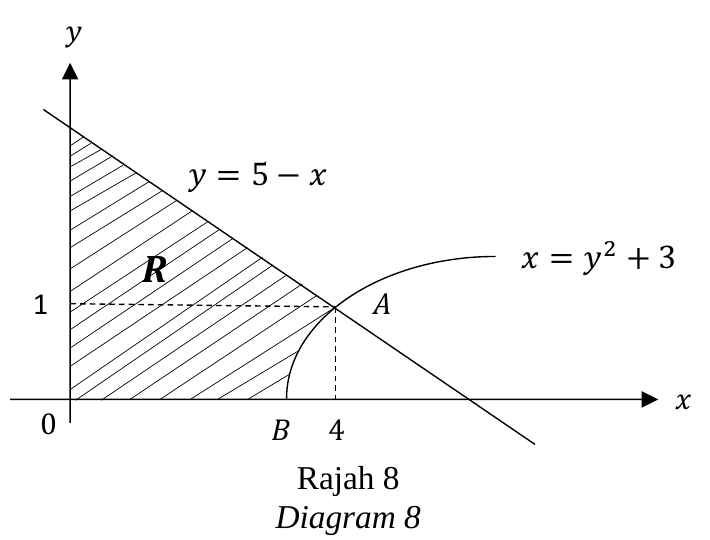
- (a)
Find the coordinates of point B.
[2] - (b)
Find the area of the shaded region R.
[4] - (c)
Find the volume generated, in terms of π.
[4]
Diagram 4 shows part of the curve x = y² + 5 and PQ is the tangent to the curve at point P(6, 1). Find (a) the equation of the tangent to the curve at point P, (b) the coordinates of point Q, (c) the area of the shaded region, (d) the generated volume, in terms of π, when the region bounded by the curve, the x-axis and the straight line x = 6, is revolved through 360° about the x-axis.
Medium10 marks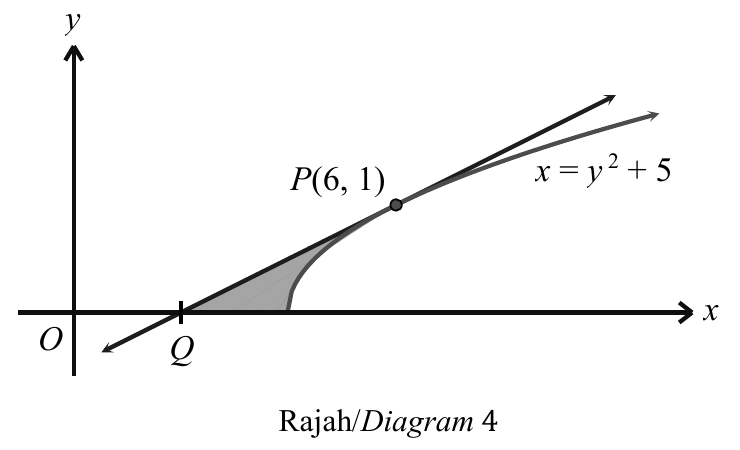
- (a)
The equation of the tangent to the curve at P.
[3] - (b)
The coordinates of Q.
[1] - (c)
The area of the shaded region.
[3] - (d)
The generated volume, in terms of π.
[3]
(a) Given that y = (2x − 1)/x² and dy/dx = 2g(x), where g(x) is a function of x, find the value of ∫ from −1 to 1 of g(x) dx. (b) Given ∫ from 4 to 10 of f(x) dx = 7, find ∫ from 4 to 5 of f(x) dx + ∫ from 5 to 7 of f(x) dx − ∫ from 10 to 7 of f(x) dx.
Easy5 marks- (a)
Given y = (2x − 1)/x² and dy/dx = 2g(x), find ∫ from −1 to 1 of g(x) dx.
[3] - (b)
Find ∫(4→5) f(x) dx + ∫(5→7) f(x) dx − ∫(10→7) f(x) dx.
[2]
(a) Diagram 8a shows the graph x = −(y + 1)(y − 3). Calculate the area of the shaded region. (b) Diagram 8b shows the straight line x + y = 5 intersecting the curve y = 4/x, x > 0 at point A and point B. (i) Find the coordinates of point A and point B. (ii) The region bounded by the curve y = 4/x and the straight line AB is revolved through 360° about the x-axis. Calculate the volume, in terms of π, of the solid generated.
Medium10 marks- (a)
Calculate the area of the shaded region.
[4]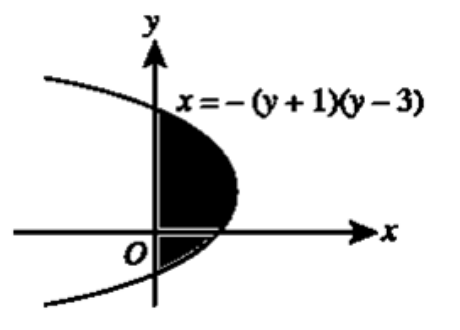
- (b)(i)
Find the coordinates of A and B.
[2]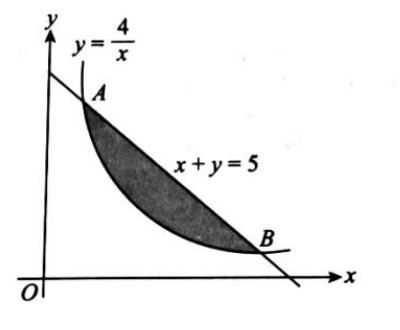
- (b)(ii)
Find the volume of the solid of revolution in terms of π.
[4]
Diagram 3 shows the point Q(2, 6) where the curve y = −x² + 10 meets the straight line PQ. Given that PQ is a tangent to the curve. The gradient of the normal to the curve at Q is 1/4. Find (a) the equation of the straight line PQ, (b) the area of the shaded region, (c) the volume generated, in terms of π, when the region bounded by the curve y = −x² + 10, the straight line y = 4 and the y-axis is rotated through 360° about the y-axis.
Medium10 marks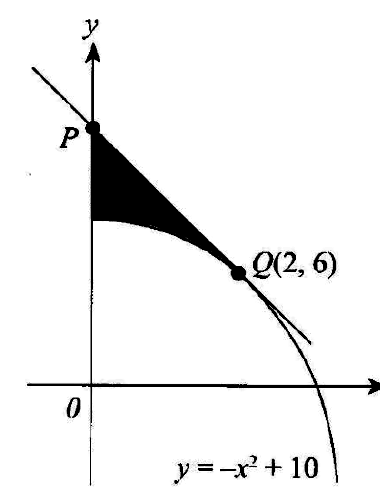
- (a)
Find the equation of the straight line PQ.
[2] - (b)
Find the area of the shaded region.
[4] - (c)
Find the volume generated in terms of π.
[4]
(a) Given h(x) = (5x + 2)²/10, find ∫₁² h′(x) dx. (b) Given ∫₁⁷ k(x) dx = 10, find the value of ∫₁³ [k(x) − 3] dx + ∫₃⁷ k(x) dx.
Easy5 marks- (a)
Find ∫₁² h′(x) dx.
[2] - (b)
Find ∫₁³ [k(x) − 3] dx + ∫₃⁷ k(x) dx.
[3]
Diagram 8 shows part of the curve y = x². The area of the shaded region P is 26 times the area of the shaded region Q. A is the point on the curve with y = 16, and k is the y-value at the boundary between P and Q. Find (a) the value of k, (b) the area of shaded region Q, (c) the volume generated, in terms of π, when the region bounded by the curve y = x², the x-axis and the line x = 4 is revolved through 360° about the x-axis.
Hard10 marks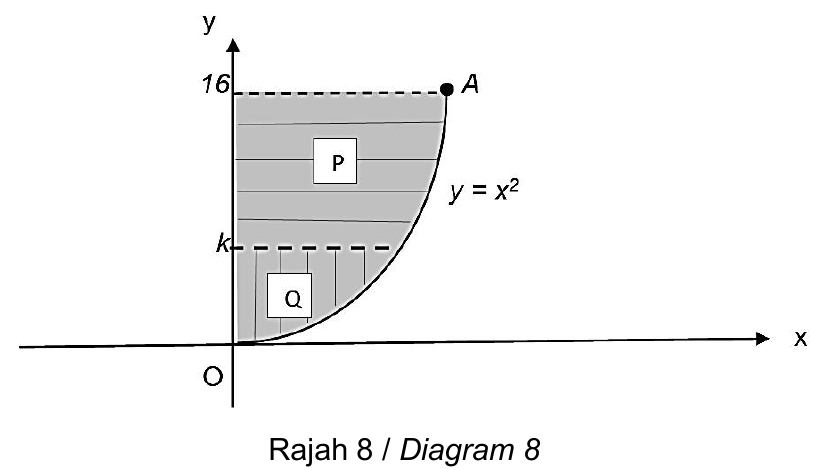
- (a)
Find the value of k.
[4] - (b)
Find the area of shaded region Q.
[3] - (c)
Find the volume generated, in terms of π, when the region bounded by y = x², the x-axis and x = 4 is revolved through 360° about the x-axis.
[3]
In the diagram, the straight line PQ is a tangent to the curve x = ½y² + 1 at Q(3, 2); PQ meets the y-axis at (0, k). (a) Show that the value of k is 1/2. (b) Find the area of the shaded region. (c) Find the volume generated, in terms of π, when the region bounded by the curve and the straight line x = 3 is revolved through 180° about the x-axis.
Medium10 marks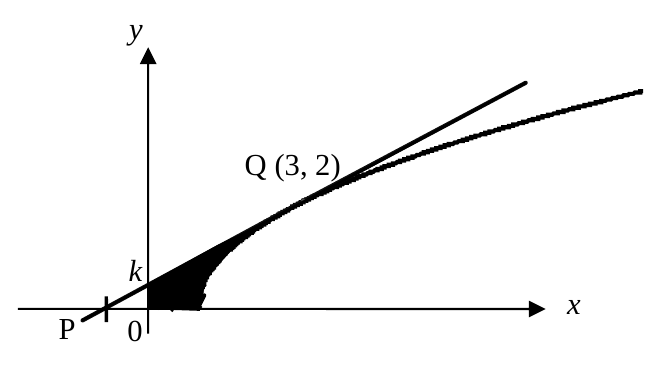
- (a)
Show that k = 1/2.
[3] - (b)
Find the area of the shaded region.
[3] - (c)
Find the volume generated about the x-axis.
[4]
Diagram 14(a) shows a cross-section of a cylindrical drinking water jug (diameter 18 cm, height h cm) and Diagram 14(b) shows a cross-section of a glass (width d cm, depth t cm, with the x-axis at the rim and the vertex below it). Given the maximum volume of water in the jug is 972π ml and the diameter of the water in the jug is 18 cm. d and t are 1/3 of the diameter of the water in the jug and the maximum height of the water in the jug respectively.
Medium8 marks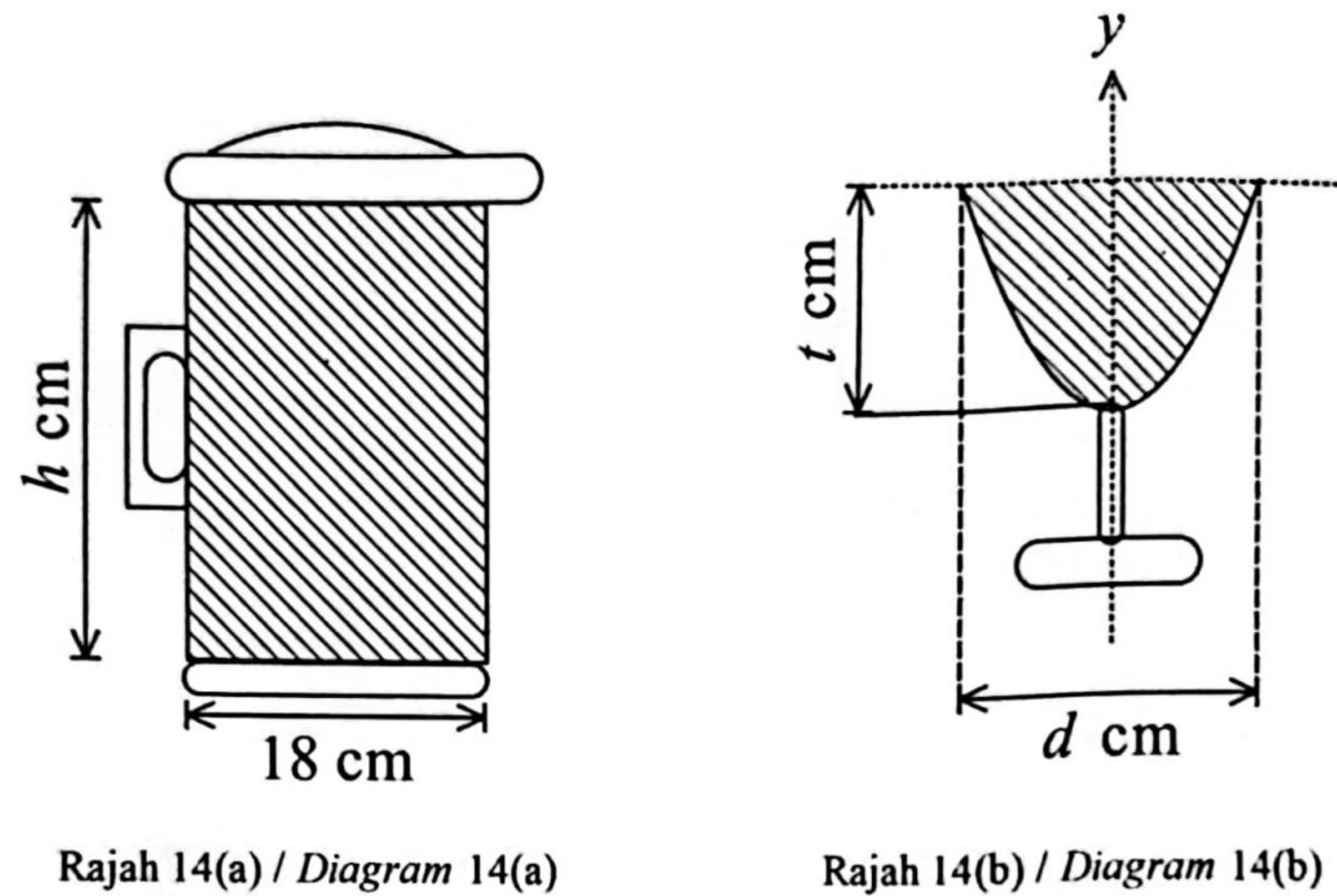
- (a)
Find the value of t, in cm.
[2] - (b)
Find the value of k and the equation of the curve for the water in the glass if the gradient function is kx where k is a constant.
[3] - (c)
Assuming water is filled to the maximum in the glasses and jugs, what is the number of glasses needed if 3 jugs of water are provided in Teacher Cendana's Farewell Ceremony?
[3]
Diagram 8 shows the curve f(x) which has a gradient function of −1/(2√(x − 4)) intersects with a straight line y = −x + 10 at point Q(13, −3). The curve starts at (4, 0) on the x-axis; the shaded region lies between the curve and the line.
Hard10 marks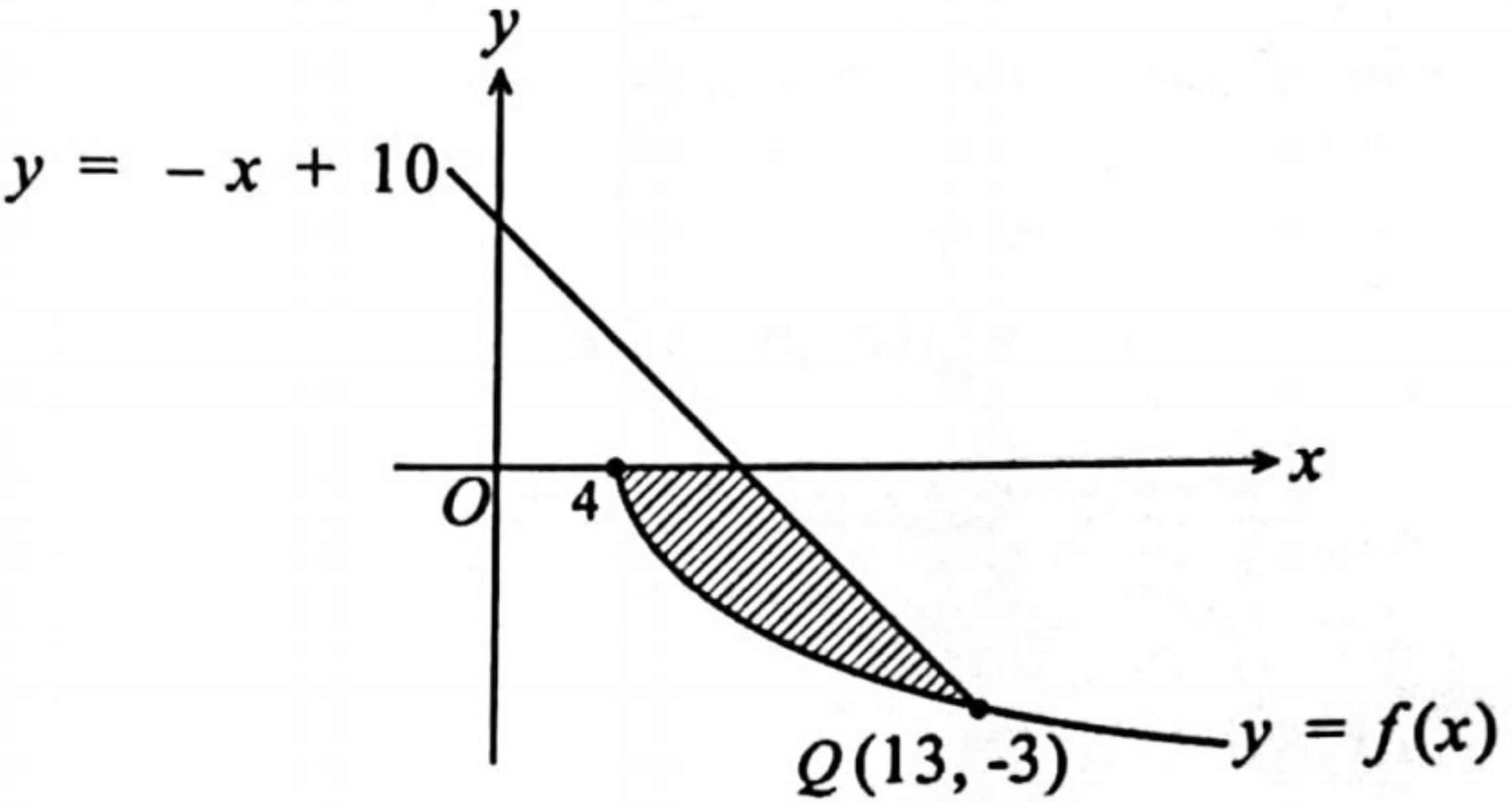
- (a)
Find the equation of the curve f(x).
[4] - (b)
Find the area of the shaded region.
[3] - (c)
Evaluate π∫ from 4 to 10 of [f(x)]² dx.
[3]
Diagram 15 shows the ship route in a film studio and two straight tracks for camera 1 and camera 2. The shaded area is the film crew area. The gradient function of the ship route is 6 + 2x. The tangent equations of the tracks of camera 1 and camera 2 are y = 10x − 4 and y = 6x respectively. Find (a) the coordinates of the point where camera 1 and camera 2 are equidistant from the ship, (b) the area of the film crew region.
Medium8 marks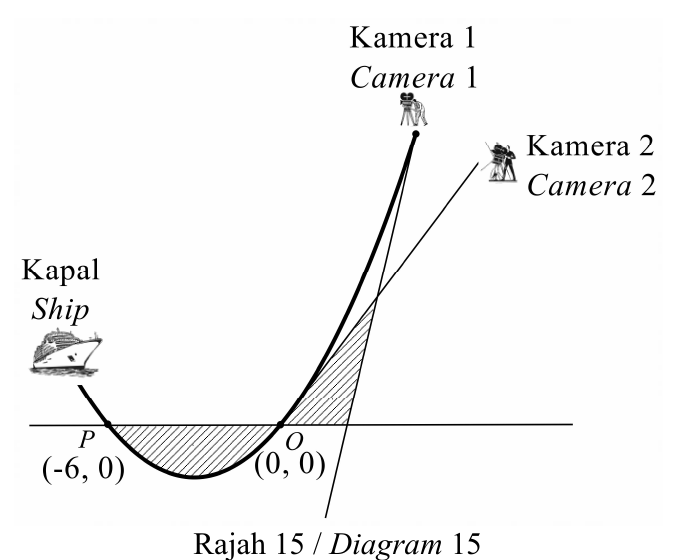
- (a)
Find the coordinates of the point where camera 1 and camera 2 are equidistant from the ship.
[2] - (b)
Find the area of the film crew region.
[6]
Diagram 8(a) shows a plastic water container and Diagram 8(b) shows its cross section. The equation of the side of the container is y = x²/8 − 32. (The cross section STUV has height 66 cm and base UV = 32 cm on the x-axis.) Find (a) the area of the cross section STUV, in cm². (b) the volume, in cm³, of the container in Diagram 8(a) in terms of π. Hence, find the cost of the liquid needed if the price for each 80π cm³ of the liquid is RM 1.20.
Medium10 marks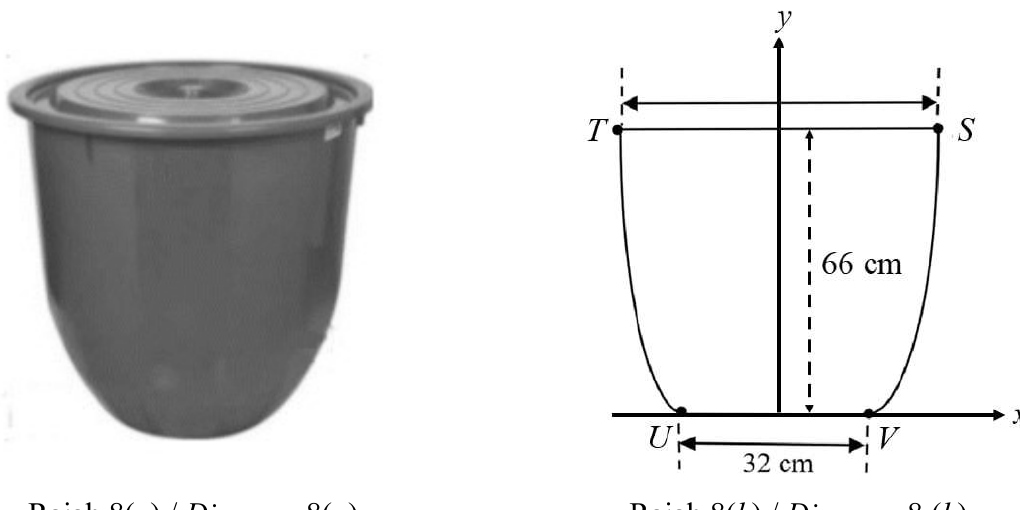
- (a)
Find the area of the cross section STUV, in cm².
[5] - (b)
Find the volume of the container in terms of π, and the cost of the liquid needed.
[5]
The line y = 16x − 5 is a tangent to the curve y = h(x) at the point (−2, −37). The gradient function is px² + 4, where p is a constant. Find (a) the value of p, (b) h(x).
Easy5 marks- (a)
Find the value of p.
[2] - (b)
Find h(x).
[3]
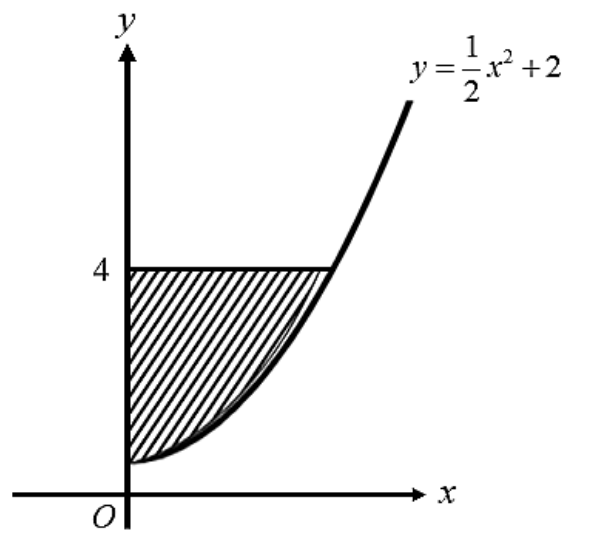
Diagram 2(a) shows the curve y = f(x) with f(x) = −x³ + 3x² + 9x. The curve cuts the x-axis at x = k (k < 0) and at the origin O; region A lies below the x-axis between x = k and O, and region B lies above the x-axis between O and x = 3. Diagram 2(b) shows part of the curve y = ½x² + 2 with a shaded region bounded by the curve, the y-axis and the line y = 4.
Medium8 marks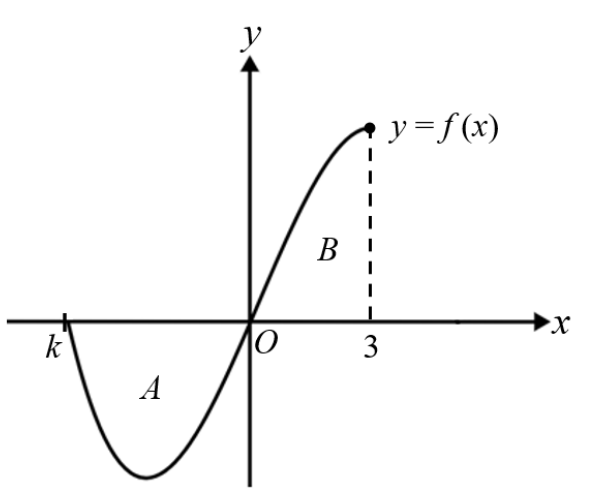
- (a)(i)
Find the area of B.
[3] - (a)(ii)
Hence, find the area bounded by x = k to x = 3 in terms of k.
[2] - (b)
Find the generated volume, in terms of π, when the shaded region is revolved 270° about the y-axis.
[3]
(a) Given ∫(x − 3)(x + 6) dx = (1/3)x³ + (m/2)x² − mnx + c. (b) Diagram 11 shows the curve y = f(x) and the straight line y = g(x) intersecting at point A(p, q). The line meets the y-axis at 8. The shaded region lies between the y-axis, the curve and the line. Given ∫₀^p f(x) dx = 12.
Medium6 marks- (a)
Find the value of m + n.
[3] - (b)
Find the area of the shaded region in terms of p and q.
[3]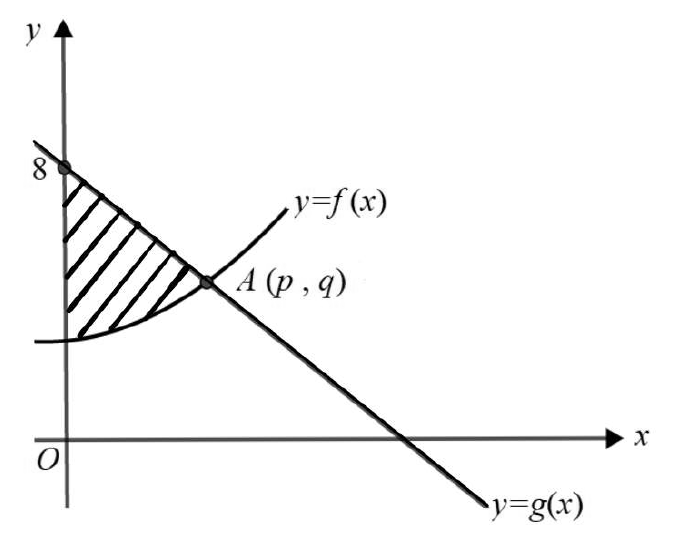
Diagram 10 shows a graph of a curve with the equation y = 6x − 3x². The straight line PQ is a tangent to the curve and parallel to the x-axis. Find (a) the equation of the straight line PQ, (b) the area bounded by the curve and the x-axis, (c) the volume of the solid generated when the shaded region is rotated through 360° about the x-axis.
Medium10 marks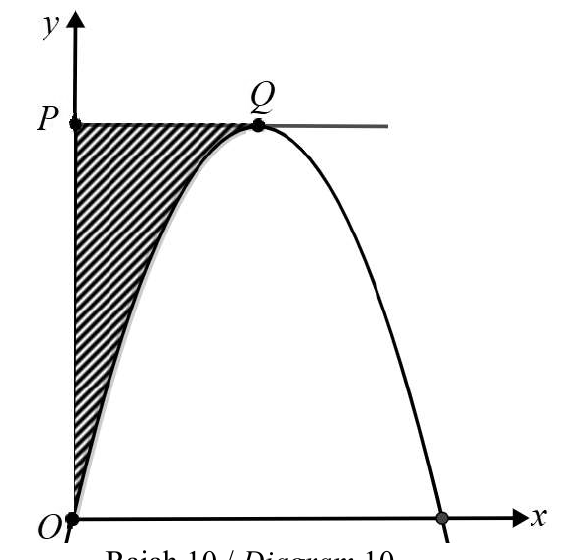
- (a)
Find the equation of the straight line PQ.
[3] - (b)
Find the area bounded by the curve and the x-axis.
[4] - (c)
Find the volume of the solid generated when the shaded region is rotated through 360° about the x-axis.
[3]
(a) Diagram 11 shows a curve y = g(x) crossing the x-axis at x = a, 0 and b. Given ∫ from a to 0 of g(x) dx = 8 and ∫ from a to 0 of g(x) dx + |∫ from 0 to b of g(x) dx| = 10. (b) Given dV/dt = −2t, where V is the volume, in m³, of a water tank and t is the time in hours. The initial volume of water in the tank before it flows out is 4 m³.
Medium6 marks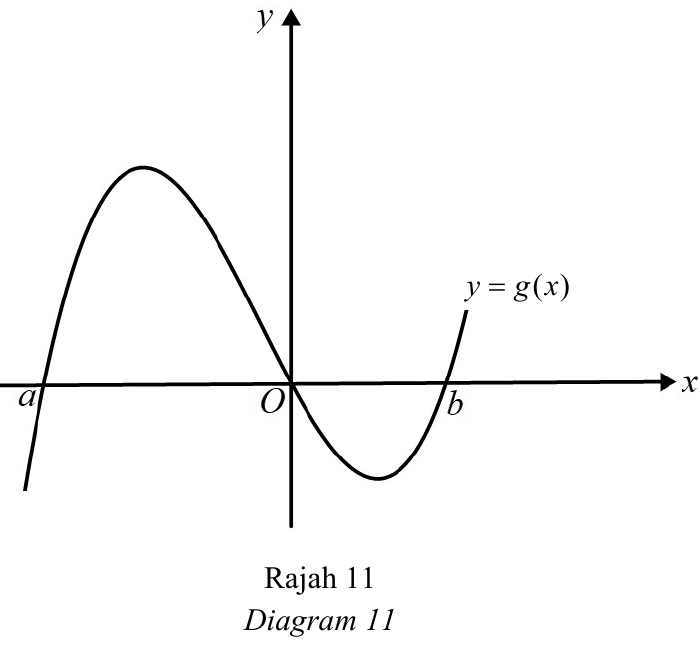
- (a)
Find the value of ∫ from 0 to b of g(x) dx.
[2] - (b)(i)
Express V in terms of t.
[2] - (b)(ii)
Find the time t if the water in the tank flows out and the tank is completely empty.
[2]
Diagram 10 shows the graph y = f(x) that touches the x-axis at B and intersects the y-axis at A. The straight line AC, parallel to the x-axis, is tangent to the curve at A. Given f′(x) = x² − 4x.
Medium10 marks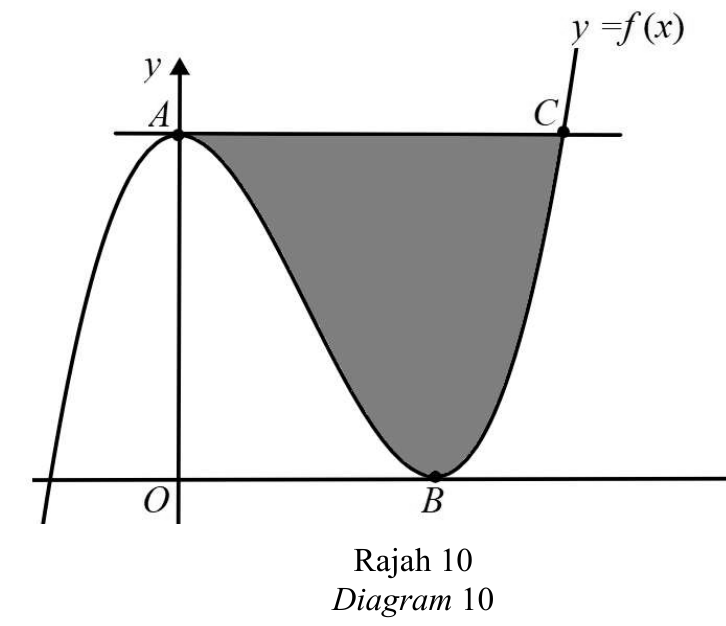
- (a)(i)
Find the coordinates of point B.
[2] - (a)(ii)
Find f(x).
[3] - (a)(iii)
Find the coordinates of point C.
[1] - (b)
Hence, calculate the area of the shaded region.
[4]
(a) Diagram 7 shows a straight line y = k and a curve y = x². Calculate the value of k if the area of the shaded area is 5⅓ unit². (b) The gradient function of a curve is px + 2, where p is a constant. Given that the normal gradient to the curve is −1/6 at point (1, −8), calculate (i) the value of p, (ii) the equation of the curve in intercept form.
Medium8 marks- (a)
Calculate k if the shaded area is 5⅓ unit².
[3]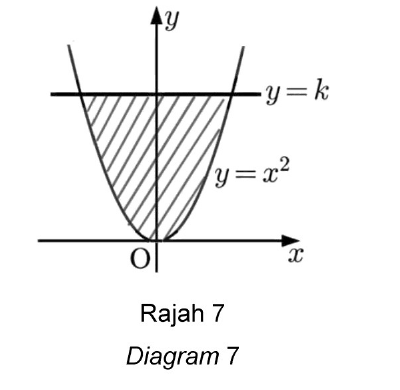
- (b)(i)
Find p (gradient function px + 2, normal gradient −1/6 at (1, −8)).
[2] - (b)(ii)
The equation of the curve in intercept form.
[3]
Diagram 7 shows the graph of y = f(x), which touches the x-axis at point A and cuts the y-axis at point B. The straight line BC, which is parallel to the x-axis, is the tangent to the curve at point B. Given that f′(x) = 2x² − 8x. (a) Find (i) the coordinates of point A, (ii) f(x), (iii) the coordinates of point B. (b) Hence, find the area of the shaded region.
Medium10 marks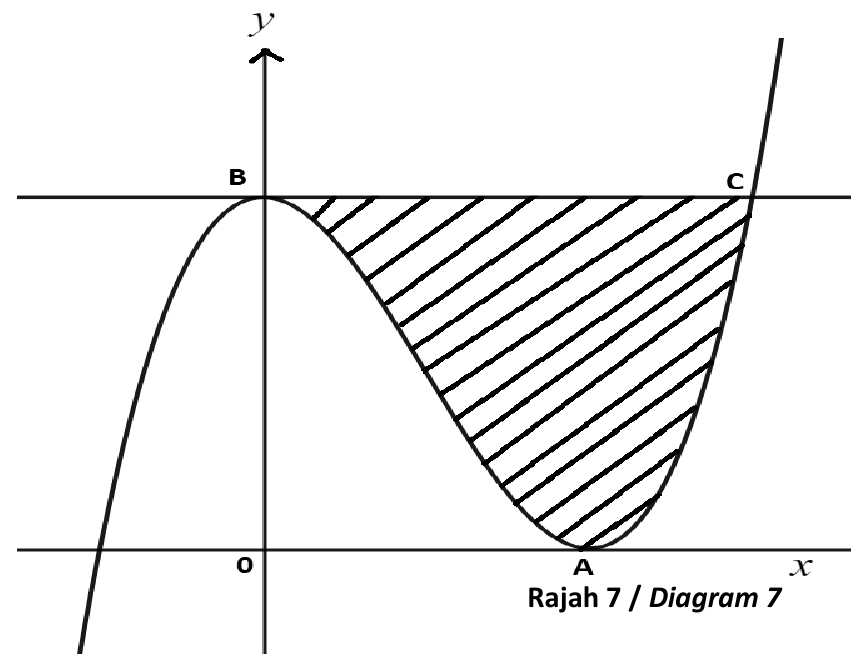
- (a)(i)
Coordinates of point A.
[2] - (a)(ii)
Find f(x).
[3] - (a)(iii)
Coordinates of point B.
[1] - (b)
Find the area of the shaded region.
[4]
Diagram 3 shows part of the graph y = (7 − x²)/2 and a straight line y = p, where p is a constant. Calculate the value of p if the area of the shaded region (above y = p, under the curve) is 2/3 unit².
Easy4 marks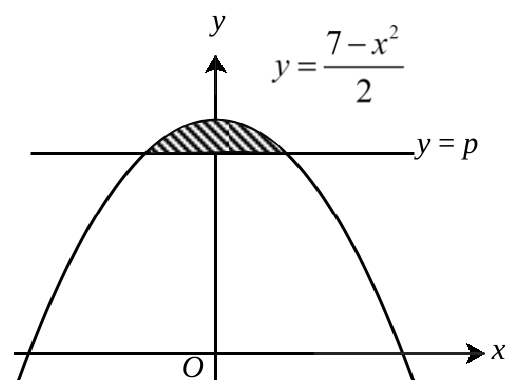
Calculate the value of p if the shaded area is 2/3 unit².
[4]
(a) Diagram 4 shows part of the curve x = 6y − y² and part of the line y = x which meet at B(5, 5) and O. Find the area of the shaded region. (b) Diagram 5 shows part of the curve x = y² − 4 and the line y = x/3 meeting at (12, 4). Calculate the volume generated when the shaded region is rotated 360° about the x-axis.
Medium10 marks- (a)
Find the area of the shaded region.
[5]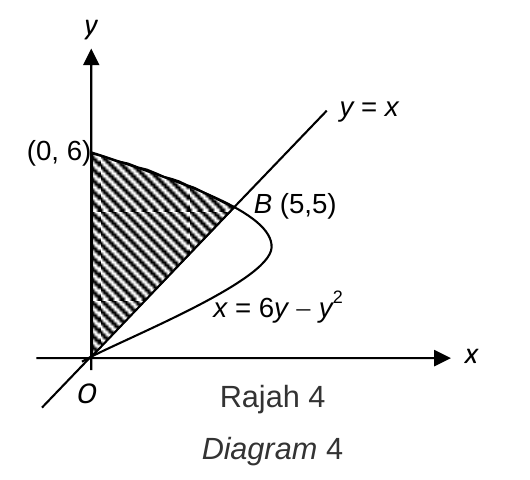
- (b)
Calculate the volume generated when the shaded region is rotated 360° about the x-axis.
[5]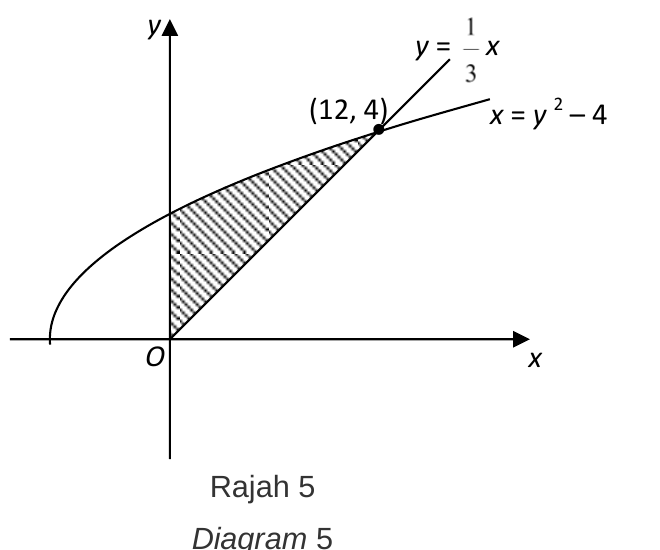
Diagram 3 shows a flower vase where the interior side surface of the vase can be represented by the equation y = ax². The vase is 12 cm high, with a top diameter of 16 cm and a base diameter of 8 cm. Using the measurements given, find the volume, in cm³, of the flower vase. Show the answer in terms of π.
Medium5 marks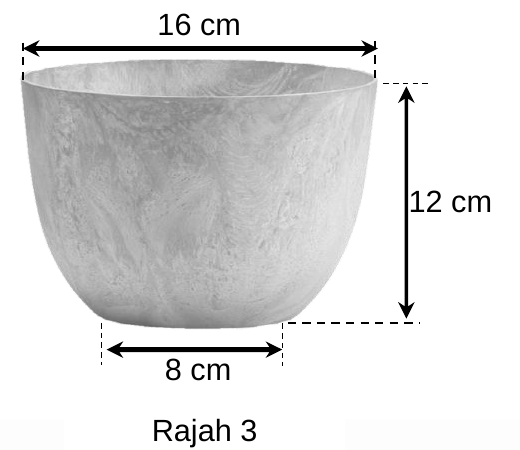
Find the volume, in cm³, of the flower vase. Show the answer in terms of π.
[5]
(a) Diagram 7 shows that the arc OPQR is part of the graph x² + y² = 16, symmetrical about the x-axis. OPQR is a sector of a circle with centre O and ∠POR = 120°. Find the volume generated, in terms of π, when the sector OPQR is rotated through 180° about the x-axis. (b) Diagram 8 shows a curve f(x) = 2x² − 3x + 2 and a straight line AB which is normal to the curve at point A. The straight line AB is parallel to the straight line 5y = 10 − x. Find the equation of the tangent to the curve at point A.
Medium10 marks- (a)
Find the volume generated, in terms of π, when the sector OPQR is rotated through 180° about the x-axis.
[6]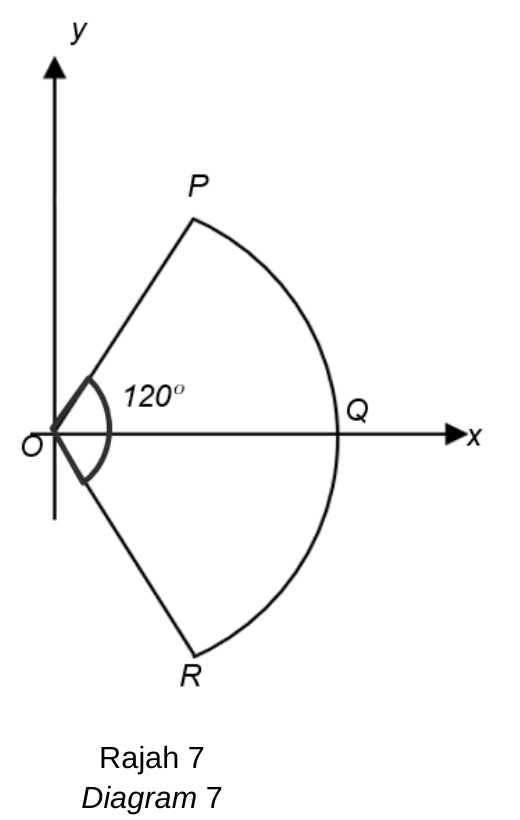
- (b)
Find the equation of the tangent to the curve at point A.
[4]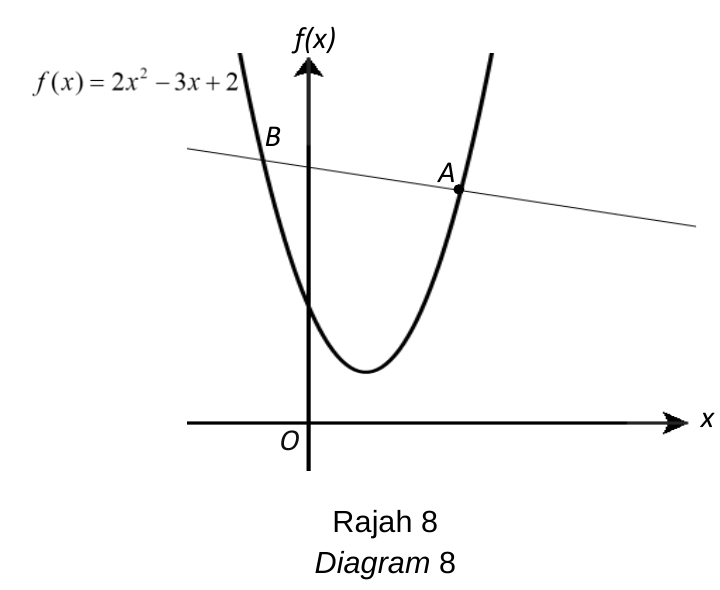
Given the quadratic function f(x) = −2(x − 3)² − 3. (a) Find the value of ∫ₚᵖ f(x) dx. (b) Find the value of m, if ∫₁² f(x) dx = 2m − 1.
Medium4 marks- (a)
Find the value of ∫ₚᵖ f(x) dx.
[1] - (b)
Find the value of m, if ∫₁² f(x) dx = 2m − 1.
[3]
Diagram 6 shows a shaded region under part of the curve y = kx² + 2m where k and m are constants. Point A(2, 11) is on the curve. Given that the area of the shaded region is 34/3 unit², find (a) the values of k and of m, (b) the equation of the normal at point A, (c) the volume of revolution, in terms of π, when the region bounded by the curve and the straight line y = 6 is revolved through 180° about the y-axis.
Hard10 marks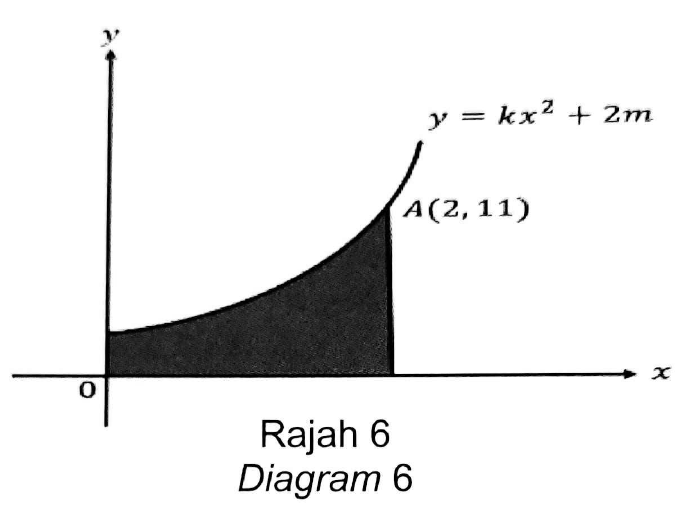
- (a)
The values of k and of m.
[4] - (b)
The equation of the normal at point A.
[3] - (c)
The volume of revolution, in terms of π, when the region bounded by the curve and y = 6 is revolved through 180° about the y-axis.
[3]
Integration.
Medium8 marks- (a)
Given that ∫ 3/(2x + 7)³ dx = a/(b(2x + 7)²) + c, find the value of a and of b.
[2] - (b)
If 3 − 4x + dy/dx = 3x², where dy/dx is the gradient function of a curve passing through the origin, find the value of ∫₁³ y dx.
[4] - (c)
Given that ∫ from (3k + 2) to (2q − k) of x² dx = 0, express k in terms of q.
[2]
Definite integrals and volume of revolution.
Medium7 marks- (a)
Given that ∫₂⁵ f(x) dx = 5 and ∫₅⁹ f(x) dx = 3. Find the value of p if ∫₂⁹ [f(x) + p] dx = 24.
[2] - (b)(i)
Diagram 2 shows x = 3y² + 2 and the line y = p intersects the curve at the point (3, p) [the shaded region lies between the curve, the y-axis, the x-axis and the line y = p, above the x-axis]. Show that the line y = √3/3.
[2]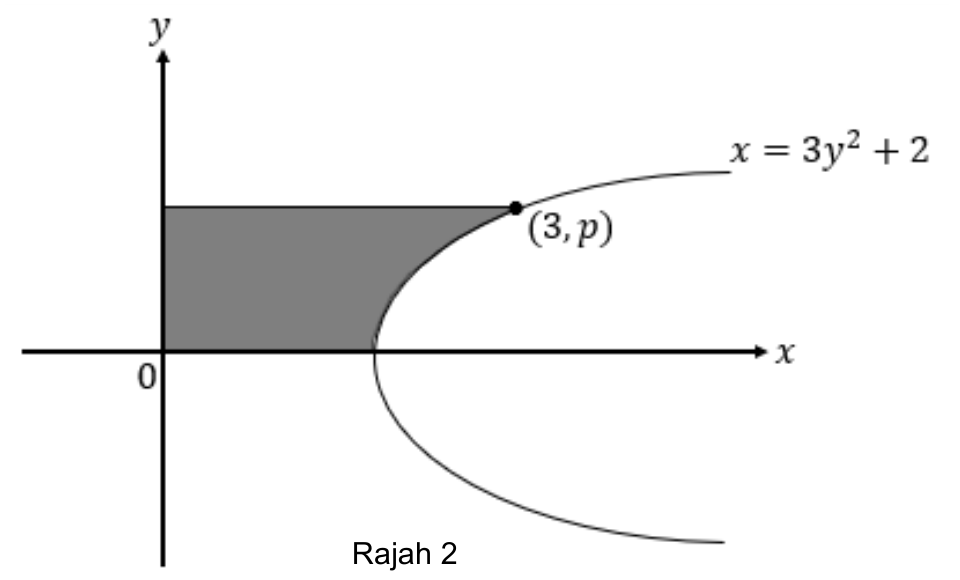
- (b)(ii)
Find the volume of the shaded region that is generated when it is rotated through 4 right angles (360°) about the x-axis.
[3]
In Diagram 6, the straight line MN is the normal to the curve y = x²/3 + 4 at the point S(3, 5). The coordinates of point N are (k, 0). The straight line RS is parallel to the y-axis.
Medium10 marks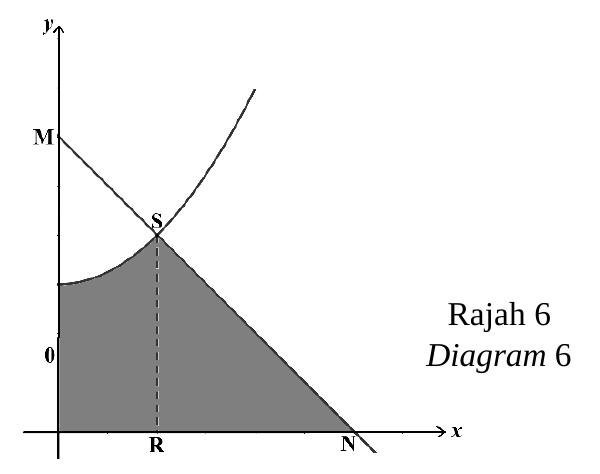
- (a)
Find the value of k.
[3] - (b)
Find the area, in unit², of the shaded region.
[4] - (c)
Find the volume generated, in terms of π, when the region bounded by the curve, the straight line RS, the x-axis and the y-axis is revolved 360° about the x-axis.
[3]
Diagram 1 shows a graph for a curve y = f(x) and the straight line y = m(x), meeting at (a, 2b); the line cuts the y-axis at b. (a) On Diagram 1, shade the region represented by ∫₀ᵃ f(x) dx − ∫₀ᵃ m(x) dx. (b) Given ∫₁ᵐ (1/2)g(x) dx = n and ∫₁ᵐ [g(x) − x] dx = 37/2 such that m > 0, express m in terms of n.
Medium4 marks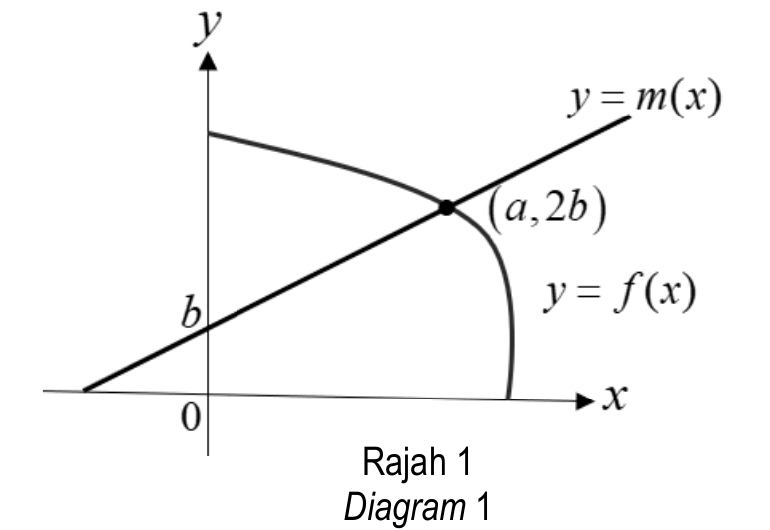
- (a)
On Diagram 1, shade the region represented by ∫₀ᵃ f(x) dx − ∫₀ᵃ m(x) dx.
[1]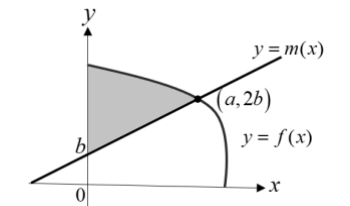
- (b)
Given ∫₁ᵐ (1/2)g(x) dx = n and ∫₁ᵐ [g(x) − x] dx = 37/2 such that m > 0, express m in terms of n.
[3]
(a) Diagram 5(a) shows the curve of the function y = x³ − 8 (the curve meets the x-axis at x = a; the region from x = 0 to x = 4 between the curve and the x-axis is shaded). (i) Find the value of a. (ii) Calculate the area of the shaded region. (b) Diagram 5(b) shows the curve y = x²/3 and two straight lines, x = 4 and y = p. When the shaded region is rotated through 360° about the y-axis, the volume generated is 34½π unit³. If p < 5, find the value of p.
Medium10 marks- (a)(i)
Find the value of a.
[1]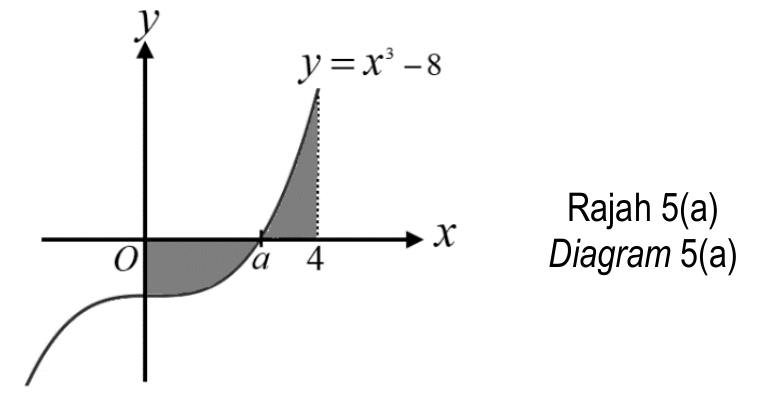
- (a)(ii)
Calculate the area of the shaded region.
[4] - (b)
Find p when the volume generated is 34½π unit³ (p < 5).
[5]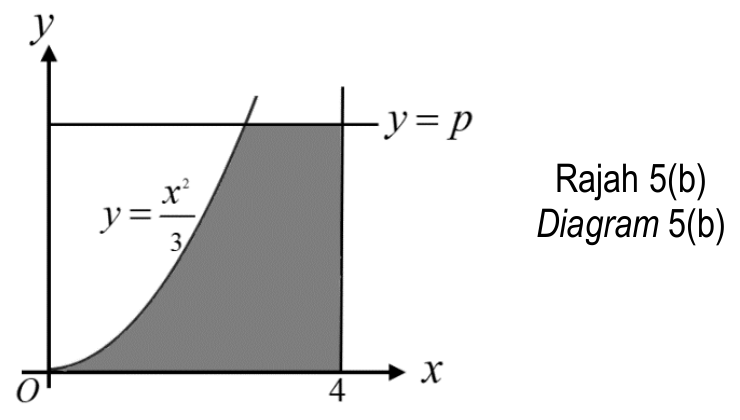
(a) Given ∫ from 1 to m of (2x − 6) dx = −4, find the value of m. (b) Diagram 3 shows the straight-line graph obtained by plotting (y − x) against x². The line cuts the (y − x)-axis at 6 and the x²-axis at −2. Express y in terms of x.
Medium6 marks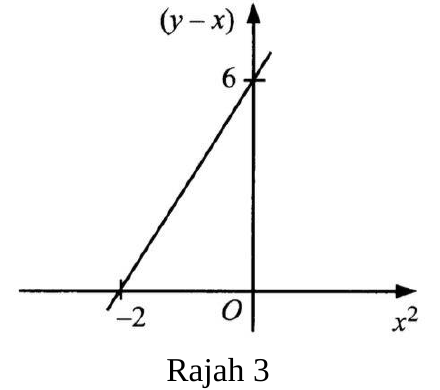
- (a)
Given ∫₁ᵐ (2x − 6) dx = −4, find the value of m.
[3] - (b)
From the graph of (y − x) against x², express y in terms of x.
[3]
Diagram 7 shows the curve y = 36 − x² and the straight line EFG is tangent to the curve at point F (where x = 2). G is the point (p, 0) on the x-axis. (a) Find (i) the equation of straight line EFG, (ii) the value of p. (b) Calculate the area of the shaded region.
Medium8 marks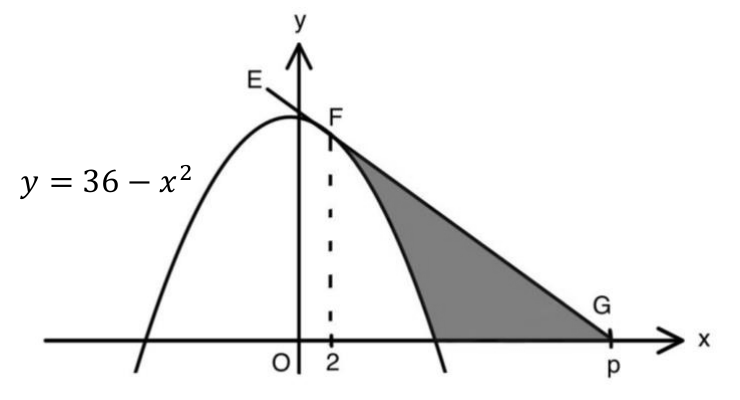
- (a)(i)
Find the equation of straight line EFG.
[3] - (a)(ii)
Find the value of p.
[1] - (b)
Calculate the area of the shaded region.
[4]
(a) It is given that ∫ from 3m − n to m + 5 of y dx = 0. Express m in terms of n. (b) Diagram 2 shows a part of the curve y = (x − 1)² + 1 and a straight line PQ such that P and Q have coordinates (0, 2) and (k, 2) respectively. (i) Determine the value of k. (ii) Calculate the volume generated when the shaded region is revolved through 360° about the x-axis.
Medium8 marks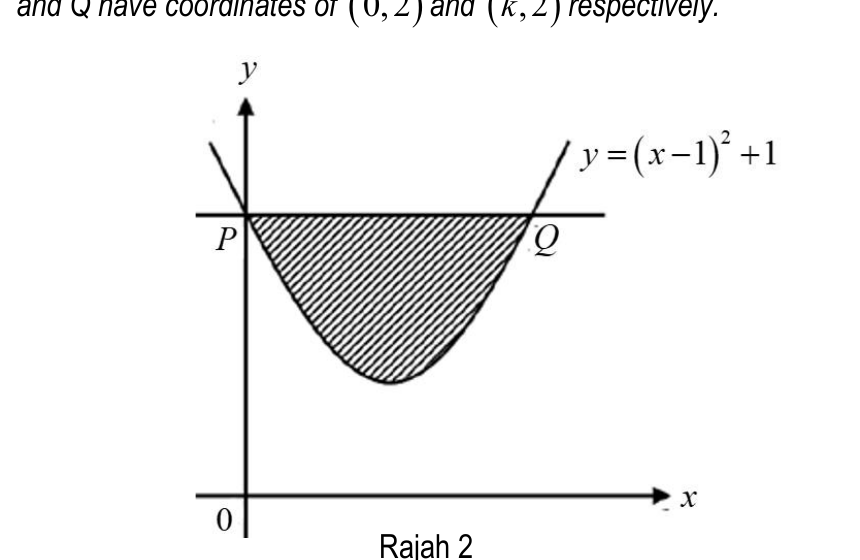
- (a)
Express m in terms of n.
[2] - (b)(i)
Determine the value of k.
[1] - (b)(ii)
Calculate the volume generated when the shaded region is revolved through 360° about the x-axis.
[5]
(a) Given ∫₁³ g(x) dx = 5, find (i) ∫₃¹ g(x) dx, (ii) ∫₁³ [g(x) + 4] dx. (b) Given dy/dx = 5x − 2 and y = 10 when x = 2, express y in terms of x.
Medium6 marks- (a)(i)
Given ∫₁³ g(x) dx = 5, find ∫₃¹ g(x) dx.
[1] - (a)(ii)
Find ∫₁³ [g(x) + 4] dx.
[2] - (b)
Given dy/dx = 5x − 2 and y = 10 when x = 2, express y in terms of x.
[3]
Diagram 5 shows the curve x = y² + 5 and the tangent that touches the curve at point A(6, 1). Find (a) the equation of the normal at point A, (b) the area of the shaded region, (c) the volume of revolution, in terms of π, when the region bounded by the curve and the straight line x = 6 is revolved 180° about the x-axis.
Medium10 marks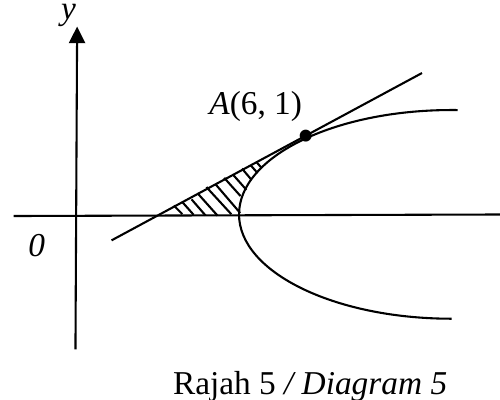
- (a)
Find the equation of the normal at A.
[4] - (b)
Find the area of the shaded region.
[3] - (c)
Find the volume of revolution about the x-axis, in terms of π.
[3]
(a) Given ∫ from −3 to 5 of f(x) dx = 7, find ∫ from −3 to 5 of [2f(x) − 3x] dx. (b) Diagram 6 shows the graph of a curve y = f(x) and a straight line y = g(x). Given ∫ from 0 to p of f(x) dx − ∫ from 0 to p of g(x) dx = 10, (i) on Diagram 6, shade the region represented by ∫₀ᵖ f(x) dx − ∫₀ᵖ g(x) dx, (ii) find ∫₀ᵖ f(x) dx in terms of p and q.
Medium6 marks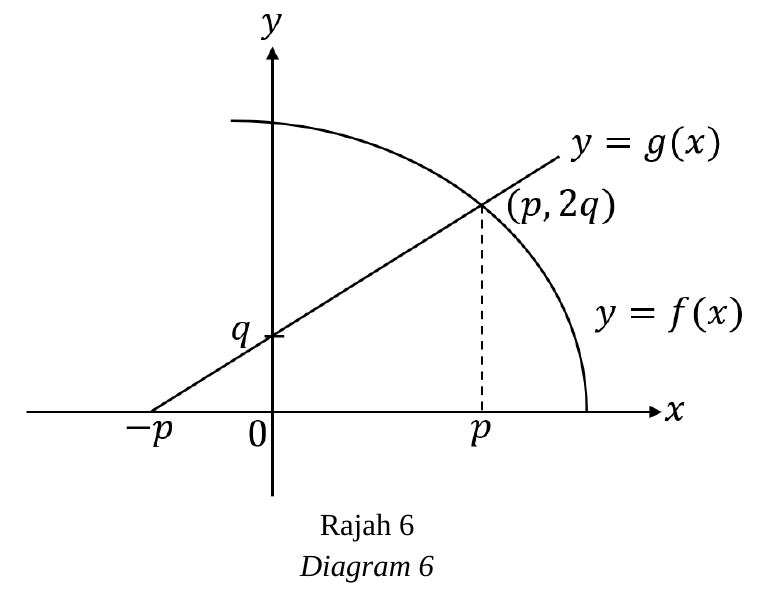
- (a)
Find ∫₋₃⁵ [2f(x) − 3x] dx given ∫₋₃⁵ f(x) dx = 7.
[3] - (b)(i)
Shade the region represented by ∫₀ᵖ f(x) dx − ∫₀ᵖ g(x) dx on Diagram 6.
[1]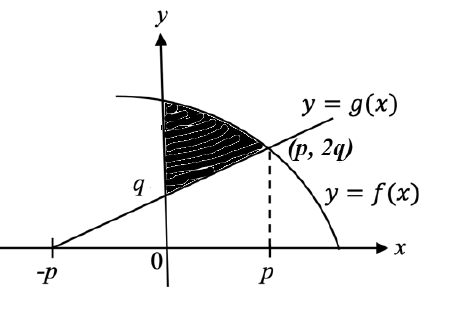
- (b)(ii)
Find ∫₀ᵖ f(x) dx in terms of p and q.
[2]
Diagram 5 shows the curve y = x² + 3 and the tangent to the curve at the point A(1, 4). Find (a) the equation of the tangent at point A, (b) the area of the shaded region, (c) the volume generated, in terms of π, when the region bounded by the curve, the y-axis and the straight line y = 5 is rotated through 180° about the y-axis.
Medium10 marks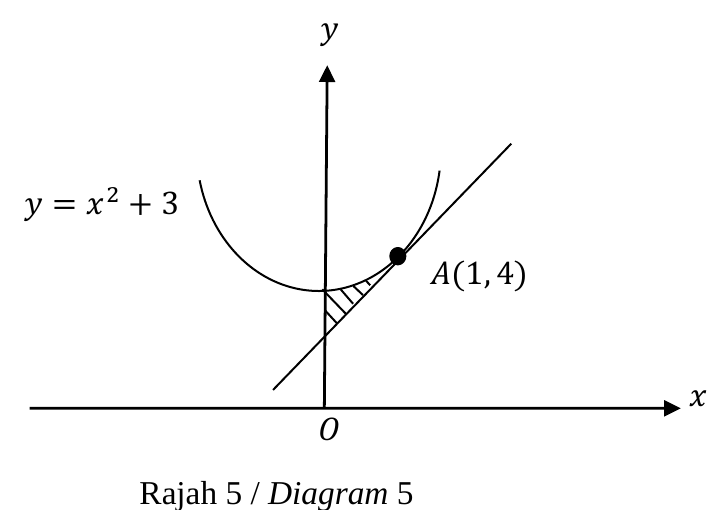
- (a)
Find the equation of the tangent at A.
[3] - (b)
Find the area of the shaded region.
[4] - (c)
Find the volume generated in terms of π.
[3]
Diagram 7 shows part of the curve y = f(x) which passes through the points (h, 0) and (4, 7); the shaded region is bounded by the axes, the line y = 7 and the curve. (a) Given the area of the shaded region is 22 unit², find the value of ∫ from h to 4 of f(x) dx. (b) The rate of temperature increase, θ°, with respect to time t seconds is dθ/dt = ½(12 − t). Find θ in terms of t if θ = 4 when t = 6.
Medium5 marks- (a)
Find ∫ f(x) dx from h to 4, given the shaded area is 22 unit².
[2]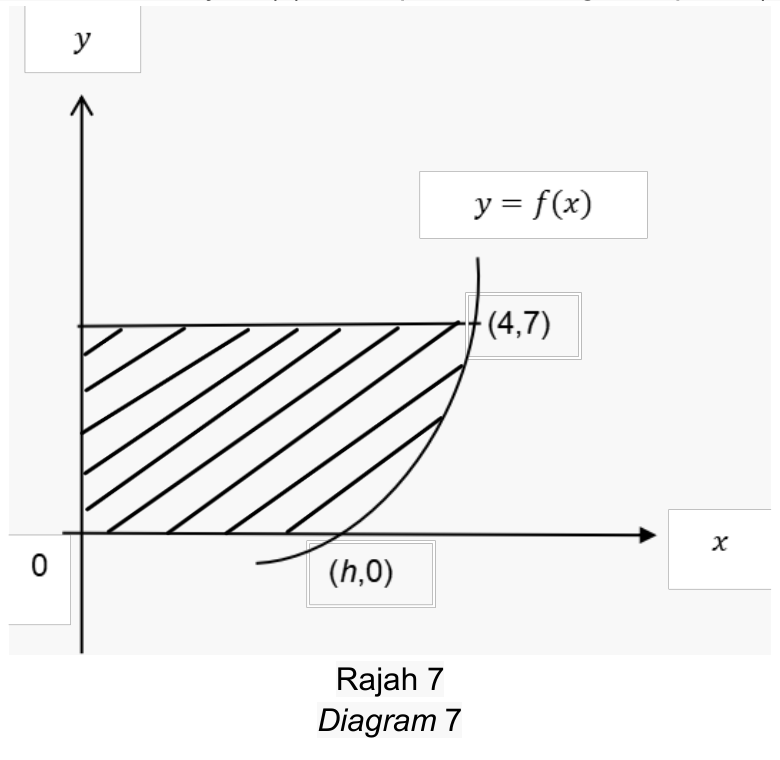
- (b)
Find θ in terms of t if dθ/dt = ½(12 − t) and θ = 4 when t = 6.
[3]
(a) The tangents to two curves have gradients 4x − 5 and px − 3 respectively. The two curves intersect at right angles at the point (2, 3). (i) Calculate the value of p. (ii) Find the equation of the curve which has gradient of tangent 4x − 5. (b) Diagram 5 shows part of the curve y = √(x + 6), the straight line x = k and the straight line AC, where A is at x = 3 on the x-axis, C is on the curve directly above A and D is on the curve at x = k. When the shaded region is revolved through 360° about the x-axis, the volume generated is 42½π unit³. Find the value of k.
Hard10 marks- (a)(i)
Calculate p.
[2] - (a)(ii)
Find the equation of the curve with gradient 4x − 5.
[3] - (b)
Find k when the volume generated is 42½π unit³.
[5]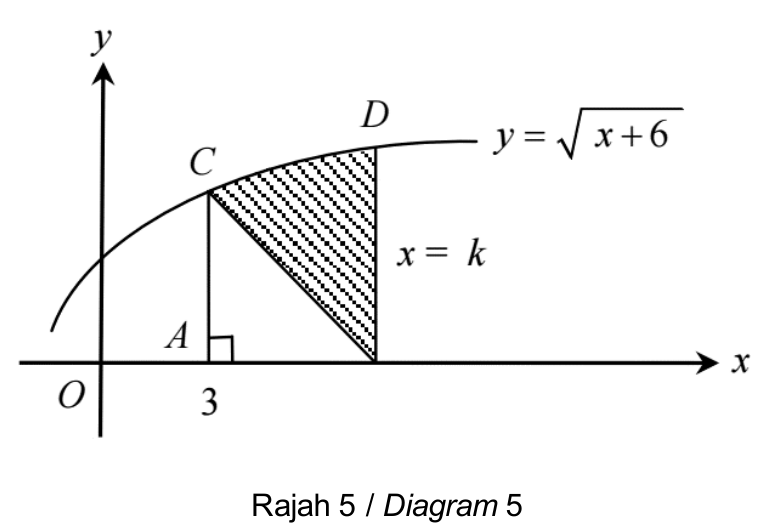
(a) Given d/dx[(4x − 1)/(2x + 7)²] = 8(4 − x)/(2x + 7)³, find ∫ 4(4 − x)/(2x + 7)³ dx. (b) Given that the coordinates of the turning point of a curve with the gradient function 3x − 3/x² are (h, 8). Find the value of h. Hence, find the equation of the curve.
Medium7 marks- (a)
Given d/dx[(4x − 1)/(2x + 7)²] = 8(4 − x)/(2x + 7)³, find ∫ 4(4 − x)/(2x + 7)³ dx.
[2] - (b)
The gradient function is 3x − 3/x² and the turning point is (h, 8). Find h and hence the equation of the curve.
[5]
Diagram 4 shows the curve y = 5/(2x − 1)². A region is bounded by the curve, the x-axis and the straight lines x = 1 and x = 3. (a) Find the area of the region. (b) The region is revolved through 360° about the x-axis. Find the volume generated in terms of π.
Medium6 marks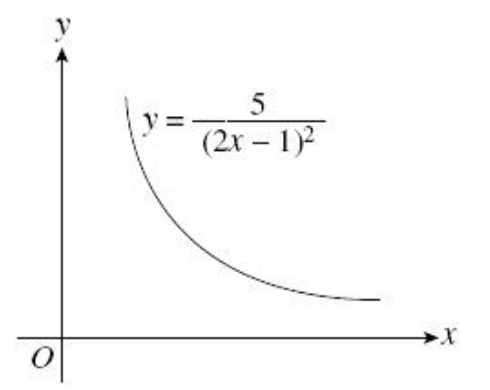
- (a)
Find the area of the region.
[3] - (b)
The region is revolved through 360° about the x-axis. Find the volume generated in terms of π.
[3]
Given d/dx[(2x + 1)³/(x − 3)] = (2x + 1)²(4x − 19)/(x − 3)², find the value of ∫ from 4 to 5 of (2x + 1)²(8x − 38)/(3(x − 3)²) dx.
Medium4 marksGiven d/dx[(2x + 1)³/(x − 3)] = (2x + 1)²(4x − 19)/(x − 3)², find the value of ∫₄⁵ (2x + 1)²(8x − 38)/(3(x − 3)²) dx.
[4]
(a) Given ∫ from m to 4 of (2 − x/4)⁻⁵ dx = 65/81 such that m < 4. (b) A straight line y = 10 is a tangent to the curve y = g(x). Given g″(x) = −4.
Medium7 marks- (a)
Given ∫ₘ⁴ (2 − x/4)⁻⁵ dx = 65/81 such that m < 4, find the value of m.
[3] - (b)
A straight line y = 10 is a tangent to the curve y = g(x). Given g″(x) = −4, find the equation of the curve when g′(1) = −8.
[4]
Diagram 6 shows the curve y = x² + 3 and the gradient of the tangent to the curve at point P is 6. The tangent at P meets the x-axis; the shaded region is bounded by the curve, the tangent, the x-axis and the y-axis.
Medium10 marks- (a)
Calculate the area of the shaded region.
[7]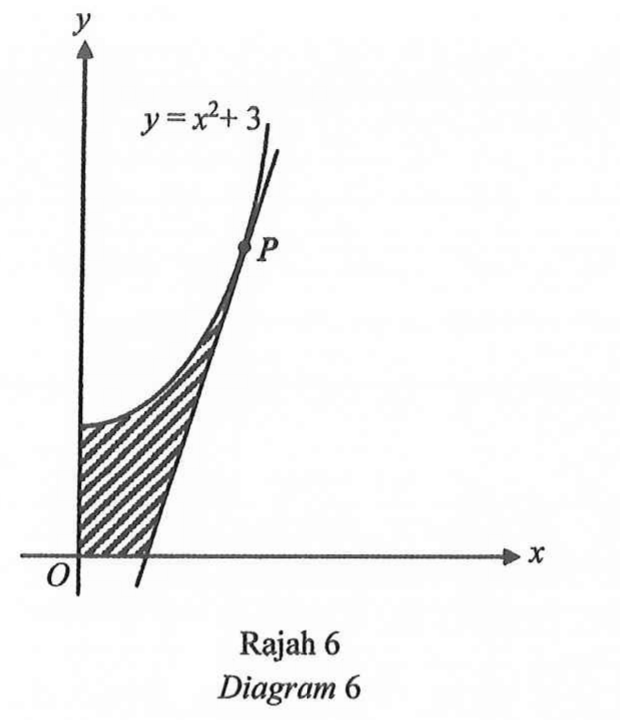
- (b)
Calculate the volume of revolution, in terms of π, when the region bounded by the curve, straight line y = 12 and the y-axis is revolved through 360° about the y-axis.
[3]
Diagram 7 shows the curve x = y³ intersecting the curve x = y² at the points O and B. (a) Find (i) the coordinates of point B, (ii) the area of the shaded region. (b) Calculate the volume generated, in terms of π, when the region bounded by the curve x = y², the straight line y = −x + 2 and the y-axis is revolved through 360° about the y-axis.
Medium8 marks- (a)(i)
Find the coordinates of point B.
[2] - (a)(ii)
Find the area of the shaded region.
[3]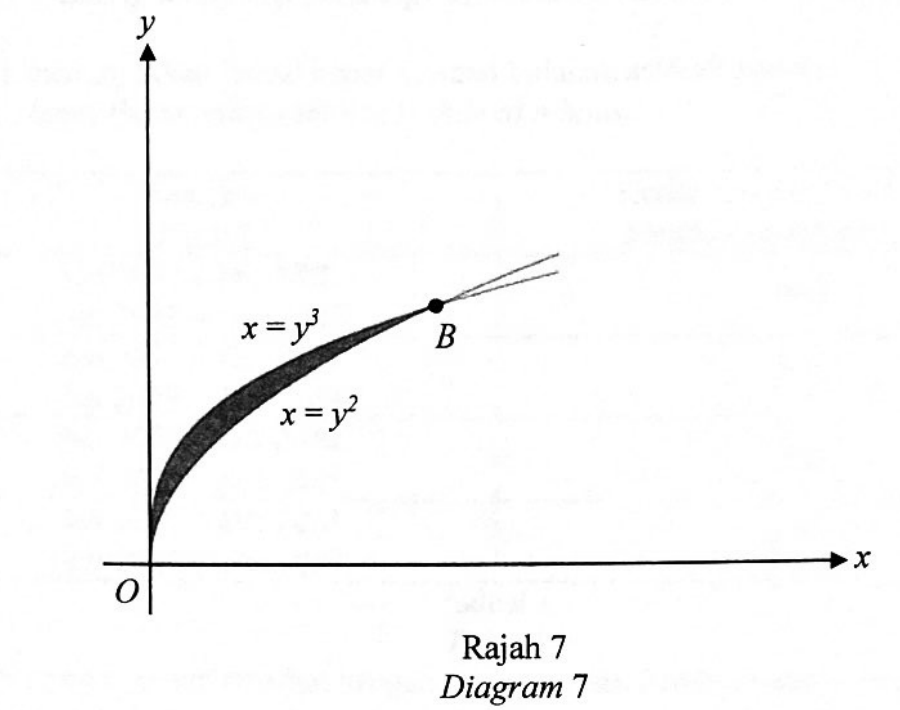
- (b)
Calculate the volume generated, in terms of π, when the region bounded by x = y², y = −x + 2 and the y-axis is revolved through 360° about the y-axis.
[3]
(a) Given d/dx(3x² − x) = f(x), find the value of ∫₀¹ f(x) dx. (b) The gradient function of a curve is 3x − h. Tangent to the curve at point (5, 7.5) cuts the x-axis at x = 3.75. Find the equation of the curve.
Medium6 marks- (a)
Given d/dx(3x² − x) = f(x), find the value of ∫₀¹ f(x) dx.
[3] - (b)
The gradient function of a curve is 3x − h. Tangent to the curve at (5, 7.5) cuts the x-axis at x = 3.75. Find the equation of the curve.
[3]
Diagram 7 shows the curve y = g(x) intersects the x-axis at point A, origin and point B. Given that the gradient function of the curve is −3x² − 2x + 2, find (a) the equation of the curve, (b) the area of the shaded region.
Medium5 marks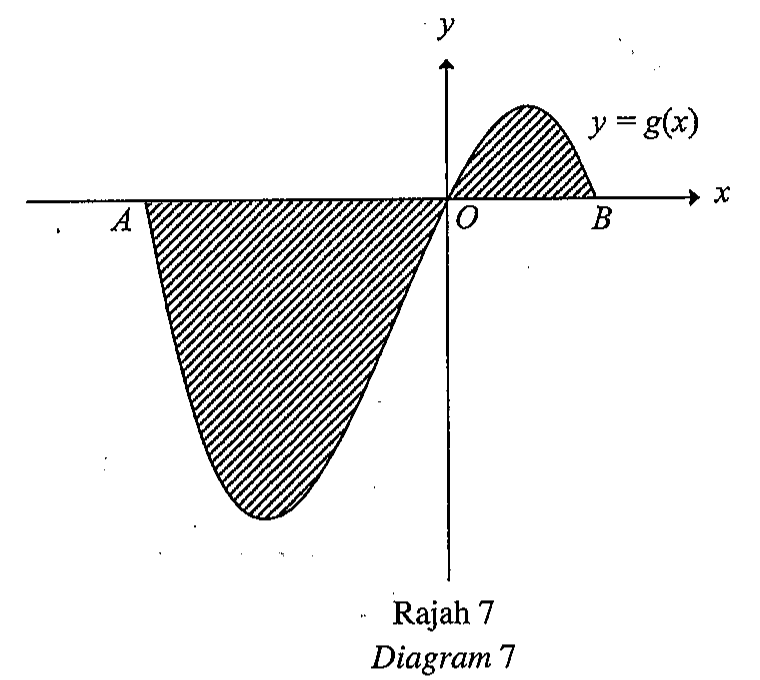
- (a)
The equation of the curve.
[1] - (b)
The area of the shaded region.
[4]
Diagram 2 shows a straight line AB intersects the curve y = g(x) at point B. A is the point (0, 1) on the y-axis and B is (2, 6). The gradient function of the curve is −2x. (a) Find the equation of the curve. (b) Calculate the volume generated, in terms of π, when the region bounded by the curve, the straight line AB and straight line y = 1 is revolved through 360° about the y-axis.
Medium7 marks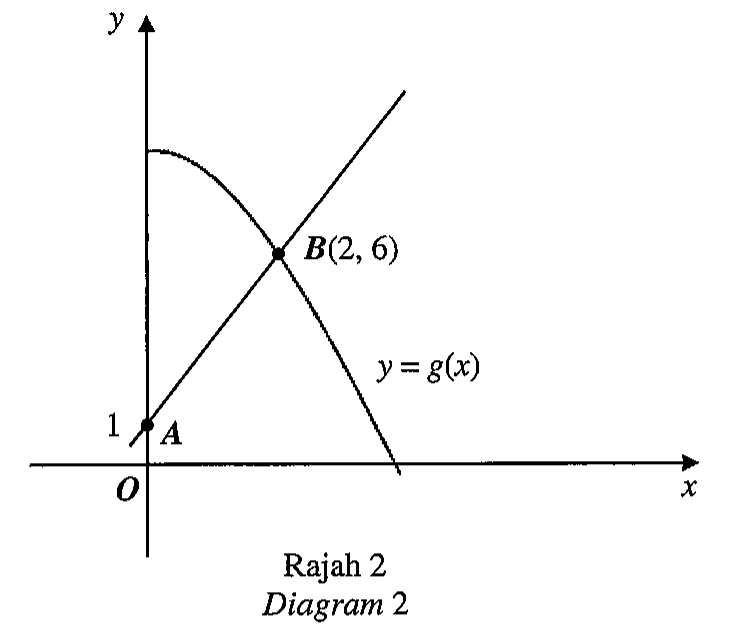
- (a)
Find the equation of the curve.
[3] - (b)
Calculate the volume generated, in terms of π, when the region bounded by the curve, the straight line AB and straight line y = 1 is revolved through 360° about the y-axis.
[4]
Given ∫₁³ f(x) dx = p, ∫₃⁵ 3f(x) dx = q and ∫₁³ g(x) dx = r, such that p, q and r are constants. Express (a) ∫₁⁵ f(x) dx in terms of p and/or q; (b) ∫₁³ [2r²x − g(x)] dx in terms of r.
Medium5 marks- (a)
Express ∫₁⁵ f(x) dx, in terms of p and/or q.
[2] - (b)
Express ∫₁³ [2r²x − g(x)] dx, in terms of r.
[3]
Diagram 4 shows that a shaded region is bounded between two curves y = 2x² and y = 6x − x². Both curves intersect at the origin and point A(2, 8).
Medium6 marks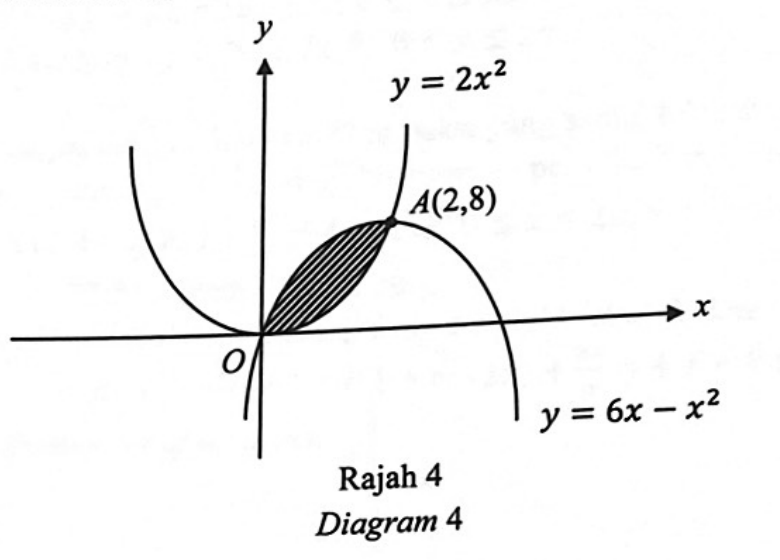
- (a)
Calculate the area of the shaded region.
[3] - (b)
Calculate the volume of revolution, in terms of π, when the region bounded by the curve y = 2x², the straight line x = 2 and the x-axis is revolved through 360° about the x-axis.
[3]
(a) Given ∫₁ᵐ g(x)/2 dx = n and ∫₁ᵐ [g(x) − x] dx = 37/2 such that m > 0. Express m in terms of n. (b) Diagram 4 shows part of a curve graph, y = f(x), with end points (−4, 16) and (−2, 2). (i) Find the value of ∫₋₄⁻² y dx + |∫₂¹⁶ x dy|. (ii) Given the gradient function of the curve is 4x + 5, find f(x).
Medium8 marks- (a)
Express m in terms of n.
[3] - (b)(i)
Find the value of ∫₋₄⁻² y dx + |∫₂¹⁶ x dy| (Diagram 4).
[2]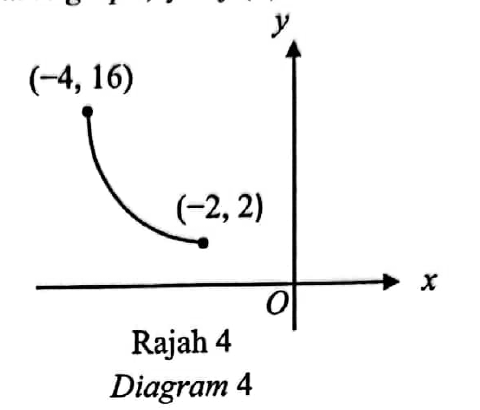
- (b)(ii)
Given the gradient function is 4x + 5, find f(x).
[3]
Diagram 5 shows a part of the curve y = h/x² and y = −x² + 4x. Given OA and BC are straight lines where BC is parallel to the y-axis. A is (2, −4). Find (a) the value of h, (b) the equation of the straight line BC if the area of the region Q is 20/3 unit². Hence, find the area of the shaded region for the whole diagram. (c) the volume generated, in terms of π, when the region P is revolved through 360° about the x-axis.
Hard10 marks- (a)
Find the value of h.
[1]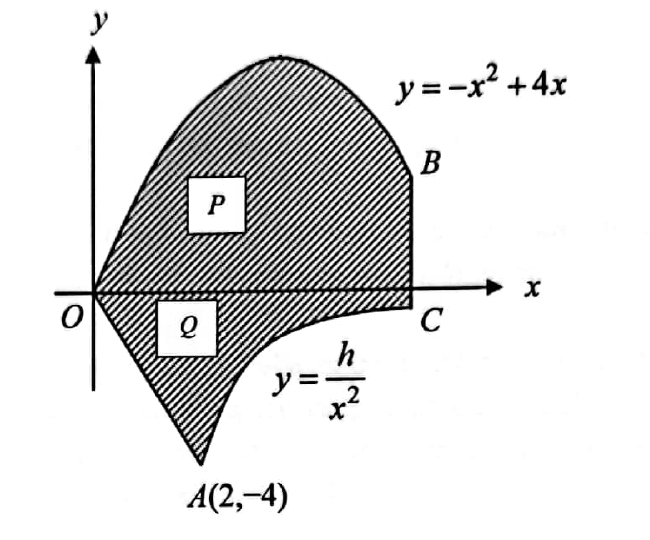
- (b)
Find the equation of BC if the area of region Q is 20/3 unit². Hence find the area of the shaded region for the whole diagram.
[6] - (c)
Find the volume generated (in terms of π) when region P is revolved through 360° about the x-axis.
[3]
(a) Given that d/dx[7/(4(3 − x)²)] = 4g(x), find the value of ∫₀² [2g(x) + 1] dx. (b) Given that 3p + ∫ₖ^(2k) f(x) dx − ∫₄ₚ^(2k) f(x) dx = 5p − 1 such that k and p are constants. Find the value of p if k = 4p.
Medium7 marks- (a)
Find the value of ∫₀² [2g(x) + 1] dx.
[4] - (b)
Find the value of p if k = 4p.
[3]
Diagram 7 shows part of a curve graph, y = ½x² + 3. The equation of the tangent to the curve at a point A(p, q) is y = 2x + k, such that k is a constant. (a) In Diagram 8 in the answer space, shade the region that is represented by ∫₀ᵖ (½x² + 3) dx − ∫₀ᵖ (2x + k) dx. (b) Find (i) the coordinates of point A and the value of k, (ii) the area of the shaded region in part (a). (c) Hence, find the volume of revolution when the region bounded by the curve and the straight line y = q is rotated through 180° about the y-axis.
Hard10 marks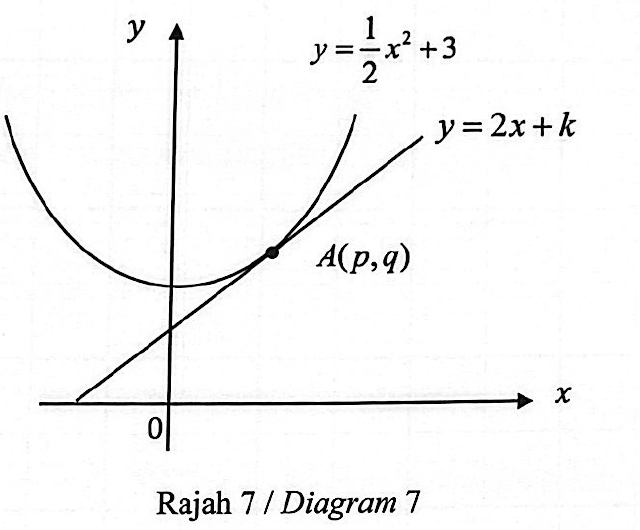
- (a)
In Diagram 8, shade the region represented by ∫₀ᵖ (½x² + 3) dx − ∫₀ᵖ (2x + k) dx.
[1]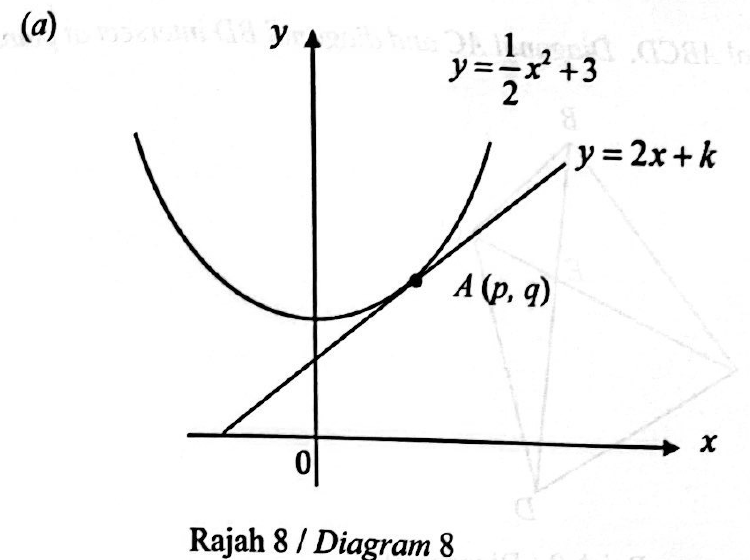
- (b)(i)
Find the coordinates of point A and the value of k.
[3] - (b)(ii)
Find the area of the shaded region in part (a).
[3] - (c)
Find the volume generated when the region bounded by the curve and the line y = q is rotated through 180° about the y-axis.
[3]
Diagram 6 shows the curve y² = x + 4 and the straight line 5y + 3x = 30 which intersect at point R(h, 3). The straight line 5y + 3x = 30 intersects the y-axis at point P. The curve crosses the y-axis at k.
Medium10 marks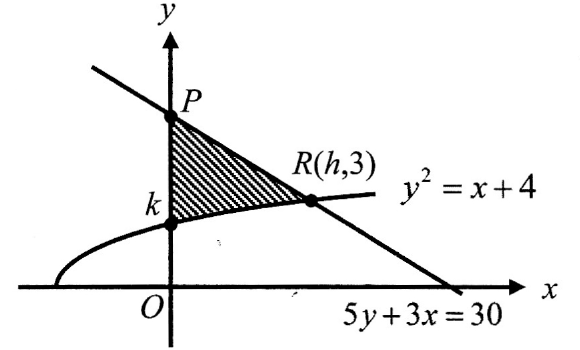
- (a)
Find the value of h and of k.
[3] - (b)
Find the area of the shaded region.
[4] - (c)
Find the volume generated, in terms of π, when the shaded region is revolved through 90° about the x-axis.
[3]
(a) Given ∫₂⁵ f(x) dx = 5, find the value of k if ∫₂⁵ [2f(x) + kx] dx = −1/2. (b) Diagram 4 shows the curve y = f(x) that intersects the x-axis at x = b. Given the area of the shaded region is 85 units², find the value of ∫₆ᵇ −11 f(x) dx. (The shaded region is bounded by the curve, the axes and y = 11 for 0 ≤ x ≤ 6.)
Medium6 marks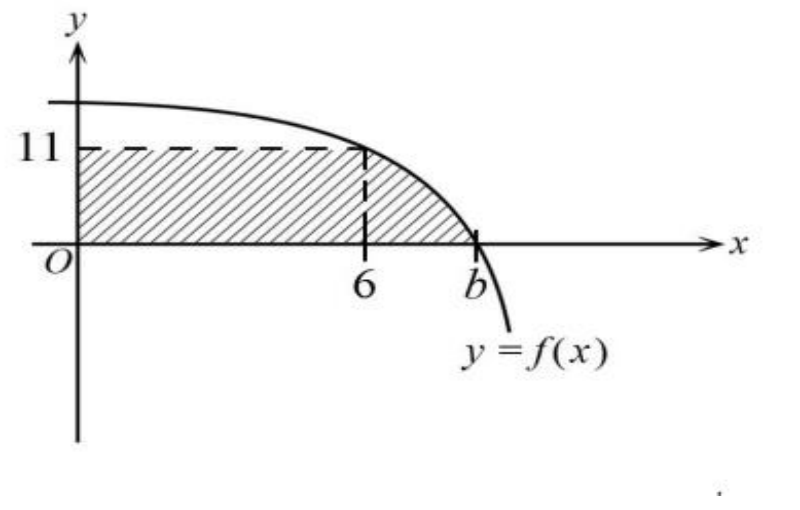
- (a)
Given ∫₂⁵ f(x) dx = 5, find k if ∫₂⁵ [2f(x) + kx] dx = −1/2.
[3] - (b)
Given the area of the shaded region is 85 units², find ∫₆ᵇ −11 f(x) dx.
[3]
Diagram 3 shows part of the curve y = (x − 6)² and a straight line y = mx + c intersecting at the point (4, 6). Given that ∫₀⁴ (mx + c) dx = 16. Calculate (a) the value of c and of m, (b) the area of the shaded region, (c) the volume generated, in terms of π, when the shaded region is revolved through 360° about the x-axis.
Medium10 marks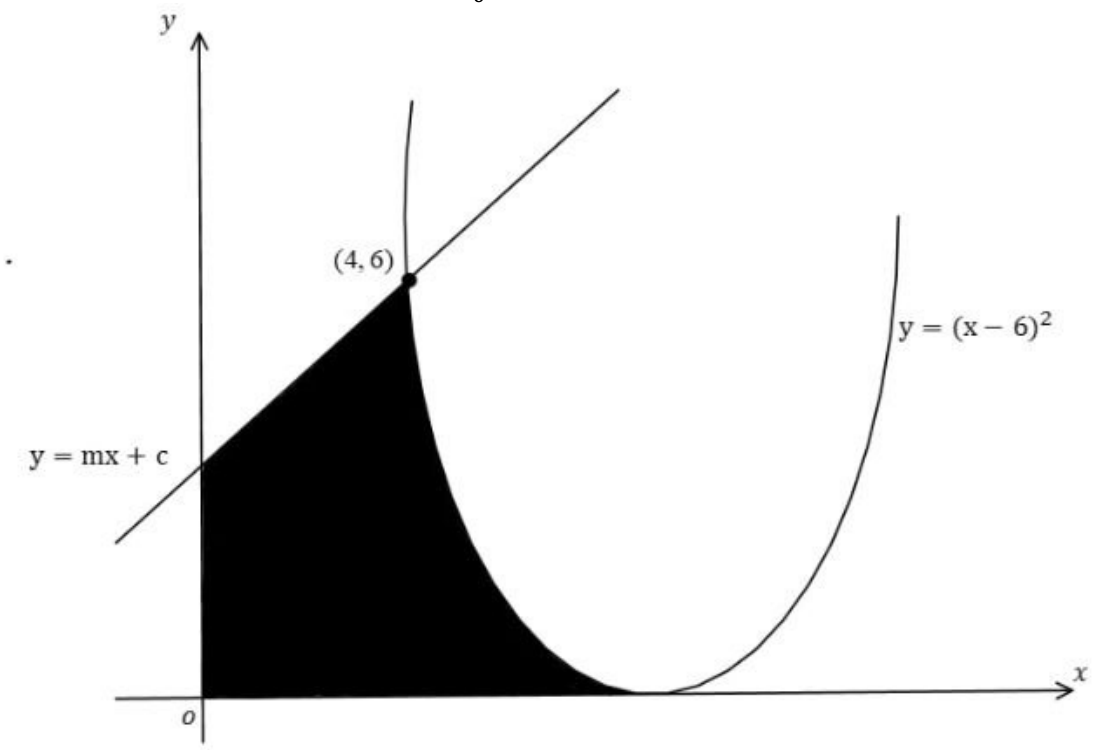
- (a)
Calculate the value of c and of m.
[4] - (b)
Calculate the area of the shaded region.
[3] - (c)
Calculate the volume generated, in terms of π.
[3]
(a) Table 1 shows a pattern of indefinite integrals: y = 4x → ∫4x dx = (4/(1+1))x^(1+1) + c; y = 4x² → ∫4x² dx = (4/(2+1))x^(2+1) + c; y = 4x³ → ∫4x³ dx = (4/(3+1))x^(3+1) + c; ... y = 4xⁿ → ∫4xⁿ dx = ?
Medium5 marks- (a)(i)
Make a general conclusion by induction for ∫4xⁿ dx.
[1]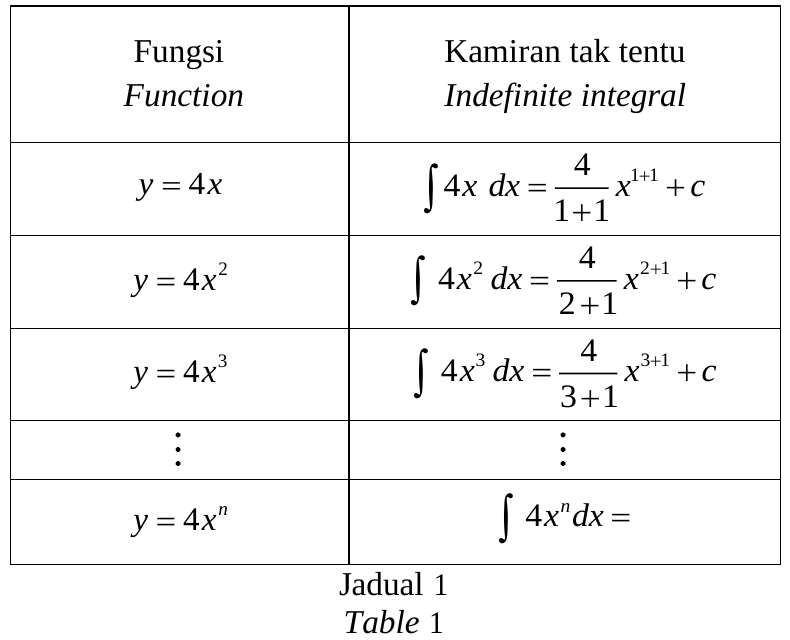
- (a)(ii)
Write one condition for the value of n and state the meaning of c.
[2] - (b)
Hence, find ∫(5 + x)(5 − x)/x⁴ dx.
[2]
(a) Diagram 4 shows a straight line y = f(x) which intersects the curve y = x² − 2x − 8 on the x-axis and y-axis at a and b respectively. (b) Diagram 5 shows the curve y = 2x², passing through x = 3 at y = p.
Medium10 marks- (a)(i)
Do you agree with the statement ∫₀ᵃ f(x) dx = ∫_b⁰ f⁻¹(y) dy? Give your justification.
[1]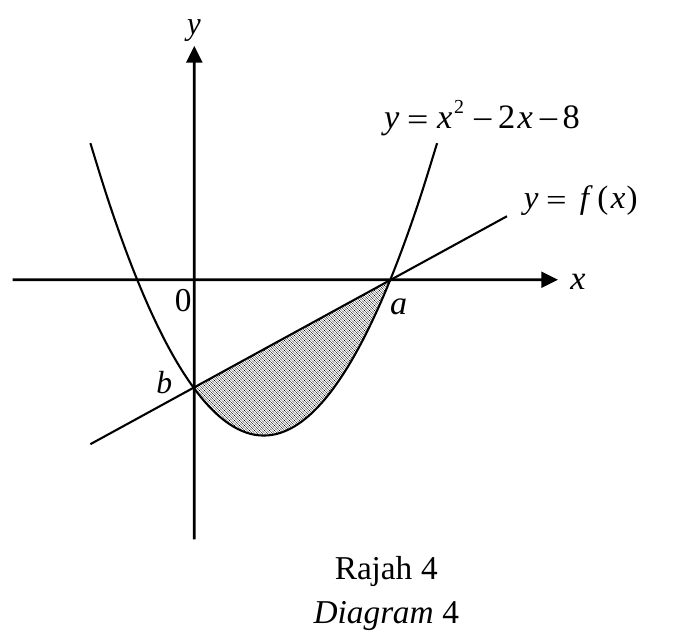
- (a)(ii)
Find the area of the shaded region.
[5] - (b)
Calculate the volume generated, in terms of π, when the region bounded by the curve y = 2x², y = 0 and y = p is revolved through 180° about the y-axis.
[4]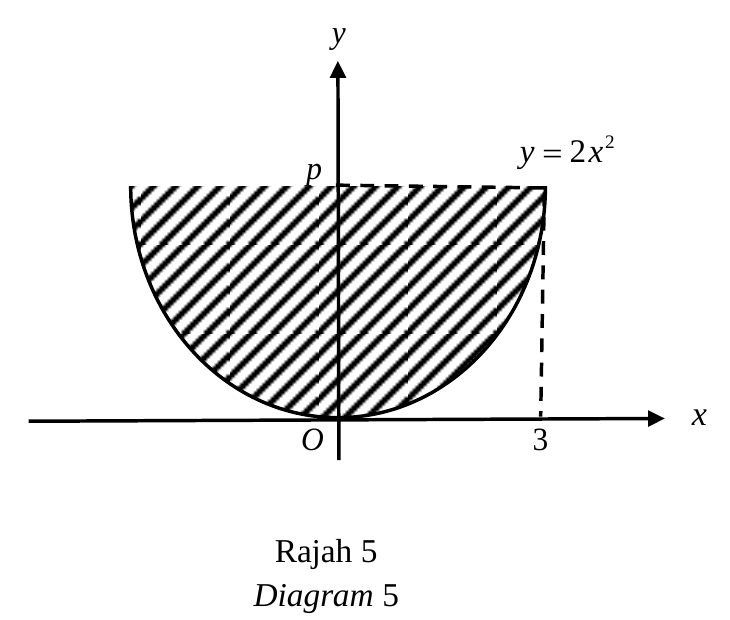
(a) Find the equation of the curve that has the gradient function dy/dx = 4x + 9 and passes through the point A(2, −3). (b) Given ∫₁³ f(x) dx = 4, ∫₃⁶ f(x) dx = 5 and ∫₁⁶ f(x) dx = k. Find (i) the value of k, (ii) ∫₁³ [7 − 2f(x)] dx.
Easy7 marks- (a)
Find the equation of the curve that has the gradient function dy/dx = 4x + 9 and passes through the point A(2, −3).
[3] - (b)(i)
Find the value of k.
[1] - (b)(ii)
Find ∫₁³ [7 − 2f(x)] dx.
[3]
A contractor builds a curved skateboard ramp at a sports school. Diagram 6 shows the cross-section of the curve of the ramp drawn on a Cartesian plane, where y is the vertical distance of the player from the ground and x is the horizontal distance of the player from the y-axis. The ramp has a height of 8 metres above ground level and has handrails at both ends that are 20 metres apart. The gradient function of the curve forming the ramp is (4/25)x. (a) Determine the equation of the curve represented by the skateboard ramp. (b) Calculate the area bounded by the curve of the skateboard ramp and y = 8. (c) For a long term plan, the ramp will be modified into a covered structure and used as a water storage tank. Calculate the maximum volume of water, in terms of π, when the region bounded by the curve y = f(x), the straight line y = 8 and the y-axis is rotated through 360° about the y-axis.
Hard10 marks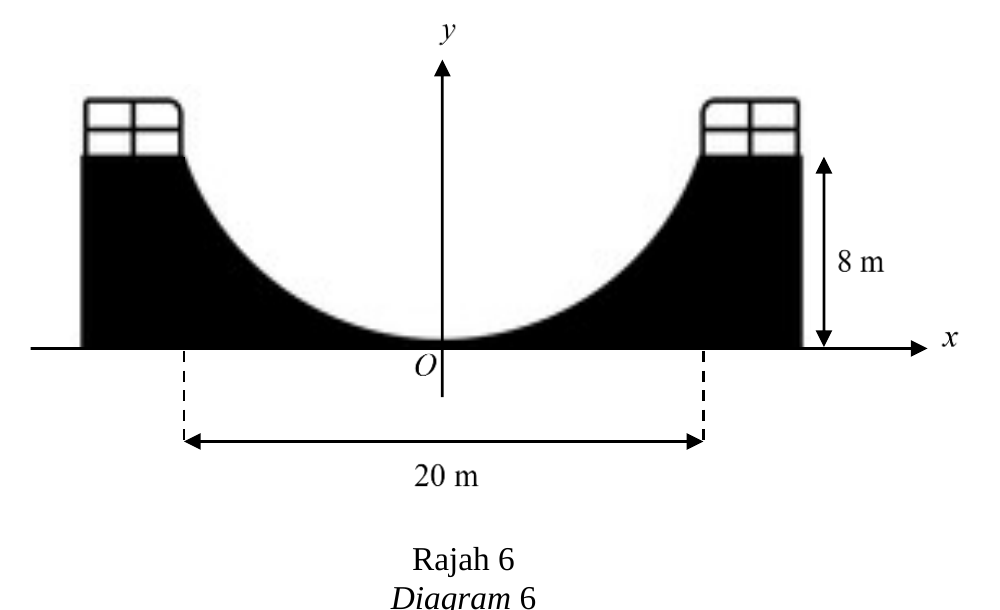
- (a)
Determine the equation of the curve represented by the skateboard ramp.
[3] - (b)
Calculate the area bounded by the curve of the skateboard ramp and y = 8.
[4] - (c)
Calculate the maximum volume of water, in terms of π, when the region bounded by the curve y = f(x), the straight line y = 8 and the y-axis is rotated through 360° about the y-axis.
[3]
Diagram 3 shows the straight line y = −x + 2 intersecting the curve y = (x − 2)(x − 2) at point A.
Medium10 marks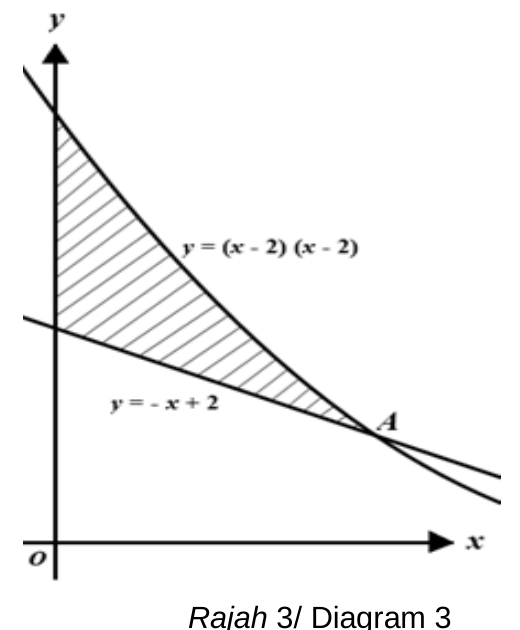
- (a)
Find the coordinates of A.
[3] - (b)
Find the area of the shaded region.
[4] - (c)
Find the volume generated, in terms of π, when the region bounded by the curve, the x-axis, the y-axis and the straight line x = 1 is revolved through 360° about the x-axis.
[3]
The gradient function of a curve y = f(x) is 2x + k. (a) Find the equation of the curve y = f(x) at the point (3, 10) in terms of k. (b) (i) Given the area bounded by the curve y = f(x), the straight lines x = −2 and x = 4 and the x-axis is 30 unit², find the value of k. (ii) Hence, find the volume generated, in terms of π, when the region bounded by the curve y = f(x) and the straight lines x = 0 and x = 4 is revolved through 360° about the y-axis.
Medium10 marks- (a)
Find the equation of the curve in terms of k. [3 marks]
[3] - (b)(i)
Find the value of k. [(b): 7 marks]
[3] - (b)(ii)
Hence find the volume generated, in terms of π, when the region between the curve, x = 0 and x = 4 is revolved through 360° about the y-axis.
[4]
(a) Given that d/dx(2x⁴ − 4/x) = 8x³ + 4/x². Find ∫(2x³ + 1/x²) dx. (b) Given ∫ from −1 to k of g(x) dx = 10. Find the value of k such that ∫ from −1 to k of [3 − g(x)] dx = 8.
Medium5 marks- (a)
Find ∫(2x³ + 1/x²) dx. [2 marks]
[2] - (b)
Find the value of k. [3 marks]
[3]
The diagram shows part of the curve y = (8/3)x − 4 − x²/3 cutting the x-axis at points A and B. (a) Find the coordinates of the turning point of the curve. (b) Find the area of the shaded region (between the curve and the x-axis from A to B).
Medium7 marks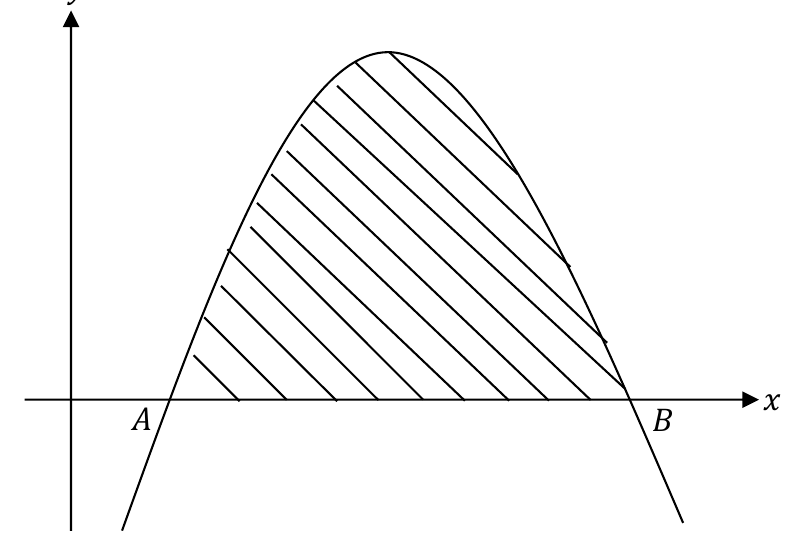
- (a)
Find the coordinates of the turning point of the curve.
[3] - (b)
Find the area of the shaded region.
[4]
The diagram shows part of the curve y² = 2x + 4 and the straight line y = x − 2 intersecting at points P and Q (R is where the curve crosses the y-axis). Find (a) the coordinates of P, Q and R, (b) the area of the shaded region, (c) the volume of revolution, in terms of π, when the region bounded by the curve and the y-axis is revolved through 180° about the x-axis.
Medium10 marks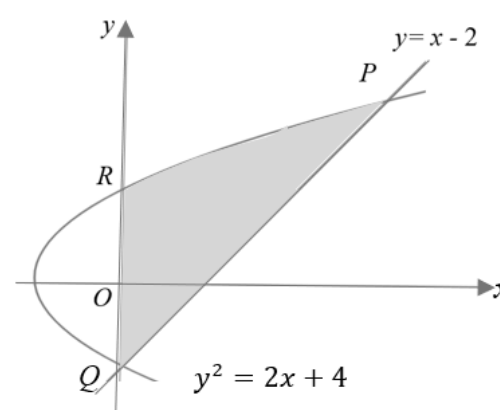
- (a)
Find the coordinates of P, Q and R.
[3] - (b)
Find the area of the shaded region.
[4] - (c)
Find the volume of revolution, in terms of π.
[3]
Diagram 2 shows the curve y = 4 − x² and a straight line y = mx + c that is tangent to the curve at point R(1, 3). Region A is the shaded region between the tangent, the curve and the y-axis; region B is the shaded region between the tangent, the curve and the x-axis [as shown in the diagram].
Medium10 marks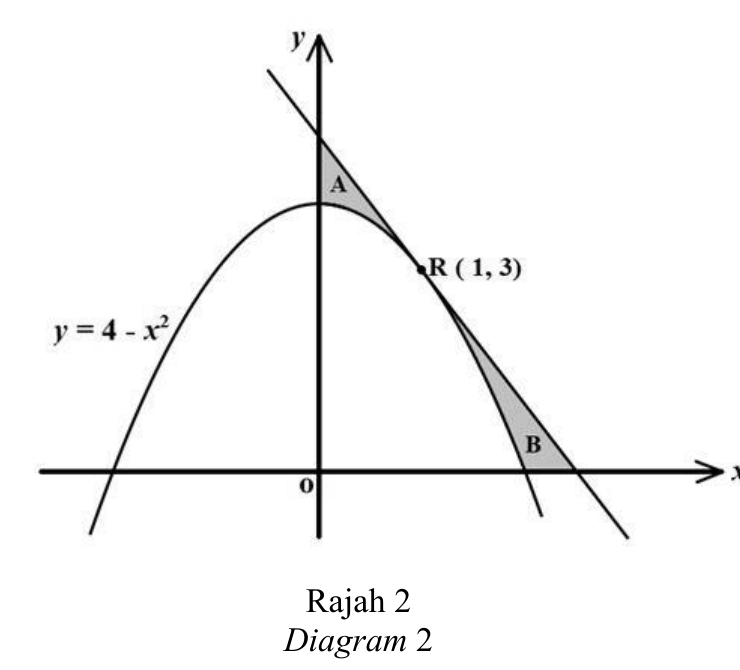
- (a)
Find the value of m and of c.
[2] - (b)
Find the area of region A.
[4] - (c)
Find the volume generated, in terms of π, when regions A and B are revolved through 180° about the y-axis.
[4]
Diagram 3 shows part of the curve y = f(x) which passes through R(h, 1) and cuts the y-axis at y = 10. The straight line RS is parallel to the y-axis (S is on the x-axis). The curve has a gradient function of −2x. Find (a) the value of h, (b) the area of the shaded region (bounded by the curve, the axes and RS) which is integrated with respect to x.
Medium7 marks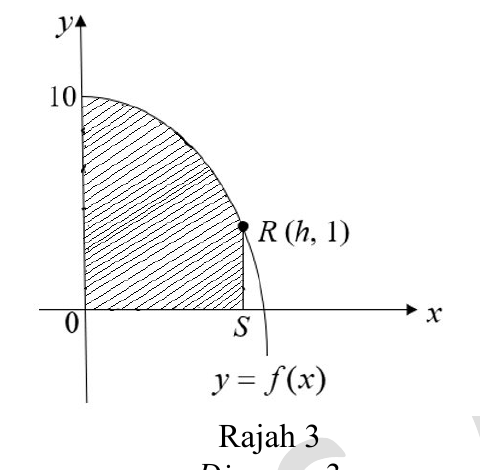
- (a)
Find the value of h.
[4] - (b)
Find the area of the shaded region, integrated with respect to x.
[3]
Diagram 4 shows a cross-section of a crater used to cook rice during a feast, represented by y = kx². The crater is 120 cm wide at the top and 40 cm high; points A(−p, q) and B(p, q) lie on the curve, with the shaded region between the curve, the floor and the verticals through A and B. (a) Find the value of k. (b) Given the area of the shaded region is 925.92 cm², find the value of p and of q. Give your answers to the nearest integer. (c) The surface above the crater is circular and water can be filled up to the line AB. Determine the volume of water, in cm³, that can be filled in the crater.
Hard10 marks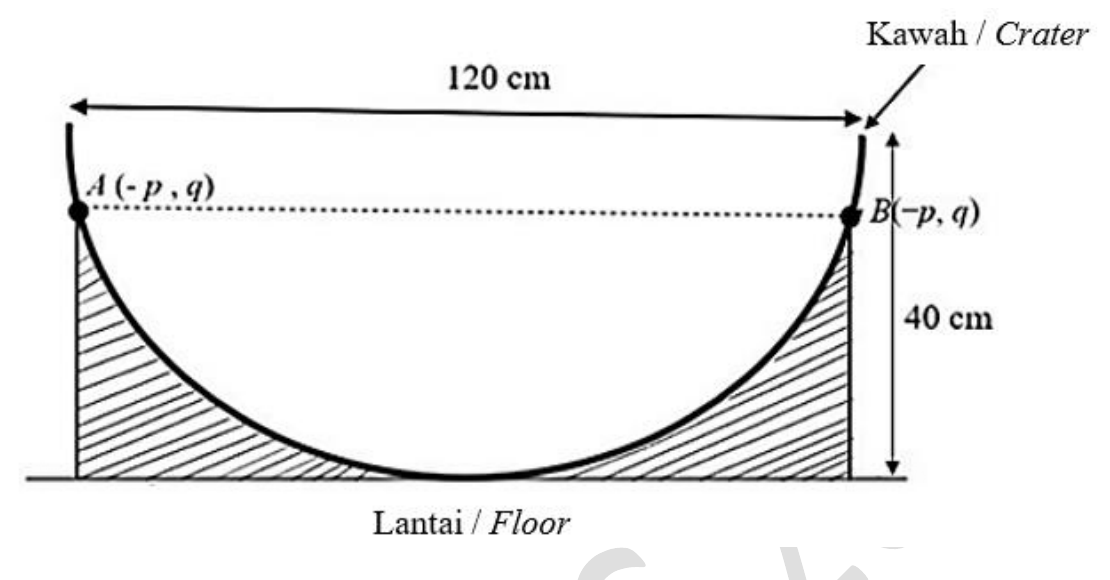
- (a)
Find the value of k.
[2] - (b)
Find the value of p and of q.
[4] - (c)
Determine the volume of water, in cm³.
[4]
(a) Given that ∫ 1/(1 − 2x)³ dx = (1/p)(1 − 2x)^q + c, find the values of p and q. (b) Hence, find the value of ∫ from −1 to 1 of 1/(1 − 2x)³ dx.
Medium5 marks- (a)
Given that ∫ 1/(1 − 2x)³ dx = (1/p)(1 − 2x)^q + c, find the values of p and q.
[3] - (b)
Hence, find the value of ∫ from −1 to 1 of 1/(1 − 2x)³ dx.
[2]
Diagram 5 shows the line 2y = 6 − x and the curve x = y² + 3 intersecting at B; the line meets the x-axis at A. The shaded region R is bounded by the y-axis, the line and the curve above the x-axis.
Hard10 marks- (a)
Find the coordinates of point B.
[3]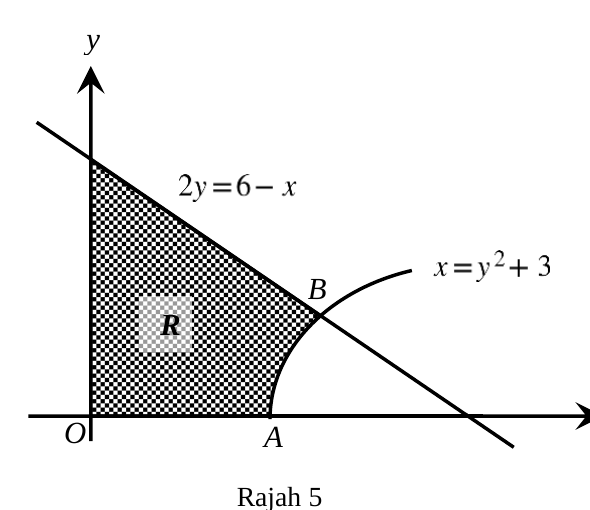
- (b)
Find the area of the shaded region R.
[4] - (c)
Find the volume generated, in terms of π, when the region bounded by the curve x = y² + 3, the straight line x = 4 and the x-axis is revolved through 360° about the x-axis.
[3]
Given the gradient function for a curve is ax + b. The slope of the curve at the point (−2, 7) is −8 and the slope of the curve at the point (0, 5) is 6. Find the value of a and the value of b. Next, find the equation for the curve.
Easy6 marksFind a and b, then the equation of the curve.
[6]
(a) Given the equation of a curve is y = ⅔ + x(4 − ⅔x). Find the coordinates of the turning point. Hence, determine whether the turning point is a maximum or minimum point by using the sketching tangent method. (b) Diagram 4 shows the curve of y = 4/x². Find (i) the area of the shaded region (under the curve between x = 2 and x = 4), (ii) the volume generated when the shaded area is rotated through 360° about the x-axis.
Medium10 marks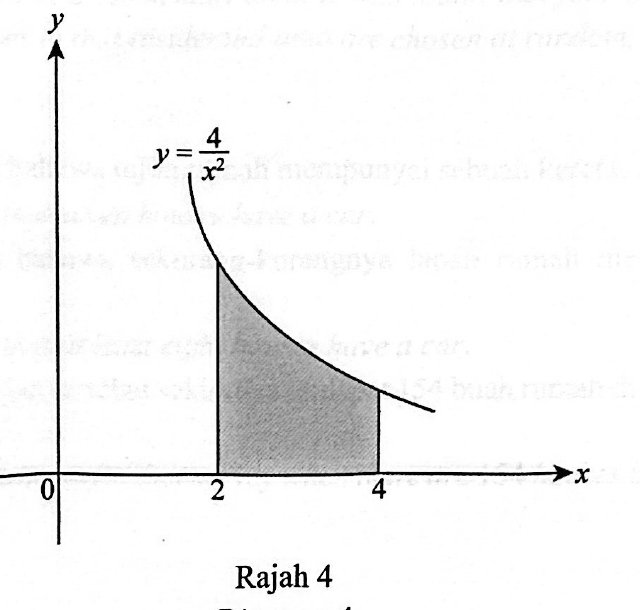
- (a)
Find the coordinates of the turning point and determine whether it is a maximum or minimum point using the sketching tangent method.
[4] - (b)(i)
Find the area of the shaded region.
[3] - (b)(ii)
Find the volume generated when the shaded area is rotated through 360° about the x-axis.
[3]
Diagram 2 shows part of the curve y = 3x². P, Q and R show areas under the graph and OA : OB = 5 : 2, with B(2k, 0) and C(8, 0). (a) Show that the area of Q is −10k² + 40k and find k if the area of Q is 40 unit². (b) Hence, find the area of R.
Easy5 marks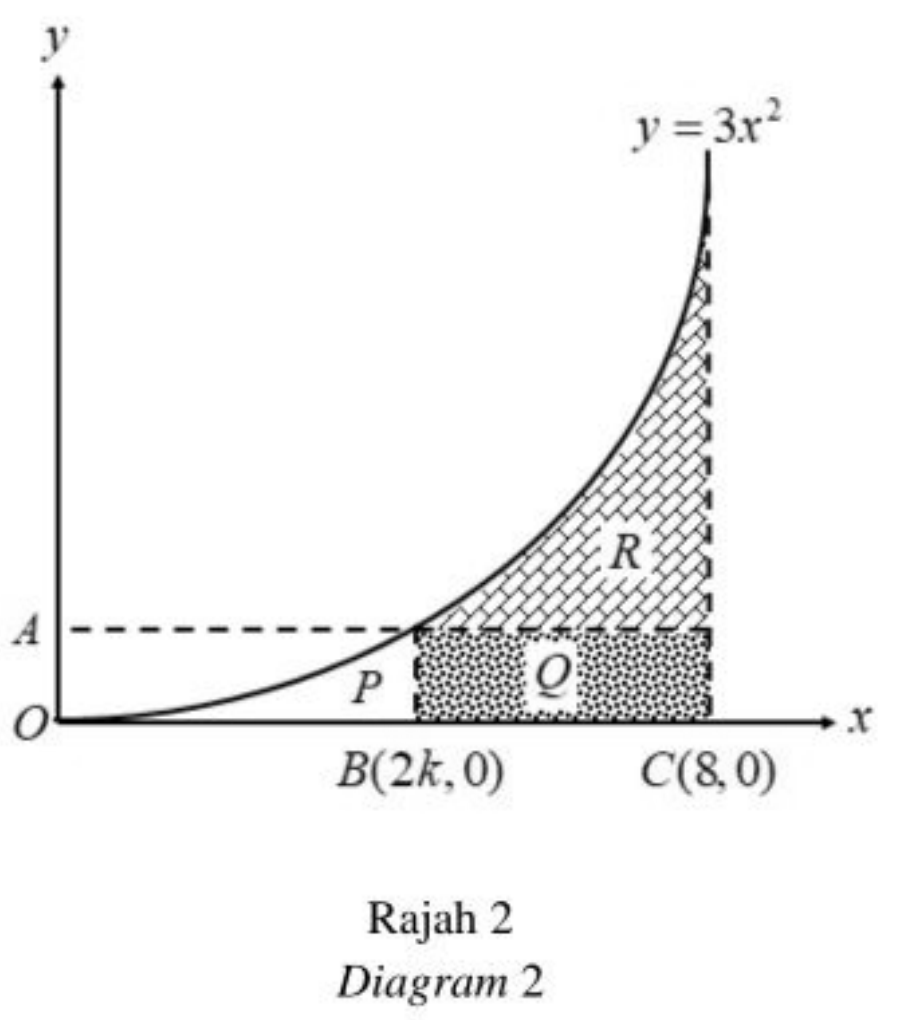
- (a)
Show that the area of Q is −10k² + 40k and find the value of k if the area of Q is 40 unit².
[3] - (b)
Hence, find the area of R.
[2]
Diagram 3 shows the straight line 2y + x = 7 intersecting part of the curve y − 2 = x² at point B. The straight line AB is parallel to the x-axis. Find (a) the coordinates of point B, (b) the area of the shaded region, (c) the volume of revolution, in terms of π, when the shaded region is rotated through 360° about the y-axis.
Hard10 marks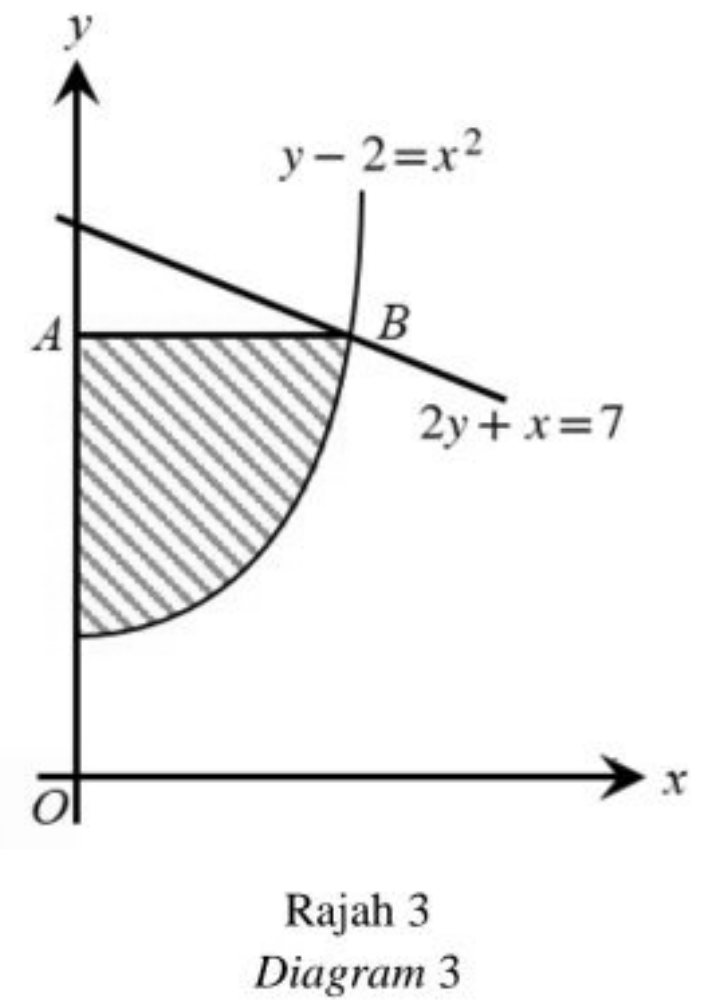
- (a)
Find the coordinates of point B.
[3] - (b)
Find the area of the shaded region.
[4] - (c)
Find the volume of revolution about the y-axis, in terms of π.
[3]
(a) ∫ from 5 to k of (y − 5) dy = 8. (b) ∫ from −1 to 4 of g(x) dx = 20.
Easy5 marks- (a)
Given ∫₅ᵏ (y − 5) dy = 8, find the values of k.
[3] - (b)
Given ∫₋₁⁴ g(x) dx = 20, find ∫₋₁² 3g(x) dx + ∫₂⁴ 3g(x) dx.
[2]
Diagram 9 shows the straight line y = x + 11 intersecting the curve y = f(x) at A(−2, 9). The gradient function of the curve is 2x. Region M is bounded by the curve, the line, the x-axis and the y-axis; region N is bounded by the curve, the straight line AB and the y-axis.
Medium10 marks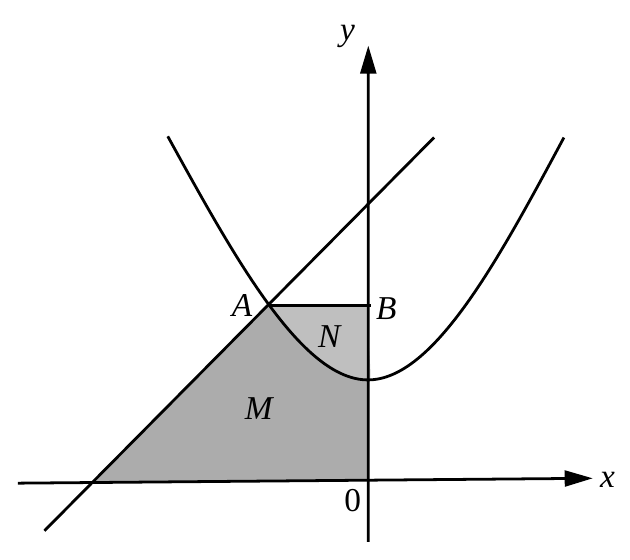
- (a)
Find the equation of the curve.
[3] - (b)
Find the area of the shaded region M.
[4] - (c)
Find the volume of revolution, in terms of π, when the shaded region N, bounded by the curve, the straight line AB and the y-axis, is revolved through 360° about the y-axis.
[3]
Given d²y/dx² = x + 3, dy/dx = 5 and y = −11 when x = −2. Express y in terms of x.
Medium5 marksExpress y in terms of x.
[5]
Diagram 9 shows part of the curve y = 2x² − 8 and the straight line y = 2x + 4. (a) Calculate the area of the shaded region. (b) The region enclosed by the curve, the x-axis, the y-axis and the straight line y = h is revolved through 360° about the y-axis. Find the volume of revolution, in terms of π.
Medium10 marks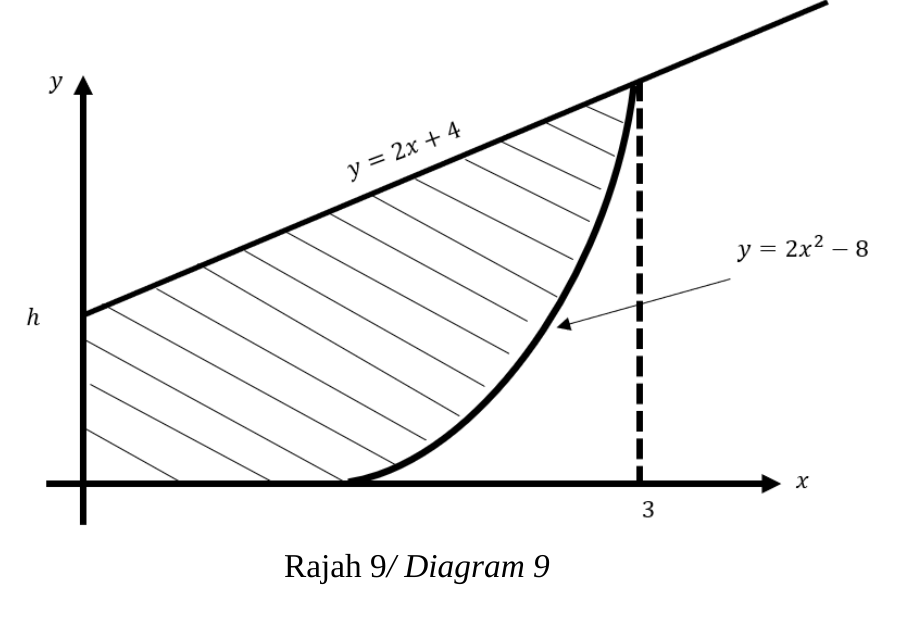
- (a)
Area of the shaded region.
[6] - (b)
Volume of revolution about the y-axis, in terms of π.
[4]
Given ∫ from 3 to 5 of f(x) dx = 10 and ∫ from 3 to 5 of 3[f(x) − qx] dx = 6, find (a) the value of q, (b) (1/2) ∫ from 5 to 3 of f(x) dx + 10.
Easy5 marks- (a)
Find q.
[3] - (b)
Find (1/2)∫ from 5 to 3 of f(x) dx + 10.
[2]
Diagram 9 shows the straight line y/6 − x/6 = 1 intersecting the curve 4y = x² + 12 at point A. B lies on the y-axis. (a) Find the coordinates of A. (b) Calculate (i) the area of shaded region P, (ii) the volume of revolution, in terms of π, when the shaded region Q is rotated through 360° about the y-axis.
Medium10 marks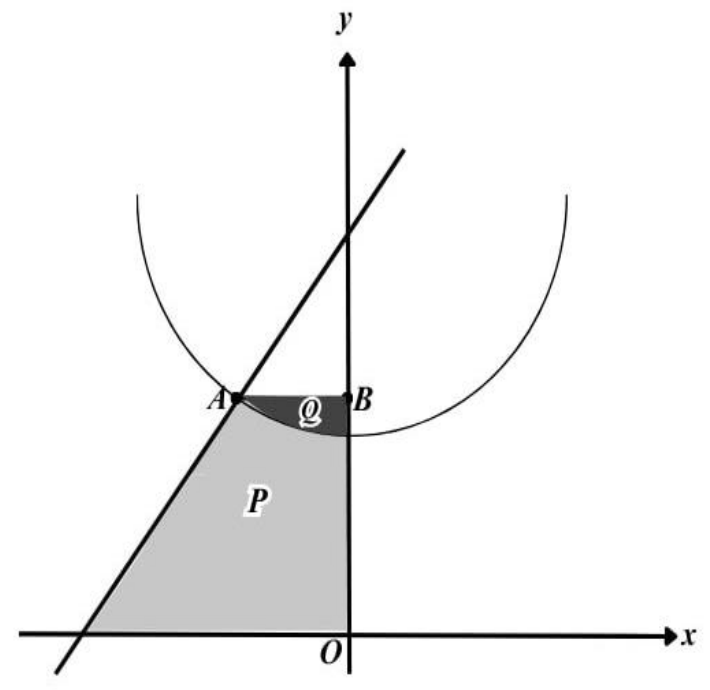
- (a)
Find the coordinates of A.
[2] - (b)(i)
Area of shaded region P.
[4] - (b)(ii)
Volume of revolution of shaded region Q about the y-axis.
[4]
(a) Evaluate ∫ from 1 to 2 of 2(x − 3)(x + 3)/(3x²) dx. (b) Given y = (2x − 1)/x² and dy/dx = 2g(x), where g(x) is a function in terms of x, find the value of ∫ from −1 to 1 of g(x) dx.
Easy5 marks- (a)
Evaluate ∫ from 1 to 2 of 2(x − 3)(x + 3)/(3x²) dx.
[2] - (b)
Given y = (2x − 1)/x² and dy/dx = 2g(x), find the value of ∫ from −1 to 1 of g(x) dx.
[3]
Diagram 9 shows the straight line y = x intersecting the curve y = 2x² − 4x at point A. (a) Find the coordinates of A. (b) Find the area of the shaded region. (c) Find the volume of revolution, in terms of π, when the shaded region enclosed by y = 2x² − 4x, y = x and y = 0 is revolved through 360° about the x-axis.
Medium10 marks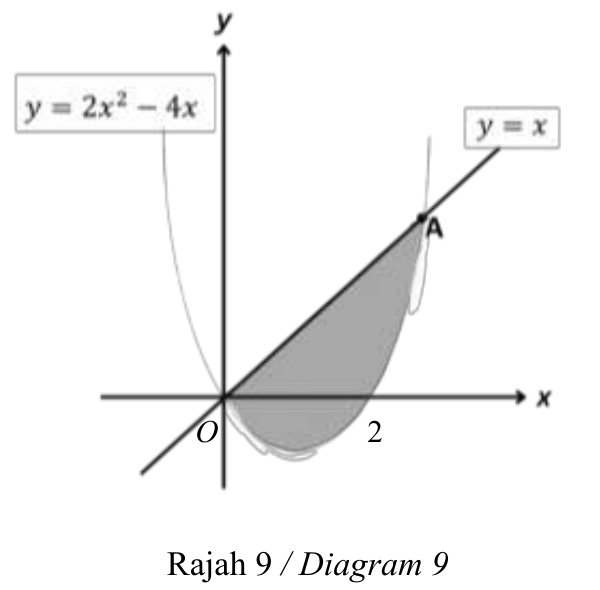
- (a)
Find the coordinates of A.
[2] - (b)
Find the area of the shaded region.
[4] - (c)
Find the volume of revolution, in terms of π.
[4]
(a) Given y = 5x/(x² + 1) and dy/dx = g(x), find the value of ∫₀³ 2g(x) dx. (b) Find ∫₄ᵃ (x + 1) dx, in terms of a.
Medium6 marks- (a)
Given y = 5x/(x² + 1) and dy/dx = g(x), find the value of ∫₀³ 2g(x) dx.
[3] - (b)
Find ∫₄ᵃ (x + 1) dx, in terms of a.
[3]
Diagram 9 shows part of curve y = f(x) which passes through Q(1, 3). The straight line PQ is parallel to the x-axis. The curve has a gradient function of 2x. Find (a) the equation of the curve, (b) the area of the shaded region, (c) the volume of revolution, in terms of π, when the shaded region is revolved through 360° about the y-axis.
Medium10 marks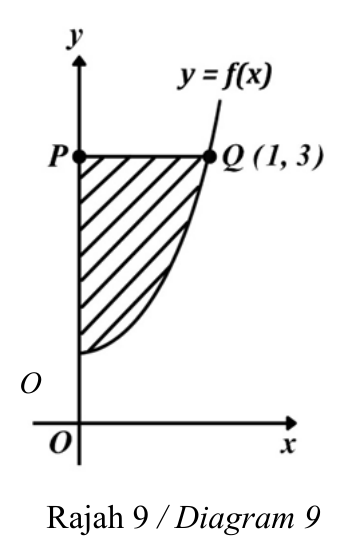
- (a)
Find the equation of the curve.
[3] - (b)
Find the area of the shaded region.
[4] - (c)
Find the volume of revolution, in terms of π, when the shaded region is revolved through 360° about the y-axis.
[3]
In Diagram 4, the straight line KL is normal to the curve y = x² + 1 at point A(1, 3). The straight line AM is parallel to the y-axis (M on the x-axis; L is (p, 0) on the x-axis; K is on the y-axis). Find (a) the value of p, (b) the area of the shaded region.
Medium7 marks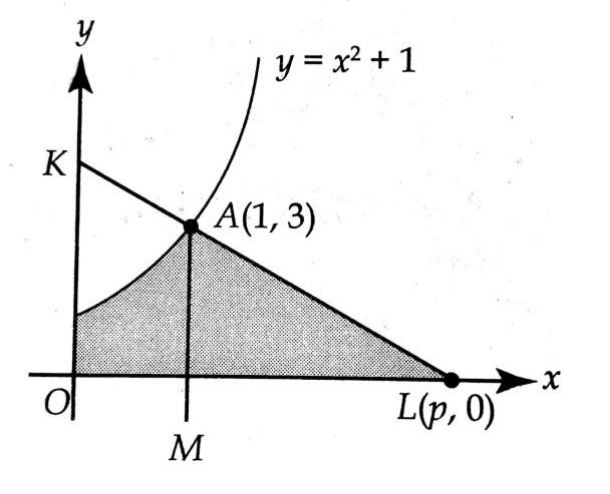
- (a)
Find the value of p.
[4] - (b)
Find the area of the shaded region.
[3]
Diagram 10 shows the shaded region bounded by the curve y = g(x), the x-axis and the straight line x = 3. The curve cuts the x-axis at x = 1; the shaded region lies below the x-axis. The area of the shaded region is 10 units². (a) Find ∫ from 1 to 3 of [x − 2g(x)] dx. (b) Given g′(x) = 2x − 8, find g(x) in terms of x.
Easy6 marks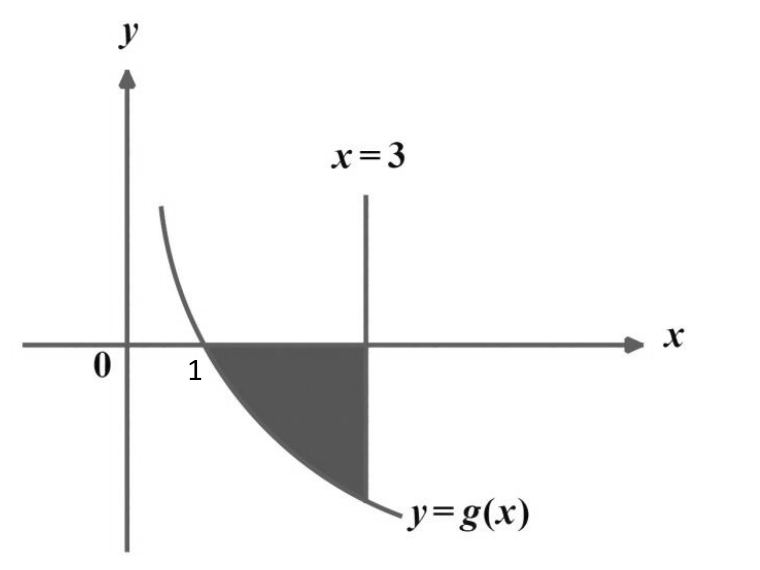
- (a)
Find ∫ from 1 to 3 of [x − 2g(x)] dx.
[3] - (b)
Given g′(x) = 2x − 8, find g(x) in terms of x.
[3]
(a) Diagram 7 shows part of the curve x = f(y). The area of the shaded region (to the left of the y-axis, between y = 1 and y = 3) is 5 unit². Find the value of ∫ from 1 to 3 of 2f(y) dy. (b) The gradient function of a curve is px² − 2x, where p is a constant. Given that the curve passes through the points S(1, 6) and T(−2, −15), find the equation of the curve.
Medium7 marks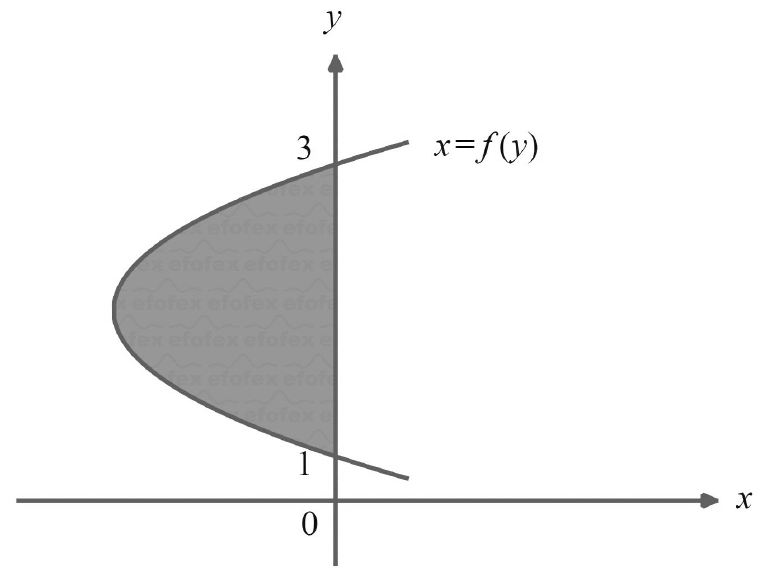
- (a)
Find the value of ∫ from 1 to 3 of 2f(y) dy.
[2] - (b)
Find the equation of the curve.
[5]
Given ∫₁⁵ m(x) dx = 9, find (a) the value of ∫₅¹ (2/3) m(x) dx, (b) the value of k, if ∫₁⁵ 3k dx = 23.
Easy4 marks- (a)
Find the value of ∫₅¹ (2/3) m(x) dx.
[2] - (b)
Find the value of k, if ∫₁⁵ 3k dx = 23.
[2]
(a) Diagram 5a shows part of the curve y = 27 − (x − 2)³ intersecting the x-axis at point P. Find (i) the coordinates of P, (ii) the area of the shaded region (bounded by the curve, the axes and the line x = 0). (b) Diagram 5b shows the shaded region bounded by the curve y = √(3x + 4), the lines x = k and x = 4 and the x-axis. When the shaded region is rotated through 360° about the x-axis, the volume generated is 26π unit³. Find the value of k.
Medium10 marks- (a)(i)
Find the coordinates of P.
[2]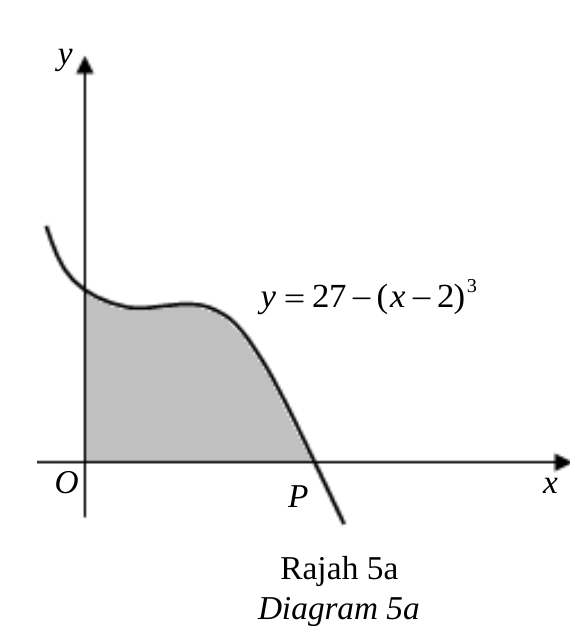
- (a)(ii)
Find the area of the shaded region.
[4] - (b)
Find the value of k (volume generated = 26π unit³).
[4]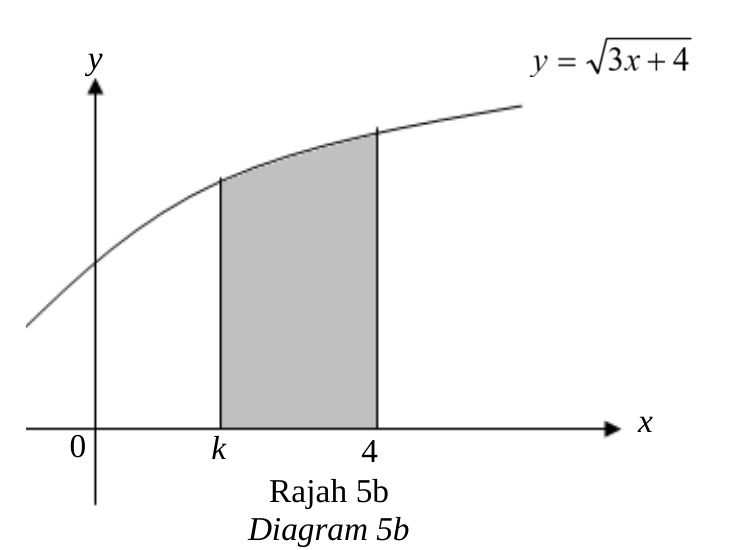
Given ∫₃⁶ g(x) dx = 7/2, find (a) the value of ∫₆³ (1/4) g(x) dx, (b) the value of q such that ∫₃⁶ 2q dx = 16.
Easy4 marks- (a)
Find ∫₆³ (1/4) g(x) dx.
[2] - (b)
Find q such that ∫₃⁶ 2q dx = 16.
[2]
Diagram 3 shows the straight line y = x + 4 intersecting the curve y = (x − 2)² at the points A and B. Find (i) the value of k, (ii) the area of the shaded region P, (iii) the volume generated, in terms of π, when the shaded region Q is revolved 360° about the x-axis.
Medium10 marks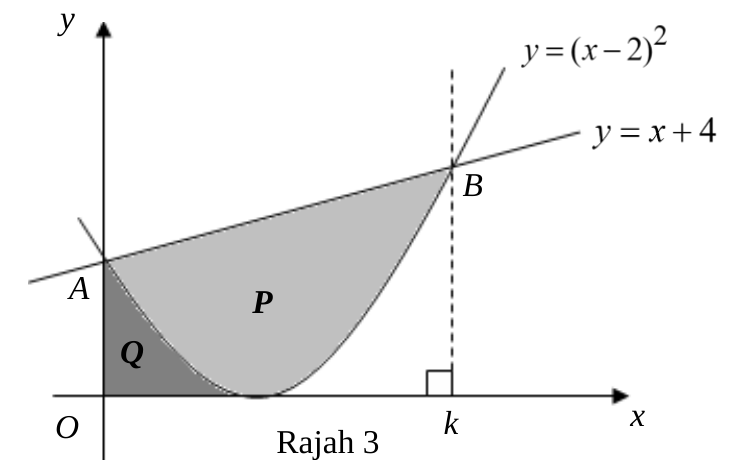
- (i)
Find the value of k.
[3] - (ii)
Find the area of the shaded region P.
[4] - (iii)
Find the volume generated when Q is revolved about the x-axis.
[3]
Given ∫₀² h(x) dx = 4 and ∫₁ᵘ f(x) dx = 3. Calculate (a) the value of ∫₀¹ h(x) dx − ∫₂¹ h(x) dx. (b) the value of u where u > 0, if ∫₀² 2h(x) dx + ∫₁ᵘ [f(x) + x] dx = 37/2.
Easy4 marks- (a)
Find ∫₀¹ h(x) dx − ∫₂¹ h(x) dx.
[1] - (b)
Find u (u > 0) if ∫₀² 2h(x) dx + ∫₁ᵘ [f(x) + x] dx = 37/2.
[3]
(a) Diagram 9(a) shows the curve y = x² − 6x + 16 and the curve y = 6x − x² intersect at points A and B. Find (i) the coordinates of the points A and B, (ii) the area bounded by the curve y = x² − 6x + 16 and the curve y = 6x − x². (b) Diagram 9(b) shows part of a curve y = √(x + 6), the straight line x = k, and the straight line AC (A on the x-axis at x = 3, C on the curve above A). When the shaded region is revolved 360° about the x-axis, the volume generated is 42½π unit³. Find the value of k.
Medium10 marks- (a)(i)
Find the coordinates of A and B.
[2]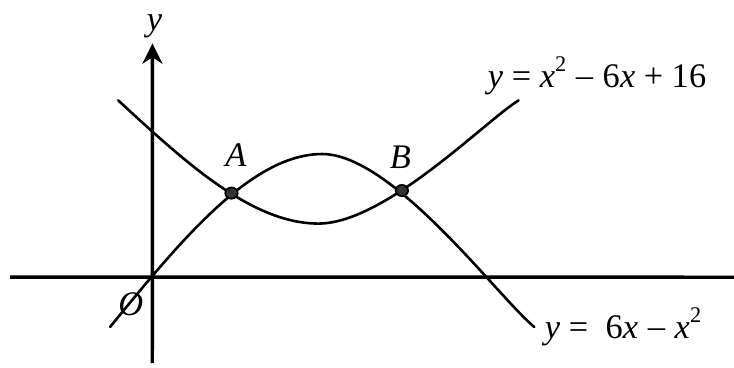
- (a)(ii)
Find the area bounded by the two curves.
[3] - (b)
Revolved 360° about the x-axis, the volume is 42½π. Find k.
[5]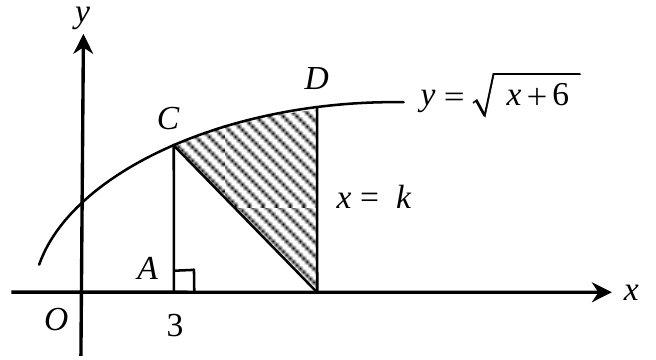
A curve has a gradient function of 4x³ − px, where p is a constant. The tangent to the curve at point (2, 5) is perpendicular to the straight line x + 8y = 1. Find (a) the value of p, (b) the equation of the curve.
Medium6 marks- (a)
Find the value of p.
[3] - (b)
Find the equation of the curve.
[3]
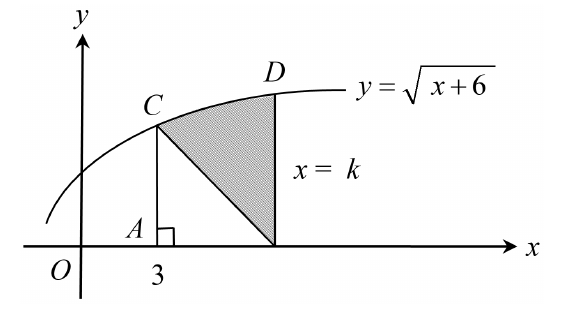
(a) Walter wants to make a door with a parabolic top (width 4 feet, total height 8 feet; assume point A is the origin). The gradient function of curve BC is px + 2, where p is a constant. (i) Find the equation of curve BC in the form y = ax² + bx + c, where a, b and c are constants. (ii) Calculate the cost to make the door if the price is RM30 per square foot. (b) The diagram shows part of the curve y = √(x + 6), the straight line x = k and the straight line AC (A on the x-axis at x = 3, C on the curve above A). When the shaded region is revolved 360° about the x-axis, the volume generated is 42½π unit³. Find the value of k.
Hard10 marks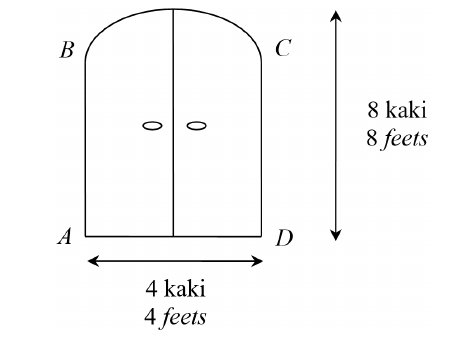
- (a)(i)
Find the equation of curve BC in the form y = ax² + bx + c.
[3] - (a)(ii)
Calculate the cost to make the door at RM30 per square foot.
[3] - (b)
Find the value of k.
[4]
Diagram 10 shows part of the curve y = 2/x² that intersects the straight line x = 4y at A. The shaded region P is bounded by the y-axis, the line y = 32, the curve and the line x = 4y.
Hard10 marks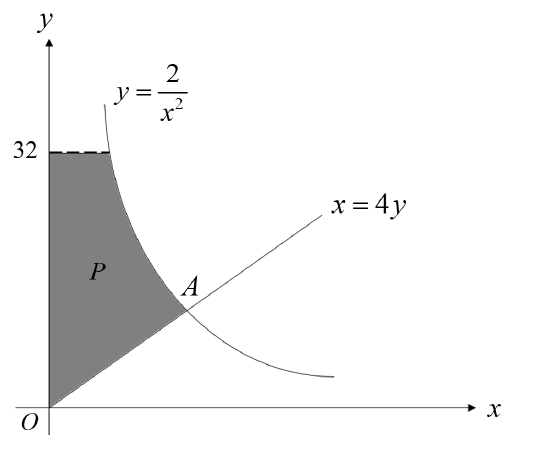
- (a)
Find the coordinates of the point A.
[2] - (b)
Calculate the area of the shaded region P.
[4] - (c)
Find the generated volume, in terms of π, when the shaded region P is rotated through 270° about the x-axis.
[4]
(a) Find the value of ∫ from −7/2 to −3 of (2p + 7)³ dp. (b) Given a curve y = g(x). The equation of the tangent to the curve is y = 10. Given that g′(x) = −x + 5, find the equation of the curve.
Easy7 marks- (a)
Find the value of ∫ from −7/2 to −3 of (2p + 7)³ dp.
[3] - (b)
Given a curve y = g(x) with tangent y = 10 and g′(x) = −x + 5, find the equation of the curve.
[4]
Diagram 9 shows a curve y = f(x) where f(x) = −x² − 7x − 10. The shaded regions lie between x = −7 and x = 0; region A is the part above the x-axis. Calculate (a) the total area of the shaded regions, (b) the volume of revolution, in terms of π, when the shaded region A is revolved through 360° about the x-axis.
Hard10 marks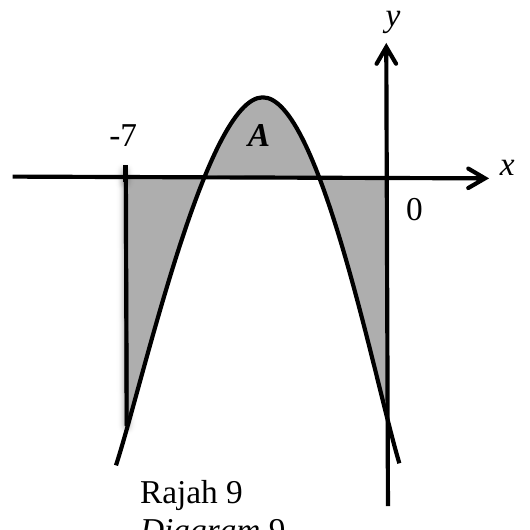
- (a)
Calculate the total area of the shaded regions.
[6] - (b)
Calculate the volume of revolution, in terms of π, when region A is revolved 360° about the x-axis.
[4]
Diagram 3 shows a part of the curve y = 12/x². The regions A, B and C lie between x = 1, 3, p and 5 as shown. Find (a) the area of region A, (b) the value of p such that the regions B and C have the same area.
Easy5 marks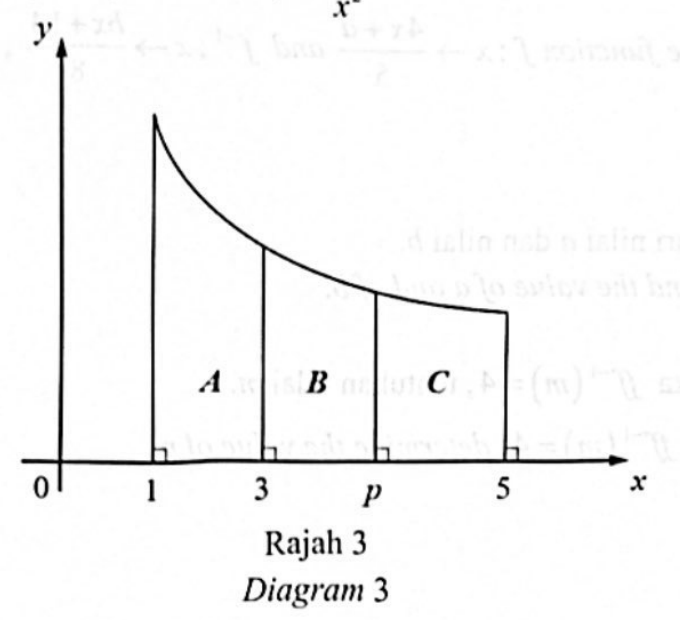
- (a)
Find the area of region A.
[2] - (b)
Find the value of p such that the regions B and C have the same area.
[3]
(a) Given d/dt [t²/(2(1 − t))] = 2g(t). Find ∫g(t)dt. (b) Diagram 3 shows part of the graph for the curve y = f(x) and y = g(x) intersecting at the point P. Given f(x) = 3x² and g(x) = 2x² + 1. (i) On Diagram 3, shade the region represented by ∫₀ᵃ g(x)dx − ∫₀ᵃ f(x)dx. (ii) Determine the coordinates of point P. (iii) Find the volume of revolution, in terms of π, when the region bounded by the curve y = g(x), the y-axis and the straight line y = 5 is revolved through 360° about the y-axis.
Medium7 marks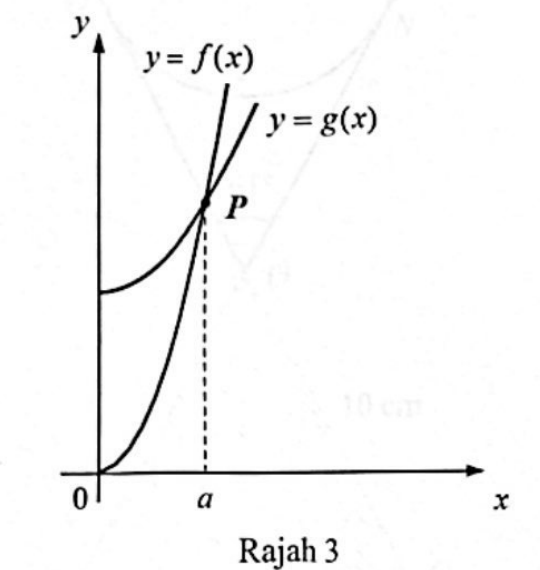
- (a)
Find ∫g(t)dt.
[2] - (b)(i)
Shade the region represented by ∫₀ᵃ g(x)dx − ∫₀ᵃ f(x)dx on Diagram 3.
[1]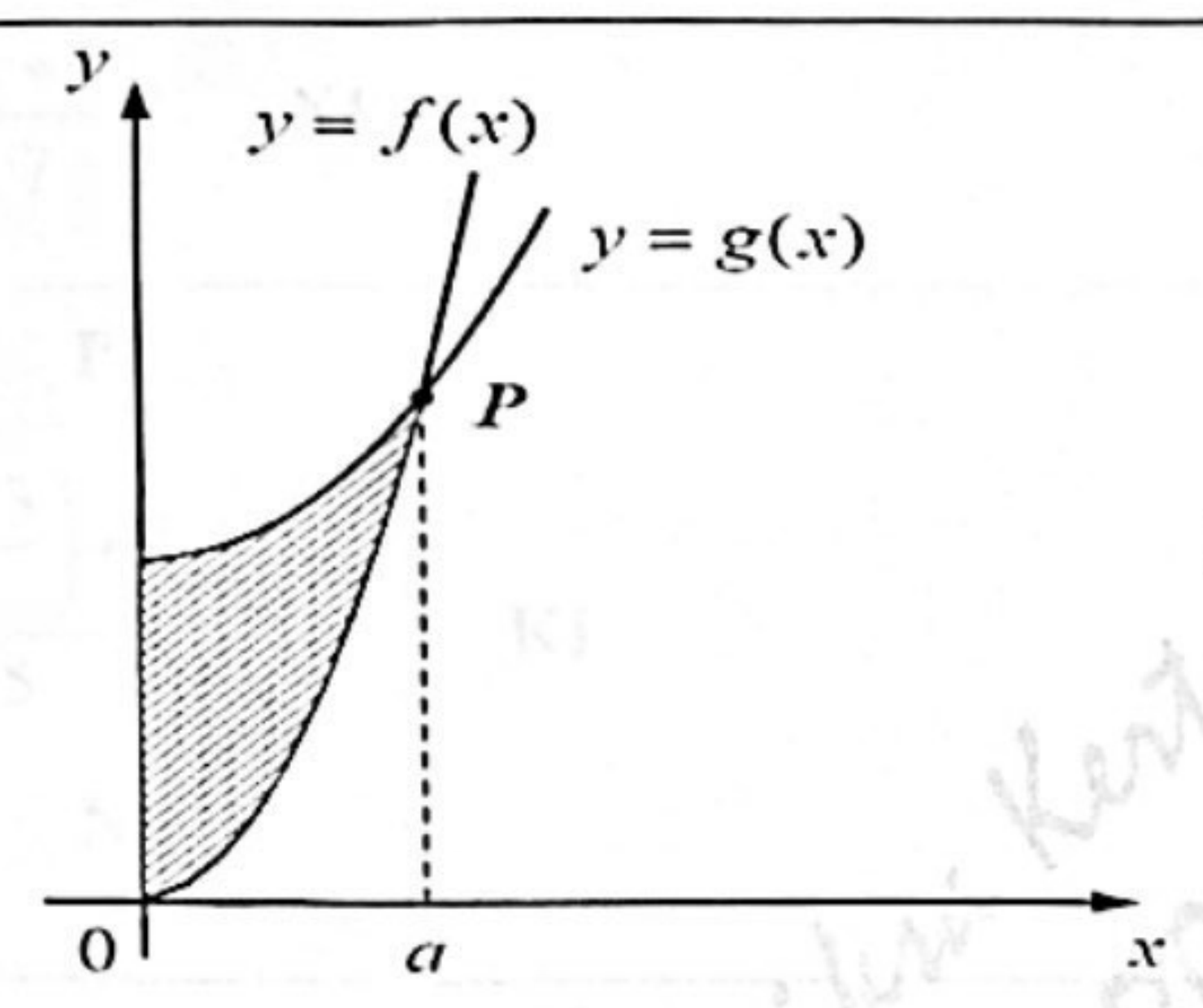
- (b)(ii)
Determine the coordinates of point P.
[1] - (b)(iii)
Find the volume of revolution, in terms of π, about the y-axis.
[3]
Diagram 4 shows the shaded region bounded by the straight line x = f(y) and curve x = g(y) from y = 2 to y = b. (a) Given that the area of the shaded region is 9/2 unit² and ∫(2 to b) (2/3)g(y) dy = 12, find the value of ∫(2 to b) f(y) dy. (b) Hence, find the value of b if d/dy[(3y² − 12y)/2] = f(y).
Medium6 marks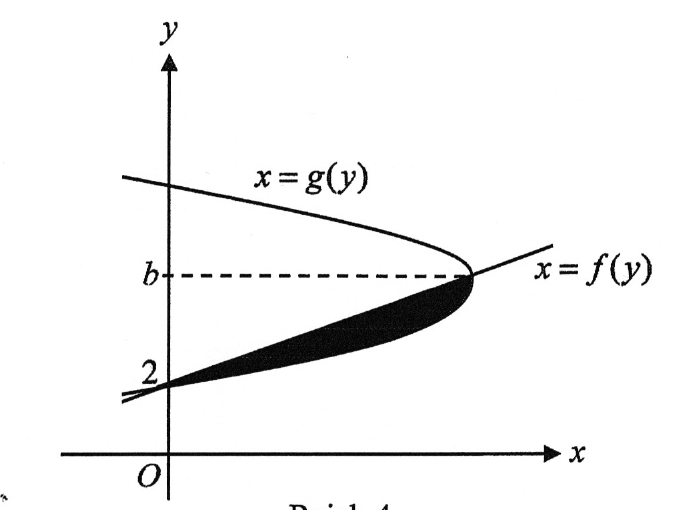
- (a)
Find the value of ∫(2 to b) f(y) dy.
[3] - (b)
Hence, find the value of b.
[3]
Diagram 4 shows part of a curve f(x) = −(x + 4)(x − 1)(x − 3) and PQR is the curve g(x) = −(1/3)(−2x + 6)². Both curves intersect y-axis and x-axis at point P and point Q. Find (a) the coordinates of P, (b) the area of the shaded region, (c) the volume generated, in terms of π, when the region bounded by the curve y = g(x), y-axis and x-axis is revolved through 360° about the x-axis.
Hard10 marks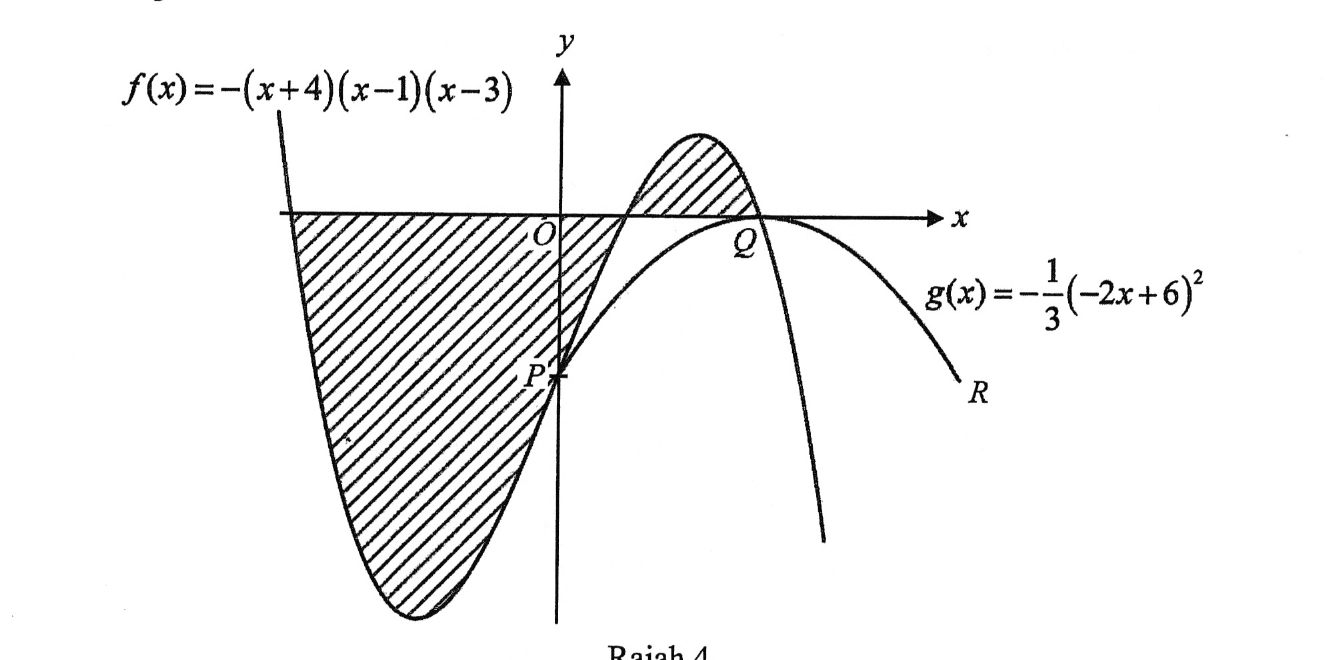
- (a)
Find the coordinates of P.
[2] - (b)
Find the area of the shaded region.
[4] - (c)
Find the volume generated, in terms of π.
[4]
Diagram 5 shows the curve y = x² + 3 intersects the straight line AC at point B. It is given that the equation of the straight line AC is y + x = 9 and the gradient of the curve at point B is 4. Find (a) the area of region P, (b) the generated volume, in term of π, when the region Q is revolved through 360° about the x-axis.
Medium5 marks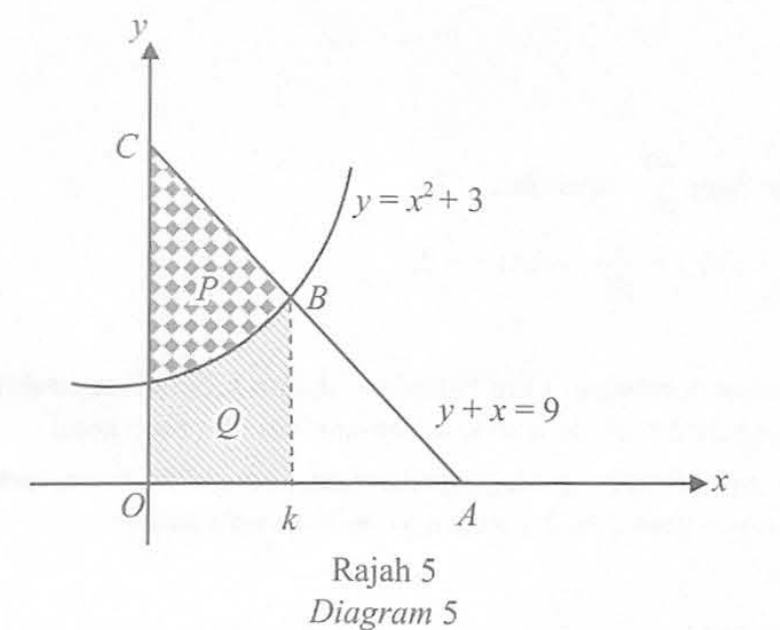
- (a)
Find the area of region P.
[3] - (b)
Find the generated volume, in term of π, when region Q is revolved through 360° about the x-axis.
[2]
Diagram 4 shows two curves y = x² and y² = 8x are intersecting at point A. The straight line AB is parallel to the y-axis. Find (a) the equation of the straight line AB, (b) area, in unit², of the shaded region, (c) the volume generated, in term of π, when region P, which bounded by the curve y = x², the straight line AB and the x-axis, is revolved 360° about the x-axis.
Medium8 marks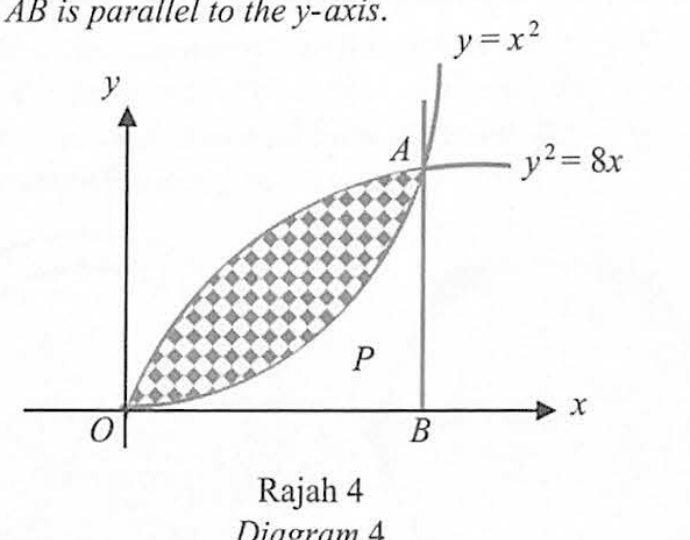
- (a)
Find the equation of the straight line AB.
[2] - (b)
Find the area, in unit², of the shaded region.
[3] - (c)
Find the volume generated, in term of π, when region P is revolved 360° about the x-axis.
[3]
Diagram 4 shows the shaded region bounded by the curve y = g(x), the x-axis and the straight line x = 3. Given that the area of the shaded region is 10 units². (a) Find ∫₁³ [x − 2g(x)] dx. (b) Given g′(x) = 2x − 8, find g(x) in terms of x.
Easy6 marks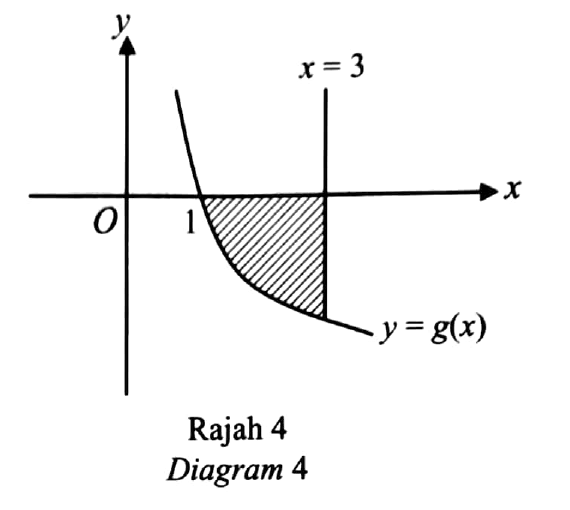
- (a)
Find ∫₁³ [x − 2g(x)] dx.
[3] - (b)
Given g′(x) = 2x − 8, find g(x) in terms of x.
[3]
Diagram 4 shows two curves y = x² and y = −x² + 4 are intersecting at point A. The straight line AB is parallel to the y-axis. Find (a) the equation of the straight line AB, (b) area, in unit², of the shaded region, (c) the volume generated when the region bounded by the curves y = x² and y = −x² + 4 is revolved 180° about the y-axis.
Medium8 marks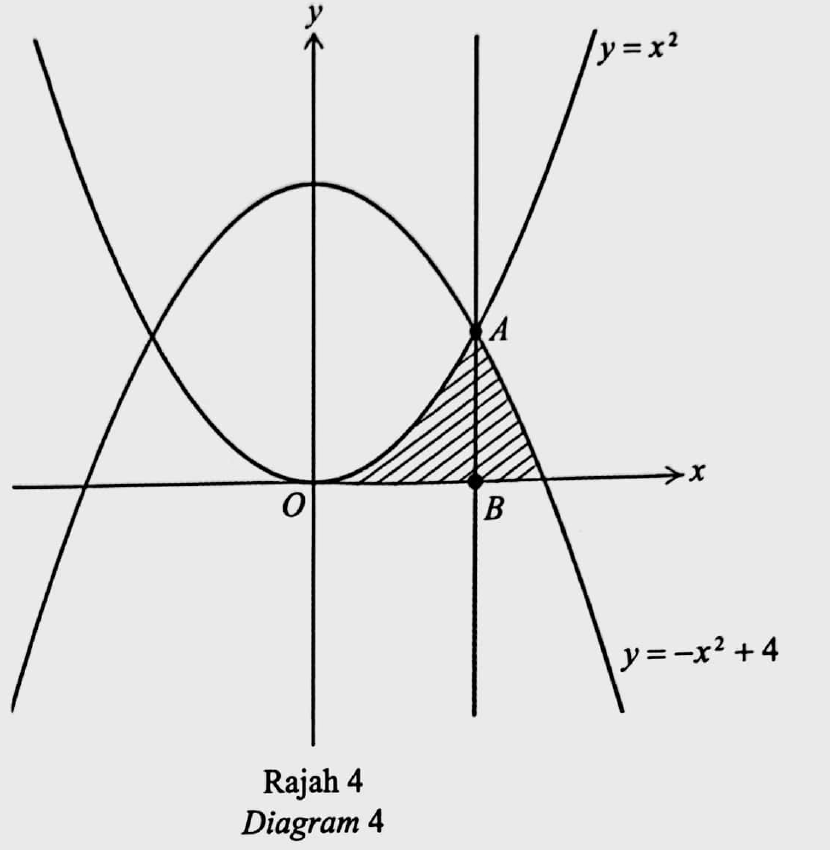
- (a)
Find the equation of the straight line AB.
[2] - (b)
Find the area, in unit², of the shaded region.
[3] - (c)
Find the volume generated when the region bounded by the curves y = x² and y = −x² + 4 is revolved 180° about the y-axis.
[3]
(a) It is given that d/dx((3x + 2)/(4x − 1)) = p/(4x − 1)², find the value of p. (b) It is given that ∫₁³ h(x) dx = k, such that k is a constant. Find (i) ∫₃¹ (h(x)/5) dx, in terms of k, (ii) the value of k if ∫₁³ [h(x) − kx] dx = 3. (c) Diagram 9 shows the curve y = 6x² and the straight line x = k. The area of shaded region is 54 unit². Find the value of k.
Medium8 marks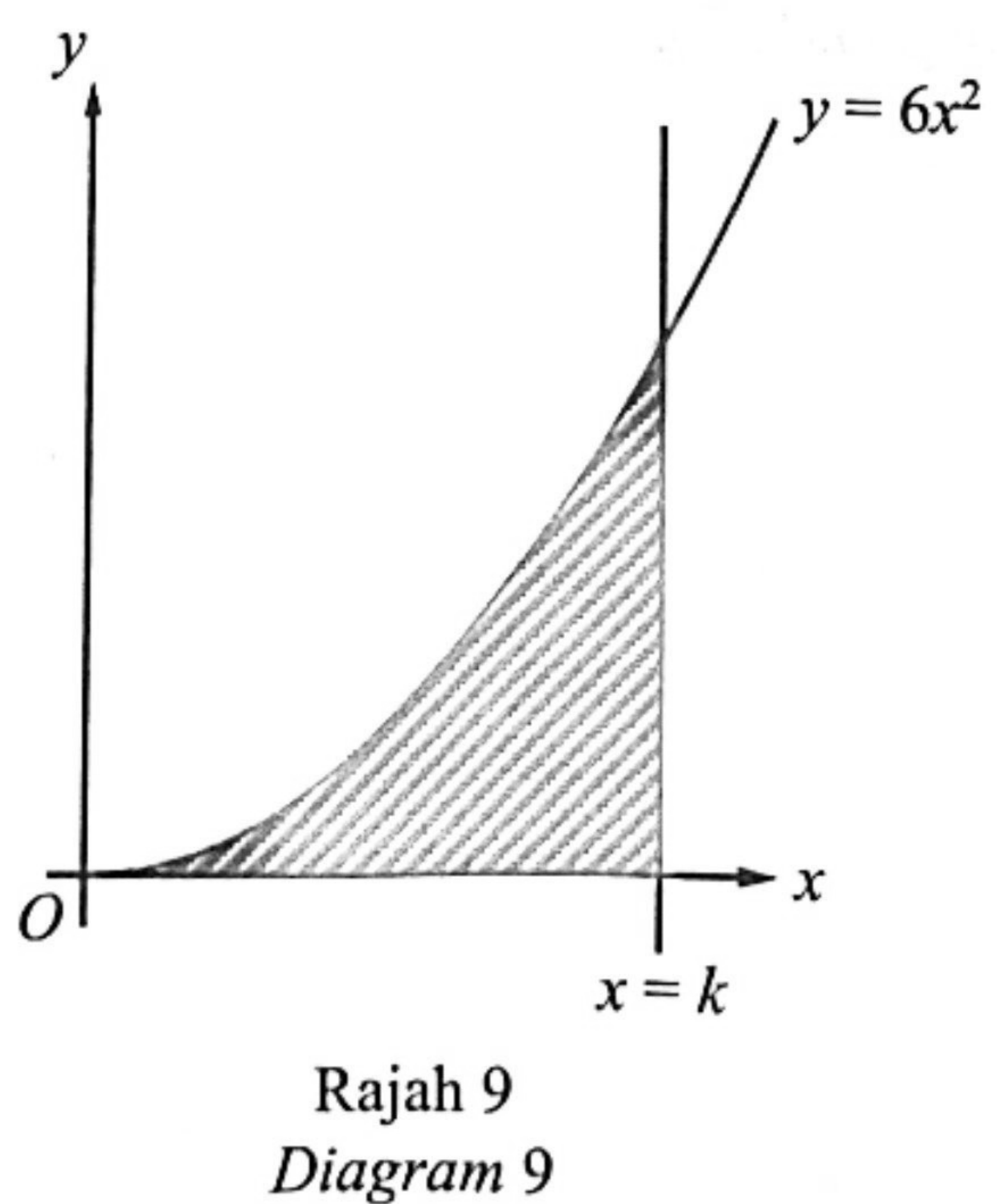
- (a)
Given d/dx((3x + 2)/(4x − 1)) = p/(4x − 1)², find the value of p.
[2] - (b)(i)
Given ∫₁³ h(x) dx = k, find ∫₃¹ (h(x)/5) dx in terms of k.
[1] - (b)(ii)
Find the value of k if ∫₁³ [h(x) − kx] dx = 3.
[2] - (c)
The curve y = 6x² and line x = k: the area of the shaded region is 54 unit². Find the value of k.
[3]
Diagram 11 shows the curve y = x² + 2 intersects the straight line y = 4 − x at point A(1, 3) and the y-axis at point B. Find (a) the area of the shaded region R (bounded by the y-axis, the curve from B to A, the line x = 1 from A down to the x-axis, the x-axis and the line y = 4 − x), (b) the volume generated, in terms of π, when the region bounded by the curve y = x² + 2, the straight line y = 3 and the y-axis is revolved through 360° about the y-axis.
Medium10 marks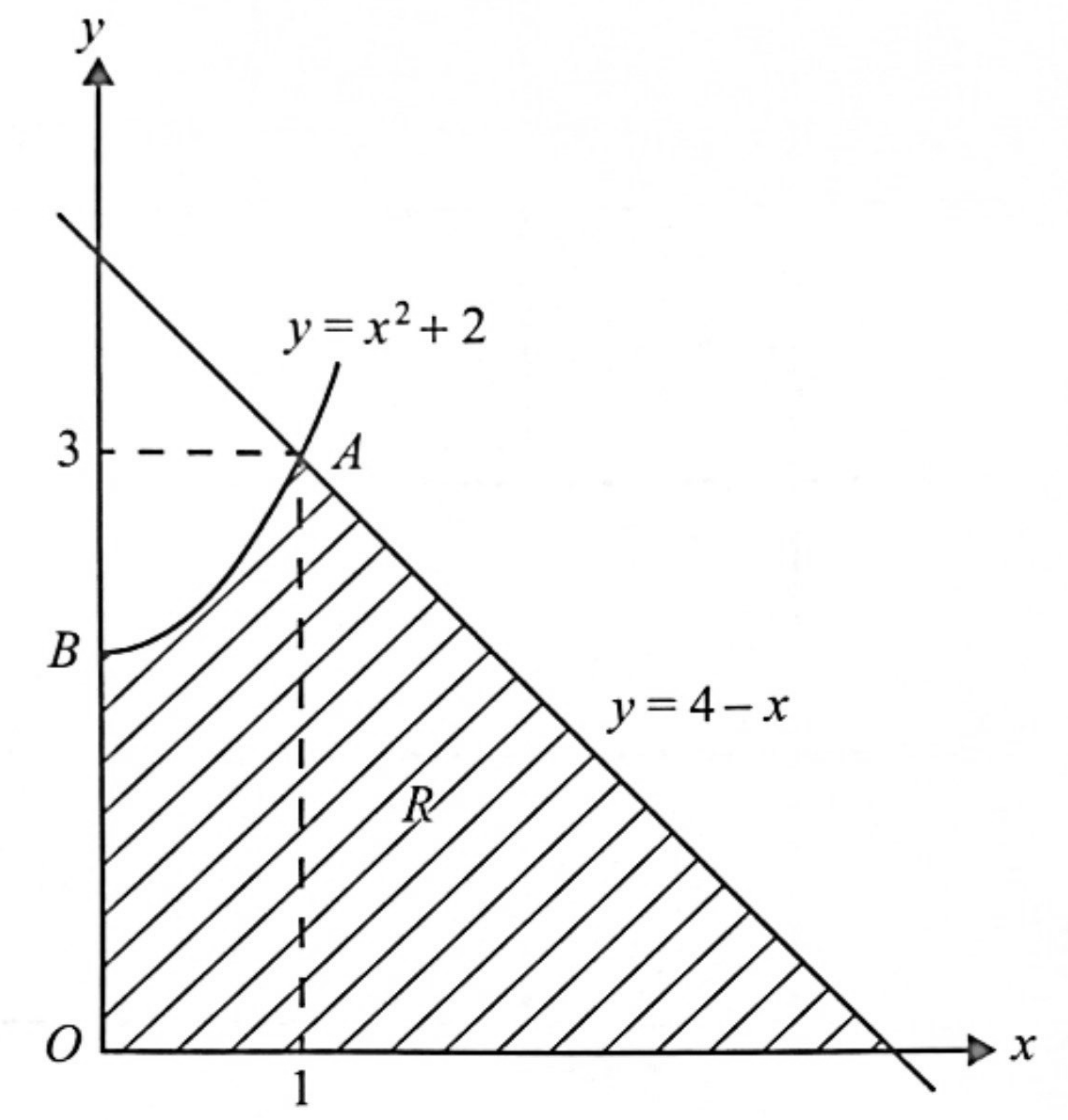
- (a)
Find the area of the shaded region R.
[6] - (b)
Find the volume generated, in terms of π, when the region bounded by y = x² + 2, y = 3 and the y-axis is revolved through 360° about the y-axis.
[4]
It is given that d/dx (2/(x + 5) − 3) = f(x), find ∫ from −1 to 2 of ½ f(x) dx.
Easy3 marksFind ∫ from −1 to 2 of ½ f(x) dx.
[3]
(a) It is given that the gradient function of a curve is (x + 1/x)². The curve passes through point (1, 2). Find the function of the curve. (b) Diagram 3 shows a curve y = x³ − x² + 3 and a straight line y = 2x + 3 intersect at the point A and point B(2, 7) where point A lies on the y-axis. Find the area of the shaded region.
Medium7 marks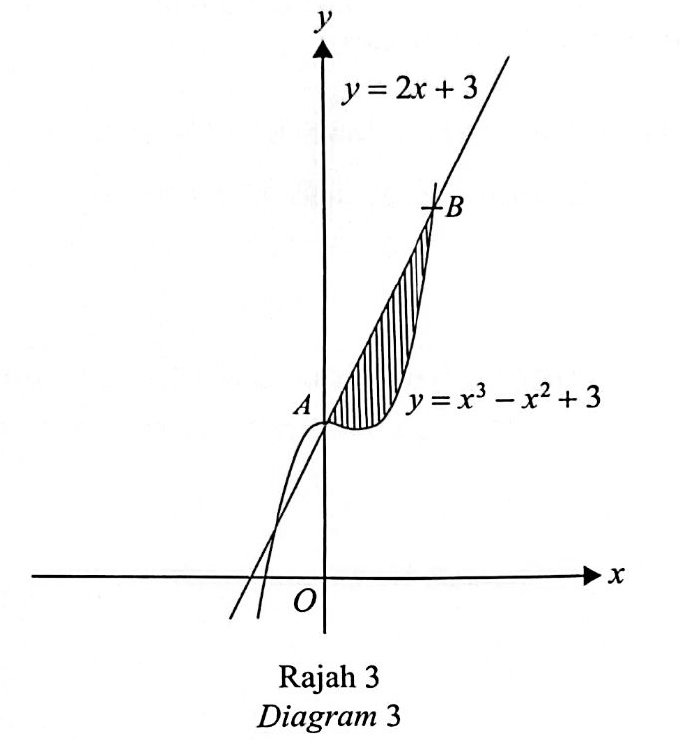
- (a)
Find the function of the curve.
[3] - (b)
Find the area of the shaded region.
[4]
Diagram 5 shows the curve y = 2x² + 1 and a straight line x + y = 4 intersect at point P. Find (a) the area of the shaded region J, (b) the volume generated, in terms of π, when the region K which is bounded by the curve y = 2x² + 1, the straight line PQ, the x-axis and the y-axis is revolved through 360° about the x-axis.
Medium6 marks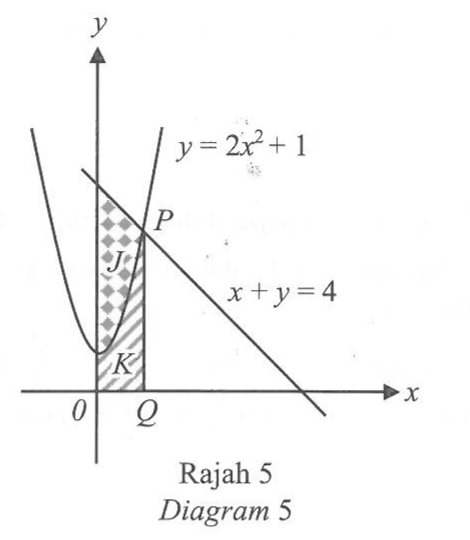
- (a)
the area of the shaded region J,
[3] - (b)
the volume generated, in term of π, when the region K which bounded by the curve y = 2x² + 1, the straight line PQ, x-axis and y-axis is revolved through 360° about the x-axis.
[3]
Diagram 5 shows two curves x = √y and x = y²/8 are intersecting at point A. The straight line AB is parallel to the x-axis. Find (a) the equation of the straight line AB, (b) the area, in unit², of the shaded region, (c) the volume generated, in term of π, when the region P, which bounded by the curve x = y²/8, the straight line AB and the y-axis, is revolved 360° about the y-axis.
Medium8 marks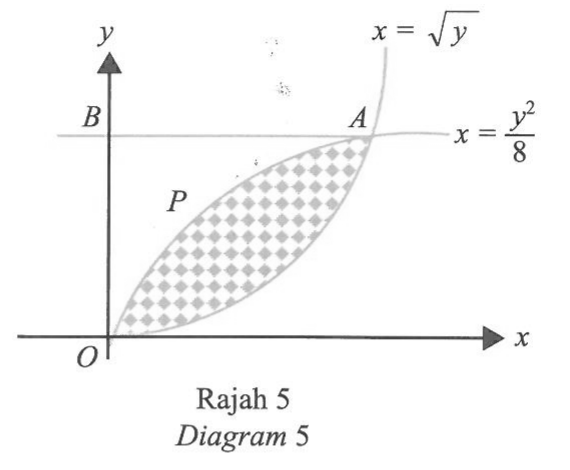
- (a)
the equation of the straight line AB,
[2] - (b)
area, in unit², of the shaded region,
[3] - (c)
the volume generated, in term of π, when the region P, which bounded by the curve x = y²/8, the straight line AB and the y-axis, is revolved 360° about the y-axis.
[3]
Diagram 4 shows part of the curve y = f(x), which passes through Q(1, 3). The straight line PQ is parallel to the x-axis. The curve has a gradient function of 2x. Find (a) the equation of the curve, (b) the area of the shaded region.
Easy6 marks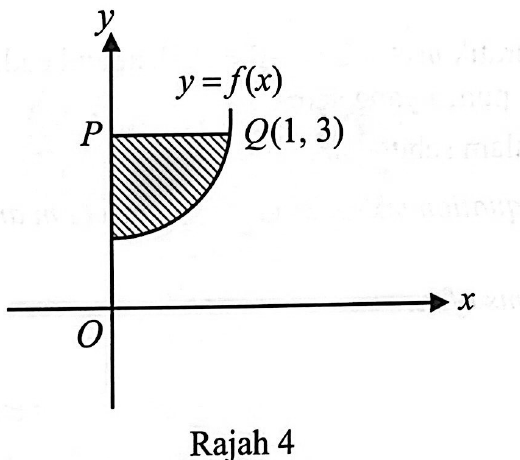
- (a)
Find the equation of the curve.
[3] - (b)
Find the area of the shaded region.
[3]
Diagram 4 shows two curves y = −x² and y = x² − 4 intersecting at point Q. The straight line PQ is parallel to the y-axis. Find (a) the equation of the straight line PQ, (b) area, in unit², of the shaded region, (c) the volume generated when the region bounded by the curves y = −x² and y = x² − 4 is rotated 180° about the y-axis.
Medium8 marks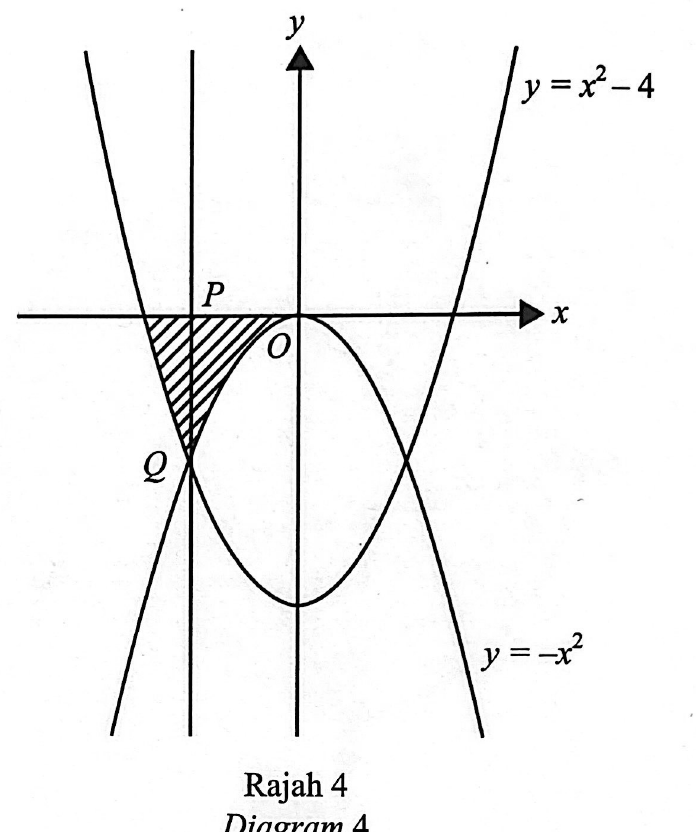
- (a)
Find the equation of the straight line PQ.
[2] - (b)
Find the area, in unit², of the shaded region.
[3] - (c)
Find the volume generated when the region bounded by the curves y = −x² and y = x² − 4 is rotated 180° about the y-axis.
[3]
Diagram 10 shows a cross-section of a trapezium shaped container which has a parabolic inner surface and a flat cover. The inner surface of the container represented by the function y = ax². It is given that the length of AB and CD are 12 cm and 8 cm respectively, AP = QB = 1 cm and the height of the container is 8 cm. Find (a) the value of a, (b) the area, in cm², of the shaded region, (c) the maximum volume of the rice, in term of π, that can be stored in the container if the cover of the container is tightly closed.
Hard8 marks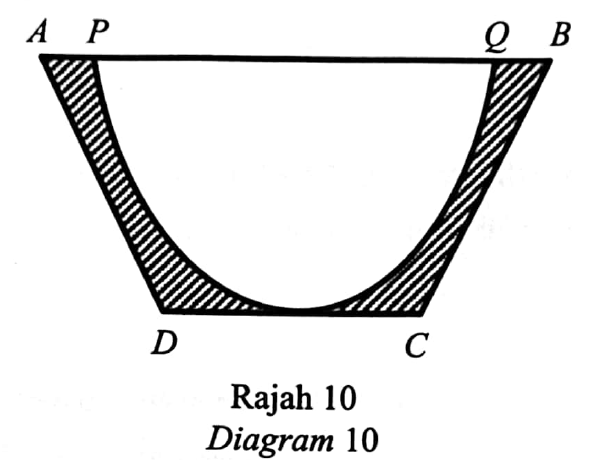
- (a)
Find the value of a.
[2] - (b)
Find the area, in cm², of the shaded region.
[4] - (c)
Find the maximum volume of the rice, in term of π, that can be stored in the container if the cover is tightly closed.
[2]
(a) Diagram 2 shows part of the curve x = f(y). Given that the area of the shaded region is 5 unit², find the value of ∫₃¹ 2f(y) dy. (b) The gradient function of a curve is px² − 2x, where p is a constant. Given that the curve passes through points S(1, 6) and T(−2, −15). Find the equation of the curve.
Easy7 marks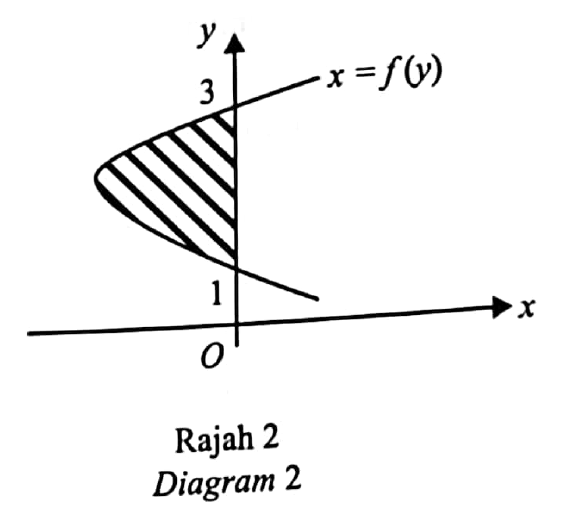
- (a)
Given that the area of the shaded region is 5 unit², find the value of ∫₃¹ 2f(y) dy.
[2] - (b)
The gradient function of a curve is px² − 2x, where p is a constant. Given that the curve passes through points S(1, 6) and T(−2, −15). Find the equation of the curve.
[5]
It is given that d/dx (2x/(1 − 3x) − 5) = f(x), find ∫ from −2 to 1 of 3f(x) dx.
Easy3 marksFind ∫ from −2 to 1 of 3f(x) dx.
[3]
(a) It is given that the gradient function of a curve is (x + 2/x)². The curve passes through point (1, 1). Find the function of the curve. (b) Diagram 3 shows a curve, y = −x³ − x² + 3 and a straight line y = −2x + 3 intersect at point A(−2, 7) and point B where point B lies on the y-axis. Find the area of the shaded region.
Medium7 marks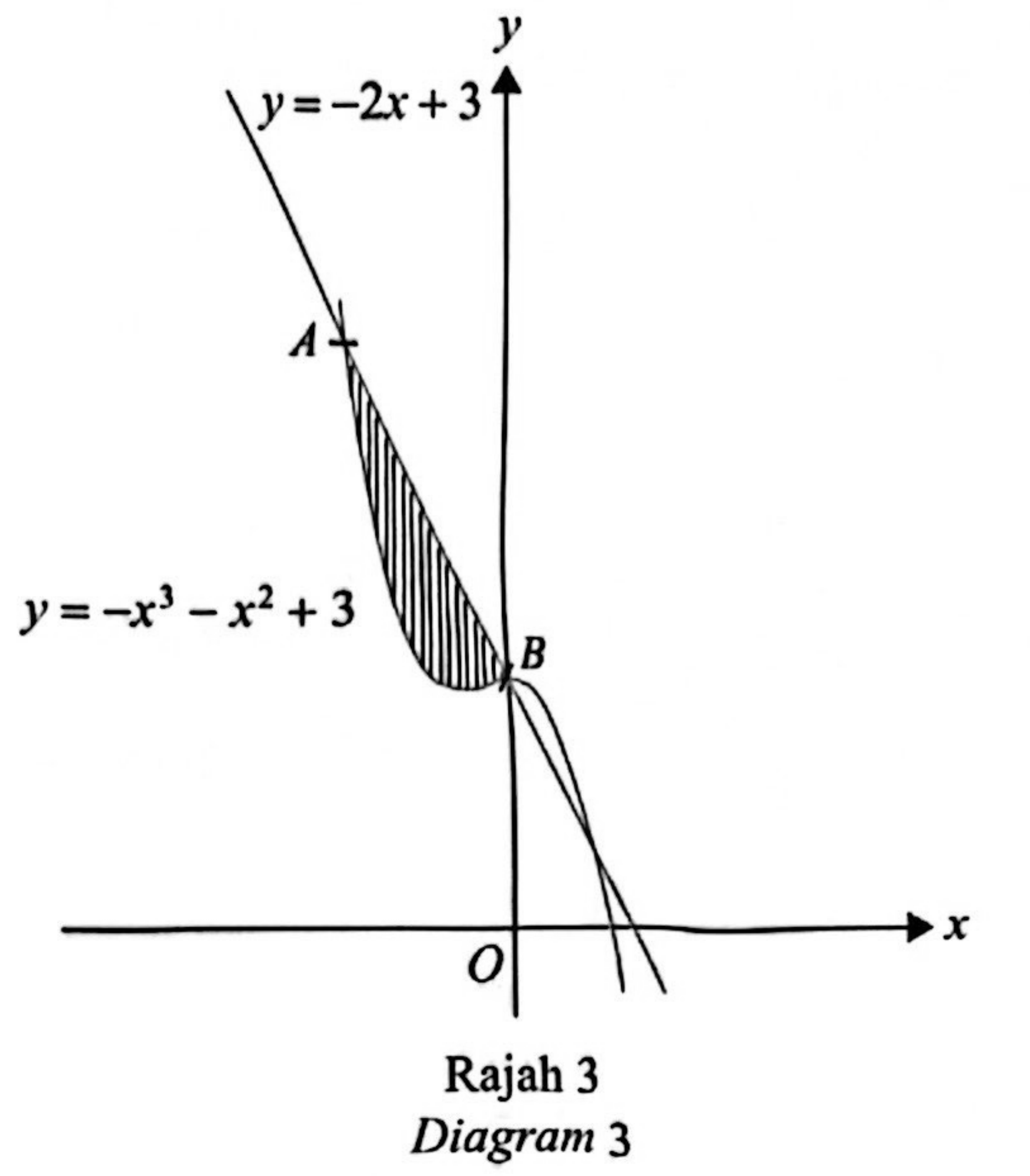
- (a)
Find the function of the curve with gradient function (x + 2/x)² passing through (1, 1).
[3] - (b)
Find the area of the shaded region.
[4]
Diagram 4 shows part of the curve y = f(x), which passes through L(2, 5). The straight line KL is parallel to the x-axis. The curve has a gradient function of −2x. Find (a) the equation of the curve, (b) the area of the shaded region.
Medium6 marks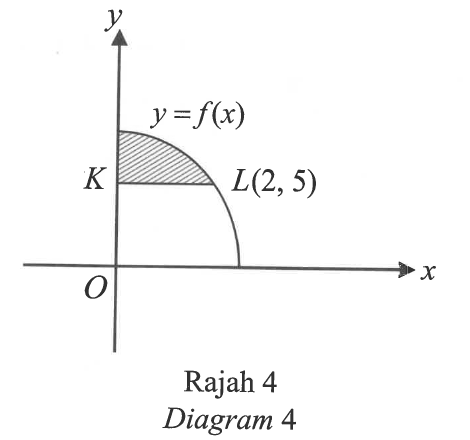
- (a)
Find the equation of the curve.
[3] - (b)
Find the area of the shaded region.
[3]
Diagram 4 shows two curves y² = x and y² = 4 − x intersecting at point Q. The straight line PQ is parallel to the x-axis. Find (a) the equation of the straight line PQ, (b) the area, in unit², of the shaded region, (c) the volume generated when the region bounded by the curves y² = x and y² = 4 − x is revolved 180° about the x-axis.
Medium8 marks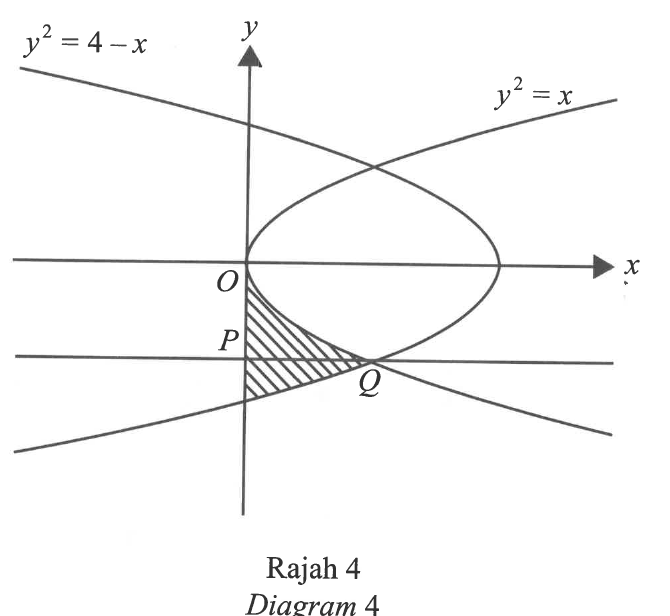
- (a)
Find the equation of the straight line PQ.
[2] - (b)
Find the area, in unit², of the shaded region.
[3] - (c)
Find the volume generated when the region bounded by the curves y² = x and y² = 4 − x is revolved 180° about the x-axis.
[3]
(a) Find ∫4(x + 1)² dx. (b) Hence, find the equation of the curve that passes through the point (0, −1).
Easy5 marks- (a)
Find ∫4(x + 1)² dx.
[2] - (b)
Hence, find the equation of the curve that passes through the point (0, −1).
[3]
Diagram 3 shows the curve x = 3y² + 2 and a straight line PQ parallel to the y-axis. P is the point on the curve where y = 2 and the shaded region is bounded by the curve, the y-axis and the lines y = 2 and y = −2.
Medium9 marks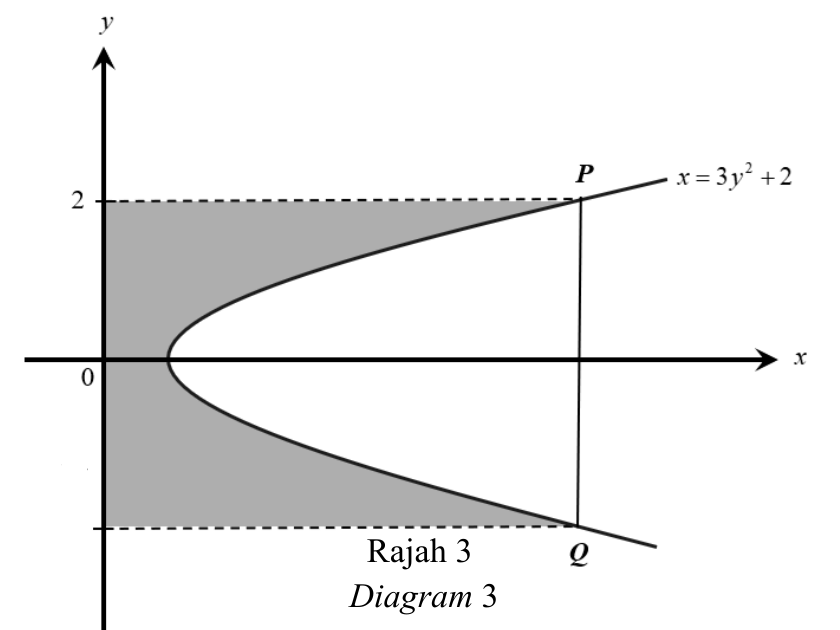
- (a)
Determine the coordinates of point Q.
[2] - (b)
Find the area of the shaded region.
[3] - (c)
Hence, find the volume generated when the shaded region is rotated through 360° about the y-axis.
[4]
(a) Diagram 3 shows the curve y = f(x). The area under the curve from x = a to x = b is represented by n rectangular strips of equal width, where n is a positive integer. Derive the formula of the area under the curve as n → ∞. (b) Hence, find the area of the shaded region in Diagram 4 (curve f(x) = 3/x², shaded between x = 1 and x = 4, above the x-axis).
Medium5 marks- (a)
Derive the formula of the area under the curve as n → ∞.
[3]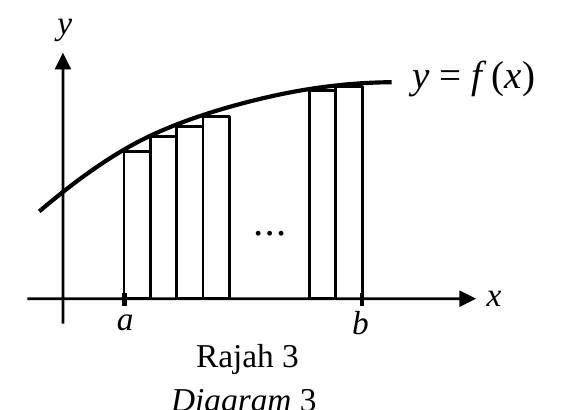
- (b)
Hence, find the area of the shaded region in Diagram 4.
[2]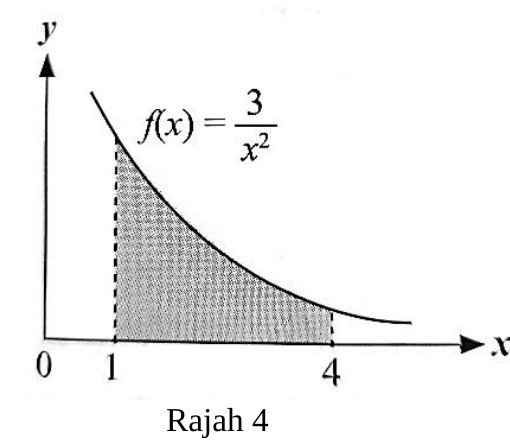
Diagram 2 shows a part of the curve y = −x² + 7 and the straight line y = (3/2)x. The curve meets the line at P and the y-axis at (0, 7); the shaded region is bounded by the curve, the line and the y-axis.
Medium10 marks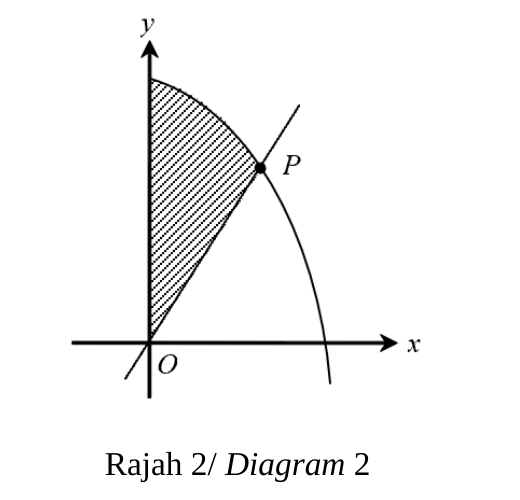
- (a)
Find the coordinates of P.
[2] - (b)
Find the area of the shaded region.
[4] - (c)
Find the volume of revolution, in terms of π, when the region bounded by the curve, the straight line y = 3 and the y-axis is revolved through 360° about the x-axis.
[4]
(a) The gradient function of a curve is 4x − 10 and the curve passes through (8, 4). Find the equation of the curve. (b) Given d/dx[5/(1 − x²)] = g(x), find ∫2g(x) dx. (c) Given ∫ₖ³... see parts.
Medium7 marks- (a)
Given that the gradient function of a curve is 4x − 10 and the curve passes through point (8, 4). Find the equation of the curve.
[3] - (b)
Given that d/dx[5/(1 − x²)] = g(x), find ∫2g(x) dx.
[1] - (c)
Given ∫ from 3 to k of f(y) dy = 3/2, find the value of k such that ∫ from 3 to k of [2 − f(y)] dy = 4.
[3]
Diagram 2 shows a straight line AC which is normal to the curve y = x²/2 + 1 at B(2, 3), meeting the x-axis at C(p, 0). Find (a) the value of p, (b) the area of the shaded region, (c) the volume of revolution, in terms of π, when the region bounded by the curve, the straight line y = 3 and the y-axis is revolved through 360° about the y-axis.
Medium10 marks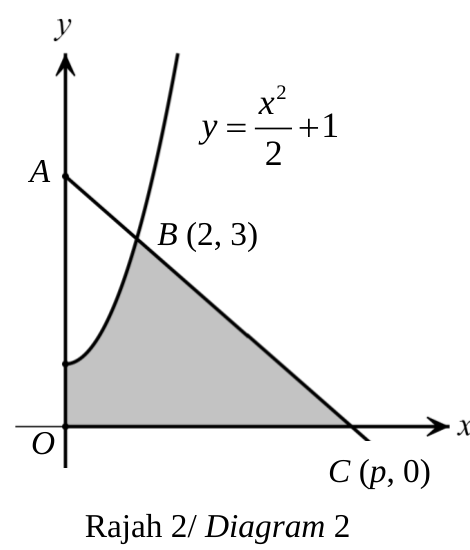
- (a)
Find the value of p.
[3] - (b)
Find the area of the shaded region.
[4] - (c)
Find the volume of revolution, in terms of π, when the region bounded by the curve, the straight line y = 3 and the y-axis is revolved through 360° about the y-axis.
[3]
(a) Given that the gradient function of a curve is 4x − 10 and the curve passes through the point (8, 4), find the equation of the curve. (b) Based on Diagram 14(b), find the area of the shaded region. (Region bounded by the curve y² = 8x, the line y = 4, the line x = 10 and the y-axis.)
Medium8 marks- (a)
Find the equation of the curve.
[3] - (b)
Find the area of the shaded region.
[5]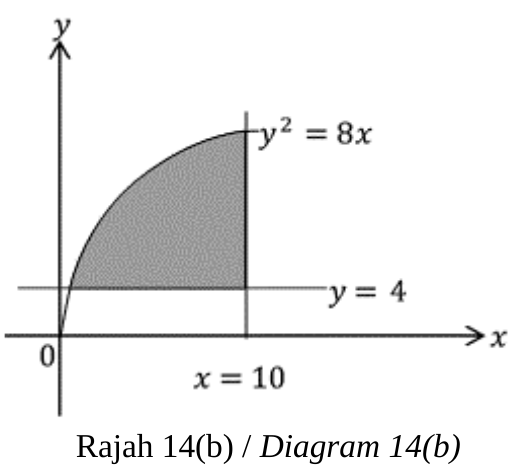
(a) Given y = (4x − 1)/(x² − 3) and dy/dx = 2g(x), where g(x) is a function in terms of x. Find the value of ∫ g(x) dx from −1 to 1. (b) Given that ∫ f(x) dx = 8 (from 2 to 5) and ∫ h(x) dx = 7 (from 1 to 3). Find the value of (i) ∫ 3f(x) dx from 5 to 2, (ii) p if ∫ [h(x) + px] dx = 15 (from 1 to 3).
Medium6 marks- (a)
Find the value of ∫ g(x) dx from −1 to 1.
[2] - (b)(i)
Given ∫ f(x) dx = 8 (from 2 to 5), find ∫ 3f(x) dx from 5 to 2.
[1] - (b)(ii)
Given ∫ h(x) dx = 7 (from 1 to 3), find p if ∫ [h(x) + px] dx = 15 (from 1 to 3).
[3]
Diagram 10 shows a curve with gradient function k − 6x, where k is a constant. PR is a tangent to the curve where R(1, 3) is the maximum point. The curve passes through the origin O and P lies on the y-axis (PR is horizontal).
Medium10 marks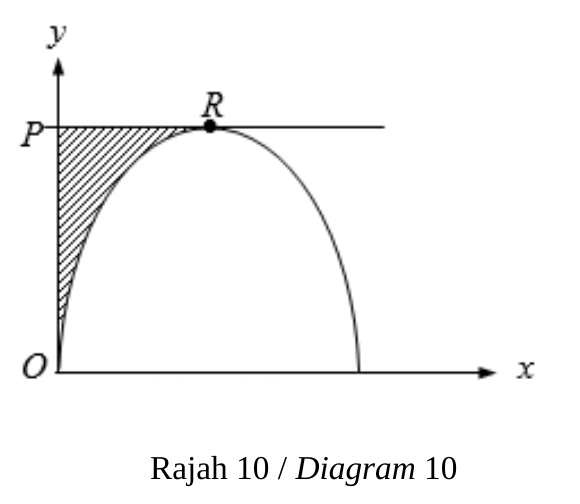
- (a)
Find the value of k.
[2] - (b)
Find the equation of the curve.
[2] - (c)
Find the area of the region bounded by the curve and the x-axis.
[2] - (d)
Find the volume generated when the shaded region is revolved through 360° about the x-axis.
[4]
Diagram 5 shows the shaded region bounded by the graph y = g(x) and the x-axis from x = 5 to x = 9. The area of the shaded region is 10 unit².
Easy5 marks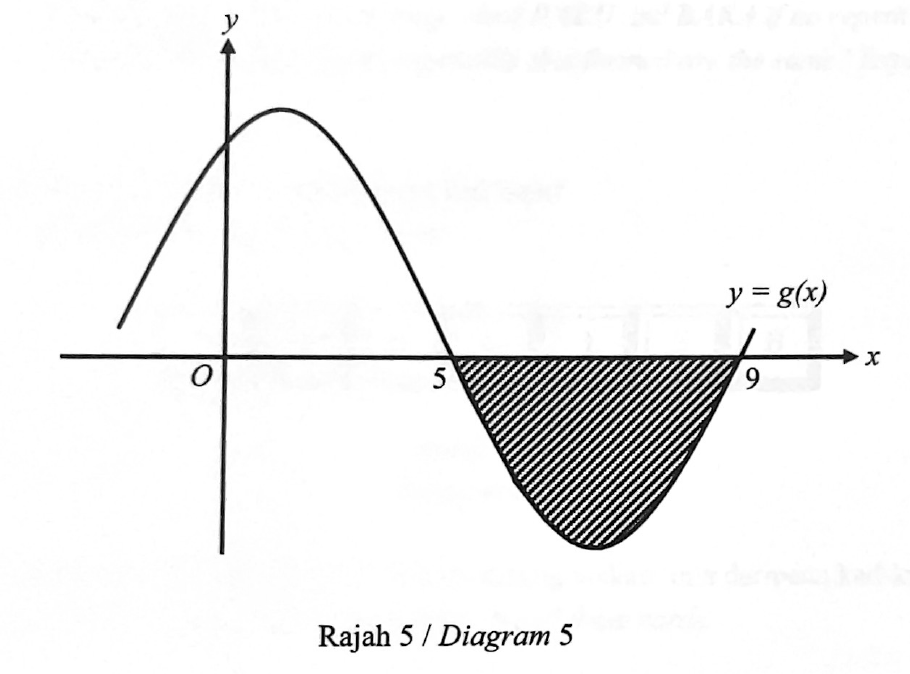
- (a)(i)
Find ∫₅⁹ g(x) dx.
[1] - (a)(ii)
Find the value of [h(x)]₅⁹ if d/dx[2h(x)] = g(x).
[2] - (b)
Given the graph y = g(x) passes through the point (1, 96) and d/dx[g(x)] = 3x² − 24x + 17, find g(x) in terms of x.
[2]
Diagram 4 shows a part of curve y = 9 − x². The straight line PQ is a tangent to the curve with the gradient −2.
Medium9 marks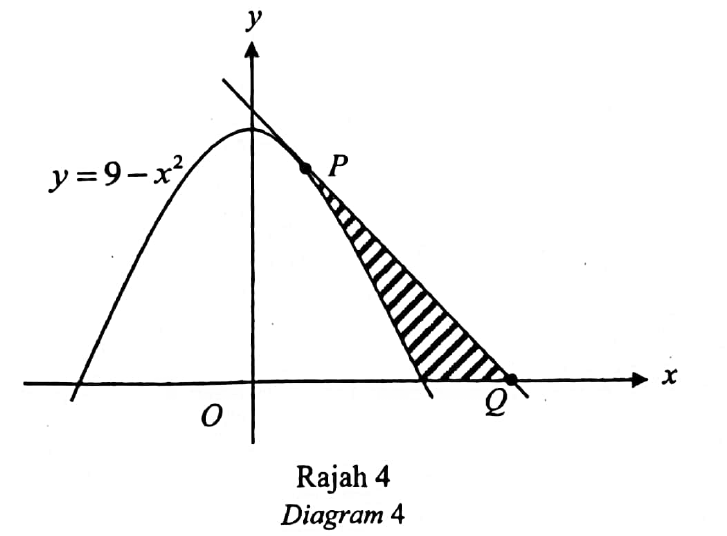
- (a)
Find the coordinates of P.
[2] - (b)
Calculate the shaded region.
[4] - (c)
When the region bounded by the curve, the y-axis and the straight line y = k, revolved through 180° at the y-axis, the volume generated is 16π unit³. Find the value of k.
[3]
(a) Diagram 3 shows part of the curve x = g(y) from y = 0 to y = 5. Region A (to the left of the y-axis, between y = 2 and y = 5) has area 10 unit² and region B (between y = 0 and y = 2, to the right of the y-axis) has area 4 unit². Find ∫ from 0 to 5 of g(y) dy. (b) Given d/dx [x²/(x + 5)] = g(x), find ∫ from 0 to 2 of [x² + g(x)] dx.
Medium5 marks- (a)
Given the area of region A is 10 unit² and the area of region B is 4 unit², find ∫₀⁵ g(y) dy.
[2]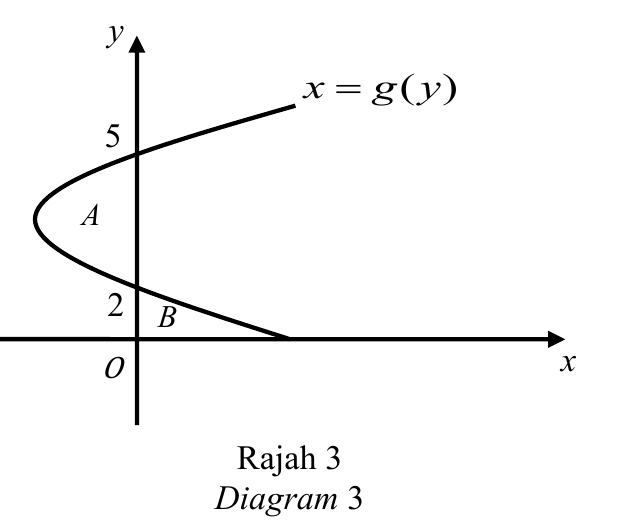
- (b)
Given d/dx [x²/(x + 5)] = g(x), find ∫₀² [x² + g(x)] dx.
[3]
Diagram 6 shows part of the curve y = 4/x². Region P lies between x = 2 and x = k, and region Q between x = k and x = 8, both between the curve and the x-axis.
Medium8 marks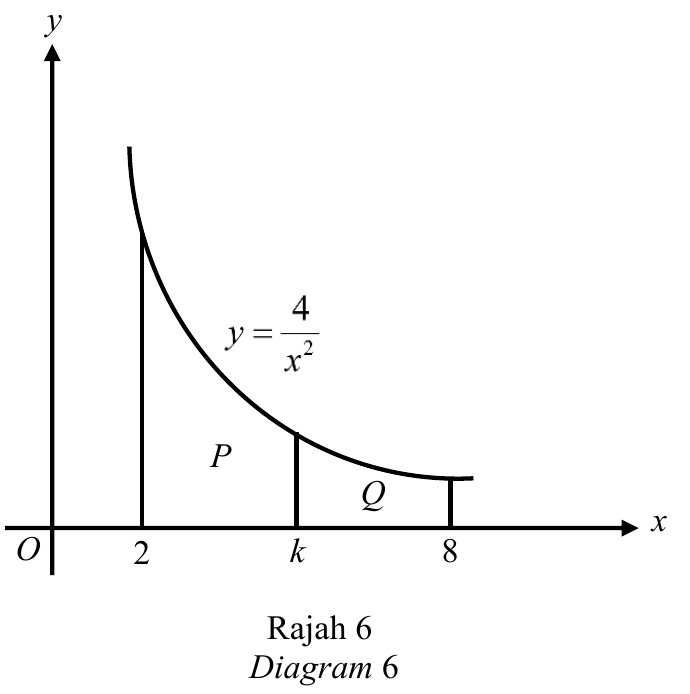
- (a)(i)
If the area of region P is four times the area of region Q, find the value of k.
[3] - (a)(ii)
Find the area of region Q.
[2] - (b)
The total area of regions P and Q is revolved through 360° about the x-axis. Find the volume generated, in terms of π.
[3]
(a) Diagram 4 shows the curve x = f(y) intersecting the y-axis at y = a and y = b. Given that the area bounded by the curve and the y-axis is 10 unit², find the value of ∫ₐᵇ 2f(y) dy. (b) Given that ∫₁³ g(x) dx = −3, find the value of k if ∫₁³ [2g(x) + x − k] dx = 3k.
Medium6 marks- (a)
Given the area bounded by the curve and the y-axis is 10 unit², find ∫ₐᵇ 2f(y) dy.
[2]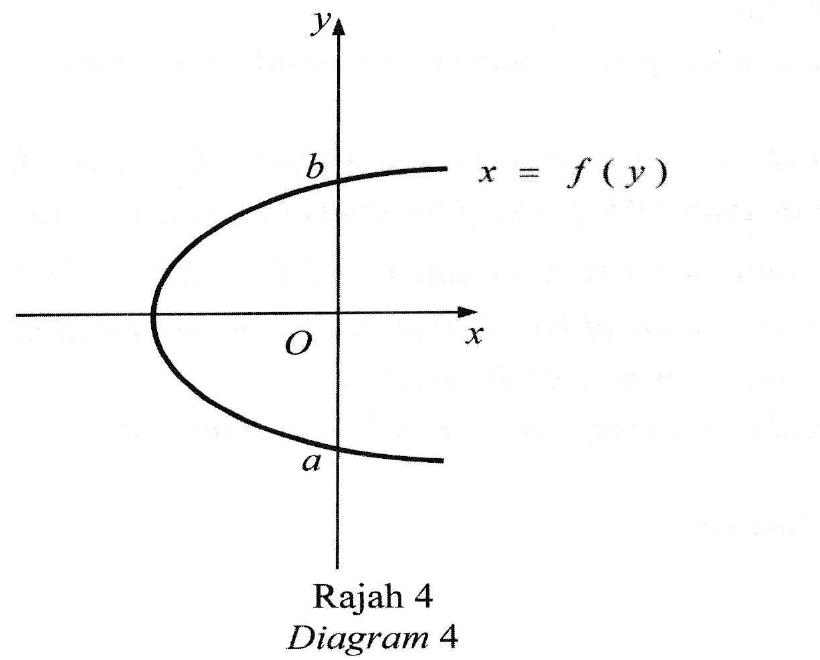
- (b)
Find k if ∫₁³ [2g(x) + x − k] dx = 3k, given ∫₁³ g(x) dx = −3.
[4]
Diagram 3 shows part of the curve y = x². The tangent to the curve at the point P(3, 9) intersects the y-axis at point Q. Find (a) the equation of the tangent at point P, (b) the area of the shaded region, (c) the volume of revolution, in terms of π, when the region bounded by the curve, the x-axis and the straight line x = 3, is rotated through 90° about the x-axis.
Hard10 marks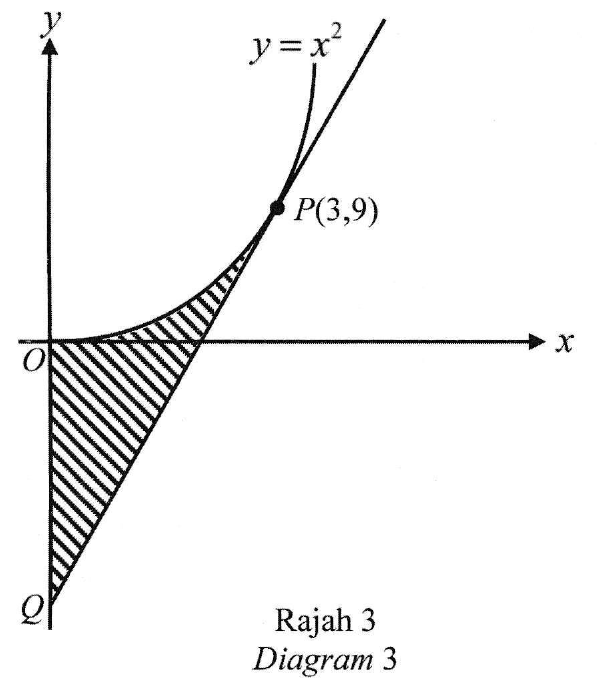
- (a)
Find the equation of the tangent at point P.
[3] - (b)
Find the area of the shaded region.
[4] - (c)
Find the volume of revolution, in terms of π, when the region bounded by the curve, the x-axis and x = 3 is rotated through 90° about the x-axis.
[3]