JOHOR 2021 P2 Q15
MediumWrite your answer on paper. Then open the answer to check it.
A company sells two types of health products, A and B. The selling price of a bottle of product A is RM120 and a bottle of product B is RM40. A promoter, Shanley, sells x bottles of product A and y bottles of product B in a month. She will be given a commission of 10% of her total sales if she achieves the following targets: I. The number of product B sold cannot be less than 40. II. The total number of products sold is at least 80 bottles. III. The minimum total sales in a month are RM4800. (a) Write three inequalities, other than x ≥ 0 and y ≥ 0, which satisfy all the above constraints. (b) Using a scale of 2 cm to 20 bottles on both axes, construct and shade the region R which satisfies all the above constraints. (c) Using the graph constructed in (b), answer the following: (i) Find the minimum number of products A and B sold if the number of product B sold is three times the number of product A. (ii) Determine the minimum amount of commission received by Shanley if she is able to sell 30 bottles of product A.
Medium10 marks- (a)
Write three inequalities (other than x ≥ 0, y ≥ 0).
[3] - (b)
Construct and shade the region R (2 cm : 20 bottles on both axes).
[3]
- (c)(i)
Minimum numbers of A and B if B is three times A.
[1] - (c)(ii)
Minimum commission if she sells 30 bottles of product A.
[3]
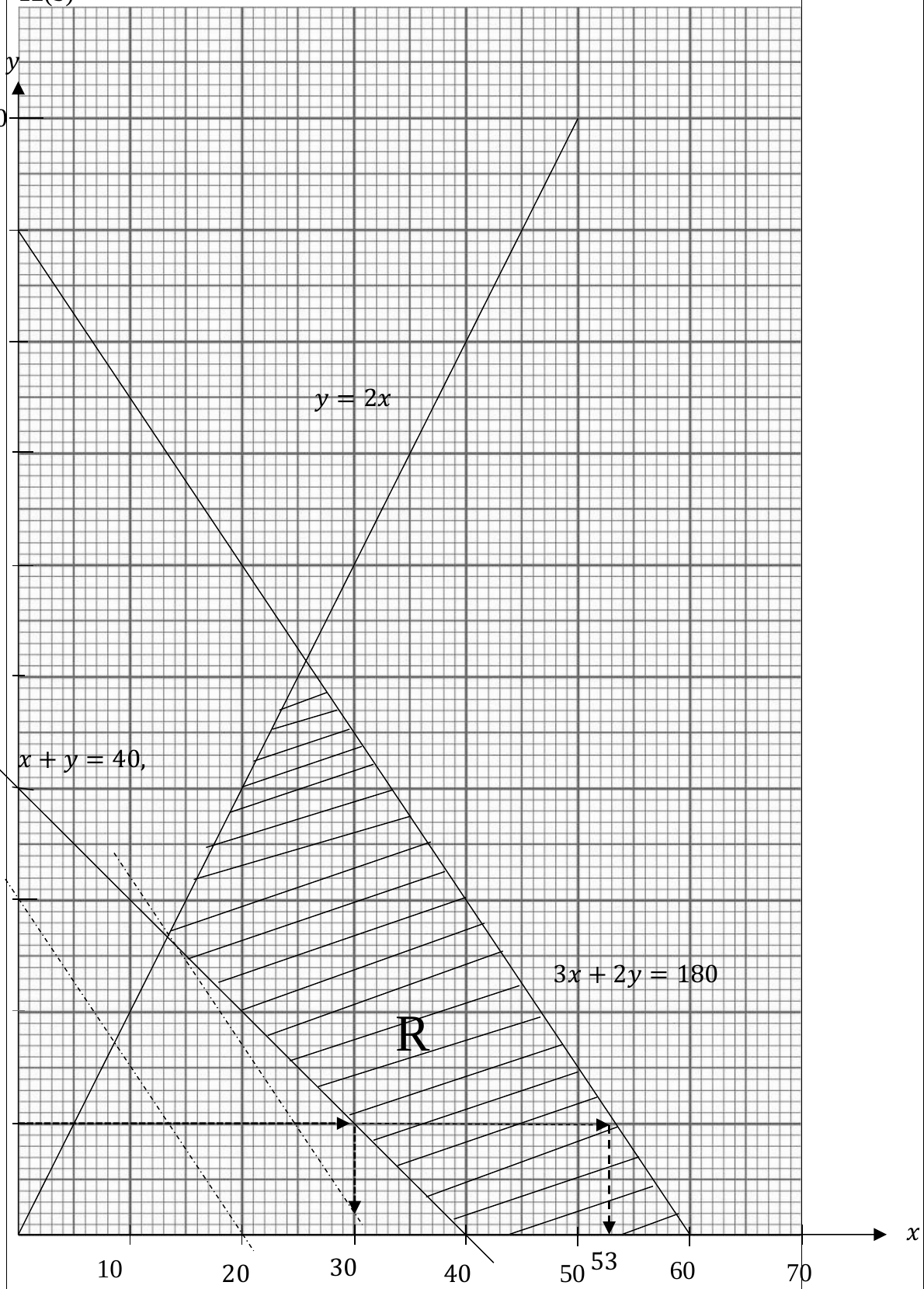
Use graph paper. A District Education Office plans a course on teaching Mathematics and Science in English, attended by x Mathematics participants and y Science participants. The constraints are: I. The total number of participants is at least 40. II. The number of Science participants is at most twice the number of Mathematics participants. III. The maximum allocation for the course is RM7200. The expenditure for a Mathematics participant is RM120 and for a Science participant is RM80. (a) Write down three inequalities, other than x ≥ 0 and y ≥ 0, which satisfy the above constraints. (b) Using a scale of 2 cm to 10 participants on both axes, construct and shade the region R which satisfies all the constraints. (c) Using the graph from (b), find (i) the maximum and minimum number of Mathematics participants when the number of Science participants is 10, (ii) the minimum cost to run the course.
Medium10 marks- (a)
Write down three inequalities, other than x ≥ 0 and y ≥ 0.
[3] - (b)
Construct and shade the region R (scale 2 cm to 10 participants on both axes).
[3]
- (c)(i)
Find the maximum and minimum number of Mathematics participants when there are 10 Science participants.
[2] - (c)(ii)
Find the minimum cost to run the course.
[2]
Haikal's food stall sells beef burgers and chicken burgers. The stall can prepare to a maximum of 90 burgers in a day. The number of chicken burgers prepared exceeds the number of beef burgers by at most 30. The demand for the beef burgers is thrice less than the chicken burgers. (a) In a day, Haikal's food stall prepares x beef burgers and y chicken burgers. Write three inequalities, other than x ≥ 0 and y ≥ 0, which satisfy all the above constraints. (b) By using a scale of 2 cm to 10 burgers on both axes, construct and shade the region R which satisfies all the above constraints. (c) Use the graph constructed in (b) to answer: (i) State the maximum number of beef burgers prepared. (ii) The profits of selling a beef burger and a chicken burger are RM1.50 and RM3.00 respectively. Express the objective function, k, in terms of x and y. Hence, draw the objective function and find the maximum profit obtained.
Medium10 marks- (a)
Write three inequalities, other than x ≥ 0 and y ≥ 0.
[3] - (b)
Construct and shade the region R.
[3] - (c)(i)
State the maximum number of beef burgers prepared.
[1] - (c)(ii)
Express the objective function k; draw it and find the maximum profit.
[3]
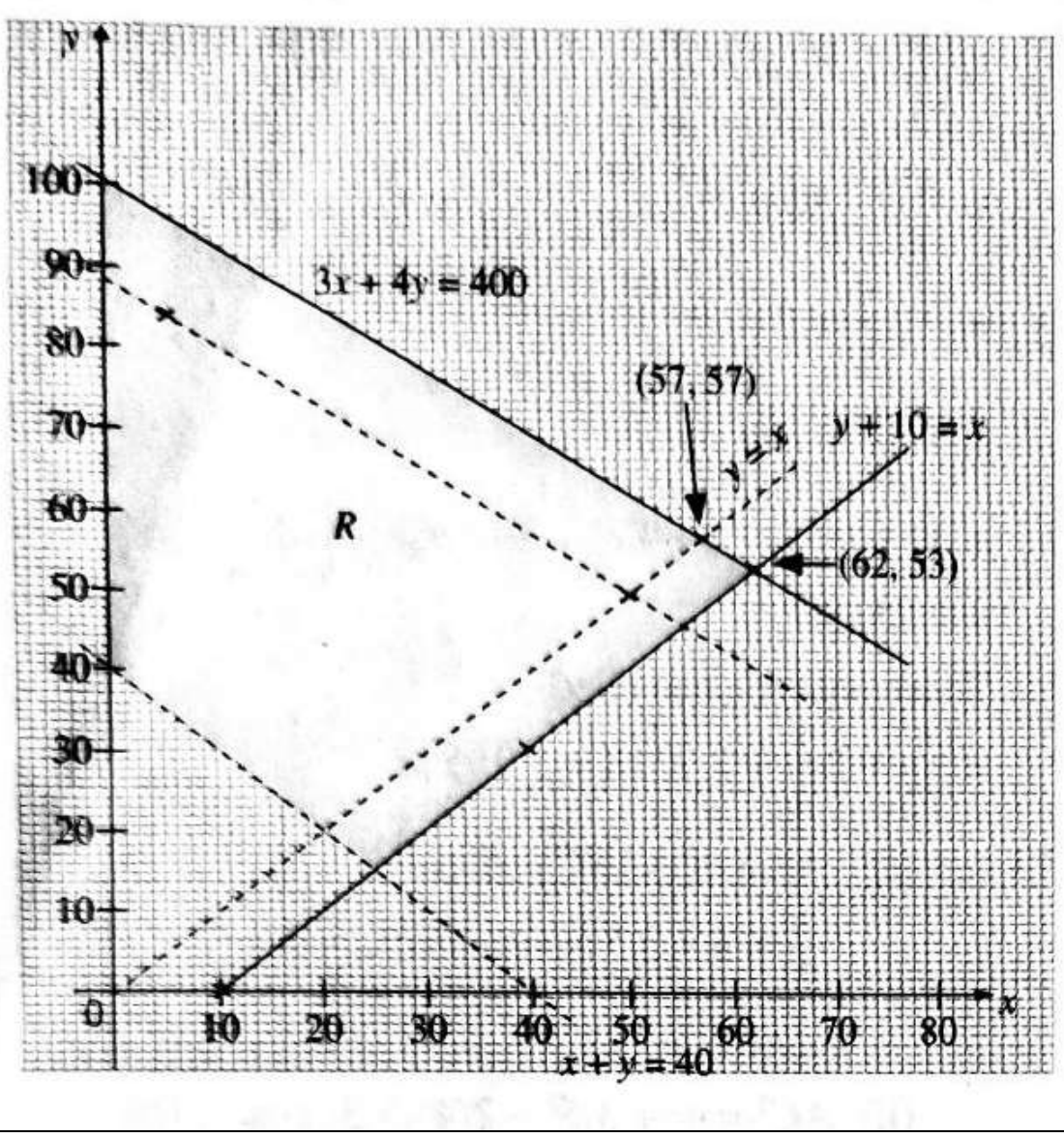
Use graph paper to answer this question. Siti is assigned to prepare prizes for STEM Week. She must buy x sets of pens and y sets of notebooks. The price of one set of pens is RM3 and the price of one set of notebooks is RM4. The purchase is based on these constraints: I The total number of sets of pens and sets of notebooks must be more than 40. II The total allocation is RM400. III The number of sets of pens exceeds the number of sets of notebooks by at most 10. (a) Write three inequalities, other than x ≥ 0 and y ≥ 0, which satisfy all the above constraints. (b) Using a scale of 2 cm to 10 sets on both axes, construct and shade the region R which satisfies all the above constraints. (c) Use your graph in (b) to find (i) the minimum balance of the allocation, if the number of sets of pens purchased equals the number of sets of notebooks, (ii) the maximum number of sets of pens that can be purchased if Siti spends RM50 on wrapping paper.
Medium10 marks- (a)
Write three inequalities (other than x ≥ 0, y ≥ 0) for the constraints.
[3] - (b)
Construct the three straight lines and shade region R (2 cm to 10 sets on both axes).
[3]
- (c)(i)
Minimum balance of the allocation if the number of sets of pens equals the number of sets of notebooks.
[2] - (c)(ii)
Maximum number of sets of pens if Siti spends RM50 on wrapping paper.
[2]
To increase pupils' interest in STEM, a training centre offers two courses, Science and Mathematics. The number of participants for the Science course is x and for the Mathematics course is y. The intake is based on these constraints: I The number of Science participants is more than 20. II The number of Mathematics participants is at least 15. III The maximum total number of participants is 80. IV The ratio of the number of Science participants to the number of Mathematics participants is not more than 3 : 1. (a) Write four inequalities, other than x > 0 and y > 0, which satisfy all the above constraints. (b) Using a scale of 2 cm to 10 participants on both axes, construct and shade the region R which satisfies all the above constraints. (c) Using the graph from (b), find (i) the range of the number of Science participants if the number of Mathematics participants is 30, (ii) the maximum fee collection if the fees for the Science and Mathematics courses are RM200 and RM150 respectively.
Medium10 marks- (a)
Write four inequalities, other than x > 0 and y > 0, which satisfy all the constraints.
[4] - (b)
Using a scale of 2 cm to 10 participants on both axes, construct and shade the region R.
[3]
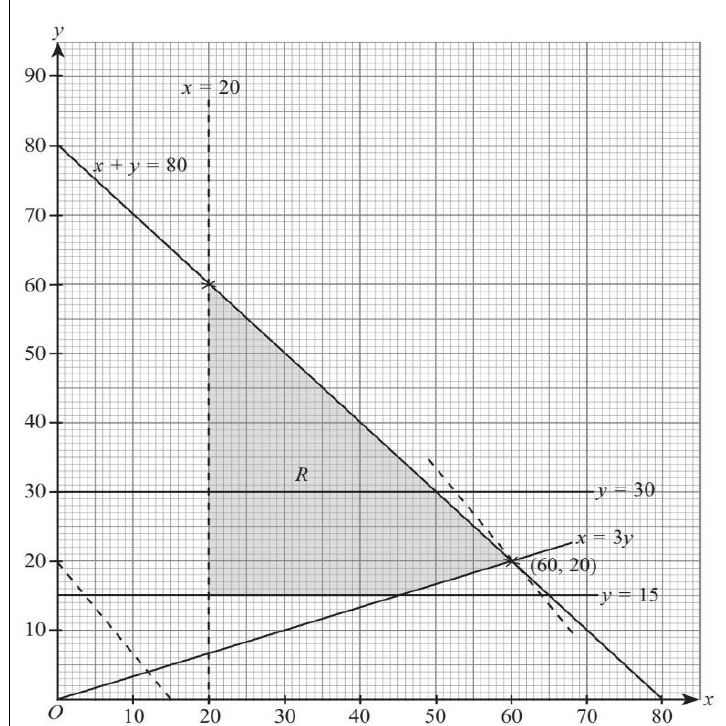
- (c)(i)
Find the range of the number of Science participants if the number of Mathematics participants is 30.
[1] - (c)(ii)
Find the maximum fee collection (fee = 200x + 150y).
[2]
Use graph paper to answer this question. An entrepreneur produces two types of toys, P and Q, using a machine. In a day the machine produces x toys of type P and y toys of type Q. A type P toy takes 6 minutes and a type Q toy takes 5 minutes. Constraints: I: the total number of toys produced must be more than 40 in a day. II: the machine can operate only 15 hours a day. III: the ratio of the number of type P toys to the number of type Q toys is at most 3 : 5.
Medium10 marks- (a)
Write three inequalities, other than x ≥ 0 and y ≥ 0, that satisfy all the above constraints.
[3] - (b)
Using a scale of 2 cm to 20 toys on both axes, construct and shade the region R which satisfies all the above constraints.
[3]
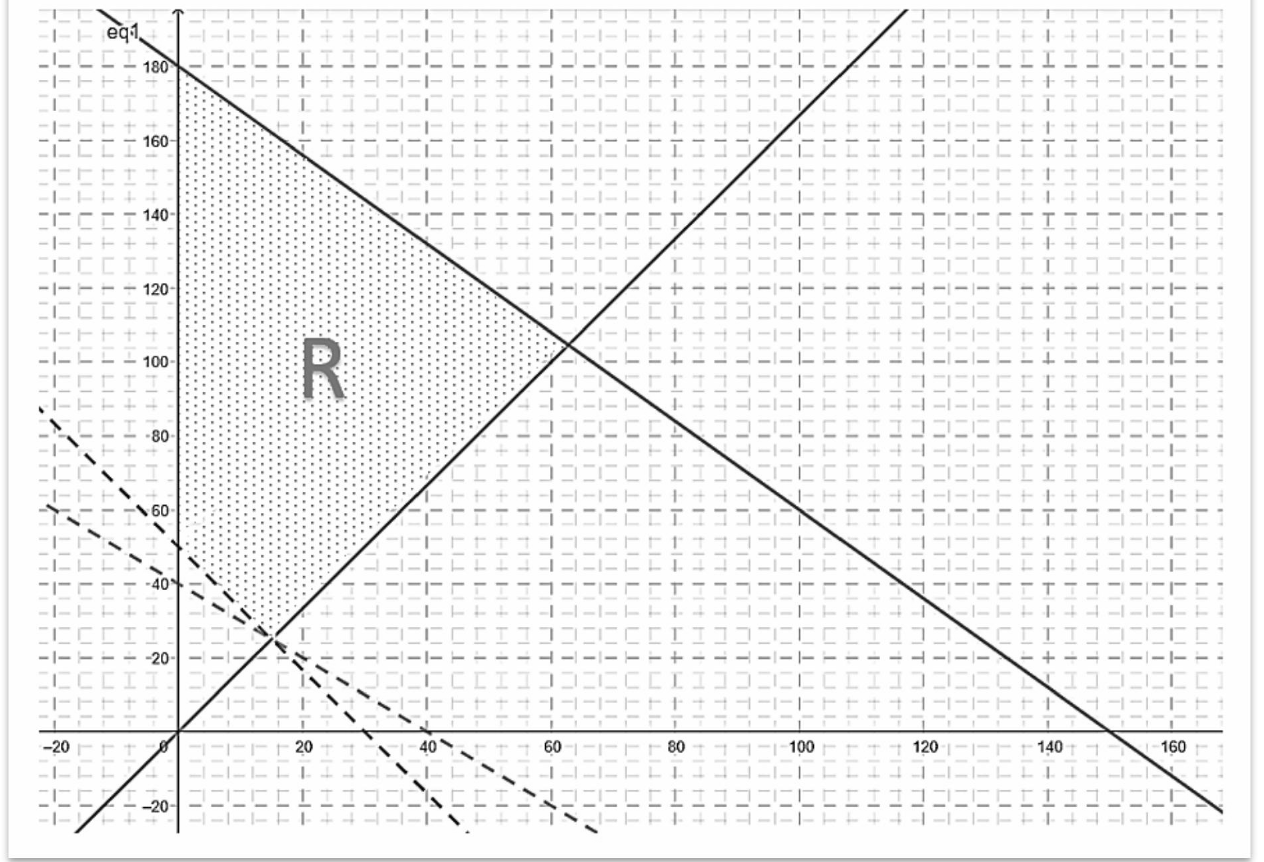
- (c)
Using the graph constructed in 12(b), find the range of total sales if the selling price of a type P toy is RM5 and of a type Q toy is RM3.
[4]
In a training centre, x trainees choose the ICT course and y trainees choose the cooking course. The registration fee is RM40 per person for ICT and RM30 per person for cooking. The intake is based on these constraints: I: the number of cooking trainees must be more than 5. II: the maximum total registration fee collected is RM1 200. III: the number of cooking trainees exceeds twice the number of ICT trainees by at most 10. (a) Write three inequalities, other than x ≥ 0 and y ≥ 0, which satisfy all the above constraints. (b) Using a scale of 2 cm to 5 trainees on both axes, construct and shade the region R which satisfies all the above constraints. (c) The monthly fee for the cooking course is RM200 more than the monthly fee for the ICT course. If the maximum monthly fee collected is RM27 800, calculate the monthly fees for the ICT course and the cooking course.
Medium10 marks
- (a)
Write three inequalities for constraints I, II and III.
[3] - (b)
Construct and shade region R (graph paper provided).
[3] - (c)
Find the monthly fees for the ICT and cooking courses.
[4]
A furniture factory produces chairs and tables for the school usage in a district. The number of chairs, x and the number of tables, y produced are based on the following constraints: I. The number of tables is 10 unit more than the number of chairs. II. The ratio of the number of table to the number of chair is more than 3 : 1. III. The total number of tables and chairs produced does not exceed 60 units.
Medium10 marks- (a)
Write three linear inequalities, other than x ≥ 0 and y ≥ 0, that satisfy all the above constraints.
[3] - (b)
By using a scale of 2 cm to 10 units on both axes. Draw and shade the region R that satisfies all the above constraints.
[3]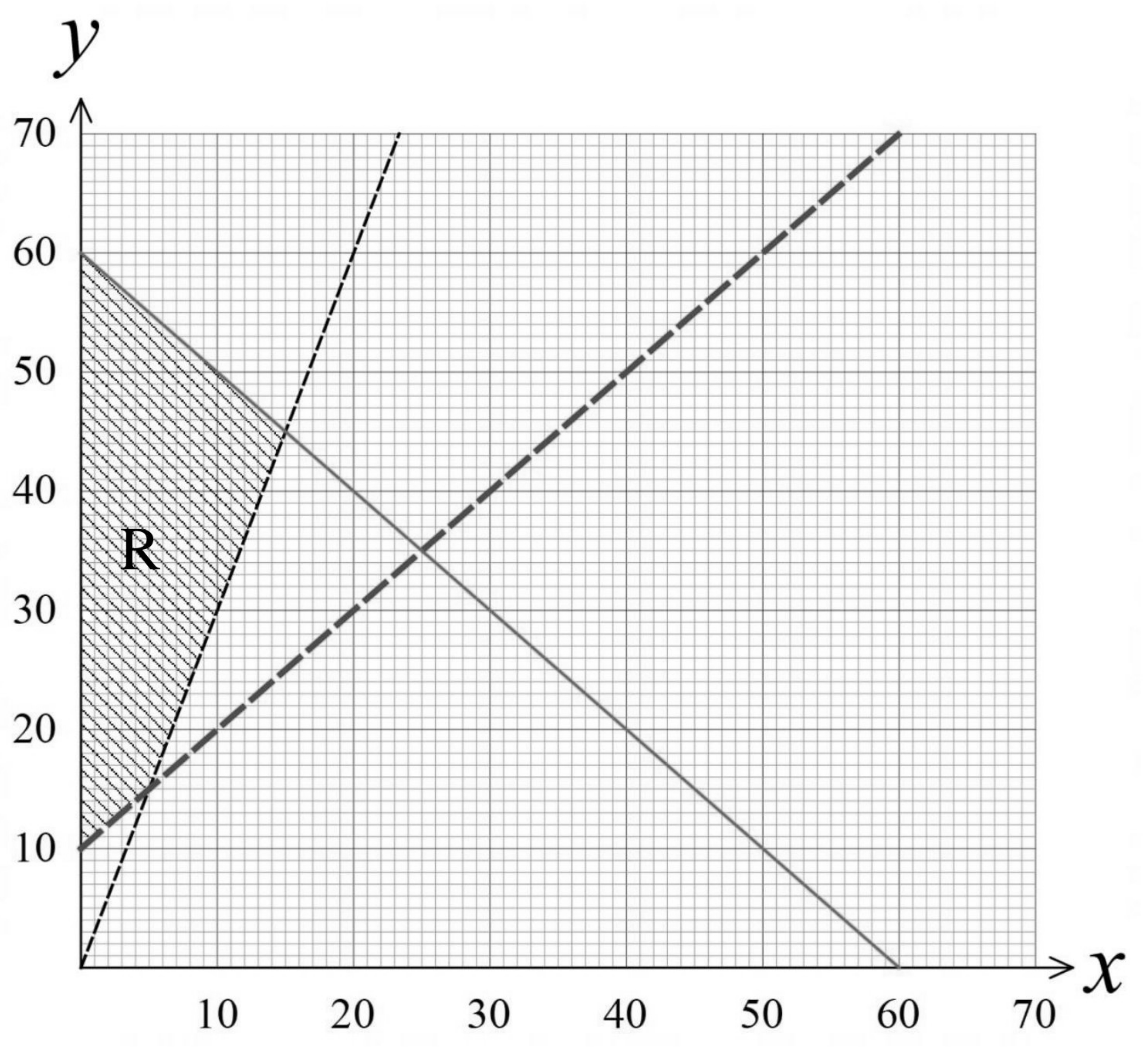
- (c)(i)
Use the graph constructed in 15(b) to answer: State the maximum number of chairs produced.
[1] - (c)(ii)
Due to the increase of the cost of raw materials, each chair produced causing a loss of RM 10.00 while the profit of each table produced is RM 5.00. Calculate the maximum profit earned.
[3]
Azri has x car workshops in Sungai Petani and y car workshops in Gurun. Table 14: each Sungai Petani workshop has 9 mechanics and 3 staff; each Gurun workshop has 5 mechanics and 3 staff. Constraints: I The total number of mechanics is at least 90. II The maximum number of staff is 51. III The ratio of the number of workshops in Gurun to the number in Sungai Petani is not less than 1 : 2. (a) Write three inequalities, other than x ≥ 0 and y ≥ 0, that satisfy all the constraints. (b) Using a scale of 2 cm to 2 workshops on both axes, construct and shade the region R that satisfies all the constraints. Use the graph in (b) to answer: (c) (i) State the range of the number of workshops in Sungai Petani if the number of workshops in Gurun is 7. (ii) By drawing the objective function, find the minimum profit if the profit of each workshop in Sungai Petani and Gurun is RM50 000 and RM10 000 respectively.
Medium10 marks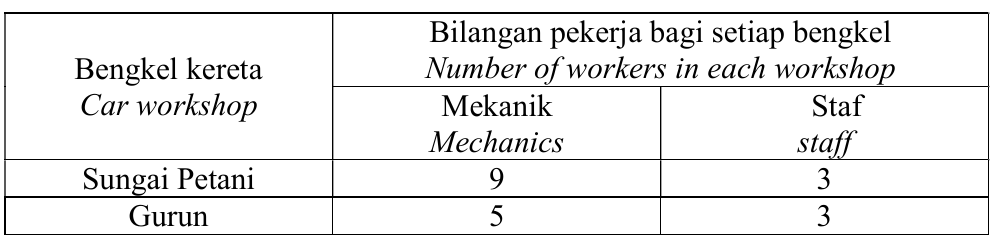
- (a)
Write three inequalities, other than x ≥ 0 and y ≥ 0, that satisfy all the constraints.
[3] - (b)
Using a scale of 2 cm to 2 workshops on both axes, construct and shade the region R.
[3]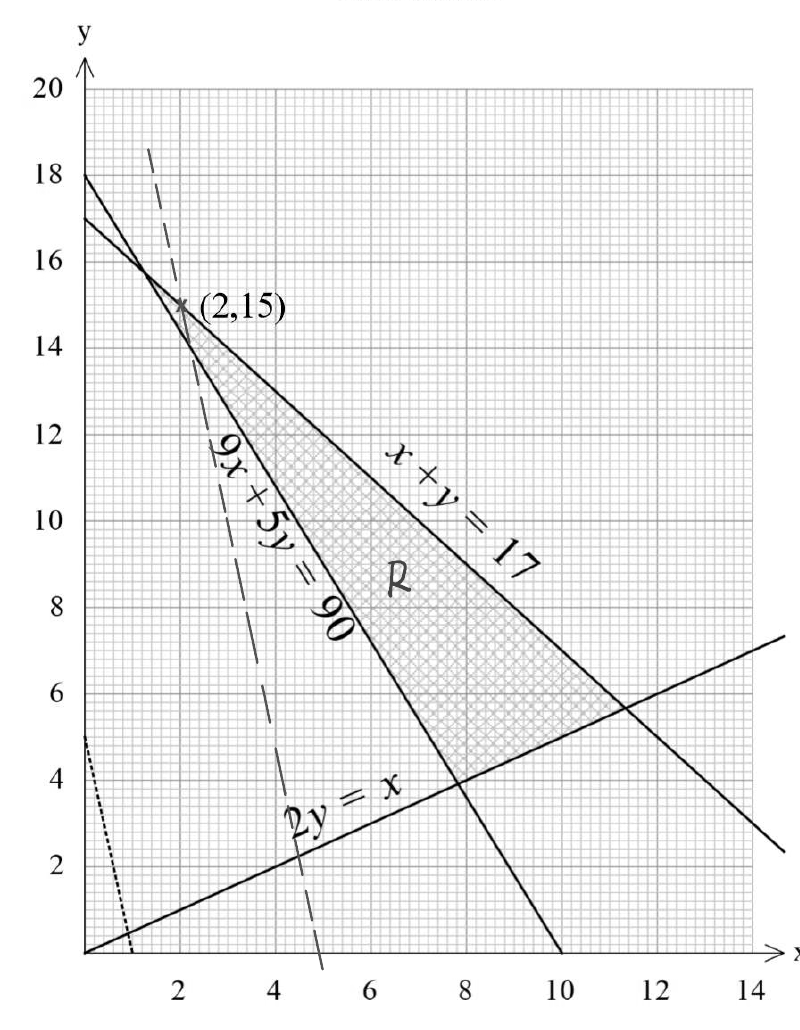
- (c)(i)
State the range of the number of workshops in Sungai Petani if Gurun has 7 workshops.
[1] - (c)(ii)
By drawing the objective function, find the minimum profit.
[3]
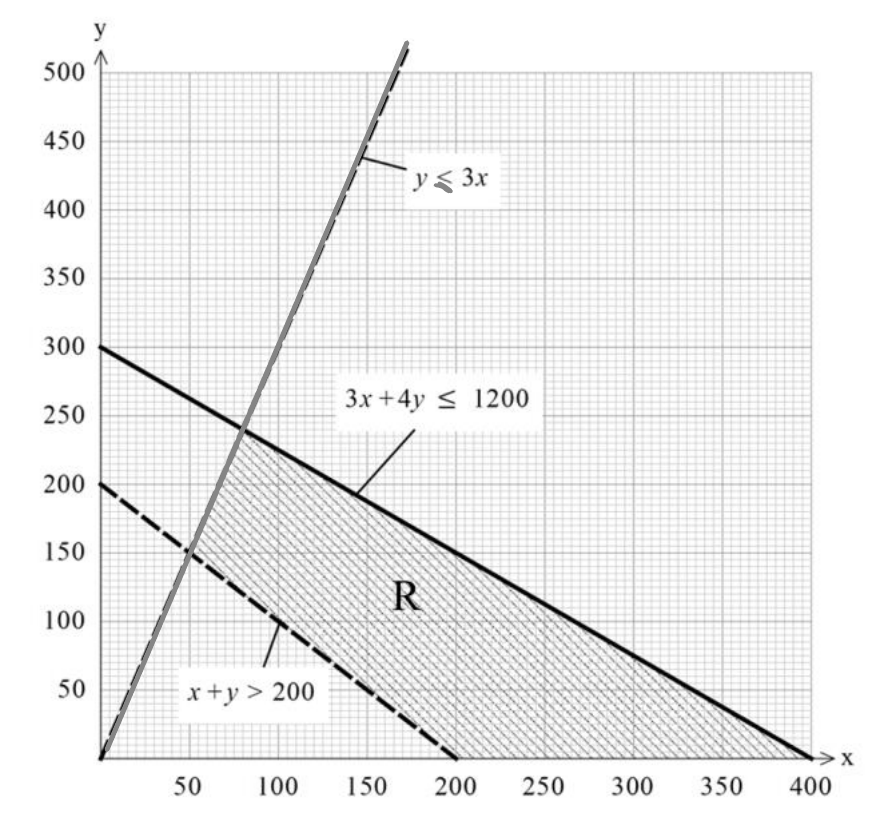
Sarah sells chicken sets (x) and meat sets (y) of Nasi Rahmah. The cost of a chicken set is RM 3.00 and of a meat set RM 4.00. Sarah has a capital of RM 1200.00 a day. The number of lunch sets sold each day is more than 200. The number of meat sets sold is not more than three times the number of chicken sets.
Medium10 marks- (a)
Write three linear inequalities, other than x ≥ 0 and y ≥ 0, that satisfy all the constraints.
[3] - (b)
Using a scale of 2 cm to 50 units on both axes, construct and shade the region R that satisfies all the constraints. (Blank graph paper on page 40.)
[3]
- (c)(i)
Find the maximum number of meat sets sold per day if the number of chicken sets sold is 200.
[1] - (c)(ii)
Given that the profit of a chicken set is RM 2.00 and of a meat set is RM 3.00, the total profit is RM k. Express k in terms of x and y. Hence, draw the graph of the objective function and determine the maximum profit.
[3]
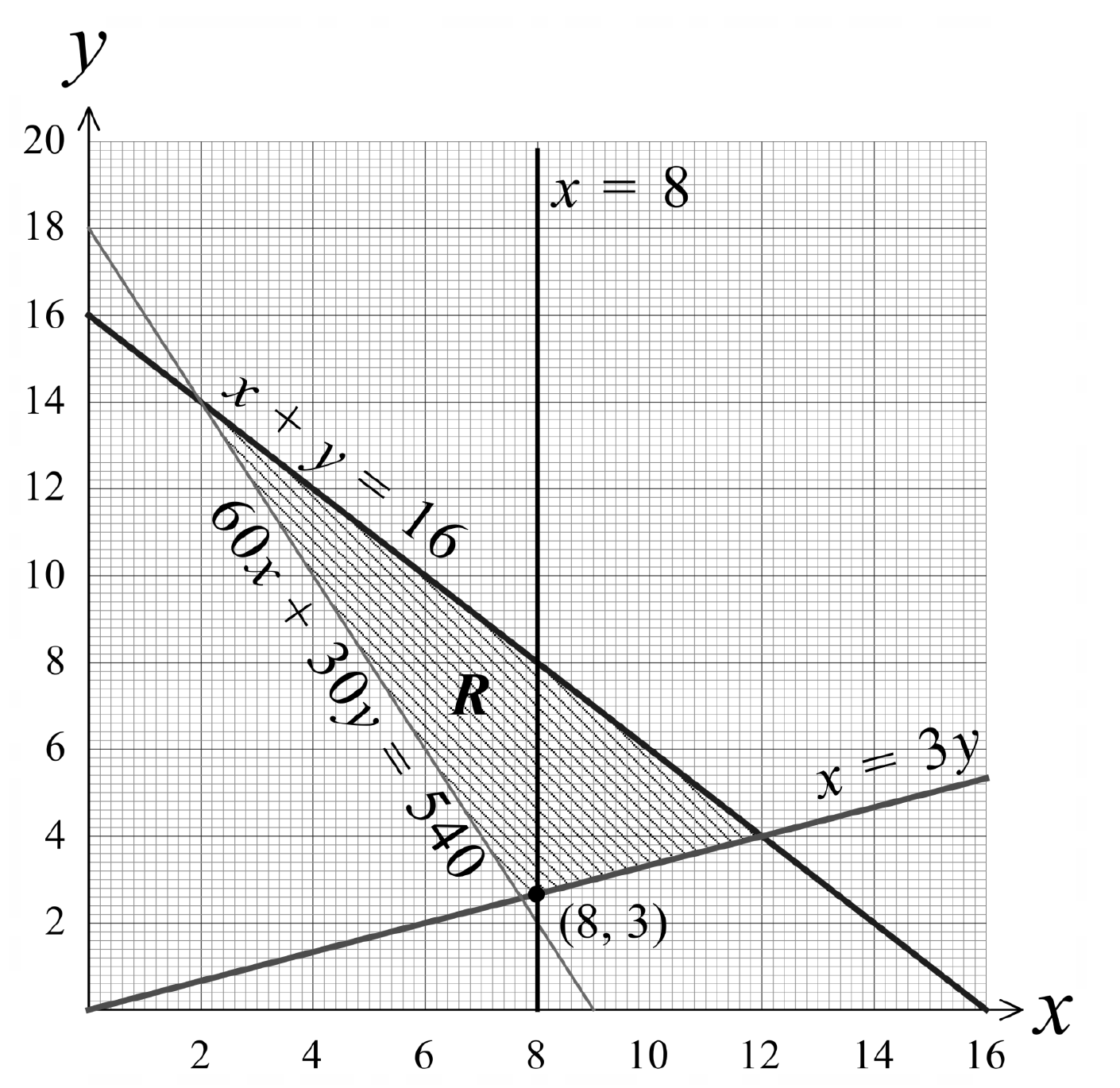
Use the graph paper provided. A tourist boat operator in Langkawi provides x trips to 'Pulau Tuba' and y trips to 'Pulau Besar' per day, based on these constraints: I The total number of trips is not more than 16. II The number of trips to Pulau Tuba is not more than three times the number of trips to Pulau Besar. III The fare per trip to Pulau Tuba is RM60 and to Pulau Besar is RM30. The total fare collection per day is not less than RM540. (a) Write three inequalities, other than x ≥ 0 and y ≥ 0, which satisfy all the constraints. (b) Using a scale of 2 cm to 2 trips on both axes, construct and shade the region R which satisfies all the constraints. (c) Using the graph in (b), find (i) the minimum number of trips to Pulau Besar if 8 trips to Pulau Tuba are provided per day, (ii) the maximum total profit per day if the profit per trip to Pulau Tuba is RM40 and to Pulau Besar is RM20.
Medium10 marks- (a)
Write three inequalities, other than x ≥ 0 and y ≥ 0, which satisfy all the constraints.
[3] - (b)
Using a scale of 2 cm to 2 trips on both axes, construct and shade the region R. (Graph paper provided.)
[3]
- (c)(i)
Find the minimum number of trips to Pulau Besar if 8 trips to Pulau Tuba are provided per day.
[1] - (c)(ii)
Find the maximum total profit per day if the profit per trip to Pulau Tuba is RM40 and to Pulau Besar is RM20.
[3]
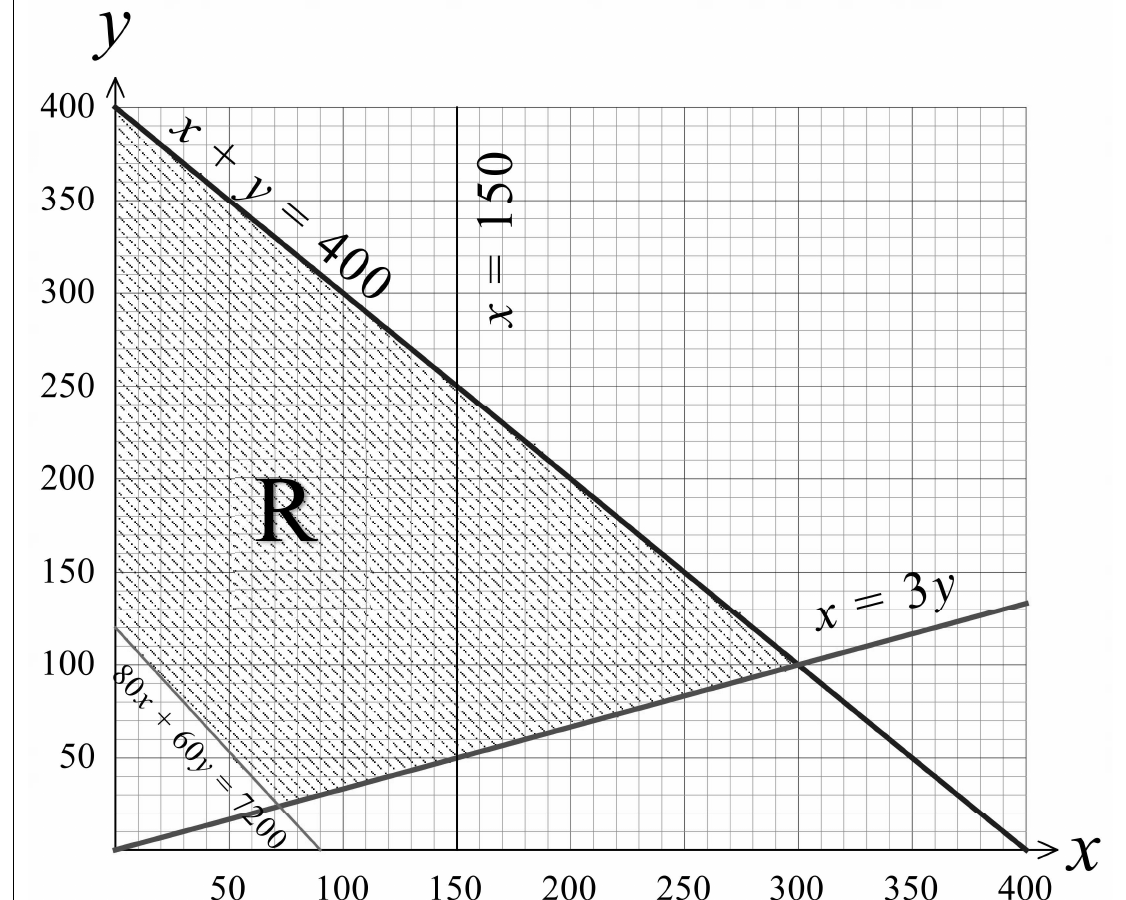
Use the graph paper provided. At Institute Mega, two courses are offered. Table 15: Computer course, x students, monthly fee RM80; Typing course, y students, monthly fee RM60. The recruitment of students is subject to: I The maximum number is 400. II The number of students enrolled in the computer course is at most three times the number enrolled in the typing course. III The minimum total collection of monthly fees is RM7200.
Medium10 marks- (a)
Write three inequalities, other than x ≥ 0 and y ≥ 0, which satisfy all the above constraints.
[3] - (b)
Using a scale of 2 cm to 50 units on both axes, construct and shade the region R which satisfies all the above constraints.
[3]
- (c)(i)
Using the graph, find the maximum collection of monthly fees.
[3] - (c)(ii)
Using the graph, find the minimum number of students enrolled in the typing course if the number enrolled in the computer course is 150.
[1]
Use a graph paper to answer this question. Kencana is a manufacturing company and it owns two factories, S and T, which make the same product. Factory S can operate for a maximum of 60 hours per week, producing 30 units of product an hour. Factory T can operate for a maximum of 50 hours per week, producing 20 units of product an hour. Factory S is bigger than factory T and the company must operate factory S for at least as many hours as factory T. To meet customer demand, at least 1 500 units of product must be produced per week. (a) The number of operating hours of factory S is x hours and of factory T is y hours. Write four inequalities, other than x ≥ 0 and y ≥ 0, which satisfy all the above constraints. (b) Using a scale of 2 cm to 10 hours on both axes, construct and shade the region R which satisfies all the above constraints. (c) Using the graph constructed in (b), find the minimum running cost per week if the hourly cost of running factory S is RM8 000 and the hourly cost of running factory T is RM4 000.
Medium10 marks- (a)
Write four inequalities (other than x ≥ 0, y ≥ 0).
[4] - (b)
Construct and shade region R (scale 2 cm to 10 hours on both axes; graph paper given).
[3]
- (c)
Minimum running cost per week.
[3]
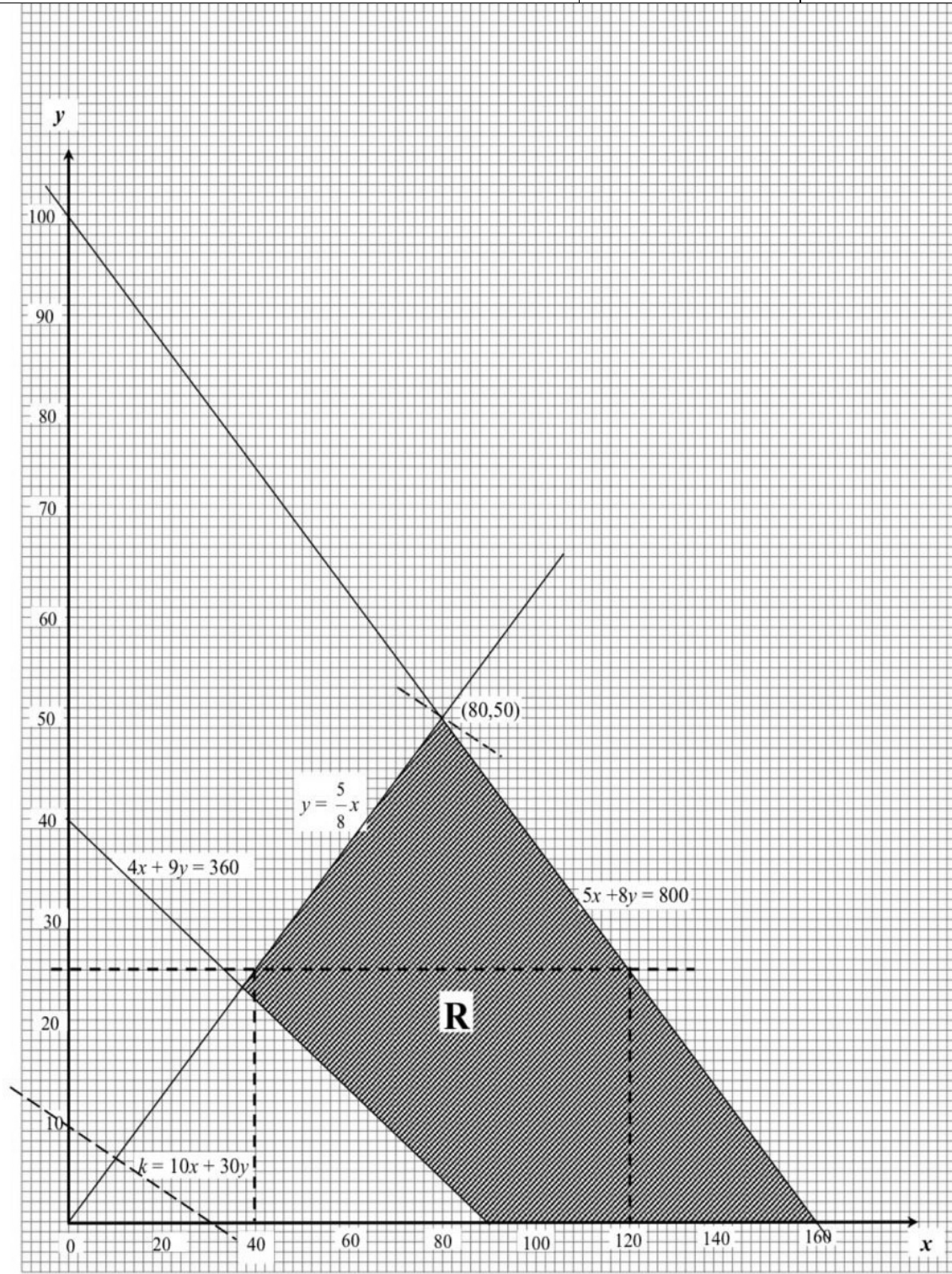
Use the graph paper provided. Table 3 shows the time (minutes) used by machine A and machine B to make remote-control cars: model P — A 8, B 5; model Q — A 18, B 8. Conditions: I Machine A operates at least 720 minutes a day. II Machine B operates not more than 800 minutes a day. III The ratio of model Q cars to model P cars is not more than 5 : 8. The factory makes x model P cars and y model Q cars. (a) Write 3 inequalities, other than x ≥ 0 and y ≥ 0, that satisfy the conditions. (b) Using a scale of 2 cm to 20 cars on the x-axis and 2 cm to 10 cars on the y-axis, construct and shade the region R that satisfies the inequalities. (c) Using the graph, find (i) the maximum and minimum number of model P cars produced if 25 model Q cars are produced, (ii) the maximum sales if each model P car sells for RM10 and each model Q car for RM30.
Medium10 marks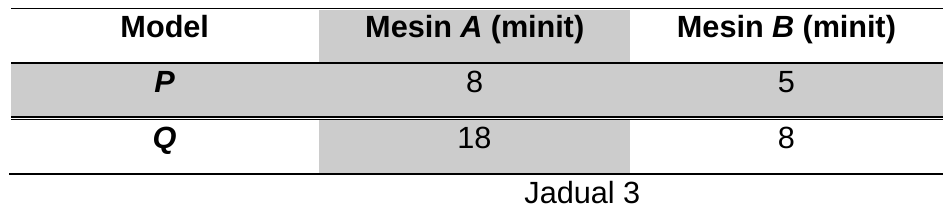
- (a)
Write 3 inequalities satisfying the conditions.
[3] - (b)
Construct and shade region R (2 cm : 20 cars on x-axis, 2 cm : 10 cars on y-axis).
[3]
- (c)(i)
Maximum and minimum number of model P cars if 25 model Q cars are produced.
[2] - (c)(ii)
Find the maximum sales.
[2]
Amsyar allocates RM200 to buy x workbooks and y reference books. The total number of books purchased is not less than 20. The number of workbooks purchased is at most twice the number of reference books. The price of a workbook is RM10 and the price of a reference book is RM5. (a) Write three inequalities, other than x ≥ 0 and y ≥ 0, that satisfy all the above constraints. (b) Using a scale of 2 cm to 5 books on both axes, construct and shade the region R that satisfies all of the above constraints. (c) Amsyar bought 15 reference books. Using the graph constructed in (b), find the maximum money balance.
Medium10 marks- (a)
Write three inequalities, other than x ≥ 0 and y ≥ 0, that satisfy all the above constraints.
[3] - (b)
Using a scale of 2 cm to 5 books on both axes, construct and shade the region R that satisfies all of the above constraints.
[3]
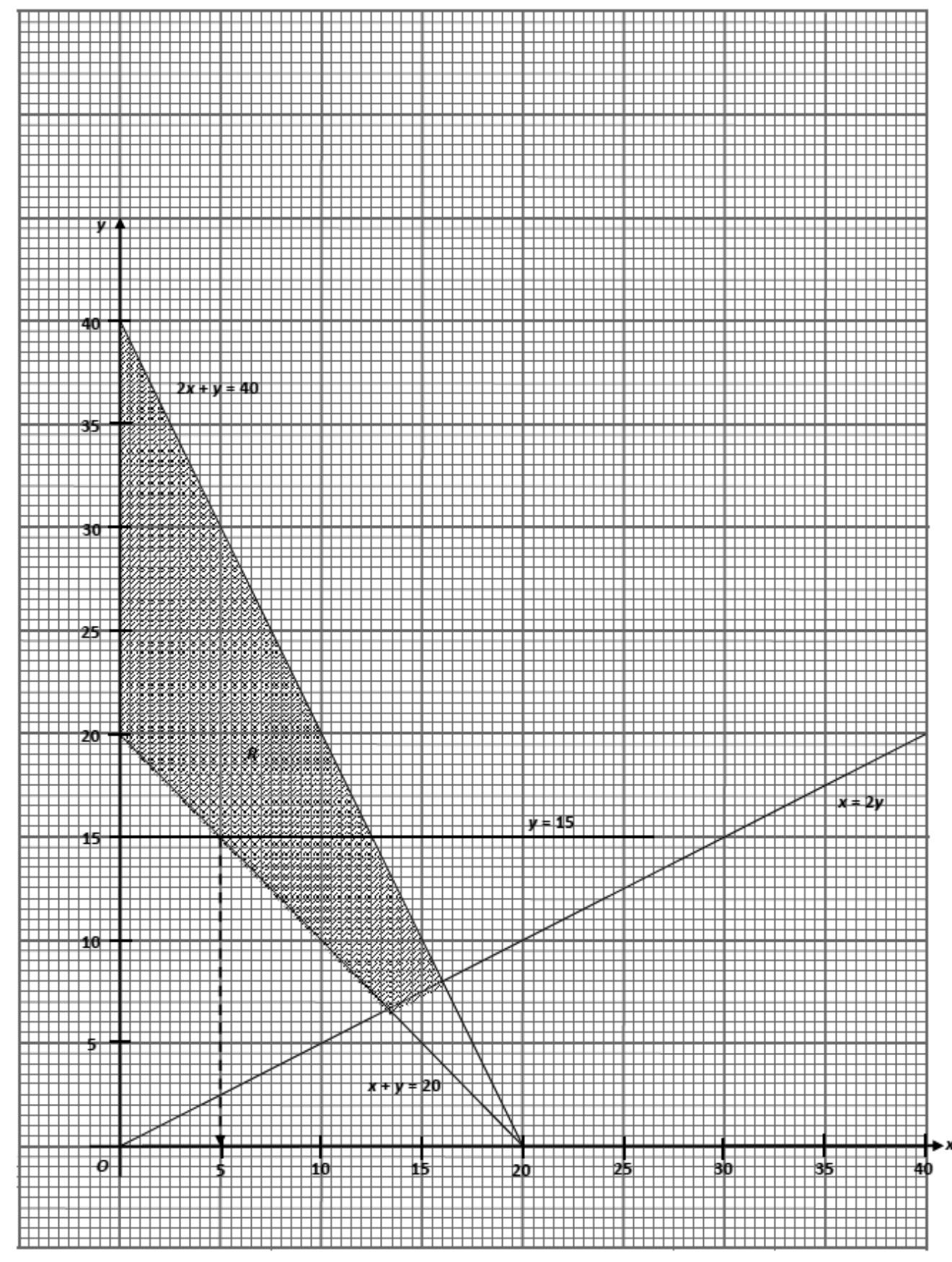
- (c)
Amsyar bought 15 reference books. Using the graph in (b), find the maximum money balance.
[4]
A factory wants to hire new employees for the positions of supervisors and operators. Money amounting to RM 32000 has been allocated for the monthly salary payment of employees. The salary of a supervisor and an operator is RM 600 and RM 400 per month respectively. The number of operators must exceed the number of supervisors by 10 people or more. The number of supervisors should be at least 10% of the number of operators. Given that x represents the number of supervisors and y represents the number of operators. (a) Write three inequalities other than x ≥ 0 and y ≥ 0 that satisfy all the above constraints. (b) Using a scale of 2 cm to 5 people on the x-axis and 2 cm to 10 people on the y-axis, construct and shade the region R that satisfies all of the above constraints. (c) Using the graph constructed in (b), find (i) the maximum number of employees that can be hired by the factory if the number of supervisors is 10% of the number of operators, (ii) the maximum amount of overtime allowance per hour to be paid by the factory if the factory will pay an overtime allowance of RM 8 per hour for an operator and RM 16 per hour for a supervisor.
Medium10 marks- (a)
Write three inequalities (other than x ≥ 0, y ≥ 0) satisfying all constraints.
[3] - (b)
Construct and shade region R (scale 2 cm to 5 people on the x-axis, 2 cm to 10 people on the y-axis).
[3]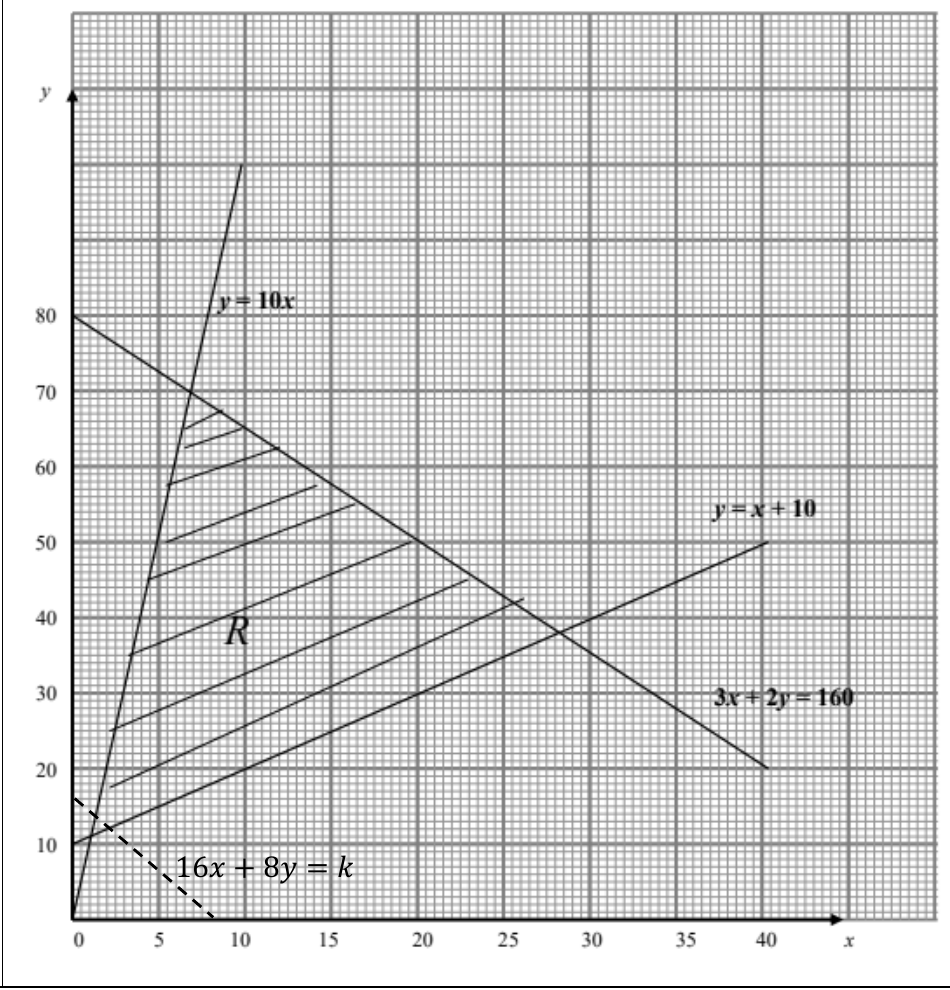
- (c)(i)
Maximum number of employees if supervisors are 10% of operators.
[1] - (c)(ii)
Maximum overtime allowance per hour (RM 8 per operator, RM 16 per supervisor).
[3]
An early acceleration workshop for Additional Mathematics will be held, involving Form 5 and Form 4 students from SMK Sri Delima. The number of selected Form 5 and Form 4 students are x and y respectively. The number of Form 5 students must not exceed twice the number of Form 4 students. The total number of students must not exceed 90, and the number of Form 4 students must exceed the number of Form 5 students by at most 10.
Medium10 marks- (a)
Write three inequalities, other than x ≥ 0 and y ≥ 0, that satisfy all the above constraints.
[3] - (b)
Using a scale of 2 cm to represent 10 students on both axes, construct and shade the region R that satisfies all the above constraints.
[3] - (c)(i)
Using the graph constructed in 12(b), find the range of the number of Form 4 students if the number of Form 5 students is 20.
[1] - (c)(ii)
Using the graph constructed in 12(b), find the maximum total participation fee that can be collected if the fee for a Form 5 student and a Form 4 student is RM120 and RM100 respectively.
[3]
A company's Staff Club would like to buy x pairs of baju kurung and y pieces of batik shirt as gifts for Labour Day. The price of a pair of baju kurung is RM102 and of a batik shirt RM75. The purchase is subject to: I. The total number of gifts must be more than 18. II. The total allocation is RM2550. III. The number of baju kurung exceeds the number of batik shirts by at most 8.
Medium10 marks- (a)
Write three inequalities, other than x ≥ 0 and y ≥ 0, which satisfy all the above constraints.
[3] - (b)
Using a scale of 2 cm to 5 items for both axes, construct and shade the region R which satisfies all the above constraints.
[3]
- (c)(i)
Use the graph to find the minimum balance of the allocation if the number of baju kurung bought equals the number of batik shirts.
[2] - (c)(ii)
Find the maximum number of baju kurung that can be bought if the Chairman of the Staff Club donates RM300 for the purchase.
[2]
Mr. Zamir is a hawker who sells two types of sausages, chicken and beef. On a certain day, he prepares x chicken sausages and y beef sausages to sell. He has only a capital of RM144. The cost of a chicken sausage and a beef sausage are RM1.20 and RM1.60 respectively. The number of chicken sausages prepared is not less than half the number of beef sausages. The number of chicken sausages exceeds the number of beef sausages by at most 20 pieces. (a) Construct a mathematical model consisting of three inequalities, other than x ≥ 0 and y ≥ 0, which satisfy all the above conditions. (b) Using a scale of 2 cm to 10 sausages on both axes, construct and shade the region R which satisfies all of the above conditions. (c) Based on the graph in (b), answer the following questions. (i) Find the maximum number of beef sausages that can be prepared that day. (ii) The profits made from the sale of a chicken sausage is RM2.00 while from a beef sausage is RM1.20. Find the maximum number of chicken sausages that must be sold in order to get the maximum profit. Hence, state the corresponding number of beef sausages sold.
Medium10 marks- (a)
Construct a mathematical model of three inequalities (besides x ≥ 0, y ≥ 0).
[3] - (b)
Construct and shade the region R (scale 2 cm to 10 sausages on both axes).
[3]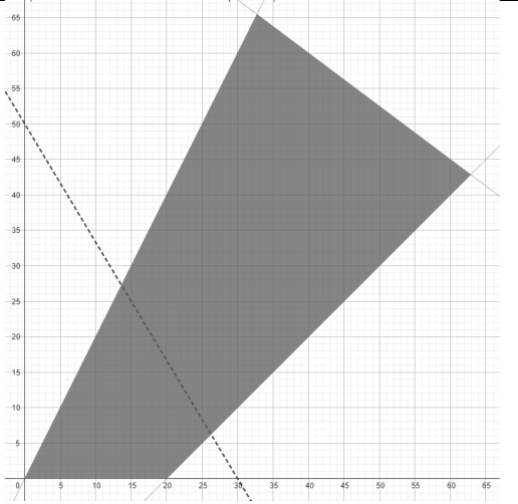
- (c)(i)
Find the maximum number of beef sausages that can be prepared.
[1] - (c)(ii)
Find the maximum number of chicken sausages to sell for maximum profit and the corresponding number of beef sausages.
[3]
Use the graph paper provided to answer this question. Mak Siti buys x kg of shrimp and y kg of squid at a wholesale market. The price of shrimp and squid is RM25.00 per kg and RM20.00 per kg respectively. The purchase is based on three constraints, two of which are: I The mass of squid is not more than 3 times the mass of shrimp. II The total amount of shrimp and squid purchased is RM800 or more. (a) Write two inequalities, other than x ≥ 0 and y ≥ 0, which satisfy the two constraints. (b) The third constraint is represented by the coloured region on the graph on page 31. Write in words the constraint. (c) Use the graph on page 31. Hence, construct and shade the region R which satisfies all the above constraints. (d) By using the graph constructed in 15(c), find (i) the minimum mass of shrimp purchased if 20 kg of squid is purchased, (ii) the maximum amount of money paid by Mak Siti.
Medium11 marks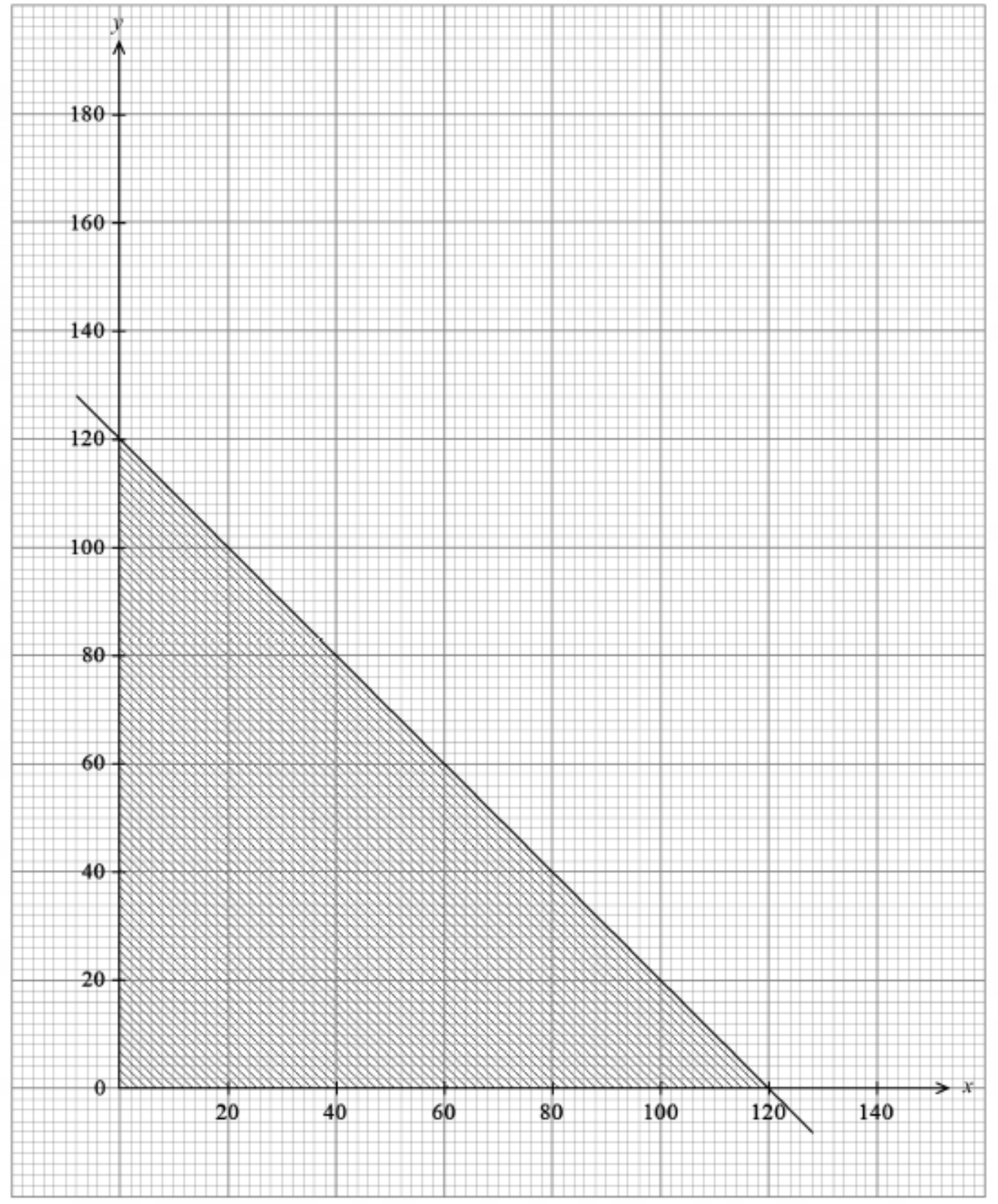
- (a)
Write the two inequalities for constraints I and II.
[2] - (b)
Write in words the third constraint (coloured region).
[1] - (c)
Construct and shade the region R which satisfies all the constraints.
[3]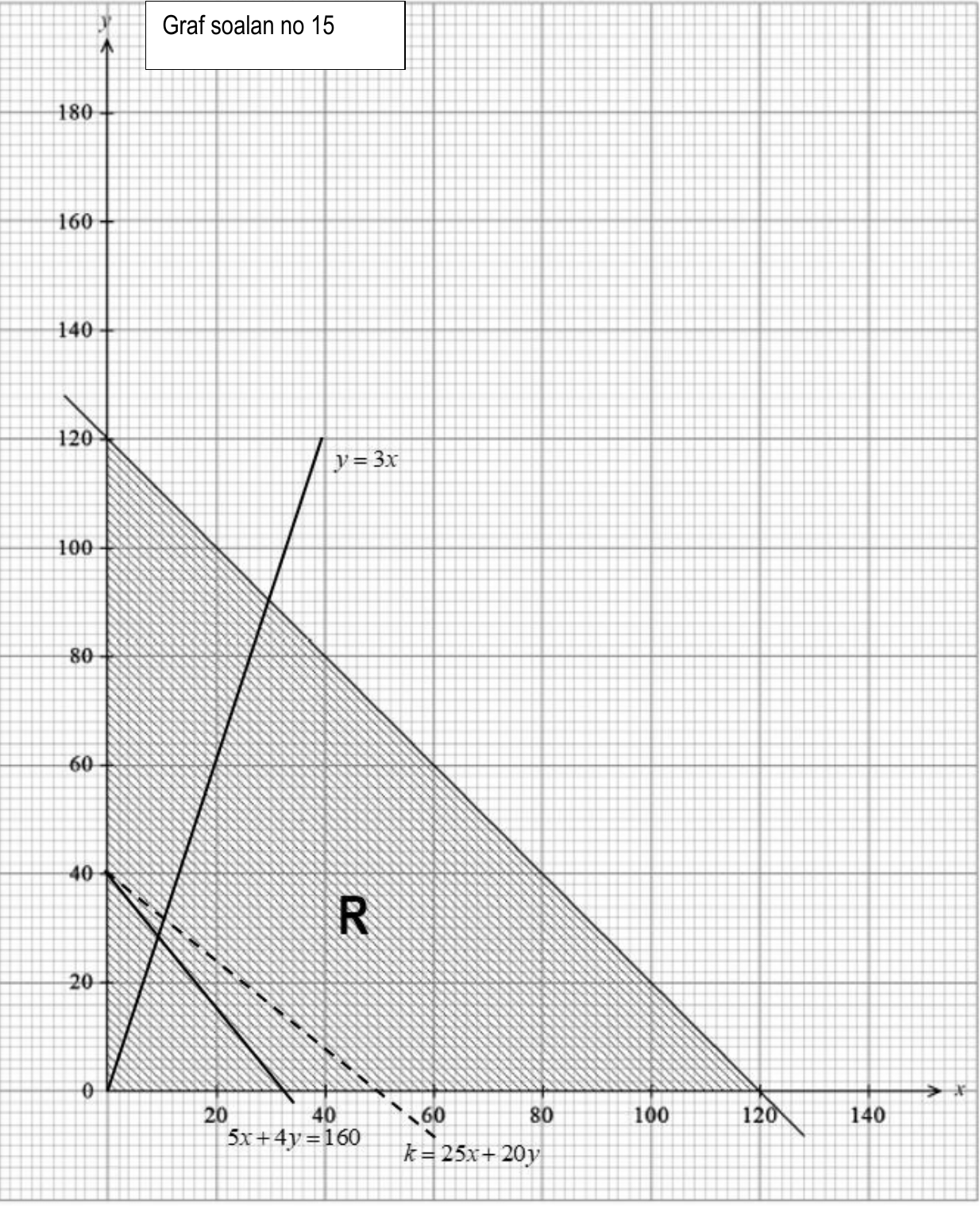
- (d)(i)
Find the minimum mass of shrimp purchased if 20 kg of squid is purchased.
[1] - (d)(ii)
Find the maximum amount of money paid by Mak Siti.
[4]
An institution offers two business courses, Management and Finance. The number of participants for the Management course is x and for the Finance course is y. The enrolment of the participants is based on the following constraints: I: The total number of participants is not more than 80. II: The number of participants for the Finance course is not more than 4 times the number of participants for the Management course. III: The number of participants for the Finance course must exceed the number of participants for the Management course by at least 10. (a) Write down three inequalities, other than x ≥ 0 and y ≥ 0, that satisfy all the above constraints. (b) Hence, using a scale of 2 cm to 10 participants for both axes, construct and shade the region R that satisfies all the above constraints. (c) By using your graph from (b), find (i) the range of the number of participants for the Finance course if the number of participants for the Management course is 20, (ii) the maximum total fees per week that can be collected if the fees per week for the Management course and the Finance course are RM60 and RM70 respectively.
Medium10 marks- (a)
Write down three inequalities (constraints I, II, III).
[3] - (b)
Construct and shade the region R (scale 2 cm to 10 participants on both axes).
[3]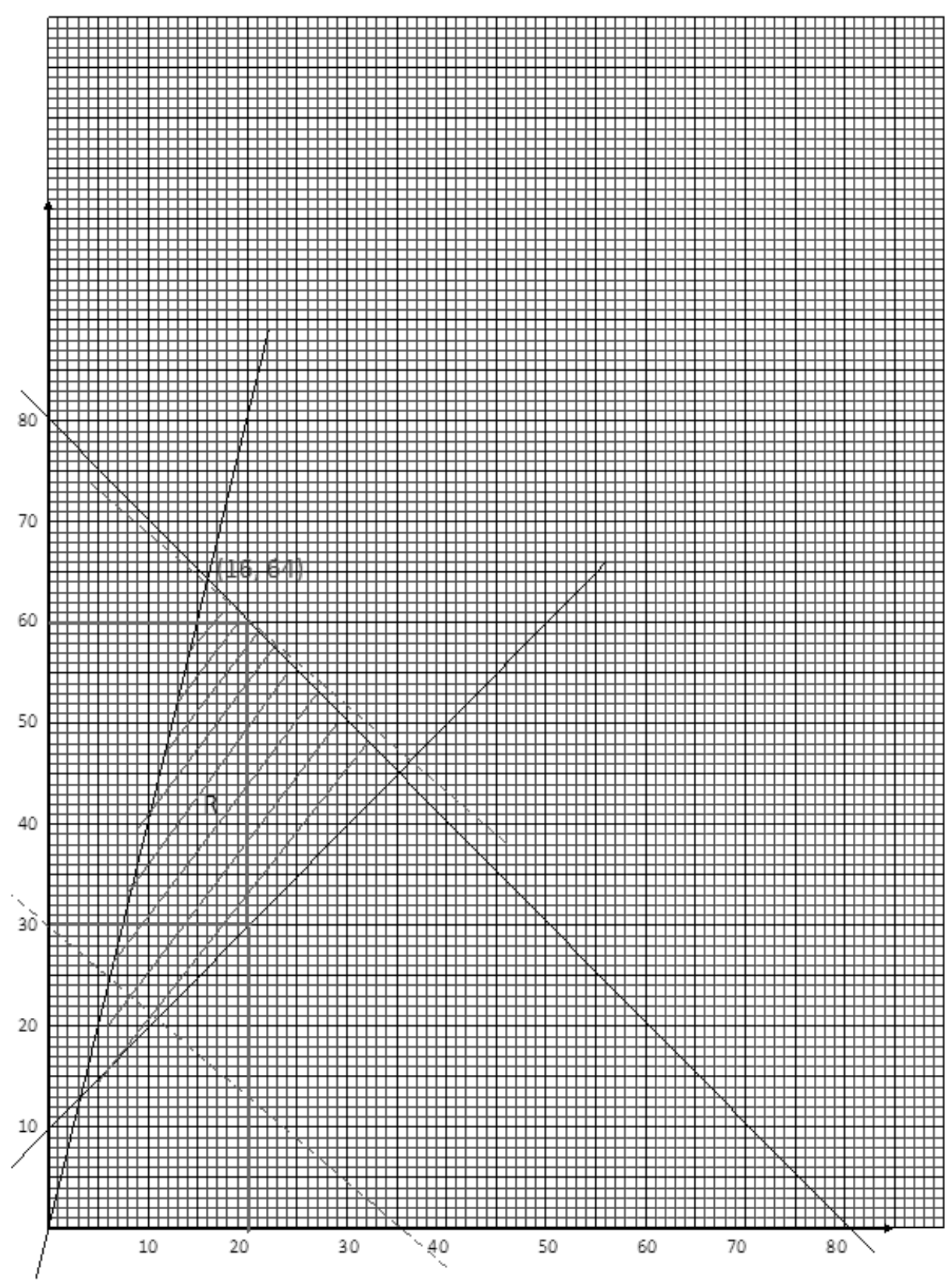
- (c)(i)
Find the range of the number of Finance participants if Management participants is 20.
[2] - (c)(ii)
Find the maximum total fees per week (RM60 Management, RM70 Finance).
[2]
Company ABC organises a programme 'Spell It Right'. Participants are x primary school students and y secondary school students. The participation fee is RM100 for a primary school student and RM120 for a secondary school student. The number of students is based on: I The maximum number of students is 90. II The ratio of the number of primary school students to secondary school students is at least 1 : 2. III The total fee collected is not less than RM6000. (a) Write three linear inequalities, other than x ≥ 0 and y ≥ 0, that satisfy all the conditions. (b) Using a scale of 2 cm to 10 students on both axes, construct and shade the region R that satisfies all the conditions in (a). (c) Using the graph in (b), find (i) the minimum number of secondary school students if the ratio of primary to secondary school students is 1 : 2, (ii) the maximum profit if company ABC earns a profit of 20% of the total fees collected.
Medium10 marks- (a)
Write three linear inequalities (other than x ≥ 0, y ≥ 0).
[3] - (b)
Construct and shade the region R (scale 2 cm to 10 students on both axes).
[3]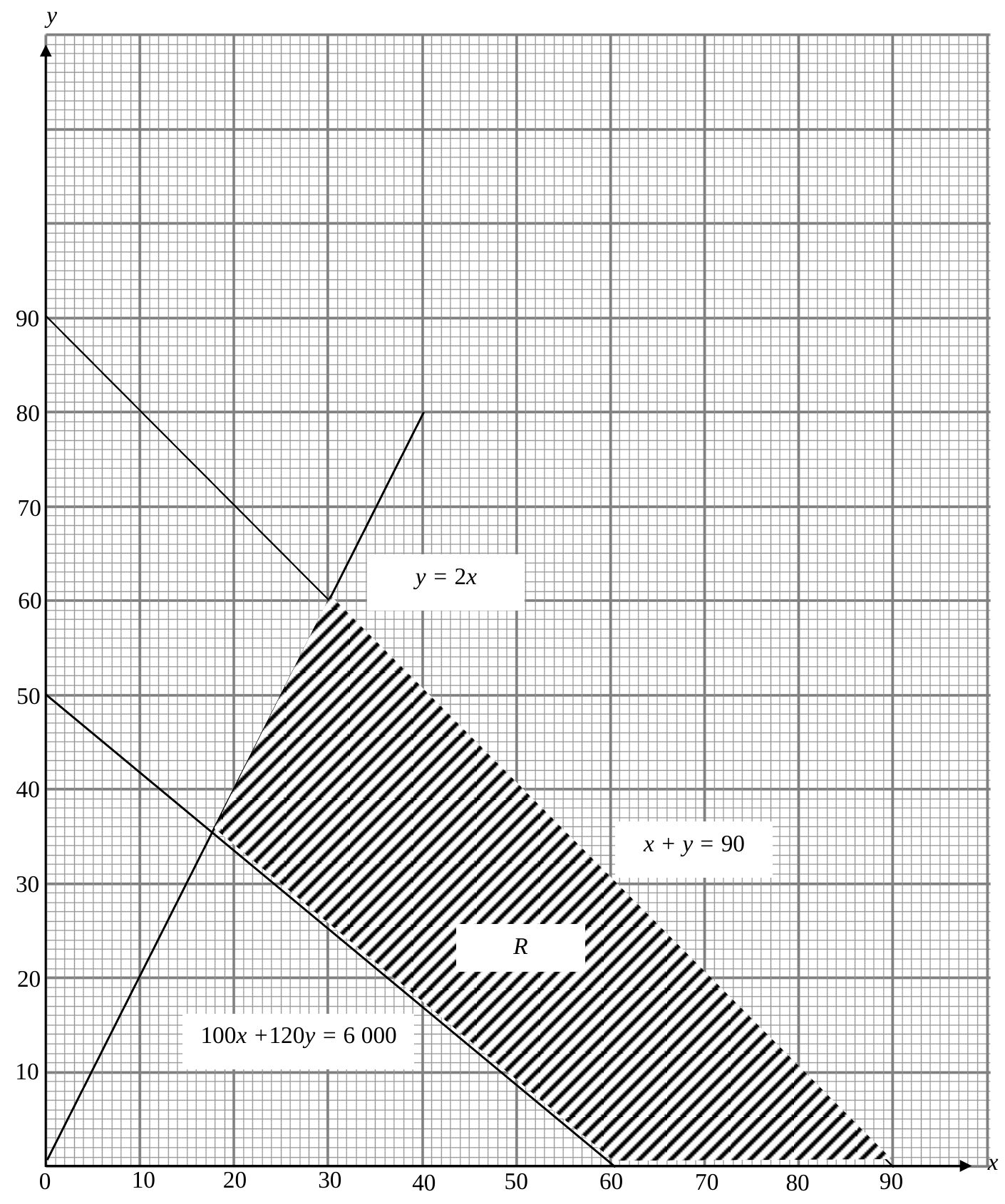
- (c)(i)
Minimum number of secondary school students if the ratio is 1 : 2.
[1] - (c)(ii)
Maximum profit if ABC earns 20% of the total fees collected.
[3]
A company wants to send workers to attend two types of computer courses, A and B. The number of participants for course A is x and for course B is y. The fees for course A and course B are RM500 and RM400 respectively. The selection of participants is based on these constraints: I: the total number of participants is at least 50. II: the number of participants for course B is not more than three times the number of participants for course A. III: the maximum allocation for the courses is RM36 000. (a) Write three inequalities, other than x ≥ 0 and y ≥ 0, which satisfy all the above constraints. (b) Using a scale of 2 cm to 10 participants on both axes, construct and shade the region R which satisfies all of the above constraints. (c) Use your graph from 15(b) to answer: (i) Find the maximum number of participants of course A if the number of participants of course B is 55. (ii) Find the minimum allocation for the courses.
Hard10 marks- (a)
Write three inequalities for the constraints.
[3] - (b)
Construct and shade the region R.
[3]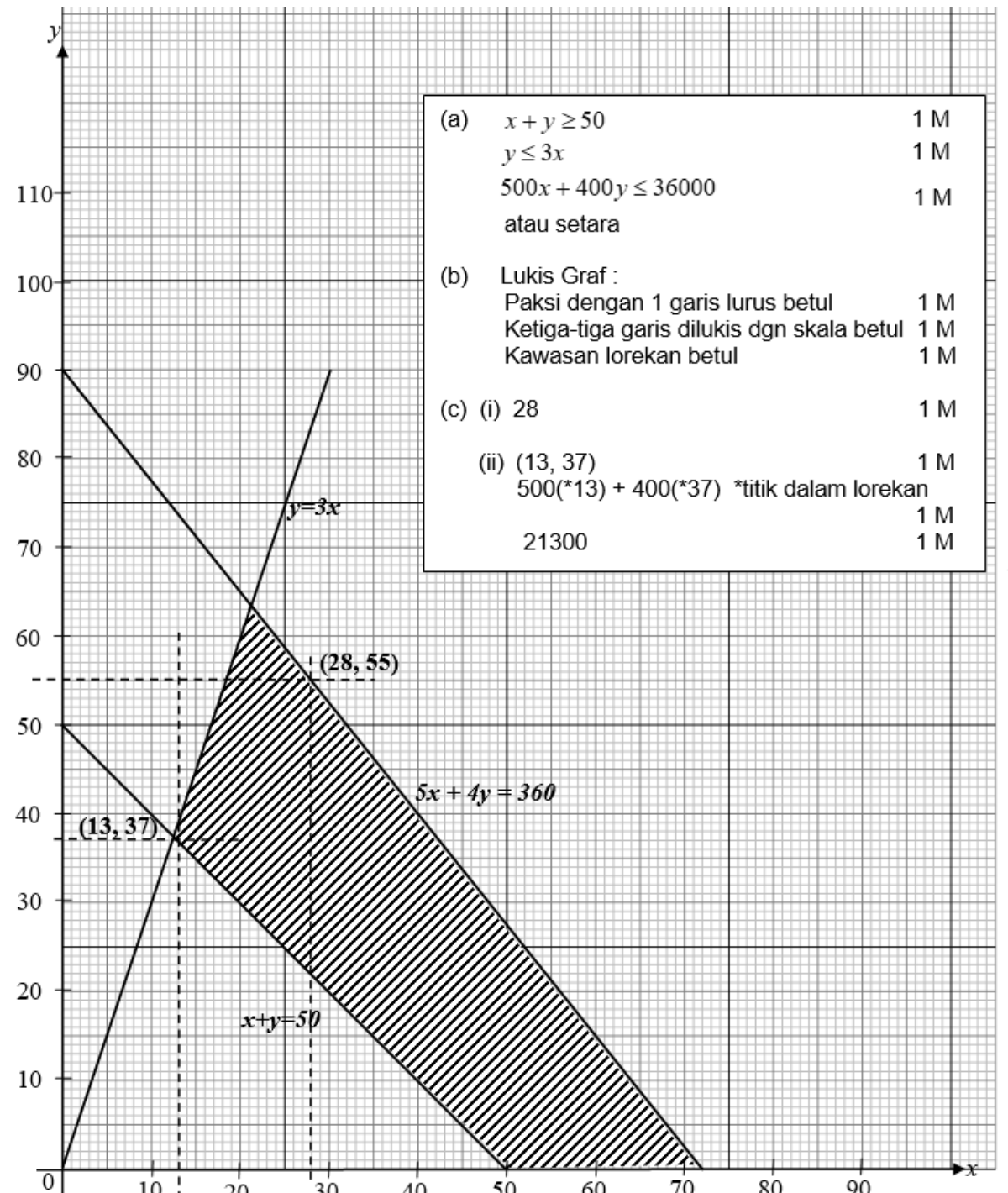
- (c)(i)
Maximum number of participants of course A when B = 55.
[1] - (c)(ii)
Minimum allocation for the courses.
[3]
Harmoni Community College offers Zapin and Ballet dancing classes. The monthly fee per student is RM30 for Zapin and RM60 for Ballet. The number of students in the Zapin class is x and in the Ballet class is y. The constraints are: I: the total number of students is not more than 40. II: the total monthly fees collected is at least RM1200. III: the number of Ballet students is at most twice the number of Zapin students. (a) Write three inequalities, other than x ≥ 0 and y ≥ 0, which satisfy all the constraints. (b) Using a scale of 2 cm to 5 students on both axes, construct and shade the region R which satisfies all the constraints. (c) Use your graph in (b) to find (i) if 10 students are enrolled for Ballet, the range of the number of students that can be enrolled for Zapin, (ii) the maximum total fees that can be collected in a month.
Hard10 marks- (a)
Write three inequalities for the constraints.
[3] - (b)
Construct and shade region R (scale 2 cm to 5 students).
[3] - (c)(i)
If 10 students are in Ballet, the range of Zapin students.
[1] - (c)(ii)
Maximum total monthly fees.
[3]
Use graph paper to answer this question. A private higher education institution A offers two courses, Engineering and Medicine. The number of students for the Engineering course is x while the number of students for the Medicine course is y. The intake of students for each course is based on the following constraints: I The minimum number of students in the Engineering course is 200 while the maximum number is 500. II The total number of students in both courses does not exceed 700. III The number of Engineering students exceeds two times the number of Medicine students by at most 200. (a) Write three inequalities, other than x ≥ 0 and y ≥ 0, that satisfy all the above constraints. (b) Using a scale of 2 cm to 100 students on both axes, construct and shade the region R which satisfies all of the above constraints. (c) Using the graph constructed in 15(b), find (i) the maximum number of students that can be taken into the Medicine course if the number of Engineering students is 250, (ii) the maximum amount of fees that can be collected per semester if the fee for each Engineering student for one semester is RM600 and for a Medicine student is RM800.
Medium10 marks- (a)
Write three inequalities (other than x ≥ 0, y ≥ 0) for constraints I, II and III.
[3] - (b)
Construct and shade the region R (scale 2 cm to 100 students on both axes).
[3]
- (c)(i)
Find the maximum number of Medicine students if the number of Engineering students is 250.
[1] - (c)(ii)
Find the maximum fees per semester (Engineering RM600, Medicine RM800 per student).
[3]
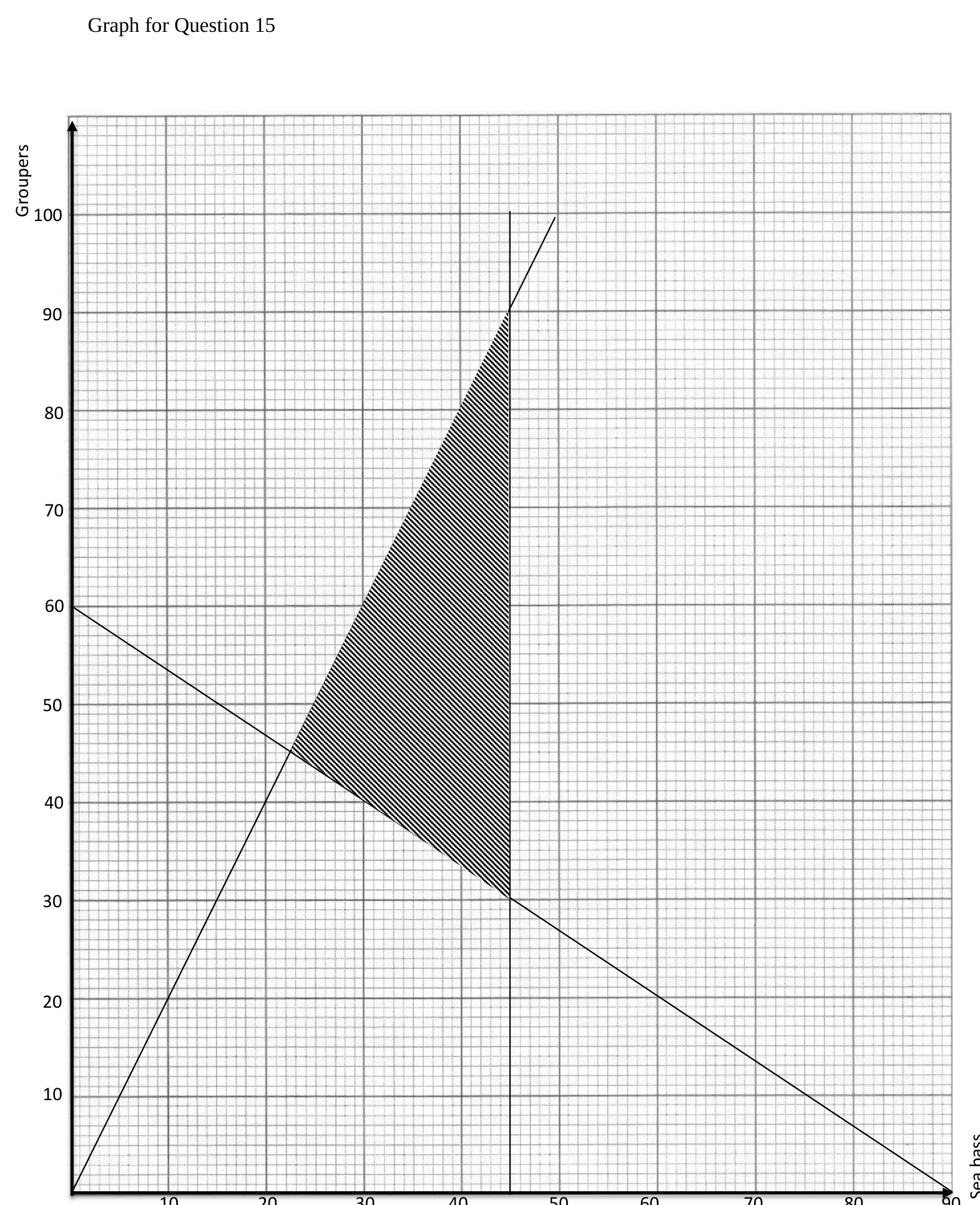
Use the graph paper provided on page 38 to answer this question. A fishmonger sells x kg of sea bass and y kg of grouper daily. He sells sea bass at RM 20 a kilogram and grouper at RM 30 a kilogram. The total amount of the sale of the fishes is at least RM 1 800 a day. The ratio of the weight in kg of sea bass to grouper sold daily is at least 1 : 2. At most 45 kg of sea bass are sold every day.
Medium10 marks- (a)
State the three inequalities other than x ≥ 0 and y ≥ 0, which satisfies all the above constraints.
[3] - (b)
Using a scale 2 cm to 10 kg on each axis, construct and shade the region R which satisfies all the above constraints.
[3]
- (c)(i)
Based on the graph constructed in 15(b), find the range of weight, in kg, of grouper sold if he sells 30 kg of sea bass in a day.
[1] - (c)(ii)
Based on the graph constructed in 15(b), find the minimum daily cost if the cost of a kilogram of sea bass and grouper are RM 15 and RM 20 respectively.
[3]
A nursery produces two types of organic fertilizer, type A and type B. It is given that the nursery produces x bottles of organic fertilizer type A and y bottles of organic fertilizer type B daily. I The ratio of the number of organic fertilizer type A to the number of organic fertilizer type B is at most 3 : 2. II The total number of organic fertilizer type A and type B that can be produced does not exceed 80 bottles. III The number of organic fertilizer type B exceed the number of organic fertilizer type A by at most 40. (a) Write three inequalities, other than x ≥ 0 and y ≥ 0, which satisfy all the above constraints. (b) Using a scale of 2 cm to 10 bottles on both axes, construct and shade the region R which satisfies all the above constraints. (c) Use the graph constructed in 13(b) to answer the following questions. (i) On a particular day, only 50 bottles of organic fertilizer type B are produced. Determine the minimum number of organic fertilizer type A produced on that day. (ii) Hence, find the maximum cost, in RM, of producing the organic fertilizer on that day if the cost of producing a bottle of fertilizer type A and type B are RM20.00 and RM30.00 respectively.
Medium10 marks- (a)
Write three inequalities, other than x ≥ 0 and y ≥ 0, which satisfy all the above constraints.
[3] - (b)
Using a scale of 2 cm to 10 bottles on both axes, construct and shade the region R.
[3] - (c)(i)
Only 50 bottles of type B are produced. Determine the minimum number of type A produced on that day.
[1] - (c)(ii)
Hence, find the maximum cost, in RM, of producing the fertiliser on that day (type A RM20.00, type B RM30.00 per bottle).
[3]
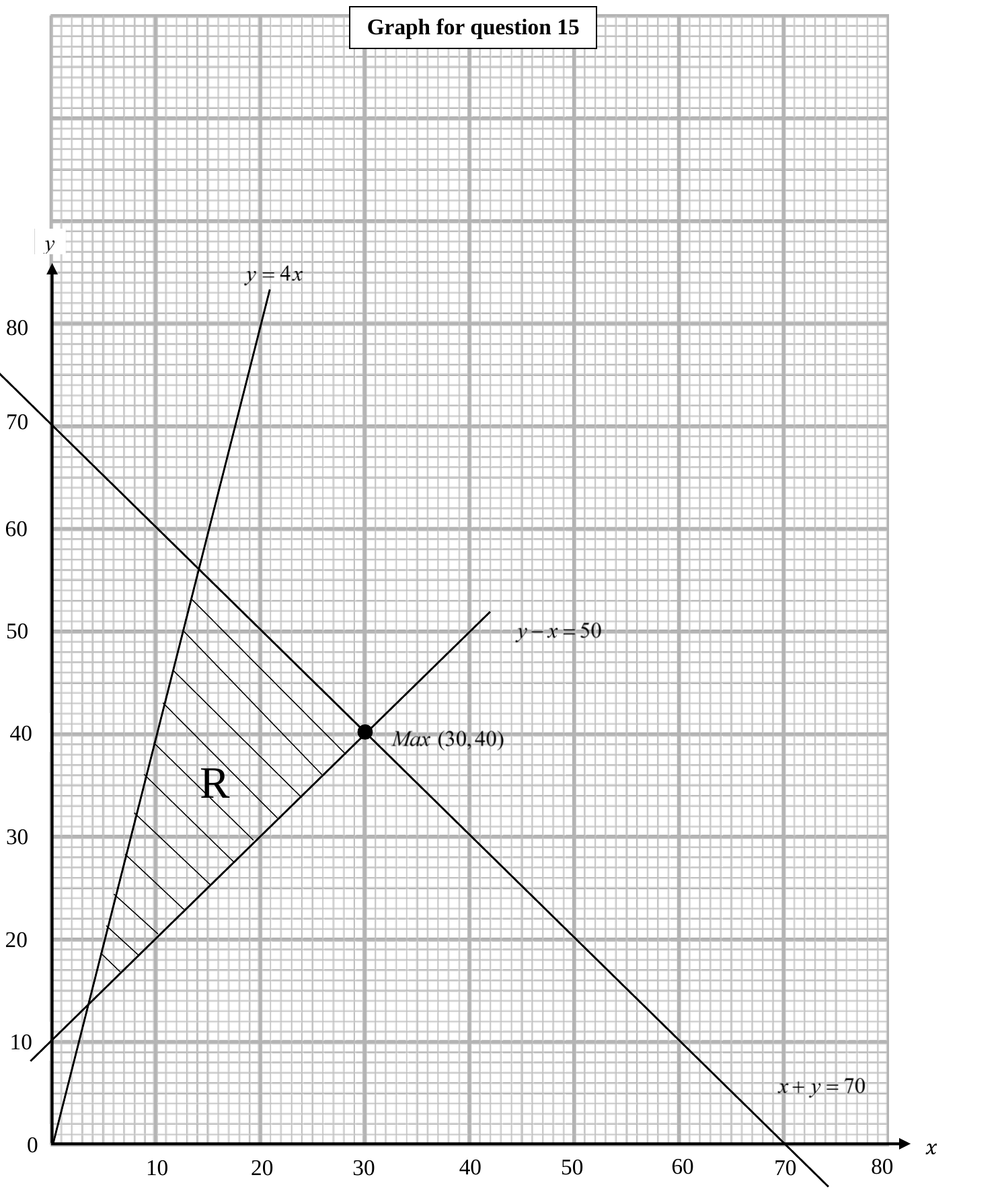
Cikgu Abdul plans to purchase x uniform and y T-shirts for a group of students in his school. The purchase is based on the following constraints: I The total number of clothes purchased cannot be more than 70 pieces. II The number of uniform is at least 25% of the number of T-shirts purchased. III The number of T-shirts must exceed the number of uniform by at least 10 pieces. (a) Write three inequalities other than x ≥ 0 and y ≥ 0 that satisfy all the above constraints. (b) Using a scale of 2 cm to 10 clothes on both axes, construct and shade the region R that satisfies all the above constraints. (c) Use the graph constructed in 15(b) to answer the following questions. (i) State the range of the number of T-shirts purchased if the number of uniform purchased is 25 pieces. (ii) Find the maximum allocation, in RM, required if the prices of a uniform and a T-shirts are RM80 and RM40 respectively.
Medium10 marks- (a)
Write three inequalities other than x ≥ 0 and y ≥ 0 that satisfy all the above constraints.
[3] - (b)
Using a scale of 2 cm to 10 clothes on both axes, construct and shade the region R that satisfies all the above constraints.
[3]
- (c)(i)
State the range of the number of T-shirts purchased if the number of uniform purchased is 25 pieces.
[1] - (c)(ii)
Find the maximum allocation, in RM, required if the prices of a uniform and a T-shirts are RM80 and RM40 respectively.
[3]
Use the graph provided on page 32 to answer this question. A shop sells two types of printers, printer P and printer Q. The price of a printer P and a printer Q are RM 1000 and RM 500 respectively. The shop sells x unit of printer P and y unit of printer Q is based on three constraints, two of the constraints are as follows: I The number of sales of printer Q exceed the number of sales of printer P by at most 40. II The total sales is at most RM 50 000.
Medium10 marks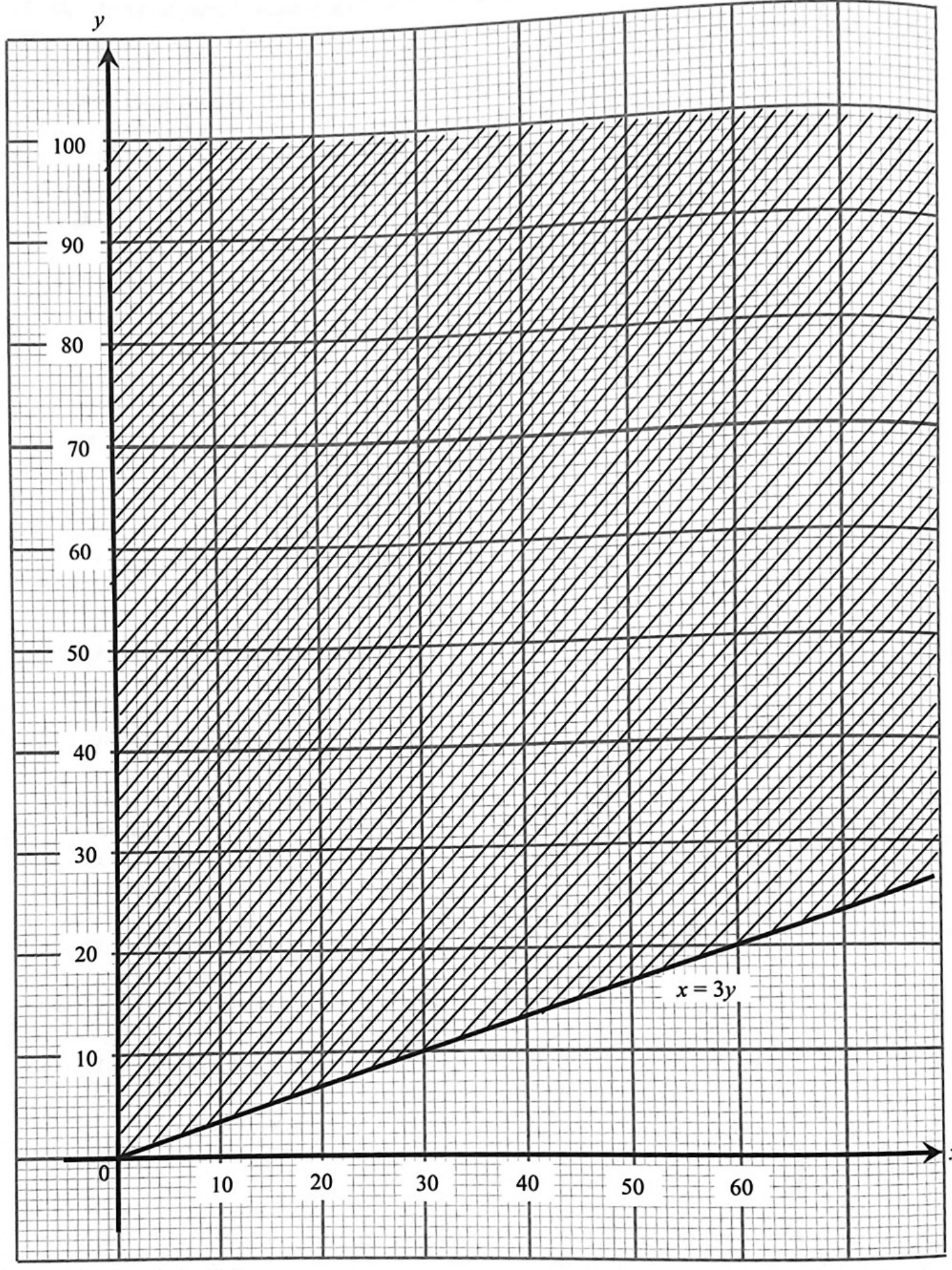
- (a)
Write two inequalities, other than x ≥ 0 and y ≥ 0, that satisfy the two constraints.
[2] - (b)
The third constraint is represented by the shaded region in the graph on page 30. Write in words the constraint.
[1] - (c)
On the graph on page 32, construct and shade the region R which satisfies all the three constraints.
[3]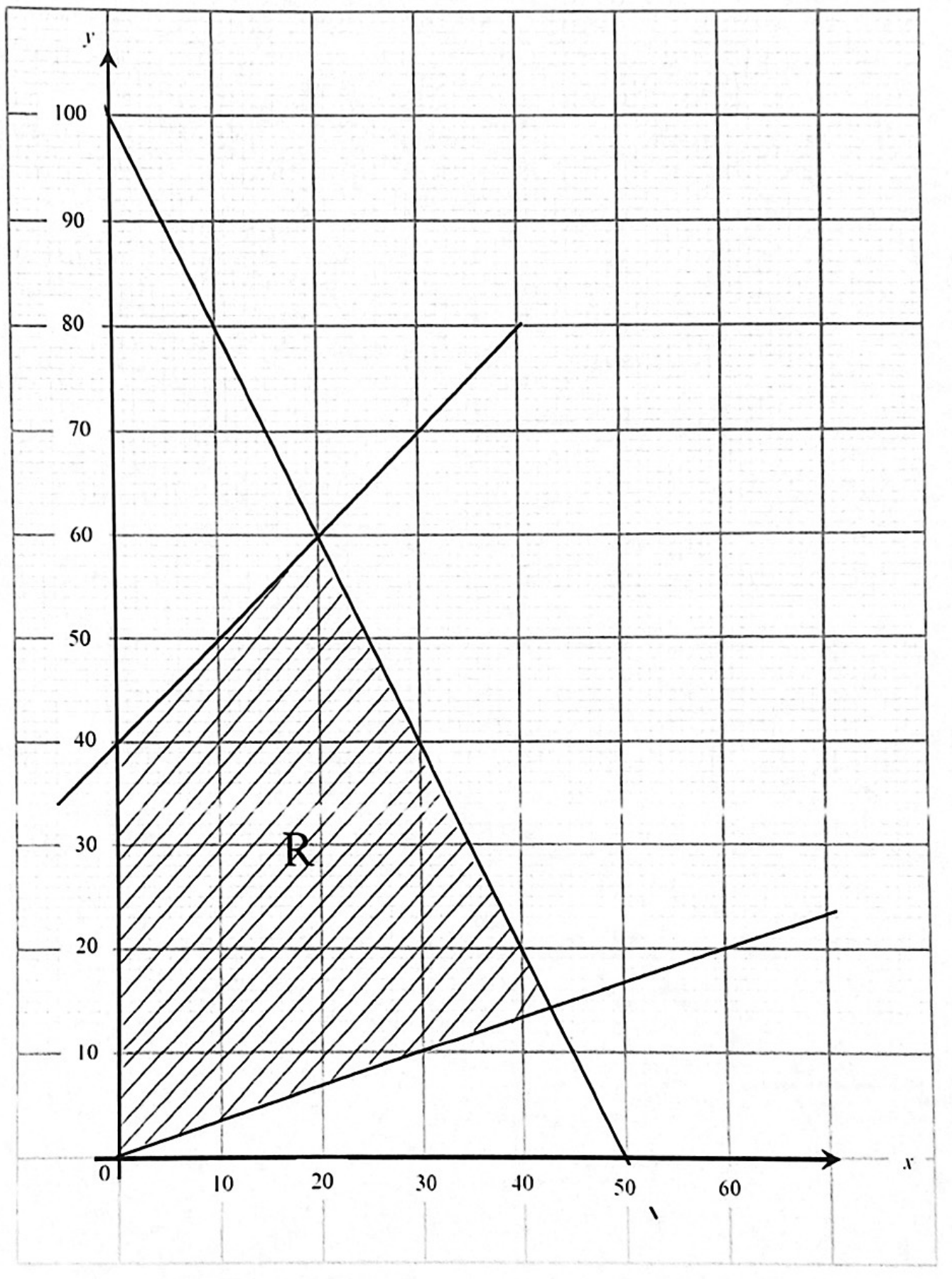
- (d)(i)
Using the graph constructed in 15(c), find the range number of printer Q if the number of printer P is 30.
[1] - (d)(ii)
Using the graph constructed in 15(c), find the maximum profit that able to make if the profit of selling a printer P is RM 200 and the profit of selling a printer Q is RM 150.
[3]
A factory produces two models of toy cars, Z50 and Z70, by using machine A and machine B. In a week, the factory produces x unit of Z50 model and y unit of Z70 model. Machine A requires 70 minutes to produce one unit of Z50 model and 40 minutes to produce one unit of Z70 model. Machine B requires 50 minutes to produce one unit of Z50 model and 40 minutes one unit of Z70 model. The production of the factory in a week is restricted to the following conditions: I Total time for the usage of machine A is at most 4 200 minutes. II Total time for the usage of machine B must be at least 2 000 minutes. III The number of Z70 model produced is not more than two times the number of Z50 model produced. (a) Write three inequalities, other than x ≥ 0 and y ≥ 0, which satisfy the above conditions. (b) By using a scale of 2 cm to 10 toy cars on both axes, draw and shade the region which satisfies the inequalities in 15(a). (c) Given the profit gained from one unit of Z50 model and one unit of Z70 model is RM30 and RM20 respectively. Using the graph constructed in 15(b), find the maximum profit if the number of units of Z50 model produced is three times the number of units of Z70 model.
Medium10 marks- (a)
Write three inequalities (other than x ≥ 0, y ≥ 0).
[3] - (b)
Draw and shade the region satisfying the inequalities (graph paper, 2 cm to 10 units).
[3] - (c)
Find the maximum profit if Z50 units = 3 × Z70 units.
[4]
A tailor accepts orders for sewing baju kurung and baju Melayu only. The preparation time and sewing time for each pair of baju kurung and baju Melayu are shown in Table 3: baju kurung 50 minutes preparation, 50 minutes sewing; baju Melayu 75 minutes preparation, 60 minutes sewing. The maximum preparation time that can be used is 100 hours and the minimum sewing time is 50 hours. The ratio of the number of baju kurung to baju Melayu must be at least 1 : 2. In a certain period of time, the shop can complete x pair of baju kurung and y pair of baju Melayu. (a) Write three inequalities other than x ≥ 0 and y ≥ 0 that satisfy all the above constraints. (b) Using a scale of 2 cm to 20 pairs of baju kurung on the x-axis and 2 cm to 10 pairs of baju Melayu on the y-axis, construct and shade the region R which satisfies all the above constraints. (c) Given the profit from sewing a pair of baju kurung and baju Melayu is RM70 and RM120, respectively. Given the maximum profit received during that period is RMk. Express the objective function, k in terms of x and y. Hence, by using the graph constructed in 15(b), draw the objective function and find the maximum profit.
Medium10 marks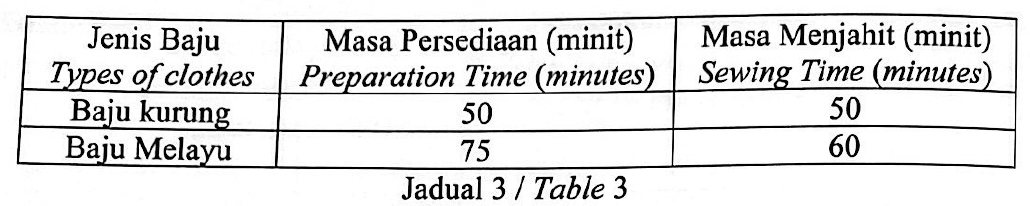
- (a)
Write three inequalities, other than x ≥ 0 and y ≥ 0, that satisfy all the constraints.
[3] - (b)
Construct and shade the region R (scale 2 cm to 20 pairs on the x-axis, 2 cm to 10 pairs on the y-axis).
[3] - (c)
Express the objective function k in terms of x and y. Hence draw the objective function on the graph and find the maximum profit.
[4]
A factory produces two types of food products, A and B. The factory produces x units of product A and y units of product B daily. The production is based on the following constraints: I The total number of both types of food products produced in a day is not more than 80 units. II The number of product B produced in a day is at most three times the number of product A produced in a day. III The number of product B produced in a day is not less than 20 units.
Medium10 marks- (a)
Write down three inequalities, other than x ≥ 0 and y ≥ 0, which satisfy all the above constraints.
[3] - (b)
Using a scale of 2 cm to 10 units on both axes, construct and shade the region R which satisfies all of the above constraints.
[3]
- (c)(i)
Using the graph constructed in (b), find the maximum number of units of product A if 30 units of product B are produced in a day.
[1] - (c)(ii)
Find the maximum profit made by the factory daily if the profit from the sales of a unit of product A and a unit of product B are RM25 and RM60 respectively.
[3]
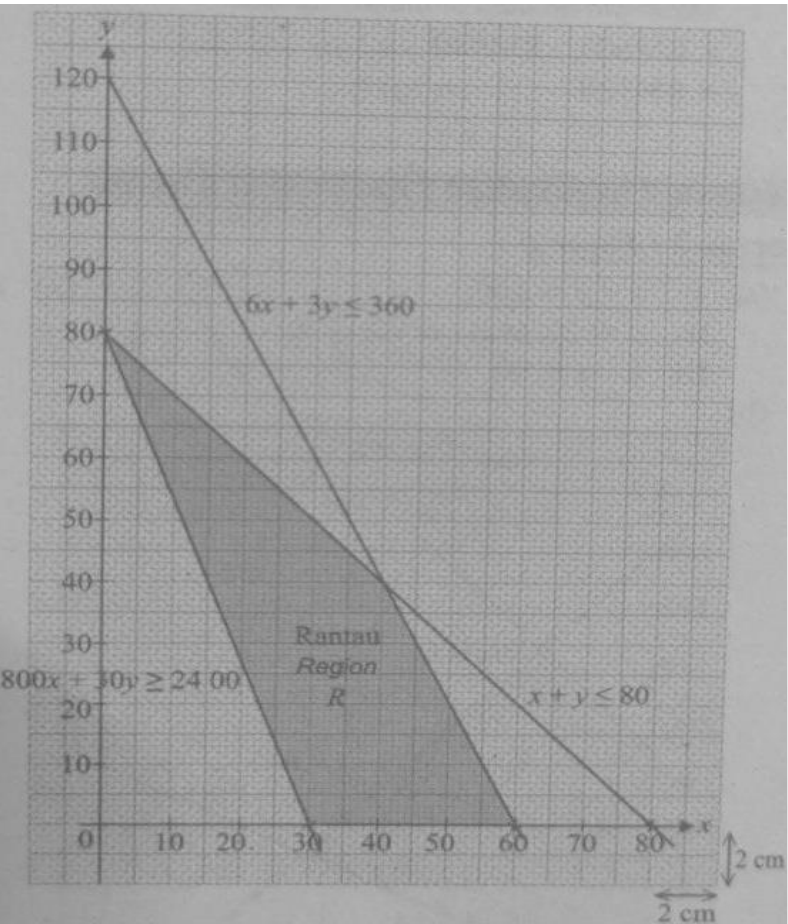
Use graph paper to answer this question. Mr Ammar used x hectares of land for planting corn and y hectares for planting papaya trees. He employs at most 360 labourers and allocates a capital of at least RM24 000. Each hectare of corn orchard needs 6 labourers and each hectare of papaya orchard needs 3 labourers. The total land for corn and papaya is not more than 80 hectares. The expenses for a hectare of corn orchard is RM800 and for a hectare of papaya orchard RM300. (a) Write three linear inequalities, other than x ≥ 0 and y ≥ 0, that satisfy all the above constraints. (b) Using a scale of 2 cm to 10 units on both axes, construct and shade the region R which satisfies all of the above constraints. (c) Using the graph, find (i) the maximum area of land for planting corn, if the area of land for planting papaya trees is 20 hectares, (ii) the maximum profit, if the profit from selling corn is RM700 and papaya is RM250 for each hectare.
Medium10 marks- (a)
Write three linear inequalities.
[3] - (b)
Construct and shade the region R (scale 2 cm to 10 units on both axes).
[3]
- (c)(i)
Find the maximum area of land for corn when the papaya area is as stated.
[1] - (c)(ii)
Find the maximum profit.
[3]
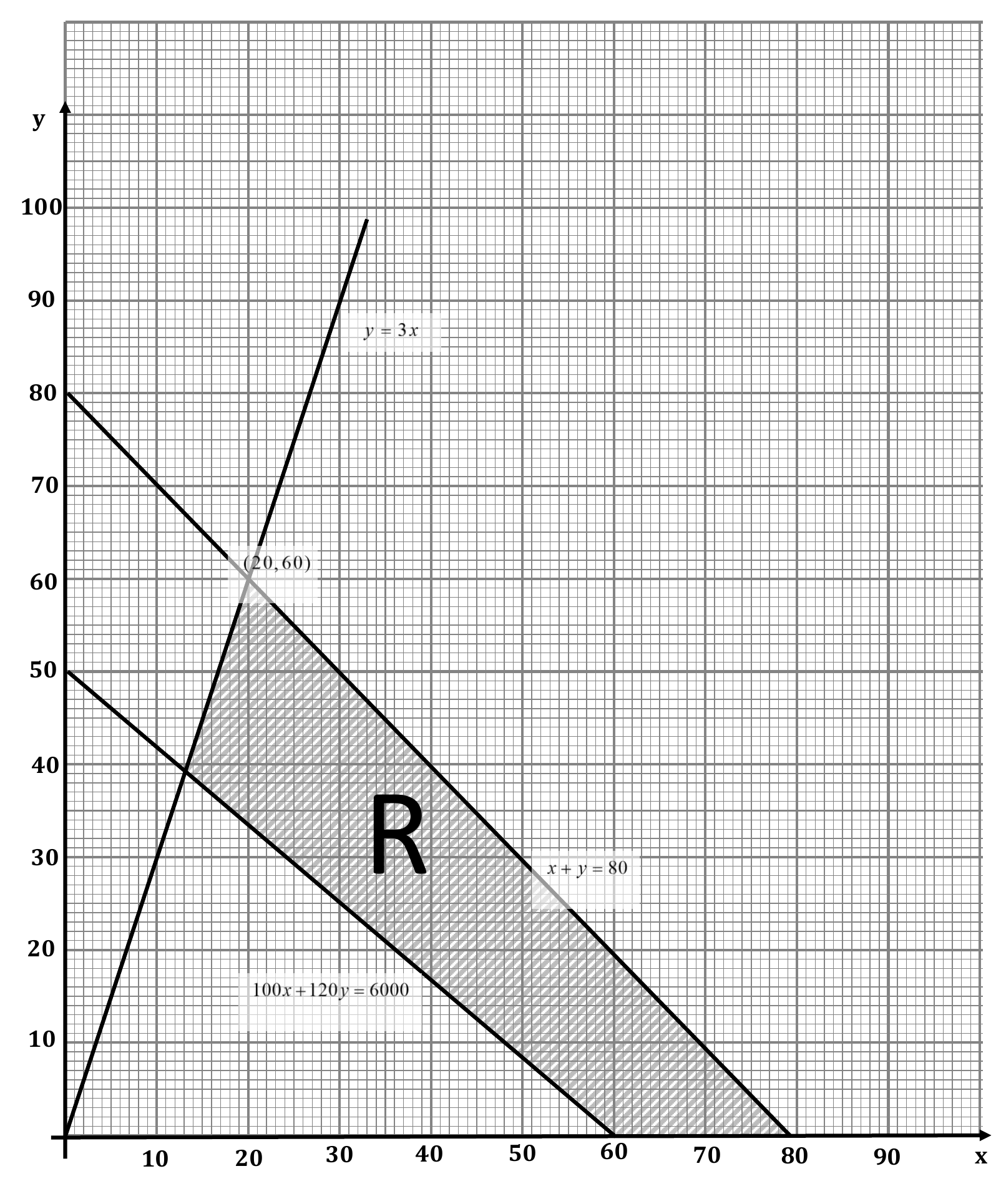
SMK Presint 8 Putrajaya organises an SPM Excellence Workshop with x SMK Presint 8 students and y outside students. The registration fee is RM100 for an SMK Presint 8 student and RM120 for an outside student. Constraints: I The maximum number of students is 80. II The ratio of SMK Presint 8 students to outside students is at least 1 : 3. III The total fee collected is at least RM6000.
Medium10 marks- (a)
Write three linear inequalities that satisfy all the above constraints except x > 0 and y > 0.
[3] - (b)
Using a scale of 2 cm to 10 students on the x-axis and y-axis, construct and shade the region R that satisfies all the above constraints.
[3]
- (c)(i)
Using the graph, find the minimum number of outside students if the ratio of SMK Presint 8 students to outside students is 1 : 3.
[1] - (c)(ii)
Using the graph, find the maximum profit obtained if the school obtains a profit of 25% of the fees collected.
[3]
A skills training centre offers cooking and sewing classes. The fees for the cooking class and the sewing class are RM15 per hour and RM25 per hour respectively. The classes are subject to these constraints: I The maximum total time that can be allocated to both classes is 20 hours per week. II The total fee for both classes in a week must not exceed RM400. III The relationship between the time allocated for cooking and sewing classes that each participant must follow is shown on the graph (page 31): the line through (3, 0) and (18, 15), that is y = x − 3. (a) In one week, a participant allocates x hours for the cooking class and y hours for the sewing class. Write the inequalities for constraints I and II. (b) Write constraint III as an inequality and explain its meaning in words. (c) On the graph, construct and label the region R that satisfies all the constraints and x ≥ 0, y ≥ 0. (d) Using the graph from (c), it is given that, on average, cooking burns 350 calories per hour, while sewing burns 450 calories per hour. By drawing the objective function, find the maximum number of calories that can be burned in one week.
Hard10 marks- (a)
Write the inequalities for constraints I and II.
[2] - (b)
Write constraint III as an inequality and explain its meaning in words.
[2] - (c)
On the graph, construct and label the region R that satisfies all the constraints and x ≥ 0, y ≥ 0.
[3]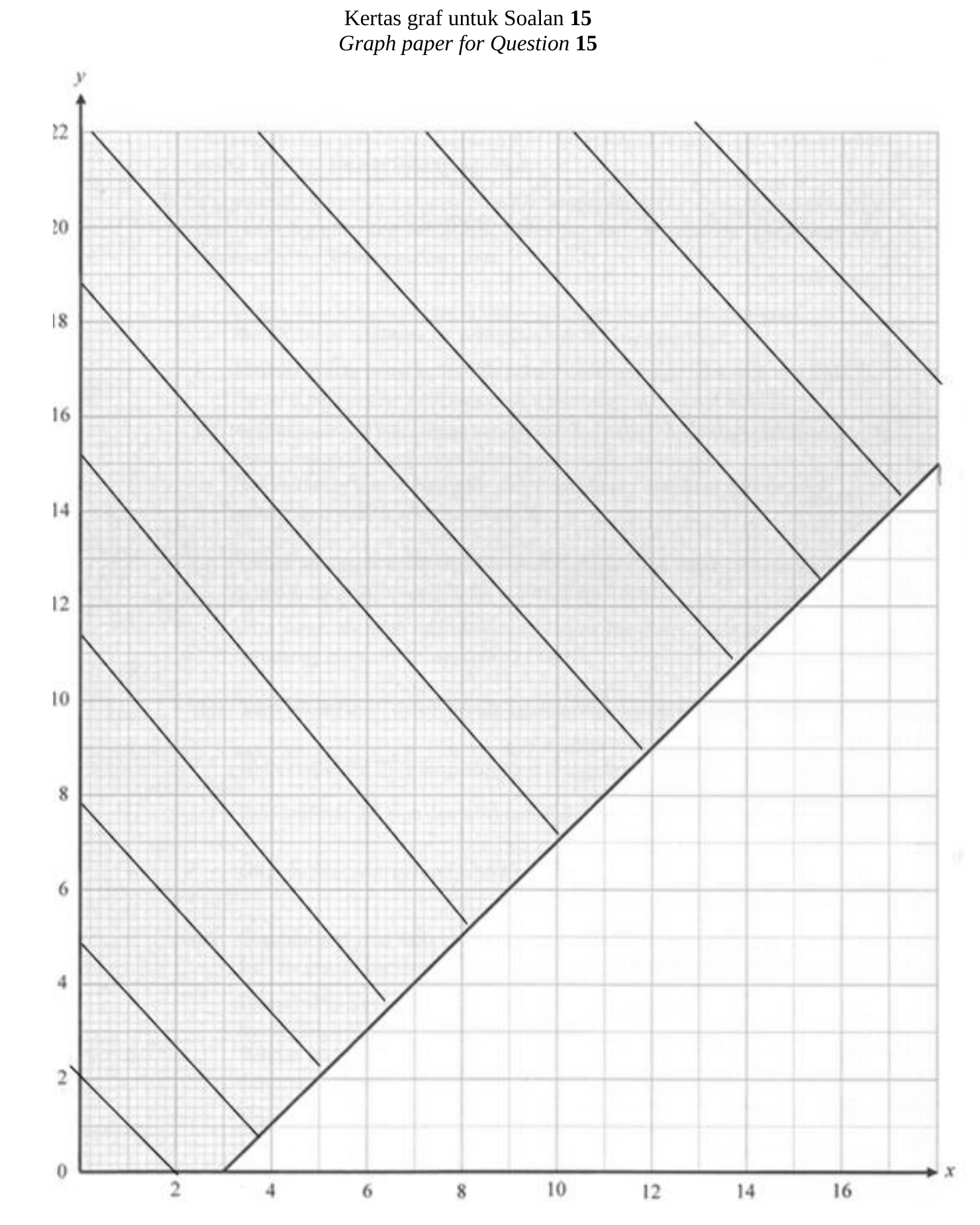
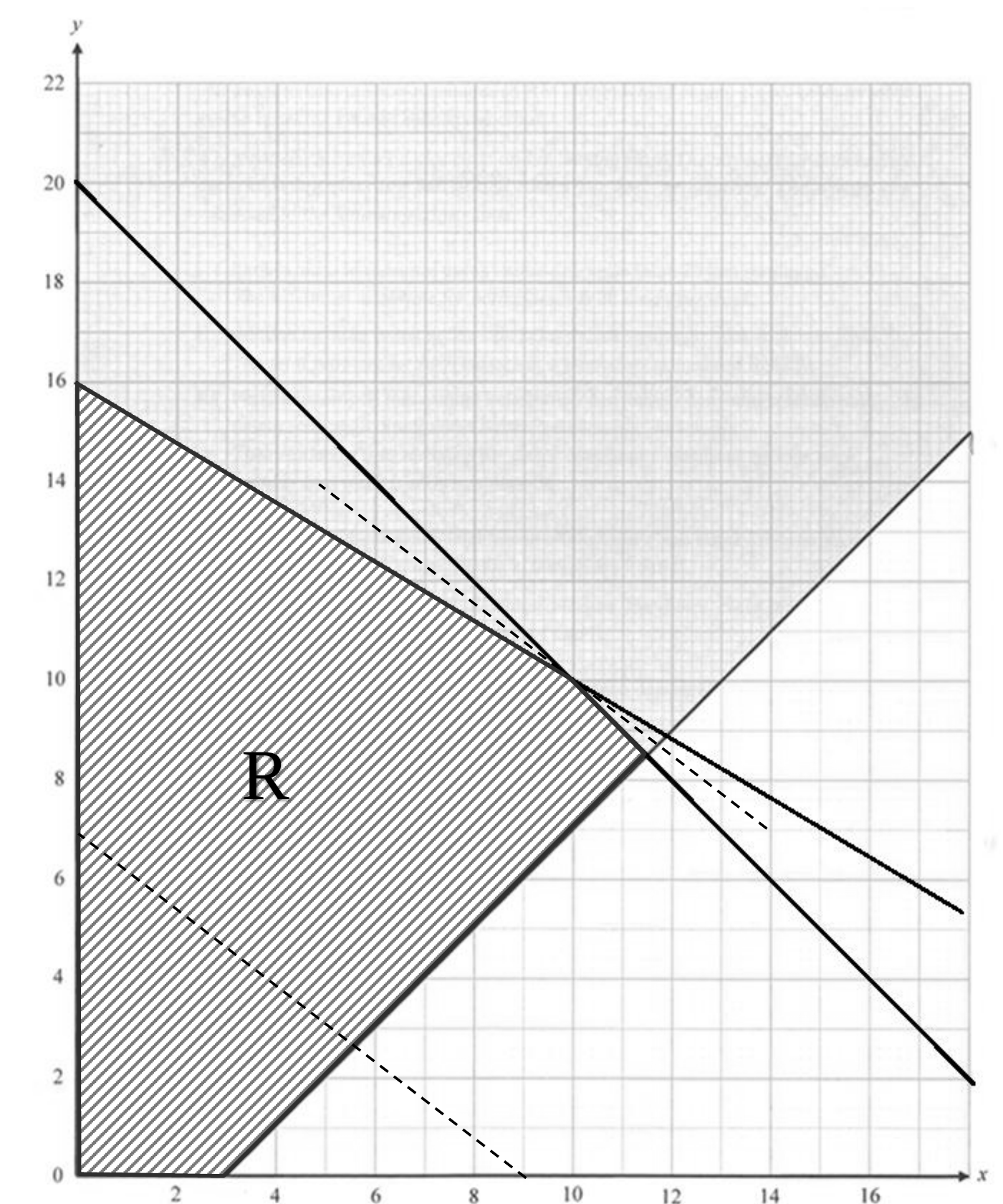
- (d)
Given cooking burns 350 calories per hour and sewing burns 450 calories per hour, find, by drawing the objective function, the maximum number of calories that can be burned in one week.
[3]
Ramli allocated RM120 to buy x workbooks and y reference books. The total number of books bought is not less than 20. The number of workbooks bought is at most twice the number of reference books. The price of a workbook is RM6.00 and the price of a reference book is RM3.00.
Medium10 marks- (a)
Write three inequalities, other than x ≥ 0 and y ≥ 0, which satisfy all the above constraints.
[3] - (b)
Using a scale of 2 cm to 5 books on both axes, construct and shade the region R which satisfies all the above constraints.
[3]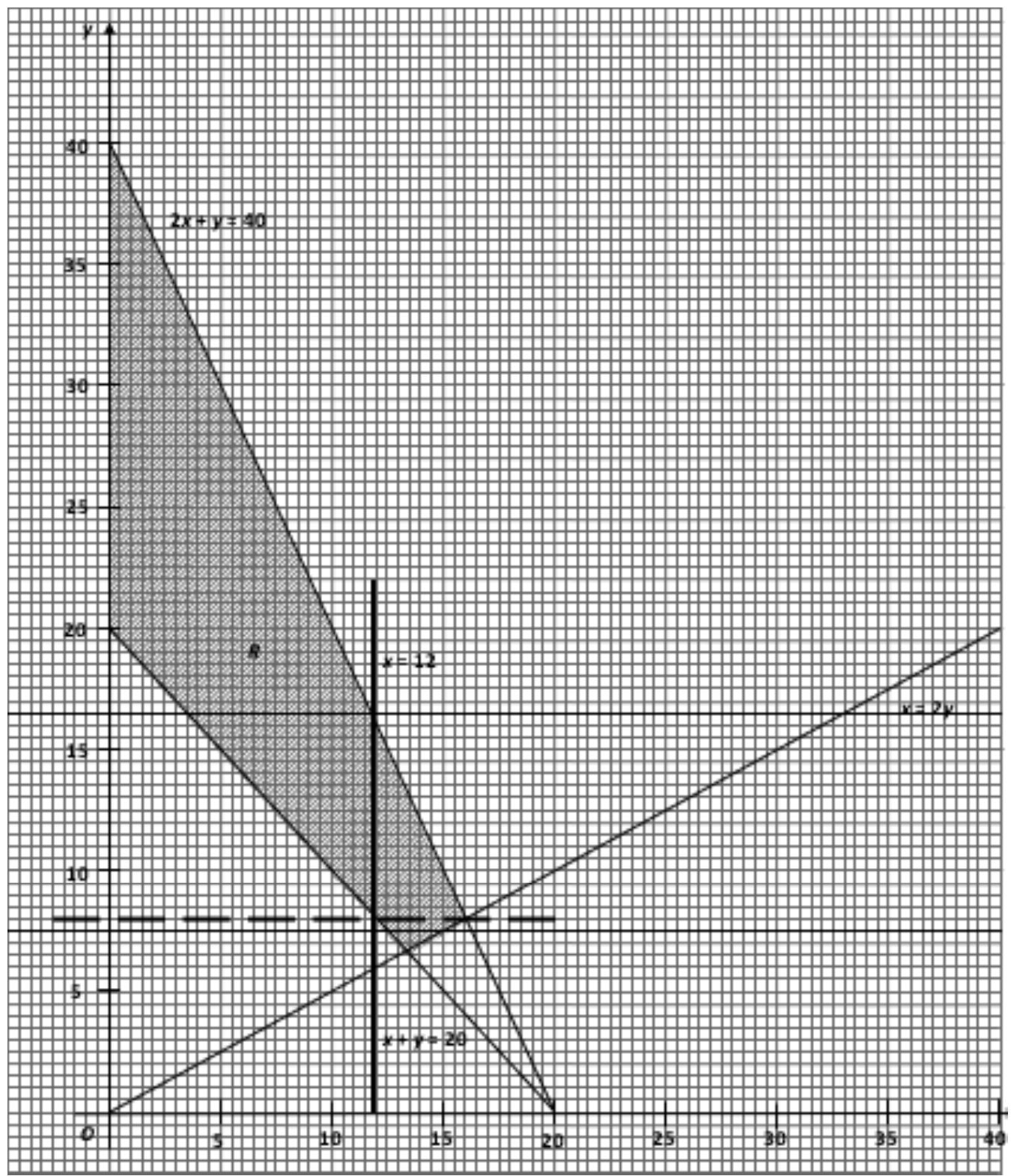
- (c)(i)
Using the graph constructed in 14(b), find the maximum number of books that Ramli can buy.
[2] - (c)(ii)
Using the graph constructed in 14(b), find the maximum amount of money left if Ramli buys 12 workbooks.
[2]
A private secondary school offers two packages, STEM A and STEM B, for Form 4 intake. Constraints: I. The school's capacity is 190 pupils. II. The minimum total intake is 80 pupils. III. The number of pupils in STEM B is more than two times the number in STEM A by at most 20. x pupils register for STEM A and y pupils for STEM B. (a) Write three inequalities, other than x ≥ 0 and y ≥ 0, that satisfy all the constraints. (b) Using scales of 2 cm to 10 pupils on the x-axis and 2 cm to 20 pupils on the y-axis, construct and shade the region R that satisfies all the constraints. (c) Using the graph, find (i) the range of the number of pupils registered for STEM B if the number registered for STEM A is 30, (ii) the minimum amount of fee collection per month if the monthly fee is RM 400 for a STEM A pupil and RM 380 for a STEM B pupil.
Medium10 marks- (a)
Write three inequalities (other than x ≥ 0, y ≥ 0). [3 marks]
[3] - (b)
Construct and shade the region R. [3 marks]
[3]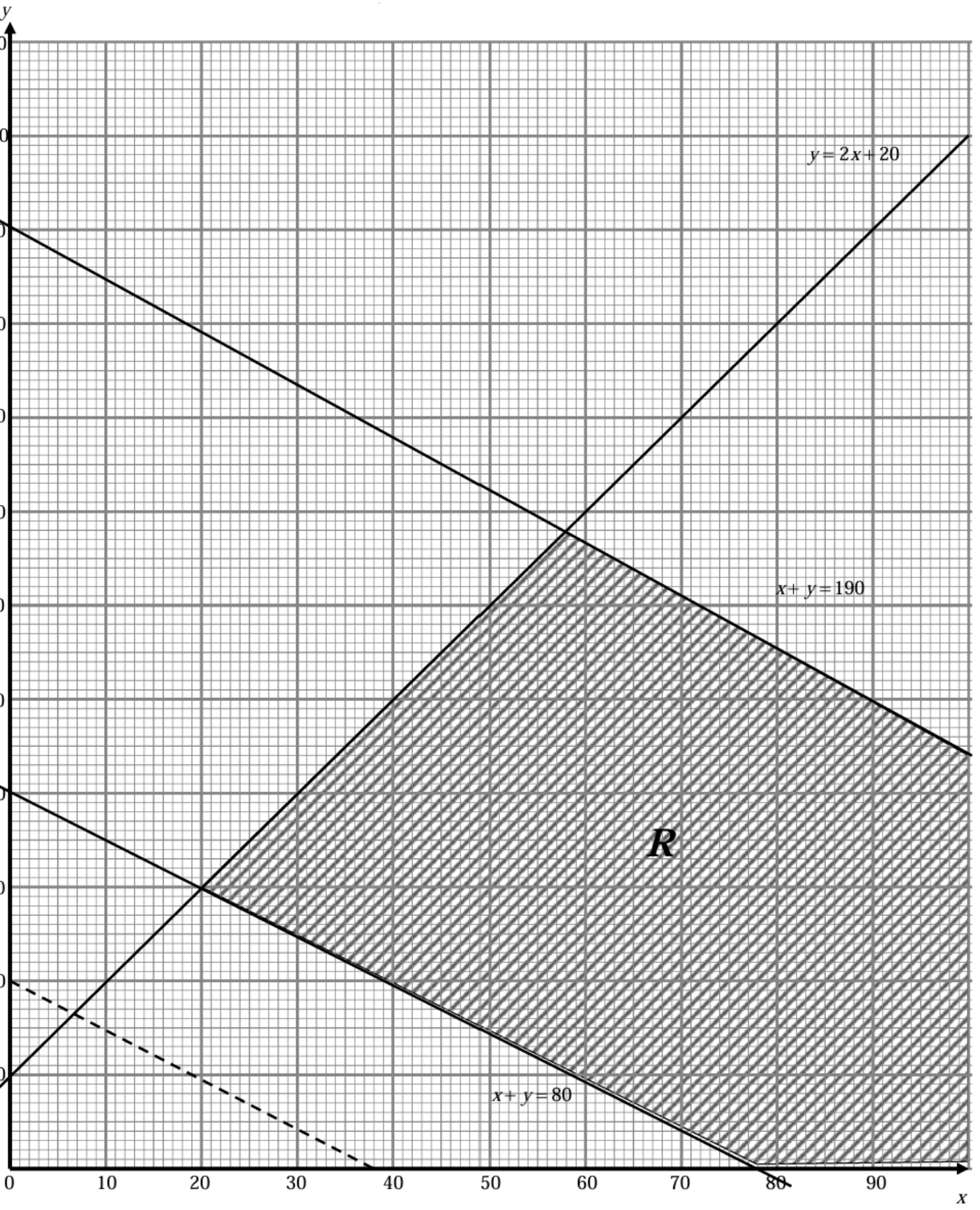
- (c)(i)
the range of y when x = 30. [(c): 4 marks]
[1] - (c)(ii)
the minimum monthly fee collection. [(c) total 4 marks]
[3]
Use the graph paper to answer this question. A factory hires x foreign workers and y local workers based on these constraints: I: The number of local workers can exceed the number of foreign workers by at most 60 people. II: The ratio of the number of local workers to the number of foreign workers is at least 3 : 5. (a) Write two inequalities, other than x ≥ 0 and y ≥ 0, that satisfy the two constraints. (b) The third constraint is represented by the shaded region on the graph on the next page (region on and below the line through (0, 180) and (160, 0)). Write the constraint in words. (c) On the graph, construct and shade the region R which satisfies all three constraints. (d) Using the graph, find (i) the maximum number of foreign workers that can be hired, (ii) the maximum amount of daily wage to be paid if the factory pays RM15 per day for foreign workers and RM30 per day for local workers.
Medium10 marks- (a)
Write two inequalities that satisfy constraints I and II.
[2] - (b)
Write the third constraint in words.
[1] - (c)
Construct and shade the region R that satisfies all three constraints.
[3]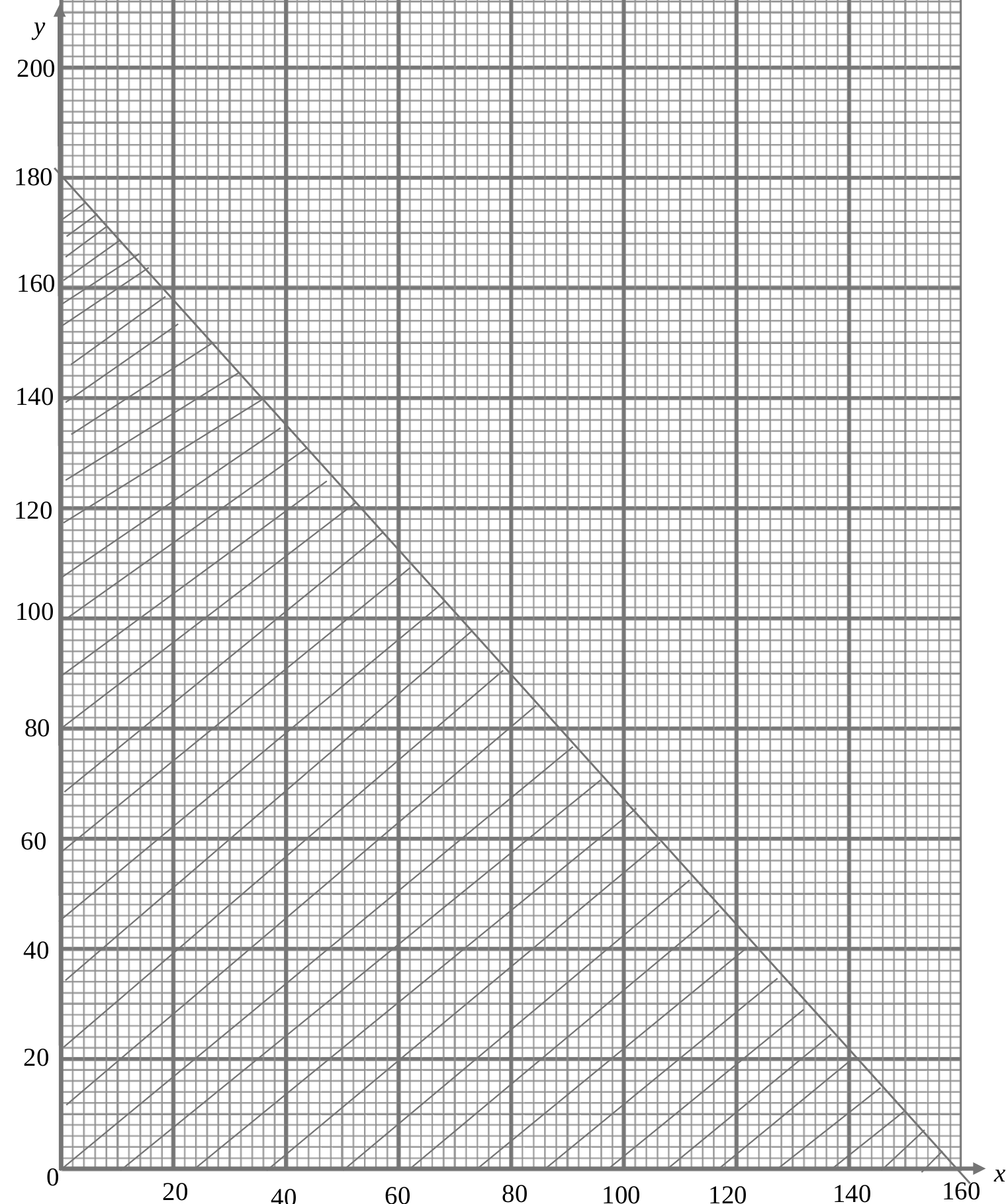
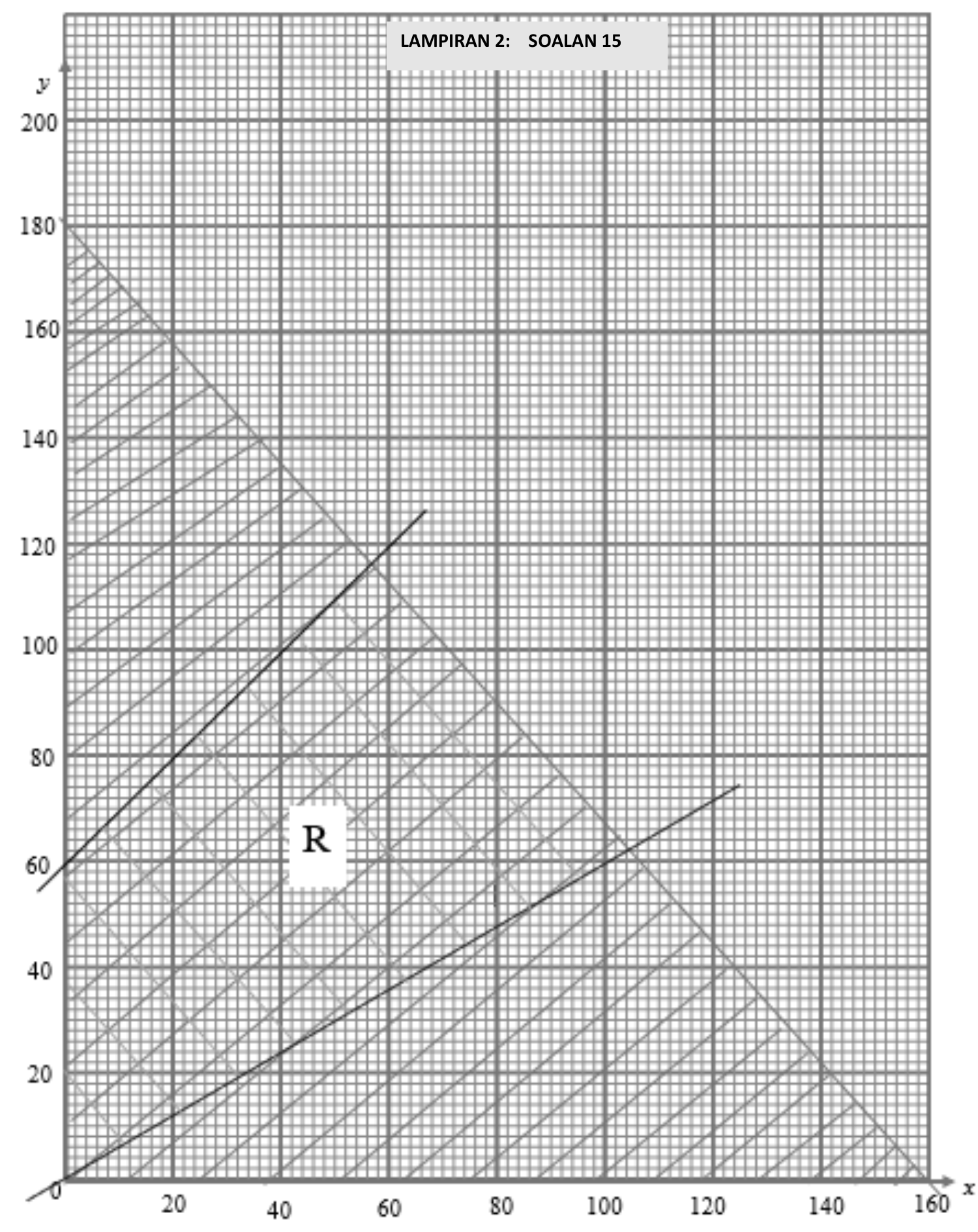
- (d)(i)
Find the maximum number of foreign workers that can be hired.
[1] - (d)(ii)
Find the maximum amount of daily wage to be paid.
[3]
A teacher wants to buy x Additional Mathematics exercise books and y Additional Mathematics reference books. Table 4: exercise book RM12.00, reference book RM15.00 per unit. Constraints: I. The total allocation for buying both types of books is RM1800. II. The number of exercise books is more than 16. III. The number of reference books is at least 15 more than the number of exercise books.
Medium10 marks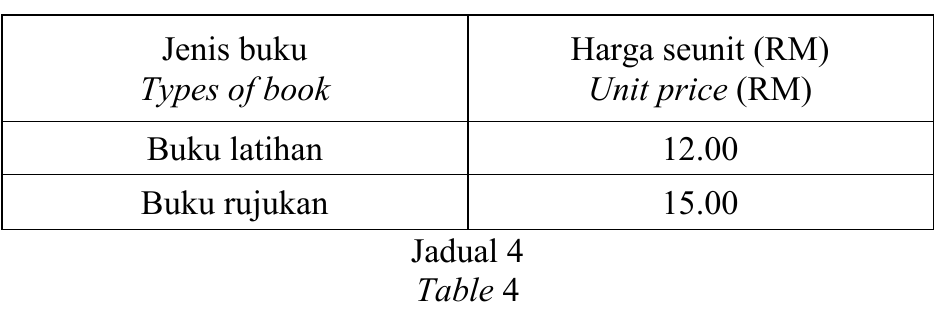
- (a)
Write three inequalities, other than x ≥ 0 and y ≥ 0, that satisfy all the above constraints.
[3] - (b)
Using a scale of 2 cm to 10 books on both axes, construct and shade the region R which satisfies all the above constraints.
[3] - (c)(i)
Use the graph constructed in 14(b) to find the maximum number of exercise books to be purchased if the number of reference books to be purchased is 70.
[1] - (c)(ii)
Use the graph constructed in 14(b) to calculate the minimum purchase price of the books.
[3]
Use the graph paper provided. A welfare organisation contributes food boxes to a flood victim settlement centre. There are two types of food boxes, box A and box B. The number of food box A is x and the number of food box B is y. The distribution is subject to the following constraints: I The number of food box B does not exceed 3 times the number of food box A. II The number of food box B is at least half the number of food box A. III The total time allocated for preparing all the food boxes must not exceed 150 hours. The preparation time for each food box A and food box B is 4 hours and 3 hours respectively. (a) Write three inequalities, other than x ≥ 0 and y ≥ 0, that satisfy all the above constraints. (b) Using a scale of 2 cm to 5 boxes on both axes, construct and shade the region R that satisfies all the above constraints. (c) Using the graph constructed in 14(b), find (i) the minimum number of food box B if the number of food box A is 25, (ii) the maximum expenditure for food boxes if a food box A costs RM60 and a food box B costs RM80.
Medium10 marks- (a)
Write three inequalities satisfying all constraints.
[3] - (b)
Construct and shade the region R.
[3]
- (c)(i)
Minimum number of food box B if A = 25.
[1] - (c)(ii)
Maximum expenditure for food boxes.
[3]
Amir produces two types of beverage products, Apple Juice and Orange Juice. The cost of selling x units of Apple Juice is RM12.50 per bottle, and the cost of selling y units of Orange Juice is RM10.00 per bottle. The beverages produced by Amir are based on the following constraints: I The total number of bottles of Apple Juice and Orange Juice produced is less than m units. II The number of bottles of Orange Juice produced is more than n units. III The number of bottles of Orange Juice produced does not exceed twice the number of bottles of Apple Juice. (a) Constraints I and II have been drawn on a graph, and the shaded region represents the points that satisfy both constraints. State the value of m and the value of n. (b) Write an inequality for Constraint III, other than x > 0 and y > 0. Hence, construct and label the Region R that satisfies all the given constraints. (c)(i) On a certain day, the ratio of the number of bottles of Orange Juice to the number of bottles of Apple Juice produced is 5 : 3. Determine the possible number of bottles of Apple Juice produced on that day. (ii) Given that the total cost of producing Apple Juice and Orange Juice is RMk, express k in terms of x and y. Hence, draw the objective function and find the maximum cost.
Medium10 marks- (a)
State the value of m and the value of n.
[1]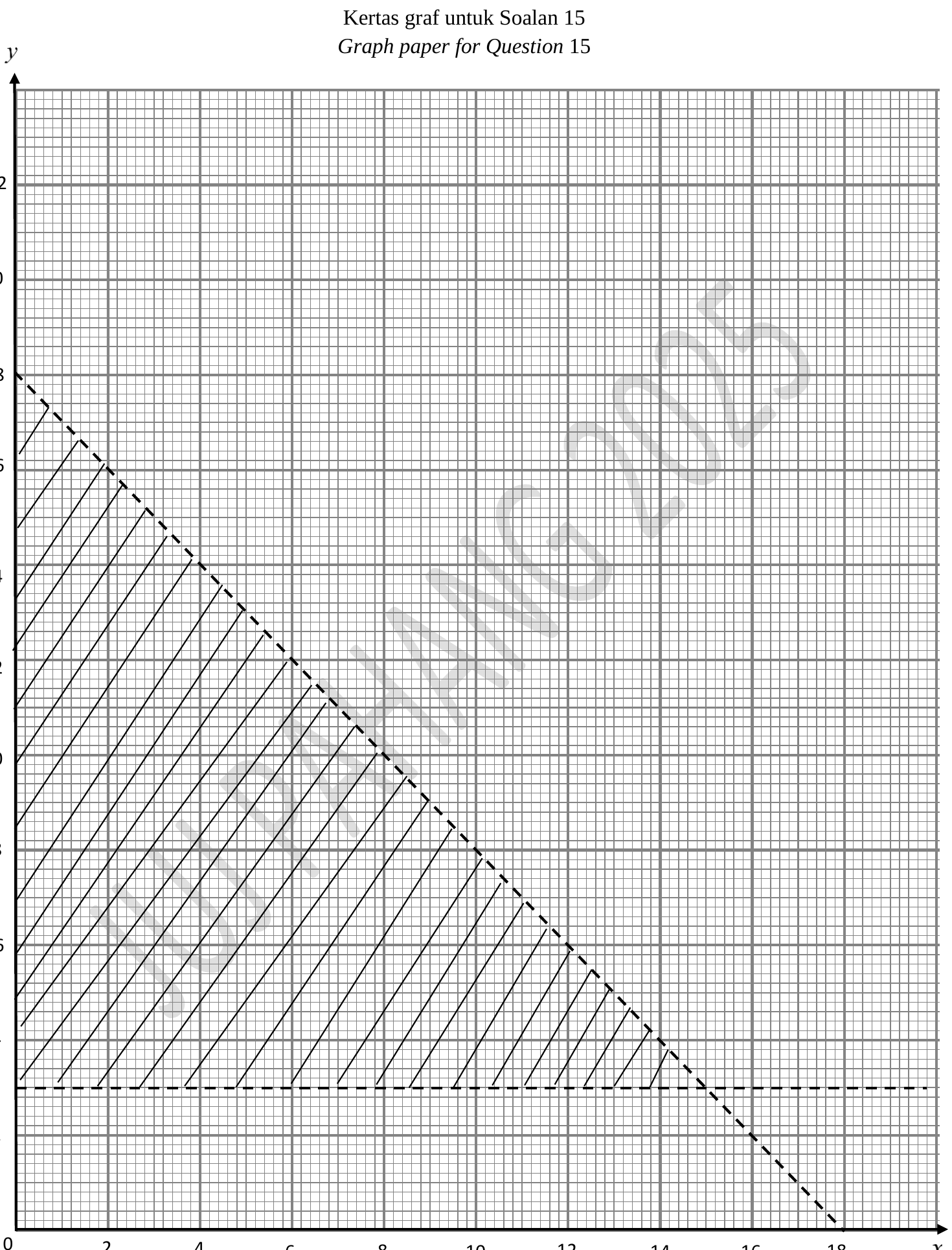
- (b)
Write an inequality for Constraint III, other than x > 0 and y > 0. Hence, construct and label the Region R that satisfies all the given constraints.
[3] - (c)(i)
Determine the possible number of bottles of Apple Juice produced on that day.
[2] - (c)(ii)
Given that the total cost of producing Apple Juice and Orange Juice is RMk, express k in terms of x and y. Hence, draw the objective function and find the maximum cost.
[4]
Butik Cantik sells two types of baju kebaya, A and B. In a month it sells x pieces of A and y pieces of B. Profit is RM 18 per piece of A and RM 16 per piece of B. Constraints: I the total number sold is at most 450; II the number of type A does not exceed four times the number of type B; III the minimum total profit is RM 3 600. Graph paper is to be used.
Medium10 marks- (a)
Write a mathematical model involving a system of linear inequalities, other than x ≥ 0 and y ≥ 0, which satisfies all the constraints.
[3] - (b)
Using a scale of 2 cm to 50 pieces on both axes, construct and shade the region R that satisfies all the constraints.
[3] - (c)
Use your graph to find (i) the maximum number of type B baju kebaya if the number of type A sold in a given month is 110, (ii) the maximum total profit per month.
[4]
Puan Amani owns a shop that sells various items related to the bakery. Her shop sells two types of premium cake flour blends, namely rose flour and lavender flour. Each flour blend is made using self-rising flour and wheat flour in different ratios. The rose flour blend contains self-raising flour and wheat flour in a 1 : 3 ratio, while the lavender flour in a 2 : 3 ratio. Puan Amani has a stock of 20 kg of self-rising flour and 36 kg of wheat flour. She made a profit of RM 4 by selling 1 kg of rose flour and RM 5 for 1 kg of lavender flour. Her shop can produce x kg of rose flour and y kg of lavender flour per day. (a) Other than x ≥ 0 and y ≥ 0, write two inequalities that satisfy all the constraints given. (b) By using a scale of 2 cm to 10 units on both axes, construct and shade the region R which satisfies all the conditions. (c) Based on the graph in (b), find (i) the mass of rose cake flour and lavender cake flour that Pn. Amani needs to sell to make maximum profit, (ii) Pn. Amani's maximum profit.
Medium10 marks- (a)
Write two inequalities that satisfy all the constraints, other than x ≥ 0 and y ≥ 0.
[2] - (b)
Construct and shade the region R (2 cm to 10 units on both axes).
[3]
- (c)(i)
Find the masses of rose flour and lavender flour for maximum profit.
[3] - (c)(ii)
Find the maximum profit.
[2]
SMK Tun Saban's shop orders school uniforms and sport t-shirts at RM 16 and RM 18 each. The number of school uniforms must be at most twice the number of sport t-shirts. The capital is only RM 19800. The uniforms and t-shirts are sold at RM 20 and RM 21 each, and the shop fixes the profit at RM 1500 or more. The shop sold x school uniforms and y sport t-shirts. (a) Write three inequalities other than x ≥ 0 and y ≥ 0 that satisfy all the conditions. (b) Using a scale of 2 cm to 100 pieces on both axes, construct and shade the region R which satisfies all the conditions. (c) Based on your graph, find (i) the maximum number of school uniforms sold, (ii) the maximum profit if the shop sells a total of 800 school uniforms and sport t-shirts.
Medium10 marks- (a)
Write three inequalities (other than x ≥ 0, y ≥ 0).
[3] - (b)
Construct and shade the region R.
[3] - (c)(i)
Find the maximum number of school uniforms sold.
[1] - (c)(ii)
Find the maximum profit when 800 pieces are sold in total.
[3]
Mira sells x cakes and y jars of cookies a week. She earns RM15 for a cake and RM20 for a jar of cookies. (I) A cake takes 30 minutes to make and a jar of cookies takes 1 hour; she allocates only 10 hours a week. (II) She buys ingredients for 15 items a week.
Medium10 marks- (a)
Write two inequalities, other than x ≥ 0 and y ≥ 0, which satisfy all the above constraints.
[2] - (b)
By using a suitable scale, construct and shade the region R which satisfies all of the above constraints.
[4]
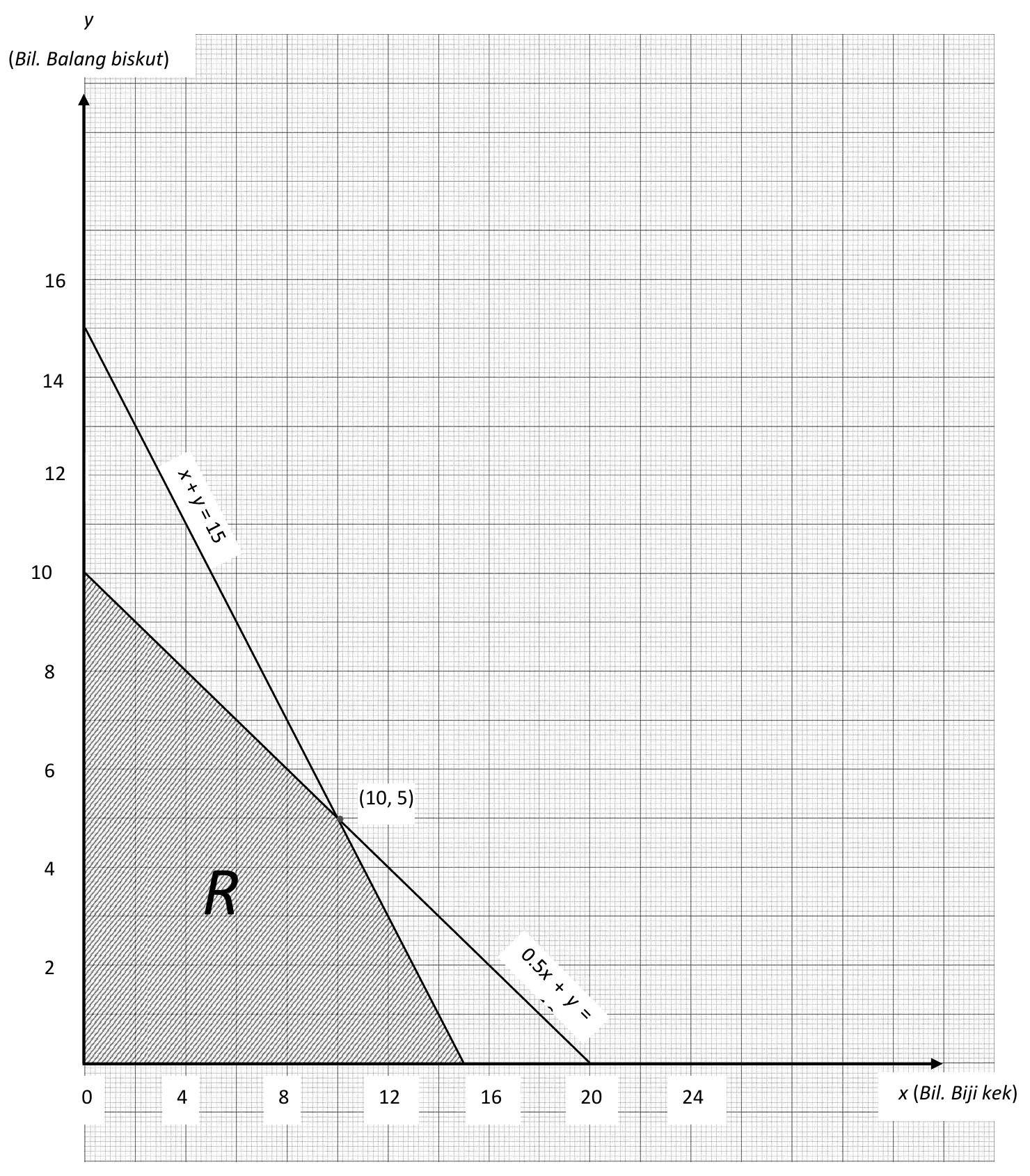
- (c)
By using the graph constructed in (b), find the number of cakes and jars of cookies Mira should make each week for maximum profit, assuming all items are sold.
[4]
A school is about to buy x tables and y chairs for its school hall. The price of a table is RM 50 and a chair is RM 40. The hall can only accommodate 350 tables and chairs. The number of tables must not exceed twice the number of chairs. The number of chairs should not exceed the number of tables by 50. (a) Write down three inequalities, other than x ≥ 0 and y ≥ 0, that meet all of the above conditions. (b) Using a scale of 2 cm to 50 on both axes, construct and shade the region R which satisfies all of the above conditions. (c) Based on your graph, find (i) the maximum allocation to buy the tables and chairs; (ii) the range of the number of chairs that can be purchased if 150 tables have been purchased.
Medium10 marks- (a)
Three inequalities.
[3] - (b)
Construct and shade region R (graph paper provided).
[3]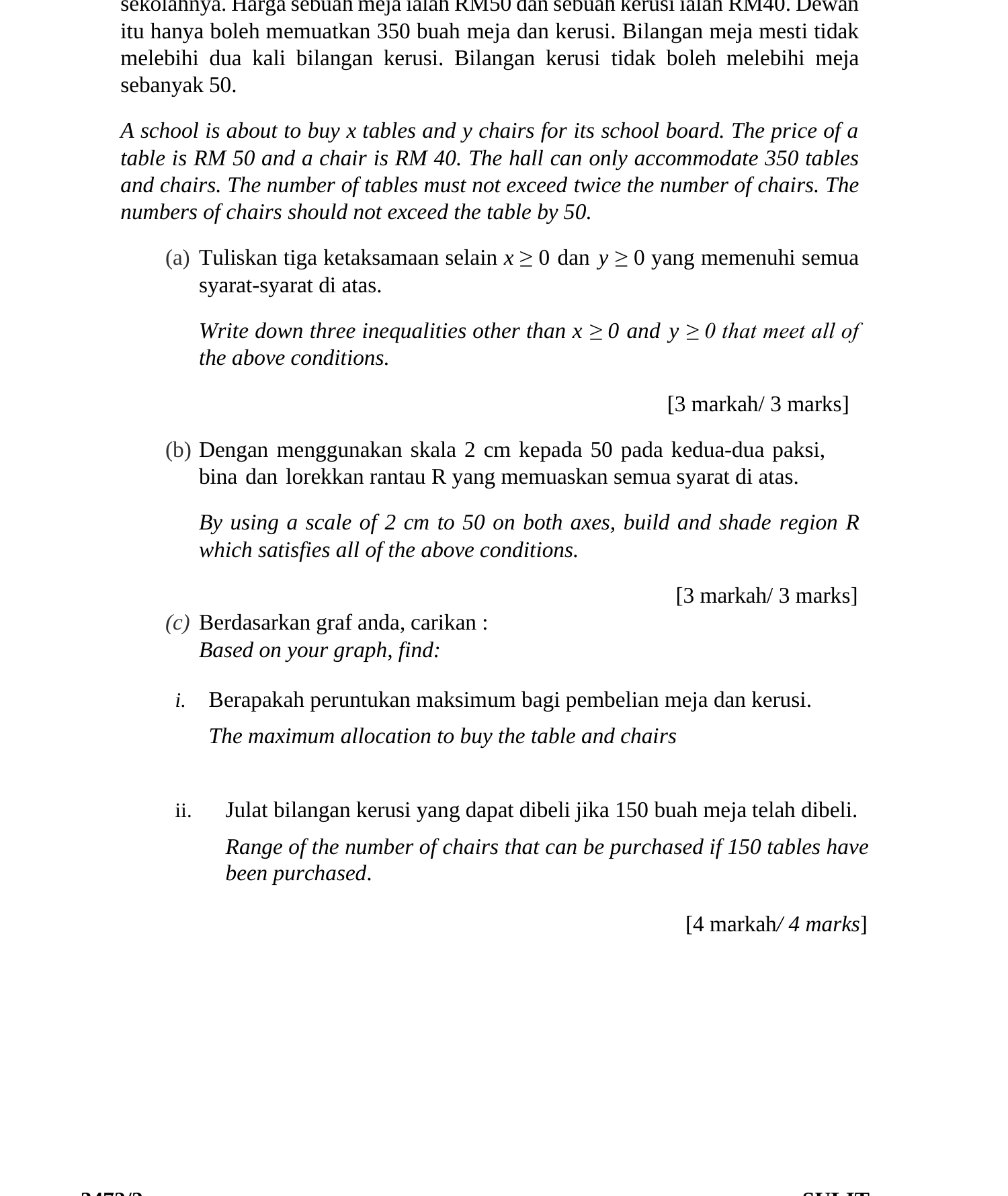
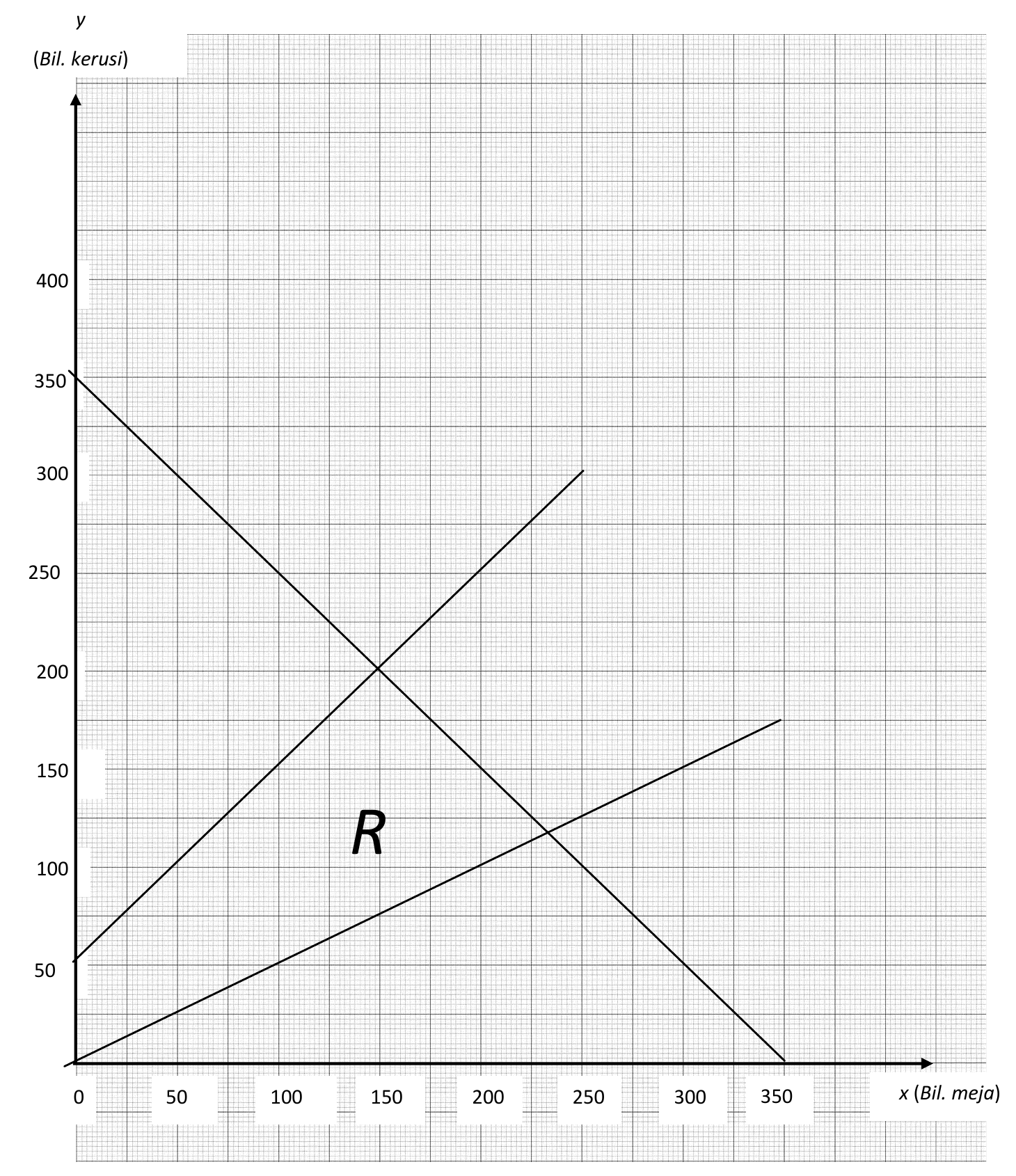
- (c)(i)
Maximum allocation.
[2] - (c)(ii)
Range of the number of chairs if 150 tables are bought.
[2]
A tuition centre offers Mathematics and Additional Mathematics for Form Five students. There are x students taking Mathematics and y students taking Additional Mathematics. The fees are RM60 for Mathematics and RM70 for Additional Mathematics. The conditions are: I The maximum number of students is 80. II The ratio of the number of students taking Mathematics to those taking Additional Mathematics is at least 1 : 2. III The number of students taking Additional Mathematics is more than 20. (a) Write three linear inequalities, other than x ≥ 0 and y ≥ 0, that satisfy all the conditions. (b) Using a scale of 2 cm to 10 students on both axes, construct and shade the region R that satisfies all the conditions in (a). (c) Based on the graph in (b), find (i) the range of the number of students taking Additional Mathematics if 20 students take Mathematics, (ii) the maximum total fees obtained by the tuition centre.
Medium10 marks- (a)
Write three linear inequalities.
[3] - (b)
Construct and shade region R.
[3]
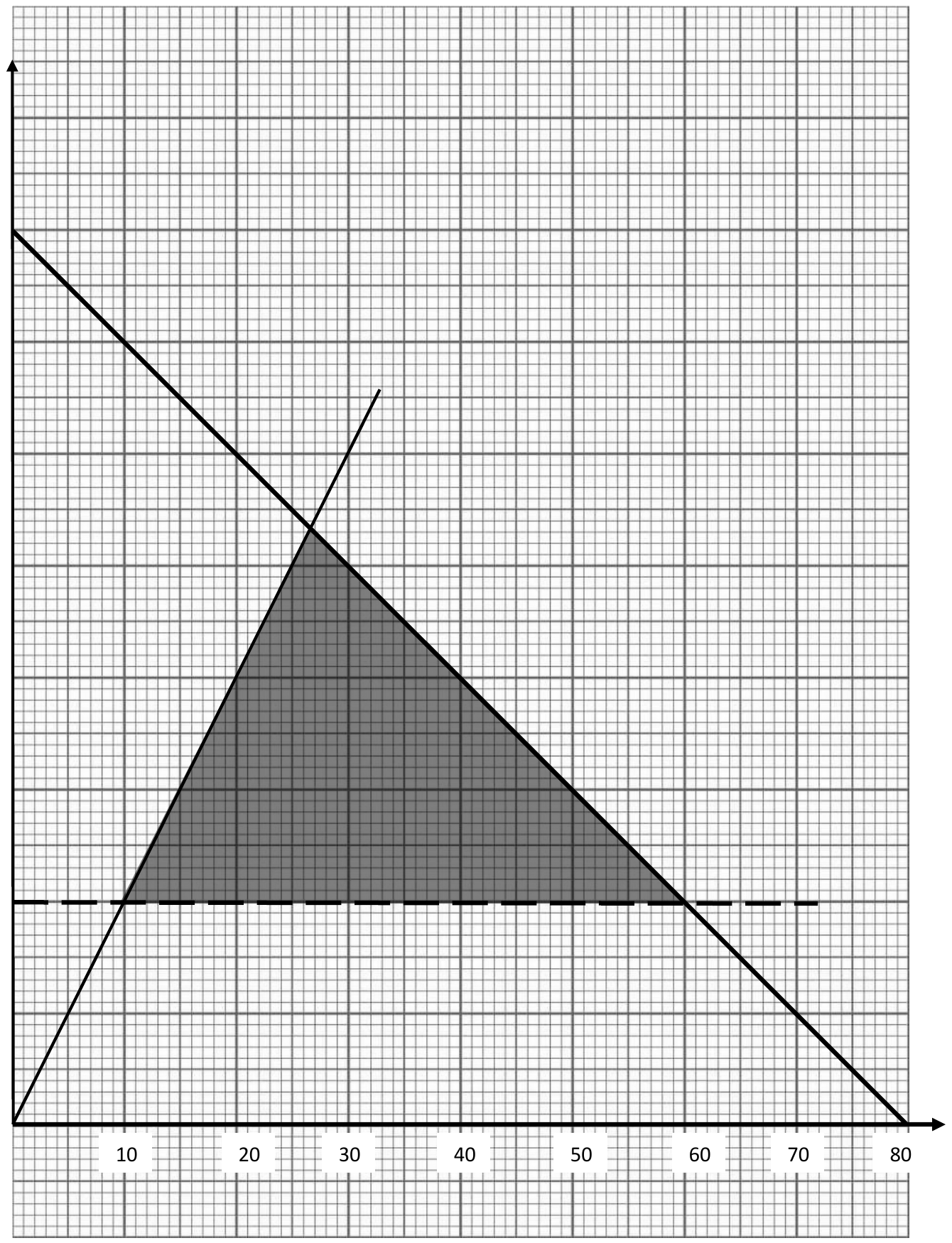
- (c)(i)
Range of the number of students taking Additional Mathematics when x = 20.
[1] - (c)(ii)
Maximum total fees.
[3]
A school has allocated at least RM 4,000 to buy x type A chairs and y type B chairs. The price of one type A chair is RM 80 and of one type B chair is RM 120. The total number of chairs must not exceed 65. The number of type A chairs is more than twice the number of type B chairs. (a) Write down three inequalities, other than x ≥ 0 and y ≥ 0, that satisfy all the conditions. (b) Using a scale of 2 cm to 10 units on both axes, construct and shade the region R that satisfies all the conditions. (c) Based on the graph in (b), find (i) the maximum cost to buy the chairs, (ii) the range of the number of type A chairs that can be purchased if 10 type B chairs have been purchased.
Medium10 marks- (a)
Write down three inequalities, other than x ≥ 0 and y ≥ 0, that satisfy all the conditions.
[3] - (b)
Using a scale of 2 cm to 10 units on both axes, construct and shade the region R.
[3] - (c)
Based on the graph in (b), find (i) the maximum cost to buy the chairs, (ii) the range of the number of type A chairs if 10 type B chairs have been purchased.
[4]
A company has allocated at least RM1,200 to buy x units of type A paint and y units of type B paint. The price of a unit of type A is RM30 and of type B is RM20. The total number of paints must not exceed 60 units. The number of type B paint is not more than twice the number of type A. (a) Write down three inequalities, other than x ≥ 0 and y ≥ 0, that satisfy all the above conditions. (b) Using a scale of 2 cm to 10 units on both axes, construct and shade the region R that satisfies all the above conditions. (c) Based on the graph drawn in (b), find (i) the maximum cost to buy the paints, (ii) the range of the number of type B paints that can be purchased when 30 units of type A paints have been purchased.
Medium10 marks- (a)
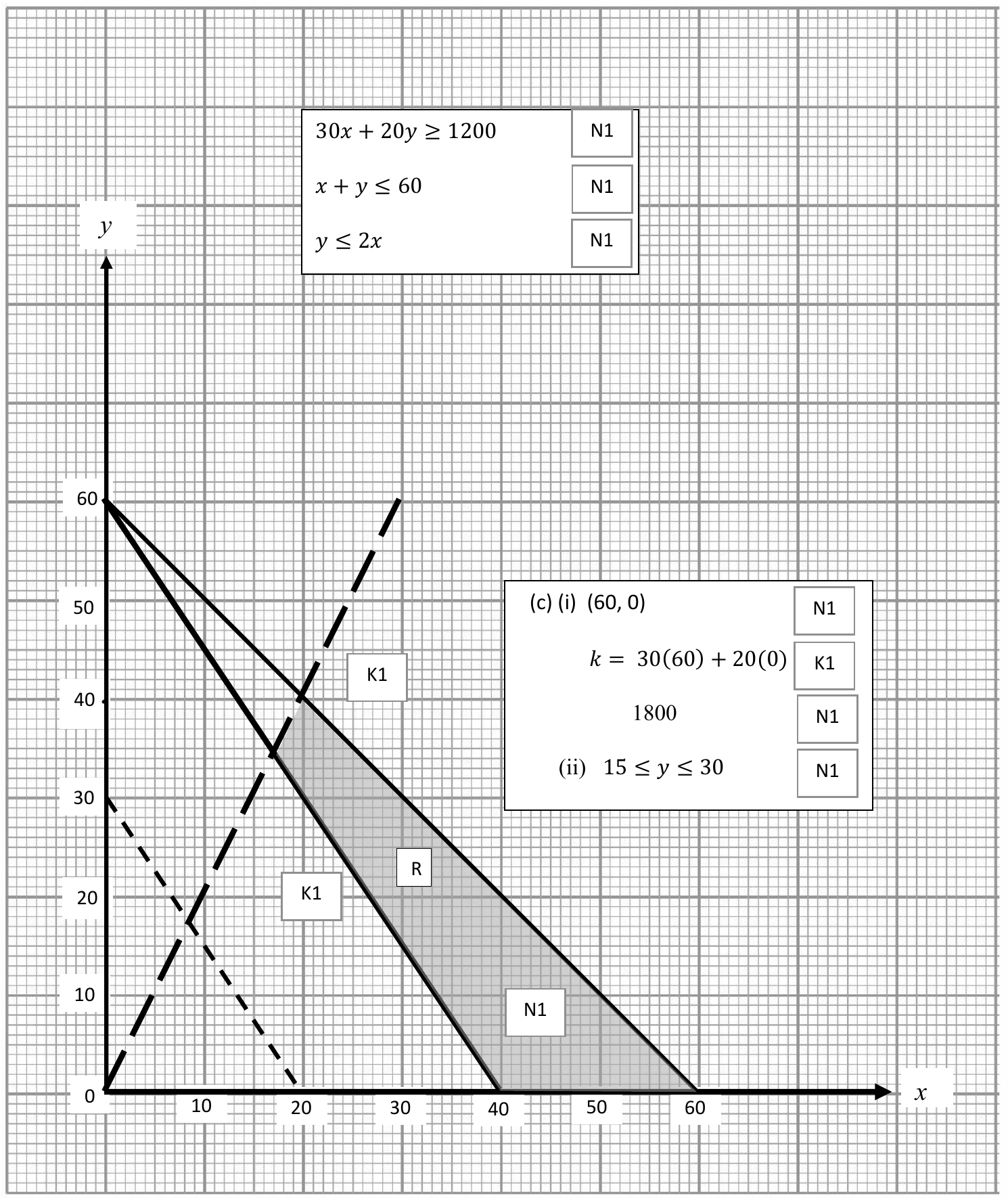
Write down three inequalities, other than x ≥ 0 and y ≥ 0, that satisfy all the conditions.
[3] - (b)
Using a scale of 2 cm to 10 units on both axes, construct and shade the region R.
[3]
- (c)(i)
Find the maximum cost to buy the paints.
[3] - (c)(ii)
Find the range of the number of type B paints that can be purchased when 30 units of type A paints have been purchased.
[1]
Section C: answer any two questions. Use graph paper to answer this question. A shop produces two types of sport shoes, M and N. A pair of sport shoes M requires 25 minutes on machine P and 35 minutes on machine Q. A pair of sport shoes N requires 15 minutes on machine P and 45 minutes on machine Q. Machines P and Q can only operate for 1200 minutes and 2520 minutes a day respectively. The factory produces x pairs of sport shoes M and y pairs of sport shoes N in a day. The number of pairs of M produced is not more than twice the number of pairs of N. (a) Write down three inequalities, other than x ≥ 0 and y ≥ 0, that satisfy all the above constraints. (b) Using a scale of 2 cm to 10 pairs on both axes, construct and shade the region R which satisfies all the above constraints. (c) Using the graph constructed in (b), find (i) the range of the number of pairs of sport shoes N produced if exactly 30 pairs of M are produced in a day, (ii) the maximum total profit per day if the profit from a pair of M and a pair of N are RM30 and RM35 respectively.
Medium10 marks- (a)
Write down three inequalities, other than x ≥ 0 and y ≥ 0.
[3] - (b)
Construct and shade the region R (scale 2 cm to 10 pairs on both axes).
[3]
- (c)(i)
Find the range of the number of pairs of N if exactly 30 pairs of M are produced.
[1] - (c)(ii)
Find the maximum total profit per day.
[3]
A book shop in a school plans to sell two types of calculator for the use of SPM students. The shop sells x units of calculator A and y units of calculator B, based on the following constraints: I The total number of calculators to sell is not more than 130. II The number of calculator A is at most twice the number of calculator B. III The number of calculator B exceeds the number of calculator A by not more than 80. (a) Write the three inequalities, other than x ≥ 0 and y ≥ 0, which satisfy all the above constraints. (b) Using a scale of 2 cm to 20 calculators on both axes, construct and shade the region R which satisfies all the above constraints. (c) Use the graph in (b) to find (i) the maximum number of calculator type A sold if 60 calculators type B are sold, (ii) the maximum profit obtained if the profit from the sale of one calculator A is RM3 and the profit from the sale of one calculator B is RM5.
Medium10 marks- (a)
Write the three inequalities, other than x ≥ 0 and y ≥ 0.
[3] - (b)
Construct and shade the region R (2 cm to 20 calculators on both axes).
[3]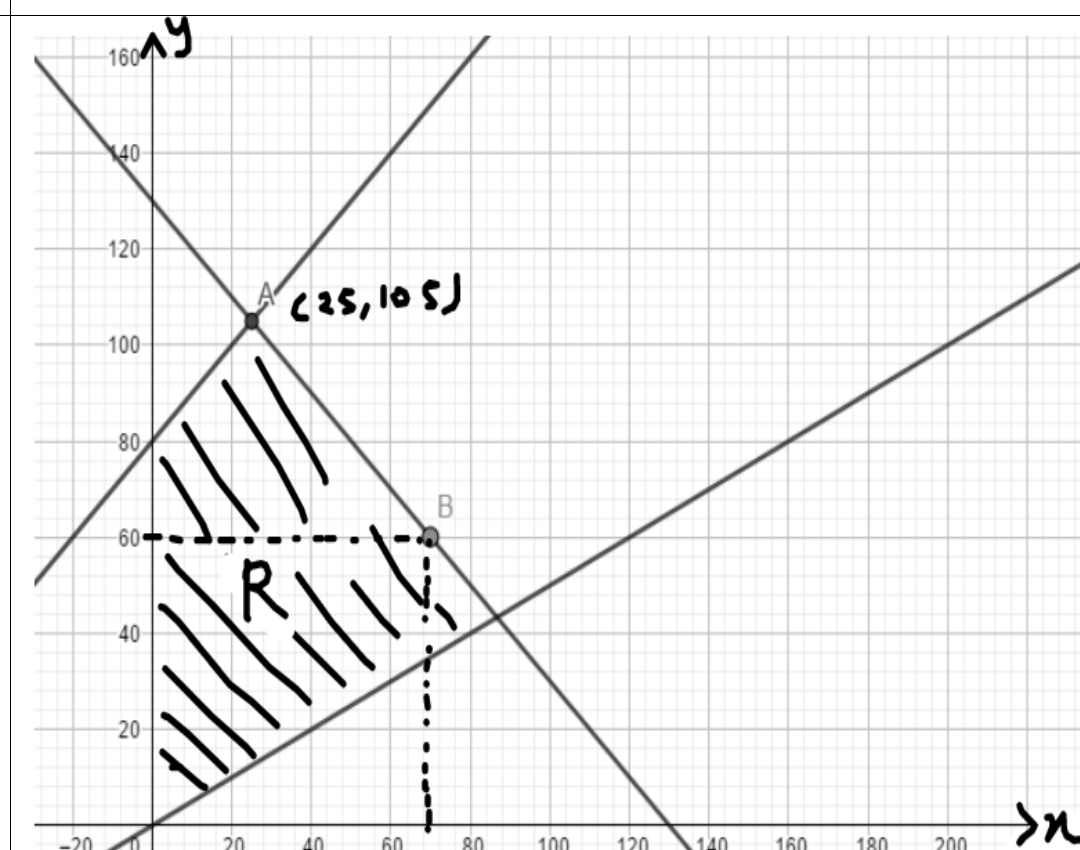
- (c)(i)
Maximum number of calculator A sold if 60 calculators B are sold.
[1] - (c)(ii)
Maximum profit (RM3 per calculator A, RM5 per calculator B).
[3]
Use graph paper to answer this question. A painter produces two types of drawings, H and K. A drawing H takes 1 hour to draw and 20 minutes to colour. A drawing K takes 30 minutes to draw and 40 minutes to colour. In a day, the painter can produce x drawings H and y drawings K with the following conditions: I: the maximum total time to draw is 12 hours; II: the total time for colouring is at most 6 hours; III: the ratio of the number of drawings K to drawings H produced is not more than 2 : 1. (a) Write down three inequalities, other than x ≥ 0 and y ≥ 0, which satisfy all the above constraints. (b) Using a scale of 2 cm to 2 units on both axes, construct and shade the region R that satisfies all the above constraints. (c) Use your graph in (b) to answer: (i) Find the number of drawings K produced if 2 drawings H are produced on a given day, (ii) by selling the drawings, the painter earns a profit of RM20 for each drawing H and RM16 for each drawing K. What is the maximum profit the painter gets?
Medium10 marks- (a)
Write three inequalities.
[3] - (b)
Construct and shade the region R.
[3]
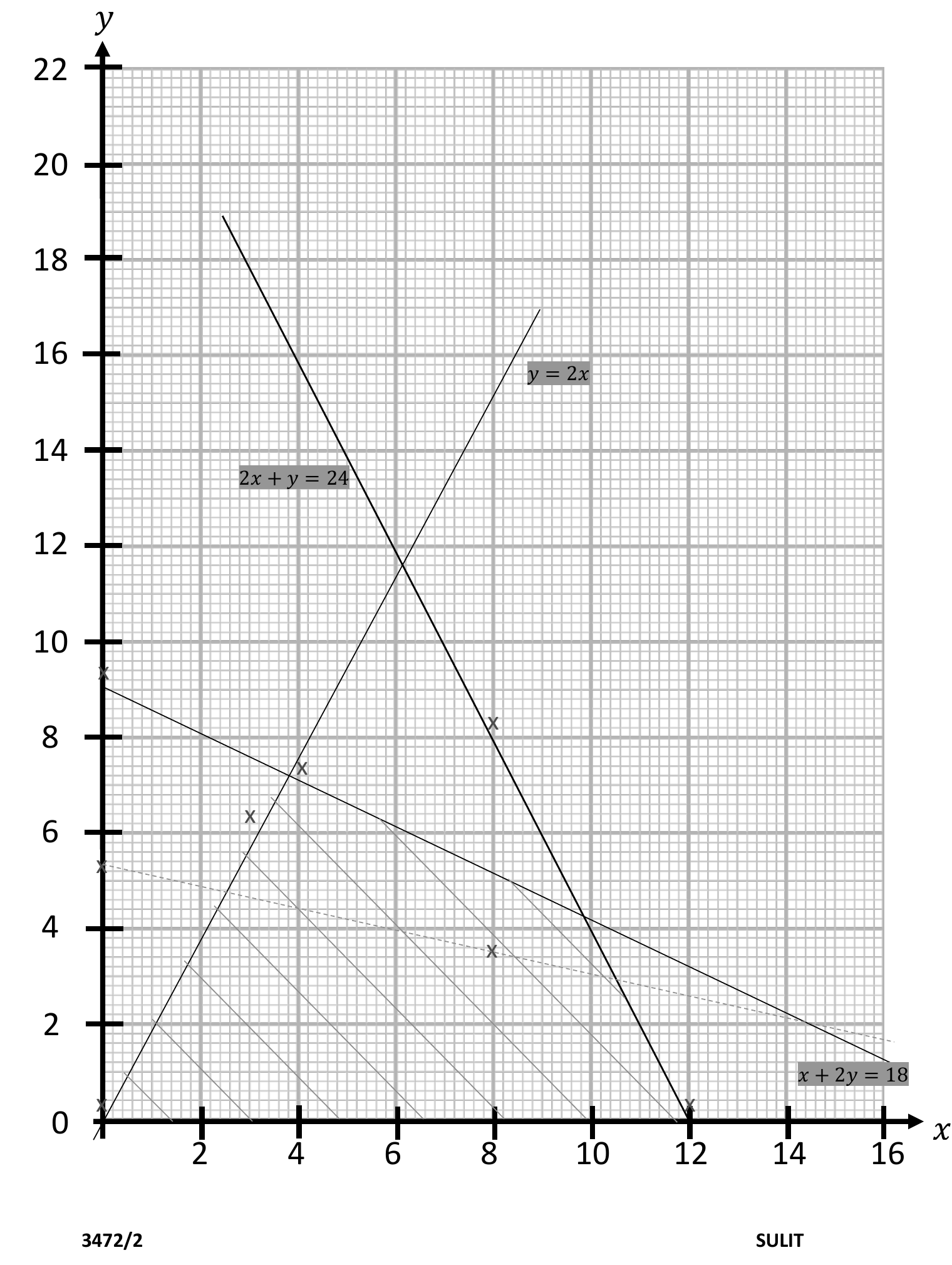
- (c)(i)
Number of drawings K when 2 drawings H are produced.
[1] - (c)(ii)
Maximum profit.
[3]
Use the graph provided to answer this question. An entrepreneur wants to produce two types of shoes, L and S by using a machine. In a day, the machine produces x units of type L shoes and y units of type S shoes. The time required to produce a type L shoe is 6 minutes and the time required to produce a type S shoe is 5 minutes. The production of shoes is based on the following constraints: I: The total number of shoes produced must be more than 40 units in a day. II: The machine can operate for only 15 hours a day. III: The ratio of the number of type L shoes to the number of type S shoes is at most 3 : 5. (a) Write three inequalities, other than x ≥ 0 and y ≥ 0, which satisfy all the above constraints. (b) Using a scale of 2 cm to 20 shoes on both axes, construct and shade the region R which satisfies all the above constraints on the graph paper provided. (c) Using the graph constructed in (b), find the range of total sales that can be obtained if the selling price of a type L shoe is RM5 and the selling price of a type S shoe is RM3.
Medium10 marks
- (a)
Write three inequalities for the constraints.
[3] - (b)
Construct and shade region R on the graph paper.
[3]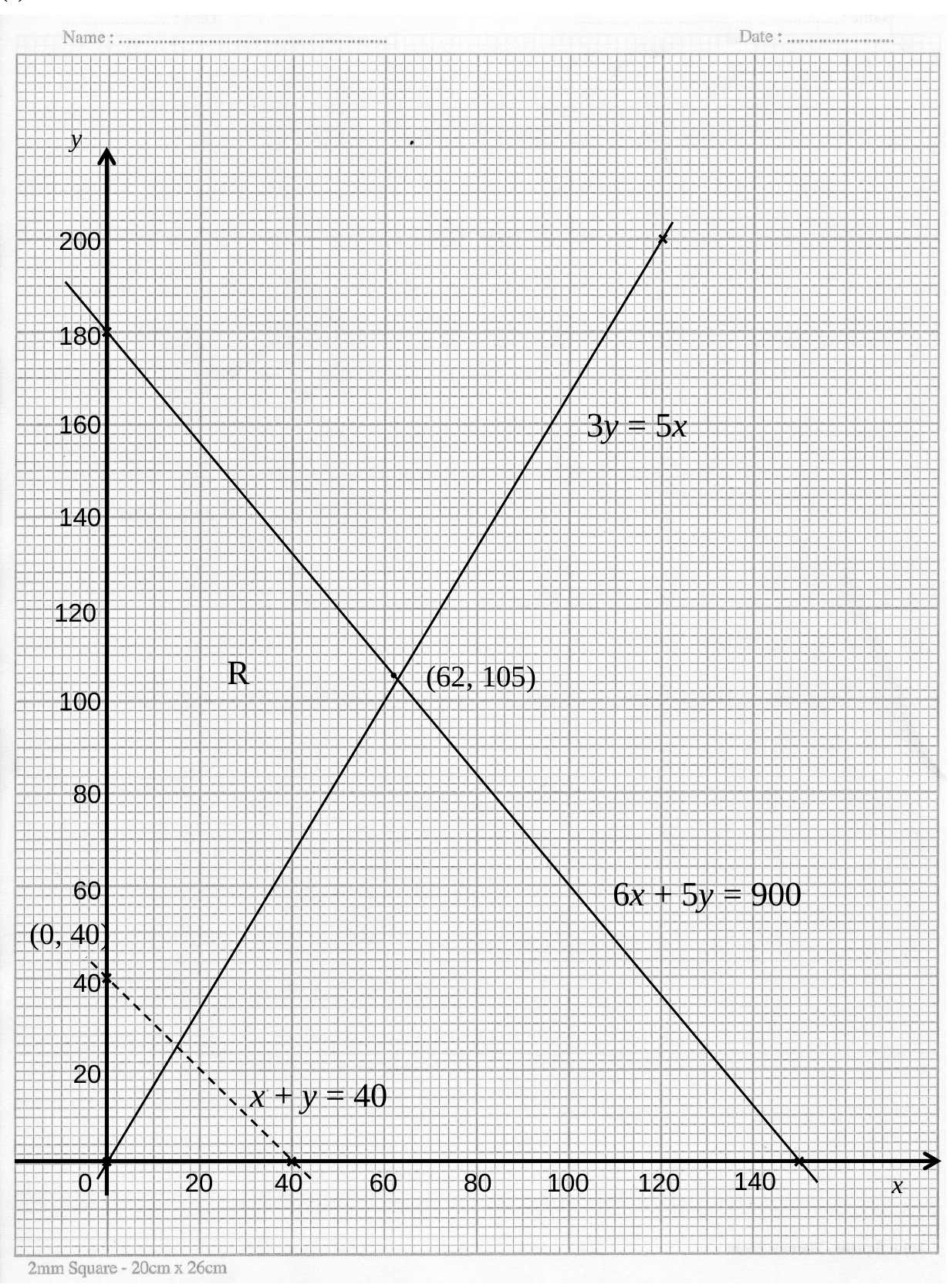
- (c)
Find the range of total sales (L at RM5, S at RM3).
[4]
An electrical shop ABC supplies 2 types of light bulbs to a hotel. The cost of an energy-efficient LED bulb and a halogen bulb is RM8 and RM5 respectively. The number of LED bulbs supplied must be at least twice the number of halogen bulbs. The shop can provide capital of only RM5 600. The shop sells LED bulbs and halogen bulbs at RM12 and RM9 each respectively and requires total sales of not less than RM4 500. Given that the shop sells x LED bulbs and y halogen bulbs to the hotel. (a) Write three inequalities, other than x ≥ 0 and y ≥ 0, that satisfy the above conditions. (b) Using a scale of 2 cm to 100 bulbs on both axes, draw the graph of those three inequalities. Mark and shade the region R that satisfies all the conditions. (c) Based on your graph, find (i) the maximum number of LED bulbs that may be sold, (ii) the minimum profit that could be earned if 200 halogen bulbs were sold.
Medium10 marks- (a)
Write three inequalities (other than x ≥ 0, y ≥ 0).
[3] - (b)
Draw the graph of the three inequalities and shade the region R.
[3] - (c)
From the graph, find (i) the maximum number of LED bulbs, (ii) the minimum profit if 200 halogen bulbs are sold.
[4]
SMK Cerdik will organise a STEM carnival with two competitions, the water rocket and the robot car race. Both are open to all students in the district with a maximum participation of 70 people. The number of participants in the water rocket competition must exceed 15. The number of participants in the robot car race is at least 1/3 of the number of participants in the water rocket competition. There are x participants in the water rocket competition and y participants in the robot car race.
Medium10 marks- (a)
Write three inequalities, other than x ≥ 0 and y ≥ 0, that satisfy all the above constraints.
[3] - (b)
Using the scale of 2 cm to 10 participants on both axes, construct and shade the region R which satisfies all the above constraints.
[3]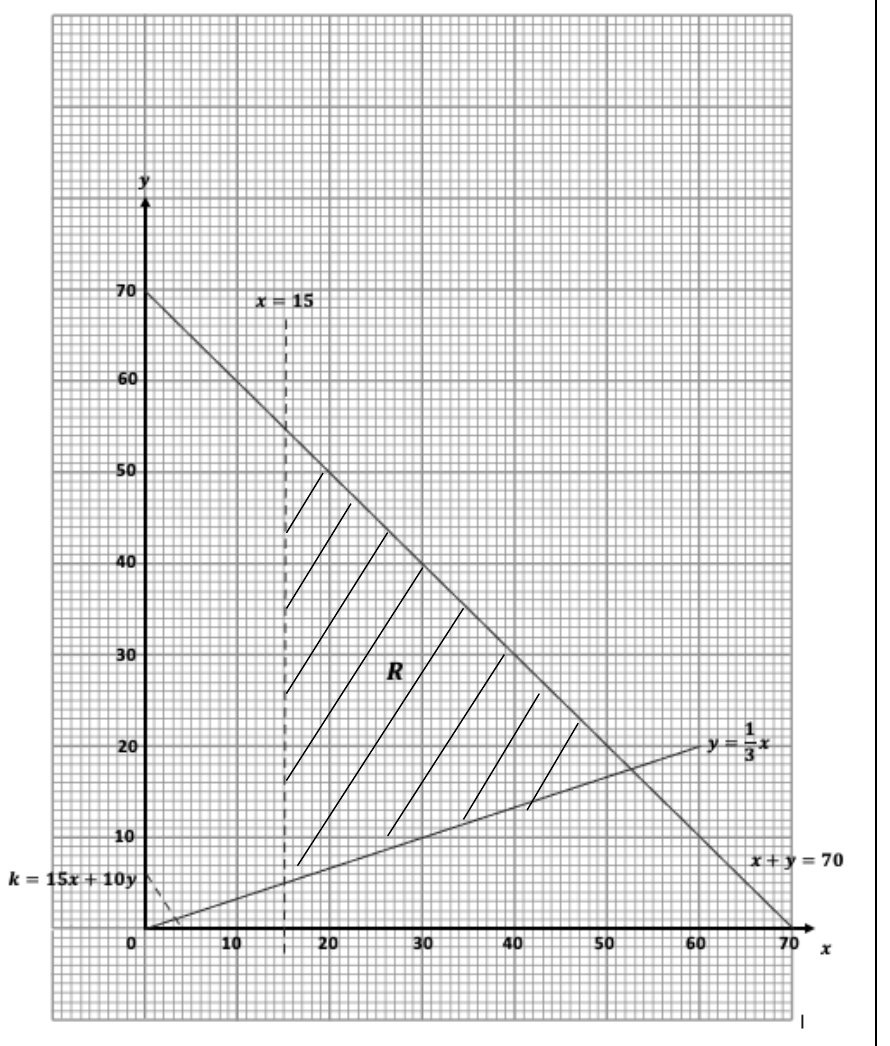
- (c)
Use the graph constructed in (b) to answer: the registration fees for the water rocket competition and the robot car race are RM15 and RM10 respectively, and the total expenditure for the carnival is RM1200. If all the registration fees collected are used to cover this cost, calculate the maximum expenditure that SMK Cerdik needs to cover.
[4]
Mutalib is a shopkeeper. He buys two types of cat food for his shop, Whiskas at RM0.40 per packet and Pro Diet at RM0.60 per packet. Mutalib has RM15 and decides to buy at least 30 packets altogether. He ensures that the ratio of cat food of the Pro Diet type to the Whiskas type is at least 1 : 2. He buys x packets of Whiskas and y packets of Pro Diet. (a) Write three inequalities, other than x ≥ 0 and y ≥ 0, which satisfy all the above constraints. (b) Using a scale of 2 cm to 5 on both axes, construct and shade the region R which satisfies all the above constraints. (c) Use the graph constructed in (b) to answer: (i) Mutalib makes a profit of RM0.10 per packet on Whiskas and a profit of RM0.20 on Pro Diet. Assuming he can sell all the packets, find how many packets of each type he should buy to maximise his profit and find that profit.
Medium10 marks- (a)
Write three inequalities, other than x ≥ 0 and y ≥ 0.
[3] - (b)
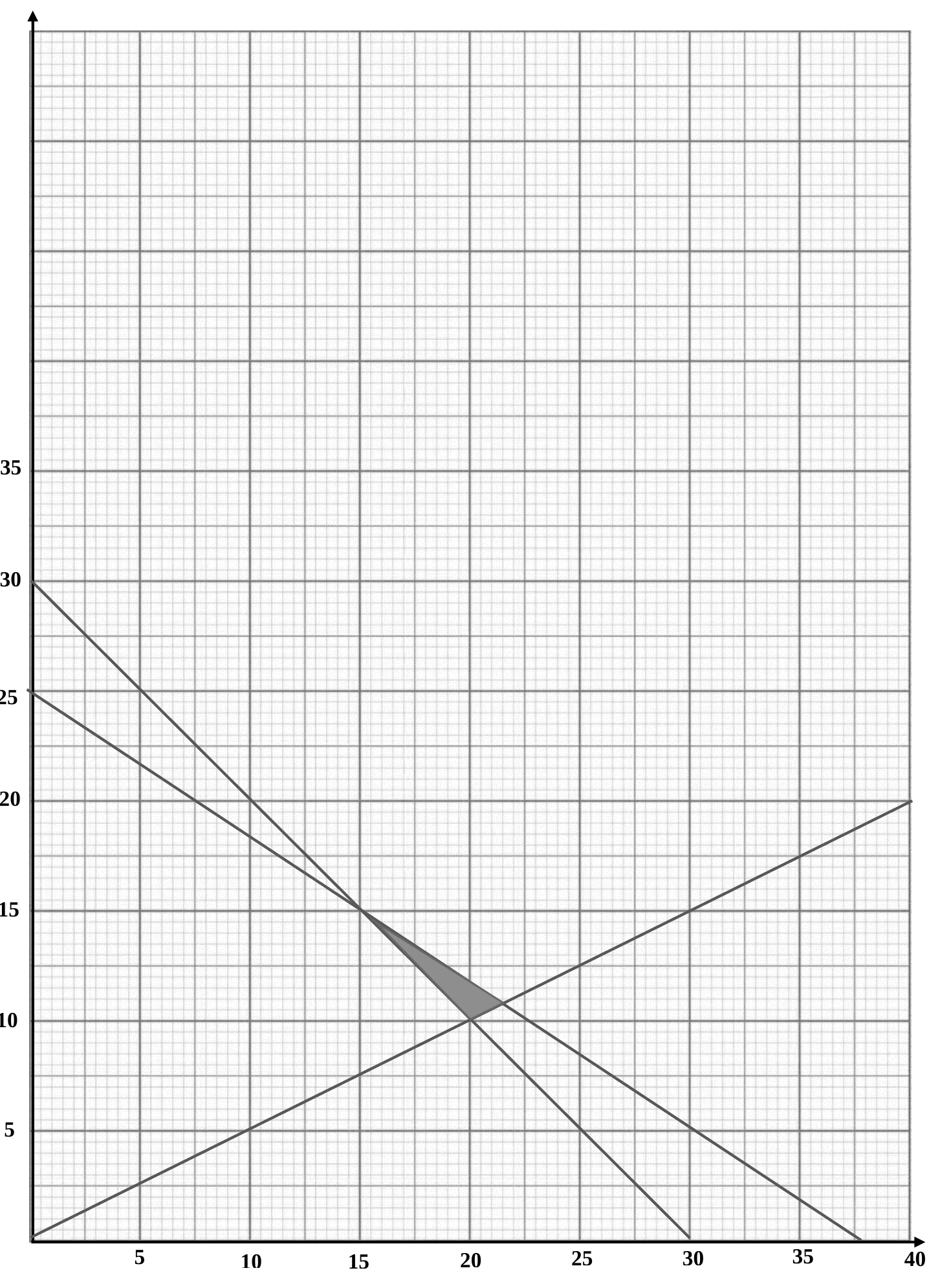
Construct and shade the region R (scale 2 cm to 5 on both axes).
[3]
- (c)(i)
Find how many packets of each type to buy to maximise the profit, and the maximum profit.
[4]
A tuition centre offers two different packages, A and K, for form 4 pupils. The number of pupils for package A and K are x and y respectively. The intake of the pupils is based on the following constraints: I The total number of pupils enrolled for package A and K is not more than P. II The number of pupils for package A is not more than twice the number of pupils for package K. III The number of pupils for package K must exceed the number of pupils for package A by at most 10 pupils. (a) Write three inequalities, other than x ≥ 0 and y ≥ 0, which satisfy all the above constraints. (b) The first constraint is represented by the straight line in the graph shown. State the value of P. (c) On the graph, construct and shade the region R which satisfies all of the three constraints. (d) Using the graph constructed in 15(c), find (i) the range of the number of students for package K if the number of students for package A is 20, (ii) the maximum total fees per month that can be collected if the fees per month for package A and K are RM120 and RM100 respectively.
Medium10 marks- (a)
Write three inequalities (other than x ≥ 0, y ≥ 0) for the constraints.
[3] - (b)
State the value of P.
[1] - (c)
Construct and shade the region R on the graph.
[2]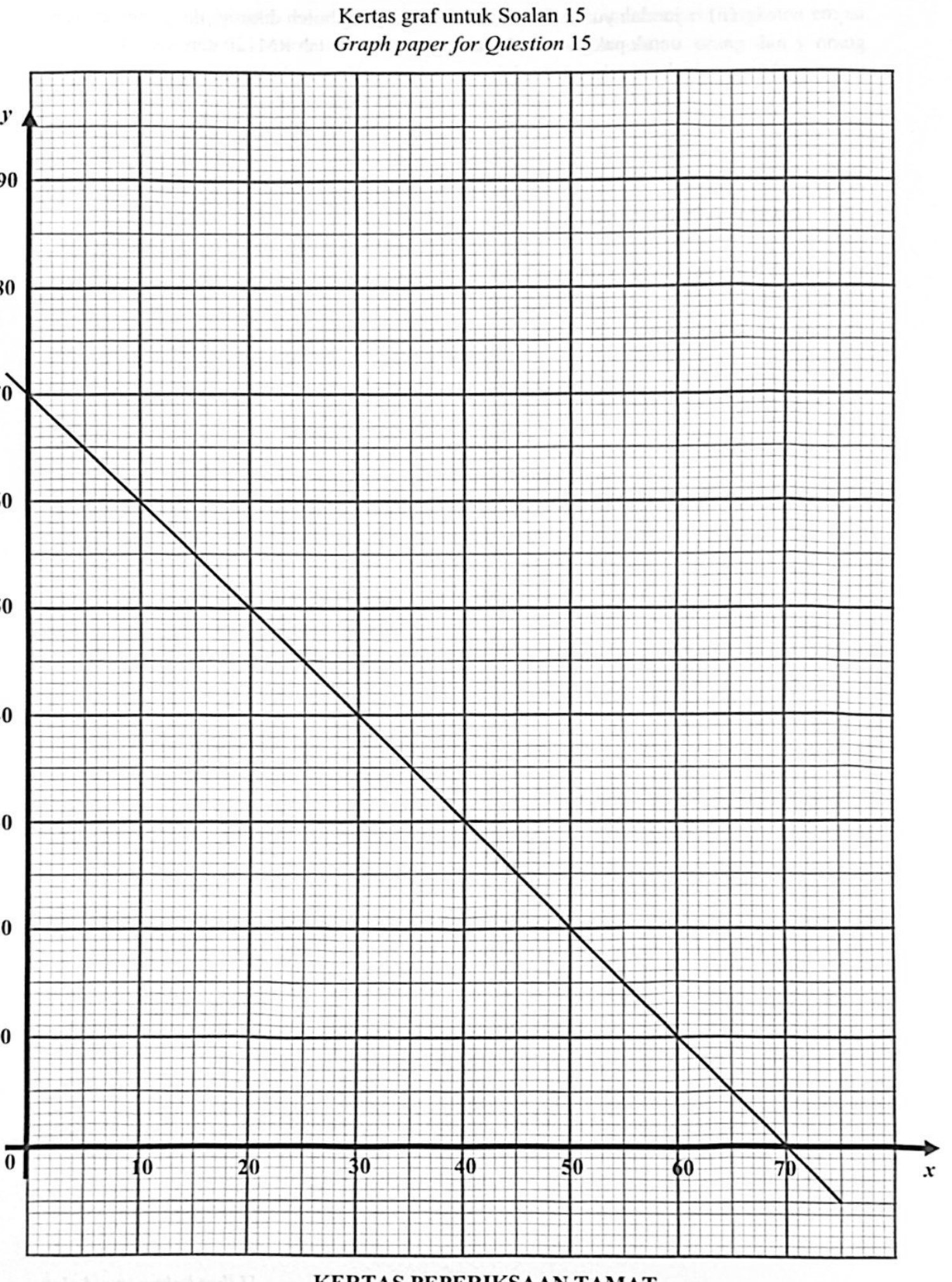
- (d)(i)
Range of the number of students for package K if package A has 20 students.
[1] - (d)(ii)
Maximum total fees per month with fees RM120 (A) and RM100 (K).
[3]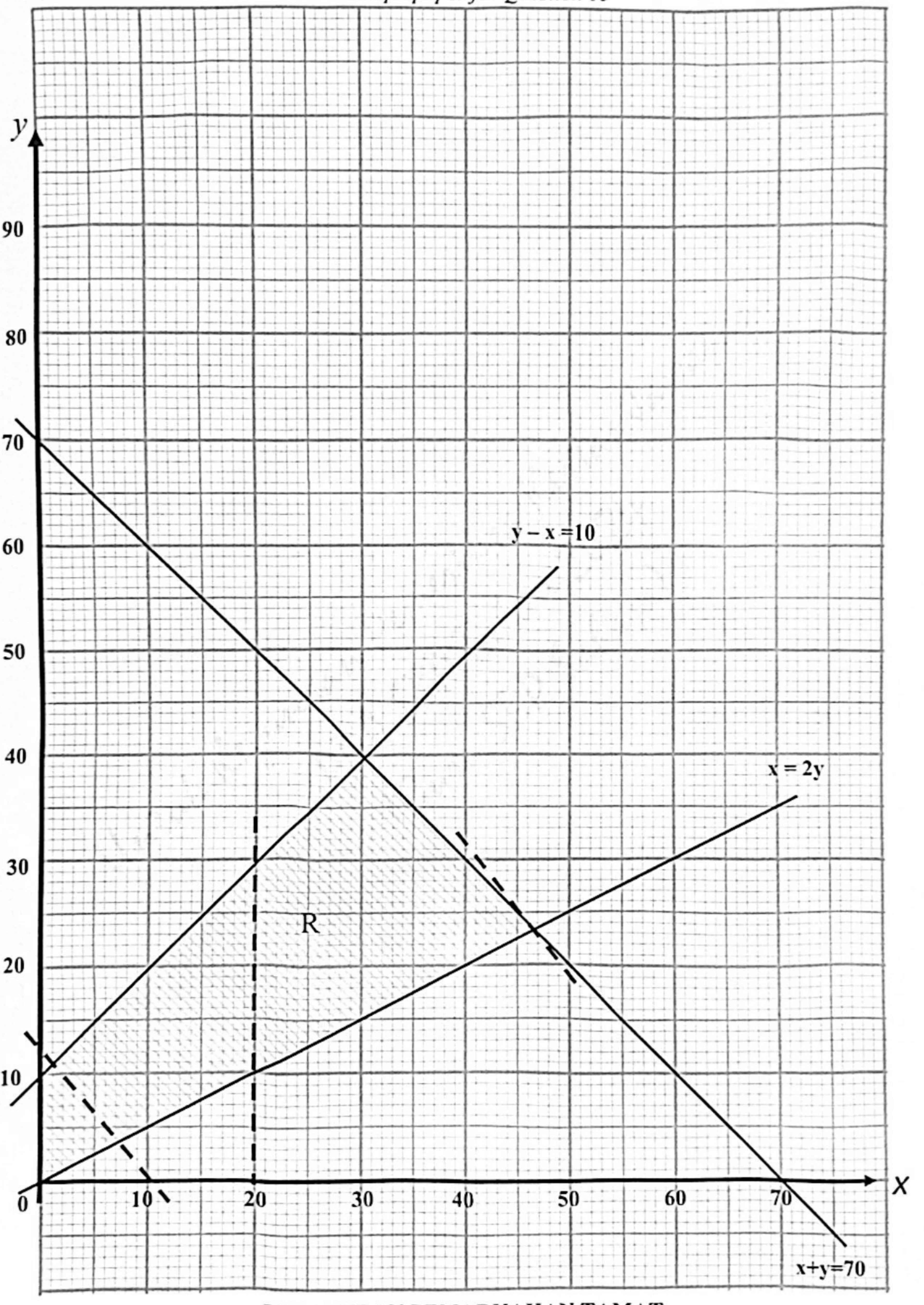
Puan Sabariah wants to sell x jar of biscoff biscuit and y jar of chocolate biscuit during the festive season. The biscuits are sold based on the following constraints: I: The total number of jar of biscuit does not exceed 400 jars. II: The number of jar of chocolate biscuit is at most 2 times of the number of jar of biscoff biscuit. III: The number of jar of chocolate biscuit exceeds one third of the number of jar of biscoff biscuit at least by 60 jars. (a) Write three inequalities, other than x ≥ 0 and y ≥ 0, which satisfy all the above constraints. (b) By using a scale of 2 cm to 50 jars of biscuit on both axes, construct and shade the region R which satisfies the inequalities in 12(a). (c) Using the graph constructed in 12(b), find (i) the range of number of jars of chocolate biscuit if the number of jars of biscoff biscuit is 150 jars, (ii) the maximum profit if the profit per jar of biscoff biscuit is RM5 and the profit per jar of chocolate biscuit is RM2.
Medium10 marks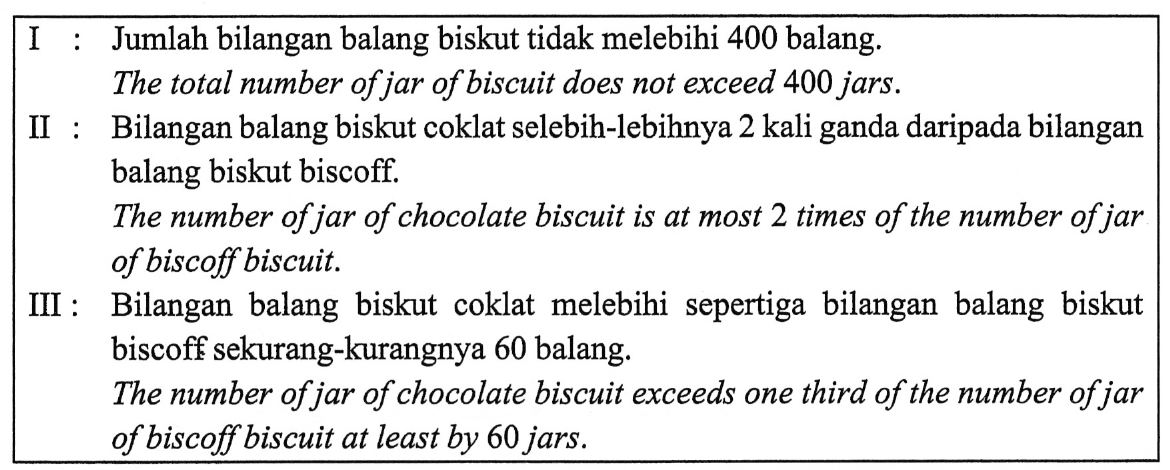
- (a)
Write three inequalities, other than x ≥ 0 and y ≥ 0.
[3] - (b)
Construct and shade the region R.
[3]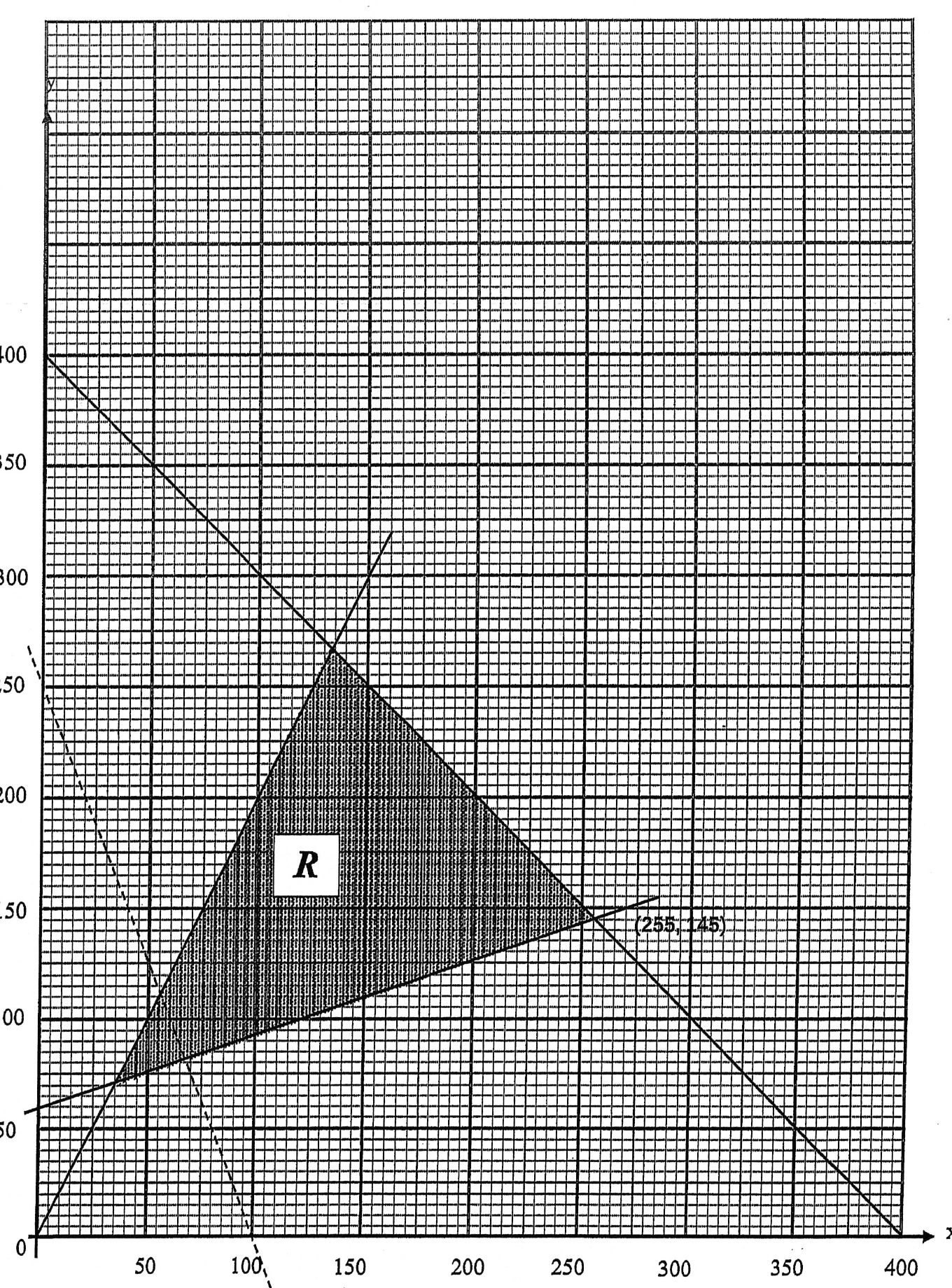
- (c)(i)
Find the range of the number of jars of chocolate biscuit if the number of jars of biscoff biscuit is 150.
[1] - (c)(ii)
Find the maximum profit.
[3]
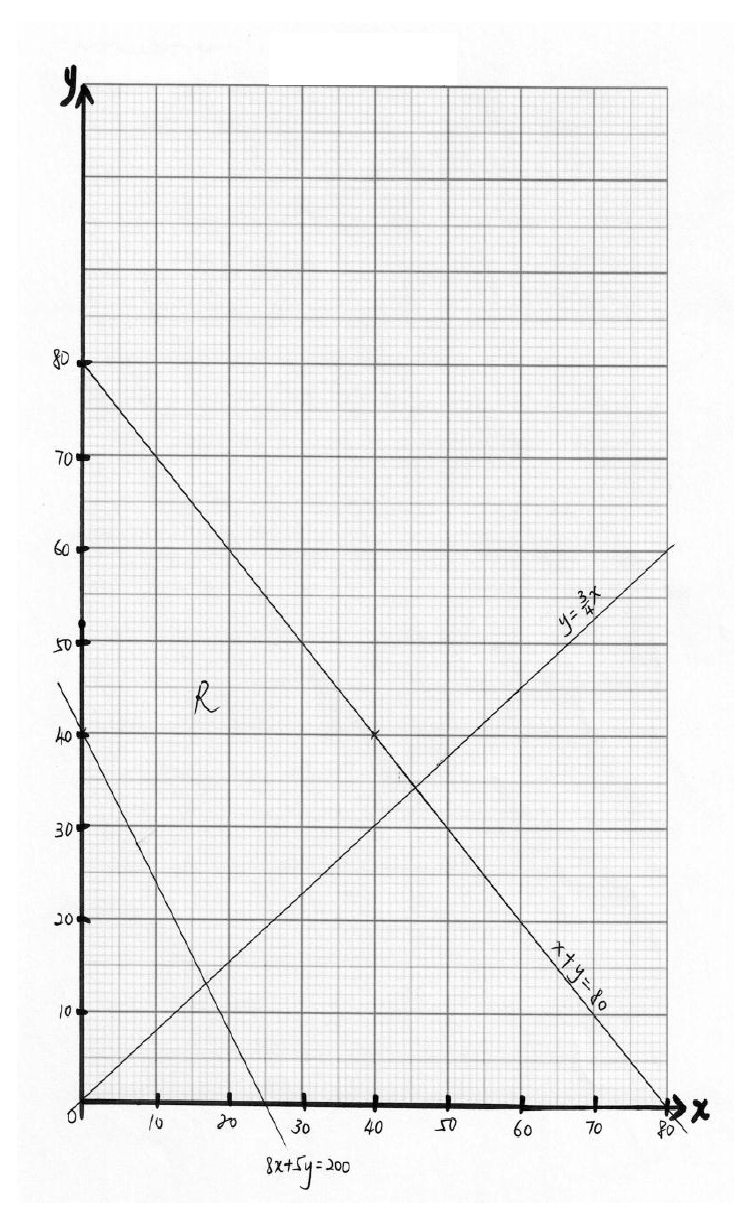
Use the graph paper provided on page 33 to answer this question. An electrical shop sells two models of smartphone, S and P. The profit made from the sale of a unit of smartphone S is RM80 and a unit of smartphone P is RM50. The shop sells x units of smartphone S and y units of smartphone P based on the following constraints: I The maximum number of the smartphone in the electrical shop is 80 units. II The number of smartphone P is at least 3/4 of the number of smartphone S. III The total profit is at least RM2 000. (a) Write three inequalities, other than x ≥ 0 and y ≥ 0, which satisfy all the above constraints. (b) By using a scale of 2 cm to 10 units smartphone on both axes, construct and shade the region R which satisfies all the above constraints. (c) By using the graph constructed in 13(b), find (i) the minimum number of smartphone S sold if 28 units of smartphone P are sold, (ii) the maximum profit that can be obtained.
Medium10 marks- (a)
Write three inequalities, other than x ≥ 0 and y ≥ 0, which satisfy all the above constraints.
[3] - (b)
Construct and shade the region R which satisfies all the above constraints (scale 2 cm to 10 units on both axes).
[3]
- (c)(i)
Find the minimum number of smartphone S sold if 28 units of smartphone P are sold.
[2] - (c)(ii)
Find the maximum profit that can be obtained.
[2]
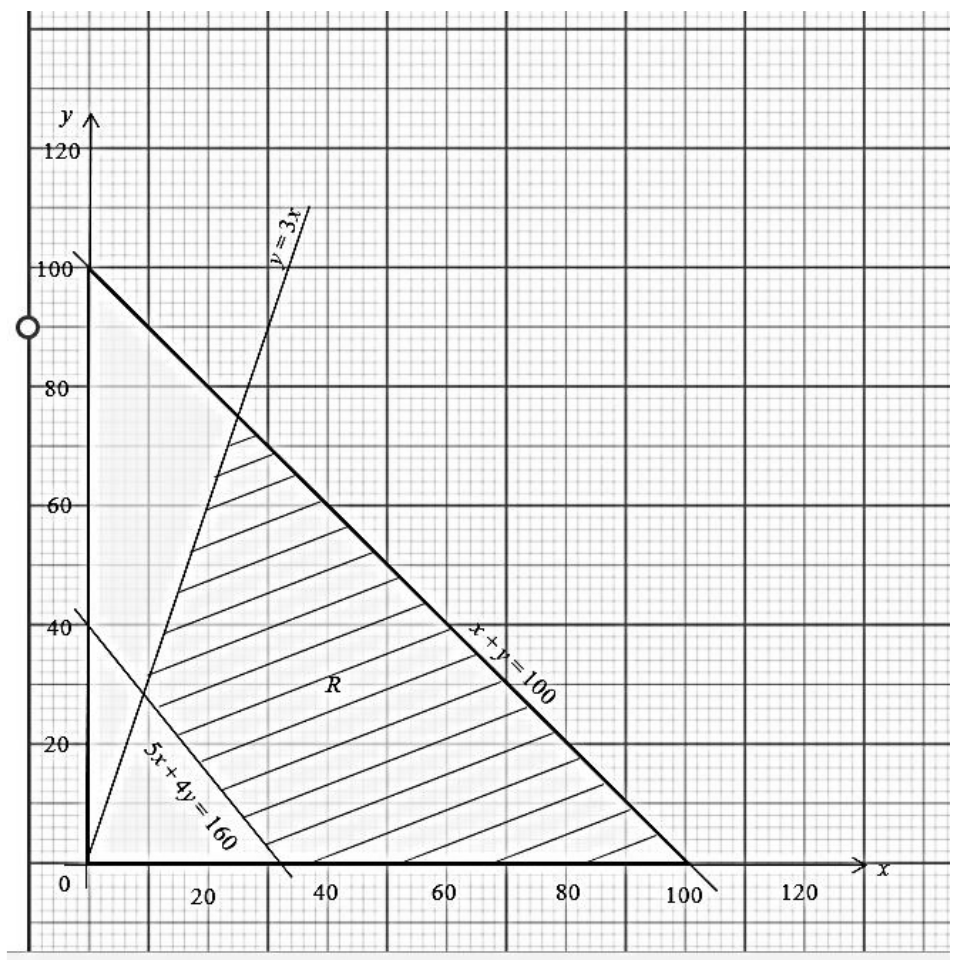
Use the graph paper provided on page 33. A fishmonger buys x kg of prawns and y kg of stingrays from a wholesaler. The price of prawns and stingrays are RM25 per kg and RM20 per kg respectively. The purchase of the prawns and stingrays are based on three constraints, two of the constraints are as follows: I The mass of stingrays is not more than 3 times the mass of prawns. II The total amount of prawns and stingrays purchased is RM800 or more. (a) Write two inequalities, other than x ≥ 0 and y ≥ 0, which satisfy the two constraints. (b) The third constraint is represented by the coloured region on the graph in page 33 (the region below the line through (100, 0) and (0, 100), shaded). Write in words the constraint. (c) Use the graph on page 33. Hence, construct and shade the region R which satisfies all the above constraints. (d) By using the graph constructed in 13(c), find (i) the minimum mass of prawns purchased if 20 kg of stingrays is purchased, (ii) the maximum amount of money paid by the fishmonger.
Medium10 marks- (a)
Write two inequalities, other than x ≥ 0 and y ≥ 0, which satisfy the two constraints.
[2] - (b)
The third constraint is represented by the coloured region on the graph in page 33. Write in words the constraint.
[1] - (c)
Use the graph on page 33. Hence, construct and shade the region R which satisfies all the above constraints.
[3]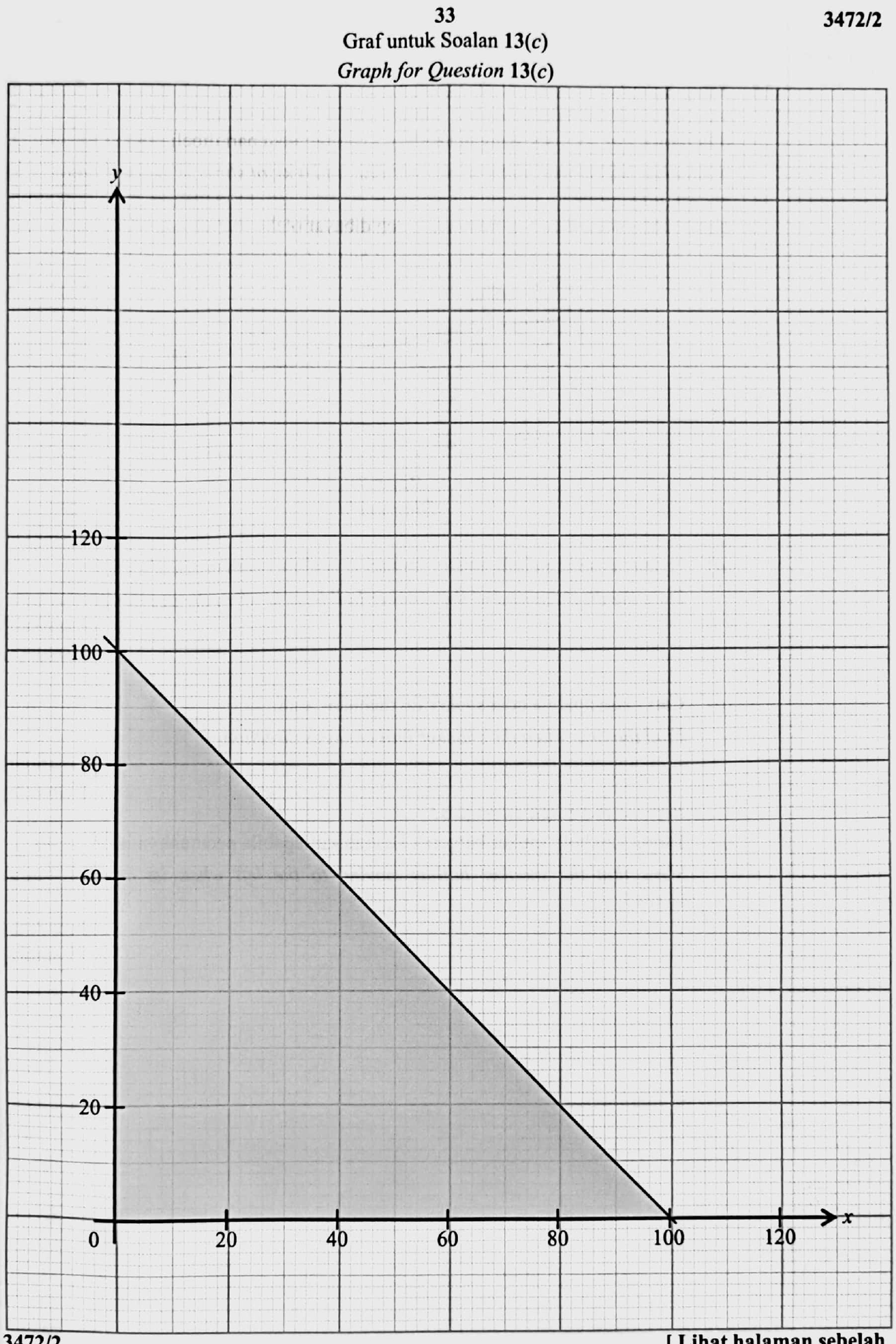
- (d)(i)
By using the graph constructed in 13(c), find the minimum mass of prawns purchased if 20 kg of stingrays is purchased.
[1] - (d)(ii)
By using the graph constructed in 13(c), find the maximum amount of money paid by the fishmonger.
[3]
Use graph paper to answer this question. A food entrepreneur provides x delivery services to Shop A and y to Shop B daily, based on constraints: I The total number of food deliveries provided is not more than 16. II The number of food deliveries to Shop A is not more than 3 times the number to Shop B. III The charge of one delivery to Shop A is RM6 and to Shop B is RM3. The total collection of charges per day is not less than RM48. (a) Write three inequalities, other than x ≥ 0 and y ≥ 0, which satisfy all of the above constraints. (b) Using a scale of 2 cm to 2 food deliveries on both axes, construct and shade the region R which satisfies all of the above constraints. (c) Using the graph in (b), find (i) the minimum number of food delivery orders to Shop B if 7 orders to Shop A are delivered daily, (ii) the maximum profit per day if the profit per delivery to Shop A is RM4 and to Shop B is RM2.
Medium10 marks- (a)
Write three inequalities, other than x ≥ 0 and y ≥ 0, which satisfy all the constraints.
[3] - (b)
Construct and shade the region R (scale 2 cm to 2 deliveries on both axes).
[3] - (c)(i)
Find the minimum number of food delivery orders to Shop B if 7 orders to Shop A are delivered daily.
[1] - (c)(ii)
Find the maximum profit per day if the profit per delivery to Shop A is RM4 and to Shop B is RM2.
[3]
A shoe store purchases two brands of shoes, A and B, from a wholesaler at prices of RM15 and RM10 for a pair of shoes, respectively. The number of pairs of brand A shoes is at least one-third the number of pairs of brand B shoes. The shoe store's total capital for purchasing shoes is limited to RM8 000. The shoe store plans to sell brand A shoes for RM25 each pair and brand B shoes for RM15 each pair, with the condition that the total profit is not less than RM3 000. It is given that x is the number of pairs of brand A shoes and y is the number of pairs of brand B shoes. (a) Write three inequalities, other than x ≥ 0 and y ≥ 0, which satisfy all the above constraints. (b) Using a scale of 2 cm to 100 pairs of shoes on both axes, construct and shade the region R which satisfies all the above constraints. (c) Use the graph constructed in 15(b) to answer: (i) State the minimum number of pairs of brand A shoes that should be sold. (ii) Find the maximum profit if 300 pairs of brand A shoes are sold.
Medium10 marks
- (a)
Write three inequalities, other than x ≥ 0 and y ≥ 0, which satisfy all the above constraints.
[3] - (b)
Using a scale of 2 cm to 100 pairs of shoes on both axes, construct and shade the region R which satisfies all the above constraints.
[3]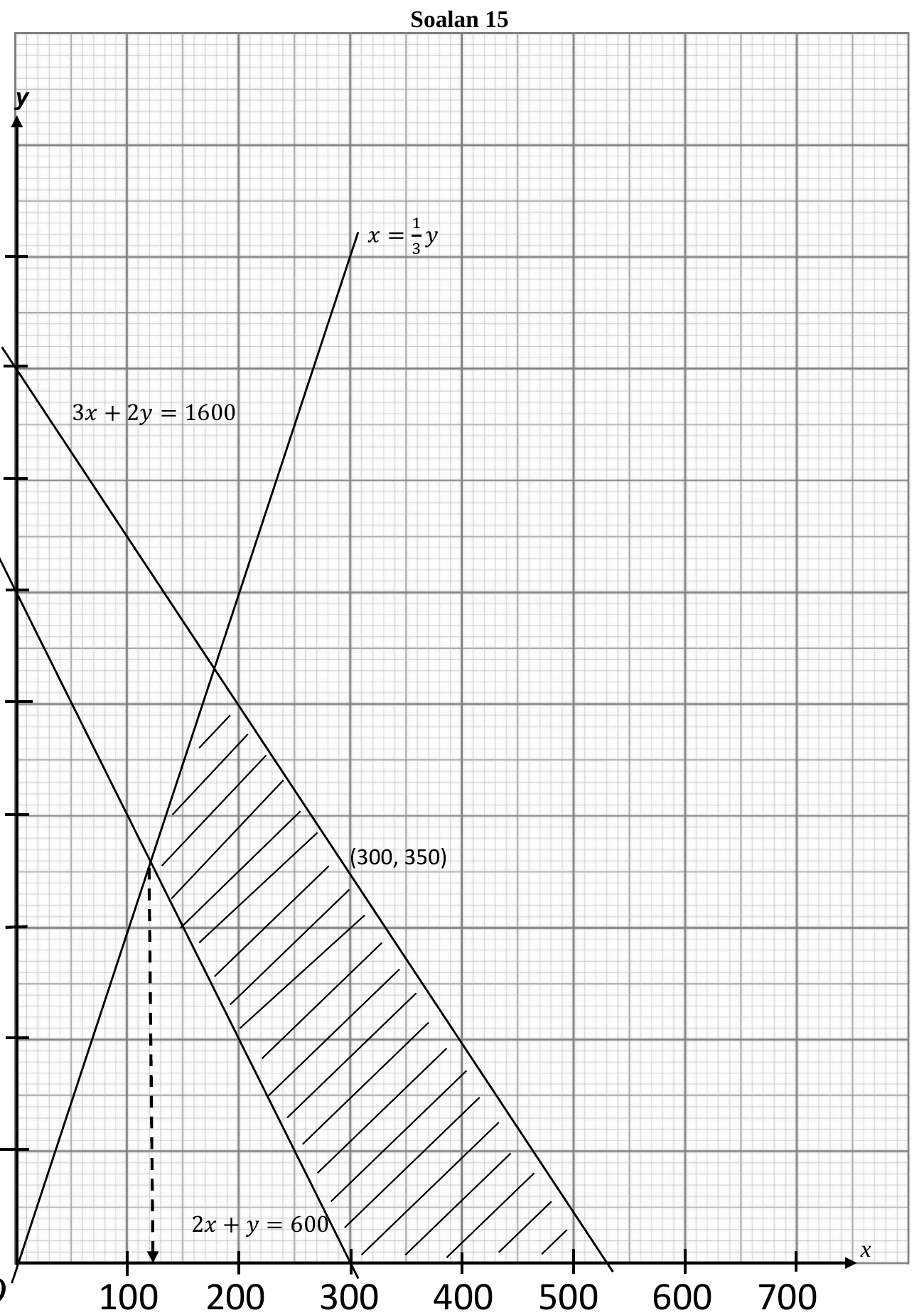
- (c)(i)
State the minimum number of pairs of brand A shoes that should be sold.
[1] - (c)(ii)
Find the maximum profit if 300 pairs of brand A shoes are sold.
[3]
Use the graph paper provided on page 33 to answer this question. Pusat Muzik Melody offers piano course and guitar course. The number of students who register for piano course and guitar course are x and y respectively. The registration of students for the two courses are based on the following constraints: I The total number of students register not more than 60 people. II The ratio of the number of students in guitar course to the number of students in piano course is at least 2 : 3. III The number of students in guitar course exceed the number of students in piano course by at most 30 people. (a) Write three inequalities, other than x ≥ 0 and y ≥ 0, which satisfy all the above constraints. (b) By using a scale of 2 cm to 10 students on both axes, construct and shade the region R which satisfies all the above constraints. (c) Answer the following questions by using the graph constructed in 13(b). Given that Pusat Muzik Melody needs to pay RM6 500 as the rental of the shop monthly. If the fees for the piano course and the guitar course are RM120 and RM80 per month respectively, can Pusat Muzik Melody sustain by only offering these two courses by satisfying all the above constraints? Give your justification.
Medium10 marks- (a)
Write three inequalities, other than x ≥ 0 and y ≥ 0, which satisfy all the above constraints.
[3] - (b)
By using a scale of 2 cm to 10 students on both axes, construct and shade the region R which satisfies all the above constraints. (Graph paper on page 33.)
[3]
- (c)
Given that Pusat Muzik Melody needs to pay RM6 500 as the rental of the shop monthly. If the fees for the piano course and the guitar course are RM120 and RM80 per month respectively, can Pusat Muzik Melody sustain by only offering these two courses by satisfying all the above constraints? Give your justification.
[4]
Use the graph paper provided to answer this question. Given x and y represent the number of Form 5 and Form 6 students respectively, to be awarded scholarships. The conditions for the awards are as follows: I The number of Form 6 recipients exceeds the number of Form 5 recipients by at most 200 people. II The number of Form 6 recipients must be at least 2/3 of the number of Form 5 recipients. III The total number of recipients is less than or equal to 500 people. (a) Write three inequalities, other than x ≥ 0 and y ≥ 0, which satisfy all the above conditions. (b) Using a scale of 2 cm to 100 students on both axes, construct and shade the region R which satisfies all the above conditions. (c) By using the graph constructed in 13(b), find (i) the maximum amount spent per month if the amounts given to Form 5 and Form 6 recipients are RM30 and RM40 per month respectively, (ii) the minimum and maximum amounts given out monthly if the number of Form 6 recipients is fixed at 250 people.
Medium10 marks- (a)
Write three inequalities, other than x ≥ 0 and y ≥ 0, which satisfy all the above conditions.
[3] - (b)
Using a scale of 2 cm to 100 students on both axes, construct and shade the region R which satisfies all the above conditions. (Blank graph paper provided.)
[3]
- (c)(i)
Find the maximum amount spent per month if the amounts given to Form 5 and Form 6 recipients are RM30 and RM40 per month respectively.
[2] - (c)(ii)
Find the minimum and maximum amounts given out monthly if the number of Form 6 recipients is fixed at 250 people.
[2]
Use graph paper to answer this question. A whole sale company plans to sell chocolate biscuits and cheese biscuits that will be packed in two types of tins, Tin A and Tin B. Each Tin A contains 100 pieces of chocolate biscuits and 80 pieces of cheese biscuits whereas each Tin B contains 60 pieces of chocolate biscuits and 120 pieces of cheese biscuits. The company will use x units of Tin A and y units of Tin B, based on the following conditions: I The number of chocolate biscuits being sold must not exceed 6 600. II The minimum number of cheese biscuit being sold is 4 800. III The total number of Tin B must be at least 2 times the total number of Tin A. (a) Write three inequalities, other than x ≥ 0 and y ≥ 0, which satisfy all of the above conditions. (b) Using a scale of 2 cm to 10 units on the both axes, construct and shade the region R that satisfies all the above conditions. (c) Use the graph in 14(b) to answer the following questions: (i) If the company decided to sell 15 Tin A, find the range of number of Tin B to be sold. (ii) Calculate the maximum profit that the company will gain if the profit per Tin A and the profit per Tin B are RM50 and RM25 respectively.
Medium10 marks- (a)
Write three inequalities, other than x ≥ 0 and y ≥ 0, which satisfy all of the above conditions.
[3] - (b)
Using a scale of 2 cm to 10 units on the both axes, construct and shade the region R that satisfies all the above conditions.
[3]
- (c)(i)
If the company decided to sell 15 Tin A, find the range of number of Tin B to be sold.
[1] - (c)(ii)
Calculate the maximum profit that the company will gain if the profit per Tin A and the profit per Tin B are RM50 and RM25 respectively.
[3]
A shoe store purchases two brands of shoes, A and B, from a wholesaler at prices of RM18 and RM12 for a pair of shoes, respectively. The number of pairs of brand A shoes is at least one-third the number of pairs of brand B shoes. The shoe store's total capital for purchasing shoes is limited to RM12 000. The shoe store plans to sell brand A shoes for RM30 each pair and brand B shoes for RM18 each pair, with the condition that the total profit is not less than RM3 600. It is given that x is the number of pairs of brand A shoes and y is the number of pairs of brand B shoes. (a) Write three inequalities, other than x ≥ 0 and y ≥ 0, which satisfy all the above constraints. (b) Using a scale of 2 cm to 100 pairs of shoes on both axes, construct and shade the region R which satisfies all the above constraints. (c) Use the graph constructed in 15(b), find (i) the minimum number of pairs of brand A shoes that should be sold, (ii) the maximum profit if 400 pairs of brand A shoes are sold.
Medium10 marks- (a)
Write three inequalities, other than x ≥ 0 and y ≥ 0, which satisfy all the above constraints.
[3] - (b)
Using a scale of 2 cm to 100 pairs of shoes on both axes, construct and shade the region R which satisfies all the above constraints.
[3]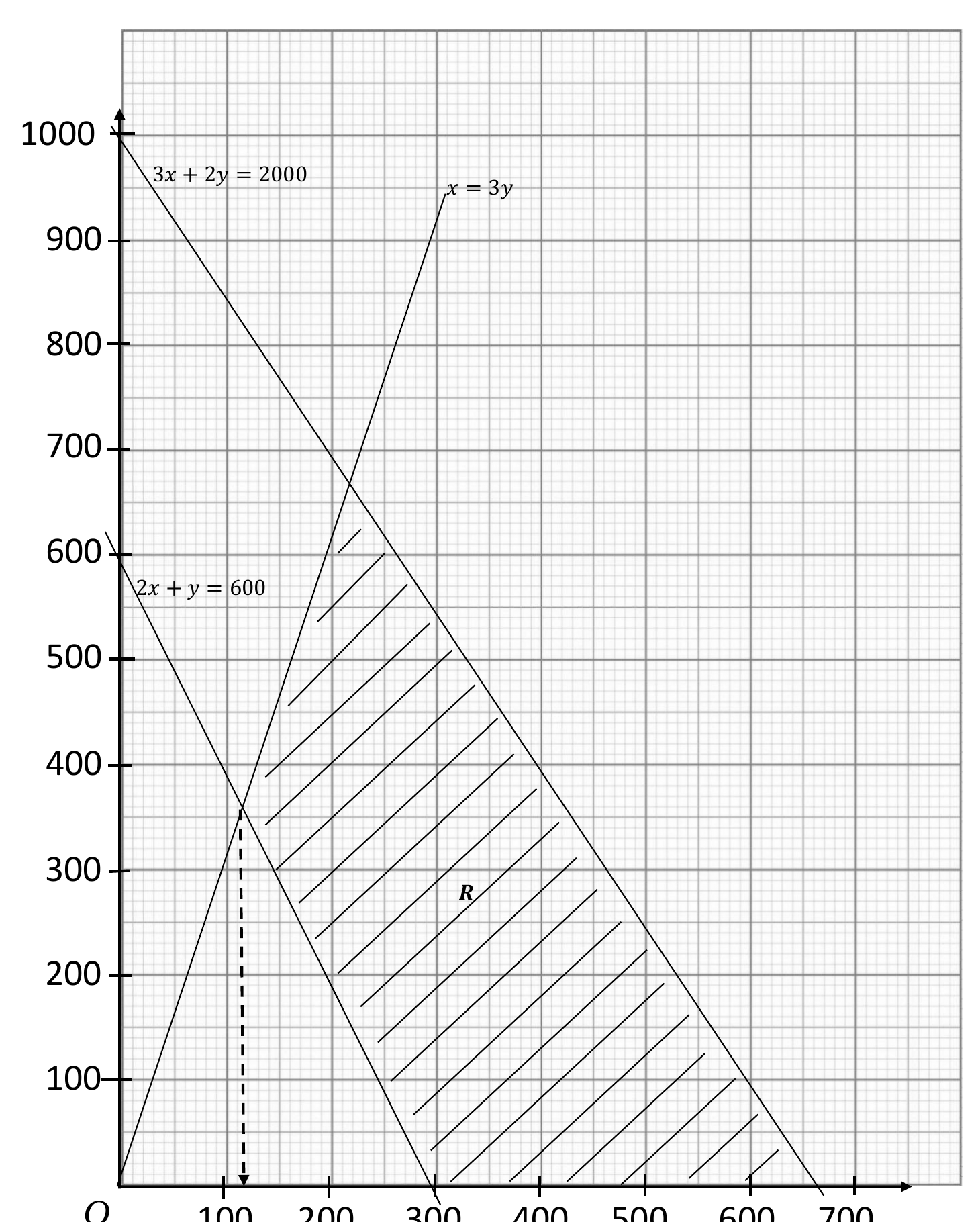
- (c)(i)
Find the minimum number of pairs of brand A shoes that should be sold.
[1] - (c)(ii)
Find the maximum profit if 400 pairs of brand A shoes are sold.
[3]
Use the graph paper provided on page 33 to answer this question. A theme park is having a special promotion during the holidays. A school organises a trip to the theme park for x boys and y girls. The number of students joining the trip is based on the following constraints: I The total number of students joining the trip is at most 85. II The number of girls is at least 20. III The number of girls is at most 11/6 times the number of boys. (a) Write three inequalities, other than x ≥ 0 and y ≥ 0, which satisfy all the above constraints. (b) Using a scale of 2 cm to 10 students on both axes, construct and shade the region R which satisfies all the above constraints. (c) By using the graph constructed in 13(b), find (i) the minimum number of boys, (ii) the maximum cost for the trip if the expenses of a boy is RM600 and the expenses of a girl is RM800.
Medium10 marks- (a)
Write three inequalities, other than x ≥ 0 and y ≥ 0, which satisfy all the above constraints.
[3] - (b)
Using a scale of 2 cm to 10 students on both axes, construct and shade the region R which satisfies all the above constraints. (Graph paper provided.)
[3]
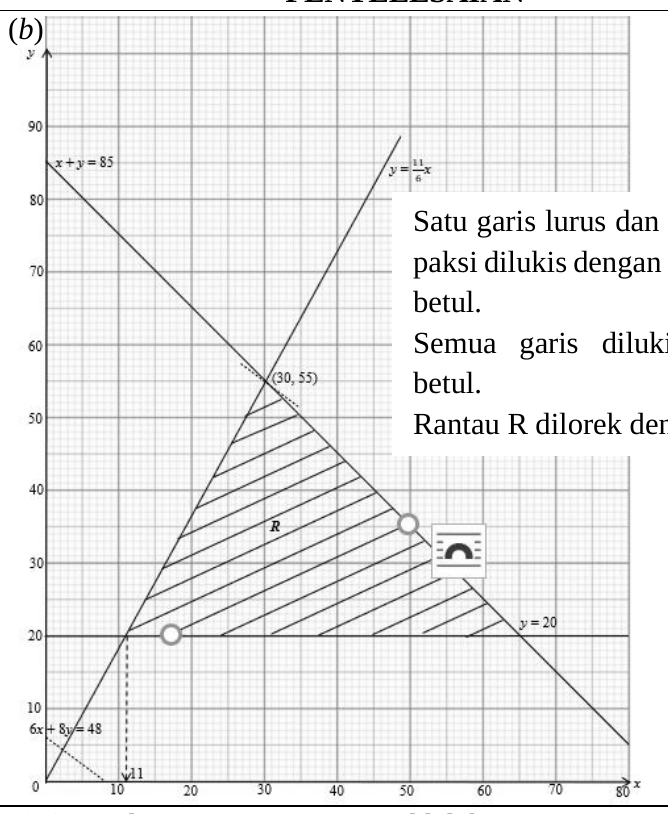
- (c)(i)
Find the minimum number of boys.
[1] - (c)(ii)
Find the maximum cost for the trip if the expenses of a boy is RM600 and the expenses of a girl is RM800.
[3]
Use graph paper to answer this question. A District Education Office organises a workshop on High Order Thinking Skills for Mathematics and Additional Mathematics teachers. The workshop is attended by x Mathematics teachers and y Additional Mathematics teachers based on the following constraints: I The total number of teachers is not more than 100. II Additional Mathematics teachers exceed the number of Mathematics teachers by 20 or less. The graph paper (see figure) shows the line x = 3y with a shaded region representing the third constraint.
Medium10 marks- (a)
Write down two inequalities, other than x ≥ 0 and y ≥ 0, that satisfy the two constraints.
[2] - (b)
The shaded region in the graph represents the third constraint. Write in words the constraint.
[1] - (c)
On the graph, construct and shade the region R which satisfies all three constraints.
[3]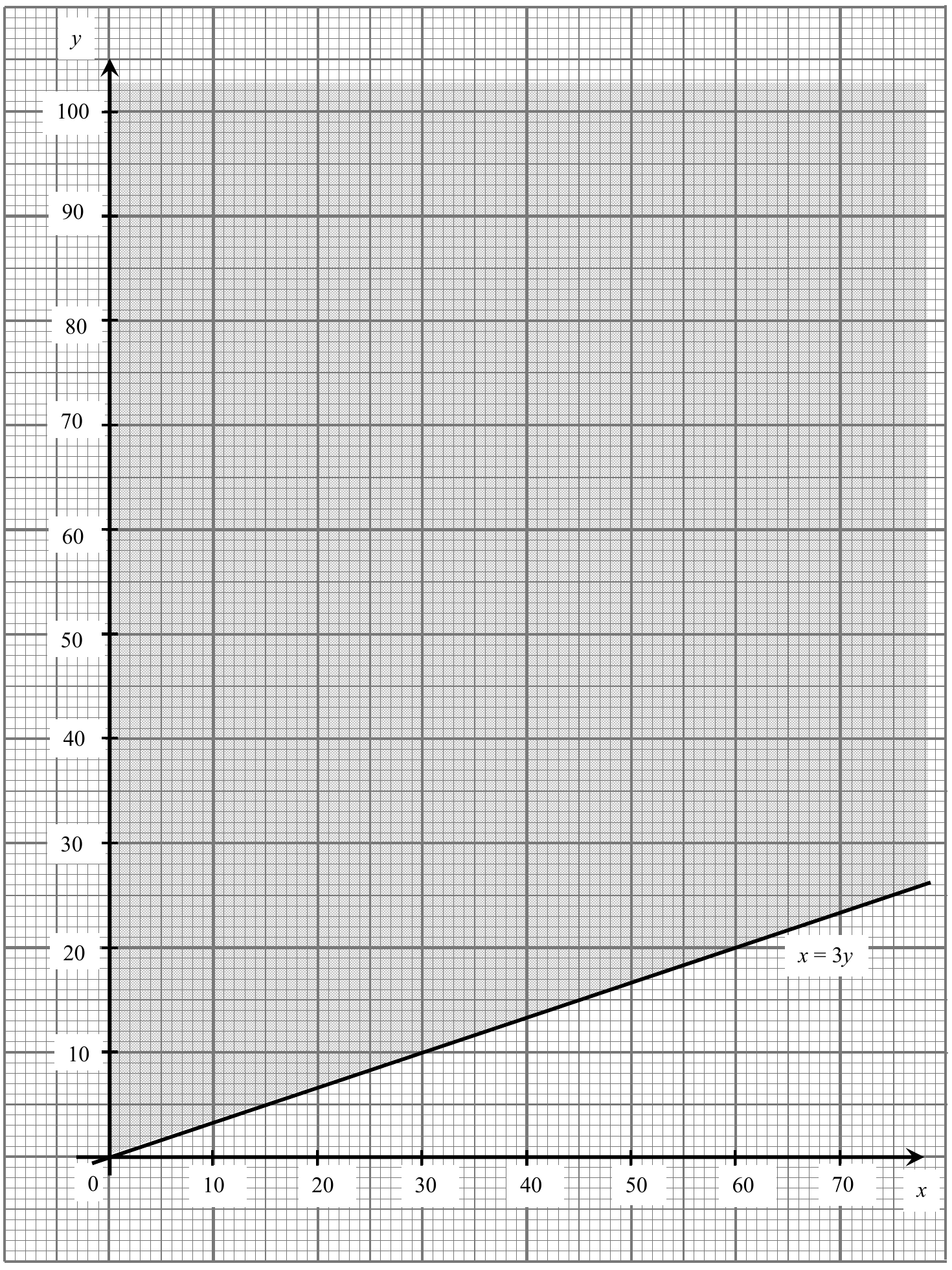
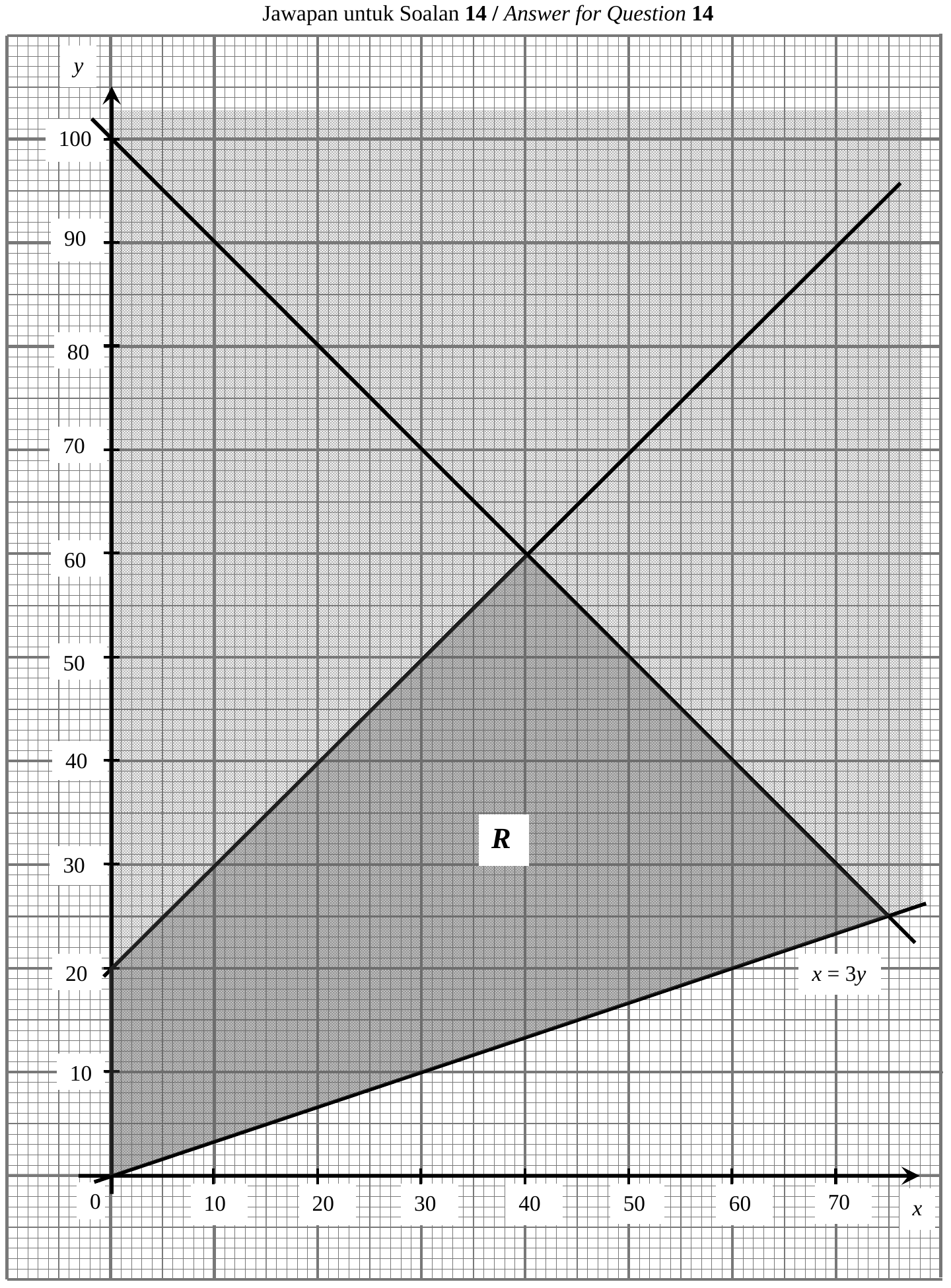
- (d)(i)
Using the graph in (c), find the range of the number of Additional Mathematics teachers that can attend the workshop if the number of Mathematics teachers is 60.
[1] - (d)(ii)
Find the maximum cost to run the workshop if the cost of a Mathematics teacher is RM150 and the cost of an Additional Mathematics teacher is RM120.
[3]
Use graph paper to answer this question. A company hires y local workers and x foreign workers as new employees in 2023. The policy states that the number of new employees must be more than 120 such that the number of foreign workers is at most 3/5 times the number of local workers. The government has allocated at most RM 211 200 to pay salaries. The salary is RM 660 per month for each foreign worker and RM 1 760 per month for each local worker.
Medium10 marks- (a)
Write down three inequalities, other than x ≥ 0 and y ≥ 0, which satisfy all the above constraints.
[3] - (b)
Using a scale of 2 cm to 10 units on both axes, construct and shade the region that satisfies all the above constraints.
[3]
- (c)(i)
Based on the graph, state the range of local workers if 40 foreign workers are hired.
[1] - (c)(ii)
Based on the graph, state the maximum amount spent by the company on salaries if the number of local workers hired is 80.
[3]
A private university will organise Bahasa Melayu and Sejarah courses attended by x Bahasa Melayu participants and y Sejarah participants. Constraints: (i) the number of participants is at least 40; (ii) the number of Sejarah participants is at most twice the number of Bahasa Melayu participants (printed as 'at least twice'); (iii) the maximum expenditure is RM7200, with RM120 for each Bahasa Melayu participant and RM80 for each Sejarah participant. (a) Write three inequalities, other than x ≥ 0 and y ≥ 0, that satisfy all the constraints. (b) Using a scale of 2 cm to 10 participants on both axes, construct and shade the region R. (c) Using the graph, find (i) the maximum and minimum number of Bahasa Melayu participants if the Sejarah participants are 10, (ii) the minimum expenditure to conduct this course.
Medium10 marks- (a)
Write three inequalities, other than x ≥ 0 and y ≥ 0, that satisfy all the above constraints.
[3] - (b)
Using a scale of 2 cm to 10 participants on both axes, construct and shade a region R that satisfies all of the above constraints. (Graph paper provided.)
[3] - (c)(i)
Using the graph in (b), find the maximum and minimum number of Bahasa Melayu participants if the Sejarah participants are 10.
[2] - (c)(ii)
Using the graph in (b), find the minimum expenditure to conduct this course.
[2]
A College of Nursing will organise a clinical convention. Participants consist of x female and y male students. The entry fee for each female student is RM 80 and for each male student is RM 30 more (RM 110). The conditions are: I. The maximum number of students attending is 80. II. Total fees collected is at least RM 4 500. III. The ratio of male to female students is not less than 2 : 1. (a) Write three linear inequalities which satisfy all the above constraints other than x ≥ 0 and y ≥ 0. (b) Using a scale of 2 cm to 10 students on both axes, construct and shade the region R which satisfies all the above constraints. (c) Using the graph constructed in (b), find (i) the minimum number of male students if the ratio of male to female students is not less than 2 : 1; (ii) the maximum profit earned if the college takes 20% of the collected amount.
Medium10 marks- (a)
Write three linear inequalities for the constraints (other than x ≥ 0, y ≥ 0).
[3] - (b)
Construct and shade the region R (graph paper provided; scale 2 cm to 10 students on both axes).
[3]
- (c)(i)
The minimum number of male students.
[1] - (c)(ii)
The maximum profit earned if the college takes 20% of the collected amount.
[3]
Use graph paper to answer this question. A local charity organisation intends to organise a Charity Run. The run is open to x adults and y children based on these constraints: I The number of children is at least 10. II The number of children is at most 3/2 times the number of adults. III The maximum total number of participants is 80.
Medium10 marks
- (a)
Write three inequalities, other than x ≥ 0 and y ≥ 0, which satisfy all the above constraints.
[3] - (b)
Using a scale of 2 cm to 10 participants on both axes, construct and shade the region R which satisfies all the above constraints.
[3]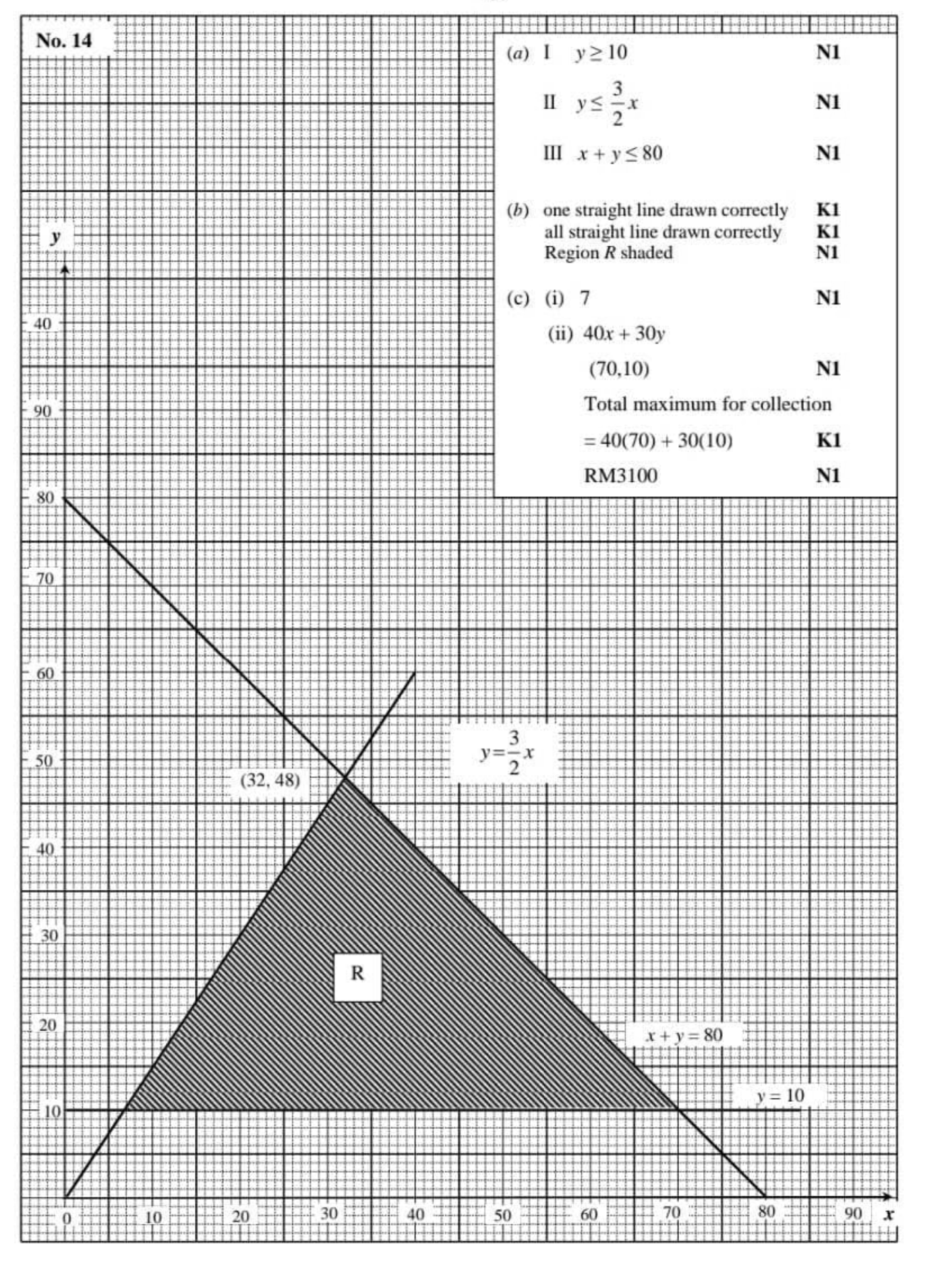
- (c)(i)
Find the minimum number of adults participating in the run.
[1] - (c)(ii)
Determine the maximum total fees collected if the fee for an adult is RM40 and for a child is RM30.
[3]
Use graph paper to answer this question. Additional Mathematics Panel SMK Seri Berlian would like to buy x reference books published by Company A and y reference books published by Company B. A book of Company A costs RM12 and a book of Company B costs RM16. Constraints: I The number of books by Company B is at least 10 more than Company A. II The number of books by Company A is more than 10. III The purchase cost does not exceed RM 960.
Medium10 marks- (a)
Write three inequalities, other than x ≥ 0 and y ≥ 0, which satisfy all the above constraints.
[3] - (b)
Using a scale of 2 cm to 10 books on both axes, construct and shade the region R which satisfies all the above constraints.
[3]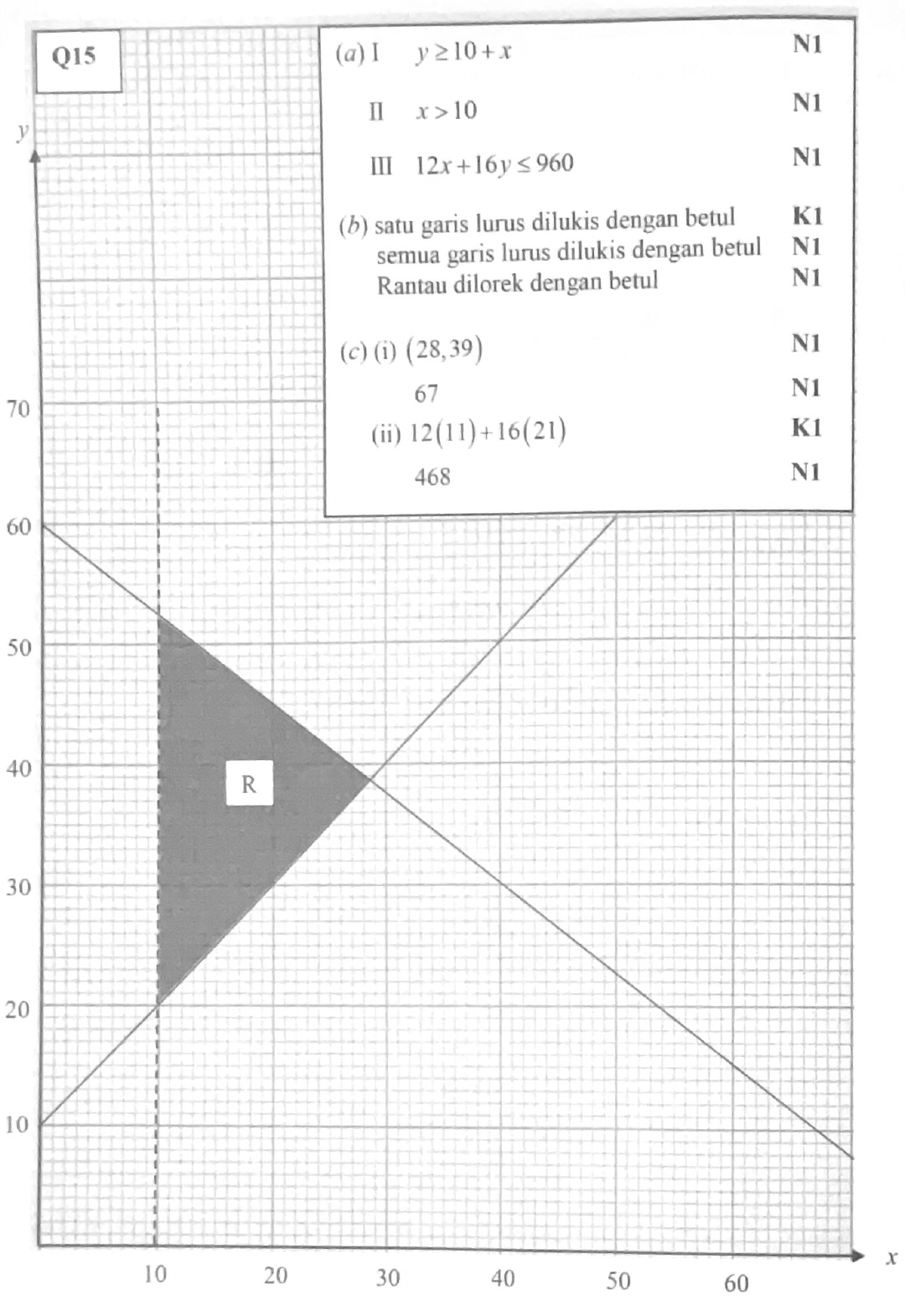
- (c)(i)
Use the graph constructed in (b) to find the maximum total number of books that can be purchased.
[2] - (c)(ii)
Determine the minimum cost of purchasing reference books.
[2]
An institution of higher learning offers undergraduate course in information technologies and engineering. The number of information technologies student is x and engineering student is y. The enrolment of these two courses are based on the following constraints: I The total number of students for these two courses is at most 450. II The number of engineering student exceeds the number of information technologies student by at least 50. III The number of engineering student is not more than three times the number of information technologies student. Use the graph paper provided to answer this question.
Medium10 marks- (a)
Write three inequalities, other than x ≥ 0 and y ≥ 0, which satisfy all the given constraints.
[3] - (b)
Using a scale of 2 cm to 50 students on both axes, construct and shade the region R that satisfies all the given constraints.
[3]
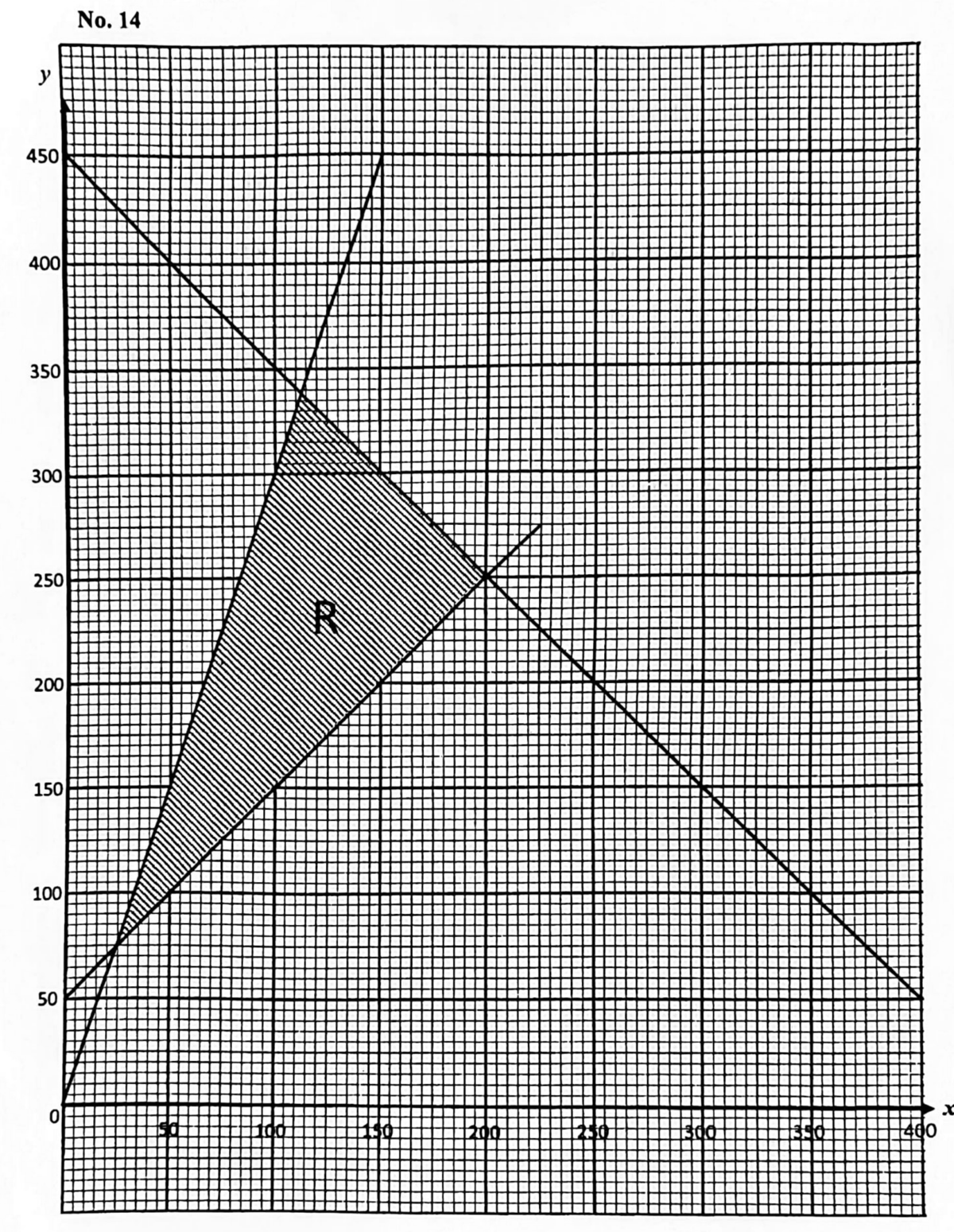
- (c)(i)
Use your graph in 14(b), find the range of the number of information technologies student.
[1] - (c)(ii)
Find the minimum total tuition fees collected per academic year if there are 125 information technologies student, with each information technologies student paying RM 8,000 and each engineering student paying RM 12,000 as annual tuition fees.
[3]
Use graph paper to answer this question. A tour boat operator provides x trips to Island P and y trips to Island Q each day based on these constraints: I The total number of trips is not more than 14. II The number of trips to Island P is not more than three times the number of trips to Island Q. III The fares per trip to Island P and Island Q are RM60 and RM30. The total fare collected per day is more than RM480.
Medium10 marks- (a)
Write three inequalities, other than x ≥ 0 and y ≥ 0, which satisfy all the given constraints.
[3] - (b)
Using a scale of 2 cm to 2 trips on both axes, construct and shade the region R that satisfies all the given constraints.
[3]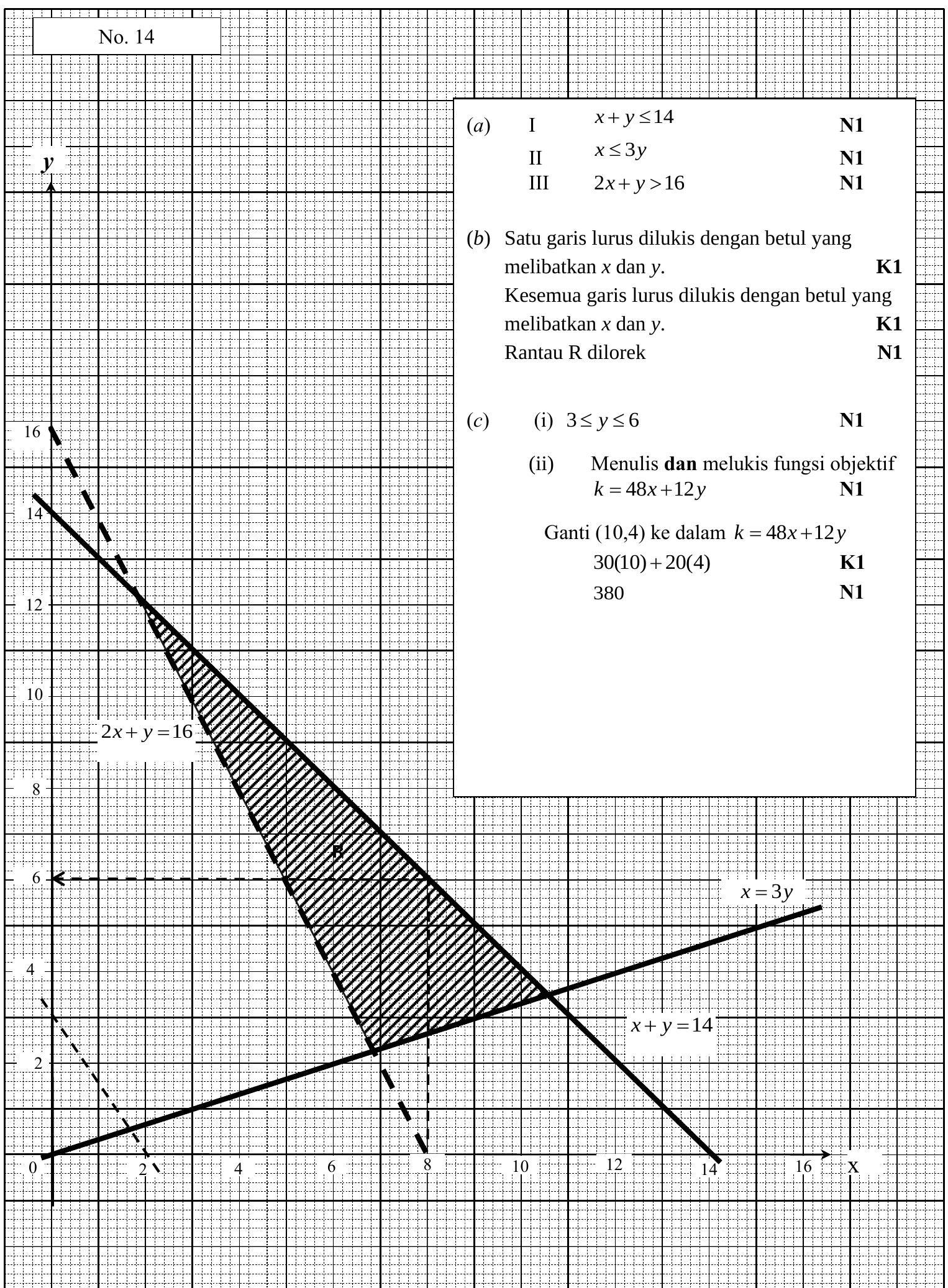
- (c)
Using the graph, find the range of the number of trips to Island Q if 8 trips are provided to Island P on a certain day.
[1] - (d)
On the same graph, draw an objective function and find the maximum profit obtained per day if the profits from a trip to Island P and to Island Q are RM30 and RM20 respectively.
[3]
A factory wants to hire new employees for the positions of supervisors and operators. Money amounting to RM32 000 has been allocated for the monthly salary payment of employees. The salary of a supervisor and an operator is RM600 and RM400 per month respectively. The number of operators must exceed the number of supervisors by 10 or more. The number of supervisors should be at least 10% of the number of operators. Given that x represents the number of supervisors and y represents the number of operators. (a) The shaded region on the graph on page 31 represents one of the constraints. Write an inequality to represent the constraint. (b) Write two inequalities other than (a), x ≥ 0 and y ≥ 0 that satisfy all the above constraints. (c) Using a scale of 2 cm to 5 people on the x-axis and 2 cm to 10 people on the y-axis, construct and label the region R that satisfies all the above constraints. (d) Using the graph constructed in (c), answer: (i) the maximum number of employees that can be hired by the factory if the number of supervisors is 10% of the number of operators; (ii) the factory will pay an overtime allowance of RM8 per hour for an operator and RM16 per hour for a supervisor. By drawing the objective function line, find the maximum amount of overtime allowance per hour to be paid by the factory.
Medium10 marks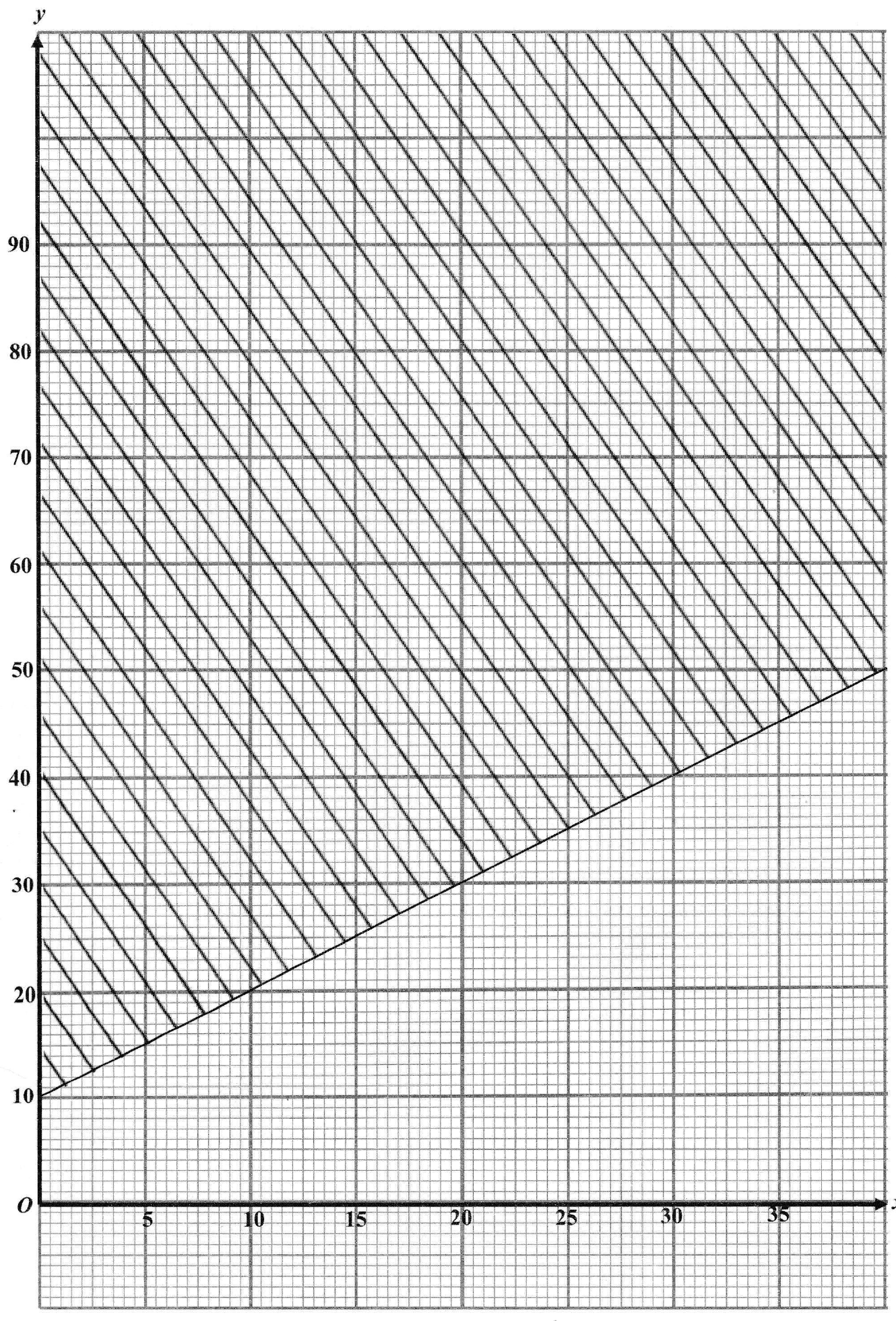
- (a)
Write an inequality to represent the constraint shown by the shaded region on the graph.
[1] - (b)
Write two inequalities, other than (a), x ≥ 0 and y ≥ 0, that satisfy all the above constraints.
[2] - (c)
Using a scale of 2 cm to 5 people on the x-axis and 2 cm to 10 people on the y-axis, construct and label the region R.
[3]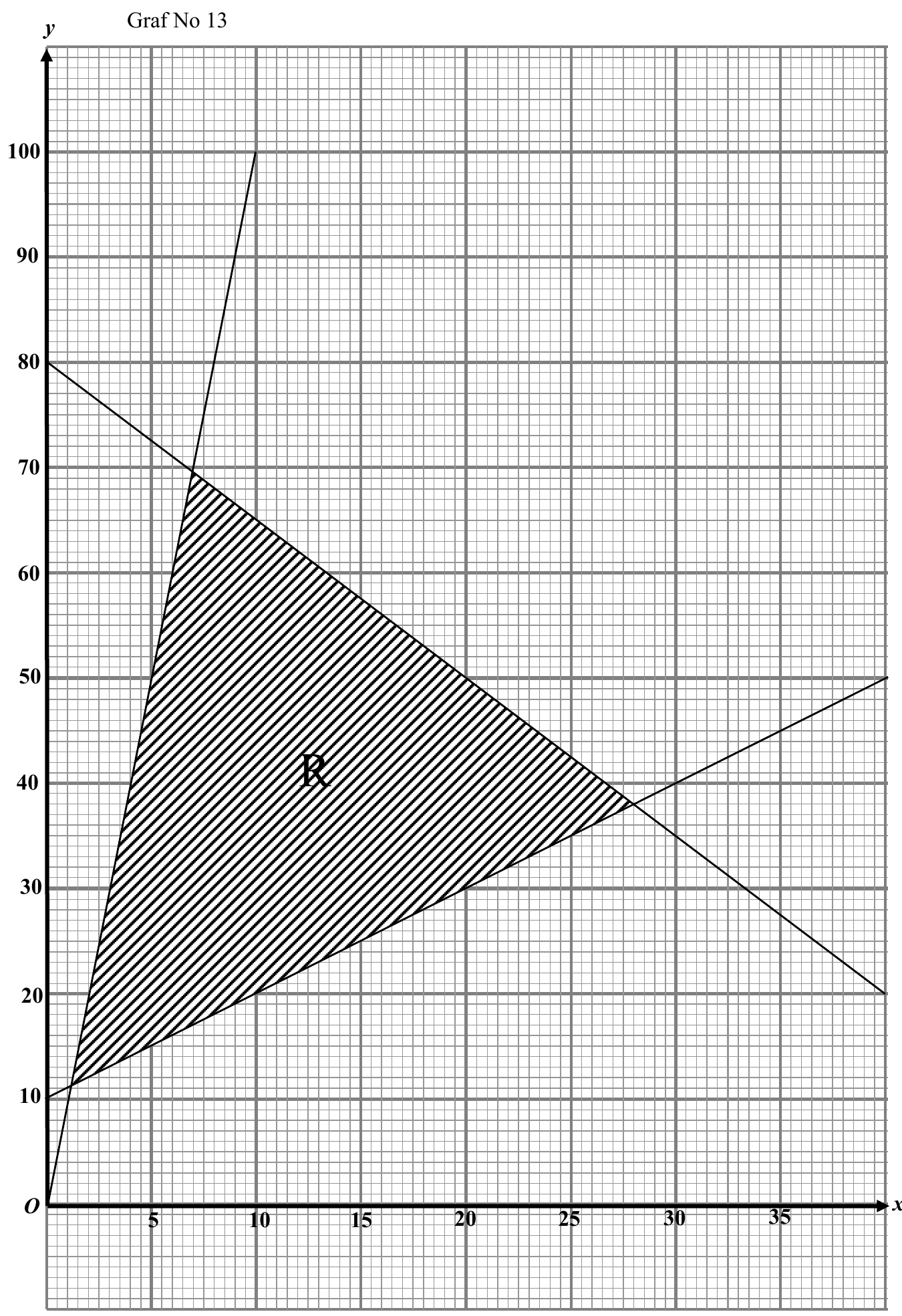
- (d)(i)
Maximum number of employees that can be hired if the number of supervisors is 10% of the number of operators.
[1] - (d)(ii)
By drawing the objective function line k = 16x + 8y, find the maximum amount of overtime allowance per hour.
[3]