JOHOR 2021 P2 Q13
HardWrite your answer on paper. Then open the answer to check it.
Diagram 13 shows the motions of two particles, A and B, which start from the fixed points O and P respectively on a straight line such that OP = 10 m. The velocities of A and B are vA = 4t − 7 and vB = 6 − 2t respectively, where t is the time in seconds. Find (a) the distance between the two particles when A is at instantaneous rest, (b) the time when the distance between the two particles is maximum, (c) the time and displacement when the two particles meet.
Hard10 marks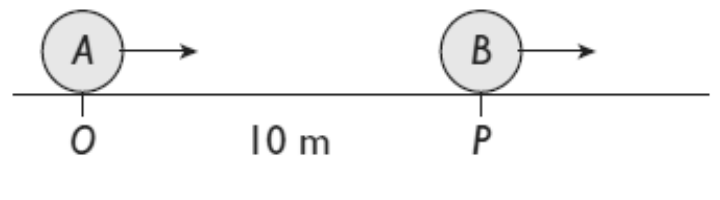
- (a)
Distance between the particles when A is at instantaneous rest.
[5] - (b)
Time when the distance between the particles is maximum.
[2] - (c)
Time and displacement when the particles meet.
[3]
A particle moves along a straight line to the right with a velocity of 5 m s⁻¹. It experiences an acceleration a = 11 − 6t m s⁻², where t is the time in seconds after leaving point O. (a) Find the velocity function of the particle. (b) Sketch the velocity-time graph for 0 ≤ t ≤ 6. (c) Find for the first 6 seconds (i) the displacement, in m, (ii) the total distance, in m, travelled by the particle.
Medium10 marks- (a)
Find the velocity function of the particle.
[2] - (b)
Sketch the velocity-time graph for 0 ≤ t ≤ 6.
[2]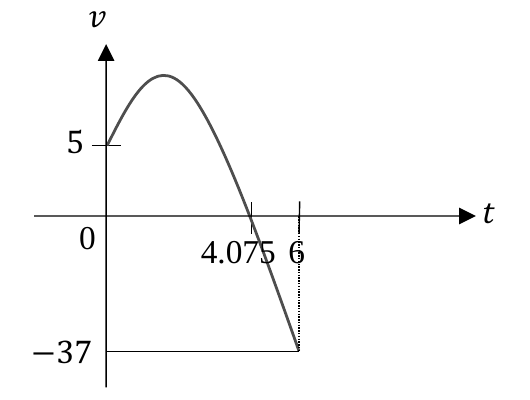
- (c)(i)
Find the displacement in the first 6 seconds.
[3] - (c)(ii)
Find the total distance travelled in the first 6 seconds.
[3]
A particle moves in a straight line such that its velocity, v m s⁻¹, t seconds after passing through a fixed point O is given by v = −t² + 4t − 3. [Assume motion to the right is positive.] Find (a) the maximum velocity, in m s⁻¹, of the particle, (b) the initial acceleration, in m s⁻², of the particle, (c) the time, in seconds, when the particle stops instantaneously at t₁ and t₂, (d) the total distance, in m, travelled between the times t₁ and t₂.
Medium10 marks- (a)
The maximum velocity.
[2] - (b)
The initial acceleration.
[2] - (c)
The times when the particle stops instantaneously.
[3] - (d)
The total distance travelled between t₁ and t₂.
[3]
The acceleration, a m s⁻², of a particle that moves along a straight line is given by a = 8 − 2t, where t is the time in seconds after passing through a fixed point O. It is given that its velocity is 16 m s⁻¹ when t = 2. Find (a) the initial velocity of the particle, (b) the maximum velocity of the particle, (c) the distance travelled in the 3rd second.
Medium10 marks- (a)
Initial velocity of the particle.
[4] - (b)
Maximum velocity of the particle.
[3] - (c)
Distance travelled in the 3rd second.
[3]
A particle moves along a straight line and passes through a fixed point O. The velocity of the particle, v m s⁻¹, is given by v = −8t + pt², where p is a constant and t is the time, in s, after leaving O. The acceleration of the particle is 12 m s⁻² when t = 5 s. [Assume motion to the right is positive.] Find (a) the value of p, (b) the time, in s, when the particle stops instantaneously, (c) the total distance, in m, travelled by the particle in the first 5 seconds. Hence, (d) sketch the graph of the velocity of the particle for 0 ≤ t ≤ 6 and state the range of values of t when the velocity of the particle is increasing.
Medium10 marks- (a)
Find the value of p.
[2] - (b)
Find the time when the particle stops instantaneously.
[2] - (c)
Find the total distance travelled by the particle in the first 5 seconds.
[3] - (d)
Sketch the graph of the velocity of the particle for 0 ≤ t ≤ 6. State the range of values of t when the velocity is increasing.
[3]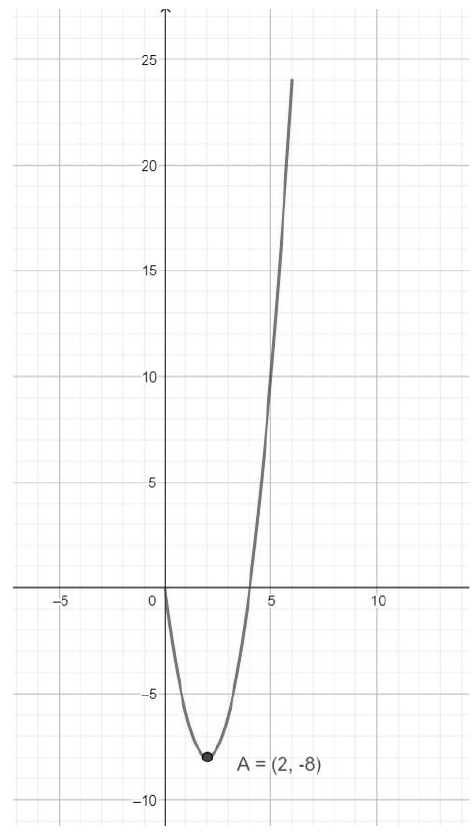
Diagram 13 shows the movement of a car along a straight path starting from a fixed point O and heading towards point A and point B. The acceleration, a m s⁻², of the car t seconds after passing the fixed point O is given by a = 6t − 16. The car is at point A when t = 5 and stops momentarily at point B. The initial velocity of the car is −12 m s⁻¹.
Medium10 marks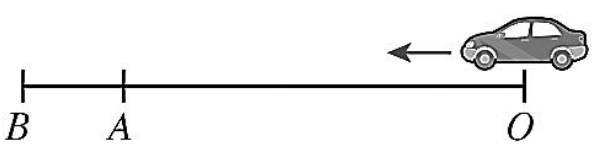
- (a)
Calculate the minimum velocity of the car at point B.
[4] - (b)
Calculate the distance AB, in m.
[6]
A particle moves along a straight line and passes through a fixed point O. Its velocity, v m s⁻¹, is given by v = 15 + 4t − 3t², where t is the time in seconds after passing through O. [Assume the movement to the right is positive.] Calculate (a) the initial velocity, in m s⁻¹, (b) the initial acceleration, in m s⁻², (c) the displacement, in m, when the particle stops instantaneously. Hence, (d) sketch the velocity-time graph for 0 ≤ t ≤ 3 and determine the range of values of t when the velocity of the particle is decreasing.
Medium10 marks- (a)
Initial velocity.
[1] - (b)
Initial acceleration.
[2] - (c)
Displacement when the particle stops instantaneously.
[4] - (d)
Sketch the v–t graph for 0 ≤ t ≤ 3 and state the range of t when the velocity is decreasing.
[3]
Two particles P and Q move in a straight line. Given the velocity, in m s⁻¹, of particle P and particle Q after passing through the fixed point O are P(t) = −2t² + 3t + 6 and Q(t) = (1/5)t² respectively. [Assume motion to the right is positive]
Medium10 marks- (a)
State the difference in velocity of particle P and particle Q when passing through the fixed point O.
[1] - (b)
Find the displacement and determine the position of the particle Q from the fixed point O, when the velocity of the particle P is maximum.
[4] - (c)
Find the acceleration of particle P when t = 3 s.
[2] - (d)
Find the time interval, t, where t is an integer, when the two particles are moving in opposite directions.
[3]
Two particles P and Q move along a straight line through a fixed point O. The velocity of P, V_P m s⁻¹, is V_P = ½t² + 2t + 6 and the acceleration of Q, a_Q m s⁻², is a = t, where t is the time in seconds after passing O. The initial velocity of Q is 14 m s⁻¹. [Assume movement to the right is positive.] Find (a) the initial velocity, in m s⁻¹, of P. (b) the time, in seconds, when the acceleration of P is 5 m s⁻². (c) the time, in seconds, when the velocities of P and Q are equal. (d) the total distance, in m, travelled by Q in the first 8 seconds.
Medium10 marks- (a)
Find the initial velocity of particle P.
[1] - (b)
Find the time when the acceleration of P is 5 m s⁻².
[2] - (c)
Find the time when the velocities of P and Q are equal.
[5] - (d)
Find the total distance travelled by particle Q in the first 8 seconds.
[2]
Diagram 12 shows two fixed points P and Q on a straight line with PQ = 6 m (Q to the right of P). At time t seconds, particle A passes through fixed point P with velocity −4 m s⁻¹ and acceleration a_A = 2t m s⁻². Particle B passes through fixed point Q with velocity v_B = (t² − 4t) m s⁻¹. Motion to the right is positive. (a) Find the time t when particle A stops instantaneously. (b) Hence, at that moment, find the distance of particle A from fixed point P. (c) Determine the time when both particles meet. (d) Determine the range of time when both particles move to the left.
Hard10 marks- (a)
Find the time t, in seconds, when particle A stops instantaneously.
[3] - (b)
At the moment particle A stops instantaneously, find the distance, in m, of particle A from fixed point P.
[2] - (c)
Determine the time, in seconds, when both particles meet each other.
[2] - (d)
Determine the range of time when both particles move to the left.
[3]
Diagram 14 shows a part of the velocity-time graph v = 6t − t² (V in m s⁻¹, t in seconds); the region under the curve from t = 0 to t = 4 is shaded. Find (a) the value of t if the acceleration is zero, (b) the range of values of t when the particle undergoes deceleration, (c) the area of the shaded region and state what is represented by the area of the shaded region, (d) the average speed for the first 4 seconds.
Medium10 marks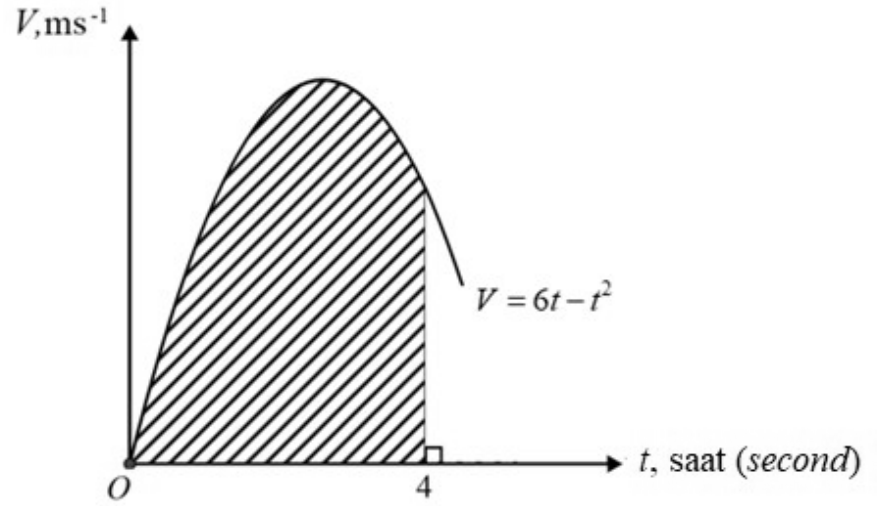
- (a)
Find the value of t if the acceleration is zero.
[2] - (b)
Find the range of values of t when the particle undergoes deceleration.
[2] - (c)
Find the area of the shaded region and state what is represented by the area of the shaded region.
[4] - (d)
Find the average speed for the first 4 seconds.
[2]
Diagram 14 shows A and B, two fixed points on a straight line, 8 m apart. Particle α passes through A with velocity V = 2t − 6 while particle β passes through B with velocity V = 5 − t, where t is the time in seconds. [Take the direction A to B as positive]
Hard10 marks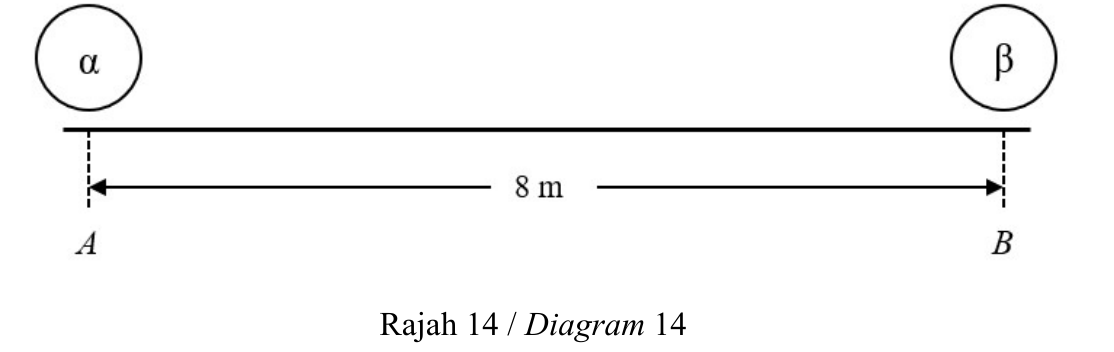
- (a)
Find the distance between particle α and particle β when particle α stops for a moment.
[3] - (b)
Find the value of t when the distance between α and β is maximum before both particles meet.
[2] - (c)
Determine the time and the distance from point A when the two particles meet.
[5]
A particle moves along a straight line and passes through a fixed point O. Its velocity, v m s⁻¹, is given by v = mt² + nt, where m and n are constants and t is the time, in seconds, after passing through O. It is given that the particle stops instantaneously when t = 5 s and its acceleration is 3 m s⁻² when t = 1 s. [Assume motion to the right is positive] Find (a) the values of m and n, (b) the range of values of t when the particle moves to the right, (c) the distance, in m, travelled by the particle during the 5th second.
Medium10 marks- (a)
Find the values of m and n.
[5] - (b)
Range of t when the particle moves to the right.
[2] - (c)
Distance travelled during the 5th second.
[3]
A particle moves along a straight line and passes through a fixed point O. Its velocity v m s⁻¹ is given by v = t² − 6t + 8, where t is the time, in seconds, after passing through O. [Assume motion to the right is positive.] Find (a) the minimum velocity, in m s⁻¹, (b) the range of values of t during which the particle moves to the right, (c) sketch the velocity–time graph for 0 ≤ t ≤ 4, (d) the total distance, in m, travelled in the first 4 seconds after passing O.
Medium10 marks- (a)
Find the minimum velocity, in m s⁻¹.
[2] - (b)
Find the range of t when the particle moves to the right.
[2] - (c)
Sketch the velocity–time graph for 0 ≤ t ≤ 4.
[2]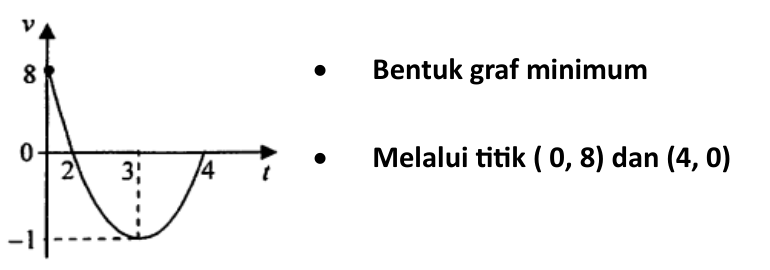
- (d)
Find the total distance travelled in the first 4 seconds.
[4]
A particle moves along a straight line and passes through a fixed point O. Its velocity v m s⁻¹ is given by v = 8 + 2t − t², where t is the time, in seconds, after passing through O. [Assume motion to the right as the positive direction.] Find (a) the initial velocity, in m s⁻¹, of the particle, (b) the value of t, in seconds, when the particle stops instantaneously, (c) the maximum velocity, in m s⁻¹, of the particle, (d) the total distance, in m, travelled by the particle in the first 6 seconds.
Medium10 marks- (a)
Find the initial velocity, in m s⁻¹, of the particle.
[1] - (b)
Find the value of t, in seconds, when the particle stops instantaneously.
[3] - (c)
Find the maximum velocity, in m s⁻¹, of the particle.
[3] - (d)
Find the total distance, in m, travelled by the particle in the first 6 seconds.
[3]
A particle moves along a straight line and passes through a fixed point O. Its velocity, v m s⁻¹, is given by v = mt² + nt, where m and n are constants and t is the time, in seconds, after passing through O. It is given that the particle stops instantaneously when t = 5 s and its acceleration is 3 m s⁻² when t = 1 s. [Assume motion to the right is positive.] Find (a) the value of m and of n, (b) the range of values of t when the particle moves to the right, (c) the distance, in m, travelled by the particle during the fifth second.
Medium10 marks- (a)
The value of m and of n.
[5] - (b)
The range of values of t when the particle moves to the right.
[2] - (c)
The distance, in m, travelled by the particle during the fifth second.
[3]
A particle moves along a straight line. The displacement, s m, from a fixed point O is given by s = (1/3)t³ − 3t² + 5t, where t is the time, in seconds, after passing through O. [Assume motion to the right is positive.]
Medium10 marks- (a)
Find the initial acceleration, in m s⁻², of the particle.
[3] - (b)
Determine the acceleration, in m s⁻², of the particle at the moment the particle reverses its direction of motion.
[3] - (c)
Find the distance at the time t = 7 s.
[4]
Solution by graph sketching is not accepted. A particle moves along a straight line and passes through a fixed point O. Its velocity, v m s⁻¹, is given by v = 14 + 5t − t², where t is the time, in seconds, after passing through O. The particle stops instantaneously at point P. [Assume motion to the right is positive.]
Medium10 marks- (a)
Calculate the acceleration, in m s⁻², of the particle at point P.
[3] - (b)
Calculate the maximum velocity, in m s⁻¹, of the particle.
[3] - (c)
Calculate the total distance, in m, travelled by the particle in the first 12 seconds after passing through O.
[4]
A particle moves along a straight line and passes through a fixed point O. Its velocity, v m s⁻¹, is given by v = pt² − 5t, where p is a constant and t is the time, in seconds, after passing through O. The acceleration of the particle is 15 m s⁻² after 2 seconds passing through O. [Assume motion to the right is positive] (a) Find the value of p. (b) Find the time interval, in seconds, when the velocity of the particle is decreasing. (c) Find the times, in seconds, when the particle stops instantaneously. (d) Calculate the total distance, in m, travelled by the particle in the first 3 seconds.
Medium10 marks- (a)
Find the value of p.
[3] - (b)
Find the time interval when the velocity is decreasing.
[2] - (c)
Find the times when the particle stops instantaneously.
[2] - (d)
Calculate the total distance travelled in the first 3 seconds.
[3]
Solution by graph sketching is not accepted. A particle moves along a straight line with its velocity, v m s⁻¹, given by v = t(h − kt), where t is the time in seconds after passing a fixed point O, while h and k are constants. The particle stops momentarily when t = 2 s and its distance at that time is 4 m to the right of O. [Assume motion to the right is positive] (a) Find the value of h and of k. (b) By using the values of h and k in (a), (i) find the value of t when the particle passes the point O again, (ii) sketch the velocity-time graph of the motion of the particle for 0 ≤ t ≤ 3, (iii) find the total distance travelled by the particle in the first three seconds.
Medium10 marks- (a)
Find h and k.
[3] - (b)(i)
Find t when the particle passes O again.
[2] - (b)(ii)
Sketch the velocity-time graph for 0 ≤ t ≤ 3.
[2]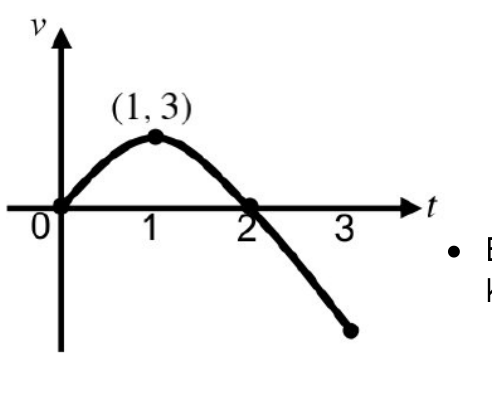
- (b)(iii)
Find the total distance travelled in the first three seconds.
[3]
A particle moves along a straight line and passes through a fixed point O. Its velocity, v m s⁻¹, is given by v = t² − 10t + 24, where t is the time in seconds after passing through O. Find (a) the initial velocity in m s⁻¹, (b) the minimum velocity, in m s⁻¹, (c) the range of values of t for which the particle moves towards the left side, (d) the total distance, in m, travelled by the particle in the first 5 seconds.
Medium10 marks- (a)
Find the initial velocity in m s⁻¹.
[1] - (b)
Find the minimum velocity in m s⁻¹.
[3] - (c)
Find the range of t for which the particle moves towards the left.
[2] - (d)
Find the total distance in the first 5 seconds.
[4]
Diagram 6 shows two particles P and Q moving along a straight line, the displacement of Q from a fixed point O being 10 m. Particle Q starts moving from B with velocity V_Q = 8 − 16t and at the same time particle P starts moving from A with S_P = 6t² − 9t − 12, where t is the time, in seconds, after the two particles start moving. (a) State the distance, in m, between A and B. Determine which particle passes through the fixed point O first. (b) The two particles meet after r seconds. Find the value of r. (c) Find the furthest distance, in m, between particle P and particle Q during the motion.
Medium10 marks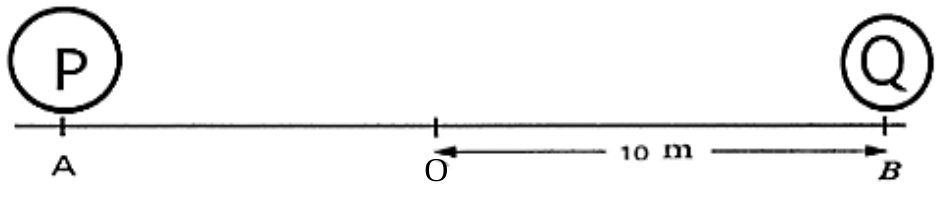
- (a)
State the distance, in m, between A and B. Determine which particle passes through O first.
[4] - (b)
The two particles meet after r seconds. Find r.
[2] - (c)
Find the furthest distance, in m, between P and Q during the motion.
[4]
A particle moves along a straight line and passes through a fixed point O with a velocity of −6 m s⁻¹. Its acceleration, a m s⁻², at t seconds after passing through O is given by a = 8 − 4t. [Assume the movement to the right is positive.] (a) Find the maximum velocity, in m s⁻¹, of the particle. (b) Find the time, in seconds, when the particle passes the fixed point O again. (c) Sketch the velocity-time graph for the movement of the particle for 0 ≤ t ≤ 3. (d) Hence, find the total distance, in m, travelled by the particle in the first 3 seconds.
Medium10 marks- (a)
Find the maximum velocity.
[3] - (b)
Find the time when the particle passes O again.
[3] - (c)
Sketch the velocity-time graph for 0 ≤ t ≤ 3.
[1]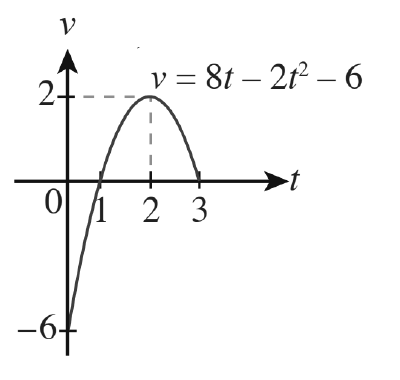
- (d)
Find the total distance in the first 3 seconds.
[3]
A particle moves along a straight line passing through a fixed point O. Its velocity, v m s⁻¹, t seconds after passing O is v = 3t² − 9t + 6. (a) Calculate the initial acceleration of the particle. (b) Find the values of t when the particle stops instantaneously. (c) Calculate the minimum velocity attained by the particle. (d) Calculate the total distance travelled by the particle from t = 0 to t = 6.
Medium10 marks- (a)
Initial acceleration.
[2] - (b)
Values of t when the particle stops instantaneously.
[2] - (c)
Minimum velocity.
[3] - (d)
Total distance from t = 0 to t = 6.
[3]
A robot moves along a straight line and passes through a fixed point O. After t seconds of moving, its displacement, s metre, is based on the function s = t³ − 16t² + 60t. Find (a) the time, in seconds, when the robot passes through the fixed point O again, (b) the acceleration, in m s⁻², of the robot when t = 6 s, (c) the maximum velocity, in m s⁻¹, of the robot.
Medium10 marks- (a)
Find the time when the robot passes through O again.
[2] - (b)
Find the acceleration when t = 6 s.
[4] - (c)
Find the maximum velocity of the robot.
[4]
A toy car moves along a straight line with velocity, v m s⁻¹, given by v = −4t² + 56t − 160 where t is the time in seconds after passing through a fixed point O. [Assume motion to the right is positive]
Medium10 marks- (a)
Find the displacement function and acceleration function in terms of t of the toy car.
[2] - (b)
The toy car will lose control if it reaches its velocity limit of 40 m s⁻¹. Determine whether in the given motion, the toy car will lose its control. Justify your answer by calculation.
[4] - (c)
During its motion, the toy car stopped twice. Find the total distance, in m, travelled by the toy car between the two stops.
[4]
A particle moves along a straight line and passes through a fixed point O. Its velocity, v m s⁻¹, is given by v = ht² + kt, where h and k are constants and t is the time, in second, after passing through O. The particle stops instantaneously when t = 3 s and its acceleration is −3 m s⁻² when t = 1 s. [Assume motion to the right is positive] (a) Find the value of h and of k. (b) Find the time interval, in second, when the particle moves to the left. (c) Calculate the total distance, in m, travelled by the particle from t = 2 to t = 5.
Medium10 marks- (a)
Find the value of h and of k.
[4] - (b)
Find the time interval, in second, when the particle moves to the left.
[3] - (c)
Calculate the total distance, in m, travelled by the particle from t = 2 to t = 5.
[3]
Diagram 5 shows the initial position and direction of the movement of particle A and particle B along a straight line. P and O are 10 m apart; A moves to the right from O and B moves to the left from P. Particle A starts moving from point O and particle B starts moving from point P simultaneously. After t seconds, velocity v m s⁻¹ of particle A is given by v_A = t² − kt + 6, such that k is a constant, while the displacement, s_B m of particle B is given by s_B = t³/3 − t² − 8t. Acceleration of particle A is 3 m s⁻² when t = 4 s. (a) Find the value of k. (b) Determine the range values of t when the particle A moves to the left. (c) Calculate (i) the distance, in m, of particle B from O when t = 5 s, (ii) time, in seconds, when particle B overtakes particle A.
Medium10 marks- (a)
Find the value of k.
[3]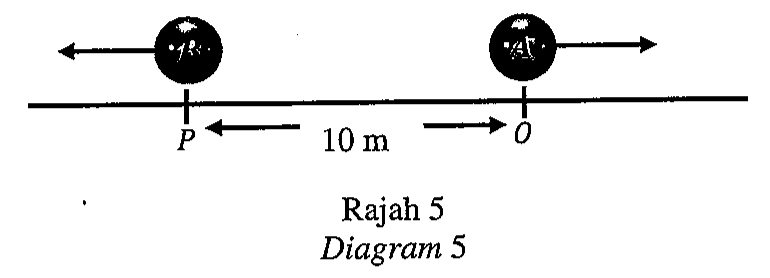
- (b)
Determine the range values of t when the particle A moves to the left.
[2] - (c)(i)
Calculate the distance, in m, of particle B from O when t = 5 s.
[2] - (c)(ii)
Calculate the time, in seconds, when particle B overtakes particle A.
[3]
Solution by graph sketching is not accepted. Diagram 8 shows particle P and particle Q along a straight line. Particle P starts moving from point A with velocity v_P = (2t − 3)(t − 4) and particle Q starts moving from point O with velocity v_Q = −2t + 6, where t is the time, in seconds, after particle Q passes through point O. Given the distance between points O and A is 6 m, such that point O is the reference point.
Medium10 marks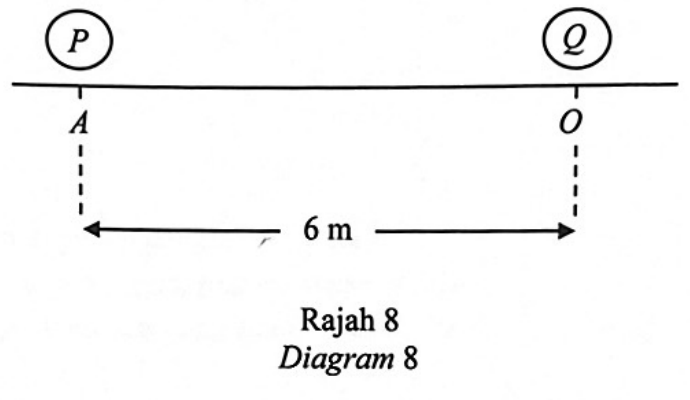
- (a)
State which particle has constant acceleration. Justify your answer.
[2] - (b)
Find the range of t, in seconds, when particle P and particle Q are both moving to the left.
[2] - (c)
Find the displacement of particle P when particle Q is stationary.
[4] - (d)
Find the total distance, in m, travelled by particle Q in the first 6 seconds.
[2]
A particle starts at rest from a fixed point O, moves along a straight line with velocity v m s⁻¹. Given that v = pt² − qt where t is the time, in seconds, p and q are constants, after the motion starts. The particle is at rest momentarily when t = 1 s and its distance at the instant is 2 m to the left of the point O. [Assume its motion to the right is positive.] (a) Calculate the value of p and of q. (b) Hence, by using the value of p and of q from 14(a), (i) find the initial acceleration, (ii) sketch the velocity-time graph of the particle for 0 ≤ t ≤ 2, (iii) calculate the total distance travelled by the particle in the first 2 seconds.
Medium10 marks- (a)
Calculate p and q.
[4] - (b)(i)
Find the initial acceleration.
[2] - (b)(ii)
Sketch the velocity-time graph for 0 ≤ t ≤ 2.
[2]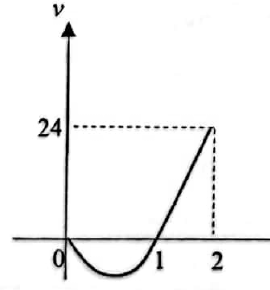
- (b)(iii)
Calculate the total distance travelled in the first 2 seconds.
[2]
A particle moves along a straight line and passes through a fixed point O with a velocity 36 m s⁻¹. Its acceleration after passing through O is given by a = −2t + 5 m s⁻², where t is time in seconds. The particle stops after k s. (a) Find (i) the maximum velocity of the particle, (ii) the value of k. (b) Sketch the graph of velocity-time for 0 ≤ t ≤ k. Hence, calculate the total distance travelled by the particle during the time.
Medium10 marks- (a)(i)
Find the maximum velocity of the particle.
[3] - (a)(ii)
Find the value of k.
[3] - (b)
Sketch the velocity-time graph for 0 ≤ t ≤ k and hence calculate the total distance travelled.
[4]
A particle moves along a straight line and passes through a fixed point O. Its velocity, v in m s⁻¹, is given by v = t² − 6t + 8, where t is the time in seconds after passing through O. The particle stops instantaneously at point A and point B.
Medium10 marks- (a)(i)
Find the minimum velocity of the particle, in m s⁻¹.
[3] - (a)(ii)
Find the distance between point A and point B.
[4] - (b)(i)
A physicist sketched a graph of velocity against time of the particle from the start until the first 7 seconds. Sketch the graph.
[2] - (b)(ii)
Hence, determine the range of values of t when the velocity of the particle is increasing.
[1]
A particle moves along a straight line and passes through a fixed point O. Its velocity, v m s⁻¹, is given by v = mt² + nt, where m and n are constants and t is the time, in seconds, after passing through O. It is given that the particle stops instantaneously when t = 5 s and its acceleration is 3 m s⁻² when t = 1 s. [Assume motion to the right is positive] Find (a) the values of m and of n, (b) the range of values of t when the particle moves to the right, (c) the distance, in m, travelled by the particle during the 2nd second.
Medium10 marks- (a)
Find the values of m and n.
[5] - (b)
Find the range of t when the particle moves to the right.
[2] - (c)
Find the distance travelled during the 2nd second.
[3]
A particle moves along a straight line and passes through a fixed point O. Its velocity, v m s⁻¹, is given by v = pt² + qt, where p and q are constants and t is the time in seconds after passing O. The particle stops instantaneously when t = 4 s and its acceleration is −2 m s⁻² when t = 1 s. [Assume motion to the right is positive]
Medium10 marks- (a)
Calculate the value of p and of q.
[5] - (b)
Calculate the range of values of t when the particle moves to the left.
[2] - (c)
Calculate the distance, in m, travelled by the particle during the fourth second.
[3]
A particle moves along a straight line and passes through a fixed point O. Its velocity, v m s⁻¹, is given by v = 10 + 3t − t², where t is the time taken, in seconds, after passing through O. Find (a) the initial velocity, in m s⁻¹, of the particle, (b) the value of t, in seconds, when the particle stops instantaneously, (c) the maximum velocity, in m s⁻¹, of the particle, (d) the total distance, in m, travelled by the particle in the first 8 seconds.
Medium10 marks- (a)
Find the initial velocity, in m s⁻¹, of the particle.
[1] - (b)
Find the value of t, in seconds, when the particle stops instantaneously.
[2] - (c)
Find the maximum velocity, in m s⁻¹, of the particle.
[3] - (d)
Find the total distance, in m, travelled by the particle in the first 8 seconds.
[4]
A particle moves along a straight line and passes through a fixed point O. Its velocity, V m s⁻¹, is given by V = t² − 8t − 20, where t is the time, in seconds, after passing through point O. The particle stops instantaneously after k seconds. Calculate
Medium10 marks- (a)
the minimum velocity, in m s⁻¹, of the particle
[3] - (b)
the value of k
[2] - (c)
the displacement of the particle when it is instantaneously at rest
[3] - (d)
the distance, in m, travelled by the particle in the first 15 seconds
[2]
A particle moves along a straight line and passes through a fixed point O with a velocity of 12 m s⁻¹. Its acceleration, a m s⁻², is given by a = 2t − 8, where t is the time, in seconds, after passing through the fixed point O. [Assume motion to the right is positive.] Find (a) the initial acceleration, in m s⁻², of the particle, (b) the minimum velocity, in m s⁻¹, of the particle, (c) the time, in seconds, when the particle is instantaneously at rest, (d) the total distance, in m, travelled by the particle in the first 5 seconds.
Medium10 marks- (a)
the initial acceleration, in m s⁻². [1 mark]
[1] - (b)
the minimum velocity, in m s⁻¹. [3 marks]
[3] - (c)
the time, in seconds, when the particle is instantaneously at rest. [2 marks]
[2] - (d)
the total distance, in m, travelled in the first 5 seconds. [4 marks]
[4]
A particle moves along a straight line to the right with a velocity of 5 cm s⁻¹. The particle experiences an acceleration a = 4 − 2t m s⁻², where t is the time in seconds after leaving point O. (a) Find the velocity function of the particle. (b) Sketch the velocity-time graph to represent the movement of the particle for 0 ≤ t ≤ 6. (c) Find for the first 6 seconds, (i) the displacement, in m, of the particle, (ii) the total distance, in m, travelled by the particle.
Medium10 marks- (a)
Find the velocity function of the particle.
[2] - (b)
Sketch the velocity-time graph for 0 ≤ t ≤ 6.
[3]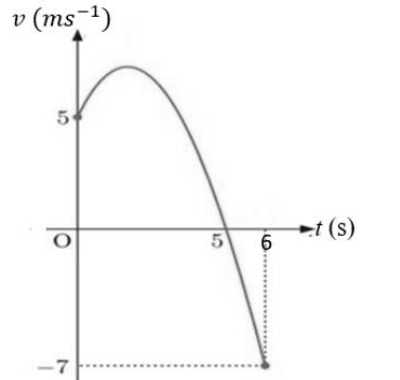
- (c)
Find for the first 6 seconds (i) the displacement, in m, (ii) the total distance, in m.
[5]
A particle moves along a straight line through a fixed point O, with velocity V m s⁻¹ given by V = 8 + pt − qt², where t is the time, in seconds, after passing through O and p and q are positive constants. The acceleration of the particle is zero when its velocity is 12 m s⁻¹. The particle is 24 m from O after 3 s.
Medium10 marks- (a)(i)
Calculate the value of p and of q.
[6] - (a)(ii)
Calculate the range of t during which the velocity of the particle decreases.
[2] - (b)
Sketch the velocity-time graph of the particle's motion for 0 ≤ t ≤ 3.
[2]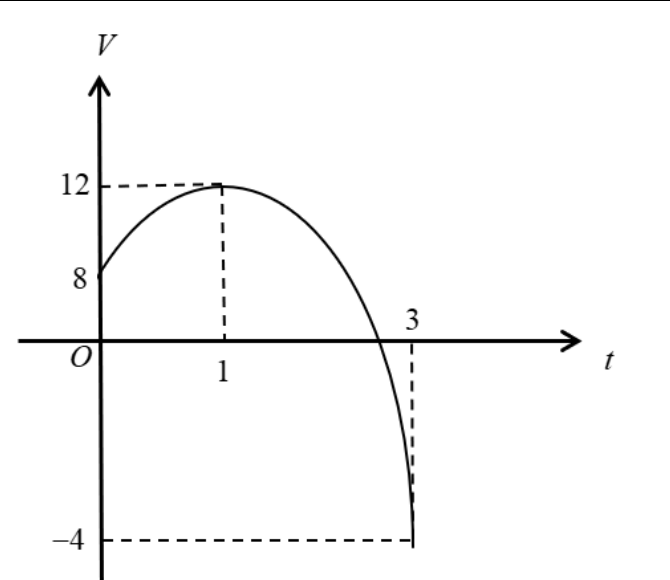
A particle moves along a straight line from a fixed point O. Its velocity, v m s⁻¹, is given by v = 22 + 7t − 2t², where t is the time, in seconds, after leaving the point O. [Assume motion to the right is positive.] Find (a) the time, in seconds, when the particle stops instantaneously, (b) the distance from O when the particle stops instantaneously, (c) the velocity of the particle when the acceleration is zero, (d) the total distance travelled, in m, by the particle in the first 7 seconds.
Medium10 marks- (a)
Find the time when the particle stops instantaneously.
[2] - (b)
Find the distance from O when the particle stops instantaneously.
[2] - (c)
Find the velocity when the acceleration is zero.
[3] - (d)
Find the total distance travelled in the first 7 seconds.
[3]
A particle moves along a straight line with an initial velocity of 15 ms⁻¹. Its acceleration, a ms⁻², is given by a = 2t − 8, where t is the time, in seconds, after passing through a fixed point O. [Assume motion to the right is positive] (a) Find (i) the minimum velocity, in ms⁻¹, of the particle, (ii) the time range during which the particle moves towards the right. (b) Sketch the velocity-time graph of the motion of the particle for 0 ≤ t ≤ 8. (c) Calculate the distance, in m, travelled by the particle during the third second.
Hard10 marks- (a)(i)
Find the minimum velocity, in ms⁻¹, of the particle.
[3] - (a)(ii)
Find the time range during which the particle moves towards the right.
[2] - (b)
Sketch the velocity-time graph of the motion of the particle for 0 ≤ t ≤ 8.
[2] - (c)
Calculate the distance, in m, travelled by the particle during the third second.
[3]
A particle moves along a straight line and passes through a fixed point O. Its velocity v m s⁻¹ is v = t² − 8t + 12, where t is the time in seconds after leaving O. (Motion to the right is positive.)
Medium10 marks- (a)
Find the initial acceleration.
[2] - (b)
Find the time period during which the particle moves to the right.
[2] - (c)
Find the time period during which the velocity of the particle decreases.
[2] - (d)
Find the distance travelled by the particle in the 2nd second.
[4]
Solution by graph sketching is not accepted. A particle moves along a straight line from a fixed point O. The displacement, s m, from point O for the particle is given by s = ht³ + kt² + 6t, such that t is time, in seconds. The maximum velocity of the particle is 15 m s⁻¹ when t = 3 s. Calculate (a) the value of h and of k, (b) the range of values of t when the particle decelerates, (c) the distance travelled by the particle during the 2nd second.
Medium10 marks- (a)
Find the value of h and of k.
[5] - (b)
Find the range of values of t when the particle decelerates.
[2] - (c)
Find the distance travelled by the particle during the 2nd second.
[3]
Diagram 6 shows two objects P and Q moving along a straight line and passing through fixed points A and B respectively. When P passes A, Q passes B. AB = 15 m. The velocity of P, v_P m s⁻¹, is v_P = 6 + t − t², where t is time in seconds after passing A, whereas Q moves with uniform velocity −3 m s⁻¹. Object P stops instantaneously at C. [Assume motion to the right is positive.] Find (a) the maximum velocity of P, in m s⁻¹, (b) the distance of C from A, in m, (c) the distance between P and Q when P is at C, in m.
Medium10 marks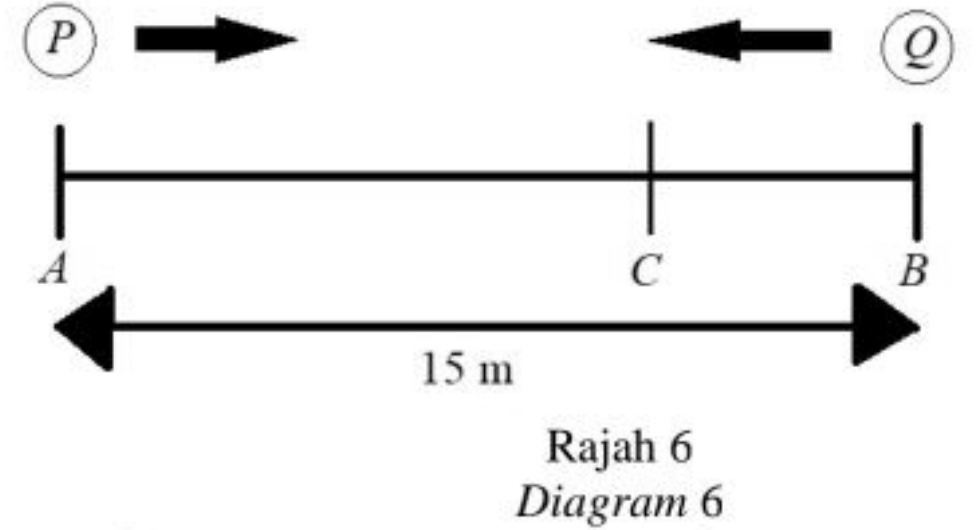
- (a)
Find the maximum velocity of P.
[4] - (b)
Find the distance of C from A.
[3] - (c)
Find the distance between P and Q when P is at C.
[3]
A particle moves along a straight line from fixed point O. Its velocity, v m s⁻¹, at t seconds after passing through O is v = pt² + 13t + 10, where p is a constant. The acceleration of the particle is 7 m s⁻² when t = 1 s.
Medium10 marks- (a)
Find the value of p.
[3] - (b)
Find the maximum velocity, in m s⁻¹, of the particle.
[3] - (c)
Find the total distance, in m, travelled by the particle in the first 6 seconds.
[4]
A particle moves along a straight line and passes through a fixed point O. Its displacement, s m, at t seconds after passing through O is given by s = 2t² − (1/3)t³ + 21t. Find (a) the initial velocity, in m s⁻¹, of the particle; (b) the maximum velocity, in m s⁻¹, of the particle; (c) the total distance, in m, travelled by the particle in the first 7 seconds.
Medium10 marks- (a)
Initial velocity (m s⁻¹).
[3] - (b)
Maximum velocity (m s⁻¹).
[3] - (c)
Total distance (m) in the first 7 seconds.
[4]
A particle starts from a fixed point O and moves along a straight line. After t seconds, its velocity, v m s⁻¹, is given by v = t² − 2t − 24. Calculate (a) the instantaneous velocity, in m s⁻¹, of the particle when t = 4, (b) the range of values of t, in seconds, when the particle moves to the left, (c) the minimum velocity, in m s⁻¹, of the particle, (d) the total distance, in m, travelled by the particle in the first 4 seconds.
Medium10 marks- (a)
Instantaneous velocity when t = 4.
[2] - (b)
Range of t when the particle moves to the left.
[2] - (c)
Minimum velocity.
[3] - (d)
Total distance in the first 4 seconds.
[3]
A particle moves along a straight line and passes through a fixed point O. Its displacement, s m, t seconds after passing O is s = 2t² − t³ + 7t. Find (a) the initial acceleration, in m s⁻², (b) the maximum velocity, in m s⁻¹, (c) the value of t, in seconds, when the particle is instantaneously at rest, (d) the total distance, in m, travelled in the first 2 seconds.
Medium10 marks- (a)
Find the initial acceleration, in m s⁻², of the particle.
[2] - (b)
Find the maximum velocity, in m s⁻¹, of the particle.
[3] - (c)
Find the value of t, in seconds, when the particle is instantaneously at rest.
[2] - (d)
Find the total distance, in m, travelled by the particle in the first 2 seconds.
[3]
A particle moves along a straight line with an initial velocity of 5 m s⁻¹. Its acceleration a m s⁻², is given by a = 19 − 8t, where t is the time, in seconds, after passing through a fixed point O. Find (a) the time, in seconds, when its acceleration is zero, (b) the maximum velocity, in m s⁻¹, of the particle, (c) the time, in seconds, when the particle stops instantaneously, (d) the total distance, in m, travelled by the particle in the first 4 seconds.
Medium10 marks- (a)
Find the time, in seconds, when its acceleration is zero.
[1] - (b)
Find the maximum velocity, in m s⁻¹, of the particle.
[3] - (c)
Find the time, in seconds, when the particle stops instantaneously.
[3] - (d)
Find the total distance, in m, travelled by the particle in the first 4 seconds.
[3]
Section B: answer any three questions. A particle moves along a straight line and passes through a fixed point O with a velocity of 10 m s⁻¹. The acceleration, a m s⁻², is given by a = 4t − 12, where t is the time, in seconds, after passing through O. Find (a) the initial acceleration, in m s⁻², (b) the minimum velocity, in m s⁻¹, (c) the value of t, in seconds, when the particle is instantaneously at rest, (d) the total distance, in m, travelled by the particle in the first 4 seconds.
Medium10 marks- (a)
Find the initial acceleration, in m s⁻².
[1] - (b)
Find the minimum velocity, in m s⁻¹.
[3] - (c)
Find the value of t, in seconds, when the particle is instantaneously at rest.
[2] - (d)
Find the total distance, in m, travelled in the first 4 seconds.
[4]
Solutions by graph sketching are not accepted. A particle moves along a straight line from a fixed point O. Diagram 14 shows the velocity-time graph of the particle's motion (v in m s⁻¹, t in s; the graph is a curve starting at O, dipping below the t-axis, crossing it at t = 6 and reaching v = 16 at t = 8). [Assume motion to the right is positive.] (a) State (i) the time, in seconds, when the particle stops instantaneously, (ii) the range of times, in seconds, when the particle moves towards the left. (b) It is given that the velocity-time graph is a quadratic function. (i) Show that v = t² − 6t. (ii) Find the acceleration, in m s⁻², when t = 2 seconds. (iii) Find the distance, in m, travelled by the particle from q seconds until the 8th second, where q is the time when the maximum velocity is achieved before it changes direction.
Medium10 marks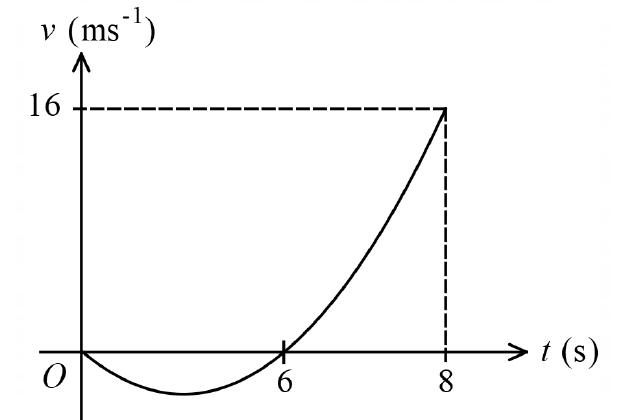
- (a)(i)
State the time, in seconds, when the particle stops instantaneously.
[1] - (a)(ii)
State the range of times when the particle moves towards the left.
[1] - (b)(i)
Show that v = t² − 6t.
[2] - (b)(ii)
Find the acceleration, in m s⁻², when t = 2 s.
[2] - (b)(iii)
Find the distance travelled from q seconds until the 8th second.
[4]
A particle moves along a straight line from a fixed point O. The velocity, v cm s⁻¹, of the particle is given by v = 6t − 3t², where t is the time in seconds after leaving O. Find (a) the acceleration, in cm s⁻², of the particle when t = 4, (b) the maximum velocity, in cm s⁻¹, of the particle, (c) the distance, in cm, from O when the particle is momentarily at rest, (d) the value of t when the particle returns to O.
Medium10 marks- (a)
Find the acceleration when t = 4.
[2] - (b)
Find the maximum velocity.
[2] - (c)
Find the distance from O when the particle is momentarily at rest.
[4] - (d)
Find the value of t when the particle returns to O.
[2]
A particle moves in a straight line and passes through a fixed point O. The velocity of the particle, v m s⁻¹, is given by v = 8 + 2t − t², where t is the time in s, after leaving O. Find (a) the initial velocity, in m s⁻¹, of the particle, (b) the maximum velocity, in cm s⁻¹, of the particle, (c) the acceleration when the particle reverses its direction, (d) the total distance travelled during the first 5 seconds after leaving O.
Medium10 marks- (a)
Find the initial velocity.
[1] - (b)
Find the maximum velocity in cm s⁻¹.
[3] - (c)
Find the acceleration when the particle reverses its direction.
[3] - (d)
Find the total distance in the first 5 seconds.
[3]
A particle moves along a straight line and passes through a fixed point O. The velocity, v m s⁻¹, of the particle at t seconds after passing through O is given by v = t² − 9t + 18. [Assume the movement to the right is positive] (a) Calculate (i) the initial velocity, in m s⁻¹, of the particle, (ii) the maximum displacement, in m, in the first 5 seconds of the particle. (b) If the particle stops instantaneously at point A and point B, find the distance, in m, between point A and point B. (c) (i) Sketch a velocity-time graph for the motion of the particle for a time period 0 ≤ t ≤ 6. (ii) Hence, find the total distance, in m, travelled by the particle in the first 6 seconds.
Medium10 marks- (a)(i)
Find the initial velocity.
[1] - (a)(ii)
Find the maximum displacement in the first 5 seconds.
[4] - (b)
Find the distance between A and B (where the particle stops).
[2] - (c)(i)
Sketch the velocity-time graph for 0 ≤ t ≤ 6.
[2]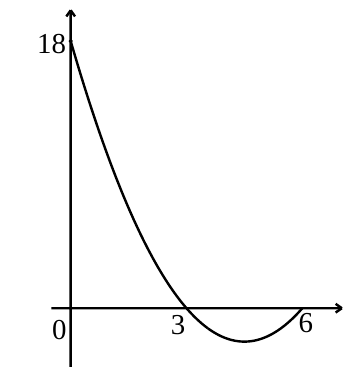
- (c)(ii)
Find the total distance travelled in the first 6 seconds.
[1]
Solution by graph sketching is not accepted. A particle moves along a straight line and its velocity, v m s⁻¹, is given by v = t(a − bt), where t is the time in seconds after passing through a fixed point O, and a and b are constants. The particle stops momentarily when t = 2 s and its distance at that moment is 4 m to the right of O. (Assume motion to the right is positive.) (a) Find the value of a and of b. (b) Using the values of a and b in (a), (i) find the value of t when the particle passes the point O again, (ii) sketch the velocity-time graph of the motion of the particle for 0 ≤ t ≤ 3, (iii) find the total distance travelled by the particle in the first three seconds.
Medium10 marks- (a)
Find the value of a and of b.
[4] - (b)
Using a = 6 and b = 3: (i) find t when the particle passes O again; (ii) sketch the velocity-time graph for 0 ≤ t ≤ 3; (iii) find the total distance travelled in the first three seconds.
[6]
Diagram 15 shows the initial position and direction of movement of particle A and particle B along a straight line (points R, Q, P in that order, with PQ = 10 m). Particle A starts from point P and particle B starts from point Q simultaneously towards point R. After t seconds, the velocity v m s⁻¹ of particle A is given by vₐ = t² − kt − 6, where k is a constant, while the displacement sʙ m of particle B is given by sʙ = t³/3 − t² − 20t. It is given that the acceleration of particle A is 3 m s⁻² when t = 4 s.
Medium10 marks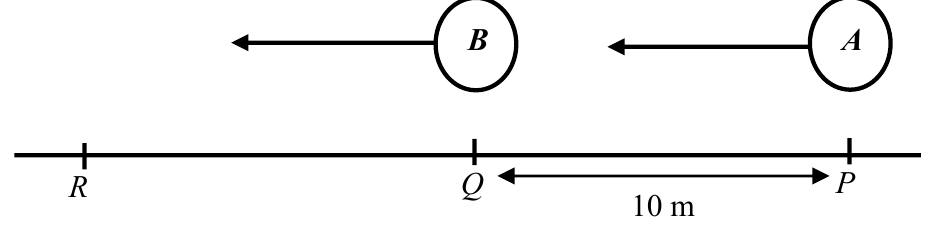
- (a)
Find the value of k.
[3] - (b)
Determine the range of values of t when the particle A moves to the left.
[2] - (c)(i)
Calculate the distance, in metres, of particle B from P when t = 6 s.
[2] - (c)(ii)
Calculate the time, in seconds, when particle B and particle A have the same displacement from point R.
[3]
Solution by graph sketching is not accepted. Two particles, P and Q, move along a straight line. The velocity of particle P, vP m s⁻¹, is given by vP = 3t² − 15t + 18, while the velocity of particle Q, vQ m s⁻¹, is given by vQ = 22 − 15t, where t is the time, in seconds, after both particles pass through a fixed point O. Calculate (a) the maximum velocity, in m s⁻¹, of particle P, (b) (i) the time, in seconds, when particle P and particle Q collide, (ii) the total distance, in m, travelled by particle P in the first 4 seconds.
Hard10 marks- (a)
Calculate the maximum velocity of particle P.
[3] - (b)
(i) Time when P and Q collide. (ii) Total distance travelled by P in the first 4 seconds.
[7]
Solution by graph sketching is not accepted. Diagram 10 shows the initial position and direction of motion of particle P and particle Q. Both particles start moving simultaneously. The velocity of particle P, v_P m s⁻¹, is given by v_P = 3 + 5t − 2t², where t is time in seconds after particle P passes through point A while particle Q moves with a constant velocity of −4 m s⁻¹. Particle P stops instantaneously at point C. The distance between point A and point B is 28 m. [Assume motion to the right is positive] (a) Calculate the maximum velocity of particle P, m s⁻¹. (b) Calculate the distance, in m, between particle P and particle Q when particle P is at point C. (c) Form the equation in terms of t, when particle P and particle Q meets.
Medium10 marks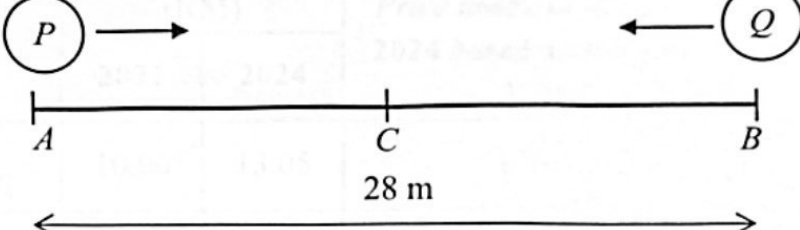
- (a)
Calculate the maximum velocity of particle P, m s⁻¹.
[3] - (b)
Calculate the distance, in m, between P and Q when P is at C.
[5] - (c)
Form the equation in terms of t when P and Q meet.
[2]
Solution by graph sketching is not accepted. A particle starts at rest from a fixed point O, moves along a straight line with velocity v m s⁻¹. Given that v = qt² − rt where t is the time, in seconds, q and r are constants after the motion starts. The particle is at rest momentarily when t = 1 s and its distance at the instant is 2 m to the left of the point O. [Assume its motion to the right is positive] (a) Calculate the value of q and r. (b) Hence, by using the value of q and of r from 13(a), (i) find the initial acceleration, (ii) sketch the velocity-time graph of the particle for 0 ≤ t ≤ 2, (iii) calculate the total distance travelled by the particle in the first 2 seconds.
Medium10 marks- (a)
Calculate the value of q and r.
[4] - (b)(i)
Find the initial acceleration.
[2] - (b)(ii)
Sketch the velocity-time graph of the particle for 0 ≤ t ≤ 2.
[2]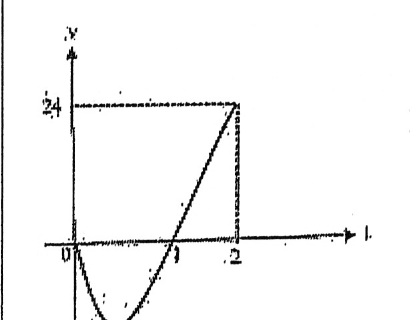
- (b)(iii)
Calculate the total distance travelled by the particle in the first 2 seconds.
[2]
A particle moves along a straight line and passes through a fixed point O. Its acceleration, a m s⁻², given that a = 6 − t, where t is the time in seconds since the particle leaving from point O. The initial velocity of the particle is 14 m s⁻¹ and it comes to an instantaneous rest at point A. Find (a) the time taken for the particle to reach point A, (b) the distance of OA, (c) the maximum speed of the particle during its motion from point O to point A.
Medium10 marks- (a)
Find the time taken for the particle to reach point A.
[4] - (b)
Find the distance of OA.
[3] - (c)
Find the maximum speed of the particle during its motion from point O to point A.
[3]
A snooker ball moves along a straight line and passes through a fixed point O as shown in Diagram 7. Its initial velocity is 40 m s⁻¹. Its acceleration, a m s⁻², is given by a = 16t − 48, where t is the time, in seconds, after passing through O. (a) State the displacement of the snooker ball from O when the acceleration is zero. (b) Find the time when the snooker ball changes direction. (c) Show that the snooker ball is moving to the left when its acceleration is 16 m s⁻².
Medium10 marks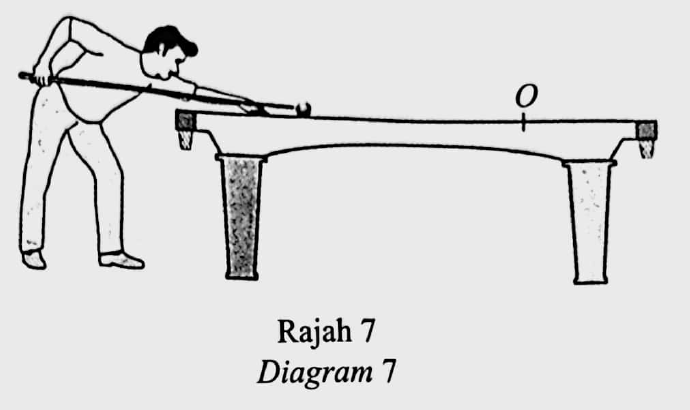
- (a)
State the displacement of the snooker ball from O when the acceleration is zero.
[4] - (b)
Find the time when the snooker ball changes direction.
[3] - (c)
Show that the snooker ball is moving to the left when its acceleration is 16 m s⁻².
[3]
A particle moves along a straight line and passes through a fixed point O with a velocity of 15 m s⁻¹. The acceleration, a m s⁻², is given by a = 2t − 8, where t is the time, in seconds, after passing through the fixed point O. [Assume motion to the right is positive] Find (a) the initial acceleration, in m s⁻², of the particle, (b) the minimum velocity, in m s⁻¹, of the particle, (c) the time, in seconds, when the particle is stop instantaneously, (d) the total distance, in m, travelled by the particle in the first 5 seconds.
Medium10 marks- (a)
Find the initial acceleration, in m s⁻², of the particle.
[1] - (b)
Find the minimum velocity, in m s⁻¹, of the particle.
[3] - (c)
Find the time, in seconds, when the particle is stop instantaneously.
[2] - (d)
Find the total distance, in m, travelled by the particle in the first 5 seconds.
[4]
A particle moves in a straight line and passes through a fixed point O. Its velocity, v m s⁻¹, is given by v = t² − 6t − 7, where t is the time, in seconds, after the particle leaving O. [Assume motion to the right is positive.] (a) Find (i) the time interval, in seconds, when the particle moves to the left, (ii) the minimum velocity of the particle. (b) Determine the maximum distance, in m, of the particle from point O and state its time, in seconds.
Medium10 marks- (a)(i)
Find the time interval, in seconds, when the particle moves to the left.
[2] - (a)(ii)
Find the minimum velocity of the particle.
[3] - (b)
Determine the maximum distance, in m, of the particle from point O and state its time, in seconds.
[5]
A particle moves along a straight line and passes through a fixed point O. Its displacement, s m, given that s = t³ − (15/2)t² + 12t + 10, where t is the time, in seconds, since the particle leaving from point O. The particle comes to instantaneous rest at point A and then at point B. [The motion of the particle to the right as the positive direction.] Find (a) the range of time when the particle moves toward the right, (b) the range of time when the particle accelerates, (c) the distance between point A and point B.
Medium10 marks- (a)
the range of time when the particle moves toward the right,
[4] - (b)
the range of time when the particle accelerates,
[3] - (c)
the distance between point A and point B.
[3]
Diagram 7 shows the displacements of two particles, A and B, moving simultaneously to the right of a fixed point O, along a straight line for a period of 6 seconds. Given the displacements of particle A and particle B are s_A = pt − t² and s_B = 2t respectively, where t is the time in seconds after leaving O. Find (a) the value of p, (b) the time when particles A and B meet after leaving O, (c) the maximum displacement of the particle A from point O, (d) the distance that have been travelled by particle A and particle B when they meet.
Medium10 marks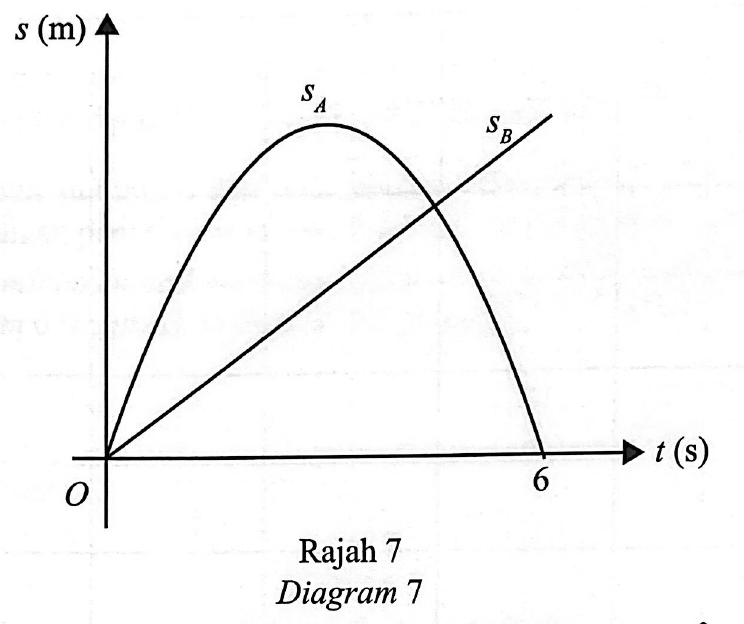
- (a)
Find the value of p.
[1] - (b)
Find the time when particles A and B meet after leaving O.
[3] - (c)
Find the maximum displacement of the particle A from point O.
[3] - (d)
Find the distance that have been travelled by particle A and particle B when they meet.
[3]
A particle moves along a straight line and passes through a fixed point O. Its velocity, v m s⁻¹, is given by v = −12t² + 24t + 15, where t is the time, in seconds, after passing through O. The particle reaches its maximum velocity at point P, changes its direction at point Q and passes through point R after 4 seconds. [Assume motion to the right is positive] Find (a) the distance, in m, of OP, (b) the range of time, in seconds, when the particle moves towards Q, (c) the total distance, in m, travelled by the particle from the moment it leaves P until it passes through R.
Medium10 marks- (a)
Find the distance, in m, of OP.
[4] - (b)
Find the range of time, in seconds, when the particle moves towards Q.
[3] - (c)
Find the total distance, in m, travelled by the particle from the moment it leaves P until it passes through R.
[3]
A particle moves in a straight line and passes through a fixed point O. Its velocity, v m s⁻¹, is given by v = −t² + 5t + 6, where t is the time, in seconds, after the particle leaving O. [Assume motion to the right is positive.] (a) Find (i) the time interval, in seconds, during which the particle moves towards the right, (ii) the maximum velocity of the particle. (b) Determine the maximum distance, in m, of the particle from point O and state its time, in seconds.
Medium10 marks- (a)(i)
Find the time interval, in seconds, during which the particle moves towards the right.
[2] - (a)(ii)
Find the maximum velocity of the particle.
[3] - (b)
Determine the maximum distance, in m, of the particle from point O and state its time, in seconds.
[5]
Diagram 7 shows a straight line AOB (A is 12 m to the left of O; B is 1 m before the right end). A particle moves along a straight line and passes through the fixed point O. Its velocity, v m s⁻¹, is given by v = 4 − 2t, where t is the time, in seconds, after leaving the point O. The particle stops instantaneously at a distance of 1 m on the right of point B. [Assume the motion to the right is positive.] Find (a) the acceleration, in m s⁻², of the particle, (b) the velocity, in m s⁻¹, of the particle when it passes through point B for the first time, (c) the time, in seconds, when the particle reaches point A, (d) the total distance, in m, travelled by the particle when it reaches point A.
Medium10 marks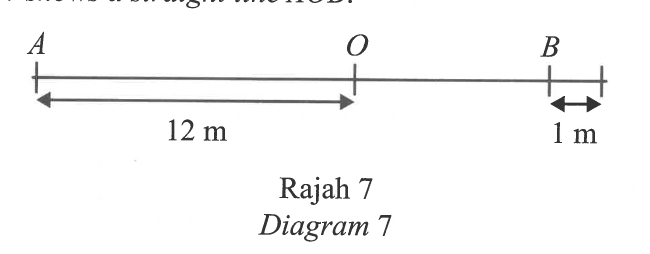
- (a)
Find the acceleration, in m s⁻², of the particle.
[1] - (b)
Find the velocity, in m s⁻¹, of the particle when it passes through point B for the first time.
[5] - (c)
Find the time, in seconds, when the particle reaches point A.
[2] - (d)
Find the total distance, in m, travelled by the particle when it reaches point A.
[2]
Solution by graph sketching is not accepted. Two particles P and Q move along a straight line. The acceleration of particle P, a_P m s⁻², is given by a_P = 18 − 6t with initial velocity −24 m s⁻¹, while the displacement of particle Q, s_Q m, is given by s_Q = 9t² − 33t, where t is the time in seconds after both particles pass a fixed point O.
Medium10 marks- (a)
Calculate the maximum velocity, in m s⁻¹, of particle P.
[4] - (b)(i)
The time, in seconds, when particles P and Q meet.
[3] - (b)(ii)
The total distance, in m, travelled by particle P in the first 4 seconds.
[3]
A particle moves along a straight line and passes a fixed point O. Its velocity, v m s⁻¹, is given by v = −2t² + 4t + 6, where t is the time in seconds after passing through O. [Assume motion to the right is positive]
Medium10 marks- (a)
Find the initial velocity, in m s⁻¹, of the particle.
[1] - (b)
Find the value of t, in seconds, when the particle stops instantaneously.
[3] - (c)
Find the maximum velocity, in m s⁻¹, of the particle.
[3] - (d)
Find the total distance, in m, travelled by the particle in the first 6 seconds.
[3]
A particle moves on a straight line with an initial velocity of 20 m s⁻¹. Its acceleration, a m s⁻², is given by a = 8 − 2t, where t is the time, in seconds, after passing through a fixed point O. The particle stops after k seconds. (a) Find (i) the maximum velocity of the particle, (ii) the value of k. (b) Sketch the velocity-time graph for 0 ≤ t ≤ k. Hence, calculate the total distance travelled during that period of time.
Medium10 marks- (a)
Find (i) the maximum velocity of the particle, (ii) the value of k.
[6] - (b)
Sketch the velocity-time graph for 0 ≤ t ≤ k. Hence, calculate the total distance travelled during that period of time.
[4]
A particle moves along a straight line and passes through a fixed point O with its acceleration a m s⁻², after t s, given by a = 8 − 2t. The particle's velocity after 5 seconds is 12 m s⁻¹. [Assume motion to the right is positive.] Find (a) the initial velocity, in m s⁻¹, of the particle; (b) the maximum velocity, in m s⁻¹, of the particle; (c) the acceleration of the particle when it reaches the velocity of 12 m s⁻¹ directed to the left.
Medium10 marks- (a)
Find the initial velocity.
[4] - (b)
Find the maximum velocity.
[2] - (c)
Find the acceleration when the velocity is 12 m s⁻¹ to the left.
[4]
A particle moves along a straight line such that its displacement, s m, is given by s = t³ − 6t² + 9t, where t is the time, in seconds, after passing through a fixed point O. [Assume motion to the right is positive.]
Medium10 marks- (a)
Find the initial velocity, in m s⁻¹, of the particle.
[2] - (b)
Find the values of t, in seconds, when the particle stops instantaneously.
[2] - (c)
Find the instantaneous velocity, in m s⁻¹, of the particle when its acceleration is zero.
[3] - (d)
Find the total distance, in m, travelled by the particle when its acceleration is negative.
[3]
A particle moves along a straight line and passes through a fixed point O. Its velocity, v m s⁻¹, is given by v = 8 + 2t − t², where t is the time in seconds, after passing through the fixed point O. [Assume the motion to the right is positive]
Medium10 marks- (a)
Find the initial velocity, in m s⁻¹, of the particle.
[1] - (b)
Find the maximum velocity, in m s⁻¹, of the particle.
[3] - (c)
Find the value of t at which the particle stops instantaneously.
[2] - (d)
Find the total distance, in m, travelled by the particle in the first 6 seconds, after passing through O.
[4]
Solution by graph sketching is not accepted. Diagram 6 shows two particles, A and B, move along a straight line passing two fixed points, K and L respectively. Particle A passes the fixed point, K and particle B passes the fixed point, L simultaneously. The distance of KL is 20 m. The velocity of A, v m s⁻¹, is given by v_A = 3t − 2t² + 2, where t is time, in seconds, after leaving K while B travels with a constant velocity of −2 m s⁻¹. Particles A stops instantaneously at the point M. [Assume motion to the right is positive] Find
Medium10 marks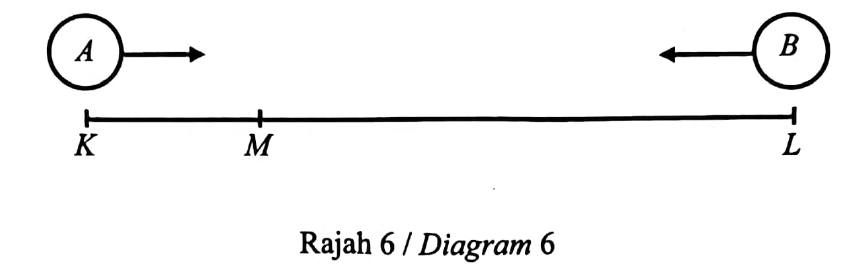
- (a)
the maximum velocity, in m s⁻¹, of the particle A,
[3] - (b)
the distance, in m, M from K,
[4] - (c)
the distance, in m, between A and B when A is at the point M.
[3]
A particle moves along a straight line and passes through a fixed point O with an initial velocity of −6 m s⁻¹. Its velocity, v m s⁻¹, is given by v = −m(t − 2)² + 2, where t is the time in seconds.
Medium10 marks- (a)(i)
Find the value of m.
[2] - (a)(ii)
Find the time, in seconds, when the particle stops instantaneously.
[2] - (b)
Sketch a graph of velocity against time for the first 5 seconds. Hence, state the range of t when the particle is moving to the left.
[3]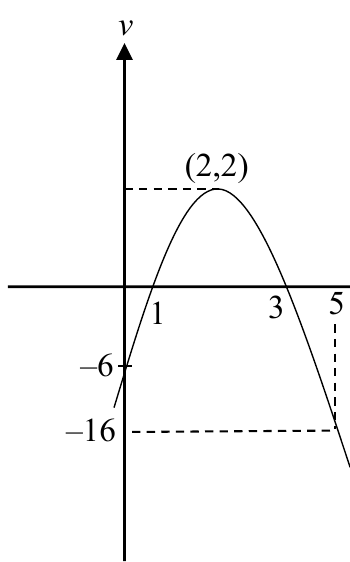
- (c)
Find the distance, in m, travelled by the particle from the time it reaches maximum velocity up to the 5th second.
[3]
Diagram 6 shows three fixed points O, P and Q on a straight line (P is 20 m to the left of O). A particle moves along a straight line and passes through a fixed point O. Its velocity, v m s⁻¹, is given by v = 8 − 2t, where t is the time after leaving the point O. The particle stops instantaneously at point Q. [Assume that motion to the right is positive] (a) Find (i) the acceleration, in m s⁻², of the particle, (ii) the time, in seconds, when the particle is at Q, (iii) the velocity, in m s⁻¹, of the particle when it passes through P. (b) Calculate the difference of distances between PO and OQ.
Medium10 marks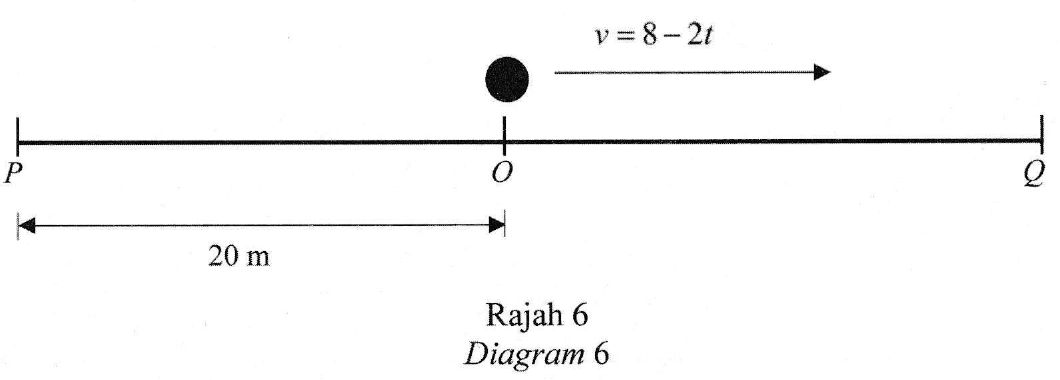
- (a)(i)
Find the acceleration, in m s⁻², of the particle.
[1] - (a)(ii)
Find the time, in seconds, when the particle is at Q.
[2] - (a)(iii)
Find the velocity, in m s⁻¹, of the particle when it passes through P.
[4] - (b)
Calculate the difference of distances between PO and OQ.
[3]