Compare microscopic groups
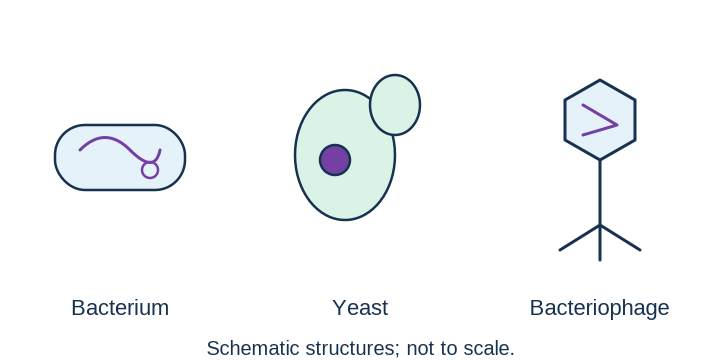 Microorganisms have different structures
| Group | Main features | Example |
|---|
| Bacteria | Prokaryotic cells; some have plasmids | Lactobacillus |
| Protozoa | Unicellular eukaryotes; many move using cilia, flagella or pseudopodia | Amoeba |
| Algae | Photosynthetic; lack true roots, stems and leaves | Chlamydomonas |
| Fungi | Absorb digested nutrients; no chlorophyll | Yeast |
| Viruses | Nucleic acid inside a protein coat; require host cells to reproduce | Bacteriophage |
Viruses contain DNA or RNA and lack their own cellular machinery. They cannot reproduce independently outside host cells.
| Bacterial shape | Name |
|---|
| Spherical | Coccus |
| Rod-shaped | Bacillus |
| Comma-shaped | Vibrio |
| Spiral | Spirillum |