JOHOR SET 1 2025 P2 Q10
HardWrite your answer on paper. Then open the answer to check it.
Answer any one question in Section B (Question 9 or Question 10). (a) Table 10 shows the word equations for two reactions involving metal P and metal Q oxide. The empirical formulas for P oxide and Q oxide were determined using Method I (P + oxygen → P oxide) and Method II (hydrogen + Q oxide → Q + water).
Hard20 marks- (a)(i)
What is meant by empirical formula?
[1]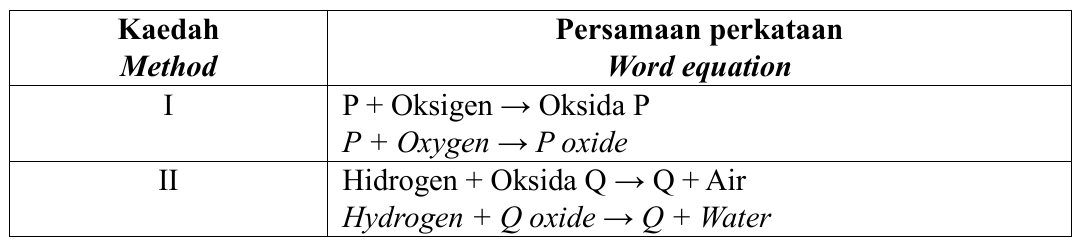
- (a)(ii)
The following is a chemical equation for the reaction between metal P and oxygen gas: 2P(s) + O2(g) → 2PO(s). State two information, qualitative and quantitative, that can be obtained from the chemical equation above.
[2] - (a)(iii)
Suggest metal P and metal Q. Explain why the metal was chosen.
[4] - (a)(iv)
In Method II, hydrogen gas is produced through the reaction between an acid and a reactive metal. Using reactive metal zinc, Zn and a suitable example of acid, write a chemical equation for the reaction that produces hydrogen gas. Calculate the mass of zinc required to produce 120 cm³ of hydrogen gas to be used in Method II. [Relative atomic mass: Zn = 65; H = 1; molar gas volume: 24 dm³ mol⁻¹ at room condition]
[5] - (b)(i)
Diagram 10.1 shows the structural formula of caffeine, which can be a natural fertiliser for plants. Based on the information above, determine the molecular formula for caffeine and the percentage of nitrogen by mass in caffeine. [Relative atomic mass: H = 1, C = 12, O = 16, N = 14]
[3]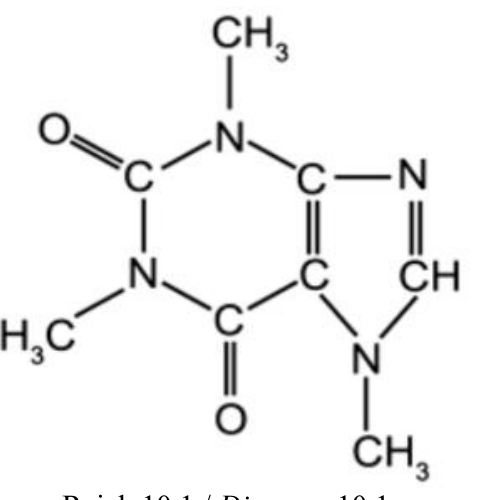
- (b)(ii)
Fertilisers usually have a high content of nitrogen. Nitrogen is needed to enhance the growth of plants such as vegetables. Among the examples of fertilisers used by farmers is urea, CO(NH2)2. Based on the percentage of nitrogen by mass in caffeine in 10(b)(i) and urea, determine the best fertiliser that should be used by farmers for their plants. Explain.
[5]