JOHOR SET 1 2023 P2 Q11
MediumWrite your answer on paper. Then open the answer to check it.
Table 11 shows the pH values for the solution of alkali P (pH 8) and alkali Q (pH 13) with the same concentration. Diagram 11 shows a titration method (burette, conical flask, tile) used to study the neutralisation reaction.
Medium20 marks- (a)
Explain why the pH values for alkali P and alkali Q are different.
[5]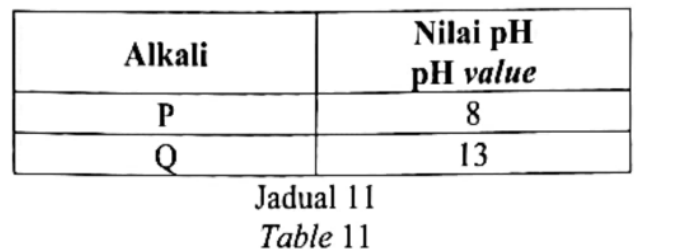
- (b)(i)
What is meant by neutralisation reaction?
[1]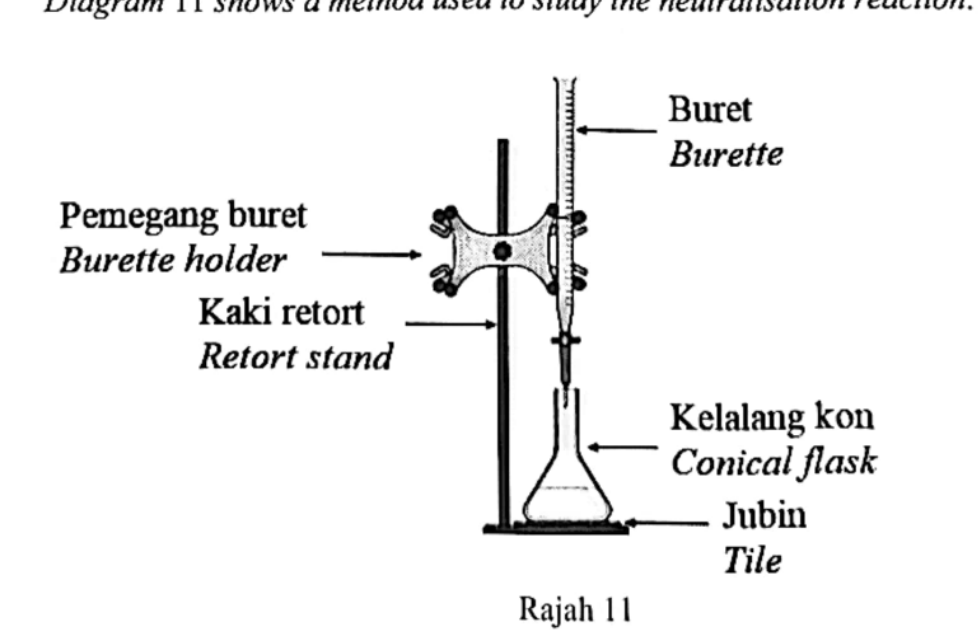
- (b)(ii)
In this reaction, 25.0 cm³ sodium hydroxide solution 1.0 mol dm⁻³ was neutralised by 20.0 cm³ sulphuric acid. Write the chemical equation for this reaction and calculate the concentration (in mol dm⁻³) for the sulphuric acid.
[4] - (c)
In a reaction, a green colour salt X is heated strongly. A black solid formed. A colourless gas produced and turns lime water cloudy. Name salt X and the black solid.
[2] - (d)
Calcium sulphate salt is used widely in the construction field. It is also known as the plaster of Paris. Suggest the chemicals that you can use to prepare calcium sulphate salt in the laboratory. Next, explain the method that is used to prepare this salt.
[8]