JOHOR SET 1 2024 P2 Q9
HardWrite your answer on paper. Then open the answer to check it.
Question 9 is in Section B (answer one of Questions 9 and 10).
Hard20 marks- (a)(i)
Table 9.1 shows the effect of heat on two different ionic compounds X and Y. The compounds consist of the same cation. Heating the compounds produces a yellow solid when hot and a white solid when cold. Compound X: gas P turns lime water cloudy (colourless gas P released). Compound Y: gas Q rekindles a glowing wooden splinter (colourless gas Q released); gas R turns blue litmus paper red (brown gas R released). State the name of gas P, Q and R released in reactions I and II. Name compound X and compound Y.
[5]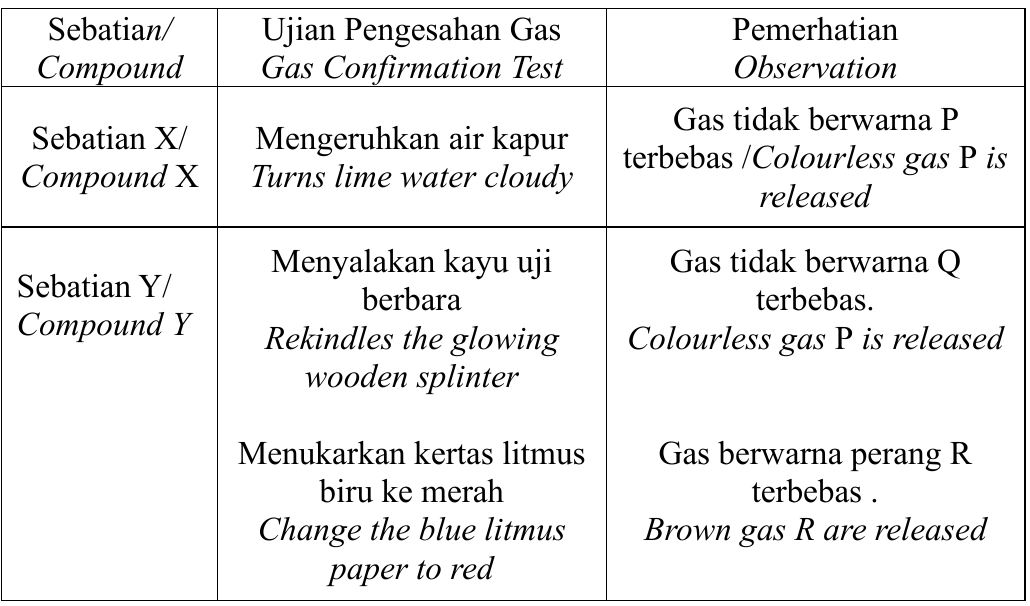
- (a)(ii)
Describe a chemical test to confirm the presence of the cation in compound Y.
[4] - (b)(i)
A student has been given the task of preparing a standard solution using solid sodium hydroxide. What is meant by a standard solution?
[1] - (b)(ii)
Calculate the mass of sodium hydroxide solid that needs to be dissolved in 500 cm³ of distilled water to produce an alkali standard solution with a concentration of 1.0 mol dm⁻³. [Relative atomic mass: Na = 23, O = 16, H = 1]
[2] - (c)
The student was asked to prepare 250 cm³ of 0.5 mol dm⁻³ standard sodium hydroxide solution from a stock solution of 1.0 mol dm⁻³ sodium hydroxide. Name the method to prepare the standard solution. Calculate the volume of stock solution needed.
[3] - (d)(i)
The student uses the standard solution of sodium hydroxide to determine the molarity of sulphuric acid using the apparatus set-up in Diagram 9.2 (burette with 0.5 mol dm⁻³ H₂SO₄ above a conical flask with 25.0 cm³ NaOH and a few drops of methyl orange). Name the method used as shown in the diagram.
[1]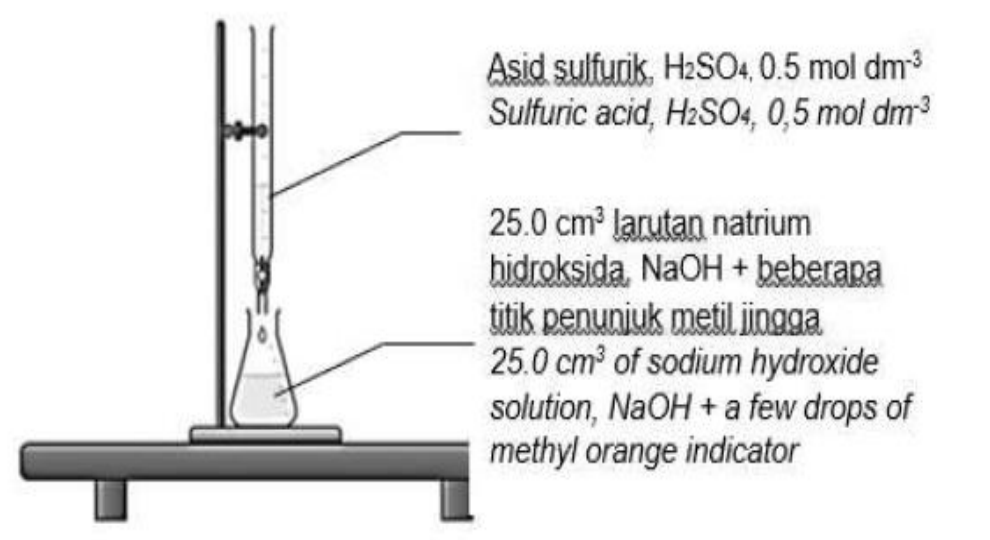
- (d)(ii)
Write the chemical equation for the reaction above. Determine the molarity of the sodium hydroxide solution used if 25 cm³ of 0.5 mol dm⁻³ sulphuric acid is needed to neutralise 25 cm³ sodium hydroxide solution.
[4]