PAHANG 2024 P2 Q10
HardWrite your answer on paper. Then open the answer to check it.
(a) Fatimah wants to prepare a 1.0 mol dm-3 sodium hydroxide solution using a 500 cm3 conical flask. This solution is known as the standard solution. Diagram 10.1 shows the apparatus set-up used. (b) The standard solution in Diagram 10.1 is used to determine the concentration of a sample of sulphuric acid by titration method (Diagram 10.2). (c) Table 10 shows the information about four solutions; P, Q, R and S.
Hard20 marks- (a)(i)
What is meant by a standard solution? State why conical flasks are used in the preparation of standard solution.
[2]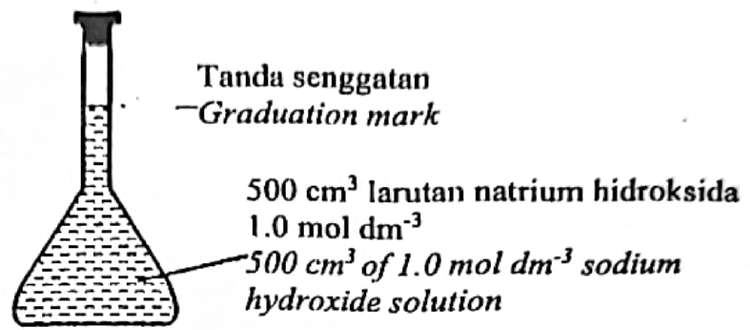
- (a)(ii)
To prepare the standard solution in Diagram 10.1, Fatimah has added X g of solid sodium hydroxide into a 500 cm3 volumetric flask. Then, distilled water is added until graduation mark is reached. Calculate the value of X. [Molar mass of sodium hydroxide = 40 g mol-1]
[2] - (b)
Complete neutralisation of 50.0 cm3 of 1.0 mol dm-3 sodium hydroxide solution required 25.0 cm3 of the sulphuric acid. Write the chemical equation for the reaction that occurs. Calculate the concentration of the sulphuric acid in mol dm-3 and g dm-3. [Relative atomic mass: H=1, S=32, O=16]
[6]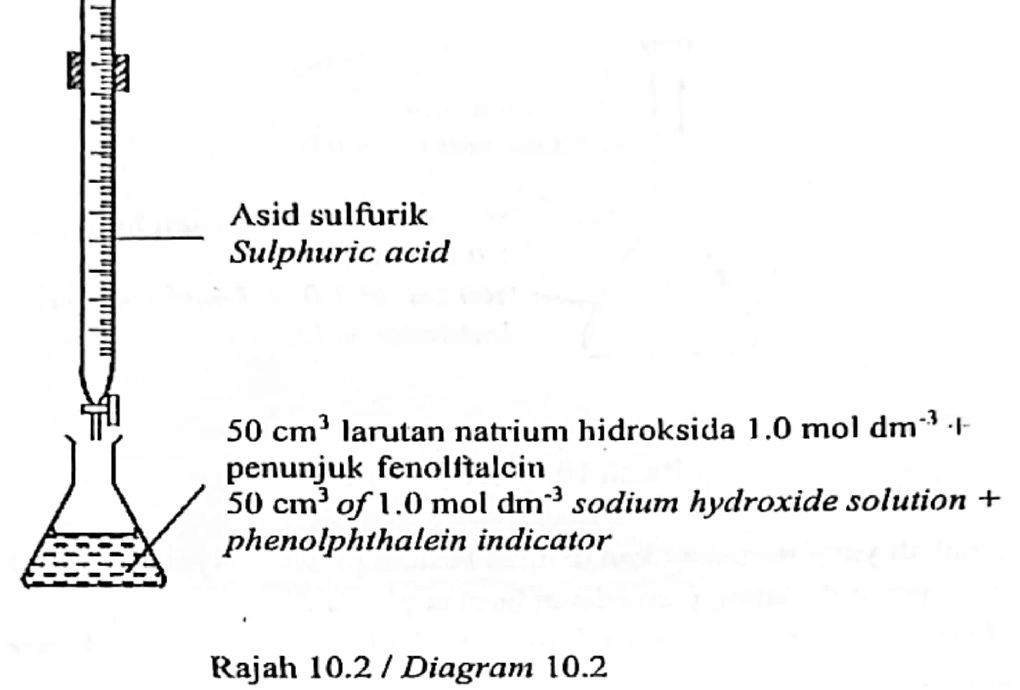
- (c)(i)
Based on Table 10, state a suitable example of a solution P, Q, R and S. (P: pH 2, degree of ionisation 100%; Q: pH 6, degree of ionisation less than 100%; R: pH 13, degree of ionisation 100%; S: pH 8, degree of ionisation less than 100%. P and Q react with R and S to produce salt and water.)
[4]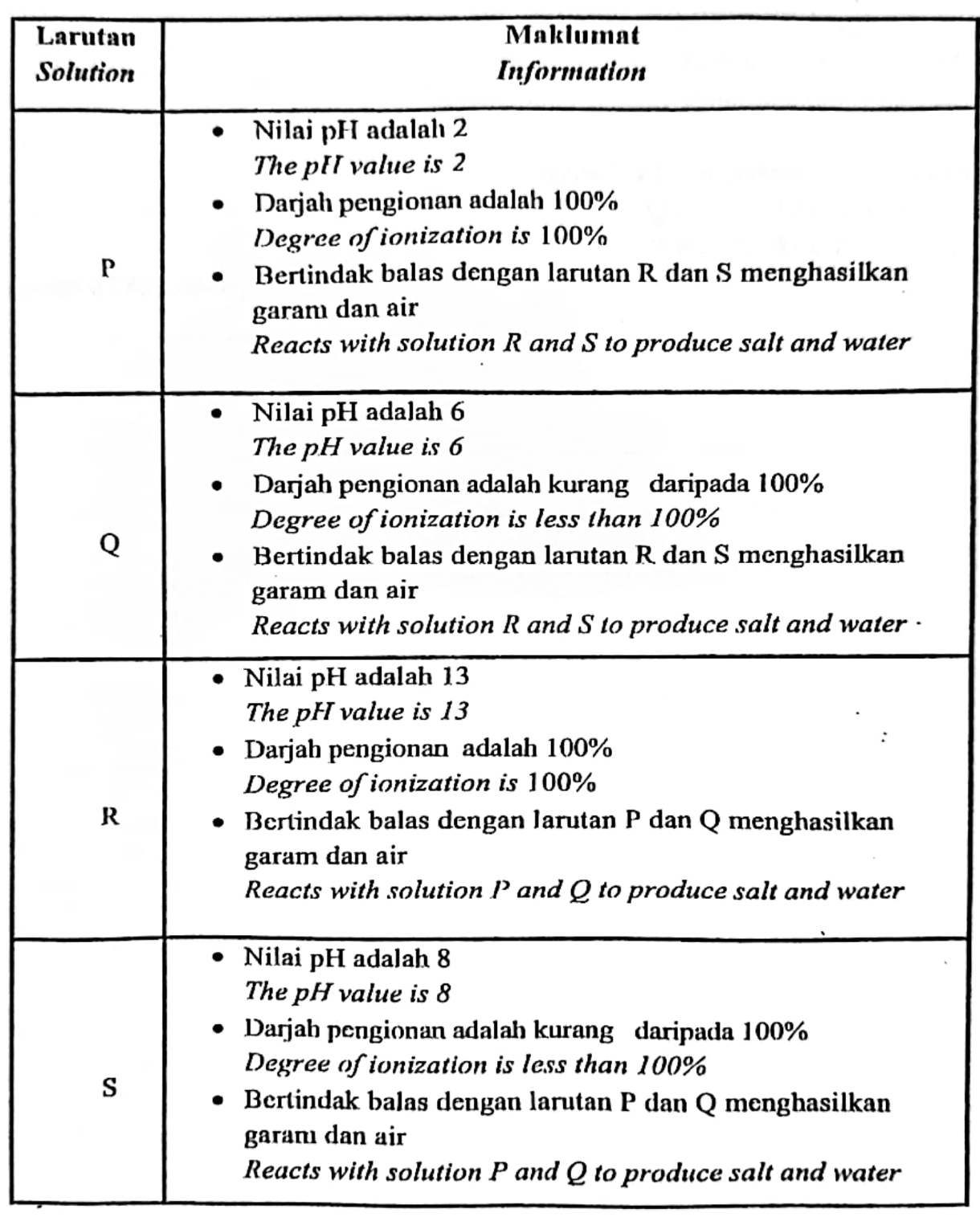
- (c)(ii)
Explain the difference in pH value for solution P and solution Q; solution R and solution S.
[6]