TERENGGANU 2021 P2 Q10
MediumWrite your answer on paper. Then open the answer to check it.
Three parts: (a) solutions P and Q of same concentration but different pH; (b) titration of sulphuric acid with potassium hydroxide; (c) hydrogen chloride dissolved in solvent X and solvent Y.
Medium18 marks- (a)
Table 10.1 shows information about solution P and solution Q with same concentration but different pH value. P: pH value less than 7; reacts with copper(II) oxide to produce copper(II) nitrate and water. Q: pH value less than 7; reacts with sodium hydroxide solution to produce sodium ethanoate and water. Based on the Table 10.1, state the name of solution P and solution Q. Which solution shows higher pH value and explain your answer.
[4]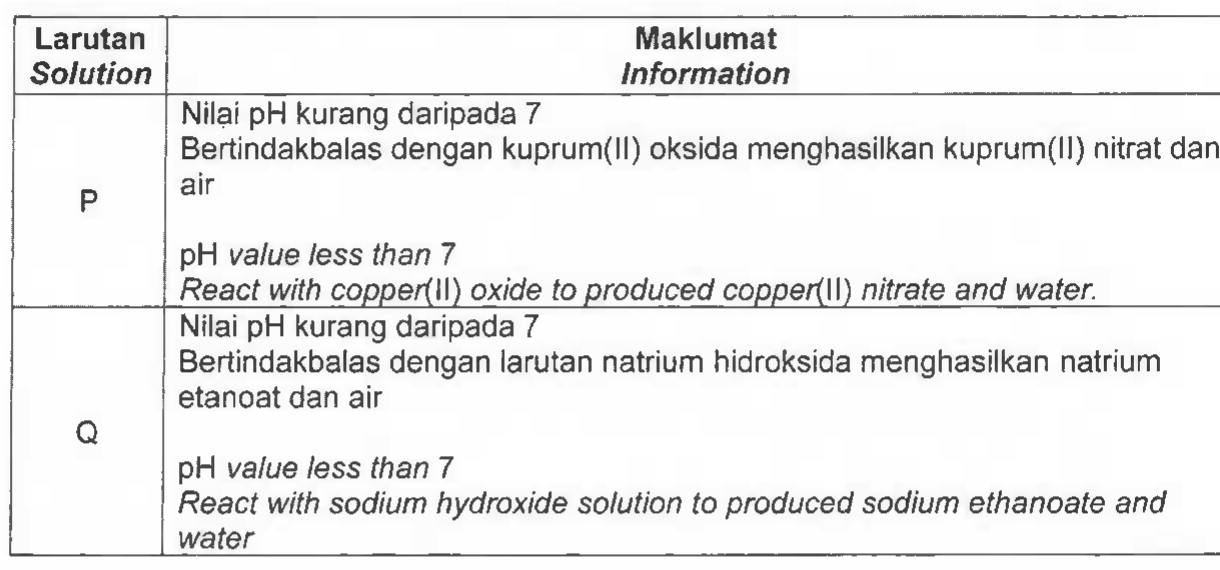
- (b)
Diagram 10.2 shows set-up of apparatus used in titration of acid and alkali: sulphuric acid in the burette, 20.0 cm³ potassium hydroxide 0.5 mol dm⁻³ + phenolphthalein in the conical flask. State the type of reaction that occurred in conical flask. Write the chemical equation, hence calculate molarity of sulphuric acid if end point of titration is 10.0 cm³.
[6]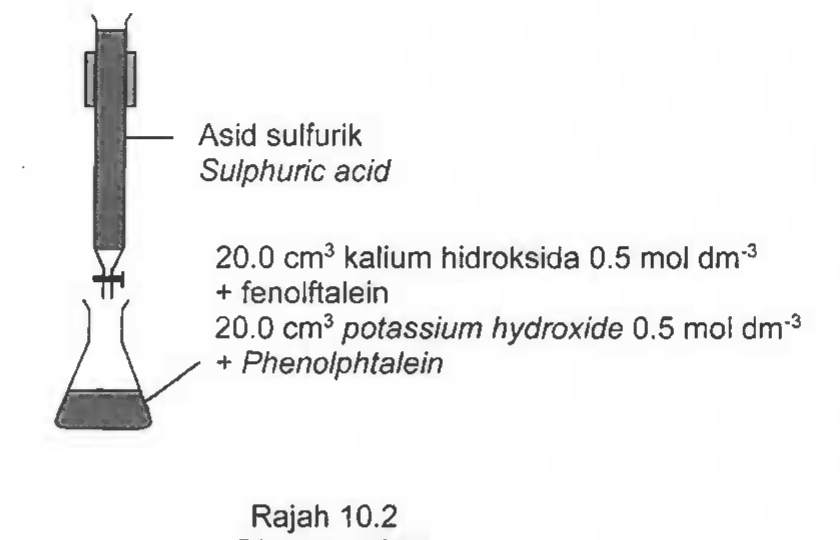
- (c)
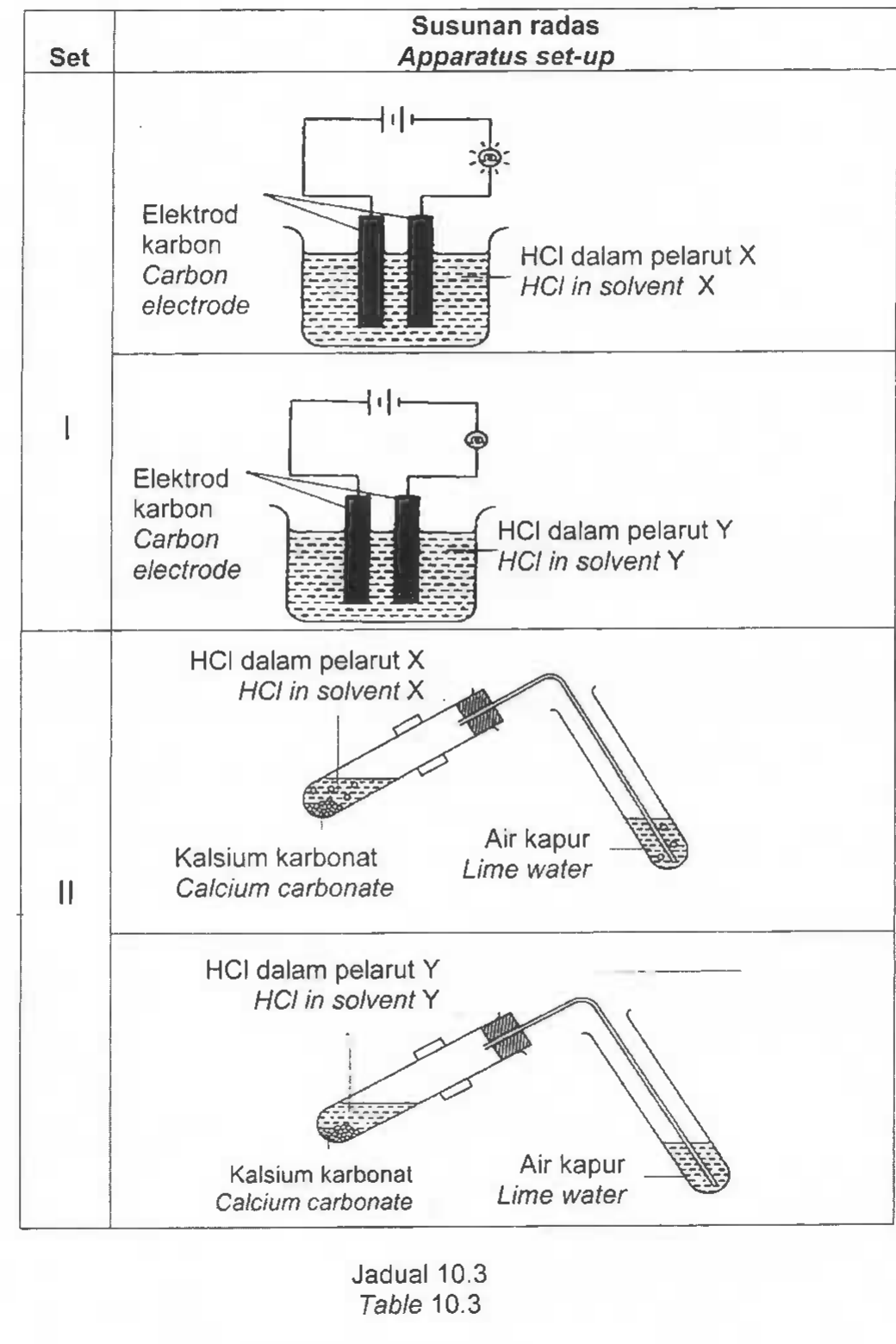
Table 10.3 shows set-up of apparatus for two sets of experiment to investigate electric conductivity and one of acid properties when hydrogen chloride dissolved in solvent X and solvent Y. Set I: carbon electrodes in HCl in solvent X (bulb lights up) and HCl in solvent Y (bulb does not light up). Set II: HCl in solvent X or Y added to calcium carbonate, gas passed into lime water. Suggest solvent X and solvent Y. Explain the differences of observation in both sets of experiments.
[8]