What has happened to magnesium when burnt in the air?
Medium
The following ionic equation represents a redox reaction.
Zn + Cu²⁺ → Zn²⁺ + Cu
Which reaction can be represented using the given ionic equation?
Medium
Which of the following equation represents a redox reaction?
Medium
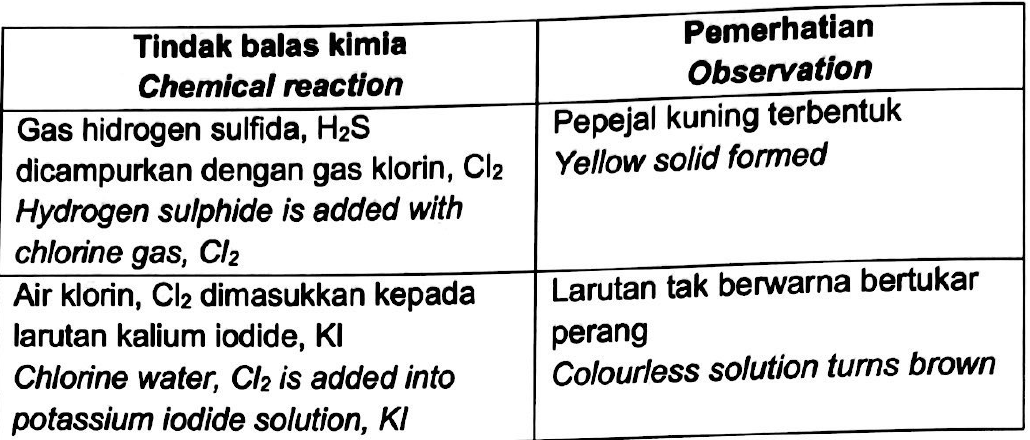
Table 4 shows chemical reactions and its observation.
Hydrogen sulphide, H₂S is added with chlorine gas, Cl₂: Yellow solid formed
Chlorine water, Cl₂ is added into potassium iodide solution, KI: Colourless solution turns brown
Which of the following statements is true about hydrogen sulphide and chlorine water?
Medium
Which of the following is an oxidation process?
Easy
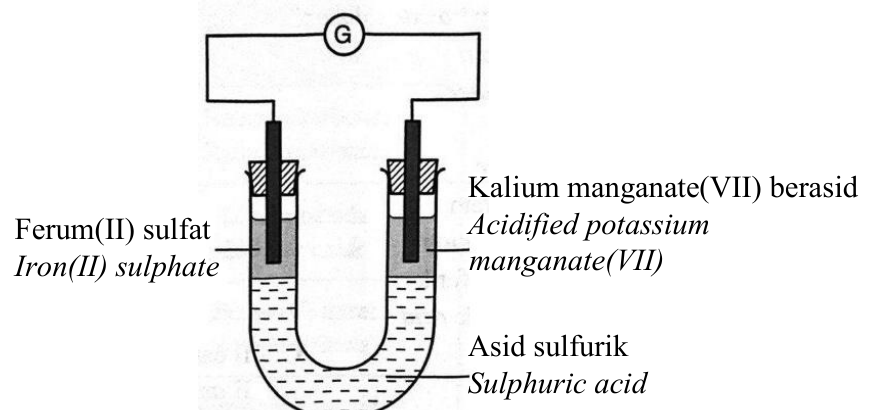
Diagram 15 shows the apparatus set-up used to investigate the reaction of acidified potassium manganate(VII) with iron(II) sulphate solution. Which of the following is the colour change of the two solutions?
Medium
Table 31 shows information about three voltaic cells: R and copper 0.44 V (negative terminal R); S and copper 1.70 V (negative terminal S); T and copper 0.53 V (negative terminal Cu). What is the potential difference for the pair of metal S and T?
Medium
Diagram 37 shows the observation of the reaction when a piece of metal X and metal Y of the same size are put into a beaker filled with cold water (metal Y burns with a larger flame than metal X). Which of the following explains the observation?
Medium
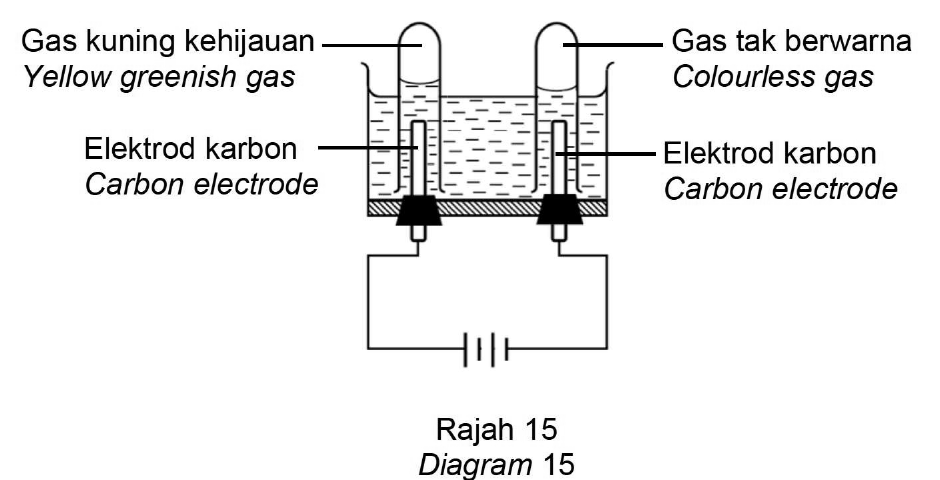
Table 38 shows the observations of electrolysis using carbon electrodes and electrolyte W. Anode: a greenish-yellow gas released. Cathode: a colourless gas which burns with a 'pop' sound is released. The electrolyte W maybe
Medium
Diagram 39 shows two chemical reactions. Sodium chloride is added to XNO₃ solution and a white precipitate forms after 5 minutes; 5.0 g of powder X is added to nitric acid and after 5 minutes 5.0 g of X remains. What is X?
Medium
Which of the following is an oxidation reaction?
Medium
What is the energy change that happens in a chemical cell?
Easy
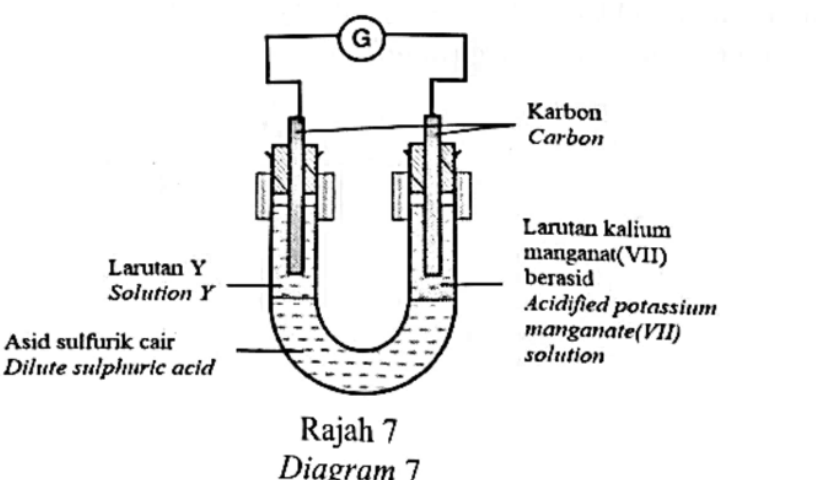
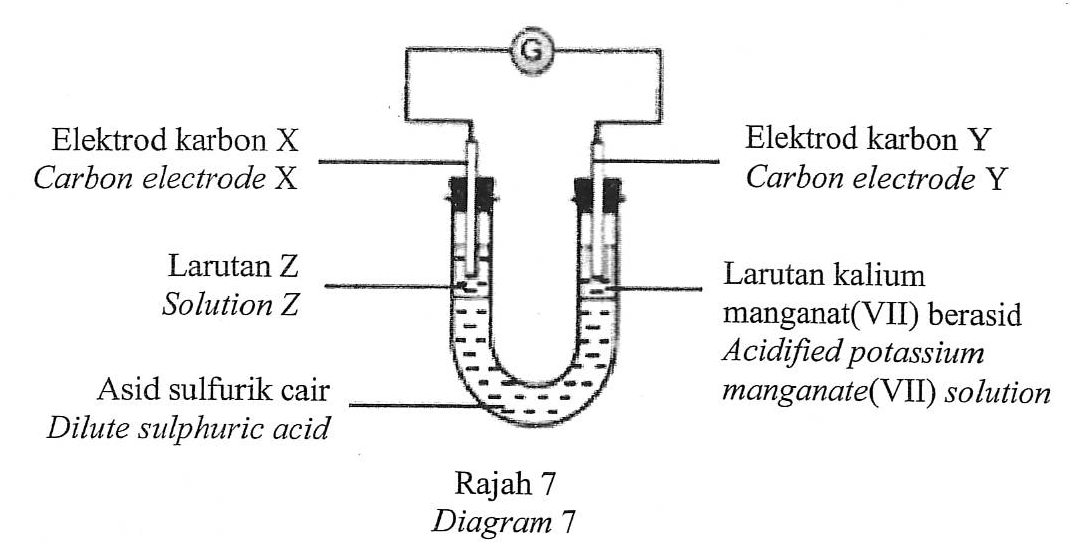
Diagram 7 shows the apparatus set-up to investigate the transfer of electrons at a distance (carbon electrodes, dilute sulphuric acid, acidified potassium manganate(VII) solution on one side, solution Y on the other). What is Y?
Medium
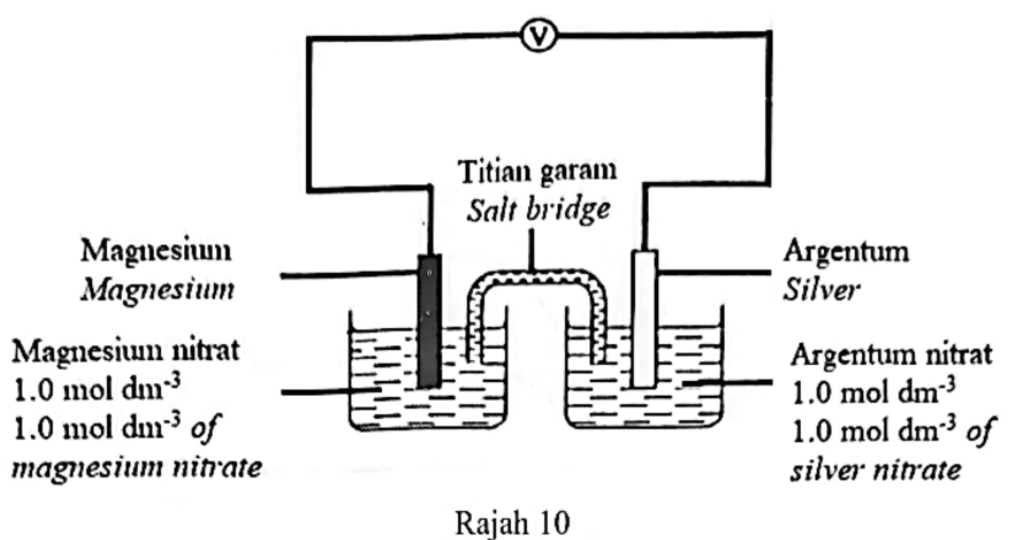
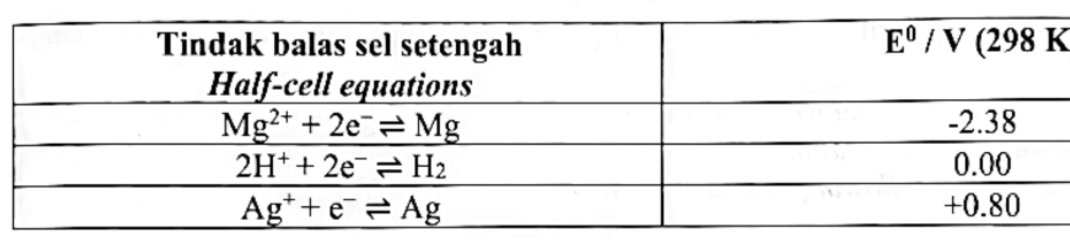
Diagram 10 shows a chemical cell (Mg in 1.0 mol dm⁻³ Mg(NO₃)₂ and Ag in 1.0 mol dm⁻³ AgNO₃, joined by a salt bridge). Standard electrode potentials: Mg²⁺ + 2e⁻ ⇌ Mg, E° = -2.38 V; 2H⁺ + 2e⁻ ⇌ H₂, E° = 0.00 V; Ag⁺ + e⁻ ⇌ Ag, E° = +0.80 V. What is the value of the cell's voltage?
Medium
The equation 4Fe + 3O₂ + 6H₂O → 4Fe(OH)₃ represents a reaction on an iron fence. Which of the following ways can be used to prevent this reaction from occurring? I Plate the fence with zinc; II Plate the fence with copper; III Apply oil on the fence; IV Apply grease on the fence
Medium
Which of the following is a reducing agent?
Medium
The following ionic equation represents a chemical reaction: X + Y²⁺ → X²⁺ + Y. Which of the following are correct about the substances? (Oxidised substance / Reduced substance / Oxidising agent / Reducing agent) A Y²⁺, X, X, Y²⁺ B X, Y²⁺, X, Y²⁺ C X²⁺, Y, Y, X²⁺ D X, Y²⁺, Y²⁺, X
Medium
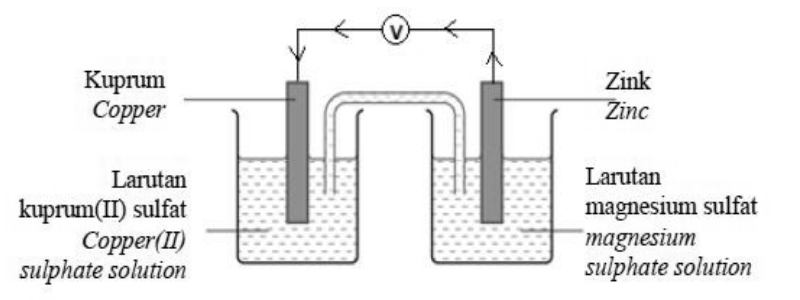
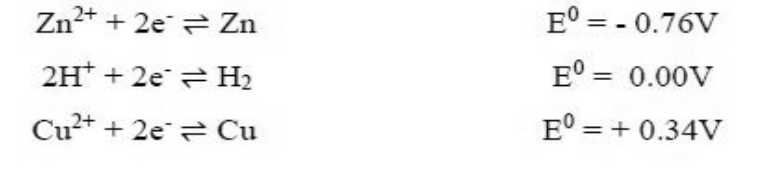
Diagram 13 shows a voltaic cell (copper in copper(II) sulphate solution and zinc in magnesium sulphate solution, joined by a salt bridge). Given the standard electrode potentials: Zn²⁺ + 2e⁻ ⇌ Zn, E° = −0.76 V; 2H⁺ + 2e⁻ ⇌ H₂, E° = 0.00 V; Cu²⁺ + 2e⁻ ⇌ Cu, E° = +0.34 V. What is the voltage for the cell?
Medium
Iron(II) nitrate can act as a reducing agent. What changes occur when iron(II) nitrate reacts with bromine water?
Medium
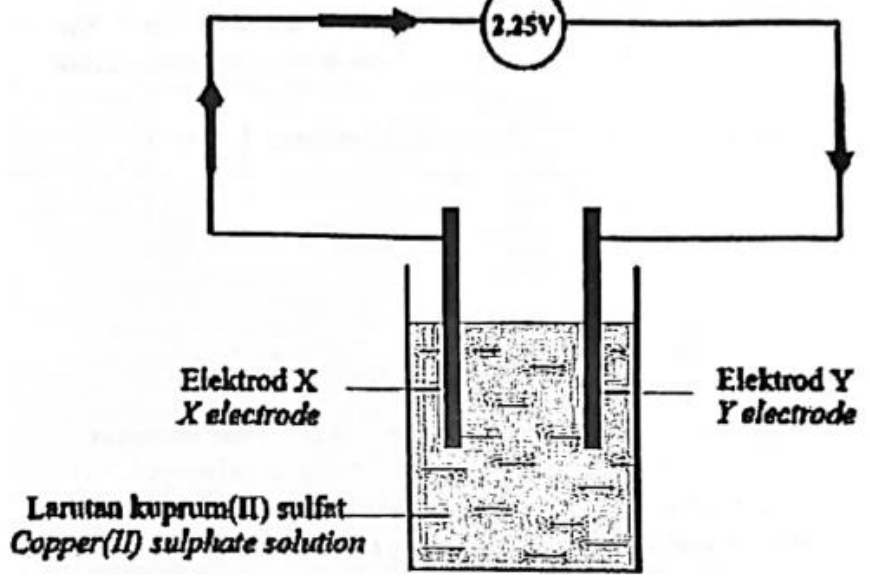
Diagram 34 shows a simple voltaic cell using metal P and metal Q as electrode (electrode X and electrode Y in copper(II) sulphate solution, voltmeter reading 2.25 V). Standard electrode potential: X²⁺ + 2e → X, E° = -2.38 V; Y²⁺ + 2e → Y, E° = p V; Cu²⁺ + 2e → Cu, E° = +0.34 V. What is the standard electrode potential value for metal Y?
Medium
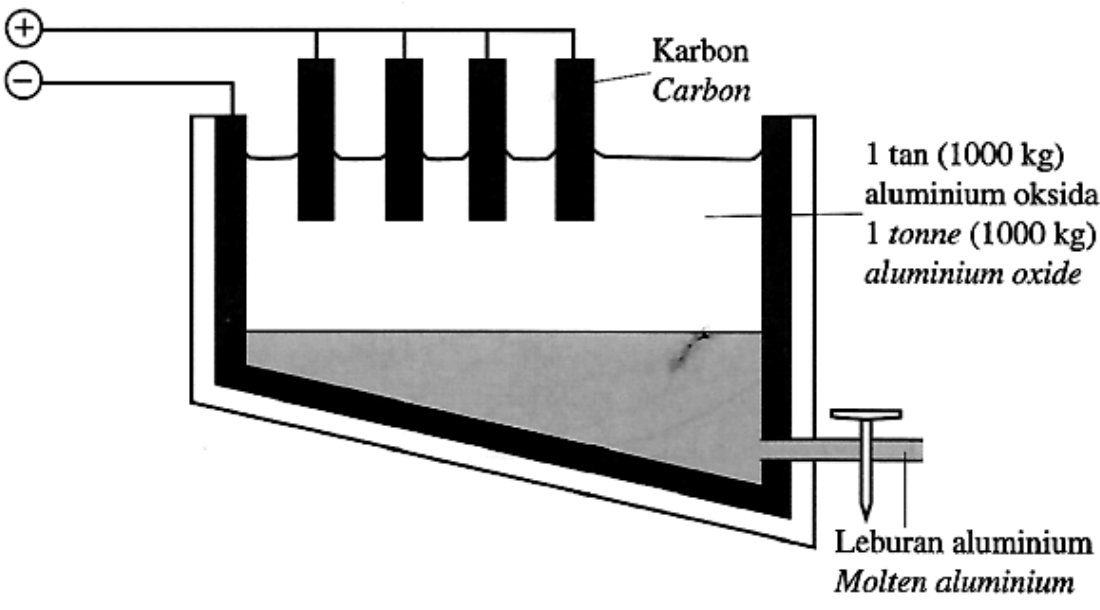
Diagram 37 shows the electrolytic tank used to extract aluminium from its ore, aluminium oxide (1 tonne (1000 kg) of aluminium oxide, carbon electrodes, molten aluminium). The following equation represents the reaction in the tank: 2Al2O3 → 4Al + 3O2. What is the mass of aluminium extracted? [Relative atomic mass: O = 16, Al = 27]
Medium
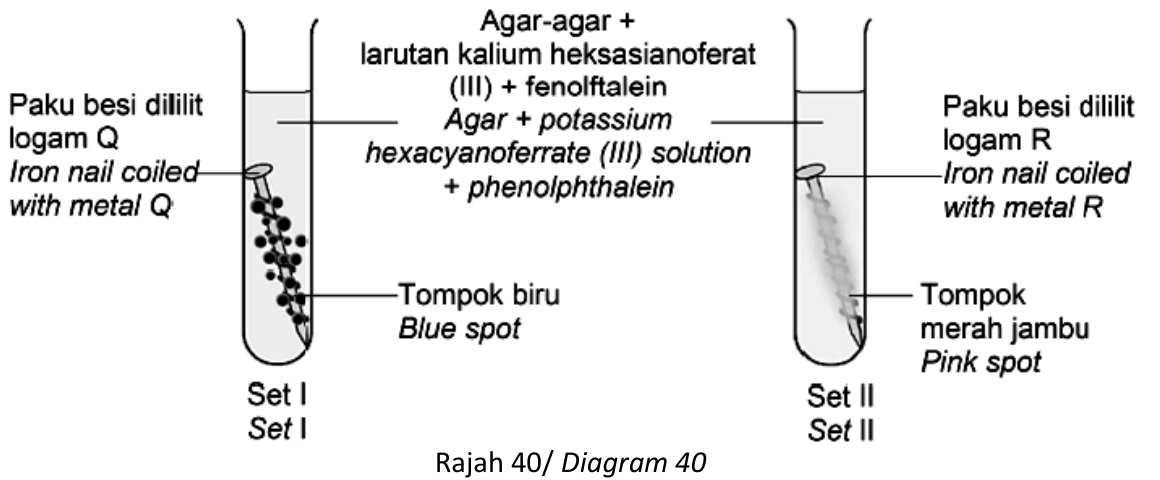
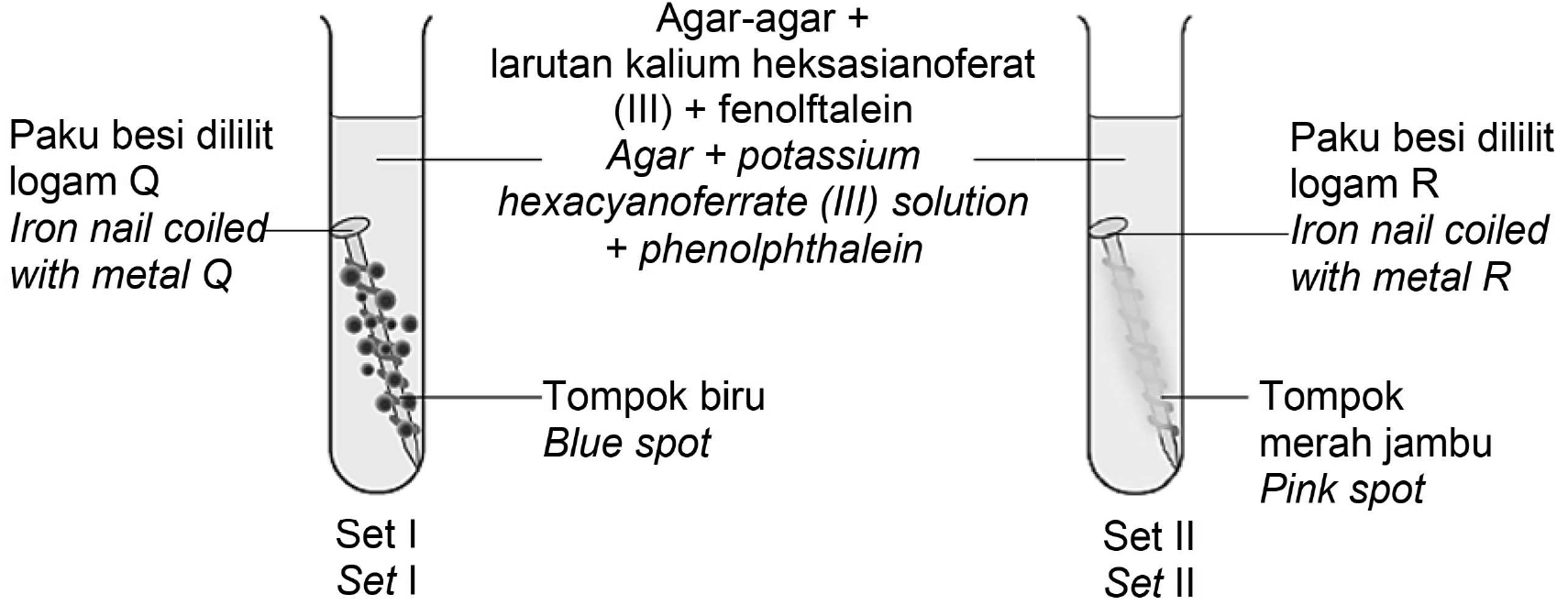
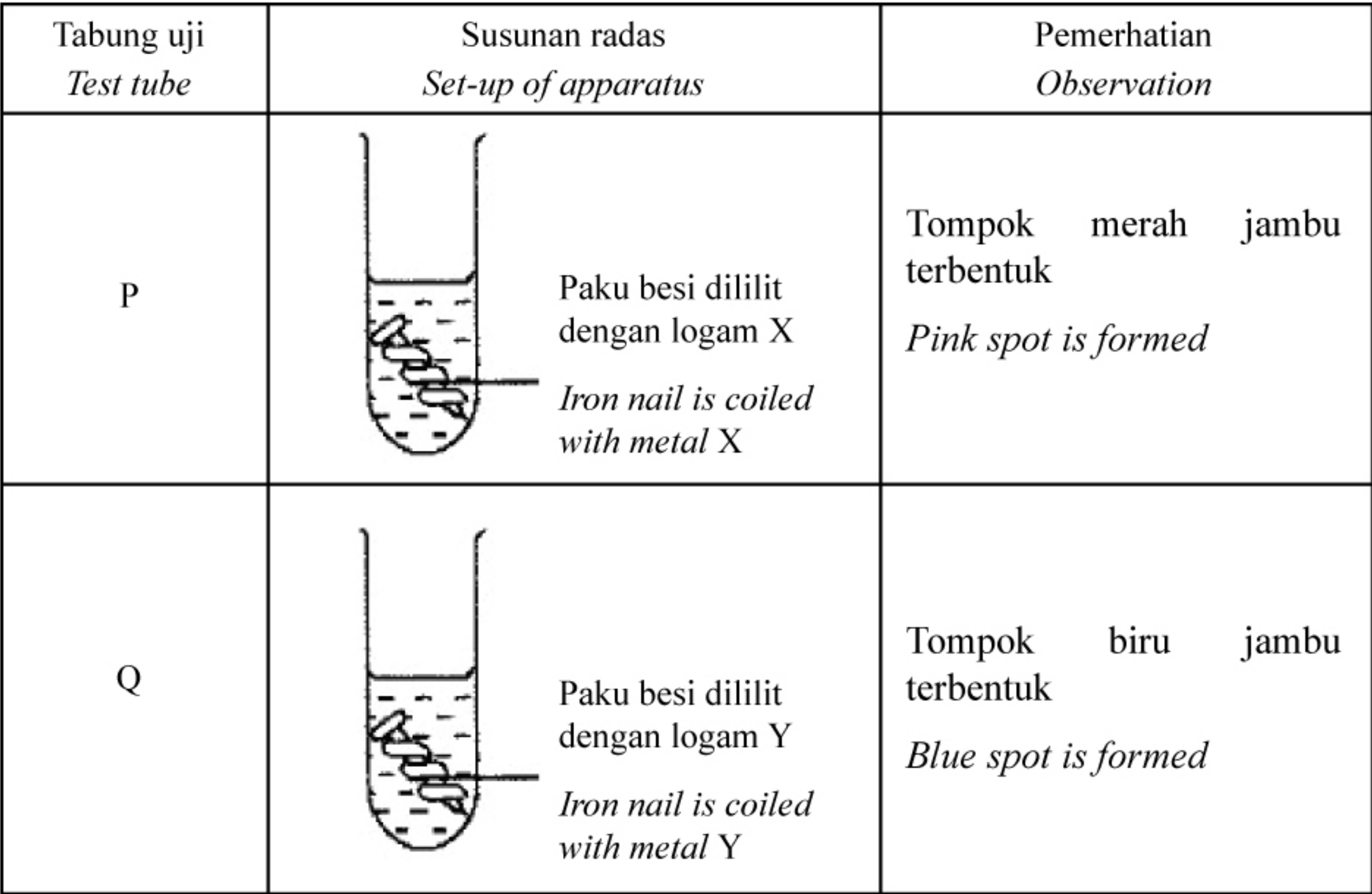
Diagram 40 shows the observation of an experiment to study the effect of metal Q and metal R on the corrosion of iron. Set I: iron nail coiled with metal Q gives a blue spot. Set II: iron nail coiled with metal R gives a pink spot. (Agar-agar + potassium hexacyanoferrate(III) solution + phenolphthalein.) What are Q metals and R metals?
Medium
A redox reaction is a chemical reaction that involves oxidation and reduction occurring at the same time. Which of the following occurs in a reduction reaction?
Easy
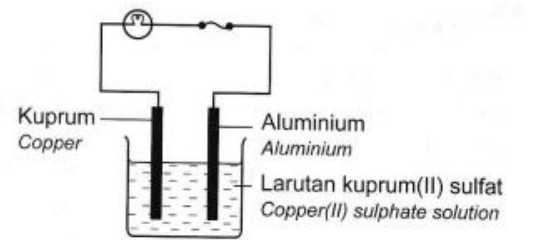
Diagram 3 shows a simple chemical cell (copper and aluminium electrodes in copper(II) sulphate solution).
Given: Al³⁺ + 3e⁻ → Al; E° = -1.66 V
Cu²⁺ + 2e⁻ → Cu; E° = +0.34 V
What is the voltage of the cell?
Medium
Which of the following substances is suitable to be used as an electrolyte?
Medium
Ahmad found an impure iron strip. Which electrolyte, anode and cathode are correct to obtain a pure iron strip through electrolysis?
A Iron(II) sulphate solution; impure iron; pure iron
B Iron(II) sulphate solution; pure iron; impure iron
C Iron(II) hydroxide; impure iron; pure iron
D Iron(II) hydroxide; pure iron; impure iron
Medium
The cell notation for a voltaic cell with magnesium and copper electrodes is Mg | Mg²⁺ || Cu²⁺ | Cu. Mg²⁺ + 2e⁻ ⇌ Mg, E° = -2.38 V; Cu²⁺ + 2e⁻ ⇌ Cu, E° = +0.34 V. What is the cell voltage?
Medium
Which of the following substance is an oxidising agent?
Easy
What is the meaning of a reducing agent?
Easy
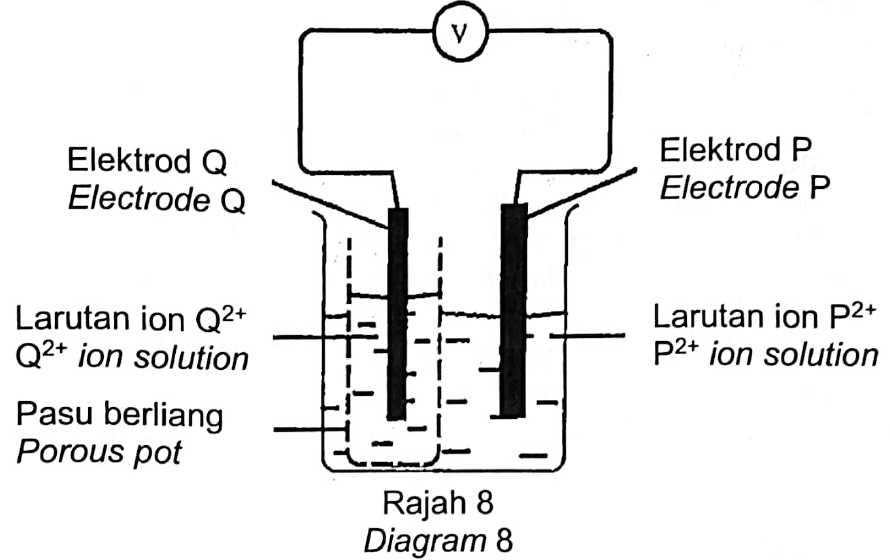
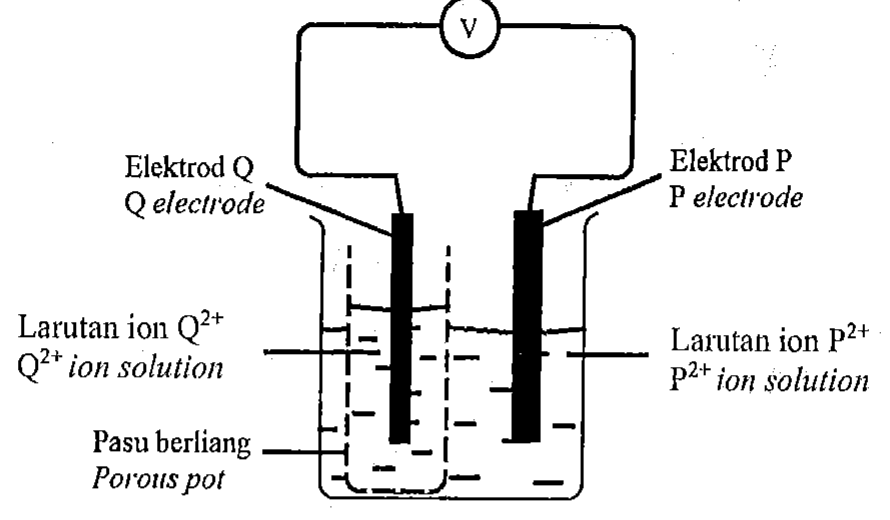
Diagram 8 shows the apparatus set-up of a chemical cell (electrode Q in Q²⁺ ion solution and electrode P in P²⁺ ion solution, separated by a porous pot, connected to a voltmeter). Electron moves from electrode P to electrode Q through the connecting wires. Which of the following statements is correct about the chemical cell?
Medium
What is the oxidation number of chlorine in the following molecules and ions? (Cl₂, Cl₂O₇, ClO⁻, ClO₃⁻)
Medium
The following ionic equation shows the reaction between zinc and acid: Zn + 2H⁺ → Zn²⁺ + H2. What is the oxidation number change for hydrogen?
Medium
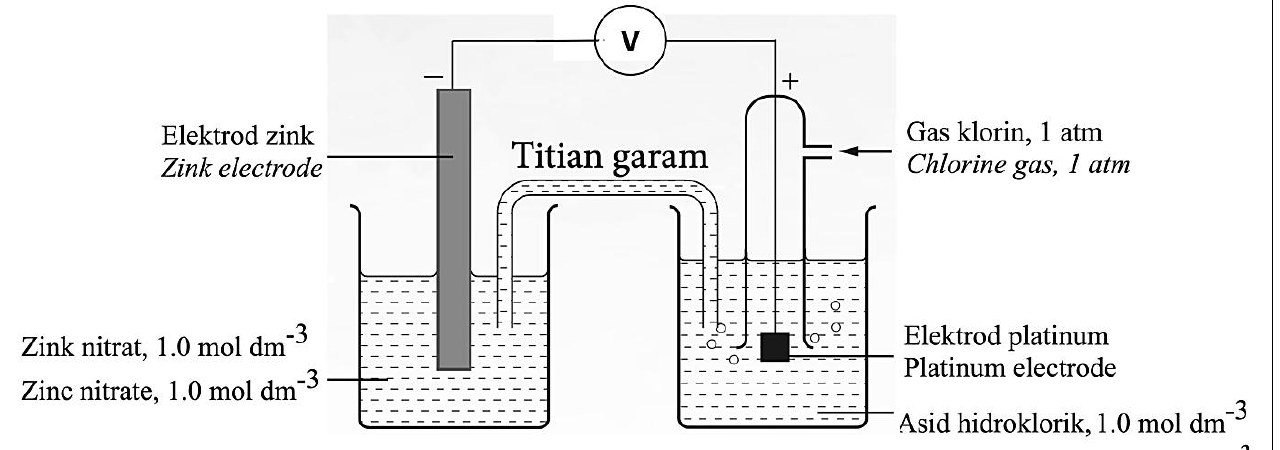
Diagram 34 shows a set-up of apparatus of a chemical cell (zinc electrode in 1.0 mol dm⁻³ zinc nitrate, negative terminal; platinum electrode with chlorine gas, 1 atm, in 1.0 mol dm⁻³ hydrochloric acid, positive terminal; salt bridge). Which of the following is the correct cell notation of the chemical cell?
Medium
Diagram 37 shows the apparatus set-up to study the transfer of electrons at a distance (iron(II) sulphate on one side and acidified potassium manganate(VII) on the other, connected by sulphuric acid and a galvanometer). What is the change in oxidation number for the substance that is oxidised and reduced?
Medium
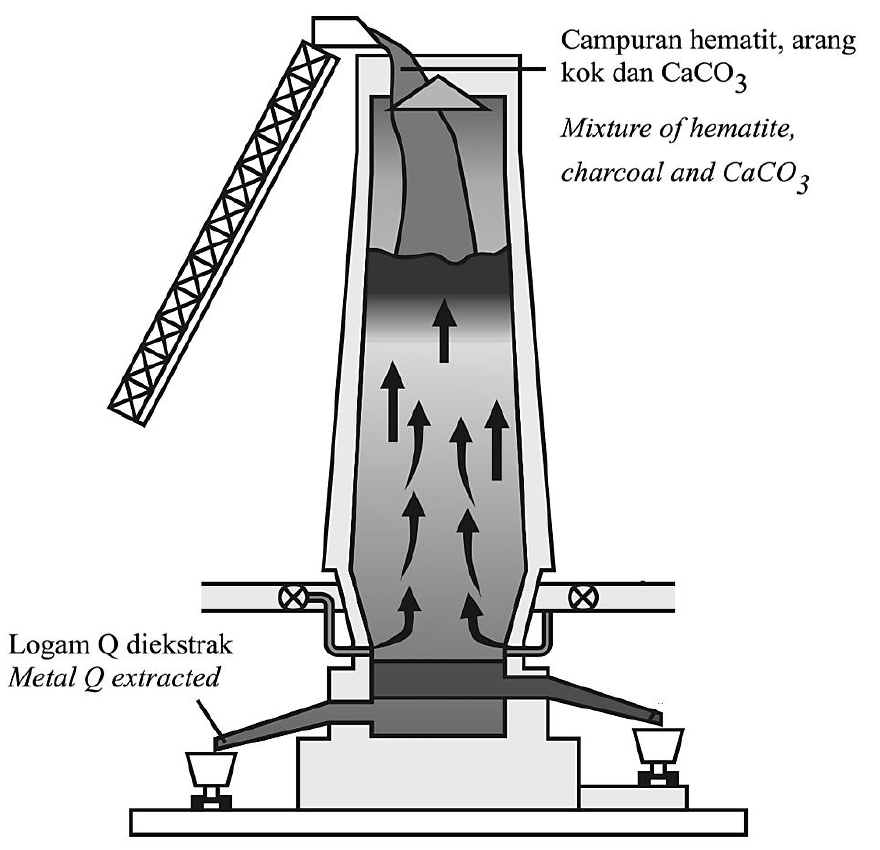
Diagram 40 shows a blast furnace which used to extract metal Q from its ore, hematite. Hematite contains iron(III) oxide. Metal Q extracted is added until excess into copper(II) sulphate solution. Which statement is correct about the reaction between metal Q and copper(II) sulphate solution?
Medium
The following is the reaction between iron metal and chlorine gas: 2Fe(s) + 3Cl₂(g) → 2FeCl₃(s). What is the change of oxidation number of iron in this reaction?
Medium
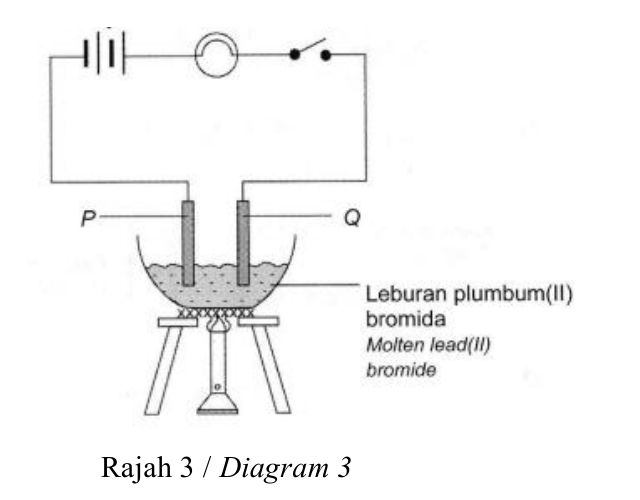
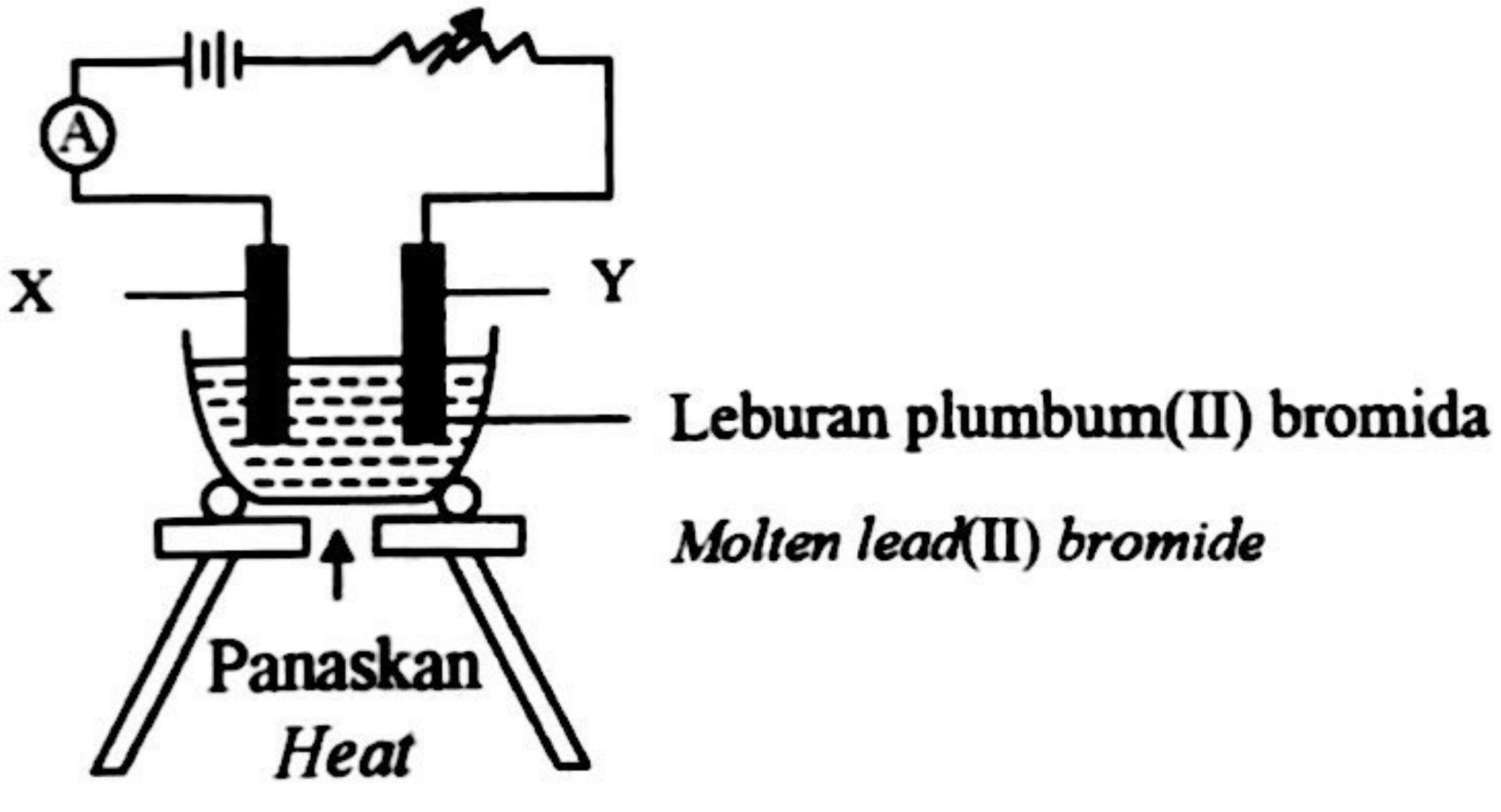
Diagram 3 shows the apparatus set-up of an electrolytic cell containing molten lead(II) bromide. Which process and product occur at electrode P?
Medium
Which of the following is a property of an electrolyte?
Medium
Ahmad found an impure iron strip. Which is correct to obtain a pure iron strip through electrolysis? (Electrolyte; Anode; Cathode)
Medium
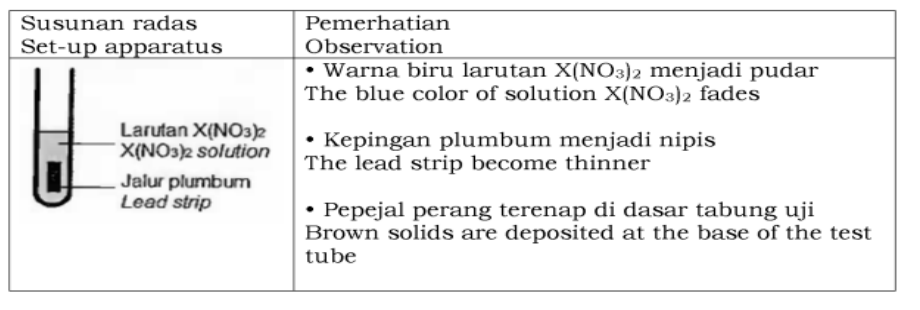
Table 3 shows a lead strip in X(NO₃)₂ solution. Observations: the blue colour of the solution fades; the lead strip becomes thinner; brown solid is deposited at the base of the test tube. Which are the equations for the oxidation and reduction processes?
Medium
Which nail will rust the fastest? Each test tube holds agar + potassium hexacyanoferrate(III) + phenolphthalein solutions with an iron nail coiled with a different metal.
Medium
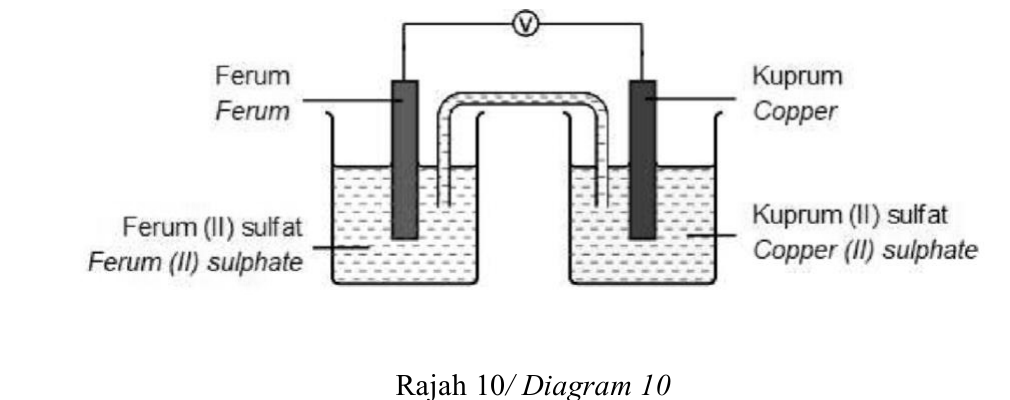
Diagram 10 shows a voltaic cell with iron in iron(II) sulphate solution and copper in copper(II) sulphate solution. Calculate the E° value if the half-cell values are: Fe²⁺(aq) + 2e⁻ ⇌ Fe(s), E° = -0.44 V; Cu²⁺(aq) + 2e⁻ ⇌ Cu(s), E° = +0.34 V.
Medium
What is the oxidation number of chromium in K2Cr2O7?
Medium
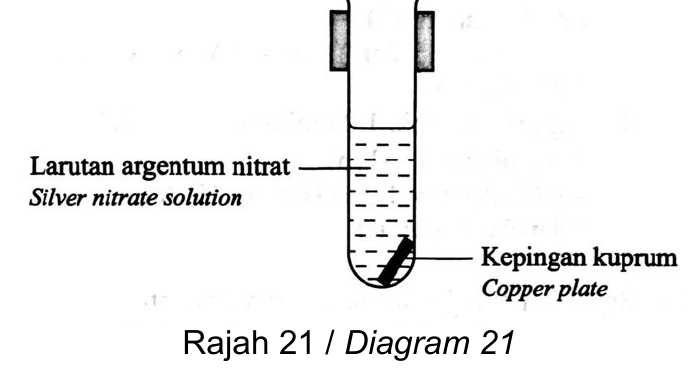
Diagram 21 shows the apparatus set up to study the displacement reaction of metal (copper plate in silver nitrate solution). What is the observation for the reaction in Diagram 21?
Medium
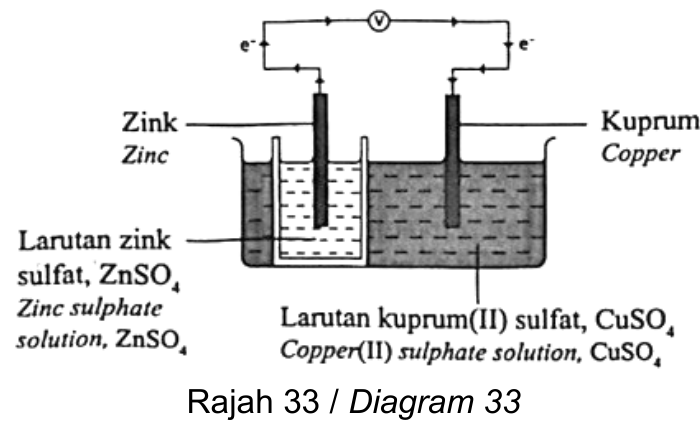
Diagram 33 shows a voltaic cell. Given the standard electrode potentials, E°: Zn²⁺ + 2e⁻ ⇌ Zn, E° = −0.76 V; Cu²⁺ + 2e⁻ ⇌ Cu, E° = +0.34 V. What is the voltage of the cell?
Medium
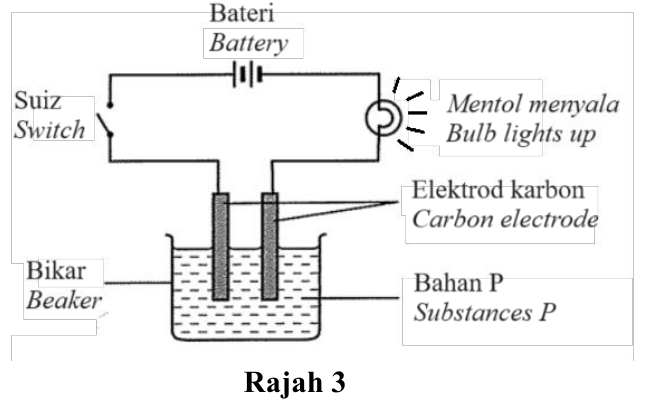
Diagram 3 shows an electrolytic cell with carbon electrodes in substance P; the bulb lights up. Which of the following is substance P?
Medium
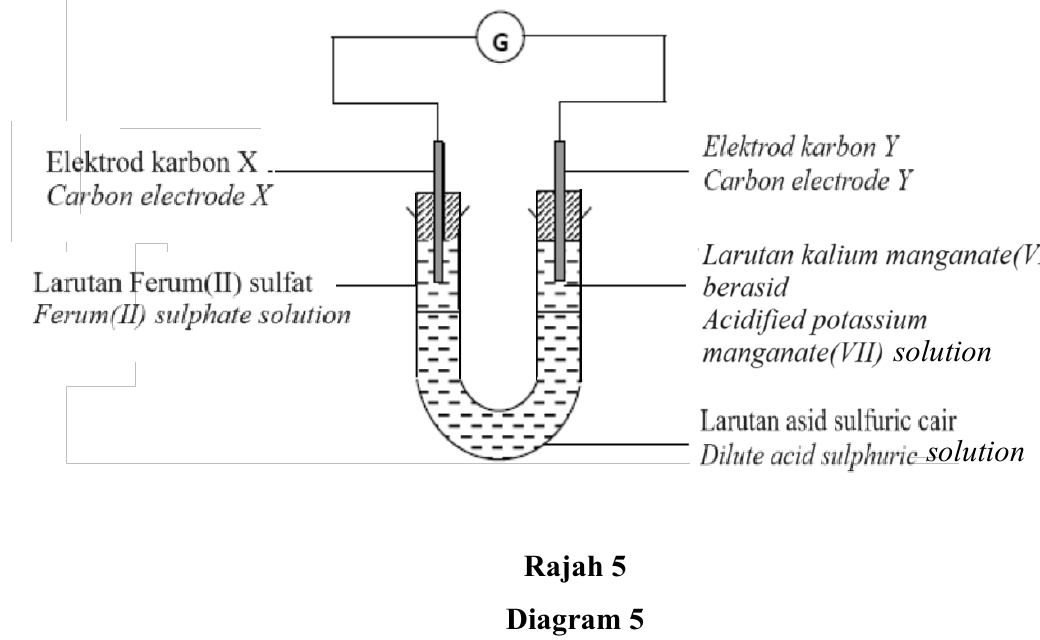
Diagram 5 shows the apparatus set up to study oxidation and reduction in terms of electron transfer at a distance (Fe2+ solution with carbon electrode X, acidified KMnO4 solution with carbon electrode Y, dilute sulphuric acid). Which ion undergoes oxidation?
Medium
A student inserted a copper wire into magnesium nitrate solution. No change occurred. Given: Mg2+ + 2e- ⇌ Mg, E° = -2.38 V; Cu2+ + 2e- ⇌ Cu, E° = +0.34 V. Which statement explains this observation?
Medium
Which of the following is an oxidation process?
Medium
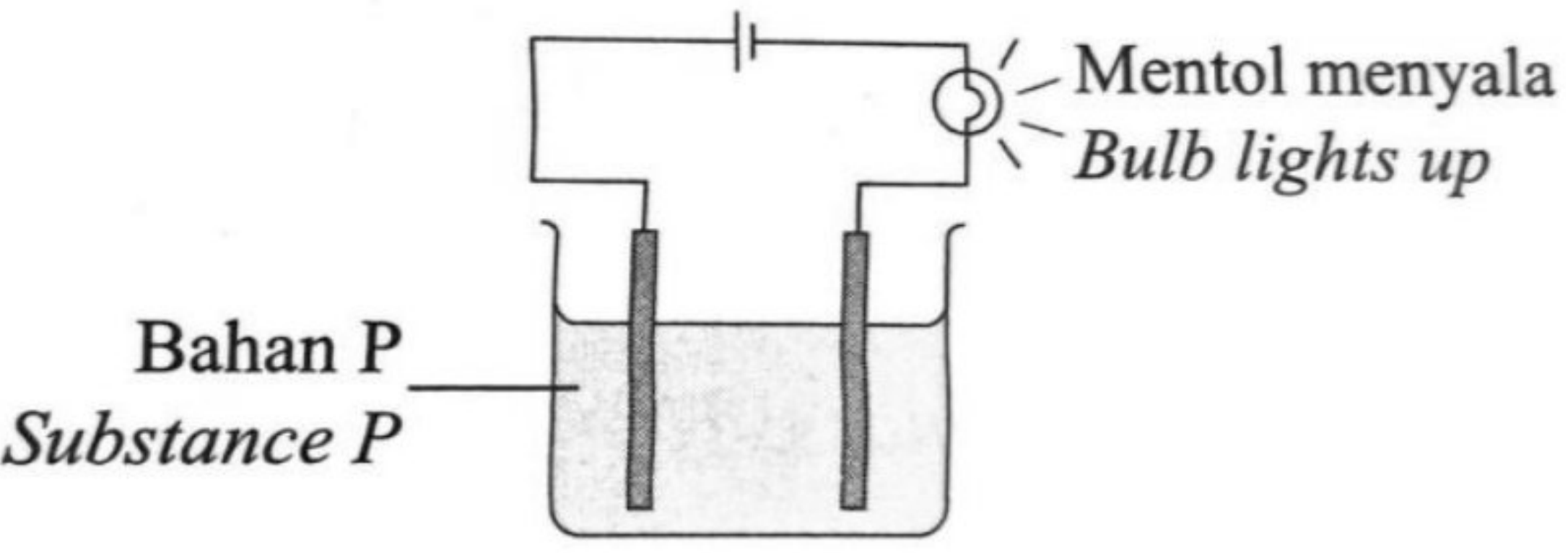
Diagram 10 shows an electrolytic cell. The bulb lights up. Which of the following is substance P?
Medium
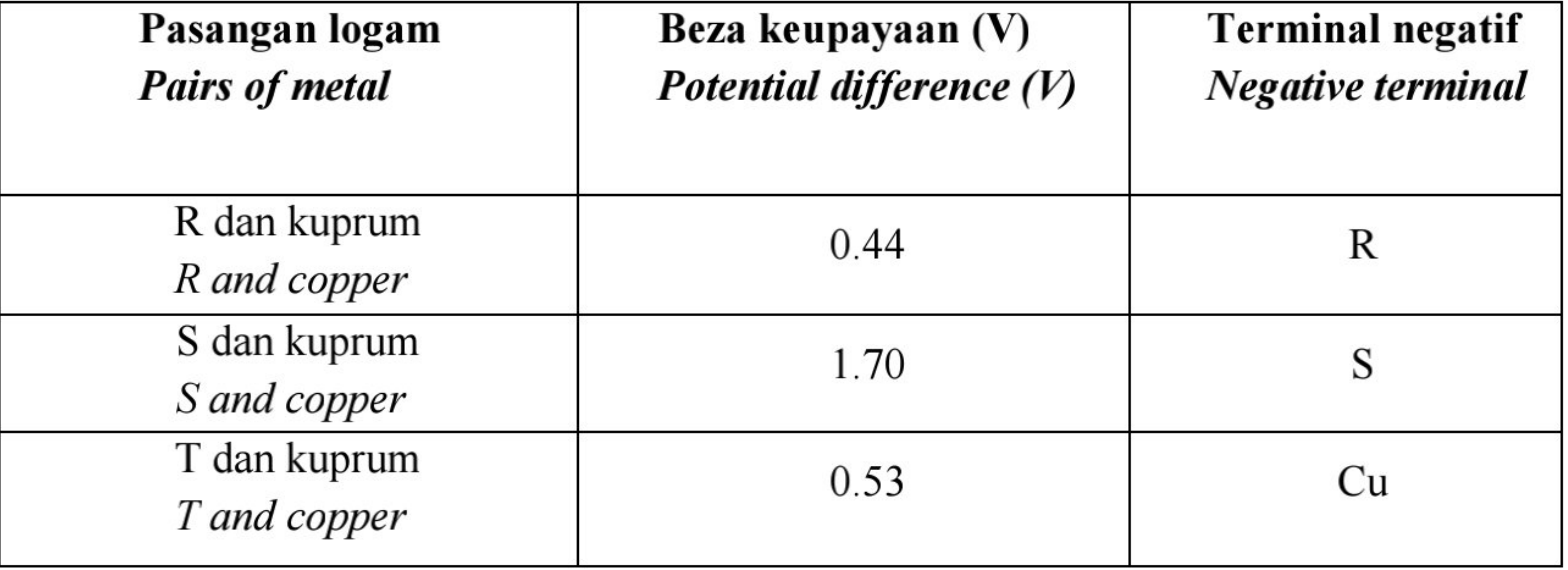
Table 3 shows information about three voltaic cells.
Pairs of metal | Potential difference (V) | Negative terminal
R and copper | 0.44 | R
S and copper | 1.70 | S
T and copper | 0.53 | Cu
What is the potential difference for the pair of metal S and T?
Medium
Which of the following is an oxidising agent?
Medium
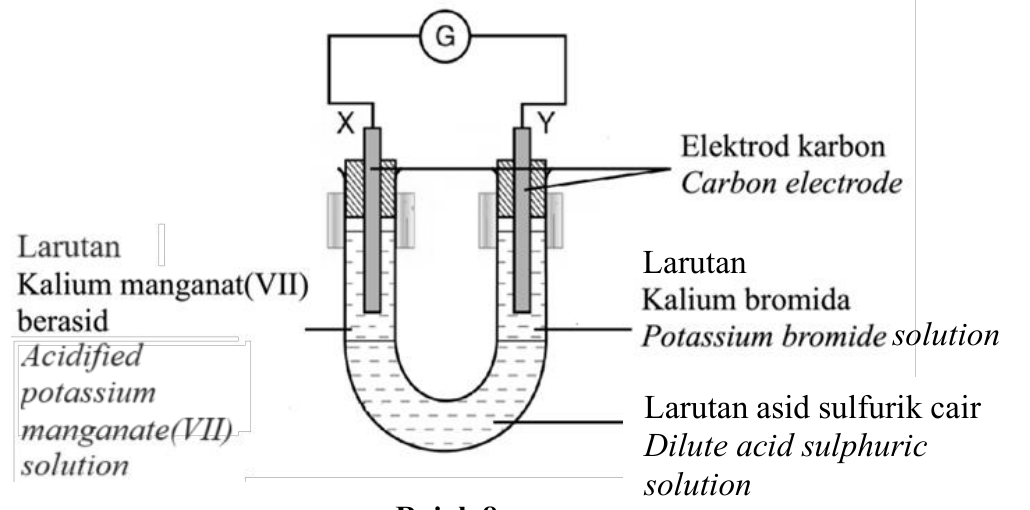
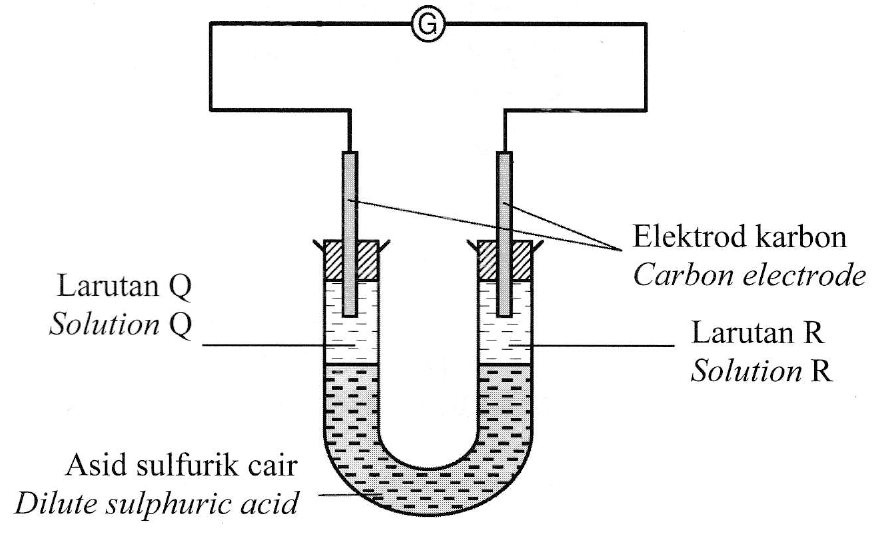
Diagram 8 shows the set-up of apparatus for the reaction which involves the transfer of electrons at a distance (acidified potassium manganate(VII) solution at electrode X, potassium bromide solution at electrode Y, dilute sulphuric acid in between). Which statement is correct about the reaction?
Medium
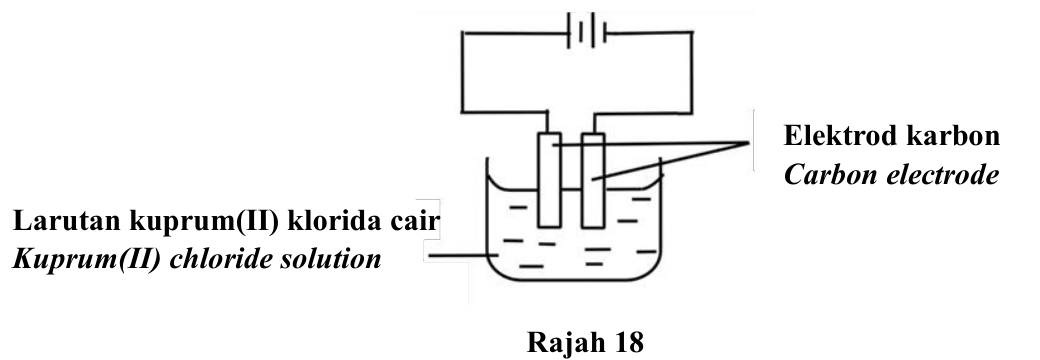
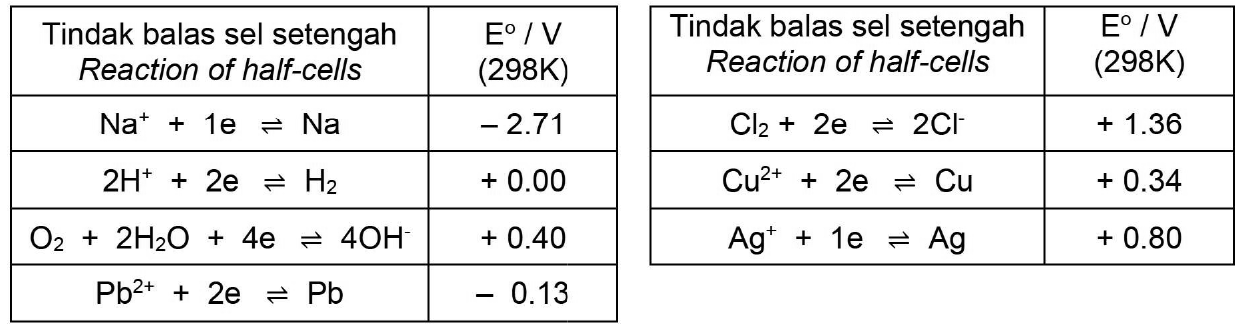
Diagram 18 shows an experiment on electrolysis (carbon electrodes, dilute copper(II) chloride solution). Given E° values: 2H⁺ + 2e ⇌ H2 0.00 V; Cu²⁺ + 2e ⇌ Cu +0.34 V; O2 + 2H2O + 4e ⇌ 4OH⁻ +0.40 V; Cl2 + 2e ⇌ 2Cl⁻ +1.36 V; Na⁺ + e ⇌ Na -2.71 V; S2O8²⁻ + 2e ⇌ 2SO4²⁻ +2.01 V. Which of the following will give same observations at anode and cathode?
Medium
The standard electrode potential, E0 for half-cell equations are given below.
Zn2+(aq) + 2e ⇌ Zn(s) E0 = –0.76 V
Fe3+(aq) + e ⇌ Fe2+(aq) E0 = +0.77 V
What can be deduced from the given information?
Medium
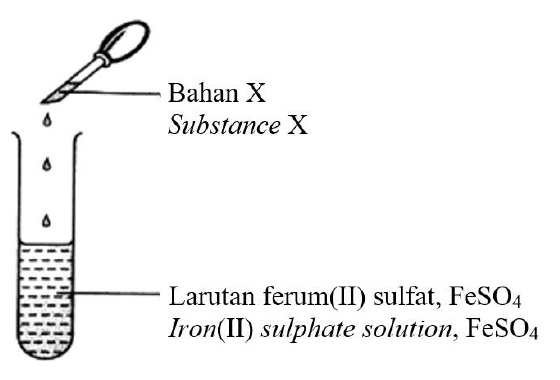
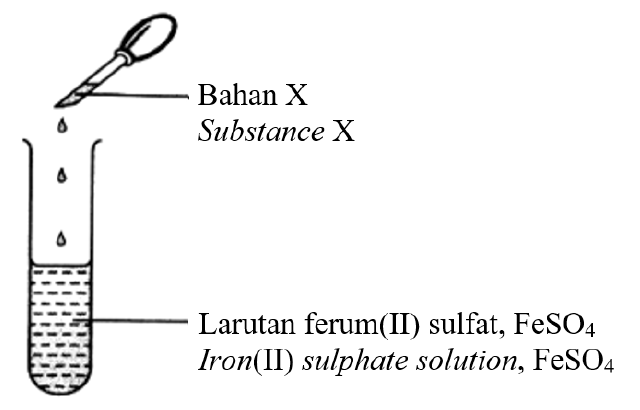
Diagram 20 shows an apparatus set-up of an experiment to study the conversion of iron(II) ion, Fe2+ to iron(III) ion, Fe3+. Substance X is added dropwise to iron(II) sulphate solution, FeSO4. Which substance can be used as substance X?
Medium
The following equation represents the oxidation reaction between ethanol and acidified potassium dichromate(VI).
3C2H5OH + 2K2Cr2O7 + 8H2SO4 → 3CH3COOH + 2Cr2(SO4)3 + 2K2SO4 + 11H2O
What is the change in the oxidation number of chromium?
Medium
Which half equations show that the reactant acts as a reducing agent?
I Mg → Mg2+ + 2e
II Cu2+ + 2e → Cu
III 2Cl- → Cl2 + 2e
IV 2H+ + 2e → H2
Medium
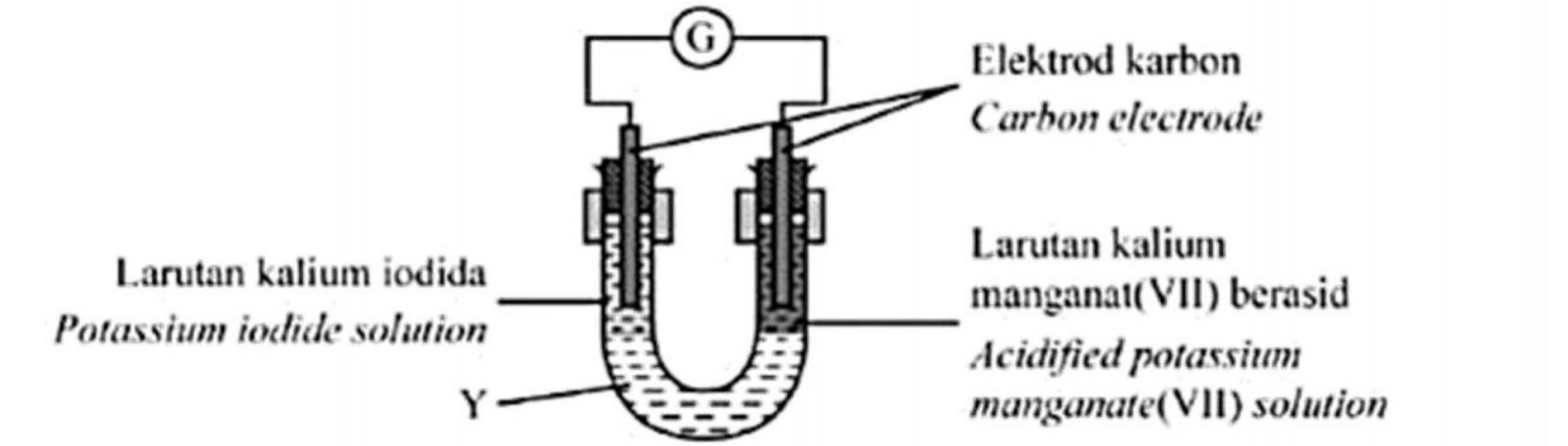
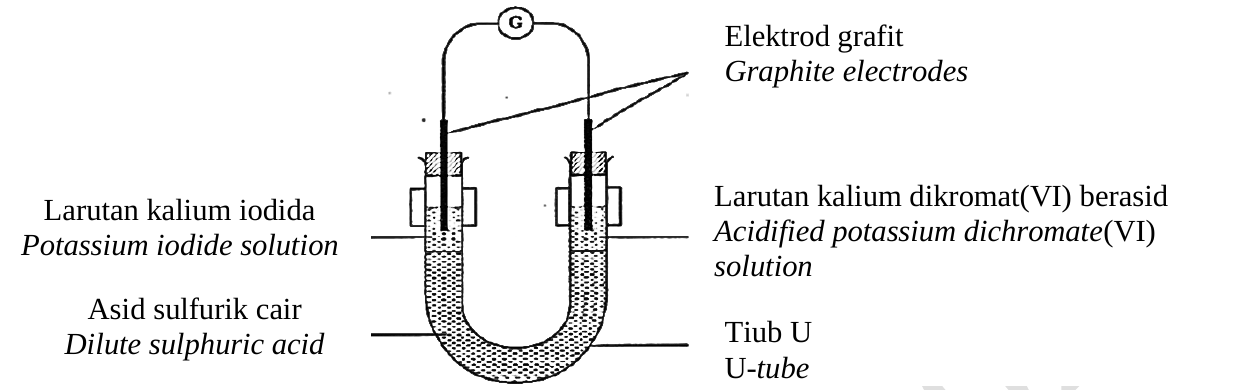
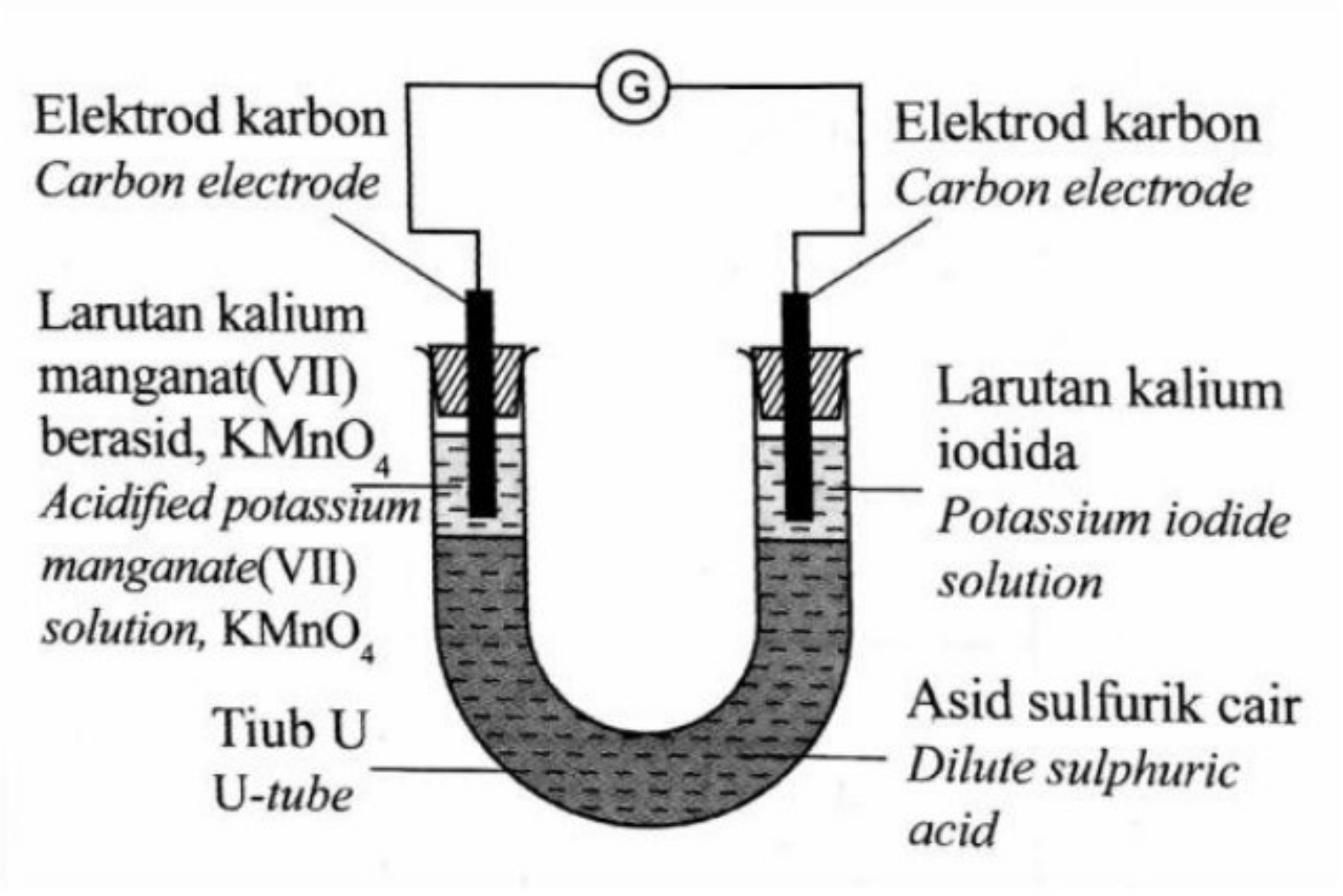
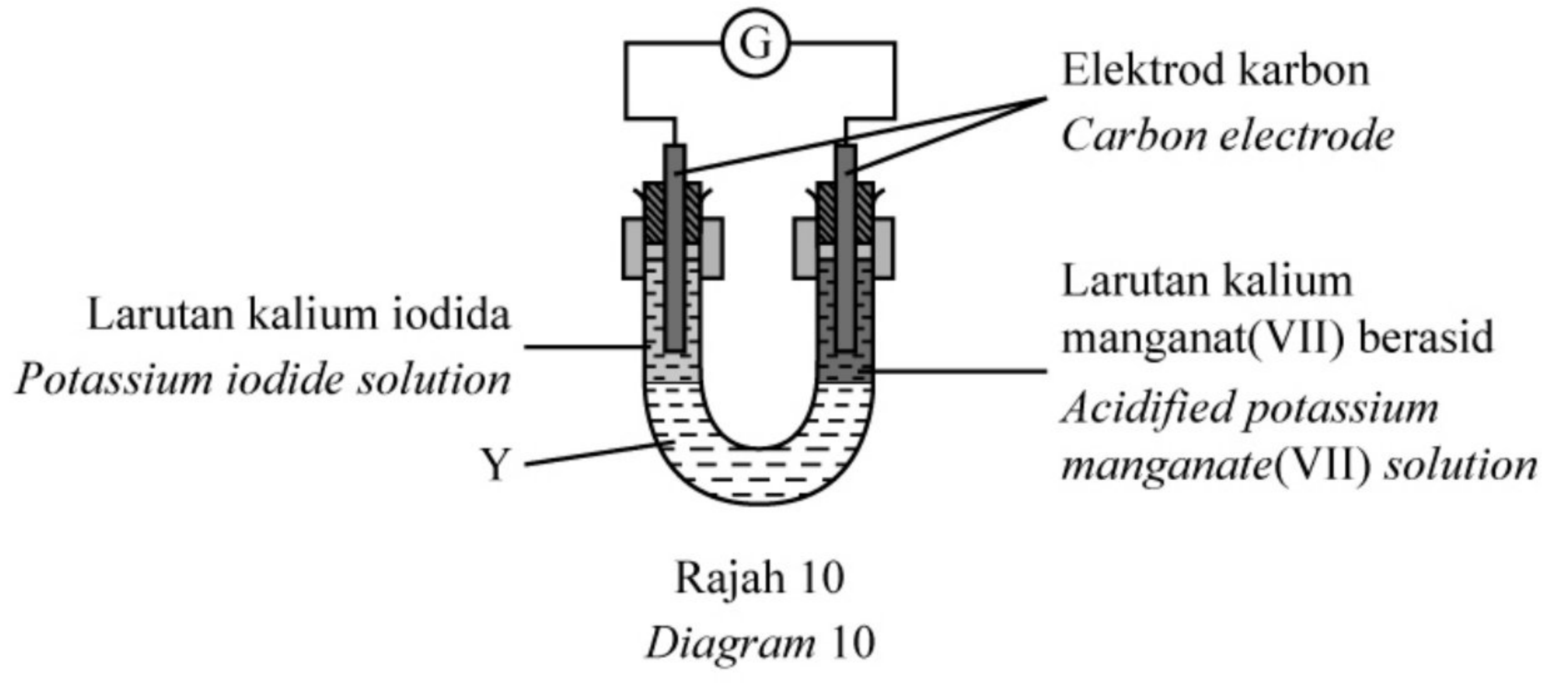
Diagram 8 shows the apparatus set-up for the transfer of electrons at a distance in a U-tube (potassium iodide solution on one side, acidified potassium manganate(VII) solution on the other, carbon electrodes connected to a galvanometer G; Y is the substance in the bottom of the U-tube). What is the function of Y?
Medium
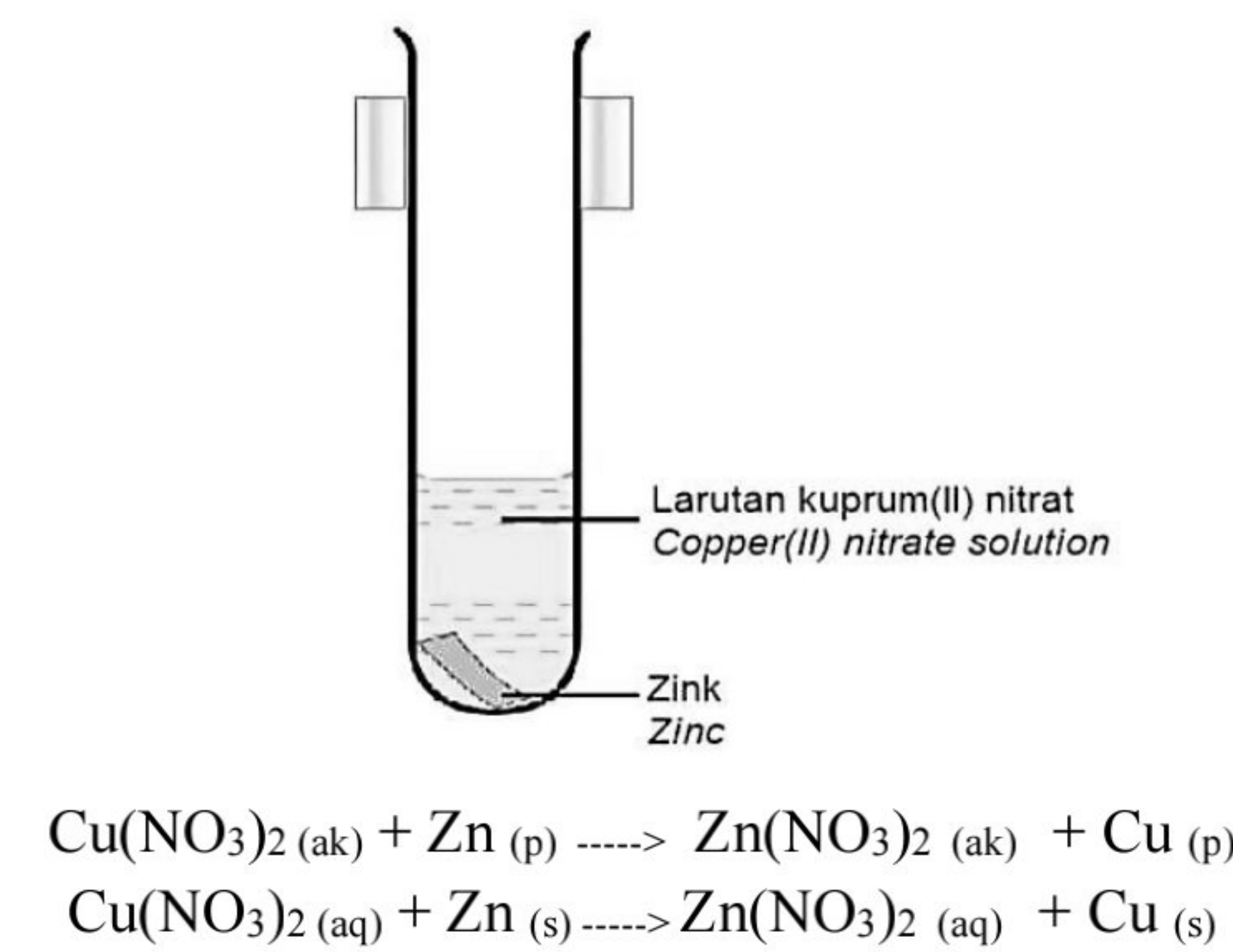
Diagram 9 shows a piece of zinc plate added into a test tube containing copper(II) nitrate solution: Cu(NO₃)₂(aq) + Zn(s) → Zn(NO₃)₂(aq) + Cu(s). Which of the following changes in oxidation number is correct for copper?
Easy
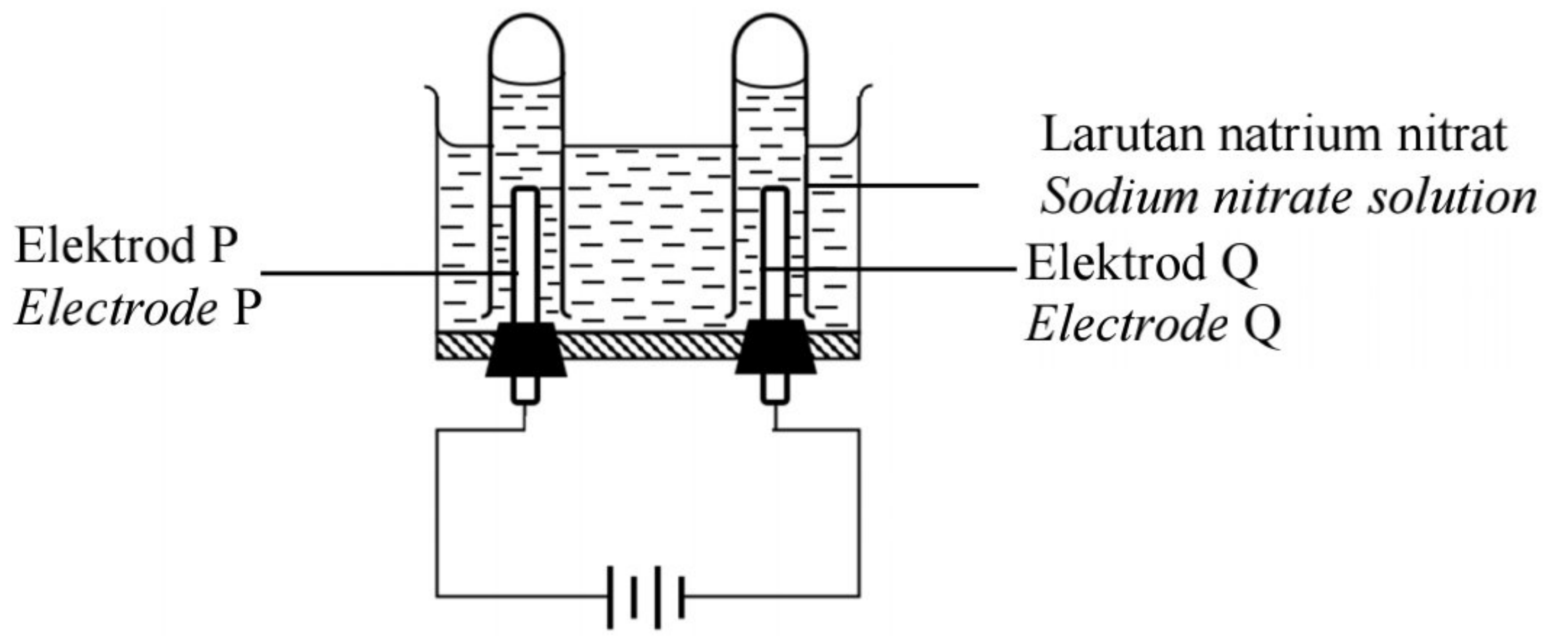
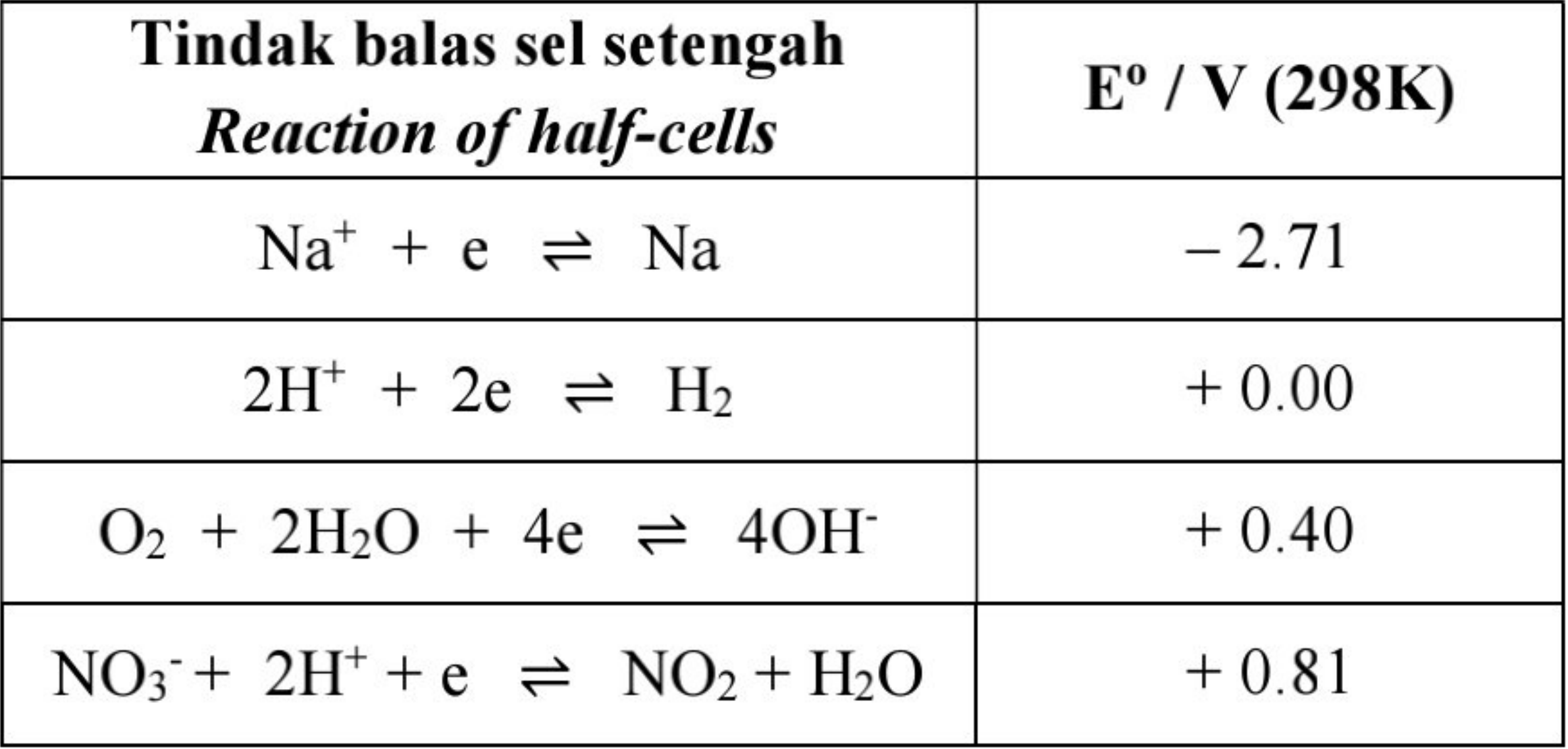
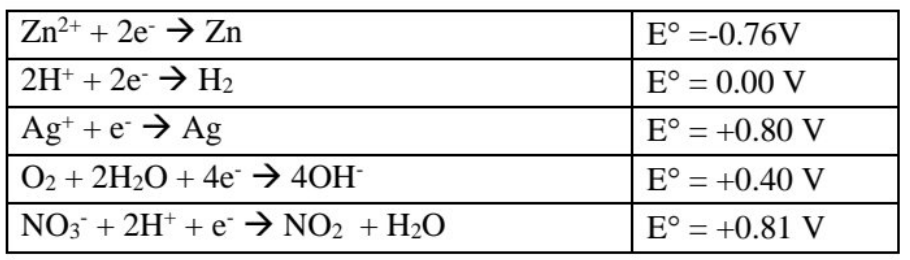
Diagram 17 shows the apparatus set up for the electrolysis of sodium nitrate solution using carbon electrodes (electrode P and electrode Q). Table 5 shows standard electrode potentials: Na⁺ + e ⇌ Na −2.71 V; 2H⁺ + 2e ⇌ H₂ 0.00 V; O₂ + 2H₂O + 4e ⇌ 4OH⁻ +0.40 V; NO₃⁻ + 2H⁺ + e ⇌ NO₂ + H₂O +0.81 V. Based on Diagram 17 and Table 5, what are the products formed at both electrodes? (Electrode P / electrode Q)
Medium
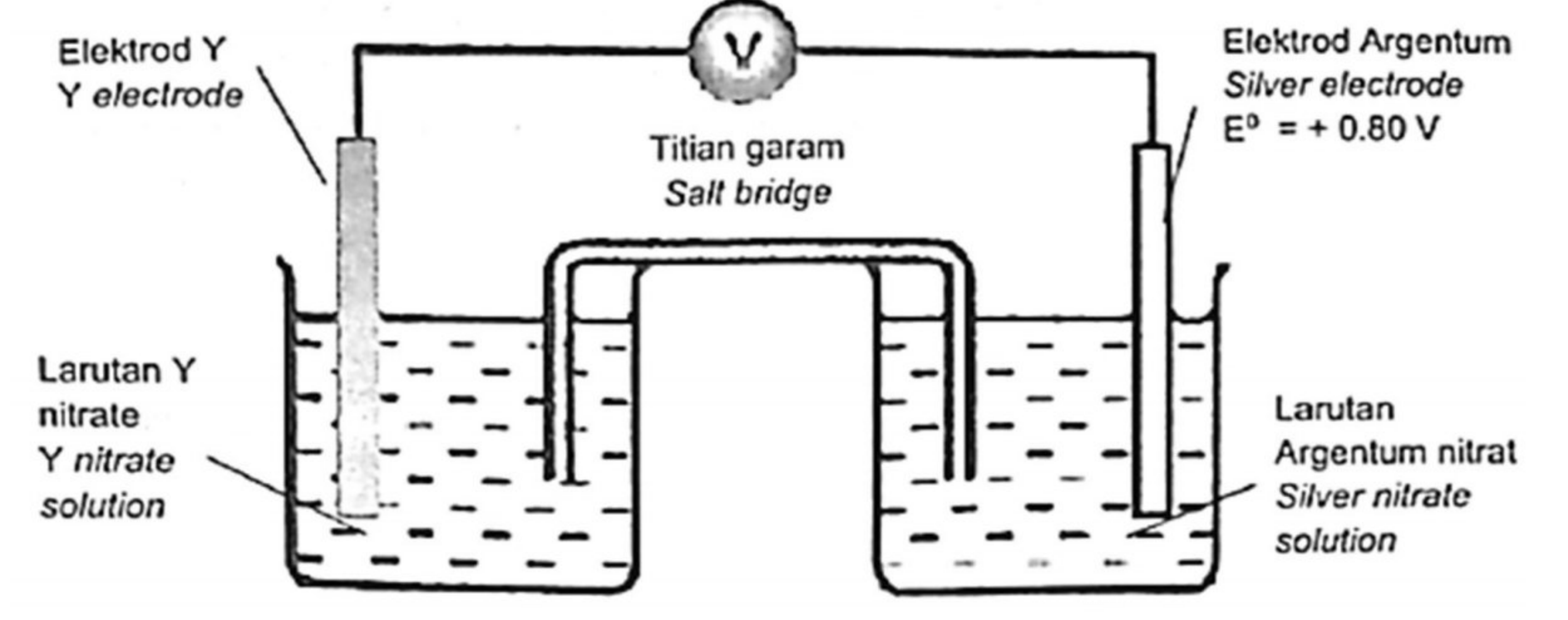
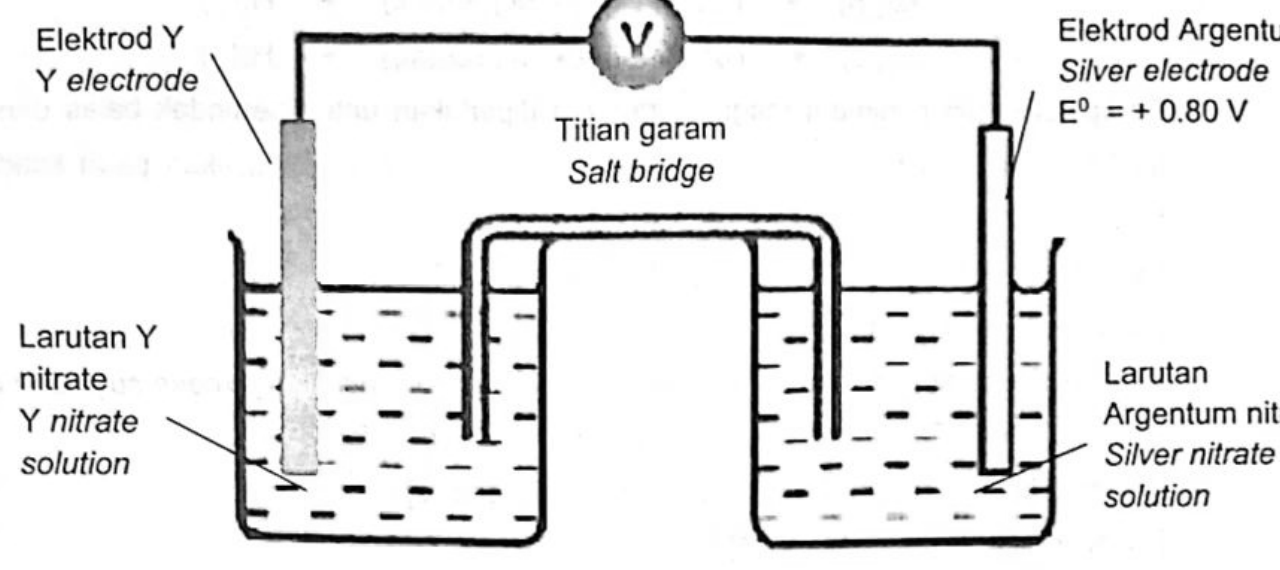
Diagram 18 shows the apparatus set-up of a voltaic cell: electrode Y in Y nitrate solution and a silver electrode (E° = +0.80 V) in silver nitrate solution, joined by a salt bridge and a voltmeter. Electrons flow from Y electrode to silver electrode through the connecting wire. If the voltage reading for the voltaic cell is +0.93 V, what is the E° value for Y electrode?
Medium
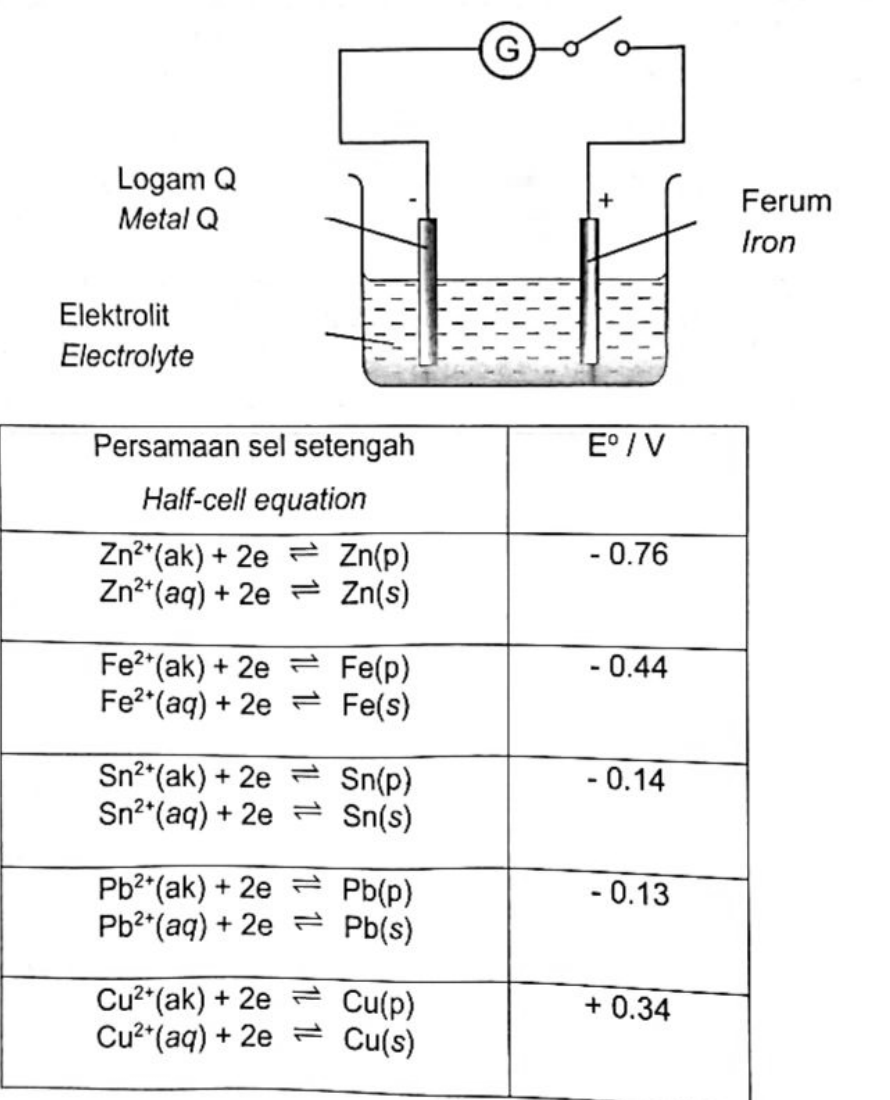
The diagram shows the apparatus set-up of a chemical cell (metal Q is the negative terminal, iron is the positive terminal) and the standard electrode potential values of half-cells: Zn²⁺/Zn −0.76 V; Fe²⁺/Fe −0.44 V; Sn²⁺/Sn −0.14 V; Pb²⁺/Pb −0.13 V; Cu²⁺/Cu +0.34 V. What is metal Q?
Medium
Which of the following statements is true about electrolyte?
Easy
The diagram shows the apparatus set-up of a voltaic cell (Y electrode in Y nitrate solution; silver electrode, E° = +0.80 V, in silver nitrate solution; salt bridge). Electrons flow from Y electrode to silver electrode through the connecting wire. If the voltage reading E° for the voltaic cell is +0.93 V, what is the E° value for Y electrode?
Medium
Which ions are present in molten lead(II) bromide?
Easy
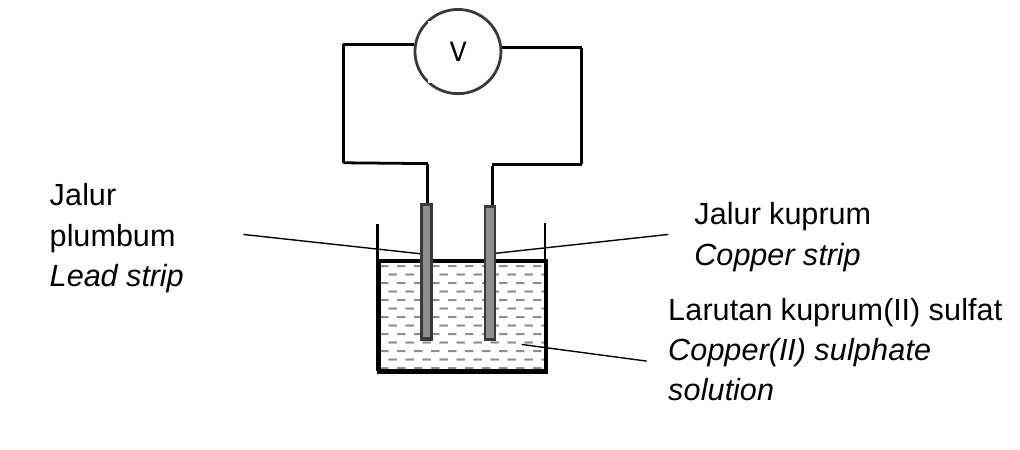
Diagram shows the apparatus set up for a voltaic cell (lead strip and copper strip in copper(II) sulphate solution). How can the voltmeter reading get increased?
Medium
Which of the following substance undergoes oxidation?
Medium
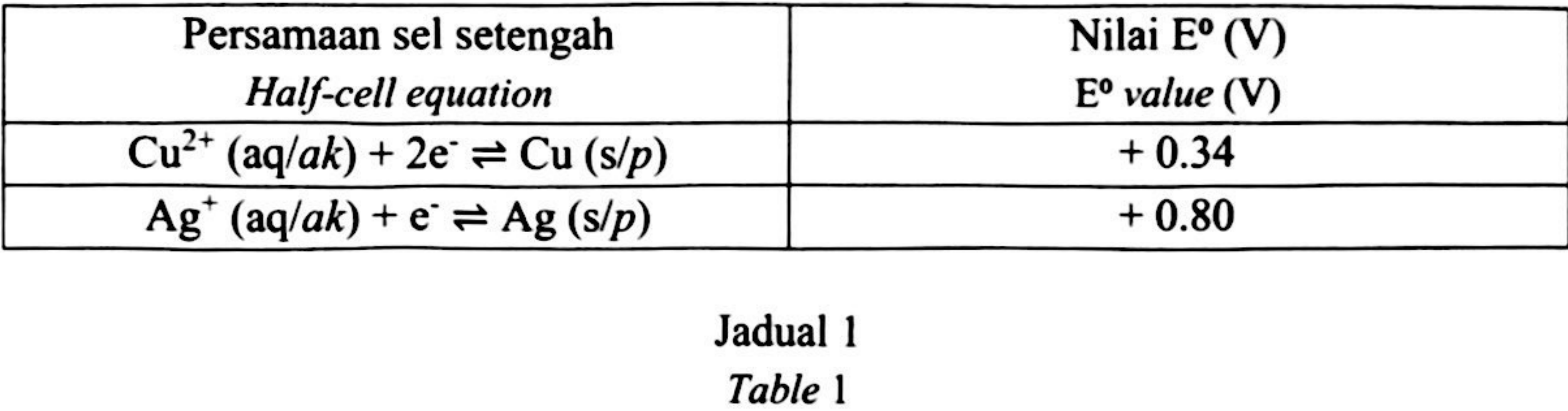
Diagram 1 shows the value of the standard electrode potential, E°: Zn²⁺ + 2e⁻ ⇌ Zn, -0.76 V; Cu²⁺ + 2e⁻ ⇌ Cu, +0.34 V. Based on Diagram 1, which is a stronger oxidising agent?
Medium
Equation below shows a redox reaction: Mg + CuSO₄ → Cu + MgSO₄. Based on the equation, predict the colour change of the copper(II) sulphate solution.
Medium
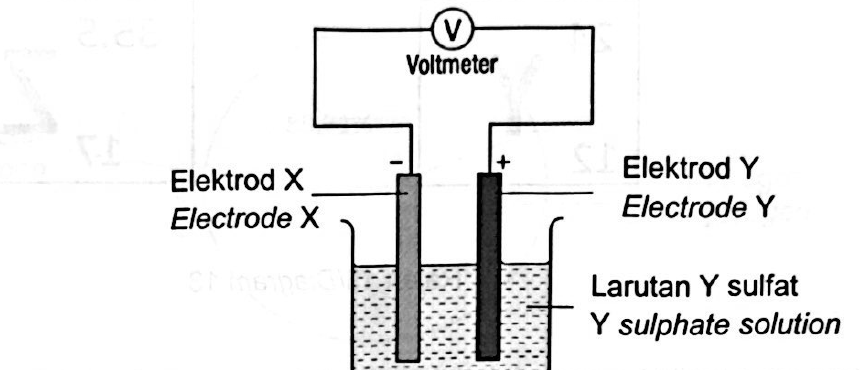
Diagram 12 shows the arrangement of the apparatus of a chemical cell (electrode X negative terminal, electrode Y positive terminal, Y sulphate solution). The voltage reading, E° for the above chemical cell is +1.24 V. By referring to the standard electrode potential, E° of the half-cell of metal X, calculate the value of the standard electrode potential of the half-cell of metal Y. X²⁺(aq) + 2e ⇌ X(s), E° = -0.44 V
Medium
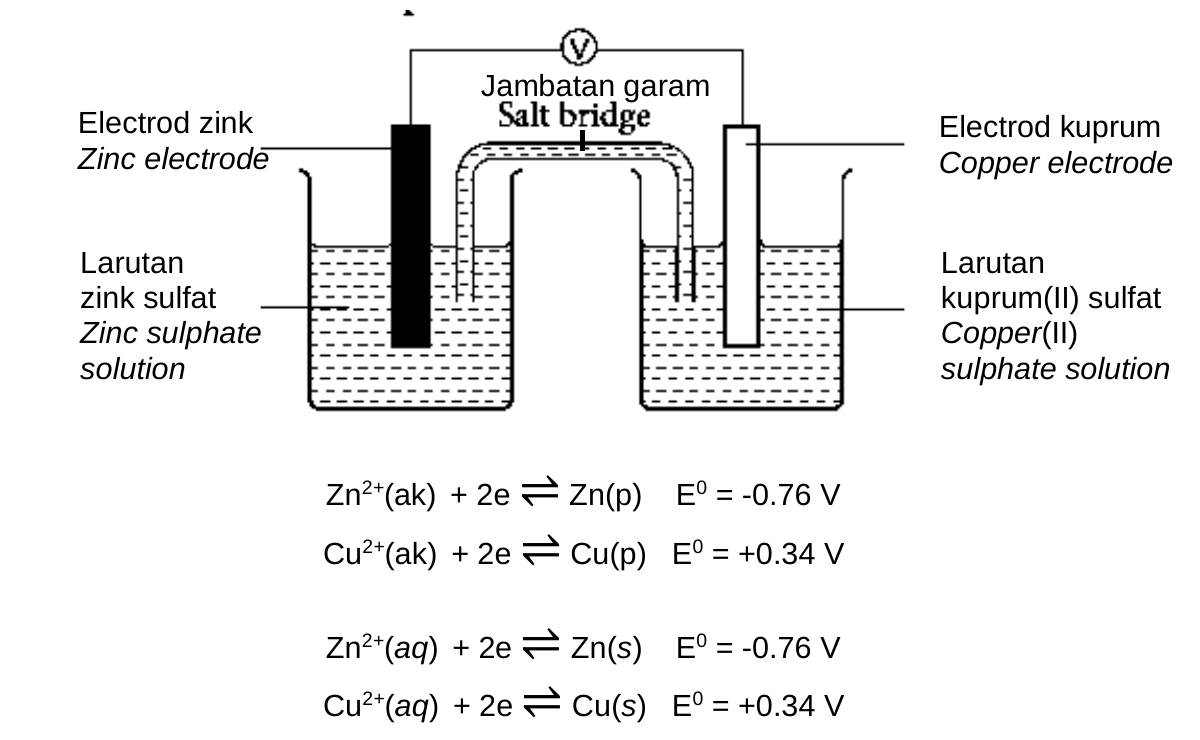
The diagram shows the apparatus set-up of a Daniell cell and E° values for two half-cells: Zn²⁺(aq) + 2e ⇌ Zn(s) E° = -0.76 V; Cu²⁺(aq) + 2e ⇌ Cu(s) E° = +0.34 V. Which of the following is the cell notation of the chemical cell?
Medium
Photochromic glass is produced when glass is combined with silver chloride and copper(I) chloride. When exposed to sunlight, the photochromic glass darkens. Which of the following is the half equation that describes the phenomenon?
Medium
Which of the following occurs in a reduction reaction?
Easy
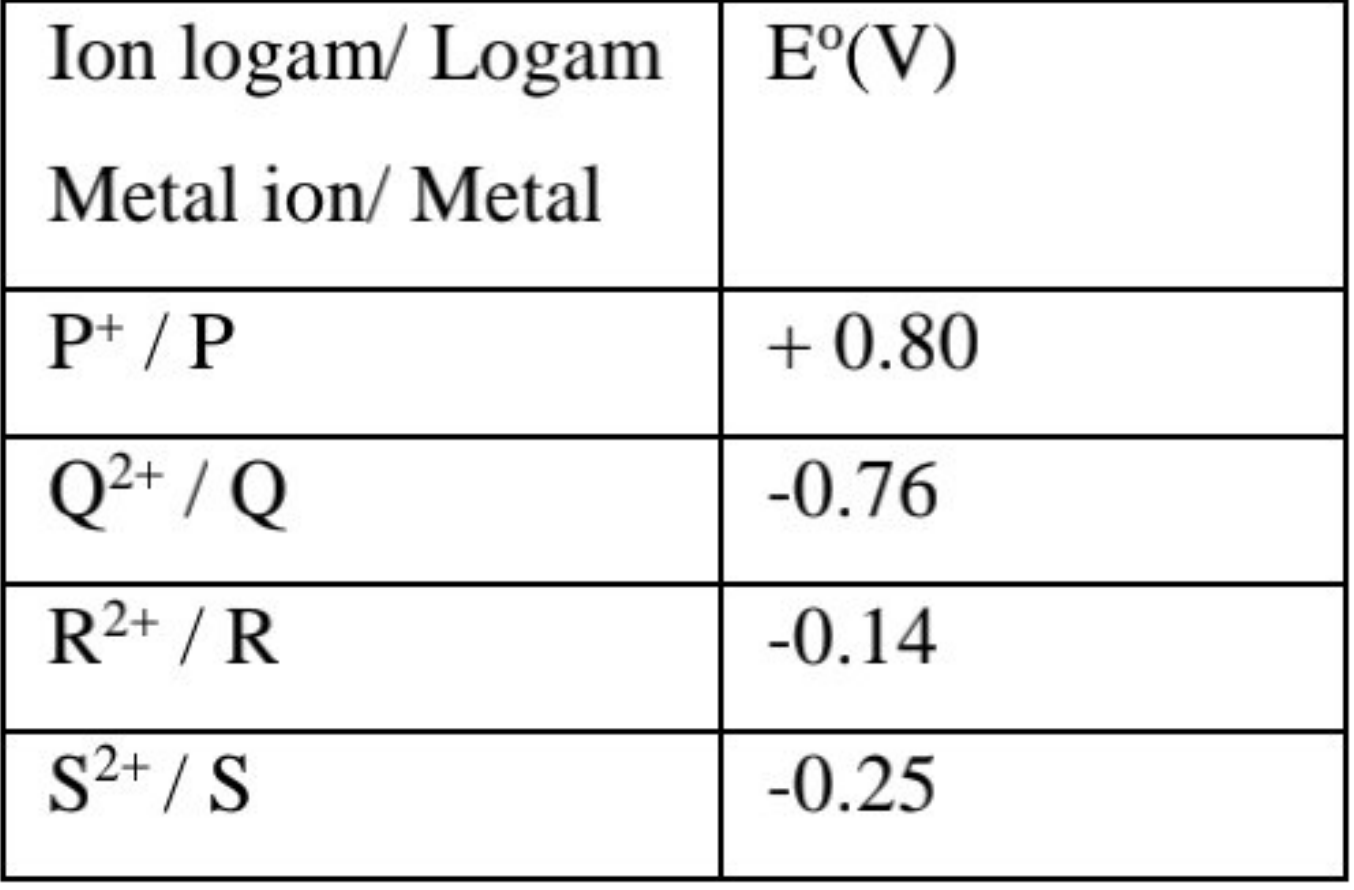
The table shows standard electrode potentials: P⁺/P +0.80 V; Q²⁺/Q -0.76 V; R²⁺/R -0.14 V; S²⁺/S -0.25 V. (P, Q, R and S are not the actual symbols of elements.) Which of the following is the correct order of increasing strength of oxidising agent?
Medium
Which of the following is true about the balanced chemical equation below?
H₂S(g) + Br₂(aq) → S(s) + 2HBr(g)
Medium
Which substance can be used to convert Fe²⁺ to Fe³⁺?
Medium
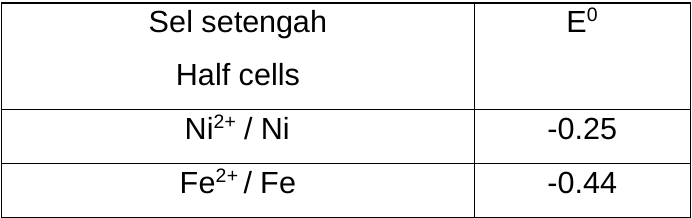
An Electrochemical cell is made up of the following half cells: Ni²⁺/Ni E° = -0.25 V; Fe²⁺/Fe E° = -0.44 V. Which statement is true based on the above table?
Medium
Which of the following occurs in an oxidation reaction?
Medium
Which of the following is a redox reaction?
Medium
The following ionic equation shows the reaction between zinc and acid: Zn(s) + 2H+(aq) -> Zn2+(aq) + H2(g). What is the change in oxidation number of hydrogen?
Medium
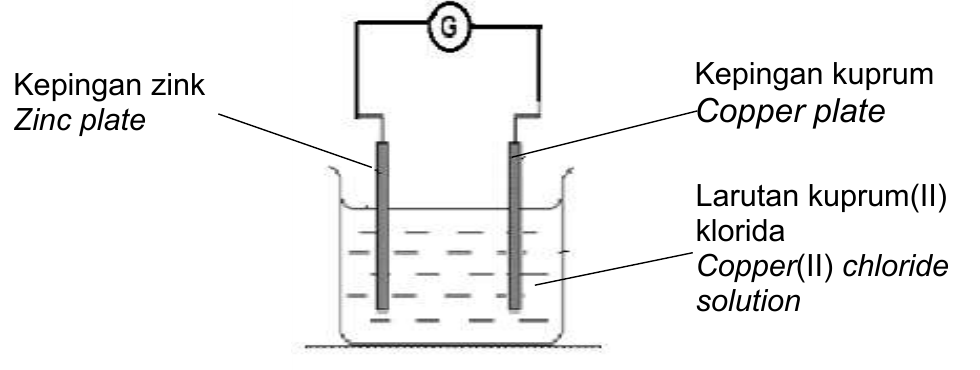
Diagram 13 shows a chemical cell (zinc plate and copper plate in copper(II) chloride solution). Which substances undergo oxidation and reduction? [E0: Zn2+ + 2e <=> Zn, E0 = -0.76 V; Cu2+ + 2e <=> Cu, E0 = +0.34 V]
Medium
Reduction reaction is a part of redox reaction. Which of the following involves a reduction reaction?
Medium
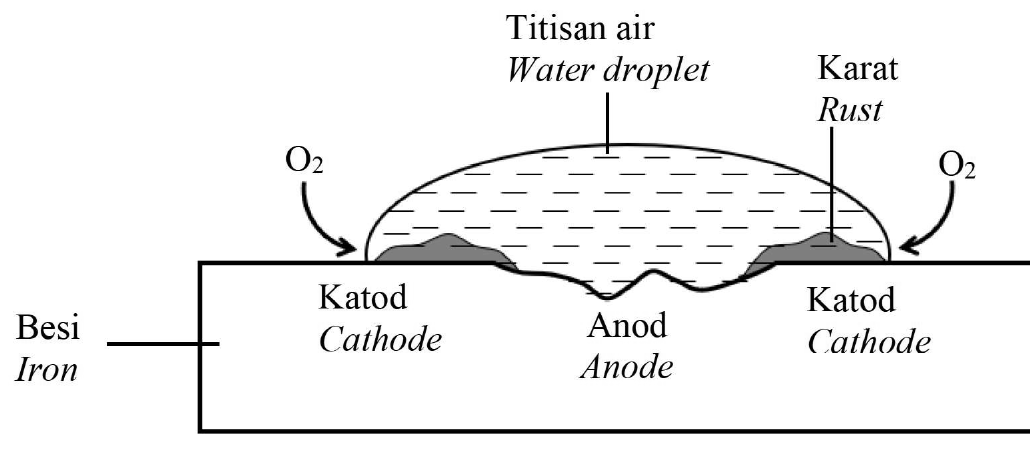
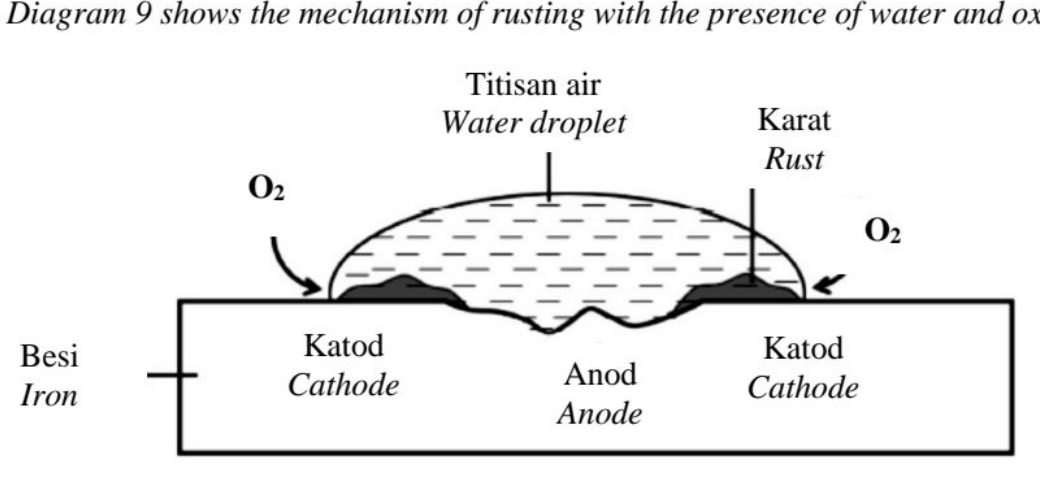
Diagram 14 shows the mechanism of iron rusting (water droplet on iron; anode at the centre of the droplet, cathode at the edges where O₂ enters). Which of the following half equations occurs at the anode and cathode?
Medium
Diagram 15 shows a chemical cell and cell notation: Mg | Mg²⁺ || Cu²⁺ | Cu (magnesium electrode in magnesium nitrate solution, copper electrode in copper(II) nitrate solution, electrons flow from Mg to Cu). Which of the following is true?
Medium
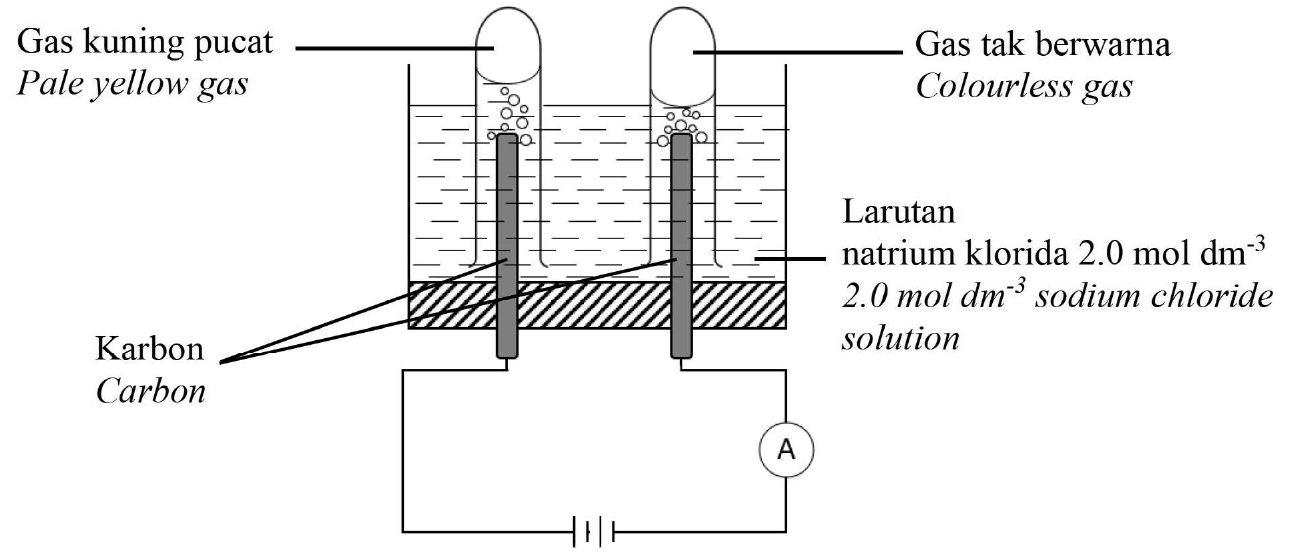
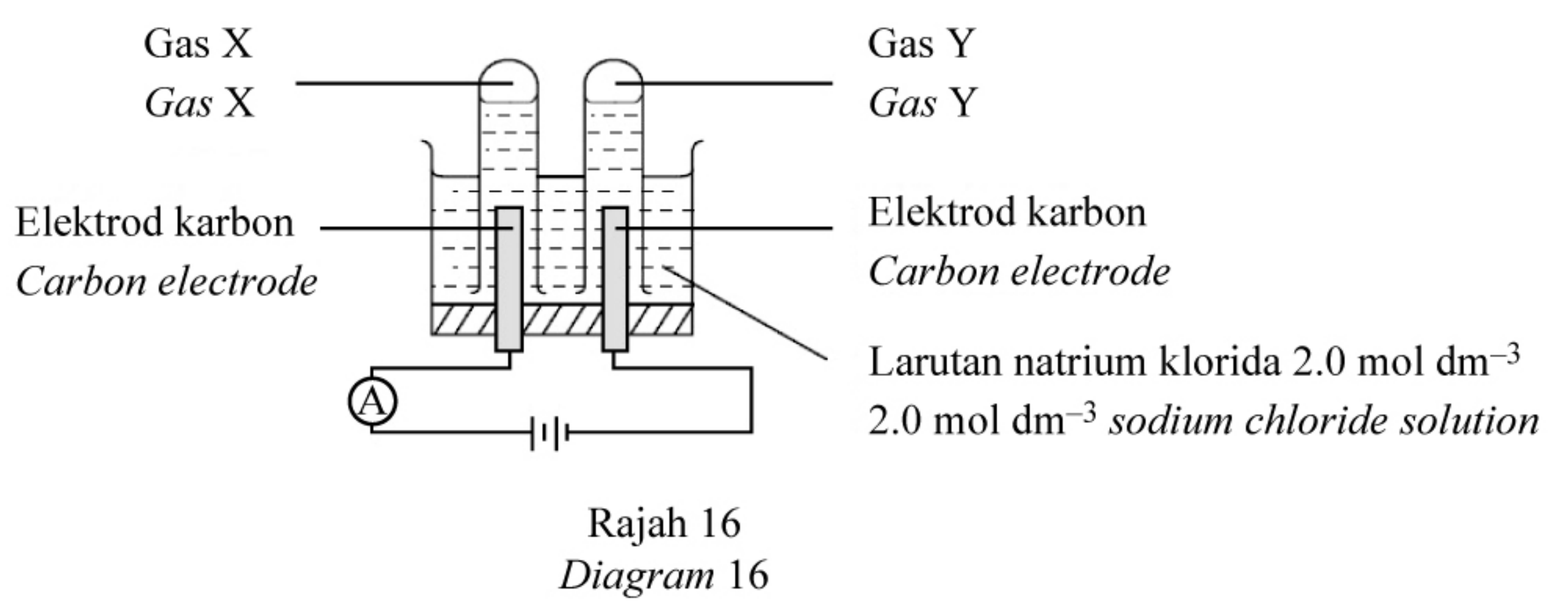
A student performs electrolysis on sodium chloride solution. The arrangement of the apparatus used and observation is shown in Diagram 16 (carbon electrodes in 2.0 mol dm⁻³ sodium chloride solution; pale yellow gas at one electrode, colourless gas at the other). What factors are involved in determining the results formed at the anode and cathode?
Medium
Which of the following is a reducing agent?
Medium
Which statement is true about oxidizing agents?
Medium
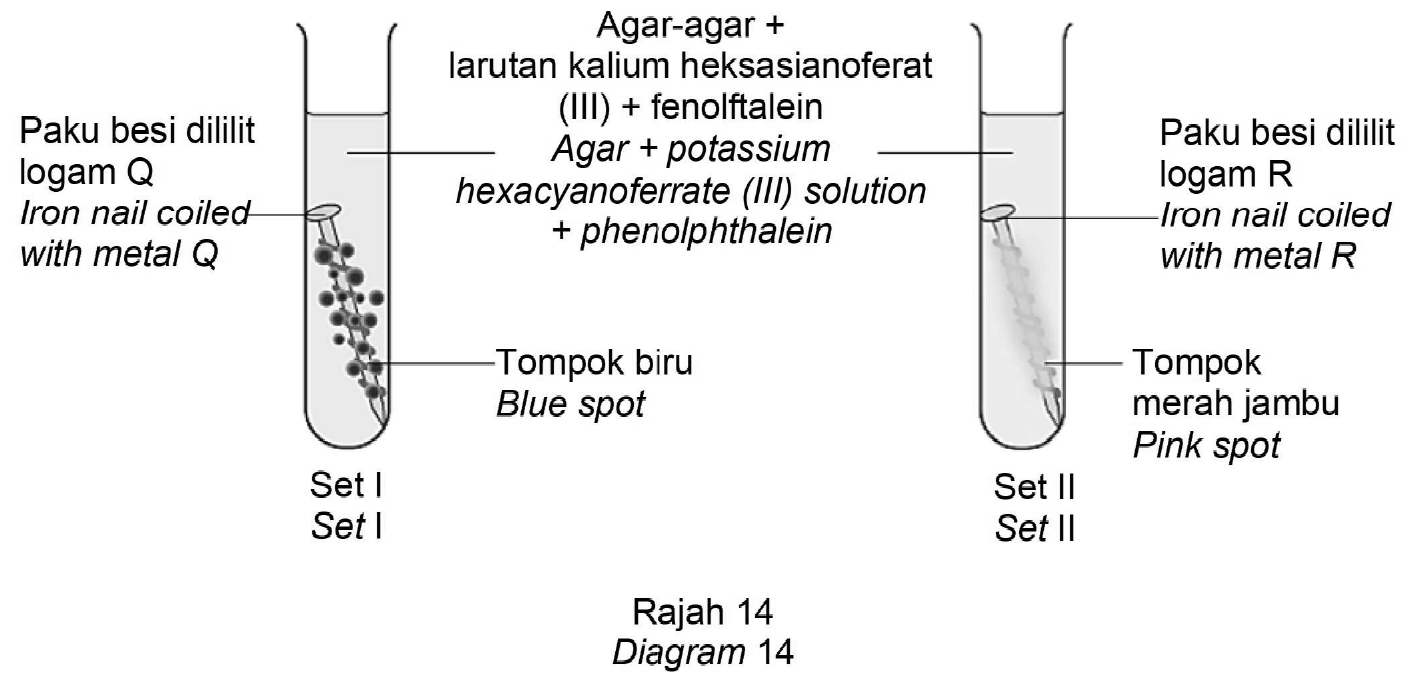
Diagram 14 shows the observation of an experiment to study the effect of metal Q and metal R on the corrosion of iron. Set I: iron nail coiled with metal Q, blue spot. Set II: iron nail coiled with metal R, pink spot. (Agar-agar + potassium hexacyanoferrate(III) solution + phenolphthalein.) Which of the following is true?
Medium
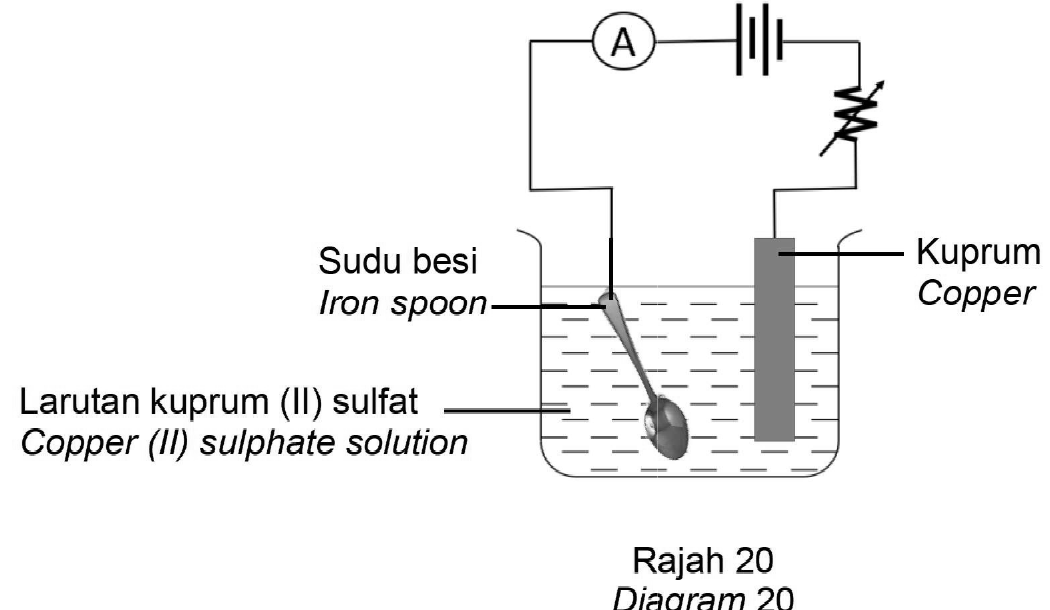
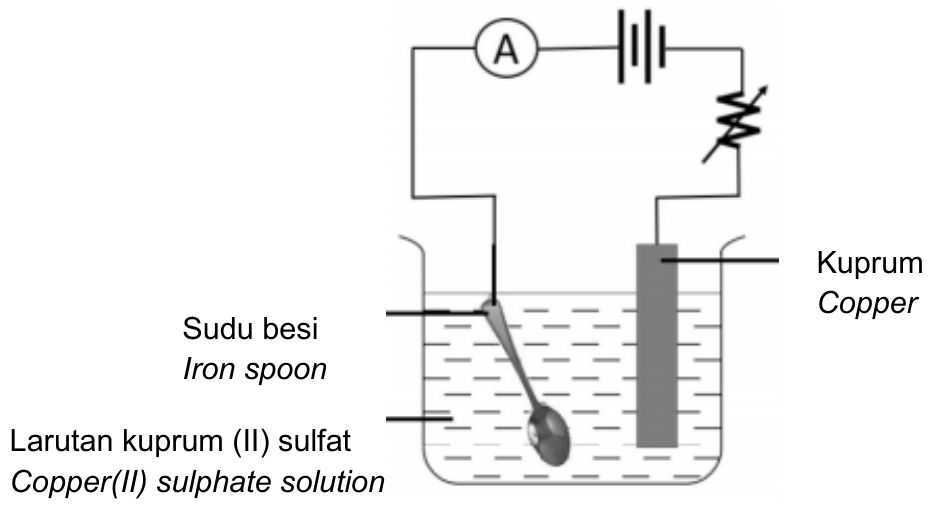
Diagram 20 shows the arrangement of the apparatus used by a student to plate an iron spoon using copper. The student found that plating was not done successfully. What needs to be done so that the plating can be done and the plating happens evenly?
I. Lower the voltage
II. Add the number of dry cells
III. Change the position between the iron spoon and copper
IV. Increase the concentration of copper (II) sulphate solution
Medium
Which of the following is a redox reaction?
Medium
The following equations represent redox reactions.
Reaction I: I2O5 + 5CO -> 5CO2 + I2
Reaction II: SO2 + 2H2S -> 3S + 2H2O
What is the reducing agent for each reaction?
Medium
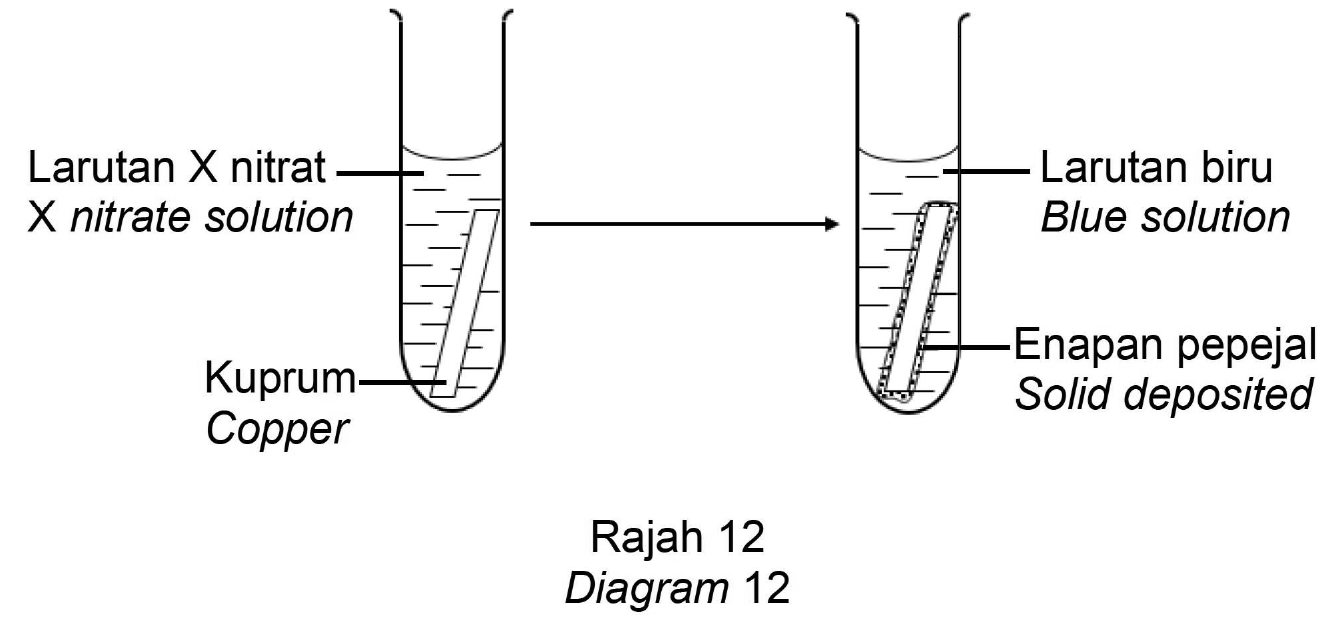
Diagram 12 shows the observation for the reaction of displacement reaction (copper placed in X nitrate solution gives blue solution and solid deposited). Which statement best describes the observation?
Medium
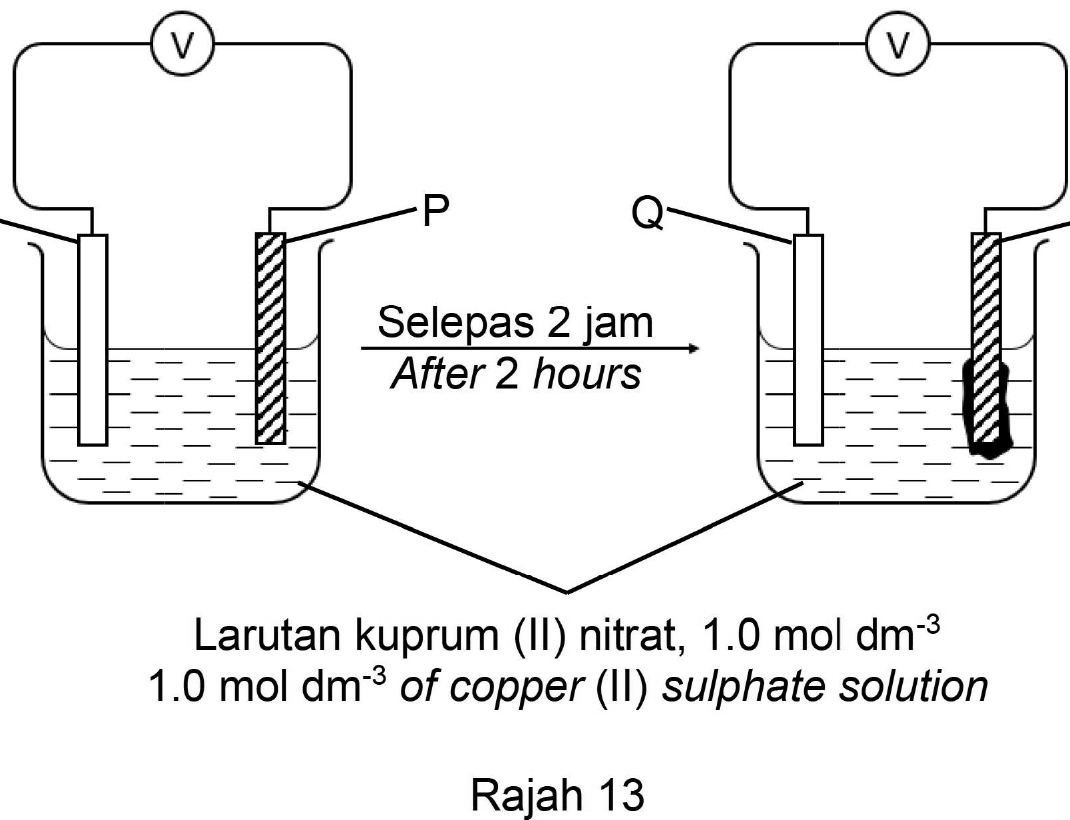
Diagram 13 shows the changes that occur in a simple chemical cell (electrodes P and Q in copper(II) sulphate solution 1.0 mol dm⁻³; after 2 hours P is coated with a black deposit). Which statement is true about the changes in Diagram 13?
Medium
Diagram 16 shows the observation of an experiment to study the effect of metal Q and metal R on the corrosion of iron (Set I: iron nail coiled with Q gives blue spots; Set II: iron nail coiled with R gives pink spots). What are Q metals and R metals?
Medium
The following is the chemical equation for a metal displacement reaction: Mg + CuSO₄ → MgSO₄ + Cu. Which of the following is true about the chemical equation? I. The oxidation number of Mg changes from 0 to +2. II. Magnesium undergoes a reduction reaction. III. Copper (II) ion accepts 2 electrons. IV. Copper (II) ions are reducing agents.
Medium
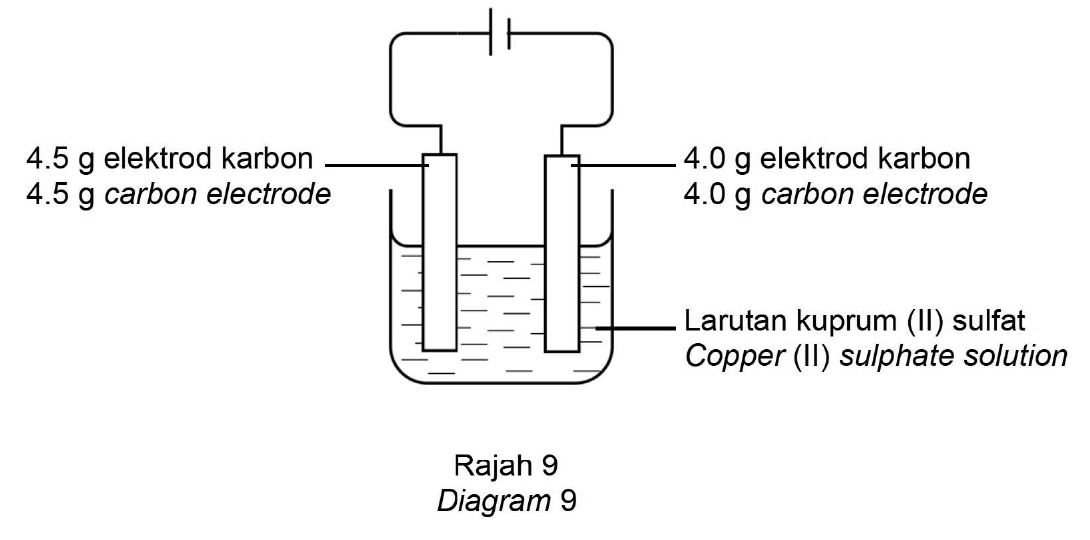
Diagram 9 shows the apparatus set up for the electrolysis of 25 cm³ of 1.0 mol dm⁻³ copper (II) sulphate solution using carbon electrodes (before: 4.5 g and 4.0 g). After the reaction is complete, the blue colour of the copper (II) sulphate solution turns colorless and there is a brown solid deposit on the carbon electrode. What is the mass of the carbon electrode after the reaction? [Relative atomic mass: C=12, O=16, S=32, Cu=64]
Medium
Diagram 15 shows the observation for an electrolysis cell carried out using solution X (yellowish green gas at one electrode, colourless gas at the other; carbon electrodes). Given as part of the Standard Electrode Potential Series: Na⁺ + e ⇌ Na -2.71 V; 2H⁺ + 2e ⇌ H₂ 0.00 V; O₂ + 2H₂O + 4e ⇌ 4OH⁻ +0.40 V; Pb²⁺ + 2e ⇌ Pb -0.13 V; Cl₂ + 2e ⇌ 2Cl⁻ +1.36 V; Cu²⁺ + 2e ⇌ Cu +0.34 V; Ag⁺ + e ⇌ Ag +0.80 V. Solution X is maybe
Medium
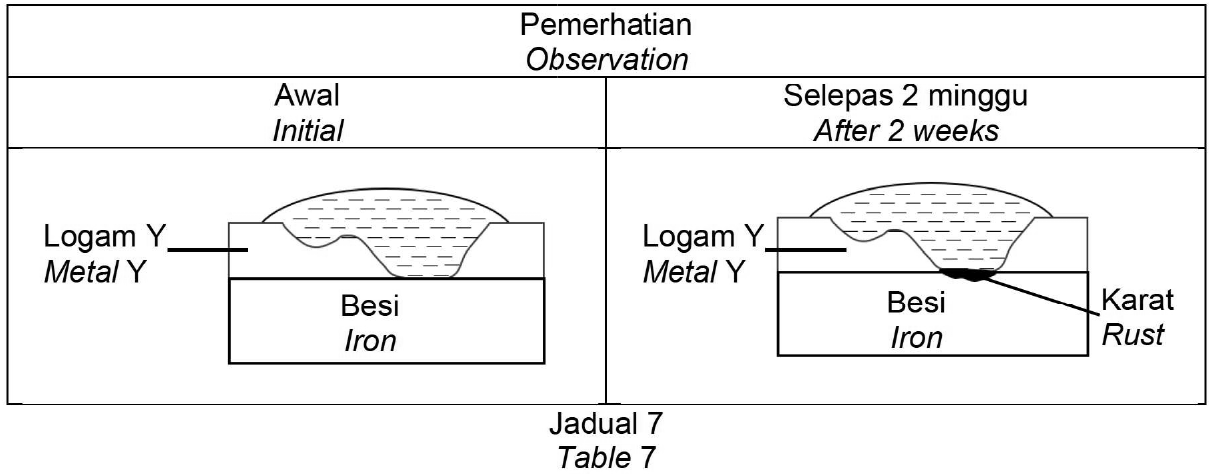
Table 7 shows observations on iron plated with metal Y. Observations were recorded when the plated surface was scratched and the iron was exposed to the environment: initially, no rust; after 2 weeks, rust forms on the exposed iron. Metal Y maybe… I. Magnesium; II. Aluminium; III. Copper; IV. Stanum
Medium
The following equation represents the reaction between iron and chlorine gas: 2Fe + 3Cl₂ → 2FeCl₃. What is the change in oxidation number of chlorine?
Medium
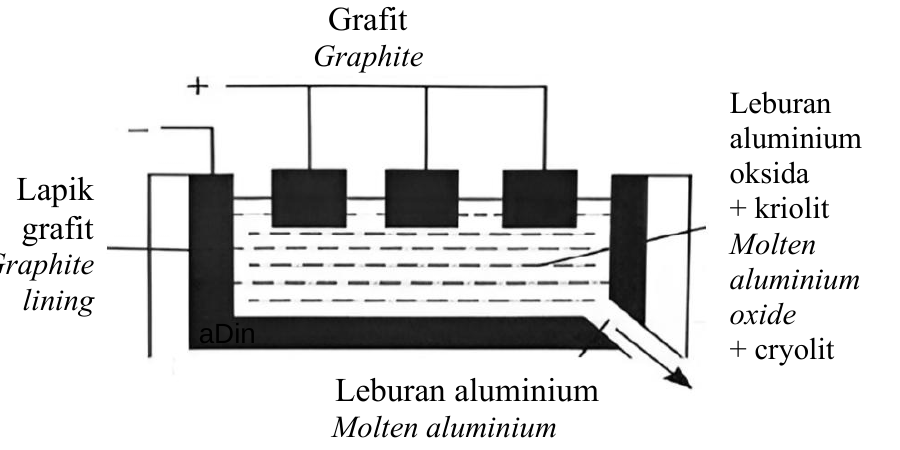
Diagram 5 shows the process of extraction of aluminium from its ore (electrolysis of molten aluminium oxide + cryolite with graphite electrodes and graphite lining). Which of the following statements is correct about Diagram 5?
Medium
Silver metal is displaced when a copper strip is placed in silver nitrate solution. What is the observation for this reaction?
Medium
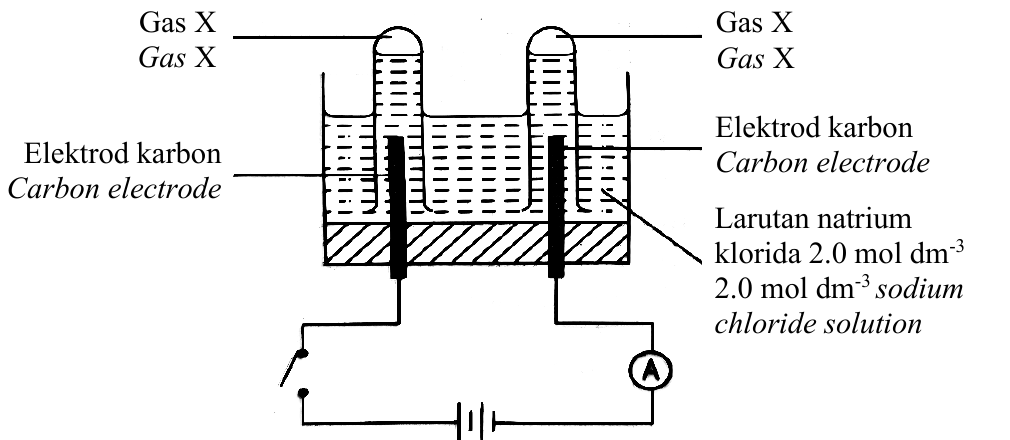
Diagram 13 shows the apparatus set up to study the electrolysis of sodium chloride solution (2.0 mol dm⁻³) using carbon electrodes. What are the names of gas X and gas Y?
Medium
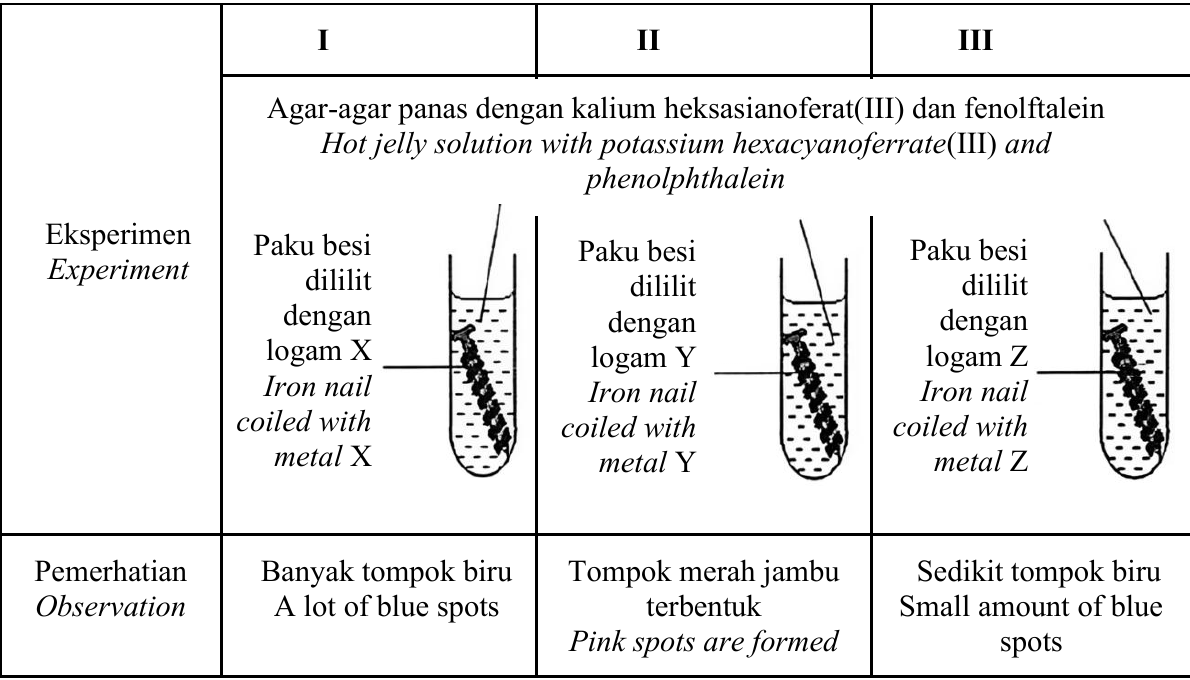
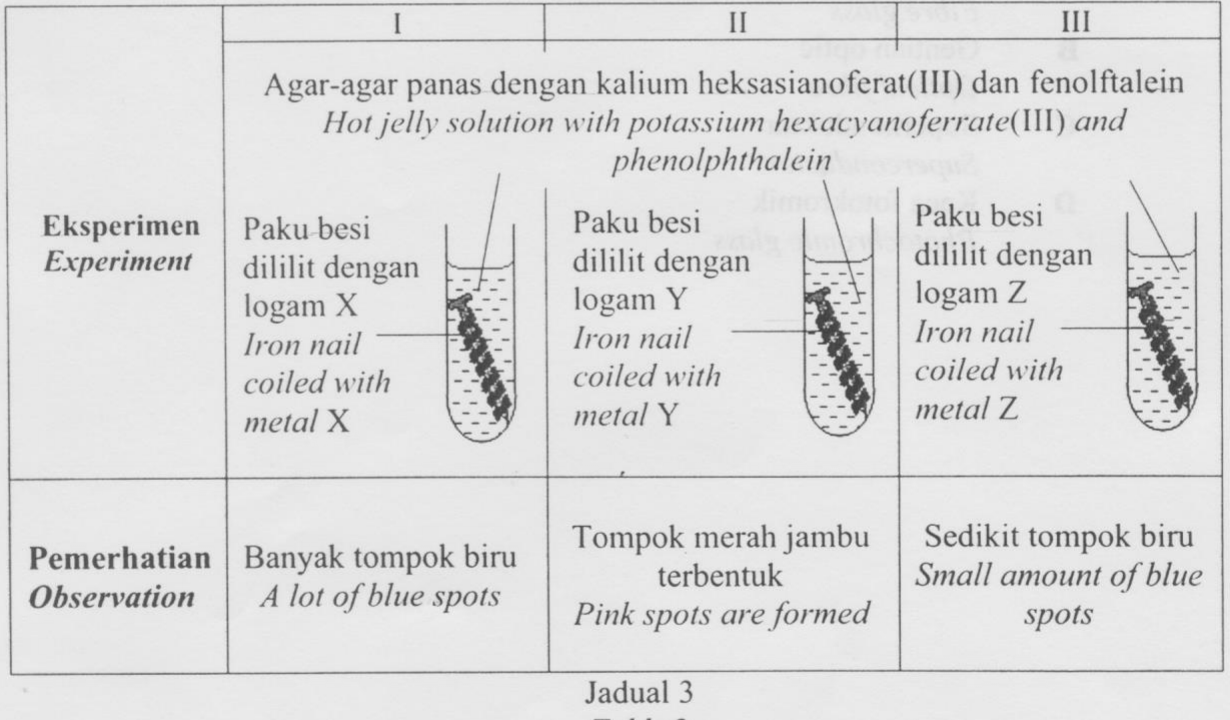
Table 3 shows the apparatus set up to investigate the effect of metals X, Y and Z on the rusting of iron. Hot jelly solution with potassium hexacyanoferrate(III) and phenolphthalein. Experiment I: iron nail coiled with metal X - a lot of blue spots. Experiment II: iron nail coiled with metal Y - pink spots are formed. Experiment III: iron nail coiled with metal Z - small amount of blue spots. Based on the experiment, arrange the metals in order of decreasing electropositivity.
Medium
Fe³⁺ ion in solution can be converted to Fe²⁺ ions by adding zinc powder. Which of the following can replace zinc powder in this reaction?
Medium
Which of the following reactions shows that copper is oxidised?
Medium
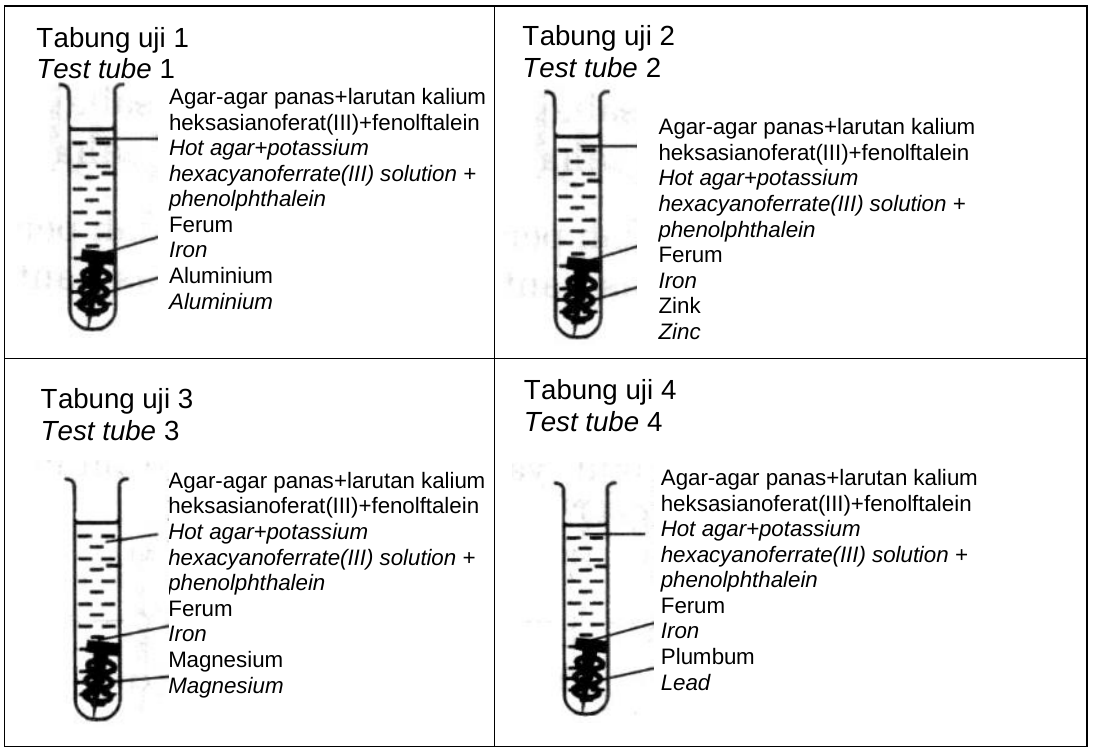
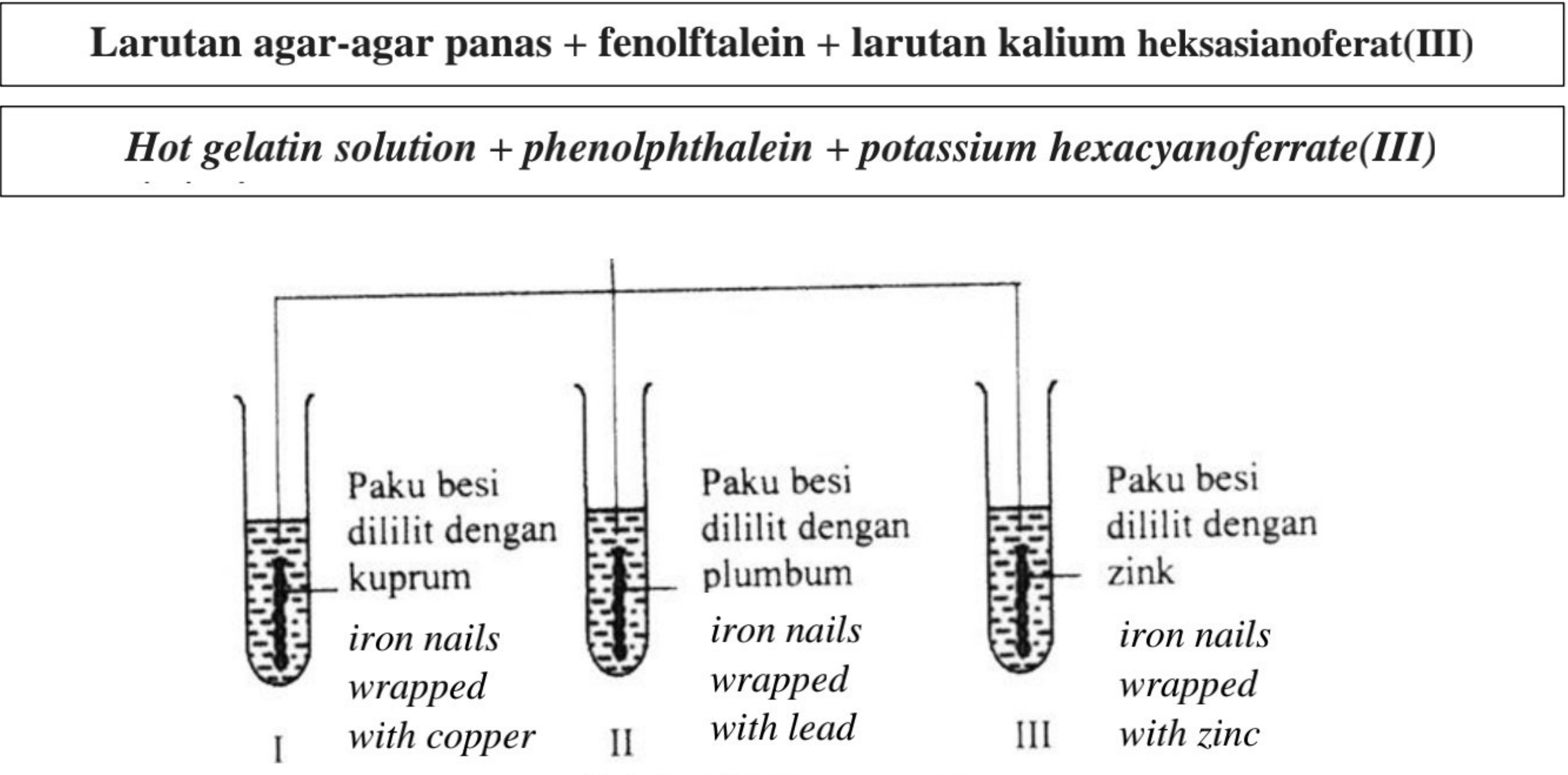
Diagram 6 shows four pairs of metals in different test tubes (each test tube contains hot agar + potassium hexacyanoferrate(III) solution + phenolphthalein with iron nail paired with: 1 aluminium, 2 zinc, 3 magnesium, 4 lead). After one day, in which test tube is the solution blue?
Medium
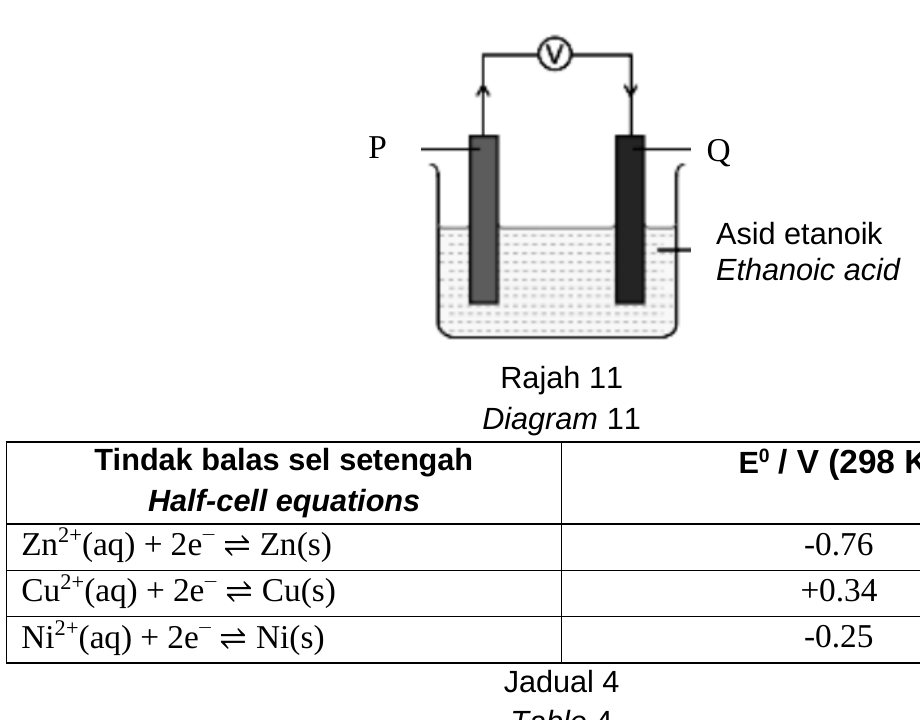
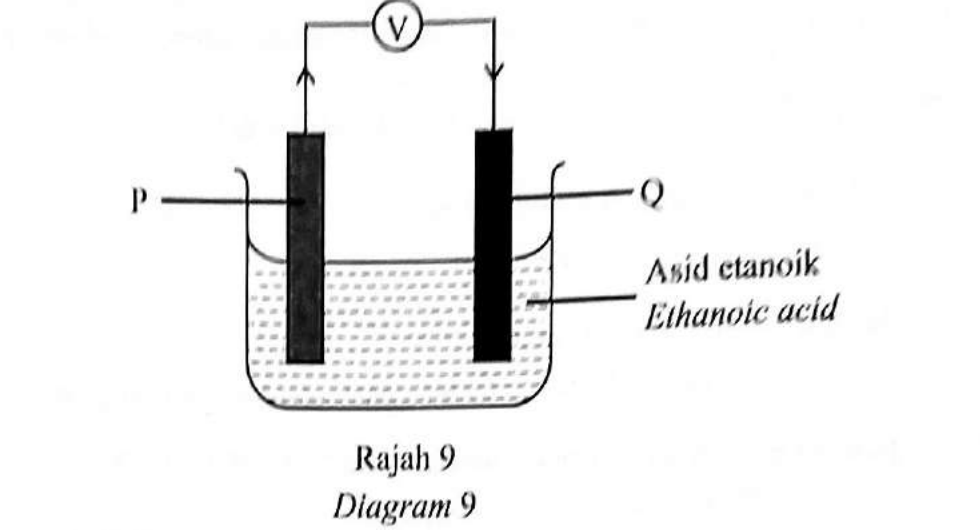
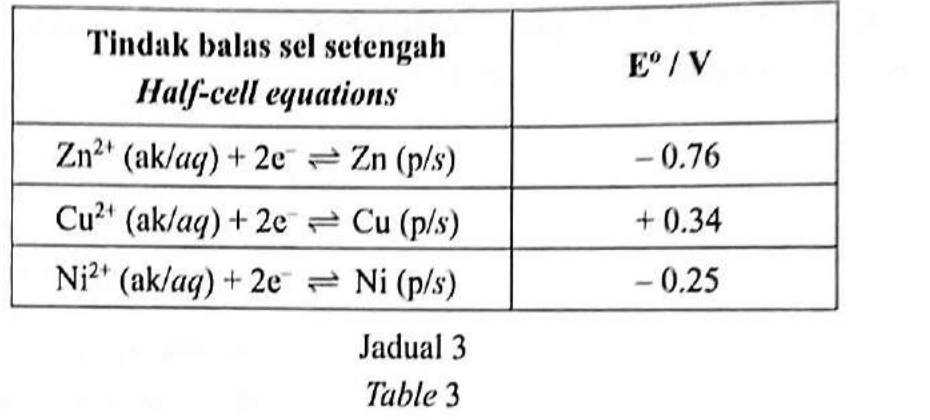
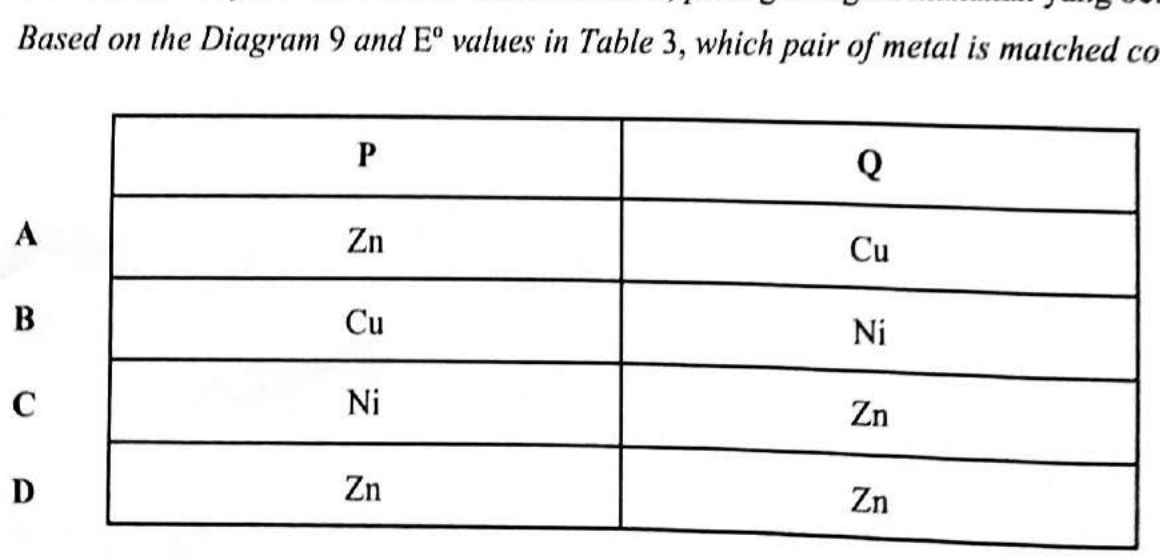
Diagram 11 shows a chemical cell (electrodes P and Q in ethanoic acid joined to a voltmeter) and Table 4 shows standard electrode potential values: Zn²⁺ + 2e⁻ ⇌ Zn, -0.76 V; Cu²⁺ + 2e⁻ ⇌ Cu, +0.34 V; Ni²⁺ + 2e⁻ ⇌ Ni, -0.25 V. Based on the Diagram 11 and E° values in Table 4, which pair is matched correctly?
Medium
Which of the following statements does not correctly describe the reduction reaction?
Medium
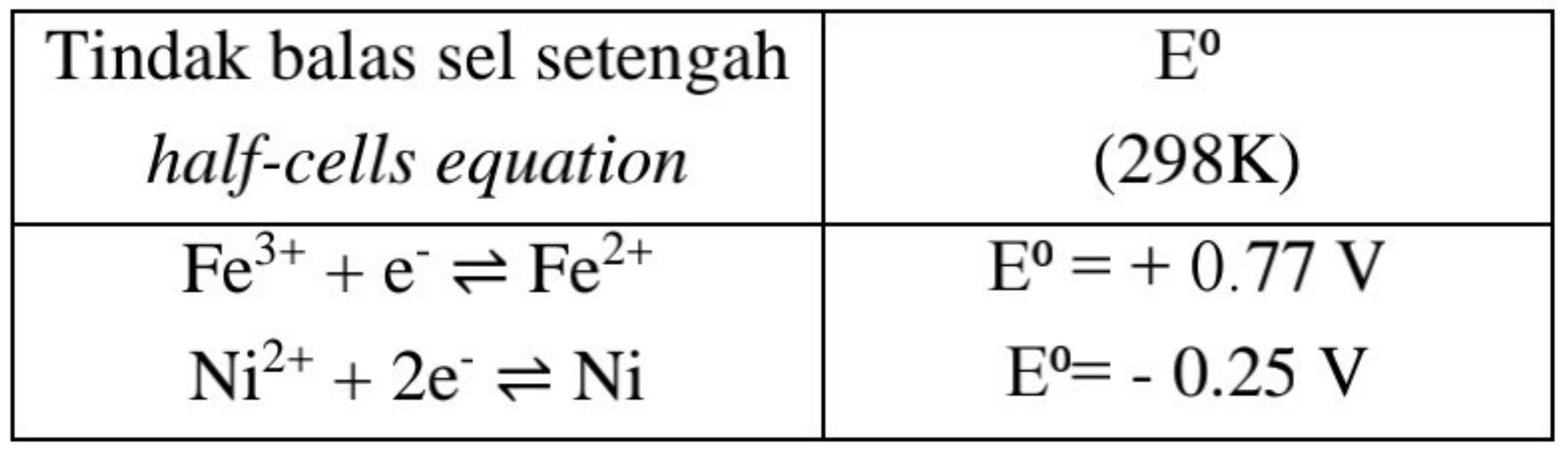
The standard electrode potential for two half-cells equation are shown below.
Fe³⁺ + e⁻ ⇌ Fe²⁺ E° = +0.77 V
Ni²⁺ + 2e⁻ ⇌ Ni E° = -0.25 V
Which substance is the strongest reducing agent?
Medium
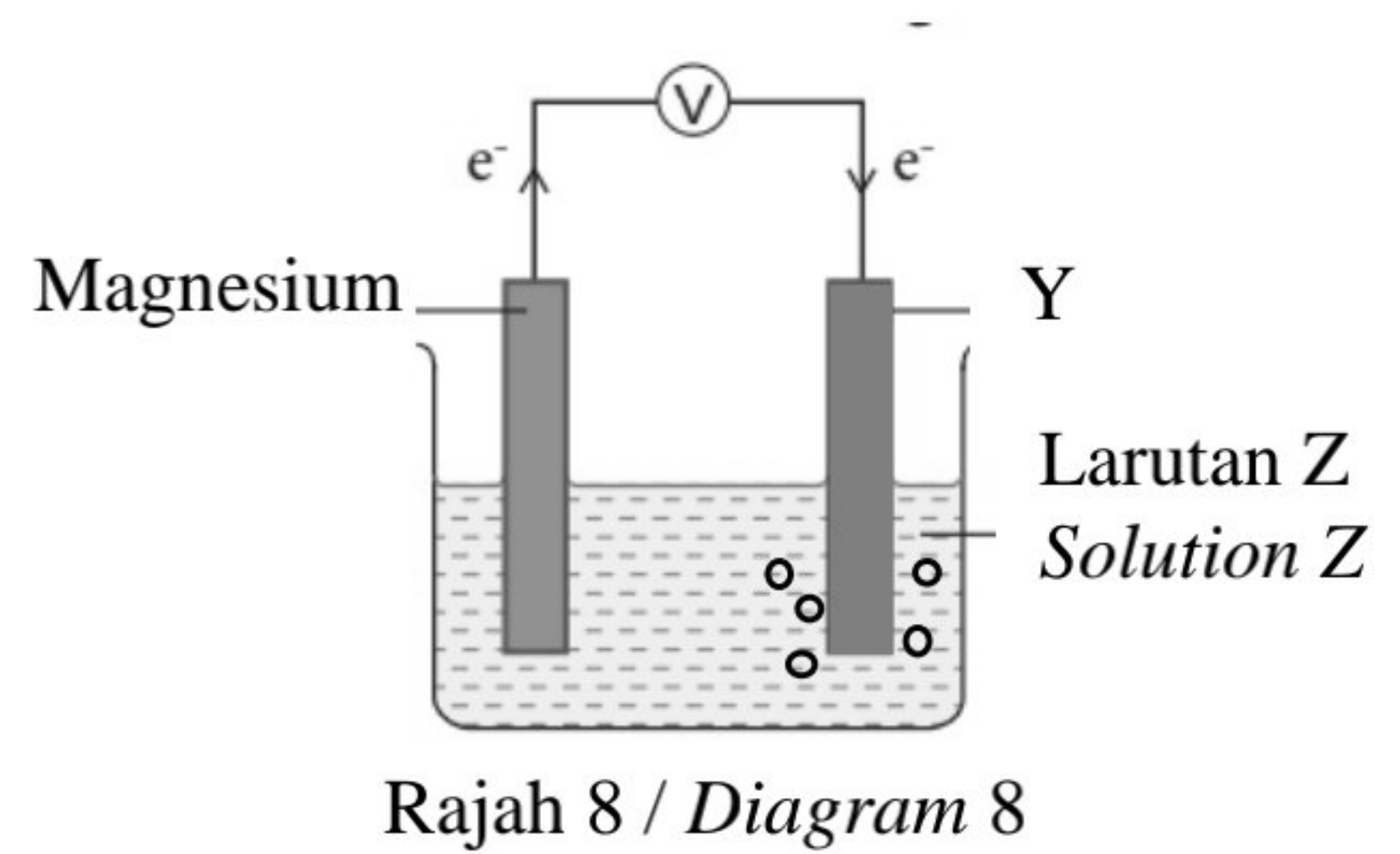
Diagram 8 shows a simple chemical cell (magnesium electrode, electrode Y, solution Z; electrons flow from magnesium to Y through a voltmeter).
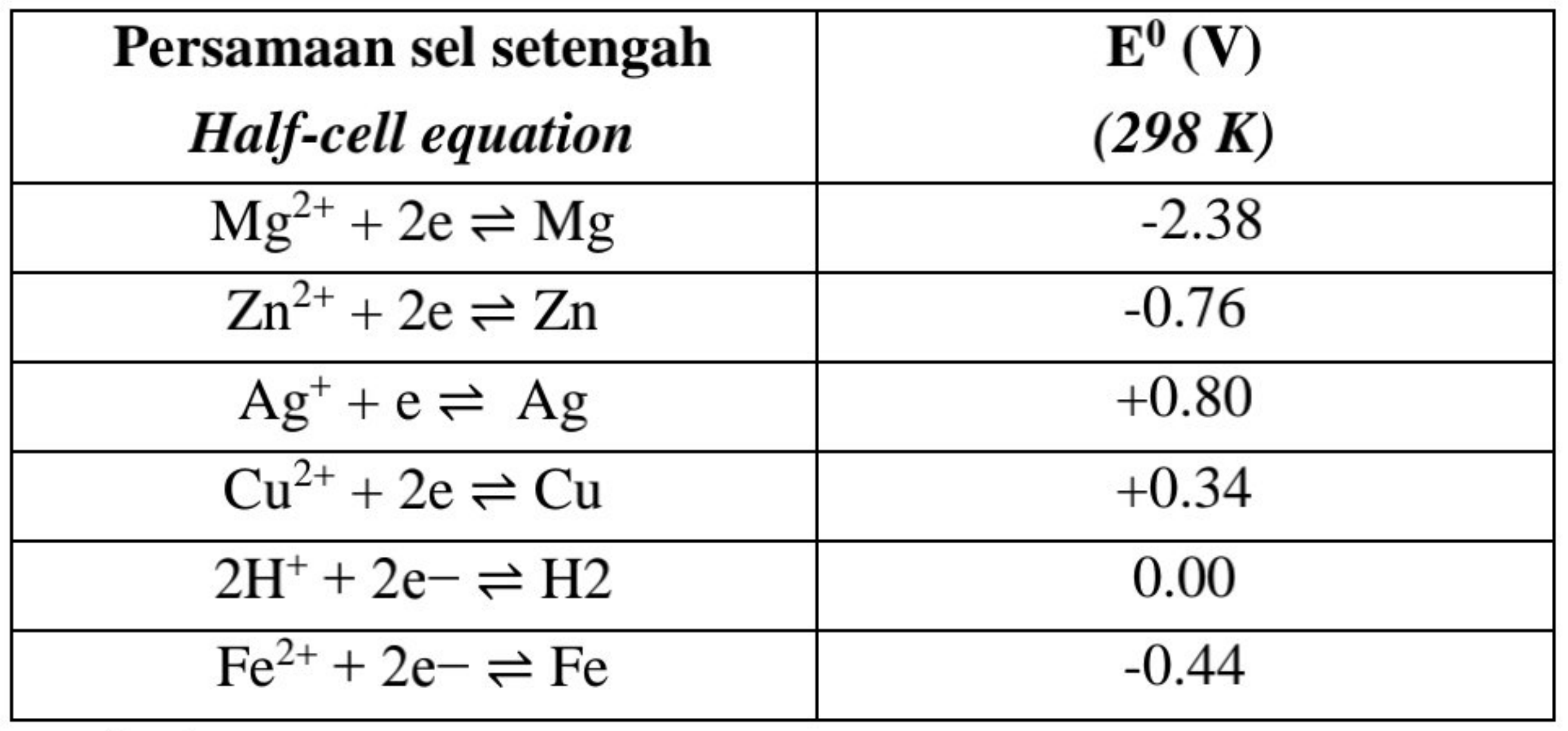
Which of the following solutions are suitable to use as solution Z so colourless gas bubble release at Y electrode?
I Zinc nitrate
II Copper (II) sulphate
III Silver nitrate
IV Iron (II) sulphate
(Half-cell E° table: Mg²⁺/Mg -2.38 V; Zn²⁺/Zn -0.76 V; Ag⁺/Ag +0.80 V; Cu²⁺/Cu +0.34 V; 2H⁺/H₂ 0.00 V; Fe²⁺/Fe -0.44 V)
Medium
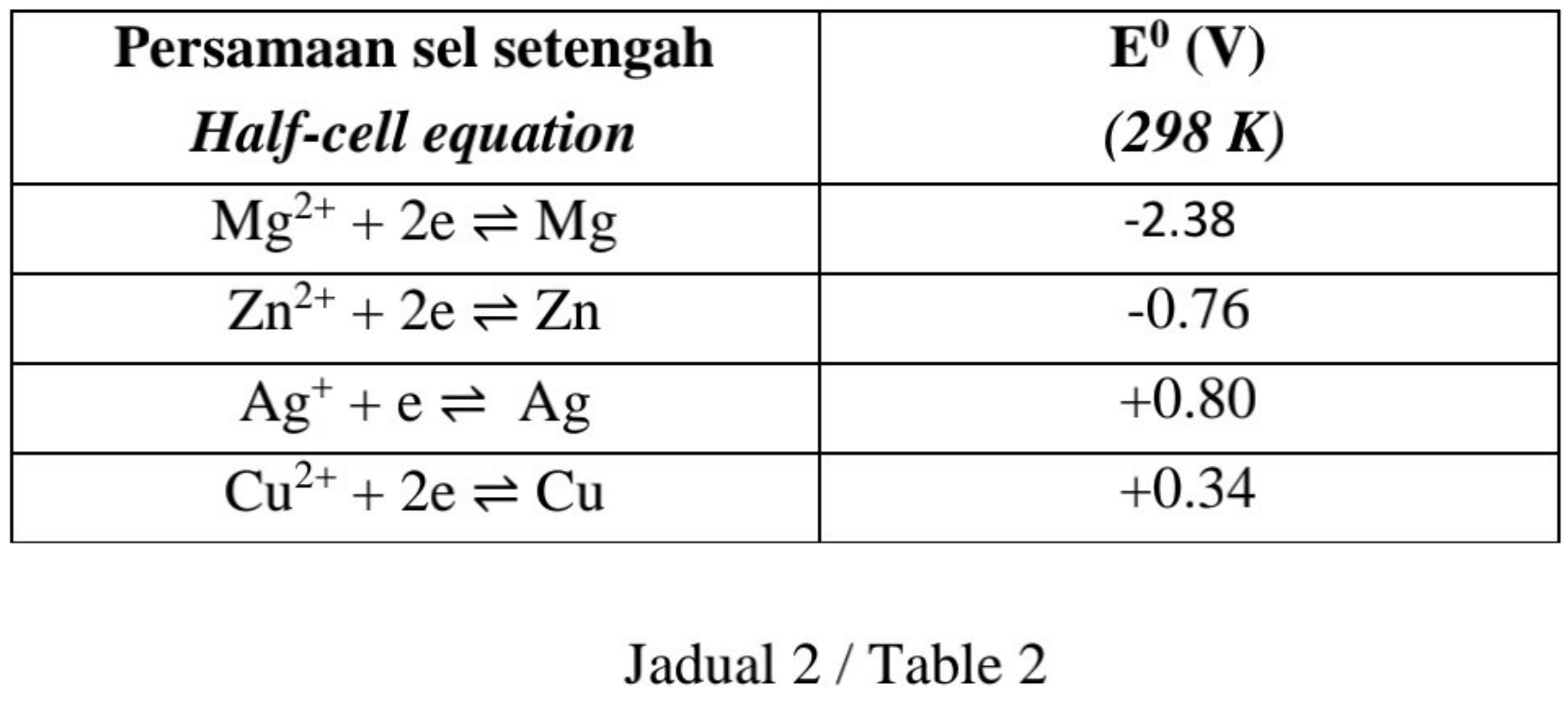
Table 2 shows the value of standard electrode potential, E° of several half equation reactions.
Mg²⁺ + 2e ⇌ Mg -2.38 V; Zn²⁺ + 2e ⇌ Zn -0.76 V; Ag⁺ + e ⇌ Ag +0.80 V; Cu²⁺ + 2e ⇌ Cu +0.34 V
Which of the following pair of metals will produce the highest voltage in chemical cell?
I Magnesium II Zinc III Silver IV Copper
Medium
A student conduct a laboratory activity to build a simple battery using solid naphthalene, C₁₀H₈. After complete circuit is assembled, the voltmeter needle is not deflected.
Which of the following statements is the step that the student should take so that the voltmeter needle is deflected?
Medium
Which of the following reactions is an oxidation reaction?
Medium
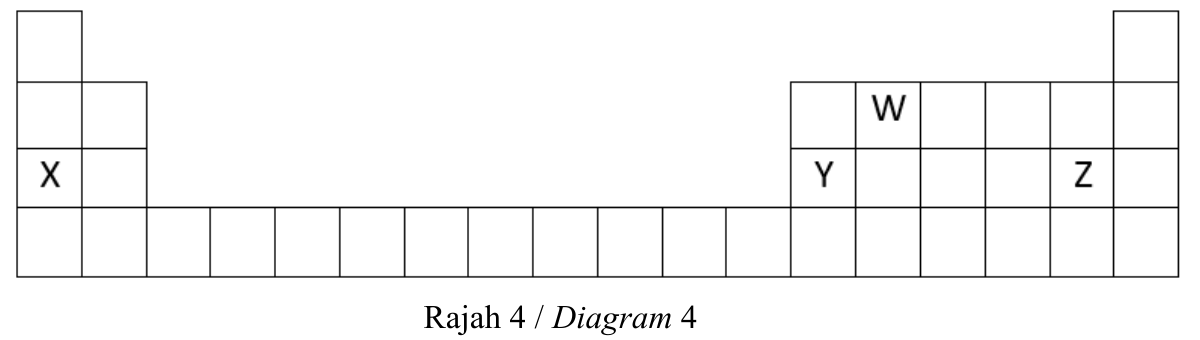
Diagram 4 shows the Periodic Table of Elements consisting of elements W, X, Y and Z. Which of the following elements forms a compound that can be used as an electrolyte in an electrolytic cell?
Medium
What is the oxidation number of sulphur in sulphuric acid, H2SO4?
Medium
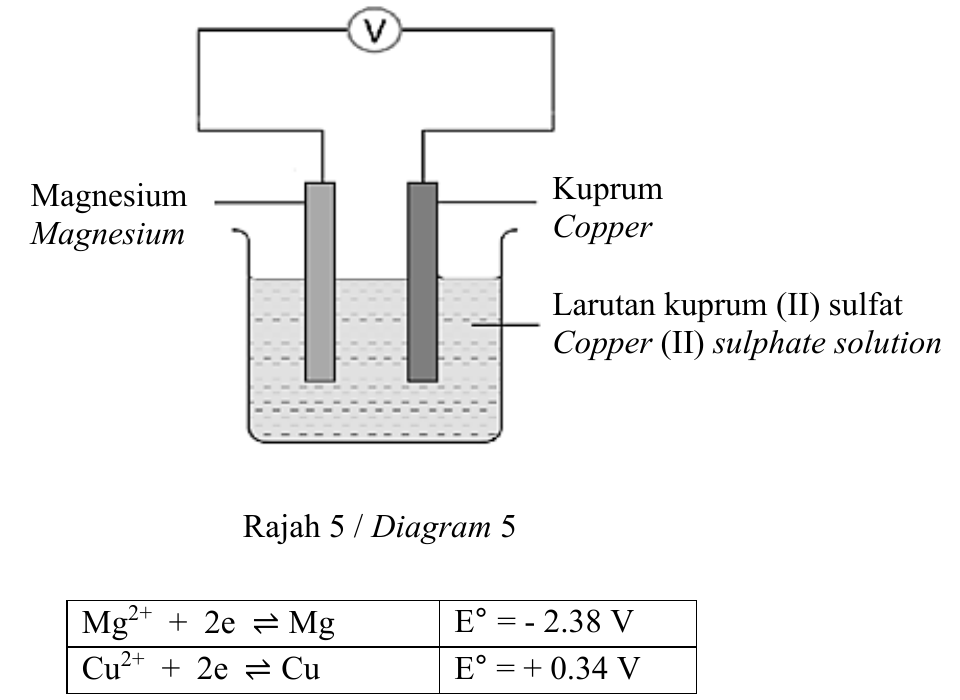
Diagram 5 shows the set-up of apparatus of a chemical cell (magnesium and copper electrodes in copper (II) sulphate solution). Mg2+ + 2e ⇌ Mg, E° = -2.38 V; Cu2+ + 2e ⇌ Cu, E° = +0.34 V. Which of the following statements are correct about the cell?
I Magnesium electrode acts as negative terminal
II Copper electrode acts as negative terminal
III Copper (II) ion undergoes oxidation reaction
IV Copper (II) ion undergoes reduction reaction
Medium
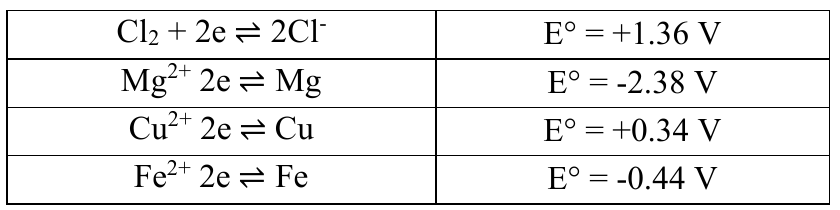
Table 2 shows a part of the standard electrode potential series of half-cells for several chemicals.
Cl2 + 2e ⇌ 2Cl-, E° = +1.36 V
Mg2+ + 2e ⇌ Mg, E° = -2.38 V
Cu2+ + 2e ⇌ Cu, E° = +0.34 V
Fe2+ + 2e ⇌ Fe, E° = -0.44 V
Which is the strongest oxidising agent?
Medium
Which of the following statements are true?
I Half-cells that have a positive E° value more easily undergo oxidation
II Half-cells with a negative E° value more easily undergo reduction
III Half-cells with a positive E° value more easily undergo reduction
IV Half-cells that have a negative E° value more easily undergo oxidation
Medium
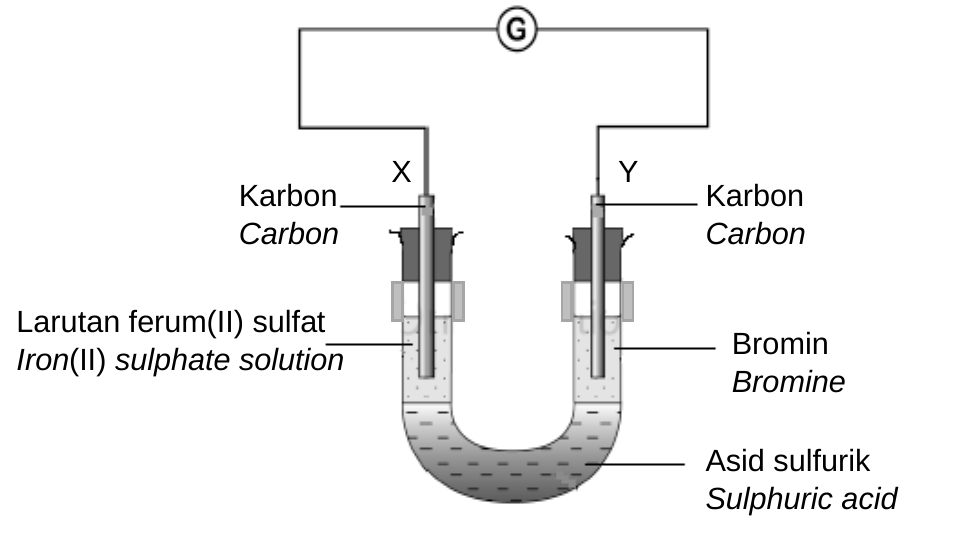
Diagram 10 shows the apparatus set-up to study the transfer of electrons at a distance: carbon electrodes X (in iron(II) sulphate solution) and Y (in bromine) in a U-tube of sulphuric acid, connected by wires through a galvanometer. Which of the following is correct based on Diagram 10?
Medium
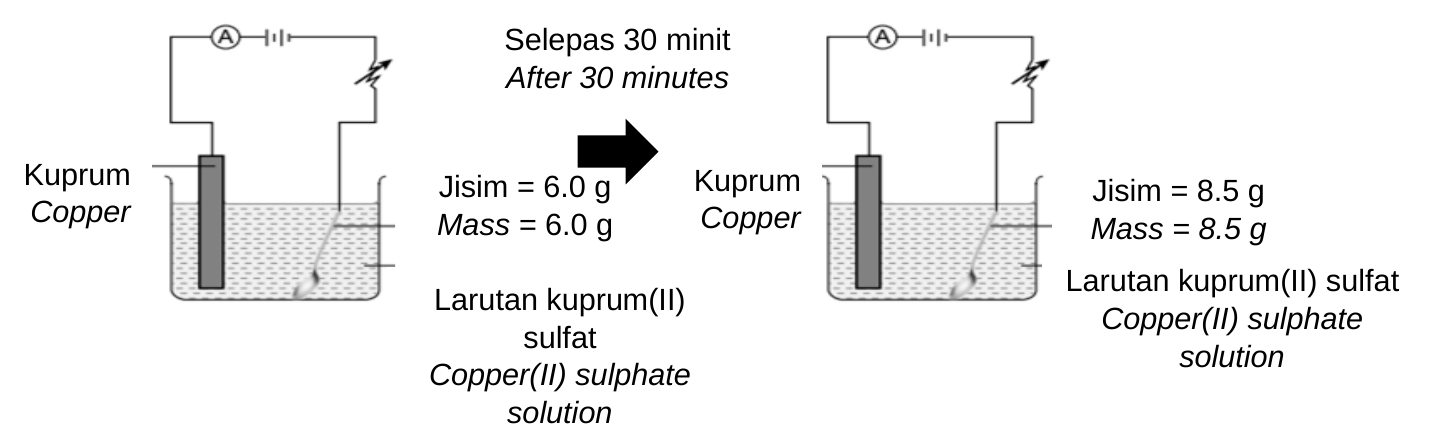
Diagram 17 shows the results of an electrolytic cell experiment: the mass of the copper electrode (cathode) is 6.0 g before and 8.5 g after 30 minutes in copper(II) sulphate solution. What is the number of copper atoms produced at the iron spoon after the experiment is done? [Relative atomic mass Cu = 64; Avogadro constant = 6.02 × 10^23 mol-1]
Medium
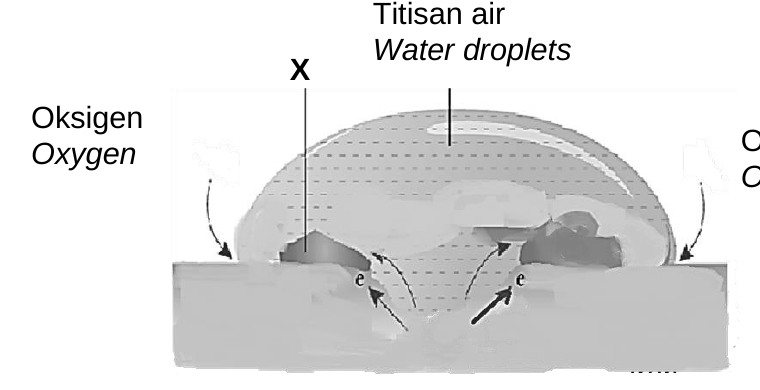
Diagram 18 shows the mechanism of formation of X (a water droplet on iron with oxygen, and electron flow). Which equations are involved in the formation of X? I Fe → Fe2+ + 2e; II Fe3+ → Fe2+ + e; III Fe3+ + OH- → Fe(OH)3; IV O2 + 2H2O + 4e → 4OH-
Medium
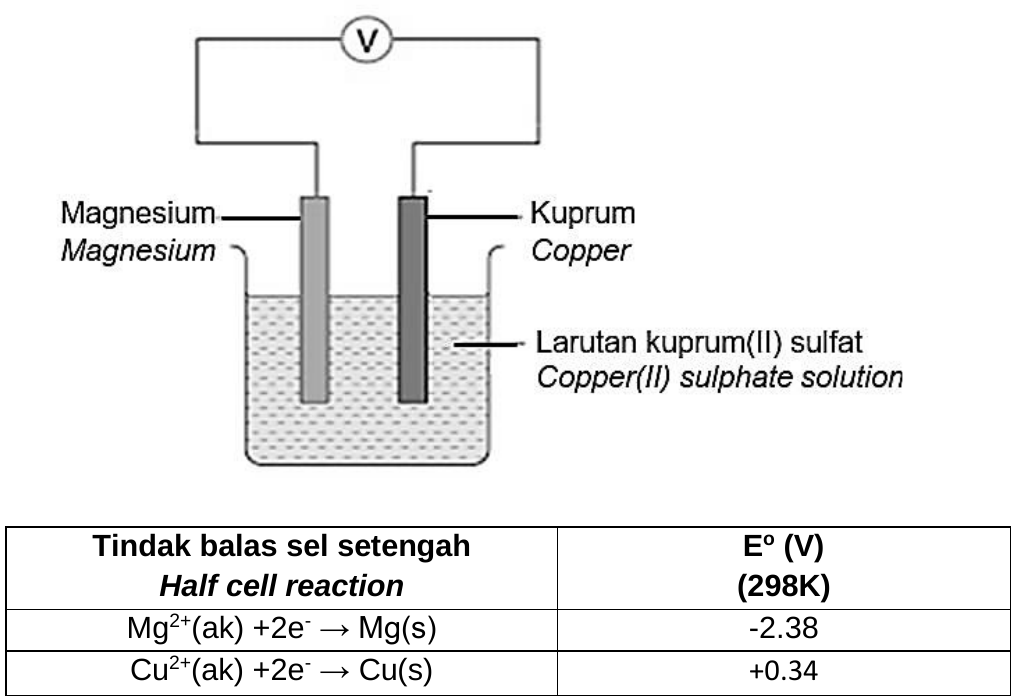
Diagram 24 shows a chemical cell (magnesium and copper electrodes in copper(II) sulphate solution) and standard electrode potential values: Mg2+ + 2e- → Mg, E° = -2.38 V; Cu2+ + 2e- → Cu, E° = +0.34 V. Calculate the cell voltage produced.
Medium
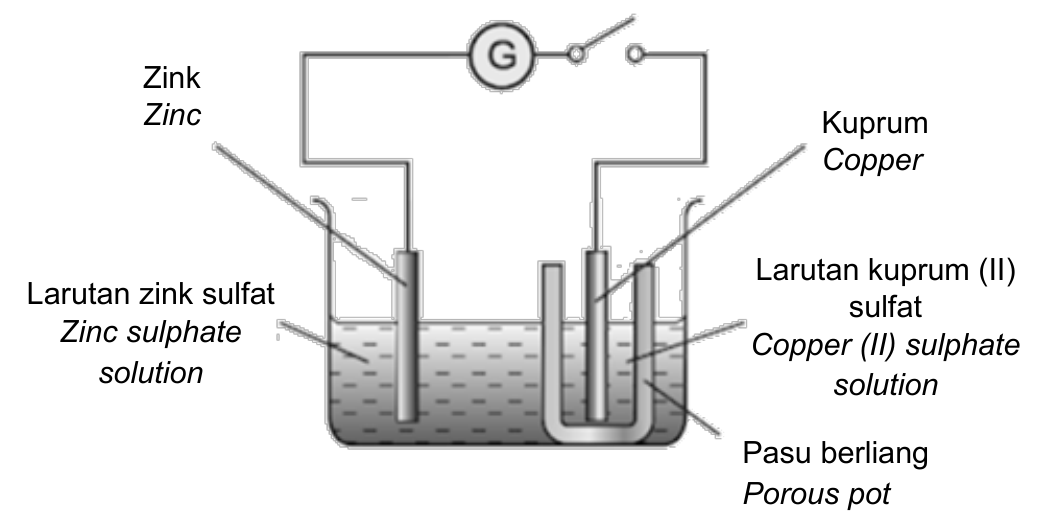
Diagram 4 shows the arrangement of the apparatus for a Daniell cell (zinc in zinc sulphate solution, copper in copper(II) sulphate solution, porous pot). Which of the following is the half equation for the reactions at the positive and negative terminals of the cell?
Option | Negative terminal | Positive terminal
A | Zn → Zn2+ + 2e- | Cu2+ + 2e- → Cu
B | Cu+ + e- → Cu | Zn → Zn+ + e-
C | Cu → Cu2+ + 2e- | Zn2+ + 2e- → Zn
D | Zn → Zn+ + e- | Cu+ + e- → Cu
Medium
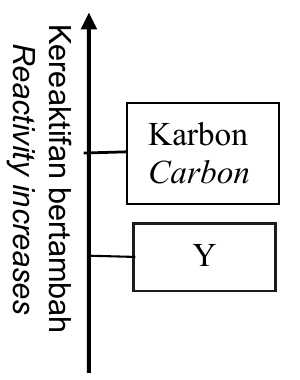
Diagram 8 shows the positions of carbon and metal Y in the Reactivity Series of Metals (Y is below carbon). Metal Y can be extracted from its ore using the reduction method by carbon. What is metal Y?
Medium
Given the following ionic equation: Cr2O7²⁻ + Fe²⁺ → Cr³⁺ + Fe³⁺
What is the correct observation and change in oxidation number for chromium during this reaction?
Medium
Diagram 11 shows the arrangement of the apparatus used by a student to plate an iron spoon using copper. The student found that plating was not done successfully. Which of the following steps needs to be done so that the plating can occur and be done evenly?
I Lower the voltage
II Add the number of dry cells
III Change the position between the iron spoon and copper
IV Increase the concentration of copper(II) sulphate
Medium
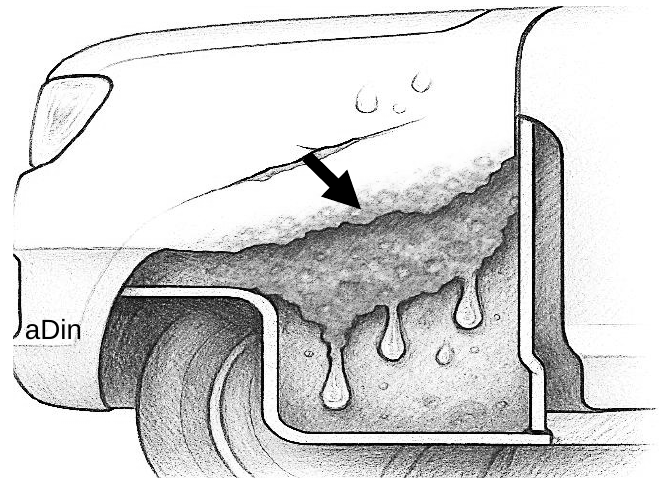
Diagram 12 shows a cross-section of part of a car body where the paint has been scratched and exposed to a humid environment. What will happen to the exposed iron area in terms of redox reactions?
Medium
What is a standard electrode potential?
Medium
In a redox reaction, oxidation and reduction occur simultaneously.
Which of the following involves a reduction?
Medium
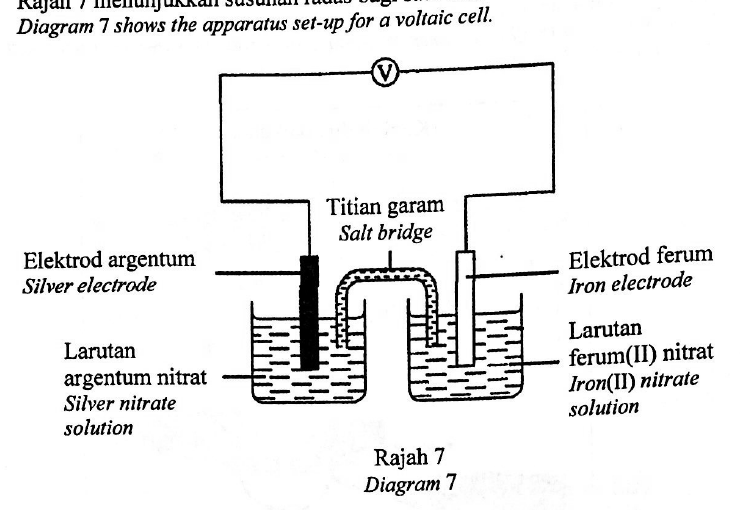
Diagram 7 shows the apparatus set-up for a voltaic cell (silver electrode in silver nitrate solution; iron electrode in iron(II) nitrate solution; salt bridge).
Given the following electrode potential values:
Ag⁺(aq) + e⁻ ⇌ Ag(s) E° = +0.80 V
Fe²⁺(aq) + 2e⁻ ⇌ Fe(s) E° = −0.40 V
What is the cell notation of the voltaic cell?
Medium
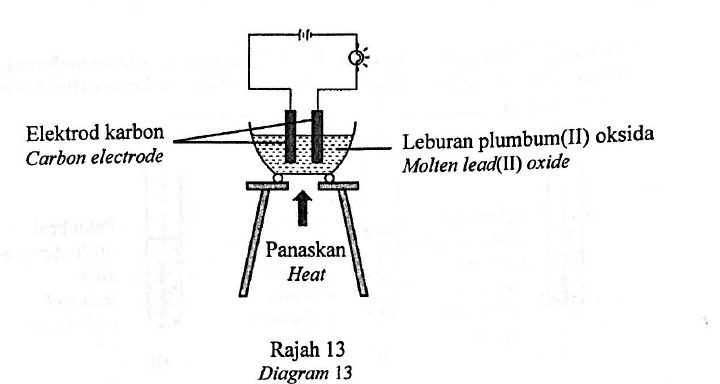
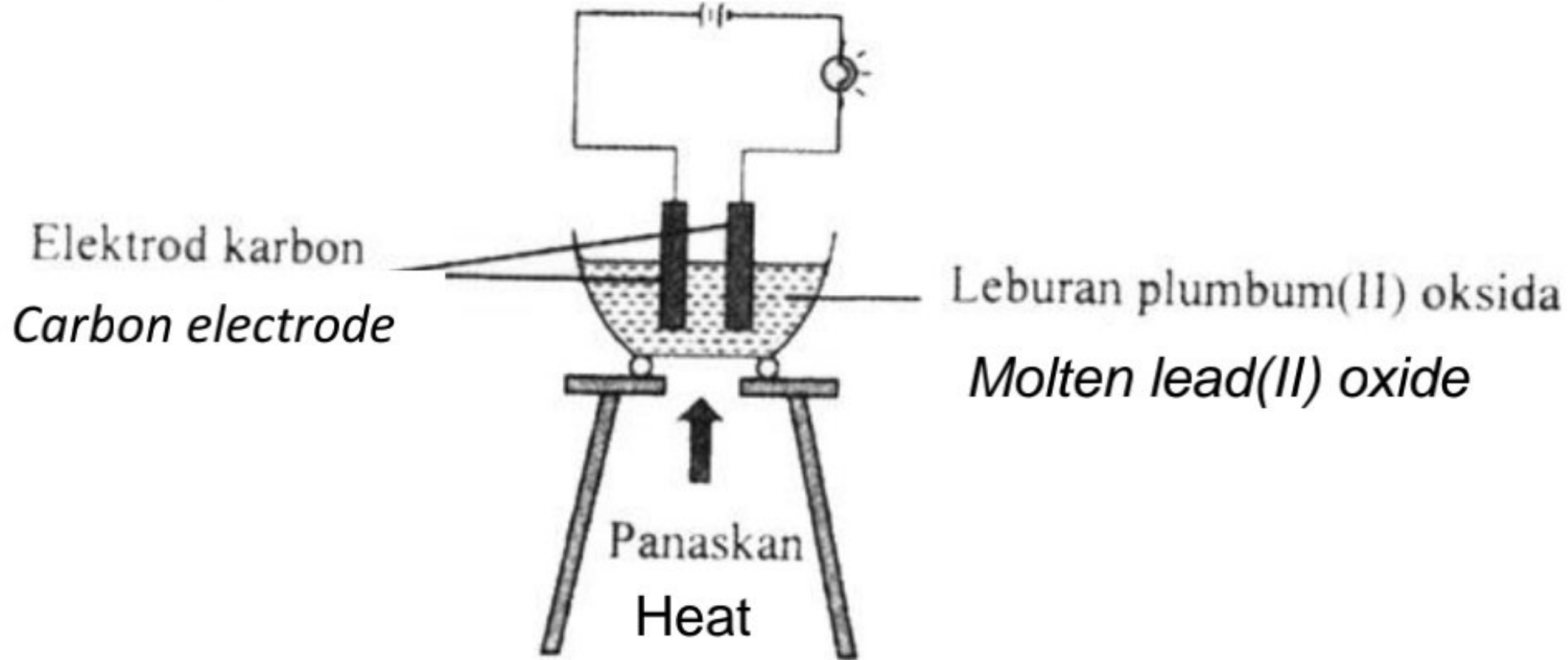
Diagram 13 shows the apparatus set-up for electrolysis of molten lead(II) oxide, PbO (carbon electrodes).
Which of the following half equations take place at anode and cathode?
Medium
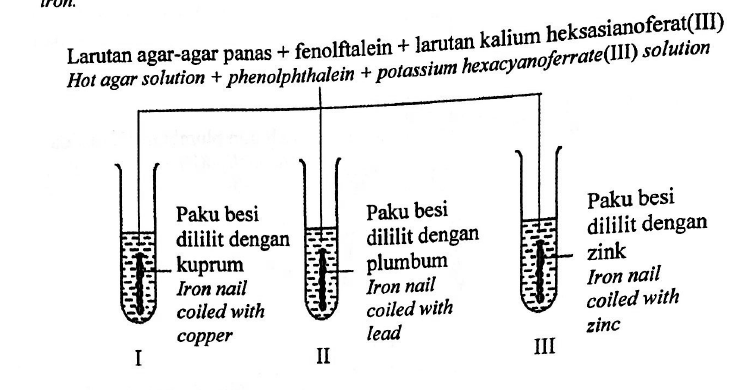
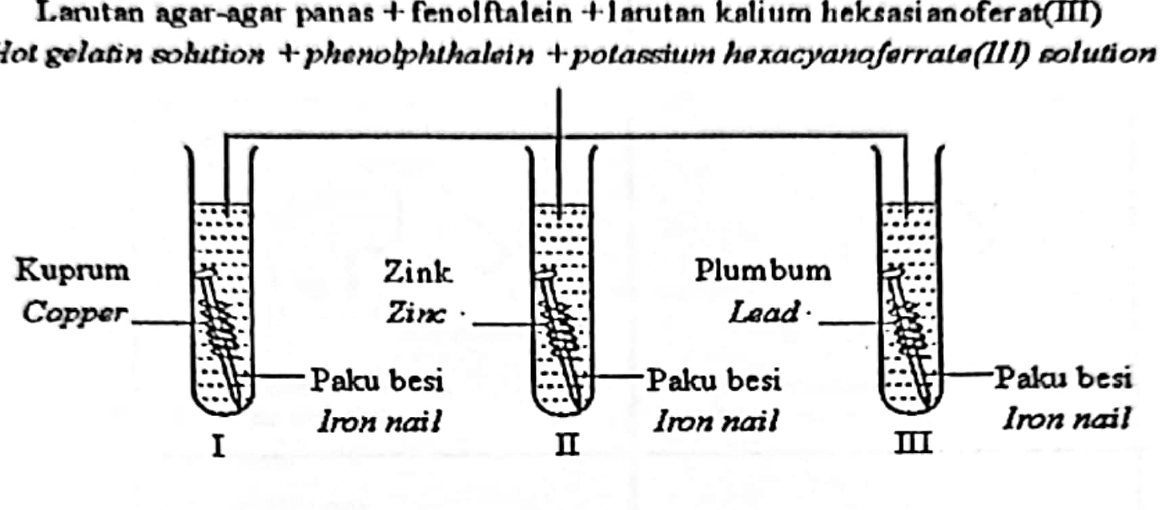
Diagram 14 shows the apparatus set-up to study the effect of other metals on the rusting of iron. Iron nails are coiled with copper (I), lead (II) and zinc (III) in hot agar-agar solution + phenolphthalein + potassium hexacyanoferrate(III) solution.
Given the following electrode potential value:
Zn²⁺(aq) + 2e⁻ ⇌ Zn(s) E° = −0.76 V
Fe²⁺(aq) + 2e⁻ ⇌ Fe(s) E° = −0.44 V
Pb²⁺(aq) + 2e⁻ ⇌ Pb(s) E° = −0.13 V
Cu²⁺(aq) + 2e⁻ ⇌ Cu(s) E° = +0.34 V
In which test tubes the blue spots can be observed?
Medium
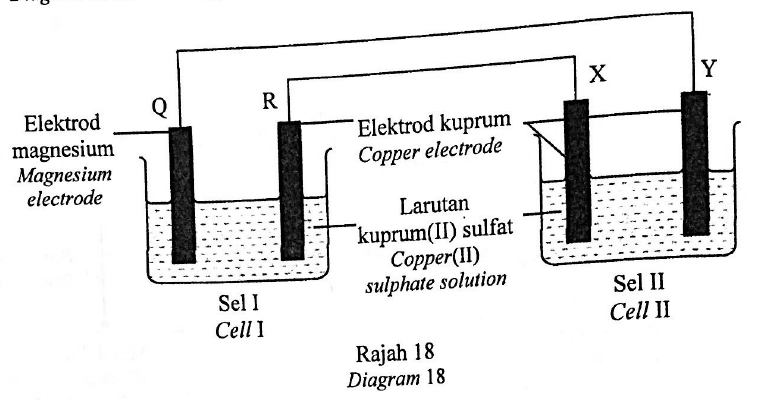
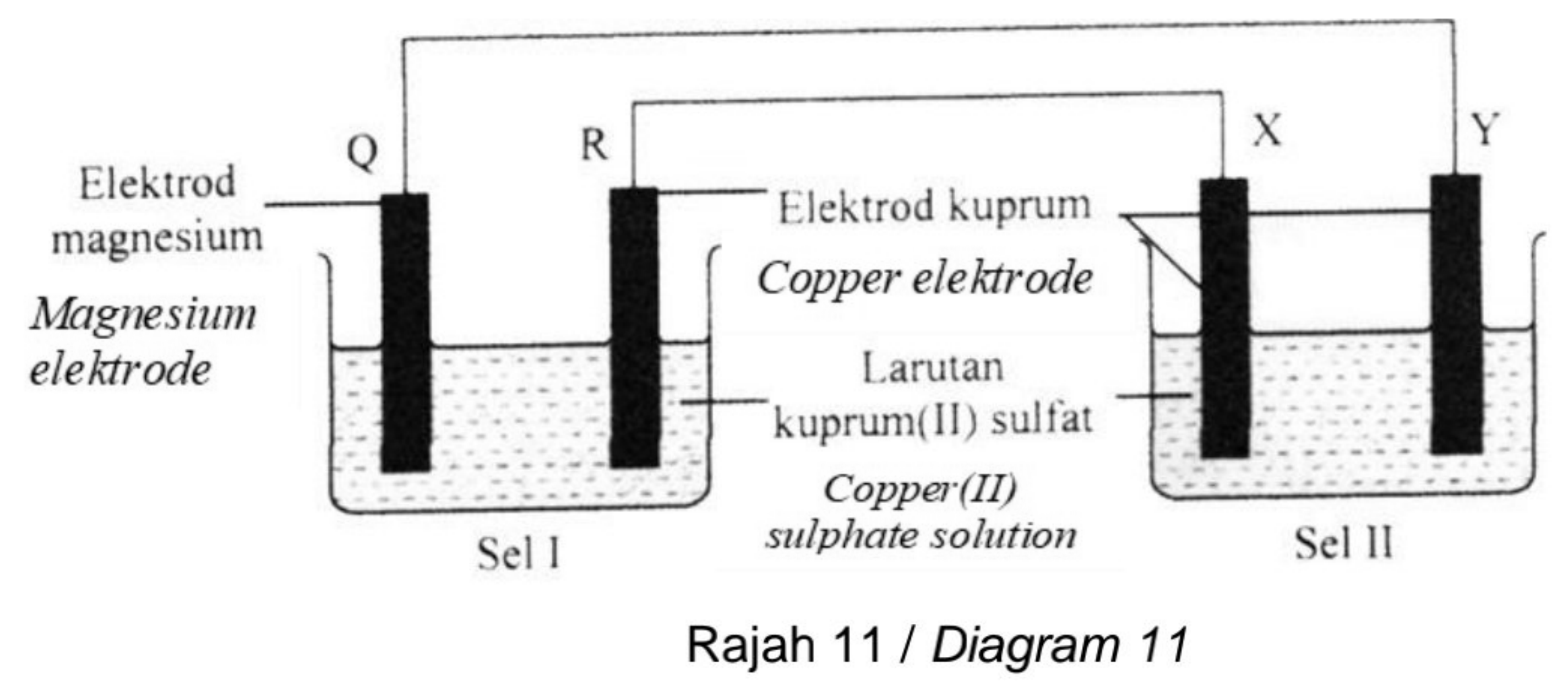
Diagram 18 shows the apparatus set-up for a combination of two cells. Cell I: magnesium electrode (Q) and copper electrode (R) in copper(II) sulphate solution; Cell II: electrodes X (copper) and Y in copper(II) sulphate solution.
Given: Mg²⁺(aq) + 2e⁻ ⇌ Mg(s) E° = −2.38 V; Cu²⁺(aq) + 2e⁻ ⇌ Cu(s) E° = +0.34 V.
Which of the following statements are true?
I: Bubbles of colourless gas is produced at electrode X
II: Electrode R and electrode Y become thinner
III: Electrode X and electrode Q are anode
IV: Blue colour of copper(II) sulphate solution in Cell II remains unchanged
Medium
The following equation represents the reaction between iron and chlorine gas: 2Fe + 3Cl₂ → 2FeCl₃. What is the change in oxidation number of chlorine?
Medium
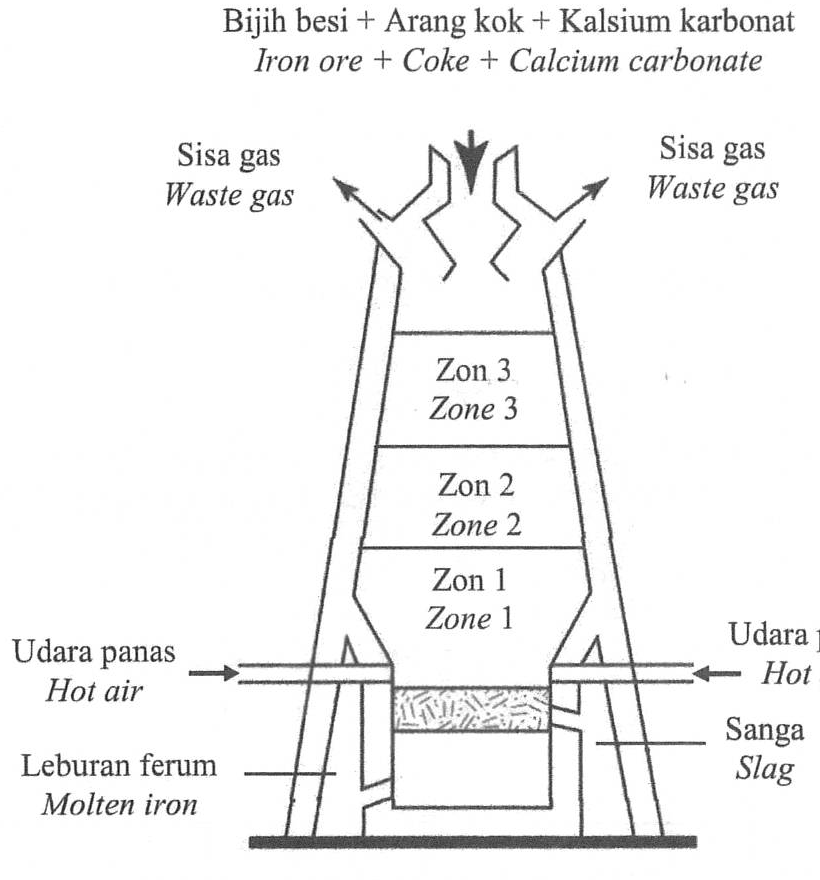
Diagram 4 shows the blast furnace used to extract iron from its ore. Which of the following chemical equation represents the reaction in Zone 2?
Medium
The extracted copper from copper pyrite has low degree of purity and needs to be purified through electrolysis. Which of the following apparatus set-up can be used to purify the copper?
Medium
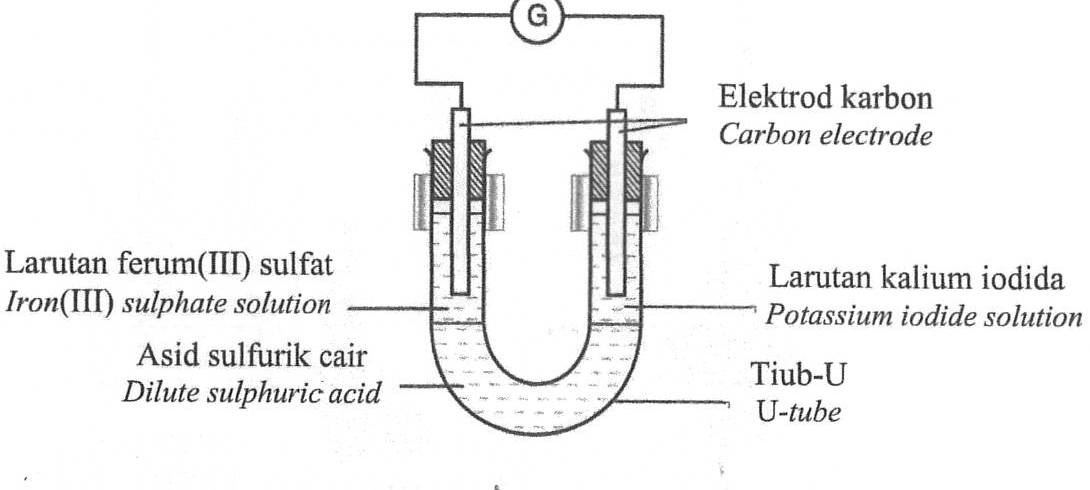
Diagram 23 shows the apparatus set-up to investigate the reaction between iron(III) sulphate solution with potassium iodide solution. Given the standard electrode potentials Fe³⁺ + e⁻ ⇌ Fe²⁺, E° = +0.77 V and I₂ + 2e⁻ ⇌ 2I⁻, E° = +0.54 V. Which of the following is the colour change of the two solutions? (Iron(III) sulphate solution; potassium iodide solution)
Medium
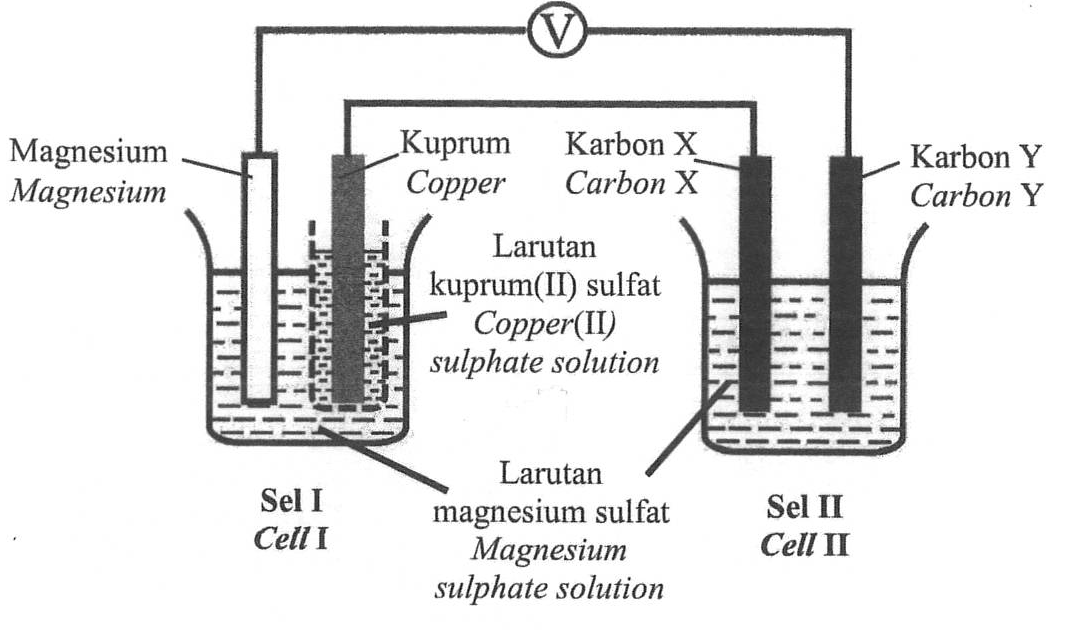
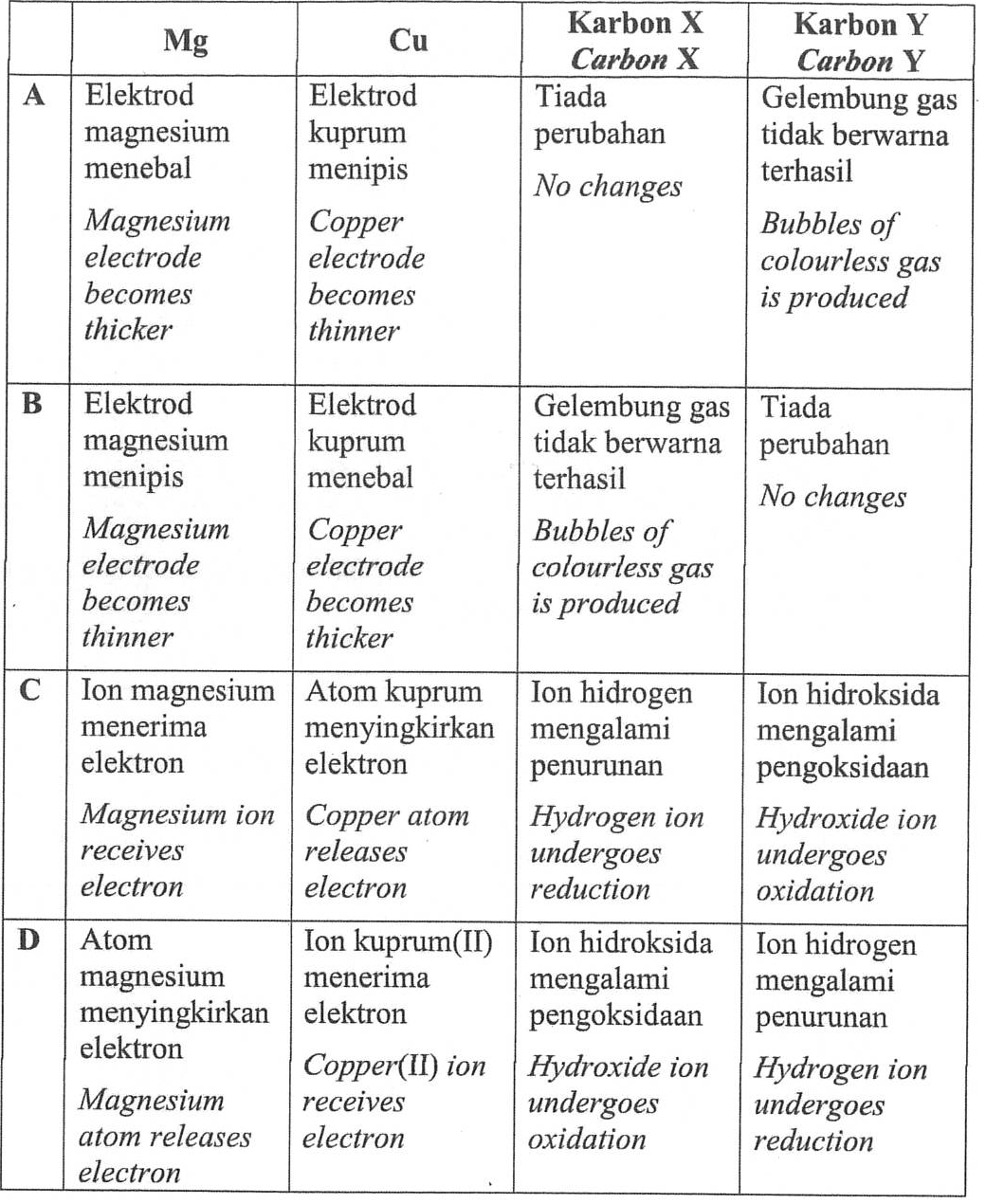
Diagram 24 shows two types of cells (Cell I: Mg in magnesium sulphate solution and Cu in copper(II) sulphate solution; Cell II: Carbon X and Carbon Y in an electrolyte). Given standard electrode potentials: Mg²⁺ + 2e⁻ ⇌ Mg E° = -2.38 V; 2H⁺ + 2e⁻ ⇌ H₂ E° = 0.00 V; Cu²⁺ + 2e⁻ ⇌ Cu E° = +0.34 V; O₂ + 2H₂O + 4e⁻ ⇌ 4OH⁻ E° = +0.40 V; S₂O₈²⁻ + 2e⁻ ⇌ 2SO₄²⁻ E° = +2.01 V. Which of the following is correct? (Mg; Cu; Carbon X; Carbon Y)
Medium
Iron(III) ions can be reduced to iron(II) ions by substance X. Which of the following is substance X?
Medium
The following ionic equation represents a redox reaction: 2Al + 3Cu2+ → 2Al3+ + 3Cu. Which statement is correct?
Medium
Table 3 shows the apparatus set-up to investigate the effect of metals X, Y and Z on the rusting of iron. Iron nail coiled with metal X: a lot of blue spots; with metal Y: pink spots are formed; with metal Z: small amount of blue spots (hot jelly solution with potassium hexacyanoferrate(III) and phenolphthalein). Based on the experiment, which arrangement of metals is in descending order of electropositivity?
Medium
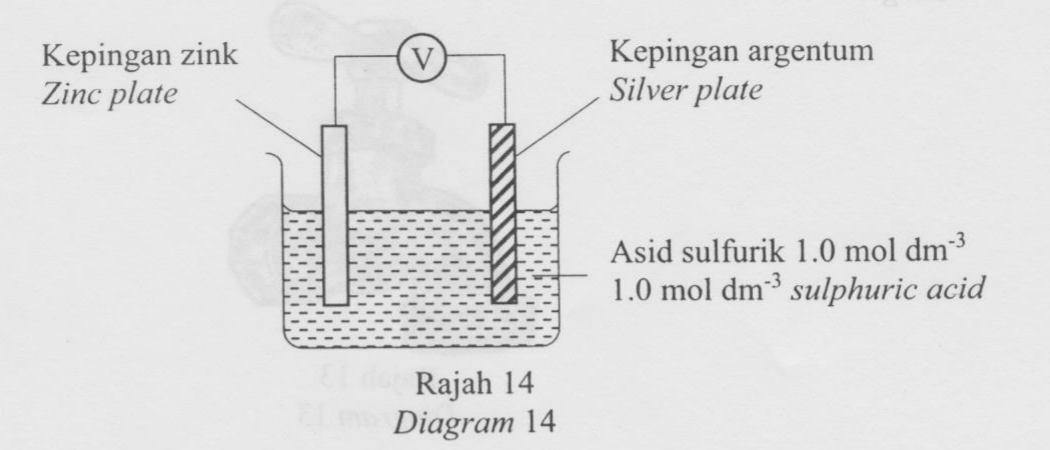
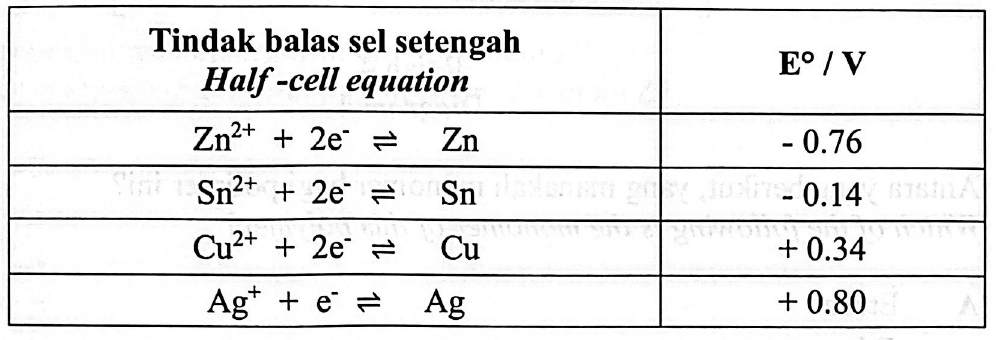
Diagram 14 shows a simple voltaic cell (zinc plate and silver plate in 1.0 mol dm-3 sulphuric acid). Given standard electrode potential: Zn2+ + 2e ⇌ Zn, E0 = -0.76 V; Ag+ + e ⇌ Ag, E0 = +0.80 V. What is the voltage value for the cell?
Medium
Which of the following processes occur in a reduction process? I Accepting of oxygen; II Loss of electron; III Accepting of hydrogen; IV Decreasing of oxidation number
Medium
Metal X has the following properties: less reactive than iron; does not react with iron(III) oxide. Which metal oxide can react with metal X?
Medium
A student adds a piece of zinc into a beaker containing copper(II) sulphate solution. He touches the beaker and feels warm. Given a part of the standard electrode potential, E°: Zn²⁺ + 2e⁻ ⇌ Zn, -0.76 V; Sn²⁺ + 2e⁻ ⇌ Sn, -0.14 V; Cu²⁺ + 2e⁻ ⇌ Cu, +0.34 V; Ag⁺ + e⁻ ⇌ Ag, +0.80 V. Which of the following metal will produce similar observation when added to copper(II) sulphate solution?
Medium
Which of the following reactants will produce a redox reaction?
Medium
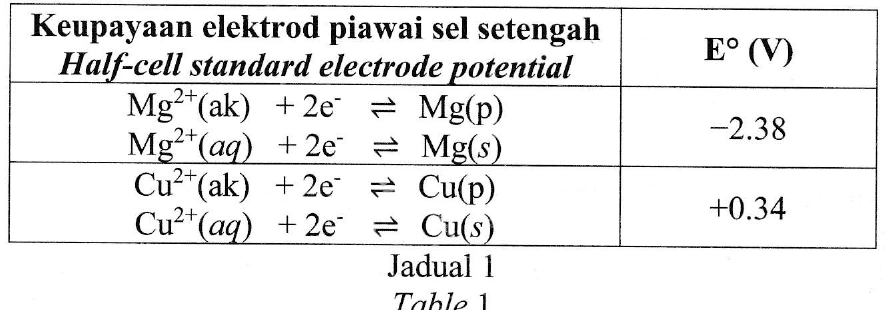
Table 1 shows the standard electrode potential values of half cells for two metals in a chemical reaction: Mg²⁺(aq) + 2e⁻ ⇌ Mg(s), E° = −2.38 V; Cu²⁺(aq) + 2e⁻ ⇌ Cu(s), E° = +0.34 V. Which of the following statements is correct for the reaction?
Medium
Table 2 shows the standard electrode potential of half-cells of two metals: L²⁺ + 2e⁻ ⇌ L, E° = −1.20 V; M³⁺ + 3e⁻ ⇌ M, E° = −2.08 V. Which of the following is the strongest reducing agent?
Medium
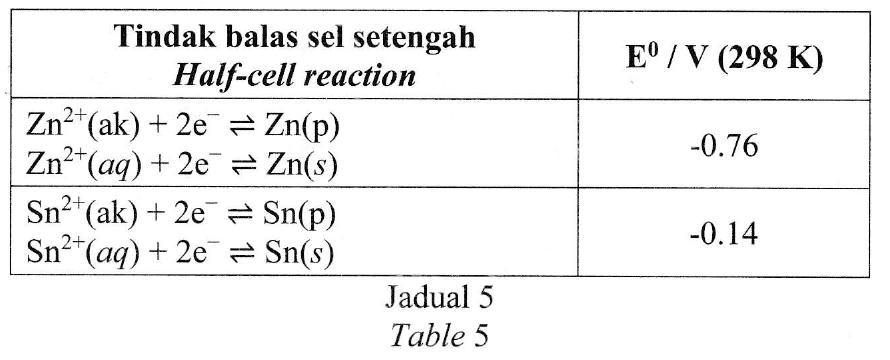
Table 5 shows half cells of two metals used to build a chemical cell: Zn²⁺(aq) + 2e⁻ ⇌ Zn(s), E° = −0.76 V; Sn²⁺(aq) + 2e⁻ ⇌ Sn(s), E° = −0.14 V. Which of the following cell notations represents the redox reaction taken place in the chemical cell?
Medium
Diagram 11 shows the apparatus set-up (U-tube with dilute sulphuric acid, carbon electrodes, galvanometer) to study the transfer of electron at a distance. After 30 minutes: solution R turns from brown to colourless; needle of galvanometer deflects. What are Q and R?
Medium
Solution Q is used to change iron(II) ion to iron(III) ion. What is Q?
Medium
Diagram 7 shows the apparatus set-up to study transfer of electron at a distance. Deflection of galvanometer needle shows that electron move from carbon electrode X to Y. Which of the following substances are suitable as solution Z?
I Chlorine water
II Potassium bromide solution
III Iron(II) sulphate solution
IV Acidified potassium dichromate(VI) solution
Medium
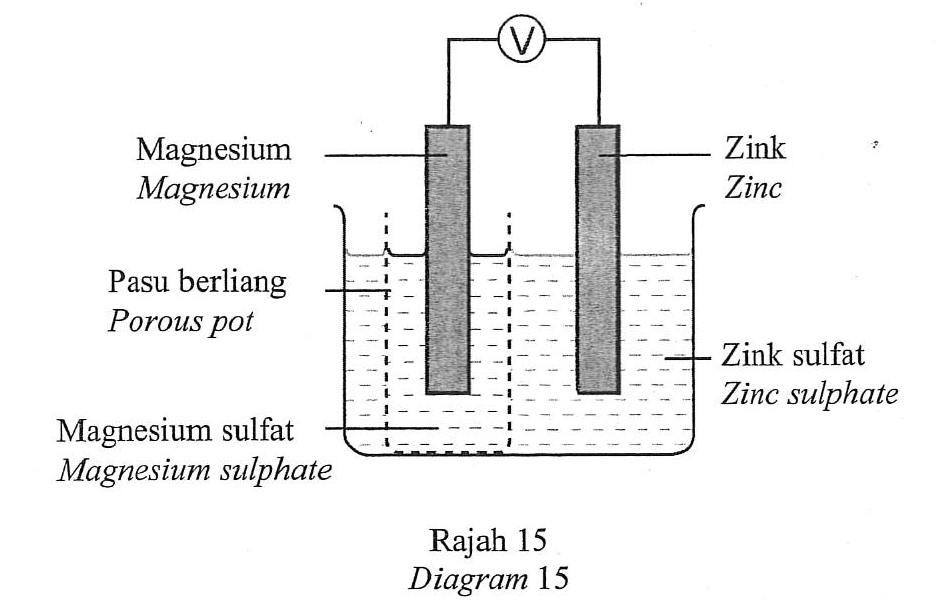
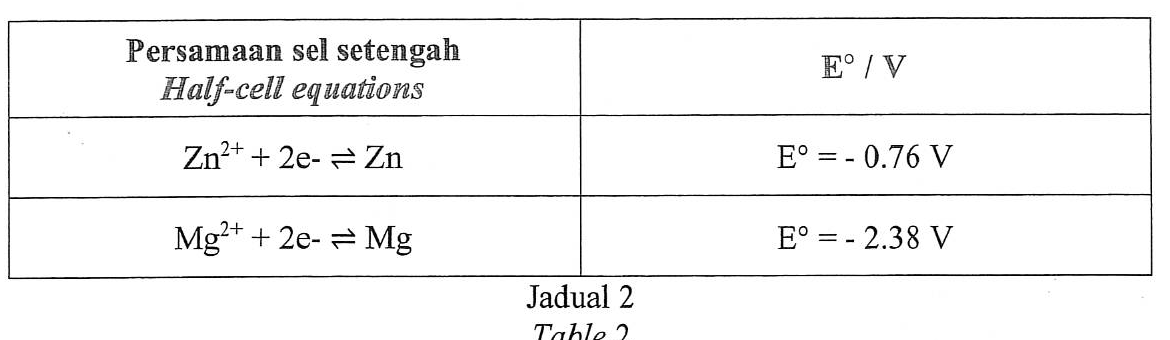
Diagram 15 shows the apparatus set-up for a simple voltaic cell (magnesium in magnesium sulphate in a porous pot, zinc in zinc sulphate). Table 2 shows the standard electrode potential of half-cells: Zn²⁺ + 2e⁻ ⇌ Zn, E° = -0.76 V; Mg²⁺ + 2e⁻ ⇌ Mg, E° = -2.38 V. What is the voltage value of the cell?
Medium
Which of the following occurs in reduction reaction?
Easy
Which of the following metal can be extracted from its ores through the reduction process by carbon?
Easy
What are the oxidation numbers of chromium in K2CrO4 and K2Cr2O7? (K2CrO4, K2Cr2O7: A +1, +1; B +1, +2; C +6, +6; D +4, +7)
Medium
Which of the following half equation occur when zinc is in contact with copper metal?
Easy
Which of the following are oxidising agents? I Potassium iodide; II Iron(II) sulphate; III Iron(III) chloride; IV Acidified hydrogen peroxide
Medium
Fe³⁺ ion solution can be converted to Fe²⁺ ion by adding zinc powder. Which substance can be used to replace zinc powder in this reaction?
Medium
Which iron nail does not corrode? Each iron nail is coiled with a metal and placed in hot agar + phenolphthalein + potassium hexacyanoferrate(III) solution. The metals are: A lead, B silver, C copper, D magnesium.
Medium
Which of the following solutions produce chlorine gas at the anode and hydrogen gas at the cathode when electricity is passed through it? I 0.1 mol dm⁻³ sulphuric acid; II 0.1 mol dm⁻³ hydrochloric acid; III 0.5 mol dm⁻³ sodium chloride solution; IV 0.5 mol dm⁻³ potassium nitrate solution
Medium
What is the meaning of oxidation?
Easy
Which apparatus set-up is correct to purify copper metal? (A pure copper and impure copper electrodes in copper(II) nitrate solution; B pure and impure copper in zinc nitrate solution; C impure and pure copper in copper(II) nitrate solution with cells connected the other way; D impure and pure copper in zinc nitrate solution)
Medium
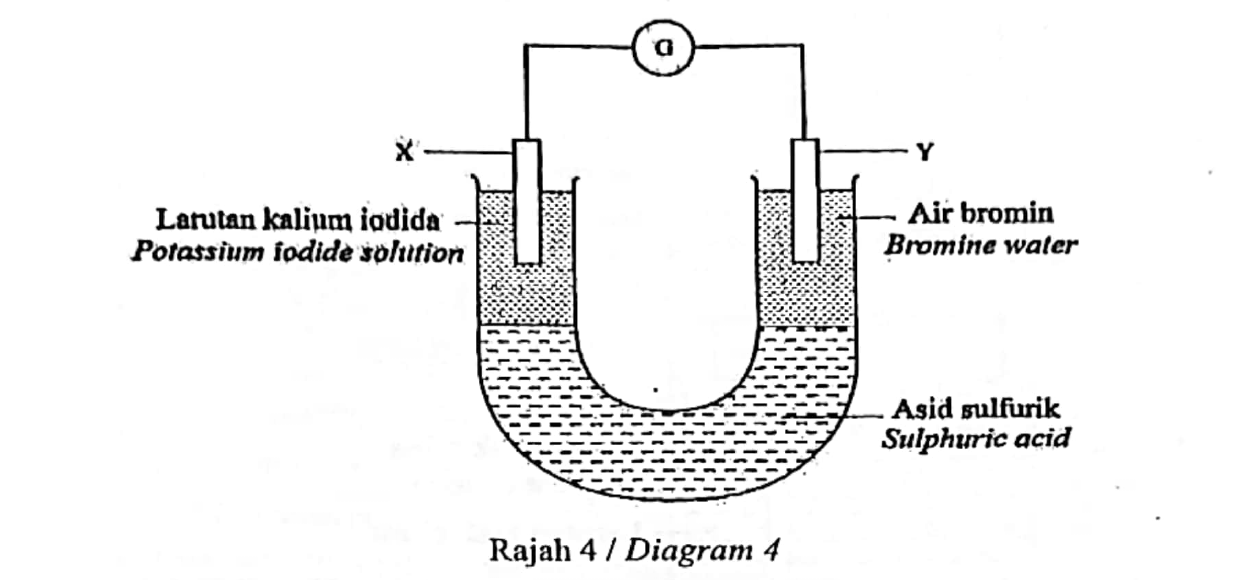
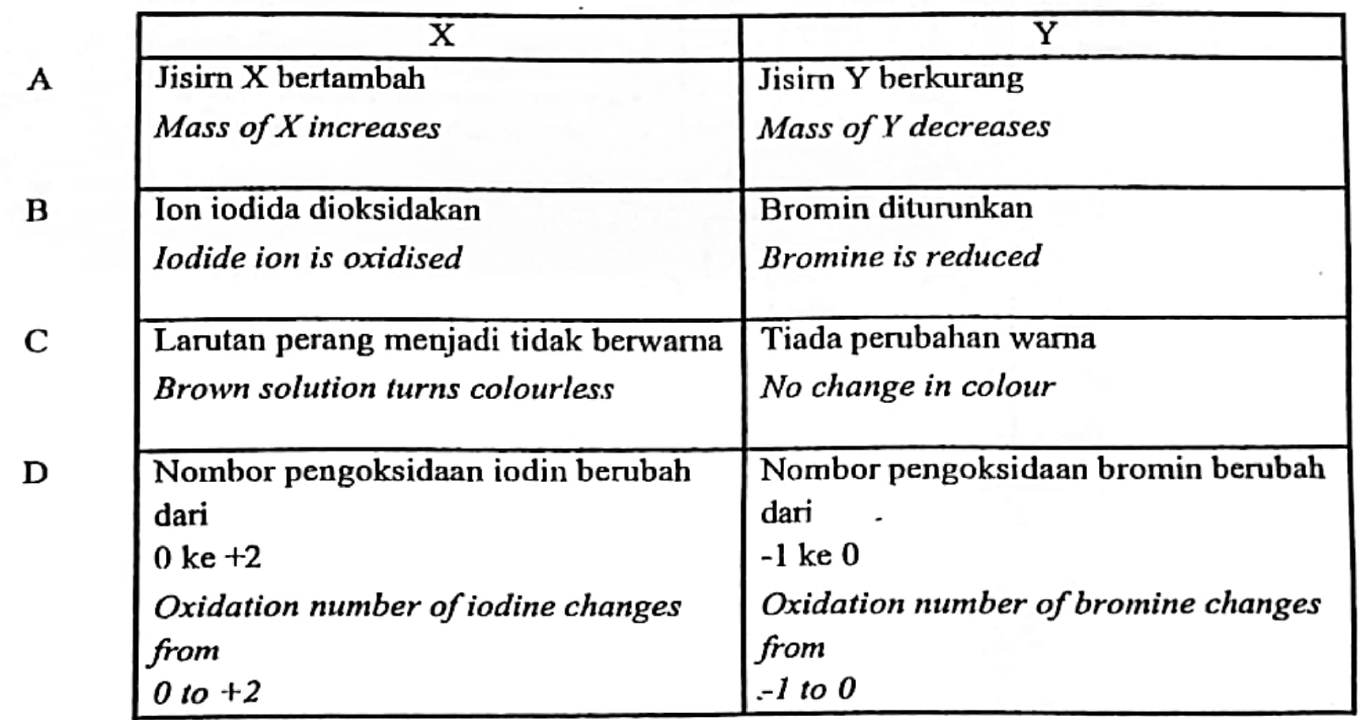
Diagram 4 shows the apparatus set-up to study the transfer of electron at a distance (potassium iodide solution at electrode X, bromine water at electrode Y, sulphuric acid between them). Which of the following occur at X and Y? A Mass of X increases / Mass of Y decreases; B Iodide ion is oxidised / Bromine is reduced; C Brown solution turns colourless / No change in colour; D Oxidation number of iodine changes from 0 to +2 / Oxidation number of bromine changes from -1 to 0
Medium
The following equation shows the reaction between iron(III) oxide, Fe2O3 with carbon monoxide, CO: Fe2O3 + 3CO → 2Fe + 3CO2. Which of the following is the change in the oxidation number of iron?
Medium
Diagram 8 shows the apparatus set-up to study the effect of other metals on the corrosion of iron: iron nail coiled with copper (I), zinc (II) and lead (III), in hot gelatin solution + phenolphthalein + potassium hexacyanoferrate(III) solution. In which test tube can the blue spot be observed?
Medium
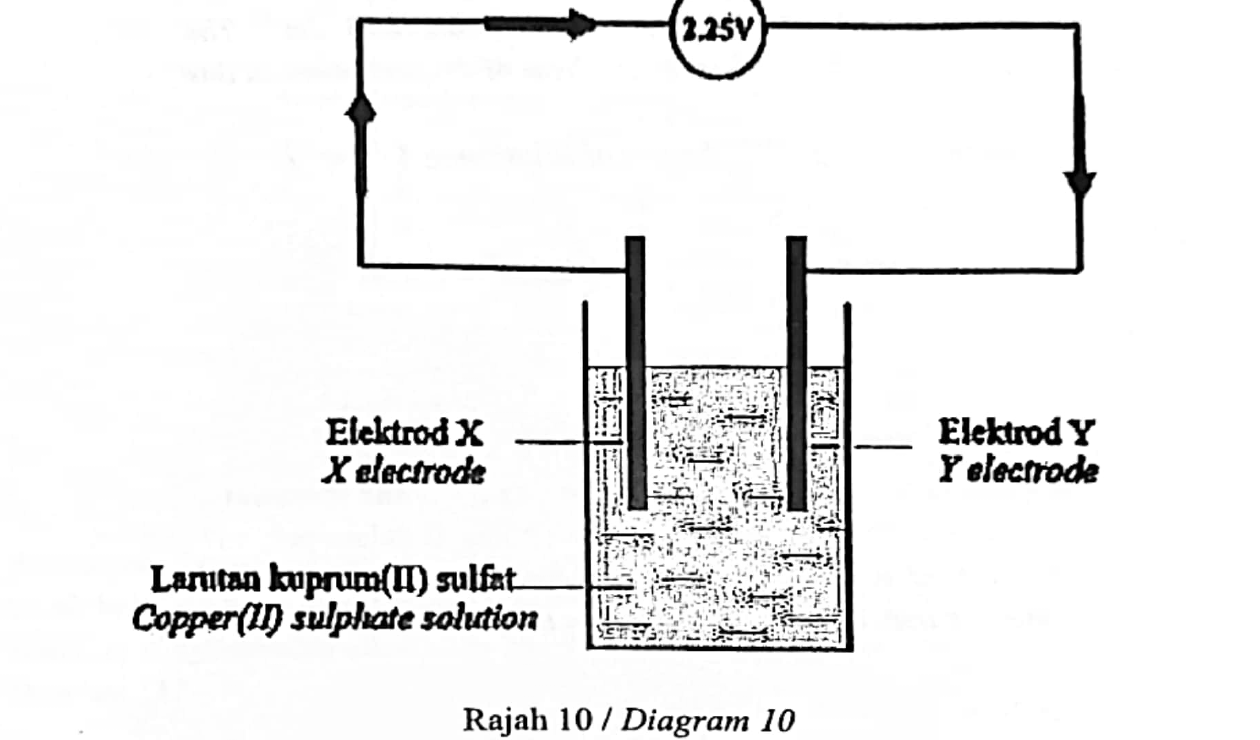
Diagram 10 shows a simple voltaic cell using metal P and metal Q as electrode (X electrode, Y electrode, copper(II) sulphate solution, voltmeter reading 2.25 V). Standard electrode potential: X2+ + 2e ⇌ X, E° = -2.38 V; Y2+ + 2e ⇌ Y, E° = p V; Cu2+ + 2e ⇌ Cu, E° = +0.34 V. What is the standard electrode potential value for metal Y?
Medium
Which of the following is a metal slow down rusting of iron?
I Silver
II Zinc
III Lead
IV Magnesium
Medium
Diagram 6 shows the apparatus set-up to study the transfer of electron at a distance (potassium iodide solution and acidified potassium dichromate(VI) solution separated by dilute sulphuric acid in a U-tube, graphite electrodes). Which of the following is the colour change of the two solutions?
Medium
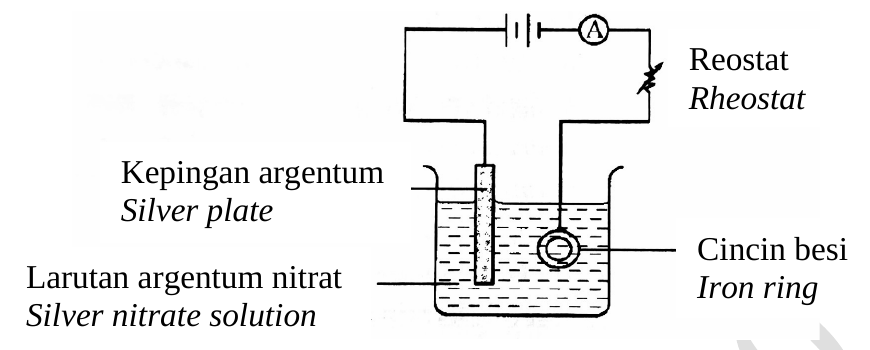
Diagram 9 shows the apparatus set-up for an experiment to electroplate an iron ring with silver (silver plate, silver nitrate solution). Which half equations represent the reactions at the anode and the cathode?
Medium
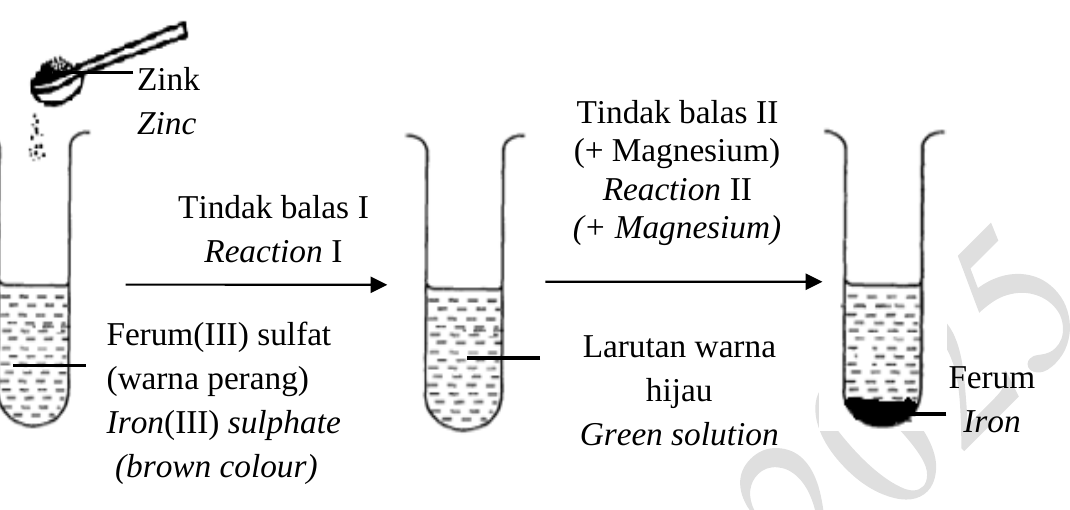
Diagram 13 shows several reactions involving a redox reaction: iron(III) sulphate (brown) + zinc (reaction I) → green solution; + magnesium (reaction II) → iron. Which of the following represent the half equation of oxidation for reactions I and II?
Medium
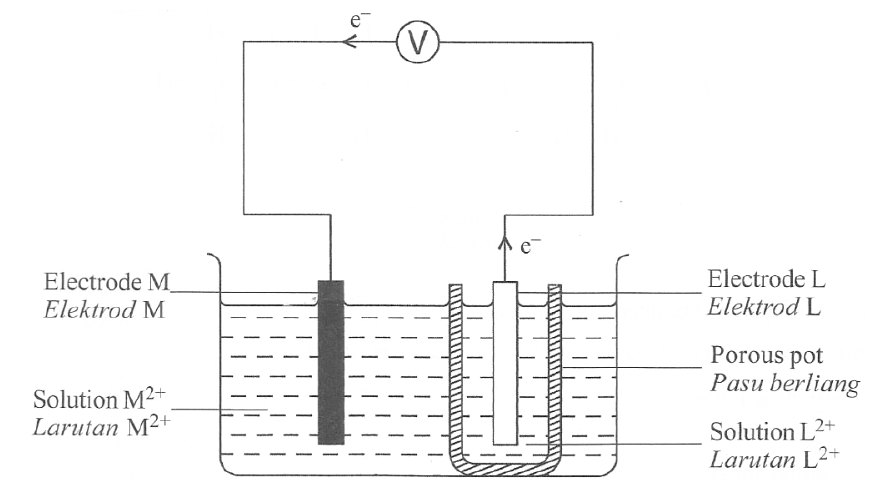
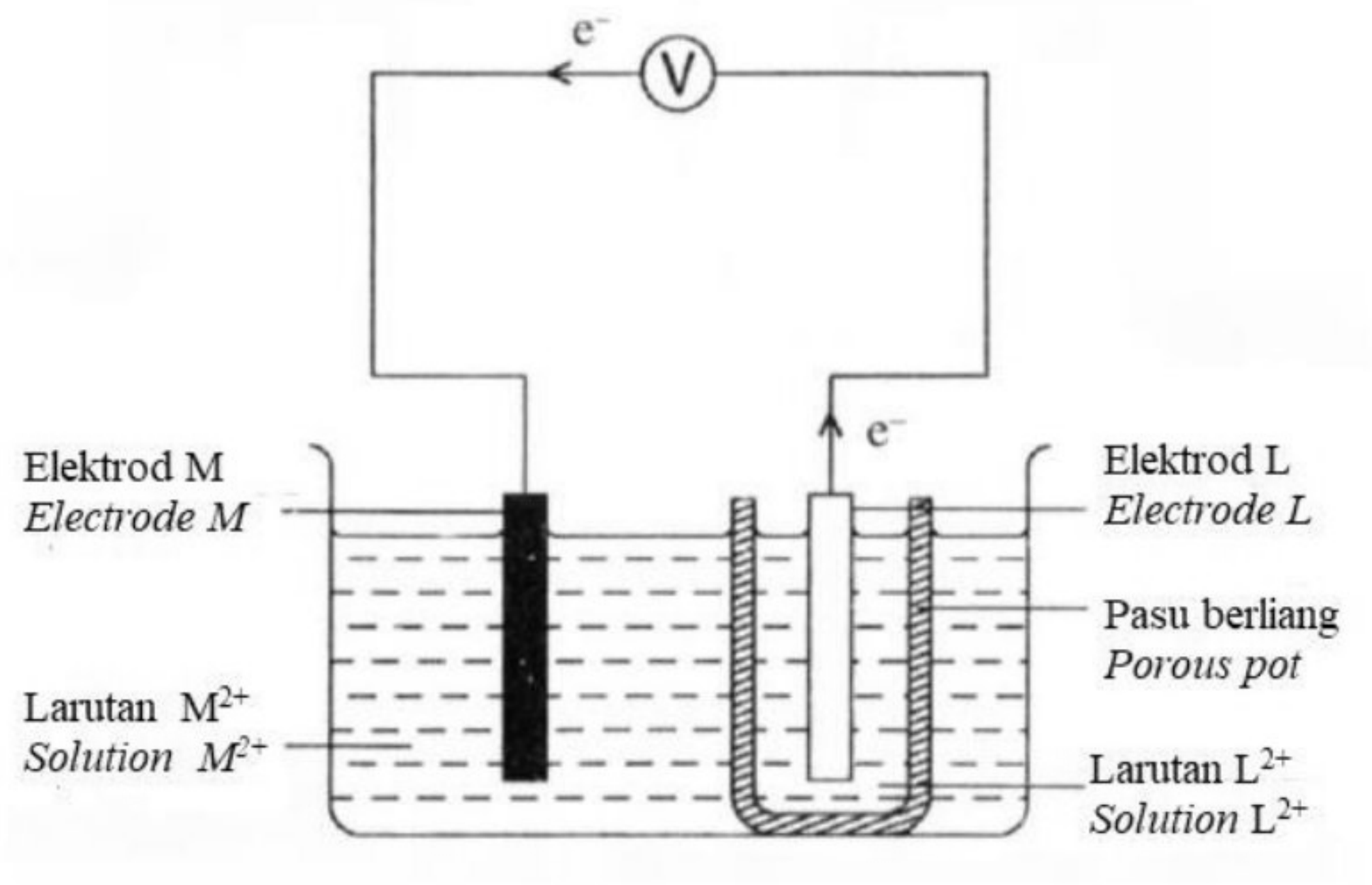
Diagram 3 shows a chemical cell (electrode M in solution M2+, electrode L in solution L2+, separated by a porous pot, voltmeter in circuit). The electrons move from electrode L to electrode M through the circuit. Which statement is correct about the reaction in the chemical cell?
Medium
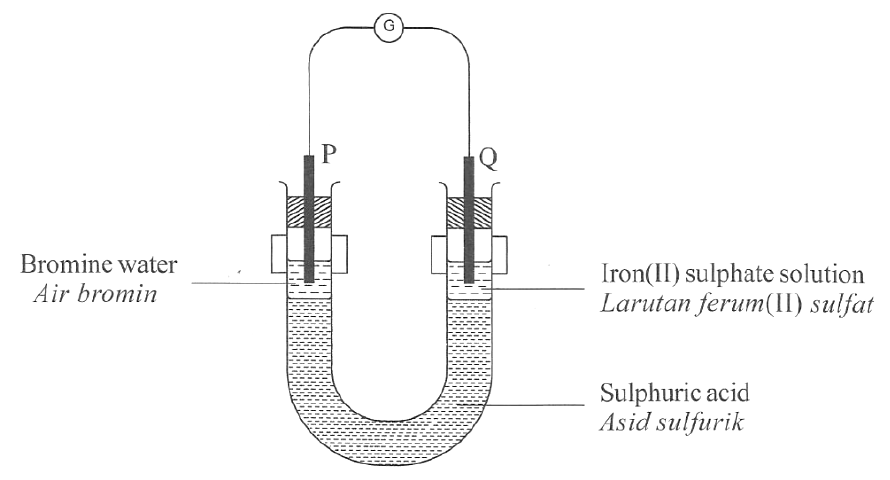
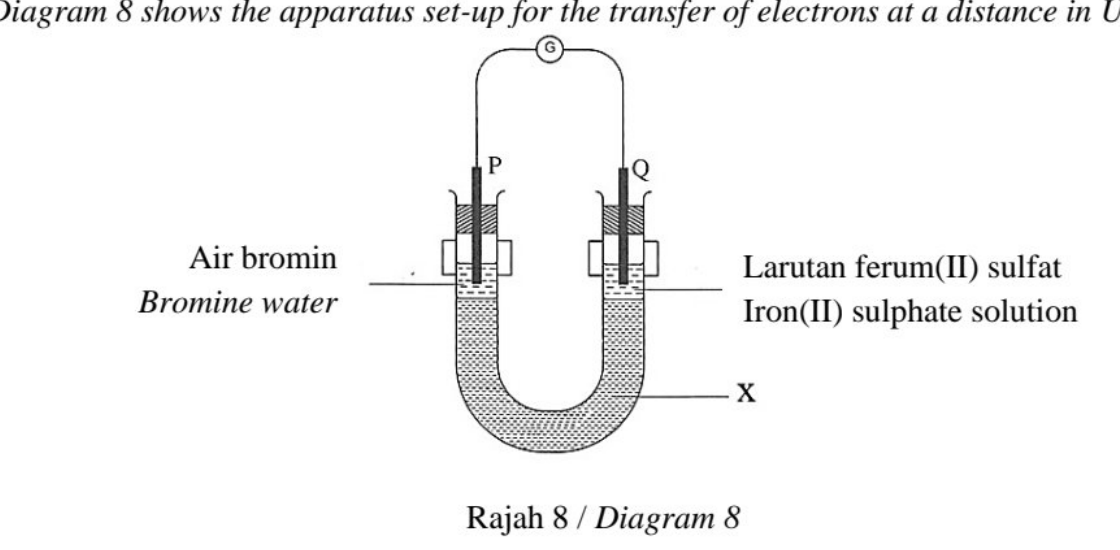
Diagram 4 shows the apparatus set-up to study the transfer of electron at a distance: a U-tube with sulphuric acid, bromine water with electrode P on one side and iron(II) sulphate solution with electrode Q on the other, joined by a galvanometer. Which of the following occurs in Diagram 4?
Medium
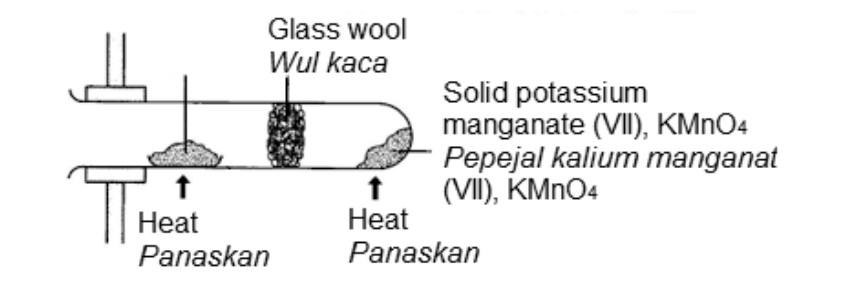
Diagram 7 shows the apparatus set-up to study the reactivity of a metal with oxygen (metal heated, oxygen from heating solid potassium manganate(VII), glass wool between). The colour of the product formed is yellow when hot and white when cold. What is the metal?
Medium
The ionic equation Cr2O7^2- + 14H+ + 6Fe2+ → 6Fe3+ + 2Cr3+ + 7H2O represents the reaction between acidified potassium dichromate(VI) solution and iron(II) sulphate solution. What is the change of oxidation number of chromium in the reaction?
Medium
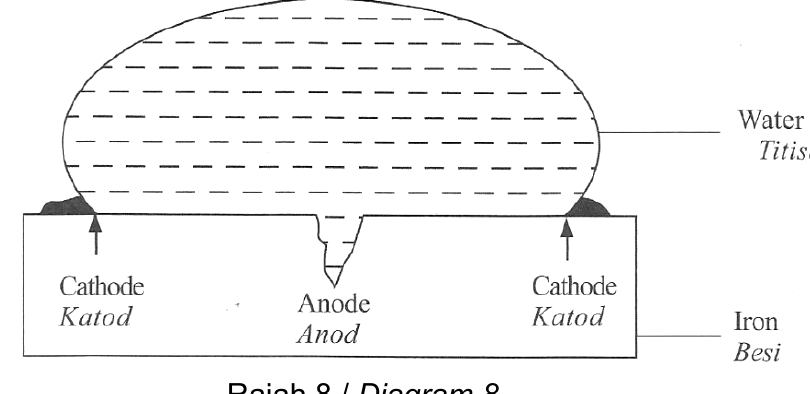
Diagram 8 shows a water droplet on a piece of iron (anode in the centre, cathode at the edges). Which equation occur at the cathode?
Medium
Which substance is used to change iron (III) ion to iron (II) ion?
Medium
Which statement defines reduction?
Easy
The following equation represents redox reaction: 2Al + 3Cl₂ → 2AlCl₃. Which of the following shows the correct change in oxidation number for aluminium, Al?
Medium
Cell notation for a voltaic cell is shown below.
Pt(s) | I⁻(aq), I₂(aq) || Ag⁺(aq) | Ag(s)
Which of the following substances undergoes reduction process?
Medium
What is the oxidation number for chromium in K₂CrO₄?
Medium
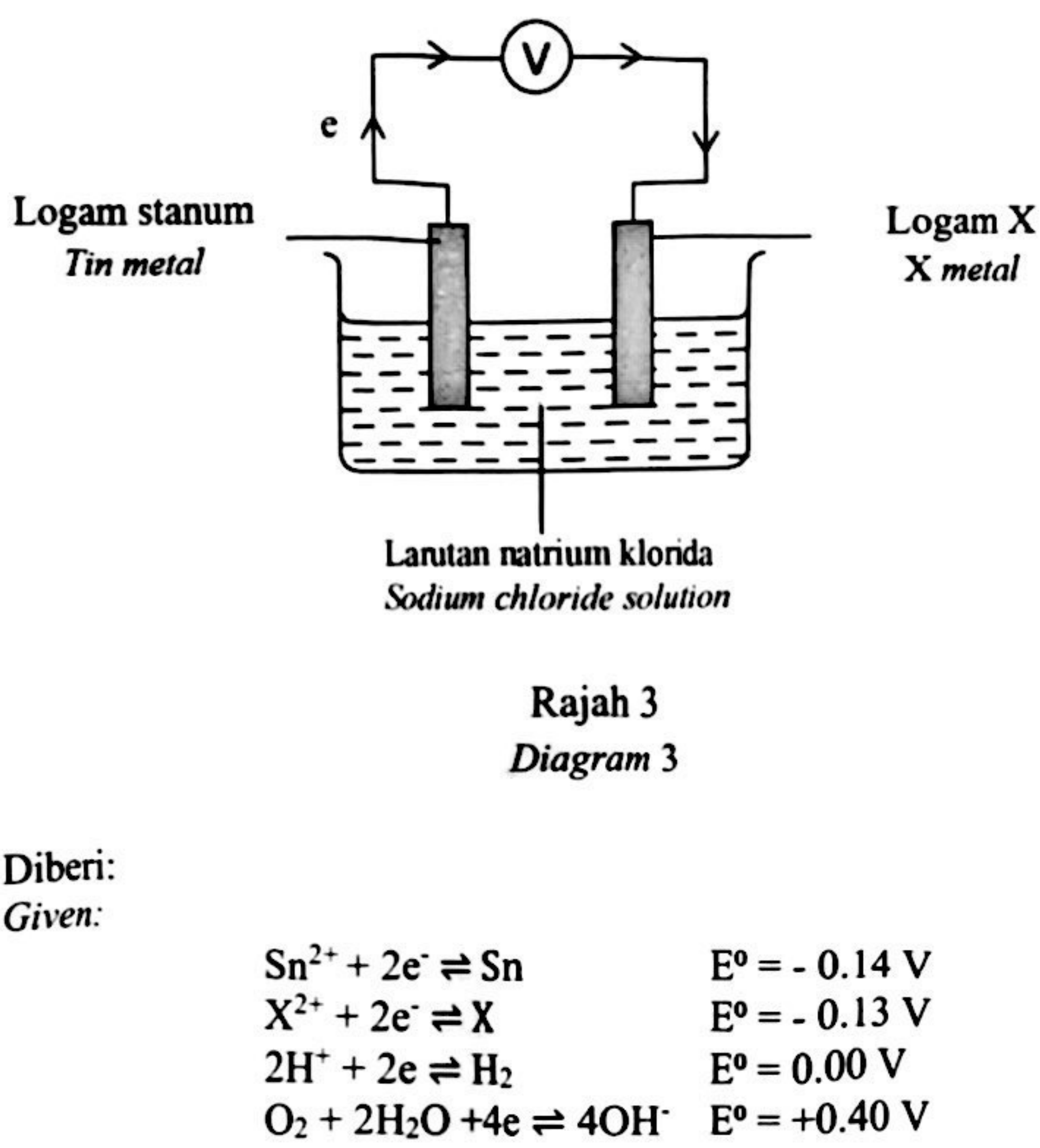
Diagram 3 shows an apparatus set-up of a voltaic cell (tin metal and X metal in sodium chloride solution; electrons flow from tin to X through the voltmeter). Given: Sn²⁺ + 2e⁻ ⇌ Sn, E° = -0.14 V; X²⁺ + 2e⁻ ⇌ X, E° = -0.13 V; 2H⁺ + 2e ⇌ H₂, E° = 0.00 V; O₂ + 2H₂O + 4e ⇌ 4OH⁻, E° = +0.40 V. Which of the following is true about the voltaic cell?
Medium
Table 1 shows the standard electrode potential value of half-cell in a Daniell cell: Cu²⁺(aq) + 2e⁻ ⇌ Cu(s), E° = +0.34 V; Ag⁺(aq) + e⁻ ⇌ Ag(s), E° = +0.80 V. Which of the following is the strongest oxidising agent?
Medium
Diagram 7 shows the apparatus set-up for the electrolysis of molten lead(II) bromide, PbBr₂. What are the products of carbon electrode X and Y? (Table of X/Y: A lead metal / bromine gas; B hydrogen gas / oxygen gas; C hydrogen gas / bromine gas; D bromine gas / lead metal)
Medium
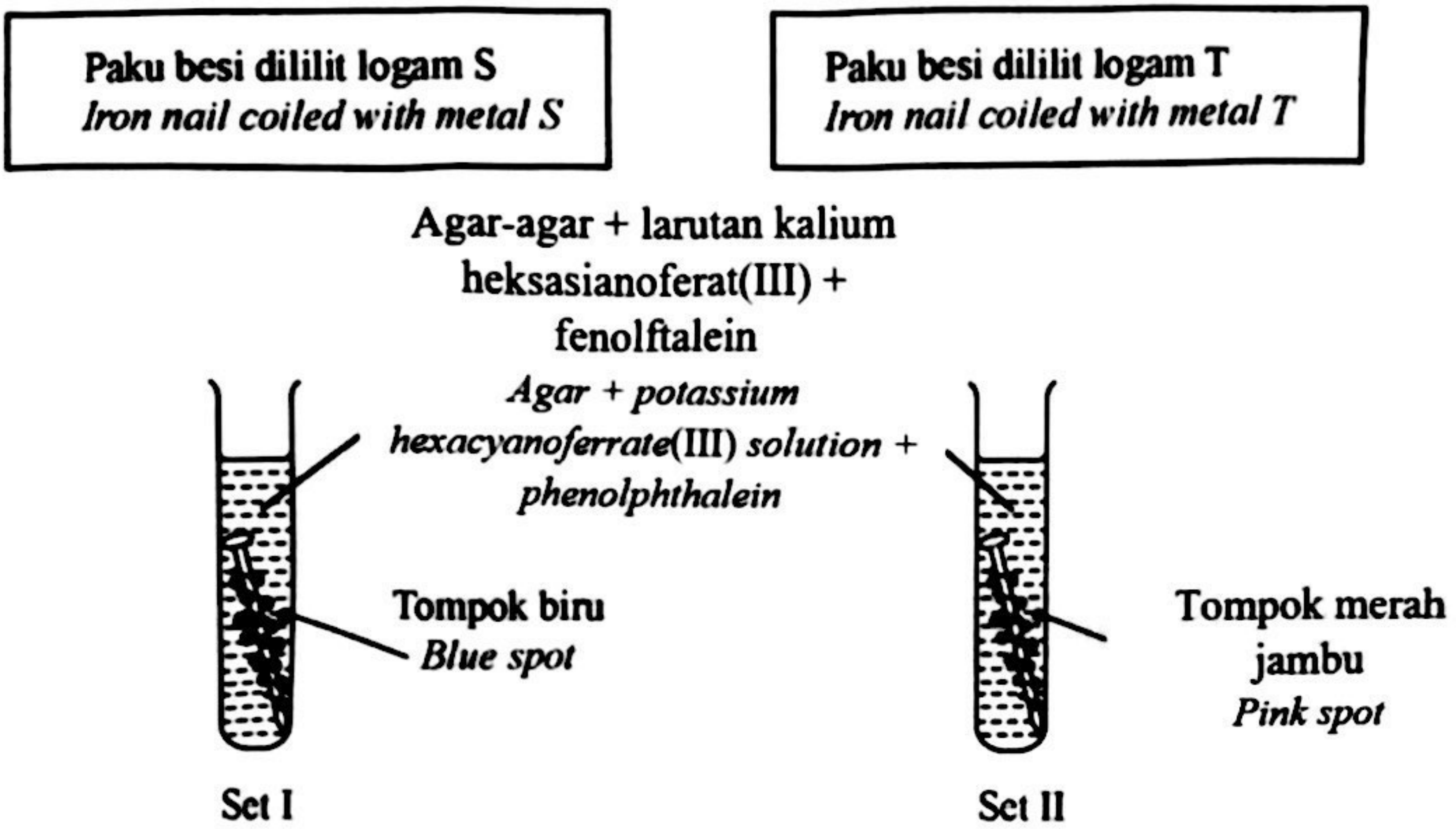
Diagram 11 shows the observation of an experiment to study the effect of metal S and metal T on the rusting of iron. Set I: iron nail coiled with metal S in agar + potassium hexacyanoferrate(III) solution + phenolphthalein gives a blue spot. Set II: iron nail coiled with metal T gives a pink spot. Which of the following statements is correct?
Medium
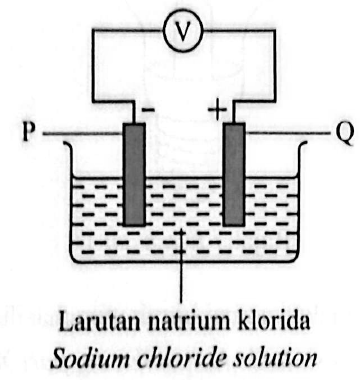
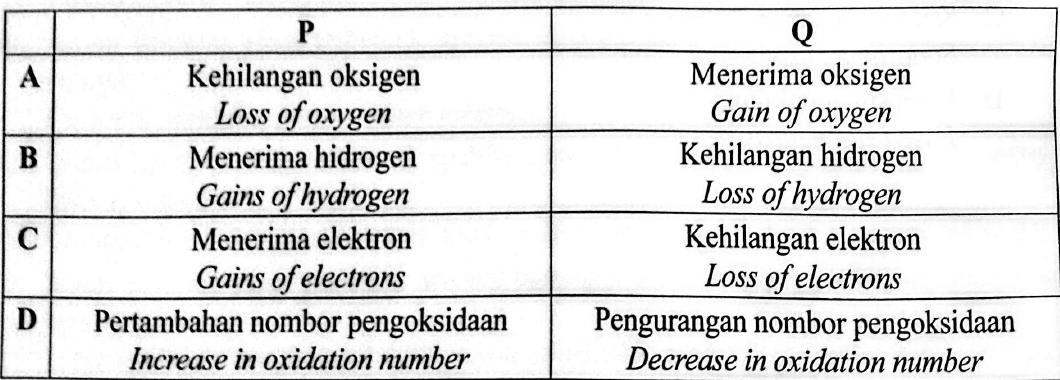
Diagram 2 shows a chemical cell (P at the negative terminal, Q at the positive terminal, sodium chloride solution). What happen at P and Q? A P: loss of oxygen, Q: gain of oxygen; B P: gains of hydrogen, Q: loss of hydrogen; C P: gains of electrons, Q: loss of electrons; D P: increase in oxidation number, Q: decrease in oxidation number
Medium
Table 1 shows the standard electrode potential value of half-cells: Cu²⁺(aq) + 2e ⇌ Cu(s) E° = +0.34 V; Ag⁺(aq) + e ⇌ Ag(s) E° = +0.80 V. Which of the following reducing agents is the strongest?
Medium
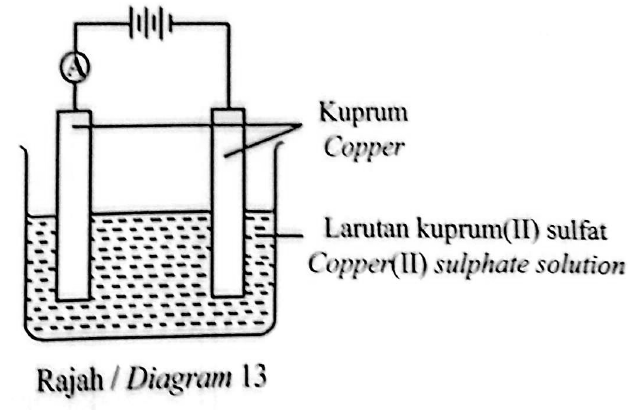
Diagram 13 shows the setup of apparatus for an electrolytic cell (copper electrodes in copper(II) sulphate solution). Which of the following graphs show the change in mass of the anode during electrolysis?
Medium
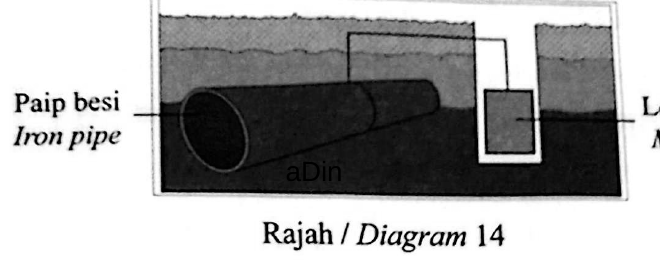
Diagram 14 shows the sacrificial metal used in underground iron pipes. Which of the following statements is correct about metal X?
Medium
A reactive metal Y burnt in the air. What happened to the reactive metal Y?
Medium
Which of the following is correct? (Electrolyte / Non-electrolyte)
Medium
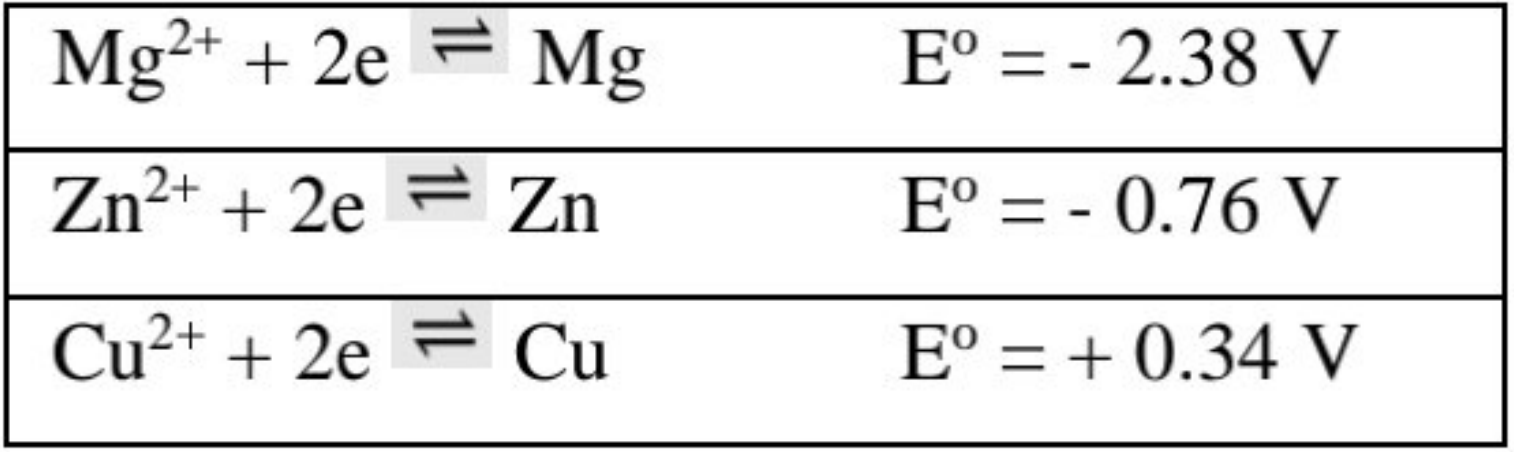
Table 6 shows the standard electrode potential values of half-cells: Mg2+ + 2e ⇌ Mg, E° = -2.38 V; Zn2+ + 2e ⇌ Zn, E° = -0.76 V; Cu2+ + 2e ⇌ Cu, E° = +0.34 V. Which of the following is the arrangement of the atoms or ions in an ascending order of the strength of reducing agents?
Medium
Diagram 13 shows the apparatus set up to investigate the reaction between potassium iodide solution and iron(II) sulphate solution (acidified potassium manganate(VII) solution at one carbon electrode, potassium iodide solution at the other, dilute sulphuric acid in the U-tube, galvanometer G). Which of the following statements is correct about the reaction?
Medium
Diagram 14 shows a chemical cell (electrode M in solution M2+, electrode L in solution L2+ inside a porous pot, voltmeter V). The electrons move from electrode L to electrode M through the external circuit. Which statement is correct about the reaction in the chemical cell?
Medium
Which of the following underlined substances acts as a reducing agent?
Medium
Iron is extracted from haematite in the blast furnace. Which gas is produced as a waste product?
Medium
Table 5 shows the standard electrode potential of metal ions P, Q, R and S. P, Q, R and S are not the actual symbols of the elements.
P⁺/P: +0.80 V; Q²⁺/Q: −0.76 V; R²⁺/R: −0.14 V; S²⁺/S: −0.25 V
Based on the above information, which is the correct arrangement of the strength of oxidising agent in ascending order?
Medium
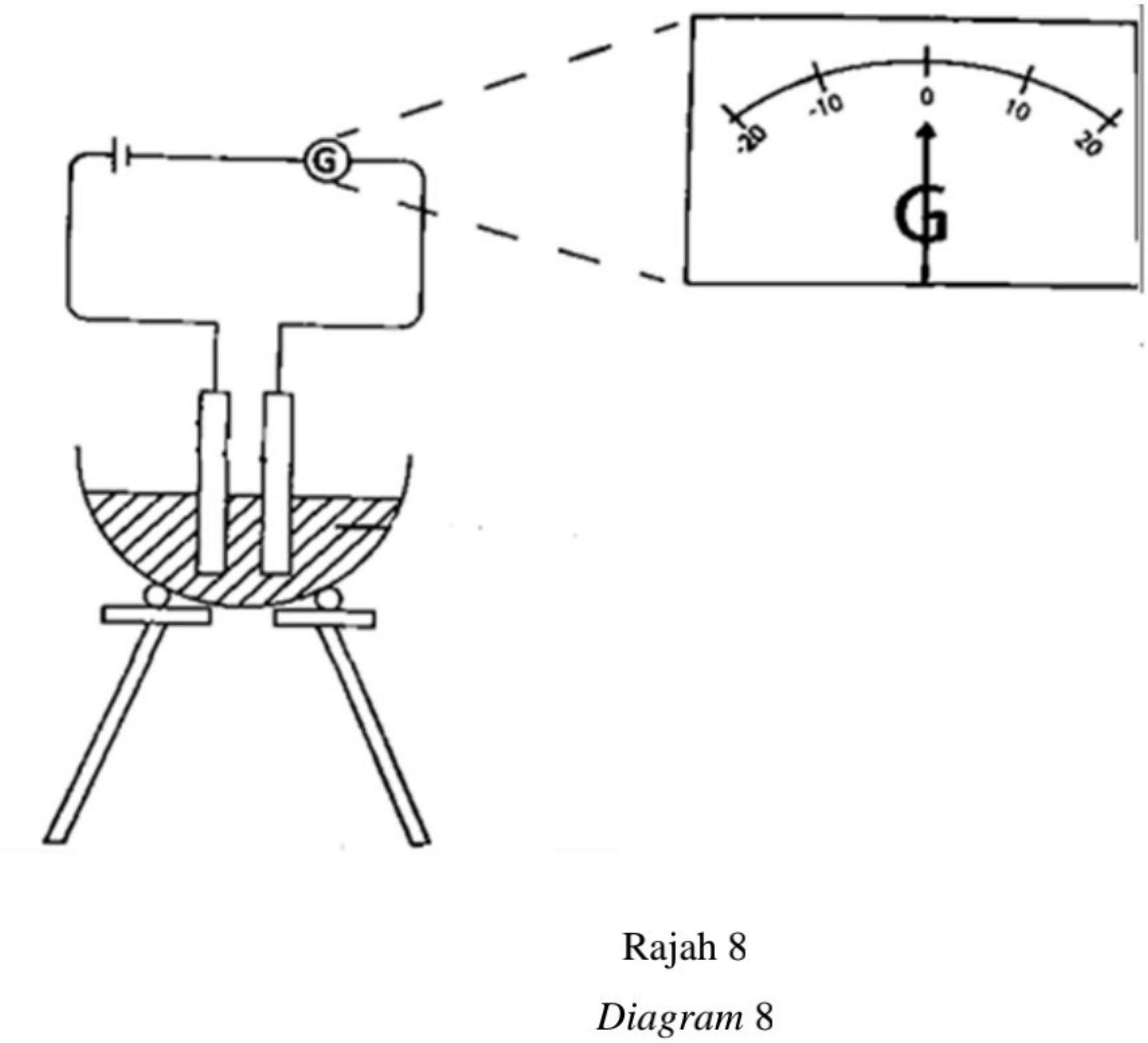
Diagram 8 shows the apparatus set-up for the electrolysis of solid Q (two carbon electrodes, dry cell and galvanometer). What should be done to deflect the needle of the galvanometer?
Medium
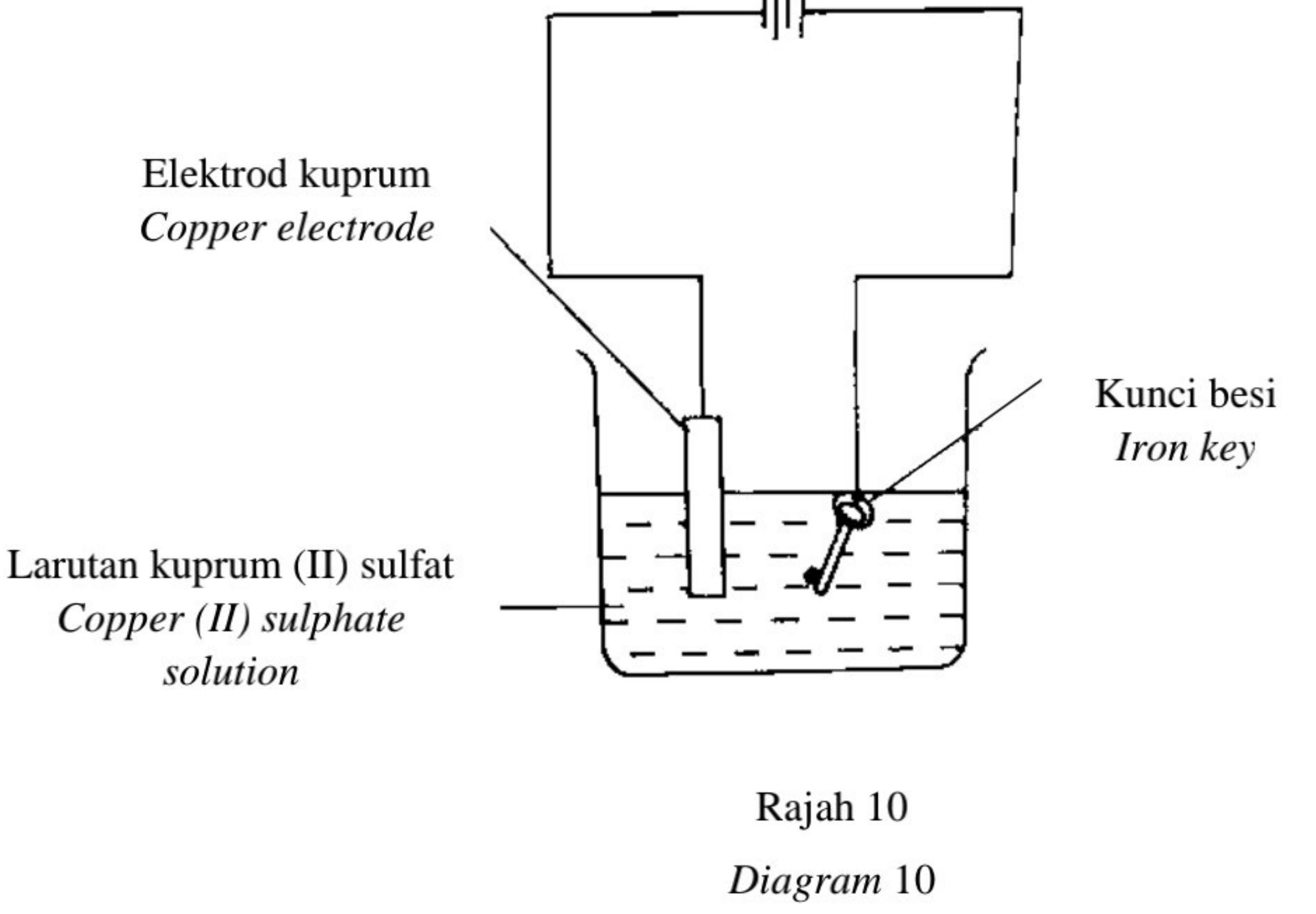
Diagram 10 shows the apparatus set-up for the electroplating of an iron key using 1.0 mol dm⁻³ copper(II) sulphate solution and copper metal as electrode. After 30 minutes, explain the observation in this experiment.
Medium
Which of the following happens to a substance that undergoes a reduction reaction?
Medium
Diagram 3 shows an apparatus set-up of an experiment to study the conversion of iron(II) ion, Fe²⁺ to iron(III) ion, Fe³⁺. Substance X is added drop by drop into iron(II) sulphate solution, FeSO₄. Which substance can be used as substance X?
Medium
The standard electrode potential, E° for half-cell equations: Zn²⁺(aq) + 2e ⇌ Zn(s) E° = –0.76 V; Fe³⁺(aq) + e ⇌ Fe²⁺(aq) E° = +0.77 V. What can be deduced from the given information?
Medium
The following equation shows the reaction between copper(II) oxide and hydrogen gas.
CuO + H₂ → Cu + H₂O
What is the type of reaction that takes place for copper(II) oxide?
Medium
Which of the following solutions should not be stored in a tin-plated container?
I NaNO₃
II KCl
III AgNO₃
IV CuSO₄
Medium
Which of the following chemical equations is not a redox reaction?
Medium
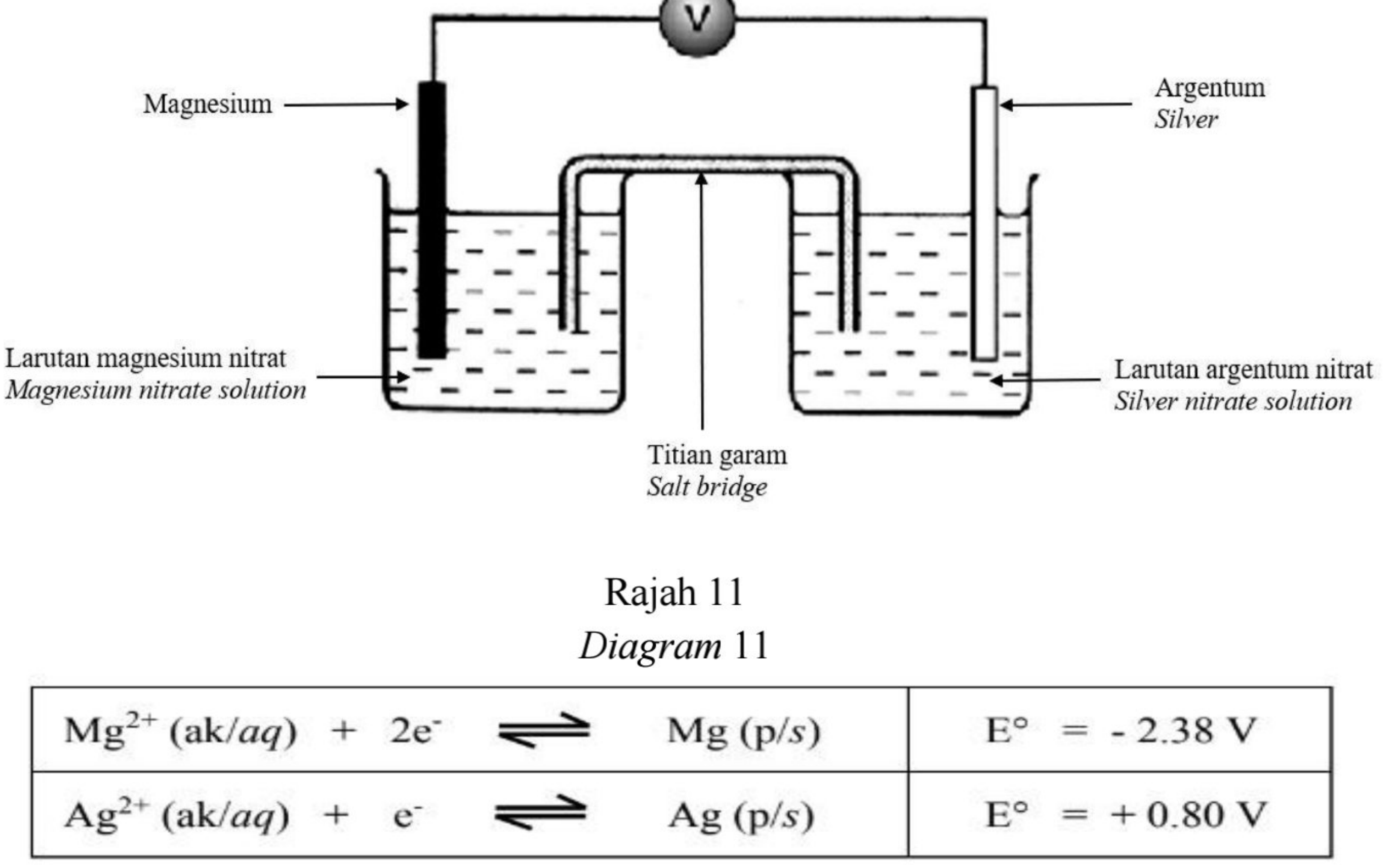
Diagram 11 shows the apparatus arrangement of a chemical cell in a redox reaction (Mg in magnesium nitrate solution, Ag in silver nitrate solution, salt bridge). Standard electrode potentials: Mg²⁺ + 2e⁻ ⇌ Mg, E° = -2.38 V; Ag²⁺ + e⁻ ⇌ Ag, E° = +0.80 V (as printed). What is the voltmeter reading in Diagram 11?
Medium
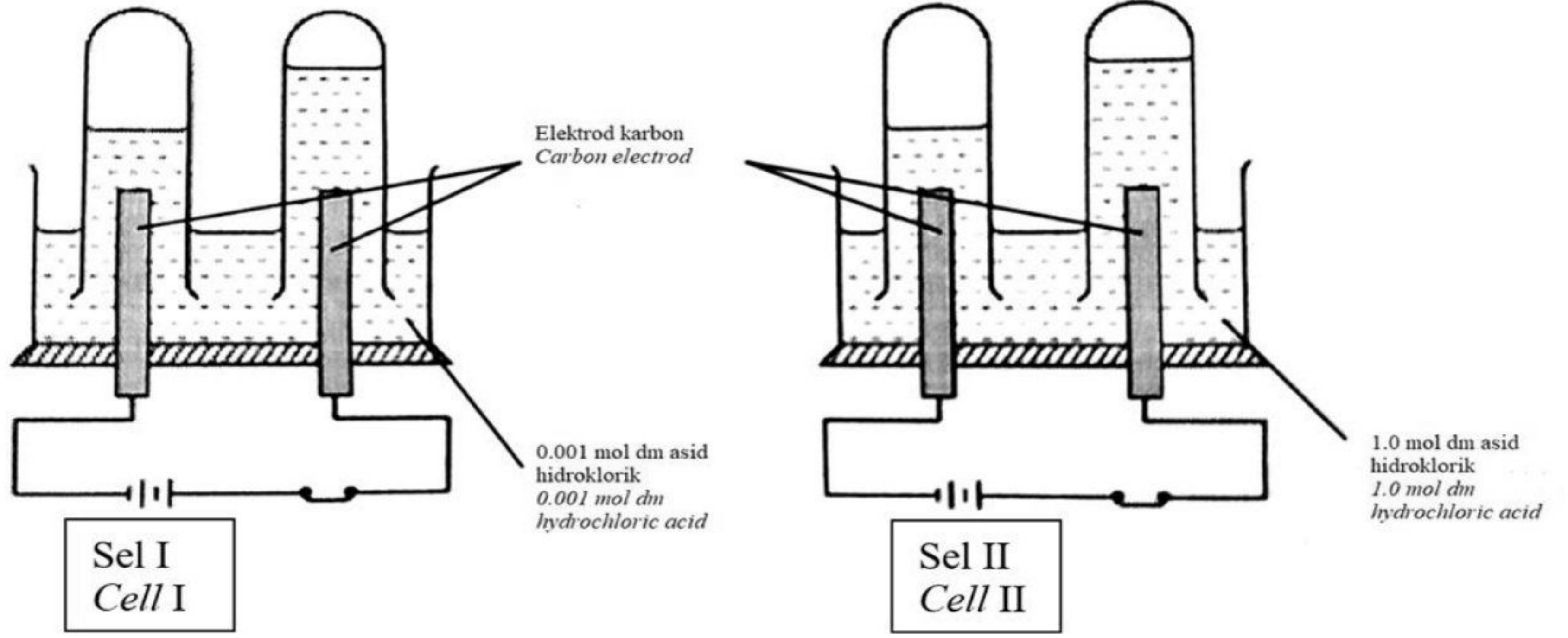
Diagram 13 shows the electrolysis of hydrochloric acid with different concentrations (Cell I: 0.001 mol dm⁻³; Cell II: 1.0 mol dm⁻³; carbon electrodes). Which of the following statements is true about Cell I and Cell II?
Medium
This is the oxidation half equation: 2I⁻(aq) → I₂(aq) + 2e⁻. Based on the equation, which statement is true?
Medium
Diagram 14 shows cell notation for chemical cells: Zn(s) | Zn²⁺(aq) || Cu²⁺(aq) | Cu(s). If the experiment is conducted by using 100 cm³ of 0.5 mol dm⁻³ zinc nitrate solution and 100 cm³ of 0.5 mol dm⁻³ copper(II) sulphate solution, what is the maximum mass of solid deposited at cathode? [Relative atomic mass: Cu = 64, Zn = 65]
Medium
Which of the following is explaining the reduction reaction?
Easy
Here is half of the oxidation equation: 2Br⁻(aq) → Br2(aq) + 2e⁻. Based on the equation, which statement is true?
Medium
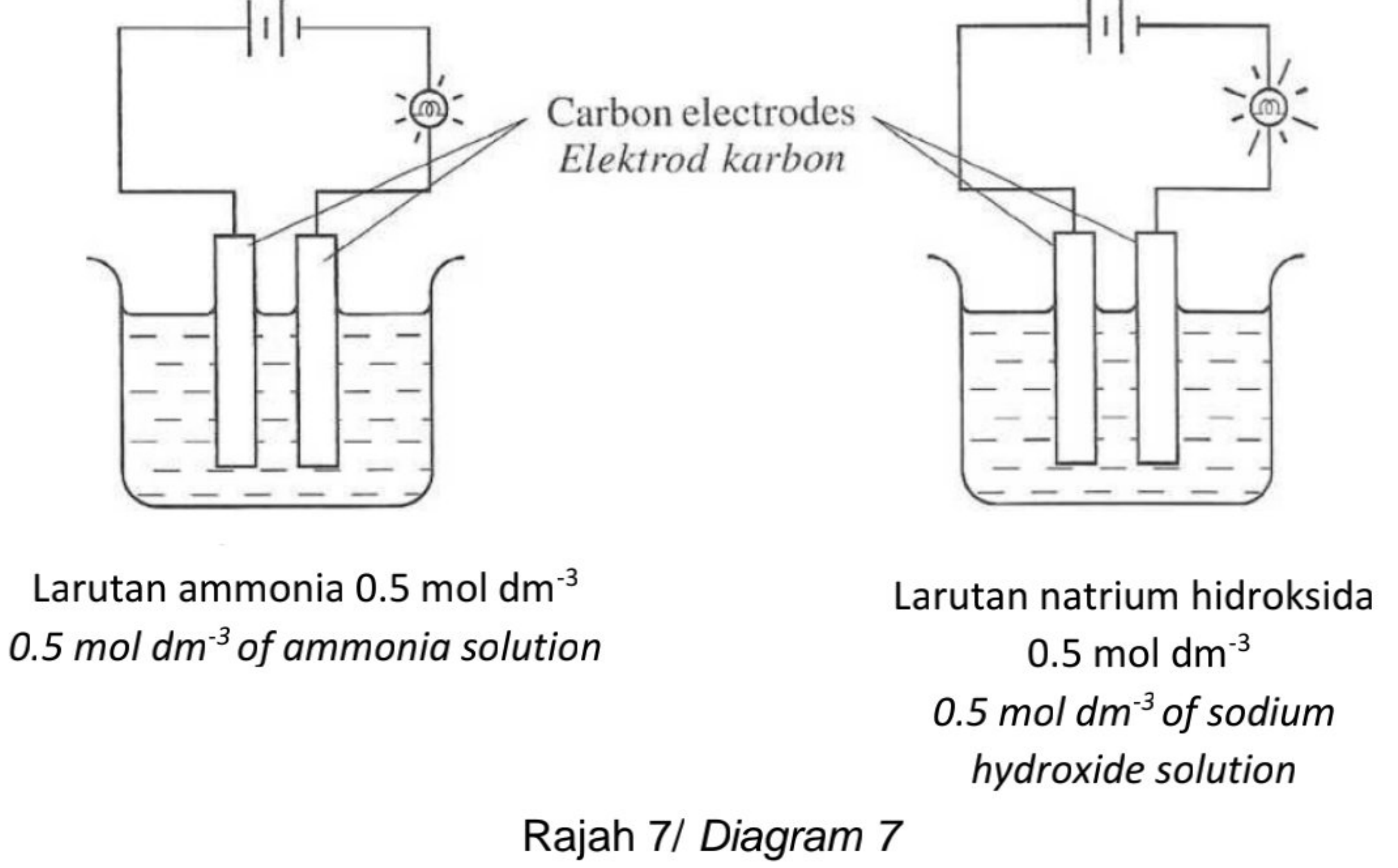
Diagram 7 shows the apparatus set-up for electrolysis of ammonia solution and sodium hydroxide solution (0.5 mol dm⁻³ of each, carbon electrodes). The bulb in the sodium hydroxide circuit is brighter.
Which statement explains the difference in the brightness of the bulb?
Medium
What is the oxidation number of chlorine in KClO₃?
Medium
Which substance can be used to convert Fe²⁺ to Fe³⁺
Medium
Diagram 11 shows the arrangement of the apparatus for the combination of two cells. Cell I: magnesium electrode Q and copper electrode R. Cell II: copper electrodes X and Y in copper(II) sulphate solution. Q is connected to Y and R is connected to X.
Given the value of the standard electrode potential as follows.
Cu²⁺ + 2e ⇌ Cu +0.34 V
Mg²⁺ + 2e ⇌ Mg +0.40 V
Which of the following statements is correct?
I A colorless gas bubble is produced at the X electrode
II The R electrode and the Y electrode are thin
III Electrode X and electrode Q are anodes
IV The blue color of the copper(II) sulfate solution in Cell II does not change
Medium
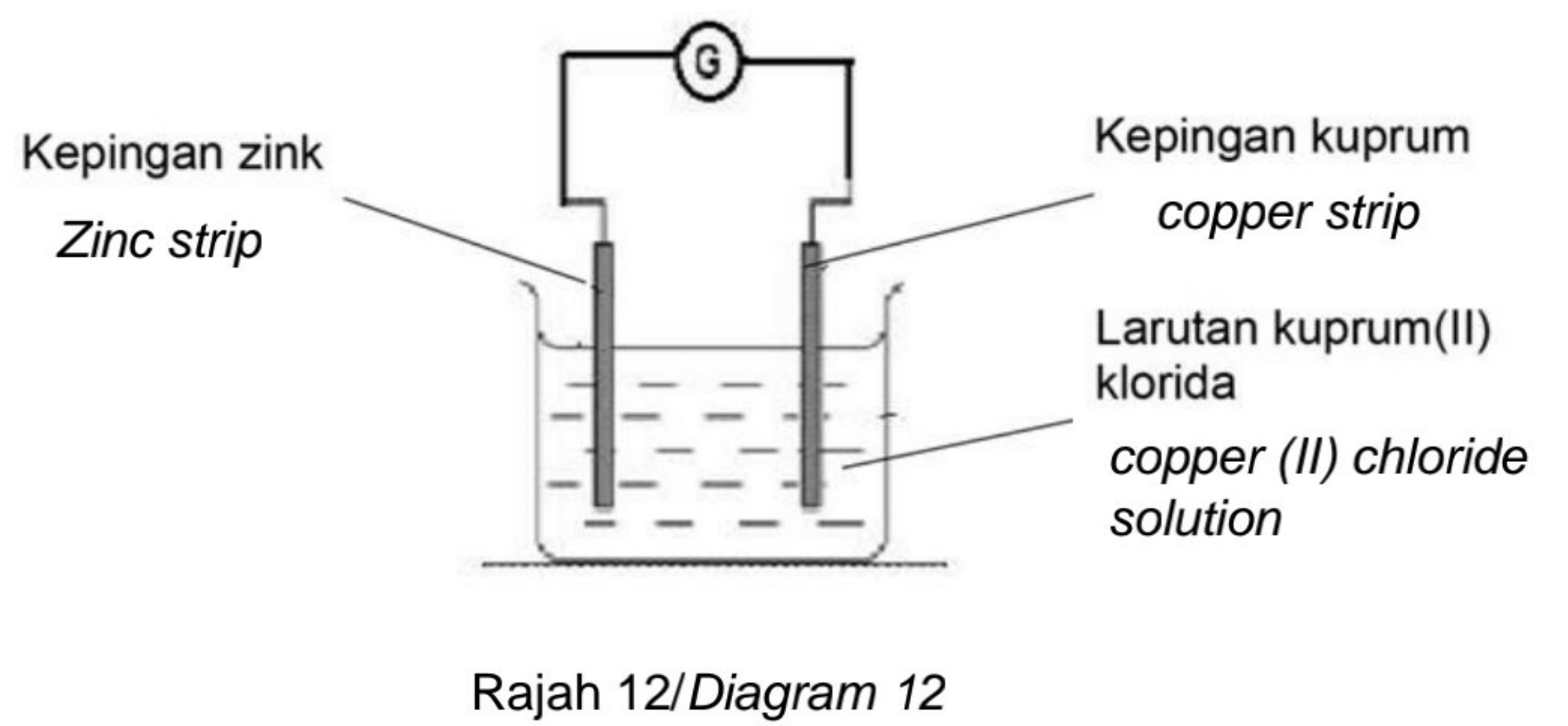
Diagram 12 shows a chemical cell (zinc strip and copper strip in copper(II) chloride solution, connected through a galvanometer).
Which substance undergoes oxidation and reduction?
[E° for half cell; Zn²⁺(aq) + 2e ⇌ Zn(s) E° = -0.76 V]
(Options are in a table: Oxidation / Reduction.)
Medium
Which substance is electrolyte?
Easy
The following ionic equation shows the reaction between zinc and acid. Zn + 2H+ → Zn2+ + H2. What is the oxidation number change for hydrogen?
Easy
Which of the following equations represents a redox reaction?
Medium
Diagram 13 shows the arrangement of apparatus for the electrolysis of molten lead(II) oxide, PbO (carbon electrodes). Which of the following half-equations occurs at the anode and cathode?
Medium
Diagram 14 shows the arrangement of the apparatus to study the effect of other metals on the corrosion of iron (hot gelatin solution + phenolphthalein + potassium hexacyanoferrate(III); I iron nails wrapped with copper, II iron nails wrapped with lead, III iron nails wrapped with zinc). Given the standard electrode potentials: Zn2+ + 2e ⇌ Zn -0.76 V; Fe2+ + 2e ⇌ Fe -0.44 V; Cu2+ + 2e ⇌ Cu +0.34 V; Pb2+ + 2e ⇌ Pb -0.13 V. In which test tube can the blue spot be observed?
Medium
Which of the following is a redox reaction?
Medium
What is the oxidation number of fluorine in fluorine gas, F2?
Easy
Which of the following metal can prevent rusting when it is in contact with iron?
Easy
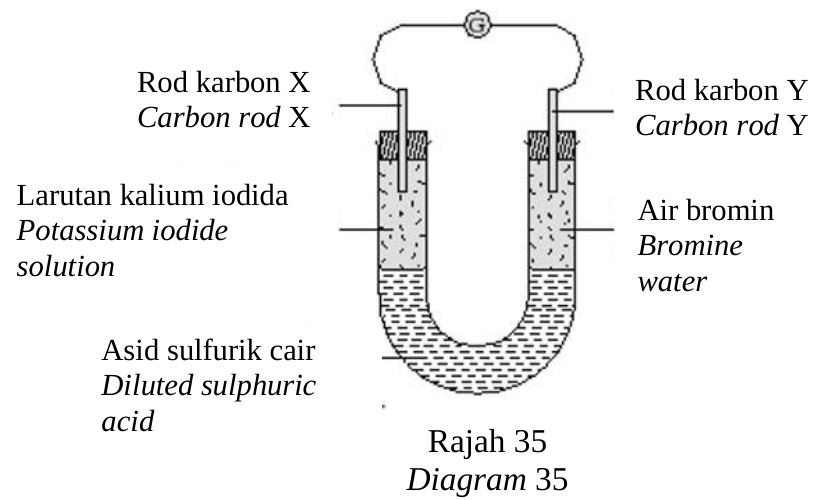
Diagram 35 shows an electrochemical cell: carbon rod X in potassium iodide solution, carbon rod Y in bromine water, with dilute sulphuric acid in the U-tube. Which of the following is true about the above cell?
Medium
Diagram 8 shows the apparatus set-up for the transfer of electrons at a distance in U-tube (bromine water and iron(II) sulphate solution). What is the function of X?
Medium
The overall ionic equation below shows the reaction between iodine, I₂ and sulphur dioxide, SO₂.
I₂ (aq) + SO₂ (g) + 2H₂O (l) → 2I⁻ (aq) + SO₄²⁻ (aq) + 4H⁺ (aq)
Based on the equation above, name the oxidising agent in this reaction.
Medium
Diagram 9 shows the mechanism of rusting with the presence of water and oxygen. Which of the following pairs of half equation represent the chemical reactions that occur at anode and cathode?
Medium
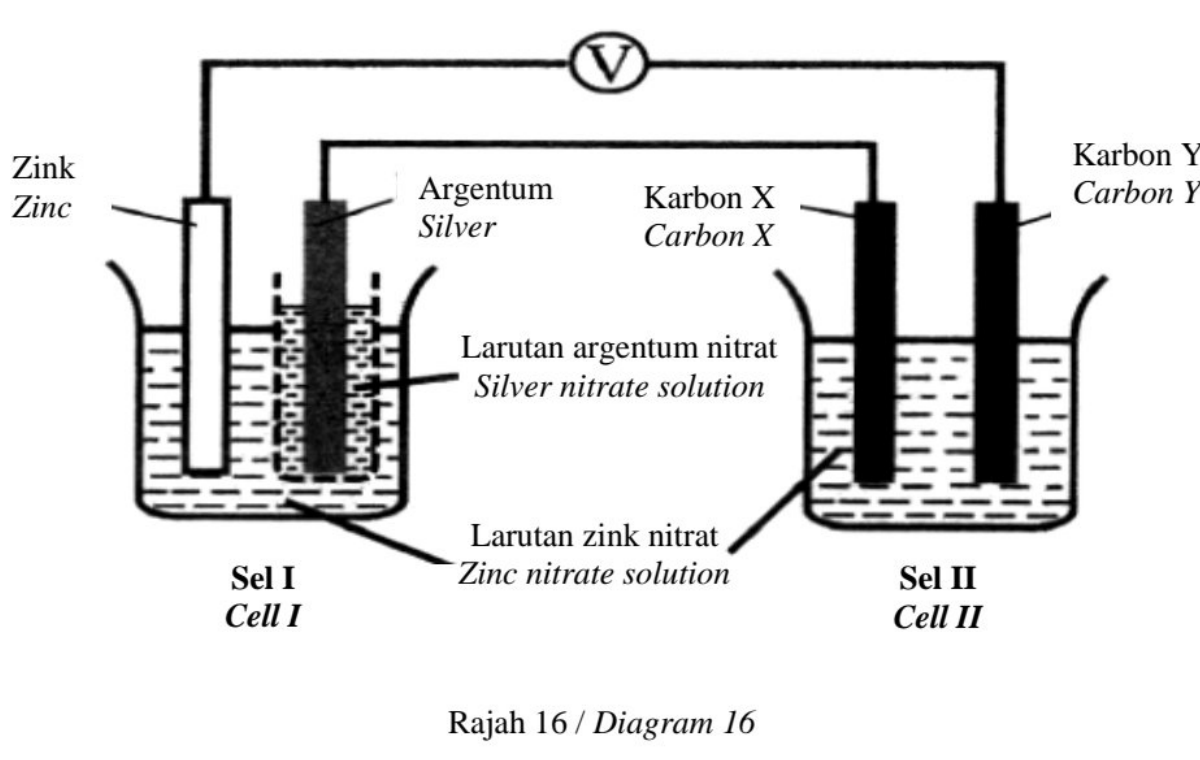
Diagram 16 shows Cell I (Zn | zinc nitrate; Ag | silver nitrate) connected to Cell II (carbon X and carbon Y in zinc nitrate solution). Given E°: Zn²⁺ + 2e⁻ → Zn −0.76 V; 2H⁺ + 2e⁻ → H₂ 0.00 V; Ag⁺ + e⁻ → Ag +0.80 V; O₂ + 2H₂O + 4e⁻ → 4OH⁻ +0.40 V; NO₃⁻ + 2H⁺ + e⁻ → NO₂ + H₂O +0.81 V. Which of the following is correct?
Medium
Which of the following chemical equation shows that copper is reduced?
A Cu + 2AgNO3 → Cu(NO3)2 + 2Ag
B 2Cu + O2 → 2CuO
C CuSO4 + Ba(NO3)2 → Cu(NO3)2 + BaSO4
D CuO + H2 → Cu + H2O
Medium
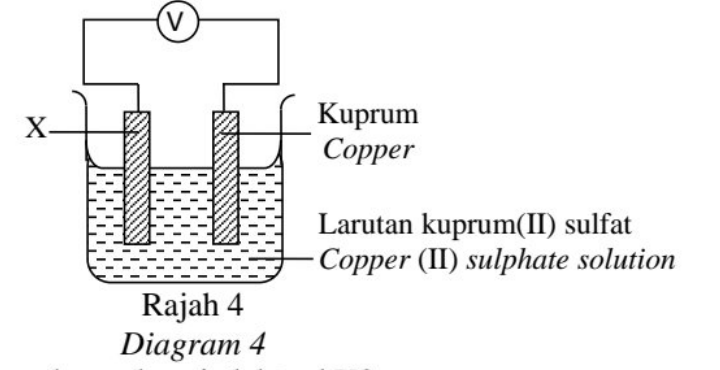
Diagram 4 shows a simple voltaic cell (electrode X and a copper electrode in copper(II) sulphate solution, connected to a voltmeter). Which material is suitable to be used as electrode X?
Medium
Table 2 shows the E° value for half-cell equations:
R + e⁻ ⇌ R⁻ +0.83 V
S²⁺ + e⁻ ⇌ S⁺ -0.56 V
T³⁺ + e⁻ ⇌ T²⁺ -0.77 V
Which of the following is the strongest reducing agent?
Medium
Diagram 14 shows the apparatus set-up for the electrolysis of molten lead(II) bromide using carbon electrodes. Which half-equation shows the reaction at the anode?
Medium
Two half-cells which are connected under standard conditions are shown below.
MnO4⁻(aq) + 8H⁺(aq) + 5e⁻ ⇌ Mn²⁺(aq) + 4H2O(l) E° = +1.52 V
Fe³⁺(aq) + e⁻ ⇌ Fe²⁺(aq) E° = +0.77 V
Which of the following statements are true?
I The e.m.f. of the cell is +2.29 V
II Fe²⁺ is a stronger reducing agent than Mn²⁺
III The oxidation number of Fe changes from +3 to +2
IV The electrode in the MnO4⁻(aq)/Mn²⁺(aq) half-cell is the cathode
Medium
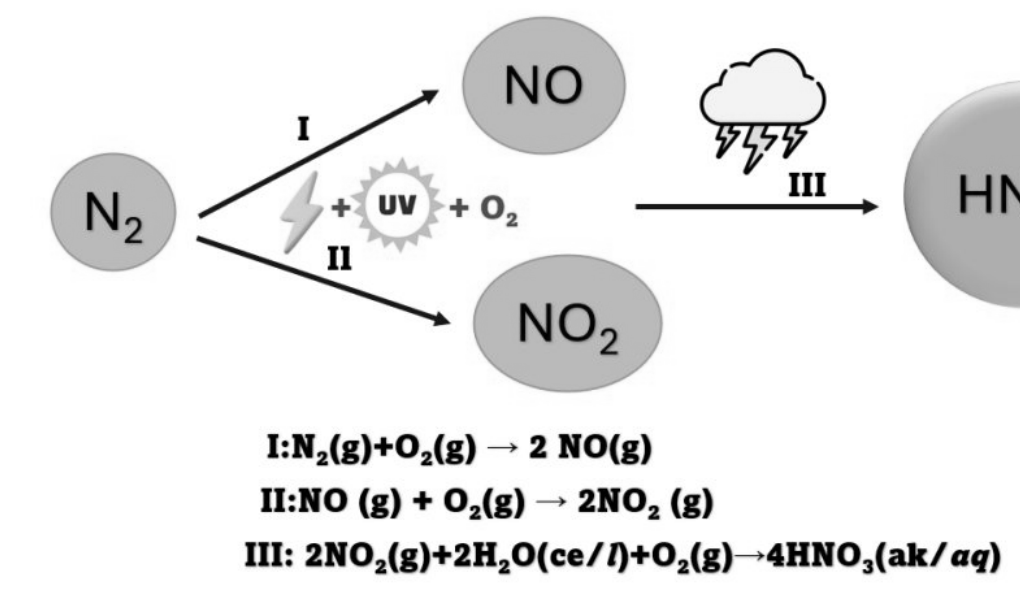
Diagram 18 shows a series of reactions: I: N2(g) + O2(g) → 2NO(g); II: 2NO(g) + O2(g) → 2NO2(g); III: 4NO2(g) + 2H2O(l) + O2(g) → 4HNO3(aq) (converting NO and NO2 into acid rain). Which of the following changes in oxidation number of nitrogen element in each reaction is correctly matched? (I / II / III)
Medium
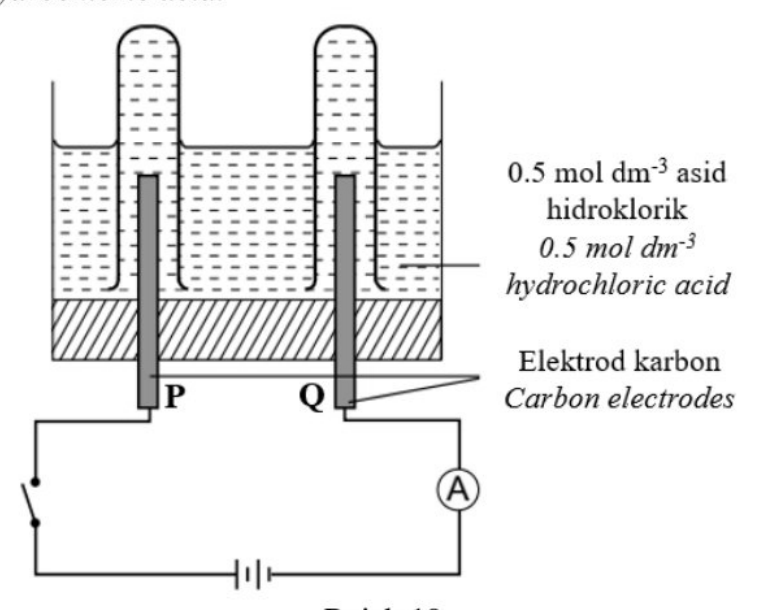
Diagram 19 shows an electrolytic cell used by a student to study the effect of electrolysis on the pH value of hydrochloric acid (0.5 mol dm⁻³ hydrochloric acid, carbon electrodes). The student poured 500 cm³ acid into the electrolytic cell and turned on the switch for 30 minutes. Given 0.075 mol of electrons had moved from electrode P to Q through the connecting wire. What is the pH value of the hydrochloric acid in the electrolytic cell after 30 minutes?
Medium
Which of the following metals is extracted from its ore through reduction reaction by carbon?
Medium
What is the oxidation number of X in X₂O₈²⁻ ion?
Medium
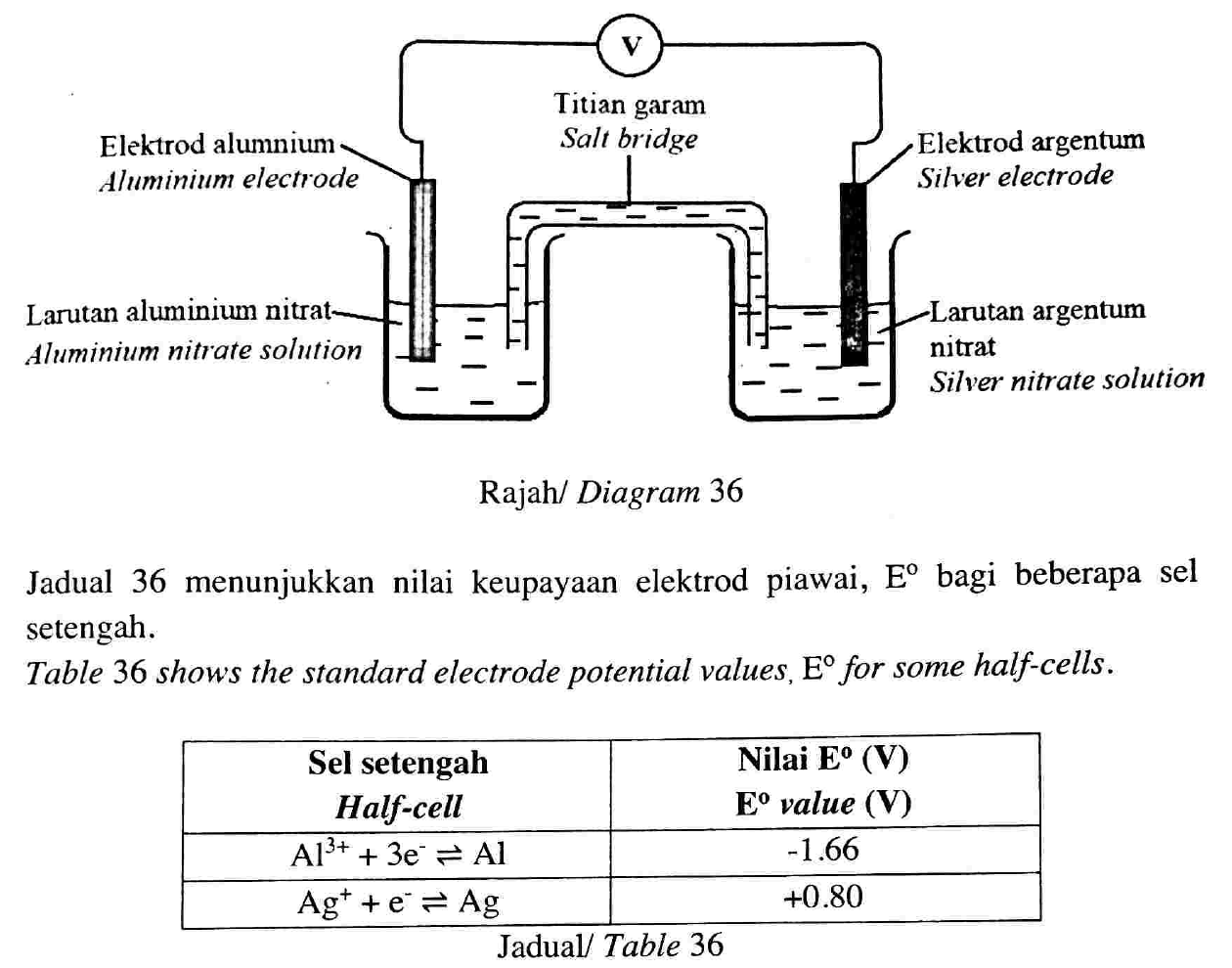
Diagram 36 shows an apparatus set-up of a voltaic cell (aluminium electrode in aluminium nitrate solution, silver electrode in silver nitrate solution, salt bridge). Table 36: Al³⁺ + 3e⁻ ⇌ Al, E° = −1.66 V; Ag⁺ + e⁻ ⇌ Ag, E° = +0.80 V. What is the cell notation for the cell?
Medium
Which of the following is a reducing agent?
Medium
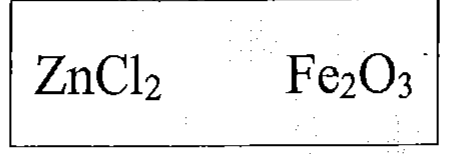
Diagram 4 shows the chemical formulae of two compounds: ZnCl₂ and Fe₂O₃.
Which of the following are the oxidation numbers of zinc and iron in the compounds?
Medium
Diagram 9 shows the apparatus set-up to investigate a redox reaction in a chemical cell (electrode Q in Q²⁺ ion solution, electrode P in P²⁺ ion solution, porous pot, voltmeter).
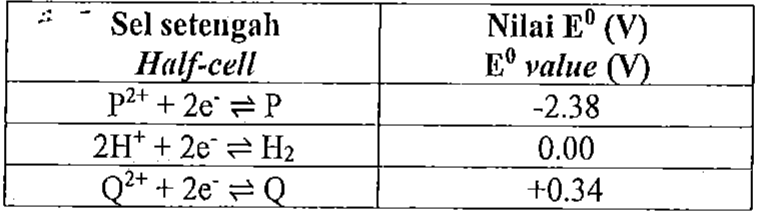
Table 3 shows the standard electrode potential values for some half-cells: P²⁺ + 2e⁻ ⇌ P, E° = -2.38 V; 2H⁺ + 2e⁻ ⇌ H₂, E° = 0.00 V; Q²⁺ + 2e⁻ ⇌ Q, E° = +0.34 V.
Which of the following statements is correct about the chemical cell?
Medium
Colourless potassium bromide solution turns brown when substance X is added into it. What is X?
Medium
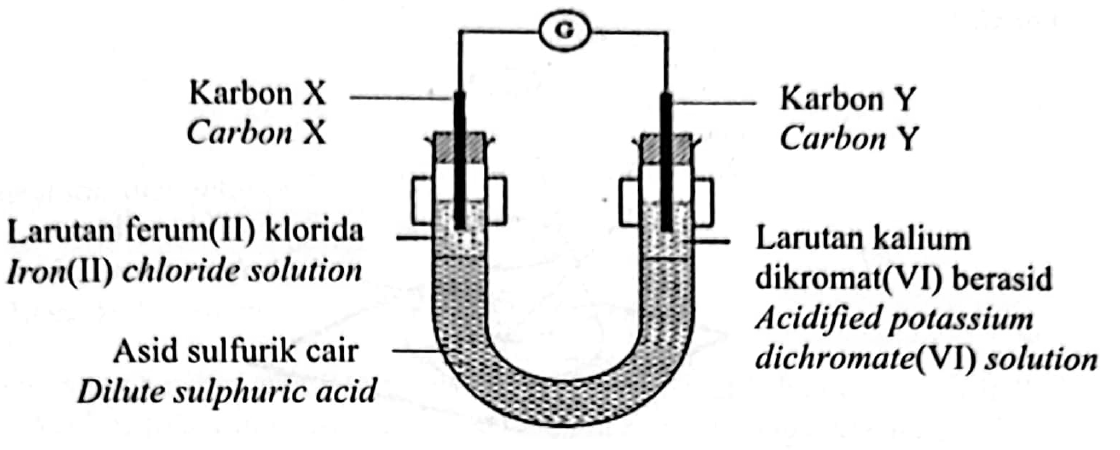
Diagram 6 shows the apparatus set-up for an experiment (U-tube with iron(II) chloride solution at carbon X, acidified potassium dichromate(VI) solution at carbon Y, dilute sulphuric acid below, connected by a galvanometer). What are the observations at carbon X and Y?
Medium
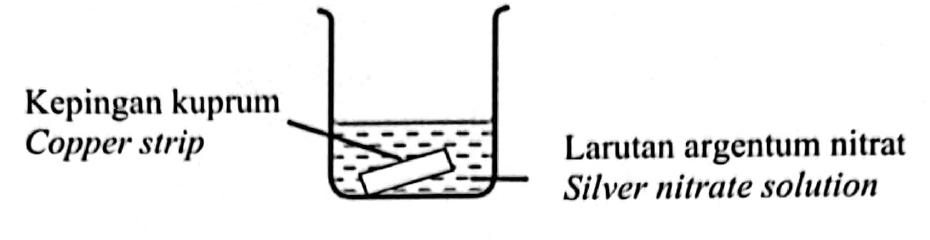
Diagram 9 shows the apparatus set-up to investigate a redox reaction (copper strip in silver nitrate solution). Which of the following statements is correct about the reaction?
Medium
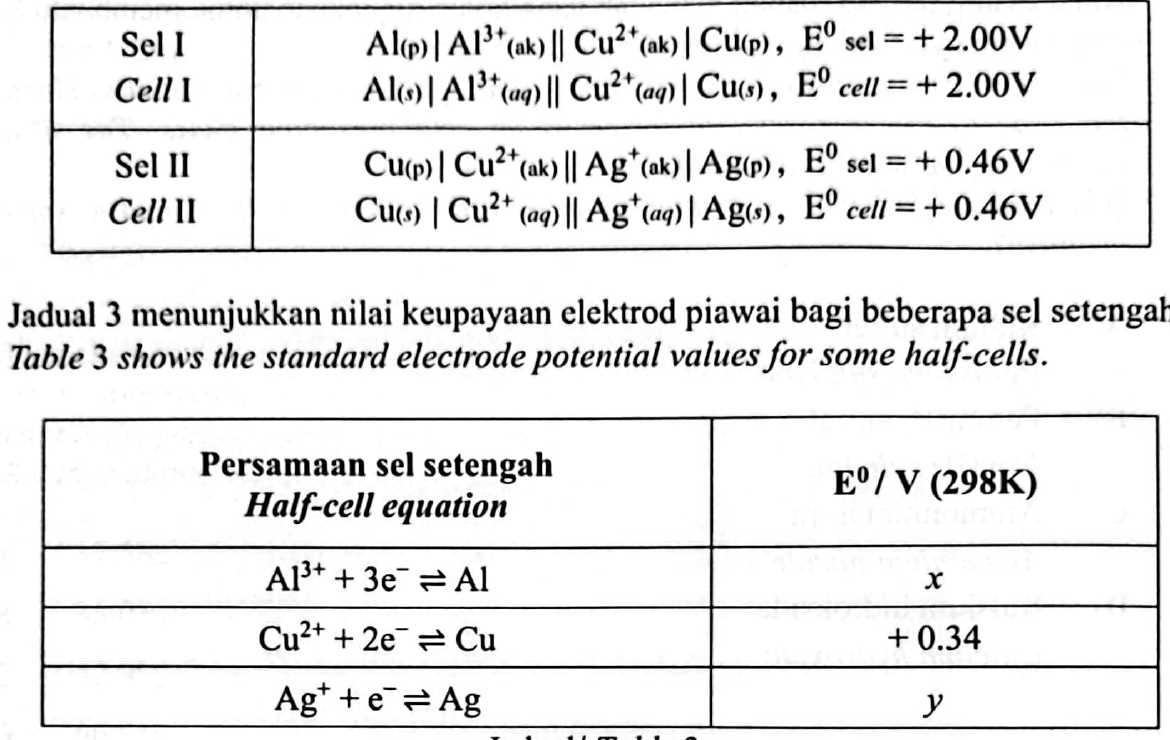
The following information shows the cell notation and voltage for two chemical cells: Cell I: Al(s) | Al³⁺(aq) || Cu²⁺(aq) | Cu(s), E°cell = +2.00 V. Cell II: Cu(s) | Cu²⁺(aq) || Ag⁺(aq) | Ag(s), E°cell = +0.46 V. Table 3 shows the standard electrode potential values: Al³⁺ + 3e⁻ ⇌ Al, E° = x; Cu²⁺ + 2e⁻ ⇌ Cu, E° = +0.34; Ag⁺ + e⁻ ⇌ Ag, E° = y. Another chemical cell has cell notation Al(s) | Al³⁺(aq) || Ag⁺(aq) | Ag(s). What is the voltage for the chemical cell?
Medium
Which of the following metals is extracted from its ore by electrolysis method?
Medium
Which of the following is a reduction reaction?
Medium
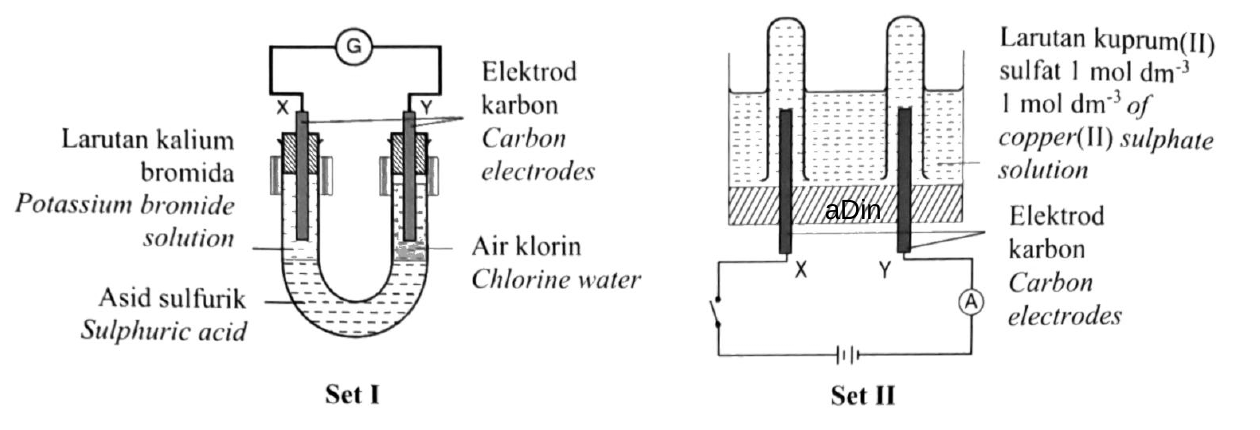
Diagram 23 shows the apparatus set up for two redox reactions. What is the process occurred at electrode X in Set I and observation at electrode Y in Set II?
Set I / Set II
A: Oxidation / Brown solid deposited
B: Oxidation / Colourless bubble of gas released
C: Reduction / Brown solid deposited
D: Reduction / Colourless bubble of gas released
Medium
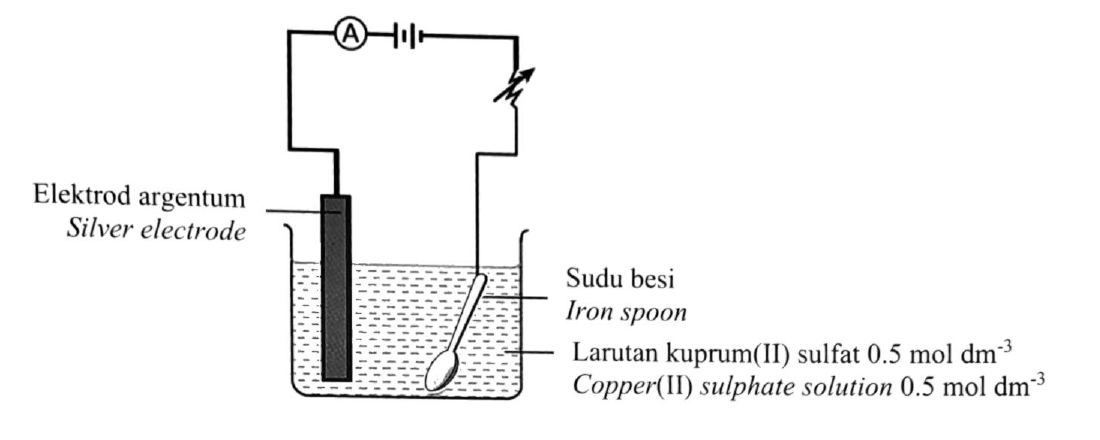
Diagram 36 shows the apparatus set up for an experiment conducted by a group of pupils (silver electrode and iron spoon in 0.5 mol dm⁻³ copper(II) sulphate solution). The pupils intend to electroplate the spoon with grey coating but the spoon becomes brown instead. What modification should be done to obtain the grey coating?
Medium
Which of the following does not occur during oxidation?
Medium
The following ionic equation represents a redox reaction. Zn + Cu²⁺ → Zn²⁺ + Cu. Which statement is correct?
Medium
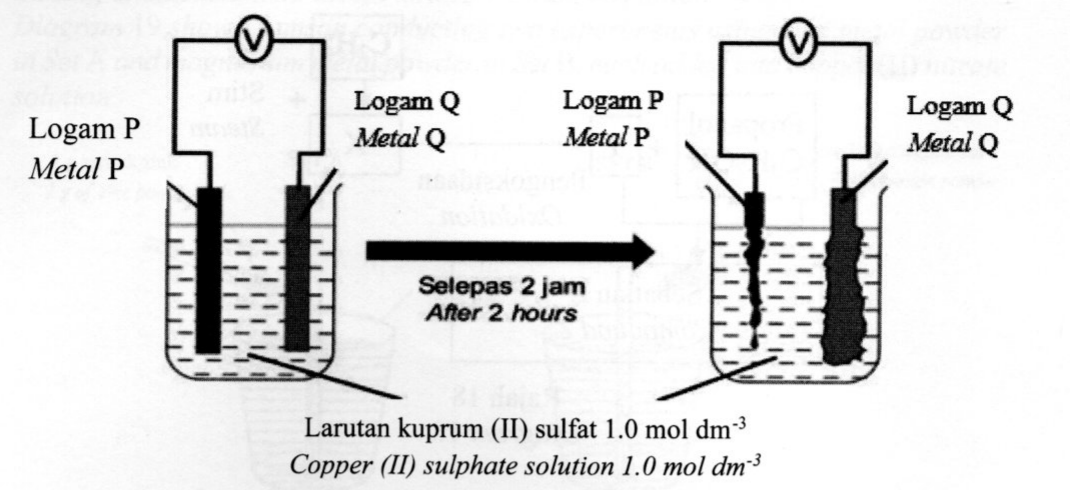
Diagram 17 shows the apparatus setup for a simple cell (metal P and metal Q in 1.0 mol dm⁻³ copper(II) sulphate solution; after 2 hours metal P becomes thinner and metal Q becomes thicker). Based on Diagram 17, which of the following is true?
Medium
What is the oxidation number of carbon dioxide, CO2?
Medium
The following equation shows the ionic equation for the reaction between zinc and copper(II) nitrate solution: Zn + Cu2+ → Zn2+ + Cu. Based on the equation, which substance undergoes oxidation?
Medium
Table 2 shows the observation for an experiment to investigate the effect of metals on the rusting of iron. Test tube P: iron nail coiled with metal X, pink spot is formed. Test tube Q: iron nail coiled with metal Y, blue spot is formed. Based on the observation, arrange iron, metal X and metal Y in ascending order of electropositivity.
Medium
Which of the following is true about an oxidation reaction?
Medium
Which statement exactly explains the following redox reaction? Cu(s) + 2AgNO₃(aq) → Cu(NO₃)₂(aq) + 2Ag(s)
Medium
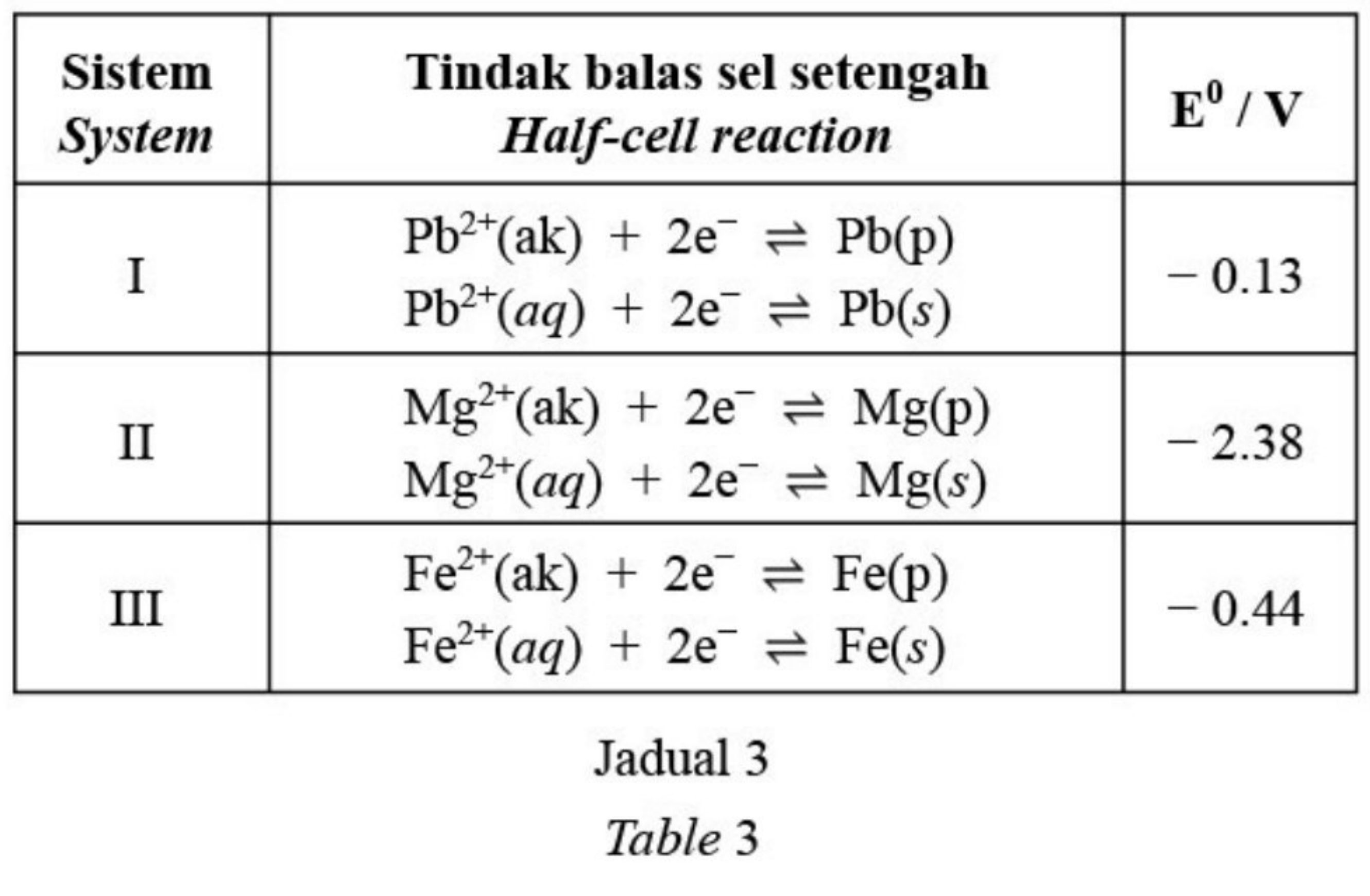
Table 3 shows standard electrode potential, E⁰ for lead, magnesium and iron: I Pb²⁺(aq) + 2e⁻ ⇌ Pb(s) −0.13 V; II Mg²⁺(aq) + 2e⁻ ⇌ Mg(s) −2.38 V; III Fe²⁺(aq) + 2e⁻ ⇌ Fe(s) −0.44 V. Which of the following cell notation represents the voltaic cell that produces the highest voltage?
Medium
The following equation shows the reaction between copper(II) oxide and hydrogen gas. CuO + H₂ → Cu + H₂O. What is the type of reaction that takes place for copper(II) oxide?
Easy
Which of the following equations represent a redox reaction?
Medium
The following ionic equation shows the reaction between zinc and acid. Zn + 2H⁺ → Zn²⁺ + H₂. What is the change in oxidation number for hydrogen?
Medium
Which statement defines oxidation?
Easy
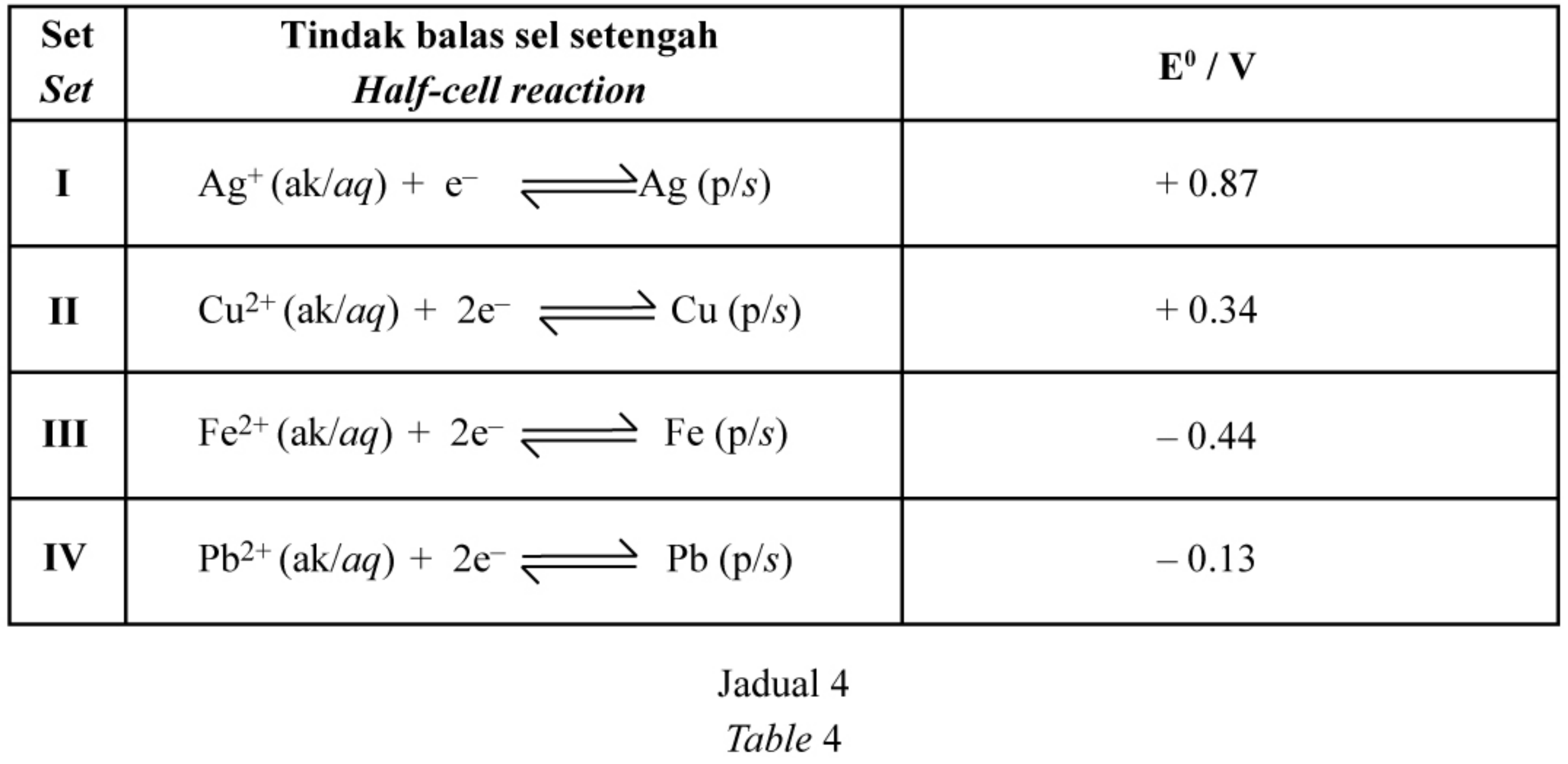
Table 4 shows standard electrode potential values, E° for silver, copper, iron and lead (I: Ag⁺/Ag +0.87 V; II: Cu²⁺/Cu +0.34 V; III: Fe²⁺/Fe −0.44 V; IV: Pb²⁺/Pb −0.13 V). Which pair of these standard electrode potential is used as a half-cell that produces the highest voltage?
Medium
Diagram 16 shows the set-up of the apparatus to study the electrolysis of 2.0 mol dm⁻³ sodium chloride solution using carbon electrodes. Name the gas X and gas Y.
Medium
Which of the following is true about reduction reaction?
Medium
Fe³⁺ ion in solution can be converted to Fe²⁺ ions by adding zinc powder. Which of the following can replace zinc powder in this reaction?
Medium
Diagram 9 shows a chemical cell (electrodes P and Q in ethanoic acid, connected to a voltmeter) and Table 3 shows standard electrode potential values: Zn²⁺/Zn -0.76 V, Cu²⁺/Cu +0.34 V, Ni²⁺/Ni -0.25 V. Based on the Diagram 9 and E° values in Table 3, which pair of metal is matched correctly? (P, Q)
Medium
Which of the following occurs in a reduction reaction?
Easy
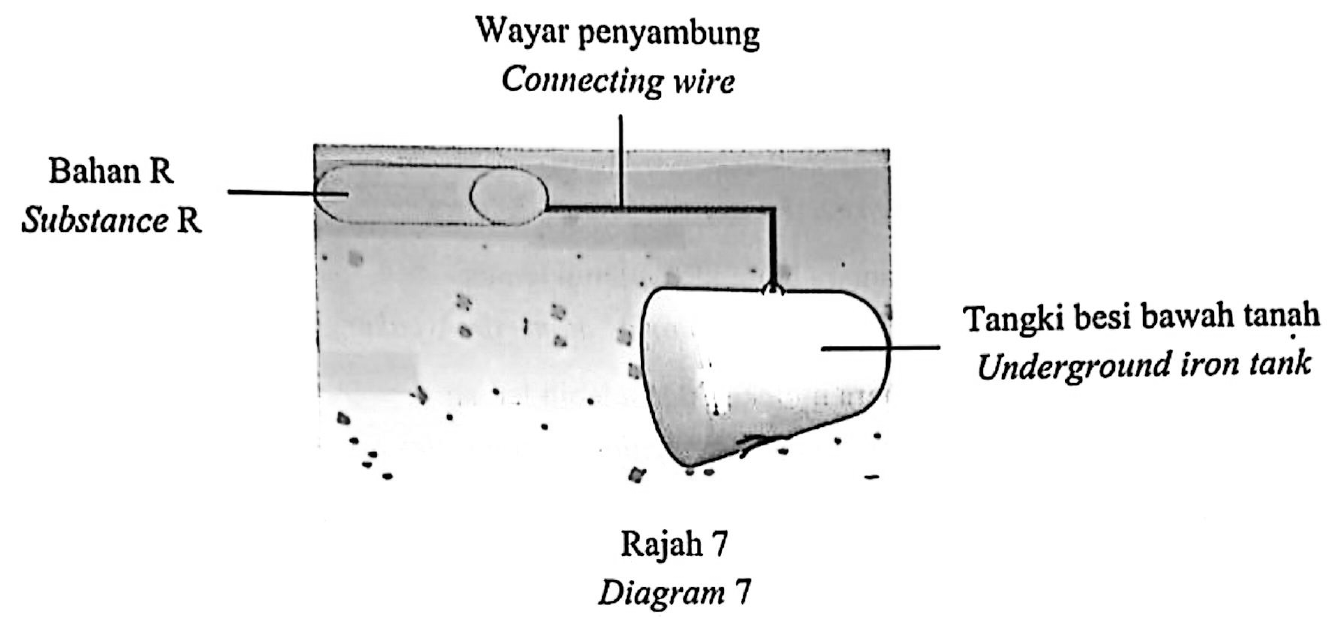
Diagram 7 shows substance R is used as a method to prevent the corrosion of an underground iron tank (R is connected to the tank by a wire). Which of the following is suitable to be used as substance R?
Medium
The following ionic equation represents the reaction between acidified potassium dichromate(VI) solution and iron(II) sulphate solution: Cr₂O₇²⁻ + 14H⁺ + 6Fe²⁺ → 6Fe³⁺ + 2Cr³⁺ + 7H₂O. What is the change of oxidation number of chromium in the reaction?
Medium
Which of the following is true about the reduction reaction?
Easy
Diagram 10 shows the apparatus set-up for the transfer of electrons at a distance in U-tube (potassium iodide solution and acidified potassium manganate(VII) solution, carbon electrodes, galvanometer G; Y is the liquid at the bottom of the U-tube). State the function of Y.
Medium
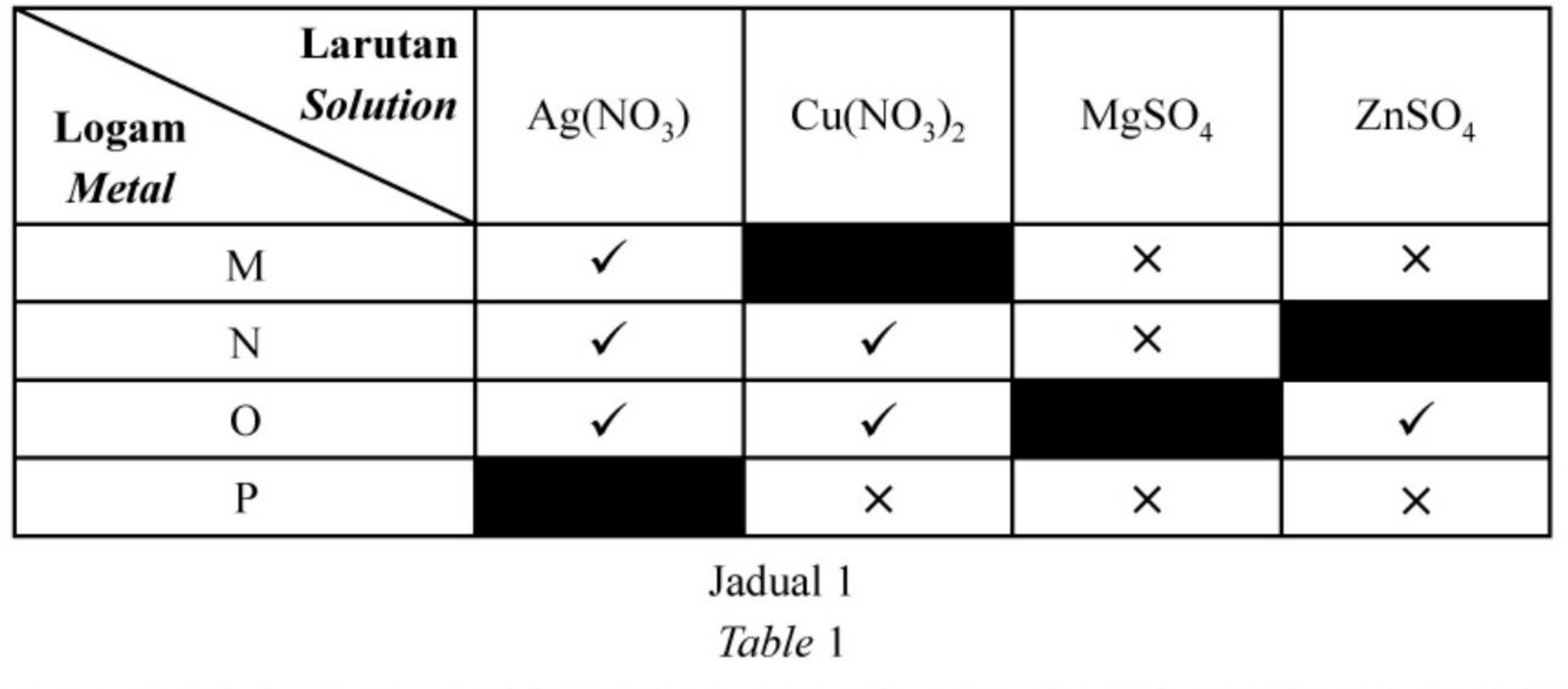
Table 1 shows results of displacement reaction for metal M, N, O and P (with solutions of Ag(NO₃), Cu(NO₃)₂, MgSO₄, ZnSO₄). Which metal has the highest tendency to donate electrons to form an ion?
Medium
Which of the following is a reducing agent?
Medium
The following shows an ionic equation.
P + Q2+ → P2+ + Q
Based on the equation, which of the following is true?
Medium
Table 3 shows the apparatus and observations for a metal displacement experiment: lead strip in X(NO3)2 solution; the blue colour of the solution fades, the lead strip becomes thinner, brown solids are deposited at the base. Which of the following is the oxidation and reduction reaction that occurs?
A Oxidation: Pb²⁺ + 2e → Pb; Reduction: Cu²⁺ + 2e → Cu
B Oxidation: Cu → Cu²⁺ + 2e; Reduction: Pb²⁺ + 2e → Pb
C Oxidation: Pb → Pb²⁺ + 2e; Reduction: Cu²⁺ + 2e → Cu
D Oxidation: Cu²⁺ + 2e → Cu; Reduction: Pb → Pb²⁺ + 2e
Medium
Which of the following is a redox reaction?
Medium
Rockets use a mixture of hydrogen and oxygen as a fuel. The equation of the reaction is as follows: 2H₂ + O₂ → 2H₂O. Which statement explains that the reaction is redox?
Medium
Electrolysis of solution X using carbon electrodes produces gases at both electrodes. What is solution X?
Medium
Magnesium chloride solution, 0.1 mol dm⁻³ is electrolyzed using carbon electrodes. Which are the half equations for the reactions occurring at the anode and cathode? A: anode 4OH⁻ → O₂ + 2H₂O + 4e; cathode Mg²⁺ + 2e → Mg. B: anode 4OH⁻ → O₂ + 2H₂O + 4e; cathode 2H⁺ + 2e → H₂. C: anode 2Cl⁻ → Cl₂ + 2e; cathode 2H⁺ + 2e → H₂. D: anode 2Cl⁻ → Cl₂ + 2e; cathode Mg²⁺ + 2e → Mg.
Medium
Iron is produced when haematite, Fe₂O₃ reacts with carbon monoxide: Fe₂O₃ + 3CO → 2Fe + 3CO₂. Which changes in oxidation number of the iron, Fe and carbon, C are correct?
Medium
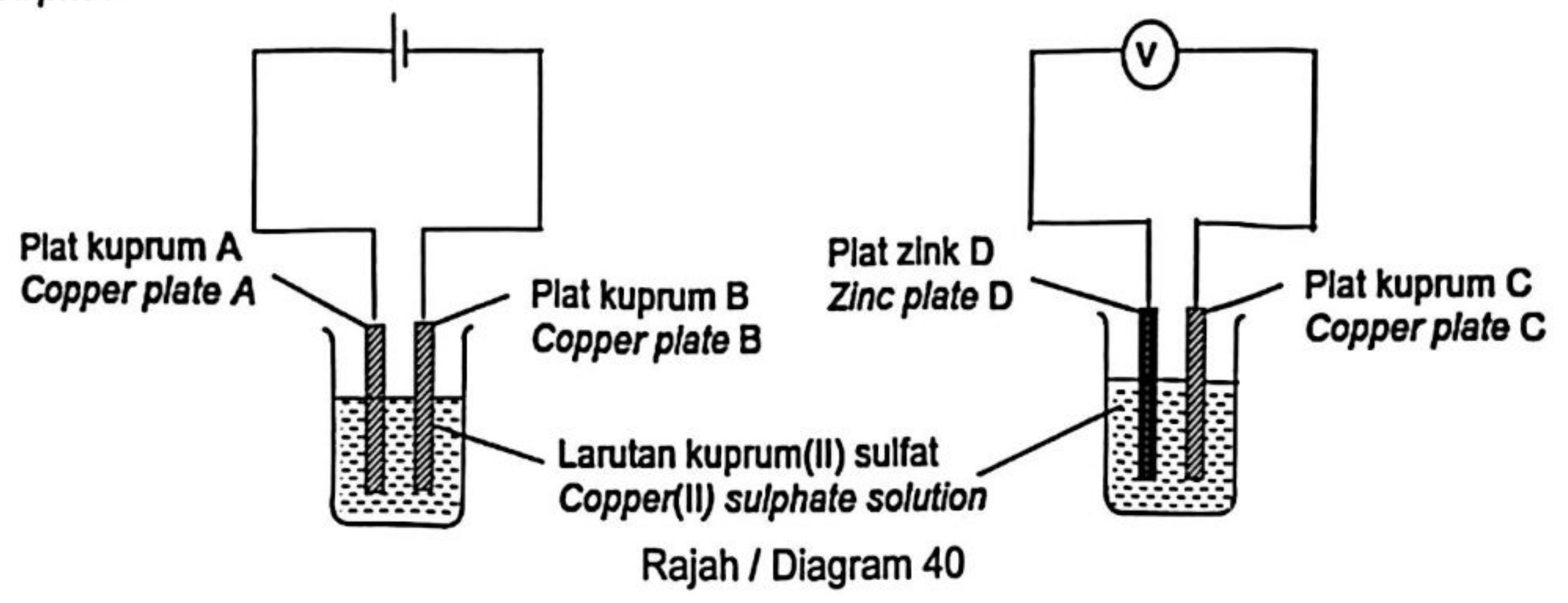
Diagram 40 shows an electrolytic cell (copper plates A and B) and a voltaic cell (zinc plate D and copper plate C) using the same electrolyte, copper(II) sulphate. Which of the changes in mass of copper plates A, B and C are true?