JOHOR SET 1 2024 P2 Q11
HardWrite your answer on paper. Then open the answer to check it.
Question 11 is in Section C (compulsory).
Hard20 marks- (a)
Diagram 11.1 shows the apparatus set-up to study the redox reaction (chlorine water added to potassium iodide in Set I and to iron(II) sulphate in Set II). Write the half-equation for the oxidation and reduction that occur in set I and set II, then determine the change in oxidation number of chlorine for both sets.
[4]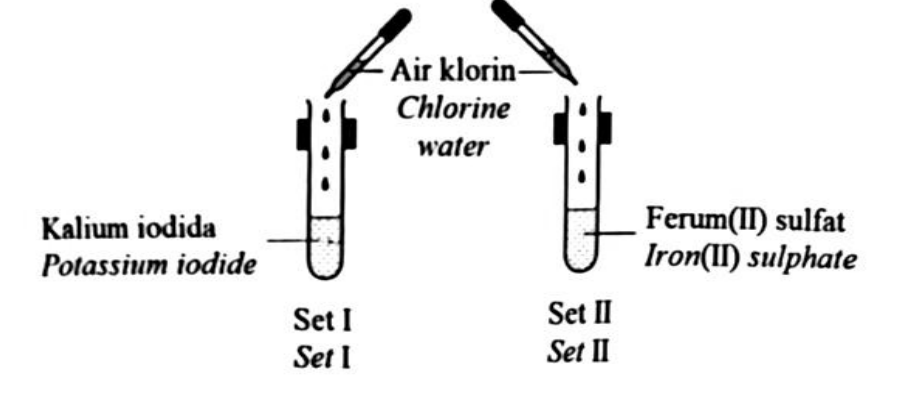
- (b)
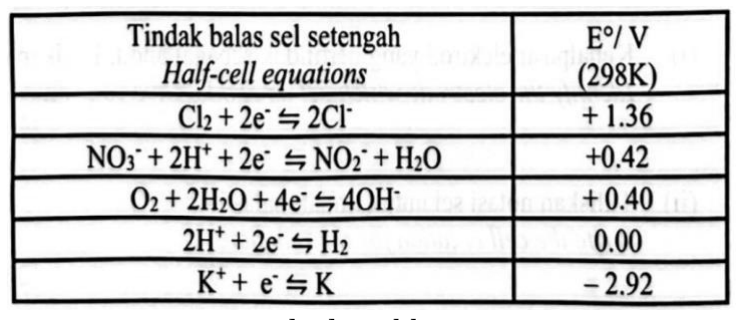
In another experiment, a student investigates the factors affecting the discharge of ions at different electrodes. Diagram 11.2 shows the apparatus (carbon electrodes): Set I uses 1.0 mol dm⁻³ potassium chloride solution; Set II uses 1.0 mol dm⁻³ potassium nitrate solution. Table 11.1 (standard electrode potentials, 298 K): Cl₂ + 2e⁻ ⇌ 2Cl⁻ +1.36 V; NO₃⁻ + 2H⁺ + 2e⁻ ⇌ NO₂⁻ + H₂O +0.42 V; O₂ + 2H₂O + 4e⁻ ⇌ 4OH⁻ +0.40 V; 2H⁺ + 2e⁻ ⇌ H₂ 0.00 V; K⁺ + e⁻ ⇌ K −2.92 V. Compare and contrast set I and set II in terms of: ions attracted to the anode; choice of ion to be oxidised; reason why the ion was chosen to be oxidised; observation at the anode.
[8]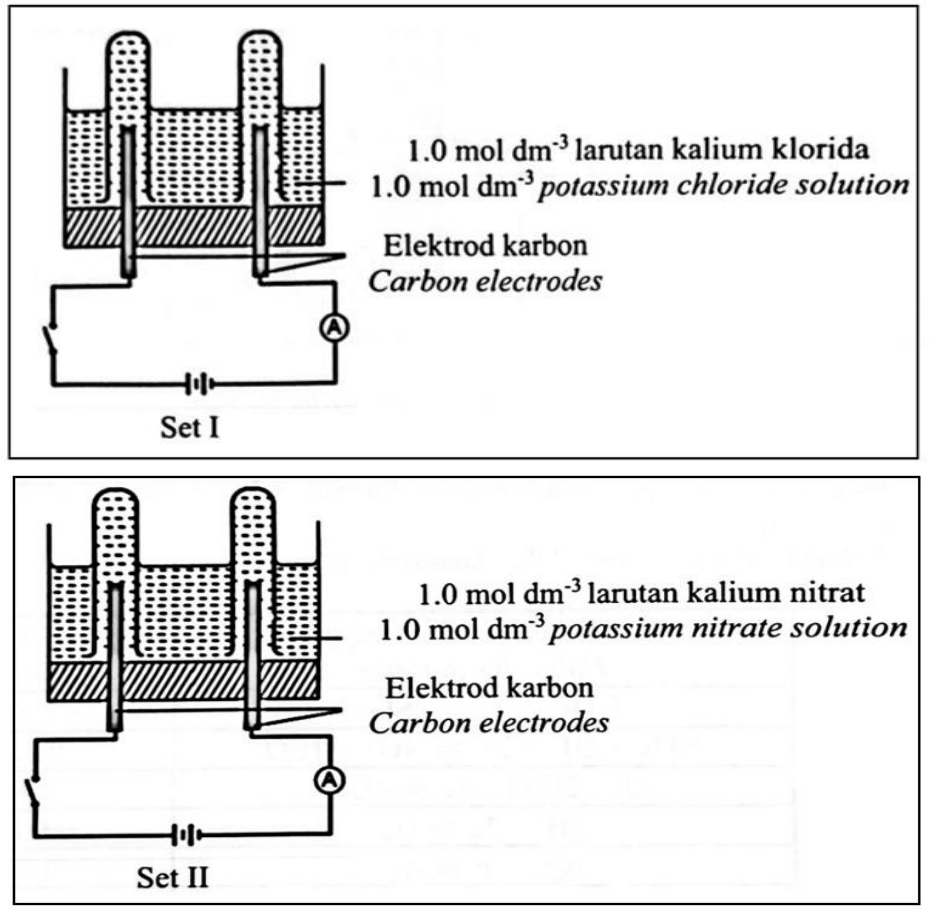
- (c)
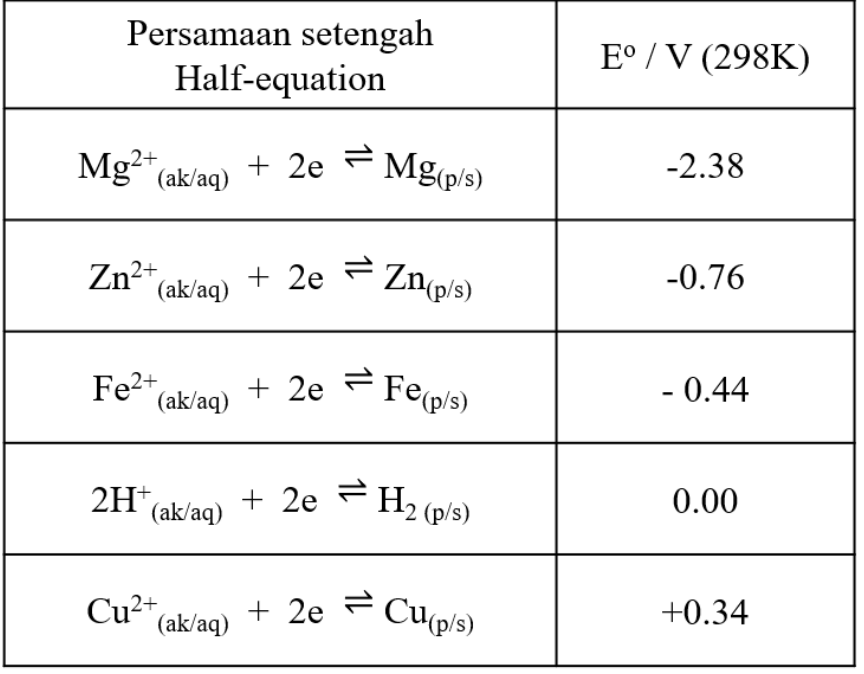
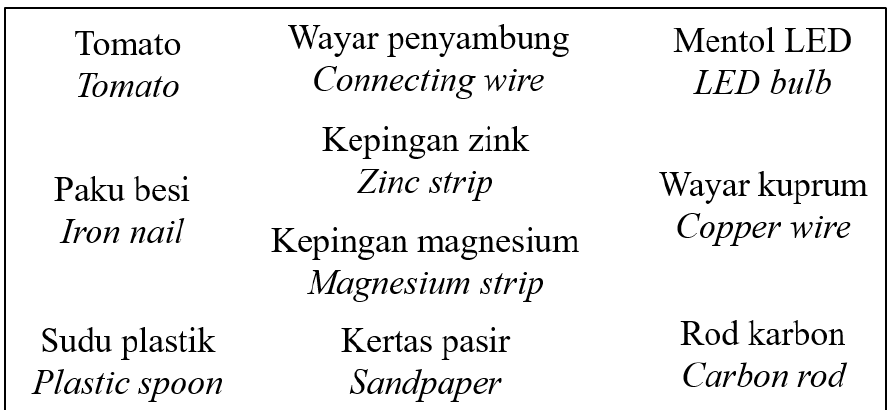
Table 11.2 shows part of the standard electrode potential series: Mg²⁺ + 2e⁻ ⇌ Mg −2.38 V; Zn²⁺ + 2e⁻ ⇌ Zn −0.76 V; Fe²⁺ + 2e⁻ ⇌ Fe −0.44 V; 2H⁺ + 2e⁻ ⇌ H₂ 0.00 V; Cu²⁺ + 2e⁻ ⇌ Cu +0.34 V. Diagram 11.3 lists the materials and apparatus provided to construct a voltaic cell: tomato, connecting wire, LED bulb, iron nail, zinc strip, copper wire, plastic spoon, magnesium strip, sandpaper, carbon rod. Using your chemistry knowledge, draw the apparatus set-up of a voltaic cell that can light up the LED bulb, using suitable materials from Diagram 11.3. Describe briefly the steps of constructing the voltaic cell and explain the redox reaction that takes place. Then determine the voltage reading obtained.
[8]