KEDAH 2025 P2 Q11
HardWrite your answer on paper. Then open the answer to check it.
Diagram 11.1 shows a metal displacement reaction from its salt solution: zinc powder added to copper(II) nitrate solution gives solution K and solid L.
Hard20 marks- (a)
State the meaning of redox. Based on Diagram 11.1, write the chemical formula for the solution K formed and state the colour of solid L.
[3]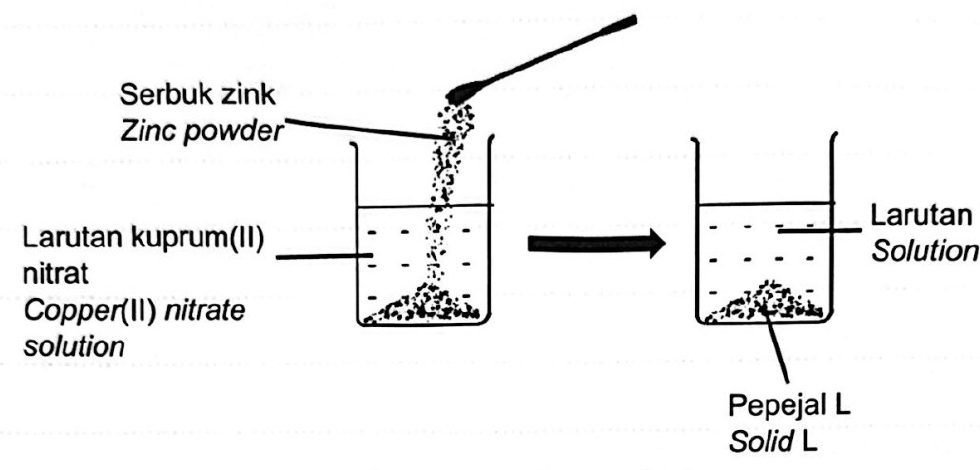
- (b)
Ba(NO₃)₂ + Na₂SO₄ → ............. + ............ Copy and complete the above equation. Name the above reaction. Determine whether the reaction is a redox reaction or not. Explain your answer.
[4] - (c)
Table 11: Salt Y: solid Y is heated and the liberated gas N is tested with damp blue litmus paper (turns red) and gas P is tested with a glowing wooden splinter (ignites); solid residue M changes from yellow to white when cooled. Salt Z: reaction between 2.0 mol dm⁻³ sodium sulphate solution and 2.0 mol dm⁻³ lead(II) nitrate solution, a white precipitate is formed. Based on Table 11, identify salt Y, salt Z, solid residue M and gas P. State the colour of the gas N that turns damp blue litmus paper to red.
[5]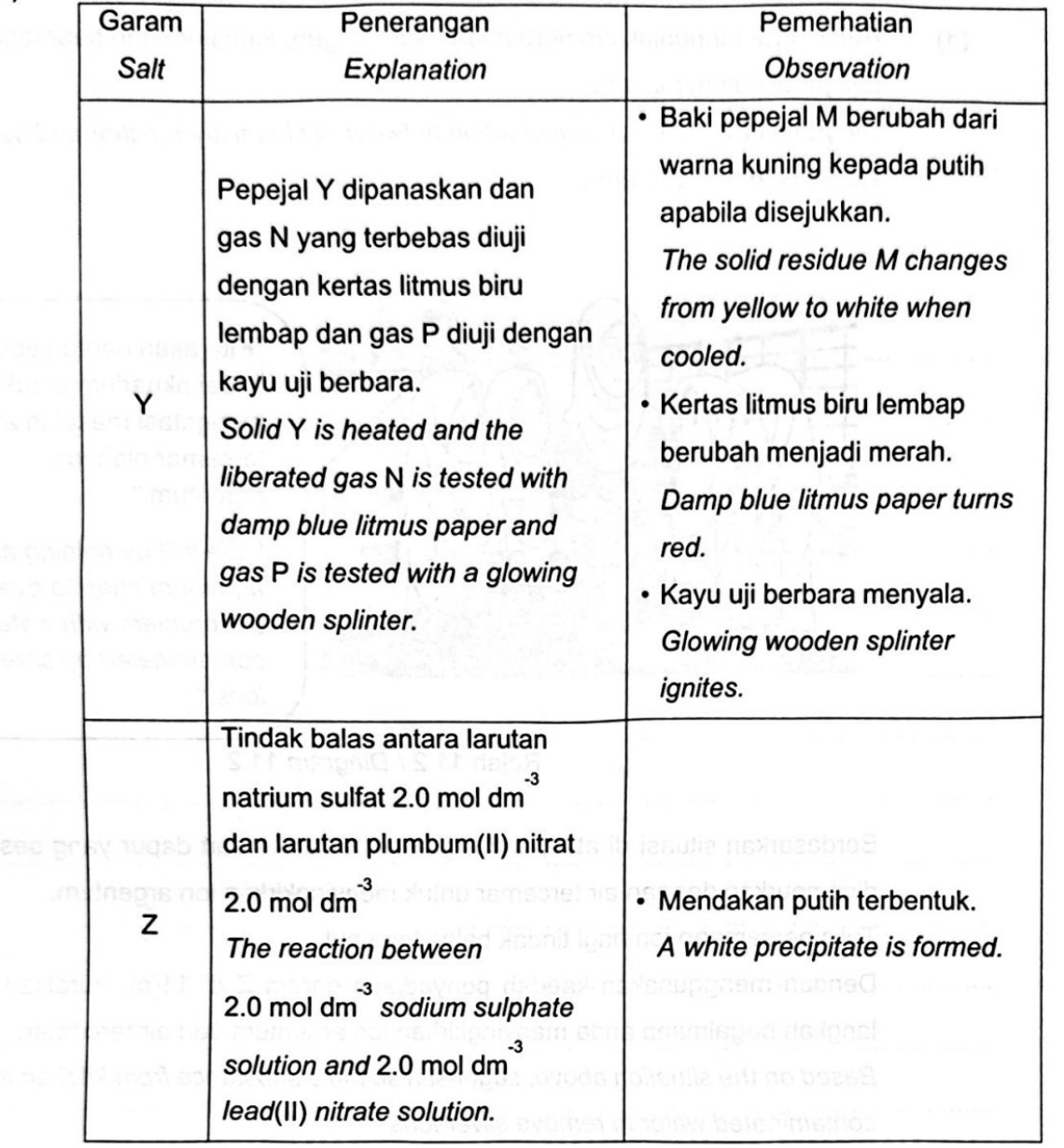
- (d)
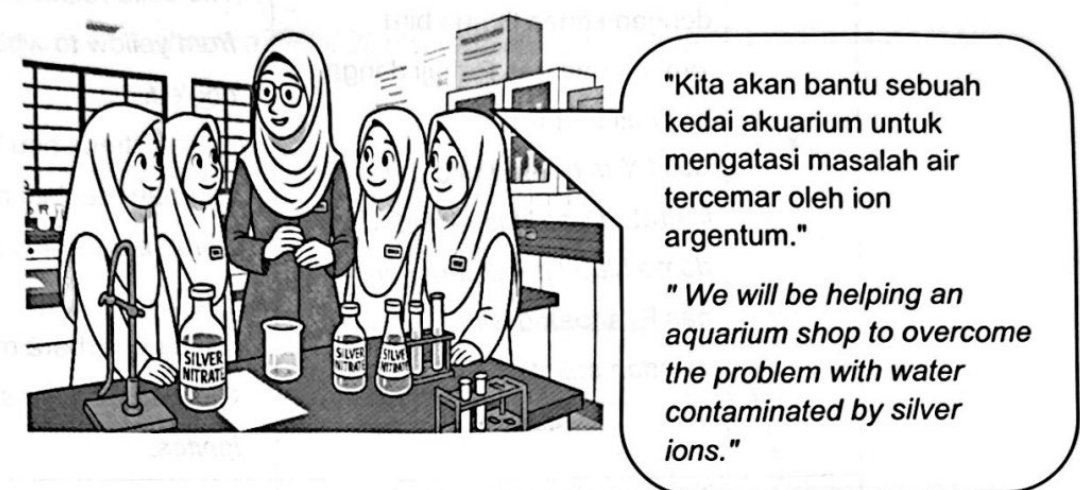
Diagram 11.2 shows a conversation between a chemistry teacher and several students: 'We will be helping an aquarium shop to overcome the problem with water contaminated by silver ions.' Based on the situation, suggest a suitable substance from the kitchen to add to contaminated water to remove silver ions. Write the ionic equation for the reaction. By using the method of preparing salt Z in 11(c), describe the steps on how you would remove silver ions from contaminated water.
[8]