KELANTAN 2023 P2 Q7
MediumWrite your answer on paper. Then open the answer to check it.
Diagram 6 shows the arrangement of apparatus for an experiment to study the potential difference between two electrodes using their respective electrolytes in a redox reaction: Beaker P zinc in 1.0 mol dm-3 zinc nitrate solution; Beaker Q copper in 1.0 mol dm-3 copper(II) nitrate solution; salt bridge; voltmeter and bulb.
Medium10 marks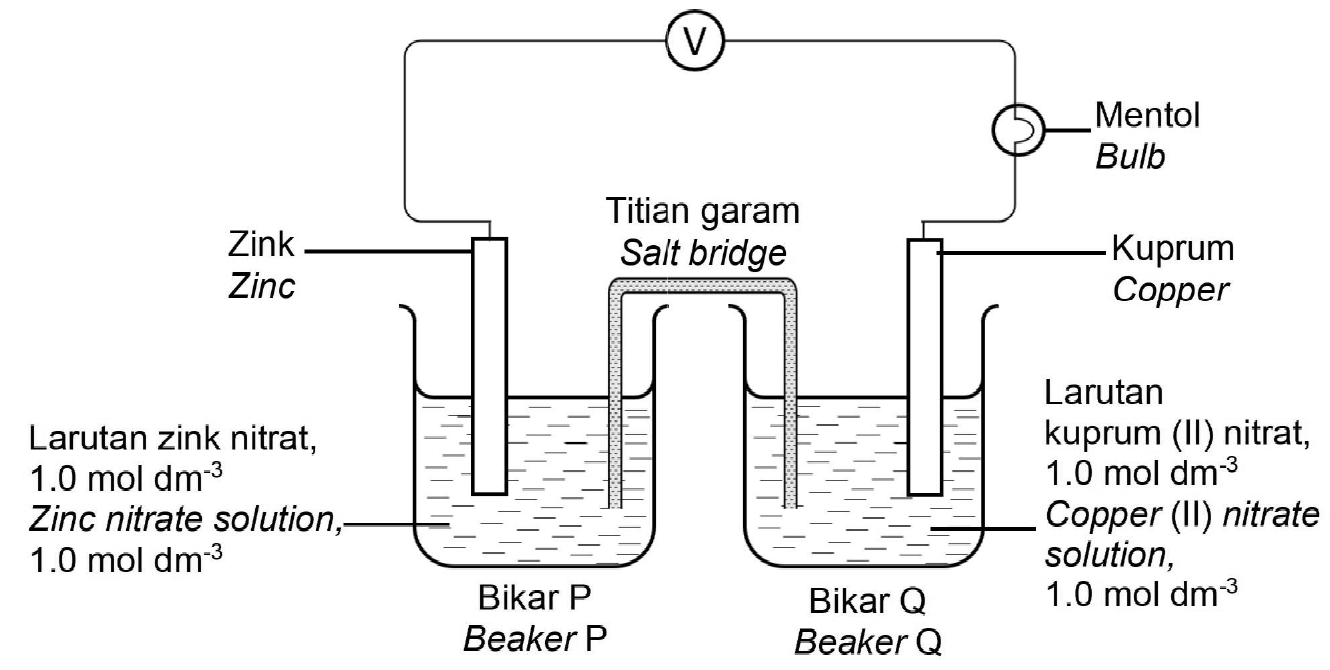
- (a)
What is meant by electrolyte?
[1] - (b)
List all the cations present in beaker Q.
[1] - (c)(i)
Table 5 shows a part of the Standard Electrode Potential Series (Mg2+/Mg -2.38 V; Zn2+/Zn -0.76 V; Cu2+/Cu +0.34 V; Ag+/Ag +0.80 V). Based on Diagram 6 and Table 5, write the cell notation for the reaction.
[2]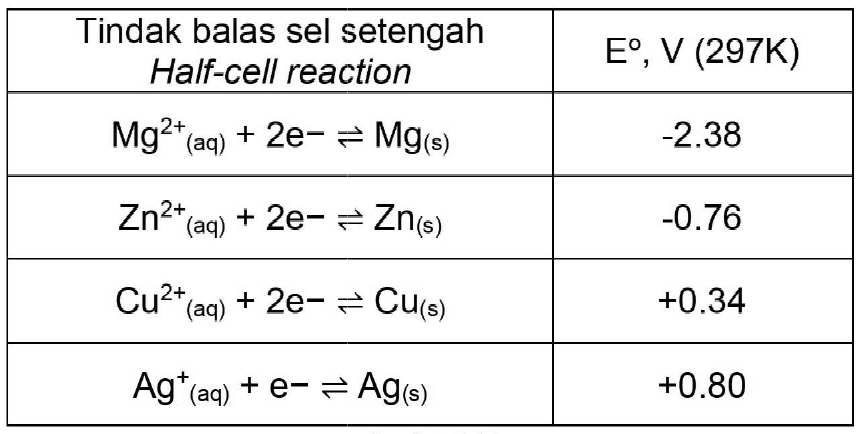
- (c)(ii)
Calculate the value of the E°cell for the reaction.
[1] - (c)(iii)
Choose the pair of metals that will produce the brightest light of bulb. Justify your choice.
[2] - (c)(iv)
Based on your answer in (c)(iii), write a half equation to represent the reaction that occurs at the negative terminal of the cell.
[1] - (d)
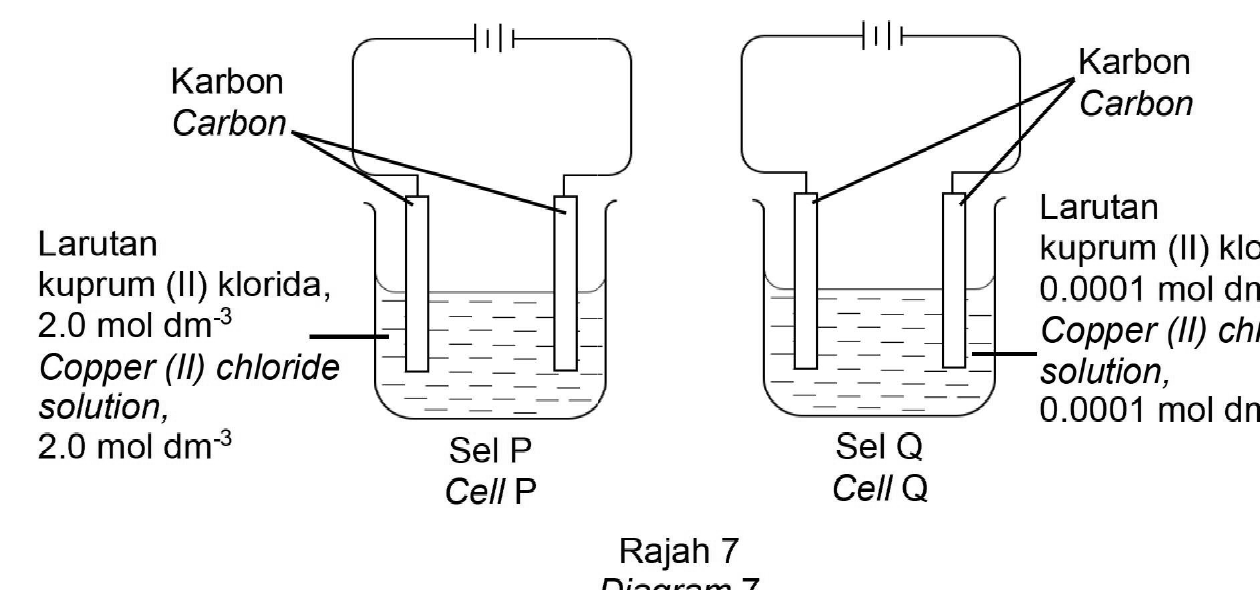
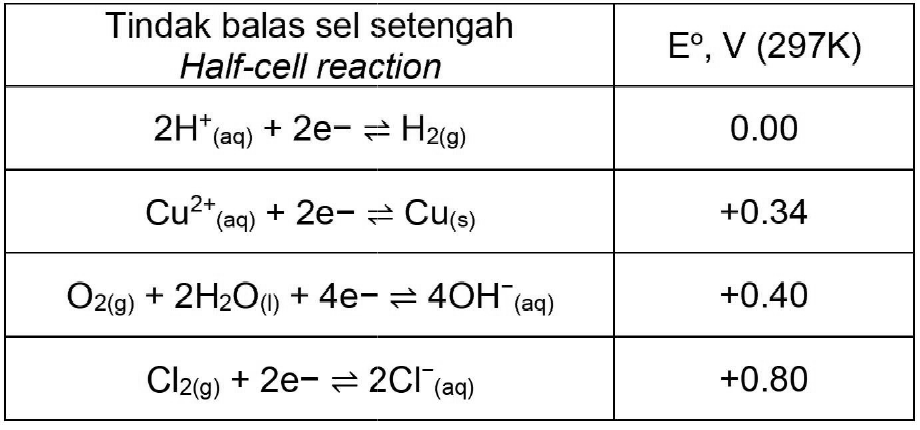
Diagram 7 shows the arrangement of apparatus used to study the results of electrolysis of copper(II) chloride solution using carbon electrodes: Cell P 2.0 mol dm-3, Cell Q 0.0001 mol dm-3. Given E°: 2H+/H2 0.00 V; Cu2+/Cu +0.34 V; O2/OH- +0.40 V; Cl2/Cl- +0.80 V. Explain the difference observed at the anode in the two electrolysis cells shown in Diagram 7.
[2]