MELAKA 2021 P2 Q9
HardWrite your answer on paper. Then open the answer to check it.
Diagram 9.1 shows a simple chemical cell: a copper electrode in 1.0 mol dm⁻³ copper(II) nitrate solution and an iron electrode in 1.0 mol dm⁻³ iron(II) nitrate solution joined by a salt bridge and a voltmeter. Choose ONE question from Section B (Question 9 or 10).
Hard20 marks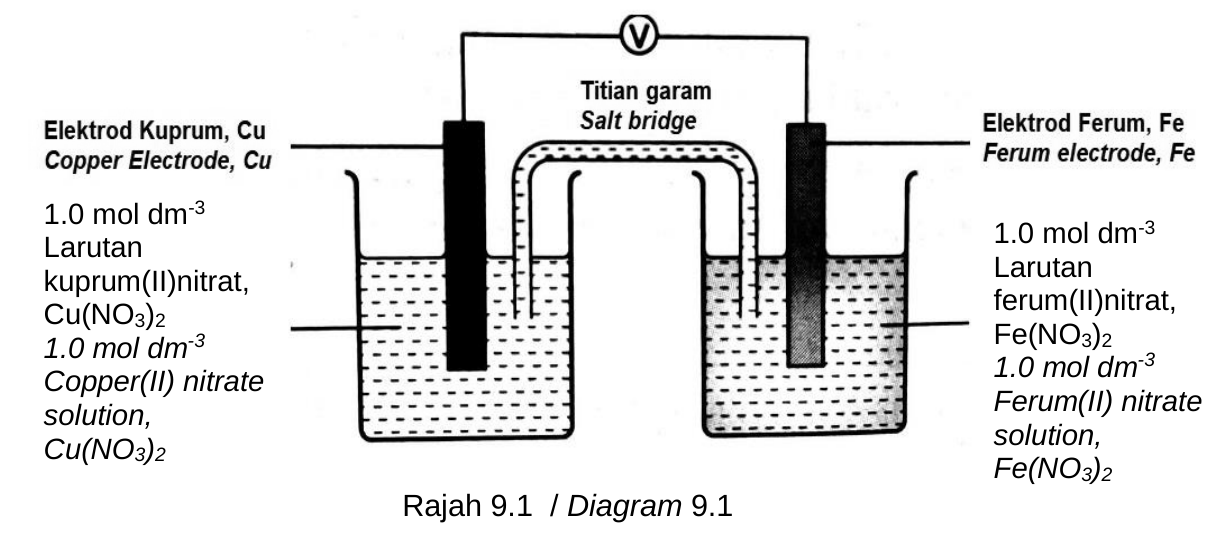
- (a)(i)
Based on Diagram 9.1 and the standard electrode potentials of the half-cells, state the positive terminal and negative terminal of this cell.
[2] - (a)(ii)
Write the cell notation for the voltaic cell.
[1] - (a)(iii)
Calculate the voltage of the cell.
[1]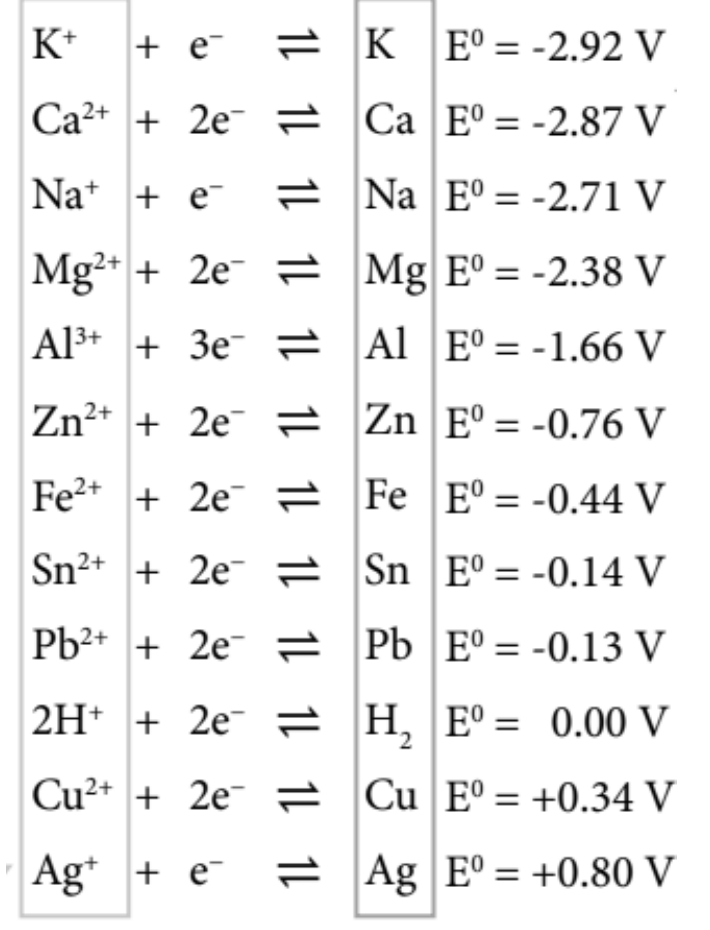
- (b)(i)
The experiment is repeated using silver and magnesium electrodes, each in an aqueous solution of its own metal ions (Table 9.1: Mg²⁺ + 2e⁻ ⇌ Mg, E° = -2.38 V; Ag⁺ + e⁻ ⇌ Ag, E° = +0.80 V; 2H⁺ + 2e⁻ ⇌ H₂, E° = 0.00 V). State an observation at the positive terminal and at the negative terminal.
[2]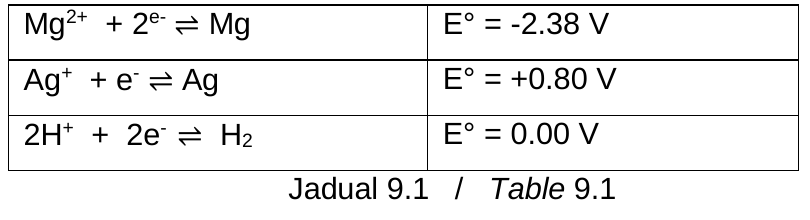
- (b)(ii)
Write the half equation of oxidation and the half equation of reduction for this experiment. Explain your answer.
[4] - (c)
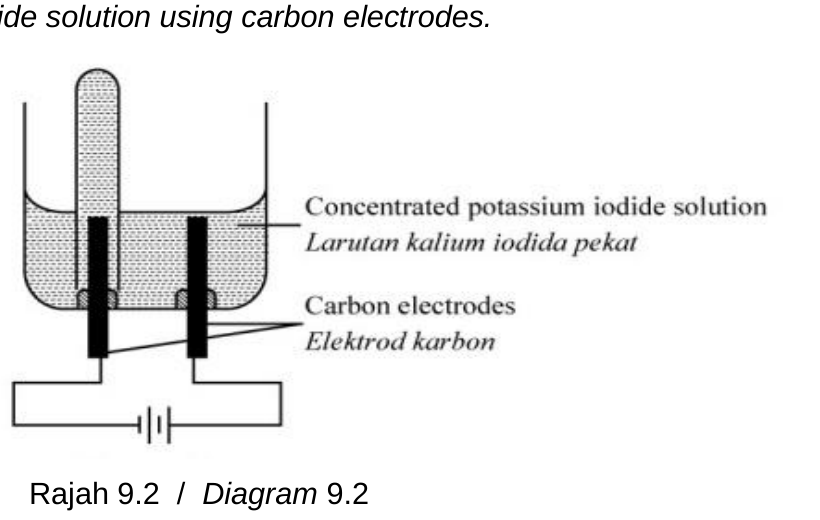
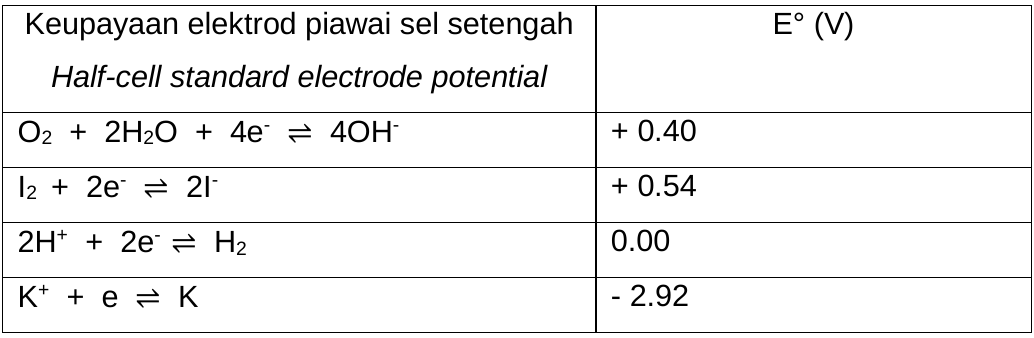
Diagram 9.2 shows the electrolysis of concentrated potassium iodide solution using carbon electrodes. Table 9.2: O₂ + 2H₂O + 4e⁻ ⇌ 4OH⁻, +0.40 V; I₂ + 2e⁻ ⇌ 2I⁻, +0.54 V; 2H⁺ + 2e⁻ ⇌ H₂, 0.00 V; K⁺ + e ⇌ K, -2.92 V. Based on Diagram 9.2 and Table 9.2, explain the reactions at the anode and cathode: ion selectively discharged, reason, half equation, observation, product.
[10]