MELAKA 2022 P2 Q9
MediumWrite your answer on paper. Then open the answer to check it.
Answer any one question in Section B. Diagram 8.1 shows the apparatus setup for two cells, Cell I (zinc in 1.0 mol dm⁻³ zinc sulphate solution, copper electrode, salt bridge) and Cell II (carbon electrodes W and X in 1.0 mol dm⁻³ copper(II) chloride solution) connected together. Table 4 gives standard electrode potentials: Zn²⁺/Zn -0.76 V; Cl₂/Cl⁻ +1.36 V; O₂/OH⁻ +0.40 V; Cu²⁺/Cu +0.34 V; 2H⁺/H₂ 0.00 V; S₂O₈²⁻/SO₄²⁻ +2.01 V.
Medium20 marks- (a)(i)
Based on Diagram 8.1 and Table 4, state the function of the salt bridge in Cell I. Identify the negative terminal in Cell I and explain why.
[3]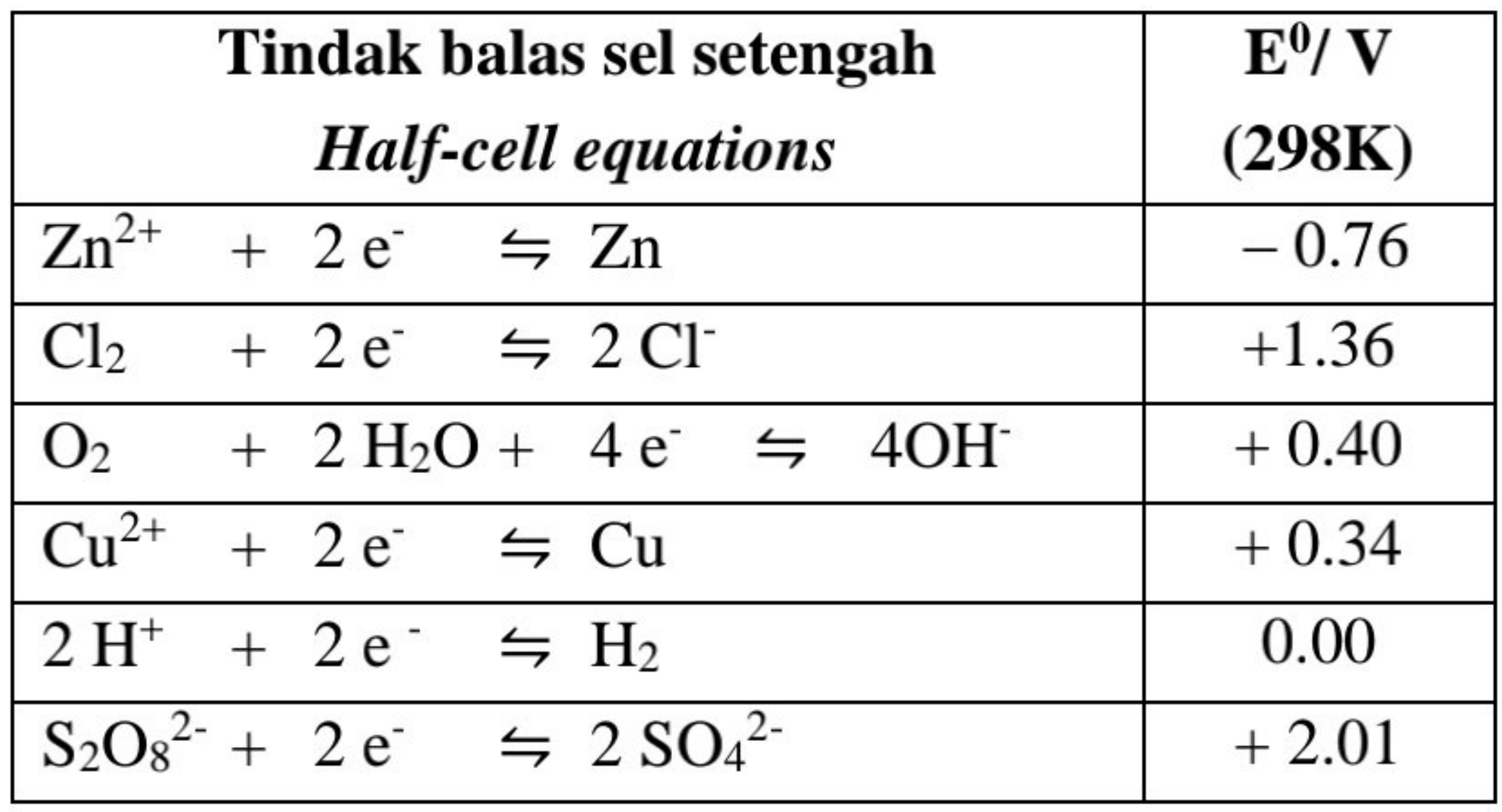
- (a)(ii)
Explain the reaction that occurs on carbon electrodes W and X in Cell II based on: movement of ions to each electrode; choice of ions to be oxidised and reduced and the reason why the ions were chosen; half-equation at each electrode; observations at each electrode.
[10]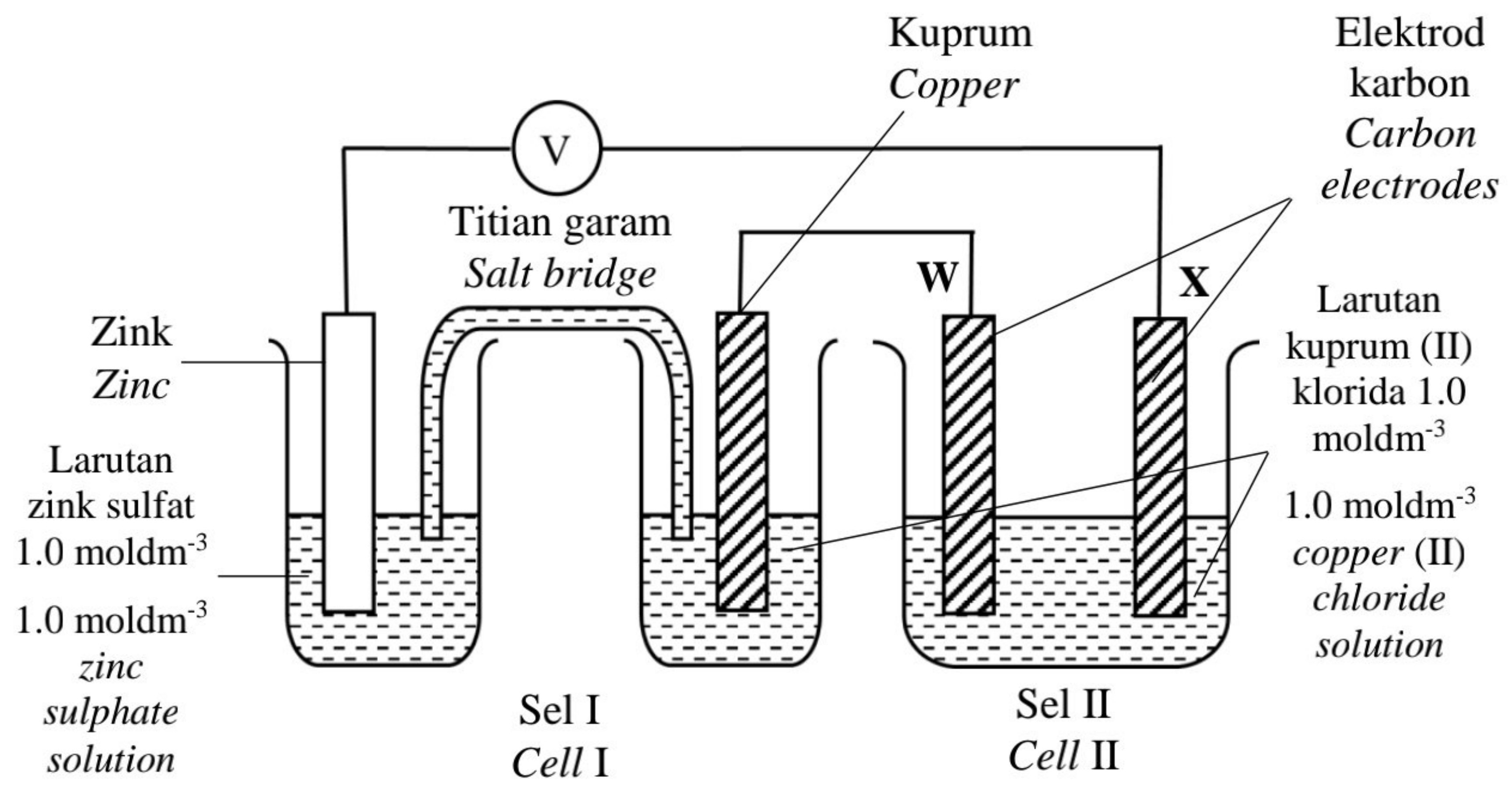
- (b)
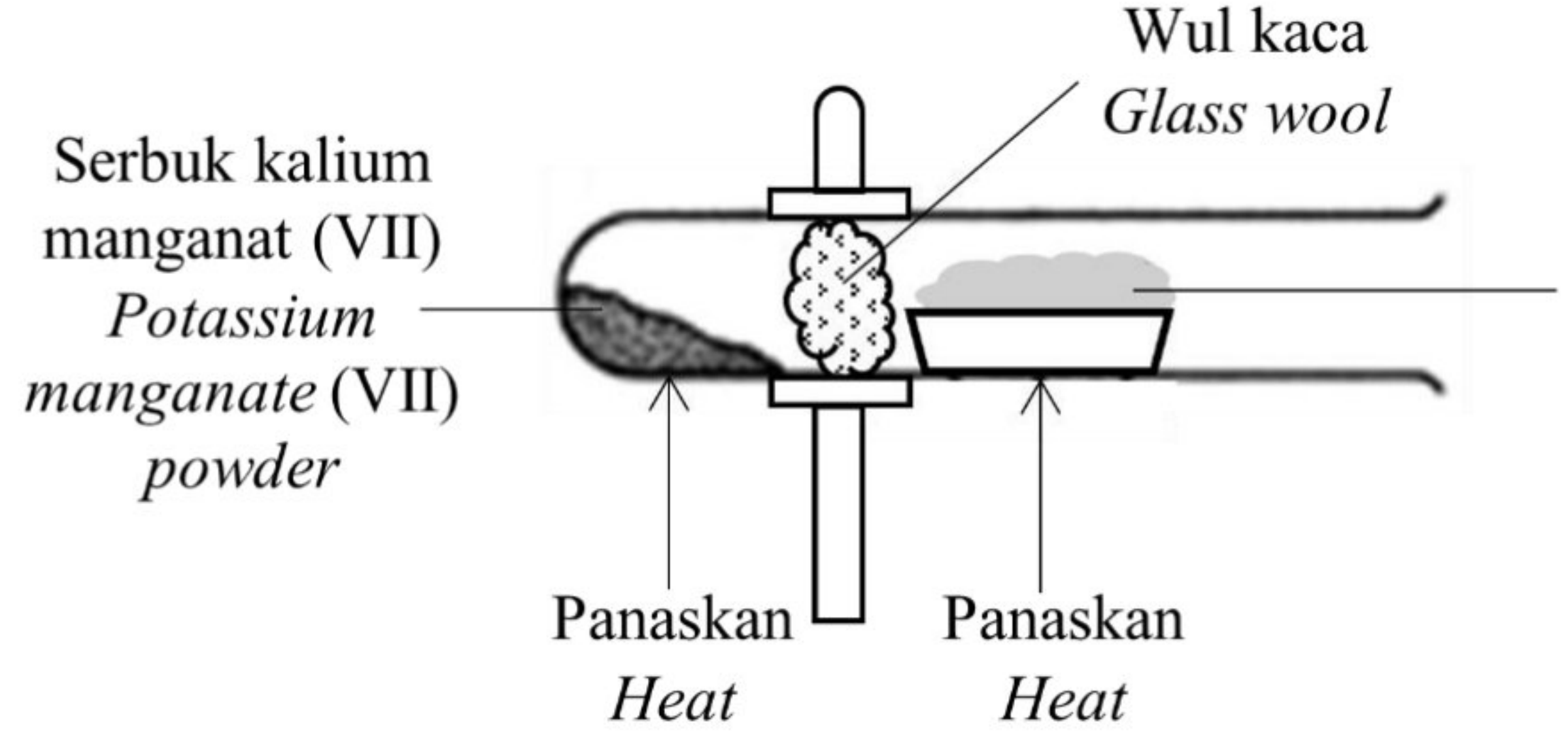
Diagram 8.2 shows the apparatus setup used in the lab to investigate the reactivity of metals towards oxygen to form metal oxide (potassium manganate(VII) powder heated, glass wool, metal powder heated). When iron is heated using the apparatus in Diagram 8.2, iron(III) oxide is formed. State the colour of iron(III) oxide formed and write a chemical equation for the reaction. Calculate the mass of metal oxide formed when 14 g of iron is heated. [Relative atomic mass: O = 16; Fe = 56]
[7]