MELAKA 2023 P2 Q10
MediumWrite your answer on paper. Then open the answer to check it.
Answer one question from Section B (Question 9 or 10). Diagram 8.1 shows the apparatus set-up to investigate the reduction of copper(II) oxide by hydrogen gas (hydrogen produced from solution X and compound Y). After heating, a brown solid forms in the combustion tube.
Medium20 marks- (a)(i)
State the type of particle present in the hydrogen gas and state the colour of copper(II) oxide.
[2]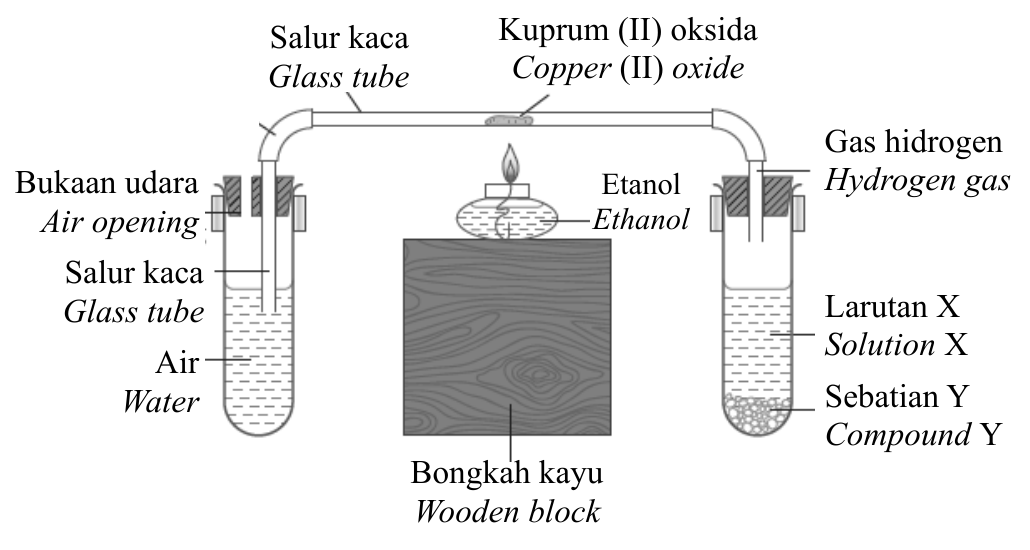
- (a)(ii)
Identify the solution X and compound Y used in Diagram 8.1.
[2] - (a)(iii)
Write a chemical equation for the reaction in Diagram 8.1. Calculate the mass of the brown solid formed when 2 g of copper(II) oxide is heated completely. [Relative atomic mass: H = 1, O = 16, Cu = 64]
[6] - (b)
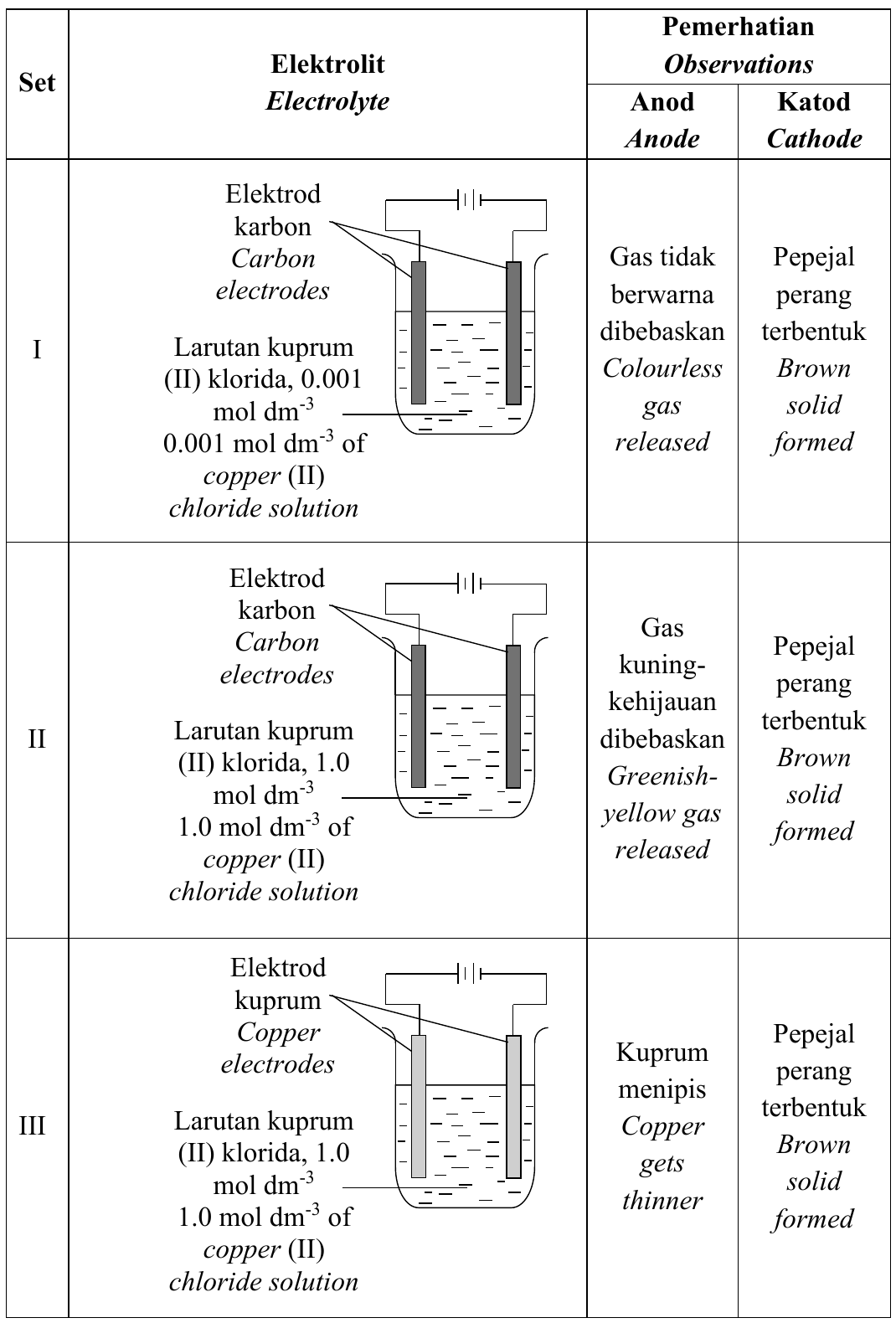
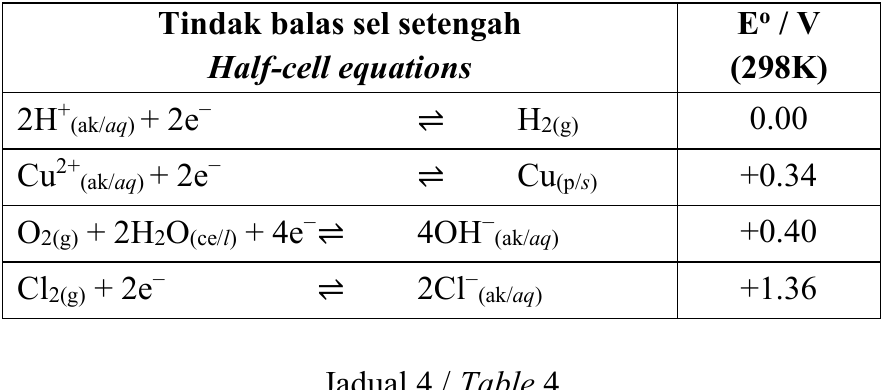
Diagram 8.2 shows three sets of apparatus and observations at the anode and cathode for the electrolysis of copper(II) chloride solution, CuCl2: Set I - carbon electrodes, 0.001 mol dm-3 CuCl2: anode colourless gas, cathode brown solid; Set II - carbon electrodes, 1.0 mol dm-3 CuCl2: anode greenish-yellow gas, cathode brown solid; Set III - copper electrodes, 1.0 mol dm-3 CuCl2: anode copper gets thinner, cathode brown solid. Table 4 (E° / V at 298 K): 2H+ + 2e- ⇌ H2, 0.00; Cu2+ + 2e- ⇌ Cu, +0.34; O2 + 2H2O + 4e- ⇌ 4OH-, +0.40; Cl2 + 2e- ⇌ 2Cl-, +1.36. Based on Diagram 8.2 and Table 4, explain the difference in observations at the anode in Set I, II and III. Write the half-equation for the reaction at the cathode of the three sets.
[10]