PERAK SET 2 2022 P2 Q9
MediumWrite your answer on paper. Then open the answer to check it.
Diagram 8 shows a flow chart for the conversion of iron(II) sulphate through redox reactions: iron(II) sulphate solution + metal X (Reaction I) gives iron; iron(II) sulphate solution + halogen Y (Reaction II) gives a brown colour solution.
Medium20 marks- (a)(i)
State the definition of redox reaction and the colour of iron(II) sulphate.
[2]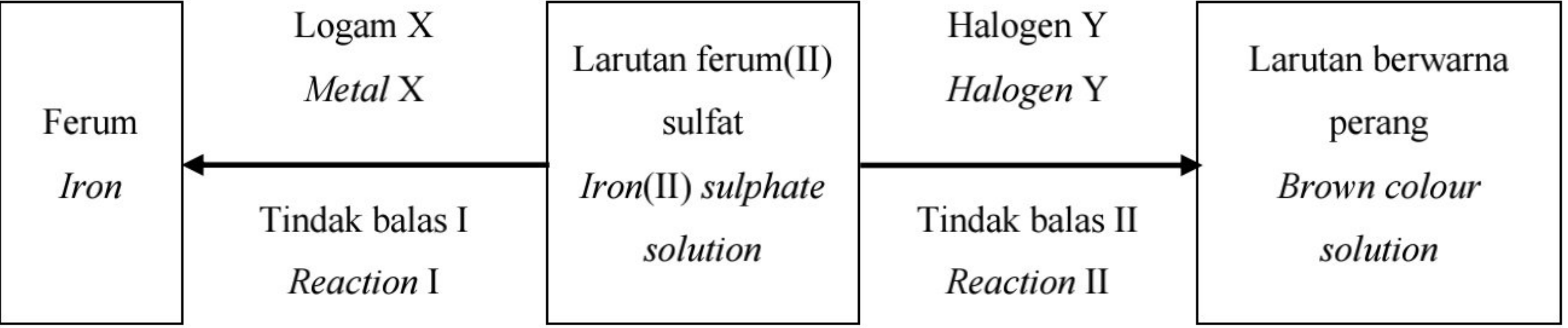
- (a)(ii)
Based on Reaction II, identify halogen Y and the cation present in the brown solution. Explain why the reaction is a redox reaction in terms of electron transfer or change in oxidation number.
[6] - (a)(iii)
Identify metal X and write the chemical equation for Reaction I. If 50 cm3 of 2.0 mol dm-3 iron(II) sulphate solution and excess metal X are used, calculate the mass of iron produced. [Relative atomic mass: Fe = 56]
[5] - (b)
A student carried out an experiment to investigate the electrolysis of 1.0 mol dm-3 hydrochloric acid in a chemistry lab. After 10 minutes, the student felt dizzy and had difficulty breathing, as a result of inhaling the greenish yellow gas W produced at the anode during electrolysis. Identify gas W. Explain how gas W is produced at the anode and write the half equation for the reaction.
[4] - (c)
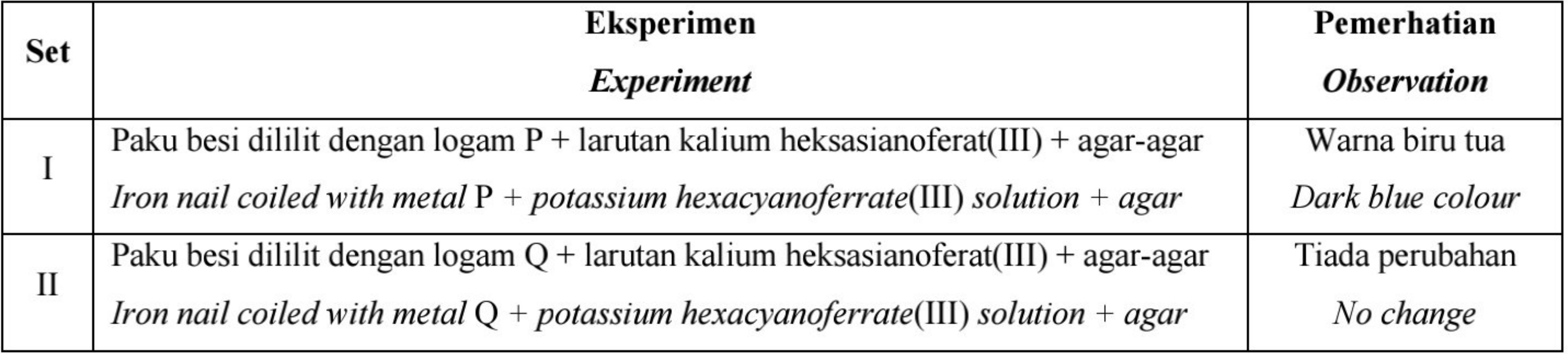
Table 6 shows the observation for the experiment of the effects of other metals on the rusting of iron nail: Set I iron nail coiled with metal P + potassium hexacyanoferrate(III) solution + agar gives dark blue colour; Set II iron nail coiled with metal Q + potassium hexacyanoferrate(III) solution + agar gives no change. Based on the information in Table 6, explain why there is a difference in the observation of Set I and Set II.
[3]