PERLIS 2021 P2 Q10
HardWrite your answer on paper. Then open the answer to check it.
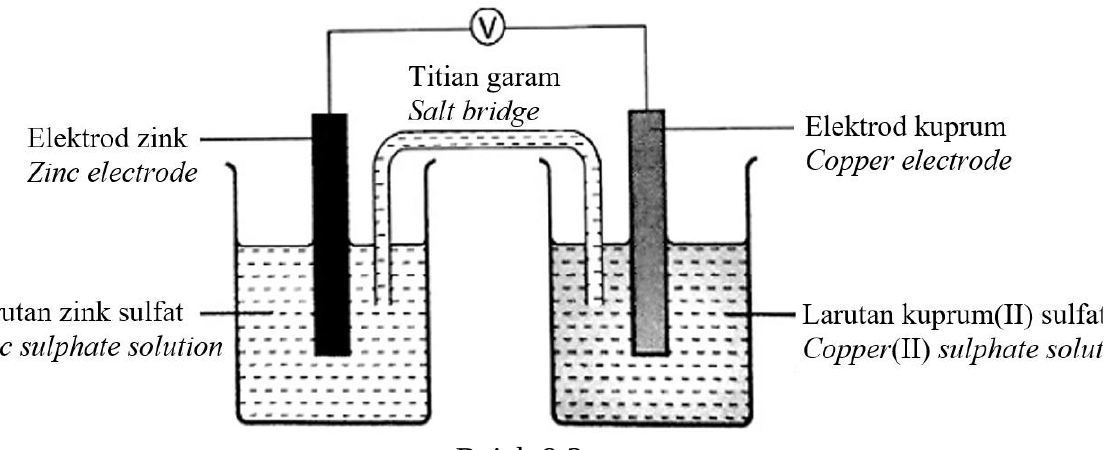
Diagram 9.1 shows a redox reaction in daily life (pear flesh turns brown after 20 minutes). Iodine can be extracted from seaweed: 2I⁻ + H2O2 + 2H⁺ → I2 + 2H2O. Diagram 9.2 shows a chemical cell with zinc electrode in zinc sulphate solution and copper electrode in copper(II) sulphate solution joined by a salt bridge.
Hard20 marks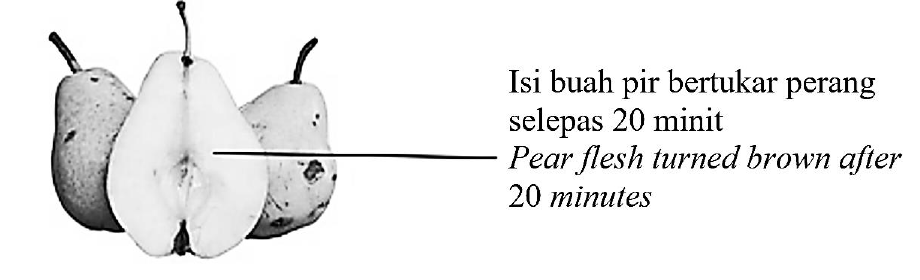
- (a)
Based on the changes shown in Diagram 9.1, state the type of reaction and the condition caused the changes. Suggest one method to slow down the changes.
[3] - (b)(i)
Based on the equation given, determine: the oxidation number of oxygen in hydrogen peroxide, H2O2; the oxidising agent and reducing agent. Explain your answer in terms of transfer of electrons.
[5] - (b)(ii)
Write the half equations for the oxidation reaction and reduction reaction.
[2] - (c)(i)
With reference to the standard electrode potentials, E°: Zn²⁺ + 2e ⇌ Zn E° = –0.76 V; Cu²⁺ + 2e ⇌ Cu E° = +0.34 V, identify the negative and positive terminals of the chemical cell. Explain your answer.
[4] - (c)(ii)
Write the cell notation and calculate the voltage of the chemical cell.
[2] - (d)(i)
Table 7 shows results of two experiments on displacement of a metal. Set I: a strip of Y metal in 2.0 cm³ of 0.1 mol dm⁻³ X nitrate solution: colourless solution turns blue, Y strip becomes thinner, shiny grey solid deposited. Set II: a strip of Y metal in 2.0 cm³ of 0.1 mol dm⁻³ magnesium nitrate solution: no changes. Based on Table 7, name the ion that formed the blue solution and suggest a suitable Y metal and X nitrate solution.
[3] - (d)(ii)
Write the ionic equation for the redox reaction that takes place.
[1]