PULAU PINANG SET 2 2022 P2 Q9
MediumWrite your answer on paper. Then open the answer to check it.
Answer any one question from Section B (Question 9 or 10).
Medium20 marks- (a)(i)
Diagram 9 shows cellular respiration, the ultimate source of energy in human beings. The food that we consume is converted into energy in mitochondria. During respiration, oxygen is reduced whereas the glucose is oxidised. Reactants: C6H12O6 + 6O2. Products: 6CO2 + 12H2O + Energy (ATP). Based on Diagram 9, state the name of the reaction that takes place for cellular respiration?
[1]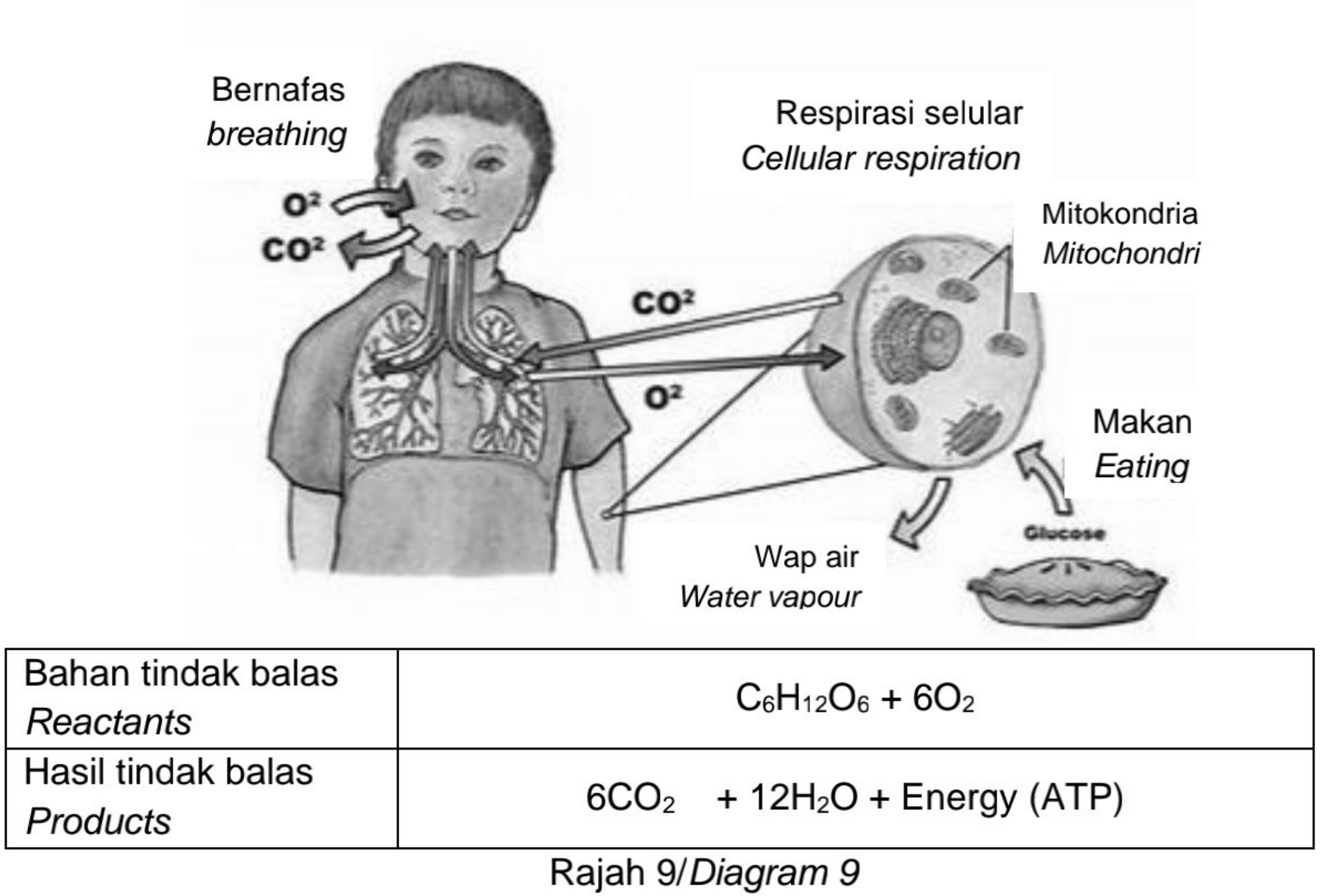
- (a)(ii)
What is the function of oxygen gas and explain why? Calculate the mass of food intake to produce 1000 cm3 of carbon dioxide gas? [Molar volume of gas at room conditions = 24 dm3 mol-1]
[4] - (b)(i)-(ii)
Table 9 shows the observation for the reaction between metal X with two different salt solutions: copper(II) sulphate - brown deposit is formed; zinc sulphate - no change. Salt X sulphate and salt X chloride are insoluble salts. Given standard electrode potentials: Sn2+ + 2e ⇌ Sn, E° = -0.14 V; X2+ + 2e ⇌ X, E° = -0.13 V; Cu2+ + 2e ⇌ Cu, E° = +0.34 V; Zn2+ + 2e ⇌ Zn, E° = -0.76 V. (i) Identify metal X and calculate the theoretical voltage of the cells using standard electrode potential value of the half-cells for the reaction between metal X and copper(II) sulphate solution. (ii) Write the half equation for oxidation reaction, half equation for reduction and the overall ionic equation for this reaction. [5 marks for (i) and (ii) together]
[5]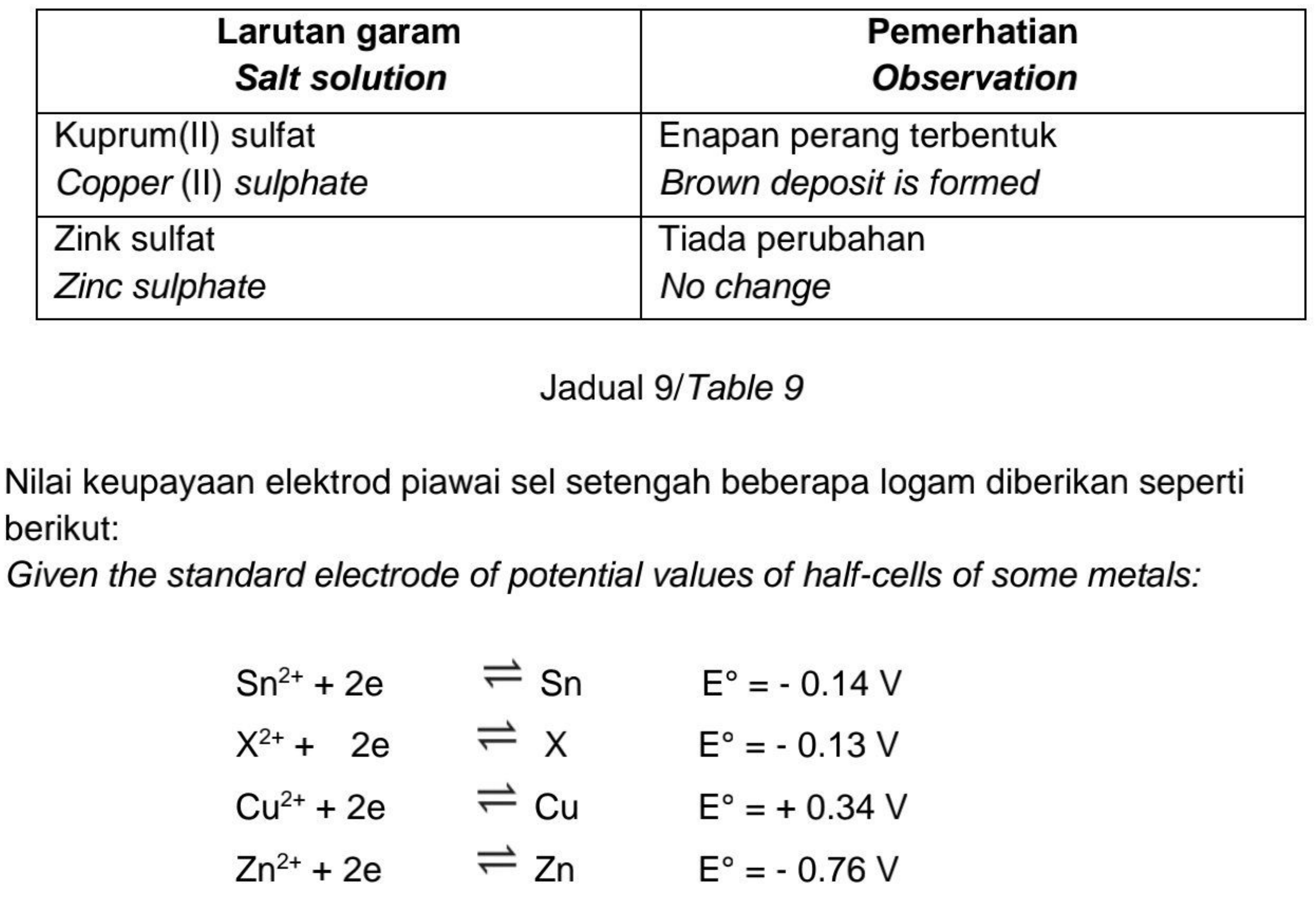
- (b)(iii)
Arrange the ions in order of increasing strength of the oxidizing agent. Arrange the atoms in order of increasing strength of the reducing agent.
[2] - (b)(iv)
Next, explain why there are differences in observation obtained in the Table 9.
[8]