SBP 2023 P2 Q10
HardWrite your answer on paper. Then open the answer to check it.
Answer any one question from Section B (Question 9 or 10). Diagram 10.1 shows the apparatus set-up to study the redox reaction: chlorine water is added to potassium iodide (Set I) and to iron(II) sulphate (Set II).
Hard20 marks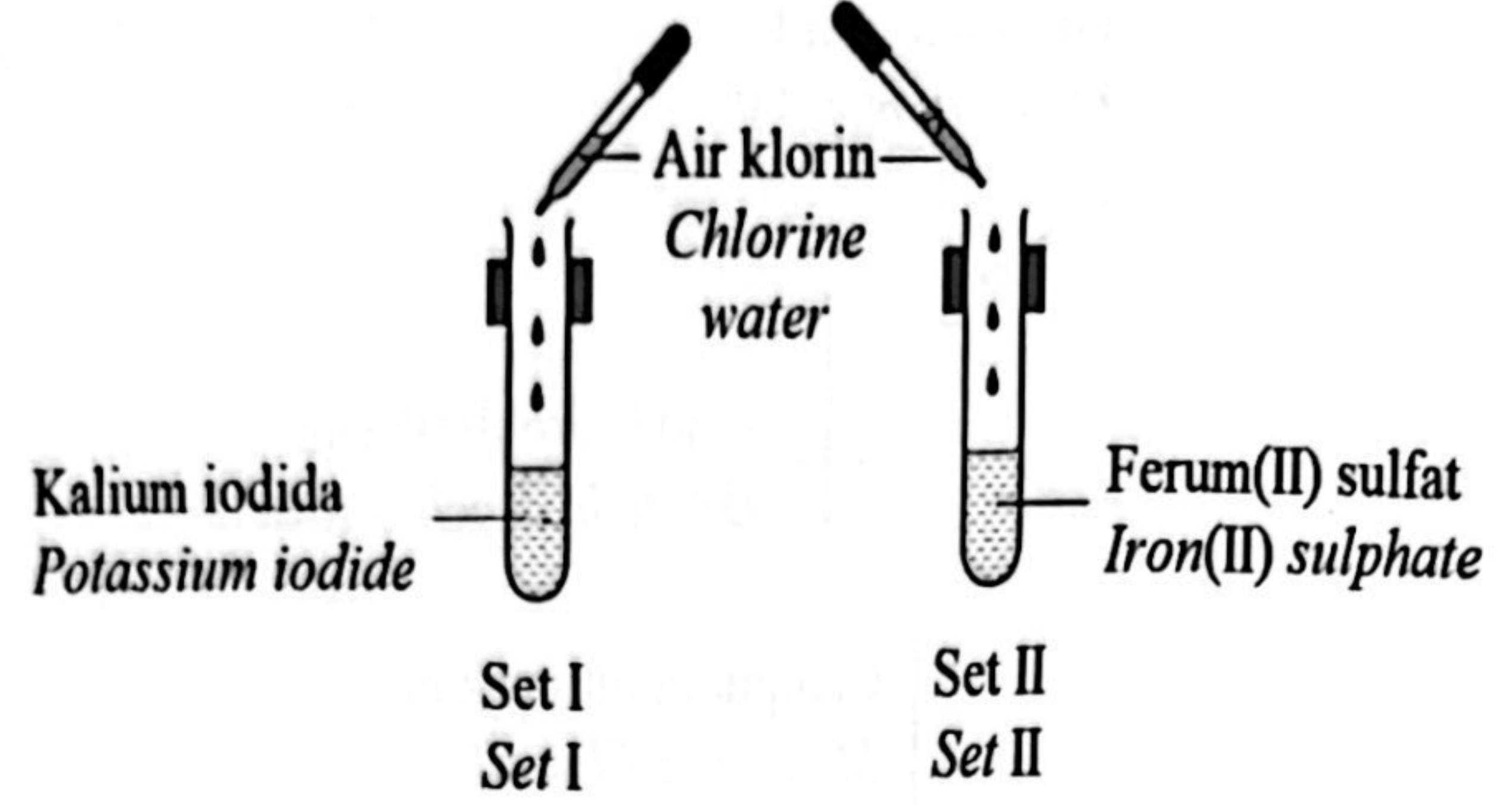
- (a)
Write the half-equation for the oxidation and reduction reactions occur in Set I and Set II. State the observation in the test tubes for Set I and Set II, then determine the change in oxidation number of chlorine for both sets.
[6] - (b)(i)
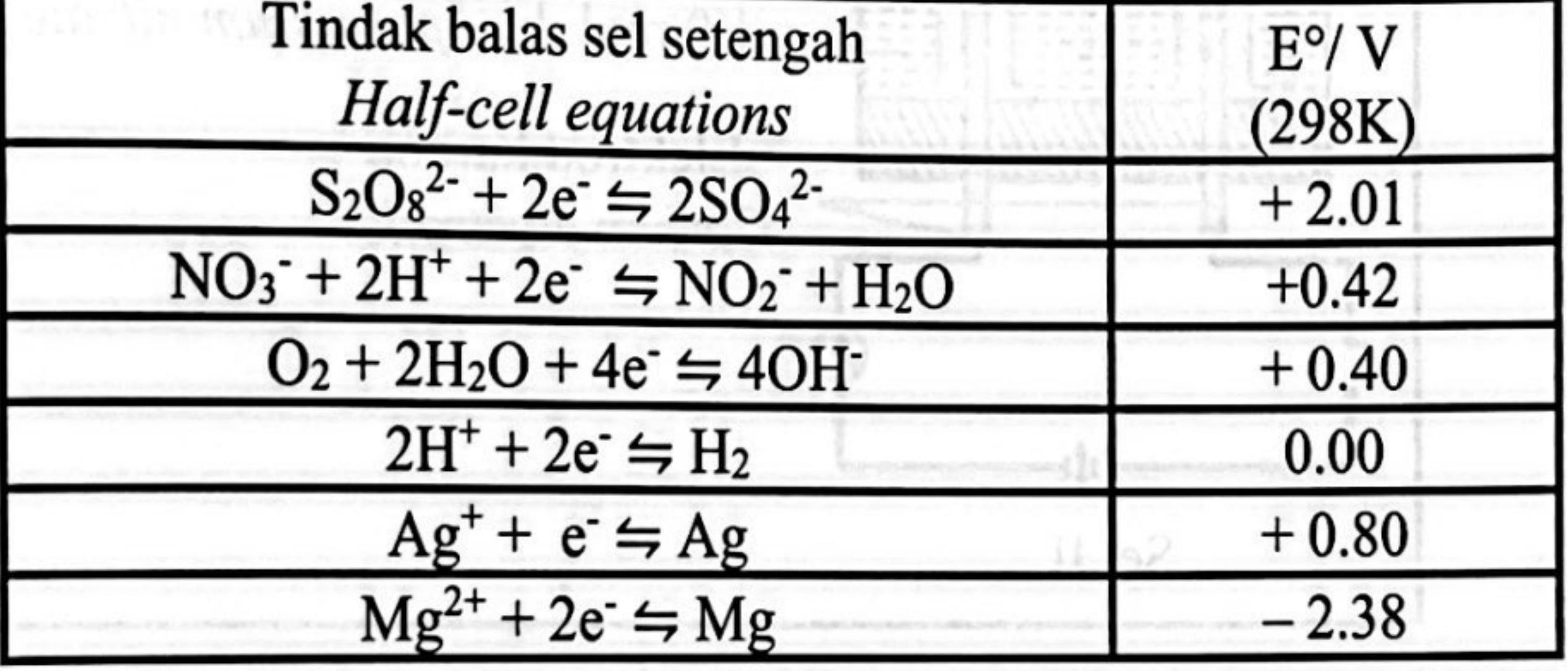
Diagram 10.2 shows the apparatus set-up (magnesium electrode in magnesium sulphate solution and silver electrode in silver nitrate solution, separated by a porous pot, connected to a voltmeter). Table 10.1 gives E° values: S2O8 2- +2e- ⇌ 2SO4 2- +2.01 V; NO3- +2H+ +2e- ⇌ NO2- +H2O +0.42 V; O2 +2H2O +4e- ⇌ 4OH- +0.40 V; 2H+ +2e- ⇌ H2 0.00 V; Ag+ + e- ⇌ Ag +0.80 V; Mg2+ +2e- ⇌ Mg -2.38 V. Identify the electrode which act as anode. Give your reason.
[2]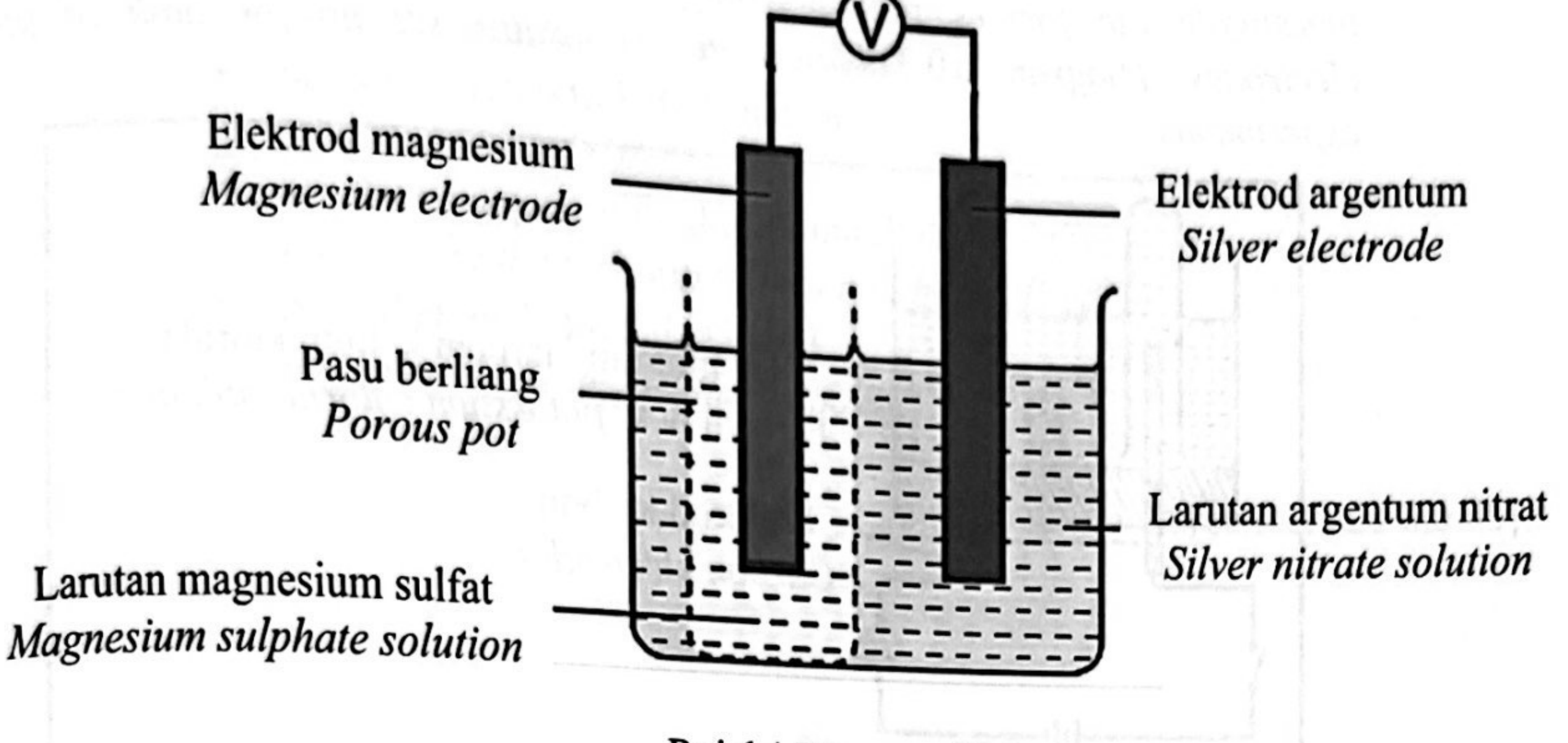
- (b)(ii)
Write the cell notation for the reaction.
[2] - (c)
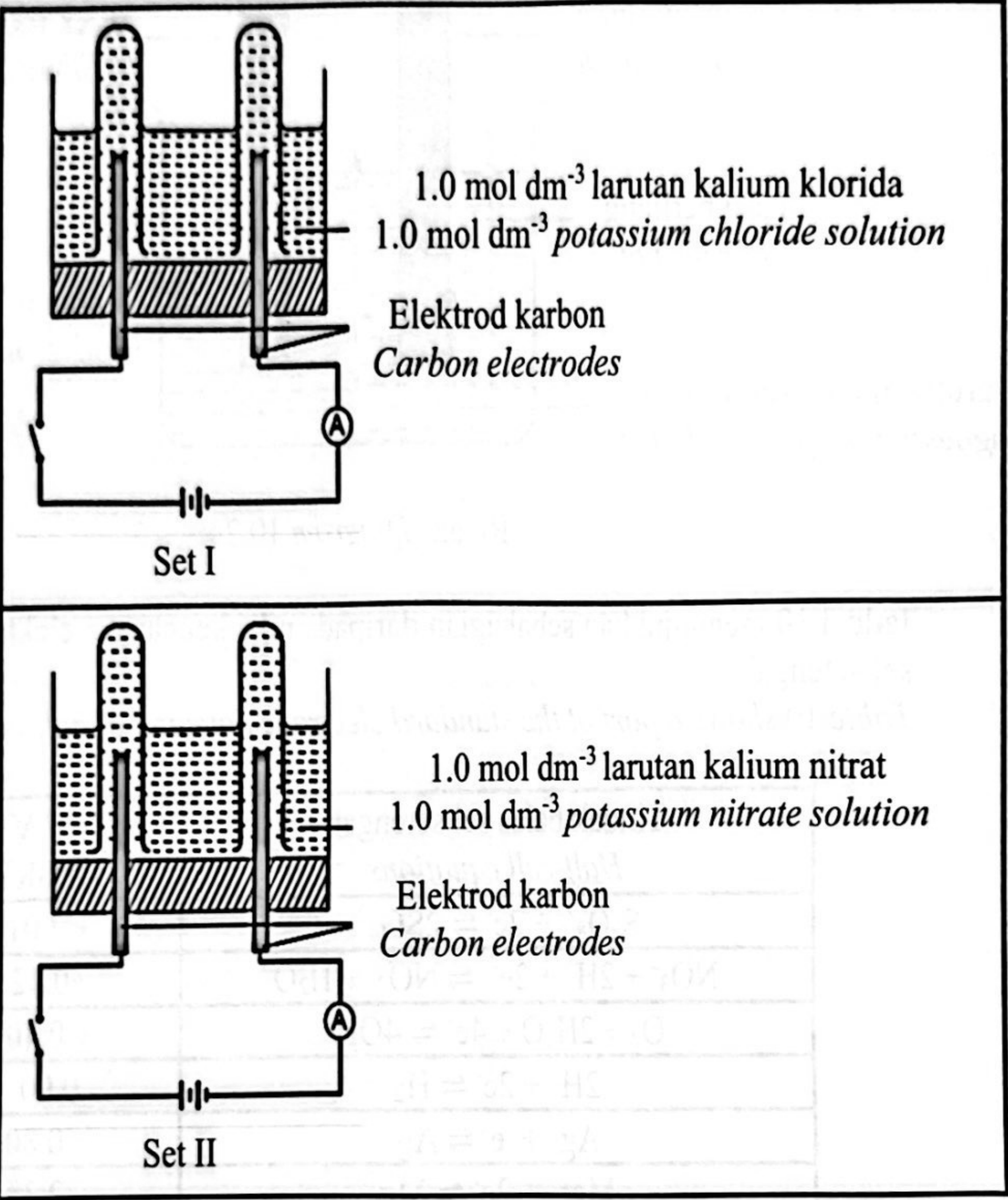
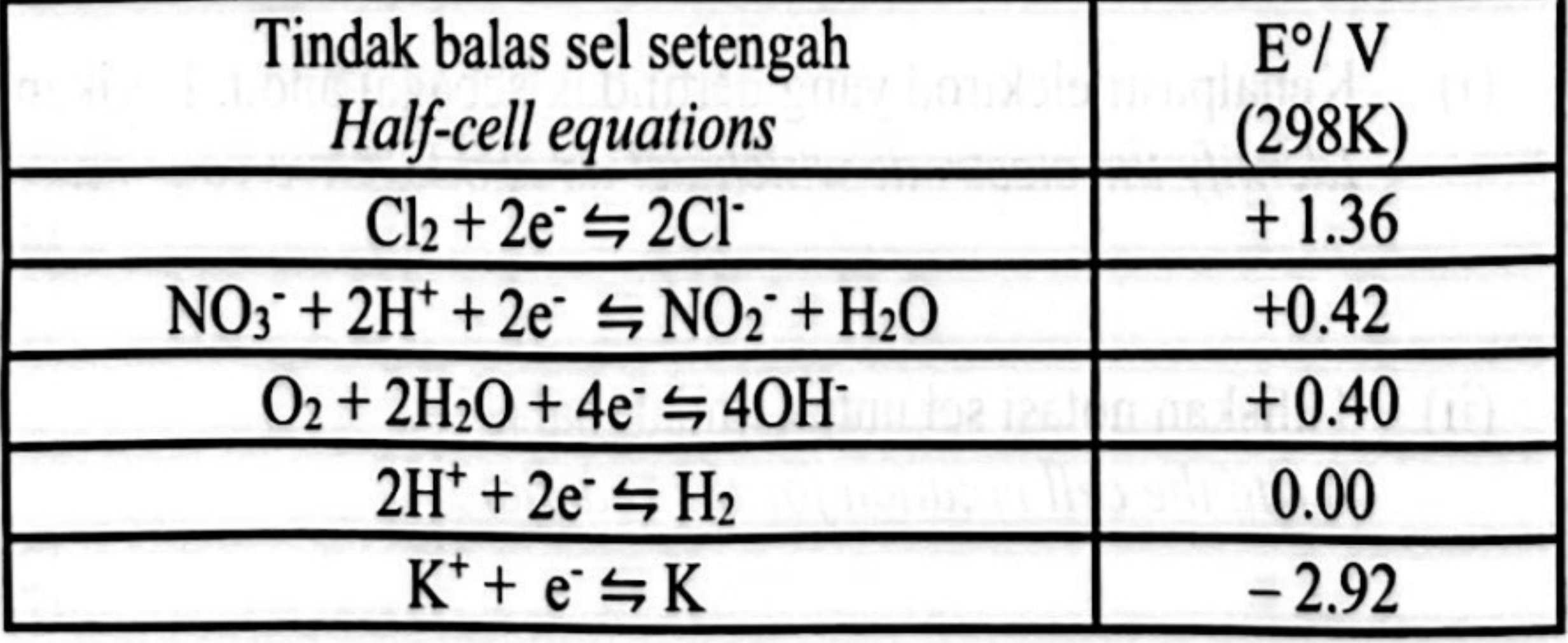
In another experiment, a student investigates the factors that affect the discharge of ions at different electrodes. Diagram 10.3: Set I uses 1.0 mol dm-3 potassium chloride solution; Set II uses 1.0 mol dm-3 potassium nitrate solution; both with carbon electrodes. Table 10.2: Cl2 + 2e- ⇌ 2Cl- +1.36 V; NO3- +2H+ +2e- ⇌ NO2- +H2O +0.42 V; O2 +2H2O +4e- ⇌ 4OH- +0.40 V; 2H+ +2e- ⇌ H2 0.00 V; K+ + e- ⇌ K -2.92 V. Compare and contrast Set I and Set II based on: ions attracted to anode and cathode; choice of ion to be oxidised; reason why the ions were chosen to be oxidised; observations at anode and cathode.
[10]