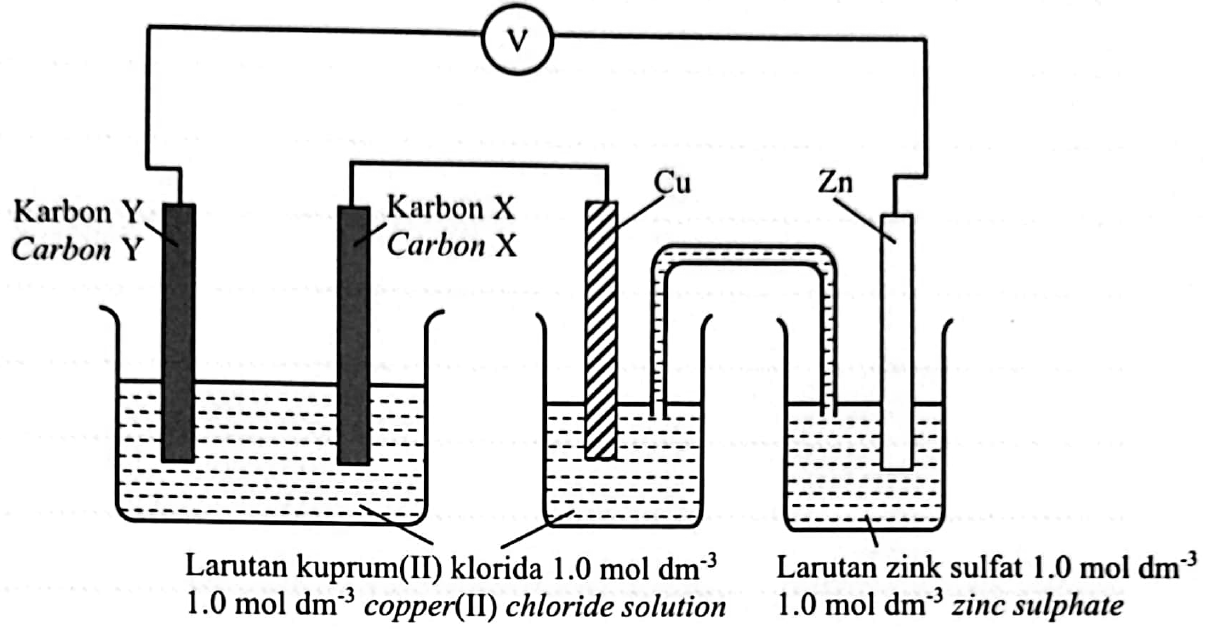
SBP 2024 P2 Q10
MediumWrite your answer on paper. Then open the answer to check it.
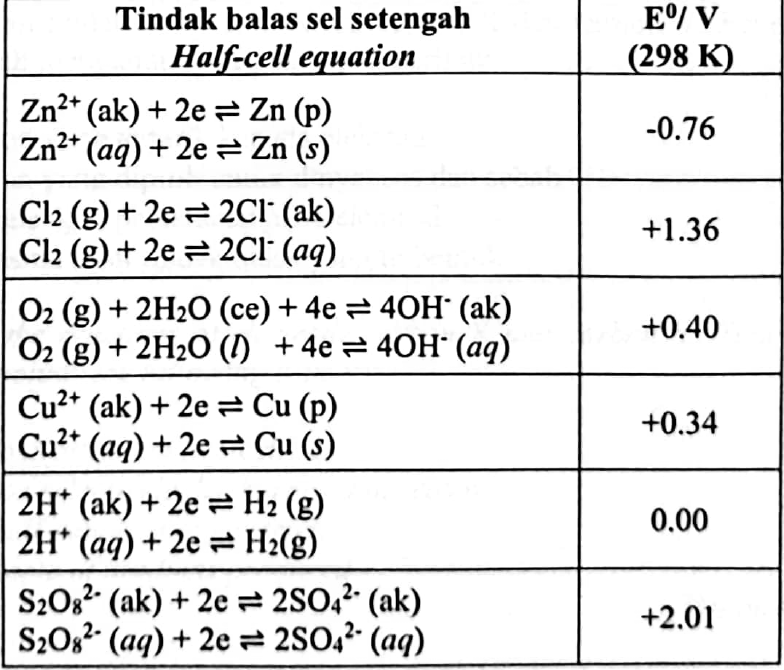
Diagram 9.1 shows the apparatus set-up of a chemical cell to study a redox reaction (zinc electrode in 1.0 mol dm⁻³ zinc sulphate solution, copper electrode in 1.0 mol dm⁻³ copper(II) chloride solution, salt bridge, voltmeter). Table 3 shows a part of the standard electrode potential of half-cells: Zn²⁺ + 2e ⇌ Zn -0.76 V; Cl₂ + 2e ⇌ 2Cl⁻ +1.36 V; O₂ + 2H₂O + 4e ⇌ 4OH⁻ +0.40 V; Cu²⁺ + 2e ⇌ Cu +0.34 V; 2H⁺ + 2e ⇌ H₂ 0.00 V; S₂O₈²⁻ + 2e ⇌ 2SO₄²⁻ +2.01 V.
Medium20 marks- (a)(i)
State the meaning of redox reaction and the function of salt bridge.
[2]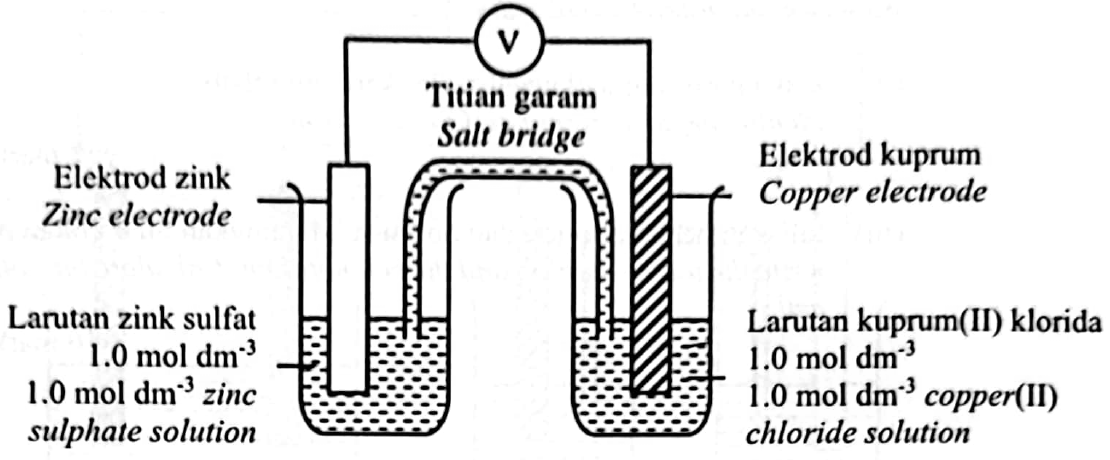
- (a)(ii)
Based on Diagram 9.1 and Table 3, identify negative terminal. Give a reason.
[2] - (a)(iii)
Write the ionic equation and the cell notation. Calculate the voltage for the cell.
[6] - (b)
Diagram 9.2 shows an apparatus set up of a chemical cell in Diagram 9.1 that combines with another cell (carbon X and carbon Y electrodes in 1.0 mol dm⁻³ copper(II) chloride solution, connected to the Cu | Zn cell with a voltmeter). Explain the reactions at electrode carbon X and carbon Y. Your explanation should include: ions attracted to electrode; ion selectively discharged and reason; half-equation at electrodes; name of products produced.
[10]