SELANGOR 2025 P2 Q11
HardWrite your answer on paper. Then open the answer to check it.
Four parts on redox reactions: (a) conversion of iron(II) nitrate to iron by metal Y; (b) heating zinc in oxygen; (c) industrial production of iron from Fe2O3 and coke; (d) electron transfer at a distance.
Hard20 marks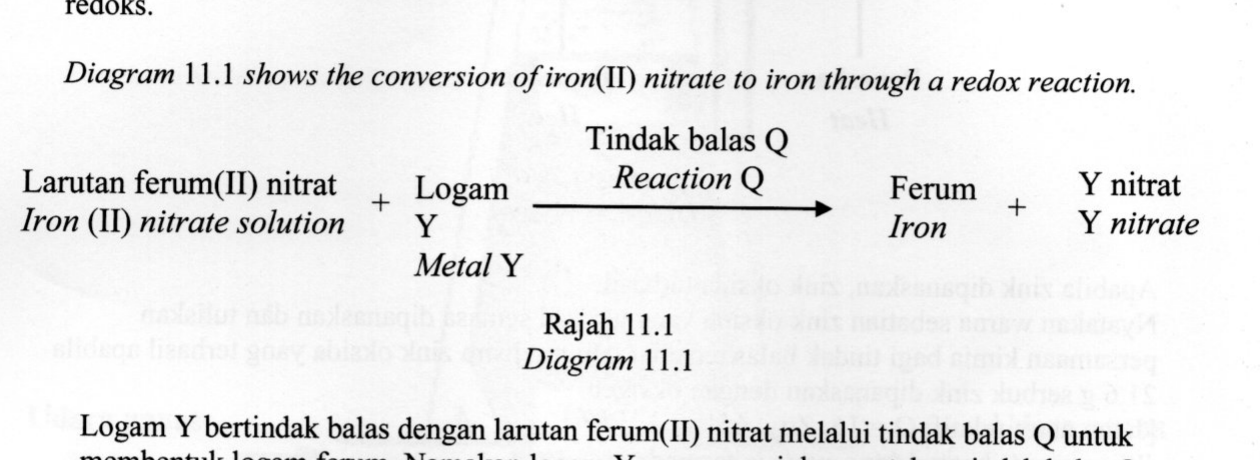
- (a)
Diagram 11.1 shows iron(II) nitrate solution + metal Y → iron + Y nitrate (reaction Q). Name a suitable metal Y and state reaction Q.
[2] - (b)
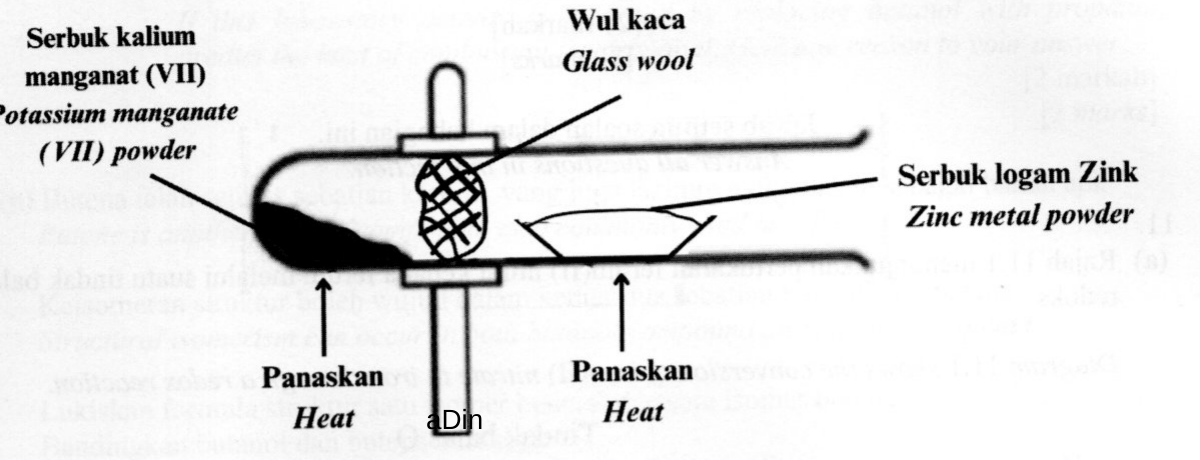
Diagram 11.2 shows the apparatus used to investigate the reactivity of zinc towards oxygen (potassium manganate(VII) powder heated, glass wool, zinc powder heated). State the colour of zinc oxide formed during heating, write the chemical equation, and calculate the mass of zinc oxide formed when 21.6 g of zinc powder is heated with oxygen. [Relative atomic mass: O = 16; Zn = 65]
[6] - (c)
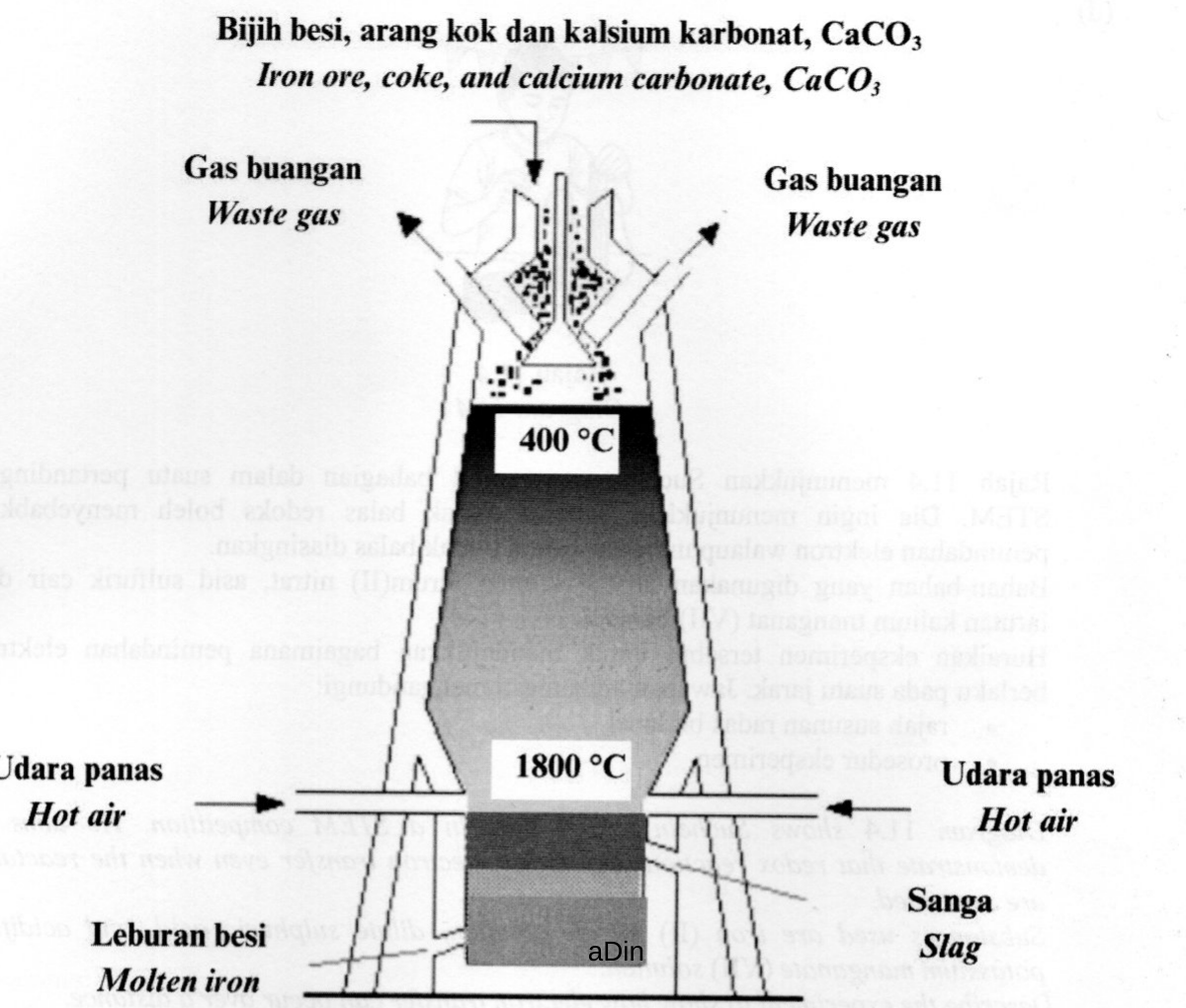
Diagram 11.3 shows the production of iron through the reaction between iron ore, Fe2O3 and coke, C. Determine the oxidation number of iron in Fe2O3 and name the compound according to IUPAC nomenclature. State whether aluminium can be extracted from its ore by the method in Diagram 11.3. Explain.
[4] - (d)
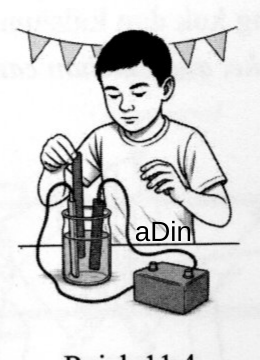
Suchein wants to show that redox reactions can cause electron transfer even when the reactants are separated. Substances: iron(II) nitrate solution, dilute sulphuric acid, acidified potassium manganate(VII) solution. Describe the experiment to show how electron transfer can occur over a distance. Include a labelled apparatus diagram and the procedure.
[8]