TERENGGANU 2021 P2 Q11
HardWrite your answer on paper. Then open the answer to check it.
Redox reaction at a distance, strengths of oxidising/reducing agents using standard electrode potentials, and factors affecting electrolysis.
Hard20 marks- (a)(i)
What is meant by redox reaction?
[1] - (a)(ii)
Table 11.1 shows the lists of apparatus and material needed by the students: U-tube, connecting wire, galvanometer, carbon electrodes, bromine water, potassium iodide solution, sulphuric acid. Draw one labelled diagram to show the apparatus set-up to conduct the experiment. The diagram must include the apparatus and materials given in Table 11.1. In your diagram, draw the arrows to show the direction of electron flow. Then, write half equation for oxidation and half equation for reduction.
[5]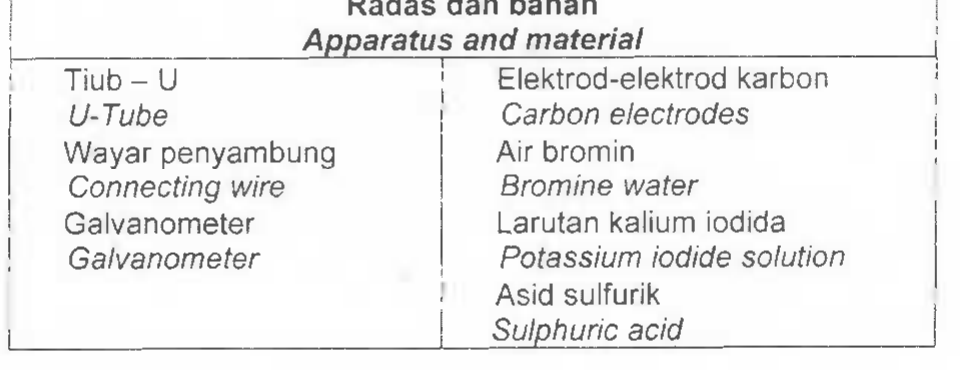
- (b)
Table 11.2 shows the observation for the reaction between metal X with two different salt solutions: copper(II) sulphate (brown deposit is formed); zinc sulphate (no change). Given the standard electrode potential values: X²⁺ + 2e ⇌ X, E° = −0.13 V; Cu²⁺ + 2e ⇌ Cu, E° = +0.34 V; Zn²⁺ + 2e ⇌ Zn, E° = −0.76 V. Based on E° value given, arrange the atoms or ions in an ascending order of the strength of oxidising agents and reducing agents. Next, explain why there are differences in observation obtained in the Table 11.2.
[7]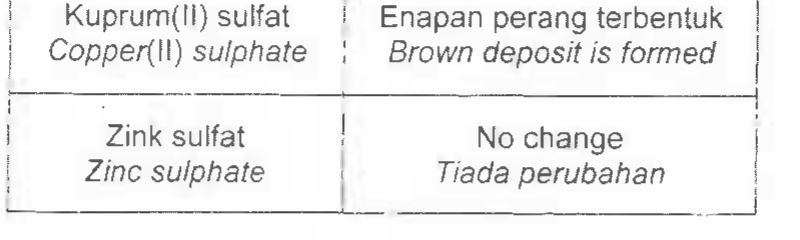
- (c)(i)
A student carried out an experiment to study one of the factors affecting electrolysis. Table 11.3 shows the observation for two sets of experiment (carbon electrodes). Set I: cathode colourless gas bubbles; anode greenish yellow gas bubbles. Set II: cathode colourless gas bubbles; anode colourless gas bubbles. By using a suitable electrolyte, describe an experiment that can be carried out to obtain the observation as in the Table 11.3.
[4]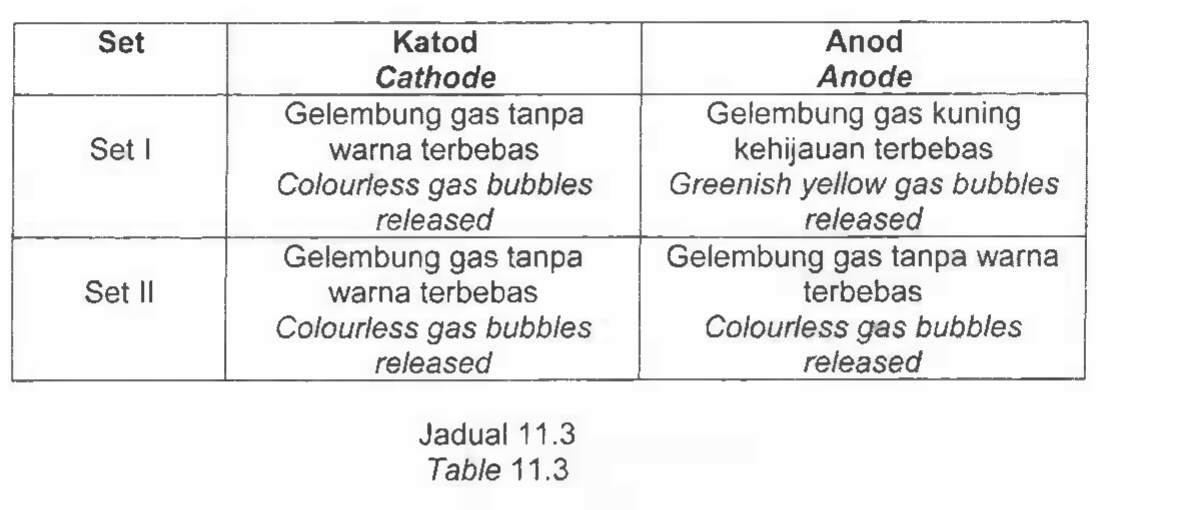
- (c)(ii)
Explain why there are differences in the observation at anode. E° is given: O2 + 2H2O + 4e ⇌ 4OH⁻, E° = +0.40 V; Cl2 + 2e ⇌ 2Cl⁻, E° = +1.36 V.
[3]