KEDAH 2025 P2 Q9
HardWrite your answer on paper. Then open the answer to check it.
Diagram 9.1 shows the reaction used in industrial production of smaller hydrocarbon from long chain hydrocarbon: C7H16 --(mixture of catalyst, heat)--> C2H4 + hydrocarbon Q. (Answer either Question 9 or Question 10.)
Hard20 marks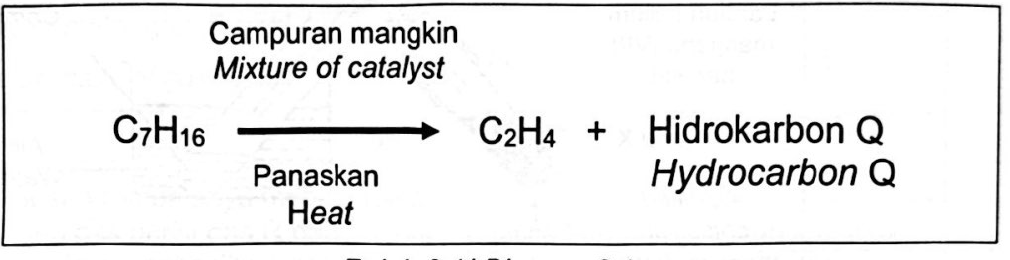
- (a)(i)
Name the above reaction and suggest a catalyst that can be used in the reaction. State the molecular formula and draw the structural formula of hydrocarbon Q.
[4] - (a)(ii)
5.6 kg compound C2H4 burnt in excess oxygen to produce carbon dioxide gas and water. Write chemical equation for this reaction, hence calculate the volume of carbon dioxide gas produced. [Relative atomic mass C=12; H=1; Molar volume of gas at room conditions = 24 dm³ mol⁻¹]
[5] - (b)
Diagram 9.2 shows apparatus set-up of conversion process of compound X to compound Z. Compound X has number of carbon atom per molecule less than three. Reaction I: compound X + acidified potassium manganate(VII) solution, heated, gives compound Y collected over water. Reaction II: compound X + compound Y with concentrated sulphuric acid, heated, gives compound Z poured into water. Based on Diagram 9.2, identify reaction I, reaction II, compound X, compound Y and compound Z. State one similar property between compound X and compound Z.
[6]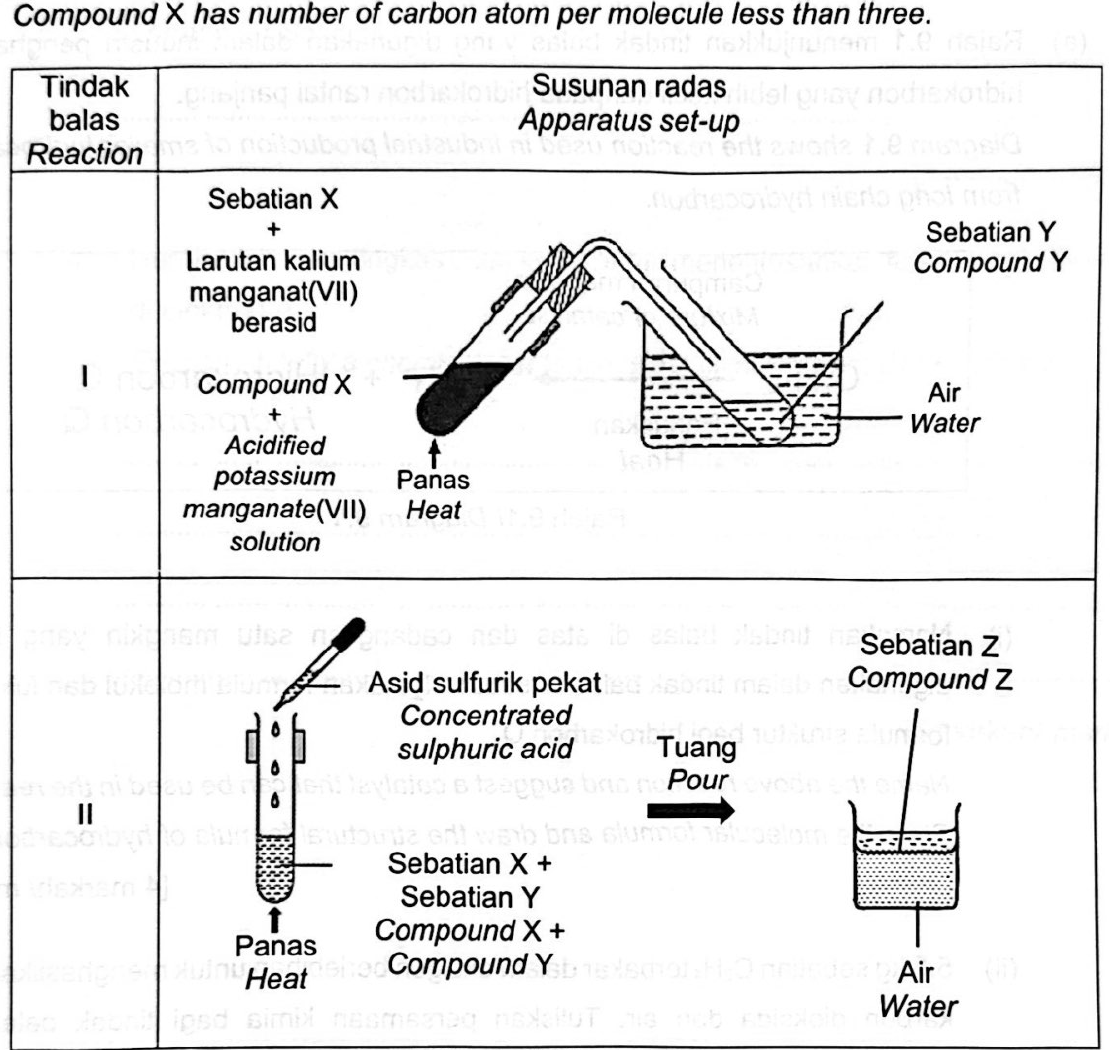
- (c)
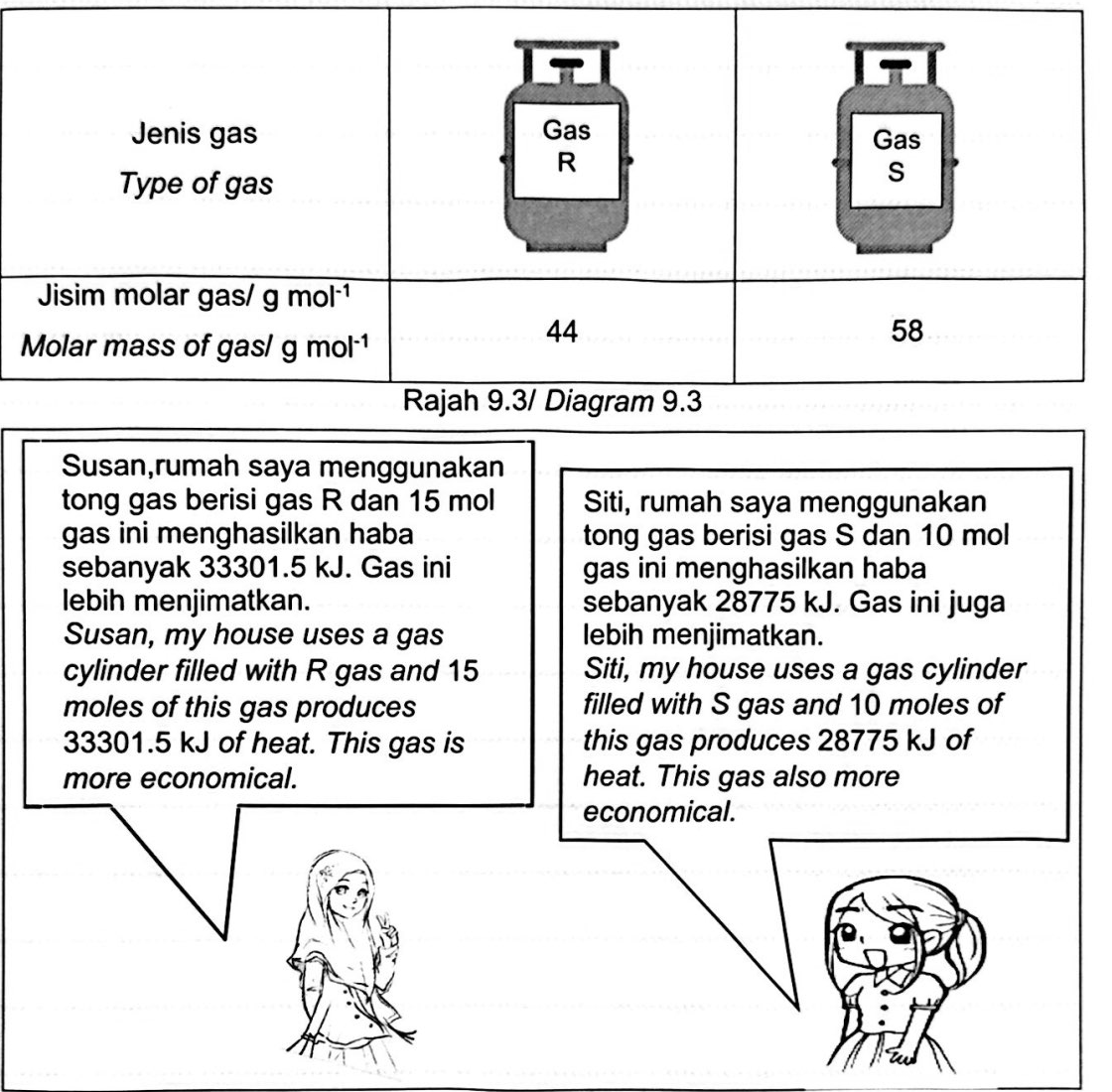
Diagram 9.3 shows two cooking gas cylinders filled with different type of gas (R: molar mass 44 g mol⁻¹; S: 58 g mol⁻¹) and Diagram 9.4 shows conversation between Susan and Siti: Susan's gas R, 15 mol produces 33301.5 kJ of heat; Siti's gas S, 10 mol produces 28775 kJ of heat. Based on diagram 9.3 and 9.4, whose home cooking gas is more economical? Prove it by calculating the fuel value of the gas.
[5]