MRSM 2022 P2 Q10
MediumWrite your answer on paper. Then open the answer to check it.
Diagram 10.1 shows a process used to separate petroleum into various products in industry (petroleum gas, petrol, naphtha, kerosene oil, diesel, lubricating oil, bitumen) using a distillation tower.
Medium20 marks- (a)(i)
State the method and physical properties involved in the separation process of petroleum as shown in Diagram 10.1.
[2]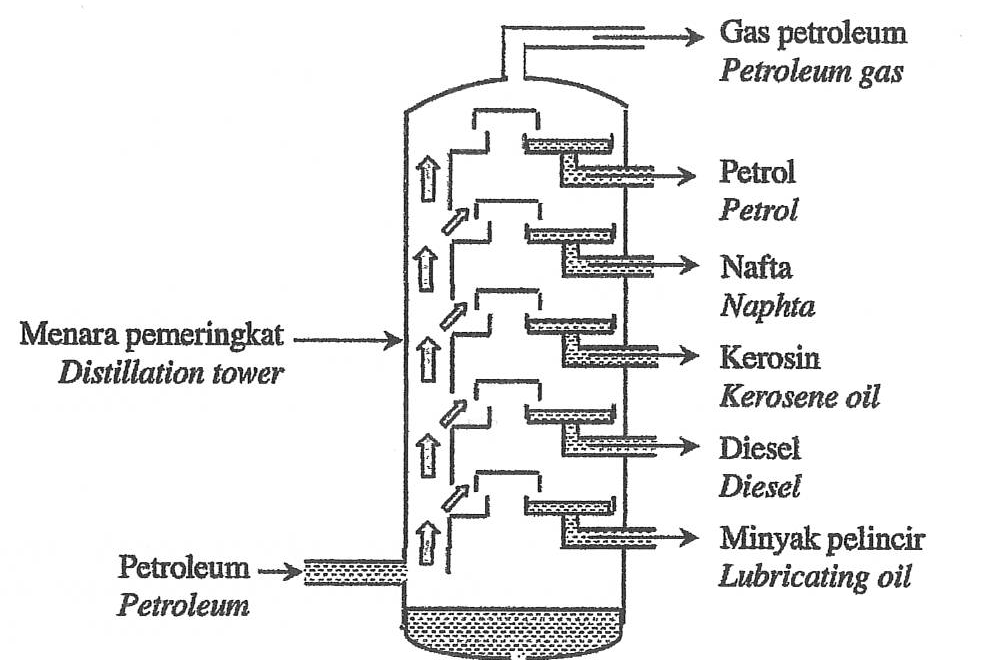
- (a)(ii)
2,2,4-trimethylpentane and butane are products of petroleum distillate. Draw the structural formulae for both distillates.
[2] - (b)
Naphtha is the mixture of hydrocarbon that consists of 5 to 10 carbon atoms. One of the distilled product is hexane, C6H14. Write the chemical equation for the combustion of hexane. Calculate the volume of carbon dioxide, CO2 gas released at room condition when 258 g of hexane used in the complete combustion above. [Relative atomic mass: H=1, C=12; 1 mol of gas occupies 24 dm³ mol⁻¹ at room conditions]
[5] - (c)(i)
Diagram 10.2 shows the conversion of organic compound from one homologous series to another. Alcohol P has less than four carbon atoms in its molecules. Compound Q can be converted to R through hydrogenation reaction. (P with porcelain chips gives Q; Reaction III converts P to compound S, which with CaCO3 gives a colourless gas; Q and R each undergo combustion to give carbon dioxide + water.) Suggest the name of alcohol P, write the molecular formula of compound Q, state the homologous series of compound R and name Reaction III.
[4]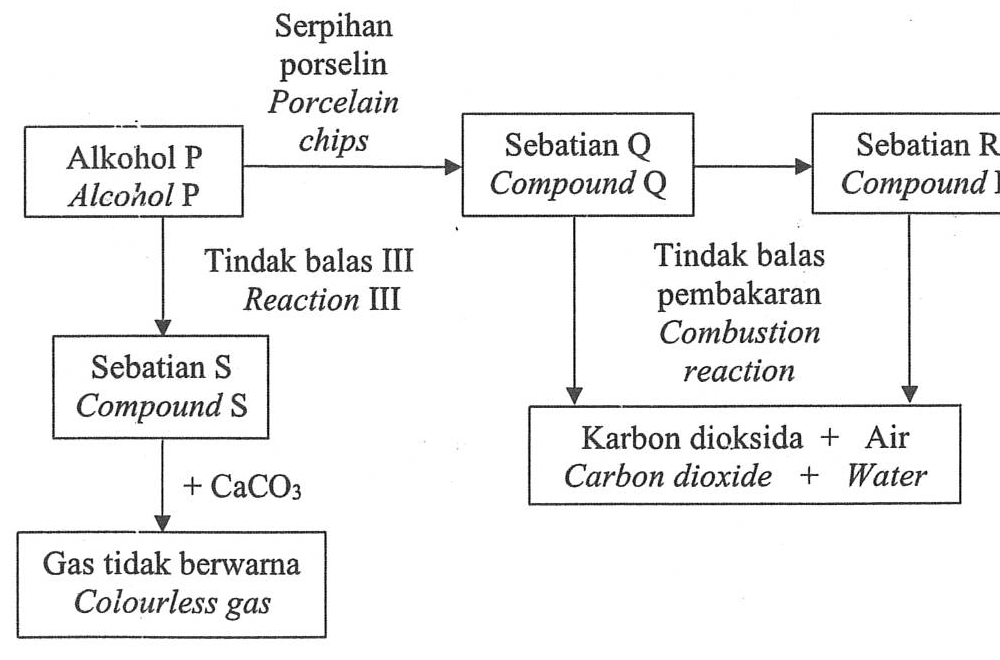
- (c)(ii)
Compare the sootiness of flames for the combustion of compound Q and compound R. [Relative atomic mass: H=1, C=12]
[4] - (d)
Diagram 10.3 shows the freshly plucked local fruits. Ethene, C2H4 gas is naturally released from the ripe fruits. Some fruits are injected with artificial ethene, C2H4 during the ripening process. Justify the use of artificial ethene during the fruit ripening process.
[3]