PUTRAJAYA 2024 P2 Q7
MediumWrite your answer on paper. Then open the answer to check it.
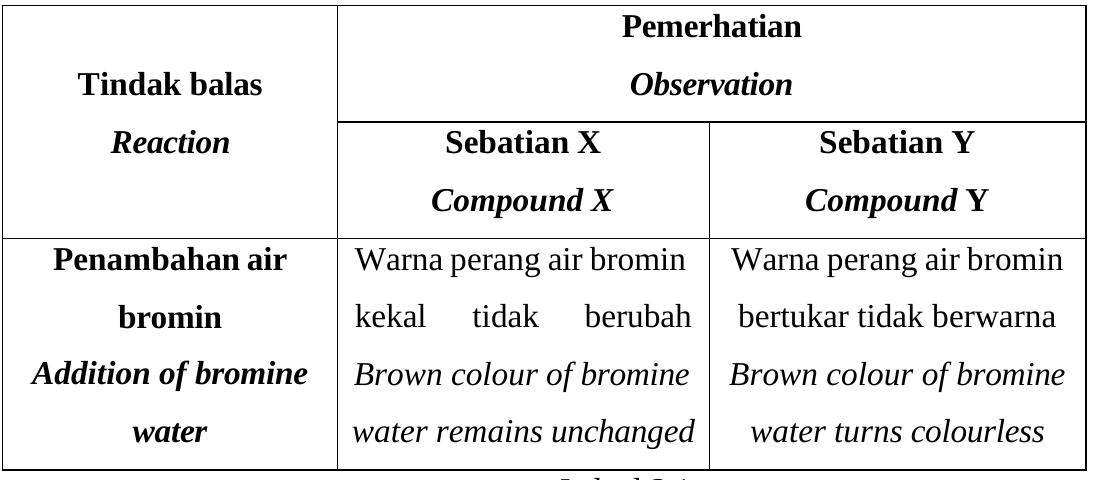
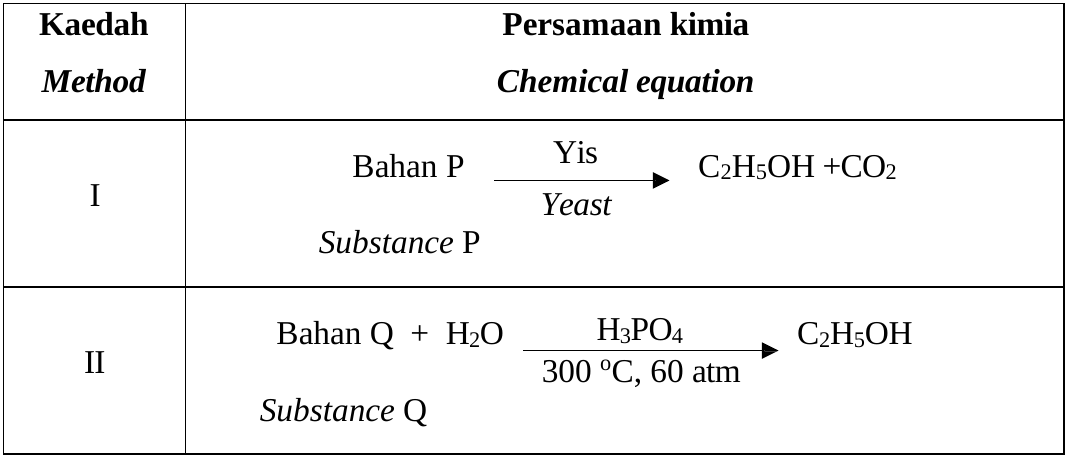
Diagram 5 shows the cracking of the hydrocarbon C7H16 over a catalyst (mixture of aluminium oxide and silicon(IV) oxide) into compound X (pentane, a saturated hydrocarbon with 5 carbon atoms) and compound Y (ethene, C2H4). Table 3.1 gives the bromine water test on X and Y; Table 3.2 gives two methods to prepare ethanol.
Medium10 marks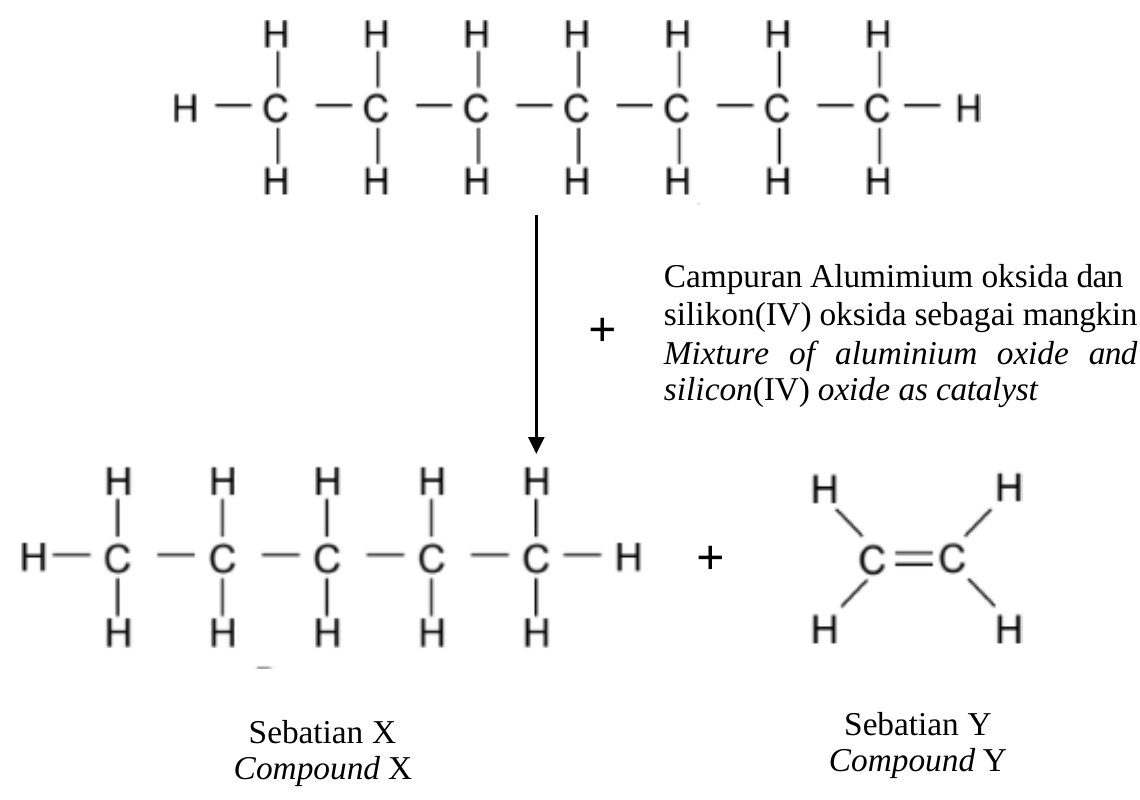
- (a)
What is meant by cracking process?
[1] - (b)(i)
Compound X is burnt completely in excess oxygen gas to produce carbon dioxide gas and water. Write the chemical equation for the combustion reaction.
[2] - (b)(ii)
If 0.2 mol of compound X is used in the reaction, calculate the volume of carbon dioxide gas produced. [1 mol of gas occupies 24 dm3 at room temperature]
[2] - (c)
Based on Table 3.1, explain why there are differences in the observations for the reaction. (Bromine water: compound X, brown colour remains unchanged; compound Y, turns colourless.)
[2] - (d)
Table 3.2 shows two methods to prepare ethanol: Method I, substance P with yeast gives C2H5OH + CO2; Method II, substance Q + H2O with H3PO4 at 300 °C, 60 atm gives C2H5OH. In your opinion, which method is more suitable to prepare ethanol? Give a reason. For the selected method, suggest substance P or Q.
[3]