JOHOR SET 5 2023 P2 Q9
HardWrite your answer on paper. Then open the answer to check it.
Question 9 has parts (a) to (c) (Section B, answer any one of Q9 or Q10).
Hard20 marks- (a)(i)
Table 9.1: Reaction I (occurs all day; heat released to surrounding; C₆H₁₂O₆ + 6O₂ → 6CO₂ + 6H₂O; -x kJ mol⁻¹). Reaction II (occurs in the day only; heat absorbed from surrounding; 6CO₂ + 6H₂O → C₆H₁₂O₆ + 6O₂; +y kJ mol⁻¹). State the type of Reaction I and Reaction II.
[2]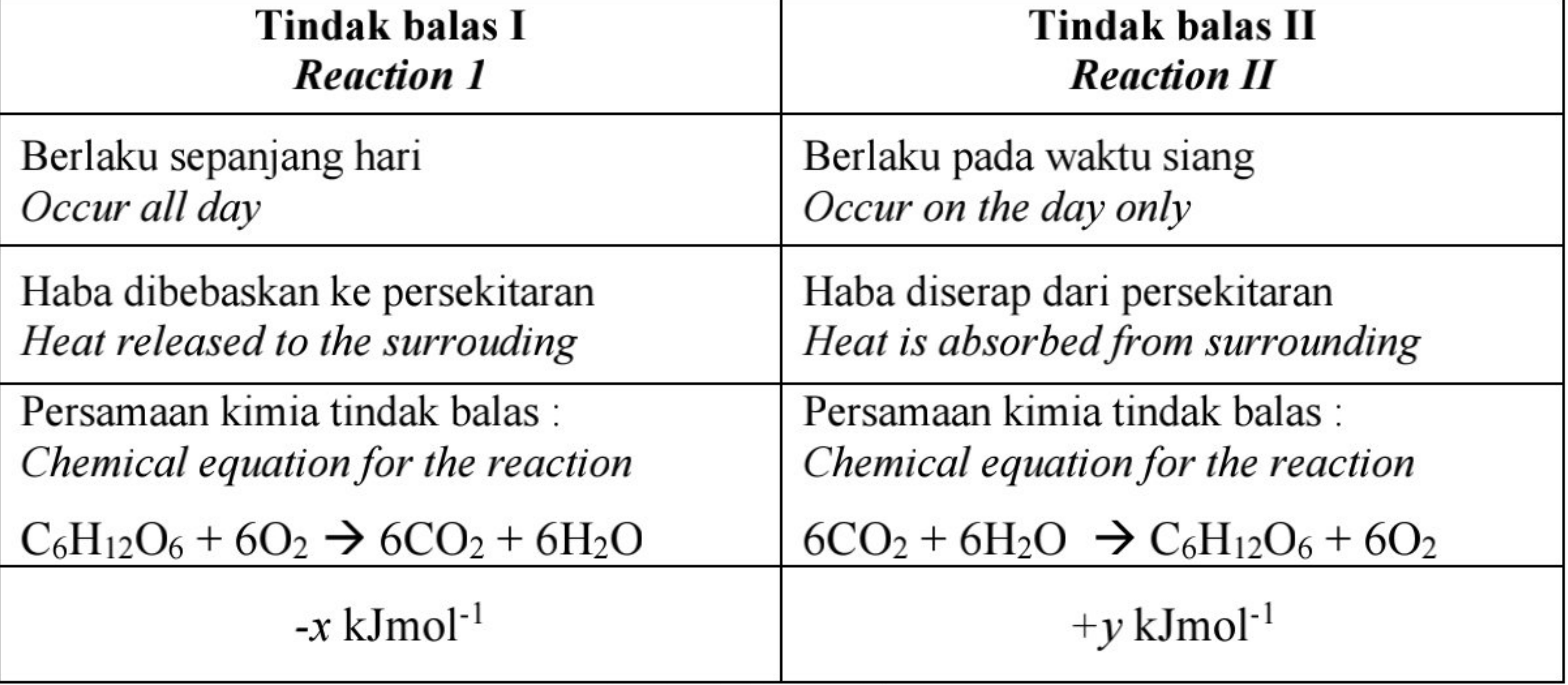
- (a)(ii)
Compare Reaction I and Reaction II in terms of: change in the total energy content of reactants and products; formation and breaking of bonds.
[4] - (b)(i)
The equation Q + Pb(NO₃)₂ → Q(NO₃)₂ + Pb represents a displacement reaction between metal Q and lead(II) nitrate solution. Given: Zn²⁺(aq) + 2e → Zn(s) E° = -0.76 V; Pb²⁺(aq) + 2e → Pb(s) E° = -0.13 V; Cu²⁺(aq) + 2e → Cu(s) E° = +0.34 V. What is meant by heat of displacement?
[1] - (b)(ii)
Suggest metal Q based on E° value above.
[1] - (b)(iii)
The heat of displacement for the reaction is -112 kJ mol⁻¹. Calculate the change in temperature when excess Q powder is added to 100 cm³ of 0.5 mol dm⁻³ lead(II) nitrate solution. [Specific heat capacity of solution = 4.2 J g⁻¹ °C⁻¹; density of solution = 1.0 g cm⁻³]
[3] - (b)(iv)
Draw an energy level diagram for the reaction.
[2] - (c)
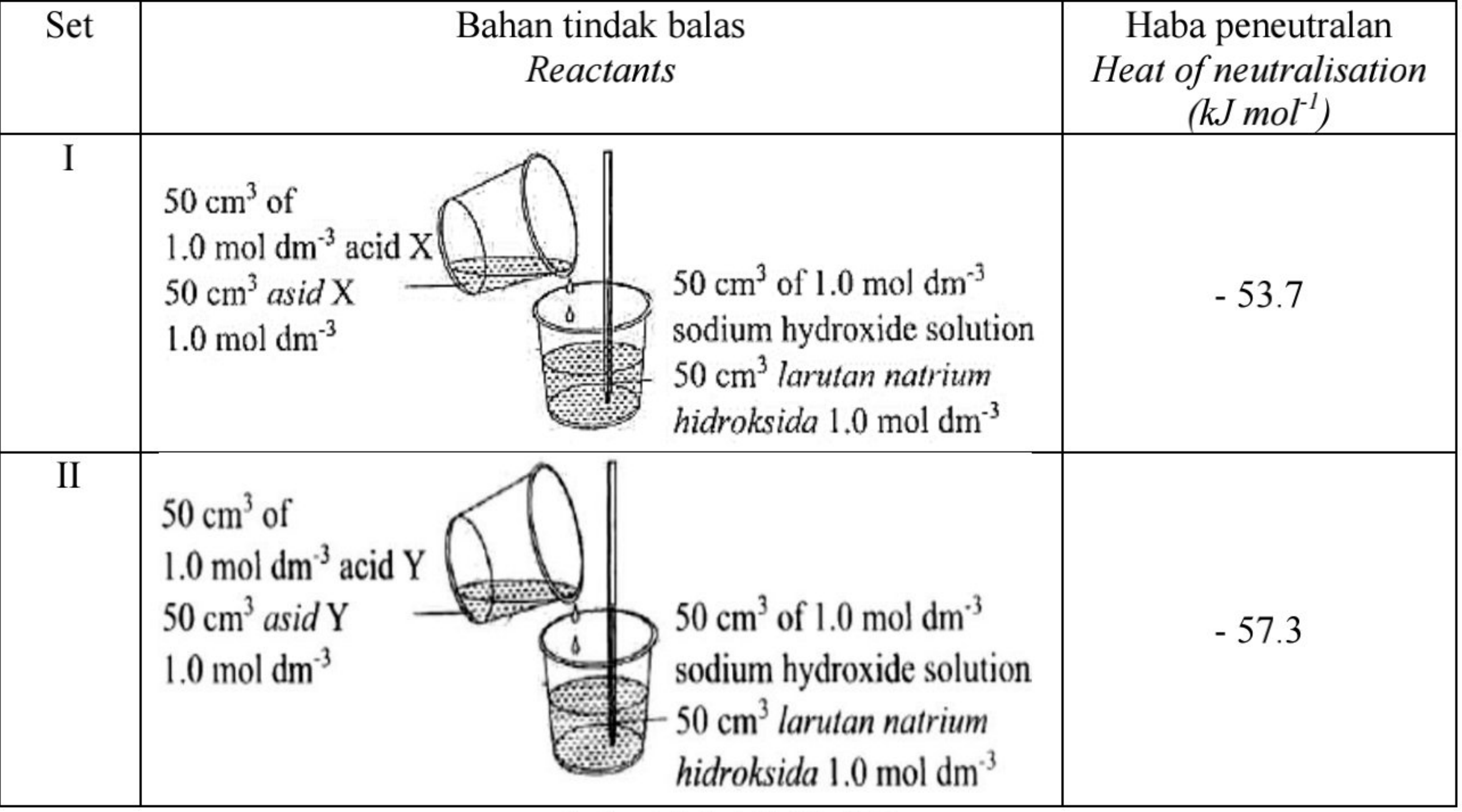
Table 9.2 shows the heat of neutralisation for two sets using different monopotic acids reacting with sodium hydroxide: Set I: 50 cm³ of 1.0 mol dm⁻³ acid X + 50 cm³ of 1.0 mol dm⁻³ NaOH, -53.7 kJ mol⁻¹. Set II: 50 cm³ of 1.0 mol dm⁻³ acid Y + 50 cm³ of 1.0 mol dm⁻³ NaOH, -57.3 kJ mol⁻¹. Suggest acid X. Compare and explain the difference in the values of heat of neutralisation for the two sets.
[7]