JOHOR SET 3 2024 P2 Q9
MediumWrite your answer on paper. Then open the answer to check it.
Diagram 8 shows energy level diagrams for two sets of precipitation reactions. Set I: 2NaCl + Pb(NO3)2 → PbCl2 + 2NaNO3, ΔH = -x kJ mol⁻¹ (products lower in energy). Set II: K2CO3 + MgCl2 → MgCO3 + 2KCl, ΔH = +23.1 kJ mol⁻¹ (products higher in energy).
Medium20 marks- (a)(i)
Based on Diagram 8, which reaction releases heat energy to the surroundings during the reaction? Explain.
[2]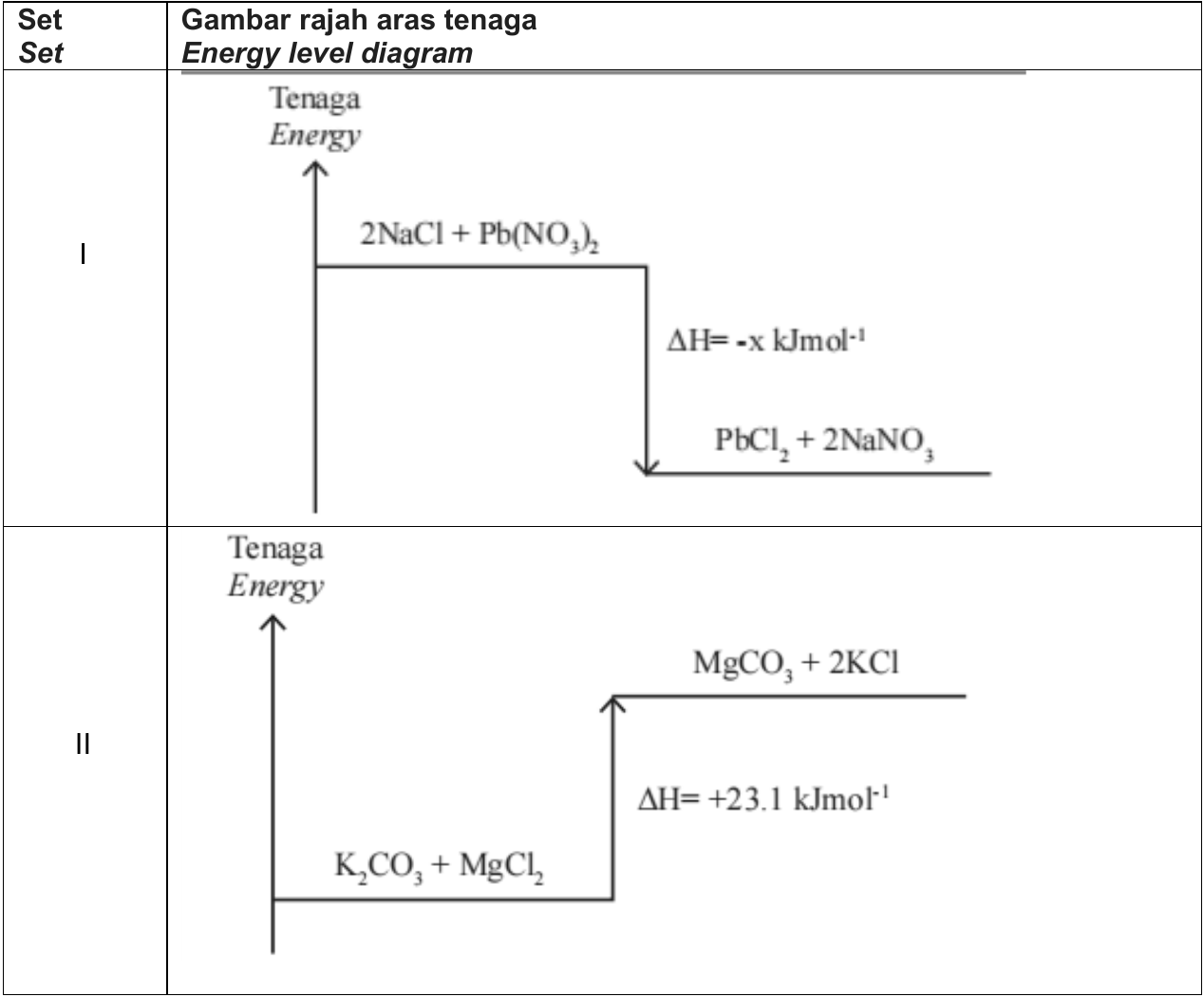
- (a)(ii)
In Set I, 50 cm³ of 1.0 mol dm⁻³ sodium chloride solution is added to 50 cm³ of 1.0 mol dm⁻³ lead(II) nitrate solution and the temperature increases by 3.5 °C. Determine which reactant is in excess. Calculate the value of x. [Density of water = 1.0 g cm⁻³, specific heat capacity of water, c = 4.2 J g⁻¹ °C⁻¹]
[5] - (a)(iii)
Ahmad conducted the Set II experiment by adding 50 cm³ of 1.0 mol dm⁻³ potassium carbonate solution to 50 cm³ of 1.0 mol dm⁻³ magnesium chloride solution. The heat of precipitation he obtained is not the same as in Diagram 8. State the meaning of heat of precipitation and explain why the heat values of precipitation are different. Write a thermochemical equation for the reaction. State the colour of the precipitate formed.
[5] - (b)(i)
Table 3: Set I: excess magnesium powder + 50 cm³ of 0.5 mol dm⁻³ copper(II) nitrate solution. Set II: excess iron powder + 50 cm³ of 0.5 mol dm⁻³ copper(II) nitrate solution. State two observations from Set I.
[2] - (b)(ii)
Compare the heat of displacement of Set I and Set II. Explain.
[2] - (b)(iii)
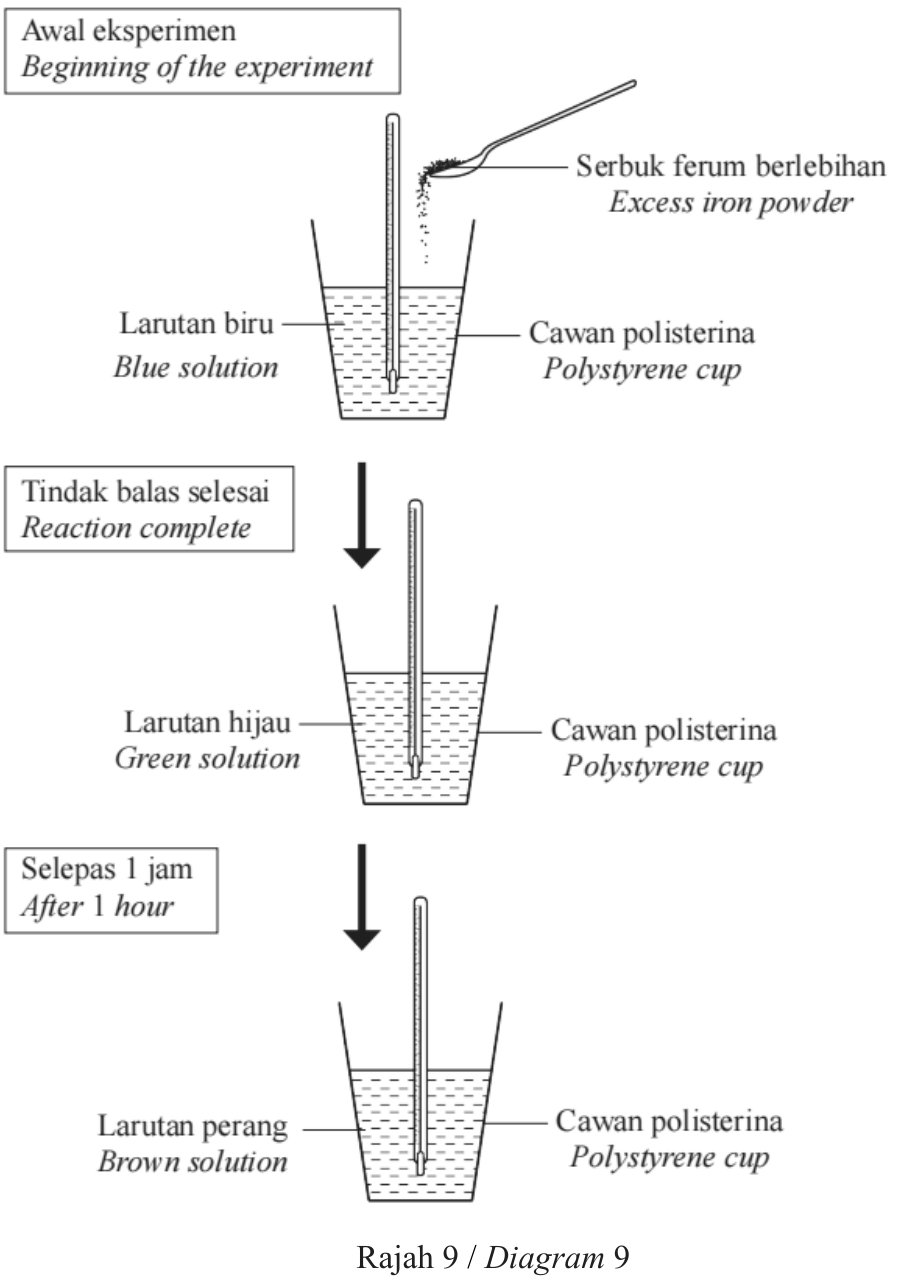
Diagram 9 shows the colour change of the solution in Set II after the reaction is complete: blue solution at the start, green solution when the reaction is complete, brown solution after 1 hour. Explain the colour change of the solution.
[4]