JOHOR SET 1 2025 P2 Q9
HardWrite your answer on paper. Then open the answer to check it.
Answer any one question in Section B (Question 9 or Question 10). (a) A student conducted an experiment to determine the heat of neutralisation using 50 cm³ of 1.0 mol dm⁻³ hydrochloric acid and 50 cm³ of 1.0 mol dm⁻³ sodium hydroxide solution. Table 9: initial temperature of hydrochloric acid 29.0 °C; initial temperature of sodium hydroxide 28.0 °C; highest temperature of the reaction mixture 35.0 °C.
Hard20 marks- (a)(i)
State the meaning of heat of neutralisation.
[1]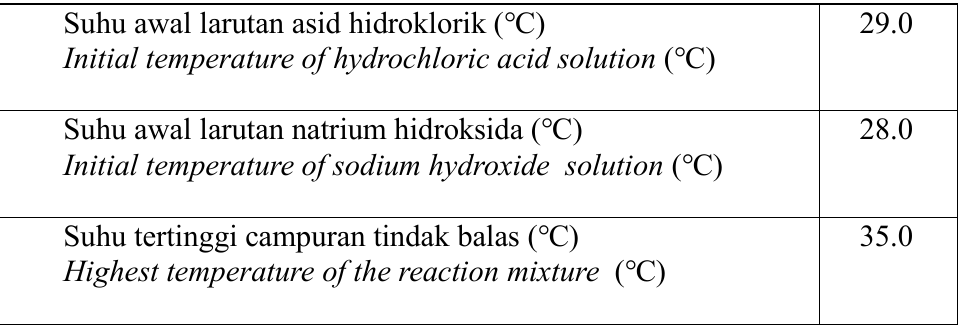
- (a)(ii)
Based on Table 9, calculate: the heat change during the reaction; the number of moles of water formed; the heat of neutralisation. [Specific heat capacity of a solution = 4.2 J g⁻¹ °C⁻¹; density of solution = 1 g cm⁻³]
[3] - (a)(iii)
This experiment was repeated using 50 cm³ of 1.0 mol dm⁻³ hydrochloric acid and 50 cm³ of 1.0 mol dm⁻³ potassium hydroxide solution. Predict the temperature change and give your reason.
[2] - (b)(i)
Diagram 9.1 shows the energy level diagram for two chemical reactions (Set I: products higher than reactants, ΔH = +; Set II: products lower than reactants, ΔH = −). Based on Diagram 9.1, suggest an example for each reaction in Set I and Set II.
[2]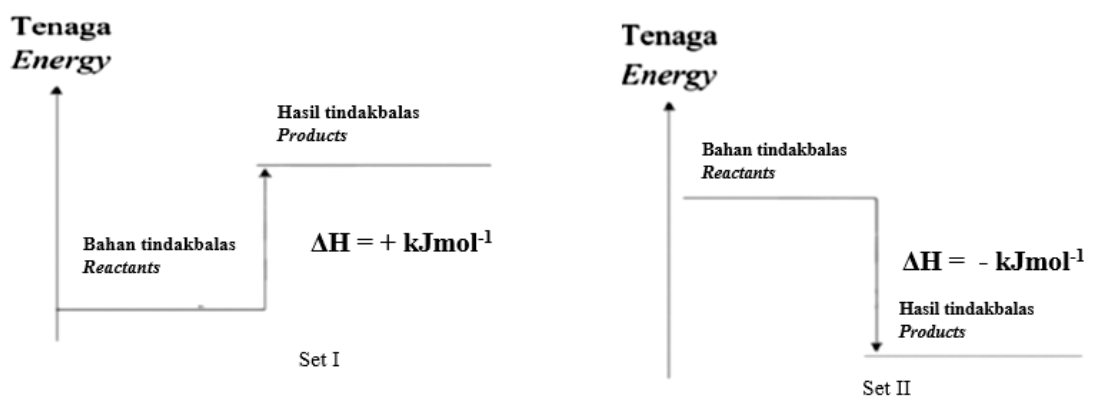
- (b)(ii)
Construct a table to compare the reactions in Set I and Set II in terms of the type of reaction, temperature change, change in thermal energy during bond breaking and formation, total energy content of the reactants and products.
[8] - (c)
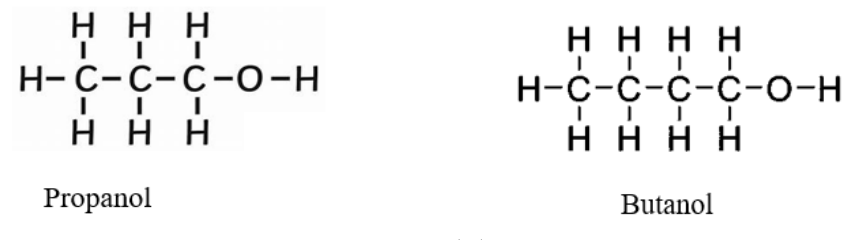
Diagram 9.2 shows the structural formula of propanol and butanol. Based on Diagram 9.2, compare the heat of combustion of propanol and butanol. Explain your answer.
[4]