KEDAH 2024 P2 Q9
HardWrite your answer on paper. Then open the answer to check it.
Diagram 9 shows two sets of apparatus used to study the heat of displacement of copper from copper(II) sulphate solution. In each set, 100 cm3 of 0.5 mol dm-3 copper(II) sulphate solution in a polystyrene cup is mixed with excess metal powder: Set I zinc powder, initial temperature 28 °C, highest temperature 34 °C; Set II metal W powder, initial temperature 28 °C, highest temperature 48 °C. A deposit is formed in each set.
Hard20 marks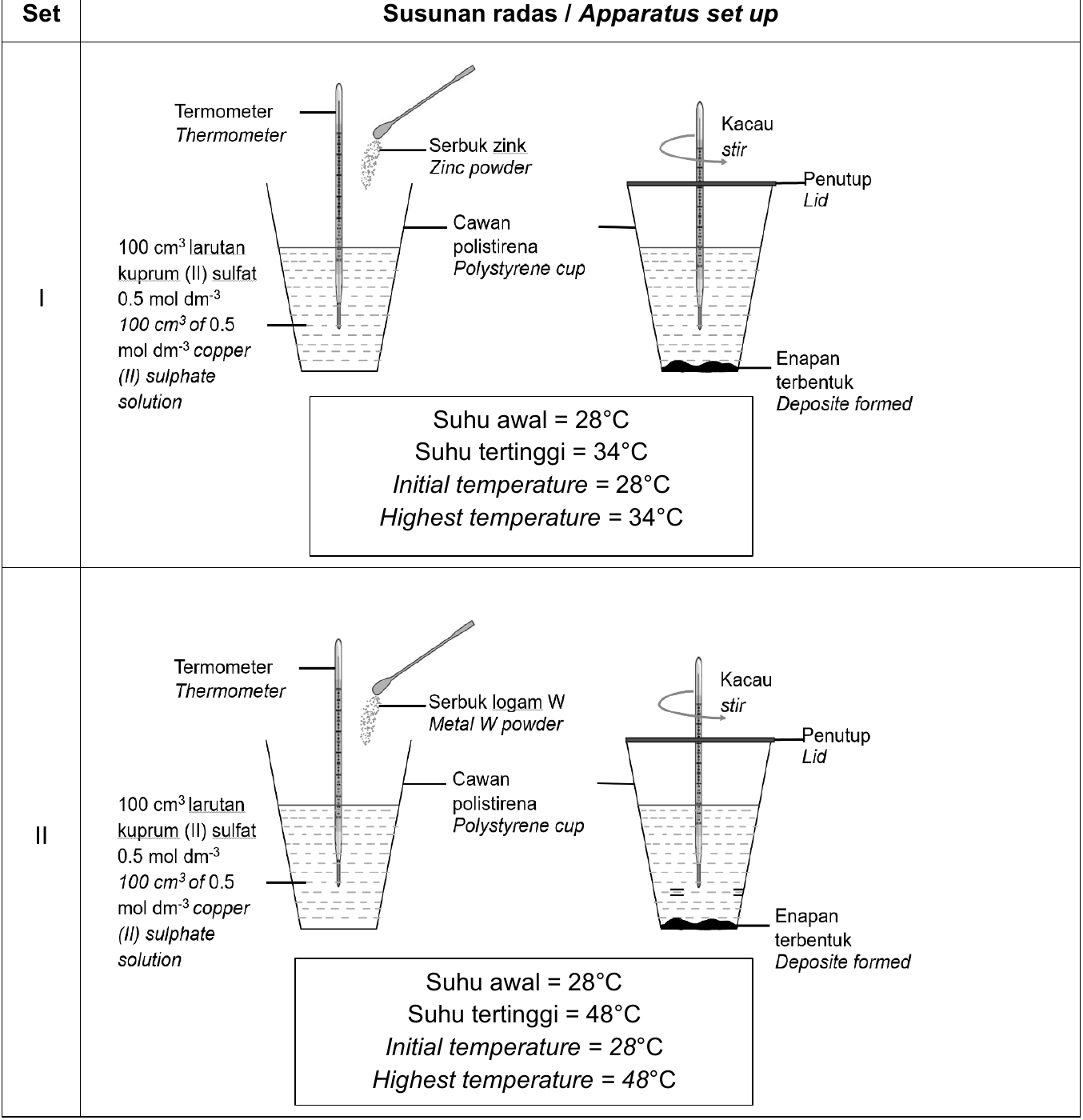
- (a)(i)
State the meaning of heat of displacement.
[1] - (a)(ii)
Based on temperature change, state the type of reaction of Set I.
[1] - (a)(iii)
Suggest the metal W for Set II and state the colour of the resulting deposit.
[2] - (a)(iv)
Calculate the heat of displacement for Set I and Set II. [Specific heat capacity of solution, c = 4.2 J g-1 °C-1]
[6] - (b)(i)
Table 9 shows the heat of precipitation: Set I, 25 cm3 of 0.5 mol dm-3 barium chloride + 25 cm3 of 0.5 mol dm-3 zinc sulphate, -42.0 kJ mol-1; Set II, 25 cm3 of 0.5 mol dm-3 potassium carbonate + 25 cm3 of 0.5 mol dm-3 magnesium chloride, +23.1 kJ mol-1. Explain the difference in heat of precipitation for Set I and Set II. Your explanation must include change in temperature, total energy content, and heat energy change during bond breaking and bond formation. Write the thermochemical equation for Set I and draw the energy level diagram of Set II.
[7]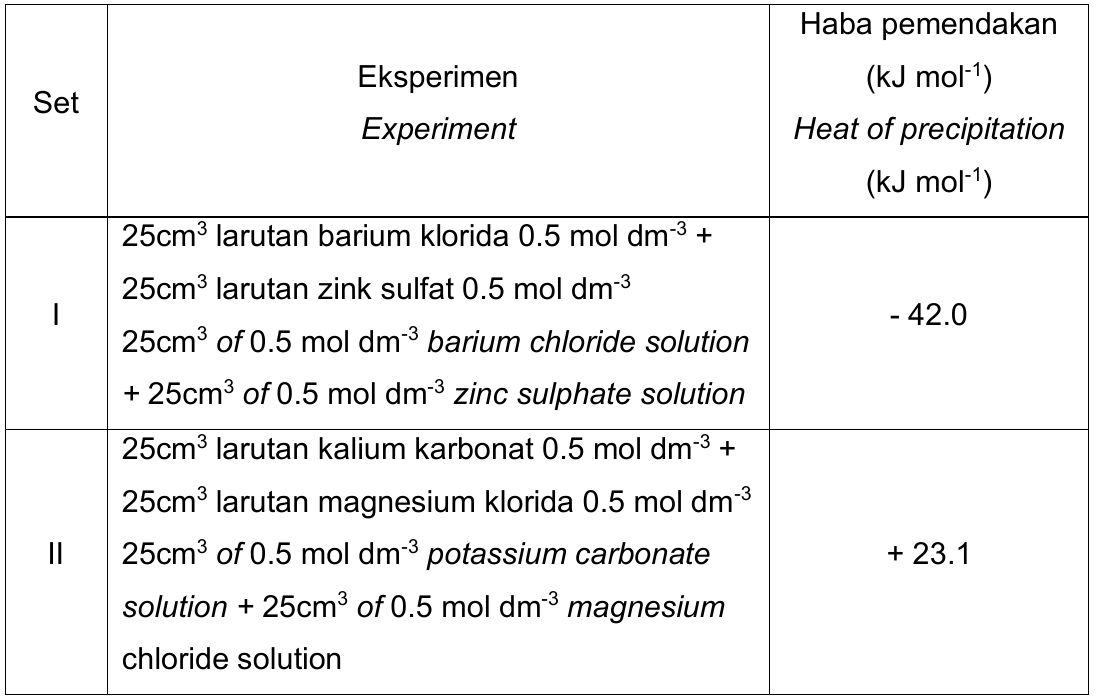
- (b)(ii)
The value of the heat of precipitation during the experiment is lower than the theoretical value. Why does this happen and what can be done to reduce this problem?
[3]