KEDAH 2025 P2 Q10
HardWrite your answer on paper. Then open the answer to check it.
Diagram 10.1 shows the apparatus set up of an experiment to determine the heat of neutralisation between acid and alkali: 25 cm³ of 1.0 mol dm⁻³ hydrochloric acid poured into 25 cm³ of 1.0 mol dm⁻³ sodium hydroxide solution. The thermochemical equation: HCl + NaOH → NaCl + H₂O, ΔH = -57.12 kJ mol⁻¹. (Answer either Question 9 or Question 10.)
Hard20 marks- (a)(i)
What is meant by heat of neutralisation? State type of reaction based on heat energy change and draw the energy level diagram for this reaction.
[4]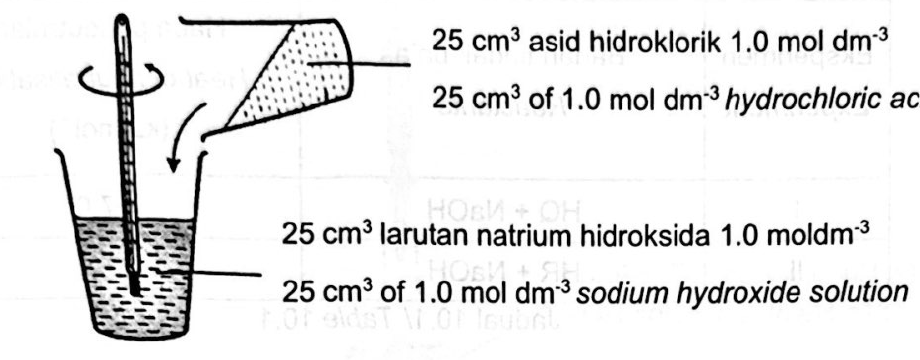
- (a)(ii)
Table 10.1 shows the heat of neutralisation of the reaction between two monoprotic acids HQ and HR with sodium hydroxide solution (Experiment I: HQ + NaOH, -57.0 kJ mol⁻¹; Experiment II: HR + NaOH, -55.0 kJ mol⁻¹). Based on Table 10.1, suggest acid HR. Explain the difference in the heat of neutralisation for Experiment I and Experiment II. If Experiment I repeated by using sulphuric acid with same volume and concentration, predict the heat of neutralisation of this reaction.
[5]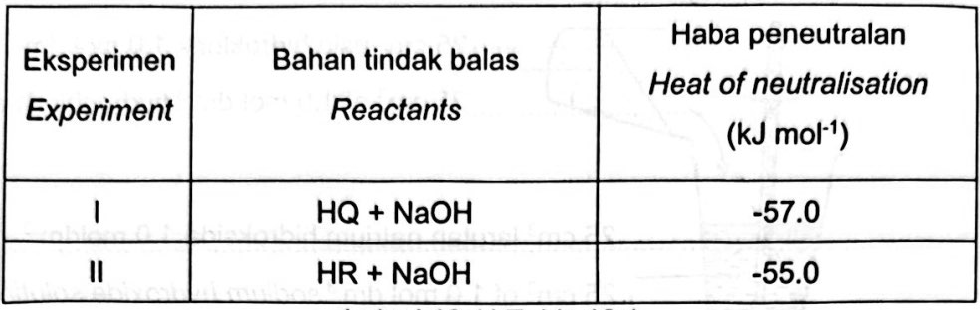
- (b)(i)
Diagram 10.2 shows an apparatus set-up of a titration (sulphuric acid in the burette, TOH solution with pH = 13 in the conical flask). What is meant by pH value? Determine the strength and concentration of TOH solution.
[4]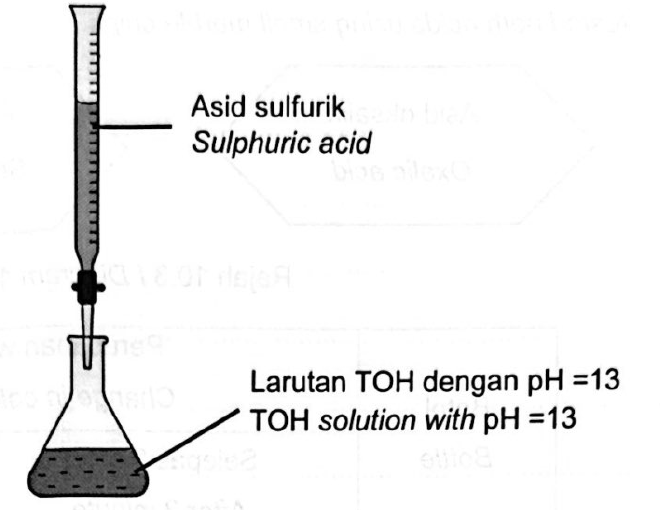
- (b)(ii)
The alkaline solution is used to neutralise 0.002 mol of sulphuric acid as below equation: 2TOH + H₂SO₄ → T₂SO₄ + 2H₂O. Determine the volume of TOH solution used.
[2] - (c)
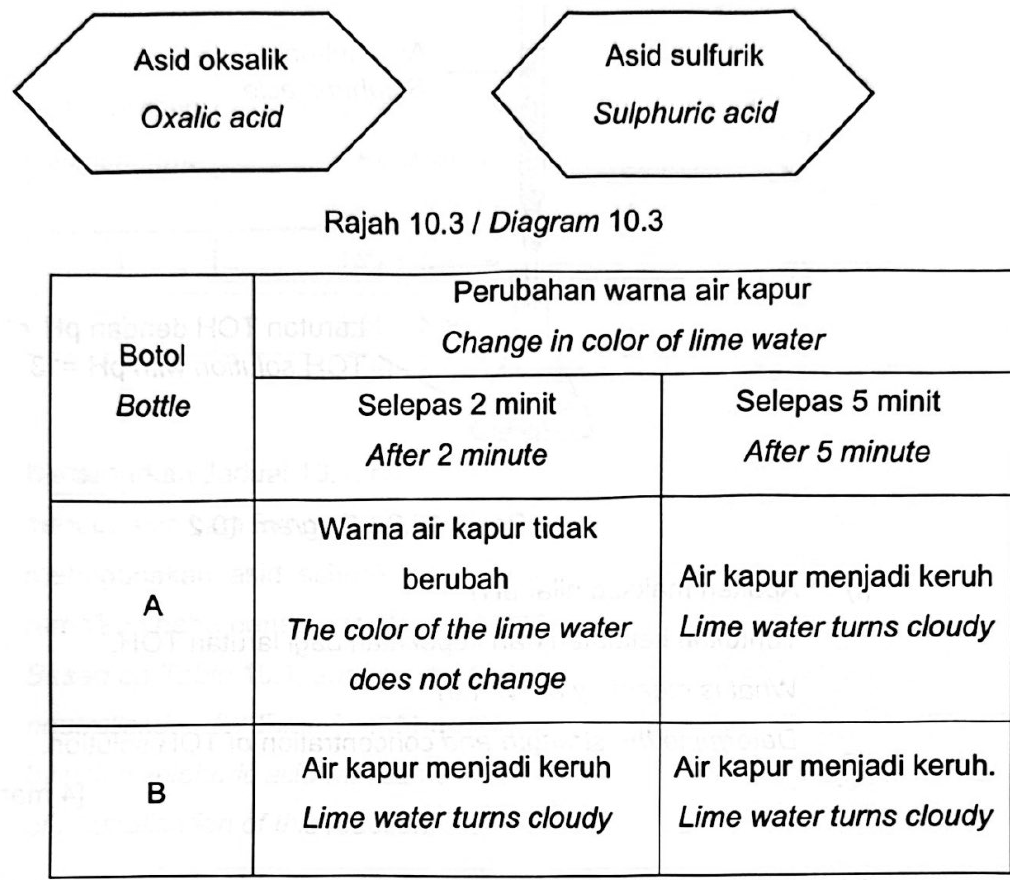
Diagram 10.3 shows labels of two bottles of acid that have come off (oxalic acid, sulphuric acid). Mr. Ali tested both acids using small marble chips. Table 10.2 (Bottle A: lime water unchanged after 2 minutes, cloudy after 5 minutes; Bottle B: lime water cloudy after 2 minutes and after 5 minutes). Based on Table 10.2, identify the label for each reagent bottle. Explain your answer.
[5]