KELANTAN 2024 P2 Q10
HardWrite your answer on paper. Then open the answer to check it.
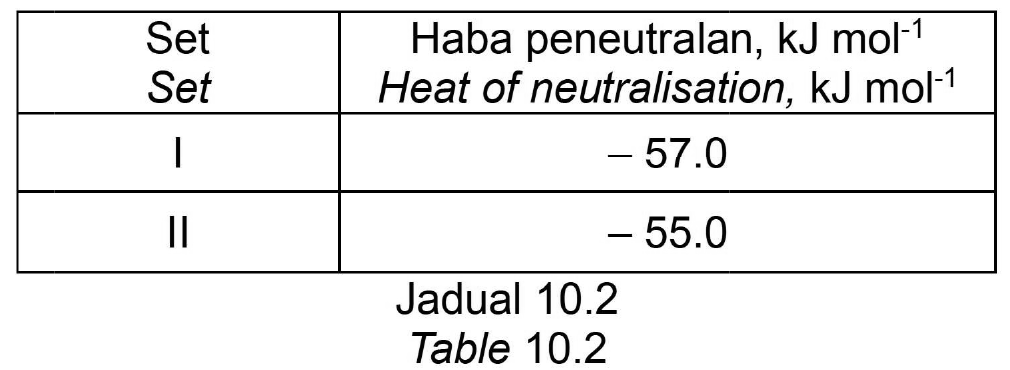
Diagram 10.1 shows observations for neutralisation reactions carried out using two different acids. Acid P and acid Q are monoprotic acids. Set I: 50 cm3 of 1.0 mol dm-3 acid P (28 °C) + 50 cm3 of 1.0 mol dm-3 NaOH solution gives X °C. Set II: 50 cm3 of 1.0 mol dm-3 acid Q (28 °C) + 50 cm3 of 1.0 mol dm-3 NaOH solution. Table 10.2: heat of neutralisation Set I 57.0 kJ mol-1; Set II -55.0 kJ mol-1 (as printed). Diagram 10.3 shows a cold pack and a hot pack that apply the thermochemistry concept in daily life.
Hard20 marks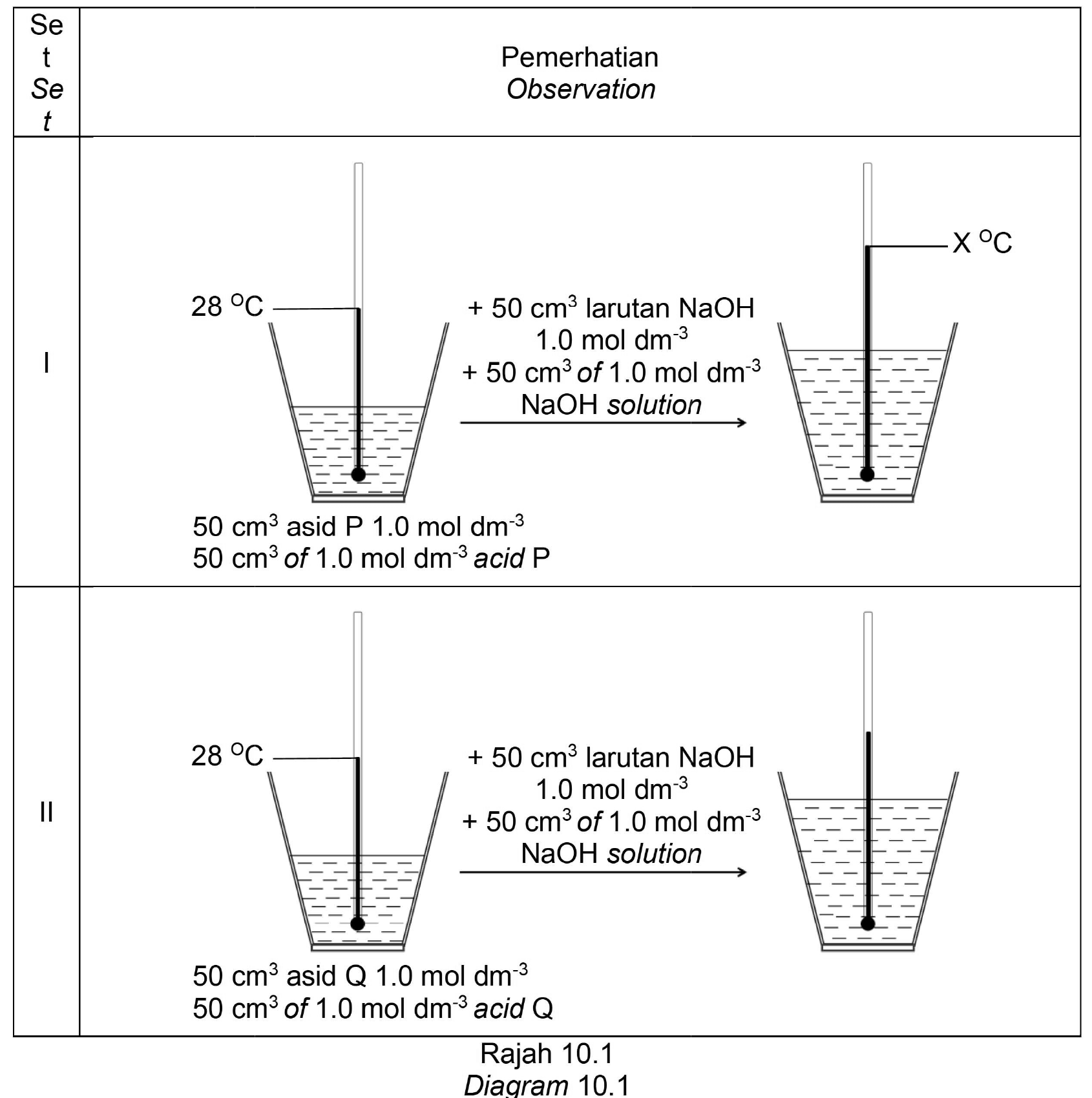

- (a)(i)
What is meant by heat of neutralisation?
[1] - (a)(ii)
Suggest the appropriate acid name for acid P and acid Q. Write the chemical equation for the reaction that occurs in Set I and Set II.
[6] - (a)(iii)
Determine the X value that is shown in Diagram 10.1. X value is the maximum temperature reached in the reaction. [Specific heat capacity of water = 4.2 J g-1 °C-1]
[4] - (a)(iv)
Explain why there is a difference in the value of the heat of reaction in the two sets of experiments carried out.
[3] - (b)(i)
State the type of reaction that occurs in cold packs and hot packs.
[2] - (b)(ii)
Compare the reactions that occur in cold pack and hot pack in terms of: heat change; temperature change; the total energy content of reactant and products; heat change during the breaking and formation of bonds.
[4]