MELAKA 2022 P2 Q11
HardWrite your answer on paper. Then open the answer to check it.
Table 6.1 shows the equations and heat of neutralisation for two sets of experiment. Set I: NaOH + HCl → NaCl + H₂O, -57.3 kJ mol⁻¹. Set II: NaOH + CH₃COOH → CH₃COONa + H₂O, -54.5 kJ mol⁻¹.
Hard20 marks- (a)(i)
What is meant by heat of neutralisation and state the type of acid used in Set I and Set II.
[3]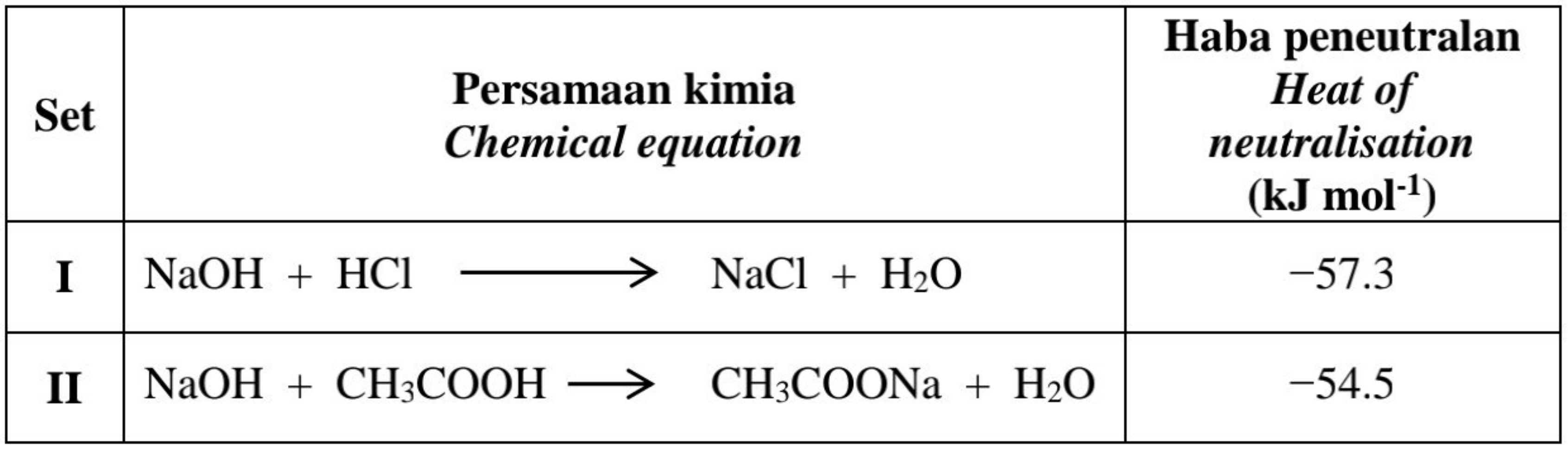
- (a)(ii)
In Set I, 50 cm³ of 1.0 mol dm⁻³ sodium hydroxide solution reacted with 50 cm³ of 1.0 mol dm⁻³ hydrochloric acid. Calculate the highest temperature reached if the average initial temperature is 28.5 °C. [Specific heat capacity: 4.2 J g⁻¹ °C⁻¹; density of solution = 1.0 g cm⁻³]
[4] - (b)
Table 6.2 shows the energy profile diagram for Reaction I (AgNO₃(aq) + NaCl(aq) → AgCl(s) + NaNO₃(aq), ΔH = -65.5 kJ mol⁻¹) and Reaction II (N₂(g) + O₂(g) → 2NO(g), ΔH = +180 kJ mol⁻¹). Compare Reactions I and II based on the type of reactions, heat change during reactions, temperature change during reactions, total energy content of reactants and products, and change of heat energy during the breaking and formation of bonds.
[5]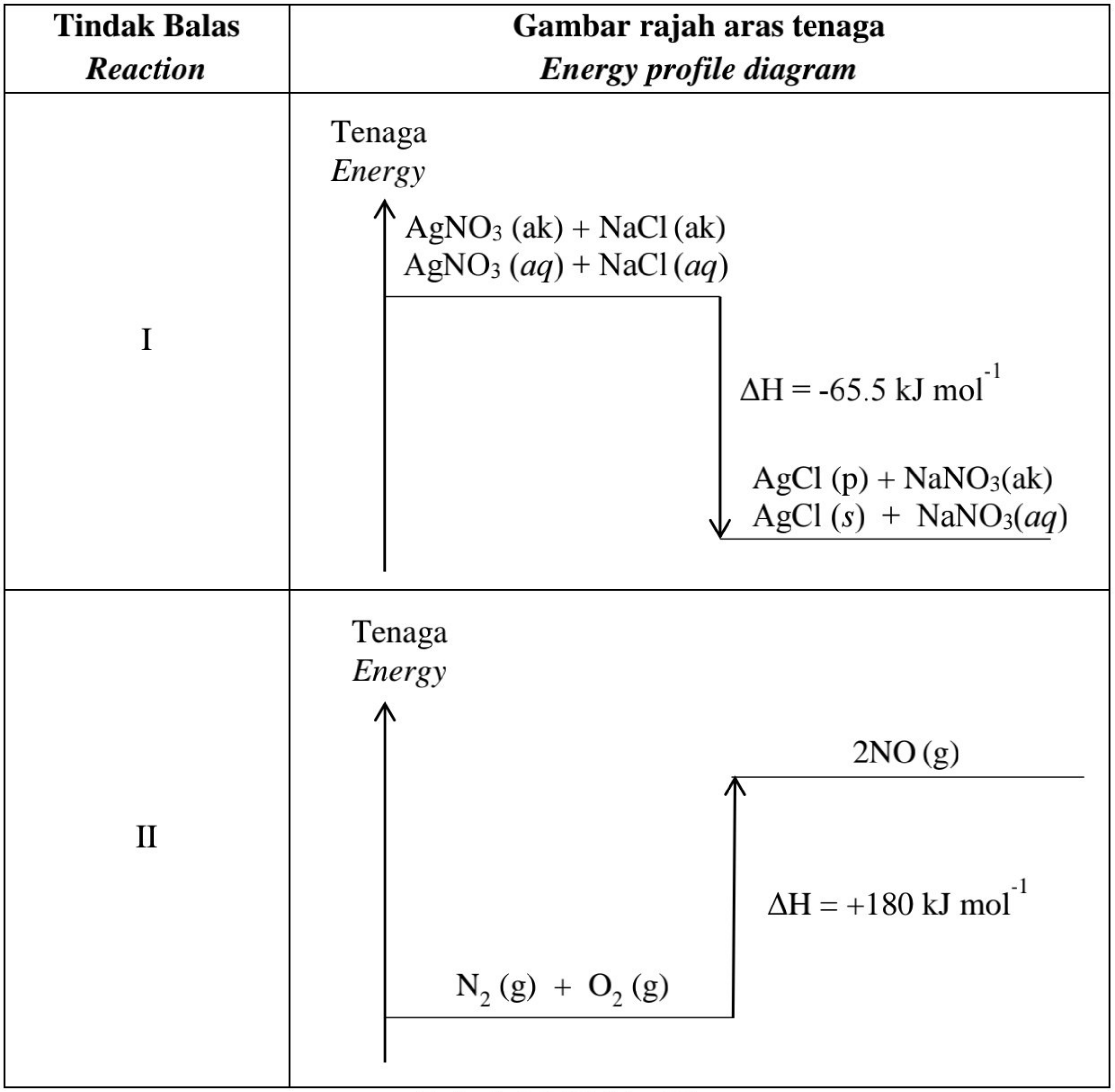
- (c)
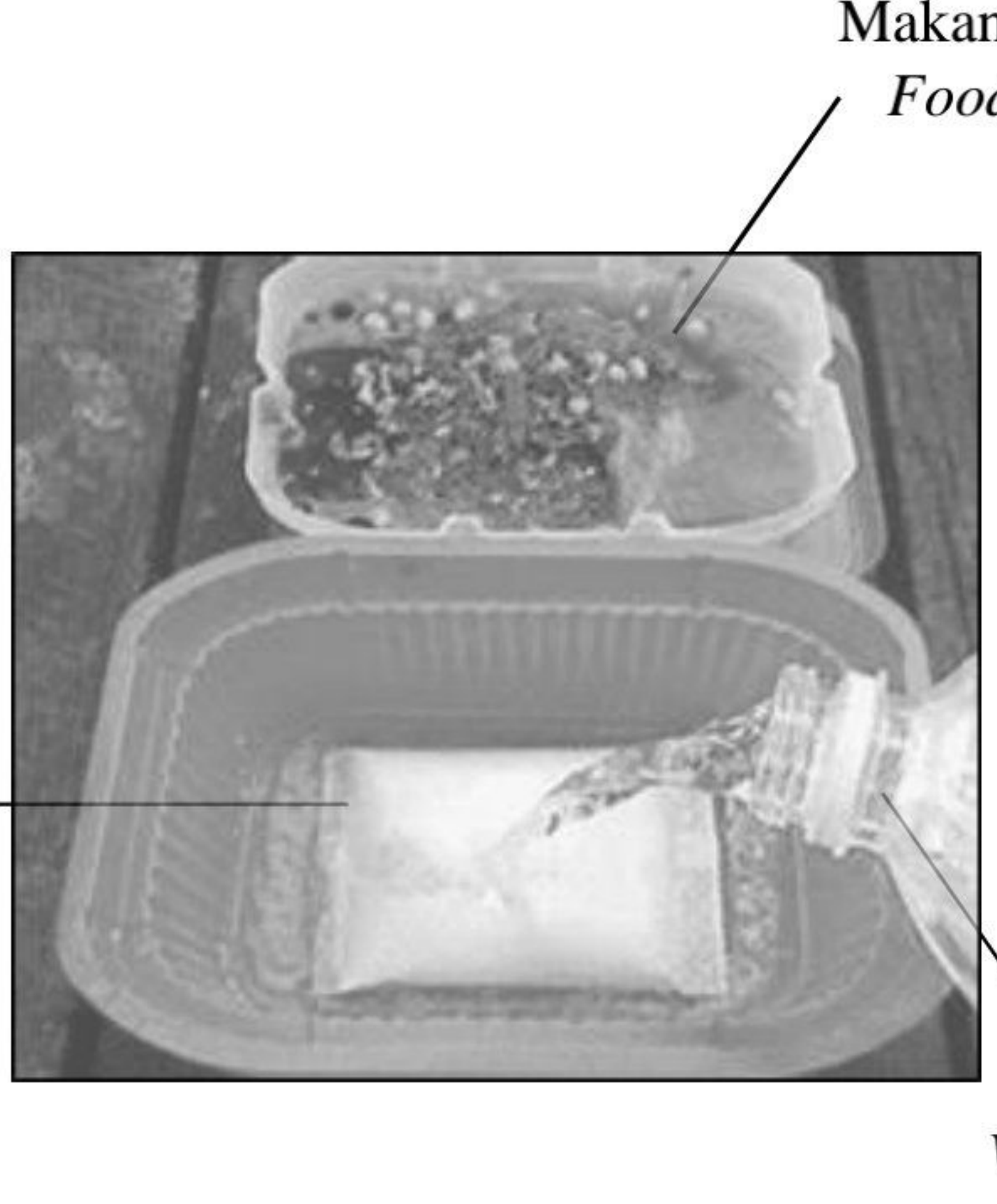
Diagram 9 shows a self-heating container to heat food. The pack is filled with calcium chloride powder, CaCl₂ and packed together with water. You are supplied with a few chemical substances like magnesium nitrate, calcium oxide and ammonium nitrate that may be used to replace the calcium chloride powder. Plan a method that could be done in the lab to choose which substance can be used to replace the calcium chloride powder. State how you choose which substance is suitable to replace the calcium chloride powder.
[8]