MRSM 2021 P2 Q8
MediumWrite your answer on paper. Then open the answer to check it.
The following chemical equation represents a displacement reaction between metal Q and lead(II) nitrate solution. Q + Pb(NO₃)₂ → Q(NO₃)₂ + Pb Given the following electrode potential values: Zn²⁺(aq) + 2e ⇌ Zn(s) E° = −0.76 V Pb²⁺(aq) + 2e ⇌ Pb(s) E° = −0.13 V Cu²⁺(aq) + 2e ⇌ Cu(s) E° = +0.34 V
Medium10 marks- (a)(i)
Suggest metal Q.
[1] - (a)(ii)
The heat of displacement for the reaction is −112 kJ mol⁻¹. Calculate the change in temperature when excess Q powder is added to 100 cm³ of 0.5 mol dm⁻³ lead(II) nitrate solution. [Specific heat capacity of a solution = 4.2 J g⁻¹ °C⁻¹; Density of solution = 1.0 g cm⁻³]
[3] - (b)(i)
Table 8 shows the heat of neutralisation for the reaction between potassium hydroxide solution with two different types of acids: Acid R + potassium hydroxide solution: −55 kJ mol⁻¹; Acid S + potassium hydroxide solution: −57 kJ mol⁻¹. Suggest acid R and acid S.
[2]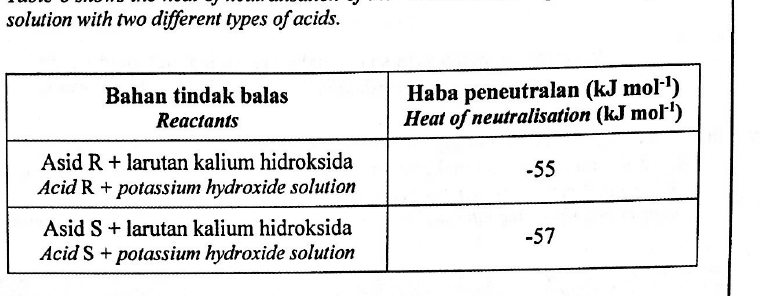
- (b)(ii)
Based on your answer in 8(b)(i), write the thermochemical equation of the reaction between acid R and potassium hydroxide solution.
[2] - (b)(iii)
The value of heat of neutralisation for both reactions are different. Explain why.
[2]