PAHANG 2023 P2 Q11
HardWrite your answer on paper. Then open the answer to check it.
Answer all questions from Section C. (a) Table 11 shows two chemical reactions using two different acids, X and Y, to determine heat of neutralisation: Reaction I, X + NaOH → NaX + H2O, -57.0 kJ mol-1; Reaction II, Y + NaOH → NaY + H2O, -52.0 kJ mol-1. (b) Diagram 11 shows the apparatus set-up for an experiment to determine the heat of combustion of hexane. 3500 kJ of heat was released when 1 mol of hexane is burnt in excess oxygen.
Hard20 marks- (a)(i)
Based on Table 11, state the meaning of heat of neutralisation.
[1]
- (a)(ii)
Suggest acid X and Y. Explain the difference in the heat of neutralisation for reaction II when compared to reaction I.
[4] - (a)(iii)
Draw the energy level diagram for reaction II and deduce one information from the energy level diagram.
[3] - (b)(i)
Suggest one modification that can be made to the apparatus set-up (Diagram 11: copper tin of water heated by a hexane lamp, thermometer, wind shield) to obtain more accurate temperature change. Give a reason for your answer.
[2]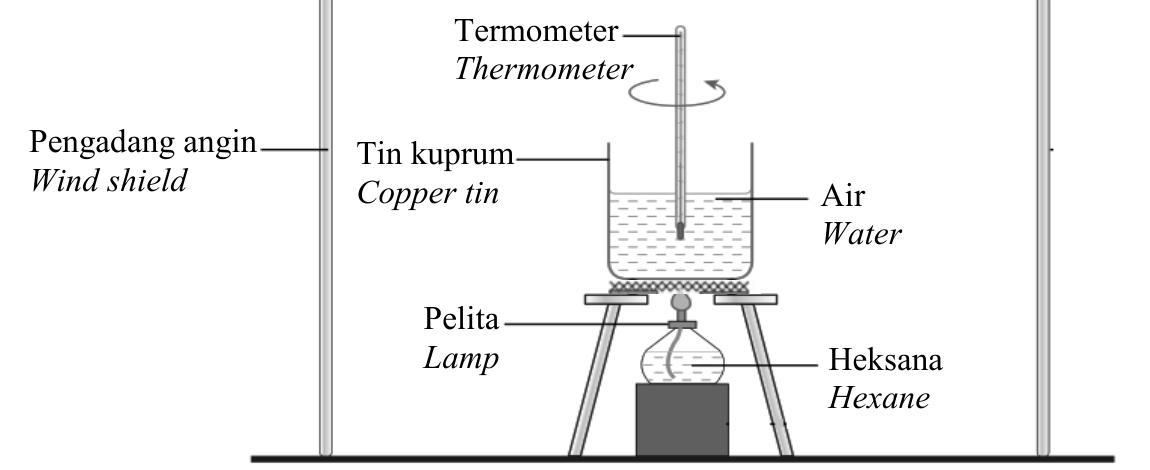
- (b)(ii)
Write the chemical equation for combustion of hexane and calculate the mass of hexane required for combustion to release 630 000 J of heat. [Relative atomic mass: C=12, H=1]
[4] - (c)
You are supplied with potassium hydroxide pellets, ammonium chloride, anhydrous calcium chloride and distilled water. Describe an experiment to determine the temperature change when the substances are dissolved in distilled water. Classify the substances into substances that undergo exothermic reactions and endothermic reactions.
[6]