SARAWAK SET 1 2024 P2 Q10
HardWrite your answer on paper. Then open the answer to check it.
(a) The thermochemical equation: Zn + CuSO₄ → ZnSO₄ + Cu, ΔH = −210 kJ mol⁻¹. (b) 50 cm³ of 2.0 mol dm⁻³ silver nitrate solution is mixed with 50 cm³ of 2.0 mol dm⁻³ sodium chloride solution to form a white precipitate of silver chloride, AgCl. 65.5 kJ of heat is released when 1 mol of silver chloride precipitated. (c) Table 6 shows the energy profile diagrams for Reaction I (AgNO₃ + NaCl → AgCl + NaNO₃, ΔH = −65.5 kJ mol⁻¹) and Reaction II (N₂ + O₂ → 2NO, ΔH = +180 kJ mol⁻¹).
Hard20 marks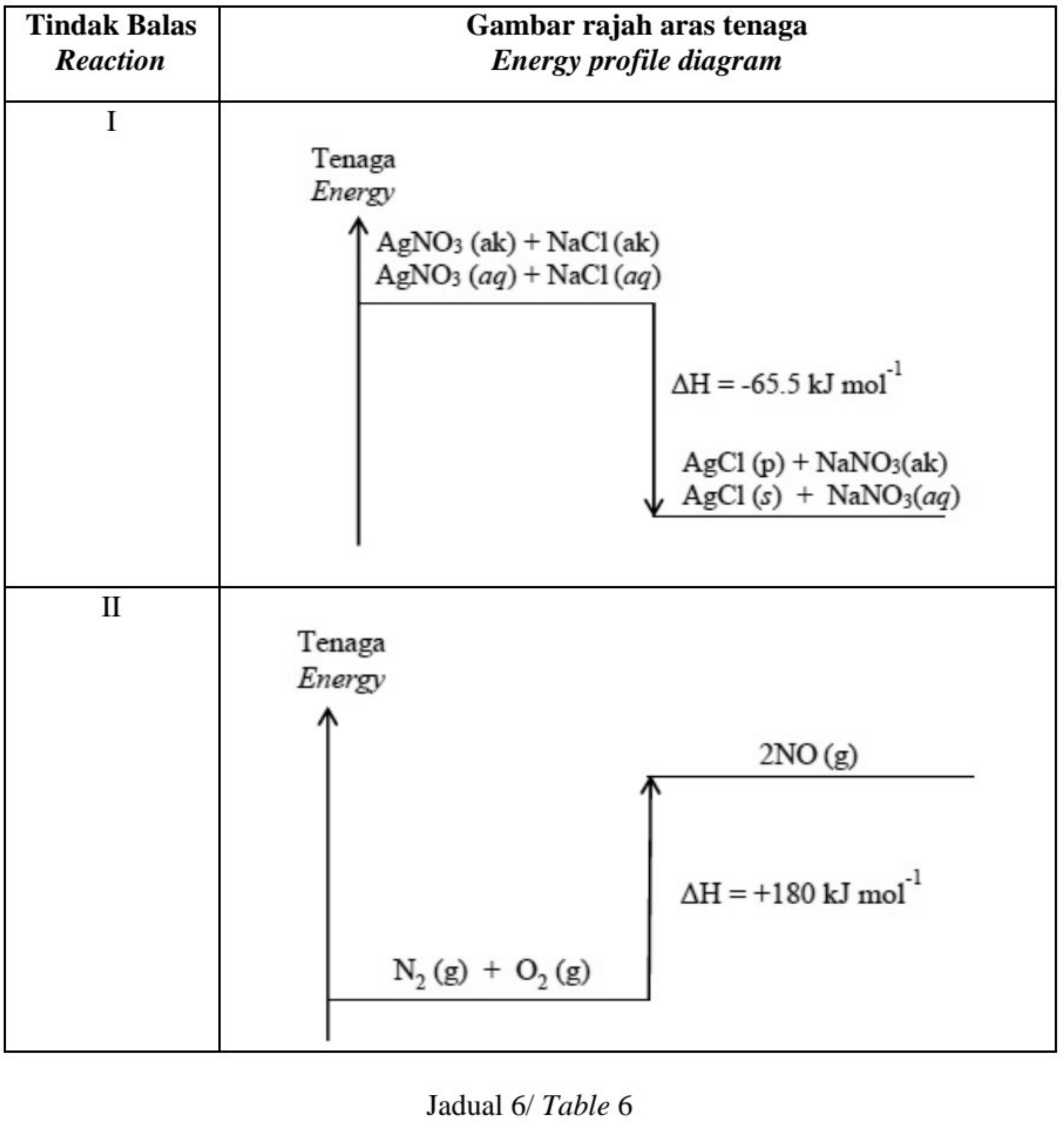
- (a)(i)
Based on the above thermochemical equation, state the meaning of heat of displacement.
[1] - (a)(ii)
State the colour of copper(II) sulphate solution.
[1] - (a)(iii)
What will happen to ΔH value when zinc metal is replaced with magnesium metal? Explain your answer.
[2] - (b)(i)
Write the ionic equation for the formation of silver chloride.
[1] - (b)(ii)
Calculate the heat released in the reaction.
[3] - (b)(iii)
What is the temperature change in the mixture? [Specific heat capacity of solution = 4.2 J g⁻¹ °C⁻¹; density of solution = 1 g cm⁻³]
[2] - (b)(iv)
The value of heat released during displacement of metal reaction is usually lower than theoretical value. Explain why and state the precautionary steps to be taken during the experiment.
[2] - (c)
Based on Table 6, compare Reaction I and Reaction II in terms of: the type of reactions; heat change during reactions; temperature change during reactions; total energy content of reactants and products; change of heat energy during the breaking and formation of bonds.
[8]